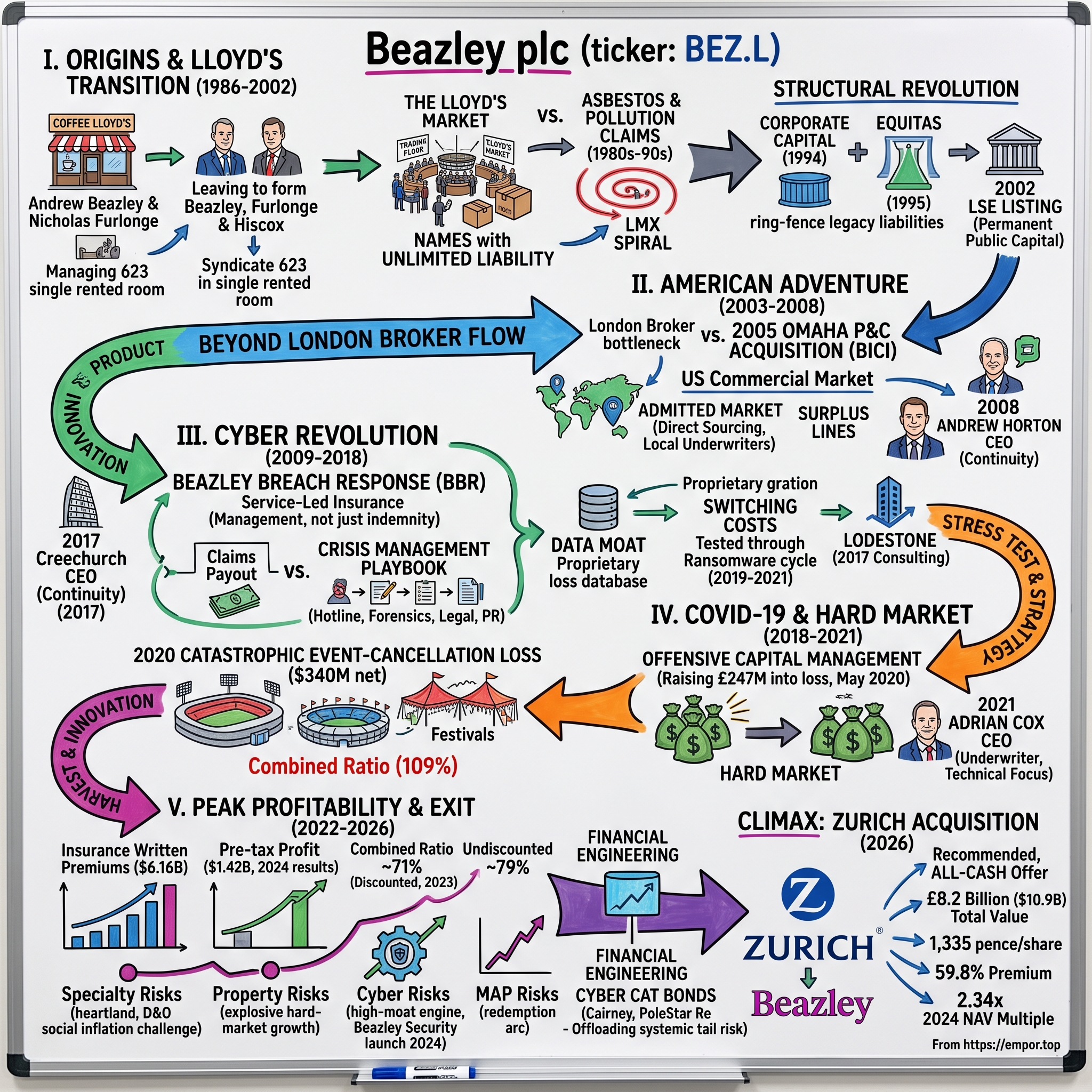
Beazley plc: The Specialty Underwriting Empire and the £8.2B Climax
I. Introduction & Episode Roadmap
On the morning of March 2, 2026, the specialty insurance world woke up to a number that did not compute. Zurich Insurance Group — the 150-year-old Swiss composite, one of Europe's largest and most conservative underwriters — announced a recommended, all-cash offer to buy Beazley plc, the London-listed specialist that started life in a single rented room at Lloyd's, for roughly £8.2 billion, about $10.9 billion.13
The headline price was 1,335 pence per share: 1,310 pence in cash plus a permitted 25-pence dividend.1 Against Beazley's undisturbed share price of 820 pence — the closing price on January 16, 2026, before the market caught wind of a deal — that was a premium of 59.8%.2 In an industry where public specialty insurers typically change hands somewhere between 1.2 and 1.8 times their book value, Zurich was paying about 2.34 times Beazley's 2024 net asset value of 570.5 pence per share.7 (That multiple is a straightforward calculation — 1,335 divided by 570.5 — rather than a figure either company advertised, but the arithmetic is unavoidable, and it is enormous.)
Insurance is supposed to be a book-value business. You underwrite risk, you hold capital against it, and the market pays you some modest premium to that capital for the skill and franchise wrapped around it. Paying more than double book for a balance sheet is the kind of thing acquirers do for software companies and payment networks — businesses where the tangible assets are almost beside the point and the real value is a data set, a distribution monopoly, or a workflow customers cannot rip out. So the central question of this story is not "why did Zurich buy an insurer?" It is: what exactly did Zurich think it was buying, and was it right?
The answer runs through four decades of Lloyd's of London history. It is the story of how two underwriters who left their employer in 1986 survived the near-collapse of the world's oldest insurance market; how they escaped the London broker bottleneck by planting a flag in Omaha, Nebraska; how they stumbled into — and then engineered — the single most important new insurance product of the twenty-first century, cyber; how they turned a catastrophic pandemic loss into an offensive land grab; and how a hard market of historic proportions turned all of that patient positioning into record profits, and record profits into an $10.9 billion exit.
This is also, deliberately, a skeptical story. Beazley's management tells a clean narrative about discipline, data, and service moats. Some of it is demonstrably true. Some of it is the kind of thing every insurance CEO says right up until a reserve blows up. Where the evidence is strong, this piece will say so; where it rests on management's word, it will flag that too. Here is the roadmap:
- The Lloyd's environment and the wrenching shift from individual "Names" to corporate capital.
- Bypassing the London broker bottleneck through the 2005 US admitted-market pivot.
- The cyber revolution: launching Beazley Breach Response in 2009 and inventing "service-led" insurance.
- The 2020 COVID-19 event-cancellation crisis, and the decision to raise capital into the teeth of a loss.
- The 2021–2025 hard-market harvest under Adrian Cox, peak profitability, and the 2026 Zurich buyout.
Let's begin where all Lloyd's stories begin: with a room, a book, and an appetite for risk.
 Subscribe on LinkedIn
II. The Origins: London, Lloyd's, and the Transition from "Names" to Corporate Capital (1986–2002)
Picture a coffee house. Not a metaphor — an actual coffee house, Edward Lloyd's, on Tower Street in the City of London in the 1680s, where ship-owners, captains, and men with capital to spare gathered to gossip about which vessels had come in and which had been lost to storm or piracy. If you had money and nerve, you could write your name under a description of a voyage and agree to cover the loss if the ship sank, in exchange for a premium. You were, literally, an under-writer. Three and a half centuries later, the institution that grew out of that coffee house still runs on the same logic, and it is where our two protagonists made their careers.
Andrew Beazley and Nicholas Furlonge were both Lloyd's-trained underwriters when, on September 12, 1986, they walked away from their employer to hang out their own shingle.5 The firm they formed was called Beazley, Furlonge & Hiscox — the third name belonging to the Hiscox family, whose backing helped get the venture off the ground — and it began managing Lloyd's Syndicate 623 out of a single room. There was no grand office, no brand, no franchise. There was a box at Lloyd's, an underwriting license, and two men who believed they could read complex risks better than the market priced them.
To understand what they were stepping into, you have to understand how Lloyd's actually works, because it is unlike any other insurance market on earth. Lloyd's is not itself an insurance company. It is a marketplace — think of it as a stock exchange, but for risk. The people who supply the capital are grouped into syndicates. The people who bring the risk are brokers, who walk complex global exposures — an oil rig in the North Sea, a film production, a pharmaceutical company's liability — from syndicate box to syndicate box, looking for underwriters willing to take a slice. One syndicate, the lead, sets the price, the terms, and the claims philosophy; the others "follow" on the same terms. Being the lead is the position of power and prestige: you dictate, others accept. From very early on, Beazley aimed to lead.
And for decades, the capital behind those syndicates came from a peculiarly British institution: the Names. These were wealthy individuals — landed gentry, retired generals, minor aristocracy — who pledged their entire personal wealth to back Lloyd's underwriting in exchange for a share of the profits. The arrangement had a seductive elegance and a fatal flaw. The Names had unlimited liability. Their capital was not the money they put up; it was, in the memorable phrase, everything they owned "down to the last cufflink." For generations this was a genteel way for the rich to get richer. And then, in the late 1980s and early 1990s, it detonated.
The bomb was American, and it was made of asbestos and pollution. Decades of US industrial liability — mesothelioma claims from asbestos exposure, environmental clean-up costs at contaminated sites — came roaring back through old Lloyd's policies written in the 1960s and 1970s, policies whose authors never imagined losses of that scale or duration. The claims ran to tens of billions. Names who had signed up for a comfortable dividend found themselves facing ruin; some lost their homes, a few took their own lives. The market that had survived the San Francisco earthquake and two world wars nearly collapsed under the weight of its own back-catalog.
It got worse before it got better, because Lloyd's had a peculiar way of amplifying its own losses called the LMX spiral. "LMX" stood for London Market Excess — reinsurance that syndicates bought from each other to cap their exposure to catastrophes. The trouble was that a syndicate would reinsure a risk, the reinsurer would reinsure it again, and the same underlying loss would circle the market repeatedly, each pass magnifying it, until a genuinely large event like the Piper Alpha oil-rig explosion or a string of hurricanes hit the top of the tower and cascaded back down through every layer it had touched. Losses that should have been contained were instead multiplied. For an investor, the LMX spiral is a permanent lesson about correlation risk: an insurer can believe it has laid off a danger when in fact it has simply passed the danger to someone who has passed it back, and the whole market is one interconnected balloon waiting for a pin. It is the exact structural nightmare that, forty years later, would haunt the thinking about cyber accumulation — the fear that a single event could ricochet through an entire book at once — and it is why Beazley's later decision to sell its cyber tail risk to outside bond investors, rather than swap it around inside the insurance market, was so deliberate.
Lloyd's survival required two structural revolutions, and both of them, as it happened, played straight into the hands of a nimble young syndicate like Beazley. First, in 1994, Lloyd's admitted corporate capital for the first time — limited-liability money from institutions, which did not carry the existential risk of the Names and could be raised and deployed at scale. Second, in 1995, Lloyd's ring-fenced its toxic history into a single vehicle called Equitas, which absorbed all pre-1993 liabilities and let the ongoing market start with a clean slate. The old, unlimited, individual model was dying; the modern, corporate, permanent-capital model was being born. Beazley was young enough to have almost no legacy asbestos problem and hungry enough to grab the new capital.
The corporate scaffolding fell into place over the next several years. Hiscox's interest was bought out in 1992, leaving Beazley and Furlonge in control. A full management buyout followed in 2001. And on November 12, 2002, Beazley listed on the London Stock Exchange, raising permanent public capital to feed its underwriting ambitions and putting a market price on what had, sixteen years earlier, been two men and a box.11
What kind of insurer had they built? A specialist, deliberately. Beazley planted itself in lines that rewarded technical skill and punished dabblers: professional indemnity (covering lawyers, accountants, and architects when their advice goes wrong), directors' and officers' liability (protecting company boards from shareholder lawsuits), and marine. These are not commodity risks you can price off a rate card. They require judgment, relationships, and a memory for how claims actually play out. By insisting on lead status wherever it could get it, Beazley was staking a claim to be the syndicate that sets the price rather than the one that meekly accepts it — the difference between being a price-maker and a price-taker in a market where that distinction is everything.
But there was a ceiling built into the Lloyd's model, and Beazley was about to bump into it. A London syndicate, however skilled, sits in London and waits for brokers to bring it business. If you wanted to grow faster than the flow of paper walking through the Lloyd's underwriting room, you had to go find the risk yourself. And the richest, most complex specialty risks in the world were not in London. They were in America.
III. The American Adventure & Moving Beyond London Broker Flow (2003–2008)
Here is the frustration that every ambitious Lloyd's underwriter eventually feels. You are, by construction, at the end of a very long supply chain. A mid-sized manufacturer in Ohio has a professional-liability exposure. That risk gets placed with a local retail agent, who hands it to a wholesale broker, who eventually hands it to a London broker, who walks it into the Lloyd's room and lays it in front of your box — often months later, several commissions lighter, and stripped of the context you would need to price it sharply. You are a price-taker at the far end of a game of telephone. If you want the good risks, and you want them early, you cannot wait in London for the phone to ring. You have to be standing in Ohio.
So in 2005, Beazley did something few Lloyd's outfits had the nerve to do: it bought its way onto American soil. It acquired Omaha Property & Casualty, Inc. — a US insurance carrier — and rechristened it Beazley Insurance Company, Inc., known internally as BICI, while spinning up a local managing agency, Beazley USA Services, to write and service the business.11 On paper it was a small deal. Strategically, it was the company's second act.
To see why, you need to understand a distinction that governs the entire US commercial insurance market: admitted versus surplus lines. An admitted carrier is licensed by each individual state's insurance regulator; it plays by that state's rulebook, files its rates, and in exchange gets access to the mainstream market and the backing of the state guaranty fund. A surplus-lines (or "non-admitted") insurer operates outside that framework, free to price unusual risks flexibly but shut out of the bread-and-butter business that flows through admitted paper. Lloyd's syndicates had historically reached America almost entirely through the surplus-lines door. By securing admitted licenses for BICI in all 50 states, Beazley bought itself a seat at the main table — the ability to write specialty coverage for ordinary mid-market American businesses, directly, through local underwriters who could look a client in the eye.11
The genius of the structure was that it kept the underwriting judgment where Beazley wanted it while moving the sourcing to where the risk lived. A Beazley underwriter in Chicago or Atlanta could originate a professional-liability policy on the ground, but the ultimate risk could still be fed back into the efficient capital structures of the Lloyd's syndicate in London. It was, in effect, a geographic arbitrage: harvest the higher-margin, harder-to-price American middle market on the front end, finance it through the deep, cheap, well-regulated capital pool of Lloyd's on the back end. The US operation grew from a literal handful of people in 2005 into a substantial franchise, adding offices and underwriters across American cities over the following years.
This is worth pausing on, because it reveals something about how Beazley thinks. The company did not try to out-market the American giants or win on price. It identified a structural bottleneck — the broker-mediated distance between Lloyd's capital and US risk — and it spent capital to remove the bottleneck. That instinct, to attack the point in the value chain where it was being taxed or constrained, would repeat itself again and again: in cyber, where it would build its own claims-response operation rather than outsource it, and in capital markets, where it would eventually go around the reinsurance market entirely and sell risk straight to bond investors.
The American build-out also coincided with the end of an era at the top. In 2008, co-founder Andrew Beazley — who had led the firm for 22 of its first 24 years — stepped back from the chief executive role. That same year he was diagnosed with cancer, and in 2010 he died at the age of 57, an underwriter's underwriter to the end.5 His departure could have been a rupture. Instead it was a handover: Andrew Horton, a former banker who had joined as finance director and grown into the business, took the helm as CEO and spent the next thirteen years hardening the company's underwriting discipline and pushing the US admitted platform. Continuity, not disruption — a theme that would recur at the next succession, and one that the company would later hold up as a core part of its edge.
Horton inherited a company that had escaped Lloyd's near-death, listed on the public markets, and cracked the American code. What he could not have known in 2008 was that the most consequential thing to happen on his watch would not be a market or a geography. It would be a product nobody had figured out how to sell — because the risk it covered had barely been invented.
IV. The Cyber Revolution: BBR and the Birth of Service-Led Insurance (2009–2018)
Imagine you run a mid-sized hospital in 2009. One Monday morning, your IT director appears at your door, gray-faced, to tell you that patient records — social security numbers, diagnoses, insurance details, tens of thousands of them — have been stolen. Now what? You do not know which laws you have just broken, and there are dozens, varying by state. You do not know whether to call the FBI, a law firm, a forensics company, or your regulators, or in what order. You do not know how to tell your patients without triggering a panic and a wave of lawsuits. You have never done this before, and by the time you figure out who to call, the damage — legal, regulatory, reputational — is compounding by the hour. What you need is not, in the first instance, a check. What you need is someone who has done this a hundred times to pick up the phone and run the playbook.
This is the insight that turned Beazley from a good specialty insurer into a category-defining one. In 2009, it launched Beazley Breach Response, or BBR — a data-breach product aimed at exactly this newly emerging risk.14 And the crucial thing about BBR was that it inverted the entire logic of what an insurance policy is.
Traditional insurance is an indemnity promise. You pay a premium; if a covered loss occurs, the insurer reimburses you. The insurer's job is to write checks accurately and slowly. That model works fine for a burned-down warehouse, where the loss is a discrete, measurable event and the policyholder mostly needs money. It fails catastrophically for a data breach, because at the moment of loss the victim is not primarily short of cash — the victim is operationally paralyzed, facing a fast-moving crisis across legal, technical, regulatory, and public-relations fronts simultaneously, with the clock running and the losses mounting precisely because nobody knows what to do next. Handing that company a reimbursement check three months later is like handing a drowning swimmer a voucher for swimming lessons.
BBR flipped it. When a Beazley-insured client suffered a breach, they called a dedicated hotline, and an in-house Beazley breach-response team immediately took command of the situation: coordinating IT forensics to figure out what happened, retaining specialist legal counsel to navigate the thicket of notification laws, managing the regulatory disclosures, handling public relations, and arranging credit monitoring for affected individuals. Beazley was no longer selling a promise to pay. It was selling a promise to manage the crisis — an integrated, service-first product where the insurance payout was almost the least important component.
Now, why does this matter to an investor rather than just a risk manager? Because service, done at scale over years, compounds into two genuine competitive advantages — and it is worth being precise about which ones are real and which are merely asserted.
The first is a data moat, or in Hamilton Helmer's language a cornered resource. Every breach Beazley managed generated proprietary data: what kind of attack, on what kind of company, costing how much, taking how long, resolved how. Cyber risk in 2009 was close to un-priceable because it had almost no actuarial history — the risk was too new. An insurer that handled thousands of real incidents was building, incident by incident, the one asset that cannot be bought: a private loss database that let it price cyber risk with more confidence than rivals who were, in effect, underwriting blind. This is a defensible edge, and the evidence for it is reasonably strong — Beazley's willingness to keep writing large cyber volumes profitably through cycles that burned other carriers suggests it did know something they didn't.
The second claimed advantage is switching costs. Once a corporate IT and legal team has run tabletop exercises with Beazley, adopted its incident-response templates, and integrated its vendor network into their crisis plan, ripping all that out to save a few points on premium introduces real operational risk. There is logic here. But the honest analyst should note this is the softer of the two moats: cyber insurance became fiercely competitive, buyers do shop on price, and the switching costs bind the sophisticated, well-prepared client far more tightly than the price-shopping mid-market buyer. The data moat is the load-bearing wall; the switching-cost story is a supporting one.
There is a temptation, in a story like this, to present the cyber franchise as a smooth ascent. It was not, and the honest version is more instructive. The cyber line went through a violent boom-bust-boom cycle that tested whether Beazley's data advantage was real or a story it told itself. In the late 2010s, as more insurers piled into cyber chasing its growth, rates softened and coverage terms loosened — right as the threat landscape mutated. The rise of ransomware around 2019–2021 changed cyber from a data-breach problem into an extortion problem: criminal gangs encrypted a company's entire systems and demanded payment, often in cryptocurrency, to unlock them, and increasingly stole the data too and threatened to publish it. Loss frequency and severity spiked together, and the whole cyber market — Beazley included — took heavy hits, which is part of what dragged even the 2020 results down alongside the pandemic.6
What happened next is the real test of an underwriting franchise. Rather than retreat from cyber, Beazley and the market repriced it savagely — cyber rates roughly doubled in some segments in 2021–2022 — while simultaneously tightening terms and, crucially, demanding better security hygiene from insureds as a condition of coverage: multi-factor authentication, tested backups, endpoint monitoring. In effect, the insurers began underwriting the client's defenses, not just the client's balance sheet. This is where Beazley's investment in pre-breach services stopped being a marketing line and started being a loss-control mechanism: an insurer that can push clients to harden their systems, and verify that they have, is actively shaping the loss distribution rather than passively betting on it. The result was that cyber went from the market's problem child back to a high-return line, and Beazley emerged with both its book and its data advantage intact. That round trip — through a genuinely painful loss cycle and out the other side more profitable — is stronger evidence for the durability of the cyber moat than any amount of management commentary, precisely because the franchise was tested rather than merely asserted.
Beazley did not stop at the insurance policy. It moved to own more of the value chain around the breach itself, the same instinct that had driven it into Omaha. In 2017 it acquired Creechurch Underwriters, a Canadian managing agent, extending its cyber and specialty reach into that market. More tellingly, that same year it founded Lodestone, a cybersecurity consulting firm, so that it could sell services before a breach — vulnerability assessments, security hardening, incident preparation — not just clean up after one.14 The logic was elegant: an insurer that helps its clients avoid breaches lowers its own claims; an insurer that is embedded in a client's security operations before anything goes wrong is much harder to displace. Whether that vertical integration paid off in loss ratios rather than just in narrative is a question the numbers would only answer later — and, as we will see, the honest verdict is "mostly, but cyber's volatility never fully went away."
By the late 2010s, Beazley had a genuinely differentiated cyber franchise and a data asset competitors envied. What it did not yet have was a stress test — a moment that would reveal whether all this talk of discipline and capital strength was real or rhetorical. That test arrived in the form of a virus, though not the digital kind.
V. The COVID-19 Stress Test & Turning Defense into Offense (2018–2021)
There is a particular corner of the insurance market that most people never think about until it fails them: event cancellation. If you are staging a music festival, a Wimbledon, a corporate conference, or an Olympic Games, you buy a policy that pays out if the event cannot go ahead. In normal times it is a lovely little book of business — high-margin, geographically diversified, uncorrelated. A washed-out cricket match in England has nothing to do with a snowed-out conference in Chicago. The whole point of insurance is that these risks do not happen at the same time.
And then, in March 2020, every event on earth was cancelled at once.
Beazley wrote event-cancellation and contingency cover inside its Political, Accident & Contingency unit — part of what it grouped under the MAP banner (Marine, Aviation, Political). It was, in ordinary years, a jewel. In 2020 it became the epicenter of one of the worst losses in the company's history. As lockdowns swept the world and festivals, sporting fixtures, and conferences evaporated, the claims poured in simultaneously, with none of the diversification the book was built on. Beazley's net first-party COVID-19 losses ran to roughly $340 million, and the contingency book's underwriting economics went from excellent to catastrophic essentially overnight.6
To measure the damage, you need one number that governs everything in insurance: the combined ratio. It is the sum of claims paid and expenses incurred, divided by the premiums earned, expressed as a percentage. Below 100% means the insurer made money purely on underwriting, before it earns a penny on its investments. Above 100% means it paid out more than it took in and is relying on investment income — or its capital — to fill the gap. A well-run specialty insurer aims for the low-to-mid 80s. In 2020, COVID and a wave of ransomware losses dragged Beazley's group combined ratio to 109% — 73 points of claims and 36 points of expense — producing a pre-tax loss of $50.4 million, a stark reversal from the $267.7 million profit the year before.6 The contingency book at the heart of the loss ran far hotter than the group as a whole; its combined ratio blew well past the point of viability for that year.
Management did not cover itself in glory on the way in. Like almost everyone in early 2020, Beazley initially underestimated how long the world would stay shut, and as lockdowns dragged on it was forced to sharply increase its loss estimates through the year — the kind of serial re-forecasting that erodes credibility and that a skeptical investor should log. Underwriters are supposed to imagine tail events for a living; a global shutdown that lasts quarters rather than weeks is exactly the sort of scenario the reserving process is meant to entertain. That it did not, at first, is a genuine mark against the 2020 vintage of Beazley's risk management, whatever came next.
But what came next is the reason this section exists. Faced with a large loss and enormous uncertainty, the reflexive move for an insurer is to hunker down: stop writing new business, conserve capital, ride it out. Beazley did the opposite. In May 2020 — with the pandemic still raging and its own losses still climbing — it went to the equity market and raised £247 million (about $300 million) in a placing of roughly 15% of its share capital, priced at 315 pence per share.9 Simultaneously it doubled its bank credit facility, from $225 million to $450 million.9
Why raise capital into a loss, diluting existing shareholders at a depressed price? Because Beazley's management understood something structural about their industry's cycle. Big, market-wide losses do not just destroy capital — they destroy competitors' capital too, and when capital gets scarce, prices rise. The aftermath of a catastrophe is almost always a hard market: rates climb, terms tighten, and the insurers with balance sheet left standing get to write business at the most attractive prices in years. The 2020 raise was not primarily defensive. It was ammunition. Beazley was arming itself to write huge volumes of newly repriced business precisely when weaker rivals, nursing their own losses, would be forced to pull back. On the first-quarter view, the company had already flagged about $170 million of net COVID claims and a $55 million investment loss even as it made the case that rising rates in its core markets justified leaning in.9
This is the single most important decision in the modern Beazley story, and it deserves a clear-eyed verdict rather than applause. Raising equity at a discount during a crisis is painful and dilutive, and it only looks brilliant in hindsight if the hard market actually materializes and you actually have the underwriting skill to exploit it. Both of those things turned out to be true — but they were not guaranteed in May 2020, and the move was a genuine bet, not a sure thing. What it demonstrated was a management team willing to take short-term pain and shareholder dilution for a structural opportunity, which is either admirable discipline or aggressive gambling depending on how the next three years played out.
It is worth pausing on the two men who bracketed this decision, because Beazley's culture is a story about underwriters, and these were the two who ran it. Andrew Horton had come up through finance rather than the underwriting box — he had been a banker and then Beazley's finance director before taking the top job — and his thirteen-year tenure was defined less by flamboyant bets than by the patient hardening of process: risk discipline, the US build-out, and a reputation, echoed by the QBE chairman who hired him away, for focusing on "risk, culture and relationships" rather than on his own profile.10 He was the steady hand who took a founder-led firm and institutionalized it.
Adrian Cox was cut from different cloth. He was an underwriter to the marrow, having joined Beazley in 2001 and built its Specialty Lines division from the inside, sitting on the board from 2010 and running underwriting across the group as CUO before the promotion.10 Where Horton had professionalized the machine, Cox was the machine — a technician whose credibility with the firm's underwriters rested on having actually priced the risks they priced. That distinction matters for how you read the company's decisions. A CEO who is himself the chief underwriter is more likely to protect risk-appetite discipline against the perennial temptation to chase premium growth, but also more likely to reflect the industry's own cyclical instincts rather than challenge them from outside. The board's choice of Cox in 2021 was, in that sense, a doubling-down on the specialist identity — the bet that in a business this technical, the person setting strategy should be the person who understands the risk at the level of the individual policy.
They played out spectacularly, but not before one more change at the top. In 2021, Andrew Horton departed to become group chief executive of Australia's QBE, leaving Beazley after thirteen years at the helm.10 The board reached inward. Effective April 1, 2021, it promoted Adrian Cox — who had joined Beazley in 2001, built its Specialty Lines division, sat on the board since 2010, and served as chief underwriting officer — to CEO.10 The choice of a two-decade underwriting veteran over an outside executive sent a deliberate signal: this would remain a company run by underwriters, where technical risk judgment, not administrative generalism, sat in the chief executive's chair. Whether that continuity was a strength or a form of insularity is a fair question for the bear case. But there was no arguing with what came next, because Cox took over just as the harvest was about to begin.
VI. The Hard Market Harvest: IFRS 17, Cyber Cat Bonds, and Record Profits (2022–2025)
Every insurance career is a wait for a hard market, and most underwriters get one or two in a lifetime. Adrian Cox took the top job at the front edge of one of the great ones. Across cyber, property, and specialty lines, rates that had been soft for years snapped upward — a combination of accumulated losses, retreating capacity, inflation, and, in property specifically, a reinsurance market that was hardening violently after years of catastrophe losses. Beazley, having deliberately over-capitalized itself in 2020, was holding exactly the balance sheet the moment demanded. What followed was the payoff.
Start with the headline arc, because it is the cleanest evidence that the 2020 bet worked. The group combined ratio went from that ugly 109% loss in 2020 to the low-to-mid 70s within three years — Beazley reported a discounted combined ratio of 71% for 2023 — meaning that for every dollar of premium it earned, it was keeping close to thirty cents in pure underwriting profit before investment income.7 In an industry where a sustained sub-90 is considered good and the mid-80s excellent, running in the low 70s is the underwriting equivalent of a sprinter posting world-record splits year after year. It is the numerical signature of a hard market meeting a well-positioned book.
A word on IFRS 17, the new insurance accounting standard that took effect in 2023, because it changes how you read these numbers. The old standard largely booked claims at face value. IFRS 17 requires insurers to discount future claim liabilities for the time value of money and to recognize profit on long-tail business more gradually through a "contractual service margin." In practice this is why Beazley now reports two combined ratios — a discounted one that reflects the accounting standard and an undiscounted one closer to the old economic view. For 2024, those figures were 74.8% discounted and 79% undiscounted.7 The gap between them is essentially the benefit of higher interest rates on the money an insurer holds against future claims. For the reader, the takeaway is simpler than the accounting: whichever measure you use, Beazley was running one of the most profitable underwriting books in the listed specialty world.
Now the full-year 2024 results, which were records across the board. Insurance written premiums reached $6.164 billion, up 10% year on year, and pre-tax profit hit $1,423.5 million, up 13% from $1,254 million the prior year, on net assets of 570.5 pence per share.7 But the group number hides the more interesting story, which is what each engine contributed:
Specialty Risks — professional indemnity, D&O, and healthcare liability — was the largest division, writing $1,988.1 million of premium and delivering a $476.5 million result, up 15%.7 This is Beazley's oldest heartland, and in 2024 its defining challenge was social inflation: the steady, grinding rise in US jury awards and litigation costs that inflates long-tail liability claims years after a policy is written. Management's response — restricting capacity and pushing rate rather than chasing volume — is the disciplined move, but it is also a tell. When your most mature division is deliberately shrinking its risk appetite to stay ahead of American juries, it means the golden years in that line may be behind rather than ahead, and reserve adequacy there is something to watch closely.
Property Risks was the explosive grower, with premiums jumping about 26% to $1,703.2 million and a result of $391.2 million.7 This was the purest hard-market play: catastrophe reinsurance rates had hardened dramatically after years of losses, and Beazley leaned into property just as pricing peaked, helped along by a relatively benign run of attritional weather claims. The risk embedded in that success is obvious — property-catastrophe earnings are cyclical and weather-dependent, and a single bad hurricane season can turn a stellar year mediocre. This is high-quality profit, but it is not the durable, compounding kind.
Cyber Risks wrote $1,275.9 million of premium and produced a $355.4 million result, up 16% — the flagship, high-moat engine, and the division that ultimately justified Zurich's premium price.7 The strategic capstone came in June 2024, when Beazley merged its in-house cyber-services team with Lodestone to launch Beazley Security, a standalone integrated cyber-risk-management firm led by Lodestone's Alton Kizziah and reporting into global cyber head Paul Bantick.12 Its centerpiece was a Managed eXtended Detection & Response (MXDR) service — always-on monitoring that hunts for and contains threats before they become breaches — sold alongside incident response and forensics, across the US, Canada, the UK, Europe, and Singapore, to Beazley clients and outsiders alike.12 In plain terms, Beazley was no longer just insuring cyber risk and cleaning up after it; it was now selling the security operations designed to prevent it, closing the loop from prevention to transfer to response.
MAP Risks — the marine, aviation, political, and contingency book that had detonated in 2020 — completed a full redemption arc, writing $950.3 million of premium (the only division to shrink slightly) and delivering a $182.6 million result at an undiscounted combined ratio of 83.2%.7 The unit that once ran past 200% in the pandemic was, four years later, back to comfortably profitable — a reminder that in specialty insurance a catastrophic year in a good book is a valuation opportunity, not a permanent impairment, provided you have the capital to survive it. Rounding out the group, a smaller Digital division wrote $246.6 million of lower-volatility, programmatic business, the automated-underwriting complement to the artisanal risk-picking that defines the rest of the firm.7
The final strategic move of this era was the most financially sophisticated, and it directly addresses the scariest thing about Beazley's cyber franchise: systemic risk. Ordinary cyber losses are diversifiable — one company's breach has nothing to do with another's. But a single catastrophic event — a global cloud-provider outage, a worm exploiting a universal software flaw — could trigger claims across an entire portfolio simultaneously, the cyber equivalent of every event on earth cancelling at once. To offload that correlated tail risk, Beazley pioneered the cyber catastrophe bond, selling the systemic slice of its risk directly to capital-market investors rather than traditional reinsurers. Its first, a private $45 million deal codenamed Cairney, priced in January 2023 as the market's first-ever cyber cat bond.8 It followed with a larger, publicly marketed $140 million 144A bond, PoleStar Re 2024-1, which closed on December 14, 2023, attaching above $500 million of losses to cover a systemic cyber event — a structure it would repeatedly upsize in later years.13 This is genuine financial innovation: it let Beazley keep growing its profitable cyber book while capping the one exposure that could otherwise threaten the whole enterprise.
It helps to place these numbers against the peer set, because a great combined ratio in a hard market can simply mean the tide lifted every boat. Beazley's closest listed comparators — Hiscox, another Lloyd's-heritage specialist with a strong retail brand; Lancashire, a lean catastrophe-focused underwriter; and the larger, Bermuda-based Arch Capital — all posted strong results through the same 2021–2024 window, because they were all writing into the same hardening rates. What distinguished Beazley was less the level of profitability in any single year than the composition of it: a genuinely differentiated cyber engine that the others largely lacked at Beazley's scale, sitting alongside the cyclical property and specialty books that everyone shared. When rates soften — and by 2024 they were already flattening, with Beazley reporting an average rate change of roughly -0.5% across the group, down from +4.3% the year before7 — the property and casualty peers give back the cyclical gains fastest, while the durability of Beazley's result will hinge on whether the cyber and service franchise holds a premium the commodity lines cannot. That -0.5% figure is the single most important tell in the 2024 report: it is the sound of the hard market ending, and it is almost certainly part of why the board was receptive when a suitor arrived at more than twice book a year later.
A brief myth-versus-reality check is warranted here, because the popular telling of the Beazley story has hardened into a legend of unbroken brilliance. The reality is messier and more useful. The company did not foresee the pandemic and position for it — it took a large loss and then reacted well. It did not invent cyber insurance from nothing — it built an early product, watched the market nearly ruin the line through underpricing and ransomware, and then rebuilt discipline into it. Its combined ratios in the harvest years were partly skill and partly a rising market that flattered every underwriter in London and Bermuda alike. Separating the structural edge (cyber data, service integration, lead status, capital discipline) from the cyclical windfall (hard-market rates, benign catastrophe years) is the whole analytical task, and it is the difference between believing Zurich bought a compounding franchise and suspecting it bought the top of a cycle at a rich price.
By 2025, then, Beazley was an anomaly — a Lloyd's-rooted specialist throwing off record profits, sitting on a proprietary cyber data set and an integrated security business, with its tail risk hedged into the capital markets and a balance sheet fattened by the hard-market harvest. It was, in short, exactly the kind of asset a global composite insurer would kill to own. Which is precisely what happened next.
VII. The Climax: Zurich's £8.2 Billion Coup (Early 2026)
By late 2025, if you were running a global composite insurer and you sat down to list the specialty franchises on earth that you could not build yourself in under a decade, the list was short, and Beazley was near the top of it. You could raise capital in an afternoon. You could not raise, at any price, fifteen years of proprietary cyber claims data, a book of lead positions at Lloyd's on syndicates 623 and 2623, a functioning breach-response and MXDR operation, and an underwriting culture that had compounded through a near-death market, a pandemic, and a hard-market harvest without blowing itself up. Those things are the definition of a cornered resource, and cornered resources are what get bought at 2.34 times book.
The suitor was Zurich Insurance Group, and its logic was strategic rather than opportunistic. Zurich is a scale composite — enormous, diversified, capital-rich, and comparatively light in exactly the high-growth commercial specialty lines where Beazley was a leader. Bolting Beazley on would create a global specialty powerhouse with roughly $15 billion in combined pro-forma specialty gross written premium (measured on end-2024 figures), instant leadership in cyber, and a deepened footprint at Lloyd's.1 For Zurich, Beazley was not a balance sheet to be absorbed; it was a growth engine and a data asset to be plugged into a far larger distribution and capital base.
The courtship, by the accounts that emerged, was not a single clean offer. Zurich made private approaches, and Beazley's board initially resisted, taking the view that early proposals undervalued the long-term franchise — a defensible stance for a company coming off record results and holding the industry's premier cyber position. It took a full-throated premium to move them. On March 2, 2026, the two companies announced a recommended offer at 1,335 pence per share — 1,310 pence in cash plus a permitted 25-pence dividend — valuing Beazley at roughly £8.2 billion including the dividend, about $10.9 billion, a 59.8% premium to the undisturbed 820-pence price.123
The financing details reveal how much Zurich wanted this. It structured the roughly $10.9 billion cash consideration from about $3.0 billion of existing cash, some $2.9 billion of new debt, and around $5.0 billion raised through an accelerated equity bookbuild.1 A composite insurer issuing $5 billion of fresh stock to buy a specialty underwriter is not a casual bolt-on; it is a strategic conviction expressed in dilution. Zurich told its own shareholders to expect mid-single-digit accretion to core earnings per share in year one, roughly $150 million of annual pre-tax cost savings by 2029, and about $1 billion of one-off capital extraction within two years — the synergy math that has to be true to justify paying double book.1
That last point is where the skeptic should lean in. Paying 2.34 times net asset value only works if Beazley is worth substantially more inside Zurich than as an independent company — through cost savings, capital efficiency, and Zurich's ability to write bigger risk limits off its larger balance sheet. History is unkind to insurance mega-deals; culture clashes and the flight of key underwriters have destroyed more specialty franchises than any catastrophe. Zurich is betting it can capture the synergies without breaking the thing that made Beazley special. Whether it can is the multibillion-dollar open question of this entire story, and it will not be answered for years.
There is also a regulatory and structural dimension that a deal of this size cannot escape, and it is unresolved as of this writing. A composite of Zurich's scale acquiring a major Lloyd's participant triggers scrutiny on several fronts: antitrust review in the jurisdictions where the two overlap, insurance-regulator approval for the change of control of Beazley's US carriers and its Lloyd's managing agent, and the assent of Lloyd's itself to a new ultimate owner sitting behind syndicates 623 and 2623. None of these is a likely deal-breaker for a buyer and target this complementary, but each is a gate, which is why completion was guided to the second half of 2026 rather than something faster.14 The deeper structural question is what Zurich does with the Lloyd's platform over time — whether it keeps Beazley's syndicates as a distinct, entrepreneurial specialty engine or gradually folds their capacity into the broader group. The former preserves the culture that created the value; the latter is how large acquirers historically extract "synergies" and, not coincidentally, how they historically destroy the franchises they paid up to buy.
For Beazley's shareholders, the calculus was simpler and, at the price, close to unanimous. Cashing out at a 59.8% premium and better than two times book, at what looked like the mature stage of a hard-market cycle — with rates already flattening, as Beazley's own 2024 average rate change of roughly -0.5% quietly signaled7 — is the kind of exit long-term owners rarely get to refuse. On April 23, 2026, they didn't: 99.9% of votes cast backed the deal, which as of this writing remains subject to court sanction expected in the second half of 2026.4 After nearly forty years, Beazley's public life was ending, not in decline but at a valuation that reframed what a specialty underwriter could be worth.
VIII. Playbook: Business & Investing Lessons
Strip away the drama and Beazley's four decades resolve into a handful of transferable lessons — some genuinely instructive, and worth separating from the ones that only look wise because the story ended well.
Service as a moat. The most durable idea in this story is that standard indemnity insurance is a commodity, and the way to escape commodity economics is to embed active operational service into the contract itself. By running breach response and, later, full security operations, Beazley did three things a pure risk-transfer insurer cannot: it lowered the severity of its own claims by resolving crises faster, it raised retention by making itself operationally sticky, and it accumulated proprietary data that improved its pricing. The lesson generalizes far beyond insurance — the more a provider does for the customer beyond the core financial promise, the harder it is to compete away on price. The caveat is that service moats are expensive to build and only pay off at scale over years, and they are stronger against sophisticated clients than price-shopping ones.
Offensive capital management. Raising equity during a loss to deploy it into the hard market that follows a crisis is the counterintuitive move at the center of the modern Beazley story. Stated as a principle: raise capital when you can, so you can deploy it when your competitors cannot. But the honest version of the lesson includes the risk. This works only if the hard market actually arrives and you actually have the skill to underwrite into it profitably. Absent either, it is just dilution. It is a repeatable playbook for disciplined specialists with a proven book; it is a good way for weaker operators to compound a loss with permanent shareholder impairment.
Continuity over disruption. Twice — in 2008 and again in 2021 — Beazley handed the top job to a long-tenured insider rather than importing a change agent, preserving a culture where underwriters, not administrators, held power. In a business where the core asset walks out of the building every evening and where reserve adequacy depends on institutional memory of how claims actually develop, that continuity is plausibly a real edge. But the same trait, viewed from the bear seat, is insularity — and the true test of it is now arriving, as that culture gets absorbed into a much larger, more bureaucratic Swiss parent.
Geographic and structural arbitrage. The 2005 US admitted-carrier build showed a company that competes by removing the toll-booths in its own value chain rather than by out-spending rivals. Source the high-margin, hard-to-price risk where it lives; finance it through the cheapest, best-regulated capital pool available; and, later, sell the uninsurable tail straight to bond investors. The through-line across Omaha, Beazley Security, and the cyber cat bonds is the same instinct: find the part of the chain where you are being constrained or taxed, and go build or buy your way around it.
IX. Analysis & Bear vs. Bull Case
Porter's Five Forces
Bargaining power of buyers (low-to-medium). Large corporate insureds have real leverage and do shop on price, especially in commoditizing lines. Beazley blunts this through lead-underwriter status — which lets it dictate rather than accept terms — and through the service bundle in cyber, which raises the cost of walking away. The power is real but partially neutralized where Beazley leads and services; it is stronger in the mid-market where the service moat binds less tightly.
Bargaining power of suppliers/brokers (medium-to-high). In the Lloyd's model, brokers control the flow of risk, and that is structural supplier power. Beazley's entire US strategy — building BICI as a local admitted carrier — was in effect a campaign to reduce dependence on the London broker chain by sourcing risk directly. It diluted the brokers' grip; it did not eliminate it.
Threat of new entrants (low, with a caveat). Capital can enter insurance overnight — that is the whole premise of insurance-linked securities. What cannot enter overnight is underwriting capability and proprietary loss data, particularly in cyber, where pricing accuracy is a function of years of handled incidents. The barrier is not capital; it is time and data. The caveat: capital can commoditize the lines where data advantages are thin, which is precisely why Beazley's property earnings are cyclical while its cyber earnings are more defensible.
Threat of substitutes (low). Large corporates can self-insure or set up captives, but a captive is just a balance sheet — it cannot replicate the breach-response ecosystem, the security operations, or the regulatory playbook that Beazley provides. The substitute exists for the pure risk-transfer component and is weakest exactly where Beazley has built its service moat.
Competitive rivalry (medium). Specialty peers — Hiscox, Lancashire, Arch, and the broader Lloyd's market — compete hard, and cyber has attracted a crowd. Beazley's differentiation rests on vertical integration in cyber and its lead-market franchise rather than on price. Rivalry is real, but Beazley has consistently chosen not to compete on price, which is both its discipline and, in softening lines, a constraint on growth.
Hamilton Helmer's 7 Powers
The two Powers Beazley most credibly holds are cornered resource (the proprietary cyber claims database, accumulated incident by incident and impossible to buy) and switching costs (the operational entanglement of clients who have integrated Beazley Security into their crisis planning). A case can be made for a modest scale economy at Lloyd's and in cyber data, where more volume means more data means sharper pricing — a flywheel. What Beazley does not obviously have is network economies or durable branding power in the consumer sense; this is a B2B franchise whose edge is data and capability, not name recognition. Being honest about which Powers are real is the whole game: the data moat is strong, the switching costs moderate, and the rest thin.
Management Credibility
Adrian Cox's credibility rests on behavior over time rather than rhetoric. He spent roughly a quarter-century inside Beazley, built its largest division, and rose through underwriting rather than administration10 — the kind of profile that aligns a CEO with the technical reality of the business. Governance disclosures indicate a heavily performance-linked pay structure and a personal shareholding that ties him materially to outcomes; the precise figures sit in the 2024 remuneration report and should be read there directly rather than taken second-hand. On strategy, the narrative has been unusually consistent across cycles: organic specialty underwriting, clear risk-appetite boundaries, and a willingness to cap tail risk (the cyber cat bonds) rather than chase every dollar of premium.
The blemishes are worth stating plainly, because a credible management assessment names them. The 2020 serial re-forecasting of COVID losses was a genuine reserving miss, and the fact that it resolved well does not retroactively make the initial call good. The Zurich sale, however lucrative, is also an admission of a kind — that the board judged the franchise worth more in someone else's hands, at the top of a cycle, than compounding independently. That is a defensible, even shrewd, read of the cycle; it is not the decision of a team that believed the best years were still ahead.
The "Why Win / Why Not" Case
Why Beazley wins from here. The cyber franchise is the strongest evidence: a data advantage that competitors cannot quickly replicate, an integrated security business that deepens switching costs, and a tail-risk hedge that lets it keep growing the book safely. Add premier lead status at Lloyd's and, from late 2026, the balance-sheet scale of Zurich behind it, and the bull case is that Beazley becomes the global default underwriter for the digital age's defining risk.
Why the case could break. Three mechanisms, in order of seriousness. First, systemic cyber catastrophe — a correlated global IT failure that bypasses the catastrophe models and punches through the cat-bond layers, hitting the entire portfolio at once. The cat bonds cap the tail; they do not eliminate the possibility that the tail is fatter than the models believe, and cyber has almost no long-run history to calibrate against. Second, social inflation — runaway US litigation eroding the long-tail specialty reserves (D&O, professional indemnity) written years ago at rates that assumed calmer juries. This is a slow, quiet risk that shows up as reserve strengthening long after the premium is booked. Third, integration and bureaucracy risk — the danger that absorption into Zurich drives out the elite underwriters and breach-response specialists whose judgment is the moat. Insurance history is a graveyard of specialty franchises that a large acquirer bought and then, through cultural friction, quietly hollowed out. The moat here walks out the door every night, and a big Swiss parent is exactly the kind of environment that can make it not come back.
The Activist Stress Test and Second-Layer Diligence
What would a skeptical long/short investor or an activist have challenged about Beazley in its final independent years? A few things, integrated rather than checklisted. Portfolio complexity and disclosure: Beazley reports through five divisions with a mix of discounted and undiscounted ratios under IFRS 17, and the accounting change conveniently arrived just as reported profitability surged — a fair-minded skeptic would want to strip out the interest-rate discounting benefit to see how much of the record profit was underwriting versus a rate-driven accounting tailwind, and the undiscounted combined ratio (79% in 2024 versus 74.8% discounted) is exactly where that gap lives.7 Reserve adequacy in long-tail lines: the D&O and professional-indemnity books are where social inflation bites years later, and an activist would press management on whether recent reserve releases were prudence or optimism. Cyber accumulation: the single largest tail exposure in the company, only partially transferred to cat-bond investors, and modeled on a risk with almost no long-run loss history — the honest concern is not that Beazley reserves badly but that nobody yet knows the true shape of a systemic cyber loss. Capital allocation and the sale itself: selling at the top of a hard-market cycle is either disciplined value realization or a signal of diminished organic conviction, and both readings deserve airing.
On the overlay diligence that sits beneath the headline story: Beazley's financial-strength ratings from the major agencies underpin its ability to write large limits, and any watch or downgrade would matter more to a specialty insurer than to almost any other kind of company, because clients buy the promise, not the product. The concentration risk that does not show up cleanly in the segment tables is talent — a specialty insurer's real balance sheet is the judgment of a few hundred senior underwriters and breach-response specialists, an asset that is nowhere on the books and that walks to the elevator every evening. And on ownership, the Zurich transaction resolves the 13F question entirely: as the deal closes, Beazley's public float is extinguished and its shareholder base becomes, in effect, a single Swiss parent. Every governance and capital-allocation question that mattered for the independent company is about to be inherited, and possibly overwritten, by Zurich's own priorities.
The Three KPIs That Matter
For anyone tracking Beazley's underlying performance — inside Zurich or in any comparable specialty underwriter — three metrics carry most of the signal:
- The undiscounted combined ratio. The cleanest single measure of underwriting profitability, stripped of the interest-rate tailwind that flatters the discounted figure. Sustained readings in the low-to-mid 80s or better indicate the discipline is intact; a drift toward the 90s signals the hard market is over.
- Insurance/gross written premium growth. Whether the franchise is still winning profitable share — and, under the Zurich umbrella, whether scale is accelerating growth or bureaucracy is throttling it.
- Prior-year reserve releases. The truth serum of underwriting. Consistent positive releases mean the company reserved conservatively and its stated profits are real; a shift to reserve strengthening, especially in long-tail specialty lines, is the earliest hard evidence that social inflation or aggressive pricing is catching up with it.
X. Epilogue & Outro
The distance between the two ends of this story is almost comic. It begins in 1986 with two underwriters, a single rented room, and one Lloyd's syndicate, in a market that was months from being nearly destroyed by liabilities written before either of them arrived. It ends in 2026 with a Swiss composite writing a $5 billion equity check as part of a $10.9 billion offer, at more than twice book value, to own what those two men and their successors built.13
The surprise at the center of it is the one worth sitting with. The defining new risk of the digital age — cyber, the fast, correlated, barely-modelable threat that keeps corporate boards awake — turned out to be dominated not by a Silicon Valley disruptor but by the modern descendant of a 340-year-old London coffee house. Beazley won cyber the same way underwriters at Lloyd's have won every risk since the age of sail: by pricing what others could not, by handling claims better than anyone else, and by turning the resulting experience into data, and data into an edge. The technology was new. The advantage — disciplined, data-driven underwriting compounded patiently over decades — was as old as the market itself.
Whether that advantage survives its absorption into Zurich is the story's genuine cliffhanger, and it is unresolved as of this writing. The moat was always the people and the data and the culture that connected them. Zurich has bought all three. The open question, the one no premium can answer in advance, is whether it can keep them.
References
-
Zurich Insurance Group Ltd Recommended Cash Offer for Beazley plc — Zurich Insurance Group, 2026-03-02 ↩↩↩↩↩↩↩↩
-
Zurich and Beazley reach agreement on £8.1bn transaction — Reinsurance News, 2026-03-02 ↩↩
-
Zurich Insurance and Beazley Agree to $10.9B Cash Acquisition — Insurance Journal, 2026-03-02 ↩↩↩
-
Beazley Shareholders Approve Zurich's $10.9 Billion Cash Takeover — Insurance Journal, 2026-04-23 ↩↩
-
Beazley, Co-Founder of Beazley Group, Passes Away — Insurance Journal, 2010-10-14 ↩↩
-
Beazley's combined ratio deteriorates to 109% on COVID & ransomware — Reinsurance News, 2021-02-05 ↩↩↩
-
Beazley posts record profit for 2024 with CoR of 74.8% — Reinsurance News, 2025-03-04 ↩↩↩↩↩↩↩↩↩↩↩↩
-
Insurer Beazley Raises $300M to Strengthen Balance Sheet on COVID-19 Uncertainties — Insurance Journal, 2020-05-19 ↩↩↩
-
Beazley's Horton to Depart as CEO for QBE; Cox Named Successor — Insurance Journal, 2021-03-03 ↩↩↩↩↩
-
Beazley plc Stock Price, Regulatory Filings & Announcements — London Stock Exchange ↩↩↩
-
Beazley Security goes live as an integrated cyber risk management firm — Reinsurance News, 2024-06-25 ↩↩
-
Beazley secures $140m of reinsurance with PoleStar Re cyber cat bond — Artemis.bm, 2023-12-14 ↩
-
Beazley expands focus on cyber security services with creation of Beazley Security — Beazley plc, 2024-02-23 ↩↩
 LinkedIn
 WhatsApp
 Reddit
 Hacker News
 Email
Email Kindle
 RSS Feed
 Spotify
 Apple Podcasts
 Amazon Music
 Audible
 YouTube