Belimo Holding AG: The Undisputed Lungs of Global Infrastructure
I. Introduction & Episode Roadmap
Walk into the mechanical room of a gleaming new commercial tower in Singapore, a pharmaceutical clean-room in Basel, or the cold-aisle of a hyperscale data center rising out of the Virginia scrubland, and you will find, bolted onto a spinning shaft or clamped to a length of chilled-water pipe, a small grey-and-orange box you have almost certainly never heard of. It hums quietly. It costs a few hundred dollars. And without it, the multi-billion-dollar building around it does not breathe, does not cool, and cannot legally be handed over to its owner.
That box is very often made by a Swiss company called BELIMO Holding AG (BEAN.SW), and it is one of the most quietly dominant industrial franchises in the world. Belimo does not build the "brains" of a building. It builds the muscles and the lungs — the actuators that swing air dampers open and shut, the valves that meter the flow of hot and chilled water, and the sensors that tell the system what is actually happening inside the ducts and pipes. These are the physical organs through which air, water, and thermal energy move through modern infrastructure.
The financials read less like a components supplier and more like a software company that forgot to tell anyone. In 2025 Belimo posted net sales of CHF 1,120.8 million — its first year above the billion-franc mark — with an operating (EBIT) margin of 20.8% and a Return on Capital Employed of 36.3%, all sitting on a balance sheet with net cash of CHF 69.4 million and no net debt whatsoever.12 Industrial businesses that turn steel, copper, and electronics into physical hardware are not supposed to earn returns like that. Belimo does, and it has done so consistently for decades.
Here is the paradox worth chewing on. The world's largest building-automation conglomerates — call them the Big Four: Honeywell, Siemens, Johnson Controls, and Schneider Electric — all sell competing "field devices." They are enormous, vertically integrated, and would love nothing more than to lock a customer into an all-proprietary system, brains and muscles alike. Yet these same giants routinely specify, buy, and install Belimo's actuators and valves inside their own multi-million-dollar system bundles. Why would a competitor hand a slice of every project to a Swiss mid-cap it could, in theory, try to displace? The answer is the entire story of this company, and it is more interesting than it first appears.
Then there is the accelerant nobody at Belimo's 1975 founding could have imagined: artificial intelligence. High-density AI server racks generate so much concentrated heat that traditional air cooling has become physically inadequate; the industry is pivoting hard toward liquid cooling, where chilled water is piped within inches of the silicon. Water-to-chip cooling demands thermodynamic precision — get the flow wrong and servers thermally throttle or shut down. That precision is exactly what Belimo's valves and its flagship Energy Valve exist to deliver. By the first half of 2026, data-center applications had swelled to roughly 23–24% of Belimo's total sales, up from about 17% for full-year 2025.45 A 50-year-old maker of damper clamps had, almost overnight, become a critical dependency for the most advanced computing clusters on earth.
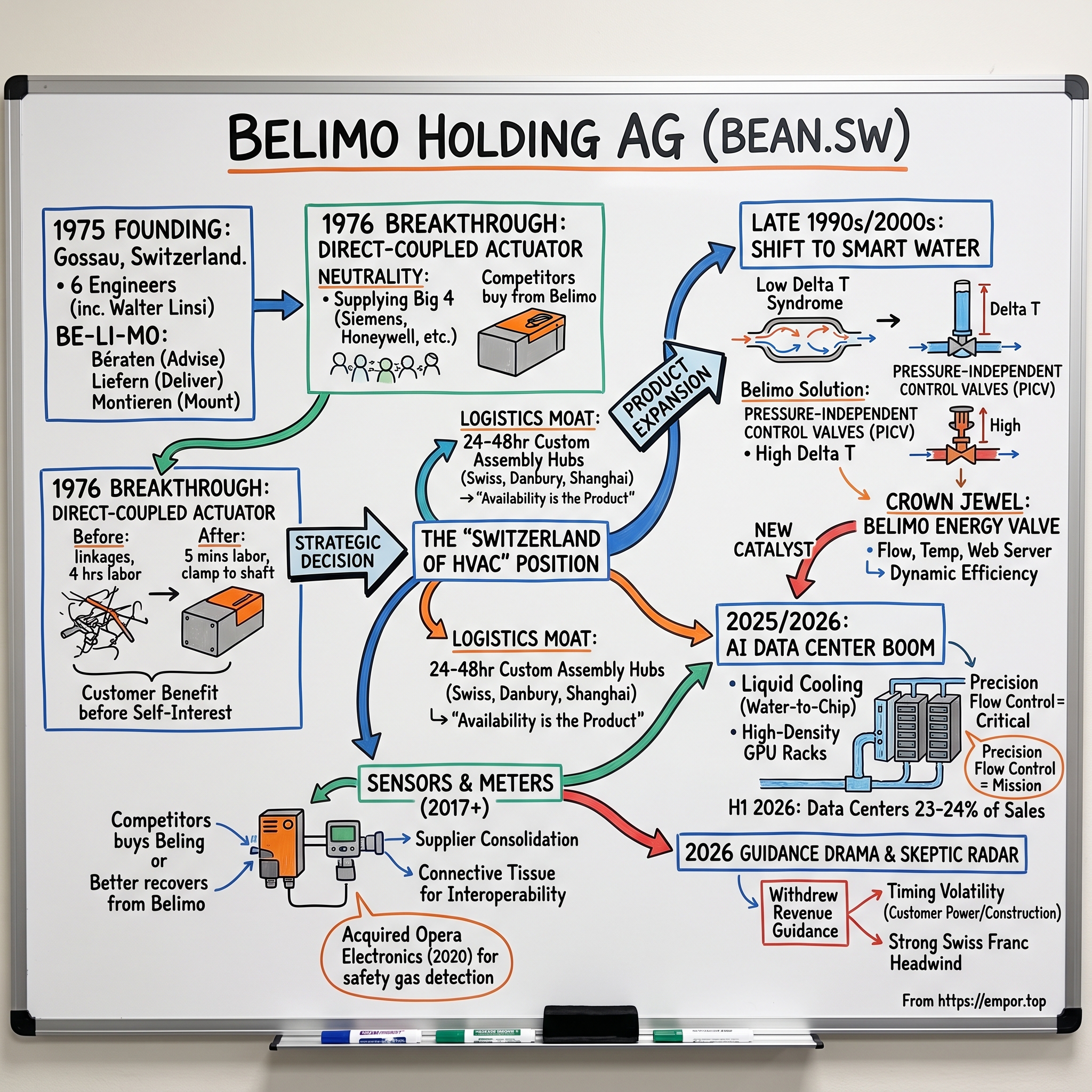
This is the roadmap. We start in Swiss-German Gossau in 1975, with six men, a breakaway, and an acronym. We trace the 1976 invention — a hollow shaft and a single clamp — that collapsed a four-hour installation job into five minutes. We examine the strategic decision that defines Belimo to this day: the deliberate refusal to move up the value chain and become a systems integrator, choosing instead to be the neutral Switzerland of HVAC. We follow the migration from mechanical air dampers to intelligent water loops, into the data-center boom and the July 2026 guidance drama that knocked the stock down. We interrogate management, incentives, and capital allocation. And we run the whole thing through Helmer's 7 Powers and Porter's Five Forces before stress-testing the bull case against a skeptic's radar. Let's begin at the beginning.
 Subscribe on LinkedIn
II. Swiss Engineering & The 1975 Founding Context
To understand why Belimo mattered, you first have to appreciate how genuinely miserable it was to control a building's climate in the early 1970s. HVAC — heating, ventilation, and air conditioning — was a fragmented craft, not an industry. Controls were largely pneumatic, which meant that regulating the temperature of a large building required threading miles of small-bore copper tubing through walls and ceilings, feeding compressed air to devices that responded sluggishly, leaked constantly, and drifted out of calibration with the seasons. Setting up such a system was slow, expensive, and unforgiving. It was, in short, a market screaming for someone to make it simpler.
In 1975, in the town of Gossau in the canton of Zürich, six men decided to try. Walter Burkhalter, Anton Heinrich Hütte, Ludwig Linsi, Walter Linsi, Werner Roner, and Karl Stocker had worked together at a German controls firm, Magnet Regelsystem GmbH (MRS) in Stuttgart, and they broke away to found their own venture: BELIMO Automation AG.6 They were not financiers or marketers. They were engineers who believed the market's incumbents had grown complacent about the daily pain of the people who actually installed this equipment.
The name they chose was not a founder's surname or a Latin flourish. It was a promise, compressed into an acronym drawn from three German verbs that describe what a good supplier actually does for a contractor: BEraten (to advise), LIefern (to deliver), and MOntieren (to mount, or install).6 Advise, deliver, install. The entire commercial philosophy of the company was baked into its name before it had sold a single unit — the idea being that Belimo's job did not end when a box left the warehouse; it ended when the device was working on-site and the contractor's problem was solved.
There is also something to the fact that this happened in Switzerland specifically, and stayed there. The country's manufacturing culture — precision, obsessive quality control, a tolerance for high labor costs justified by near-zero defect rates — is the same soil that grows its watchmaking and its pharmaceutical instrumentation. For a product whose entire value proposition would eventually rest on the promise that it simply will not fail in a location where failure is catastrophic and inspection is impossible, being born into that culture was not incidental. The "Swiss reliability" that a mechanical engineer now invokes almost unconsciously when specifying Belimo is not a marketing slogan bolted on later; it is a genuine inheritance from where and how the company learned to build. That same choice, as we will see, is also the source of Belimo's most chronic financial headache, because Swiss quality is priced in Swiss francs.
Under the guiding hand of Walter Linsi, the founders codified a principle that the company still repeats like a catechism half a century later: "Kundennutzen vor Eigeninteresse" — customer benefit before self-interest. It is the sort of motto that adorns a thousand corporate lobbies and means nothing at most of them. What makes it worth taking seriously at Belimo is that, as we will see, the company has repeatedly turned down obvious opportunities to enrich itself at its customers' expense — declining to compete with the very integrators who buy from it — in ways that only make sense if the slogan is load-bearing rather than decorative.
The most consequential legacy of those early years, though, may be the ownership structure. The Linsi family never cashed out and walked away. Decades later, the family — organized as Group Linsi, primarily through the U.W. Linsi Foundation — remains Belimo's anchor shareholder, with a registration limit set at 19.51% of the company's share capital and voting rights, and Urban Linsi representing the family's interests on the Board of Directors.8 This is not a trivial governance footnote. A patient, multi-generational anchor shareholder with a fifth of the votes changes what a public company can do. It insulates management from the quarterly tyranny that pushes so many listed industrials toward debt-funded buybacks and short-cycle earnings management. Whether that patience is an unalloyed good for minority investors — concentrated family control cuts both ways — is a question we will return to. For now, note simply that Belimo's long-termism is not a matter of executive temperament. It is structural. And it gave the founders room to bet the company on a single strange idea.
III. The "Aha" Moment: The Direct-Coupled Actuator Breakthrough
Picture the job as it existed before 1976. To motorize an air damper — the louvered flap inside a duct that regulates airflow — an installer had to mount a heavy electric motor onto a nearby wall or bracket, then connect it to the damper's rotating spindle through a Rube Goldberg assembly of linkage rods, crank arms, and levers. Every one of those linkages was a joint that could bind, slip, or fall out of adjustment. Calibrating the throw so that "motor fully open" actually corresponded to "damper fully open" was fiddly, manual work. A single installation could eat four hours of a skilled technician's day, and the resulting mechanism was a lifetime maintenance liability — linkages drifted, dampers ended up chronically half-open or half-shut, and the building leaked conditioned air and energy for years.
Belimo's founders looked at this contraption and asked a deceptively simple question: what if you got rid of the linkage entirely? In 1976, within a year of founding the company, they delivered the answer — the world's first direct-coupled motorized damper actuator, the direktgekoppelter Klappenantrieb.6 The insight was almost embarrassingly elegant. Instead of mounting the motor remotely and connecting it through rods, they built the actuator with a hollow shaft running through its center. The installer simply slid the actuator directly onto the damper spindle, tightened a single U-bolt clamp, secured an anti-rotation strap so the body didn't spin with the shaft, and walked away. No linkage. No calibration geometry. No drift.
The economics were brutal in the best possible way. A job that took four hours collapsed to roughly five minutes. The physical envelope shrank dramatically because there was no longer a linkage assembly sprawling across the ductwork. And the entire category of alignment error — the single biggest source of downstream failures — was mathematically eliminated, because the actuator was now rigidly clamped to the very shaft it was turning. There was nothing left to fall out of adjustment. This is the kind of innovation that does not merely improve a product; it removes an entire failure mode and an entire labor cost from the customer's world at the same time.
Naturally, the incumbents and the old hands scoffed. The idea of a motor simply hanging off a rotating shaft, with no rigid mounting to a wall, offended the intuition of engineers who had spent careers bolting things down. It looked precarious. Belimo's answer was not a marketing campaign; it was a field campaign. The founders and their early salespeople went to construction sites, handed contractors free trial units, and let the labor math do the persuading. When a mechanical contractor discovers he can commission a damper in five minutes instead of half a morning, the skepticism evaporates by lunchtime. The product sold itself to the one constituency that mattered most — the person on the ladder with the wrench — and that grassroots, installer-first go-to-market became a permanent part of Belimo's DNA.
There is a deeper pattern in that first product worth naming, because it recurs throughout Belimo's history. The direct-coupled actuator did not win on raw performance — a linkage-driven damper and a direct-coupled one ultimately move the same flap of metal. It won by attacking the customer's labor economics, by removing cost and risk from the installation rather than adding features to the box. That instinct — solve the problem the customer actually loses sleep over, which is almost never the headline spec and almost always the total cost and hassle of getting the thing working — became the template for everything that followed. Decades later, when Belimo built the Energy Valve, it applied the identical logic to water: don't just sell a better valve, sell a device that eliminates the on-site guesswork of balancing a hydronic system. The 1976 clamp was not merely a product; it was the first expression of a philosophy the company would monetize for the next fifty years.
By 1995, the company had grown enough to take the next step, listing on the Swiss Stock Exchange (SIX) to fund automated domestic manufacturing and a network of global sales subsidiaries.6 The IPO was not a cash-out for the founders so much as a fuel-up for international expansion. But going public also forced a strategic question that would define the next thirty years: now that Belimo owned a beachhead in the humble damper actuator, how far up the value chain should it climb? The answer it chose was, in a word, counterintuitive.
IV. Building a Pure-Play Category King & The Logistics Moat
Every successful component maker eventually faces the same seduction. You dominate a small, unglamorous niche; your margins are healthy; and looming above you are the system integrators — the companies that assemble your part, and dozens of others, into the complete Building Management System (BMS) that actually runs the building and commands the fat, sticky, recurring contract. The obvious move, the one an MBA would draw on a whiteboard, is to climb: build the brains, own the whole stack, capture the value that flows to Honeywell and Siemens. Belimo looked hard at that path and deliberately walked the other way.
The logic was not sentimental; it was strategic. The moment Belimo built its own BMS, it would stop being a supplier to the integrators and start being their competitor. Every Honeywell branch, every Siemens installation division, every independent systems integrator that had been happily specifying Belimo actuators would suddenly be buying from a rival — and would immediately start looking for a substitute. Belimo would trade a large, reliable, conflict-free business selling components to everyone for a small, embattled business selling systems against incumbents with vastly greater scale and installed bases. By refusing to climb, Belimo made itself safe to buy. It became the neutral party — the Switzerland of HVAC — whose field devices any integrator could specify without arming a competitor. That neutrality is the single most important strategic decision in the company's history, and it explains the paradox we opened with: the Big Four buy Belimo precisely because Belimo promised never to try to become them.
Neutrality, though, only earns you the right to compete. What Belimo built on top of it was a logistics machine that turned a cheap commodity into an un-substitutable one. Here it helps to understand the strange economics of a field device on a construction site. The actuator itself is cheap — a few hundred dollars against a building that costs hundreds of millions. But it sits on the critical path of commissioning. If a contractor is missing a single damper actuator or control valve, the entire HVAC system cannot be balanced, tested, or signed off. Building handover slips. And in commercial construction, a slipped handover can trigger liquidated-damages clauses that cost thousands of dollars per day. The cheapest part in the building has become the most expensive thing to be waiting on.
Belimo's answer was to make availability itself the product. Rather than warehousing millions of finished, pre-configured variants — an inventory nightmare given the near-infinite combinations of torque, voltage, control signal, and mounting — the company organized modular, localized assembly hubs, anchored by its Swiss operations and mirrored in the Americas around Danbury, Connecticut, and in Asia around Shanghai. These hubs stock the generic building blocks — motors, gearboxes, control electronics, housings — and assemble, test, and ship a customer's exact configuration on demand, typically within a day or two of the order. The genius is that the customization happens at the last possible moment, close to the customer, so Belimo gets the responsiveness of a local shop with the cost structure of a global manufacturer.
What makes this genuinely hard to copy is not any single element but the way they compound. A competitor can build an automated assembly line; it can rent a warehouse in Connecticut; it can even, given enough capital, stock the same sub-assemblies. What it cannot quickly manufacture is the trust that lets a customer order a bespoke configuration on Monday afternoon and stake a building-handover date on it arriving Wednesday morning — reliably, at scale, across thousands of variants, without an expediting phone call. That reliability is a reputation earned one on-time delivery at a time over decades, and reputation is the one input that cannot be bought with capital or accelerated with a factory. The modular design is the enabler; the accumulated confidence of the channel is the actual moat, and it is why Belimo's logistics edge has proven so much stickier than a purely operational advantage would suggest.
Set that against the giant conglomerates, whose sprawling catalogs and centralized distribution centers can turn a component order into a multi-week wait. For a contractor staring down a liquidated-damages clock, the modest price premium on a Belimo device is trivial next to the schedule risk it retires. This is the mechanism beneath the fat margins: Belimo is not really being paid for a clamp and a motor. It is being paid for certainty — the assurance that the cheapest, most critical part will be on-site when the schedule demands it. Certainty, it turns out, is a product you can charge a premium for and defend for decades. The next question was where to point that machine, and the answer was water.
V. The Shift to Smart Water: Control Valves & The Data Center Boom
For its first two decades Belimo was, essentially, an air company — the damper actuator was the franchise. But somewhere in the late 1990s and 2000s management made a bet that would eventually eclipse the original business: that the real money, and the real engineering difficulty, lay not in moving air but in controlling water. Today that bet dominates the income statement. Of Belimo's CHF 1,120.8 million in 2025 net sales, control valves generated CHF 591.4 million, or 53% of the total, and grew 31.3% in local currencies — the largest and fastest-growing pillar. Damper actuators, the cash-generative legacy core, contributed CHF 476.3 million, or 42%. Sensors and meters, the newest and smallest layer, added CHF 53.1 million, or 5%.12 The company that was born controlling air now makes most of its money controlling water.
Why is water so much harder — and so much more lucrative — than air? The answer is a piece of building physics with the unglamorous name of "low Delta T syndrome," and it is worth slowing down to explain, because it is the intellectual heart of Belimo's modern franchise. In a building's hydronic system, chilled or hot water is pumped through heat exchangers — the coils that actually warm or cool the air. The efficiency of the whole plant depends on extracting as much thermal energy as possible from each liter of water, which shows up as a large temperature difference (a high "Delta T") between the water going in and the water coming back. The enemy is water moving too fast: if flow races through the coil, the water doesn't linger long enough to give up or absorb its heat, the temperature difference collapses, and the chiller plant is forced to pump far more water than it should to deliver the same cooling. Energy costs balloon. Multiply that across a skyscraper and the waste is enormous.
The reason this happens is maddeningly dynamic. Every time a valve somewhere else in the building opens or closes, the water pressure across every other valve shifts, and a conventional valve set to a given position suddenly passes too much or too little flow. Belimo's solution was the pressure-independent control valve (PICV) — a valve that senses and dynamically compensates for those pressure swings, guaranteeing a constant, correct flow regardless of what the rest of the building is doing. By holding flow steady, PICVs keep Delta T high and can cut a building's hydronic energy consumption dramatically. The company markets energy savings of up to roughly 30% from proper flow control — a management claim to weigh against a customer's specific baseline rather than a universal guarantee, but directionally the mechanism is real and well understood by mechanical engineers.
The crown jewel of this lineage is the Belimo Energy Valve — a device that fuses a control valve, a flow meter (electromagnetic or ultrasonic), temperature sensors, and an embedded web-server into one intelligent unit. It doesn't just hold a set flow; it continuously measures the actual Delta T across the coil in real time and throttles the water to keep the heat exchanger at peak efficiency. In effect, it closes the control loop on the single most wasteful behavior in a hydronic system. For years this was a nice, high-margin premium product for commercial buildings. Then AI arrived and turned it into something close to mission-critical.
High-density AI server racks — the NVIDIA GPU clusters and custom accelerators powering the current computing boom — concentrate so much heat into so little space that blowing cold air over them is no longer thermodynamically sufficient. The industry has pivoted to liquid cooling: water-to-chip cold plates and chilled rear-door heat exchangers that carry heat away within inches of the silicon. These loops demand exactly the precise, pressure-independent, Delta-T-optimized flow control that Belimo spent two decades perfecting for office towers, except now the stakes are a rack of GPUs thermally throttling or shutting down rather than an uncomfortable conference room. Belimo's valves walked into the data-center boom already holding the answer.
It helps to make the physics concrete, because the layman version explains the investment stakes better than any spreadsheet. Imagine trying to keep a marathon runner cool by fanning them with a newspaper: fine for a gentle jog, hopeless once they sprint. An air-cooled server rack is the newspaper, and an AI training cluster is the sprinter — the heat is now so concentrated that the only way to carry it away fast enough is to run a coolant right up against the source, the way blood carries heat from your muscles to your skin. That is what liquid cooling does, and it is exquisitely sensitive to flow. Pump the coolant too fast and it whisks past the hot chip without absorbing enough heat; too slow and it boils off its capacity before the job is done. The valve that holds that flow at exactly the right rate, second by second, as dozens of other valves in the building open and close around it, is not a commodity afterthought — it is the difference between a rack running at full tilt and a rack throttling itself to avoid melting. In an air-cooled office, a mis-set valve costs a few percent on the energy bill. In an AI hall, it can idle millions of dollars of GPUs. That is why a device that was a premium nicety in 2015 became a gating dependency by 2026.
The numbers detonated in the first half of 2026. Sales grew 29.6% in local currencies to CHF 676.4 million, and EBIT rose 19.1% to CHF 152.5 million, for a still-formidable margin of 22.5%; net income climbed 23% to CHF 124.9 million.34 Data-center applications, which had been about 17% of 2025 sales and roughly 18% in the second half of that year, jumped to 23–24% of first-half 2026 revenue and, by management's account, contributed slightly more than half of the company's absolute sales growth in the period.45 For a business that spent fifty years compounding in the low double digits, this was a genuine step-change in demand.
And then, on July 20, 2026, Belimo did something that beat companies rarely do after a blowout quarter: it withdrew its quantitative full-year revenue guidance, and the stock fell about 5%.45 The instinctive read is that management saw a slowdown coming. The actual explanation, offered on the earnings call, was more subtle and more revealing. CFO Markus Schürch told analysts that Belimo was pulling the number not because demand was faltering but because it could no longer forecast the timing of that demand with confidence. Order entry from hyperscalers remained strong; the problem was that actual deployment was lagging orders, held up by power availability and execution constraints on the customers' sites — bottlenecks entirely outside Belimo's own production or product. The company would resume quantitative guidance, Schürch said, once the market became less volatile and visibility improved; it maintained its expectation of an EBIT margin above 20% for the full year, subject to currency swings.35
The analyst Q&A is where the story got tested, and it is worth listening to who pushed and how management answered. George Featherstone of Barclays pressed on how to interpret the guidance withdrawal and on the sustainability of data-center growth; Fabian Piasta of Jefferies probed the mix between hyperscalers and colocation operators, the pace of liquid-cooling penetration, and the competitive landscape; UBS, Kepler, and Zürcher Kantonalbank analysts pushed on regional exposure, pricing versus cost, and the threat from cheaper polymer valves.5 The recurring skeptical thrust was pointed: if orders are so strong, why can't you commit to a number? Management's answer was consistent and, to its credit, concrete — the constraint is your customers' power and construction pipeline, not our factories or our demand. Whether that framing proves prescient or merely convenient is the central open question of the current investment case, and we will come back to it. First, the smallest and most strategic of Belimo's three businesses deserves its moment.
VI. Sensors and Meters: Niche M&A and Supplier Consolidation
At CHF 53.1 million in 2025 sales — a rounding error next to the valve and actuator franchises — Belimo's sensors and meters business looks, at first glance, like a distraction.1 Why would a company with 20%-plus operating margins wade into the notoriously commoditized, low-margin world of temperature and humidity sensors, where a thousand undifferentiated suppliers compete on price? The answer, launched deliberately in 2017, is that Belimo was not really entering the sensor market. It was closing a loop and defending a perimeter.
Think about what an intelligent control valve or damper actuator actually needs to do its job: it needs to know things. It needs accurate readings of temperature, humidity, CO₂, and pressure to modulate flow correctly. Historically, an installer bought sensors from one brand, valves from a second, and actuators from a third, then spent frustrating hours on-site making them talk to one another — matching signal ranges, calibrating offsets, and untangling wiring. Every mismatched component was a source of error and a service call. By building its own sensor line, Belimo could offer a field-device suite where the sensor, the valve, and the actuator were designed to work together out of the box, with guaranteed signal compatibility and unified calibration. The sensor was less a product than the connective tissue that made the rest of the system foolproof.
The M&A that built out this capability is a case study in disciplined restraint, and it stands in deliberate contrast to how industrial conglomerates typically behave. Rather than overpaying for a large competitor and later confessing to a goodwill write-down, Belimo bought small and specific. The signature deal closed on December 2, 2020, when Belimo acquired Opera Electronics Inc. of Montreal — a specialist in air-quality and gas sensors, including refrigerant-leak and combustible-gas detection for HVAC plant rooms — for undisclosed terms, folding it into the Americas organization and rebranding it Belimo Sensors Inc.7 The logic was purely technological: Opera extended Belimo's addressable market into safety-critical gas detection, a genuinely differentiated, higher-value niche, rather than piling on commodity volume. It was a tuck-in that expanded the competitive perimeter, not a transformational bet that risked the balance sheet.
The strategic payoff is supplier consolidation. By offering the complete field-device kit — actuators, valves, sensors, and thermal-energy meters — under one brand, with one purchase order, one shipment, and guaranteed out-of-the-box software compatibility, Belimo lets a contractor shrink its supplier base and eliminate integration headaches. Each additional product category the customer adopts deepens the switching cost of the whole relationship, because ripping out one part now means re-validating the interoperability of the rest. Sensors and meters may be the smallest line on the income statement, but they function as a high-margin lock-in tool that widens the moat around the two businesses that actually pay the bills. The skeptical counter-read deserves airing, though. Nine years after launch, sensors and meters remain just 5% of sales, and one could argue the segment has yet to prove it can scale into anything material — that it is a strategically tidy idea generating a rounding error, propped up by the halo of the valve business rather than winning share on its own merits in a market crowded with entrenched sensor specialists. Belimo's rebuttal is that the point was never standalone sensor volume; it was defensive and integrative, and on that metric the 25% local-currency growth the line posted in 2025 suggests the consolidation thesis is at least gaining traction with contractors.1 The honest verdict is unsettled: sensors are a credible strategic hedge whose financial payoff is still mostly in front of the company, and an investor should watch whether the segment's growth rate stays comfortably ahead of the group's, or quietly fades into an also-ran. That kind of patient, perimeter-widening discipline is a management trait, not an accident — which brings us to the people setting the rules.
VII. Current Management, Incentives, & Capital Allocation
Belimo does not do celebrity CEOs, dramatic turnarounds, or imported outsiders parachuted in to "shake things up." Its leadership is an almost aggressively Swiss study in continuity, and that is itself a strategic choice worth examining rather than praising. Lars van der Haegen, the chief executive, is the archetype. Born in 1968 and trained as a building-technology designer before adding MBAs from both Columbia and London Business School, he joined Belimo around the turn of the millennium and then rotated through almost every geography and function the company has.10 He ran product management for air-volume control in Europe in the early 2000s, moved to Danbury to head product management and marketing for the Americas, took the managing director's chair in Italy, and then led the entire Americas division and sat on the Executive Committee for four years before being appointed CEO in July 2015.10 That itinerary matters. This is a leader who has personally stood in a mechanical room in Milan, sold into the price-sensitive American distribution channel, and carried a regional P&L — someone who understands, viscerally, what it feels like to be the contractor waiting on a part, because he spent his formative career selling to that contractor. In a business whose entire moat is built on channel intimacy and delivery reliability, promoting from deep within the channel is not nepotism; it is a coherence between what the company sells and who runs it.
Alongside him sits CFO Dr. Markus Schürch, and the contrast in background is telling. Born in 1971, Schürch holds a doctorate and a master's in chemical engineering from ETH Zurich, cut his teeth as a consultant at McKinsey's Zurich office, and spent well over a decade at the Swiss metering group Landis+Gyr — latterly as its CFO for the EMEA region — before joining Belimo's Executive Committee in 2018 and taking the group finance chair in January 2019.10 He is, in other words, an engineer who became a financier at a company that lives and dies on precise physical measurement — a fitting steward for Belimo's asset-light discipline, and the man who, in July 2026, chose to withdraw a guidance number rather than defend a forecast he no longer believed he could hit.5 That episode is a useful tell about management temperament: faced with a choice between preserving the appearance of visibility and admitting the honest truth that timing had become unforecastable, Belimo chose candor and ate a 5% stock decline for it. For long-term investors, a management team that would rather look uncertain than be wrong is a feature — though the same candor also means the company will not shield shareholders from volatility when the story gets bumpy.
The continuity runs to the top of the governance structure as well. The chairman of the board, Patrick Burkhalter — elected in 2014 and chairman since 2019 — carries the surname of one of the six 1975 founders, a reminder that Belimo's leadership is not a rotating cast of hired managers but a tightly held lineage of people with multi-decade, and in some cases multi-generational, stakes in the outcome.8 For a skeptic, that concentration is a double-edged sword: the same insider cohesion that enforces long-term discipline can also entrench, dull external challenge, and leave minority holders reliant on the family's continued good judgment rather than on independent board muscle. It is a governance model that has worked handsomely for decades, but "it has worked" is a description of the past, not a guarantee about the future.
The alignment machinery got materially tighter effective January 1, 2025, when Belimo introduced formal shareholding guidelines for its leadership. Under the new rules, the CEO must personally hold registered Belimo shares worth at least 200% of base salary, and each other member of the Executive Committee at least 100%.9 That requirement is reinforced by the structure of variable pay: 40% of target variable remuneration is delivered in restricted shares carrying a three-year restriction period, ensuring executives are exposed to the same multi-year price action as outside owners rather than cashing out annually on short-term metrics. Combined with the Linsi family's anchoring 19.51% block, the result is a leadership group whose personal wealth rises and falls with the same shares minority investors hold — the closest thing a public company has to an owner's mindset by design.8
Where that mindset shows up most clearly is capital allocation, and here Belimo's model is refreshingly boring. The company carries zero net debt — indeed it sits on net cash — and funds its growth entirely from its own cash generation.1 Major physical investments, such as the ongoing capacity expansion that pushed 2025 capital expenditure up to CHF 86.8 million (from CHF 63.1 million a year earlier) as Belimo raced to serve data-center demand, come straight out of operating cash flow rather than borrowed money.1 That self-funding discipline is precisely what lets management withdraw a guidance number without panic: a debt-free compounder answers to no lender's covenant and no refinancing calendar.
The flip side of that conservatism is a steady, unspectacular return of capital. Belimo raised its dividend to CHF 10.00 per share for 2025, up from CHF 9.50, against earnings per share of CHF 14.77 — an implied payout of roughly two-thirds of net income — and has historically supplemented dividends with opportunistic buybacks.2 A skeptic might reasonably ask whether a business earning 36% on capital employed should be returning that much cash rather than reinvesting every franc it can into a demand surge — or, conversely, whether the recent capex ramp signals the first cracks in the asset-light story. Both are fair challenges, and both hinge on the durability of the data-center wave, which is exactly where the competitive analysis has to earn its keep.
VIII. Playbook: The 7 Powers and Porter's 5 Forces Deep Dive
Strip away the narrative and ask the hard question a war-gaming investor would ask: what, precisely, stops a competitor from taking this business away? Belimo makes a mechanical device out of widely available motors and electronics. There is no patent thicket protecting a fifty-year-old clamp, no proprietary silicon, no software network effect in the Silicon Valley sense. And yet the returns persist. Hamilton Helmer's 7 Powers framework helps locate where the durability actually lives.
The first and most underrated power is switching costs, though not in the usual software sense. A Belimo actuator costs around $200 in a building that costs hundreds of millions, or a data center that costs billions. But if that actuator fails — if a fire damper jams shut, or a chiller valve seizes — the consequences run from an unusable floor to a rack of cooked GPUs. The buyer's calculus is therefore wildly asymmetric: the entire potential saving from choosing a cheaper unproven part is perhaps $50, while the potential loss from that part failing is catastrophic and career-ending. Building owners, consulting engineers, and installers are, rationally, extreme risk-avoiders on field devices. They will not gamble a nine-figure project to shave a few dollars off a component, and that asymmetry — not a contract — is the true lock-in.
The second power is scale economies, specific to this niche. Belimo produces millions of actuators and valves a year, vastly more than any dedicated field-device competitor, which lets it automate assembly, drive down unit costs, and simultaneously fund an R&D budget that likely rivals the entire HVAC revenue of smaller rivals. Scale in a narrow niche is a quieter but very real advantage: a generalist conglomerate spreads its research across dozens of product lines, while Belimo concentrates its firepower on the handful of devices it has decided to own completely.
The third is what Helmer calls a cornered resource, and in Belimo's case it is intangible: the decades-deep web of relationships with independent mechanical-engineering consultants, systems integrators, and local distributors. These are the people who write building specifications, and over fifty years they have learned to write "Belimo or equivalent" — with the "or equivalent" often a formality no one intends to exercise. Getting designed into the spec is the game, and Belimo's installed base of trusting specifiers is not something a competitor can buy or replicate on any reasonable timeline. It is the accumulated interest on fifty years of showing up on-site.
Porter's Five Forces tell the same story from the industry's angle. The threat of new entrants is very low: a would-be competitor would have to replicate not just the product but the 24-to-48-hour localized custom-assembly logistics and, harder still, the multi-decade brand equity of Swiss reliability that lets an engineer specify Belimo and never think about it again. Buyer power is limited despite buyers being large mechanical contractors and integrators, because their overriding priority is schedule certainty, and Belimo has demonstrated pricing power — in 2025 it passed through roughly 7 points of price into the H1 2026 growth bridge without visible volume destruction, evidence that customers accept the premium.4 Supplier power is low, because Belimo's modular designs let it dual-source generic motors and electronics globally, keeping internal value-add high. The threat of substitutes is effectively negligible: thermodynamics is not negotiable — a building or a data center physically requires something to move air and divert water, and no amount of AI or software can substitute for a mechanical device doing mechanical work.
The one force with real bite is industry rivalry, and here the picture is genuinely moderate rather than benign. Belimo competes against Siemens, Honeywell, Johnson Controls, and Schneider — companies with vastly greater resources that also make field devices. The reason this rivalry has not compressed Belimo's margins is structural: those giants' strategic center of gravity is systems, software, and total-building contracts, and field devices are a supporting act in their portfolios. Belimo wins by being the specialist ally to every independent installer who does not want to be locked into a Big Four ecosystem — a position that is defensible precisely because the giants are conflicted about attacking it.
But "moderate" is not "none," and it is worth war-gaming the specific angles of attack rather than waving them away. On the July 2026 call, analysts pressed two of them directly. The first is the polymer or plastic-bodied valve — a cheaper alternative to Belimo's metal and stainless-steel valves that could, in theory, undercut it in less demanding applications. Belimo's answer is that mission-critical and high-temperature applications, above all data-center cooling loops, are precisely where buyers refuse to trade material reliability for a lower price; the polymer threat is real at the commodity edge of the market but weakest exactly where the growth and the margin now sit. The second angle is the low-cost Asian competitor, and here Belimo's defense is the localized-logistics and specification moat rather than the product itself — a cheaper actuator that arrives in six weeks and was never written into the building spec does not solve the contractor's schedule problem. Both rebuttals are coherent, but note that they are, at this stage, largely Belimo's own framing; the honest analytical posture is to treat them as hypotheses to be tested by future margin and volume data, not as settled facts.
This is also the place to puncture a myth. The popular framing of Belimo as a fresh "AI cooling play" implies a company that got lucky standing next to a boom. The reality is closer to the opposite: Belimo solved the hard problem — pressure-independent, Delta-T-optimized flow control — two decades before the AI wave existed, for the entirely unglamorous purpose of saving energy in office towers. The data-center surge did not create Belimo's advantage; it revealed it, by suddenly making thermodynamic precision a life-or-death requirement rather than a cost-saving nicety. That distinction matters for how durable the position is, and it is the right cue to turn the analysis on its head and ask what could actually break the case.
IX. The Skeptical-Investor Stress Test & Risk Radar
Here is the bull case in one sentence: Belimo is an un-disruptable bottleneck on two of the largest secular trends of the decade — the decarbonization retrofit of the built environment and the liquid-cooling build-out of AI infrastructure — and whichever brain runs the building, it will still use Belimo's muscles. Regulation is a tailwind: tightening energy codes such as the EU's Energy Performance of Buildings Directive push existing buildings toward exactly the efficient flow control Belimo sells. The AI data-center wave is a step-change in demand that arrived pre-solved by two decades of valve engineering. And the company harvests both trends with 20%-plus margins, 36% returns on capital, and no debt. That is a formidable spine.
Now the skeptic's rebuttal, which deserves to be taken just as seriously. Start with valuation and the cyclicality of the catalyst. The market has enthusiastically re-rated Belimo as an AI-cooling play, but the data-center surge is a wave, and waves crest. The pointed question — the one Jefferies and Barclays circled on the July 2026 call — is whether the current pace of data-center orders represents a new structural baseline or a pull-forward that will digest painfully. Management's own decision to withdraw guidance is, read cynically, an admission that even they cannot see the top of this wave. A business trading on the assumption that 23–24% of sales keeps compounding is priced for a continuation nobody at the company will underwrite with a number.
An activist or a hard-nosed short would push the point further, and it is worth voicing the challenge in full rather than dismissing it. The bear's case is not that Belimo is a bad company — it plainly is not — but that a superb company can still be a poor investment at the wrong price. The market has, in effect, capitalized a cyclical demand spike as if it were a permanent structural annuity, and layered onto that the risk that data-center margins may prove lower-quality than the legacy book if hyperscalers, who are far larger and more concentrated buyers than a fragmented base of mechanical contractors, eventually flex their purchasing muscle. A short would also note the capex ramp — 2025 capital spending jumped by more than a third as Belimo built capacity into the surge — and ask the uncomfortable question every cycle eventually asks: what does that new capacity earn if data-center order timing slips a year, or two? The bull's answer is the retrofit base and the debt-free balance sheet, which together mean Belimo can wait out an air pocket without distress. Both sides are arguing about the same fact — the durability of the current demand — and neither can prove its case today. That irreducible uncertainty, not any flaw in the business, is the real subject of the debate.
The second risk is the chronic Swiss franc headwind, and it is not hypothetical — it is a permanent structural drag. Belimo manufactures its most specialized core components in high-cost Switzerland but sells globally in dollars, euros, and yuan. When the franc strengthens, as it chronically does in risk-off periods, every foreign sale translates into fewer francs and every Swiss cost line looks more expensive. The H1 2026 results made the point vividly: 29.6% growth in local currencies became just 20.5% in reported francs, a roughly nine-point FX haircut on the top line in a single half.3 Management's mitigation — continuously localizing final assembly and sourcing in the US and China to build natural hedges — is real but partial; the crown-jewel engineering stays in Switzerland, so the franc chokehold is a tax Belimo will pay for as long as it is Swiss.
The third and most immediate risk is the power-and-construction bottleneck that triggered the guidance withdrawal in the first place. If utilities cannot energize substations fast enough to power the surging pipeline of AI facilities, the liquid-cooling loops inside them do not get installed on schedule — and Belimo's valves sit in a warehouse waiting for a customer who is waiting for an electric hookup. This is the crucial nuance the market may be under-appreciating: Belimo's near-term risk is not that hyperscalers stop wanting cooling, but that they cannot deploy it on the timeline order books imply. Note, in fairness, the limit of the public record here: management framed the constraint on the call as "power availability" and "execution constraints" on customer sites and the timing of deployment, rather than itemizing specific grid-connection or labor causes, so the precise mechanism is partly inference.5
Against these, Belimo's most credible structural defense is the one that gets least attention: the retrofit market. New commercial construction is deeply cyclical and, in a post-pandemic office glut, structurally soft in parts of the developed world. But the majority of the addressable opportunity in mature markets lies not in new towers but in upgrading the enormous stock of existing buildings to meet tightening carbon rules — a replacement-and-renovation demand stream, marketed under Belimo's RetroFIT+ banner, that is driven by regulation and equipment end-of-life rather than the construction cycle. That base of non-discretionary, code-mandated replacement demand is what has historically let Belimo compound through downturns, and it is the reason the company is not simply a leveraged bet on cranes in the sky.
So what should an investor actually watch? Three KPIs cut through the noise. First, net sales growth in local currencies — the only clean read on underlying demand once the violent franc translation is stripped out; reported CHF growth tells you as much about currency markets as about Belimo. Second, EBIT margin stability around or above the 20% line — the live test of whether Belimo's pricing power is genuinely offsetting wage inflation, the capex ramp, and input costs, or whether the recent margin (22.5% in H1 2026, 20.8% for 2025) is peaking. Third, the data-center revenue contribution — the single number that will reveal, quarter by quarter, whether the liquid-cooling pipeline is converting at the velocity the current valuation assumes, or whether the power bottleneck is turning a boom into a plateau. Track those three and you are, in effect, auditing the entire bull-versus-bear debate in real time.
X. Epilogue & Outro
Fifty years after six engineers walked out of a Stuttgart controls firm and slid the first motor directly onto a damper shaft, their descendants' company has become the invisible standard beneath the world's most advanced infrastructure. The through-line is remarkably consistent. Belimo never tried to own the building. It owned the one component in the building that was cheapest to make, most catastrophic to get wrong, and most annoying to have to wait for — and then it made sure that component was always available, always reliable, and never in competition with the people who installed it.
The lesson for founders and investors is almost the inverse of the empire-building instinct that dominates modern strategy. The seductive move is always to climb the value chain, own the platform, capture the recurring software contract. Belimo's history is a fifty-year argument for the opposite discipline: pick the most critical, highest-risk, most manufacturing-intensive node in a system, defend it with logistics and trust, stay scrupulously neutral so that even your competitors become your customers, and let the labor economics of the person holding the wrench do your selling. It is a less glamorous path, and it produced returns most platform companies would envy.
There is a final irony worth sitting with. The most sophisticated machines humanity has ever built — the AI clusters training the models that may reshape the economy — cannot run without keeping their silicon cool, and keeping that silicon cool depends, in the end, on the boringly physical reliability of a small Swiss-engineered valve throttling a stream of water to hold a temperature difference steady. The future of computation, for all its abstraction, still runs on thermodynamics. And thermodynamics, it turns out, still runs partly through Gossau. Whether Belimo's investors are being asked to pay too much for that privilege, and whether the AI wave that lifted the stock will crest before the retrofit base can carry it, are the open questions the next several years will answer.
References
-
Annual Report 2025 — Management Report — Belimo Holding AG, 2026 ↩↩↩↩↩↩
-
Belimo Accelerated Growth in 2025 (Ad-hoc announcement) — Belimo Holding AG / EQS-News, 2026-02 ↩↩↩
-
Belimo Accelerated Sales Growth in the First Half of 2026 — Belimo Holding AG / Webdisclosure, 2026-07-20 ↩↩↩
-
Belimo H1 2026 slides: data centers drive 30% sales surge — Investing.com, 2026-07-20 ↩↩↩↩↩
-
Earnings call transcript: BELIMO H1 2026 sales surge, but stock falls 5% — Investing.com, 2026-07-20 ↩↩↩↩↩↩↩
-
Belimo History — 50 Years of Innovation (1975–2025) — Belimo Holding AG ↩↩↩↩
-
Belimo Acquires Montreal-Based Opera Electronics — Belimo Holding AG, 2020-11-26 ↩
-
Annual Report 2024 — Group Structure and Shareholders — Belimo Holding AG, 2025-03 ↩↩↩
-
Annual Report 2024 — Remuneration Policy — Belimo Holding AG, 2025-03 ↩
-
Annual Report 2022 — Executive Committee (CEO/CFO biographies) — Belimo Holding AG, 2023 ↩↩↩
 LinkedIn
 WhatsApp
 Reddit
 Hacker News
 Email
Email Kindle
 RSS Feed
 Spotify
 Apple Podcasts
 Amazon Music
 Audible
 YouTube