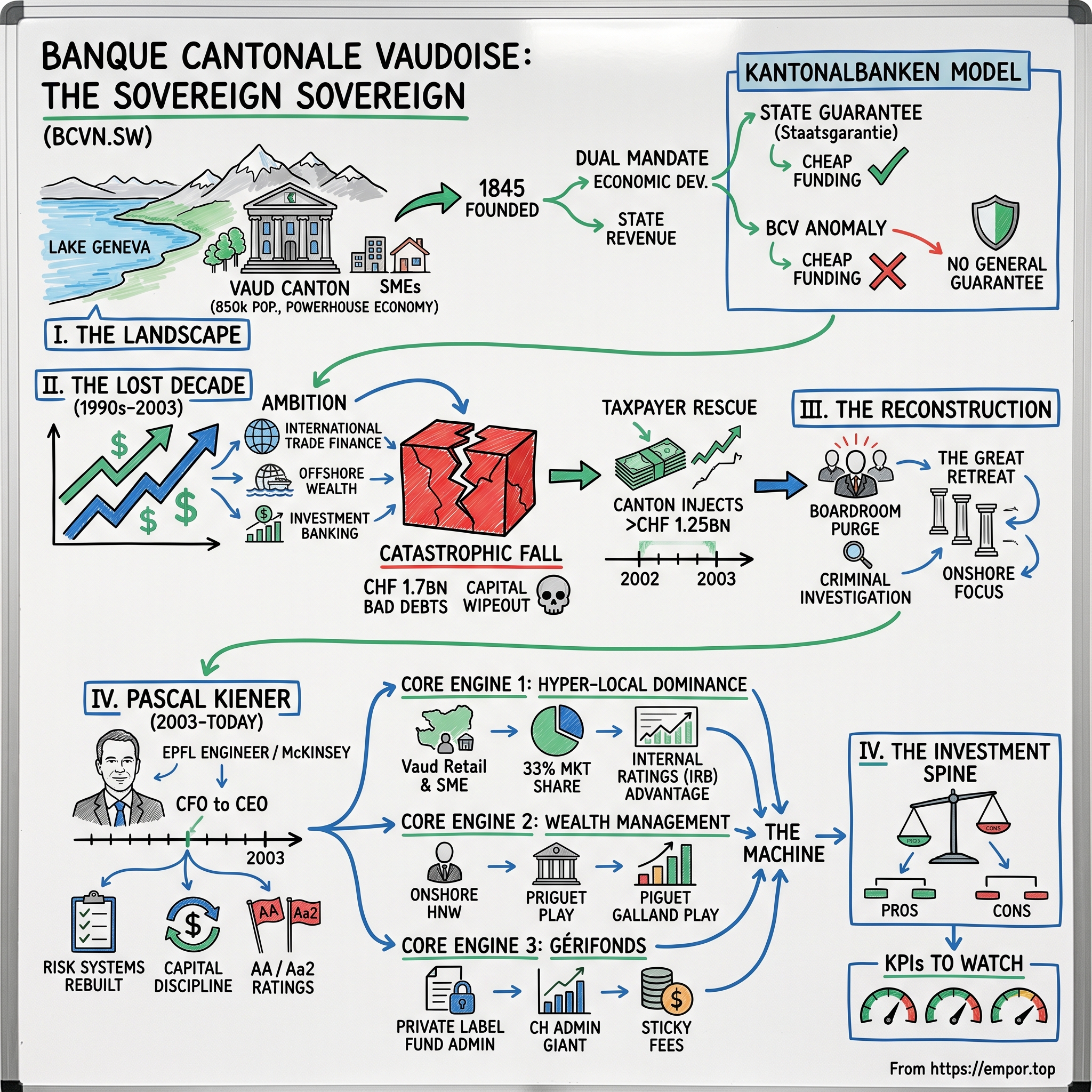
Banque Cantonale Vaudoise: The Sovereign Sovereign
I. Introduction & Episode Roadmap
Picture the shoreline of Lake Geneva — Lac Léman to the locals — on a clear morning: the water a hard alpine blue, the vineyards of Lavaux terraced up the hillside, the spires of Lausanne rising behind. This is one of the wealthiest stretches of real estate in Europe. Nestlé's global headquarters sits an hour up the lake in Vevey. The École Polytechnique Fédérale de Lausanne (EPFL) pumps out engineers and biotech startups. Olympic administrators, hedge-fund managers, and pharmaceutical fortunes cluster along the water. And the bank that quietly finances an enormous share of it all — the mortgages, the SME credit lines, the family wealth — is Banque Cantonale Vaudoise.
Here is the paradox that makes BCV worth an entire episode. Swiss cantonal banks — the Kantonalbanken — are famous for one thing above all: the state guarantee. Most of the twenty-four cantonal banks carry an explicit, often unlimited guarantee from their home canton's taxpayers, a backstop so powerful that the largest cantonal banks fund themselves almost as cheaply as the Swiss Confederation itself. It is the ultimate cheat code in banking: borrow cheaply because the government will never let you fail.
BCV does not have that cheat code. Uniquely among the large cantonal banks, it operates without a general state guarantee on its liabilities.11 Strip away the safety net and a bank has to earn its funding advantage the hard way — through balance-sheet strength, underwriting discipline, and a reputation so solid that depositors and bondholders trust it on its own merits. Remarkably, BCV pulls it off: it holds an AA rating from S&P and Aa2 from Moody's, both stable — a rating tier that only a handful of banks anywhere reach without a sovereign backstop.14
The company that earned that rating today is almost unrecognizable from the one that nearly destroyed itself. Because the second half of this story's hook is darker. In the early 2000s, BCV was not a paragon of Swiss prudence. It was a cautionary tale. A decade of overreach into international commodity trade finance, offshore wealth management, and speculative lending blew a crater in the balance sheet. Bad-debt provisions ballooned to CHF 1.7 billion, wiping out the bank's capital and forcing the Canton of Vaud to inject well over a billion francs of taxpayer money to keep it alive.45 Heads rolled. A criminal investigation followed. The bank that today lectures the market on risk discipline was, twenty-odd years ago, the bank that had to be saved from itself.
So the questions that animate this episode are simple to state and hard to answer. How does a regional bank thrive without the guarantee that props up its peers? How did it climb from a taxpayer bailout to an AA rating and a dividend machine that returns almost everything it earns? And how durable is that recovery now that a single, terrifying competitor — the merged UBS–Credit Suisse colossus — dominates the very market BCV calls home?
Our roadmap follows the arc of that transformation. First, the canvas: the peculiar architecture of Swiss cantonal banking and why Vaud is such a rich place to be a bank. Then the fall: the hubris of the 1990s and the 2002 rescue. Then the reconstruction under Pascal Kiener, the McKinsey partner who arrived to clean up the mess and stayed eighteen years as CEO. Then the three engines that now drive the machine — hyper-local retail and corporate lending, onshore wealth management, and a hidden fund-administration business that quietly dominates its niche. And finally the investment spine: the powers that protect BCV, the forces that threaten it, and the honest case for why the thesis could still break.
The through-line, as we'll see, is a lesson that runs against every instinct of modern finance: sometimes the most valuable thing a business can do is figure out exactly how small it should be.
 Subscribe on LinkedIn
II. The Swiss Cantonal Banking Landscape & BCV's Structural Anomaly
To understand why BCV is strange, you first have to understand why the ordinary cantonal bank is such a comfortable place to be.
The Kantonalbanken are a nineteenth-century invention, born of a very Swiss idea: that credit is too important to a region's prosperity to be left entirely to distant, profit-maximizing outsiders. Founded across the cantons from the 1830s onward, these banks were chartered with a dual mandate baked into law — foster the economic development of their home canton, and generate a steady stream of revenue back to the cantonal treasury. They were, in effect, public utilities for money: half commercial bank, half instrument of regional policy. BCV itself was created in 1845, when the people of Vaud petitioned their cantonal parliament to establish a bank of their own during a period of economic hardship.3
The masterstroke — the thing that makes cantonal banking such a good business — is the state guarantee, the Staatsgarantie. For most cantonal banks, the canton stands explicitly behind the bank's obligations. If the bank cannot pay, the taxpayer will. This is not a vague implication; for many it is written into cantonal law as an unlimited guarantee. The consequences ripple through the entire economics of the institution. A guaranteed bank can fund itself almost as cheaply as the government, because lending to it carries virtually no default risk. Zürcher Kantonalbank, the largest of them, funds itself at rates a standalone commercial bank could never match, purely on the strength of Zurich's explicit backing. Cheap funding is the raw material of banking; a structural discount on it is a permanent competitive advantage that no amount of clever product design can replicate.
Now, the canvas BCV paints on. The Canton of Vaud is not some sleepy alpine backwater. With a population of roughly 850,000 it is among Switzerland's largest cantons, and its economy is a genuine powerhouse. Lausanne, the capital, anchors a corridor of world-class institutions: EPFL and the University of Lausanne on the research side; global corporations like Nestlé and Logitech; a dense life-sciences and medtech cluster; the International Olympic Committee; and an extraordinary concentration of private wealth strung along the lake from Lausanne to Montreux. This is a canton where property is scarce and expensive, incomes are high, businesses are export-oriented and sophisticated, and the population is growing. For a bank whose profits come from mortgages, deposits, SME credit, and wealth management, it is close to an ideal habitat.
And here is the anomaly. Sitting in this rich habitat, dominant in its home market, BCV chooses to compete without the very guarantee that makes its peers so formidable. The state guarantee was removed as part of the reforms that followed the bank's crisis — the canton did not want unlimited, open-ended exposure to a bank it had already been forced to rescue once. So BCV became a rare hybrid: majority state-owned but explicitly not state-guaranteed.11
Why does that distinction matter so much? Because it changes what the bank has to do to survive. A guaranteed bank can be mediocre and still fund itself cheaply; the guarantee does the heavy lifting. BCV cannot hide behind anyone. Every basis point of its funding advantage has to be earned through demonstrated safety — thick capital buffers, clean loan books, transparent disclosure, and a credit rating agencies will actually stand behind. In a sense, the removal of the guarantee forced BCV to become a genuinely well-run bank rather than a politically protected one. The discipline is not optional; it is the price of admission.
It is worth pausing here to puncture a myth, because the consensus shorthand for BCV — "a Swiss cantonal bank, therefore government-guaranteed, therefore riskless" — is simply wrong, and the error cuts in a direction that flatters the bank less than people assume. The reality is that BCV deliberately gave up the guarantee, and its safety today is a manufactured safety, built from capital and discipline rather than conferred by statute. This matters for how an investor should think about the downside. With a guaranteed peer like ZKB, the safety lives on the canton's balance sheet; with BCV, it lives on BCV's own. If the bank's underwriting ever slipped again, there is no automatic legal mechanism forcing the taxpayer to make bondholders whole — only the same political calculus that produced the 2002 rescue, which is a probability, not a promise. The upside of the myth is that BCV has proven it can earn an AA rating on its own merits, which is genuinely impressive. The downside is that investors who treat it as government-backstopped are pricing a guarantee that does not exist. Both halves of that are true, and both matter.
The governance structure completes the picture. The Canton of Vaud remains the controlling shareholder, holding 66.95% of the share capital — down from the ~84% peak it reached during the rescue, but still an unambiguous majority.113 The rest trades publicly on the SIX Swiss Exchange under the ticker BCVN.[^12] This creates an unusual alignment. The canton is simultaneously the bank's owner, its largest single beneficiary of dividends, and — as the market well knows — the party that would face enormous political and economic pain if BCV ever wobbled again. There is no legal guarantee. But there is a controlling owner with every incentive to keep the bank both safe and generous. That tension between public accountability and commercial independence is the governance engine of the entire story, and to understand how it got there, we have to go back to the moment it very nearly all came apart.
III. The Lost Decade: The Rise and Catastrophic Fall of BCV (1990s–2003)
Every disciplined institution has, somewhere in its past, the memory of the time it was anything but. For BCV, that memory has a number attached to it: CHF 1.7 billion in bad-debt provisions, disclosed in a single grim announcement, against a bank whose entire capital base was a fraction of that.4
The road to that number began, as these roads usually do, with ambition. In the late 1980s and through the 1990s, BCV's leadership decided that the Canton of Vaud was too small a stage for the bank's aspirations. Why settle for financing local dentists and vineyards when the whole world was borrowing money? The bank pushed aggressively beyond its home turf — into international commodity trade finance, into investment banking, into higher-risk lending and offshore wealth management. On paper, this was diversification, the sober banker's virtue. In practice, it was the abandonment of the one thing BCV actually understood: the creditworthiness of the people and companies of Vaud.
The trouble compounded quietly, in the way credit problems always do. The first tremor came not from abroad but from home. In 1993, BCV was pressed into rescuing a failing local rival, absorbing roughly CHF 3.5 billion of assets and liabilities from the collapsed Banque Vaudoise de Crédit to prevent what officials called a major disaster for the canton's economy.34 That rescue loaded BCV with distressed exposures and set a pattern: a bank taking on risk it did not fully understand in the name of regional duty and growth. Through the late 1990s, the loan book quietly rotted — property loans made too generously, trade-finance positions underwritten without the discipline the business demanded, offshore relationships that generated fees on the way in and losses on the way out.
Then the tide went out. When the dot-com bubble burst and global credit conditions tightened at the turn of the millennium, the absence of underwriting discipline in BCV's non-core books was suddenly, brutally exposed. The bank reported a loss of CHF 381 million for 2001, and that was only the overture.5 As auditors and a new, alarmed management dug into the loan portfolio, the true scale of the rot emerged. In the spring of 2002, BCV raised its credit-risk provisions toward CHF 1.7 billion, a figure large enough to vaporize the bank's regulatory capital.46 A bank with no capital is not a bank; it is a liquidation waiting to be scheduled. For a canton whose economy ran on BCV's credit, that was unthinkable.
So the Canton of Vaud did what a controlling owner with a systemically important bank on its hands had to do: it stepped in, repeatedly and expensively. The rescue came in waves. In spring 2002, the bank raised roughly CHF 600 million in fresh funds, about half of it from the cantonal government.4 It was not enough. In October 2002, the canton announced a far larger injection — CHF 1.25 billion — to shore up the shattered capital base.4 Across the whole episode the state's support ran well past a billion francs, and the canton's ownership stake climbed from 50.1% to roughly 84%.3 The taxpayers of Vaud, in other words, did not merely lend BCV money; they were forced to buy far more of a bank they already controlled, simply to keep it standing.
Money was the easy part. The reckoning that followed was uglier. The chairman, Gilbert Duchoud, stepped down in April 2002, ahead of the storm.5 But the storm arrived anyway. An independent inquiry, led by the celebrated former Ticino prosecutor Paolo Bernasconi, uncovered evidence of account manipulation, and the bank launched criminal proceedings against members of its own former management. Four senior figures — including a vice-president, the director-general, the head of compliance, and the secretary-general — were ordered out.5 The charges under investigation read like a syllabus of banking sins: forgery of documents, breach of fiduciary duty, false statements about commercial enterprises, and violations of Swiss federal banking law.5 Jacqueline Maurer, the cantonal minister overseeing the economy, acknowledged bluntly that beyond the named individuals, others had likely been involved in massaging the figures.5 This was not a bank that had suffered bad luck. This was a bank whose numbers had, in part, been made up.
Out of that wreckage came the strategy that defines BCV to this day, and it was almost aggressively unglamorous. Between roughly 2003 and 2005 the bank executed what amounted to a great retreat. The international trade-finance desks were wound down. The risky offshore offices were shuttered. The investment-banking ambitions were abandoned. What remained was a deliberately narrowed institution organized around four onshore pillars: retail banking, corporate banking, wealth management, and asset management — every one of them anchored in the Swiss home market it actually understood.
The lesson the survivors drew was the opposite of the one they had started with. Diversifying away from Vaud had nearly killed the bank. Concentrating on Vaud, it turned out, was the safer and more profitable path all along. But a strategy is only as good as the people who execute it, and BCV's recovery would come to be defined by one man in particular — an engineer-turned-consultant who walked into the smoking ruins in 2003 with a spreadsheet and a very long time horizon.
IV. Enter Pascal Kiener: From CFO of the Cleanup to CEO of the Empire (2003–Today)
When Pascal Kiener joined BCV as Chief Financial Officer on June 1, 2003, he was walking into a crime scene.7 The provisions had been taken, the canton's billions had been injected, and the prosecutors were circling, but the underlying machine was still broken. The loan book was full of problems that had to be identified, quantified, and worked out one exposure at a time. The risk systems that were supposed to have caught the rot had failed. And the market's trust — the invisible asset on which every bank ultimately depends — was gone. Someone had to rebuild all of it. That someone turned out to be a mechanical engineer from EPFL.
Kiener's background was, on paper, an odd fit for a bank and, on reflection, exactly the right one. Born in April 1962, he took a degree in mechanical engineering from EPFL in 1985, then spent his early career as an engineer at technology firms before adding an MBA from INSEAD in 1992.7 In 1993 he joined McKinsey & Company, and by 2000 he was a partner and a member of the firm's Swiss leadership, specializing in financial institutions — the strategy, risk management, controlling, and process-reengineering problems that are precisely what a broken bank needs solved.7 He was not a career banker steeped in the deal-making culture that had led BCV astray. He was an outsider whose entire professional training was in taking apart complex systems, finding what was broken, and rebuilding them to work.
For five years he did exactly that from the CFO's chair. He built out the Finance and Risk division, drove the reduction of problem credits, and — crucially — put in place the internal credit-risk models and capital discipline that had been so catastrophically absent.7 This is the unglamorous, foundational work of banking: deciding how much capital to hold against each kind of loan, how to price risk, how to say no. It rarely makes headlines. But it is the difference between a bank that compounds quietly for decades and one that blows up. By the time the cleanup was substantially complete, Kiener had effectively rewritten how BCV thought about risk.
In May 2008, the board handed him the top job. He became CEO — Président de la Direction générale — on May 1, 2008.7 The timing looks, in hindsight, almost comically ominous: he took command just as the global financial system was beginning to seize. Within months, Lehman Brothers had failed, and Switzerland's own global champion, UBS, required a joint rescue from the Swiss government and the central bank. Here was the delicious irony of the crisis: the giant, sophisticated, globally diversified UBS needed a state bailout, while the small, chastened, deliberately un-diversified BCV — a bank that just six years earlier had itself been rescued — sailed through untouched. BCV had already been burned by exactly the kind of exotic exposure that was now torching the global banks, and its scars had taught it to stay away. Sometimes the best preparation for a disaster is having survived a smaller one first.
Kiener's real test as a leader, though, was not the acute panic of 2008 but the slow grind that followed. From 2015 to 2022, the Swiss National Bank ran its benchmark policy rate at -0.75%, an extended experiment in negative interest rates that was corrosive for deposit-taking banks. The mechanism is worth pausing on, because it sits at the center of BCV's economics. A retail bank makes much of its money on the spread between what it pays depositors and what it earns on loans and securities. When market rates go negative, the bank is effectively being charged to park its excess cash — yet it cannot easily pass a negative rate on to ordinary savers without sparking a run to the mattress. The spread gets squeezed from both ends. Kiener's response was characteristically methodical: manage deposit pricing aggressively, charge fees on large institutional cash balances to offset the drag, and lean ever harder into capital-light, fee-generating businesses that earn money without depending on interest spreads at all. He would later describe the negative-rate years as a genuine ordeal for the system — and notably, on the bank's own earnings calls, he has argued that near-zero rates are actually worse for BCV than modestly positive ones.2
It is worth sitting with just how counterintuitive that stance is. Most bank executives publicly welcome higher rates as an unambiguous good and grumble when the central bank cuts. Kiener's more textured view — that BCV suffers most at zero and prefers a modest positive rate to either extreme — reflects the specific shape of the bank's book. When rates sit at zero, the deposit franchise that is BCV's crown jewel loses much of its value, because the whole point of cheap deposits is the spread you can earn by deploying them at a positive rate; take the rate to zero and the spread evaporates, turning the bank's greatest asset into dead weight. A modest positive rate revives the spread without triggering the credit stress that very high rates can bring. That the CEO can articulate this trade-off so precisely, and has repeated the same framing across years of calls, is itself a small piece of evidence about the analytical seriousness of the management team — the opposite of the promotional vagueness a skeptic learns to distrust.
That last point reveals something about how Kiener runs the place, and about the governance that surrounds him. BCV's executive incentives are deliberately tilted toward return on equity and capital efficiency rather than raw asset growth — a direct inoculation against the growth-at-all-costs disease that nearly killed the bank. Management does not issue precise earnings guidance, a choice Kiener defends by pointing to the stability of the business model: with a book this predictable, he argues, formal guidance would invite profit warnings over trivial deviations and add noise rather than signal.2 Employees hold a small sliver of registered shares, aligning them modestly with outside owners. And the board, chaired by Eftychia Fischer, has held the line on risk appetite, guarding against any relapse into the expansionist behavior of the pre-2002 era.
Assessing management credibility means watching behavior over time, and here Kiener's record is unusually legible. On the most recent full-year call, the CFO noted that BCV had raised or held its dividend "step by step" for seventeen straight years, through multiple crises — a claim that is checkable against the filings and that has, so far, held up.2 The narrative across a decade and a half of reports has been strikingly consistent: conservative, local, capital-disciplined, generous with cash returns. That consistency is itself a form of evidence. The harder question — the one a skeptic should keep asking — is whether metronomic execution in a benign home market is genuinely durable, or whether it has simply never again been stress-tested the way 2002 tested it. We'll return to that. First, we need to understand the machine Kiener spent eighteen years perfecting.
V. Core Engine 1: Hyper-Local Dominance in Vaud's Economic Goldmine
Walk down almost any high street in the Canton of Vaud — in Lausanne, in Nyon, in Vevey, in Yverdon — and you will pass a BCV branch. Not one of them is remarkable. That is the point. The genius of BCV's core business is not in any single branch but in the aggregate: a physical and digital presence so pervasive, and a brand so woven into local life over 180 years, that for a very large share of Vaud's households and businesses, "the bank" and "BCV" are effectively synonyms.
That familiarity converts into the single most valuable asset a bank can own: a cheap, sticky, low-cost deposit base. BCV commands roughly a one-third share of the retail banking market in Vaud — a level of concentration that would trigger antitrust alarms in most industries but is simply the accepted order of things in cantonal banking.3 Here is why that share matters more than it might seem. Retail deposits are the cheapest funding a bank can get; ordinary customers keep money in checking and savings accounts at little or no interest, valuing convenience and safety over yield. A bank with a dominant, loyal deposit base is buying its raw material — money — at a structural discount to competitors who have to attract funds with higher rates. For BCV, that discount is the foundation everything else is built on, and it is what allows the bank to earn a healthy margin on mortgages without taking excessive credit risk.
The numbers put flesh on the strategy. In full-year 2025, the retail banking division generated roughly CHF 308 million in revenue and about CHF 150 million in operating profit, with the profit line growing sharply as rising interest rates temporarily widened the deposit spread that negative rates had crushed.1 The mechanism behind that jump is exactly the deposit franchise described above: when rates normalize off the floor, a bank funded by low-cost deposits sees its margin expand faster than a bank that has to pay up for funding. What the retail engine really demonstrates is not a clever product but an entrenched position — the payoff from owning the customer relationship at scale in a wealthy, growing region.
The second cylinder is corporate banking, where BCV serves as a primary lender to the small and medium-sized enterprises that form the backbone of the Vaudois economy. In 2025 this division produced around CHF 275 million in revenue and CHF 165 million in operating profit, dipping modestly as rate cuts began to compress margins.1 But the strategically interesting feature here is not the revenue — it's the underwriting technology. BCV is among the select group of banks that Swiss regulator FINMA has approved to use its own internal ratings-based (IRB) approach to credit risk, rather than the standardized model that smaller banks must apply.
It's worth explaining what that actually means, because it's easy to gloss over as jargon. Under the standardized approach, a regulator hands the bank a rulebook: this type of loan requires this much capital, full stop, regardless of how well the bank actually knows the borrower. Under the IRB approach, the bank is trusted to use its own historical data and models to estimate the true probability that each borrower defaults, and to hold capital accordingly. For a bank with decades of granular data on Vaud's specific companies, properties, and payment histories, that is a genuine edge: it can identify which SME loans are safer than the standardized rulebook assumes and price them more competitively, while pricing genuinely risky loans appropriately or declining them. It is, in effect, a proprietary information advantage encoded into the capital rules — a direct legacy of the risk-modeling apparatus Kiener built during the cleanup. The very discipline forced on the bank by its near-death experience became a competitive weapon.
Underpinning both retail and corporate lending is the mortgage book, the largest single concentration of credit risk on the balance sheet, at roughly CHF 35.6 billion and growing around 4-5% a year.1 Financing property around Lake Geneva is a business with a split personality. On one hand, Vaud real estate is among the most desirable and supply-constrained in Europe, with vacancy rates in the Lausanne area running near a startlingly low 0.3% — the kind of scarcity that supports values.2 On the other hand, expensive property markets are precisely where a credit shock does the most damage, and Switzerland's regulators have long fretted about a housing bubble. BCV's answer is conservatism as doctrine: disciplined loan-to-value limits, stringent affordability tests that assume borrowers could withstand materially higher interest rates, and a stated preference for lending in low-vacancy, high-demand micro-markets over chasing volume in weaker areas.2 On the most recent call, management framed its mortgage ambition explicitly as "quality over volume" — a phrase that, from a bank with BCV's history, reads less like marketing than like a scar tissue reflex.2
The retail-corporate-mortgage complex is the ballast of the enterprise: capital-intensive, cyclical, tied to interest rates, but anchored by a deposit franchise that is very hard to dislodge. It is also, by design, not where the most interesting margins live. For that, BCV built a second engine — one that spins fees rather than spreads, and that becomes more valuable precisely when the lending engine is under pressure.
VI. Core Engine 2: Wealth Management and the Piguet Galland Play
If retail banking is about serving everyone in Vaud, wealth management is about serving the specific slice of Vaud — and French-speaking Switzerland more broadly — that has a great deal of money and wants someone trustworthy to help manage it. Given that the shores of Lac Léman host one of Europe's densest concentrations of private wealth, that is a very good slice to serve.
Wealth management has become one of BCV's most important profit pillars, and its appeal is structural. In full-year 2025 the division generated roughly CHF 483 million in revenue and CHF 232 million in operating profit, with assets under management in the segment rising about 9% to CHF 96.5 billion.18 Notice the shape of those economics: an operating margin near half of revenue, on a business that consumes very little regulatory capital. That is the opposite of mortgage lending, where every franc lent must be backed by capital. Wealth management earns recurring fees on assets — advisory fees, management fees, custody — and the more assets it gathers, the more it earns without a corresponding balloon in the balance sheet. In a world where BCV's lending margin is at the mercy of the SNB, a large and growing pool of fee income is exactly the diversification the bank actually wants, as opposed to the fake diversification into trade finance that nearly killed it.
BCV's stated approach to the business is "open architecture" — advising clients across a range of products rather than aggressively pushing its own, competing on the quality of advice and the durability of local relationships rather than on product sales quotas. Whether that ethos survives contact with revenue pressure is the kind of thing a skeptic watches for; the incentive to push in-house product is always present at a bank that also manufactures funds. But the model as described is coherent with the broader BCV strategy: win on trust, not on hustle.
The most instructive chapter in the wealth-management story, though, is a piece of M&A — because it shows how BCV does deals, which after 2002 is no small question. The bank had owned a small private bank, Banque Piguet & Cie, since 1991. In 2011 it acquired another, Banque Franck Galland & Cie, from the American Johnson Financial Group, and rather than run it as a standalone trophy, it merged the two into a single entity: Piguet Galland & Cie, a near-wholly-owned BCV subsidiary.15 The combined firm was positioned as a premium onshore wealth manager for high-net-worth individuals in French-speaking Switzerland, and it has grown to manage on the order of CHF 8 billion in client assets.13
Two things about that deal are worth dwelling on. First, the word onshore. The old BCV chased offshore money — the secretive, cross-border, tax-sensitive flows that once made Swiss banking notorious and that, after the global crackdown on bank secrecy, became a legal and reputational minefield. The new BCV deliberately anchored its private bank in the onshore, fully-declared, relationship-driven business. It was a bet that the future of Swiss wealth management belonged to the boring, compliant, sustainable version of the trade rather than the glamorous, risky one — and given how many Swiss banks were subsequently gutted by tax-evasion penalties, it looks like the right bet. Second, the structure of the deal. Rather than overpay for a splashy acquisition and carry a mountain of goodwill that would later have to be written down, BCV executed a disciplined, low-premium bolt-on and folded it into existing infrastructure. It is a textbook example of regional consolidation done conservatively — the M&A equivalent of the underwriting discipline running through the rest of the bank. For an institution whose historical catastrophe was born of overreach, the Piguet Galland deal is a quiet statement of a philosophy: grow, but only in ways you can afford to be wrong about.
Which brings us to the strangest and, in some ways, most elegant business inside the entire group — one most BCV shareholders have never heard of, that owns almost no capital, and that quietly dominates a corner of Swiss finance almost nobody outside the industry knows exists.
VII. The Hidden Giant: Gérifonds and the 50% Private Label Fund Monopoly
Start with a problem most people never think about. Suppose you run a boutique asset manager, a family office, or a small private bank in Switzerland, and you want to launch your own investment fund — a fund with your name on it, pursuing your strategy. You have the investment ideas. What you almost certainly do not have is the sprawling, expensive, heavily regulated back-office machinery required to actually operate a fund: the legal structuring, the regulatory filings and ongoing compliance, the fund accounting, the net-asset-value calculations, the custody arrangements, the investor reporting. Building all of that yourself for a single fund would be absurdly costly. So you don't. You rent it — from a "private-label" fund company that provides the entire industrial backbone while you keep the brand and the investment mandate.
This is the business of Gérifonds SA, a wholly-owned BCV subsidiary founded back in 1970, and it is the unsung hero of the group's financials.9 As of mid-2026, Gérifonds administered roughly CHF 24.9 billion in assets across some 137 individual funds — funds that mostly carry other firms' names, running on Gérifonds' regulatory and operational plumbing.9 Within the broader BCV group sit related vehicles too, including a Luxembourg subsidiary and GEP SA, a real-estate fund management company, extending the same infrastructure across jurisdictions and asset classes.
Now the punchline that turns a dull administrative business into a genuine moat. Gérifonds is widely regarded in the Swiss market as one of the largest independent private-label fund administrators in the country; the "roughly half the market" shorthand that circulates in industry commentary gestures at that leadership, though BCV does not itself publish a precise market-share figure, so it belongs in the category of well-sourced reputation rather than audited fact. What is concretely documented is how deeply the group's institutional plumbing is embedded in its home region — three out of every four Vaud pension funds are clients of the bank.10 The point that matters for the investment case is structural. Fund administration is a specialized, hard-to-switch service in which scale, trust, and regulatory track record concentrate business in a small number of providers, and BCV is unambiguously one of them.
Why is this such a good business, and why does it matter to the investment case? Three reasons, and they compound. First, it is capital-light to the point of near-weightlessness. Unlike mortgage lending, fund administration ties up almost no regulatory capital — you are selling a service, not warehousing credit risk. That means the return on the equity actually deployed in the business is very high, and it doesn't dilute the bank's prized capital ratios. Second, the revenue is sticky and recurring. Once a fund is running on your platform, migrating it to a competitor is a genuine ordeal — new legal documents, regulatory re-approvals, operational cutover, client communication, all for a back-office function the fund sponsor would rather never think about. The switching cost is high and the value of switching is low, which is exactly the combination that keeps clients in place for years. Third, and most elegantly, it is a natural hedge against BCV's biggest vulnerability. When interest rates fall and the net interest margin on the lending book compresses, fee businesses like Gérifonds keep humming — their revenue is a function of assets administered, not of rate spreads. The engine that suffers most in a rate-cut environment is partly offset by an engine that doesn't care about rates at all.
There is a skeptic's footnote worth adding, in the spirit of honesty: a near-50% share of a specialized domestic niche is dominant, but the niche itself is finite. Fund administration is a scale-and-technology game where fee rates grind lower over time and where larger global custodians could, in principle, decide to compete harder. Gérifonds's position is a moat, but it is a moat around a pond, not an ocean — its absolute contribution to a CHF 1.15 billion revenue base is meaningful but not transformative. Still, as an illustration of the deeper BCV principle — that a boring, trust-based, capital-light service business can be quietly more valuable than a flashy capital-heavy one — Gérifonds is close to perfect. And it feeds directly into the question every BCV shareholder ultimately cares about: how all of this converts into cash returned.
VIII. Financial Engine, Capital Allocation, and the Canton's Dividend Machine
Strip a bank down to its essence and you are left with two questions: how much money does it make, and what does it do with the money? BCV's answers to both are refreshingly simple, and the simplicity is the strategy.
Start with the earnings. For full-year 2025, BCV reported total revenues of roughly CHF 1.15 billion, essentially flat year-on-year, with operating profit of about CHF 503 million and net profit of CHF 430 million, each down around 2%.1 The modest decline is itself a tell. It came primarily from the beginnings of net-interest-margin compression as the SNB started cutting rates — net interest income fell by about CHF 26 million over the year — partly cushioned by higher commission and trading income.12 What that pattern reveals is the built-in shock absorber of BCV's model: when the rate-sensitive lending engine softens, the fee engines (wealth management, Gérifonds, trading) lean against the decline. The result is not spectacular growth — BCV will never be a growth stock — but remarkable stability. Revenue that barely moves through a rate cycle is exactly what you would design if your goal were a dependable dividend rather than a moonshot.
The efficiency of the machine is captured in the cost/income ratio, which has hovered around the 50% mark — meaning the bank spends roughly fifty centimes to earn a franc of revenue.1 For a full-service universal bank running a physical branch network, that is genuinely strong; many peers sit well north of 60%. Low costs are the other half of the deposit-franchise advantage: a dominant local bank spreads its fixed infrastructure across an enormous local customer base, and the operating leverage shows up in the ratio.
Then there is the fortress balance sheet, which is the whole point of a bank with no state guarantee. BCV's CET1 capital ratio — the core measure of loss-absorbing equity against risk-weighted assets — rose to 18.0% in 2025, boosted partly by regulatory (Basel III) changes but sitting comfortably in the top tier of capitalized banks anywhere.1 Its liquidity position sits comfortably above regulatory requirements.1 This is the balance-sheet strength that earns the AA / Aa2 ratings without a sovereign backstop — the market extends BCV cheap trust because the bank has made itself demonstrably, almost excessively, safe.14 "Excessive" is not editorializing: management itself has acknowledged that the 18% capital ratio sits above the roughly 14-15% level it considers genuinely efficient, and that the surplus should be worked down over time through dividends and credit growth rather than hoarded or spent on acquisitions.2 That admission is worth pausing on, because it is a governance statement as much as a financial one — a bank that says out loud "we have more capital than we need, and we intend to give it back" is a bank consciously resisting the empire-building instinct that once destroyed it.
A genuinely skeptical investor would press on that admission rather than applaud it. If management concedes that BCV carries three to four percentage points of capital above what it considers efficient, then the bank is, in a sense, sitting on hundreds of millions of francs of shareholders' money that is earning a low return inside a fortress balance sheet rather than being deployed or returned. An activist would ask the obvious question: why not accelerate the return through special dividends or buybacks, rather than letting the surplus drift down gradually over years? The counterargument — and it is a reasonable one for a bank with no state guarantee and a controlling public owner — is that excess capital is precisely what lets BCV keep its rating and its dividend promise through a downturn without ever again needing a rescue. For an institution whose founding trauma was running out of capital, erring toward too much is a defensible overcorrection. But it is a genuine tension: the same conservatism that makes the dividend safe also means the balance sheet is not being worked as hard as a purely profit-maximizing owner might demand. Which side of that trade an investor prefers depends largely on whether they are buying BCV for safety or for return — and the honest answer is that it is built far more for the former.
Which leads to the capital-return policy, the beating heart of the modern BCV story. The bank runs one of the most generous distribution regimes in European banking, targeting payout ratios that typically land between 80% and 100% of net profit. For 2025 it proposed a dividend of CHF 4.40 per share, unchanged from the prior year, amounting to a total distribution of roughly CHF 379 million — about 88% of net profit — payable in May 2026, at a yield in the low-to-mid 4% range.112 The CFO has framed a CHF 4.30-4.70 band as a "comfort zone" rather than a rigid target, and the CEO has been about as categorical as a bank executive ever gets, stating flatly that BCV "will never lower the dividend" barring extreme regulatory compulsion.2 A skeptic should file that promise away and check it against future behavior — categorical dividend pledges have a way of meeting reality — but the seventeen-year track record of maintaining or raising the payout through crises gives it more weight than most such statements carry.2
And here we arrive at the elegant closing of the loop that makes BCV's ownership structure so self-reinforcing. Who receives the largest share of that CHF 379 million? The Canton of Vaud, owner of nearly 67% of the shares. Between dividends and taxes, BCV channels a substantial sum to the canton each year — for 2025, roughly CHF 253.5 million in dividends plus CHF 34.7 million in cantonal and municipal taxes, some CHF 288 million in total flowing to the public purse — money that funds public services, schools, and infrastructure.14 This is where the absence of a state guarantee and the presence of a controlling public owner fuse into a coherent whole. The canton does not guarantee BCV's liabilities, but it depends on BCV's dividend to help run the government. That dependence makes the canton the fiercest possible advocate for a bank that is simultaneously safe enough never to need rescuing again and profitable enough to keep the checks coming. The majority owner's self-interest and the minority shareholders' interest in a high, sustainable payout point in precisely the same direction. It is, whatever else one thinks of it, an unusually aligned machine — and understanding how durable that alignment and the moats beneath it really are requires putting BCV through the strategic frameworks that professional investors use to stress-test a business.
IX. Strategic Frameworks: Helmer's 7 Powers & Porter's 5 Forces for BCV
Frameworks are only as good as the honesty you bring to them, so let's use them not to flatter BCV but to locate precisely where its advantages are real, where they are moderate, and where the bull case is doing more asserting than proving.
Start with Hamilton Helmer's 7 Powers, the taxonomy of durable competitive advantage. BCV possesses several, in varying strengths.
The clearest is switching costs, and they are formidable. A primary bank relationship — the account where your salary lands, your mortgage sits, your standing orders run, your business credit line lives — is one of the stickiest relationships in all of consumer and commercial finance. People change banks about as often as they change dentists, and for similar reasons: the switching is annoying, the alternatives seem interchangeable, and the incumbent is "good enough." BCV's roughly one-third retail share in Vaud is protected less by any single feature than by the sheer inertia of hundreds of thousands of embedded relationships. This is a genuine, evidenced power.
Second, a cornered resource of an unusual kind: the controlling ownership and implicit backing of the Canton of Vaud. Here we must be careful, because this is where bulls overreach. There is no formal state guarantee — that is the entire premise of the story. But the market observes that the canton owns two-thirds of the bank, depends on its dividend, and demonstrably chose to rescue it in 2002 rather than let it fail. That revealed preference is not nothing; it plausibly contributes to the stability of BCV's funding at the margin. The honest framing, though, is that this is a softer power than a legal guarantee — an inference the market draws, not a contract it can enforce. Treating implicit backing as if it were explicit backing is exactly the error that makes a bull case fragile.
Third, brand and authority, built over 180 years as, quite literally, the bank of the Vaudois. In a business where the product is trust and the purchase is infrequent, being the default, most-recognized name in the canton is a real asset — though, as the 2002 crisis proved, brand equity built over generations can be badly damaged in a single year of scandal, and had to be painstakingly rebuilt.
Fourth, process power, embodied in the IRB credit-risk engine and the risk culture Kiener installed. This is the ability to do something competitors structurally cannot easily replicate — in BCV's case, to underwrite Vaud's specific SMEs and properties with proprietary data and regulator-approved internal models. It is a moderate but genuine edge, and notably one created by the crisis rather than despite it.
Scale economies round out the list at a moderate level: BCV is efficient within Vaud, spreading fixed costs across a dominant local base, but it is a minnow nationally, dwarfed on technology and marketing budgets by the giants. It has regional scale, not national scale — and that distinction becomes the entire bear case in the next section.
Now Porter's 5 Forces, which map the competitive terrain around those powers.
Threat of new entrants: very low. Starting a bank in Switzerland means clearing FINMA's licensing regime, assembling capital, and — hardest of all — manufacturing the local trust that BCV accumulated over nearly two centuries. Capital can be raised; a 180-year reputation cannot be bought.
Bargaining power of depositors (suppliers of funding): low. The stickiness of retail deposits means BCV pays little for its most important input. Savers value convenience and safety over squeezing out an extra few basis points, and inertia does the rest.
Bargaining power of buyers (borrowers and clients): low to moderate. In fragmented retail and SME lending, no single customer has leverage. But in wealth management and institutional business, sophisticated clients absolutely can and do shop between BCV, the private banks, and UBS — so pricing power thins out precisely as clients get richer.
Threat of substitutes: moderate and rising. Non-bank mortgage lenders — insurers and pension funds hunting for yield — increasingly compete for exactly the low-risk property loans BCV covets, and can sometimes undercut on rate. Digital neobanks like Neon and Yuh chip at the low-value transactional edges of retail banking. Neither yet threatens the core, but both are pressure on the margins.
Competitive rivalry: high. BCV is boxed in by other cantonal banks at the borders, by the cooperative Raiffeisen network locally, and above all by the national behemoth. Which is the perfect segue, because no framework analysis of BCV survives contact with the single largest fact in Swiss banking today: the monster that UBS became in 2023.
X. The Investment-Story Spine: Bull vs. Bear Stress Tests & The UBS Monster
Every durable investment case can be reduced to a spine: the specific reasons a business wins from here, and the specific things that would break it. For BCV the temptation is to file it under "safe dividend stock" and move on. That is lazy. The interesting work is stress-testing both sides.
The "Why Win" case rests on four load-bearing pillars, each of which we've now seen the evidence for. First, the quality of the habitat: Vaud is a wealthy, growing, supply-constrained economy anchored by world-class institutions and private wealth, which acts as an insulation chamber against global shocks — a premium regional market that most banks would kill to be locked inside. Second, the cheap-funding moat: a dominant, sticky, low-cost deposit base that lets BCV fund high-quality mortgages at a structural advantage over non-bank lenders. Third, the capital-light fee engines — wealth management, Piguet Galland, and Gérifonds — that generate high-return income without consuming precious capital and that cushion the lending book when rates fall. Fourth, the aligned dividend machine: a high, historically dependable yield underwritten by an 18% capital ratio and a controlling owner whose fiscal interest is perfectly aligned with a generous, sustainable payout. Put together, the bull case is not "BCV will grow fast." It is "BCV will keep doing something narrow, safe, and cash-generative for a very long time, and hand you most of the proceeds." For a certain kind of long-term investor, that is precisely the appeal.
The "Why Not" case is where an honest analyst earns their keep, and it has four sharp edges.
The first and largest is the UBS monster. When UBS absorbed the collapsing Credit Suisse in 2023, Switzerland was left with a single globally systemic bank of staggering scale relative to the domestic economy — and that bank competes directly with BCV for exactly the most profitable clients: wealthy individuals and substantial corporates in the Lausanne–Geneva arc. The bear thesis is straightforward: UBS can outspend BCV on technology by orders of magnitude, offer global reach a cantonal bank cannot match, and use its balance sheet to compete aggressively for HNW and corporate relationships. The counter-evidence is subtler and, interestingly, shows up in BCV's own numbers. Management has noted that credit demand strengthened and deposits flowed after Credit Suisse's disappearance, as customers who disliked being consolidated into a single mega-bank actively sought alternatives — and a trusted local incumbent is the obvious refuge.2 The disruption of the merger, in other words, created a window for BCV to gain disaffected clients even as the long-term competitive threat intensified. Both things are true at once: UBS is the gravest structural risk and, in the near term, its integration chaos has been a gift. How that nets out over a decade is the single most important open question in the story.
The second edge is net-interest-margin compression, and it is already visible rather than hypothetical. The SNB's rate cuts through 2025 and into 2026 are the direct cause of the 2% dip in operating profit, and the mechanism is unforgiving: as rates fall toward zero, the spread BCV earns on its deposit franchise narrows, and the lending engine — still the largest single profit source — stalls. Kiener's own framing that near-zero rates are "the worst situation" for BCV is not spin; it is an admission that the core engine's output is at the mercy of a central bank the bank cannot influence.2 The fee businesses cushion this, but they do not fully offset it, which is why revenue and profit drift down in a cutting cycle even as the bank executes flawlessly.
The third edge is real-estate concentration. The mortgage book is the largest risk on the balance sheet, and it is concentrated in one of the most expensive property markets in Europe. BCV's conservative LTV and affordability discipline is real and well-documented, and Vaud's near-zero vacancy supports values — but a severe Swiss property correction, however unlikely it looks today, would strike BCV where it is most exposed. Discipline reduces the probability of disaster; it does not eliminate the concentration.
The fourth edge is the one that is also the whole strategy: geographic captivity. BCV's genius is that it retreated to Vaud and dominated it. But that same choice means the bank is structurally bound to a single canton's fortunes, unable to easily pivot if Vaud were to suffer a localized recession or if a major local employer stumbled. The moat and the trap are the same wall. An activist skeptic would push further and ask harder questions about the two-thirds state ownership itself: does a controlling government shareholder optimize purely for shareholder value, or also for political and regional-policy objectives that a private owner would not tolerate? The interests are unusually aligned today — but they are aligned by circumstance, not by contract, and a controlling owner that is also a government is a governance factor a careful investor keeps a permanent eye on.
It is worth war-gaming the UBS confrontation one level deeper, because it is the fulcrum of the whole case. Imagine you run UBS's Swiss retail and wealth business and you decide to take share in Vaud. What are your weapons? Superior technology and a global platform, certainly; deeper product shelves for the wealthiest clients; and a balance sheet that dwarfs BCV's. What are your obstacles? First, the same switching-cost inertia that protects BCV protects it against you — prying a Vaudois family or SME off a multi-decade primary relationship is expensive and slow. Second, the integration of Credit Suisse consumed years of UBS management attention and IT budget, and left a cohort of clients actively suspicious of bigness — the precise emotional territory a local bank owns. Third, price competition in mortgages and deposits is a game BCV can play from a position of lower cost and higher local trust; a national giant discounting to win Vaud market share is spending a lot to buy a little. The realistic bear scenario, then, is not that UBS suddenly routs BCV, but that it grinds away at the margins over a decade — winning the most mobile, price-sensitive, and globally-minded clients while BCV keeps the sticky local core. That is a slow erosion of BCV's most profitable client tier, not an existential threat. But "slow erosion of your best customers" is exactly the kind of risk that stable-looking banks under-price, because it never shows up in a single bad quarter.
Weighing the spine honestly, BCV emerges as neither a slam-dunk compounder nor a value trap, but something rarer and harder to categorize: a low-volatility, cash-returning franchise whose principal risks are slow-moving and structural rather than acute. The bull and bear cases do not so much contradict each other as describe different time horizons — the bear worries about the decade, the bull collects the dividend in the meantime. Which is why, for anyone actually following this business, the entire debate ultimately collapses onto a very short list of things to watch.
XI. Epilogue, Core KPIs to Watch, and Key Lessons for Investors
There is a temptation, having toured a bank this stable, to conclude that nothing about it needs watching. That is the trap. The whole point of BCV is that its risks are slow and structural, which means they announce themselves not in a single dramatic quarter but in the gradual drift of a few key numbers. Strip away the noise, and the dashboard for this business comes down to a very short list.
The first metric is the net interest margin — the pulse of the lending engine. Because BCV's largest profit source is the spread it earns funding mortgages with cheap deposits, the trajectory of that margin, as the SNB's rate cycle plays out, is the single most important driver of near-term earnings. A margin that stabilizes as rates find a floor is the bull case intact; a margin that keeps compressing toward the negative-rate nightmare is the bear case arriving. Watch the direction, not the level.
The second is assets under management and net new money across wealth management and Gérifonds. This is the health check on the capital-light fee engines that are supposed to offset margin pressure and to fend off UBS. Net new money is the cleaner signal because it strips out market movements and shows whether clients are actually choosing BCV — the 2025 inflow of roughly CHF 3.8 billion was the evidence that, so far, they are.1 A slowdown here would be the first quantitative sign that the UBS monster is winning the battle for wealthy clients.
The third is the cost/income ratio, the ultimate measure of whether BCV's operational discipline is holding. As long as it stays anchored around the low 50s and does not drift toward the 55%+ range, the efficiency that underwrites the whole model — and the dividend — remains intact. A rising ratio would signal that costs are outrunning a stagnant revenue base, the quiet way stable banks decay. (Some investors will keep the CET1 ratio on the same screen as a permanent safety check, but at 18% it is a slow-moving comfort rather than a live worry.)
That is the entire dashboard: margin, flows, efficiency. If those three hold, the dividend holds, and the story continues as it has.
What, in the end, does BCV teach a long-term investor? Three durable lessons stand out, and none of them is about banking specifically.
The first is that geography can be a moat. In an age that worships global scale and total addressable markets, BCV's most profitable decision was to retreat from the world and dominate its own backyard. Owning a defined territory completely — its deposits, its trust, its data, its dividend-dependent government — proved more valuable and far safer than competing everywhere and understanding nothing. Smallness, chosen deliberately, became a strength.
The second is that a crisis can be the raw material of a moat. The 2002 catastrophe was a genuine disaster — taxpayer billions, a boardroom purge, criminal proceedings. But it forced a total governance and cultural overhaul that a healthy bank would never have undertaken voluntarily. The risk-modeling apparatus that became a competitive weapon, the capital discipline that earns the AA rating, the aggressive humility that keeps management from empire-building — all of it was forged in the fire of near-death. Not every crisis produces a comeback. But the ones that do tend to produce institutions with an unusually clear sense of what they must never do again.
The third is that capital-heavy businesses can incubate capital-light ones. BCV used the trust, infrastructure, and relationships built by its plodding, capital-intensive retail bank to grow high-margin, asset-light franchises — the fund administration of Gérifonds, the advisory fees of Piguet Galland — that quietly earn some of the group's best returns. The boring business paid for and distributed the exciting one.
Whether BCV keeps compounding quietly from here is not guaranteed, and this piece has tried hard not to pretend otherwise. The UBS threat is real, the rate cycle is unfriendly, the geographic captivity cuts both ways, and the categorical dividend promise will eventually meet a hard year. But the deeper story — of a speculator that nearly died, refounded itself on discipline, and discovered that the most sovereign thing a bank can do is to master a single sovereign canton — is already written. What remains is to watch the three numbers and see whether the sovereign sovereign can keep its throne.
References
-
BCV FY 2025 presentation: Stable revenue, 8% AuM growth despite profit dip — Investing.com, 2026-02 ↩↩↩↩↩↩↩↩↩↩↩
-
Earnings call transcript: Banque Cantonale Vaudoise Q4 2025 revenue stable, net profit dips — Investing.com, 2026-02 ↩↩↩↩↩↩↩↩↩↩↩↩
-
A story inextricably linked with Vaud Canton — Banque Cantonale Vaudoise ↩↩↩↩↩
-
Vaud pumps fresh cash into cantonal bank — SWI swissinfo.ch, 2002 ↩↩↩↩↩↩
-
Heads roll as Vaud bank takes legal action — SWI swissinfo.ch, 2003 ↩↩↩↩↩↩
-
Le Conseil d'Etat nomme Pascal Kiener à la tête de la BCV — État de Vaud, 2008 ↩↩↩↩↩
-
Half-Year 2025 Results — Investors' and analysts' presentation — Banque Cantonale Vaudoise, 2025-08-21 ↩
-
Custom products / depositary bank services — Banque Cantonale Vaudoise ↩
-
Investor Relations — Overview (Canton of Vaud 66.95% ownership; BCV's commitments not underwritten by the Canton) — Banque Cantonale Vaudoise ↩↩↩
-
For shareholders — Banque Cantonale Vaudoise Investor Relations ↩
-
BCV Group posts stable revenues of CHF 1.15bn and net profit of CHF 430m in 2025 (FY2025 results press release) — Banque Cantonale Vaudoise, 2026-02-12 ↩↩↩
-
A new player on the private banking scene in French-speaking Switzerland: Banque Piguet Galland & Cie S.A. — Banque Cantonale Vaudoise, 2010-12-08 ↩
 LinkedIn
 WhatsApp
 Reddit
 Hacker News
 Email
Email Kindle
 RSS Feed
 Spotify
 Apple Podcasts
 Amazon Music
 Audible
 YouTube