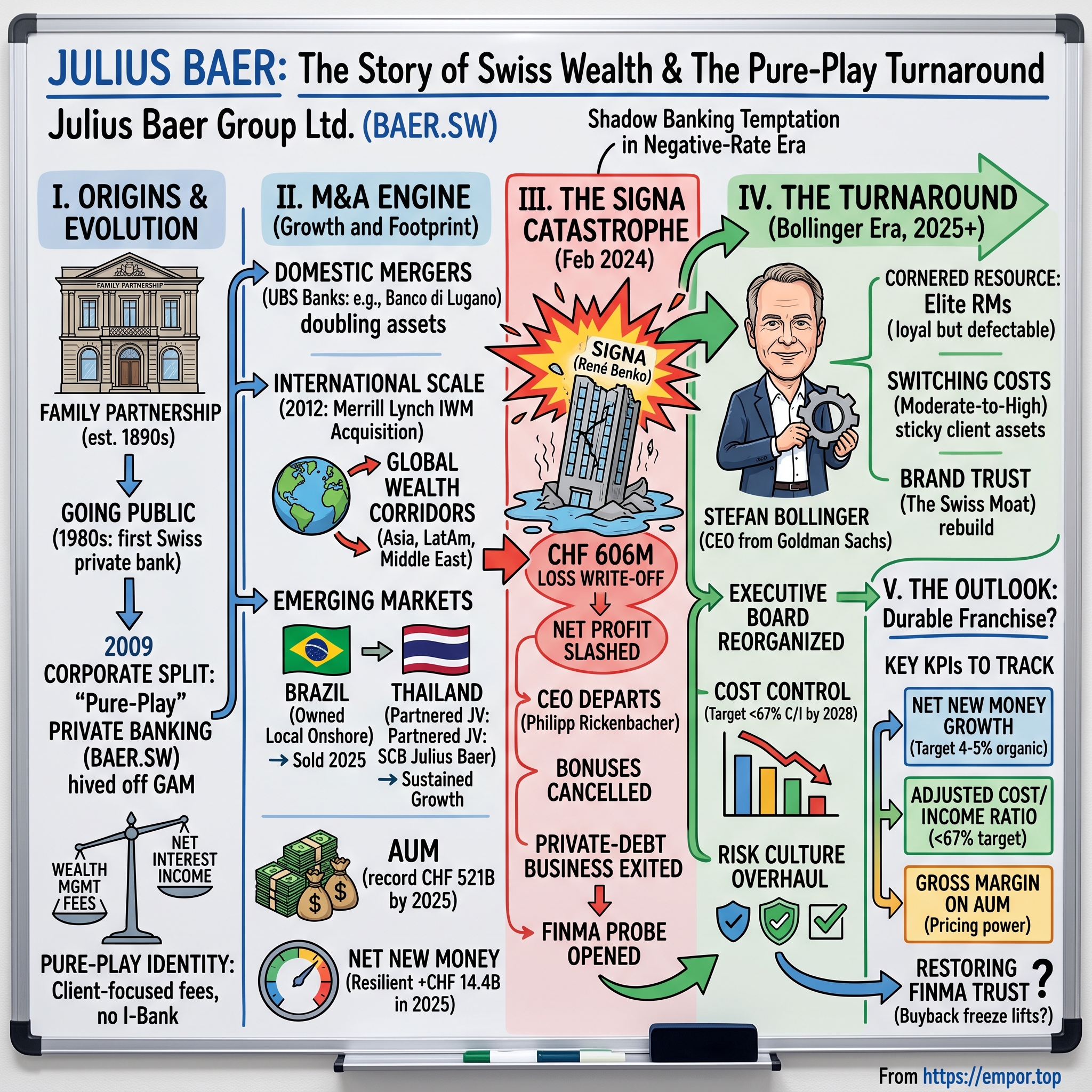
Julius Baer: The Story of Swiss Wealth, Shadow Banking, and the Pure-Play Turnaround
I. Introduction & Episode Roadmap
Picture a bank that had, by almost any measure, done everything right. For more than 130 years it had cultivated the single most valuable commodity in finance—trust—by refusing to do the dangerous things. No sprawling investment bank. No proprietary trading desk blowing up in a crisis. No retail mortgage book. Just wealthy families, their money, and the quiet Swiss promise to look after it. Then, in the space of a single winter, that reputation cracked. In February 2024, Zurich's Julius Baer Group told the market it was writing off the entire CHF 606 million it had lent to one client: a flamboyant Austrian real-estate developer named René Benko, whose Signa empire had just collapsed into the largest corporate bankruptcy in postwar Austrian history.12 The write-off cut the bank's 2023 net profit by more than half, cost its chief executive his job, and dragged Switzerland's financial regulator into the boardroom.2
How did the country's largest independent, "pure-play" private bank—an institution whose entire brand was not taking reckless risks—end up as the single largest creditor to a debt-fuelled property speculator? That is the paradox at the heart of this story, and it is a paradox with a structural cause rather than a merely human one.
The pure-play wealth model is beautiful on paper. You take no balance-sheet risk to speak of, you charge fees for advice and administration, and you compound the assets of the world's rich as they compound their own fortunes. But that same model has a hidden pressure valve. When interest rates go to zero—or below zero, as they did in Switzerland for the better part of a decade—the fee-and-deposit machine sputters. Relationship managers, the expensive human beings who actually hold the client relationships, still need to be paid. And the temptation to manufacture yield, to lend a little more aggressively to the biggest clients, becomes almost irresistible. Signa was that temptation made flesh.
This is the story of how Julius Baer became a pure-play, why that identity is both a genuine structural advantage and a trap, and whether a Goldman Sachs banker parachuted in as CEO can rebuild what a single bad loan nearly destroyed. The roadmap:
- The nineteenth-century family origins of Julius Baer in Zurich, and the long march from a private partnership to a listed company.
- The structural transformation that made it a "pure" private bank: shedding its asset-management arm and listing on the Swiss exchange under the ticker
BAER.SW. - The M&A engine that doubled the bank overnight, culminating in the game-changing purchase of Merrill Lynch's international wealth business.
- The Signa catastrophe—the private-debt disaster that cost the CEO his job and triggered a formal regulatory probe.
- The next act: Stefan Bollinger's turnaround plan and the 2026–2028 strategic cycle, and whether the evidence supports the promise.
Throughout, we will keep one question in front of us: is Julius Baer a durable franchise that stumbled once, or a structurally conflicted business that will keep reaching for yield until it is punished again? Let us start where every great banking story starts—with the moat.
 Subscribe on LinkedIn
II. The Swiss Private Banking Mystique & The Pure-Play Identity
To understand why the world's wealthy park their money in a small, landlocked, Alpine country with no natural resources beyond scenery and discretion, you have to understand what Switzerland was selling. For most of the twentieth century, the product was not investment returns. It was safety of a very specific kind: political neutrality that kept the country out of two world wars, a hard currency, a legal tradition of banking secrecy codified in 1934, and a cultural reflex toward discretion so ingrained it became a national brand.
A Greek shipping family, a Latin American industrialist, a Middle Eastern royal, an Indian promoter—each faced the same private nightmare: that a coup, a devaluation, an expropriation, or a vindictive tax authority could vaporize a fortune built over generations. Switzerland offered an insurance policy against your own country. That is the real "Swiss moat," and it explains a peculiar feature of the business that outsiders miss: much of the money managed in Zurich and Geneva was never Swiss. It was offshore—wealth booked in Switzerland but belonging to clients living in São Paulo, Hong Kong, Dubai, or Mumbai. The Swiss banks built booking hubs to serve those corridors, planting flags in 新加坡 Singapore and 香港 Hong Kong so that an Asian client could keep a Swiss account without ever crossing an ocean.
The industry that grew up around this promise was originally organized as private partnerships, where the partners bore unlimited personal liability. That structure was itself a marketing device: if the people running the bank could lose their own houses when the bank failed, they would presumably be careful with yours. Over the past three decades most of the great houses drifted away from that model, converting into corporations and, in some cases, listing on public markets—trading a measure of the old skin-in-the-game discipline for access to permanent capital and the ability to make acquisitions with shares.
There is a myth worth puncturing here, because it explains why the modern Swiss bank has to work so much harder for its fees than its ancestors did. The popular image is that Swiss banking still runs on secrecy—numbered accounts, nods and winks, money that no tax authority can find. That world is largely gone. Under sustained pressure from the United States and the European Union through the 2010s, Switzerland dismantled cross-border bank secrecy, signing up to the automatic exchange of account information with dozens of governments and forcing its banks to purge undeclared foreign money from their books. For the Swiss houses this was an existential re-engineering: the product they had sold for the better part of a century—confidentiality itself—was legislated away, and they had to replace it with something harder to deliver. The pitch shifted from "we will hide your money" to "we will manage your money better, across more jurisdictions, with more sophistication, than anyone else." That transition matters enormously to the investment case, because it stripped out the lazy, high-margin business of simply warehousing hidden fortunes and replaced it with a genuine competition on advice, breadth of platform, and performance. The banks that adapted learned to earn their keep; the ones that clung to the old model shrank or were absorbed. Julius Baer, already public and already global, had no choice but to compete on the merits—which raised the stakes on every strategic decision and, as we will see, made the temptation to manufacture margin the hard way all the more seductive.
That corporate evolution split the Swiss wealth world into two camps, and the distinction matters enormously for investors. On one side sit the universal banks—above all UBS, now the last Swiss giant standing after it absorbed Credit Suisse in 2023. Universal banks bolt wealth management onto a capital-intensive investment bank, a trading operation, and a retail branch network. The pitch is one-stop shopping and enormous scale; the cost is complexity and a permanent thicket of conflicts of interest, because the same institution that advises a client may also be trading against the market the client is invested in, or underwriting the bond the client is being sold.
On the other side sit the pure-plays: Julius Baer, and the storied Geneva partnerships Pictet and Lombard Odier. Their pitch is the mirror image. We do not have an investment bank whose losses can sink the ship. We do not sell you our own products to hit a quota. We charge you a fee, we advise you, we custody your assets, and our interests are aligned with growing your wealth rather than churning it. It is a cleaner story, and for a certain kind of client it is worth paying for.
But—and this is the analytical crux of the whole episode—the pure-play model has a structural fragility that the universal banks partly escape. Strip out the investment bank and the trading floor, and roughly two-thirds of your revenue comes from fees on assets, while much of the rest comes from net interest income: the spread you earn on client cash and on lending. That makes a pure-play acutely sensitive to two forces it cannot control. The first is the interest-rate cycle: when rates fall, the spread on client deposits compresses toward nothing. The second is the cost of human capital, because in this business the relationships live with the relationship managers (RMs), not with the logo on the door, and elite RMs command elite pay.
Here is the margin trap. When rates are high, life is easy; net interest income gushes and everyone looks like a genius. When rates collapse—as they did across the negative-rate 2010s—the pure-play is squeezed from both sides: falling interest income and rising RM compensation. Management, staring at a stagnant margin, faces a choice. Cut costs and shrink, which is painful and slow. Or find a way to make the balance sheet work harder—to lend more, to lend to bigger and riskier clients, to build a "structured finance" book that promises fat margins in exchange for taking on credit risk the pure-play model was supposed to avoid. Every incentive in the system pushes toward that second door. Keep that door in mind, because Julius Baer walked through it—and the room on the other side had René Benko in it. But first, we need to understand how a nineteenth-century Zurich exchange bureau became the thing that could make that mistake at all.
III. Foundations: From Family Partnership to the Public Markets
In 1890, a man named Julius Bär bought his way into a Zurich exchange and money-changing business on the Bahnhofstrasse, the street that would become the spine of Swiss finance.3 The name went on the door, and for the next century the firm was what its name implied: a family house, run by Bär descendants, doing the unglamorous, essential work of moving money, changing currencies, and safeguarding the savings of Zurich's merchant class. Two world wars, the Depression, the rise and fall of the gold standard—the little bank on the Bahnhofstrasse survived them all by doing exactly what conservative Swiss private banks were supposed to do: taking almost no risk and charging for reliability.
We are going to move quickly through the century of family stewardship, because the story that matters for an investor today begins with the firm's transformation from a private house into a public company—and, crucially, into a pure one. For most of its life Julius Baer was not a pure-play at all. It was a mixed institution with two engines: a private bank that looked after wealthy individuals, and an institutional asset-management arm that ran funds for pension schemes and other big allocators. Those are genuinely different businesses. The private bank sells trust and discretion to families; the asset manager sells investment performance to professionals. Owning both meant Julius Baer was, in equity-market terms, a muddle—hard to value, pulled in two strategic directions.
The public-markets story is older and messier than the tidy version usually told, and the details matter. Julius Baer had actually been listed for decades—it became the first Swiss private bank to go public, back in 1980, though the founding family kept voting control through a dual-share structure.3 The transformation into the pure private bank investors trade today came much later, and it came from surgery rather than an IPO. In October 2009, the group split itself in two: the private bank continued as Julius Baer Group Ltd., trading under SIX-listed BAER.SW, while the institutional asset-management arm was hived off as a separately listed company under the GAM name.3 What was left was something rare on global stock markets: a large, liquid, dividend-paying, publicly traded pure private bank. If you wanted to own Swiss wealth management—the moat, the offshore corridors, the fee machine—without also owning a fund-management business or an investment bank, Julius Baer became just about the only way to do it at scale through a single, freely tradeable stock.
The wisdom of that separation looks sharper in hindsight when you watch what happened to the other half. GAM, cut loose to sink or swim on its own, spent the following decade lurching from crisis to crisis—a liquidity scandal in a flagship fund, waves of redemptions, a collapsing share price, and eventually a contested takeover saga. That the asset manager nearly imploded while the private bank compounded is about as clean a natural experiment as corporate history offers: these were two businesses that never truly belonged under one roof. It also tells you something encouraging about the culture—at least once, this management was willing to shed a business it could not run to advantage rather than cling to it for the sake of size. Whether that discipline was durable or a one-off is a question the Brazilian retreat and the private-debt exit would both revisit. But having simplified its corporate structure, Julius Baer spent the next decade doing precisely the opposite to its footprint.
That scarcity is itself part of the investment case, and it is worth pausing on. Pictet and Lombard Odier, the two other great pure-plays, remained private partnerships; you cannot buy their shares. UBS gives you wealth management wrapped inside a universal bank. Julius Baer gives you the pure exposure in listed form. For a certain investor that purity is the entire attraction—and, as we will see, it is also what makes the stock so unforgiving when the purity is compromised. A clean identity cuts both ways: it magnifies the reward when management stays disciplined, and it magnifies the punishment when management does not.
Having become a pure-play, Julius Baer now needed to become a big pure-play. In wealth management, scale is not vanity; it is survival. The fixed costs of compliance, technology, and booking infrastructure are enormous and rising, and they get spread across your asset base. A sub-scale private bank is a slow death. So the bank turned to the one lever that could add scale fast: acquisitions.
IV. The M&A Boom: Scaling the Global Wealth Corridors
If the twentieth-century Julius Baer grew like a tree—slowly, organically, one client at a time—the twenty-first-century version grew like a corporation on a mission, buying its way to scale with a boldness that would have horrified its cautious founders. The M&A engine had two settings. The first was defensive: use deals to bulk up in the crowded home market. The second was offensive: use deals to plant flags in the fast-growing wealth corridors of the emerging world. Both settings, over time, added assets. Both also added something less visible on the ledger—legacy compliance risk that would take a decade to surface.
The transformative home-market deal. The opening move came from an unlikely seller: UBS. In the mid-2000s Julius Baer acquired a cluster of private banks—Banco di Lugano, Ehinger & Armand von Ernst, and Ferrier Lullin—from UBS, an acquisition that roughly doubled the bank's managed assets in a single stroke and cemented its position in the Swiss heartland hubs of Lugano and Geneva. This was the deal that turned Julius Baer from a respectable mid-sized house into the clear number-one independent Swiss private bank. The strategic logic was airtight: in a business where scale determines who can afford the compliance and technology bills, buying a competitor's book is the fastest way to buy relevance.
The gardener behind the growth. Deals do not make themselves, and to understand the culture that both built the modern Julius Baer and seeded its later disaster, you have to meet Boris Collardi. When he became chief executive in 2009, at the improbable age of 34, he was one of the youngest bosses of any major European bank.19 Born in 1975 to Swiss and Italian parents and raised in Nyon near Geneva, Collardi had skipped university, joining Credit Suisse at nineteen and cutting his teeth in its Singapore operations before arriving at Julius Baer in 2006 as chief operating officer.19 He was, by temperament, everything the stereotype of a Swiss private banker was not: fast, hungry, allergic to the guild's genteel caution. His conviction, stated bluntly, was that the old model was finished—"Just to be a Swiss bank isn't enough anymore," he argued; "now you need to bring local competence."19 He treated Asia as a second home market, flying to Hong Kong and Singapore roughly every six weeks to plant flags and poach bankers, and under his hand assets under management climbed relentlessly—up 75% in his first five years alone, to CHF 264 billion by 2014, and roughly doubling again over his full tenure.19
Collardi built a genuine wealth-gathering machine, and the market cheered the growth. But there was a shadow side that only became legible in retrospect. A culture that prizes speed, scale, and relationship managers who bring big clients is a culture that can, if unchecked, treat risk and compliance as friction to be minimized rather than guardrails to be respected. When Collardi left abruptly in late 2017 to become a partner at the Geneva house Pictet—a defection that stunned the Swiss establishment—the growth-at-pace machine kept running under his successors. The bill for that culture, in the form of the anti-money-laundering failings and the catastrophic credit concentration we are about to meet, would land years after its architect had moved on. Keep that lag in mind; it is the through-line that connects this section's triumphs to the disasters of the next two.
The deal that changed everything. But the acquisition that defined modern Julius Baer came in 2012, and it was audacious. On August 13, 2012, Julius Baer agreed to buy Merrill Lynch's International Wealth Management business—the private-banking operations Bank of America ran outside the United States and Japan—in a transaction structured around roughly USD 84 billion (about CHF 81 billion) of client assets, more than 2,000 employees, and over 500 financial advisers.45 The agreed price was set at 1.2% of the assets that actually transferred, working out to roughly CHF 860 million in cash and stock.45
Read that structure again, because it is clever. Julius Baer did not pay a fixed price for a fixed pile of assets; it paid a percentage of the assets that stuck. In a business where the assets can literally walk out the door with a departing relationship manager, tying the price to retained assets was a way of sharing the risk of attrition with the seller. The strategic prize was enormous: in one transaction, Julius Baer bought a ready-made global footprint in exactly the corridors where new wealth was being created fastest—Asia, Latin America, and the Middle East. It transformed the bank from a Swiss house with international clients into a genuinely global wealth manager with booking centers strung across the emerging world.
The cost, though, was not just the CHF 860 million. Integrations of this kind are multi-year slogs. Relationship managers defected, sometimes taking clients with them, which is precisely why the earn-out structure existed. And—this is the part that matters for later chapters—Julius Baer inherited books of clients whose paperwork, source-of-wealth documentation, and risk profiles had been assembled under someone else's compliance regime. A decade later, some of those legacy Merrill Lynch relationships would show up in a Swiss regulator's anti-money-laundering findings. When you buy USD 84 billion of other people's client relationships in one go, you are also buying whatever skeletons are in those clients' closets. That is the hidden liability of growth-by-acquisition in a trust business, and Julius Baer would pay for it.
The Brazilian case study—a lesson in scale. No corridor illustrated the promise and the pain of emerging-market expansion better than Brazil. In the 2010s, betting on a domestic Brazilian wealth boom, Julius Baer built an onshore presence by acquiring the local advisory firms GPS Investimentos and Reliance Group. The idea was to capture Brazilian wealth inside Brazil, competing head-to-head with entrenched local players for domestic mandates.
It did not work well enough. In January 2025 Julius Baer agreed to sell its domestic Brazilian wealth-management business to Banco BTG Pactual, and the sale completed in March 2025 for around BRL 615 million (roughly CHF 91 million).67 The retreat carried a lesson that generalizes across the whole industry. Managing Brazilian client wealth offshore—booking it in Zurich or Miami—is highly profitable, because it plays to the Swiss moat and spreads across shared global infrastructure. Running an onshore domestic operation is a different and much harder business: capital-intensive, locally regulated, and pitted against homegrown giants like BTG Pactual with deeper local networks and lower cost bases. The offshore corridor is where the pure-play wins; the onshore mass market is where it bleeds. Selling Brazil was an admission that not all "emerging-market growth" is created equal, and that Julius Baer's real edge is the corridor, not the country.
The Thai frontier—a smarter template. Which is why the bank's 2018 move into Thailand looked, in hindsight, like a wiser design. Rather than buy its way onshore and take balance-sheet and regulatory risk directly, Julius Baer formed a joint venture with ธนาคารไทยพาณิชย์ Siam Commercial Bank, one of the country's dominant lenders, creating SCB Julius Baer.8 The Swiss partner brought the wealth-management expertise and global platform; the Thai partner brought the domestic distribution, the local license, and an existing base of wealthy clients. It was a way to tap onshore Asian wealth by renting a dominant local network rather than trying to build or buy one. Compare Brazil and Thailand side by side and you can see a management team learning, in real time, the difference between owning a market and partnering into one.
The M&A engine, then, delivered scale and reach—but it also stretched the organization's ability to control what it had bought. And nothing exposes weak controls like the pursuit of yield. Which brings us to the room René Benko was waiting in.
V. The Shadow of Shadow Banking: The Signa & René Benko Debacle
Every disaster has a slow, respectable beginning, and Julius Baer's began with a spreadsheet problem. It was the 2010s. The Swiss National Bank had pushed its policy rate below zero, an almost unprecedented experiment that meant banks were effectively charged to hold cash. For a pure-play that earns a meaningful slice of its money on the spread between what it pays depositors and what it earns on their cash, negative rates were a slow-acting poison. The interest engine didn't just slow—it ran backwards. Management needed yield, and the traditional levers weren't producing it.
So the credit department reached for the second door we flagged earlier: structured finance. The idea was to offer the bank's ultra-high-net-worth clients bespoke, complex financing—loans tailored to individual tycoons, secured against assets like commercial real estate, priced at margins far richer than a plain-vanilla mortgage. On paper it was a natural extension of private banking: your wealthiest clients need financing, so why let a rival bank earn that fee? In practice it was a quiet mutation of the whole business model. A pure-play that lends only against liquid, marked-to-market securities is barely taking credit risk at all. A pure-play that writes bespoke loans against illiquid real estate has become, whatever it calls itself, a lender—a shadow bank—and it is now exposed to the one thing wealth management was supposed to avoid: the credit cycle.
Enter René Benko. The Austrian was the archetype of the era: a charismatic, self-made property developer who had assembled a sprawling empire called Signa, stuffed with trophy commercial real estate and luxury-retail assets across the German-speaking world. Signa was a monument to cheap money—an edifice of debt piled on debt, whose valuations only made sense as long as interest rates stayed near zero and property prices kept rising. Julius Baer became one of Benko's lenders, ultimately extending CHF 606 million across three separate credit facilities, ostensibly backed by premier commercial real estate.12 For a bank of Julius Baer's size, concentrating that much credit risk on a single client was a staggering breach of the most basic principle in lending: diversification. This was not a portfolio of loans; it was a bet.
Then the world changed. Beginning in 2022, central banks raised rates at the fastest pace in a generation to fight inflation. For a business model built on near-zero rates, higher rates were fatal. Property valuations that had been inflated by cheap debt deflated; refinancing that had been routine became impossible. Through 2023, Signa buckled, and late in the year it collapsed into insolvency—the largest bankruptcy in postwar Austrian history. The collateral that was supposed to make those loans safe turned out to be worth a fraction of the debt against it, tangled in a web of holding companies that made recovery a distant, litigious dream.
The reckoning was brutal and public. On February 1, 2024, Julius Baer announced it was writing off essentially the entire Signa exposure, booking net credit losses of roughly CHF 586 million and slashing its 2023 net profit by more than half.12 The number stunned analysts, who had penciled in perhaps CHF 400 million of losses; the reality was far worse.1 And the damage did not stop at the income statement. Philipp Rickenbacher, who had been chief executive since 2019 and had spent months publicly playing down the Signa fallout, resigned by mutual agreement the same day.29 The board canceled and clawed back executive bonuses, and the head of the credit function departed; the chairman, Romeo Lacher, would also announce his exit as the reckoning widened.2 Rickenbacher's own pay told the story of accountability in miniature: his compensation for 2023 was cut sharply from the year before as the losses landed.9
Then came the decision that mattered most for the franchise. Alongside the write-off, Julius Baer announced it would exit the private-debt business entirely.12 No more bespoke structured lending against illiquid real estate. Lending would refocus strictly on traditional lombard loans—credit extended against highly liquid, easily sold collateral like blue-chip stocks and bonds, where the bank can seize and sell the security in a falling market before the loan goes underwater. In effect, management slammed the second door shut and nailed it. It was the right call, and it was also a confession: the bank was admitting that its detour into shadow banking had been a strategic error grave enough to require amputating the entire limb.
Here the neutral posture matters. Management framed the exit as decisive risk discipline, and closing the private-debt book genuinely reduces the odds of a repeat. But an investor should hold two facts side by side. First, the concentration on a single client of that magnitude was not an act of God; it was a governance failure—a risk-management and credit-committee process that let a bet dress up as a loan. Second, the bank only closed the door after the loss, not before. The test of whether Julius Baer has truly changed is not the write-off or the exit—those were forced. The test is whether the controls that failed have been rebuilt so that the next tempting, yield-rich, oversized loan gets stopped before it is written. And whether those controls are credible is no longer only Julius Baer's judgment to make—because by now the regulator had walked into the room.
VI. Under the Regulatory Microscope: The Reputational and Compliance Toll
There is a particular dread that settles over a Swiss bank when Finanzmarktaufsicht FINMA—the country's Financial Market Supervisory Authority—opens a formal enforcement proceeding. FINMA is an unusual regulator with an unusual limitation: unlike its American or British counterparts, it cannot levy punitive fines.[^10] That sounds toothless until you understand the tools it does have, which are arguably scarier for shareholders than a fine. FINMA can confiscate profits it deems illegitimately earned, order structural remediation, install an independent monitor, restrict a bank's business activities, and—most painfully for a capital-returning stock—effectively freeze a bank's ability to hand cash back to shareholders while an investigation is open.
The Signa enforcement probe. In February 2025, roughly a year after the write-off, FINMA opened formal enforcement proceedings against Julius Baer over its risk-management failures in the Signa credit exposure.10 The mechanism of harm here is subtle and worth spelling out, because it drives a large part of the bear case on the stock. FINMA cannot fine the bank into submission—but while the proceeding is live, Julius Baer is in no position to resume the share buybacks that had been a pillar of its capital-return story. Management itself acknowledged it would not even ask FINMA to green-light a buyback resumption until the enforcement overhang cleared.11 For a pure-play whose equity appeal rests heavily on returning surplus capital to shareholders, that freeze is a real and ongoing cost—it ties management's hands on the single lever that most directly supports the share price, and it does so for an open-ended period the bank does not control. The threat of eventual capital surcharges compounds the uncertainty.
The strategic implication is uncomfortable: Julius Baer's capital-return narrative is now hostage to a regulator's timetable rather than the board's. The bank can build capital—and it has, with its CET1 ratio climbing sharply through 2025, a point we will return to—but building capital and being allowed to return it are different things. Excess capital that cannot be deployed or returned is a drag on returns, and every quarter the probe stays open is a quarter of that drag.
The legacy AML crackdown. As if to prove that the compliance tail of a decade of aggressive M&A is long, a second and entirely separate regulatory matter surfaced in November 2024. FINMA concluded a previously confidential investigation into Julius Baer's anti-money-laundering controls, finding a "serious violation" of money-laundering rules and ordering the bank to disgorge roughly CHF 3 million in unlawfully earned profits and cover about CHF 1.3 million in costs—more than CHF 4 million in total.1213 The failings spanned 2009 to 2019 and centered on the bank's inability to detect or act on suspicious transactions, with specific problems flagged at its Monaco and Singapore branches and accounts linked to a Russian banker suspected of embezzlement and to several Indian nationals.1213
The dollar figure is trivial for a bank of this size; the meaning is not. Trace the dates—2009 to 2019—and the timeline overlaps precisely with Julius Baer's most aggressive expansion, including the digestion of the Merrill Lynch international book acquired in 2012. This is the delayed invoice for growth-by-acquisition in a trust business. When you buy tens of billions in client relationships assembled under someone else's standards, you inherit the risk that some of those clients should never have been onboarded—and you may not find out for a decade, when the paperwork is finally scrutinized under a Swiss microscope. The AML case and the Signa case are not really two separate stories. They are the same story told twice: a franchise that grew faster than its control functions could safely govern.
For investors, the regulatory chapter reframes the entire turnaround. The job facing new management is not merely to cut costs and grow assets. It is to convince a skeptical regulator that the institution's risk culture has genuinely changed—because until FINMA is convinced, the capital-return lever stays locked. That is a very specific mandate, and it explains why the board went looking for a very specific kind of CEO.
VII. The Turnaround Playbook: Stefan Bollinger's "Goldmanization"
When a wealth manager whose defining failure was taking too much risk goes shopping for a new chief executive, the logic of the hire almost writes itself: find someone whose entire career was built inside an institution that treats risk management as a religion. Julius Baer found that person at Goldman Sachs.
Stefan Bollinger took over as CEO of Julius Baer in January 2025, poached from Goldman Sachs, where he had served as co-head of Private Wealth Management for the Europe, Middle East and Africa region.14 The symbolism was deliberate. Goldman is not a private-banking house in the cozy Swiss sense; it is an institutional risk machine, an organization whose culture is defined by rigorous credit parameters, layered risk controls, and a paranoid attention to what can go wrong. Bringing a Goldman lifer into Zurich's genteel wealth world was a statement that the era of clubby, relationship-driven risk-taking was over. The financial press quickly dubbed the project the "Goldmanization" of Julius Baer—the grafting of institutional-grade risk discipline onto a private bank that had just proven, expensively, that it lacked it.
Bollinger's opening moves were about credibility, and they were aggressive. He took a chainsaw to the top of the house, streamlining the executive board from fifteen members down to five and reorganizing the bank around global client segments rather than the tangle of regional and product silos that had grown up over years of acquisitions.15 He cut hundreds of jobs as part of a broader clean-up.15 The message to FINMA, to staff, and to shareholders was the same: accountability now runs through a small number of people, the org chart is legible, and the person at the top came from a place where risk controls are not optional.
Bollinger did not arrive alone, and the wider board refresh matters as much as the CEO change. Julius Baer installed a new chairman in 2025—Noel Quinn, the former chief executive of HSBC, one of the world's largest and most heavily regulated banks. Pairing a Goldman-trained risk operator as CEO with a big-bank veteran as chairman was a deliberate signal to a regulator that had accused the old board of asleep-at-the-wheel oversight. The reconstruction continued into 2026, with Peter Burrill lined up to join as chief financial officer in August 2026, subject to regulatory approval, completing the overhaul of the executive suite.20 For a management team asking FINMA to trust that the risk culture has changed, replacing the faces in the room is table stakes; the harder task is proving the controls behind them work.
The freshest read on that effort came at the half-year mark. In its first-half 2026 results, Julius Baer reported net profit of CHF 673 million—more than double the prior-year period—assets under management of roughly CHF 547 billion, and net new money of CHF 5.7 billion, an annualized organic growth rate of about 2.2%.20 Bollinger was candid that the clean-up is not finished: a deliberate "de-risking" program that sheds clients in high-risk countries and sensitive industries would, he warned, keep dampening inflows into 2027, and on the question investors most wanted answered—when buybacks resume—he would only say the process "moves into the right direction," still declining to give a date.20 That mix of visible profit recovery and studied caution on the regulatory timeline is the honest texture of a turnaround in its early innings.
The substance arrived with the 2026–2028 strategic cycle, unveiled under the banner of "disciplined execution."16 Strip away the corporate language and the plan has three concrete pillars, each of which an investor can test against results.
Cost control. The first target is the bloated cost structure. Julius Baer's cost/income ratio—the share of revenue eaten by expenses, and the single cleanest gauge of operating efficiency in this business—had drifted up to a stubborn 70.9% on an underlying basis in 2024.17 In plain terms, the bank was spending nearly 71 cents to earn a franc of revenue, leaving thin margins for a business that is supposed to be capital-light and highly profitable. Bollinger set a target of an adjusted cost/income ratio below 67% by 2028, backed by CHF 130 million of additional efficiency measures.1618 Alongside it he set a net-new-money growth target of 4–5% and a return on CET1 capital of at least 30%.16
Growth in the right corridors. The second pillar is a deliberate turn away from mass-volume asset gathering—the strategy that, taken to an extreme, produced both the Merrill Lynch compliance tail and the temptation toward yield-chasing—and toward higher-margin advisory mandates in the wealth corridors where Julius Baer's Swiss brand is worth the most: Europe, the Middle East, and Asia. Grow the quality of assets, not merely the quantity.
Rebuilding regulatory trust. The third pillar is unstated in the targets but implicit in the whole exercise: restore FINMA's confidence, because that is the key that unlocks capital return. Institutionalizing credit parameters and risk controls is not just good hygiene; it is the precondition for ever asking the regulator to lift the buyback freeze.
Now the neutral read. Is the "Goldmanization" credible, or is it a story? The early evidence is genuinely encouraging on cost. By the end of 2025 the underlying cost/income ratio had already improved to 67.6% from 70.9%, and the bank reported it had captured CHF 130 million of gross cost savings on a run-rate basis—hitting its efficiency figure early and beating the original target by CHF 20 million.17 Management even signaled the ratio could dip below 67% in the second half. That is real operating leverage arriving faster than promised, and it is the kind of early, verifiable win that builds management credibility.
But two cautions belong in the ledger. First, cost-cutting is the easy half of a turnaround; it is largely within management's control, and a determined new CEO can almost always find fat. The hard half—rebuilding a risk culture so that the next Signa never gets underwritten—is invisible on any KPI dashboard and will only be proven by the loans the bank doesn't make over the next decade. Second, the plan's growth and return targets depend on a benign environment for asset prices and interest rates that no CEO can guarantee. Bollinger has earned early credibility on cost. Whether he has changed the thing that actually broke the bank remains, by its nature, unproven. To judge how much room he has to work with, we need to open up the economics of the bank itself.
VIII. The Economics of Julius Baer
Here is a useful way to think about a pure-play private bank: it is a toll bridge over a river of other people's money. It does not own the money and it takes little risk on the money; it simply charges for the privilege of guarding, advising, and moving it. The size of the river is the assets under management. The toll rate is the margin the bank earns on those assets. Multiply the two and you have most of the revenue. Everything in the economics flows from that simple picture—and from the fact that both the river and the toll rate can move against you.
How the money is made. Revenue arrives through three channels. The largest, typically around 60–70% of the total, is net fee and commission income—the crown jewel. This is the toll itself: fees for discretionary portfolio mandates (where clients hand over the keys and let the bank manage the money), advisory fees, and wealth-planning charges. It is the most attractive revenue in the business precisely because it is recurring and capital-light; the bank earns it year after year simply for managing assets that are already there. The second channel, roughly 20–25% of revenue, is net interest income—the spread on client cash and on lombard lending. This is the volatile piece, exquisitely sensitive to central-bank rates and to whether nervous clients are holding cash (which earns spread) or fully invested (which earns fees). The third channel, around 10–15%, is net trading income, largely from foreign exchange, structured products, and treasury activity as clients move between currencies and markets.
The composition tells you what kind of business this is. The dominance of recurring fee income is what makes wealth management such a coveted model—it is annuity-like, resilient, and it compounds. The chunk of interest income is what makes it cyclical and explains why management is forever fretting about rates. And it was the hunger to juice that interest-sensitive, margin-squeezed middle slice during the negative-rate years that produced the Signa detour. The economics and the scandal are the same coin.
The 2025 numbers make those textbook proportions vivid—and reveal a wrinkle worth understanding. Net commission and fee income, the crown jewel, grew 5% to CHF 2,314 million, with recurring fees up 5% and brokerage income rising 12% as client activity picked up.17 The eye-catching move was on the interest line: reported net interest income collapsed to just CHF 125 million, down more than CHF 250 million year on year.17 That does not mean the bank stopped earning interest; it reflects an accounting migration, as more of the interest-driven economics shifted into the "income from financial instruments measured at fair value" line through the bank's treasury and hedging structure. The lesson for an investor is a general one: in a bank's accounts the headline "net interest income" figure can understate the true interest sensitivity of the franchise, because the economics leak across several revenue lines. What does not change is the underlying exposure—when rates fall, the spread on client cash shrinks wherever it is booked.
The size of the river. By the end of 2025, Julius Baer's assets under management reached a record CHF 521 billion, up about 5% on the year.17 That figure is the headline number the whole business orbits, and its growth came from two sources that an investor must always separate: markets and flows. When stock and bond markets rise, AuM rises without the bank lifting a finger—that is market performance, and it is borrowed, not earned. The number that actually measures the franchise is the money clients choose to bring.
The KPI that matters most. That number is net new money (NNM): the net assets flowing in from clients after subtracting what flows out, stripped of market moves. It is the purest possible read on whether the franchise is winning or losing trust, because it captures the real-time verdict of the world's wealthy on whether they want to bank with you. And here the 2025 result is genuinely striking. Julius Baer pulled in CHF 14.4 billion of net new money in 2025, an organic growth rate of roughly 3%.17
Sit with what that means. This is a bank that, barely a year earlier, had been splashed across the financial press for a CHF 606 million loss to a bankrupt property developer, had lost its CEO, and had a national regulator opening formal proceedings against it. If the pure-play thesis—that the franchise is built on trust and that trust, once broken, sends clients fleeing—were operating at full force, you would expect outflows. Instead, on net, wealthy clients kept bringing money. That resilience is the single most important piece of evidence in the entire bull case. It suggests that the client relationships, held by individual RMs and reinforced by switching costs and the Swiss brand, are far stickier than the headlines implied—that the trust franchise bent without breaking. An investor should not over-read a single year, and NNM can be lumpy, but a positive, roughly 3% organic inflow through the worst reputational storm in the bank's modern history is a powerful data point about the durability of the underlying business.
The strengthening base. The 2025 results also showed a bank rebuilding its foundations. Underlying profit before tax grew 17% to CHF 1,266 million, on a 6% rise in operating income against just a 1% rise in expenses—textbook operating leverage.17 The Basel III CET1 capital ratio jumped to 17.4% from 14.2% a year earlier, and the total capital ratio to 24.7%.17 Those are fortress-like capital levels, comfortably above requirements—which is exactly why the FINMA buyback freeze stings so much. The bank is generating and hoarding capital it is not yet permitted to return.
The same results carried a reminder that the credit chapter is not yet fully closed. The 2025 accounts absorbed net credit losses of CHF 213 million, stemming from a comprehensive review of the loan book completed in November 2025—a housekeeping exercise that flushed out additional problem exposures beyond Signa.17 It is the gap between the two profit figures worth dwelling on: statutory IFRS net profit came in at CHF 764 million, well below the CHF 1,266 million underlying pre-tax result, precisely because of these credit and one-off items. A skeptic would note that a bank still taking nine-figure credit charges two years after swearing off risky lending has not entirely put the legacy behind it; a more charitable read is that a new management team is choosing to lance every remaining boil at once, so that future years start clean. Which interpretation is right will only be settled by whether the credit charges keep recurring.
Why operating leverage stays elusive. So why doesn't a business this attractive simply mint money? Because of the cost side, and specifically the talent war. In wealth management, the client is loyal to the adviser, not the institution. That gives elite relationship managers enormous leverage over their own pay, and it means a rival can inflict real damage simply by hiring your best RMs away—clients often follow. The cost/income ratio is, at bottom, a story about RM compensation, and it is why squeezing efficiency in this business is a permanent grind rather than a one-time fix. Which is the perfect segue into the competitive battlefield, because the RMs are also the front line of the war.
IX. Strategic Positioning: Porter's 5 Forces & Hamilton Helmer's 7 Powers
Let us war-game this business the way a skeptical long/short investor would—not by asking whether Julius Baer is a "good company," but by asking where the profit pools are, who controls them, and whether the bank's advantages are real, durable moats or merely a comfortable brand riding on a Swiss reputation. Two frameworks help: Michael Porter's five forces, which map the structural pressures on an industry, and Hamilton Helmer's seven powers, which identify what actually lets a specific company keep excess returns.
Rivalry: extremely high. Start with the competitive intensity, because it is ferocious. Julius Baer fights for the same finite pool of wealthy clients as a formidable roster of rivals. Above them all now looms UBS, which after absorbing Credit Suisse in 2023 became a consolidated mega-competitor of a scale no independent can match—a universal bank that can cross-subsidize wealth management with its other franchises. Alongside it sit the Geneva pure-play aristocrats Pictet and Lombard Odier; the Liechtenstein-rooted LGT; the nimble EFG International; and the deep-pocketed cantonal player Zürcher Kantonalbank ZKB, which carries an implicit state backing. This is a mature, slow-growing, overbanked market where everyone is chasing the same billionaires, and that structural rivalry caps pricing power and pressures margins.
Supplier power: high—and this is the unusual one. In most industries "suppliers" means vendors. In wealth management the critical supplier is the relationship manager, and RM power is the defining feature of the whole business. Because clients bond with their individual adviser rather than the bank's brand, top RMs can hold a book of relationships almost hostage, threatening to walk—and take the clients—unless they are paid handsomely. This is why compensation is the dominant cost and why the cost/income ratio is so sticky. The suppliers, in effect, capture a large share of the economics the bank produces. Any thesis about Julius Baer's margins is really a thesis about its leverage over its own RMs.
Buyer power: moderate to high. The clients themselves are wealthy, sophisticated, and mobile. Moving assets between Swiss booking centers is not frictionless, but it is far from impossible, and ultra-wealthy clients negotiate hard on fees. They hold real bargaining power, which is another cap on the toll rate.
Threat of substitutes and new entrants: low today, rising slowly. The two remaining Porter forces are where complacency is most dangerous. The classic substitute for a private bank is the single-family office—the ultra-rich hiring their own investment staff and cutting out the intermediary entirely—and at the very top of the wealth pyramid that option is real and growing. A step below sit low-cost passive platforms and digital "robo" advisers that commoditize the plain-vanilla portfolio management a private bank used to charge handsomely for, and above them the booming world of private-market funds that competes for the same client wallet. None of these has yet dented the top-end franchise meaningfully, because at genuine ultra-high-net-worth levels the demand is for bespoke service, multi-jurisdictional complexity, and human trust rather than the cheapest index fund. The threat of brand-new entrants, meanwhile, is genuinely low: the capital, the banking licenses across multiple regulators, and above all the multi-generational brand needed to custody a fortune are barriers no fintech start-up can vault quickly. The honest read is that Julius Baer's competitive perimeter is not under acute assault—but the long-run direction of travel is toward fee compression on the commoditizable parts of the business, which makes management's stated pivot toward higher-margin advisory mandates less a growth flourish than a defensive necessity.
Now flip to Helmer's seven powers, which ask what specifically protects Julius Baer's returns.
Cornered resource: the elite RMs. The same relationship managers who are the bank's most demanding suppliers are also, paradoxically, a genuine source of power. A stable of top-performing advisers with loyal, wealthy client followings is a scarce, hard-to-replicate asset. The catch is that it is a cornered resource the bank only rents, not owns—the RMs can leave, which is exactly why the power is double-edged. It is a moat that can walk out the door.
Switching costs: moderate to high. Once a wealthy family has woven Julius Baer into the fabric of its financial life—estate planning, family-trust structures, multi-jurisdictional booking accounts, credit facilities—unwinding it all and re-papering with a rival is administratively painful and time-consuming. That friction is real, and it is a large part of why net new money stayed positive through the Signa storm: inertia and integration are powerful glue. But note the limit—switching costs slow client departures; they do not prevent a client from routing new money elsewhere, and they do nothing to stop a rival from poaching the RM who holds the relationship.
Brand and trust: high, but conditional. The Swiss wealth legacy is a genuine intangible asset—a "peace of mind" premium that offshore clients in volatile regions will pay for. This is the bank's deepest moat and its most fragile one. It took more than 130 years to build and, as Signa demonstrated, can be cracked in a single winter. The brand is real, but it is not self-sustaining; it is a promise that has to be re-earned with every risk decision.
Put the frameworks together and a clear-eyed picture emerges. Julius Baer operates in a brutally competitive industry where the profit pool is shared with powerful RMs and negotiated down by powerful clients. Its durable advantages—switching costs and brand—are real but partial, and its cornered resource can defect. This is not a fortress business with structural, self-reinforcing economics like a network-effects platform. It is a good business with a genuine but maintenance-intensive moat, one that rewards operational discipline and punishes complacency. That framing sets up the final question every investor must answer for themselves: why does Julius Baer win from here, and what could break the case?
X. The Investment Story Spine: Bull vs. Bear Case
Every investment is an argument with itself. Here is the argument, laid out honestly, with the evidence for and against each side.
The bull case.
The only pure exposure. Julius Baer is close to the only way to own Swiss wealth management as a liquid, listed equity without also owning an investment bank's volatility. Pictet and Lombard Odier are private; UBS is a universal bank. For an investor who wants the annuity-like economics of the wealth toll bridge in clean form, BAER.SW is a scarce vehicle, and scarcity commands a premium.
The Bollinger operating-leverage lever. The single most tangible element of the bull case is cost. A bank running at a 70.9% cost/income ratio has visible fat, and management proved in 2025 that it can cut—delivering CHF 130 million of run-rate savings early and pulling the underlying ratio down to 67.6%.17 Because wealth management has high fixed costs, every franc of cost taken out drops disproportionately to the bottom line as revenue grows. If Bollinger keeps executing toward the sub-67% target, the earnings leverage is real and largely self-help—it does not require the world to cooperate.
The durable organic engine. And underneath it all, the franchise held. CHF 14.4 billion of net new money in 2025, roughly 3% organic growth, through the worst reputational crisis in the bank's modern history, is hard evidence that clients did not flee.17 The trust franchise proved more resilient than the bears feared.
The bear case.
The regulatory freeze. The most concrete bear point is not about the business—it is about the regulator. While FINMA's Signa enforcement proceeding stays open, Julius Baer cannot resume share buybacks, and management has said it is in no position even to ask until the overhang lifts.1011 The proceeding could end in structural constraints or capital surcharges. For a stock whose appeal depends heavily on returning surplus capital, an open-ended freeze on that lever—controlled by a regulator, not the board—is a genuine drag on both returns and sentiment. Fortress capital ratios are cold comfort if you cannot deploy them.17
RM poaching. The cornered resource can be stolen. A bank with a bruised reputation is exactly the kind of target from which competitors try to lift the best relationship managers, and because clients follow advisers, aggressive poaching could turn into asset outflows that the 2025 NNM figure would not have captured. The very supplier power that defines the industry is a live threat when your brand is soft.
Interest-rate headwinds. The net-interest slice of revenue cuts both ways. Just as negative rates once squeezed the bank into shadow banking, falling central-bank rates from here would compress the spread on client cash and lombard lending, eroding a fifth or more of revenue through no fault of management. The cyclicality is structural and permanent.
The activist stress test. A skeptical activist would push on three things. On governance: the Signa loss was not bad luck but a control failure, and the same M&A-driven growth produced a decade-long AML tail—so what proof exists that risk culture has genuinely changed rather than been reorganized on a slide? An activist would sharpen the point with the pay data: after bonuses were canceled in the crisis year, total executive-board compensation rebounded to CHF 49.2 million in 2024 from just CHF 13 million in 2023, as profits recovered—an awfully fast restoration of rewards at a bank that had just detonated CHF 606 million of shareholder capital and remained under active FINMA investigation.21 On capital: the bank is hoarding capital it cannot return; is that a fortress or a trapped asset earning a low return while the buyback stays frozen? On cost: the early cost wins are real, but are they sustainable efficiency or one-time cuts that will reverse the moment the bank has to pay up again in the RM talent war? None of these have settled answers, and that is precisely the point—the case is genuinely contested.
The KPIs to track. Cut through the noise and three numbers tell you almost everything about whether this story is working:
- Net new money growth rate. The purest read on franchise trust and the durability of the client base. Management targets 4–5% organic; watch whether flows stay firmly positive and accelerate toward that band, or whether reputational damage and RM poaching eventually bite.
- Adjusted cost/income ratio. The cleanest gauge of the turnaround's execution. The target is below 67% by 2028; the 2025 print of 67.6% suggests early momentum, but the grind is continuous.
- Gross margin on AuM (in basis points). The toll rate on the river of money. It reveals whether the bank is defending pricing and mix as it shifts toward higher-margin advisory, or quietly giving ground to competitive and client pressure.
Watch those three over time and you will know, well before any headline does, whether the pure-play franchise is healing or hollowing. Which leaves one last question—the one the whole story has been circling.
XI. Epilogue & Lessons
The deepest lesson of Julius Baer is a lesson about the physics of trust, and it is asymmetric. Trust in wealth management is built the way sediment builds rock—slowly, imperceptibly, over more than a century of not doing the reckless thing. It is destroyed the way a dam breaks—suddenly, catastrophically, in a single winter. Julius Baer spent 130 years accumulating a reputation for conservative stewardship and very nearly spent it all on CHF 606 million of loans to one charismatic developer whose empire was made of debt. The core moral is not complicated, which is exactly why it is so easy for a bank to forget when interest rates are negative and the margin is bleeding: juicing yield through risky structured debt is a siren song, and in a pure-play trust franchise it almost always compromises the very thing that made the franchise valuable in the first place. The pursuit of a little extra return nearly cost Julius Baer the whole business.
And yet the more genuinely surprising lesson runs the other way, and it complicates the tidy morality tale. The franchise did not break. For all the theory that broken trust sends the wealthy fleeing, the wealthy mostly stayed—CHF 14.4 billion of net new money arrived in 2025, in the teeth of the scandal.17 That resilience is the real puzzle for investors to sit with. It suggests that the moat in wealth management is less about the pristine institutional brand than about something more human and more granular: the individual relationship between a client and an adviser, the administrative friction of moving a complex financial life, the inertia of a family that has banked in one place for a generation. The headline reputation cracked; the thousands of individual relationships underneath it, held one RM at a time, largely held.
That is the tension the next chapter of this story will resolve. A Goldman Sachs banker is now trying to graft institutional risk discipline onto a house that just proved it needed it, cutting costs faster than he promised while a regulator holds the capital-return lever hostage. The cost turnaround is showing real, verifiable progress. The deeper repair—whether the risk culture that let a bet masquerade as a loan has actually been rebuilt—cannot be proven by any single number and will only be revealed by the loans Julius Baer chooses not to make in the years ahead. For a business that is, at its heart, a 135-year-old promise to look after other people's money carefully, that is the only test that has ever really mattered.
References
-
Julius Baer Replaces CEO, Exits Private Debt After Signa Hit — U.S. News / Reuters, 2024-02-01 ↩↩↩↩↩
-
Julius Baer hit by Signa exposure, announces CEO exit and job cuts — CNBC, 2024-02-01 ↩↩↩↩↩↩↩
-
Julius Baer to acquire Merrill Lynch's International Wealth Management business outside the United States from Bank of America — Julius Baer, 2012-08-13 ↩↩
-
Julius Baer to acquire Merrill Lynch's International Wealth Management business outside the United States from Bank of America — Business Wire, 2012-08-13 ↩↩
-
Julius Baer sells Brazilian domestic business to BTG Pactual — Finews, 2025-01 ↩
-
BTG Pactual closes acquisition of Julius Baer's domestic Brazilian wealth arm — WealthBriefing, 2025-03 ↩
-
SCB Julius Baer Strategic Thailand Joint Venture Launch — Siam Commercial Bank, 2018-02 ↩
-
Julius Baer Ex-CEO Philipp Rickenbacher salary decreased in 2023 after Signa credit losses — Caproasia, 2024-03-21 ↩↩
-
Swiss bank watchdog steps up Signa action against Julius Bär — SWI swissinfo.ch, 2025-02 ↩↩
-
Julius Baer's Capital Puzzle: Navigating Regulatory Overhang and Strategic Reorientation — AInvest, 2025 ↩↩
-
FINMA concludes AML enforcement action against Julius Baer with CHF 4 million penalty — Fincrime Central, 2024-11 ↩↩
-
Julius Baer fined over lapses in AML controls — Private Banker International, 2024-11 ↩↩
-
Julius Baer appoints Stefan Bollinger as CEO — Financial Times, 2024-07 ↩
-
Julius Baer's Crossroads: Can Cost Cuts and New Leadership Secure Long-Term Value? — AInvest, 2025 ↩↩
-
Julius Baer sets focused strategy to unleash its full potential through disciplined execution — EQS News, 2025 ↩↩↩
-
Presentation of the 2025 full-year results for the Julius Baer Group — Julius Baer, 2026-02-02 ↩↩↩↩↩↩↩↩↩↩↩↩↩
-
Julius Baer seeks cost cuts by 2028 in strategy update — Private Banker International, 2025 ↩
-
Julius Baer Asia Push Needs High Energy From Dynamo Collardi — SWI swissinfo.ch, 2014-06-27 ↩↩↩↩
-
Julius Baer beats net new money forecast despite de-risking impact (H1 2026 results) — Global Banking & Finance Review, 2026-07 ↩↩↩
-
Julius Bär pays its management significantly better again — SWI swissinfo.ch, 2025 ↩
 LinkedIn
 WhatsApp
 Reddit
 Hacker News
 Email
Email Kindle
 RSS Feed
 Spotify
 Apple Podcasts
 Amazon Music
 Audible
 YouTube