 Chat with
this content: Summary, Analysis, News...
Chat with
this content: Summary, Analysis, News...
 Subscribe on LinkedIn


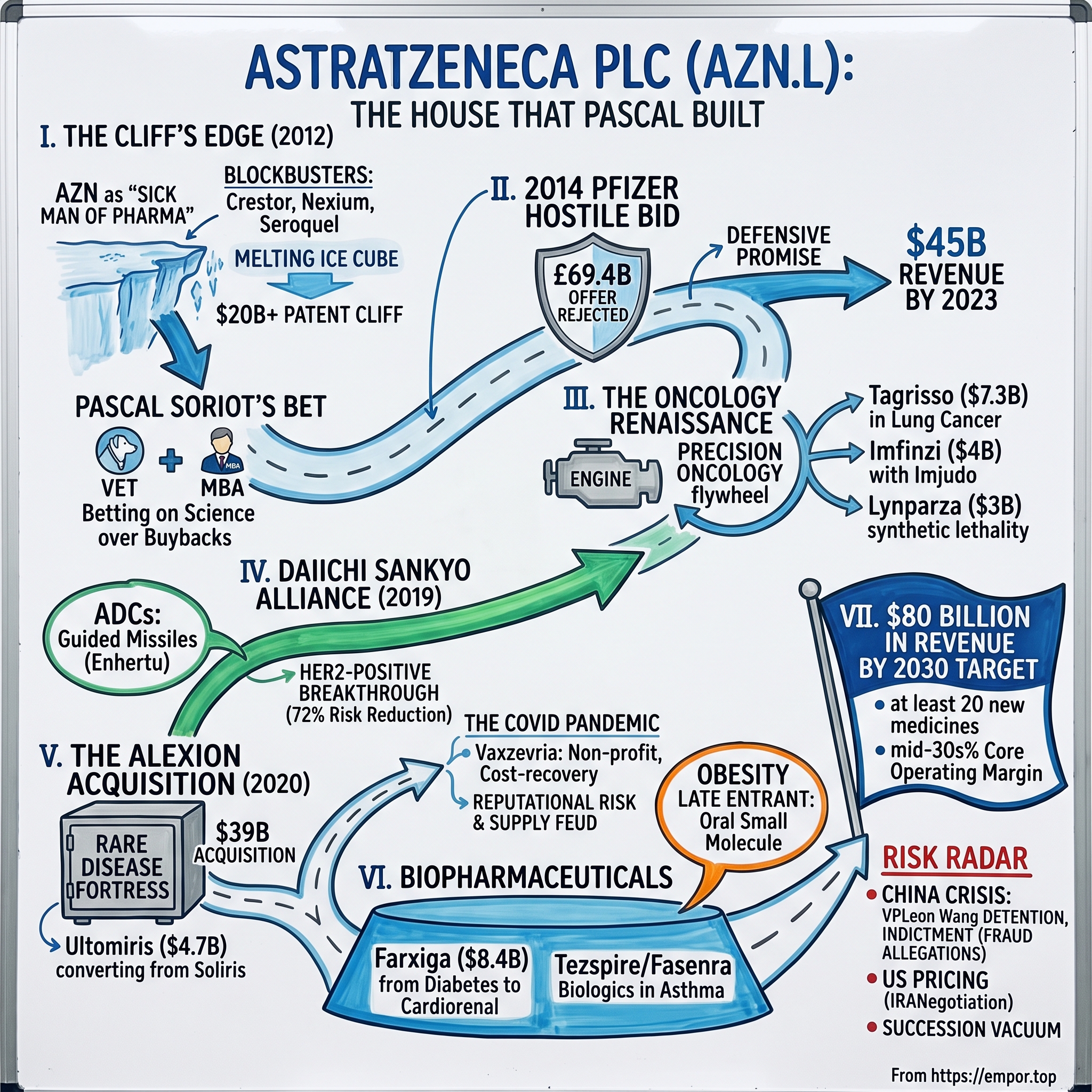
AstraZeneca: The House that Pascal Built
I. Introduction & Episode Roadmap
In May 2024, in a conference hall that felt more like a product launch than a pharmaceutical investor day, Sir Pascal Soriot walked to the front of the room and did something the industry considers reckless. He gave a number. Not a hedged range, not a "mid-term ambition," but a hard target with a date attached: $80 billion in total revenue by 2030, powered by at least twenty new medicines, many of them with peak-sales potential north of $5 billion each.3 In an industry where CEOs are trained to under-promise because biology is cruel and clinical trials fail more often than they succeed, planting a flag that far out is close to heresy.
To understand why the room took him seriously, you have to rewind roughly a decade. In 2012, AstraZeneca was widely described as the "sick man of big pharma." It was staring down a patent cliff worth more than $20 billion in lost annual sales as its primary-care blockbusters — Crestor for cholesterol, Nexium for acid reflux, Seroquel for bipolar disorder — marched toward generic oblivion. Its late-stage pipeline had suffered a demoralizing run of failures. The consensus on the Street was that AstraZeneca was less a growth company than a slowly melting ice cube, destined to be broken up or swallowed.
The moment that consensus nearly became reality was 2014. Pfizer, led by Ian Read, launched a hostile takeover approach that ultimately valued AstraZeneca at roughly £69.4 billion, or about $117 billion.4 Soriot's counter was not a spreadsheet of cost synergies. It was a promise so audacious that analysts openly laughed: that this shrinking, wounded company would nearly double revenue to $45 billion by 2023. When AstraZeneca posted $45.8 billion in 2023, the laughter stopped.1
This is the throughline of the AstraZeneca story, and it is worth stating plainly rather than accepting on management's word. The company's turnaround rests on a specific bet: that if you pour capital into precision oncology and rare disease instead of returning it to shareholders, and if you have the science to back it, R&D productivity itself becomes the moat. This episode tests that thesis. We will trace how the primary-care giant reinvented itself around molecularly targeted cancer drugs; dissect the 2019 Daiichi Sankyo alliance for Enhertu, arguably one of the most value-accretive deals in pharma history; interrogate the math of the $39 billion Alexion acquisition; and stare directly at the current risk radar, including the late-2025 indictment of the company's China chief, insurance-fraud allegations, U.S. shareholder litigation, and the delicate position of being the most exposed Western drugmaker in China.8
It helps to fix the scale of the thing we are talking about. By full-year 2025, AstraZeneca was a business generating $58.7 billion in revenue, with core earnings per share of $9.16, up 11% on the prior year, and it ranked among the very largest constituents of the London Stock Exchange — at times the single most valuable company in the FTSE 100.1 It employs tens of thousands of people across research hubs in Cambridge, Gaithersburg, and Gothenburg, and it markets medicines in more than a hundred countries. This is not a scrappy biotech making a single bet; it is one of a handful of firms with the balance sheet and the global infrastructure to run dozens of parallel programs at once. That scale is both the source of its resilience and, as we will see, the reason a stumble in any one market or molecule rarely sinks the whole ship — but a stumble in management judgment might.
A neutral reading requires holding two ideas at once. Soriot did what he said he would do, twice. And a company built on twenty-drugs-by-2030 promises is a company whose entire equity story depends on execution that has not yet happened. Both are true. Let us begin where the modern story does — at the edge of the cliff.
II. Pre-Soriot Legacy: The Patent Cliff & The Desperate Stand of 2014
Every empire has an origin myth, and AstraZeneca's is a marriage of convenience between two very different corporate cultures. In 1999, Sweden's Astra AB merged with the UK's Zeneca Group in a cross-border deal that created one of the world's largest drugmakers. Zeneca itself was a spinoff, carved out of Imperial Chemical Industries — ICI, the sprawling British industrial conglomerate — which meant AstraZeneca carried in its DNA both Scandinavian scientific rigor and the muscle of a chemicals giant. The combined company inherited a business model that was, for a golden decade, spectacularly profitable and, in hindsight, spectacularly fragile.
The Astra side of the family brought its own pedigree. The Swedish firm had produced Losec, later known as Prilosec — the omeprazole heartburn drug that became, for a stretch in the 1990s, the best-selling medicine in the world and taught the combined company just how lucrative a single primary-care molecule could be. Nexium was its chemically tweaked successor, engineered in part to extend the franchise as omeprazole's patents lapsed, a maneuver critics dismissed as "evergreening." The pattern was set early: find a mass-market chronic condition, dominate it with one branded pill, and defend the patent to the last day. It worked brilliantly, right up until it didn't.
That model was the primary-care mega-blockbuster: a single pill, prescribed to tens of millions of people for chronic conditions, protected by patents, and sold at high volume. Nexium quieted acid reflux. Crestor lowered cholesterol. Seroquel treated bipolar disorder and schizophrenia. These were extraordinary cash machines. They were also, by definition, commodities-in-waiting. The moment a patent expired, a generic manufacturer could produce the identical molecule for pennies, and 80% or more of the revenue simply evaporated — not gradually, but in a matter of quarters. The industry calls this the patent cliff, and the metaphor is apt: there is no gentle slope.
Between 2010 and 2012, AstraZeneca walked off the edge. Crestor, Nexium, and Seroquel all approached or crossed their expiry dates in major markets, and the company had nothing of comparable scale ready to replace them. Worse, the R&D engine that was supposed to manufacture the next generation of blockbusters had stalled. Late-stage failures piled up. Investors watched a company generating enormous cash from a portfolio it could not renew, and they lost patience. In 2012, chief executive David Brennan departed under pressure from institutional shareholders who had concluded that the strategy was broken.
Into this vacuum stepped an unlikely figure. Pascal Soriot grew up in a tough banlieue on the outskirts of Paris, the kind of neighborhood where, by his own telling, learning to read people and defuse conflict was a survival skill. He trained first as a veterinarian and later took an MBA, an unusual pairing that gave him both scientific literacy and commercial instinct. He spent years in the operational trenches of the drug industry, rising through Roche and its crown-jewel biotech subsidiary Genentech, where he absorbed a culture that treated cutting-edge science, not marketing muscle, as the source of durable value. That background matters, because it explains the conviction he would soon stake the company on. He joined AstraZeneca as CEO on October 1, 2012, and his early moves signaled a genuine break with the past.10 He stopped share buybacks. He protected the dividend as a signal of stability. And he redirected essentially every spare dollar of free cash flow away from financial engineering and into R&D — specifically into oncology, the therapeutic area where he believed the science was inflecting and where AstraZeneca had quietly assembled some promising early assets.
This was, in capital-allocation terms, a genuinely contrarian call. Buybacks flatter earnings per share and please income-hungry investors; cutting them to plow money into a research organization that had just failed repeatedly looked, to many, like doubling down on a losing hand. Soriot's wager was that the failures were a productivity problem he could fix — by concentrating resources, killing weak programs faster, and betting on a few areas where the underlying biology was genuinely advancing — rather than proof that the science was barren. He would not have long to prove it before someone tried to take the whole decision out of his hands.
That capital-allocation choice — starve the buyback, feed the lab — is the founding decision of the modern company, and it set up the confrontation that nearly ended it. In 2014, Pfizer came calling. Ian Read wanted AstraZeneca for several reasons: a tax inversion that would let the U.S. giant re-domicile in lower-tax Britain, the sheer scale of the combined entity, and — crucially — AstraZeneca's early-stage immuno-oncology pipeline, including the PD-L1 checkpoint inhibitor that would later become Imfinzi. Pfizer's approaches escalated toward a final proposal worth around £55 per share, valuing the company at roughly £69.4 billion.4
The bid did not arrive all at once; it escalated, as hostile approaches do, in a series of rising offers designed to peel shareholders away from the board. Pfizer moved from an initial proposal around £50 per share in early May to £53.50, and finally to a "best and final" offer of £55.00 per share — a mix of £24.76 in cash and 1.747 Pfizer shares — that valued AstraZeneca at roughly £69.4 billion.164 Each increment was calculated to test the board's nerve and the shareholders' patience.
Soriot's defense is a case study in playing a weak financial hand with a strong strategic one. Rather than promising cost cuts, he issued a projection: AstraZeneca, then generating about $26 billion in revenue and falling, would reach $45 billion by 2023.5 It was a number so far ahead of consensus that skeptics treated it as a negotiating ploy. He also turned the bid into a matter of national interest. The politics were incendiary: Pfizer's chief executive wrote to Prime Minister David Cameron with reassurances on British jobs and research, an overture that initially won a warm reception in Downing Street before the mood curdled. Soriot and his allies pressed the argument that a takeover motivated substantially by tax inversion would gut UK science, threaten thousands of research jobs, and hand a strategic national asset to a company with a history of aggressive post-merger cost-cutting. Members of Parliament hauled executives before select committees. What had begun as a financial transaction became a referendum on the future of British research. The board rejected Pfizer's final terms on May 19, key shareholders backed the long-term plan over the immediate cash, and on May 26, 2014, Pfizer walked away empty-handed.164
The episode crystallized the thesis that governs AstraZeneca to this day: in pharmaceuticals, if you genuinely have the science, R&D productivity is a defense against even a much larger rival's financial engineering. Whether that thesis holds is a question the rest of this story exists to answer. But Soriot had bought himself the one thing he needed — time. And he intended to spend it in oncology.
III. The Oncology Renaissance: Rebuilding the Engine
Walk through the wreckage of a patent cliff and the obvious question is: what do you build in its place? Soriot's answer was to abandon the logic that had made the old AstraZeneca rich. Instead of one pill for tens of millions of people, the new company would chase drugs for smaller, molecularly defined groups of patients — cancers identified not by which organ they started in, but by the specific genetic mutation driving them. It was a bet that the future of oncology was precision, and that precision commanded pricing power that primary care never could.
A decade on, the numbers vindicate the direction, even if they do not settle every debate. In its full-year 2025 results, AstraZeneca reported that oncology generated $25.6 billion, roughly 44% of product revenue and growing at a double-digit clip — the single largest pillar of the company.12 To understand how they got there, you have to meet the drugs.
The crown jewel is Tagrisso, which delivered around $7.3 billion in 2025.2 Tagrisso is an EGFR inhibitor for non-small-cell lung cancer. Here is the layman's version: a subset of lung cancers are driven by a specific fault in a protein called EGFR that tells cells to keep dividing. Tagrisso jams that specific signal. Because it targets a defined mutation, doctors can test a patient's tumor and know in advance whether the drug is likely to work — a far cry from the scattershot chemotherapy of the past. AstraZeneca's masterstroke was to push Tagrisso earlier and earlier in the disease, including into the adjuvant setting — patients whose tumors have been surgically removed but who remain at risk of recurrence. That expands the treatable population and lengthens the duration each patient stays on the drug, which is the economic heart of the franchise.
Then there is Imfinzi, the very PD-L1 checkpoint inhibitor Pfizer coveted in 2014, which surpassed $4 billion in 2025.2 Checkpoint inhibitors work on a different principle from Tagrisso: instead of attacking the tumor directly, they release the brakes on the patient's own immune system so it can recognize and destroy cancer cells. Rather than fight the market leader head-on, AstraZeneca carved out defensible niches for Imfinzi — unresectable Stage III lung cancer, and biliary tract cancers — where it could establish standard-of-care positions instead of trench warfare.
The third leg is Lynparza, a PARP inhibitor developed in partnership with Merck & Co., which contributed roughly $3 billion.2 Lynparza exploits a beautiful piece of biology called synthetic lethality: cancers with a broken BRCA gene already have one DNA-repair pathway disabled, and Lynparza knocks out the backup, so the cancer cell — unable to fix itself — dies, while healthy cells with intact repair machinery survive. The Merck arrangement is itself worth pausing on as a strategic tell. Rather than go it alone, AstraZeneca agreed in 2017 to co-develop and co-commercialize Lynparza with a much larger rival — sharing the profits, but also sharing the enormous cost and risk of running trials across dozens of tumor types. It is the same instinct that produced the Daiichi and Amgen partnerships: when the prize is big and the risk is real, AstraZeneca has repeatedly chosen a smaller slice of a de-risked pie over a whole slice of a riskier one.
Beyond the big three sit the drugs that show where the franchise is heading. Calquence, a next-generation inhibitor for blood cancers such as chronic lymphocytic leukemia, competes in a market long dominated by Johnson & Johnson and AbbVie's Imbruvica, differentiating on tolerability — fewer of the cardiac side effects that plague the older drug. Imjudo and Imfinzi are increasingly deployed together in combination regimens, the industry's answer to squeezing more benefit out of immunotherapy by hitting two immune checkpoints at once. Each of these reflects the same underlying discipline: find a defined patient population, prove a specific advantage, and avoid the commoditized center of the market.
This is where the competitive war-game gets interesting. The dominant force in this arena is Merck's Keytruda, the best-selling drug in the world, which itself faces a patent cliff around 2028. Bristol Myers Squibb fields Opdivo; Roche has Tecentriq. AstraZeneca's strategy has been to avoid the bloodiest battlefield — broad, first-line metastatic lung cancer, where Keytruda is entrenched — and instead win in earlier-stage, biomarker-defined populations where a targeted drug can become the default. It is flanking maneuver rather than frontal assault, and it reflects a clear-eyed reading of where a challenger can actually win.
The purest expression of this thinking is the adjuvant strategy behind Tagrisso. The ADAURA trial tested the drug not in patients dying of advanced cancer, but in those whose EGFR-mutant tumors had just been surgically removed and who, by conventional wisdom, needed no further drug therapy. The result was striking: giving Tagrisso after surgery dramatically reduced the risk of the cancer coming back. The commercial implication is profound. An adjuvant patient is, by definition, not very sick — which means they can stay on the drug for years, and there are far more of them than there are patients with late-stage disease. AstraZeneca had, in effect, discovered a way to expand its most valuable market by moving upstream in the disease. This is the strategic template the company applies again and again: get the molecularly targeted drug to the patient earlier, keep them on it longer, and let duration do the compounding. The risk, of course, is that competitors and payers eventually push back on treating patients who might never have relapsed at all — a debate about over-treatment that trails every adjuvant success.
The economics explain why Soriot bet the company on this. Oncology drugs command high prices with relatively low payer resistance, because the alternative to an effective cancer therapy is often death, and treatment regimens can run for years. Gross margins on these medicines run extraordinarily high, and that gusher of cash is precisely what funds the multi-billion-dollar R&D budget that produces the next generation of drugs. It is a flywheel — provided the pipeline keeps delivering.
There is a deeper analytical point buried in the oncology numbers, and it is the one that actually tests Soriot's founding thesis. The bet in 2012 was that R&D productivity — the rate at which research dollars convert into approved, revenue-generating drugs — could be dramatically improved. The evidence a decade later is genuinely supportive: AstraZeneca's approval rate and the commercial success of its recent launches have run well ahead of where the company sat in its patent-cliff nadir, and independent observers have at times ranked its late-stage pipeline among the industry's most productive. That is not nothing; it is the empirical core of the whole turnaround. But productivity is a rate, not a permanent trait, and the honest skeptic notes that a research organization can look brilliant for a decade and then hit a dry patch, because drug discovery retains an irreducible element of luck. The engine has performed; whether it keeps performing is the question that every subsequent section circles back to.
And that is the honest caveat a neutral observer must attach. The oncology engine is real, but it is not self-sustaining without continuous innovation, and much of AstraZeneca's future oncology growth is pinned to a class of medicines it does not fully own. To understand that dependency, we have to fly to Tokyo.
IV. The Daiichi Sankyo Alliance: A Masterclass in M&A
In March 2019, AstraZeneca signed a deal for a drug that had not yet been approved anywhere, betting billions on a molecule most investors could not pronounce. The partner was Japan's 第一三共 Daiichi Sankyo. The molecule was trastuzumab deruxtecan, an antibody-drug conjugate that the world would come to know as Enhertu. And the initial market reaction was not applause — it was a sell-off.
Start with what an antibody-drug conjugate actually is, because the science is the whole story. Traditional chemotherapy is a carpet bomb: a toxic drug flooded through the entire body, poisoning cancer and healthy tissue alike, which is why patients lose their hair and their strength. An ADC is a guided missile. It takes a monoclonal antibody — a protein engineered to latch onto a specific marker on the surface of cancer cells, in Enhertu's case the HER2 protein — and chemically bolts a potent chemotherapy payload onto it. The antibody finds the tumor, delivers the toxin directly inside the cancer cell, and spares much of the healthy tissue. Daiichi Sankyo's particular chemistry — how many payload molecules it could attach per antibody, and how stably — was the crown jewel, and it is not something a competitor can easily copy.
The deal terms revealed how much AstraZeneca believed. It paid $1.35 billion upfront, with up to $5.55 billion in additional payments contingent on regulatory and sales milestones, for a total potential value of $6.9 billion. Development costs and profits outside Japan would be split 50/50, with Daiichi retaining sole rights in its home market.6 For a single, unapproved asset, the headline number was enormous.
Then came the financial-engineering wrinkle that irritated the market. To fund the upfront cash, AstraZeneca did not borrow — it issued new shares, raising roughly $3.5 billion in an equity placement.6 Diluting existing shareholders to pay for a drug that might still fail struck short-term-focused analysts as either desperation or hubris. In retrospect, it looks like conviction pricing.
Why did Daiichi need AstraZeneca at all? 第一三共 Daiichi Sankyo was a formidable research house with a century of chemistry expertise, but it lacked the sprawling global commercial and regulatory machine required to launch a drug simultaneously across the United States, Europe, and the emerging markets, and to run the dozens of confirmatory trials that turn one approval into many. AstraZeneca brought exactly that muscle. The partnership was thus a trade of complementary strengths: Daiichi's guided-missile chemistry for AstraZeneca's global launchpad. For a Japanese company historically cautious about ceding control of a home-grown asset, handing half of it to a foreign partner was a significant cultural leap — and a signal of how much scale matters in modern oncology.
The clinical data is what turned skepticism into legend. In the DESTINY-Breast03 trial, Enhertu reduced the risk of disease progression or death by 72% compared with Roche's Kadcyla, the prior HER2-targeted standard — a hazard ratio of 0.28 that oncologists described as a generational result.12 A later analysis showed Enhertu also cut the risk of death by 36% versus the same comparator, confirming a genuine survival benefit rather than a statistical mirage.13 Perhaps most strategically, Enhertu proved effective in patients with only low levels of HER2 expression — creating an entirely new treatment category, "HER2-low," and dramatically expanding the population of breast-cancer patients eligible for HER2-targeted therapy. In one stroke, a drug designed for a slice of breast cancer became relevant to a far larger swath of patients, the kind of market-expanding surprise that biology occasionally gifts and that no financial model would have dared assume.
Confident in the first bet, AstraZeneca doubled down. In 2020 it struck a second, even larger agreement with Daiichi for datopotamab deruxtecan, or Dato-DXd — a different ADC aimed at a target called TROP2, found across lung and breast tumors — with a potential value reported at up to $6 billion, later commercialized as Datroway.6 The two deals together turned Daiichi from a one-off partner into the anchor of AstraZeneca's next-generation oncology strategy, and they helped ignite an industry-wide gold rush: after Enhertu's data, virtually every major drugmaker scrambled to acquire ADC capabilities, with rivals paying billions for their own conjugate platforms. AstraZeneca had been early to a paradigm the whole industry now chases.
The lesson for capital allocators is not simply "the deal worked." It is that AstraZeneca correctly priced an early-stage asset that the broader market underestimated, absorbed the short-term pain of dilution, and built commercial and regulatory scale around a partner's chemistry it could not have invented in-house. That is a repeatable capability, or at least management presents it as one. The counter-risk, which we will return to, is dependency: Enhertu's and Dato-DXd's economics are shared, not owned, and a meaningful share of AstraZeneca's future oncology growth rides on a pipeline of ADCs sourced from a single Japanese partner. Concentrated brilliance is still concentration, and a partnership that has been a triumph also creates a strategic reliance that a wholly owned discovery would not.
If the Daiichi deal showed AstraZeneca at its most strategically precise, the next chapter showed it at its most exposed — thrust onto the global stage in a role it did not fully control.
V. The Covid-19 Pandemic: Public Profile and Geopolitical Turbulence
In early 2020, as the world locked down, AstraZeneca made a decision that would define its public image for years and teach it a painful lesson about the difference between doing good and being seen to do good. It partnered with the University of Oxford to develop and manufacture a Covid-19 vaccine — and, extraordinarily, agreed to supply it on a non-profit, cost-recovery basis for the duration of the pandemic. No windfall. No profiteering off a global catastrophe. On paper, it was the ethical high ground.
The technology was elegant and pragmatic. Vaxzevria used a modified chimpanzee adenovirus as a delivery vehicle — a harmless virus engineered to carry instructions that teach the immune system to recognize the coronavirus spike protein. Unlike the mRNA vaccines that required ultra-cold storage, the adenovirus-vector approach was cheaper to make and easier to ship, which made it the workhorse of vaccination campaigns across the developing world and much of Europe. In terms of lives touched, it was one of the most consequential products AstraZeneca ever made.
And yet it became a case study in reputational risk. The trouble began with a clinical-trial stumble: a dosing error in which some participants accidentally received a half dose followed by a full dose appeared, confusingly, to produce better results, muddying the data and unsettling regulators. The U.S. FDA, wanting cleaner numbers, never authorized the vaccine for American use — a conspicuous absence that dented global confidence. In Europe, supply shortfalls triggered a bitter public feud with the European Commission that spilled into the courts. And then came the rarest but most damaging problem of all: a very small number of recipients developed a serious blood-clotting condition, thrombosis with thrombocytopenia syndrome. The absolute risk was tiny, but the headlines were not, and several countries restricted the vaccine's use.
The European supply fight deserves its own paragraph, because it became a defining image of pandemic-era "vaccine nationalism." AstraZeneca had signed an advance purchase agreement with the European Commission in August 2020 committing to deliver 300 million doses by mid-2021. When manufacturing problems at its European plants — combined with export restrictions — forced it to slash near-term deliveries to roughly 100 million, the Commission took the extraordinary step of suing its own supplier in a Brussels court in April 2021.17 The subtext was raw politics: with the UK vaccinating faster, European leaders accused AstraZeneca of favoring Britain, and the company found itself the villain in a cross-Channel blame game it had entered as a humanitarian volunteer. The two sides settled in September 2021, with AstraZeneca agreeing to deliver the full 300 million doses by March 2022, nine months later than first promised.17 For a company that had donated its profit margin, being dragged through court by a government it was trying to help was a masterclass in the perils of good intentions.
Here is the bitter irony a neutral observer cannot ignore. While Pfizer-BioNTech and Moderna, selling their mRNA shots at commercial prices, booked tens of billions of dollars in pure pandemic profit, AstraZeneca absorbed the brand damage, the legal fights, and the geopolitical friction of a non-profit effort — and got comparatively little financial reward for it. And yet the counter-ledger is enormous and easy to forget: the Oxford-AstraZeneca vaccine, manufactured at cost and licensed widely, including to the Serum Institute of India, was delivered in billions of doses and is credited with preventing an extraordinary number of deaths, disproportionately in lower-income countries that the pricier mRNA shots reached last. Virtue, in this instance, was expensive and thankless — but it was not nothing.
The company eventually pivoted. It moved its Vaccines & Immune Therapies work to a commercial footing, developed antibody therapies such as Evusheld and later Sipavibart aimed at protecting immunocompromised patients who respond poorly to vaccines, and ultimately wound down Vaxzevria entirely as the pandemic emergency faded. The investor takeaway is double-edged. On the one hand, AstraZeneca proved it could scale manufacturing to billions of doses across the planet at breathtaking speed — a genuine operational feat. On the other, it learned that wading into a hyper-politicized public-health arena without flawless trial execution is a way to acquire enormous reputational liability for little economic gain. That lesson in the value of diversification and control would echo in the boldest capital-allocation decision of the Soriot era, announced in the very same pandemic year.
VI. Diversification Play: The $39 Billion Alexion Acquisition
In December 2020, with the world still consumed by the pandemic, AstraZeneca dropped a bombshell that had nothing to do with Covid: it agreed to buy Alexion Pharmaceuticals for $39 billion, its largest acquisition ever. The structure was $60 in cash plus 2.1243 AstraZeneca American depositary shares for each Alexion share, a package that represented a 45% premium to Alexion's undisturbed price.7 The market's verdict was swift and unkind — AstraZeneca's shares fell in the days after the announcement as investors questioned the logic and the price.
To understand the rationale, you have to understand what Alexion was. Founded in Connecticut in 1992 by physician-scientist Leonard Bell, Alexion spent more than a decade and a fortune in R&D chasing a then-unfashionable idea: that a single antibody blocking one specific protein in the immune system's complement cascade could treat devastating rare diseases. The complement system is an ancient part of the immune defense — a chain reaction of proteins that punches holes in invading cells. In a handful of rare disorders, that machinery misfires and turns on the patient's own blood cells or organs. In paroxysmal nocturnal hemoglobinuria, or PNH, complement destroys red blood cells, causing clots and organ failure; in atypical hemolytic uremic syndrome, it savages the kidneys. Soliris, Alexion's flagship, blocked the cascade at a protein called C5 and, for the first time, gave these patients a way to live.
Because those diseases are so rare — only a few thousand patients worldwide for some indications — and because the drug is genuinely life-altering, Alexion could charge on the order of half a million dollars per patient per year and face little payer resistance. Rare disease is a fortress business: tiny patient populations, sky-high prices, deep clinical relationships, and enormous switching costs, because patients dependent on a complement inhibitor to prevent life-threatening episodes are not eager to experiment. It was also, before AstraZeneca arrived, a company under pressure — from an activist investor agitating for change and from the looming expiry of the Soliris patent — which is part of why it was available at all.
Soriot's logic was diversification. Oncology was booming, but it was also cyclical, competitive, and increasingly exposed to pricing politics. He wanted a high-margin, cash-generative third pillar that behaved differently from cancer drugs — a shock absorber for the portfolio. Alexion provided exactly that. The skeptics' objection was equally clear, and worth taking seriously: Soliris, the engine of the whole franchise, faced looming biosimilar competition, meaning AstraZeneca was paying a rich premium for a business with a visible cliff of its own.
There was also a financing angle that reveals how Soriot thinks. Unlike the Enhertu deal, which he funded with dilutive equity, the Alexion purchase was paid for mostly in cash plus stock, and AstraZeneca took on substantial debt to close it — a bet that Alexion's fat, predictable cash flows would rapidly pay that borrowing down. The logic was that a rare-disease business throwing off high-margin cash is exactly the kind of asset you should lever against, because its revenues are stickier and less cyclical than oncology's. It was, in essence, using the fortress's own reliability to finance the purchase of the fortress.
What the bears underweighted was Alexion's defensive playbook, and it is genuinely clever. Before biosimilars could erode Soliris, Alexion had developed Ultomiris, a re-engineered, longer-acting version of the same complement-blocking mechanism. The difference is convenience: where Soliris required infusions every two weeks, Ultomiris needs one only every eight weeks. For a patient facing a lifetime of hospital visits, that is transformative — and it gave doctors a reason to switch patients onto the newer, patent-protected drug before cheaper Soliris copies arrived. It is a franchise-extension strategy: cannibalize your own product on your own terms rather than let a generic do it for you. AstraZeneca has since pushed the same complement biology into new diseases, notably a form of the neuromuscular disorder myasthenia gravis, extending the franchise beyond the original blood and kidney indications.
By full-year 2025, the strategy showed up in the numbers. Rare disease generated $9.1 billion, about 16% of total revenue, with Ultomiris alone contributing roughly $4.7 billion and growing at a strong double-digit pace as patients converted from Soliris.12 The third pillar Soriot wanted now stands.
The integration has not been flawless, and a neutral ledger records the misses. AstraZeneca terminated several clinical-stage programs it inherited from Alexion — including the complement asset vemircopan — and took associated write-downs, a reminder that a chunk of the $39 billion was paid for pipeline optionality that did not all pan out.15 The honest verdict is nuanced: the market's initial fear about the Soliris cliff was reasonable, management's conversion strategy has so far answered it, and the diversification thesis has largely delivered — even as some of the acquired science was quietly shelved. Diversification, it turns out, was a theme Soriot was not done exploring.
VII. BioPharmaceuticals: Cardiorenal, Respiratory, and The Next Frontier
If oncology is the company's growth story and rare disease its shock absorber, then BioPharmaceuticals is its broad, steady base — the part of AstraZeneca that quietly touches the largest number of patients. Comprising two divisions, Cardiovascular, Renal & Metabolism (CVRM) and Respiratory & Immunology (R&I), the segment delivered $23.0 billion in full-year 2025, roughly 39% of total revenue, growing at a mid-single-digit pace.12 It is the least glamorous pillar and, in some ways, the most instructive about how AstraZeneca learned from its own history.
The star here is Farxiga, which brought in about $8.4 billion in 2025.2 Farxiga's journey is one of the great label-expansion stories in modern pharma. It launched as an SGLT2 inhibitor for type 2 diabetes — a drug that lowers blood sugar by making the kidneys excrete excess glucose in urine. Then something unexpected happened in the clinical data. Trials showed that Farxiga dramatically reduced hospitalizations and deaths in patients with heart failure and chronic kidney disease — even in patients who did not have diabetes at all. A diabetes drug turned out to be a cardiovascular and kidney drug, and its addressable market exploded. It is a reminder that in pharmaceuticals, the biology sometimes hands you a bigger prize than the one you set out to win. The competitive counterweight is Jardiance, marketed by Eli Lilly and Boehringer Ingelheim, which works by the same mechanism and keeps the category fiercely contested.
Around Farxiga sits a broader cardiorenal portfolio that rounds out the division: Brilinta, an anti-clotting drug used after heart attacks, though it now faces its own generic erosion; Lokelma, which manages dangerous potassium build-up in kidney patients; and a pipeline of next-generation cardiovascular assets such as the hypertension candidate baxdrostat, aimed at patients whose blood pressure resists existing drugs. The strategic thread is that AstraZeneca is trying to own the intersection of heart, kidney, and metabolic disease — conditions that increasingly travel together in aging, overweight populations — rather than any single organ. That positioning is what makes the obesity opportunity so strategically tempting rather than a mere land grab.
The R&I division, at roughly $8.9 billion and growing at a brisk double-digit rate, tells a story of deliberate reinvention.2 This is where AstraZeneca is escaping its own past. The old respiratory business was built on primary-care inhalers like Symbicort — exactly the kind of high-volume product that gets crushed when patents expire. The new business is built on biologics: Tezspire for severe asthma, developed with Amgen, and Fasenra, precision therapies that target the specific inflammatory pathways driving disease in defined patient groups. Same therapeutic area, completely different economics — higher margins, stronger differentiation, harder to genericize. It is the primary-care-to-precision pivot, replayed in the lungs.
Which brings us to the segment's most-watched question mark: obesity. The GLP-1 class of weight-loss drugs — the Ozempic and Zepbound phenomenon — has become the biggest gold rush in the industry, and AstraZeneca arrived late. It entered in 2023 by licensing an oral GLP-1 receptor agonist, then known as ECC5004 or AZD5004, from China's Eccogene. Management frames this not as a speculative flyer but as a strategic core asset, and its angle is specific: an oral small molecule, which is far cheaper to manufacture at scale than the injectable peptides that dominate the market today, potentially combined with the company's cardiorenal drugs to protect against the muscle loss and cardiovascular strain associated with rapid weight loss.
A neutral assessment must be blunt here. This is a management aspiration, not a demonstrated position. AstraZeneca is entering a market where Novo Nordisk and Eli Lilly have years of head start, entrenched brands like Ozempic, Wegovy, Mounjaro, and Zepbound, and manufacturing scale measured in tens of billions of dollars of annual sales. Being late to a category this large has historically been very costly, and the graveyard of pharma is full of "fast followers" who arrived after the market had already consolidated around the pioneers. The oral-and-cheaper thesis is plausible: an oral small molecule sidesteps the injectable-peptide manufacturing bottleneck that has constrained even the incumbents, and pairing weight loss with muscle preservation and cardiovascular protection is a genuinely differentiated pitch. But it is a hypothesis to be tested in large trials and in the market, not an advantage the company yet possesses. AstraZeneca has already had at least one early obesity asset disappoint in trials, a reminder that intent and outcome are different things. That distinction — between what AstraZeneca has proven and what it has promised — becomes the central tension of its most ambitious pledge yet.
VIII. Current Strategy: The Audacious $80 Billion Target
Return now to that May 2024 stage, and to the number that opened this story. Having already pulled off the impossible once — the $45 billion promise made under siege from Pfizer and delivered in 2023 — Soriot chose to do it again, only bigger. The new target: $80 billion in total revenue by 2030, roughly a 6-8% compound annual growth rate from the 2025 base of $58.7 billion, underpinned by the launch of at least twenty new medicines before the decade is out, many with blockbuster potential above $5 billion in peak sales.31
The strategic architecture behind the number rests on three growth vectors and one discipline. The first vector is oncology expansion, moving beyond today's blockbusters into next-generation modalities: more antibody-drug conjugates, bispecific antibodies that engage two targets at once, and cell therapies. The second is deepening the rare-disease franchise, adding complement biology and gene therapy. The third is the BioPharma base, from cardiorenal drugs to the oral GLP-1 obesity bet. The discipline is margin: management has committed to reaching a core operating margin in the mid-30s percent and holding it there, funded by digital transformation, the use of AI in drug discovery, and manufacturing automation.3
To feed those vectors, AstraZeneca has been busy on the deal front, buying capabilities rather than just products. It acquired Fusion Pharmaceuticals to build out radioligand therapy — cancer treatment that uses a targeting molecule to deliver radiation directly to tumors, the same principle that made Novartis's Pluvicto a success. It bought 亘喜生物 Gracell, a Chinese biotech, to bolster CAR-T cell therapy, in which a patient's own immune cells are re-engineered to hunt cancer. And it acquired France's Amolyt Pharma to strengthen its endocrine rare-disease pipeline. These are the seeds intended to become part of the twenty-drug harvest, and they reveal a preference for bolt-on acquisitions of specific technologies over another mega-merger — a deliberate contrast to the Alexion-scale bet.
The named pipeline candidates give the $80-billion target something concrete to be measured against. Camizestrant, an oral treatment for the most common form of breast cancer, is positioned as a potential multi-billion-dollar franchise. Baxdrostat targets resistant hypertension, a huge cardiovascular market. Datroway and the expanding roster of ADCs push oncology into new tumor types. And a geographic detail from the 2025 results sharpens the picture: management expects roughly half of that $80 billion to come from the United States, a reflection of American pricing power but also, as the next section shows, of concentrated exposure to whichever way U.S. drug-pricing politics break.1 The bull sees a diversified portfolio of shots on goal; the bear sees a target that requires an improbable number of those shots to convert.
Now for the neutral stress test, because a target this specific invites one. The bull case is straightforward: Soriot has an established habit of setting outlandish goals and hitting them, which is exactly the kind of behavioral track record that should raise a management team's credibility. Guidance discipline and delivery against prior promises are the strongest evidence an investor has that a forecast is more than marketing. On that count, Soriot has earned genuine benefit of the doubt. The bear case is equally real: $80 billion by 2030 depends on twenty drugs succeeding in clinical trials and in the market, on pricing pressure not accelerating faster than expected, and on a company whose defining CEO will be well into his sixties. A target dependent on twenty future events each carrying meaningful failure risk is, statistically, a fragile object. The honest position is to hold both: an excellent track record does not make biology cooperative.
That fragility points straight at the people who must execute, and the incentives pulling on them.
Evaluating Management & Incentives
Sir Pascal Soriot is, by 2026, one of the longest-tenured chief executives in global pharma, having led AstraZeneca since October 2012 — a run of well over a decade in a job where five years is a good innings.10 His capital-allocation record is the core of the bull case on management: he starved buybacks to fund R&D, defended the company against Pfizer on the strength of the pipeline, priced the Enhertu partnership correctly, and integrated the largest deal in company history. That is a portfolio of decisions that, viewed together, reflects unusual willingness to prioritize long-term scientific bets over quarterly earnings optics.
It has also made him expensive. For full-year 2025, Soriot received total remuneration reported at around £17.7 million, and his maximum potential package for 2026 was set as high as £19.6 million — figures that drew objections from some UK pension funds and governance groups but were ultimately approved by shareholders.14[^10] The board's defense is the transatlantic pay gap: to retain a CEO of Soriot's caliber against the temptation of far richer American packages at the likes of Pfizer and Eli Lilly, they argue, London has to pay closer to New York. A skeptic would note that "pay us like Americans" is a convenient argument for any executive, and that £19.6 million is a lot of money for a company that also asks investors to trust a six-year revenue promise. Soriot's own shareholding — on the order of 0.02% of the company, worth tens of millions of pounds — does align his wealth with shareholders', though it is modest relative to a founder's stake.14
On capital allocation more broadly, the picture is consistent with the founding decision. AstraZeneca has kept its dividend progressive rather than lavish, has favored R&D and targeted M&A over large buybacks, and has broken ground on major new manufacturing — including a headline commitment to invest tens of billions of dollars in U.S. facilities as it braces for a pricing and tariff environment that increasingly rewards making drugs where you sell them. A skeptic's stress test would probe whether serial dealmaking — Enhertu, Alexion, Fusion, Gracell, Amolyt — amounts to disciplined capability-building or the early signs of "diworsification," a portfolio growing too complex to manage. So far the evidence favors discipline: the deals cluster around a few coherent themes rather than scattering across unrelated fields. But complexity compounds quietly, and it is exactly the kind of thing that only looks obvious in hindsight.
The sharpest governance concern is not pay but succession. Soriot is in his late sixties, and the company that has been so thoroughly shaped by one person's judgment has not named an obvious heir. The board has cultivated a bench of senior leaders — a strong chief financial officer, respected R&D and oncology chiefs — but has conspicuously declined to anoint a crown prince, and each year Soriot stays makes the eventual handover a larger single-point risk. For a business whose equity story is essentially "trust the man who has been right twice," the absence of a visible successor is a material, unhedged risk. If the $80 billion target is the House that Pascal Built, long-term investors are entitled to ask who holds the keys when the architect leaves. And no risk to that house looms larger right now than the one unfolding in its single most important growth market.
IX. The China Crisis & Risk Radar
For more than a decade, China was AstraZeneca's great differentiator — the one Western drugmaker that had cracked the world's second-largest pharmaceutical market. The company built an enormous commercial presence, generating well over 10% of group revenue from the region — a far higher proportion than most of its Western peers — and Soriot became one of the most vocal defenders of China as an indispensable market, backing that conviction with billions of dollars in local investment and manufacturing commitments, including a major new research and manufacturing push centered on Beijing.111 Being China's favorite foreign drugmaker was, for years, a genuine competitive advantage. In late 2024 and 2025, it curdled into a genuine crisis.
Understanding the stakes requires understanding how China's drug market actually works. Two policy machines dominate it. The 国家医保药品目录 National Reimbursement Drug List, or NRDL, is the state formulary: getting a drug added means access to hundreds of millions of insured patients, but the price of admission is brutal annual negotiations that routinely demand steep discounts. Alongside it, volume-based procurement centralizes bulk purchasing and squeezes prices further. AstraZeneca learned to play this game better than any foreign rival — pricing for volume, building a vast salesforce reaching into lower-tier cities, and getting its drugs onto the list. That very success, which made China such an outsized contributor, is what made the subsequent legal troubles so consequential.
The face of that crisis is 王磊 Leon Wang, who as Executive Vice President International and President of AstraZeneca China was one of the most powerful executives in the company. In late 2024, Wang was detained by Chinese authorities, and the situation escalated dramatically. In November 2025, Chinese prosecutors formally indicted AstraZeneca's Chinese subsidiary, Wang, and several other former executives.89
The charges are serious and multi-pronged. They include medical insurance fraud — with allegations that genetic test results were altered to trigger state insurance coverage for cancer drugs including Tagrisso; the unlawful collection of patients' personal information; and illegal importation of unapproved medicines, with authorities probing the movement of oncology drugs including Imfinzi, Imjudo, and Enhertu from Hong Kong into mainland China.89 AstraZeneca has said Chinese authorities assessed roughly 24 million yuan — about $3.5 million — in unpaid taxes tied to the alleged illegal imports, which the company prepaid, while warning it could face a fine of up to five times that amount if found liable.9
An investor must weigh two things here without flinching. The direct financial hit — a few million dollars in taxes and even a multiple of that in fines — is immaterial to a company earning tens of billions. The reputational and strategic damage is not. When your most important foreign growth market indicts your country head and your local subsidiary, it raises hard questions about compliance culture, about how much of past China growth rested on practices now under legal challenge, and about whether the political goodwill that made AstraZeneca special in China has evaporated. Compounding this, a U.S. shareholder class-action lawsuit has been filed, alleging that management downplayed systemic compliance failures in the China business — putting the adequacy of the company's disclosures directly at issue.9 Soriot himself moved to reassure staff as the probe widened, an acknowledgment of how destabilizing the affair had become internally.11
There is a broader geopolitical frame here that no amount of legal resolution erases. AstraZeneca spent a decade making itself indispensable to China and China indispensable to itself, and the Wang affair is a reminder that deep exposure to a market where the state controls prices, courts, and the fate of your executives is a double-edged sword. In an era of decoupling between Beijing and the West, being the most China-exposed Western drugmaker is a strategic position that can flip from asset to liability with a single indictment. Management continues to defend its China commitment, but the honest read is that the political premium AstraZeneca once enjoyed there has, at minimum, evaporated.
The China affair is the most acute item on the risk radar, but it is not the only regulatory pressure bearing down on the model. In the United States, the Inflation Reduction Act gave Medicare the power to negotiate prices on selected high-spend drugs for the first time — and Farxiga was among the first ten drugs chosen, with the negotiated price representing a discount reported at roughly 68% off list when it takes effect in 2026.[^11] Management's defense is that Farxiga faces its own patent expiry later this decade anyway, so the negotiated price merely front-runs generic erosion that was coming regardless. That is a reasonable point for Farxiga specifically. The larger, unspoken worry is structural: the IRA establishes a precedent in which future blockbusters — including oncology drugs with far more growth runway — could face government-mandated price compression much earlier in their commercial lives than the industry's economic model assumes. Layered on top is the threat of pharmaceutical tariffs and "most favored nation" pricing proposals that would peg U.S. prices to lower international benchmarks — precisely the pressures pushing AstraZeneca to localize U.S. manufacturing. The buyer, in other words, is getting more powerful on both sides of the Pacific. That shift sits at the center of how to think about AstraZeneca's competitive position from here.
X. Strategic Position: Hamilton Helmer's 7 Powers & Porter's 5 Forces
Strip away the drug names and the dramatic headlines, and the investment question reduces to a single query: does AstraZeneca possess durable competitive advantages, or is it simply running fast on a treadmill of expiring patents? Two frameworks help war-game the answer — Hamilton Helmer's 7 Powers and Michael Porter's Five Forces — and applied honestly, they yield a picture of real but qualified strength.
Begin with what Helmer would call a cornered resource. AstraZeneca's exclusive, multi-billion-dollar collaboration with Daiichi Sankyo for Enhertu and Dato-DXd gives it privileged access to ADC conjugation chemistry that rivals cannot simply replicate — the technical know-how of attaching toxic payloads to antibodies stably and precisely is genuinely hard-won. This is a high-power advantage, with one important asterisk: it is a shared resource, not a wholly owned one, which means the economics and some of the strategic control are split with a partner.
The clearest switching-cost power lives in the rare-disease franchise. A patient stabilized on a complement inhibitor to prevent life-threatening hemolysis, and the physician managing that patient, are both deeply reluctant to switch to an unproven biosimilar when the downside of being wrong is catastrophic. That reluctance is worth billions in revenue durability, and it is why the Alexion business behaves like a fortress even as patents on individual molecules expire. Scale economies constitute a third power: AstraZeneca's roughly $10-billion-plus annual R&D budget and its global clinical-trial infrastructure spread enormous fixed costs across many programs, an advantage no startup can match. And there is a measure of process power — the accumulated organizational skill of navigating oncology approvals, designing adaptive trials, and running global cold-chain biologic manufacturing — though this is more medium-grade, since large peers possess similar capabilities.
Two of Helmer's powers are conspicuously weak for AstraZeneca, and saying so is part of an honest appraisal. Branding — the kind of durable pricing premium a consumer feels toward a beloved logo — barely applies, because a drug's value is dictated by its clinical data and its patent, not by patient affection; the moment a molecule goes generic, no amount of brand equity preserves the price. And network economies, so powerful for platform businesses, are essentially absent, since one patient's use of Tagrisso does not make it more valuable to the next. AstraZeneca's moat, in other words, is built from cornered resources, switching costs, and scale — not from the softer, stickier advantages that protect a Coca-Cola or a Visa. That is worth internalizing: a pharma moat is real but perpetually eroding, which is why the entire enterprise is a treadmill that must keep moving to stay in place.
Porter's Five Forces sharpens where the pressure comes from. The threat of new entrants is low: replicating global commercial scale, regulatory expertise, and trial execution is effectively impossible for a startup without partnering with an incumbent, so the moat against fresh competition is deep. The threat of substitutes is moderate but persistent: once patents lapse, biosimilars and generics erode franchises, which is exactly why the company must keep innovating — the Ultomiris-for-Soliris maneuver is the model response, but it must be repeated indefinitely.
The force that matters most, and the one clearly worsening, is the bargaining power of buyers. Governments and health systems — U.S. Medicare via the IRA, European national health services, and China's NRDL — are aggressively and increasingly forcing prices down. Unlike a consumer market where a strong brand commands a premium, pharma's ultimate customers are often states with monopsony power and a political mandate to cut drug spending. This is the structural headwind against which AstraZeneca's entire high-price, high-margin model must run, and it is intensifying rather than easing.
The remaining two forces are more benign. Supplier power is low: AstraZeneca's key inputs are talent, contract manufacturers, and licensing partners, none of which hold it hostage, though the Daiichi dependency discussed earlier is a partial exception where a "supplier" of chemistry has become genuinely strategic. Competitive rivalry, by contrast, is intense — Merck, Roche, Bristol Myers Squibb, Eli Lilly, Novartis, Johnson & Johnson, and a swarm of biotechs all compete for the same scientists, the same trial sites, and increasingly the same molecular targets. What keeps that rivalry from becoming ruinous is that patents temporarily convert each successful drug into a legal monopoly. The entire industry is thus a race to keep refilling a portfolio of time-limited monopolies faster than the old ones expire — which is simply the patent-cliff dynamic viewed from thirty thousand feet.
Myth vs Reality
Three consensus narratives deserve a fact-check. The first myth is that AstraZeneca is "a cancer company." The reality is that oncology is the largest pillar but not a majority — the BioPharma and rare-disease segments together generate more than half of revenue, and that diversification is precisely the point of the Alexion deal.12 The second myth is that Soriot is an infallible operator. The reality is more textured: the same executive delivered two landmark revenue promises and also presided over the Covid vaccine's reputational debacle, a compliance crisis in his most important growth market, and at least one failed obesity asset. Betting brilliance and operating messiness coexist in the same record. The third myth, popular among bulls, is that the $80-billion target is essentially in the bag because "Soriot always delivers." The reality is that past delivery raises credibility but does not change the base rates of drug development, where most candidates fail — the target remains a probabilistic bet on twenty separate events, not a promissory note.
The Investment Story Spine: Why Win / Why Not
Assemble the pieces and the bull case is coherent. AstraZeneca wins from here if it truly possesses the industry's most productive clinical-development engine — converting R&D dollars into approved blockbusters at an above-average rate — buttressed by a high-margin rare-disease business that shields cash flows from oncology's volatility, and led by a management team with a demonstrated willingness to make bold, long-horizon scientific bets. The evidence for that edge is not merely rhetorical: two delivered revenue promises, a correctly priced Enhertu deal, and a rare-disease conversion strategy that has so far worked are concrete proof points, not slogans.
The bear case is equally grounded, and a neutral observer gives it full weight. AstraZeneca may not win if the succession vacuum after Soriot's eventual departure removes the singular judgment the whole model has relied upon; if the China fallout metastasizes from a legal problem into lasting market-share loss and a permanent erosion of political goodwill; or if buyer power, having found its teeth in the IRA, compresses prices on the next generation of oncology blockbusters far earlier than the $80-billion math assumes. Each of these is a mechanism, not a mood — a specific way the thesis could break. The most intellectually honest conclusion is that AstraZeneca's moat is real but contingent: strong enough to have earned its comeback, not so strong that the outcome is decided.
XI. Outro & Key Takeaways
Step back from the individual drugs and deals, and the AstraZeneca story resolves into a single coherent playbook — Soriot's turn of the wheel. Take a company drowning in low-margin, high-volume primary-care products walking off a patent cliff, and rebuild it around high-margin, molecularly targeted precision medicines. Defend ferociously when you believe in the science, as against Pfizer in 2014, but acquire aggressively when you need diversification, as with Alexion. And be willing to pay — for a partner's chemistry, for a rare-disease fortress, for a world-class CEO — when the value created dwarfs the price. It is a strategy that took AstraZeneca from the sick man of big pharma to a company confident enough to promise $80 billion.
Whether that promise is kept is the open question, and it is not one this story can answer, because the evidence does not yet exist. What a long-term investor can do is watch the right signals rather than the noise. Three matter most.
The first is oncology revenue growth. This is the engine that funds everything; if its growth rate slips from double digits toward stagnation, the R&D flywheel that justifies the entire strategy loses momentum, and the twenty-drug ambition becomes arithmetic that no longer works.
The second is core operating margin. Management has staked credibility on reaching and holding the mid-30s percent range. Margin is where ambition meets discipline — it reveals whether the company can fund its enormous pipeline and still convert growth into profit, or whether the pursuit of $80 billion quietly erodes the economics that make the revenue worth having.
The third is the cadence of pipeline launches toward that 2030 goal. Twenty new medicines is not a slogan but a countable series of regulatory events, and tracking how many actually reach the market — and at what peak-sales potential — is the single clearest read on whether Soriot is about to be proven right a third time, or whether biology and politics finally caught up with the house he built.
References
-
Full Year and Q4 2025 Results — AstraZeneca, 2026-02-10 ↩↩↩↩↩↩↩↩↩
-
AstraZeneca results: FY and Q4 2025 results announcement (PDF) — AstraZeneca, 2026-02-10 ↩↩↩↩↩↩↩↩↩
-
Investor Day 2024 Webcast & Presentation — AstraZeneca, 2024-05-21 ↩↩↩
-
Pfizer withdraws hostile bid for AstraZeneca — Reuters, 2014-05-26 ↩↩↩↩
-
AstraZeneca hostile takeover defence strategy — Financial Times, 2014-05-19 ↩
-
AstraZeneca and Daiichi Sankyo enter into global development and commercialisation collaboration for trastuzumab deruxtecan — AstraZeneca, 2019-03-29 ↩↩↩
-
Acquisition of Alexion Pharmaceuticals, Inc. — AstraZeneca, 2020-12-12 ↩
-
Prosecutors indict AstraZeneca China executives for frauds — Reuters, 2025-11-06 ↩↩↩
-
China indicts AstraZeneca and former exec Leon Wang over data, trade charges — Fierce Pharma, 2025-11-06 ↩↩↩↩
-
AstraZeneca CEO Pascal Soriot seeks to reassure staff on China probe — Bloomberg, 2024-11-06 ↩↩
-
Enhertu reduced the risk of disease progression or death by 72% vs. trastuzumab emtansine (T-DM1) in HER2-positive metastatic breast cancer — AstraZeneca, 2021-09-18 ↩
-
Enhertu achieved statistically significant overall survival, reducing the risk of death by 36% vs. trastuzumab emtansine (T-DM1) in DESTINY-Breast03 — AstraZeneca, 2022 ↩
-
AstraZeneca Axes Two Alexion Assets as Q4 Earnings Exceed Expectations — BioSpace ↩
-
AstraZeneca Board rejects Pfizer's final proposal — AstraZeneca, 2014-05-19 ↩↩
-
AstraZeneca and European Commission reach settlement agreement over vaccine supply, ending litigation — AstraZeneca, 2021-09-03 ↩↩


 RSS Feed
 Spotify
 Apple Podcasts
 Amazon Music
 Audible
 YouTube