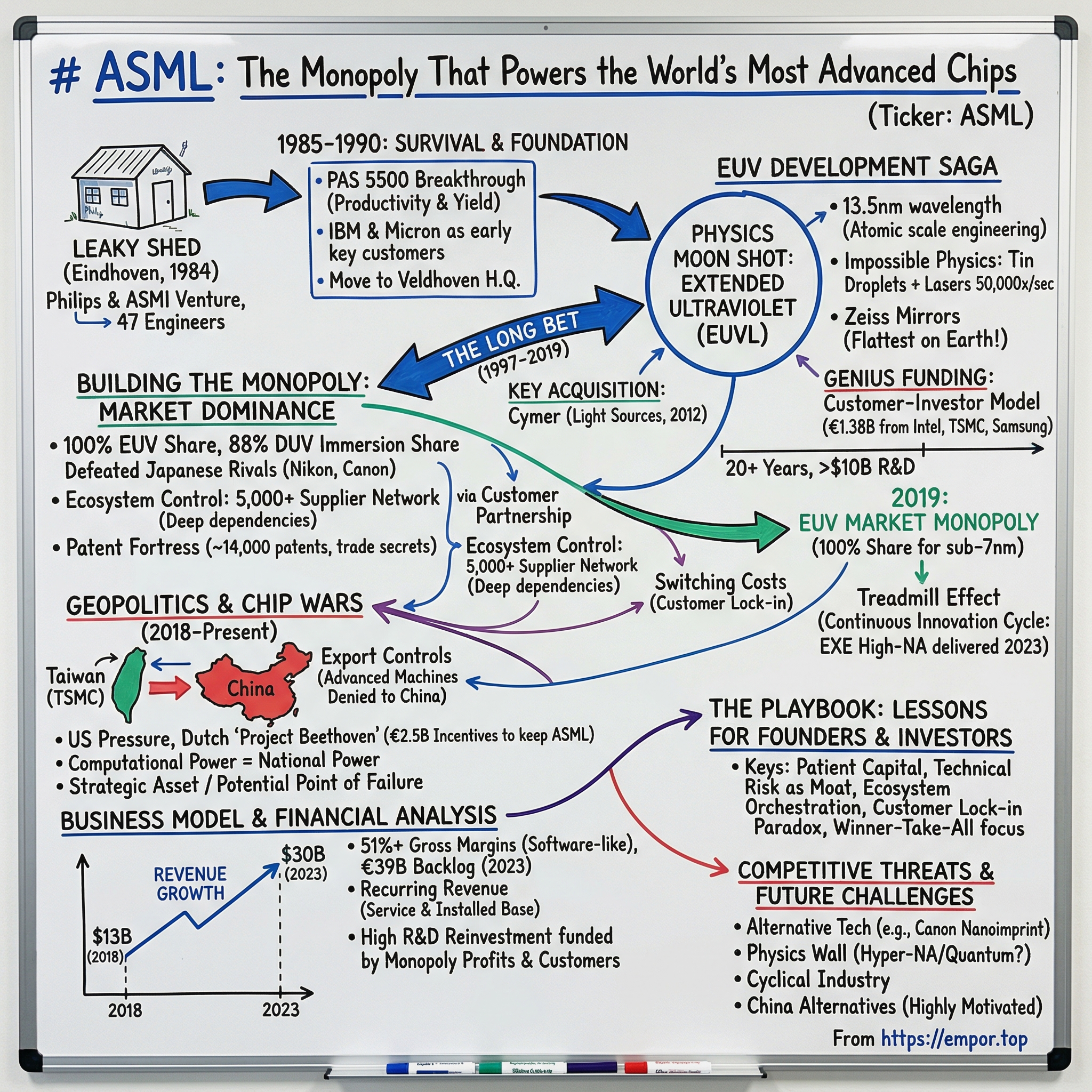
ASML: The One Machine Standing Between the World and the Next Chip
I. Introduction & Roadmap
There is a building in Veldhoven, a town of forty-odd thousand people in the southern Netherlands, where men and women in white bunny suits assemble machines that no one else on Earth knows how to build. The machines are the size of a city bus, weigh as much as a fully loaded airliner once you count the subsystems, and require multiple Boeing 747 freighters to move from the Netherlands to a customer's fab. The most advanced version — the High-NA EUV platform ASML sells under the name EXE — costs roughly $380 million per unit, more than double the roughly $180 million price of the previous generation.1 Every company on the planet that intends to manufacture a leading-edge logic or memory chip must buy several. There is no alternative supplier. There has never been one.
That is the whole story in a sentence, and it is why ASML Holding N.V. is one of the strangest businesses in the public markets: a company whose product is so difficult to make that it has, for more than two decades, faced no competition at all in its most important segment — and whose entire strategic risk therefore lives somewhere other than competition.
The numbers underneath the monopoly are enormous and getting more so. ASML closed 2025 with €32.7 billion in net sales and €9.6 billion in net income, with a year-end order backlog of €38.8 billion and a fourth quarter that alone brought in a record €13.2 billion of net bookings — roughly double what analysts had penciled in.2 By July 2026, management had raised full-year 2026 revenue guidance to €43–45 billion, up from the €34–39 billion range it had issued only six months earlier.32
But this is not really a chip company story, and it should not be read as one. It is a story about who controls a choke point — and about what happens to a company when its choke point becomes so economically valuable that governments start treating it as a strategic asset rather than a private business. ASML sits at the narrowest point of the most contested supply chain in the world. The United States has spent eight years progressively shrinking what ASML is permitted to sell to China. The Dutch government spent €2.5 billion in a single package to persuade the company not to move parts of its operations abroad.[^4] Congress is currently debating a bill that would strip ASML of the right to service machines it already sold.4
The roadmap from here: a leaky shed next to a Philips lab that nobody inside Philips wanted; a twenty-year, roughly $10 billion bet on a physics problem so hard that ASML's own customers had to co-fund it; the emergence of an uncontested monopoly and the acquisitions that widened it; the mechanics of a business where a single order can swing a quarter by billions; the awkward fact that ASML's biggest customer is currently declining to buy its newest machine; the geopolitics; and one October morning in 2024 when €49 billion of market value disappeared before lunch because of a website error.5
Start where ASML started: as a corporate orphan.
 Subscribe on LinkedIn
II. Origins: From Philips Offshoot to Independent Company (1984–1995)
In the early 1980s, Philips — the Dutch lighting-and-electronics conglomerate that once seemed capable of making anything — had a research problem it could not solve commercially. Inside its Natuurkundig Laboratorium in Eindhoven, engineers had built a wafer stepper, the machine that projects circuit patterns onto silicon. It worked. It was called the PAS 2000. And it had no home. A stepper is sold to a handful of semiconductor manufacturers in a brutally cyclical industry that demands relentless annual improvement; Philips was a conglomerate whose management attention was spread across television sets, shavers, and light bulbs. The stepper business needed obsessive focus and a tolerance for losing money for years. Philips could offer neither.
So Philips did what conglomerates do with promising orphans: it found a partner. On April 1, 1984 — an April Fool's Day founding that ASML employees have never stopped enjoying — Philips and Advanced Semiconductor Materials International formed a 50/50 joint venture called ASM Lithography.6 The new company got the PAS 2000, a small team, and premises so unglamorous that the founding lore centers on a wooden shed alongside the Philips lab. In 1985 the operation moved to Veldhoven with about a hundred employees.6
The early machines were not good enough. The PAS 2000 had hydraulics customers disliked, and the PAS 2500 that followed in 1986 was an improvement rather than a breakthrough. What mattered far more, in retrospect, was a decision made that same year that had nothing to do with a product: ASML began working with Carl Zeiss on optics.6 Four decades later that relationship would be simultaneously the deepest source of ASML's advantage and one of its two or three genuine single points of failure.
The company that survived was made by the PAS 5500, the platform ASML launched at the start of the 1990s.6 It was the first ASML product that could credibly claim best-in-class throughput and resolution at the same time — the two variables that determine whether a chipmaker's cost per wafer goes up or down. Customers began ordering not because ASML was Dutch or cheap, but because the machine printed better wafers faster. That is the only argument that has ever worked in this industry, and it is the argument ASML has been making ever since.
By 1995, ASML had outgrown the joint venture. It became a fully independent public company, listed simultaneously in Amsterdam and New York, with ASM International progressively exiting.6 The listing did something more important than raise money. It gave ASML its own balance sheet, its own currency for acquisitions, and — critically — its own capacity to absorb losses on a development program without a corporate parent asking why the lighting division was subsidizing an optics gamble.
Here is why this compressed history still matters in 2026. The template ASML established in its first decade is the template it runs today: sell a platform before the technology behind it is fully proven, get volume customers paying and iterating on it, and use their money and their process data to fund the next generation. The PAS 5500 was that model at small scale. EUV would be the same model at a scale that nearly broke the company — and that no competitor was willing or able to match.
III. The 20-Year Bet: EUV, Cymer, and the Customer-Funded Moonshot (1997–2019)
Explain extreme ultraviolet lithography to someone without a physics background and the sensible reaction is disbelief.
Every lithography machine works like a projector: shine light through a patterned mask, focus it onto a silicon wafer coated in photoresist, and the pattern is transferred. The finer the features you want, the shorter the wavelength of light you need. By the late 1990s the industry was using deep ultraviolet light at 193 nanometers and running out of road. The next step down was 13.5 nanometers — extreme ultraviolet. The trouble is that EUV light does not occur naturally in any usable form, cannot pass through glass lenses (it must be bounced off mirrors so precise that, scaled to the size of Germany, their largest imperfection would be under a millimeter), and is absorbed by ordinary air, which means the entire optical path has to sit in a vacuum.
And the light itself has to be manufactured. The method that eventually worked: fire a high-power carbon-dioxide laser at microscopic droplets of molten tin, roughly fifty thousand times per second, vaporizing each droplet into a plasma that radiates at 13.5nm. Every EUV machine ASML has ever shipped contains a tin-droplet generator running at that rate, continuously, inside a vacuum chamber, in a production fab.
ASML did not invent this alone, and the way it got access to the underlying science is one of the more remarkable episodes in American technology policy. In March 1997 a consortium of U.S. chipmakers led by Intel — with Motorola and AMD, later joined by others — signed a cooperative research and development agreement with three Department of Energy national laboratories, forming an entity called EUV LLC to fund EUV research at Sandia, Lawrence Livermore, and Berkeley.7 In 1999, over objections from some in Washington, ASML was permitted to join and license the consortium's technology, subject to conditions including building a U.S. plant using largely American components — conditions that, by most accounts, were never fully met.7 A foreign company was given a seat inside a U.S. national-laboratory program aimed at the most strategically sensitive manufacturing technology of the coming century. Twenty-five years later, American legislators would spend considerable energy trying to control what that company sells and to whom.
The engineering took two decades and roughly $10 billion. ASML shipped its first EUV prototype, the NXE:3100, in 2010; the NXE:3400 reached what ASML called production readiness in 2016; genuine high-volume manufacturing began in 2019, the year ASML reported €11.8 billion of total net sales.68 Between those dates were years in which the light source produced a fraction of the power required, throughput was too low to be economic, and serious people inside the industry believed EUV would never work.
Buying the ignition system
The light source was the bottleneck, and ASML did not own it. Cymer, a San Diego company, had been ASML's supplier of laser light sources for years and was the furthest along in laser-produced-plasma EUV sources. In October 2012 ASML agreed to acquire it in a cash-and-stock deal valued at about €1.95 billion, roughly $2.55 billion, completing the acquisition on May 30, 2013.910
Judge that decision on outcomes rather than on the multiple paid at the time. Cymer's plasma source became the literal ignition system of every EUV machine ASML has sold since — and EUV system revenue alone reached €11.6 billion in 2025, up 39% year over year.11 A single year of EUV system sales is now roughly six times what ASML paid for the company that makes the light. Whatever premium ASML paid in 2012 was, in hindsight, underpricing. The strategic logic was simpler than the financial logic: ASML had concluded that the most uncertain component in its most important program could not be left in someone else's hands, on someone else's roadmap, at someone else's pace.
The customers write the checks — and one of the two bets fails
The second move was stranger, and it is the one investors should study hardest.
In July 2012, ASML announced a customer co-investment program under which Intel agreed to invest as much as $4.1 billion, taking an equity stake capped at 15% of post-transaction shares alongside committed advance purchase orders for development and production tools.1213 Samsung and TSMC 台灣積體電路製造 followed with smaller stakes. The stated aim was to pull forward two technology transitions by as much as two years: EUV, and a parallel shift from 300mm silicon wafers to 450mm wafers.13
The 450mm bet failed completely, and it belongs in the same paragraph as the EUV triumph rather than in a footnote. Bigger wafers mean more chips per pass and lower unit costs, but only if the entire equipment industry moves together. It did not. ASML paused 450mm lithography development at the end of 2013, citing the absence of clear customer demand and timing.14 Intel — the program's chief sponsor — pulled resources in 2014 as its half-built, 450mm-capable Fab 42 in Arizona sat without production equipment.14 TSMC and the rest of the industry never left 300mm; more than a decade later, 300mm remains the standard.15
So the honest verdict on the celebrated "customer-funded R&D model" is this: one round of customer capital funded one of the most valuable technology programs in industrial history and one complete dud, and neither ASML nor its customers could tell in advance which was which. That does not invalidate the model. It bounds it. Co-investment de-risks ASML's balance sheet; it does not de-risk the technology, and it produced no better forecasting than a normal R&D budget would have.
There is a second, quieter lesson in the equity side of that deal. TSMC fully exited its ASML stake in 2015, and Samsung 삼성전자 sold down in stages from 2016.16 Intel began cutting its own holding in late 2017, and by October 2018 a regulatory filing showed it had fallen below 3%.17 In other words, the three strategic investors who funded ASML's riskiest decade — the people with the best possible information about whether EUV would work — sold before the EUV payoff arrived. It is a useful corrective to the habit of treating informed-investor enthusiasm as prescience. They were right that EUV would work and wrong about when to own the stock.
By 2019, the machines were shipping into real fabs producing real chips at real yields, and ASML had become something that essentially does not exist in modern industrial economics: the sole global supplier of a capability an entire industry could not do without. The next question is how much of that is genuinely durable, and how much is a snapshot.
IV. Anatomy of the Monopoly: Industry Structure, the Ecosystem, and How Durable Is It Really
Walk the length of an EUV machine and you are walking past the outputs of perhaps five thousand suppliers, several of which have no substitute anywhere on the planet. That sentence is the moat, and it is also the risk. This is the section where most of ASML's economic value actually lives, so it is worth being precise rather than rhetorical.
The five forces, read honestly
Run Porter's framework across lithography and four of the five readings come back extreme, and one comes back uncomfortable.
Threat of new entrants: effectively zero. No company has entered EUV in more than twenty years. The barrier is not capital — several governments could fund it — but the accumulated, largely tacit knowledge of making a machine with hundreds of thousands of parts hold nanometer alignment while a plasma detonates fifty thousand times a second inside it. That knowledge lives in ASML's engineers, its supplier relationships, and its installed-base service data.
Rivalry: functionally absent in EUV, real but minor in DUV. ASML has never faced a competitor that shipped a production EUV tool. In immersion DUV — the workhorse for mature and mid-range nodes — ニコン Nikon and キヤノン Canon retain a genuine minority position. Precision matters here: the "100% monopoly" framing is accurate for EUV specifically and should not be extended to the whole company. DUV system sales were €12.0 billion in 2025, actually larger than EUV's €11.6 billion, and that is the segment where competition exists.11
Buyer power: concentrated but structurally weak. ASML's customer list is short — TSMC, Samsung Electronics, Intel, SK하이닉스 SK Hynix, Micron, a handful of Chinese mainstream-logic fabs. In most industries, four customers representing the bulk of revenue would dictate terms. Here they cannot, because there is nowhere else to go. The evidence is in the price: EUV systems run roughly $200 million for low-NA and about $380 million for High-NA, and ASML's gross margin rose from 51.3% in 2024 to 52.8% in 2025 while its customers were, by their own accounts, capacity-constrained.12 Pricing power that survives a customer base this concentrated is close to proof rather than assertion.
Substitutes: theoretical today. Nanoimprint lithography exists as a shipped product. It has no production adoption. Section X treats this on the evidence rather than the press releases.
Supplier power: this is the real one. And it is not hypothetical.
The Zeiss problem, which is also the Zeiss moat
Carl Zeiss SMT, headquartered in Oberkochen, Germany, makes the optical columns — the mirrors and lens assemblies — for ASML's systems. It is the sole supplier, and it can develop and produce those components only at its facilities in Oberkochen and Wetzlar.18 In 2020, purchases from Carl Zeiss SMT accounted for 28.2% of ASML's cost of system sales.18 ASML's own filings describe this concentration as a risk to its ability to ship, not as a theoretical exposure.
ASML's response was not to diversify away from the dependency. It was to bind itself more tightly to it. In November 2016 ASML agreed to acquire a 24.9% minority stake in Carl Zeiss SMT for approximately €1 billion in cash, and separately committed roughly €220 million toward Zeiss SMT's R&D and about €540 million toward capital expenditure and supply-chain investments over the following six years.19 Financing a supplier's factory expansion is a strange thing for a customer to do — unless that supplier's capacity is the binding constraint on your own revenue, in which case it is the only rational move.
The result is a two-sided fact that should be held in mind together rather than picked apart. On one hand, it is a genuine, disclosed concentration risk: a fire, a strike, or a geopolitical event affecting two German sites would constrain the world's supply of leading-edge chipmaking capacity. On the other, it is the most effective barrier to entry in the whole structure. Any would-be competitor would need to replicate not just ASML's machine but Zeiss's optics — and Zeiss's optics capacity is contractually and financially entangled with ASML for years to come.
Cornered resource, not network effect
Applying Hamilton Helmer's 7 Powers, ASML is a process power and cornered resource story, and specifically not a brand or network-effects story. There is no flywheel where more ASML customers make ASML more valuable to the next customer. What there is: two decades of accumulated manufacturing know-how, a patent estate in the tens of thousands, and — most importantly — a body of practical knowledge about how these machines actually behave in fabs that exists nowhere else because nowhere else has an installed base to learn from.
Switching costs follow from this rather than from contracts. An EUV or immersion DUV tool is installed, calibrated, and serviced on-site across a working life measured in decades; a fab's entire process recipe is tuned around the specific behavior of specific tools. Migrating away would be gradual and expensive. But this claim is worth stating carefully, because it is often overstated: the switching cost argument is not what protects ASML in EUV. What protects ASML in EUV is that there is nothing to switch to. Switching costs are the second lock on a door that has no other key.
Buying the adjacent choke point
If lithography prints the pattern, something has to check whether the pattern is right. In June 2016 ASML agreed to acquire Hermes Microvision, the Taiwanese leader in e-beam wafer inspection, for TWD 1,410 per share — roughly TWD 100 billion, about €2.75 billion or $3.1 billion, financed with €1.5 billion of debt, €500 million of equity, and cash.20 HMI dominated e-beam inspection, and the deal extended ASML from "the machine that exposes the wafer" to a fuller lithography-plus-metrology stack: expose, measure, feed the measurement back into the exposure.
A decade on, the honest assessment is that HMI worked but is not transformative. Metrology and inspection system sales were €825 million in 2025, up 28% year over year, on total revenue of €32.7 billion — roughly 2.5% of the company.112 That is a real, growing, high-value business and a genuine widening of the moat into the yield-optimization workflow. It is not a second EUV. Investors who model ASML's adjacencies as a major growth vector are extrapolating past what the reported numbers support.
Where the moat is thinner than the slogan
The place ASML faces actual price competition is DUV, and the pressure is increasing rather than fading. In late May 2026, Nikon's chief executive Yasuhiro Ohmura signaled an explicit strategy of deep discounting on argon-fluoride immersion systems, leveraging Nikon's in-house component manufacturing to undercut ASML's average DUV tool price of roughly $82.5 million and win back mature-node share.2122 Separately, 上海微电子装备 SMEE has moved a domestically produced immersion scanner into production in China, several generations behind the leading edge but plausibly adequate for legacy nodes.21
Neither of these threatens EUV. Both threaten the segment that was, in 2025, the larger of ASML's two system businesses. That asymmetry — an impregnable position in the smaller, faster-growing half and a contested position in the larger, slower half — is the single most under-appreciated feature of ASML's structure, and it flows directly into how the business is actually built.
V. The Business Today: Segments, Economics, and Where the Money Actually Comes From
ASML sells two things: machines, and everything that happens to a machine after it is installed.
The first is lumpy, enormous, and cyclical. The second is the part of the business that has quietly changed shape. In 2025, Installed Base Management sales — service contracts, field options, and performance upgrades sold into machines already sitting in customers' fabs — rose 26% to €8.2 billion, roughly a quarter of total revenue, up from around a fifth in 2023.112 These revenues are not a true subscription, but they are far closer to an annuity than system sales are: they scale with the number of tools operating in the field, and that number only goes up.
A structural nuance worth noting, because it distorts the segment optics: a substantial number of NXE:3800E field upgrades in 2025 shifted revenue that would otherwise have been recognized as EUV system sales into installed-base revenue.23 So part of the IBM growth is genuinely a growing service annuity and part is an accounting placement of what was economically an EUV sale. Both are real; only the first is durable in the way "recurring revenue" usually implies.
Within systems, the split in 2025 was closer than the popular narrative suggests. EUV system sales, including early High-NA, rose 39% to €11.6 billion. DUV system sales declined 6% to €12.0 billion, across 279 systems of which 47% were immersion tools.11 DUV is not a legacy afterthought waiting to be harvested; it was the larger business in 2025, and its decline in a record year is a reminder that the two halves of ASML move on different cycles and face different competitive conditions.
Margins tell the mix story more clearly than revenue does. Gross margin was 51.3% in 2024, 52.8% in 2025, and reached 54.0% in the second quarter of 2026, with full-year 2026 guidance raised to 54–56%.23 Margin moves with EUV and High-NA penetration and with the service mix; it is the single most useful indicator of the quality of ASML's growth, as opposed to its quantity. A revenue increase driven by cheap DUV tools shipped to Chinese mainstream-logic fabs and a revenue increase driven by EUV tools shipped to a leading-edge foundry look identical on the top line and very different below it.
R&D runs at roughly 14–15% of sales — €4.3 billion in 2024, €4.7 billion in 2025 — and is funding two things at once: making the current EUV platform cheaper and more productive, and building whatever comes after High-NA.23 For a company with no competitor in its flagship product, that is a deliberately uncomfortable level of spending. It is also the only reason the flagship has no competitor.
The lumpiness is the business
Then there are bookings, and this is where investors most often misread ASML.
Net bookings are the leading indicator, running roughly one to two years ahead of revenue. They are also violently volatile, because a single large EUV order can move a quarter by billions. The demonstration case runs from October 2024, when third-quarter net bookings came in at €2.6 billion, down 53% sequentially and roughly half of consensus,245 to the fourth quarter of 2025, when net bookings hit a record €13.2 billion, of which €7.4 billion was EUV — more than double what analysts expected.2
Those two prints are fifteen months apart and describe the same company with the same technology and largely the same customers. Neither was a signal about ASML's competitive position. Both were signals about the timing of a handful of fab construction decisions. Any reading of a single quarter's bookings as a verdict on the business is a category error — which does not stop the market from making it, as the October 2024 share price will attest.
The three numbers that matter
For an investor tracking ASML over years rather than quarters, three metrics carry most of the information:
Net bookings, and the EUV share within them. Bookings tell you what revenue looks like in eighteen months. The EUV mix inside bookings tells you whether that revenue will carry ASML's better or worse margins.
Gross margin. The cleanest available proxy for EUV and High-NA penetration and for the health of the service business, and the number that reveals whether growth is coming from the valuable half of the company or the contested half.
China as a percentage of total sales. Not a demand indicator — a policy indicator. It measures how much of recent growth was backlog-clearing ahead of export restrictions versus durable underlying demand, and it is the line item most exposed to decisions made in Washington and The Hague rather than in Veldhoven.
Everything else — units shipped, backlog, regional splits — is context. Those three are the spine. And the second of them, gross margin, leads directly into the question of whether ASML's next product actually sells.
VI. High-NA EUV: Extending the Monopoly — Or Hitting Its First Real Resistance
In a clean room in Oregon in 2024, Intel engineers began working with the first commercial High-NA EUV system ever installed. It is a machine that arrives in roughly 250 crates and takes months to assemble. It is also, in a narrow but important sense, the answer to the question every ASML investor is actually asking: does the monopoly extend into the 2030s, or does it plateau?
The physics of High-NA is easier to grasp than it sounds. "NA" is numerical aperture — a measure of how wide a cone of light the optics can capture and focus. Moving from 0.33 NA to 0.55 NA is like going from a narrow flashlight beam to a wide one: more light angles collected means finer detail resolved. ASML's EXE platform delivers roughly 1.7 times smaller feature sizes and about 2.7 times the transistor density of first-generation EUV in a single exposure. The alternative to buying it is multi-patterning: printing the same layer two, three, or four times with the older machine and stitching the results together, which costs extra process steps, extra time, and extra yield risk, but avoids a $380 million capital purchase.
That trade-off is the entire commercial question, and it is being answered right now — by customers, differently.
The traction is real, and small
High-NA is selling. ASML recognized revenue on two High-NA systems in the fourth quarter of 2025 alone, including its first EXE:5200B — the high-volume-manufacturing configuration, roughly 60% more productive than the original EXE:5000.225 On the January 2026 call, Christophe Fouquet said customers "continue to make good progress on the qualification," singling out Intel's acceptance of its first 5200 tool and describing imaging and overlay performance across multiple customers as looking good.25 By July 2026 the milestone had firmed up considerably: Intel Foundry confirmed it was using ASML High-NA EUV in production on the Intel 18A node for Core Ultra Series 3 processors, which Fouquet called an important step in demonstrating High-NA readiness in a production environment.26
That is a genuine achievement and it deserves to be called one. It is also, still, a small revenue line inside a €43–45 billion company, and ASML has not broken out High-NA revenue separately in its quarterly disclosures.
The disconfirming evidence, in the same passage as the claim
Now the part that narrows the thesis.
TSMC, ASML's largest single customer, has said publicly and repeatedly that it does not need High-NA for its A16 or A14 nodes, and will instead extend 0.33-NA EUV with multi-patterning.1 Kevin Zhang, TSMC's deputy co-COO, framed it as a question of demonstrated value: TSMC will adopt High-NA "whenever we see high-NA will provide meaningful, measurable benefit."1 The stated reason is economic, not technical. A High-NA tool costs more than double a low-NA tool, and by some estimates would push manufacturing costs up roughly 2.5x — which is fine for a halo product and fatal for a node meant to reach consumer volumes.1 TSMC's published roadmap shows no High-NA node through 2029; the A14P variant arriving that year, and a high-performance A14X after it, are the earliest plausible candidates.1
This is the single best available test of whether the High-NA story repeats the EUV story, and as of today ASML's most important customer is voting no.
There is a second piece of evidence, and it comes from inside ASML's own governance documents rather than from a competitor or a journalist. ASML's 2025 remuneration report shows that the Board of Management's short-term incentive included a sub-target for "EUV 0.55 NA insertion." Its payout for 2025 was 0.0% — the only sub-target in the entire scorecard to score zero, against sub-targets for multibeam adoption, DUV competitiveness, and 0.33-NA maturity that paid out between 75% and 120%.27 For 2026, the Supervisory Board quietly renamed that sub-target from "insertion" to "maturity."27 That is not a scandal; goals get restated. But it is ASML's own board, in its own compensation disclosure, recording that the commercial insertion of High-NA missed its target completely in 2025 and then reframing the objective away from insertion.
The calibrated conclusion
Weigh the two sides. Intel is in production. Samsung and SK Hynix are engaged. Multiple customers are qualifying tools and the performance data, by management's account, is good. Against that: the largest buyer of leading-edge lithography in the world has publicly deferred adoption by roughly half a decade on cost grounds, and ASML's own incentive scorecard registered a complete miss on insertion.
The history does not reject the claim that High-NA extends the monopoly — no competitor is contesting it, and Intel's production use is meaningful evidence that the technology works. It narrows the claim. The defensible version is: High-NA extends ASML's technical monopoly into the 2030s, but on a slower and more customer-specific timeline than the EUV transition, and its near-term revenue contribution depends on a two-or-three-customer base rather than an industry-wide transition.
What would confirm or falsify the narrowed claim is specific and observable. First: whether TSMC's own roadmap commentary shifts at the A14/A10 transition around 2027–2029. Second: whether High-NA's share of ASML's EUV revenue climbs into the mid-to-high teens by 2027–2028, which would indicate broad-based adoption rather than a niche. Third: whether that 0.55-NA sub-target on the executive scorecard starts paying out. Investors should note that ASML does not currently disclose High-NA revenue as a separate line, which makes the second test harder to run than it should be — a disclosure gap worth pressing management on.
There is a reason ASML is pushing so hard on a machine its biggest customer does not want yet. The company's own capacity planning assumes the leading edge keeps moving, and the leading edge is increasingly located in exactly the places where politics has become the binding constraint.
VII. The Geopolitical Weaponization of a Monopoly: China and Export Controls (2018–2026)
In July 2019, during a state visit by Dutch Prime Minister Mark Rutte to the White House, American officials handed their Dutch counterparts a classified intelligence assessment on what would happen if China obtained ASML's most advanced machine.28 The Dutch government had already granted ASML an export license to ship an EUV system to a Chinese customer — 中芯国际 SMIC, the country's largest foundry. Secretary of State Mike Pompeo had lobbied The Hague directly; U.S. officials had held at least four rounds of talks on whether the sale could be blocked outright.28 Shortly after the White House meeting, the Dutch declined to renew the license. The machine never shipped. None of this was public until Reuters reported it in January 2020.28
That episode established the status quo that still holds in 2026: no EUV tool has ever been exported to China, and none is likely to be. But it also established something more consequential — that ASML's export decisions would henceforth be made in Washington and The Hague rather than in Veldhoven.
The ratchet
What followed was not one decision but a ratchet, tightening in roughly annual increments.
In 2023 the Netherlands introduced national licensing requirements covering advanced immersion DUV systems — the NXT:2000i and above — effective that September. In September 2024 the Dutch government expanded the list of restricted models, again under sustained American pressure.29 Each step moved the line further down ASML's product stack, from the machines China could never have to the machines China had been buying in volume.
The current fight is over the last open door. The Multilateral Alignment of Technology Controls on Hardware Act — the MATCH Act — was introduced in the U.S. House on April 2, 2026, with a Senate companion moving in parallel.430 It would ban the sale of specified equipment, explicitly including DUV immersion lithography, to designated countries, and would extend restrictions to service and technical support for tools already installed at named Chinese fabs.4 It gives the Netherlands and Japan 150 days to align their own rules, after which the U.S. reserves the right to act unilaterally through an expanded Foreign Direct Product Rule asserting jurisdiction over any tool containing American technology.4 The House Foreign Affairs Committee cleared it on April 22, 2026.30
The servicing provision is the one that matters most and gets discussed least. ASML's installed base in China is large, and installed-base revenue is the annuity-like part of the business. A ban on selling new tools removes future revenue. A ban on servicing existing ones removes revenue ASML is already earning, from machines already paid for.
Critically, the allies are not aligned. In June 2026, Dutch officials were publicly irritated by the American proposals, and the Netherlands lobbied Washington to drop the curbs, with trade minister Sjoerd Sjoerdsma meeting Commerce Secretary Howard Lutnick and lawmakers directly.3132 The Dutch government has continued to permit servicing. This is a live disagreement between two governments over the disposition of one company's revenue, and ASML is a spectator to it.
The revenue rollercoaster, told as policy rather than demand
The China numbers only make sense as a policy story.
As restrictions tightened through 2024, Chinese fabs bought everything still legal to ship. China's share of ASML's system sales spiked toward roughly half in mid-2024, then fell back sharply as that pull-forward exhausted itself. Management's framing throughout — repeated on call after call — was backlog normalization plus regulatory caution, not a collapse in Chinese demand.
Then the normalization refused to normalize. China came in at 27% of system sales in both the first and second quarters of 2025, jumped to 42% in the third quarter, and reached 36% in the fourth — landing at 33% of system sales for the full year 2025, down from 41% in 2024 but far above what ASML had told investors to expect.33 For 2026, management has guided China to approximately 20% of net sales, consistent with China's roughly 20% share of the year-end 2025 backlog, and reaffirmed that guidance on the second-quarter 2026 call.2526 The first half of 2026 ran below even that: China contributed about €2.9 billion, roughly 16% of revenue.32
Management's forecasting record on this specific number
This deserves to be stated plainly rather than politely, because it is the most policy-sensitive line item in the business and management has been consistently wrong about it in one direction.
ASML guided China to roughly 20% of 2025 sales in October 2024. It then revised that expectation upward repeatedly through 2025 — to the low twenties, then to a little over 25% by mid-year — and the actual outcome was 33% of system sales.33 The full-year figure exceeded the company's own July 2025 forecast of around 25% by eight percentage points.33
Two readings are available and only one survives contact with the evidence. The first is that management was dissembling. Nothing supports that: the direction of error was consistently against the conservative narrative management was telling, and being too pessimistic about your largest region is not a promotional posture. The second, which fits, is that ASML genuinely cannot forecast Chinese mainstream-logic demand with precision, because that demand is a function of Chinese industrial policy and of anticipated future restrictions — variables no company can model. The practical implication for investors is not that management lacks credibility. It is that any specific China percentage in ASML's guidance should be treated as a wide range rather than a point estimate, in either direction.
Taiwan, and the other kind of concentration
There is a second geographic exposure that receives far less attention than China and is arguably more severe. TSMC is simultaneously ASML's largest customer and located in the most geopolitically contested piece of real estate in the industry. For most suppliers, customer concentration is a commercial risk. For ASML, TSMC concentration is a commercial risk and a supply-chain-integrity question at once — a disruption to Taiwan would take out a large share of ASML's demand and a large share of the world's ability to use ASML's machines in the same instant. No amount of technical superiority hedges that.
Europe wakes up
The geopolitics cut in ASML's favor exactly once, and it is instructive. In March 2024, ASML publicly floated moving parts of its operations out of the Netherlands, citing friction over infrastructure, housing, and immigration policy that constrained its ability to hire international engineers. The Dutch response was extraordinarily fast. On March 28, 2024, the Council of Ministers approved "Project Beethoven": €2.51 billion committed by national government, province, and region toward education, talent, housing, and infrastructure in the Brainport Eindhoven area — including plans for nearly 20,000 new homes by 2030 — with €1.28 billion drawn from the National Growth Fund.[^4]
A national cabinet restructured regional infrastructure policy in a matter of weeks because one company hinted it might leave. That is what it looks like when a private business becomes a strategic asset. It is worth remembering, though, that the same status is what brought the export controls. Governments that will build you houses will also tell you who you may sell to.
Which raises the question of how the people running the company handle a situation where the largest variables in their business are not theirs to control — and whether they handle it consistently when things go badly.
VIII. Management Under Pressure: The October 2024 Earthquake and Christophe Fouquet's First Two Years
On the morning of Tuesday, October 15, 2024, ASML's third-quarter results appeared on its own website. They were not supposed to. The company had scheduled publication for the following day; a technical error pushed them out early, into a market that was still trading.34
What the market found was worse than the timing. Net bookings of €2.6 billion — down 53% quarter over quarter and roughly half of what analysts expected — and a 2025 revenue outlook narrowed from a prior €30–40 billion range down to €30–35 billion, with gross margin guided to 51–53%.245 The shares fell as much as 16–17% intraday, erasing approximately €48.7 billion of market capitalization in a single session: the largest one-day decline in the company's history and, by some measures, its worst day in twenty-six years.535 The selloff dragged semiconductor equipment names across three continents with it.
Christophe Fouquet had been chief executive for six months.
Who he is
Fouquet is not a financier who arrived to run a technology company. He is a physicist by training who joined ASML in 2008, spent years inside the EUV program — the program on which the company's existence was staked — and rose to run it, then became Chief Business Officer before being named to succeed Peter Wennink. The succession was announced in November 2023 and took effect at the annual general meeting on April 24, 2024.3627 It was an internal, technical-track appointment rather than an outside hire, which is the pattern ASML has generally followed: Wennink himself had been the company's CFO before becoming CEO.
The stabilizing counterweight is Roger Dassen, who joined as CFO in 2018 after roughly three decades at Deloitte, including a stint as global CEO of Deloitte Netherlands. Dassen provided financial continuity straight through the Wennink-to-Fouquet handover and through the October 2024 crisis — a leadership transition that, with a new CFO alongside a new CEO, would have looked considerably riskier.
Opening the call the day after the leak, Fouquet apologized for what he called "the confusion yesterday" before turning to the substance.37 The substance was three-part and specific: China backlog normalization; logic customers pushing out fab timing rather than cancelling orders; and memory customers remaining conservative despite AI tailwinds.37 Note what that framing does not do. It does not blame the macro environment generically, does not claim the orders are merely delayed by a quarter, and does not point at anything outside the company's own customer base.
Judging it on outcomes, not on the apology
The apology is not evidence of anything. What management says after a bad quarter is cheap; what matters is whether the explanation survives contact with the following two years, and whether the reset guidance held.
Track the causal framework across the calls from the fourth quarter of 2024 through the second quarter of 2026 and it does not move. The reasons given in October 2024 — China normalizing, logic timing, memory conservatism — are the same reasons referenced in subsequent quarters, with the AI-driven logic and memory recovery layered on top rather than substituted for them. No new excuse appeared. No goalpost was quietly relocated. On the January 2026 call, when Dassen guided 2026 China revenue, he anchored it explicitly to China's share of the backlog rather than to a demand forecast — a more falsifiable framing than the vaguer language that would have been available.25
And the direction of surprise ran consistently positive. Full-year 2025 revenue landed at €32.7 billion, in the top half of the cut range.2 The 2026 guide issued in January at €34–39 billion was raised in April to €36–40 billion, and again in July to €43–45 billion, with gross margin guidance lifted from 51–53% to 54–56%.338
The conclusion has to be stated with its caveat attached, because the caveat is the interesting part. In hindsight, the October 2024 cut looks like genuine conservatism rather than a cover for deteriorating fundamentals: the narrative stayed constant, the guidance held, and every subsequent revision went up. But that verdict rests almost entirely on an AI capital-expenditure supercycle that ASML did not itself forecast in October 2024. Management did not predict the thing that vindicated its guidance. Reading skill into the recovery is therefore a mistake — what the record actually supports is that management set a floor it could defend and then benefited from a demand environment it neither anticipated nor caused. Those are different things, and only the first is a management quality.
On the July 2026 call, notably, management showed no visible caution about AI demand sustainability, describing plans to build capacity in both advanced logic and DRAM as "equally aggressive" and pointing to a backlog broadening across customers.26 There is a version of that confidence that reflects genuine multi-year visibility from committed orders. There is another version in which a supplier at the center of a capex boom extrapolates the boom. The record from October 2024 argues for treating both possibilities as live.
Capacity as the real forward commitment
The most consequential management decision of 2026 was not a guidance number. It was capacity. ASML told investors it would increase low-NA EUV capacity — roughly 65 units in 2026 — by about 30% for 2027, with a further 30% increase for 2028 under investigation, targeting on the order of 110 systems, with similar expansion planned for DUV immersion.326 Dassen noted the 30% unit increase translates to roughly 45% more wafer capacity once the mix shift from NXE:3800E to NXE:3800F is accounted for, and Fouquet emphasized the expansion fits within ASML's existing footprint through optimization rather than new construction.26
That is the real bet. Guidance can be revised in a quarter; capacity commitments take years and cannot be unwound cheaply. Building toward 110 EUV systems a year is management staking its own capital on the AI cycle lasting long enough to absorb them. If it does, ASML converts a supply constraint into revenue. If it does not, ASML has expensive idle capacity in a business with high fixed costs — and the October 2024 experience becomes a template rather than a one-off.
Incentives and skin in the game
ASML's compensation structure is unusually well documented and points in a defensible direction. The 2025 short-term incentive for the Board of Management weighted non-GAAP EBIT margin at 60%, customer orientation at 20% — with sub-targets for multibeam adoption, DUV cost and competitiveness, 0.33-NA EUV maturity, 0.55-NA insertion, and a customer trust survey — and strategic orientation at 20%, covering the ERP rollout, product quality, supply chain, and platform productivity.27 The 2025 EBIT margin of 34.6% beat the 33.0% stretch target, producing a 150% payout on that component and 142.5% overall.27 The long-term incentive for the 2025–2027 cycle weights return on average invested capital at 35%, relative total shareholder return against the Philadelphia Semiconductor Index at 25%, a technology leadership index at 20%, and ESG measures at 20%.27
This is a capital-efficiency-weighted structure rather than a revenue-growth one, which is the right orientation for a company whose revenue is inherently lumpy. Two observations temper the praise. First, the ESG component was modified during 2025 in response to U.S. executive order 14173, with gender diversity measures omitted for the U.S.-based board member and calculated excluding U.S. employees for the others — a mid-cycle change to running plans made for legal rather than performance reasons.27 Second, the new remuneration policy passed the 2025 AGM with 91.43% support, comfortable but not unanimous.2739
Ownership is where honesty is required in both directions. Fouquet's shareholding is 5.77x his base salary against a 4x requirement; Dassen's is 7.81x against a 3x requirement.27 Both comfortably exceed the guidelines. But the underlying holdings are 7,040 and 6,643 shares respectively — a few million euros each, against a company whose market capitalization runs in the hundreds of billions.27 Fouquet's total 2025 remuneration was €7.0 million on a base salary of €1.125 million.27 The alignment is real in a multiples-of-salary sense and economically negligible in a skin-in-the-game sense. Both statements are true and investors should hold both rather than choosing the flattering one.
Which brings us to what management does with the enormous amount of cash this business now generates.
IX. Capital Allocation: The M&A Scorecard, Buybacks, and the New AI Bet
ASML has made four acquisitions worth judging, and the striking thing about the scorecard is how narrow the bets have been. No adjacent-industry expansion. No attempt to become a broad semiconductor equipment conglomerate in the mold of Applied Materials. Four purchases, each aimed at something ASML's own machines depended on.
Cymer is the clear win, and the case for it strengthens with every EUV shipment. The €1.95 billion paid in 2013 bought the light source that every EUV tool since has been built around.10 Against €11.6 billion of EUV system revenue in 2025 alone, the price looks less like a premium and more like an option purchased cheaply.11
HMI is the second win, smaller and more honestly assessed as such. Roughly $3.1 billion in 2016 bought the leading e-beam inspection franchise and extended ASML into metrology.20 Ten years on it contributes about 2.5% of revenue. Sound strategy, sound execution, modest scale.
Berliner Glas is the most capital-efficient thing ASML has done. In October 2020 ASML acquired the German optics specialist for €257.1 million, wanting its optics manufacturing capability for the EUV and DUV roadmap.40 It then sold the businesses it did not want — Technical Glass in April 2021, Medical Applications and Swiss Optic in November 2021 — for total proceeds of €339.4 million, recognizing a pre-tax gain of €213.7 million.40 ASML kept the strategically relevant capability and recovered more than the entire purchase price. That is about as clean as acquisition arithmetic gets.
Mapper Lithography is the cautionary tale, and it belongs in the main narrative rather than a footnote.
Mapper was a Delft company that spent eighteen years and a great deal of investor money trying to build maskless multi-beam electron lithography — a fundamentally different approach to patterning that would have bypassed the mask-and-optics architecture ASML depends on. It never shipped a production tool. It was declared bankrupt on December 28, 2018.41 In January 2019 ASML agreed to acquire its intellectual property assets and offered positions to its engineers; roughly 100 accepted, 80 going into ASML's multibeam work and 20 into YieldStar metrology.41 Financial terms were not disclosed. There have been reports that the U.S. Department of Defense encouraged the transaction to keep the technology out of other hands.42
ASML did the disciplined thing: it absorbed the talent and the IP into its inspection and multibeam roadmap and never revived Mapper's original product or promoted the deal as a new business line. But the reason Mapper matters to an ASML investor is not the acquisition. It is what Mapper's eighteen years demonstrate about this industry: a technically real, well-funded alternative lithography approach can consume nearly two decades of capital and never convert a single technical milestone into commercial revenue. That is the base rate to keep in mind when assessing Canon's nanoimprint program in the next section — and, uncomfortably, when assessing the commercialization timeline for ASML's own High-NA platform.
Returning cash, with a caveat about consistency
ASML raised its 2025 dividend by 17% to €7.50 per share and, in January 2026, announced a new share buyback program of up to €12 billion running through December 2028, following a program of the same size covering 2022–2025.2 Total capital returned to shareholders in 2025 was €8.5 billion.23 Cash and short-term investments stood at €13.3 billion at year-end 2025.2
The buyback pattern through the cycle is worth examining, because it is often described as disciplined counter-cyclical behavior and the record is more mixed than that. Under the 2022–2025 authorization ASML repurchased €4.64 billion in 2022, then €1.0 billion in 2023, then just €500 million in 2024 — the year of the guidance shock and the depressed share price — then €5.95 billion in 2025 as confidence returned.43 Buying least when the stock was cheapest and most after it had recovered is not textbook counter-cyclical capital allocation; it is procyclical, and it should be described as such. The generous reading is that ASML preserved liquidity during a period of genuine uncertainty about China and about customer capex. The accurate reading is that the pattern tracks confidence rather than valuation.
Worth noting too: ASML has never used the full authorization in a single program cycle without a late surge. The 2022–2025 program ultimately deployed the full €12.1 billion, but two-thirds of it landed in the final year.43
The Mistral bet
On September 9, 2025, ASML became the lead investor in the Series C round of French AI company Mistral AI, committing €1.3 billion for approximately 11% on a fully diluted basis and a seat on Mistral's Strategic Committee, taken by Dassen.44 The valuation more than doubled Mistral's prior mark.
The stated rationale is operational rather than financial: embedding AI models across ASML's product portfolio, R&D, and operations to improve scanner performance and yield optimization, in what Fouquet described as a partnership going "beyond a traditional vendor-client relationship."44
Size it honestly. €1.3 billion is about 10% of ASML's year-end cash and less than a third of one year's R&D. If the technology works, it makes ASML a somewhat better tool-maker — a margin story, not a new revenue line. If it does not, the loss is absorbable. What it is not, on any evidence available today, is a second business. And a minority stake in a fast-scaling AI model company carries a real possibility of markdown that ASML's other deployments — all of which bought capabilities inside its own supply chain — did not. Investors should watch whether it shows up in the numbers before treating it as anything more than optionality.
X. Competitive Threats & the Limits of Physics
On September 26, 2024, Canon shipped an FPA-1200NZ2C to the Texas Institute for Electronics in Austin.45 It was the first commercial delivery of a nanoimprint lithography system for semiconductor manufacturing — a genuinely different way of patterning a wafer, and the most credible technical challenge to EUV's architecture in twenty years.
Nanoimprint abandons projection entirely. Instead of shining light through a mask onto resist, it presses a template carrying the circuit pattern physically into the resist, like a stamp into wax.45 No plasma source, no vacuum optics, no tin droplets. Canon has claimed a fraction of EUV's power consumption and, by its own account, capability at leading-edge dimensions.46 If it worked at production scale it would be an existential problem for ASML.
It does not currently work at production scale, and the reasons are specific rather than vague. The recipient was a research consortium backed by UT Austin, Intel, Samsung, and DARPA — not a production fab. As of late 2025, independent technical analysis found no chipmaker had adopted nanoimprint for production, citing unresolved problems with template durability and defect-inspection economics: fielded template performance on the order of tens of wafers, against the 100,000-plus wafer life expected of a conventional photomask.47 A stamp that wears out after a few dozen impressions is not a manufacturing technology; it is a demonstration.
The correct posture is therefore watch, do not fear yet — and the reason to hold that posture with some confidence is Mapper. Mapper was also a technically real alternative with a plausible physical argument and serious funding, and it spent eighteen years failing to cross the gap between a working prototype and a qualified production tool. The gap between "shipped a unit" and "a fab depends on it" is where lithography alternatives go to die. Canon has shipped a unit. Nothing in the public record yet suggests it has crossed the gap.
Nikon presents a narrower and more immediate threat. Nikon abandoned EUV development in 2008 and has no near-term commercial EUV product. Its 2026 strategy is not to re-enter the leading edge but to compete on price in immersion DUV, using vertical integration to undercut ASML and win back mature-node and automotive-chip customers, particularly in China.2122 This is real competition, in the segment that generated €12.0 billion for ASML in 2025 — but it is competition on price for the older half of the business, not a challenge to the monopoly. Investors should expect it to show up as DUV margin pressure rather than as unit share loss at the leading edge.
Customer concentration is the structural risk that has already fired once. TSMC, Samsung, Intel, and SK Hynix together account for the overwhelming majority of EUV revenue. When any two of them slow capital spending simultaneously — as Intel and Samsung effectively did through 2024 — bookings can fall by billions in a quarter. That is not a hypothetical; it is what produced the 53% sequential bookings collapse described earlier. It can happen again, and the more ASML's capacity expansion assumes sustained AI-driven orders from a handful of buyers, the more severe the consequence would be.
Below the Zeiss layer, the supply chain narrows further. The high-power CO2 drive laser that vaporizes the tin droplets is reported to be effectively single-sourced through Trumpf, though this dependency is less independently verified in public filings than the Zeiss optical column dependency is. Neon — a critical input for certain lithography lasers — became a genuine supply concern in 2022 when the war in Ukraine disrupted a country that supplied a substantial share of global semiconductor-grade neon; no confirmed disruption to ASML shipments resulted, but the episode illustrated how thin some of these input markets are.
Antitrust deserves a bounded statement rather than an assurance. A review of public reporting and government announcements for this article surfaced no active competition-law investigation into ASML's market position in the EU, the Netherlands, the United States, or Asia. That is a bounded search of public sources, not a check of EU Commission or Dutch ACM case dockets, and it should be read as such. The general pattern is that ASML's dominance has been treated as earned through technical leadership rather than exclusionary conduct — which is a defensible characterization, and also a status that could change if a regulator ever decided that bundling lithography with metrology and installed-base services constituted leverage rather than integration.
XI. Playbook: Business & Investing Lessons
Customer-funded R&D is a balance-sheet tool, not a forecasting tool. ASML got its own customers to fund a twenty-year technology bet with no guaranteed payoff, and that is genuinely remarkable. But the 2012 program funded EUV and 450mm in the same check, and one of them was worthless. The customers — the best-informed buyers in the world — could not tell them apart in advance. Co-investment reduces who bears the risk. It does not reduce the risk.
Some moats are built by binding a supplier tighter rather than diversifying away. Conventional supply-chain doctrine says to eliminate single points of failure. ASML did the opposite: it bought a quarter of Carl Zeiss SMT and funded its factories. The logic only works when the supplier's capability is genuinely irreplaceable and the relationship can be made mutually captive. Where it works, it converts your largest vulnerability into the highest wall a new entrant would have to climb.
Bolt-on M&A works when you buy the choke point you already depend on. Cymer and HMI were both purchases of things ASML's machines needed. Berliner Glas added the discipline of selling the parts that came attached but were not wanted, at a gain. The common thread is that ASML never bought revenue; it bought capability inside its own value chain.
Absorb a failed competitor quietly. ASML took Mapper's people and IP into existing programs and never announced a new product line. The temptation with a distressed acquisition is to justify it publicly. ASML did not, and as a result nobody is holding it to a promise it never made.
Being the arms dealer in a great-power conflict is lucrative right up until it is a liability. Geopolitical importance guarantees demand, government support, and €2.5 billion infrastructure packages. It also means a foreign legislature can debate whether you may service machines you already sold. Technical superiority does not hedge single-country policy risk; if anything, it attracts it.
Judge management on the consistency of their reasons, not on whether they miss. Everyone in a cyclical capital-goods business misses. What separates credible management from the rest is whether the causal story stays the same across the following eight quarters, or whether a new explanation appears each time. ASML's held. That is the test worth applying to any company after a guidance cut.
XII. Bear vs. Bull: The Investment Case Stress-Tested
The bull case, and the evidence behind each claim
The EUV monopoly is real and, so far, uncontested. No competitor has shipped a production EUV tool in more than two decades, and none is close. Canon's nanoimprint system exists but has no production adoption and unresolved template-durability economics; Nikon exited EUV development in 2008 and is competing on DUV price instead.4721 This is the strongest single fact in the investment case, and unlike most moat claims it requires no interpretation.
AI-driven logic and memory capex is currently overwhelming the China headwind. The evidence is two upward guidance revisions inside seven months in 2026 — €34–39 billion to €36–40 billion to €43–45 billion — with gross margin guidance raised alongside, driven by EUV net system sales growth above 45% year over year.32638 Demand is broad enough that ASML is expanding EUV capacity by roughly 30% for 2027 with another 30% under study for 2028.26
The installed base is becoming a meaningful cushion. At €8.2 billion and 25% of revenue in 2025, service and upgrade revenue partially offsets the volatility of new system sales.11 It grows with the number of tools in the field, which is a one-way ratchet absent a servicing ban.
The balance sheet gives genuine optionality rather than necessity. €13.3 billion of cash and short-term investments at the end of 2025, no leverage constraint, a €12 billion buyback authorization and a rising dividend all funded from operations.2 ASML returns cash because it can, not because it lacks investment opportunities.
The bear case, and the evidence behind each claim
High-NA adoption is not universal, and the deferral comes from the customer that matters most. TSMC has publicly stated it does not require High-NA through A16 and A14, on cost rather than technical grounds, with no High-NA node on its roadmap through 2029.1 ASML's own 2025 remuneration scorecard recorded a 0% payout on the 0.55-NA insertion target.27 The next leg of moat extension is unproven at the largest buyer.
China revenue sits entirely at the mercy of policy. Even after normalization, China is guided at roughly 20% of 2026 sales, and the MATCH Act would restrict both DUV immersion sales and servicing of installed tools.264 Every prior iteration of this policy fight has moved against ASML. This is a durable structural exposure, not a one-time adjustment, and the servicing provision threatens revenue ASML already earns.
Customer concentration is extreme and has already produced one violent shock. A simultaneous slowdown at two of four major customers produced a 53% sequential bookings collapse in the third quarter of 2024.24 The capacity expansion now underway raises the operating leverage on a repeat.
Management's forecasting on the most policy-sensitive line item has been persistently wrong. China guidance for 2025 required repeated upward revision and still landed eight points above the mid-year forecast.33 The error direction was conservative rather than promotional, but the imprecision is the point: forward guides on this line should be treated as ranges.
The next transition after High-NA is not yet technically defined. High-NA's roughly 2x cost premium is a customer objection grounded in cost-per-transistor arithmetic, not an execution problem ASML can engineer away. And what follows High-NA — hyper-NA or something else — remains a research question rather than a roadmap item with committed customers.
Framework read: where the power actually sits
Under Helmer's 7 Powers, ASML holds two of the seven with unusual clarity. Cornered resource: the exclusive relationship with Carl Zeiss SMT for optical columns produced at two German sites, reinforced by a 24.9% equity stake and hundreds of millions in supplier co-investment.1918 Process power: twenty years of accumulated manufacturing and integration know-how that cannot be reverse-engineered from a patent filing. Scale economies appear in a third-order way — ASML's R&D of €4.7 billion annually is spread across the only installed base large enough to justify it.23 What ASML conspicuously lacks is network economies, switching costs as a primary defense, branding, and counter-positioning. That matters, because the two powers ASML does hold are both erodable by a sufficiently determined state-backed program over a long enough horizon — which is exactly what China is attempting.
Against Porter, the structure is close to ideal except in one dimension. Entry barriers are near-absolute, rivalry in EUV is nil, buyer power is neutralized by the absence of an alternative, substitutes remain non-commercial. Supplier power is the exception, and ASML has managed it by capitalizing the supplier rather than replacing it.
The activist stress test
What would a skeptical investor actually attack?
Disclosure, first. ASML does not break out High-NA revenue as a separate line, which makes the single most important question about the next decade — is High-NA adoption broadening or stalling? — harder to answer from the filings than it should be. A shareholder would reasonably demand that disclosure.
Capital allocation, second. The buyback pattern is procyclical, with the smallest repurchase in the year the shares were cheapest.43 And the €1.3 billion Mistral stake is the first capital ASML has deployed outside its own supply chain in a decade — a minority position in a private company whose valuation depends on the same AI cycle that drives ASML's order book, which is correlation rather than diversification.44
Concentration risk management, third. ASML has responded to its Zeiss dependency by deepening it and to its Taiwan dependency by doing nothing that is publicly visible. Both may be the only available answers. Neither is a hedge.
Governance, fourth and mildly. The mid-cycle modification of running long-term incentive plans in response to a U.S. executive order, and 91.43% rather than near-unanimous support for the new remuneration policy, are the kinds of details that draw proxy-adviser attention without rising to a real problem.27
XIII. Epilogue: What to Watch From Here
The most important sentence for ASML over the next two years will not be spoken by anyone at ASML. It will be spoken by TSMC, at some technology symposium, about when it intends to adopt High-NA at the A14 or A10 transition around 2027 to 2029. If that commentary shifts toward adoption, ASML's monopoly extends into the 2030s on the EUV playbook. If it does not, ASML still has a monopoly — but one whose most expensive product serves a narrow customer base, and whose growth then depends on selling more of the machine it already sells rather than a more expensive one.
The second number is China settling meaningfully below 20% of sales, which would confirm that the normalization management has described for two years is finally complete, versus surprising upward again, which would confirm that Chinese mainstream demand is more resilient than either ASML or Washington expects. Both outcomes are informative; the one to distrust is a precise forecast of either.
The third is whether the AI capital-expenditure cycle survives a full downturn. ASML is currently building capacity toward roughly 110 EUV systems a year on the assumption it does.26 Somewhere in the next few years, one of two things happens: the demand proves durable and ASML converts a supply constraint into several years of compounding revenue, or 2026's raised guidance turns out to have been the top of a cycle and requires its own October 2024 moment. Nothing in the public evidence resolves that today, and any writer who claims otherwise is guessing.
What the record does establish is a more modest and more useful conclusion than the popular one. ASML is not an unbreakable monopoly. It is a monopoly that has to keep re-winning the next technology transition while sitting on a geopolitical fault line. The moat is genuine — but holding it has already cost a twenty-year bet, roughly $10 billion of research spending, one strategic write-off in 450mm, one quietly absorbed competitor failure in Mapper, and a supplier relationship that had to be part-nationalized onto ASML's own balance sheet. It now requires at least one more successful multi-year transition, and the largest customer in the world is currently declining to participate in it.
That is not a bear case. It is the actual shape of the business, which is more interesting than the slogan.
XIV. Recent News & Near-Term Catalysts
Second-quarter 2026 results, reported July 15, 2026. Net sales of €9.3 billion, gross margin of 54.0%, net income of €2.9 billion, 86 new lithography systems sold, and full-year 2026 guidance raised to €43–45 billion at 54–56% gross margin — the second increase of the year.3 Third-quarter guidance was set at €11.0–12.0 billion with gross margin of 55–57%.3 An interim dividend of €1.88 per share was paid on August 5, 2026, and roughly €1.1 billion of shares were repurchased in the quarter.3
The MATCH Act remains live and unresolved. Cleared by the House Foreign Affairs Committee on April 22, 2026, the bill would ban DUV immersion sales to China and bar servicing of already-installed tools, with a 150-day alignment window for the Netherlands and Japan.304 The Dutch government has lobbied against it and continues to permit servicing; ASML's shares fell on the initial proposal in April.3132 The gap between Dutch and American positions is the variable to watch, not the bill's text.
TSMC's High-NA commentary at A16 and A14. Currently a deferral through 2029, with A14P and a potential A14X variant the first realistic candidates.1 Any change here moves ASML's 2030s revenue model more than any quarterly print will.
Korean memory expansion. On June 29, 2026, South Korea announced that Samsung Electronics and SK Hynix would invest a combined 800 trillion won — roughly $520 billion — in four new memory fabs, with an additional 81 trillion won toward chip packaging, targeting a doubling of national DRAM capacity within five years.48 Memory has historically been the more volatile source of ASML demand; a commitment of this scale is the principal reason ASML's capacity expansion is credible, and its principal source of concentration risk if HBM demand disappoints.
Canon nanoimprint qualification beyond the Texas pilot. No production adoption has been reported as of late 2025, with template durability and defect inspection the cited obstacles.47 The signal to watch is a shipment to a commercial fab rather than a research consortium.
References
-
TSMC reiterates it doesn't need High-NA EUV for 1.4nm-class process technology — Tom's Hardware ↩↩↩↩↩↩↩↩
-
ASML reports €32.7 billion total net sales and €9.6 billion net income in 2025 — ASML, 2026-01-28 ↩↩↩↩↩↩↩↩↩↩↩↩
-
ASML reports €9.3 billion total net sales and €2.9 billion net income in Q2 2026 — ASML, 2026-07-15 ↩↩↩↩↩↩↩↩
-
Congress moves to strip the DoC of chip-export discretion with the MATCH Act — Tom's Hardware, 2026-04 ↩↩↩↩↩↩
-
ASML share plunge wipes over $50 billion off Dutch chip giant's value — CNBC, 2024-10-15 ↩↩↩↩
-
ASML reports €11.8 billion sales and €2.6 billion net income in 2019 — ASML, 2020-01-22 ↩
-
ASML to Acquire Cymer to Accelerate Development of EUV Technology — ASML, 2012-10-17 ↩
-
ASML 2025 fourth-quarter and full-year results investor presentation — ASML Holding NV Form 6-K, SEC EDGAR, 2026-01-28 ↩↩↩↩↩↩↩
-
Intel Investing $4.1 Billion in ASML to Speed Production — Bloomberg, 2012-07-09 ↩
-
Intel and ASML Reach Agreements to Accelerate Key Next-Generation Semiconductor Manufacturing Technologies — Intel Corporation, 2012-07-09 ↩↩
-
How TSMC killed 450mm wafers for fear of Intel, Samsung — The Register, 2022-08-08 ↩
-
Intel reduces its stake in ASML to below 3% — CNBC, 2018-10-12 ↩
-
ZEISS and ASML Strengthen Partnership for Next Generation of EUV Lithography — ASML, 2016-11-03 ↩↩
-
ASML to Acquire HMI to Enhance Holistic Lithography Product Portfolio — ASML, 2016-06-16 ↩↩
-
Nikon plans to undercut ASML on price to win back chipmaking lithography customers — Tom's Hardware, 2026-05 ↩↩↩↩
-
Nikon Leveraging ArF Scanner Price to Challenge ASML — EE Times ↩↩
-
ASML announces Q3 2024 financial results — ASML, 2024-10-16 ↩↩↩
-
Earnings call transcript: ASML Q4 2025 sets revenue record, stock edges up — Investing.com, 2026-01-28 ↩↩↩↩
-
Earnings call transcript: ASML beats Q2 2026 forecasts and lifts full-year outlook — Investing.com, 2026-07-15 ↩↩↩↩↩↩↩↩↩
-
US tried to block Dutch firm's chip machine sale to China: Report — Al Jazeera, 2020-01-06 ↩↩↩
-
The Netherlands expands export control measure for advanced semiconductor manufacturing equipment — Government.nl, 2024-09-06 ↩
-
MATCH Act passes first hurdle — targeting semiconductor tools, not just chips — Tech Wire Asia, 2026-04 ↩↩↩
-
Dutch government irritated by U.S. plans for new ASML export restrictions — NL Times, 2026-06-24 ↩↩
-
U.S.-China AI feud sees ASML walk tightrope between sales and geopolitics — CNBC, 2026-07-17 ↩↩↩
-
ASML reports heated global demand in 2025, but cools China outlook amid US sanctions — South China Morning Post, 2026-01 ↩↩↩↩
-
Statement relating to early publication of our Q3 2024 results — ASML, 2024-10-15 ↩
-
ASML stock price plunges 16% after tech firm accidentally publishes Q3 earnings early — NL Times, 2024-10-15 ↩
-
ASML boss Wennink to retire in April; veteran Fouquet to step up — CNBC, 2023-11-30 ↩
-
ASML Holding N.V. (ASML) Q3 2024 Earnings Call Transcript — Seeking Alpha, 2024-10-16 ↩↩
-
ASML stock sinks amid tightening China restrictions despite strong earnings, guidance — CNBC, 2026-04-15 ↩↩
-
ASML agrees to acquire Mapper assets and intends to offer continued employment to staff — ASML, 2019-01-28 ↩↩
-
Pentagon pushed for ASML's acquisition of Mapper — Bits&Chips ↩
-
ASML, Mistral AI enter strategic partnership — ASML, 2025-09-09 ↩↩↩
-
Canon delivers FPA-1200NZ2C nanoimprint lithography system for semiconductor manufacturing to the Texas Institute for Electronics — Canon Global, 2024-09-26 ↩↩
-
Canon, known for its cameras, launches ASML challenge with machine to make the most advanced chips — CNBC, 2023-10-13 ↩
-
Nanoimprint Lithography: Stop Saying It's Ready — SemiAnalysis, 2025-10-26 ↩↩↩
-
South Korea says Samsung and SK Hynix investing in AI, semiconductor mega-projects — CNBC, 2026-06-29 ↩
 LinkedIn
 WhatsApp
 Reddit
 Hacker News
 Email
Email Kindle
 RSS Feed
 Spotify
 Apple Podcasts
 Amazon Music
 Audible
 YouTube