Alquiber Quality: The Fleet That Eats Its Own Cash
I. Twenty-Two Thousand Vehicles, One Question
Picture the yard of an Alquiber branch at the end of 2025. Vans with racking bolted into the cargo bay, pickups with tool chests, refrigerated trucks, small tippers and crew cabs, each with a work order attached and a customer waiting for it. Across Spain the company now owned 21,913 of them, about 12.8% more than a year earlier.1 Laid bumper to bumper, that fleet would stretch for something like a hundred kilometres. Every one of those vehicles was earning a monthly rental fee. Every one of them had also been bought, and most had been bought with borrowed money.
That is the paradox at the centre of this story. Alquiber Quality reported €164.3m of revenue in 2025, and roughly 86% of it came from renting vehicles to businesses, the steady, monthly kind of revenue investors usually like.21 Its operations threw off a healthy stream of cash. And yet, across the twelve years from 2014 to 2025, after paying for the vehicles it bought, the company's free cash flow added up to a deficit of roughly €345m.1 In 2025 alone the company reported capital expenditure of €118.4m, most of it on new vehicles.2 A business can look like a toll road from the income statement and like a construction site from the cash-flow statement. Alquiber is both at once.
None of this makes Alquiber unusual for a rental company. Hertz, Sixt and every leasing house in Europe live with the same arithmetic: the product is a depreciating machine, and growing the business means buying more machines before the old ones have paid for themselves. What makes Alquiber interesting is its size and position. It is a family-controlled Spanish company, listed on BME Growth, Madrid's market for smaller and expanding companies, with a market value of only about €81m but an enterprise value, once debt is counted, of about €319m.1 The shareholders own a thin slice at the top of a large, leveraged stack of vans and trucks. Small changes in how much those vehicles earn, how long they stay rented and what they fetch when sold flow straight to that slice.
So the story is built around three questions. The first is whether Alquiber's position in flexible rental, the business of supplying work vehicles on short, cancellable contracts, is defensible against operators many times its size. The second is whether a vehicle, over its life in the fleet, earns enough rent and resale value to justify the debt used to buy it. The third is about people: the Acebes family has run the company since 2009, and during 2026 the next generation moved into the top jobs. Does that generation have a credible plan for a company whose old growth rate is slowing and whose bank debt comes due in clumps?
One boundary needs setting before the story starts. The listed company is Alquiber Quality, S.A. Its 2025 annual accounts and its June 2026 interim statements are individual accounts, not consolidated ones.13 They show Alquiber's own revenue, assets and debts, but not the full results of the two subsidiaries it owned at the end of 2025: Carrozados Industriales Segovianos, a vehicle body-building business known as INSE, and Alquiber S.R.L., the Italian company it founded in 2024.1 That matters for interpretation. When this story talks about Alquiber's economics, it is talking about a Spanish rental business with 25 branches, plus small and still largely invisible bets outside it, including a new operation in Milan.14
The bet is simple to state. If Alquiber can keep buying vehicles that earn more over their life than they cost to buy, run and finance, then the negative free cash flow is the visible cost of building something valuable, and the shareholders are getting a growing asset base at a modest price. If it cannot, then each new van adds revenue, adds debt and adds very little to the owners. The rest of the story is an attempt to tell those two futures apart with the evidence the company actually publishes, and to be honest about where that evidence runs out.
The place to begin is with the family that built the fleet.
 Subscribe on LinkedIn
II. The Acebes Family Takes the Wheel
Alquiber was older than its current owners. The company marked its 25th anniversary in July 2025, which puts its roots at the turn of the millennium, when it was one of many Spanish firms renting out cars and vans.2 The moment that defines the modern company came in 2009, when the Acebes family bought into it.56 Spain was in the middle of a property and banking collapse that would last years. Construction, the industry that had kept thousands of work vans busy, was in free fall. It was a strange time to buy a business whose customers were contractors, installers and service companies. It was also, for a buyer with patience, a time when assets were cheap and competitors were weak.
The family's patriarch, Miguel Ángel Acebes Acebes, would serve for years as chair and as a chief executive with delegated powers.7 But the figure whose biography explains the company's direction is his daughter, Marianela Acebes Moreno. She studied business administration at Universidad San Pablo CEU, specialising in auditing, and in 2006 began her career in England at Northgate, the British company that built one of Europe's largest flexible van-rental businesses.6 In 2007 she joined Grupo San José, the Spanish construction group, as a controller.6 When the family entered Alquiber in 2009, she took the finance director's job in the early years, and later became chief executive.6
That sequence is worth slowing down on. Northgate was the template for what Alquiber would become: a company that rents commercial vehicles to businesses on flexible terms, owns the fleet, maintains it and sells it on. Marianela Acebes therefore arrived at Alquiber having seen the model from inside a larger, more mature operator, and having then sat on the customer side, in the finance department of a construction group of exactly the kind that rents work vehicles. It would be too neat to say she copied Northgate. It is fair to say she knew from the start what the business was supposed to look like when it worked, and that the company she helped build ended up competing with her first employer in Spain.
The growth that followed was relentless. By 2018, Alquiber had a fleet of 7,213 vehicles, 12 branches, 115 employees and revenue of about €41m.8 In July of that year it listed on what was then the MAB, the Spanish market for expanding companies now called BME Growth, after a capital increase and share placement arranged by Bankinter.5 At listing, Alquiber had 5.615 million shares.5 It had only 52 shareholders, 46 of whom were small holders who owned about 13% between them.5 It is worth noting what kind of listing this was. It was not a CNMV-approved prospectus for a broad public offering; it was an admission document for a junior market, and the shareholder register was tiny. Alquiber went public to gain access to capital and visibility, not to hand the company to the public.
Five years later, in 2023, the fleet had more than doubled to 18,232 vehicles across 24 branches.8 José Ramón Calvo, the long-serving executive whom the company presented as chief executive in its 2024 anniversary note, summarised the strategy in three words: grow, grow and grow.8 That same year the company cancelled 213,362 treasury shares, bringing its share count down to 5.401 million shares of €1 nominal value.1 Alquiber has never come back to shareholders for a rights issue since the listing; it has funded growth through banks and leasing companies, and it continues to buy and sell small amounts of its own stock to pay employee bonuses in shares, holding 70,443 at the end of 2025.1
Who owns it now? At the end of June 2026, Sebeca Ikap, S.L., the family holding company, held 55.94% of Alquiber.9 The family owns all of Sebeca. On top of that, Miguel Ángel Acebes Acebes held 7.57% directly, Marianela Acebes Moreno 6.32% and her brother Miguel Acebes Moreno 6.74%.9 Those stakes were broadly stable from December 2023 to December 2025, apart from small movements in direct holdings.1011 Add the holding company and the direct stakes together and the family controls something on the order of three-quarters of the company. Alquiber's filings disclose holders above 5%, not a full current shareholder count or a free-float breakdown, so the exact size of the independent public float is not published.9 What is clear is that a minority investor here is a passenger, and the family is driving.
That is not automatically a weakness. A family that owns most of the equity bears most of the losses if the fleet is mispriced, and it has every reason to think in decades rather than quarters. The Acebes record also has a quality many listed companies lack: the same owners have been in charge for the entire period that matters. Almost every number in this story, the doubling and redoubling of the fleet, the swelling debt, the profit and the cash, happened under one regime.5 There is no previous management to blame and no inherited mess to excuse. That makes the record unusually clean to judge. Long tenure is evidence of commitment; it is not, by itself, evidence of good capital allocation. That has to come from what the fleet earned on the money it consumed.
The family's story also had a turn in 2026. On 24 March, Miguel Ángel Acebes Acebes resigned as chair for what the company called strictly personal reasons, while keeping his executive role as a chief executive with delegated powers.7 The board unanimously named Marianela Acebes Moreno chair with immediate effect.7 Then, on 18 November, the board unanimously appointed her brother Miguel Acebes Moreno a joint chief executive, with all the board's delegable powers to exercise on his own, except one: granting or modifying guarantees for third parties' obligations, which he must exercise jointly with Marianela or with his father.12 The same board meeting accepted the resignation of Solopa, S.L.U., the director represented by Jesús Carlos Jiménez López, also for personal reasons.13
That carve-out on guarantees is a small, revealing detail. In a company whose life depends on financing vehicles, the power to put the company's name behind someone else's debt is the one power the family chose not to hand over to a single person. The succession is happening, but with a second key on the safe. Before judging how that next generation might steer, it helps to understand exactly what Alquiber sells, and why a business would pay a premium to rent a van it could buy.
III. A Flexible Lease for a Business That Cannot Wait
Imagine a mid-sized electrical contractor in Valencia that has just won a contract to rewire a hospital wing. The job starts in three weeks and will last perhaps eight months. It needs four extra vans fitted with ladders, cable reels and shelving, and a small truck with a lifting platform. Buying them would tie up cash the contractor would rather keep for wages and materials, and would leave it with five vehicles it may not need next year. A conventional four-year lease would lock it into payments long after the job ends. What it wants is to pick up the phone, get the right vehicles adapted for the job, pay a single monthly bill, and hand them back when the hospital is finished.
That customer is Alquiber's market. The company rents vehicles at a fixed monthly price per vehicle, a price that typically bundles in services such as maintenance, and its contracts are short-term or cancellable at the customer's request.1 Its customers have historically been the kind of companies that live from project to project: in the 2018 admission document, named large customers included ACS, Elecnor, Eulen, FCC and Vinci, builders and service groups that spin crews up and down as contracts come and go.5 The customer gets flexibility and avoids owning a depreciating asset. Alquiber gets a monthly fee and takes on everything else: the purchase price, the financing, the maintenance risk, the chance the vehicle sits idle, and the price it will fetch when it is sold.
Think of it as the difference between buying a house, signing a long lease and booking a serviced apartment. Ownership is cheapest if you know you will stay. A long lease suits a predictable need. The serviced apartment costs more per night, but you can leave when the work is done. Alquiber is in the serviced-apartment business for work vehicles, and it earns its premium only so long as customers value the ability to leave, and so long as Alquiber can find the next tenant quickly when they do.
The business has two revenue streams, and they are not equal partners. In 2025, vehicle rentals were about 86% of sales and the sale of used vehicles was about 14%.1 In the first half of 2026, rentals rose to about 88%.3 The rental line is the business; the sales line is how the company exits vehicles at the end of their working life. Lighthouse, the independent research arm of the Spanish Institute of Financial Analysts, describes rental as the more profitable of the two.14 That makes intuitive sense, since a used-vehicle sale at close to book value earns very little revenue margin. But the accounts do not publish a rental-only operating profit, so that judgment rests on the analyst's assessment rather than on a figure the company reports.
Where does a company with about 22,000 vehicles sit in a market dominated by giants? The large European fleet businesses, Ayvens, Arval and Alphabet, each run fleets that number in the hundreds of thousands or millions across many countries, and they are backed by major banks; Northgate, now part of Zigup, is a specialist in flexible van rental with a large Spanish operation.15 Against those names, Alquiber is a focused Spanish operator. Its niche is narrower than the broad leasing market: flexible rental of commercial and industrial vehicles, often adapted for a particular trade. Within that niche, Lighthouse estimates Alquiber holds roughly 15% to 20% of the Spanish market.14 That is an analyst's estimate, not a reported market share, but if it is broadly right Alquiber is not a minnow in its own pond. It is one of the two or three players that matter.
There is also a growth signal that is hard to fake. In 2025, Alquiber's fleet grew 12.8%, while the Spanish renting sector's fleet grew about 7%, according to data from the Spanish Renting Association, AER, that the company presented to investors in May 2026.2 The comparison is not perfect. AER's figure covers the whole renting sector, including long-term car leasing to companies and consumers, rather than flexible rental of work vehicles alone. Still, growing at almost twice the rate of the broader market means customers are choosing Alquiber's vans at an increasing rate, or at least that Alquiber is willing to put more vehicles on the road than its rivals.
What lets it serve customers? The answer the company gives is physical presence. It operates 25 branches across Spain, from Andalusia, where it opened a fifth site in Córdoba in May 2025, to A Coruña and Mallorca, and it relies on a network of more than 4,500 external workshops for maintenance and repair.1248 It can also adapt vehicles for specific trades: shelving, refrigeration, lifting gear, crew cabs. The ownership of INSE, a body-builder in Segovia, sits behind that capability.1 These are real operating resources. A customer in Mallorca with a broken-down van wants a replacement that afternoon, not a call centre in another country. The question is whether those resources lock customers in, or merely let Alquiber compete.
Customer concentration offers one piece of evidence. Alquiber says no single customer may exceed 10% of its receivables portfolio and that credit risk is spread across many clients.1 That is a statement about who owes Alquiber money at year-end, not a table of who generates its revenue, and the company does not publish its current top-customer revenue shares. The most recent detailed figures come from 2017, when the largest customer accounted for 7.7% of sales and the top ten for 32%.5 That was a modestly concentrated book then, and the fleet has roughly tripled since, so concentration has probably not risen. But that is inference, not disclosure.
Here is the uncomfortable mechanism behind the flexible model. The very thing that makes Alquiber attractive to customers, the right to cancel, is also the thing that undermines any claim of lock-in. A customer who can return a van next month can also rent the next one from Northgate, or switch to a long-term lease from a bank-owned fleet company when its needs become predictable. Alquiber does not publish customer retention rates, renewal pricing, utilisation by vehicle type or the cost of winning a new account. Without those, switching costs remain unproven. The company has shown that it can grow faster than the market. It has not shown that its customers would pay meaningfully more to stay than to leave.
That leaves the service claim at a plausible but modest level: Alquiber is a well-run, well-distributed specialist that customers keep choosing, in a market where they could choose otherwise. And every one of those choices has a second side. When a customer signs for five adapted vans, Alquiber is not just making a sale. It is making a capital-allocation decision about what those vans will cost, how long they will be rented, how much it will spend keeping them on the road and what they will fetch when they return. The growth that looked like a sales story is really an investment story, and the pace of that investment is where the record starts to shift.
IV. The Fleet Grows Faster Than the Market
For most of its listed life, Alquiber's problem was not finding customers. It was finding vehicles. In 2022 and 2023, as semiconductor shortages and supply-chain chaos throttled European car factories, commercial-vehicle buyers waited months for delivery. A rental company that cannot get vans cannot grow, no matter how much demand it sees. By the company's account, vehicle availability constrained fleet growth in 2024.1 Then, in 2025, the taps opened. Alquiber says supplier agreements helped it register about 1,000 more vehicles than it had in 2024, and the fleet grew by 2,487 vehicles over the year.1
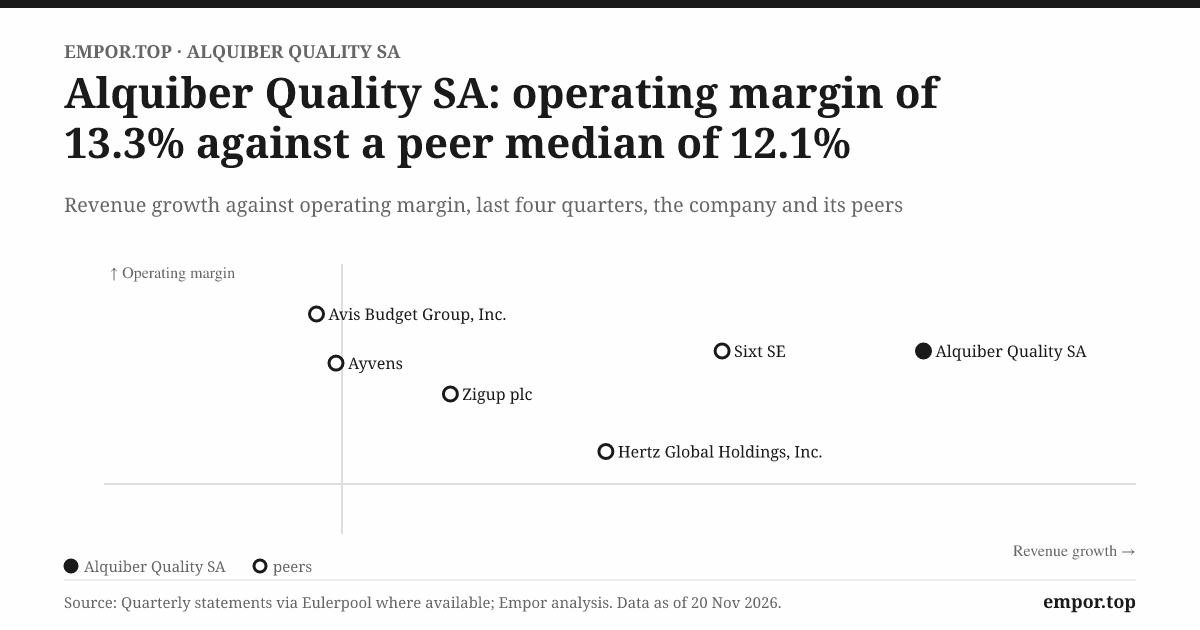
That release of pent-up supply is the scene against which the growth story has to be read. Over the decade from 2015 to 2025, revenue grew at about 24.7% a year, rising from under €20m to €164.3m.12 That is compounding of a very high order, a business multiplying its sales roughly ninefold in ten years. Since 2021, revenue rose from about €76m to €164m.2 Look at the shape, though. Revenue growth slowed from 31.6% in 2022 to 13.9% in 2025.1 In the first half of 2026, revenue grew 12.6% year on year.3 The company is still growing fast by any normal standard, but it is growing at about half its old rate.
The fleet tells a slightly different story from the revenue. Alquiber's fleet grew from about 13,200 vehicles in 2021 to 21,900 by the end of 2025.2 So the number of vehicles grew by about two-thirds over four years while revenue more than doubled. Part of that gap is the used-vehicle sales line, and part is price: monthly rents rose across the industry during the inflationary period, and the vehicles themselves got more expensive. The 2025 rebound in fleet growth, at 12.8%, also outpaced revenue growth that year, which may mean newer vehicles were still ramping up their rental income by year-end. Lighthouse estimated average fleet occupancy at about 90% in 2025.14 That figure is the analyst's, not the company's; Alquiber does not publish utilisation itself.
Then comes the profit complication. Over the five years to 2025, net profit roughly tripled, from about €2.5m in 2020 to €8.0m in 2025.82 But the path was not smooth. Net profit peaked at about €8.5m in 2022, slipped to €7.8m in 2023 and fell to about €6.1m in 2024, before recovering to about €8.0m in 2025.2 Measured over three years, from 2022 to 2025, net profit shrank by about 4.4% a year even as revenue rose by about 18% a year.1 In plain terms, Alquiber sold a great deal more in 2025 than in 2022 and kept less profit from it.
The decomposition is not mysterious, and it points straight at the balance sheet. Operating margin, the share of each euro of revenue left after running costs and depreciation, slipped from about 15.7% in 2022 to about 13.3% in 2025.1 Meanwhile, the cost of financing the fleet rose sharply as European interest rates rose from zero to multi-year highs during 2022 and 2023. By 2025 Alquiber was paying about €11.3m a year in financial expense against pre-tax profit of €10.7m.1 Interest had become larger than pre-tax profit itself. The 2024 dip was the visible bill for the rate shock arriving on a fleet bought with borrowed money; the 2025 recovery came as rates eased and the fleet grew into its costs. Net profit rose by roughly 30% in 2025, from about €6.1m to €8.0m, and the first-half 2026 figures showed it up about 27% year on year, with a net margin of around 4.7%.13
The next growth vector is Italy. Alquiber established Alquiber S.R.L. in 2024 and opened its first Italian branch, in Milan, in November that year.14 In October 2026, the company announced another new branch in Italy.4 Italy is a logical extension: it is a large market of small and medium-sized businesses, with a long tradition of trade contractors and many of the same project-driven customers. But it is an extension of the core model, not yet a second engine. Because the published statements are individual, they show Alquiber's €1.52m vehicle-financing loan to the Italian subsidiary and its €2.15m guarantee on that subsidiary's CaixaBank loan, but no separate Italian revenue or profit.1 Investors can see what Alquiber has put at risk in Italy. They cannot yet see what Italy earns.
How does management tell the story? Alquiber does not hold public earnings calls with analyst Q&A, so the most direct evidence of its voice is its prepared materials. At the Foro MedCap investor conference in May 2026, where Marianela Acebes presented alongside head of investor relations Juan José Rodríguez, the company framed 2025 around two messages: a sustained increase in activity indicators across the year, and no impact on results from the complex environment facing vehicle manufacturers.2 It described its team as pioneers in the sector, with long experience and great stability in management.2 Those are reasonable claims for a year in which revenue and profit rose. They are also, notably, claims about growth and resilience, not about returns. The presentation displays fleet size, sales, profit, capex and gross debt, all rising. It does not show return on fleet, utilisation or the economics of a vehicle over its life.
That gap matters because it determines which numbers would settle the debate. Three would do most of the work. The first is rental revenue growth, separated from used-vehicle sales, because rental is the recurring business and sales can swing with the used market. The second is fleet utilisation, because a van that sits idle earns nothing but still depreciates and still costs interest. The third is net debt after fleet purchases and vehicle-sale proceeds, because it reveals whether growth is being paid for by the business or by lenders. Alquiber publishes the first in its segment note and the third in its interim materials. It does not publish the second.
So the verdict on growth is a measured one. Alquiber is still growing faster than its market, and the 2025 recovery in profit shows the business can absorb higher financing costs once it grows into them. But the decade-long pace has slowed by half, the three-year profit trend is negative, and growth now arrives with more capital per euro than before. To understand why profit and cash behave so differently, the story has to follow a single vehicle from the day it is bought to the day it is sold.
V. The Used-Vehicle Sale Is Part of the Rental Bet
Follow one van. It leaves a manufacturer's lot near Madrid, bought by Alquiber on terms its supplier agreements make possible, perhaps with a volume rebate attached. If the customer needs it, the van goes to a body shop, possibly INSE in Segovia, to be fitted with shelving or a refrigerated box. Then it goes out on hire. For the next few years it earns a monthly fee, comes back for servicing at one of thousands of workshops, goes out to another customer, and gradually loses value on Alquiber's books. Somewhere around its fourth birthday, the company sells it on the used market and buys a replacement.
The accounting rhythm of that van is set by two estimates. Alquiber depreciates its vehicles over an average useful life of about 3.75 years, down to an estimated residual value.1 In 2025, depreciation of the vehicle fleet came to about €73.3m, the single largest cost in the business.1 That charge is the accountant's best guess at how much value the fleet loses each year through wear and age. If the guess is right, the van is sold for about its remaining book value and the sale produces neither gain nor loss. If the van is sold for more than book value, Alquiber records a gain. If the used market collapses, it records a loss.
It is important to keep three different numbers apart here, because they answer different questions. Revenue from used-vehicle sales, about 14% of 2025 sales, tells you how big the resale channel is.1 Cash proceeds from those sales, about €24.3m in 2025, tell you how much money came back in the door to help fund new vehicles.1 And the disposal gain, the excess of sale price over book value, about €10.2m in 2025 and €10.8m in 2024, tells you how conservative the depreciation estimate had been.1 Blending them into a single "margin on sales" would muddle all three.
The gain is the number that deserves attention. Set €10.2m of disposal gains beside 2025 pre-tax profit of €10.7m and the scale becomes obvious.1 The gains are roughly as large as the company's entire pre-tax result. That does not mean the rental business lost money; the disposal gain is in substance a correction to depreciation, since a van that sells above book value was depreciated too fast during its rental life. Rental profits were understated in earlier years by the same amount that disposal gains overstate them now. But it does mean the reported profit in any year leans heavily on the used-vehicle market. If second-hand van prices fell by a fifth, a good part of that cushion would disappear, and with it most of the year's reported profit.
Two other items sit around the edges. In 2025, Alquiber booked about €1.19m of exceptional income, mainly a rebate on vehicle purchases and the reversal of provisions made in earlier years.1 Financial income was negligible, about €0.1m, against €11.3m of financial expense.1 There is no treasury portfolio flattering the results, and no hidden stream of investment income. The cash Alquiber holds, €16.8m at the end of 2025, is working liquidity for a company that has to pay for vehicles before they earn.1
So how profitable is the rental business on its own? The honest answer is that the company does not say. Rental made up about 86% of 2025 sales, and Lighthouse describes it as the more profitable line.114 But neither the annual accounts nor the non-financial report publish a rental-only operating result, a resale margin by vehicle type, or the full return earned by a cohort of vehicles from purchase to sale. Those are the numbers a fleet investor most wants, because they reveal whether the company is buying the right vehicles at the right prices and holding them for the right time. Without them, outsiders can see the total but not the engine.
There is a reasonable bull reading of the disposal gains. Year after year, Alquiber has sold its used vehicles for more than its own depreciation schedule assumed. That suggests its assumptions are conservative and its vehicles are in good enough condition, and in demand enough, to fetch strong prices. The 2022 to 2024 period was also one in which new-vehicle shortages pushed used-vehicle prices across Europe to unusual highs, which flattered every fleet company's disposal results. The more cautious reading is that some of the gain reflects that cyclical tailwind rather than a permanent edge, and that a normalising used market would shrink the gain toward zero. The fact that gains held at roughly €10m in 2025, after supply eased, is modest evidence for the first view. The absence of resale margins by cohort keeps the second alive.
Either way, the van's life cycle reveals the shape of the bet. Alquiber earns rent for nearly four years, recovers part of its money at the end, and has to have bought the replacement already. The fleet can generate plenty of operating cash. The question is whether that cash ever catches up with the cheques the company writes to keep the fleet growing.
VI. The Cash Comes In; the Fleet Takes It Back
Open Alquiber's 2025 cash-flow statement and the first line looks like a triumph. Cash from operations was about €84.3m, more than ten times that year's net profit.1 Most of the gap is depreciation, which is subtracted in the profit and loss account but costs no cash in the year it is charged. The accounts add back the €73.3m of depreciation, strip out the €10.2m of disposal gains, which are counted in profit but belong with investing, and pick up a small working-capital tailwind of about €2.6m.1 A rental company with expensive, fast-depreciating assets will always show operating cash far above its profit.
Then turn to the next section of the statement. In 2025, Alquiber spent about €120.2m on tangible assets, overwhelmingly vehicles, and got back €24.3m from selling used ones; its net investing outflow was about €97.7m.1 The company's investor presentation reports capex of €118.4m, which is a slightly different measure of the same activity, compared with €45.5m in 2020.2 Either way, the conclusion is the same. Depreciation is not cash today, but it is a promise about the cash needed tomorrow. Every euro the accounts add back as "non-cash" eventually comes due when the vehicle has to be replaced.
Stretch the view to twelve years and the pattern becomes the defining fact of the company. From 2014 to 2025, Alquiber earned about €43m of cumulative net profit and generated about €365m of operating cash, more than eight times its profit.1 Over the same period, free cash flow was roughly €345m negative.1 Shareholders received about €2m of dividends in that time, paid in 2023 and 2024.1 Everything else was reinvested, and then the company borrowed hundreds of millions more on top.
It is tempting to read that record as a red flag. It is better read as a question. A growing rental company should have negative free cash flow, because it is buying more vehicles each year than it is retiring. Think of a landlord who buys an extra apartment building each year: rent comes in, but the purchase prices keep the bank account empty. The test is not whether free cash flow is negative. It is whether each new building, or in this case each new van, earns a return over its life that exceeds the cost of the money used to buy it. A fleet that earns 8% on capital funded at 5% creates value as it grows; a fleet earning 5% on money costing 5% creates nothing but size. Alquiber's return on invested capital, about 5.9% over the twelve months to June 2026, sits uncomfortably close to the kind of rates lenders have charged recently.13 That ratio is a rough measure, and a growing fleet has many young vehicles whose earnings have not yet peaked, but it is the clearest sign that the spread between what the fleet earns and what it costs is thin.
The debt that fills the gap comes in several forms, and they should not be lumped together. At the end of 2025, Alquiber owed about €119.1m in bank loans, €5.4m in discounted bills and €125.6m in finance-lease liabilities.1 The finance leases are obligations tied directly to specific vehicles, in effect the leasing company owning the van while Alquiber rents it out, and they tend to amortise as the vehicle ages. Bank loans are more general and must be repaid or refinanced on fixed dates. Gross financial debt, by the company's own measure, rose from about €127m at the end of 2021 to €247.5m at the end of 2025, roughly doubling in four years, in line with the fleet.2 A €30m commercial-paper programme on Spain's alternative fixed-income market, MARF, was not renewed in 2025 and had no notes outstanding.1
The maturity schedule is where the abstraction becomes a calendar. Of the long-term bank debt at the end of 2025, about €79.1m falls due in 2027 and €36.2m in 2028.1 Management says its debt is mostly at fixed rates, that it works with many banks, that unused credit and discount lines were available at year-end, that it expects financing to be renewed, and that it has not breached any loan obligation.1 Those are reassuring statements. They are not the same as a signed refinancing. The 2027 maturity is about as large as a year's operating cash flow, and Alquiber has never run its business without borrowing more each year. In practice, the company will need its banks to keep lending at roughly the pace of fleet growth, or it will need to slow that growth.
There are signs that the company is pacing itself. At the end of June 2026, net financial debt stood at €238.5m, down from €242.9m six months earlier, and cash was above €21m.3 A first-half fall in net debt while revenue grew 12.6% is the kind of number that would matter if it continues, because it would show the fleet starting to fund more of its own growth. One half-year does not establish a trend. Seasonal timing of vehicle purchases can move these figures, and the full-year 2026 numbers will be the real test.
There is one external credit view. INBONIS, a Spanish rating agency focused on mid-sized companies, lists Alquiber at BB+, with its most recent rating action dated 28 September 2026.16 BB+ is the top of the sub-investment-grade scale, the kind of rating that says an issuer can generally service its debt but is sensitive to adverse conditions. The agency's full company-specific rationale is available only to subscribers, so the grade alone cannot tell outsiders which strengths or weaknesses drove it.16
Now play the activist. Suppose an investor bought a large stake and asked the board a blunt question: if Alquiber stopped growing the fleet and merely replaced the vehicles it retires, what would it be worth? In that world, capex would fall toward the level of depreciation, operating cash would comfortably exceed it, and free cash flow would turn sharply positive. The company could pay down its bank debt, reduce its interest bill and distribute cash. The investor's argument would be that a company earning a return on capital barely above its borrowing cost should grow slower and pay more. The family's argument would be that scale strengthens purchasing power, branch density and resale reach, so growth is what makes returns improve. Neither side can win the argument with published data, because the company does not disclose returns on fleet additions or utilisation. That is precisely why those figures matter so much more than the headline growth rate.
The verdict on cash is clear enough to state plainly. Alquiber converts accounting profit into operating cash very well. That cash has never covered fleet investment, and the gap has been filled with debt that now falls due in concentrated waves. That is not a flaw in itself; it is the nature of a growing rental fleet. It does mean that the case for Alquiber rests on two things outsiders cannot fully see: the lifetime return on each vehicle, and the willingness of lenders to keep financing the next one. Which brings the story back to the people who decide how fast to buy.
VII. Succession at the Top, Control in the Family
On the morning of 19 November 2026, Alquiber filed two short notices with BME Growth, each signed by Marianela Acebes Moreno as chair and chief executive.1213 The first announced that her brother, Miguel Acebes Moreno, had been unanimously appointed a joint chief executive the previous day.12 The second announced that Solopa, S.L.U., a director represented by Jesús Carlos Jiménez López, had resigned from the board, for strictly personal reasons, with effect from the same date.13 After eight months in which the father stepped aside as chair, the daughter took the chair and the son received executive powers, the second generation now held the top of the company.
Miguel Acebes Moreno came to the company from finance. He holds a double degree in business administration and international relations from Universidad Antonio de Nebrija and a master's in management from IE, and he passed the first level of the CAIA alternative-investment certification.17 He spent about four years in investment banking and advisory roles: as a junior consultant in ventures and acquisitions at Accenture, then in Andbank's capital-markets team, where he worked on share offerings in Spain and abroad, and then as a senior strategy and financial-risk consultant at Deloitte.17 He joined Alquiber in January 2025 as head of business development and transformation.17 Less than two years later he was a joint chief executive.
That background fits a company whose central problem is financing. A chief executive who has worked on equity offerings and financial risk will understand the trade-offs in the debt schedule. It is also a short operating apprenticeship. Marianela Acebes spent years in finance at Alquiber before running it, having begun at a rental competitor; her brother's experience inside the business is measured in months. The appointments are best read as a governance change, not as proof of a new strategy. The company has not announced any change in direction alongside them.
The ownership structure explains why succession happens this way. The family owns 100% of Sebeca Ikap, which holds the majority stake, and each of the three family members on the board holds additional shares directly.9 There is no realistic route for outside shareholders to choose a different leadership. That concentration aligns the family with long-term outcomes, since they bear most of any loss. It also makes independent challenge more important, because no one else has the votes to supply it.
How much challenge is there? In the 2025 governance data, three of eight directors were independent.1 Alquiber's investor pages list Julio de Santos Algar, Alfonso Martín Muncharaz and Mar Martínez Carrasco as independent directors, with de Santos chairing the audit committee, whose composition was changed in April 2026.42 With Solopa's departure, the board shrank, which mechanically raises the independent share, but the family remains firmly in the majority. The structure is common for family-controlled Spanish small caps. It is also exactly the structure in which disclosure has to do the work that boardroom friction cannot.
Pay offers a modest test. Board remuneration rose to about €161,000 in 2025 from €96,000 in 2024; directors who are also employees received about €300,000 in salaries; and accrued variable pay rose to €234,000 from €180,000.1 Those sums are small for a company of this size, and they rose in a year when net profit recovered by about a third, from €6.1m to €8.0m.1 But the accounts do not break pay down by individual, do not explain what metrics drive the variable component, and say there is no other employee who meets the definition of senior management.1 It is not possible to tell from the disclosures whether executives are rewarded for growth, for profit, or for returns on capital. In a fleet business, that difference is the whole game. Meanwhile, the company paid no dividend from 2025 earnings, despite investor materials describing an average payout of about 20% of net profit.14 In 2023 and 2024 it had paid modest dividends; the decision to skip one in a year of rising profit and rising debt is defensible, but it is a departure from the stated habit that shareholders were not given a detailed explanation for.
Related-party dealings are where stewardship becomes concrete. In 2025, Alquiber received about €2.30m of services from related parties, of which about €1.24m came from Navegama, S.L., a company under common control that owns premises Alquiber rents.1 The accounts say these arrangements are priced at market and negotiated on a cost-plus basis.1 The services equal about 1.4% of revenue and about 5% of external-services costs, so they are not large enough to distort the business. But an owner that rents its own buildings to the company it controls has interests on both sides of the lease, and outsiders have only the company's assurance that the rent is fair. Related parties also bought about €1.02m of used vehicles from Alquiber.1 There were no transactions with Sebeca itself and no royalties or management fees charged to the listed company.1
The Italian subsidiary is the other exposure worth watching. Alquiber lent it €1.52m through 36-month vehicle-financing contracts at 5% and guaranteed €2.15m of its loan from CaixaBank.1 Separately, the accounts disclose total guarantees of €399,052, a figure that does not reconcile with the €2.15m Italian guarantee reported in the related-party note.1 The difference is probably one of scope or presentation, but the accounts do not explain it, and in a company where the board took care to require two signatures on any new guarantee, the aggregate contingent exposure ought to be stated clearly. This is a disclosure gap, not evidence of wrongdoing, and the amounts are small relative to the balance sheet.
Shareholder votes add little information. At the 2026 annual meeting, 24 shareholders representing about 86% of the capital attended; every resolution passed with no votes against and 37,911 abstentions.18 Given the family's stake, that outcome says more about ownership arithmetic than about any independent endorsement of strategy.
The audit record is clean. BDO issued an unmodified opinion on the 2025 accounts, with revenue recognition and the impairment of trade receivables identified as key audit matters.19 For receivables, BDO reviewed debt ageing, the trend in unpaid balances and collection claims reported by the company's lawyers.19 Key audit matters are not qualifications; they mark where judgment is greatest and where the auditor spent most effort. For a company that depends on estimating vehicle lives and collecting from thousands of small business customers, those are exactly the right places for the auditor to look.
So the governance verdict is balanced. The family is committed, aligned and has kept the business on a consistent path for seventeen years. The succession is orderly and comes with a sensible restraint on guarantees. But the combination of majority control, a minority of independent directors, undisclosed individual pay metrics, rented family premises and a guarantee figure that does not reconcile means outside shareholders are relying heavily on trust. The way to earn more of it would be to publish the operating economics this story keeps returning to. And those economics depend, above all, on whether Alquiber can keep winning against competitors who have far deeper pockets.
VIII. The Case for a Moat Meets the Case for a Commodity
Stage the contest. A regional facilities-management company in Seville is tendering for 60 vans to support a new public-sector maintenance contract. On one side of the table is Alquiber, with a branch down the road in Andalusia, a body shop that can fit the vans to the job, and a monthly rate that can flex as the contract grows or shrinks. On the other side are the international giants: Ayvens, the fleet-leasing arm built around Société Générale; Arval, owned by BNP Paribas; Alphabet, BMW's fleet business; and Northgate, the British specialist where Marianela Acebes began her career. They can offer vehicles across countries, long-term leases, flexible rental and finance from a balance sheet backed by some of Europe's largest banks.15 Who wins, and why?
The honest place to start is with what Alquiber can prove. Its fleet of about 21,900 vehicles grew 12.8% in 2025 against roughly 7% growth in the Spanish renting sector.2 Lighthouse puts its share of Spanish flexible renting at around 15% to 20%.14 It has a national network of 25 branches and access to thousands of workshops, and it can adapt vehicles through its own body-building subsidiary.12 Those facts establish real niche scale. They do not, on their own, establish a moat. To see whether there is one, it helps to walk through the five forces that shape any industry, and then ask which, if any, of Hamilton Helmer's seven sources of durable power apply.
Begin with rivalry. Flexible van rental in Spain is a market where a handful of specialists compete with large leasing houses that can bundle rental into wider fleet contracts. The international firms operate at vastly greater scale and with access to bank funding that a BB+-rated family company cannot match.16 Their weakness is focus: flexible rental of adapted commercial vehicles is a small corner of their business, and they may not want to compete aggressively on price for a few dozen vans in a provincial city. Alquiber's strength is that this corner is its entire business. Rivalry is therefore intense on financing cost and broad reach, and more moderate on local service and vehicle adaptation.
Buyer power is meaningful. No single customer exceeds 10% of receivables, and the historical revenue concentration was modest, so no one buyer can dictate terms.15 But Alquiber's core product is the cancellable contract, which means the customer's switching cost is, by design, low. A contractor unhappy with price or service can return the van next month. Large construction and services groups, the kind of names that appeared in the customer list at listing, buy fleet services from several providers and can play them against each other. The company does not publish current top-customer revenue shares or retention rates, so the strength of that bargaining power cannot be measured directly.
Supplier power runs in two directions. Vehicle manufacturers are essential, and the 2024 supply constraints showed how quickly a shortage can stall growth.1 Alquiber later cited supply agreements that let it add about 1,000 more registrations in 2025, suggesting that its purchasing scale now buys it priority with at least some brands.1 The vehicle-purchase rebate in its 2025 exceptional income is a small concrete sign of the same thing.1 Current supplier concentration is not disclosed, and in 2017 the largest non-vehicle supplier accounted for 23% of the relevant expenses and the top five for 51% of external services, a dependency the company has not updated publicly.5 The other critical supplier is the banking system. Lenders are not usually listed among a company's suppliers, but for a fleet business they are the most important supplier of all.
Substitutes are everywhere. A customer can buy its own vans, sign a conventional long-term lease, rent from a large fleet operator, or simply stretch its existing fleet harder. Flexible duration and trade-adapted vehicles make Alquiber's offer distinct, but the filings do not quantify what customers save by renting from it rather than buying or leasing, nor how often they convert from flexible rental to a cheaper long-term arrangement once their needs stabilise. Electrification is a slow-moving substitute risk of a different kind. About 14.4% of the fleet was classified as alternative-fuel vehicles in 2025, covering electric, hybrid, liquefied-gas and compressed-gas models.2 The shift matters mostly through residual values: if battery-electric vans depreciate unpredictably, the disposal gains discussed earlier could turn into losses. The company has not shown that its alternative-fuel fleet earns better or worse returns than the rest.
The threat of entry is the force most favourable to Alquiber. A credible new entrant would need hundreds of millions of euros of financing, relationships with manufacturers, a resale channel for used vehicles, a branch network across Spain and the operating know-how to keep thousands of vans on the road. That is a high bar. But Alquiber's position is not unassailable either: the giants already exist, and any one of them could decide to invest heavily in Spanish flexible rental. The barrier protects Alquiber against start-ups. It does not protect it against incumbents.
Now Helmer's powers. Of the seven, scale economies are the most plausible: a larger fleet can buy vehicles more cheaply, spread branch costs across more rentals and sell used vehicles through more channels. Process power, the accumulated know-how of running an adapted fleet efficiently, may also apply, though it is hard to prove from outside. There is no network effect, since one customer renting a van does not make the service more valuable to another. There is no proprietary technology, and no evidence of a brand strong enough to command a price premium. Switching costs are, by the nature of the product, low. Counter-positioning, the idea that incumbents cannot copy a model without damaging their own business, has some force, because a bank-owned lessor that prefers long, locked-in contracts may be reluctant to promote cancellable ones. But Northgate's success with the same model shows the barrier is not structural. And there is no cornered resource.
So the moat claim, tested against the evidence, narrows to a smaller version. Alquiber has credible niche scale, a strong national footprint and real capability in adapted vehicles. Its fleet growth relative to the market shows customers keep choosing it. But there is no published evidence of higher retention, better pricing, lower cost of capital or superior returns on vehicles compared with peers. The advantage is plausible and modest, rather than proven and wide. The tests that would confirm or reject it are specific: customer retention, fleet utilisation, rental price realisation, fleet growth against the market, the rate at which major tenders are lost, and resale margins by vehicle cohort. A growing fleet alone does not prove a stronger competitive position; it may simply prove a willingness to borrow.
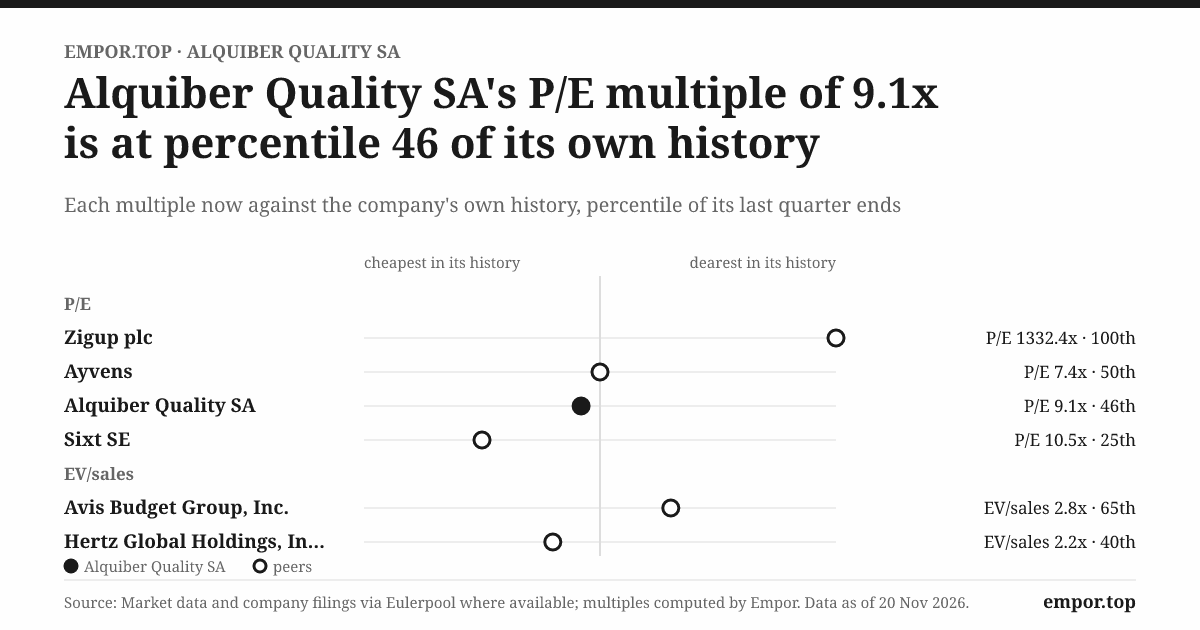
Valuation benchmarks deserve the same caution. In its May 2026 analysis, Lighthouse compared Alquiber with Avis Budget, Hertz, Sixt, Ayvens and Zigup. On its 2026 estimates, Alquiber traded at about 8.1 times earnings and 3.0 times EV/EBITDA, against peer averages of about 15.2 and 18.1 times respectively.15 The gap looks dramatic, but the analyst itself flags the caveats: peer multiples come from market consensus while Alquiber's come from Lighthouse's own estimates, the EV/EBITDA uses total rather than recurring EBITDA, and the peers are vastly larger, often far more diversified, and in some cases loss-making or heavily restructured.15 A discount to that group is context, not a conclusion. It tells you the market prices Alquiber as a small, illiquid, leveraged family company. It does not tell you the market is wrong.
IX. Lessons from a Business Built on Other People's Vehicles
Go back to the van leaving the depot in Valencia, fitted for the electrician's hospital job. The customer drives away with a monthly bill and the right to return it. Alquiber watches it go with a finance-lease obligation, a depreciation schedule and a bet on what it will be worth in four years. That single image carries most of what this company teaches.
The first lesson is that a flexible promise to the customer is a fixed obligation for the owner. The cancellable contract is Alquiber's product and its selling point, but every ounce of flexibility it offers to a contractor is risk it absorbs itself. The van does not stop depreciating when the customer hands it back early, and the loan does not shrink when the job is cancelled. Founders who build service businesses on the customer's convenience should ask the same question Alquiber's shareholders do: who is holding the asset when the convenience is exercised?
The second lesson is that cash from operations is only half the story when the fleet is the product. Alquiber's operating cash has never covered fleet investment, leaving free cash flow deeply negative. Both numbers are true. Investors who stop at the first one will think they own a cash machine. Investors who stop at the second will think they own a black hole. The truth lives in the return on each vehicle, which the company does not publish.
The third lesson is that resale gains belong beside rental results: the sale at the end is part of the price at the start.
The fourth lesson is the one that matters most in 2026: a family can think in decades, but lenders still refinance by date. The 2027 bank-debt maturity does not care about horizons. Continuity of ownership supports patience; it does not substitute for liquidity. The most important operating variable at Alquiber over the next eighteen months may not be a customer or a van. It may be a bank.
X. Analysis & Bear vs. Bull Case
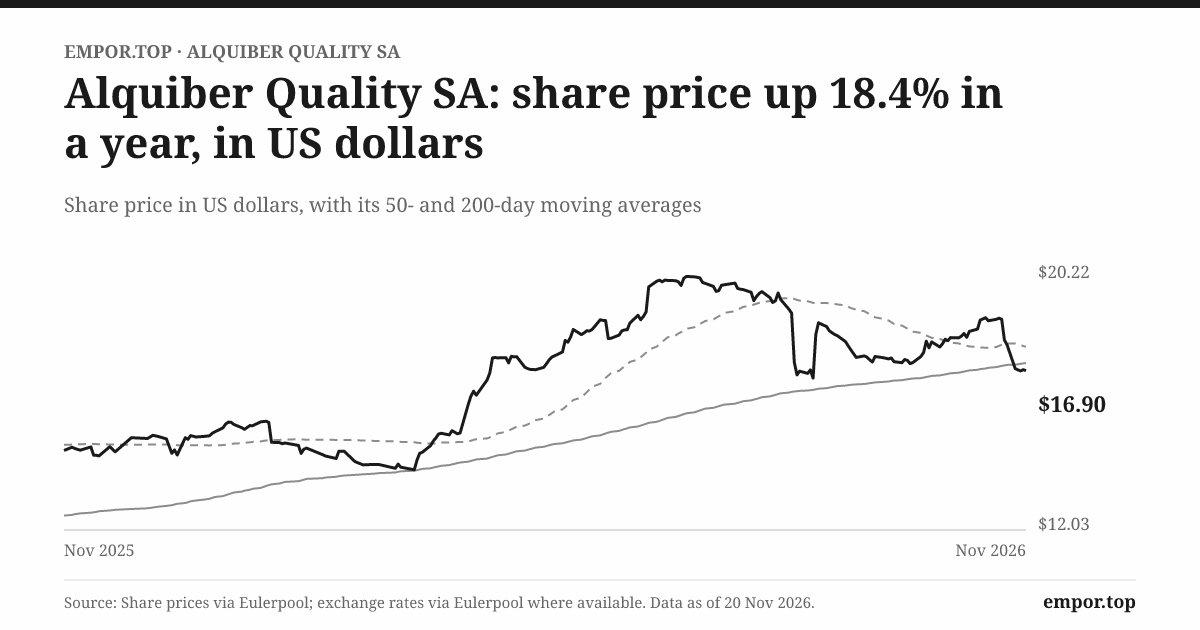
On 20 November 2026, Alquiber's shares closed at €15.40, about 11% below their 52-week high of €17.30 and comfortably above the low of €12.00.4 A year earlier, at the end of 2025, they had stood at €12.70, having started 2025 at about €10.2 At €15.40, the market valued the equity at about €81m, or roughly 9.1 times trailing earnings, against a five-year median of about 9.8 times.13 Add the debt and subtract the cash, and the enterprise value was about €319m, roughly 3.2 times EBITDA and 13.8 times operating profit. Free cash flow yield, on the same basis, was negative 21.4%.
The gap between those last two multiples is the whole analysis in miniature. EV/EBITDA of about 3 times looks almost absurdly cheap, until you remember that EBITDA excludes depreciation, and depreciation at Alquiber is not a theoretical charge but the real cost of a fleet that wears out every four years. EV/operating profit of nearly 14 times, which includes depreciation, looks fair rather than cheap. The market is not ignoring Alquiber's earnings. It is pricing the fact that most of its EBITDA is spoken for by fleet replacement before it reaches shareholders.
The bull case starts with the market. Flexible rental of work vehicles remains a growing Spanish market, as companies prefer to keep vehicles off their balance sheets and contract fleets to the length of the job. Alquiber is gaining fleet faster than the sector, which suggests its service, footprint and vehicle-adaptation capability are winning business. Rental, the recurring and more profitable line, has risen to almost 88% of sales.3 Collection discipline has improved dramatically: the time customers take to pay fell from about 143 days of revenue in 2016 to about 49 in 2025.1 Profit rebounded strongly in 2025 and continued to grow in the first half of 2026, and net debt fell slightly while the fleet grew.3 On this view, the negative free cash flow is the price of building an increasingly valuable fleet, and the share trades at less than ten times earnings for a business that has compounded revenue at more than 20% a year for a decade.
The bear case starts with the same numbers and reads them differently. Revenue growth has halved from its long-run rate, and net profit is still below its 2022 peak despite much higher sales.12 Free cash flow after capex remains deeply negative, and net debt, at about three times the equity's market value, is high for a company whose return on invested capital is under 6%.3 The 2027 bank maturity is concentrated and large relative to annual cash generation. And disposal gains roughly equal to pre-tax profit mean that a weaker used-vehicle market could erase most of the reported earnings. On this view, the low P/E is not a bargain but a fair price for a leveraged fleet whose profitability depends on resale prices and refinancing terms it does not control.
How does management's credibility sit between the two? There is affirmative evidence: a consistent strategy pursued by the same owners for seventeen years, growth delivered through a severe supply crisis and an interest-rate shock, no reported loan breaches and an unmodified audit. There is also a missing layer. The company's investor materials emphasise fleet, sales and profit growth but do not report utilisation, rental-only margins, returns on fleet additions or a plan for the 2027 maturities.2 The skipped 2025 dividend, against a stated average payout policy, went without detailed explanation.4 Management's credibility on growth is established. Its credibility on returns has not yet been tested in public, because the numbers that would test it are not published.
Receivables deserve one more check, because they were once a weak point. The provision for doubtful debts was €2.90m at the end of 2025, up from €2.58m a year earlier, after new charges and some reversals.1 BDO treated both receivables impairment and revenue recognition as key audit matters.19 The improvement in collection days is real and significant, and it reflects a larger, more diversified customer base with a working-capital cycle that now runs in the company's favour, since suppliers are paid more slowly than customers pay. The accounts do not, however, publish a detailed ageing table, so investors cannot see how much of the book is seriously overdue.
The risks that matter can each be tied to a mechanism. A slowdown in construction or business services would lower utilisation, because customers on cancellable contracts return vehicles quickly; the vans still depreciate and the loans still accrue interest. Inflation in vehicle prices raises the cost of every replacement, and unless rents rise in step, returns fall. A decline in used-vehicle prices would shrink disposal gains or turn them into losses. Higher funding costs or a pullback by lenders would hit the business twice, raising interest and constraining growth at the same moment. Regulation and electrification work mainly through vehicle mix and residual values: low-emission zones in Spanish cities and the gradual shift to electric vans could change which vehicles customers want and what used ones are worth. The company's 14% alternative-fuel share shows it is adapting, but there is no published evidence yet that electrification is a margin advantage rather than a residual-value risk.2
Capital deployment outside the core fleet has been small. In June 2026, Alquiber proposed absorbing INSE, its wholly owned body-building subsidiary, in a merger that the project said would require no new shares.20 That is an internal simplification, not an acquisition, so there is no purchase price or premium to assess. Italy is the only material expansion beyond Spain, and its scale so far is measured in single-digit millions of euros of loans and guarantees.1 Alquiber's capital has gone overwhelmingly into vehicles rather than acquisitions. The capital-allocation question at Alquiber is therefore almost entirely about the fleet: how many vehicles to buy, at what price, and with whose money.
If an investor could follow only three numbers, they should be these. The first is rental revenue growth; rentals reached about 88% of sales in the first half of 2026.3 The second is fleet utilisation, estimated by Lighthouse at about 90% in 2025 but not published by the company itself.14 The third is net financial debt after fleet investment and disposals, which fell from €242.9m to €238.5m in the first half of 2026.3 The event that would settle the debate is a full-year disclosure that separates rental profitability from vehicle sales, reports fleet additions and resale proceeds side by side, and explains how the 2027 maturities will be met.
Taken together, the multiple is modest against Alquiber's own history, and the business is clearly growing. But the company's debt, its capital intensity and the thin evidence on vehicle-level returns mean a low P/E is not, by itself, proof of value. The market appears to assume that Alquiber will keep growing at a moderate pace, keep its banks onside, and earn returns roughly equal to its cost of capital. Beating that assumption requires proving the returns. Falling short of it requires only a bad year in the used-vehicle market.
XI. Epilogue
Tonight, Alquiber stands at an unusual junction. A daughter who began her career at Northgate in England now chairs the board and shares the chief executive's powers with her father and brother. The brother, a former capital-markets adviser, has held his joint role for less than a week.12 The Milan operation is about two years old and announced another Italian branch in October.4 The INSE merger is in progress.20 Net financial debt remained high, with a large bank-debt maturity due in 2027.31 The next eighteen months will decide which of the two futures sketched at the beginning of this story is the real one.
The first moment comes with the 2026 annual accounts, likely in spring 2027. They will show whether net debt kept falling over the full year while the fleet grew, or whether the first-half improvement was a timing effect. They will show whether rental revenue kept growing at double-digit rates, and how much disposal gains contributed to profit. If debt falls while the fleet grows, the case that Alquiber's fleet is beginning to fund itself gets its first hard evidence. If debt rises again, the company is back to depending on lenders for every euro of growth.
The second moment is the refinancing of the 2027 maturities. The company will either extend those loans, replace them with new facilities, return to the commercial-paper market, or slow fleet purchases to repay them. Each route tells investors something. An easy extension at similar rates would vindicate management's confidence in its banking relationships. A costly one would compress returns. A slowdown in growth would test whether the family is willing to trade size for balance-sheet strength.
The third moment is Italy. At some point the Milan operation will need to produce visible revenue and profit, either in consolidated accounts or in separate disclosures. Until then, it is an investment of modest size whose payoff is unknown. If it works, Alquiber gains a second market in which to replicate its model. If it struggles, the losses will be contained but the narrative of geographic expansion will lose credibility.
The fourth moment is the new leadership's first full year. The appointments of 2026 give the second generation a chance to define its own approach to disclosure. Publishing utilisation, rental-only margins and returns on fleet additions would turn the strongest parts of the bull case from assertions into evidence. Continuing to report fleet and sales growth alone would leave investors where they are today: watching a business grow without being able to tell whether it is growing more valuable.
Some questions remain open: current customer concentration, rental-only profit and vehicle returns are unpublished, and INBONIS's full BB+ rating rationale is available only to subscribers. Until those answers appear, the fleet remains both the asset and the question.
XII. Outro
Somewhere in Spain this morning, a customised work van is leaving an Alquiber branch for a customer's job. The racks are bolted in, the paperwork is signed, the monthly fee will start tomorrow. In another office, someone at the company is arranging the financing for the vehicle that will replace it in four years' time, and for the two or three more the fleet will need if growth continues.
Twenty-two thousand vehicles are not just a measure of scale. They are a rolling promise to customers that a van will be there when the job starts, a rolling investment by the owners who bought it, and a rolling claim by the lenders who paid for most of it. Alquiber's whole history has been an argument that those three can be kept in balance as the fleet grows. At Alquiber, growth arrives on four wheels, and every one of them has to earn its next mile.
References
-
2025 Annual Accounts, Management Report and EINF — Alquiber Quality, S.A. via BME Growth, 2026-04-09 ↩↩↩↩↩↩↩↩↩↩↩↩↩↩↩↩↩↩↩↩↩↩↩↩↩↩↩↩↩↩↩↩↩↩↩↩↩↩↩↩↩↩↩↩↩↩↩↩↩↩↩↩↩↩↩↩↩↩↩↩↩↩↩↩↩↩↩
-
Foro MedCap 2026 Investor Presentation — Alquiber Quality, S.A., 2026-05-26 ↩↩↩↩↩↩↩↩↩↩↩↩↩↩↩↩↩↩↩↩↩↩
-
Interim Financial Statements, First Half 2026 — Alquiber Quality, S.A., 2026-10-09 ↩↩↩↩↩↩↩↩↩↩↩↩↩
-
Investors and Shareholders — Alquiber Quality, S.A., accessed 2026-11-23 ↩↩↩↩↩↩↩↩↩
-
Documento Informativo de Incorporación al MAB — Alquiber Quality, S.A., 2018-07 ↩↩↩↩↩↩↩↩↩
-
Curriculum Vitae of Marianela Acebes Moreno — Alquiber Quality, S.A. ↩↩↩↩
-
Appointment of New Chair of the Board — Alquiber Quality, S.A., 2026-03-26 ↩↩↩
-
Alquiber Celebrates Six Years on BME Growth — Alquiber, 2024-07-11 ↩↩↩↩↩
-
Significant Shareholdings at 30 June 2026 — Alquiber Quality, S.A., 2026-07-06 ↩↩↩↩
-
Significant Shareholdings at 31 December 2025 — Alquiber Quality, S.A., 2026-01-02 ↩
-
Significant Shareholdings at 31 December 2023 — Alquiber Quality, S.A., 2024-01-05 ↩
-
Appointment of Joint Chief Executive — Alquiber Quality, S.A., 2026-11-19 ↩↩↩↩
-
Resignation of Board Member — Alquiber Quality, S.A., 2026-11-19 ↩↩↩
-
Alquiber Quality: Independent Company Analysis — Lighthouse/IEAF, 2026-05-26 ↩↩↩↩↩↩
-
Alquiber Quality: Peer Comparison — Lighthouse/IEAF, 2026-05-26 ↩↩↩↩
-
Curriculum Vitae of Miguel Acebes Moreno — Alquiber Quality, S.A. ↩↩↩
-
Resolutions Adopted by the 2026 General Meeting — Alquiber Quality, S.A., 2026-05-22 ↩
-
Alquiber Quality: 2025 Annual Financial Information and Audit Report — MarketScreener, 2026-04 ↩↩↩
-
Common Draft Terms of Merger by Absorption of Carrozados Industriales Segovianos — Alquiber Quality, S.A., 2026-06-11 ↩↩
 LinkedIn
 WhatsApp
 Reddit
 Hacker News
 Email
 Kindle
 RSS Feed
 Spotify
 Apple Podcasts
 Amazon Music
 Audible
 YouTube