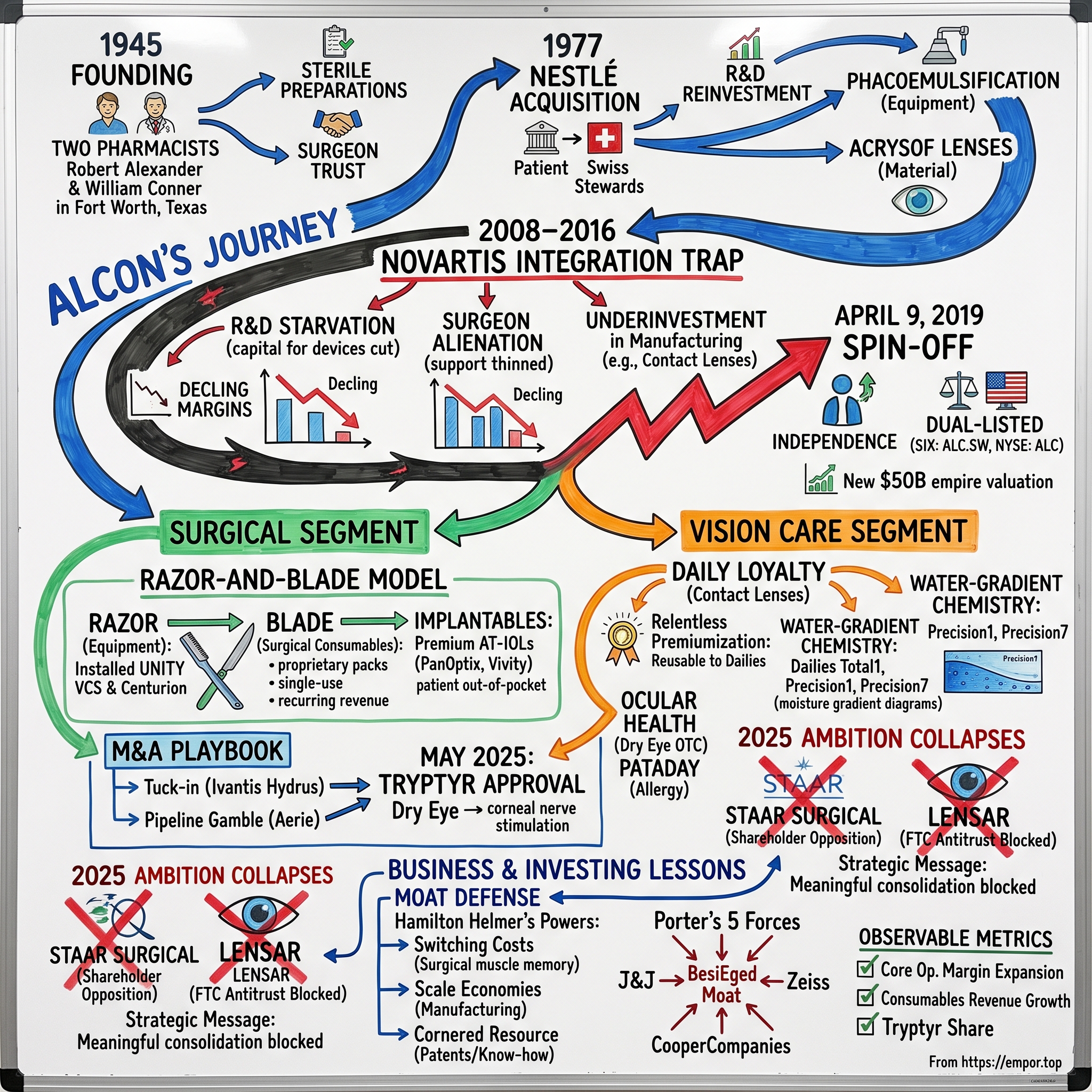
Alcon: The $50 Billion Eye-Care Empire and the Fight for the Front of the Eye
I. Introduction: The Spin-Off that Defied the Corporate Graveyard
Picture the scene in Basel in the winter of 2010. Novartis, one of the largest pharmaceutical companies on earth, has just committed to spending roughly $51.6 billion — across three carefully staged tranches stretching back to 2008 — to swallow whole a Texas eye-care company it had first bought a minority slice of from Nestlé.5 The press releases used the language of destiny: healthcare convergence, a global eye-care champion, drugs and devices under one roof, all pointed at the aging eyeball of the developed world. On paper it was a masterstroke. Novartis already owned Lucentis, a blockbuster injection for wet age-related macular degeneration. Bolt on the world's dominant maker of cataract equipment and contact lenses, and you would own the eye from the retina to the cornea.
It did not work. What followed over the next several years is one of the cleaner case studies in corporate value destruction you will find in modern healthcare — not because anyone was incompetent, but because a drug company tried to run a medical-device business as if it were a drug business. Margins that had once flirted with 30% sagged into the teens. Surgeons who had trained their hands on Alcon machines began to grumble that the famous in-the-operating-room support had thinned out. The manufacturing lines that should have been humming out next-generation daily contact lenses went underfunded while rivals ate share.
And then, in a rare and honest admission that a $51 billion-plus thesis had been wrong, Novartis let it go. On April 9, 2019, Alcon was spun off to Novartis shareholders as an independent, dual-listed company — trading in Geneva on the SIX Swiss Exchange under ALC.SW and in New York under ALC — carrying about $3.5 billion of fresh debt and a mandate to simply be itself again.2 Seven years later, as of mid-2026, that once-suffocated division is a standalone company that generated $10.319 billion in sales in 2025 and carries an equity value north of $50 billion.1
This is the central puzzle of the Alcon story. How did a company obsessed with the front of the eye — cataracts, contact lenses, dry eyes, glaucoma — build one of the most durable, cash-generative "razor-and-blade" franchises in all of healthcare? And, just as important for anyone deciding what the next decade looks like: is that moat as deep as management says it is, or is it quietly being drained by a resurgent Johnson & Johnson, a strong Swiss franc, and the simple fact that a premium lens is, at the end of the day, an out-of-pocket luxury?
To answer that, we have to go back to two pharmacists in Fort Worth, Texas, and then follow the money through Swiss chocolate, Swiss pharma, and finally Swiss independence. Along the way we will dissect the phacoemulsification economics that make cataract surgery a recurring-revenue machine, the water-gradient chemistry that makes an Alcon contact lens genuinely hard to copy, and the M&A playbook that turned a $770 million "overpay" into a first-in-class dry-eye drug — before, in 2025 and 2026, it ran head-first into antitrust regulators and rebellious target shareholders. We will apply Hamilton Helmer's 7 Powers and Porter's 5 Forces to the moat, and stress-test a management team that has promised margin expansion right after a year of margin contraction. This is the story of Alcon, and the fight for the front of the eye.
 Subscribe on LinkedIn
II. The Foundational Seeds: Pharmacists, Fort Worth, & Swiss Stewards (1945–2002)
The origin is almost comically humble for a company that would one day be worth tens of billions. In 1945, in Fort Worth, Texas, two pharmacists named Robert Alexander and William Conner opened a small prescription pharmacy. They needed a name, and they did what founders have always done — they stapled their own together. Alexander plus Conner became Alcon.3 There was no grand plan to dominate global ophthalmology. There was a compounding counter, a back room, and two men who happened to be very good at the unglamorous discipline of mixing sterile solutions.
Here is where the founding insight matters, because it is the same insight that pays the bills eighty years later. Alexander and Conner noticed that eye medications — drops meant to be dripped directly onto the most sensitive, infection-prone surface of the human body — were being prepared inconsistently and often without proper sterility. They specialized in exactly that: sterile, standardized, ready-to-use ophthalmic preparations. It sounds mundane. It was, in fact, a defensible manufacturing competency. Making a liquid that is simultaneously sterile, correctly buffered, stable on a shelf, and safe to put in an eye is a genuine industrial skill — and it is the direct ancestor of the multi-billion-dollar surgical consumables and dry-eye businesses Alcon runs today. The company's entire modern identity — that it is fundamentally a manufacturer of precision, sterile, single-use products bought over and over again — was already visible in that Fort Worth back room.
The other early decision that echoes through every era was who Alcon chose to sell to. Because an eye preparation can cure or blind depending on invisible details, the buyer who mattered was never a purchasing clerk comparing unit prices; it was the ophthalmologist whose name sat on the patient's chart. So Alcon built something unusual for its size — a sales force that called directly on individual eye surgeons, spoke their clinical language, and embedded itself in the clinic rather than the loading dock. Alcon's real distribution asset, from the very beginning, was clinical trust, not procurement contracts. That is a subtle thing, and it is the seed of the entire moat: a surgeon who has learned to trust a product on living patients does not switch for a discount.
For three decades Alcon grew as a respectable, regional American eye company. The transformation came in 1977, and from an unlikely direction. Nestlé — the Swiss maker of chocolate, coffee, and infant formula — bought Alcon for roughly $280 million.4 On its face this was a bewildering fit. What does a food conglomerate know about intraocular lenses? The answer, and the reason this chapter matters, is that Nestlé turned out to be a nearly ideal long-term owner — something closer to a patient private-equity steward than a meddling parent. Its genius was restraint. Rather than parachute food executives into a business they did not understand, Nestlé recognized that Alcon's economics were extraordinary and adopted a posture of deliberate non-intervention. Management stayed in Fort Worth. The scrappy, surgeon-first culture was preserved. And, crucially, the cash the business threw off was allowed to be reinvested into research and development rather than swept back to Switzerland to fund unrelated ventures. For a business whose entire edge depended on staying ahead of surgeons' expectations, that permission to keep spending was worth more than any strategic advice.
What that reinvestment bought, across the Nestlé decades, was leadership in the two technologies that still define the company: phacoemulsification — the ultrasonic technique that liquefies a cataract for removal through a tiny incision — and the intraocular lens, where Alcon's foldable acrylic AcrySof implant captured more than half the global market by resisting the clouding and microscopic "glistenings" that plagued lesser materials. We will unpack the economics of both in the surgical deep-dive; the point here is that the defensible, materials-based moat was engineered under Nestlé, not invented after the spin-off.
By the time Nestlé took Alcon public in 2002 — selling roughly a 25% stake on the New York Stock Exchange while keeping majority control — the business was, in plain terms, a machine. Operating margins approached 30%, and Alcon utterly dominated the cataract-surgery suite: the equipment, the fluids, the lenses, the training. What the 2002 IPO revealed to public investors for the first time was a truth Nestlé had quietly enjoyed for twenty-five years — that eye care, done at scale with proprietary consumables, throws off cash with the reliability of a utility and the margins of a luxury brand. That combination — utility-like demand, luxury-like margins — is precisely what makes a business irresistible to acquire and dangerous to mismanage. Nestlé, sensing both an extraordinary price and a drift away from its food-and-nutrition core, decided to sell. The buyer would be a pharmaceutical giant with a very different theory of how the eye should be run.
III. The Novartis Integration Trap: A $51B Cultural Collision (2008–2016)
Daniel Vasella, the physician-turned-executive who built Novartis, had a thesis, and it was not a crazy one. The aging populations of the rich world were going to need more of everything that keeps eyes working — and Novartis already had a foot in the door with Lucentis. If you believed in "healthcare convergence," the idea that diagnostics, drugs, and devices would fuse into integrated franchises, then owning the world's best eye-device company was the logical move.
So Novartis bought it, deliberately and in stages. In July 2008 it acquired an initial 25% interest in Alcon from Nestlé for about $10.4 billion, or $143 per share.5 In 2010 it exercised its option for Nestlé's remaining 52% for roughly $28.3 billion, or $180 per share, lifting it to a 77% controlling stake.5 It then mopped up the outstanding public minority in a contested merger completed in April 2011. Add the tranches together and Novartis had paid on the order of $51.6 billion to own all of Alcon.5 At the time, Forbes crowned Novartis the "eye-care king," and the logic looked unassailable.6
Then culture met strategy, and culture won — in the worst way. To understand why, you have to understand that pharmaceuticals and medical devices are not adjacent businesses. They are different sports that happen to be played near each other.
A pharma business, at its core, runs on the long shot. You spend a decade and a fortune on clinical trials for a molecule that will probably fail; the rare winner enjoys a patent-protected monopoly with enormous gross margins and, once approved, comparatively little ongoing capital intensity — until a patent cliff arrives and generics vaporize the franchise overnight. A medical-device business runs on the opposite rhythm. Innovation is iterative — a better handpiece, a smarter fluidics algorithm, a marginally more forgiving lens — released in a steady cadence of annual upgrades rather than a once-a-decade miracle. There is no single cliff; there is a relentless treadmill, and the company that stops running falls behind quietly rather than catastrophically. Success depends on being physically present: technical specialists in the operating room, surgeon training programs, hands-on service. And it is capital-intensive forever, because every product is a manufactured object requiring expensive, high-precision production lines.
Novartis, staffed and structured for the first sport, tried to play the second, and three specific failures followed. The first was R&D starvation. Here the culprit was not malice but arithmetic: inside a pharma parent, capital flows to the highest risk-adjusted return, and a late-stage drug trial with billion-dollar peak-sales potential will almost always out-argue an incremental console upgrade in a budget meeting. Device R&D looks unglamorous line by line even though its cumulative effect is what keeps the franchise alive. So the budget got cut, and rivals seized the opening — Johnson & Johnson, which had absorbed Abbott Medical Optics, and Germany's Carl Zeiss Meditec used the pause to close the technology gap that Nestlé-era reinvestment had opened.
The second failure was surgeon alienation. Alcon's legendary in-theater clinical support — representatives standing beside surgeons, troubleshooting in real time — was reframed by the new owners as an SG&A inefficiency to be trimmed. To a drug company, that support looked like cost. To a surgeon, it was the product. The third failure was underinvestment in manufacturing capacity, most damagingly in the high-speed lines needed to mass-produce next-generation daily disposable contact lenses. While Alcon hesitated, rivals such as CooperCompanies and Johnson & Johnson pressed their advantage in dailies and took share.
The financial toll was exactly what you would predict once you frame the mistake correctly: growth stalled, and operating margins that had once approached 30% deteriorated toward the low teens. There was even a China episode — aggressive channel-loading that booked sales into distributor warehouses ran ahead of genuine end-demand, and when the channel choked, reported growth reversed hard, a reminder that a device franchise can look healthier than it is when product sits in a warehouse rather than in a patient's eye. The crown jewel of Nestlé's portfolio had become, inside Novartis, a stagnant and low-margin drag — a business slowly rotting not from lack of quality but from being loved in the wrong language. The lesson, which Alcon's leadership would later state almost as doctrine, is that treating a device company like a drug business is a recipe for strategic rot. The question by the mid-2010s was whether anyone could reverse it before the damage became permanent.
IV. Rebuilding from Within: The Turnaround and the Spin-Off (2016–2019)
Turnarounds usually start with a person, and Alcon's started with two. In 2016, with the franchise visibly stalling, Novartis brought in Mike Ball — a veteran who had run Allergan — to steady Alcon, and paired him with David Endicott, another executive steeped in the eye-and-devices world, who would become chief operating officer and then chief executive in 2018. Both men understood, in their bones, that this was a device-and-relationship business, not a molecule business. Endicott in particular had spent a career inside businesses that live or die on surgeon relationships and iterative product cycles — time at Allergan and a stint running Hospira's infusion-systems business — which is precisely the résumé the moment demanded.15
Their playbook was almost embarrassingly simple, which is often the sign of a correct diagnosis. Step one was to go back to the clinic. Ball and Endicott restored the clinical training budgets and put Alcon representatives back in the operating room, rebuilding the trust that the Novartis years had quietly spent. Notably, the turnaround did not begin with a breakthrough product; it began with restoring dependability. In a business where a surgeon needs to know the console will behave identically on the two-hundredth case as on the first, reliability is the product — and rebuilding it, not launching something flashy, is where the recovery started.
Step two was to reopen the taps on the things that make a device company win: capital expenditure and product development. They pushed Novartis to fund the commercialization of Dailies Total1, the daily disposable lens whose water-gradient design was Alcon's answer to the comfort wars, and to accelerate the next generation of premium intraocular lenses — the trifocal PanOptix and the extended-depth-of-focus Vivity. These were exactly the programs a pharma-minded owner had been reluctant to bankroll, because they demanded steady capital for iterative engineering gains rather than a single binary jackpot.
By 2018, something had shifted inside Novartis itself. The convergence thesis that had justified the $51.6 billion purchase was quietly declared dead. Leadership concluded what the numbers had been screaming for years: the ophthalmology pharmaceuticals business and the eye-device business required different capital, different management, and different strategic clocks, and forcing them to share a roof helped neither. Rather than keep managing a business it had proven it could not, Novartis chose to set it free.
The mechanism was elegant. On April 9, 2019, Alcon was spun off to Novartis shareholders as a tax-free dividend-in-kind — every Novartis holder simply received Alcon shares — and listed simultaneously on the SIX Swiss Exchange and the NYSE.2 The headquarters was placed in Geneva, Switzerland, which secured Alcon a spot in Swiss domestic equity indices and a natural home for a company now led from Europe, while the operational and R&D heart stayed exactly where it had always beaten: Fort Worth, Texas. To stand on its own, the newly independent Alcon took on roughly $3.5 billion of debt, cleaning up its balance sheet and funding the machinery of being a standalone public company.2
There is a management lesson embedded here that matters for judging Endicott today. He treated the company's problems as operational rather than strategic — the strategy of selling premium products to surgeons who trust you was sound; the execution had rotted. That diagnosis proved correct, and it earned him credibility coming out of the spin-off. But it also set a standard: a leader who builds his reputation on operational reliability and margin discipline invites a harsher judgment when margins later wobble, as they did in 2025. For investors, the spin-off is the moment the real Alcon becomes visible again — a focused, surgeon-centric eye-care company, finally measured on its own results. The interesting question is no longer whether the escape was justified; the margins answered that. It is whether the underlying business is as good as the bulls believe. So let us open it up, starting with the engine that drives more than half the revenue and a disproportionate share of the profit: the Surgical segment.
V. The Razor-and-Blade Masterclass: Surgical Segment Deep Dive
Walk into a modern cataract operating room and you are looking at one of the most reliable annuity streams in healthcare, disguised as a medical procedure. A cataract is simply the clouding of the eye's natural lens — a near-universal consequence of aging. The fix has been refined into a fifteen-minute outpatient routine: the surgeon breaks up the cloudy lens with ultrasonic vibration, suctions out the fragments, and slots in a tiny artificial lens. Now multiply that by tens of millions of aging eyes a year, forever, and you begin to see why this is Alcon's crown jewel.
The Surgical segment generated $5.751 billion of Alcon's $10.319 billion in 2025 net sales — about 55.7% of the company — and an even larger share of its profits.1 But the revenue headline matters less than the revenue shape, because this is a textbook razor-and-blade model, and the blade is where the magic lives.
Start with the razor. Alcon's surgical equipment — the Centurion phacoemulsification system that does the ultrasonic lens-removal, the Constellation vitreoretinal system for the back of the eye, and the newly launched UNITY Vitreoretinal Cataract System (VCS) — accounted for about $941 million in 2025, roughly 16% of Surgical, and grew about 6%.1 Equipment is not, on its own, a spectacular margin business. Its real job is to be installed. Every UNITY or Centurion console placed in a surgical center is a decade-long lock on everything that machine consumes.
That brings us to the blade, and the blade is the whole point. Surgical Consumables were $3.028 billion in 2025 — 52.7% of the entire Surgical segment, up about 6%, and the single most valuable line in the company.1 Here is the mechanism in plain English: for every cataract procedure performed on an Alcon machine, the clinic must open a proprietary custom pack — sterile tubing, drapes, blades, handpieces, and the viscoelastic gels that hold the eye's shape during surgery. These are single-use, procedure-specific, and keyed to the platform the way a specific coffee machine takes only its own pods. The clinic cannot substitute a generic, because the pack is engineered to the console. So the moment a hospital buys the razor, it commits to buying Alcon's blades for as long as that machine runs. From the surgery center's point of view, the console is a sunk capital cost depreciated over years, while the disposables are a variable, clinically essential cost incurred on every single case that cannot be economized away — you cannot reuse a phaco tip. From Alcon's side, that converts a lumpy, competitive, low-margin equipment sale into a smooth, captive, high-margin annuity. The result is a revenue stream that is high-margin, insulated from any single procedure's outcome, and about as predictable as demographics itself.
This is exactly why the UNITY platform rollout across 2025 and 2026 is more strategically important than a mere equipment refresh. Alcon has framed UNITY as a driver of a multi-year capital replacement cycle, and the analytical read is straightforward: every console swapped in resets and extends the consumables lock for another decade.18 The pitch to surgeons is concrete — a new phacoemulsification modality Alcon says removes the lens nucleus faster while delivering less ultrasonic energy into the eye. The risk to hold in the other hand is that this same logic is available to J&J and Zeiss, who place their own next-generation consoles and, at times, discount hardware aggressively to win the disposable stream that follows. The console war is fought at a loss precisely because the blades are where the money is. Watch equipment placements not for their own margin but as a leading indicator of future blade revenue.
The third leg is Implantables — the artificial lenses themselves — at $1.782 billion in 2025, about 31% of Surgical, and, tellingly, flat for the year.1 This is where the story gets both more lucrative and more contested. For decades the standard was a monofocal lens: it corrects one distance, insurance covers it, and the patient still needs reading glasses. Alcon helped pioneer the far more profitable category of Advanced Technology Intraocular Lenses, or AT-IOLs — premium lenses like the trifocal Clareon PanOptix and the non-diffractive extended-depth-of-focus Clareon Vivity that aim to free patients from glasses entirely.
The economics of the AT-IOL are the quiet genius of the model. Because these lenses are a lifestyle upgrade rather than a medical necessity, insurance does not pay the premium — the patient does, often $1,500 to $3,000 per eye, out of pocket. A trifocal like PanOptix uses concentric optical zones to split incoming light and focus at multiple distances at once, so the brain selects the sharp image; Vivity stretches a single continuous range of focus for cleaner night vision at the cost of a little near vision. Either way, that design choice conjures a revenue stream that is simultaneously very high margin for Alcon, highly profitable for the surgeon who implants it, and almost entirely insulated from insurance reimbursement pressure. It flips the usual healthcare dynamic in which a payer squeezes the manufacturer: here the end-consumer upgrades themselves voluntarily. It is a consumer-luxury business hiding inside a medical procedure.
So why were Implantables flat in 2025 while the rest of Surgical grew? Because this is the one part of the moat where a serious competitor is pushing hard, and we will war-game that fight shortly. First, the reason Alcon tends to win here at all. Two mechanisms do the heavy lifting. The first is surgeon muscle memory. Phacoemulsification is a feat of micro-control — the surgeon modulates fluidics and ultrasonic power through a foot pedal while manipulating instruments inside a structure the size of a marble. Surgeons learn this on Alcon equipment during residency; the foot pedal becomes, quite literally, an extension of the body. Asking an experienced surgeon to switch consoles is asking them to rewrite deeply grooved motor habits on live patients — a switching cost measured not in dollars but in risk and retraining. The second is workflow integration: the Alcon Vision Suite ties diagnostic equipment directly to the surgical microscope and the phaco console, so a patient's pre-operative imaging and astigmatism markings flow seamlessly into the procedure. Once a clinic runs on that integrated digital plumbing, ripping it out to mix in a rival's console is not a purchase decision — it is a re-plumbing project. That is the surgical moat, and it is real. The question the flat Implantables line raises is whether the lens half of the moat is as sturdy as the console half — a question we hold until the war-gaming section. For now, we turn to the other half of the company, where the battle is fought not in operating rooms but in bathroom mirrors.
VI. The Comfort Wars: Vision Care Segment Deep Dive
Every morning, hundreds of millions of people perform the same small ritual: they lift a translucent disc of hydrogel onto a fingertip and place it directly on their eye. Whether they notice it for the next fourteen hours — whether it feels like nothing or like a grain of sand — is a multi-billion-dollar question of materials science. This is the Vision Care segment, and it is a very different animal from Surgical: not a razor-and-blade lock on operating rooms, but a consumer-staple grind for daily loyalty.
Vision Care generated $4.568 billion in 2025, about 44.3% of Alcon's sales.1 It is capital-intensive and lower-drama than Surgical, but it throws off robust, recurring cash because its customers, by definition, come back — a contact-lens wearer is a subscriber who just doesn't call it that.
The larger piece is Contact Lenses at $2.770 billion, 60.6% of Vision Care, up about 6%.1 Alcon's strategy here has been relentless premiumization: shifting the market away from reusable monthly lenses toward daily disposables that cost the consumer three to four times more per year but deliver better hygiene and comfort. The economics are elegant. A patient who wears a fresh lens every day consumes roughly thirty times as many lenses per month as a monthly-reusable wearer, dramatically raising the annual spend and lifetime value of each customer. And the migration is driven by genuine consumer preference rather than pushed against the customer's will — a fresh lens every morning also removes the infection risk that comes with cleaning and reusing lenses, which makes optometrists more comfortable recommending the upgrade. When a product change simultaneously raises revenue per customer and lowers the clinical risk the professional worries about, adoption tends to be durable rather than promotional.
What makes the daily-disposable strategy defensible rather than just aspirational is the chemistry, and it is worth slowing down for because it is the heart of the Vision Care moat. Alcon's flagship lenses — Dailies Total1, Precision1, and Total30 — use a proprietary "water gradient" design. Silicone lets oxygen pass through to the cornea, which is vital for eye health, but silicone is also naturally water-repellent and slightly greasy — the opposite of what you want touching a wet eye. The water-gradient design squares that circle: think of the lens as a breathable silicone core, about one-third water for mechanical strength and oxygen flow, wrapped in an almost purely watery skin at the surface, so the part that touches your eye and eyelid behaves like a film of tears rather than a piece of plastic. The result is a lens that feels, to the wearer, like it isn't there. The point for investors is not the comfort claim itself — every lensmaker claims comfort — but the manufacturing difficulty. Producing that gradient of water content across a disc a few hundred microns thick, consistently, at billions of units and pennies of unit cost, requires specialized, multi-million-dollar high-speed casting lines. That production complexity is the barrier to entry. A rival cannot simply copy the marketing; it has to build the factory, which is why the daily-disposable market stays a contest among a handful of well-capitalized giants.
The newest move extends that same chemistry into a segment Alcon had underserved. Launched across late 2025 and into 2026, Precision7 is a weekly-replacement lens built around an ACTIV-FLO moisture system, aimed squarely at the enormous middle of the market — cost-conscious wearers who find daily disposables too expensive but want more comfort and hygiene than a monthly lens gives.18 Strategically, Precision7 is an attempt to colonize the "sweet spot" between daily and monthly with a high-margin product, and its uptake is one of the cleaner tests of whether Alcon can keep growing Vision Care without simply cannibalizing its own dailies.
The second leg of Vision Care is Ocular Health at $1.798 billion, 39.4% of the segment, up about 5%.1 This is the over-the-counter world: dry-eye drops under the Systane brand — including Systane Complete and Systane PRO — and allergy relief under Pataday. Dry eye is a quietly growing secular market, propelled by aging and by the epidemic of screen time that suppresses the blink reflex and lets the tear film evaporate. On its own, an eye drop is a commodity. Alcon's edge is distributional and industrial: it already owns the shelf space, the optometrist relationships, and the retail presence built over decades, and Systane behaves less like a device and more like a branded consumer-packaged good that patients reach for by habit. That lets Alcon bundle dry-eye and allergy products alongside contact lenses and defend a leading position in OTC dry eye. The analytical caution is that this leadership rests on distribution and brand rather than on anything as hard to replicate as water-gradient casting lines — it is a good business, but a more contestable one, and it sits right next to a prescription dry-eye market Alcon has only just entered. That entry is not organic; it came from an acquisition that skeptics once called an overpay, which brings us to the M&A playbook.
VII. The Surgical Adjacency M&A Playbook & Tryptyr Blockbuster
Every acquisitive company tells you it has a disciplined framework. Most are flattering themselves. Alcon's chief financial officer, Tim Stonesifer — who came to the company after serving as chief financial officer of Hewlett Packard Enterprise — has publicly anchored the company on a deliberately unglamorous version: no transformative mega-deals, just "tuck-in" acquisitions in surgical adjacencies and ophthalmic pharmaceuticals, bought close to the core where Alcon's existing sales force and surgeon relationships can immediately go to work.16 The discipline is easy to state and hard to keep. Several deals show how it has actually played out — a clean strategic fit, a gamble that looked foolish and then inspired, and, most recently, two large bets that failed and revealed the limits of the whole strategy.
Start with the clean fit. In November 2021, Alcon agreed to acquire Ivantis and its Hydrus Microstent for $475 million upfront, plus contingent milestone payments, closing the deal in early 2022.13 The Hydrus is a scaffold smaller than an eyelash, used in Minimally Invasive Glaucoma Surgery, or MIGS: implanted during cataract surgery, it props open the eye's natural drainage channel to lower the intraocular pressure that, untreated, causes glaucoma to blind people slowly and without symptoms. The strategic logic is almost too neat. Alcon's cataract surgeons are already inside the eye; adding a Hydrus takes roughly two minutes, uses the same surgical suite, and lets Alcon cross-sell a second high-value implant into a procedure it already dominates. It is the razor-and-blade model extended by adjacency.
The skeptic's footnote on Ivantis is an execution one. In early 2026, Alcon ran into temporary supply-chain and manufacturing disruptions on the Hydrus device — a modest revenue headwind that analysts pressed management on during the first-quarter 2026 earnings call.9 It was resolved, but it is a live reminder that single-source medical-device manufacturing carries operational fragility: when one specialized line hiccups, there is no second supplier to absorb it. For a company whose entire thesis rests on proprietary, hard-to-manufacture products, that fragility is the flip side of the moat.
Now the gamble. In August 2022, Alcon agreed to buy Aerie Pharmaceuticals for about $770 million, paying $15.25 per share in cash — roughly a 37% premium.12 At the time this looked, charitably, like a stretch. Aerie was an unprofitable pharmaceutical company whose marketed glaucoma drops, Rhopressa and Rocklatan, had never sold especially well. Critics argued Alcon was overpaying for a struggling drug business outside its device comfort zone. On the reported numbers of 2022, the critics had a case. What they undervalued was buried in Aerie's pipeline: an experimental compound called AR-15512.
On May 28, 2025, the FDA approved it as TRYPTYR (acoltremon ophthalmic solution 0.003%) for the treatment of the signs and symptoms of dry eye disease.10 This is worth understanding mechanically, because it is genuinely novel. Most dry-eye products either lubricate the surface or tamp down inflammation. Tryptyr does neither. It is a first-in-class TRPM8 receptor agonist — a neuromodulator that stimulates the sensory nerves in the cornea to trigger the eye's own natural tear production. In effect, instead of adding artificial tears, it tells the eye to make real ones. Alcon launched it in the United States in July 2025, its first entry into prescription dry-eye therapeutics.11 The strategic elegance is that Tryptyr slots directly on top of the distribution and eye-care-professional relationships Alcon already runs for its OTC Systane franchise, and it drops Alcon into a large prescription dry-eye market against Bausch + Lomb's Miebo and Xiidra — the latter a drug Novartis had itself once owned and sold. If Tryptyr's launch curve holds, a single approved asset could turn the once-derided $770 million Aerie deal into a high-return investment and retroactively vindicate the whole "buy the pipeline, not the P&L" logic. The honest counter is that a launch is a promise, not a result: prescription uptake, payer coverage, and real-world tolerability all still have to prove out, and as of mid-2026 the curve is early. Treat Tryptyr as real optionality being validated in real time, not a settled win.
Beyond the anchor deals sit smaller, more speculative bets worth sizing honestly rather than hyping. A partnership around LumiThera's Valeda photobiomodulation (light-therapy) device for early dry age-related macular degeneration is plausibly material but small. And the acquisition of cell-therapy assets through Aurion Biotech, aimed at treating corneal endothelial disease in a way that could one day reduce the need for corneal transplants, is strategically fascinating and squarely on-core — but the skeptic's note belongs in the same breath: the clinical promise is large while the regulatory path and reimbursement landscape remain highly uncertain, and concrete evidence of a durable commercial advantage is still thin. These are lottery tickets bought at sensible prices, not earnings you can bank.
Then, in 2025, the tuck-in discipline gave way to ambition — and the results are the most revealing chapter of the whole playbook. Emboldened by a strong balance sheet, Alcon reached for two much larger, market-consolidating deals in adjacencies where it did not already dominate. The first was STAAR Surgical, owner of the Implantable Collamer Lens (ICL) that competes with LASIK for severe nearsightedness by inserting a permanent, reversible lens rather than reshaping the cornea, and which has been growing fast in Asia among younger patients. Announced in August 2025 at $28 per share and later sweetened to $30.75 per share — valuing STAAR at roughly $1.6 billion — the deal would have handed Alcon a dominant position in a segment riding the global myopia epidemic. The second was Lensar, a maker of femtosecond lasers for laser-assisted cataract surgery, which Alcon agreed to buy for $14.00 per share, about $356 million.
Both collapsed within weeks of each other in early 2026, and the manner of each collapse is the point. The STAAR deal died not at the hands of regulators but of the target's own owners: Broadwood Partners, STAAR's largest holder with a stake above 30%, campaigned against the offer as a lowball, and at a special meeting on January 6, 2026, shareholders declined to approve the merger. The agreement was terminated with no premium locked in and no termination fee paid.17 The Lensar deal died a different death — killed by antitrust enforcers. The U.S. Federal Trade Commission moved to block it, on the reasoning that combining Alcon and Lensar would merge two of the leading players in the concentrated market for femtosecond laser-assisted cataract surgery, extinguishing a rivalry that — in the regulator's telling — had been driving prices down and spurring innovation to the benefit of surgeons and patients.18 Rather than fight to the deadline, Alcon and Lensar mutually terminated their agreement in March 2026.19 The strategic message from both failures is unmistakable: Alcon has become large enough that meaningful consolidation now runs straight into either antitrust walls or the resistance of well-organized target shareholders. The era of buying its way to a stronger competitive position appears, for major deals, to be over — which throws the company back onto organic execution and forces a rethink of what to do with cash it can no longer spend on transformative M&A. That question of capital allocation, and the moat it is meant to defend, is where the investing frameworks earn their keep.
VIII. Playbook: Business & Investing Lessons
Strip away the product names and the eye-care jargon, and Alcon is a case study in a specific kind of competitive advantage — the kind that is boring, cumulative, and very hard to attack head-on. Hamilton Helmer's 7 Powers framework is a useful scalpel here, and three of the seven apply with real force.
The first is switching costs, concentrated in Surgical. We have already met the mechanism — surgeon muscle memory trained on Alcon foot pedals, custom consumable packs engineered to specific consoles, and the Alcon Vision Suite software binding diagnostics to the operating room. The point worth adding is that these switching costs compound: each is modest alone, but stacked together they mean displacing Alcon from a surgical center requires retraining hands, requalifying supplies, and re-plumbing software all at once. The evidence for this power is behavioral, not rhetorical: surgeons demonstrably stay on their platforms for years, and consumable revenue persists straight through equipment cycles. That is the observable signature of a real moat rather than a claimed one.
The second is scale economies, concentrated in Vision Care but also in commercial reach. The capital-intensive, high-precision casting lines required to manufacture water-gradient lenses at billions of units are a genuine barrier to entry, and Alcon's global sales-and-service organization can bundle capital equipment, service, consumables, and premium IOLs into a single negotiation on terms a smaller, single-product rival such as Bausch + Lomb cannot profitably match. The third is a cornered resource: the patents and proprietary know-how protecting water-gradient technology and the Clareon biomaterial, which resists the glistening and calcification that can cloud lesser intraocular lenses over time. This is the most fragile of the three powers, because patents expire and materials can be engineered around — which is precisely why the R&D starvation of the Novartis years was so dangerous, and why the fight over premium lenses matters so much.
It is worth noting which powers Alcon lacks, because their absence keeps the analysis honest. Network economies are weak — one surgeon adopting a console does not directly make it more valuable to the next, except through the soft channel of residents learning on whatever machine their teaching hospital owns (a genuine but indirect advantage: a generation trained on Alcon consoles tends to buy Alcon consoles later). And branding power is real in consumer-facing Vision Care, where Systane behaves like a true consumer brand, but almost absent in surgery, where a surgeon's loyalty is to performance and habit, not a logo. This is a switching-cost-and-scale story, not a network-effects story, and conflating the two would overstate the moat.
Run the same business through Porter's Five Forces and the picture sharpens. The threat of new entrants is low: the combination of extreme regulatory hurdles — FDA and Swissmedic approvals for anything that touches the eye, plus China's 国家药品监督管理局 National Medical Products Administration — the capital required for sterile manufacturing, and entrenched clinic relationships makes greenfield entry nearly impossible. In practice, promising startups do not attack head-on; they get acquired, which is a moat of its own. The bargaining power of buyers is moderate and rising: in the United States especially, ambulatory surgical centers and large clinical chains are consolidating, which concentrates purchasing power. Alcon's counter is to bundle — a real defense, but also a tacit admission that buyers have enough leverage to require one. And the intensity of rivalry is high: this is a tight oligopoly, and the flat 2025 Implantables line shows the fight is already live.
It is that rivalry that deserves the most honesty, because the rivals attack from different directions. Johnson & Johnson is the deepest-pocketed, with a vision business spanning surgical and contact lenses and a healthcare colossus's balance sheet behind it — the competitor most able to fund a sustained console price war and, more pointedly, the one whose next-generation TECNIS Odyssey trifocal and TECNIS PureSee extended-depth-of-focus lenses are aimed squarely at PanOptix and Vivity.14 Carl Zeiss Meditec brings a heritage in precision optics and a strong position in the diagnostic imaging surgeons use before they pick up a phaco handpiece, giving it a foothold at the front of the workflow. CooperCompanies is the specialist threat in contact lenses and myopia management, and Bausch + Lomb, the oldest name in the field, competes across both arenas but lacks the scale to bundle as aggressively. The correct conclusion is not that Alcon lacks a moat — the switching-cost and scale evidence is strong. It is that the moat is real but besieged, and its durability depends on Alcon out-innovating equally capable rivals year after year.
Underneath the frameworks sits the deepest lesson of the whole saga, and it is cultural rather than financial. The Novartis era proved, at a cost of tens of billions in foregone value, that medical devices and pharmaceuticals are fundamentally different businesses. Devices demand iterative engineering, intense in-theater technical support, and constant customer-relationship maintenance; drugs demand tolerance for binary risk and a payer-facing commercial machine. Run one as if it were the other, and the moat erodes not from any single decision but from a thousand small misalignments. Alcon's independence is, in a sense, the market's verdict that focus and cultural fit can be worth more than theoretical conglomerate synergy. The frameworks tell us the moat is real. Whether it is widening or narrowing from here is the question the bull and bear cases have to settle.
IX. Analysis: Bull vs. Bear Case & Management Credibility
Before weighing the cases, weigh the people, because in a business built on execution and relationships, management quality is not a soft factor — it is the factor. CEO David Endicott's résumé of surgeon-facing device businesses was the right fit for the turnaround, and CFO Tim Stonesifer arrived from the CFO seat at Hewlett Packard Enterprise.1516 On behavioral evidence, the team has earned real credibility: it executed a complex dual-listed spin-off cleanly, rebuilt the surgeon relationships that Novartis had let fray, and integrated a string of acquisitions without blowing up the balance sheet. Those are promises kept.
Incentive alignment reinforces the picture. Endicott's total compensation for 2025 was about $11.6 million — down roughly 12% from the prior year, a movement in the right direction when results softened — and the overwhelming majority, on the order of 87.7%, was performance-based rather than fixed salary.7 He is also subject to Alcon's share-ownership guidelines, which require the CEO to hold Alcon stock worth a multiple of base salary, tying his personal balance sheet to the same share price public investors care about.7 None of this guarantees good decisions, but it means management eats its own cooking.
The real test of credibility, though, is how a team behaves when it misses — and here Alcon offers a genuine case study. Management originally guided toward "mid-20s" percent core operating margins by 2025. It did not get there. Core operating margin was 20.6% in 2024 and actually slipped to 19.8% in 2025, an 80-basis-point decline, and management re-anchored the "mid-20s" ambition out to 2027.1 A pushed-out target is exactly the kind of thing that should make an investor suspicious. The mitigating evidence is in how it was explained: on the earnings calls, management attributed the shortfall to specific, external, verifiable pressures — post-pandemic input-cost inflation, a strong Swiss franc against a USD reporting currency, component shortages, launch spending ahead of the UNITY and Tryptyr cycles, and a new tariff drag — rather than to vague excuses or blame-shifting, and it laid out a concrete margin-expansion path rather than simply restating the old goal.89 That is the difference between a credible miss and an evasive one. The skeptic is still entitled to note that a target moved is a target missed, and that "macro did it" is the most convenient explanation a management team can reach for. The margin line is where credibility will be re-earned or lost over the next two years.
The failed STAAR and Lensar deals sharpen this stress test in two directions at once. On the disciplined side, walking away from STAAR after raising the bid to $30.75 a share — rather than sweetening it a third time to overcome Broadwood's resistance — is exactly the behavior a shareholder wants from a management team that lived through the consequences of Novartis overpaying in 2011.17 Blocked from large M&A, Alcon pivoted to returning cash: alongside its 2025 results it authorized a new share-repurchase program of up to $1.5 billion over three years.8 The honest reading of that pivot is two-sided. It is a sign of discipline — hand capital back rather than chase a worse deal — but a buyback is also what a large-cap does when it has run out of large places to deploy capital at attractive returns; it is a graceful confession that the growth-by-acquisition avenue has narrowed. On the skeptical side, an activist would ask whether pursuing two deals that both failed — when regulators had been signaling heightened healthcare-consolidation scrutiny for years and Broadwood's opposition was public well before the vote — reflects a management team that misjudged both the antitrust climate and its own target's shareholders.
Now the risk radar — kept to what is actually material to this business. The first and most fundamental risk is premium elasticity. The most profitable parts of Alcon — premium AT-IOLs and daily-disposable contact lenses — are discretionary, out-of-pocket purchases. In a genuine consumer downturn, patients trade down: back to insurance-covered monofocal lenses, back to cheaper monthly contacts. The very insurance-insulation that makes these products so high-margin also exposes them to household budgets in a way a medically necessary procedure never is. The second is currency and tariffs. Headquartered in Switzerland but reporting in dollars, Alcon is structurally sensitive to Swiss franc strength, and management flagged a roughly 120-basis-point gross-margin tariff headwind in the first quarter of 2026, with a full-year net tariff impact framed in the range of $100–150 million.89 These are not existential, but they are precisely the frictions that have kept the margin target sliding. The third is the competitive threat in premium lenses: if J&J's TECNIS Odyssey and PureSee win over the clinical opinion leaders who set implant preferences, Alcon's high-margin Implantables line could face persistent share erosion — and the flat 2025 number suggests the fight is already joined.114
With the people and the risks in view, the bull case is coherent, and it rests on evidence rather than demographics alone. Consumable revenue has kept growing through equipment cycles — the observable proof of the switching-cost moat. Premium AT-IOL adoption has kept climbing as a share of the lens mix, showing patients will in fact pay out of pocket for spectacle independence. The UNITY rollout is driving a multi-year equipment-replacement cycle that seeds a decade of high-margin consumables pull-through. Tryptyr launches into a large prescription dry-eye market and turns the Aerie deal into a home run. And management executes toward its 2027 "mid-20s" margin target, delivering the operating leverage a focused, moaty eye-care leader should be able to produce.
The bear case attacks each pillar and targets the same pressure points. Implantables stay flat or decline as J&J's Odyssey and Zeiss's platforms commoditize the premium-lens category, draining the cornered-resource power. The heavy, perpetual capital expenditure required to feed the contact-lens lines — Precision7, water-gradient capacity — keeps return on invested capital pinned below the cost of capital, so scale never fully converts into shareholder returns. Persistent inflation, FX, and tariff headwinds prevent core operating margins from meaningfully clearing the low-20s, making the 2027 target the same mirage the 2025 target turned out to be. And with major consolidation now blocked by antitrust and by target shareholders alike, the company is thrown back on organic execution with no acquisition escape hatch — while trading at a premium multiple that prices in flawless execution and leaves little cushion for a miss.
The synthesis is this. Alcon's switching-cost moat in surgery is the most credible part of the bull case and is supported by real behavioral evidence; its scale and materials patents are genuine but require constant reinvestment to stay ahead of equally capable rivals. The bear case is not that the moat is fake — it is that its owner is a mature, premium-valued oligopolist whose growth and margin promises now rest entirely on out-executing J&J and Zeiss organically, with a recent track record of margins going the wrong way. Which case is winning is, mercifully, observable, which is why the discipline for following Alcon comes down to three numbers rather than a forecast. First, core operating margin expansion: management has guided to roughly +70 to +170 basis points in 2026, and this single line is the referendum on whether the margin story is real or rhetorical.8 Second, the consumables revenue growth rate, historically around 5–6%: because consumables are the razor-and-blade annuity, their growth is the truest read on the health of the installed base and the durability of the surgical moat.1 Third, prescription dry-eye share, tracked through the Tryptyr adoption curve since its July 2025 launch: the clearest single gauge of whether Alcon's biggest optionality is converting into a durable franchise.11 Watch those three, and the bull-versus-bear debate largely resolves itself over time.
X. Epilogue
Step back from the quarter-to-quarter noise and Alcon is a genuinely unusual animal in public markets. It fuses the defensive quality of essential healthcare — cataracts are not optional; the aging eye will need repair regardless of the business cycle — with the offensive economics of a consumer-staple franchise, where daily contact-lens wearers resubscribe every morning and cataract patients voluntarily hand over thousands of dollars to upgrade their own eyes. That combination of non-discretionary demand and discretionary margin is rare, and it is the real reason the company throws off the cash it does.
But the more durable lesson is the one written across the whole eighty-year arc, from the Fort Worth compounding counter to the Geneva headquarters. Nestlé created enormous value by leaving a specialized business alone and funding it patiently. Novartis destroyed value — tens of billions of it — by trying to run that same specialized business as something it was not. And the market only recovered that value when Alcon was set free to be, once again, a surgeon-centric eye-care company measured on its own terms. Strategic independence and cultural alignment turned out to be worth more than the elegant conglomerate synergies that looked so compelling on a slide in 2010.
There is one risk that sits underneath the whole edifice and deserves the closing word: the assumption that Alcon's premium products stay premium. The entire margin thesis rests on patients and surgeons continuing to pay up for water-gradient lenses, trifocal implants, and next-generation consoles rather than trading down to good-enough alternatives — whether from a technological leapfrog by J&J, a patent expiry that opens a category to copycats, or a shift in how healthcare systems reimburse elective vision correction. So far that premium has held, defended by patents, clinical trust, and switching costs. But a company priced for flawless premiumization is, by definition, a company with a lot to lose if the premium ever erodes. The story of 2025 and 2026 — a year of contracting margins and two blocked acquisitions — is a reminder that even a powerful franchise has limits, and that moats are maintained, not inherited. For founders and investors, that is the takeaway worth keeping: in a business defined by muscle memory, manufacturing craft, and the trust of the person holding the scalpel, focus is not a soft virtue. It is the moat. Whether that focus can push margins through the mid-20s while fending off equally capable rivals, with no acquisitions left to buy, is the question the next several years will answer.
References
-
Alcon Delivers Strong Fourth Quarter and Full-Year 2025 Financial Results — Alcon Investor Relations, 2026-02-24 ↩↩↩↩↩↩↩↩↩↩↩↩↩
-
Novartis Plans Alcon Spin-Off on April 9, 2019 — Novartis Media Release, 2019-03-22 ↩↩↩
-
The (Alcon) Family Tree: How One Company Seeded a DFW Life Science Legacy — Dallas Innovates ↩
-
Nestlé Completes Sale of Alcon to Novartis — Nestlé Global ↩
-
Novartis AG Form 20-F FY2010 (Alcon acquisition tranches and valuation) — SEC EDGAR ↩↩↩↩
-
Novartis Is Eye-Care King After Acquiring Alcon — Forbes, 2010-12-15 ↩
-
Alcon Inc. Form 20-F FY2025 (compensation and governance) — SEC EDGAR ↩↩
-
New Product Launches Drive Alcon's First Quarter 2026 Growth as Momentum from Unity and Tryptyr Builds — Alcon Investor Relations, 2026-05-05 ↩↩↩↩↩↩
-
Alcon (ALC) Q1 2026 Earnings Call Transcript — The Motley Fool, 2026-05-06 ↩↩↩
-
Alcon Announces FDA Approval of TRYPTYR (acoltremon ophthalmic solution 0.003%) for Dry Eye Disease — Alcon Investor Relations, 2025-05-28 ↩
-
Alcon Announces U.S. Launch of TRYPTYR (acoltremon ophthalmic solution 0.003%) — Alcon Investor Relations, 2025-07 ↩↩
-
Alcon to Acquire Aerie Pharmaceuticals, Inc., Enhancing Its Ophthalmic Pharmaceutical Portfolio — Alcon Media Release, 2022-08-22 ↩
-
Alcon to Acquire Ivantis, Inc. and Its Hydrus Microstent, Strengthening Surgical Glaucoma Portfolio — Alcon Media Release, 2021-11-08 ↩
-
Comparative clinical evaluation of presbyopia-correcting intraocular lenses — Scientific Reports (Nature), 2025 ↩↩
-
David J. Endicott — Board of Directors Biography, Alcon Investor Relations ↩↩
-
Alcon Announces Timothy Stonesifer as Chief Financial Officer — Alcon Media Release ↩↩
-
Alcon Provides Update on STAAR Surgical Transaction (shareholders vote down merger) — Alcon Inc. Form 6-K, SEC EDGAR, 2026-01-06 ↩↩
-
FTC Stops Proposed Merger of Leading Cataract-Surgery Device Makers — U.S. Federal Trade Commission, 2026-03 ↩
-
Alcon and LENSAR, Inc. Agree to Terminate Merger Agreement — Alcon Investor Relations, 2026-03-16 ↩
 LinkedIn
 WhatsApp
 Reddit
 Hacker News
 Email
Email Kindle
 RSS Feed
 Spotify
 Apple Podcasts
 Amazon Music
 Audible
 YouTube