 Chat with
this content: Summary, Analysis, News...
Chat with
this content: Summary, Analysis, News...
 Subscribe on LinkedIn


AkzoNobel: From Alfred Nobel to the World's Third-Largest Paint Company
I. Introduction & Episode Roadmap
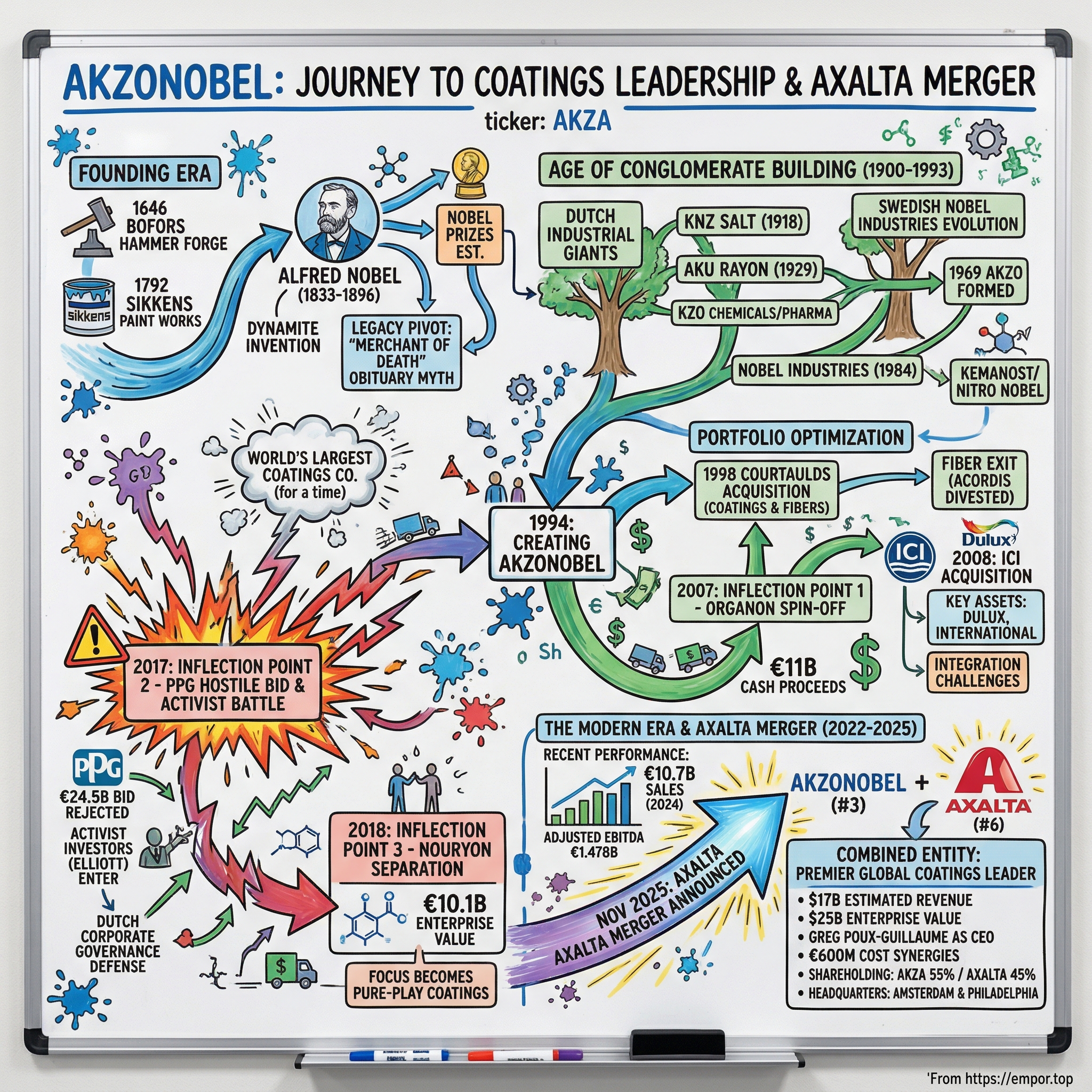
On the rain-soaked streets of Amsterdam in November 2025, two historic coatings companies announced what could become the defining deal of the decade in their industry. AkzoNobel and Axalta Coating Systems entered into a definitive agreement to combine in an all-stock merger of equals, creating a premier global coatings company with an enterprise value of approximately $25 billion.
The announcement sent ripples through boardrooms from Pittsburgh to Tokyo, signaling the most significant reshaping of the global paints and coatings landscape since AkzoNobel itself swallowed Britain's Imperial Chemical Industries in 2008. But the real story here isn't about spreadsheets and synergy projections. It's about how a company with roots stretching back nearly four centuries—roots that include dynamite, synthetic fibers, pharmaceuticals, and salt mining—systematically shed almost everything except paint.
AkzoNobel is a Dutch multinational company which creates paints and performance coatings for both industry and consumers worldwide. Headquartered in Amsterdam, the company has activities in more than 150 countries. AkzoNobel is the world's third-largest paint manufacturer by revenue after Sherwin-Williams and PPG Industries.
The central question that haunts this narrative: How did a company with roots in dynamite, rayon, and salt become a pure-play paints and coatings leader? The answer lies in a series of dramatic inflection points—corporate near-death experiences, hostile takeover battles, activist investor confrontations, and strategic pivots that would make any business school case study pale in comparison.
The combined company will create a global coatings leader with $17 billion in revenue and an enterprise value of $25 billion, with significant value creation through approximately $600 million in cost synergies supporting strategic and capital allocation priorities. AkzoNobel shareholders will own 55% of the new group and Axalta investors 45%, and the combined company will be led by current AkzoNobel chief executive Greg Poux-Guillaume as CEO.
The themes that will guide our exploration include: mergers as corporate destiny, the collision between activist investors and entrenched management, the peculiarities of Dutch corporate governance (which proved crucial in fending off PPG's advances), and the strategic logic of portfolio simplification in an era of conglomerate skepticism.
Since 1792, AkzoNobel has been supplying the innovative paints and coatings that help to color people's lives and protect what matters most. Their world class portfolio of brands – including Dulux, International, Sikkens and Interpon – is trusted by customers around the globe. These four brands represent the DNA of what AkzoNobel has become—household names for homeowners repainting their living rooms, specialized coatings for cargo ships crossing oceans, and industrial solutions protecting infrastructure from corrosion.
But before we can understand where AkzoNobel is going, we must understand where it came from—a journey that begins not in paint factories, but in the tumultuous life of one of history's most conflicted inventors.
II. The Founding Era: Four Centuries of Origins (1646–1900)
Picture a modest gatehouse nestled within the ancient city wall of Groningen in the Netherlands during the late 18th century. It's an unassuming structure, certainly not the kind of place you'd expect to find the origins of what would become one of the world's largest coatings companies. Yet this was where in the late 18th century, Wiert Willem Sikkens opened a small paint and varnish works in a gatehouse in the city wall of Groningen, the Netherlands.
From the outset business grew steadily, as did Sikkens' solid reputation. By the 1920s Sikkens was focused on R&D, establishing a lab for quality control and product development in 1924. Soon the brand expanded into specialist coatings for the joinery, automotive and aerospace industries.
But the Sikkens paint operation was just one strand in what would become an extraordinarily tangled corporate web. AkzoNobel has a long history of mergers and divestments. Parts of the current company can be traced back to 17th-century companies.
The Dutch industrial tradition that birthed the precursors to Akzo was built on fundamentals: salt, chemicals, and textiles. The KNZ was formed in 1918 by Ko Vis as a salt producing company; a business that to this day plays an important role in AkzoNobel's activities. Salt may seem mundane, but it was the foundation of the chemical industry—chlorine, caustic soda, and a host of downstream products all flowed from salt processing.
Alfred Nobel: The Merchant of Death Who Changed His Legacy
No story of AkzoNobel is complete without understanding the Swedish inventor whose name adorns the company. Alfred Nobel was a Swedish chemist, inventor, engineer, and businessman. He is known for inventing dynamite, as well as having bequeathed his fortune to establish the Nobel Prizes. Alfred Nobel was born in Stockholm, Sweden, on 21 October 1833. He was the third son of Immanuel Nobel, an inventor and engineer, and Andriette Nobel.
The family's path to explosives began with tragedy and financial ruin. From 1853 to 1856, the Nobel family produced armaments for the Crimean War. But when the war ended, they had difficulty returning to domestic production, and were eventually forced to file for bankruptcy. In 1859 Alfred returned to Sweden with his parents, where he devoted himself to the study of explosives.
What Alfred discovered would change the world. After the industrial revolution in the 19th century, activities such as mining increasingly necessitated far more explosive power. In 1847 a breakthrough came with the development of nitroglycerin, an extraordinarily strong—and terribly dangerous—compound. Its volatility gave it power but led to deadly accidents. The challenge for inventors was to marry the power of nitroglycerin to the stability of gunpowder. The man who did it was Alfred Nobel.
But the path to dynamite was paved with personal loss. In 1864, some unstable nitroglycerine caused an explosion at the Nobel factory. Five people were killed, including Alfred's younger brother, Emil. Dynamite was developed to be a safer, simpler, and more stable alternative to nitroglycerine. And crucially, it was originally developed for use in the mining and building industries.
Three years later, in 1867, Nobel stumbled on the discovery that would make him a household name. Purely by chance, he observed that the porous sedimentary rock known as diatomaceous earth has the property of absorbing nitroglycerin. On testing the resulting mixture he found, to his excitement, that it was an effective explosive but far more stable than pure nitroglycerin. Nobel termed the compound "dynamite" from the Greek dynamis, meaning "power."
Then came the defining moment that would reshape Nobel's legacy—a moment that may be more legend than fact, but captures a deeper truth about the inventor's troubled conscience.
In 1888, Alfred Nobel's brother Ludvig had died while staying in Cannes, France. The French newspapers reported Ludvig's death but confused him with Alfred, and one paper sported the headline "Le marchand de la mort est mort" ("The merchant of death is dead."). It then stated that Nobel, the inventor of dynamite and other explosives, had "became rich by finding ways to kill more people faster than ever before."
Alfred Nobel had loathed war all his life and was stunned when his obituary referred to him as a "merchant of death." He vowed that he would not be remembered as such! So he decided to leave his immense fortune to foster science, literature and peace. The Nobel Prizes were born! All because a journalist did not check his facts.
During his life, Nobel was issued 355 patents internationally, and by his death, his business had established more than 90 explosives and armament factories, despite his apparently pacifist character.
The story of AkzoNobel begins where Alfred Nobel's story ends. His commercial empire—the factories, the patents, the business relationships—didn't disappear with his death. They evolved, merged, and transformed over the following century into what would eventually become Nobel Industries AB of Sweden.
The synthetic element nobelium was named after him, and his name and legacy also survive in companies such as Dynamit Nobel and AkzoNobel, which descend from mergers with companies he founded.
The lesson for investors: great companies often emerge from unexpected origins. The Sikkens paint shop in Groningen and Nobel's explosives empire seemed to have nothing in common. Yet through the alchemy of industrial consolidation, they would eventually unite under the same corporate banner—a reminder that corporate ancestry, like human ancestry, follows paths that are rarely straight and often surprising.
III. The Age of Conglomerate Building (1900–1993)
The early 20th century was the golden age of industrial conglomerates, and the corporate ancestors of AkzoNobel were enthusiastic participants in this era of relentless expansion and consolidation.
Dutch Industrial Giants Take Shape
Akzo was formed in 1969 as merger of Algemene Kunstzijde Unie (General Artificial Silk Union; AKU) and Koninklijke Zout Organon (Royal Salt Organon; KZO). The AKU was formed in 1929 when the Vereinigte Glanzstoff-Fabriken (est. 1899) and Nederlandse Kunstzijdefabriek (ENKA, est. 1911) merged, forming Algemene Kunstzijde Unie (AKU).
These weren't paint companies—they were rayon manufacturers. Rayon, the first commercially successful synthetic fiber, was the high-tech material of its era. The ability to create "artificial silk" from cellulose represented a triumph of industrial chemistry, and companies that mastered this process enjoyed decades of prosperity.
The latter faced, amongst others, technical problems in the manufacturing of synthetic fibers. Its founder, Jacques Coenraad Hartogs, turned to Dutch industrialist Rento Hofstede Crull for a solution for which Hofstede Crull provided the answer. They created a joint venture, the NV I.S.E.M., whose successes and profits laid the foundation for the ENKA's subsequent acquisitions and mergers and which was eventually absorbed by the AKU in 1938.
Meanwhile, on the other side of the eventual Akzo merger equation, the KZO was formed when Koninklijke Zout Ketjen merged with Koninklijke Zwanenberg Organon in 1967. Koninklijke Zwanenberg Organon was formed when Zwanenberg's Fabrieken (est. 1887), a meat export factory based in Oss merged with Organon, a pharmaceuticals company founded by Saal van Zwanenberg, also in Oss.
This last detail deserves emphasis: one of the founding components of Akzo was literally a meat export factory. The pharmaceutical arm, Organon, would grow to become one of the most valuable parts of the eventual AkzoNobel empire—only to be sold off decades later in a pivotal strategic shift.
The 1969 merger that created Akzo brought together fibers, salt, chemicals, and pharmaceuticals under one roof. After the merger of AKU and KZO, Akzo made a number of other critical acquisitions; Armour and Company in 1970, Levis Paints in 1985, specialty chemicals division of Stauffer in 1987 and divested its polyamides and polyesters plastics engineering business to DSM in 1992.
Swedish Nobel Industries Evolution
Across the Baltic Sea, a parallel consolidation was occurring with companies descended from Alfred Nobel's industrial empire.
Nobel Industries was created in 1984 by the merger of a chemical company, KemaNobel, and an armaments maker, Bofors. Both Bofors and KemaNobel had historic ties to Alfred Nobel, the great 19th century Swedish inventor who was the first to discover a way to detonate the flammable liquid nitroglycerin.
The story of how these Nobel heirs reunited is itself remarkable. Alfred Nobel's first company, Nitroglycerin Ltd., continued in the explosives business. In 1965 the company's name was changed to Nitro Nobel, and in 1978 the business was acquired by Swedish industrialist Marcus Wallenberg, who headed a group of companies that included Sweden's largest bank, major airline, leading telecommunications company, a major forest products company, the well-known household appliance maker Electrolux, and the country's second largest auto company. These holdings, controlled directly or indirectly by Wallenberg, were said to account for 25 percent of Sweden's gross domestic product. Wallenberg merged Nitro Nobel with his KemaNord group, and renamed the company KemaNobel.
Bofors, the second company involved in the formation of Nobel Industries, traced its lineage back to 1646, when it was a hammer forge near Karlskoga, Sweden, that by 1894 had become a munitions factory.
The reunification was orchestrated by an unlikely figure. Bofors merged with KemaNobel due to the dealings of a canny Swedish financier, Erik Penser. Penser had dropped out of law school in the mid-1960s, preferring to play poker rather than study. Penser combined KemaNobel with Bofors and named the new entity Nobel Industries. The 42-year old broker now controlled a company with sales of one billion dollars. He installed a friend, Anders Carlberg, as president, while Penser himself moved to England in order to avoid Swedish income taxes.
Nobel Industries expanded rapidly, making many acquisitions. In 1986 the company bought Italian industrial paints company TechnoMax and a Swedish defense electronics firm named Pharos. Nobel also acquired an option to buy Swedish Match, another large chemical company controlled by Marcus Wallenberg. In 1989 the company increased its holdings in its industrial paints division, buying up 60 percent of Italian paint company Colorifico Valtramigna SpA; acquiring a West German adhesives company, Hermanns & Co. GmbH; a Belgian paint company called Trimetal; and the impregnated paper operation of Britain's Catalin.
By the early 1990s, both Akzo and Nobel Industries were diversified chemical conglomerates with significant coatings businesses. The logic of combination was becoming irresistible.
For investors, the key insight from this era is that AkzoNobel's current focus on paints and coatings was not inevitable—it emerged from decades of corporate evolution that included fibers, pharmaceuticals, explosives, and salt. The company's DNA is fundamentally that of a serial acquirer and portfolio optimizer, skills that remain relevant as it pursues the Axalta merger.
IV. The 1994 Merger: Creating AkzoNobel
January 20, 1994, marked the birth of AkzoNobel as a corporate entity. But unlike most corporate births, this one involved the union of two century-old industrial dynasties rather than a startup and its founders.
The merger of Akzo and Nobel represented the culmination of more than a century of acquisitions and mergers between two companies with long histories.
In 1993, Dutch company Akzo N.V. agreed to acquire Nobel Industries for $1.73 billion. The merger was completed in 1994, forming Akzo Nobel.
In 1994, Akzo completed the merger of Nobel's six business groups, making Akzo Nobel one of the ten largest chemical companies in the world. Shortly before the merger, Akzo had implemented a sweeping reorganization drive to dismantle the company's five major business divisions and recreate them in four new groups—chemical, fibers, coatings, and pharmaceuticals.
The immediate aftermath of the merger required substantial pruning. In 1994 Akzo and Nobel Industries agreed to merge, forming Akzo Nobel, with the new combined entity having 20 business entities a number of divestments were made: Nobel Chemicals, Nobel Biotech and Spectra-Physics. In 1995 the PET resins business was sold to Wellman, Inc. In 1996 the group sold the crop protection business to Nufarm.
The Courtaulds Acquisition & Fiber Exit
Just four years after the Akzo-Nobel merger, the company made another transformative acquisition that would dramatically reshape its portfolio.
In 1998 the company acquired industrial coatings and synthetic fiber company Courtaulds, later divesting Courtaulds industrial coatings. Courtaulds was merged with Akzo Nobel Fibres forming Acordis, which in December 1999 was divested to CVC Capital Partners and then sold in 2000 to Teijin.
The Courtaulds deal was a two-step maneuver that reflected management's emerging strategic clarity. By acquiring Courtaulds, AkzoNobel gained valuable coatings assets, including the International marine coatings brand. But rather than doubling down on fibers—a business facing commoditization and Asian competition—management combined the fiber operations into Acordis and then quickly divested the whole thing.
This was portfolio optimization in action. The company was systematically shedding businesses that didn't fit the emerging vision while strengthening positions in areas with better long-term prospects. The International brand, acquired through Courtaulds, the Holzapfel brothers built a new factory in Felling, UK, to produce their increasingly successful International marine antifouling paint.
By the early 2000s, AkzoNobel had evolved from a diversified industrial conglomerate into something more focused: a company with strong positions in coatings, specialty chemicals, and pharmaceuticals. But the most dramatic transformation was yet to come—one that would involve selling the crown jewel of its healthcare empire and using the proceeds for its largest acquisition ever.
V. INFLECTION POINT #1: Organon Spin-off & ICI Acquisition (2007–2008)
The years 2007 and 2008 represented the most consequential strategic pivot in AkzoNobel's modern history. In a bold double move, management sold the company's pharmaceutical business for a blockbuster price and immediately redeployed the capital to acquire one of Britain's most storied industrial names.
The Pharmaceutical Exit
On March 12, 2007, Akzo Nobel announced that on March 11, 2007, it received an offer for the purchase of its wholly owned subsidiary Organon BioSciences N.V. (OBS) from Schering-Plough for EUR 11 billion in cash.
Eight months after the initial announcement, Schering-Plough announced it had completed the acquisition, creating a combined company with a significantly deepened portfolio of human and animal health products. Schering-Plough would keep its headquarters in Kenilworth but would establish global headquarters for its animal health business in Boxmeer, the Netherlands.
The €11 billion price tag stunned analysts. Analysts had valued Organon at 9 billion euros on a stand-alone basis and 10 billion euros in a trade sale. Organon BioSciences, with 3.7 billion euros in annual revenues, develops and markets prescription drugs, and animal health products.
Commenting on the announcement, Akzo Nobel CEO Hans Wijers said: "The intended sale of Organon BioSciences is a major milestone in the history of Akzo Nobel. It is a fundamental step towards our goal of creating a focused, international industrial player. At the same time, we are convinced that we have found an excellent home for OBS."
The timing proved prescient. Within two years, Schering-Plough itself would be acquired by Merck in a $41 billion deal—For its part, Akzo Nobel did not let the money it made selling Organon sit for long. It made several small and middling buys in the paint and chemical industries, and then spent more than 8 billion euros to buy Imperial Chemical Industries.
The ICI Mega-Deal: Buying an Icon
Imperial Chemical Industries was not just any company. ICI was founded in December 1926 from the merger of four companies: Brunner Mond, Nobel Explosives, the United Alkali Company, and British Dyestuffs Corporation. ICI established its head office at Millbank in London in 1928. Competing with DuPont and IG Farben, the new company produced chemicals, explosives, fertilisers, insecticides, dyestuffs, non-ferrous metals, and paints. In its first year, turnover was £27 million.
ICI's technical achievements had been remarkable. During the 1920s and 1930s, the company played a key role in the development of new chemical products, including the dyestuff phthalocyanine (1929), the acrylic plastic Perspex (1932), Dulux paints (1932, co-developed with DuPont), polyethylene (1937), and polyethylene terephthalate fibre known as Terylene (1941).
In 1933 ICI developed polyethylene, which is later patented and sold as an insulating material. This was arguably the most important commercial plastic ever invented, enabling everything from packaging to electronics.
But by 2007, ICI had shrunk dramatically from its glory days. In 2006, the Company sold Quest International, its flavours and fragrances business, to Givaudan, for £1.2 billion and Uniqema, its oleochemical business, to Croda International, for £410 million. Having sold much of its historically profitable commodities businesses, and many of the new speciality businesses which it had failed to integrate, the company consisted mainly of the Dulux paints business, which found itself the subject of a takeover by AkzoNobel in 2007.
The pharmaceutical arm had already departed years earlier—In 1993 ICI demerged its bioscience business, splitting into two publicly listed companies: ICI and Zeneca. The latter would later go on to merge with Astra AB, forming the current pharmaceutical company, AstraZeneca.
The Deal Drama
AkzoNobel's pursuit of ICI was no smooth transaction. In June 2007, the Dutch firm AkzoNobel (owner of Crown Berger paints) bid £7.2 billion (€10.66 billion or $14.5 billion) for ICI.
The initial bid was rejected by the ICI board and the majority of shareholders. However, a subsequent bid for £8 billion (€11.82 billion) was accepted by ICI in August 2007, pending approval by regulators.
Several issues complicated the transaction. An area of concern about a potential deal was ICI's British pension fund, which had a deficit of almost £700 million and future liabilities of more than £9 billion at the time.
Regulatory issues in the UK and other markets where Dulux and Crown Paints brands each have significant market share were also a cause for concern for the boards of ICI and AkzoNobel. In the UK, any combined operation without divestments would have seen AkzoNobel have a 54 per cent market share in the paint market.
On January 2, 2008, AkzoNobel acquired 100 percent of the share capital of Imperial Chemical Industries plc (ICI). The total cost of the acquisition, paid mostly in cash, was €11.6 billion.
Integration & Asset Sales
The acquisition required immediate divestitures to satisfy regulators. The adhesives business of ICI was transferred to Henkel as a result of the deal, while AkzoNobel agreed to sell its Crown Paints subsidiary to satisfy the concerns of the European Commissioner for Competition.
In connection with the acquisition of ICI, AkzoNobel sold all assets and liabilities comprising the businesses known within ICI as the Adhesives business and the Electronic Materials business to Henkel, for €3.6 billion in cash after a pension settlement and before final settlement adjustments. The transaction took place in April 2008. In addition, in granting clearance, the EU and Canadian authorities accepted a commitment package from AkzoNobel involving the divestment of a number of AkzoNobel Decorative Paints businesses in the UK, Ireland, Belgium and Canada. These businesses were sold in the course of 2008.
Akzo Nobel upgraded the estimated annual synergies target resulting from its recent acquisition of ICI to EUR 340 million, a 20 percent increase on the previously announced EUR 280 million. CEO Hans Wijers explained that the integration is making good progress and the company is benefiting from the complimentary cultures of both businesses. "After reviewing the available synergies from the transaction and former cost reduction programs of both companies, we now expect to realize estimated annual pre-tax cost synergies of EUR 340 million per annum. This breaks down as EUR 180 million from Decorative Paints, EUR 85 million from corporate savings and EUR 75 million from procurement costs."
The company decided to continue using the Akzo Nobel name for the newly enlarged company. "Our research findings confirmed that the Akzo Nobel name is well respected and trusted among our key stakeholders and commands significant brand equity. Its use, combined with our products, adds a high degree of value. Therefore, while all strong product brand names such as Dulux® and Glidden® will remain, ICI will be discontinued as a corporate name."
The 2007-2008 transformation was breathtaking in scope. AkzoNobel had exited pharmaceuticals entirely and bet heavily on becoming the world's largest decorative paints company. The Dulux brand—that iconic British name associated with the beloved Old English Sheepdog mascot—was now the crown jewel of a Dutch corporation.
VI. INFLECTION POINT #2: The PPG Hostile Bid & Activist Battle (2017)
If the ICI acquisition demonstrated AkzoNobel's capacity for transformative deals, the PPG battle of 2017 demonstrated its capacity for corporate combat. This was the defining corporate governance drama of modern AkzoNobel—a clash that pitted American financial logic against Dutch stakeholder capitalism, activist investors against entrenched management, and short-term shareholder value against long-term industrial strategy.
The Unsolicited Approach
In March 2017, PPG Industries launched an unsolicited takeover bid of €20.9 billion, which was promptly rejected by AkzoNobel's management. Days later, PPG again launched an increased bid of €24.5 billion, which was again rejected by AkzoNobel's management.
The premium was substantial. The bid represented a 29 percent premium to Akzo's closing price of 64.42 euros on Wednesday and its shares almost 15 percent to 73.95 euros on Thursday, nearing all-time highs.
PPG's management believed the combination made strategic sense. "We believe a combination is a very compelling strategic opportunity," said CEO Michael McGarry in a statement, adding he believed it was in the interest of shareholders, employees and customers as well. "PPG…has devoted significant time and resources to analyzing a potential combination of PPG and AkzoNobel and is confident in its ability to execute and complete the proposed transaction."
But AkzoNobel's management saw things differently. Buechner said Akzo's management and supervisory boards had concluded that the PPG proposal failed "to reflect the long-term value creation potential of the company." The country's Economic Affairs Minister Henk Kamp said the proposed deal was "not in the interest of the Netherlands."
Activist Investors Enter
The battle escalated dramatically when activist investors entered the fray. A number of shareholders urged the company to explore the offer and subsequent negotiations. In April, activist investor, Elliott Investors called for the removal of Chairman Antony Burgmans following Akzo's refusal to submit to discussing with PPG. Elliott, which has a 3.25% stake in the company, claimed it was one of a group of investors that met the Dutch legal threshold of 10% voting-share support, which is needed to call an extraordinary meeting to vote on a proposal to remove Burgmans.
On 13 April, Templeton Global Equity said it was among another group of investors calling for an extraordinary meeting of AkzoNobel shareholders to discuss Burgmans continued tenure as Chairman.
Reuters reported that Causeway Capital, which owns 6.8 percent of AkzoNobel, agreed that PPG's last offer of $24.2 billion for AkzoNobel was still too low—but the board and AkzoNobel CEO Ton Büchner shouldn't have blown it off so quickly. "(W)e believe the bid is at a level where management should now engage in discussions with PPG," Causeway wrote to AkzoNobel.
The Defense Strategy
AkzoNobel's management responded with a classic defense playbook. Later, in the same month Akzo outlined its plan to separate its chemicals division and pay shareholders €1.6 billion in extra dividends, in order to attempt to hold-off PPG.
On 24 April, a day before Akzo's annual meeting of shareholders, PPG increased its final offer by approximately 8% to $28.8 billion (€26.9 billion, €96.75 per share)—with Akzo's share pricing rising 6% to a record price of €82.95 per share. Akzo shareholder, Columbia Threadneedle Investments, urged the company to open dialogue with PPG, whilst PPG claimed that the deal would add to earning within its first year.
The Legal Battle & Dutch Corporate Governance
What distinguished this takeover battle from typical Anglo-American corporate combat was the distinctive nature of Dutch corporate governance. Like many Dutch companies, Akzo Nobel has strong defenses in place against a hostile takeover. Under a 1928 provision, members of its supervisory board hold "priority shares" granting them the right to make binding nominations to the management board or amend the company's articles of association.
The activists turned to the courts. A number of AkzoNobel's shareholders continued to pursue the case for engagement with PPG by commencing litigation against AkzoNobel. Led by activist fund Elliott Advisors, the Dutch commercial court was petitioned to make inquiries into the company's conduct and policies for breach of directors' fiduciary duties and Dutch corporate law, and impose an interim measure to convene an EGM for shareholders to vote on a resolution for the removal of the Chairman of the Supervisory Board. The court rejected the shareholders' legal challenge and found no breach of fiduciary duties or corporate governance rules by the AkzoNobel Supervisory Board, and therefore, found no need for an EGM. It was held that there was no general duty on a target company board to consult with shareholders or negotiate with bidders in takeover situations.
PPG Withdraws
In early May, Akzo again rejected PPG's bid, citing the deal still undervalued the company, as well as potentially facing antitrust risks, and not addressing other concerns such as "cultural differences". Under Dutch company law, PPG had to then decide to either make a formal bid or walkaway. In early June, PPG chose to walk away from the potential deal.
Akzo angered some of its shareholders by rejecting PPG's $22 billion bid earlier this year. Activist investors Elliott Management led an aggressive campaign to force the Dutch company to accept the bid but was thwarted by a combination of resistance from managers, politicians, and local institutional investors, who feared that a merger would result in thousands of Dutch jobs being lost.
Leadership Aftermath
Victory came at a cost. As part of Akzo's defense to shareholders, many of whom pushed for the deal, chief executive Ton Büchner agreed to split Akzo in two and achieve increased financial targets. Büchner stepped down as CEO in July 2017, citing health reasons. He was succeeded by Thierry Vanlancker, former chief of the company's chemicals division.
The PPG battle offers several lessons for investors. First, Dutch corporate governance provides substantial protection against hostile takeovers—a consideration for anyone investing in Netherlands-domiciled companies. Second, management's promises during takeover defenses often become binding commitments—AkzoNobel's subsequent sale of its chemicals business was a direct consequence of the commitments made during the PPG fight. Third, activist investors can be powerful forces, but they can also lose, especially when management can appeal to stakeholders beyond just shareholders.
VII. INFLECTION POINT #3: The Nouryon Separation (2018)
Having successfully fended off PPG, AkzoNobel's management now had to deliver on the promises made during the battle. The centerpiece was separating the specialty chemicals business—a strategic transformation that would finally make AkzoNobel a pure-play coatings company.
The Chemicals Split
AkzoNobel announced the sale of 100% of its Specialty Chemicals business to The Carlyle Group and GIC for an enterprise value of €10.1 billion. This transaction creates two focused and high performing businesses – Paints and Coatings, and Specialty Chemicals – as part of its strategy announced in April 2017.
The timing was notable—management had promised to separate the chemicals business during the PPG fight, and they delivered ahead of schedule. The Board of Management and the Supervisory Board concluded that a private sale to The Carlyle Group and GIC is in the best interests of AkzoNobel, Specialty Chemicals and its respective stakeholders, including employees, shareholders and customers. This is the outcome of a thorough dual-track process during which the Boards of AkzoNobel carefully considered both a legal demerger and a private sale. The Carlyle Group has a global presence and the financial capacity to enable the Specialty Chemicals business achieve its full potential.
Thierry Vanlancker, CEO AkzoNobel, said: "Today is a key milestone in creating two focused, high performing businesses, to generate value for all stakeholders. We delivered on our commitment to separate the Specialty Chemicals business and did so ahead of schedule. We are very pleased to announce the sale of Specialty Chemicals to The Carlyle Group and GIC. We believe the business is well positioned to capture growth opportunities and further improve performance."
Shareholder Returns
AkzoNobel distributed $7.5 billion from its net proceeds of $8.6 billion from the divestment to shareholders. Remaining proceeds were used to repay debt, finance costs associated with Nouryon's transformation, and conduct bolt-on acquisitions. AkzoNobel decided in 2017 to sell its chemicals business to raise funds for shareholders rather than allow itself to be taken over by U.S. paints rival PPG Industries.
Nouryon's New Life
The former AkzoNobel Specialty Chemicals is being relaunched as Nouryon. The move follows the recent acquisition of the business by The Carlyle Group and GIC and marks the company's transition to becoming an independent, global specialty chemicals leader. "Launching our new company is a significant milestone to add to our proud history and we are all looking forward to this exciting new chapter," said new CEO Charles W. Shaver. "We are ready to leverage our experience, global presence, and strong company culture to unleash our full potential as an independent company."
Nouryon's new CEO, Charles W. Shaver, was until recently CEO of U.S. coatings firm Axalta. This detail would prove prescient years later when AkzoNobel and Axalta would come together.
Nouryon has a history that stretches back nearly 400 years and its new name and brand identity reflect that heritage. Noury & Van der Lande was one of the first companies to realize the important role chemistry could play in everyday life; today, Nouryon is a world leader in essential chemistries used to manufacture everyday products.
On October 1, 2018 AkzoNobel completed the sale of the Specialty Chemicals business to The Carlyle Group and GIC for an enterprise value of EUR 10.1 billion.
On October 9, 2018 Specialty Chemicals was re-branded as a new company, Nouryon, after acquisition by the Carlyle Group.
With the Nouryon separation complete, AkzoNobel emerged as what it is today: a focused paints and coatings company. The sprawling conglomerate that once included pharmaceuticals, fibers, explosives, and specialty chemicals had been systematically pruned to a single, coherent business. The question now became: could this focused company generate the returns its shareholders expected?
VIII. The Modern Era: Recent Performance and the Axalta Deal (2022-2025)
The post-Nouryon era required AkzoNobel to prove that a focused coatings strategy could deliver competitive returns. The company needed to demonstrate that it hadn't simply sold off its most valuable businesses while keeping the slower-growth remainder.
New Leadership
Grégoire (Greg) Poux-Guillaume joined AkzoNobel in November 2022 as Chief Executive Officer and Chairman of the Board of Management, bringing with him 30 years of experience in various industrial businesses and private equity.
Poux-Guillaume succeeded Thierry Vanlancker, who had been CEO and member of the Board of Management since 2017, and whose term of office was coming to an end. Gregoire, a French national, is an international business leader with 25 years of experience. He has a distinguished track record of building successful, profitable businesses in challenging environments, accelerating business growth and improving margins. Previous roles include CEO of Sulzer, CEO of GE Grid Solutions (previously Alstom Grid) and Senior Managing Director of CVC Capital Partners.
Financial Performance
AkzoNobel's fiscal year 2024 revealed a sales figure of €10.711 billion (approximately $11.618 billion), which remained relatively stable compared to the previous year. The company experienced a 2% organic sales growth, driven by a 1% increase in volume and a 1% rise in price/mix. The growth in coatings, particularly in marine coatings, protective coatings, and powder coatings, was notable, especially in China. However, the decorative paints segment saw flat sales, with growth in LATAM and SESA offset by ongoing weakness in the Chinese market.
Adjusted EBITDA rose by 3% to €1.478 billion, while operating profit fell by 10.88% to €917 million, primarily due to restructuring costs. The net profit attributable to shareholders increased by 22.62% to €542 million (approximately $588 million).
CEO Greg Poux-Guillaume commented, "2024 was a year of organic growth for us, with an increase in adjusted EBITDA, demonstrating our ability to grow under mixed market conditions. In the fourth quarter, we raised adjusted EBITDA by 3%, maintaining costs in fixed currency terms compared to last year."
In his opening statement in the 2024 annual report, CEO Greg Poux-Guillaume reflects on a year that presented a series of challenges. "We faced a complex operating environment, with continued inflationary pressure, adverse currency impacts and unstable markets," he says. "Although these headwinds spurred competitive intensity and tested our resilience, they also strengthened our determination to control our own destiny by stepping up self-help measures that ultimately boosted our performance."
The Axalta Merger: A New Chapter
In November 2025, AkzoNobel announced the deal that represents its next major strategic evolution. AkzoNobel and Axalta entered into a definitive agreement to combine in an all-stock merger of equals, creating a premier global coatings company with an enterprise value of approximately $25 billion. The combination brings together two coatings industry leaders with complementary portfolios of highly regarded brands to better serve customers across key end markets and enhance value for shareholders, employees and other stakeholders. Anchored in both companies' proud histories and broad expertise, the combined business will have a highly attractive financial profile, industry-leading innovation capabilities and a balanced global footprint spanning over 160 countries.
Greg Poux-Guillaume, Chief Executive Officer and Chairman of the Board of Management of AkzoNobel, said, "We're excited to enter a new chapter in our long and proud history as a leader in the paints and coatings industry. This merger will allow us to accelerate our growth ambitions by bringing together highly complementary technologies, expertise and passionate people to unlock our full combined potential. I am excited to lead our talented teams in bringing the best of both companies to our customers and shareholders, delivering outstanding value to both." Ben Noteboom, Chairman of the Supervisory Board of AkzoNobel, stated, "This combination represents a compelling opportunity. It's a great value proposition for all our stakeholders both in the Netherlands, where we maintain our domicile and internationally, including our shareholders, customers and employees."
The combined company will have a new name and ticker symbol, which has not yet been announced, and will have dual headquarters in Amsterdam and Philadelphia. The agreement terms were unanimously approved by AkzoNobel's Supervisory Board and Board of Management, as well as Axalta's Board of Directors. Axalta shareholders will receive 0.6539 shares of AkzoNobel stock for each share of Axalta common stock owned. In connection with the transaction, AkzoNobel will pay a special cash dividend to AkzoNobel shareholders equal to €2.5 billion ($2.9 billion) minus the aggregate amount of any regular annual and interim dividends paid by AkzoNobel to its shareholders in 2026 before completion. AkzoNobel shareholders will own 55% and Axalta shareholders 45% of the combined company on a pro forma basis immediately after closing.
Under the agreement, Amsterdam-based Akzo Nobel will own 55% of the combined entity, whose brands range from Dulux to Cromax. After trading for some three decades in Amsterdam, the share listing will move to New York while the companies will maintain headquarters in the Netherlands and Philadelphia.
In PCI's 2025 Global Top 10 Rankings, AkzoNobel finished at #3 with $11.6 billion in coatings sales and Axalta came in at #6 with $5.3 billion. With the estimated combined revenue, this would push the new company up between longstanding #1 and #2 positions.
The new company expects annual revenues of $17 billion, an annual adjusted core earnings (EBITDA) of $3.3 billion, and $1.5 billion in adjusted free cash flow. It expects to deliver annual cost savings of $600 million, 90% of which are expected within the first three years following the close of the transaction.
IX. Industry Analysis: The Global Paints & Coatings Landscape
Understanding AkzoNobel requires understanding its competitive environment. The global paints and coatings industry is a fascinating study in industrial economics—fragmented in some segments, consolidated in others, and increasingly shaped by environmental regulations and technological change.
Market Size and Structure
The global market for paints and coatings was valued at $194.0 billion in 2023. The market is expected to grow from $203.8 billion in 2024 and should reach $263.2 billion by 2029, at a compound annual growth rate (CAGR) of 5.2% from 2024 to 2029.
The Competitive Hierarchy
The global coatings industry operates with a clear hierarchy. The American multinational Sherwin-Williams is, without a doubt, the global market leader for paints and coatings. With a revenue of $18.4 billion in 2024, Sherwin-Williams remains the top player, holding the highest market share in North America at 28.5% in 2019. Through smart acquisitions and developments, the company, which specializes in manufacturing and distributing premium paints and coatings, continues to strengthen its global presence. Sherwin-Williams' dominant position in the industry has been solidified by its steady performance, particularly in residential and commercial construction projects.
With approximately $18.2 billion in revenue in 2024, PPG Industries, another American multinational, is a strong competitor to Sherwin-Williams. PPG is well known for its extensive product line, which includes coatings for industrial, architectural, and automotive applications.
AkzoNobel N.V. - Reported EUR 10.7 billion in 2024 revenue, driven by strong demand for decorative paints, performance coatings, and sustainable surface protection. PPG Industries, Inc. - Achieved USD 18.2 billion in 2024 revenue, supported by growth in industrial coatings, automotive OEM coatings, and advanced protective applications. The Sherwin-Williams Company - Delivered USD 23.0 billion in 2024 revenue, maintaining its position as a global leader in architectural paints, industrial coatings, and specialty finishes. Axalta Coating Systems - Recorded USD 5.2 billion in 2024 revenue, driven by strong performance in automotive refinishing, industrial powder coatings, and energy-efficient coating systems.
Geographic Dynamics
By geography, Asia-Pacific dominated with 46.55% revenue contribution in 2024 and is expected to post the highest regional CAGR of 5.08% through 2030.
Asia Pacific is the fastest-growing paints & coatings market due to the rapid infrastructural activities in the region, triggered by the availability of raw materials, low-cost labor, increasing trade relations with other regions, and private sector involvement. The rising population and rapid urbanization in the emerging economies of Asia Pacific also contribute significantly to the market growth.
Technology Trends
By resin, acrylics led with 36.26% paints and coatings market share in 2024 and are projected to grow at a 4.11% CAGR through 2030. By technology, water-borne systems accounted for 50.05% of the paints and coatings market size in 2024 and remain the fastest-expanding technology at 4.17% CAGR to 2030. By end-user, architectural coatings commanded 48.97% of 2024 revenue and are also pacing the segment growth at a 4.52% CAGR through 2030.
The market for coatings manufactured with solvent-borne technologies is slowly diminishing and being taken over by coatings based on waterborne technologies, essentially because of their environmentally friendly properties.
X. Strategic Framework Analysis
Porter's Five Forces Assessment
Threat of New Entrants: Low to Moderate The paints and coatings industry presents significant barriers to entry. Established brands like Dulux and Sikkens command consumer loyalty built over decades. Distribution networks require substantial capital investment. Regulatory compliance—particularly environmental regulations governing VOC emissions—creates additional hurdles. However, regional players can enter specific markets, and private label manufacturing provides an avenue for lower-cost competition.
Bargaining Power of Suppliers: Moderate Raw material costs—titanium dioxide, resins, and solvents—represent significant input costs. These commodities can experience price volatility, as AkzoNobel experienced during recent inflationary periods. However, large coatings manufacturers can leverage their scale to negotiate favorable terms, and multiple suppliers exist for most inputs.
Bargaining Power of Buyers: Moderate to High The industry serves diverse customers with varying power. Professional contractors purchasing industrial coatings often have strong negotiating positions due to volume purchases. Automotive OEMs command significant leverage over their coating suppliers. However, retail consumers of decorative paints tend to be brand-conscious and less price-sensitive.
Threat of Substitutes: Low Paints and coatings perform functions—protection, aesthetics, functional performance—that have few genuine substitutes. While alternative surface treatments exist in some applications, the fundamental need for protective and decorative coatings remains robust.
Competitive Rivalry: High Competition among established players is intense. Sherwin-Williams, PPG, and AkzoNobel compete globally across multiple segments. Regional champions like Asian Paints dominate specific geographies. The industry has seen significant M&A activity as players seek scale advantages.
Hamilton Helmer's 7 Powers Framework
Scale Economies The coatings industry exhibits meaningful scale economies in manufacturing, procurement, and R&D. The combined company will have approximately $400 million combined annual R&D spend; 91 R&D facilities for local customer needs; approximately 4,200 research fellows, scientists, and engineers; and around 3,200 granted and pending patent applications. These R&D capabilities would be prohibitively expensive for smaller competitors to replicate.
Network Economies Limited direct network effects exist, though distribution networks create geographic barriers to entry.
Counter-Positioning AkzoNobel has partially counter-positioned through its emphasis on sustainability and waterborne technologies, though competitors pursue similar strategies.
Switching Costs Professional users develop familiarity with specific products and systems. Industrial customers may have qualified specific coatings for their processes, creating switching costs. However, these costs are generally moderate rather than prohibitive.
Brand Brand represents a genuine source of power. Since 1792, AkzoNobel has been supplying the innovative paints and coatings that help to color people's lives and protect what matters most. Their world class portfolio of brands – including Dulux, International, Sikkens and Interpon – is trusted by customers around the globe. The Dulux brand, with its iconic Old English Sheepdog mascot, commands premium positioning in decorative paints.
Cornered Resource No obvious cornered resources exist in the industry.
Process Power Manufacturing excellence and formulation expertise represent potential sources of process power, though these advantages tend to be incremental rather than transformative.
XI. Investment Considerations: Bull Case and Bear Case
Bull Case
Scale and Synergy Benefits The combined company will deliver significant value creation with approximately $600 million in cost synergies supporting strategic and capital allocation priorities, combining highly complementary portfolios across end markets, driving stronger revenue growth, enhanced profitability and increased value for customers. This synergy target represents meaningful value creation if executed successfully.
Diversified Portfolio The merger brings together AkzoNobel's and Axalta's complementary portfolios to create a full spectrum offering of coatings solutions, with first-rate franchises across Powder, Aerospace, Refinish, Mobility, Marine & Protective, Industrial Coatings and Decorative Paints. The combined portfolio will be differentiated by its breadth of solutions across approximately 100 well-known brands.
Geographic Reach With more than 160 countries in its reach and 173 manufacturing sites, the new organization will have deepened access to regional markets and expanded distribution and service capabilities. By comparison, Sherwin-Williams has more than 130 manufacturing facilities and operations in over 120 countries, while PPG operates in more than 70 countries with over 150 manufacturing locations placing the combined AkzoNobel–Axalta group in the same tier of global reach.
Strong Cash Generation The company targets leverage below 2.5 times net debt/adjusted EBITDA by the end of 2025 and around 2 times in the mid-term, while remaining committed to retaining a strong investment grade credit rating. For the mid-term, AkzoNobel aims to expand profitability to deliver an adjusted EBITDA margin of above 16% and a return on investment between 16% and 19%, underpinned by organic growth and industrial excellence.
Bear Case
Integration Risk Mergers of equals historically face significant integration challenges. Cultural differences between Dutch and American corporate traditions, combined with the complexity of harmonizing global operations, create execution risk.
Antitrust Uncertainty One of the most public cases was PPG's unsolicited bid to acquire AkzoNobel in 2017. The proposed deal faced strong resistance from AkzoNobel's board, scrutiny from Dutch authorities and concerns about the merger's impact on local jobs and competition. PPG ultimately withdrew the offer after three attempts. What it shows: Large, cross-border transactions involving major coatings players can face intense stakeholder, political and regulatory pressure.
End Market Exposure The decorative paints business depends heavily on residential construction and renovation activity. The decorative paints segment saw flat sales, with growth in LATAM and SESA offset by ongoing weakness in the Chinese market. Weakness in key markets like China represents ongoing headwind risk.
Competitive Intensity The industry remains highly competitive. February 2025: Sherwin-Williams completed acquisition of BASF's Brazilian decorative paint business for USD 1.15 billion, adding two plants and USD 525 million in annual sales. October 2024: PPG divested its U.S. and Canada architectural coatings division to American Industrial Partners for USD 550 million, including 750 company-owned stores. Competitors continue to reshape their portfolios and pursue growth.
XII. Key Performance Indicators to Monitor
For investors tracking AkzoNobel's ongoing performance, three metrics deserve particular attention:
1. Organic Revenue Growth This measures the company's ability to grow volumes and pricing independent of acquisitions and currency effects. Full-year organic sales up 2% to €10.67 billion, driven by higher volumes and increase in price/mix. Consistent organic growth signals market share gains and pricing power. A sustained inability to grow organically would suggest competitive erosion.
2. Adjusted EBITDA Margin This captures underlying profitability independent of restructuring charges and other one-time items. Adjusted EBITDA increased to €1,478 million (2023: €1,429 million). Adjusted EBITDA margin increased to 13.8% (2023: 13.4%). The company's mid-term target of above 16% adjusted EBITDA margin represents the key profitability benchmark. Progress toward this target will indicate whether management's strategic initiatives are delivering results.
3. Return on Investment (ROI) This measures capital efficiency—critical for a business with substantial manufacturing assets. The company targets ROI between 16% and 19% in the mid-term. This metric captures whether the combined entity can generate adequate returns on the capital invested in facilities, inventory, and working capital.
XIII. Conclusion: The Arc of Industrial Transformation
The story of AkzoNobel is fundamentally a story of corporate metamorphosis. From Wiert Willem Sikkens' paint shop in a Groningen gatehouse to Alfred Nobel's dynamite empire, from rayon and pharmaceuticals to a pure-play coatings leader—the company has reinvented itself repeatedly over four centuries.
The Axalta merger represents the latest chapter in this ongoing transformation. By uniting two world-class organizations, they're creating a strong platform for the future, built on a solid foundation of shared values and heritage." Chris Villavarayan, CEO and President of Axalta, stated, "We are pleased to enter into this transaction with AkzoNobel and join our best-in-class platforms to enhance innovation, develop new capabilities and further strengthen customer relationships."
But history also teaches caution. The 2017 PPG battle demonstrated that AkzoNobel's destiny remains contested terrain. Activist investors, strategic acquirers, and market forces will continue to test whether the company's current strategic direction maximizes value for all stakeholders.
For long-term investors, AkzoNobel presents a compelling case study in industrial evolution. The company's ability to systematically divest non-core businesses while strengthening its position in paints and coatings demonstrates strategic discipline. The pending Axalta combination offers scale and synergy benefits that could enhance competitive positioning.
Yet execution risk remains substantial. Integrating two global organizations across diverse cultures, regulatory environments, and customer relationships is never straightforward. The proof of this strategy will emerge not in the announcement press releases, but in the quarterly results over the years to come.
As Alfred Nobel might have observed, it's not what you build that determines your legacy—it's how that legacy is remembered. For AkzoNobel, the next chapter of that legacy is being written right now, one coat of paint at a time.
Myth vs. Reality Box: The "Merchant of Death" Obituary
Popular Narrative: Alfred Nobel read his own obituary calling him "the merchant of death," was devastated, and immediately resolved to create the Nobel Prizes to rehabilitate his reputation.
Reality: The newspaper incident is often cited as the driving force behind Nobel's philanthropy, but historians have yet to find an original copy of the "Merchant of Death" obituary. Some now dismiss the story as a myth, while others argue that it was only one of many factors that helped shape the inventor's decision. The Nobel Foundation, for instance, notes that he may have first gotten the idea for the science prizes in 1868, when he received an award from the Royal Swedish Academy of Sciences for "important inventions for the practical use of mankind." Nobel's correspondence with peace activist Bertha von Suttner was likely equally influential in shaping the peace prize.
Material Legal/Regulatory Considerations
The pending Axalta merger faces regulatory review in multiple jurisdictions. Given industry precedents—including divestitures required for the Sherwin-Williams/Valspar and AkzoNobel/ICI transactions—investors should anticipate potential remedies that could reduce expected synergies. The shift from Amsterdam to NYSE listing may also create tax and governance considerations for existing European shareholders.


 RSS Feed
 Spotify
 Apple Podcasts
 Amazon Music
 Audible
 YouTube