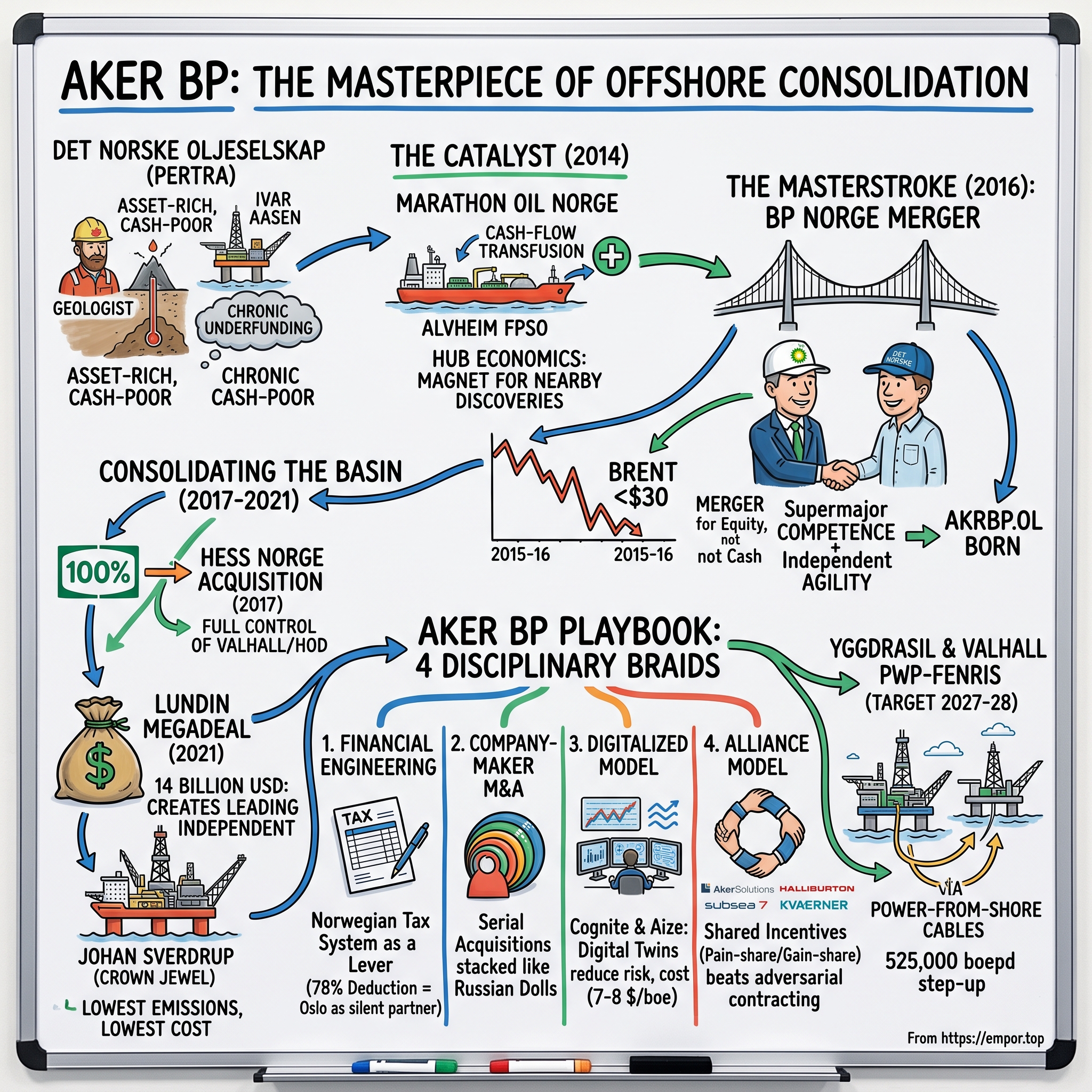
Aker BP: The Masterpiece of Offshore Consolidation
I. Introduction & The Norwegian Continental Shelf (NCS) Paradigm
Picture the North Sea in winter. A grey slab of water heaving under a sky the same colour, wind screaming across a hundred miles of open ocean, and bolted to the seabed a steel city lit up like a refinery at midnight. This is the least forgiving industrial environment on Earth, a place where a single helicopter ride offshore costs more than most people's monthly salary and where a bad decision does not produce a bad quarter — it produces a fatality. And yet on this water, over a single decade, a company that in 2013 produced almost nothing and could barely fund its own drilling program clawed its way to become the second-largest oil producer on the entire Norwegian Continental Shelf, pumping more than 400,000 barrels of oil equivalent a day.7
How? That is the hook of this story. Because Aker BP did not out-drill the majors, and it certainly did not out-spend them. It out-engineered them — financially, commercially, and digitally.
To understand any of it, you first have to understand the strangest and most important fact about doing business on the Norwegian shelf: the tax. Norway taxes offshore petroleum profits at a marginal rate of 78 percent — a 22 percent ordinary corporate rate stacked with a 56 percent special petroleum tax.2 To an American oilman that number sounds like confiscation. It is not. It is the most elegant risk-sharing arrangement in global energy, and once you grasp it, the whole Aker BP playbook clicks into place.
Here is the trick. Because costs — exploration, drilling, development, decommissioning — are deductible against that same 78 percent, the Norwegian state effectively pays 78 cents of every dollar an operator spends, and takes 78 cents of every dollar it earns. The system is deliberately designed to be "neutral," so that a project profitable before tax remains profitable after tax.2 In plain English: Oslo is your silent partner on the downside and your senior partner on the upside. Dry hole? The taxpayer ate most of it. Gusher? The taxpayer takes most of it. For a small company with more geological promise than cash, this fiscal design is not a burden — it is a subsidised call option on the seabed.
There is a subtler consequence buried in that arithmetic, and it is the phrase seasoned NCS investors reach for: the tax is a natural hedge. Consider what happens across the oil-price cycle. When crude is high and profits fat, the state takes 78 percent — so the operator keeps only a diluted slice of the windfall, which feels painful. But when crude is low and a project looks marginal, that same 78 percent deductibility means the state is absorbing the lion's share of the pain too, cushioning the downside. The tax compresses the range of after-tax outcomes. It clips the top of the boom and pads the bottom of the bust. For a company trying to commit billions to a platform that won't produce a barrel for five years, that compression is enormously valuable, because the single greatest enemy of long-cycle capital investment is not low prices — it is uncertainty about prices. Norway's fiscal design quietly de-risks the exact decisions oil companies find hardest to make.
Layer onto that a second unfair advantage. The geology of the NCS is world-class: large, well-mapped structures in shallow-to-moderate water, with a century of production runway. And the regulation is the gold standard — stable, transparent, and utterly boring, which in the oil business is the highest possible compliment. No nationalisation risk, no surprise fiscal grabs, no sovereign chaos. The rules in 2026 are recognisably the rules of 2006. This matters more than it sounds. Around the world, the graveyard of oil-company returns is littered with assets stranded not by geology but by politics — expropriated fields, renegotiated contracts, export bans, sudden windfall taxes imposed in the dark. Norway removed that entire category of risk. An operator on the NCS can underwrite a thirty-year development knowing the rules of the game are set by one of the most predictable states on Earth, whose own prosperity — its trillion-dollar sovereign wealth fund was built on exactly these barrels — depends on keeping the shelf attractive to private capital.
The paradox worth holding, then, is that the country most associated with climate ambition and electric cars also runs one of the most investment-friendly petroleum regimes in the world. Norway pumps the oil, banks the tax, and invests the proceeds in a fund that owns slices of the global economy. Aker BP is a private-sector expression of that national bargain — and understanding the bargain is the key to understanding why a small company could take such large risks.
So here is the core thesis, and it is worth stating plainly because Aker BP is routinely misread as "just another oil stock." It is not, in the usual sense, an oil-finding company at all. It is a masterclass in three disciplines braided together: financial engineering that used the tax system as a lever; company-maker M&A that assembled a great business out of other people's discarded portfolios; and a digitised, alliance-based operating model that squeezed the cost of a barrel down to a level almost no offshore operator on the planet can match. Management would add a fourth: some of the lowest carbon emissions in the industry. We will test all four claims against the evidence rather than take them on faith.
The roadmap of this story runs through four acquisitions that stacked like Russian dolls — Det norske, then Marathon Oil Norge, then BP Norge, then Lundin Energy — each one bought with the cash flow of the last. It runs through the software sibling, Cognite, that turned Aker BP's platforms into a live laboratory. And it ends at a set of hard questions about concentration, execution, and what a decarbonising world does to a company whose entire product is hydrocarbons. Let's start where every good origin story starts: with a stubborn man and not enough money.
 Subscribe on LinkedIn
II. Det norske & Kjell Inge Røkke's Industrial Vision
Every Norwegian oil story eventually collides with Kjell Inge Røkke, so let's get him on the stage early. Røkke is the closest thing modern Norway has to a self-made industrial folk hero — and a controversial one. He left home as a teenager with, by his own telling, no education and a fisherman's ambition, went to America, and built a fortune in the trawler business before returning to Norway and buying his way into the crown jewels of Norwegian industry. By the 2000s he controlled Aker ASA, a sprawling industrial holding company with fingers in shipbuilding, offshore engineering, and oilfield services. Røkke's instinct was never to be a passive investor. He wanted to own the machine and rebuild it.
But the seed of Aker BP was not Røkke's idea. It grew out of a scrappier, more romantic outfit called Det norske oljeselskap — "the Norwegian oil company" — and its earlier incarnation, Pertra. Its animating spirit was Erik Haugane, a geologist and unapologetic contrarian who believed the international majors had grown fat and lazy on the NCS, walking past perfectly good barrels because they were too small to move a supermajor's needle. Haugane's thesis was almost punk: pick up the licenses the big boys ignore, drill them cheaply, and prove that a nimble Norwegian independent could find oil the giants missed. It was a wonderful story and, financially, a precarious one.
Because here was Det norske's central and nearly fatal problem: it was asset-rich and cash-poor. The company held a portfolio of genuinely exciting exploration acreage — including, crucially, an early minority stake in a structure that would later be christened Johan Sverdrup, one of the largest oil discoveries in Norwegian history. But holding a slice of a future giant does not pay the bills. Turning a discovery into a producing field on the NCS means building steel platforms and drilling wells that run into the billions, and Det norske simply did not generate the cash to do it. To fund operations, it had at various points to dilute and lean on capital markets — the eternal predicament of the promising junior that owns tomorrow but can't afford today. Its own development, the Ivar Aasen platform, loomed as a capital commitment far larger than its balance sheet could comfortably carry.
This is the tension that defines the early company: extraordinary optionality, chronic underfunding. Røkke's Aker consolidated these independent licenses under its umbrella precisely because he could see the mismatch — great rocks, no engine. What the company needed was not more geology. It needed cash flow, and it needed operational rigour.
It is worth pausing on why Røkke, specifically, was the right owner for this problem, because it is not obvious that a fisherman-turned-financier should be the man to fix an oil junior. Røkke's entire career had been an exercise in buying industrial assets that others had written off and re-engineering them — trawlers, shipyards, offshore-services firms. Aker ASA under his control was less a conglomerate in the diversified-for-its-own-sake sense and more a machine for taking controlling stakes in hard, cyclical, capital-heavy businesses and running them with an owner's patience and a trader's opportunism. He thought in decades and in control blocks, not in quarters and in minority positions. That temperament — the willingness to sit on an underperforming asset through a downturn, to inject capital when others were fleeing, and above all to treat a listed company as a long-term industrial project rather than a stock to be flipped — is precisely what a business like Det norske required. A conventional financial owner would have looked at the balance sheet and demanded the company either sell its acreage or stop drilling. Røkke's instinct was the opposite: keep the optionality, and go find the engine.
The other half of the answer sat in Aker's own ecosystem. Røkke controlled not just capital but capability — engineering firms, oilfield-services companies, and the industrial relationships that come from decades on the Norwegian shelf. Det norske was never going to be a lonely junior scrapping for favours. It was embedded, from early on, in an industrial group that could supply engineering muscle, credibility with counterparties, and eventually a captive software lab. That embeddedness is a double-edged sword — it raises the related-party questions we will return to — but in the lean years it was mostly an advantage, giving a small company reach that its balance sheet alone could never justify.
Enter the man who would supply the rigour. In 2014, Det norske's board appointed Karl Johnny Hersvik as chief executive, effective 1 May.3 Hersvik was a striking choice — and a telling one. He was not a wildcatter or a dealmaker. He was a technocrat: a Bergen native with a Cand Scient degree in industrial mathematics, who had spent sixteen years inside Statoil and Hydro rising to run Statoil's research and development division in Trondheim.3 He had been chief reservoir engineer, an operations manager, and had led business development on projects as far afield as the West Qurna field in Iraq.3 Where Haugane was the explorer's showman, Hersvik was the engineer's engineer — analytical, systems-minded, and quietly obsessed with the idea that digital technology could re-architect how an oil company actually works.
That handoff — from entrepreneurial explorer to engineering-driven operational machine — is the real hinge of this section. Haugane's Det norske proved the acreage was worth having. Hersvik's job was to build the cash-generating industrial platform that could develop it without bleeding shareholders dry through endless equity raises. For long-term investors, the lesson is already visible in miniature: promising assets are necessary but not sufficient. The company only became investable when it paired the geology with a leadership team focused relentlessly on cost and cash conversion. And the fastest way to buy cash flow, Hersvik quickly concluded, was not to drill for it. It was to acquire it.
III. The First Catalyst: Marathon Oil Norge (2014)
In the spring of 2014, an American major decided it wanted out of Norway. Marathon Oil, a Houston company retrenching toward US shale, put its entire Norwegian business up for sale — and for a company Det norske's size, the price tag looked almost absurd. On 3 June 2014, Det norske announced it would buy Marathon Oil Norge for NOK 12.6 billion, roughly 2.1 billion dollars.4 For a junior that had struggled to fund a single platform, writing a two-billion-dollar cheque was audacious to the point of recklessness. Critics said as much: was the minnow swallowing something that would swallow it?
To understand why it was not reckless — why it was, in fact, one of the shrewdest pieces of capital allocation in the company's history — you have to understand what came with the deal. The crown jewel was a floating steel workhorse called the Alvheim FPSO. FPSO stands for Floating Production, Storage and Offloading vessel, and the concept is elegant: instead of building a fixed platform anchored to the seabed, you moor a giant processing ship over a cluster of subsea wells. Oil flows up from the seabed into the vessel, gets processed and stored in its hull, and is periodically offloaded to shuttle tankers. The Alvheim hub was not a promise or a prospect. It was already producing, already paid for, and already throwing off cash — Marathon's Norwegian operations had averaged around 80,000 barrels of oil equivalent a day in 2013, and the deal brought roughly 202 million barrels of proven and probable reserves along with ten operated licenses.4
Read the strategic logic through Hersvik's own framing at the time: Marathon Norway was, he said, "an excellent fit for Det norske, given the operational expertise, access to cash flow and the production profile it brings."4 Notice the ordering — expertise, cash flow, production. This was not a growth-for-growth's-sake land grab. It was a deliberate transfusion. Overnight, a company that had been living hand-to-mouth on capital markets acquired a self-funding cash engine.
And here is where the tax system we discussed earlier becomes the hidden hero. Alvheim's cash flow gave Det norske the internal funding to build out its high-cost development pipeline — above all the Ivar Aasen platform — without relying entirely on dilutive equity issuance or expensive high-yield debt. Because Norway effectively co-funds development spending through the 78 percent deduction, and because a producing asset generates taxable income to absorb those deductions, owning Alvheim meant Det norske could deploy its development capex against real, sheltered cash flow rather than against investor patience.2 The acquisition, in other words, didn't just add barrels. It transformed the company's financial architecture, converting a fragile explorer into an entity that could fund its own future.
There is a second, less-remarked reason the Alvheim hub was such a shrewd acquisition, and it foreshadows a theme that runs through this whole story: hub economics. An FPSO like Alvheim is not just a producing asset; it is infrastructure. Once you own a processing and offloading vessel moored over a productive corner of the North Sea, every new discovery you make nearby can be tied back to it with a relatively cheap subsea well rather than a whole new standalone platform. The fixed cost is already sunk; incremental barrels flow in at a fraction of greenfield economics. Buying Alvheim, in other words, did not just give Det norske today's production — it gave the company a magnet for tomorrow's, turning nearby exploration success into low-cost tie-back barrels. This is the quiet logic behind much of Aker BP's later strategy: own the hubs, and let geography do the rest.
Meanwhile, the deal's timing supplied the cash flow exactly when Det norske needed it to carry the Ivar Aasen development across the finish line. Ivar Aasen was the kind of project that can break a small company — a fixed platform requiring years of spending before a single barrel is sold. Financing it purely with equity would have meant issuing shares into a falling oil market, the most value-destructive thing a company can do. Alvheim's income changed the equation, letting Det norske fund the build from a position of relative strength rather than desperation. The sequencing was deliberate: buy the cash cow first, then build the capital-hungry project, not the other way around.
What does this tell a long-term investor about the emerging Aker BP playbook? That the company understood something many growth-hungry E&Ps never internalise: scale is worthless if it doesn't self-fund. Det norske did not buy Marathon to be bigger. It bought Marathon to be solvent enough to develop what it already owned. That distinction — acquiring cash generation to underwrite a capital-intensive pipeline — would become the template for everything that followed. It also revealed a management team willing to make a bet that looked disproportionate to its size, provided the acquired asset was already producing and already de-risked. Hold that thought, because the next deal made Marathon look small — and it was structured so cleverly that Det norske barely spent a krone of cash to pull it off.
IV. The Masterstroke: The BP Norge Merger
To set this scene, rewind to the mood of the oil industry in 2015 and early 2016. The price of Brent crude had collapsed from over 110 dollars a barrel to under 30. Across the North Sea, the majors were in full retreat — slashing capex, shelving projects, and desperately hunting for ways to shed high-cost, sub-scale operations that no longer earned their keep. And no major was under more strategic and financial pressure than BP. Still carrying the enormous legacy liabilities of the 2010 Deepwater Horizon disaster, BP was under investor orders to simplify a bloated global portfolio. Its Norwegian business — a collection of good but mature fields run through a full-fat local corporate structure — was exactly the kind of thing a shrinking supermajor wanted off its plate.
Here two men saw an opening that neither BP's managers nor most of the market had spotted. Kjell Inge Røkke and Øyvind Eriksen — Eriksen being the CEO of Aker ASA and the chairman of the entity they were about to create — proposed something audacious in its simplicity. Rather than buy BP Norge for cash Det norske didn't have, why not merge with it, and pay BP in shares of the combined company?
The mechanics, announced in 2016, were a small masterpiece of financial choreography.5 Det norske issued 135.1 million brand-new shares, priced at NOK 80 apiece, and handed them to BP as consideration for the entirety of BP Norge.5 In return, BP contributed its whole Norwegian portfolio — the sprawling Valhall complex, the gas-rich Skarv field, Ula, Tambar and Hod — and the corporate wrapper came with a net cash position of about 178 million dollars and a tax-loss carry-forward valued at 267 million dollars after tax.5 When the dust settled, the newly minted Aker BP was owned roughly 40 percent by Aker ASA, 30 percent by BP, and 30 percent by the old Det norske shareholders.5
Sit with the elegance of this for a moment. Det norske acquired a portfolio producing tens of thousands of barrels a day, more than doubling its scale, and it did so without draining its balance sheet — the currency was equity, not cash, and the target even arrived carrying cash and tax assets rather than debt. This is financial engineering in its purest and most defensible form: using your own paper, at a moment when your paper is one of the few things holding value, to acquire hard assets from a distressed seller who values simplicity more than squeezing the last dollar.
It is worth dwelling on why BP was willing to be paid in the paper of a company a fraction its size — because that willingness is the whole deal. A supermajor exiting a business usually wants cash and a clean break. BP wanted something subtler: to shed the operational burden and cost structure of running its own Norwegian company while retaining exposure to the upside if a nimbler operator could run those same fields better. Taking 30 percent of the merged entity, rather than a cheque, let BP do exactly that — offload the management headache, keep the economic option, and put its Norwegian assets into the hands of a partner it judged more capable of squeezing value from them. For a company still bleeding cash and credibility from Deepwater Horizon, simplifying the portfolio while keeping the upside was worth more than maximising the sale price. That is the distressed-seller psychology Røkke and Eriksen read correctly: BP's scarcest resource in 2016 was not money, it was managerial attention, and they offered to take the attention problem away.
But the deeper genius was human, not financial. What the merger married was two organisational cultures that were each other's missing halves. BP brought the institutional heft of a supermajor: world-class deepwater and reservoir engineering, rigorous safety systems forged in the crucible of Deepwater Horizon, and decades of accumulated operating discipline. Det norske brought what BP had lost — speed, flatness, local agility, and a near-religious focus on technology and cost. The bet was that you could bolt supermajor competence onto independent-company metabolism and get the best of both. And crucially, both Aker and BP stayed on the register as active, aligned industrial sponsors rather than cashing out — a signal that this was a long-term partnership, not an exit.
For investors, the BP Norge merger is the moment the modern company was born, and it carries a durable lesson we will return to: the best time to do transformational M&A is when the industry is on its knees and you own a currency — equity, relationships, a distressed counterparty's desire to simplify — that the market is undervaluing. Aker BP now had scale, a supermajor's operating toolkit, and two deep-pocketed anchor shareholders. What it did next was decide that "leading independent" was not nearly ambitious enough.
V. Consolidating the Basin: Hess Norge and the Lundin Megadeal
If the BP merger was about acquiring capability, the next phase was about acquiring ownership — buying out the co-owners of assets Aker BP already ran, and then, in one breathtaking stroke, buying the single best oil field in Europe.
Start with the tidy one. Aker BP had emerged from the BP merger owning large but not total stakes in its flagship Valhall and Hod fields. The problem with a partly-owned field is that you don't fully control its destiny — every major redevelopment decision requires herding partners with different balance sheets and different appetites. So in October 2017, Aker BP moved to end the partnership. It agreed to acquire Hess Norge for 2.0 billion dollars in cash, sweeping up Hess's 64.05 percent of Valhall and 62.5 percent of Hod and taking Aker BP to 100 percent ownership and operatorship of both.6
The financial subtlety here is easy to miss but characteristic of the company. The deal came with a tax-loss carry-forward worth about 1.5 billion dollars in net after-tax value.6 In the Norwegian fiscal system, those accumulated losses are not a footnote — they are a real, monetisable asset, because they shelter future income from that punishing 78 percent rate. Aker BP was, in effect, buying both the barrels and a large pre-paid tax shield, and gaining the freedom to redesign the entire Valhall hub on its own timetable. The Hess deal was small in the sweep of this story, but it embodied the discipline: acquire full control of assets you understand better than anyone, and pick up tax assets on the way through.
Now the big one. On 21 December 2021, Aker BP announced the transaction that would define its scale for a generation: the acquisition of Lundin Energy's oil and gas business for roughly NOK 125 billion — around 14 billion dollars.7 Unlike the all-share BP merger, this was a hybrid: about 2.22 billion dollars in cash plus 271.91 million newly issued Aker BP shares.7 Overnight, the combination roughly doubled Aker BP's production and vaulted it to more than 400,000 barrels a day, creating what management billed as the largest listed E&P company focused purely on the NCS.78
The crown jewel. What made Lundin worth 14 billion dollars was, above all, one asset: a 20 percent interest in Johan Sverdrup. Recall that Det norske had held a small early stake in this very structure back in its cash-poor days — the field it had partly diluted to survive. Now, through Lundin, the company was reunited with it at scale. Johan Sverdrup is the field every oil executive in the world quietly wishes they owned: a giant, Equinor-operated development on the NCS that produces at an operating cost widely regarded as among the very lowest on the planet and with carbon intensity a fraction of the global norm.10 It is, in the truest sense, the anti-shale asset — decades of stable, dirt-cheap barrels rather than a decline curve you have to constantly outrun.
Did they overpay? This is the question a skeptical investor should press, and it doesn't have a triumphant answer — it has a conditional one. The nominal price was enormous, and Aker BP was buying at a moment when oil had recovered sharply from its pandemic lows, which is precisely when acquisitions are most expensive and most likely to look foolish in hindsight. The bull rebuttal is that Sverdrup's cash generation is so vast, so low-cost, and so long-lived that it immediately de-risked Aker BP's entire capital program: the field became the reliable cash spine funding the company's high-capex development pipeline. Management projected up to 200 million dollars a year in synergies.7 Whether the price proves brilliant or merely adequate depends on a variable no one controls — the long-run oil price — and honest analysis should hold that uncertainty in view rather than assume the happy ending.
The shareholder shift. The deal reshaped the register. The Lundin family, through their vehicle Nemesia S.à.r.l, emerged owning about 14.4 percent of Aker BP, sitting alongside Aker at roughly 21.2 percent and BP at 15.9 percent.7 That gave Aker BP three concentrated, long-horizon industrial anchors controlling over half the company — a governance structure that can be read two ways, and we will return to that tension.
There is a governance dimension to the Lundin deal that a stress-testing investor should not gloss over, and it is genuinely uncomfortable. Barely weeks before the Aker BP transaction was announced, Sweden's public prosecutor had, in November 2021, charged Lundin Energy's chairman Ian Lundin and former chief executive Alex Schneiter with complicity in war crimes allegedly committed in Sudan between 1999 and 2003 — charges the company and executives rejected outright, and which became the longest criminal trial in Swedish history, running until early 2026.17 Aker BP structured the transaction to acquire the oil and gas business specifically, and those legacy legal matters remained attached to the Lundin corporate lineage rather than to the assets Aker BP bought. But the arrival of the Lundin family as a 14.4 percent anchor shareholder means the two stories are now, fairly or not, linked in the public mind. For a company that markets itself heavily on ESG credentials and low-carbon leadership, inheriting that association is a real tension worth naming rather than airbrushing — and precisely the sort of thing an activist short-seller or an ESG-screening institution would put on the table.
The concentration trade-off. There is no free lunch, and this deal bought a real risk along with a real prize. By making Johan Sverdrup the cornerstone of the portfolio, Aker BP accepted heavy reliance on a single, giant, non-operated asset — a field whose day-to-day fate rests in the hands of state-controlled Equinor, not Aker BP. The company traded operational control for unmatched margin. That the stake has since edged up — a 2025 unit redetermination lifted Aker BP's Johan Sverdrup interest to 31.7163 percent from 31.5733 percent, entitling it to additional barrels in exchange for a share of historical investment costs — only deepens both the reward and the concentration.9 For investors, Sverdrup is the clearest expression of the whole Aker BP bargain: extraordinary, low-cost, low-carbon cash flow, purchased at the price of control and diversification. Having assembled the barrels, the company now had to prove it could develop them cheaper and cleaner than anyone else. That story runs through the supply chain.
VI. Restructuring the Oilfield: The Alliance Model
Here is a dirty secret of the offshore business that almost never makes the annual report: the industry is structurally wired to blow its own budgets. To see why Aker BP's operating model matters, you first have to understand the failure loop it was built to escape.
The traditional way to build an offshore project is adversarial by design. The operator draws up a specification and puts it out to competitive tender. Engineering, procurement and construction contractors — the EPC firms — bid against each other, and to win the work they shave their prices to the bone, sometimes below cost. Then reality intrudes: the seabed is different than the survey suggested, the spec changes, the schedule slips. And now the contractor, who bid too low on purpose, reaches for the only lever it has left — the change order. Every deviation becomes a claim, every claim becomes a negotiation, and the negotiations become litigation. The operator squeezed the supplier; the supplier claws it back through disputes; and the project comes in late and over budget. Everyone loses, predictably, every time.
Aker BP's answer was to tear up the transactional contract and replace it with something that sounds soft but is ruthlessly commercial: the Alliance Model. Rather than re-bidding every project, Aker BP formed long-term alliances with a fixed roster of key suppliers — names like Aker Solutions, Subsea 7, Halliburton, Kvaerner and Odfjell Drilling — organised into standing teams for subsea work, for platform construction, for modifications, and for drilling and wells.1112 By 2023 the company operated a web of these alliances covering platform builds, subsea infrastructure, well interventions and drilling.12
To feel why this loop is so destructive, think about the incentives at the moment a contract is signed. The winning bidder has, almost by definition, been the most optimistic — the firm that assumed the fewest problems and priced accordingly. Optimism wins tenders. But optimism does not build platforms; reality does, and reality is always messier than the bid. So the winner starts the job already underwater, and its entire commercial energy shifts from building well to recovering margin — hunting for every ambiguity in the specification that can be reframed as a billable change. The operator, sensing this, staffs up an army of contract managers to fight the claims. Now both sides are paying lawyers and quantity surveyors to argue over a project neither is focused on finishing. Multiply that across every discipline — drilling, subsea, topsides, modifications — and you have an industry that has, for decades, treated a 30 percent cost overrun and a two-year delay as roughly normal. The tragedy is that everyone can see the loop and no single player can escape it alone, because unilaterally being generous just means being exploited.
Two design features make the model work. The first is organisational: one team. Instead of an operator's engineers throwing a spec over the wall to a contractor's engineers, the alliance puts them in the same offices, working from the same digital models toward the same schedule. There is no wall to throw the change order over. The second feature is the commercial engine: pain-share and gain-share. The contracts are written so that suppliers share the financial downside when a project runs late or over budget — and directly pocket a slice of the upside when it comes in early or under. Suddenly the contractor's incentive is not to manufacture disputes but to finish fast and finish cheap, because the contractor's own margin now moves with the project's success.
Does it actually work, or is it a nice slide in an investor deck? The company's showpiece proof point is Valhall Flank West, an unmanned wellhead platform that came online in December 2019 for around NOK 5.5 billion — and, critically, was delivered ahead of schedule and within budget, at a break-even price of just 28.5 dollars a barrel.11 Hersvik pointedly noted that the alliance had delivered "ahead of schedule and within budget," and the partners reported fewer engineering hours, lower costs and shorter construction time versus comparable projects.11 For an industry whose signature is the multi-year, multi-billion-dollar overrun, delivering a North Sea platform early and on budget during a volatile market is genuinely unusual.
There is also a structural reason to believe the model is more than a fair-weather story, and it is worth stating because it is the strongest version of the bull argument. Repeat business changes behaviour. When a supplier knows it will be working with Aker BP not on one platform but on a decade-long series of them, the calculus around cutting corners or manufacturing disputes inverts. A one-off contractor maximises the current job; a standing alliance partner maximises the relationship, because tomorrow's award depends on today's conduct. Long-term alliances, in effect, manufacture the trust that transactional bidding destroys — and trust, in project execution, is worth real money in the form of fewer lawyers, faster decisions, and engineers who solve problems instead of documenting them for the eventual claim. The alliance model is, at bottom, a deliberate machine for turning a repeated game into cooperation. Whether it holds up when the projects get bigger and the money tighter is the open question.
The honest caveat is that one platform is a data point, not a law of nature, and the alliance model has yet to be truly stress-tested at the scale that now matters. Because this same framework is the baseline for Aker BP's two enormous greenfield projects, Yggdrasil and Valhall PWP–Fenris, both targeting start-up in 2027. Those are complex, multi-billion-dollar developments, and the real verdict on the Alliance Model will be written not by Valhall Flank West but by whether Yggdrasil and Fenris land on time and on budget. Investors should watch those milestones as the acid test of whether "one team" and gain-share are a structural cost advantage or merely a favourable-conditions success. And underpinning all of it — the shared models, the real-time collaboration — is a software layer that deserves its own section.
VII. The Digital Twin & The Aker Software Ecosystem
Walk into an onshore control room in Stavanger and you can, if the marketing is to be believed, inspect a valve on a platform two hundred kilometres out to sea without anyone putting on a survival suit. That is the promise of the digital twin, and Aker BP has been its most aggressive real-world adopter. But the more interesting story is why Aker BP became the industry's testbed — and it goes back, again, to Kjell Inge Røkke.
Røkke's insight was that his oil company and his software ambitions could feed each other. An offshore operator generates staggering volumes of data — sensor readings from pumps, pressure gauges, valves, drones and satellites — but that data is a mess. It arrives in incompatible formats from decades of different systems, disconnected from the engineering drawings and maintenance records that give it meaning. What Aker BP had that a pure software startup could never buy was a live, operating, high-stakes industrial environment willing to let engineers test, break and iterate on software in real time. Røkke turned Aker BP into exactly that: a living laboratory.
The flagship tenant of that lab is Cognite, the industrial-software company incubated within the Aker group and pointed first at Aker BP's operations. Its core product, Cognite Data Fusion, does the unglamorous but essential work of contextualisation. Think of it as a universal translator for industrial data: it ingests the messy operational-technology sensor readings pouring off the platforms and stitches them together with the IT world's engineering diagrams, equipment tags and maintenance histories, producing a single, queryable, real-time model of the physical asset.1314 On top of that foundation, Aker BP layered tools like Cognite InField, which lets a worker point a device at a piece of equipment and pull up its 3D model and work packages, and machine-learning recommendation engines for production staff.14
The second company is Aize, another Aker-group venture, which builds the visual layer — the interactive, cloud-native digital twin itself, the workspace where operators "connect to the information and tools they need to cooperate and make better decisions."13 Cognite organises the data; Aize turns it into a navigable replica of the platform. Together they let engineers run maintenance checks, inspect piping and optimise production flows from onshore, collapsing the number of times a human has to be flown out over freezing water to eyeball a gauge.13
Now, the neutral investor's instinct should be to discount vendor-supplied benefit numbers, so let's look at what the ecosystem itself claims and treat it as a claim, not a fact. Cognite's own case materials cite up to a 50 percent reduction in time spent on visual inspection, a 30-to-80 percent reduction in maintenance-execution time, and roughly 35.7 million dollars in three-year risk-adjusted benefits — split across production optimisation, staff efficiency and reduced unplanned downtime.14 These figures come from the vendor and Aker BP's own reporting, so the appropriate posture is healthy skepticism. But the direction is corroborated by the thing investors can't fake: unit cost. Aker BP's production costs have run in the range of seven to eight dollars a barrel, with 2026 guidance around eight dollars.1 Against an offshore industry where lifting costs are frequently multiples of that, a genuinely low and stable unit cost is the strongest available evidence that the digitisation is doing real work rather than generating slide decks.
It helps to make the digital-twin concept concrete, because "digital twin" has been abused into meaninglessness by a decade of vendor marketing. Strip away the jargon and the idea is simple: a digital twin is a living, data-fed replica of a physical thing. Not a static 3D drawing — a model wired to the real object's sensors, so that when the pressure in a pipe on the platform rises, the pressure on the number next to that pipe in the onshore model rises too, in real time. The reason this is hard, and the reason a company like Cognite exists at all, is that the underlying data is a Tower of Babel. A single offshore platform is an accretion of forty years of equipment from dozens of vendors, each speaking its own data dialect, none of it connected to the engineering drawings that describe what the equipment is or the maintenance logs that describe what has gone wrong with it. An operator historically had the data — oceans of it — but could not ask questions of it, because a temperature reading meant nothing without knowing which valve it came from, what that valve was rated for, and when it was last serviced. Contextualisation is the unsexy act of joining all of that back together so a human, or an algorithm, can finally query the platform as a coherent whole rather than as a landfill of disconnected numbers.
Once that foundation exists, the applications compound. An engineer onshore can pull up a valve, see its live readings, its 3D position, its maintenance history and its manufacturer's spec in a single view — and decide whether it needs a human to fly out, or whether the anomaly is benign. A machine-learning model can watch thousands of sensors at once and flag the subtle drift that precedes a pump failure, converting unplanned downtime into scheduled maintenance. This is the mechanism behind the cost claims: you are not just saving inspection hours, you are catching failures before they cascade into lost production. The prize is a platform that tells you what is wrong with it before it breaks.
The strategic prize is subtler than cost savings, though. By reducing high-risk offshore working hours, the digital stack also attacks the industry's deepest liability — the human safety exposure that turned Deepwater Horizon into a corporate near-death experience for BP. Fewer people offshore is fewer people in harm's way. There is, however, a real question mark hovering over this whole edifice, and it is a governance one: the software companies Aker BP feeds are part of the same Røkke-controlled Aker sphere. Is Aker BP the beneficiary of a captive, world-class software partner — or the paying customer and unpaid test-lab for its controlling shareholder's other ventures? That related-party tension is not disqualifying, but it is exactly the kind of thing a stress-testing investor should keep on the radar. And it connects directly to the next front where digitisation and cost control fuse into hard cash: carbon.
VIII. Electrification, the Carbon Tax Hedge, and the temporary Fiscal Loophole
Imagine you are told that within a few years, one of your largest and least avoidable operating costs will be a tax on the exhaust from your own power generators — a tax heading toward 200 dollars for every tonne of carbon dioxide you emit. That is the regulatory threat hanging over every offshore operator in Norwegian waters, and it turns a seemingly boring engineering choice — how you power a platform — into an existential financial question.
Here is the mechanism. Offshore platforms need enormous amounts of electricity to run pumps, compressors and living quarters, and the traditional way to generate it is to burn some of your own natural gas in turbines bolted to the platform. Those turbines emit CO2, and in Norway that CO2 is taxed twice over — once through the EU Emissions Trading System carbon price, and again through Norway's domestic offshore CO2 tax. Stack those together and extend the trend line, and a platform full of gas turbines becomes a machine for generating tax bills. For a high-cost operator, that is a slow-motion margin killer.
To grasp the scale of the emissions problem, it helps to know a slightly counterintuitive fact: a huge share of the oil industry's carbon footprint comes not from burning the product but from producing it. Running an offshore platform is astonishingly energy-hungry — pressurising wells, separating oil from gas from water, compressing gas for export — and doing all of that with onboard gas turbines is like running a small power station whose only customer is itself, venting CO2 the entire time. In a world without a carbon price, that inefficiency was merely wasteful. In Norway's world of stacked carbon taxes, it is a metered financial leak that widens every year the carbon price climbs.
Aker BP's answer is called Power-from-Shore, and the concept is exactly what it sounds like: instead of burning gas offshore, you run a massive high-voltage subsea cable from the Norwegian mainland — where the grid is dominated by cheap, essentially zero-emission hydroelectricity — straight out to the installation. The platform's turbines fall silent, and the installation draws its power from the same clean grid that lights Norwegian homes. Fields like Johan Sverdrup, Valhall and Ivar Aasen already draw clean power this way, and the giant new Yggdrasil development was designed around it from the start, switching on its power-from-shore supply in June 2026 ahead of first oil in 2027.
The result is a carbon intensity that management touts, credibly, as world-class: Aker BP has reported equity-share CO2 intensity in the region of roughly 2.8 kilograms of CO2 per barrel of oil equivalent for 2025, against a global industry average often cited around 15.1 But — and this is the analytically important point — this is not primarily an environmental story dressed up for an ESG brochure. It is a hedge, and a lucrative one, with two distinct payoffs. First, by not burning gas offshore, Aker BP simply avoids the escalating carbon tax bill, protecting long-run margins against a rising cost that its dirtier competitors cannot escape. Second — and this is the elegant part — the natural gas that would have been fed into offshore turbines is instead freed up to be sold, flowing into European export pipelines at premium prices during an era when Europe is desperate for non-Russian gas. Electrification thus turns a cost centre into a revenue stream. That is what makes it a genuinely high-return capital project rather than corporate virtue-signalling.
Then there is the fiscal accelerant, and it deserves an honest and slightly less flattering framing than the word "loophole" implies. In 2020, as the pandemic threatened to freeze investment across the shelf, Norway introduced temporary petroleum-tax changes — colloquially the oljeskattepakken — that dramatically front-loaded the tax value of new investment, allowing companies to expense capex much faster against the special tax, with generous uplift provisions.2 The design was deliberate: keep the rigs and yards busy through the downturn. For Aker BP, the timing was a gift. The package sharply improved the after-tax economics of sanctioning its huge Yggdrasil and Valhall PWP–Fenris developments right at the decision point, effectively shifting the bulk of the near-term capital risk onto the Norwegian state's balance sheet.2
A skeptic should press on the flip side of that generosity, because it cuts both ways. The same immediate-expensing that made sanctioning attractive also means Aker BP front-loaded enormous gross capital commitments — the 2026 capex guidance alone runs to 6.2–6.7 billion dollars before tax — into a compressed window, with first oil and first cash returns not arriving until 2027 and beyond.1 The state absorbs most of the risk, yes, but the company still has to execute multi-billion-dollar megaprojects on schedule to convert that spending into the promised 525,000-barrel-a-day production step-up.1 Tax relief lowers the cost of a mistake; it does not build the platform. And because so much of the pipeline was sanctioned in the same fiscal window, a common execution shock — a shared contractor stumbling, a supply-chain squeeze in a hot market — could hit several projects at once. The tax package de-risked the financing of the growth; it did nothing to de-risk the engineering of it.
The neutral reading matters here. This was not a secret exploit — it was public policy working exactly as intended, and Aker BP was one of its most aggressive users, sanctioning a wave of investment on terms it may never see again. The uplift has since been dialled back toward more normal levels, and Norway moved the special-tax regime to a cash-flow basis in 2022.2 The investor takeaway is double-edged: Aker BP's committed growth pipeline is unusually well-protected on the downside by the tax system — but a meaningful slice of the returns on that pipeline was manufactured by a temporary fiscal window, which is a very different and less durable thing than a structural competitive advantage. Which brings us to the harder question of what, exactly, is durable here.
IX. Playbook: Business & Investing Lessons
Step back from the individual deals and platforms, and Aker BP resolves into a small number of transferable lessons — the kind that outlast any single oil-price cycle. This is the section to read if you never plan to buy an oil stock but want to understand how heavy industry actually creates value.
Lesson 1: M&A as a financial escalator, not a scale grab. The single most important thing to understand about Aker BP is the sequence of its acquisitions, because the order was the strategy. Cash-poor exploration acreage (Det norske) was matched with a cash-generative producing hub (Marathon's Alvheim), which stabilised the balance sheet; that stability enabled a near-cashless equity merger with a distressed major (BP Norge); the resulting scale and cash flow then funded the purchase of full control (Hess) and, ultimately, a world-class premium asset (Lundin's Johan Sverdrup). Each rung was climbed using the cash flow of the rung below. Most serial acquirers buy for scale and destroy value; Aker BP bought for funding capacity, and each deal was engineered to make the next one affordable. That is a fundamentally different and more disciplined logic than "get big fast."
Lesson 2: shared incentives beat transactional friction. The Alliance Model is, at bottom, an argument about human behaviour under contracts. Adversarial low-bid tendering optimises for winning the contract; open-book, gain-share partnership optimises for finishing the project. The evidence — a platform delivered early and on budget in a volatile market — suggests that aligning a supplier's margin with the operator's outcome produces better capital efficiency than squeezing the supplier's price. The lesson generalises far beyond oil: in any complex, long-cycle project business, how you structure supplier incentives may matter more than the headline price you negotiate.
Lesson 3: decarbonisation as a structural cost shield. In a carbon-taxed jurisdiction, spending capital today to electrify away a rising future tax is not an ESG concession — it is a high-return investment that widens your cost advantage over competitors who cannot or will not follow. The insight is to recognise regulatory cost trajectories early and spend into them, converting a looming liability into a moat. The caveat, already noted, is that this logic only holds where the grid is genuinely clean and cheap; it is a Norwegian advantage as much as an Aker BP one.
Lesson 4: digitalisation needs a real-world sandbox. Cognite did not succeed because it wrote clever code in a vacuum. It succeeded because it had a demanding, operating, high-consequence customer in Aker BP willing to let it test, fail and iterate on live infrastructure. Enterprise software for heavy industry dies in the gap between demo and deployment; the lesson is that a captive, sophisticated launch customer can be the difference between a product and a PowerPoint. The flip side, for investors, is that captive relationships between a company and its controlling shareholder's other ventures deserve scrutiny, not just applause.
Taken together, these four lessons describe a company that treated an old, cyclical, capital-punishing industry as a design problem — of financing, of contracting, of energy, of data — rather than a commodity to be dug up. Whether that design constitutes a genuine, defensible competitive advantage, or a clever configuration that the cycle and the majors can eventually erode, is the question the final analysis has to confront.
X. Analysis: Hamilton Helmer's 7 Powers & Bull vs. Bear Case
So where is the moat, really? Oil is the ultimate commodity — Aker BP is a price-taker on a global market it cannot influence — which makes the search for durable advantage both harder and more interesting. Let's run the company through Hamilton Helmer's 7 Powers framework, then war-game the bull and bear cases, keeping the skeptic in the room throughout.
Process Power — the strongest claim. The combination of the Alliance Model and the Cognite/Aize digital stack is the most plausible candidate for a genuine, hard-to-copy advantage. Process Power in Helmer's sense means an advantage embedded in the organisation's way of working that rivals cannot replicate quickly even if they understand it. Legacy majors are structurally handicapped here: their adversarial procurement cultures, entrenched engineering silos, and legacy platform designs make it genuinely difficult to pivot to integrated, gain-share alliances and onshore-run digital twins. That said, "difficult" is not "impossible," and the majors are not standing still — Equinor and others run their own digitalisation and low-carbon programs. The honest verdict: a real edge, but one measured in years of head start rather than permanence.
Cornered Resource — the premium licenses. Aker BP holds stakes in some of the most attractive acreage on Earth: a large slice of Johan Sverdrup, the Yggdrasil hub, and the redeveloped Valhall complex, all inside the gold-standard NCS regulatory regime.79 Owning irreplaceable, low-cost, long-life barrels that cannot be manufactured elsewhere is close to a textbook cornered resource. The qualifier is that the crown jewel is non-operated, so Aker BP owns the resource without fully controlling its exploitation.
Scale Economies — regional density. By consolidating multiple NCS players, Aker BP spreads fixed costs — helicopters, supply vessels, onshore support, engineering overhead — across a dense, concentrated asset base in a single basin. This regional scale is real and directly visible in the sub-eight-dollar unit cost.1 It is, however, basin-specific scale, not global scale; it does not travel.
Counter-Positioning — the pioneer's bet. When Aker BP committed early to alliances and wholesale electrification, it adopted a model incumbents could not easily copy without abandoning legacy relationships and sunk-cost platform designs. That is textbook counter-positioning. The limitation is that counter-positioning erodes as the disadvantaged incumbents eventually adapt — and a decade on, some are.
Myth versus reality. Three consensus narratives about Aker BP deserve a fact-check before the verdict. Myth one: Aker BP is a low-risk dividend stock. Reality: its cash flows are genuinely lower-cost than most peers, but they are still levered to a volatile commodity, and the Q4 2025 swing to a reported loss on impairments — even as the dividend rose — is a reminder that low costs compress risk without removing it.1 The dividend is well-covered at mid-cycle prices; it is not a bond coupon. Myth two: the electrification story is mainly about being green. Reality, as we saw, it is mainly about money — a hedge against carbon taxes and a way to free gas for premium export — with the environmental benefit as a genuine but secondary consequence. Treating it as ESG virtue rather than cold economics under-rates management's actual reasoning. Myth three: Aker BP is a diversified NCS champion. Reality: it is increasingly a leveraged play on one field it does not operate. The Sverdrup concentration is the defining feature of the investment case, for better and worse, and any framing that buries it in a portfolio narrative is misleading.
Porter's Five Forces, briefly. The framework flatters and warns in equal measure. Supplier power is deliberately blunted by the alliance structure. The threat of new entrants onto the NCS is low — capital, expertise and licensing see to that. But the two forces that matter most are brutal and outside the company's control: rivalry is global and the product is undifferentiated (a barrel is a barrel), and the long-term threat of substitutes — renewables, electrification of transport, energy-transition demand destruction — hangs over the entire industry. No amount of process excellence changes the fact that Aker BP sells a commodity into a market that much of the world is actively trying to shrink.
Key KPIs to track. For a company this concentrated, three numbers tell most of the story: 1. Total production volume (mboepd). Guidance for 2026 is 370–400 mboepd, with management targeting a step-change to around 525 mboepd by 2028 as Yggdrasil and Fenris come online — roughly a third higher.1 Watching actual volumes against that ramp is the single clearest read on execution. 2. Unit production cost ($/boe). The industry-leading ~seven-to-eight-dollar range is the quantitative proof of the whole operating thesis; erosion here would signal the moat is leaking.1 3. Project execution milestones for Yggdrasil and Valhall PWP–Fenris. On-time, on-budget progress toward the 2027 start-ups is the make-or-break test of the Alliance Model at scale — and the direct input to that 2028 volume jump.
A note on management credibility. The right way to judge a management team is not by the polish of its slides but by the correspondence between what it promised and what it delivered over time. On that test, Hersvik's team scores reasonably well on the things it controls. The stated M&A logic — buy cash flow to fund development, use equity when it is dear to buy hard assets from distressed sellers — was not a retrospective rationalisation; it is visible consistently across the Marathon, BP, Hess and Lundin transactions, each of which fit the same escalator template. The company set out a cost ambition and has broadly held unit costs in the low single digits per barrel while much of the offshore industry drifted higher.1 Valhall Flank West is a concrete instance of a promised delivery mechanism — the alliance — actually delivering early and on budget.11 Where the jury is still out is precisely where it should be: the 2027 megaprojects. Management has staked significant credibility on Yggdrasil and Fenris landing on time and on the 525,000-barrel target for 2028, and it has been specific and repeated about those numbers rather than vague — which is admirable, but also means a miss would be unambiguous and hard to spin.1 The disclosure to watch is whether, if a project slips, management explains the miss concretely and early or reaches for the passive-voice language of "market conditions." So far the narrative across filings, calls and presentations has been notably consistent — the same strategy described the same way for a decade — which is itself a form of credibility, though consistency of story is not the same as certainty of outcome.
The Bull Case. Aker BP is a formidable cash-generation engine: industry-low costs and carbon intensity that shield it from a rising carbon tax, a set of world-class low-breakeven assets, a large volume ramp already sanctioned and largely funded for 2027–2028, and a dividend management raised 5 percent to an annualised 2.646 dollars per share for 2026, signalling confidence in the cash flow.116 Two supportive, aligned anchor shareholders and an investment-grade credit profile round out a picture of a disciplined, low-cost survivor built to thrive across most of the oil-price band.15
The Bear Case. Every strength has a shadow. Asset concentration in a single, non-operated field means a chunk of the company's fate rests with Equinor's decisions, not its own. The 2027 megaprojects carry real execution risk, and a slip on Yggdrasil or Fenris would dent both the volume ramp and the credibility of the alliance advantage. There is political and regulatory risk that Norway's green politics could tighten future licensing, and the temporary tax package that supercharged recent sanctioning is already being unwound. The three-anchor ownership structure, while stabilising, concentrates control and invites related-party scrutiny — most pointedly around the captive software relationships. And looming over all of it is the longest-term bear argument of all: in an accelerating energy transition, even the cleanest, cheapest barrel is still a barrel, exposed to structural demand destruction that no operating brilliance can offset. The Q4 2025 results underscored the cyclicality — impairment charges pushed the quarter to a reported loss even as the company lifted the dividend, a reminder that low costs reduce but do not eliminate exposure to the commodity cycle.1
The bull-versus-bear spine, then, comes down to a single tension: Aker BP has arguably built the best operating machine in offshore oil, but it operates in an industry whose end market is structurally contested. The company can win the game it controls — cost, execution, carbon — and still be graded by a game it does not.
XI. Epilogue & Outro
Return, at the end, to that steel city on the winter sea — but see it now for what it represents. In a little over a decade, a cash-strapped Norwegian explorer with no meaningful production was reassembled, deal by deal, into the second-largest producer on one of the world's premier petroleum basins, running some of the lowest-cost and lowest-carbon barrels in the global industry.7 It happened not through a lucky discovery but through a sequence of deliberate acts of engineering — financial, commercial, and digital — orchestrated around Kjell Inge Røkke's conviction that even the heaviest, oldest, most capital-punishing industry could be redesigned.
It is worth naming the human irony at the centre of it. The man who built the machine, Kjell Inge Røkke, is not a technologist or a petroleum engineer; he is a former fisherman who happened to understand, better than most people with far grander credentials, that industrial value is created by patient owners willing to re-engineer unglamorous things. He surrounded himself with people who supplied what he lacked — Øyvind Eriksen's dealmaking, Hersvik's mathematical rigour — and pointed the whole apparatus at a single question: how do you make the oldest business in the modern economy behave like a well-run software company without pretending it is one? The answer he arrived at was not a gadget but a system — fiscal, commercial, digital, and organisational — in which each piece made the others cheaper and safer.
What Aker BP ultimately offers the student of business is a case study in transformation under constraint: how a small player used a distinctive tax regime, a distressed-seller moment, an alliance-based supply chain, and a captive software lab to punch far above its weight. The open question — the one no framework can settle and no management team can promise away — is whether a superbly engineered machine for producing hydrocarbons is a durable long-term asset or a magnificently optimised bet on a fuel the world has resolved to use less of. The answer will be written in the 2027 project start-ups, in the unit-cost line, and ultimately in the price of a commodity that Aker BP, for all its ingenuity, does not control.
References
-
Fourth Quarter 2025 Results and Strategy Update — Aker BP, 2026-02-11 ↩↩↩↩↩↩↩↩↩↩↩↩
-
Hersvik appointed as new CEO of Det norske — Aker BP, 2014 ↩↩↩
-
Det norske to acquire Marathon Oil Norge for $2.1bn — Offshore Technology, 2014-06-03 ↩↩↩
-
Det norske oljeselskap and BP Norge merge to create a leading independent E&P company on the NCS — Aker BP, 2016 ↩↩↩↩
-
Aker BP acquires Lundin Energy's oil and gas business — Aker BP, 2021-12-21 ↩↩↩↩↩↩↩↩
-
Aker BP to acquire Lundin's oil and gas business to create Nordic giant — Reuters, 2021-12-21 ↩
-
Aker BP gains larger stake in Johan Sverdrup after redetermination — Yahoo Finance, 2025 ↩↩
-
Alliance project Valhall Flank West starts production — Aker BP, 2019-12-16 ↩↩↩↩
-
How Aker BP Uses Alliances to Deliver Projects on Time — OffShore Engineer, 2023-05-15 ↩↩
-
Aker BP Boosts Dividend by 5% as Production Targets Solidify — Bloomberg, 2026-02-11 ↩
-
In historic indictment, public prosecutor charges Lundin Energy executives with complicity in Sudan war crimes — Business & Human Rights Resource Centre, 2021-11-11 ↩
 LinkedIn
 WhatsApp
 Reddit
 Hacker News
 Email
Email Kindle
 RSS Feed
 Spotify
 Apple Podcasts
 Amazon Music
 Audible
 YouTube