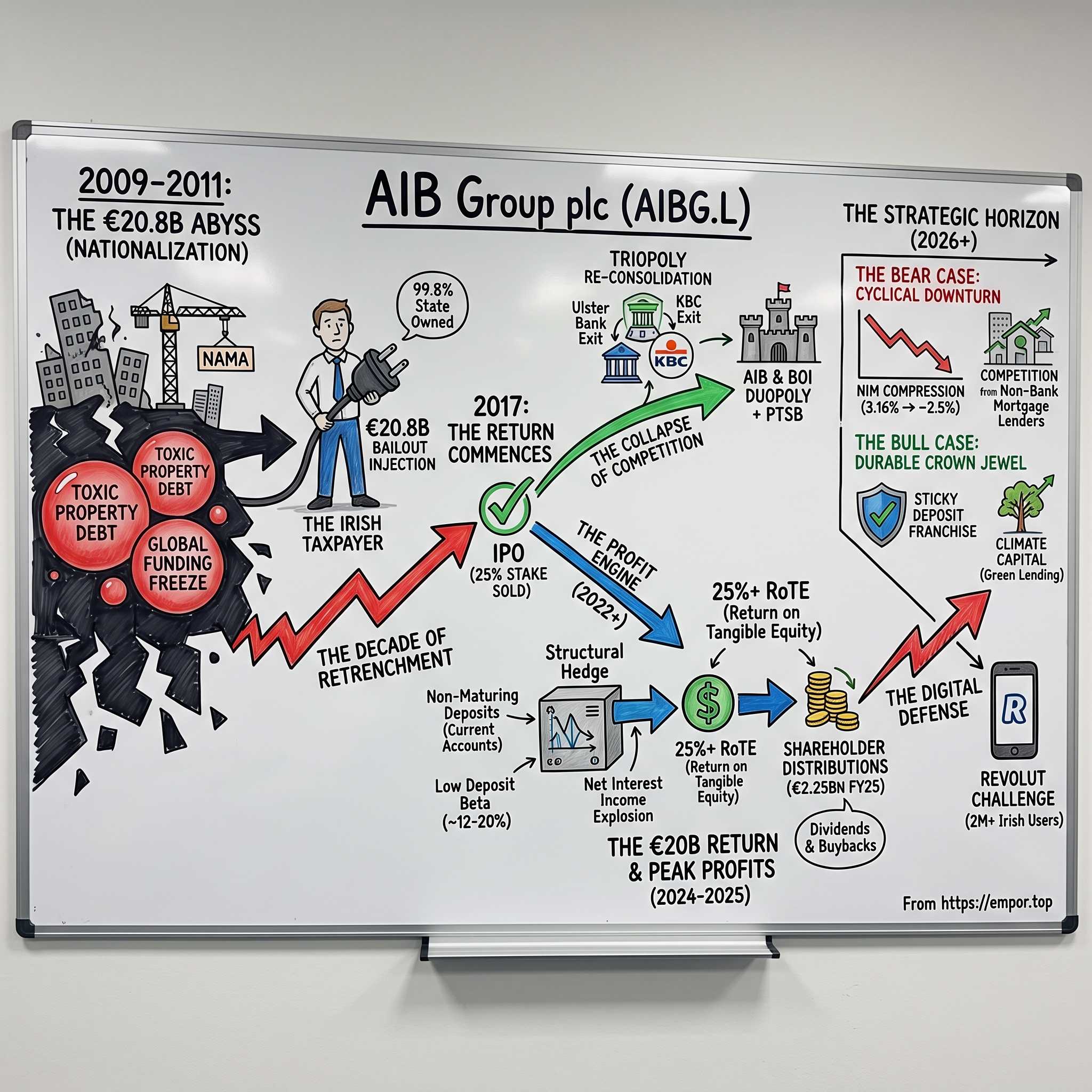
AIB Group plc: The €20 Billion Return from the Brink
I. Introduction: The €20 Billion Return to Private Hands
On the morning of June 17, 2025, there was no ringing of a bell, no confetti, no triumphant press conference on the steps of Government Buildings in Dublin. Instead, the Irish Department of Finance issued a short statement confirming that it had sold its final 2.06% stake in AIB Group plc — the institution Irish speakers know as Banc-Aontas Éireann — for roughly €305 million.[^1] The Department framed it as the completion of a long journey back to normality rather than a moment for celebration.[^6] With that quiet transaction, the State's ownership of a bank it had once controlled almost entirely fell to zero. A few months later, on October 31, 2025, AIB closed the final chapter by paying €390 million to buy back the 271 million warrants the State still held over its shares.1 The last financial umbilical cord between the Irish taxpayer and Allied Irish Banks was cut.
To understand why this was one of the most consequential moments in modern Irish corporate history, you have to appreciate the sheer scale of what came before. Between 2009 and 2011, the Irish State pumped €20.8 billion of public money into AIB to keep it from collapsing — a rescue so large it helped drag the sovereign nation itself into an international bailout.[^1] By the time the State walked away in 2025, it had recovered approximately €20.2 billion in absolute cash terms through share sales, dividends, coupon payments, and fees.1 On a pure nominal basis, that is a shortfall of only around €600 million on a €20.8 billion outlay — before you adjust for the time value of money, inflation, or the interest the State paid to borrow that money in the first place.
It is worth pausing on that number, because context is everything. Measured against the great banking rescues of the 2008 crisis, this was a remarkable outcome. Anglo Irish Bank, the developer-obsessed lender that became a byword for Celtic Tiger excess, cost Irish taxpayers roughly €30 billion and returned almost nothing. In the United Kingdom, the government's rescue of Royal Bank of Scotland ultimately crystallised losses in the billions of pounds when it finally sold down its stake. AIB, against expectations, very nearly broke even. The Irish State did not make money in real terms — inflation and debt-servicing costs mean it lost — but recovering essentially all of the headline figure from a bank that was 99.8% nationalized is closer to a miracle than to normal financial gravity.
The final acts of the exit are worth understanding, because they reveal how deliberately this was engineered. For years the State could not sell, because the shares traded below what taxpayers had effectively paid. The turn in interest rates from 2022 onward changed everything: as AIB's profits exploded, its share price roughly doubled, and suddenly the government could offload stock at prices that made the arithmetic work. It sold in a steady drumbeat of placings and, crucially, through a series of directed buybacks in which AIB itself repurchased large tranches of the State's holding — using the bank's own surplus capital to retire the taxpayer's stake.[^1] That mattered: it let the State exit without flooding the open market with shares and crushing the price. The warrants dealt with last were the tail end of this — instruments granted to the State during the recapitalisation that gave it the right to buy shares cheaply, a sweetener that had preserved taxpayer upside. Buying them back for €390 million was AIB paying to extinguish that final claim on its equity.1 By the time it was done, the choreography had been almost clinical.
Here is the paradox that makes AIB such a compelling story in 2026. This bank — bailed out, nationalized, gutted, and restructured under the watchful eye of Brussels — is today one of the most profitable large banks in Europe. In its 2024 financial year, AIB reported profit after tax of €2,351 million and a return on tangible equity of 26.7%, a figure that would make the leadership of JPMorgan or HSBC blink.[^3] In 2025, as interest rates began to ease, profit after tax came in at €2,139 million with an RoTE of 25.0% — a small step down, but still roughly double the return that global banking investors typically consider "good."[^4]2
The central question of this story is deceptively simple: how does a bank go from being buried under billions of euro of toxic property debt, its equity effectively wiped out and handed to the State, to becoming a cash machine printing 25% returns barely a decade later? The easy answer is "interest rates went up." It is also the wrong answer, or at least a dangerously incomplete one. The real story of AIB is about something more structural and more durable: the consolidation of a competitive market from a crowded free-for-all into a cozy three-player field, the quiet economics of a sticky, low-cost deposit franchise, and a piece of financial plumbing called a structural hedge that turned patience into profit. It is a masterclass — and also, potentially, a cautionary tale about peak earnings. Let us go back to the beginning.
 Subscribe on LinkedIn
II. Foundations & The Ghost of John Rusnak
Every Irish bank has a founding myth wrapped in the language of nation-building, and AIB is no exception. But the institution that exists today was not born in a single moment of visionary genius. It was assembled, in 1966, through a shotgun marriage of three tired nineteenth-century banks — the Munster & Leinster Bank, the Provincial Bank of Ireland, and the Royal Bank of Ireland — stitched together to form Allied Irish Banks.12 The logic was defensive as much as ambitious: post-war Ireland was a small, capital-starved, heavily agricultural economy, and three sub-scale banks competing for the same farmers and shopkeepers made less sense than one bank with national reach able to stand toe-to-toe with the older, grander Bank of Ireland.
For its first three decades, AIB grew up alongside the modern Irish state — financing farms, funding the first waves of industrialization, following its customers as they moved from the land into towns and cities. It was, in the parlance of the trade, a relationship bank: it knew its borrowers, it took deposits from the same community it lent to, and it grew at the sedate pace of the domestic economy. This is not glamorous banking. It is, however, the foundation on which everything profitable about AIB today rests — the deposit franchise, the branch network, the fact that a plurality of Irish households simply bank with AIB because their parents did.
By the 1980s and 1990s, AIB had grown into one of the two pillars of Irish finance, locked in a genteel duopoly with Bank of Ireland that shaped a generation of Irish economic life. Between them, the two banks financed the mortgages, the small businesses, and the current accounts of most of the country. It was comfortable, profitable in a modest way, and — for a management team that had watched Ireland remain poor and peripheral for most of the twentieth century — not nearly ambitious enough. AIB wanted to be more than a big fish in a small pond. That hunger for scale beyond Ireland's shores is the through-line that connects the Rusnak debacle to the property crash that followed: both were expressions of an institution that could not quite accept the natural limits of its domestic market.
Ambition, when it came, took AIB abroad — and it was abroad that the bank learned its first brutal lesson in the limits of its own risk management. In February 2002, AIB stunned the financial world by disclosing that a currency trader at its Baltimore-based US subsidiary, Allfirst, had run up $691 million in hidden foreign exchange losses.3 The trader's name was John Rusnak, and the story reads like a thriller. Between 1997 and 2001, Rusnak had made a series of losing bets on the Japanese yen and then, rather than confess, fabricated fictitious options trades to disguise the holes in his book. He was not a flamboyant "big swinging" trader; colleagues described him as a mild-mannered, churchgoing family man. That was precisely the problem. His very ordinariness meant nobody looked closely enough, until his foreign-exchange turnover in a single December month reportedly ballooned to a multiple of what the entire subsidiary was worth.3
The lesson of Rusnak was not really about one rogue employee. It was about a bank operating a business — proprietary currency trading in a distant subsidiary — that it did not truly understand or control. An independent investigation later found that Rusnak had exploited weak controls, intimidated back-office staff into skipping confirmations, and manipulated the bank's own risk systems, all while his supervisors failed to ask basic questions about how a modest currency desk in Baltimore was generating such enormous turnover. The comfortable answer — one bad apple — was precisely the wrong one. The real failure was cultural and supervisory, a bank that had bought an American subsidiary it could not properly oversee from three thousand miles away.
The scandal humiliated AIB's board, forced a wave of resignations and control reforms, and hastened a strategic retreat: within a few years AIB sold Allfirst to America's M&T Bank and pulled back toward its domestic core. On paper, retrenchment to Ireland looked prudent. In practice, it set a trap. Denied international growth, and watching the Irish economy catch fire around it, AIB turned its considerable ambition inward and downward — toward the one market it thought it understood better than anyone: Irish property. The ghost of Rusnak had taught AIB to fear exotic trading desks. It had taught the bank nothing, it would turn out, about the far more mundane danger of lending too much money against Irish bricks and mortar. The next catastrophe would not come from a rogue trader in Baltimore. It would come from the most conventional, respectable lending a bank can do — and it would be an order of magnitude larger.
III. The Celtic Tiger and the €20.8B Abyss
If you want to feel the texture of Ireland in the mid-2000s, picture the cranes. By 2006 the skyline of Dublin — and Cork, and Galway, and a hundred commuter towns that barely existed a decade earlier — bristled with them. Ireland had become the "Celtic Tiger," and the roar was the sound of concrete being poured. GDP growth ran hot, unemployment fell to levels unseen in Irish history, emigrants who had left in the grim 1980s came home, and everyone, it seemed, was buying, building, or flipping property. Underneath the euphoria was a simple, seductive belief: Irish land only ever goes up.
AIB, having retreated from the world, threw itself into this domestic gold rush. The bank that had once prided itself on knowing its borrowers gradually transformed from a relationship lender into a speculative property-development financier. The shift was driven less by conviction than by fear. Prowling the same market was Anglo Irish Bank, a hyper-aggressive specialist that had turned developer lending into an art form, growing its loan book at a ferocious pace and posting returns that made the established banks look sleepy. For AIB's leadership, watching Anglo hoover up the marquee developers and the fat margins that came with them, the strategic question curdled into something more primal: are we going to sit here and lose market share to these people?
They chose not to. AIB relaxed its underwriting, chased the same commercial-property developers, and — critically — funded the lending not with its own sticky deposits but with cheap, short-term money borrowed from European wholesale markets. This is the detail that turned a bad lending cycle into an existential crisis. When you fund thirty-year property bets with money you have to roll over every few months, you are making a bet not just on Irish land but on the permanent kindness of strangers in the funding markets. As long as European banks were happy to lend to AIB overnight, the machine hummed. The moment they hesitated, the whole structure was exposed.
That moment arrived in September 2008. When Lehman Brothers collapsed, the global wholesale funding markets froze solid. Irish property values, already wobbling, began a fall that would eventually exceed 50% peak to trough. AIB suddenly faced the nightmare of every bank that funds long assets with short money: its loans were turning bad and its funding was evaporating at the same time. On the night of September 29–30, 2008, in a decision made in a panic-stricken few hours, the Irish Government issued a blanket guarantee covering roughly €440 billion of liabilities across the Irish banking system — an amount that dwarfed the entire Irish economy.13 It was a systemic gamble of breathtaking proportions, made to stop a bank run, and it fused the fate of the banks to the fate of the sovereign. When the losses proved far larger than anyone had admitted, that fusion pulled Ireland itself into a 2010 bailout program with the IMF, the European Central Bank, and the European Commission — the so-called Troika.
For AIB specifically, the reckoning came in two brutal instalments. First, its most toxic development loans were carved out and transferred to the National Asset Management Agency, or NAMA, a state "bad bank" that bought the loans at deep, punitive discounts to their face value — crystallising enormous losses on AIB's balance sheet. The mechanics here are worth understanding, because they explain the scale of the hole. NAMA did not pay AIB what the loans were nominally worth; it paid what the underlying collateral — the half-built apartment blocks and speculative land banks — was actually worth in a collapsed market, which in many cases was a fraction of the loan's face value. The gap between the two was a loss AIB had to recognise immediately and in full. Multiply that across billions of euro of development lending and you arrive at a capital shortfall no private investor on earth would fill.
So the State filled it. To plug the crater, it injected €20.8 billion of public money in stages between 2009 and 2011, through a combination of preference shares, ordinary equity, and capital funnelled via the National Pensions Reserve Fund — the sovereign savings pot that was supposed to fund future pensions and instead ended up rescuing a bank.[^1] In exchange, the taxpayer ended up owning 99.8% of Allied Irish Banks. The bank had, in every sense that mattered, ceased to be a private company. There is a human ledger behind these numbers that the financial figures obscure: shareholders, including tens of thousands of ordinary Irish savers and pensioners who had held AIB stock as a supposedly rock-solid blue chip, were almost completely wiped out. What followed was not a bankruptcy but something stranger — a decade of living inside the State, being slowly rebuilt for an eventual return that almost nobody, in the dark days of 2011, actually believed would come.
IV. The Decade of Retrenchment & Structural Remodeling
Being rescued by the State is not a soft landing; it is a form of receivership with better public relations. From 2011 onward, AIB operated under the strict conditions of an EU-approved restructuring plan, and the terms were harsh by design. Brussels does not hand over billions in state aid without demanding that the beneficiary shrink, sell, and suffer — partly to protect competition, partly to make sure taxpayers are not simply subsidising a bloated failure. AIB was ordered to become smaller and simpler.
So it sold. Non-core foreign assets were shed one by one, the most valuable being its Polish subsidiary, Bank Zachodni WBK, a genuinely successful business that AIB was effectively forced to offload to Spain's Santander to raise capital and satisfy its state-aid obligations. There is a bitter irony here that would echo for years: some of the assets AIB was compelled to dump in its weakest moment were among its best. The bank was selling the family silver to pay for the sins of its property desk.
The larger, grimmer project was deleveraging — shrinking the balance sheet from around €130 billion to under €90 billion — and, above all, resolving the mountain of non-performing loans, or NPLs. An NPL is simply a loan the borrower has stopped reliably repaying, and at the depth of the crisis these clogged AIB's books like arterial plaque. Clearing them involved two paths, both controversial. For thousands of retail borrowers in mortgage arrears, AIB negotiated restructurings — extended terms, split mortgages, forbearance — a slow, politically sensitive grind. For larger and more distressed portfolios, AIB sold loans in bulk to private-equity buyers, the funds that Irish tabloids and politicians memorably branded "vulture funds." Each such sale drew public fury on behalf of the borrowers whose loans were being transferred to hard-nosed investors, and reinforced a lesson AIB could never afford to forget: it was a commercial bank operating under an intensely political spotlight.
There was also a slow-burning scandal from this era that remains a live reputational and regulatory theme: the tracker mortgage controversy. Across the Irish banking system, lenders — AIB among them — had wrongly denied thousands of customers the cheap "tracker" mortgage rates they were contractually entitled to, in some cases pushing families into arrears or the loss of their homes. When the Central Bank of Ireland forced a full industry examination, AIB had to identify affected customers, refund them, pay compensation, and absorb penalties. The specific totals evolved over years of disclosure, but the episode is analytically important for two reasons: it was a self-inflicted conduct failure that cost real money and real trust at exactly the moment AIB was trying to rehabilitate its reputation, and it cemented the political narrative that Irish banks treated their customers as adversaries. That narrative would resurface every time AIB later tried to do something commercially rational, from closing branches to booking record profits.
By 2017, the patient was healthy enough to show to the market. In June of that year, the State floated an initial 25% stake in AIB on the Dublin and London exchanges, pricing the shares at €4.40 and raising around €3 billion for the initial 25% stake — a total that rose toward €3.4 billion once the over-allotment was exercised.4 It was a symbolic milestone — proof that the corpse had a pulse and could attract private capital again. But it was also the beginning of a long, frustrating limbo. The shares languished for years, weighed down by the great macro curse of the late 2010s: negative interest rates. The ECB had pushed its deposit rate below zero, and for a bank whose entire business model rests on the gap between what it earns on loans and what it pays on deposits, sub-zero rates were a slow suffocation. AIB was profitable, but only modestly, and the stock drifted well below its IPO price. The State, sitting on a huge unrealised loss, could hardly sell more.
And then there were the shackles. As a bailed-out bank, AIB operated under a State-imposed remuneration regime that was, by international standards, extraordinary: an absolute cap of €500,000 on total executive pay, no bonuses, and no variable compensation of any kind.[^1] Politically, this was understandable — voters who had bailed out the bank were in no mood to see its executives paid millions. Commercially, it was corrosive. AIB became a training ground it could not retain talent from; senior risk, technology, and corporate-banking staff were routinely poached by fund managers, fintechs, and international rivals who faced no such limits. The bank was being asked to compete in a modern, digitising financial system with one hand tied behind its back. What it needed was a leader who could run the restructuring playbook to its conclusion and position AIB for the moment — if it ever came — when the macro tide turned. In 2019, it got one.
V. Colin Hunt's Playbook & The Great Triopoly Re-consolidation
Colin Hunt is not the archetype of a swashbuckling bank chief executive. An economist by training who earned a doctorate and spent years as a market strategist and adviser — including a stint as a special adviser in government — before moving into corporate banking, Hunt arrived at the top of AIB in March 2019 with the temperament of an analyst rather than a dealmaker. He had served as the bank's chief economist and co-head of corporate banking, so he knew the institution from the inside. His instincts were about discipline: relentless focus on the cost base, a serious commitment to digital transformation, and a patient plan to restructure AIB's capital so that, when the day came, it could return money to shareholders at scale. For his first three years, this looked like unglamorous blocking and tackling. Then the ground shifted beneath the entire Irish banking market.
Hunt's timing was, in one sense, wretched. He had barely settled into the role when the COVID-19 pandemic hit in early 2020, forcing AIB to take large precautionary provisions against feared loan losses and pushing the bank into a statutory loss for that year. For a chief executive whose whole pitch was steady, disciplined normalisation, opening with a pandemic-driven loss was not the debut he wanted. But it also revealed something about his approach: rather than retreat, AIB used the disruption to accelerate a restructuring it had been contemplating anyway — cutting headcount, consolidating its property footprint, and setting a hard medium-term cost target. Working alongside him was Donal Galvin, a markets and treasury specialist who had risen through AIB's funding operations to become chief financial officer, and whose fluency in the arcana of hedging, capital, and debt issuance would prove central to the profit story that followed. Hunt set the strategic frame; Galvin engineered the balance sheet inside it.
Then the catalyst arrived from an unlikely direction: AIB's competitors decided to leave. In 2021, two significant players announced they were quitting the Republic of Ireland entirely. NatWest, the British banking group, decided to wind down Ulster Bank, the storied lender that had operated in Ireland for generations. Belgium's KBC Group announced it too would exit its Irish retail operation. Their reasoning was the same and it was rational: the Central Bank of Ireland required banks operating in the Republic to hold unusually high levels of capital against Irish mortgages — a legacy of the crisis, meant to make the system safer — and that heavy capital charge crushed the returns a sub-scale foreign bank could earn. There is a deeper structural point here. Irish mortgages had proven catastrophically risky in 2008, so regulators forced banks to hold far more capital against them than, say, a German or Dutch mortgage required. Ironically, that same rule that punished the whole system also created the barrier to entry that now protects the survivors — and it was the specific reason a giant like NatWest concluded that Ireland was more trouble than it was worth. So they folded.
For AIB, this was the strategic opportunity of a generation, and Hunt — working closely with his chief financial officer, Donal Galvin — moved decisively to seize it. Rather than simply watch customers scatter, AIB set out to buy the departing banks' loan books directly. It agreed to acquire Ulster Bank's roughly €5.7 billion performing tracker-mortgage portfolio, a deal that completed in early 2023, alongside around €4.2 billion of corporate and commercial loans.[^10] These were not distressed assets being dumped in a fire sale of the 2011 variety; they were performing, income-generating loans from a seller that simply wanted out cleanly and quickly.
That distinction matters enormously for how we judge the deals. A skeptical analyst always asks: did the acquirer overpay? On the FY 2024 earnings calls, management and analysts alike noted that AIB had secured these portfolios at highly favourable terms. The logic is straightforward war-gaming. Ulster Bank and KBC were forced sellers on a deadline — they had publicly committed to exiting and had shareholders demanding a clean withdrawal. AIB, sitting on a mountain of excess capital it could not yet return to its own shareholders, was one of the very few buyers with the scale and regulatory standing to absorb billions in Irish loans overnight. In that negotiation, the buyer holds the cards. AIB was able to add immediate scale — customers, mortgages, deposits — at low incremental risk and without paying the kind of premium that a competitive auction would normally extract. The excess capital that had been a drag on returns for years suddenly had a productive job to do.
The spoils were divided across the surviving three. AIB took Ulster Bank's tracker and corporate books; Bank of Ireland acquired the bulk of KBC's performing Irish mortgages and deposits; and Permanent TSB, the small third pillar, was deliberately handed a meaningful slice of Ulster Bank's retail mortgages, branches, and small-business loans — partly on the reasoning that a healthy third competitor was better for the system than a pure duopoly. Regulators and government were not passive here; they wanted consolidation, but not so much that Ireland ended up with only two banks and the political toxicity that would carry.
The deeper consequence was structural. When the dust settled, the Irish retail banking market had been transformed from a crowded field into a triopoly: AIB, Bank of Ireland, and the much smaller Permanent TSB. Two full-service competitors had simply vanished. For anyone who understands banking economics, this is the whole ballgame. A market with five or six lenders fighting for share is a market where loan margins get competed down and deposit rates get competed up — bad for bank profits, good for customers. A market with three players, all of them capital-constrained and returns-focused, behaves very differently. There is a genuine question, which competition authorities have circled warily, of whether this concentration is too comfortable — whether Irish consumers now pay the price, in higher mortgage rates and lower deposit rates, for a market that regulators themselves helped consolidate. That tension between shareholder profit and consumer welfare sits at the centre of the AIB investment case, and it is not going away. But for now, the re-consolidation of Irish banking did not just hand AIB a bigger loan book. It handed the entire surviving industry a gentler competitive environment — and it set the stage for the single most important profit engine in this story.
VI. Capital Allocation & The Structural Hedge Engine
To understand how AIB turned the interest-rate cycle into a windfall, you first have to understand a piece of financial machinery that almost never makes headlines: the structural hedge. It sounds intimidating. It is actually one of the more elegant ideas in banking, and it is best understood through an analogy.
Imagine you run a bank, and you are sitting on tens of billions of euro in customer current accounts — money in checking accounts that pays essentially no interest and that, in aggregate, tends to just sit there year after year. These are your "non-maturing" deposits: no fixed term, no interest to speak of, and remarkably stable in total even as individual customers come and go. Now, when interest rates are near zero, this pile of free money earns you almost nothing. But you know rates will not stay at zero forever. So you take that stable pool and you invest it in a rolling ladder of, say, five-year fixed-rate instruments — spreading the maturities out so that a slice matures and gets reinvested each month. This is the structural hedge. It deliberately smooths your income: you give up some upside when rates spike, but you lock in the higher yields for years and cushion yourself when rates eventually fall.
When the ECB began hiking rates aggressively in 2022 — dragging its key deposit rate from −0.5% all the way to 4.0% in barely over a year — AIB's structural hedge came into its own. On the earnings calls, CFO Donal Galvin repeatedly returned to this theme, explaining how the bank had positioned itself to capture rising yields on its enormous base of near-free deposits. As older, low-yielding hedge tranches matured, they were reinvested at dramatically higher rates, steadily lifting the bank's income in a way that would persist even after the ECB started cutting again.
But the hedge is only half the magic. The other half — the truly striking part — is the liability side, and here the triopoly does its quiet work. Consider what a bank pays its savers as rates rise. In a fiercely competitive market, when central-bank rates jump, banks are forced to pass much of that increase on to depositors or watch their money walk out the door to a rival offering a better savings rate. The proportion of a rate hike that a bank passes on to savers is called the deposit beta. A high deposit beta means depositors capture the benefit; a low deposit beta means the bank keeps it.
AIB's deposit beta was astonishingly low. In FY 2024, even as the ECB's rate sat near its peak, AIB passed on only around 12% of the rate increases to its depositors.[^3] By FY 2025 that figure had crept up to roughly 20% — still remarkably low by any historical or international standard.[^4] Why could AIB get away with paying its savers so little? Because in a three-player market where all three players are capital-constrained and returns-focused, nobody had a strong incentive to start a deposit price war. There was simply no aggressive fifth competitor dangling a market-beating savings rate to lure customers away. And Irish depositors, as we will see, are famously inert.
The combination — rising asset yields locked in by the structural hedge, and near-frozen deposit costs protected by the triopoly — produced an extraordinary result. AIB's net interest margin, the core spread between what it earns and what it pays, expanded to a record 3.16% in 2024 before easing to 2.73% in 2025 as rates began to fall.[^4]2 Net interest income surged past €3.7 billion. The plain-English conclusion is this: AIB's 2024–2025 profitability was not primarily a story of clever lending or brilliant products. It was overwhelmingly a story of the liability side of the balance sheet — a huge pool of cheap, sticky deposits, invested patiently, in a market with too few competitors to compete the advantage away. That is durable in a way that a one-off good year is not. It is also, crucially, cyclical — a caveat we will return to in the bear case.
It is worth being precise about why the deposits are so cheap, because this is where casual observers get AIB wrong. The magic is not that AIB pays low rates on savings accounts; plenty of banks do that. It is the sheer proportion of AIB's funding that sits in current accounts — everyday transaction accounts where customers keep their salaries and pay their bills — which pay essentially nothing and are not really "savings" at all in the customer's mind. Money in a current account is not chasing yield; it is there for convenience, and convenience is sticky. By the end of 2025, AIB's total customer deposits had grown to €117.2 billion, up 7% in a single year even as the bank paid savers a pittance — a striking vote of confidence, or inertia, from Irish depositors.[^4]2 A bank funded predominantly by this kind of money enjoys a cost of funding that no wholesale-funded lender can match through a full cycle. The corollary, which bulls sometimes forget, is that the value of that free funding is directly proportional to the level of interest rates. At 4% base rates, tens of billions of free deposits are worth a fortune. At 2%, they are worth half as much. The deposit franchise is a permanent asset; the income it throws off is not.
While the interest-rate engine roared, Hunt and Galvin also rebuilt AIB's fee-generating and capital-efficient businesses. In 2021, AIB re-acquired Goodbody Stockbrokers, one of Ireland's oldest wealth-management and capital-markets firms, for €138 million — a figure that included around €56 million of surplus cash inside Goodbody, making the effective price meaningfully lower.5 The backstory is almost poetic: AIB had been forced to sell Goodbody for a mere €24 million in 2011, at the trough, as part of its post-crisis deleveraging.5 Buying it back a decade later let AIB instantly rebuild a high-margin wealth franchise and generate fee income that does not depend on interest rates at all. There was also a subtler, more cynical benefit that observers noted at the time: Goodbody, as a separate regulated entity, sat outside the State's €500,000 pay cap, giving AIB a legitimate corner in which to house — and pay — the corporate-finance and wealth professionals it could not otherwise retain. Around the same period, AIB built out AIB Life, a 50:50 joint venture with Great-West Lifeco's Irish Life, to manufacture and cross-sell pensions and protection products through AIB's dominant branch network — another capital-light, fee-rich lever pulled to reduce the bank's dependence on the rate cycle. Which brings us to the engine room itself: how AIB actually makes its money, segment by segment.
VII. The Core Engine: Segment Economics
Strip away the drama of bailouts and buybacks, and a bank is ultimately a collection of businesses that either make money or do not. AIB reports itself in a handful of segments, and reading them tells you where the profit really lives and where the growth ambitions are being placed. The headline finding is blunt: this is, first and foremost, an Irish retail and mortgage bank, and its crown jewel is its dominance of Irish home lending.
Start with Retail Banking, the beating heart of the franchise. In FY 2024 it generated an operating contribution of roughly €1,678 million — comfortably the largest slice of group profit.[^3] The engine within the engine is the Irish mortgage. AIB held a commanding 36% share of new Irish mortgage lending in 2024, meaning that of every three homes bought with a new mortgage in Ireland that year, more than one was financed by AIB.[^3] That figure normalised down to around 30% in 2025 as competitors pushed back on price, a shift we will scrutinise in the bear case.[^4] But raw market share understates the quality of the position. AIB is particularly strong in the direct-to-consumer channel — customers who walk into a branch or onto the app and take a mortgage directly from AIB rather than through a broker — where it commands roughly a 46% share.[^3] Direct business is more profitable because there is no broker commission to pay and the customer relationship is owned end-to-end. In a market with only three real banks, being the default choice for a plurality of Irish homebuyers is about as good a position as retail banking offers.
This is the place to puncture a common myth about AIB, because the consensus narrative tends to frame the bank's revival as a story of shrewd management brilliance. The reality is more sobering and more useful for an investor. AIB did not out-innovate its way to a 36% mortgage share; it inherited a dominant distribution position built over a century, then watched two competitors voluntarily leave the field. Its record margins did not come from pricing genius; they came from a rate cycle it did not control and a market structure it did not single-handedly create. This is not to diminish the execution — buying the Ulster book cleanly, running the structural hedge well, and holding costs down were all real achievements. But the honest reading is that AIB's spectacular numbers are as much a product of position and timing as of skill, and position and timing are exactly the things that can reverse. A management team that credits itself for a tailwind tends to be unprepared when the wind changes direction.
Next is Capital Markets, which contributed about €818 million in FY 2024.[^3] This segment houses AIB's commercial and corporate lending, its treasury operations, and — post-reacquisition — the corporate-finance and advisory activities anchored by Goodbody. It is a chunkier, more cyclical, more relationship-driven business than retail: bigger individual loans to Irish and international corporates, project finance, and the machinery that manages the bank's own funding and the structural hedge described earlier. It matters both as a profit centre and as the natural home for the excess capital AIB deploys when opportunities like the Ulster Bank corporate book appear.
Then there is AIB UK, the group's operation across Great Britain and Northern Ireland. This is often overlooked but has become a quietly useful contributor: statutory profit before tax rose to £249 million in FY 2025.[^4] The business is two-sided. In Great Britain, AIB runs a focused, niche corporate-lending book concentrated in sectors it understands well — property, healthcare, and manufacturing — deliberately avoiding the bloodbath of trying to compete head-on with Britain's giant high-street banks. In Northern Ireland, it operates a more traditional retail and mortgage franchise. The strategic logic is discipline: compete only where you have an edge, and do not chase scale in a market where you will never be a leader.
Finally, and most interesting for the future, is Climate Capital, established as a standalone reporting segment in 2024. Sized honestly, it is still small — gross loans of around €5.5 billion and an operating contribution of about €60 million — a rounding error next to Retail Banking.[^3] But it is growing fast and it represents real optionality. AIB has positioned this unit to finance large-scale renewable-energy and grid-infrastructure projects — wind, solar, and the transmission networks that connect them — not just in Ireland but across the UK, continental Europe, and North America. The bank has made green lending a genuine priority: it disclosed that 43% of its new lending in 2025 was classified as green.2 The independent read is that this is neither pure marketing nor yet a material profit driver; it is a credible early-stage bet that the enormous, decades-long capital demand of the energy transition will be a durable lending market, and AIB wants an established franchise before that market matures. Whether it becomes a third pillar of profit or stays a worthy sideline is one of the more interesting open questions in the story. But no segment analysis survives contact with the real competitive threat facing AIB — and that threat is not another bank. It is an app.
VIII. Strategic Battles & Digital Defense: Enter Revolut
Here is a statistic that should terrify any incumbent Irish banker. More than two million people in Ireland — in a country of barely five million — use Revolut.14 That is close to 40% of the entire population, using a financial app that did not offer Irish banking services at all a few years ago. Revolut began life as a slick foreign-exchange and peer-to-peer payments app, the thing you used to split a dinner bill or spend money abroad without punitive fees. But it has methodically transformed itself into a licensed bank, rolling out Irish IBANs, personal loans, credit cards, and high-yield instant-access savings accounts. For a generation of younger Irish consumers, Revolut, not AIB, is the app they open first when they think about money.
This is the strategic reality that hangs over everything in the bull case. AIB's great advantage — the sticky, inert, near-free deposit base — depends on customer inertia. Revolut's entire business model is an assault on that inertia. It cannot yet easily dislodge the primary current account, with its tangle of direct debits and salary mandates, but it can and does capture the marginal relationship: the spending money, the savings that chase a better rate, the first product a young customer ever signs up for. The generational dimension is the part that should keep AIB's strategists awake. For an Irish twenty-five-year-old in 2026, Revolut is not a challenger brand to be weighed against the incumbent; it is the default, and AIB is the institution you deal with only because your mortgage or your employer forces you to. Brand primacy among the young is a slow-acting but powerful force, because today's marginal Revolut customer is tomorrow's prime mortgage borrower and wealth-management client. If Revolut owns the relationship before AIB even gets a look, the deposit franchise erodes not in a dramatic run but in a slow demographic drift.
On the September 2024 record, Colin Hunt spoke publicly about the digital-lender challenge, framing AIB's response around investing heavily in its own app and digital capabilities rather than pretending the threat did not exist.6 It is a credible posture, and AIB's own digital metrics are genuinely strong — more than two million active digital customers is not the profile of a bank asleep at the wheel. But there is an inherent tension in the incumbent's defence that no amount of app investment fully resolves: AIB's profitability requires customers not to shop around, while Revolut's entire promise is that shopping around is now effortless and free. The honest question for an investor is whether those two facts can coexist for another decade, or whether the deposit beta — that magically low pass-through rate — is destined to rise not because rivals bid up rates, but because customers simply stop leaving their idle cash in a bank that pays them nothing.
AIB's own missteps have not helped. In July 2022, the bank announced plans to make 70 of its 170 branches cashless — removing over-the-counter cash and cheque services in favour of digital and post-office alternatives.9 The reaction was ferocious and instantaneous. In rural Ireland, where a bank branch is often the last financial infrastructure in town and where many older customers still run their lives on cash, the plan landed as an abandonment. Independent members of the Dáil, the Irish parliament, physically marched into AIB's headquarters demanding to see the chief executive; the issue reached the floor of parliament within hours.9 Faced with a political firestorm, AIB executed a humiliating U-turn within roughly 48 hours, announcing it would retain full services across all 170 branches.9 The episode is a perfect miniature of the central tension in owning AIB: it is a commercial enterprise expected to earn 25% returns, but it is also a systemically and politically important institution that cannot make a purely commercial decision without navigating the raw nerve of Irish public sentiment. Digitisation is essential to its cost structure and its defence against Revolut — but it cannot be pursued at the speed a pure fintech enjoys.
The incumbents did try to fight back collectively, and the effort became a cautionary tale of its own. AIB, Bank of Ireland, and Permanent TSB — later joined initially by KBC — spent years attempting to build a shared instant account-to-account payments network through a joint venture called Synch Payments, which was to launch a consumer app branded "Yippay." The vision was a domestic, bank-owned answer to Revolut's frictionless transfers. It never launched. In November 2023, the banks pulled the plug, citing an elongated timeline driven by competition-clearance delays and a business case overtaken by events — chiefly the speed at which Revolut had already captured the Irish consumer.7 By the time the incumbents could have shipped a committee-designed app, the war for account-to-account payments was effectively already lost.
AIB's current defensive posture is more pragmatic and, arguably, more realistic. Rather than trying to launch a standalone platform, it has moved to embed instant, account-to-account payments — branded "Zippay," delivered in partnership with the pan-European payments group Nexi — directly inside its existing mobile app, a rollout management flagged on its 2025 results call as a customer-experience improvement.8 The philosophy has flipped: instead of building a new destination and hoping customers migrate to it, AIB is wiring modern payment rails into the app its customers already use. It is a sensible retreat to defensible ground. Whether "meet the threat inside our own app" is enough to hold two million-plus Revolut-using Irish consumers within the AIB franchise is, frankly, unproven — and it is the single most important qualitative uncertainty in the entire investment story. To weigh it properly, we need to move from narrative to framework.
IX. Strategic Frameworks: Porter's 5 Forces & Helmer's 7 Powers
Strip the story down to its competitive skeleton and two classic frameworks — Michael Porter's Five Forces and Hamilton Helmer's 7 Powers — help separate what is genuinely durable about AIB's position from what is merely a good moment in the cycle.
Porter's Five Forces
Rivalry among existing competitors — low to moderate. This is the crux of the whole AIB story. The exit of Ulster Bank and KBC converted a competitive market into a triopoly, and three capital-constrained, returns-focused players simply do not wage the kind of destructive price wars that five or six hungry lenders do. The evidence is in the numbers already discussed: a 12–20% deposit beta is only possible in a market where nobody is desperate to buy share by overpaying savers. The caveat is that "low rivalry" among the three incumbents does not account for a fourth force — the digital insurgent — that the framework captures elsewhere.
Threat of new entrants — low for traditional banks, high for digital. The regulatory moat around traditional banking in Ireland is formidable. The capital requirements imposed by the Central Bank of Ireland and the ECB — the very requirements that drove Ulster and KBC out — also make it economically unattractive for any new full-service bank to enter. The Central Bank has itself repeatedly flagged the concentration of the Irish banking system and the resilience of the surviving lenders as a supervisory theme, a reminder that the regulator is watching the very market structure that generates AIB's profits.[^12] That is a genuine barrier. But it is a barrier built for the last war. Digital-native players like Revolut enter under a lighter, e-money-then-banking regulatory pathway and do not need a branch network or a legacy cost base, so for the products that matter most to younger customers, the barrier to entry is far lower than the traditional framing suggests.
Bargaining power of buyers — moderate. Irish mortgage borrowers have fewer bank choices than they did five years ago, which on its face strengthens AIB. But mortgage brokers, who now intermediate a large share of the market, actively shop rates across lenders including non-bank competitors, and that broker channel is precisely where AIB's share slipped from 36% to 30%. Borrowers are not powerless; they have simply outsourced their bargaining to intermediaries.
Bargaining power of suppliers — low. In banking, the "suppliers" are depositors — they supply the raw material, money. And the defining feature of the Irish depositor is inertia. Irish savers have historically tolerated near-zero interest on current accounts and have been slow to move for a better rate. This inertia is the foundation of AIB's low funding cost. It is also, notably, the exact behaviour Revolut is trying to erode.
Threat of substitutes — moderate. Non-bank mortgage lenders such as ICS Mortgages and Finance Ireland compete directly on price and have been winning volume. Their structural weakness is that they lack a low-cost deposit base; they fund themselves in wholesale markets and are therefore far more exposed when funding costs rise. They can undercut AIB on price in good times but cannot match its funding advantage through a full cycle.
Hamilton Helmer's 7 Powers
Of Helmer's seven sources of durable competitive advantage, three genuinely apply to AIB, and naming them precisely matters.
Cornered resource — the deposit franchise. AIB's single most valuable asset is not a loan book or a brand; it is a deposit base that exceeded €117 billion by the end of 2025, a large portion of it in near-free current accounts.[^4] This is the cornered resource: an institutionalised, sticky, low-cost funding engine accumulated over generations of Irish banking relationships that a competitor cannot simply buy or replicate. Everything profitable about AIB ultimately traces back to it.
Scale economies. AIB spreads the enormous fixed costs of modern banking — regulatory compliance, cyber-security, technology platforms, the app itself — across a vast loan book and more than two million active digital customers. A sub-scale competitor bears similar fixed costs over a fraction of the revenue, which is a large part of why Ulster and KBC could not make Ireland pay.
Switching costs. Moving a primary current account remains a genuinely high-friction act. Rerouting a salary mandate, re-establishing every direct debit and standing order, updating the account on file with employers and utilities and the tax authorities — the hassle is real, and it is why AIB retains customers who might, on a pure price comparison, do slightly better elsewhere. The honest qualification, again, is that Revolut is systematically attacking the edges of this switching cost even where it cannot yet crack the core account. These frameworks explain why AIB earns what it earns today. They do not, on their own, tell us whether it will keep earning it — and that is the question that decides the investment case.
X. The Investment-Story Spine: Bull vs. Bear
Every good business story eventually comes down to a single tension: why does this company keep winning from here, and what could break it? For AIB in 2026, that tension is unusually sharp, because the very things that make it look spectacular today are the things that could look ordinary tomorrow. Before laying out the two cases, it is worth naming the handful of numbers that actually decide the argument.
The KPIs That Matter Most
An investor does not need to track fifty metrics on AIB. Three tell most of the story. Net interest margin (NIM) is the master variable — the spread that drives the vast majority of profit; management has signalled that a "normalised" NIM well below the 2024 peak, in the region of 2.5%, is the more realistic long-run number as rates settle.[^4] Deposit beta is the early-warning system for the competitive environment — if it starts climbing sharply above the ~20% level, it means the deposit war has begun and the funding advantage is eroding. And return on tangible equity (RoTE) is the scoreboard: management's through-the-cycle target is above 15%, so the real question is not whether AIB can beat that bar but how far above it the bank settles once the rate tailwind fades from today's 25%.[^4] Watch those three, and you understand AIB.
The Bull Case: The Cash Machine
The bull case is, at its core, about capital returns and freedom. With the State finally and completely off the share register, AIB is no longer a political football constrained in what it can pay out — and it has chosen to pay out enormously. For FY 2025, AIB announced total shareholder distributions of €2.25 billion, comprising roughly €1.25 billion in dividends and €1.0 billion in buybacks — a payout ratio of around 105% of earnings, meaning it returned more than it earned in the year by drawing down surplus capital.102 This is the behaviour of a management team that believes it is over-capitalised and wants to shrink its equity base, which mechanically supports that eye-watering RoTE. For income-oriented and value investors, a bank trading on a modest multiple while handing back capital at this rate is the beating heart of the bull thesis.
The second pillar is normalisation. With the State gone, the €500,000 pay cap was lifted, and AIB moved quickly: Hunt's base salary rose from €500,000 to €795,000 in mid-2025 and then to €1.35 million in early 2026, with fixed share awards of up to 100% of salary lifting his potential package toward €2.7 million.1110 One can debate the optics — and Irish commentators certainly did, given that this is a bank the public rescued — but the strategic point is real: AIB can now compete for institutional-grade risk, technology, and commercial talent it spent a decade unable to retain. For a bank whose gravest historical failures were failures of risk management, the ability to actually pay for top-tier risk and technology leadership is not a perk; it is a genuine strengthening of the franchise.
There is a third pillar the bulls lean on: capital strength and disclosure discipline. AIB has consistently run its core capital ratio above regulatory requirements, which is precisely what allows the enormous distributions — you can only pay out more than you earn if you are starting from a surplus. The 105% payout ratio for 2025 is management explicitly telling the market that it is over-capitalised and intends to hand the excess back rather than hoard it or, worse, chase growth through risky lending or empire-building acquisitions.10 For investors scarred by the memory of a bank that once destroyed itself pursuing growth, a management team that publicly commits to shrinking its own equity base is, paradoxically, reassuring. Underpinning it all is a genuinely favourable macro backdrop: Ireland has one of the youngest, fastest-growing populations in Western Europe, chronic housing undersupply that sustains mortgage demand, and a large multinational-driven economy — all of which feed durable credit demand into the dominant domestic lender.
The Bear Case: The Peak Earnings Trap
The bear case begins with a single, uncomfortable observation: AIB's record profits arrived at the exact top of the interest-rate cycle, and cycles turn. The bank's earnings are powerfully geared to rates. As the ECB cuts its deposit rate back toward 2.0% and below, the asset side of AIB's balance sheet reprices downward faster than the near-zero deposit side can fall — there is simply less room for deposit costs to drop when they were barely above zero to begin with. NIM compression from 3.16% toward the guided ~2.5% is not a risk; it is management's own base case, and it means the 25% RoTE is a peak, not a plateau. The structural hedge cushions the descent, but it does not reverse it.
The second worry is competitive erosion, and it is already visible in the data. AIB's new-mortgage share fell from 36% in 2024 to 30% in 2025 — a five-percentage-point slide in a single year.[^4] That is not noise. It is the signature of non-bank lenders and rivals pricing aggressively to win volume, and it raises a pointed question about the durability of the "cozy triopoly" thesis: the triopoly reduces destructive competition among the three banks, but it does nothing to stop nimbler non-bank and digital competitors from skimming the most price-sensitive, highest-quality borrowers. If share attrition continues, the bull case's assumption of dominance quietly weakens.
The third risk is political, and it cuts both ways in a manner unique to Irish banking. The very profitability that thrills shareholders infuriates a public that bailed the bank out and still pays some of the highest mortgage rates and mortgage-related costs in the eurozone. That resentment creates genuine tail risks: windfall taxes on bank profits, of the kind several European governments have already imposed; political pressure to cap mortgage rates or force more generous treatment of borrowers; and the ever-present possibility that a populist shift in Irish politics turns AIB back into a target. The cashless-branches U-turn was a small preview of how quickly the political ground can move under this particular bank. An activist short-seller would frame the whole picture bluntly: you are being asked to value a bank on peak-cycle earnings that management itself concedes are not sustainable, in a market where its flagship mortgage share is already slipping, where a fintech owns the loyalty of the next generation, and where the state has both the appetite and a proven track record of intervening when bank profits offend the public mood. The same skeptic would probe the capital-return story from the other side: a 105% payout ratio is wonderful while surplus capital lasts, but it is by definition finite — once the excess is distributed, future returns must be funded from earnings alone, and those earnings are heading down as rates fall. A generous distribution today can flatter a story that is quietly getting harder underneath. Whether all of this adds up to a bargain or a trap depends entirely on how gracefully NIM lands, how firmly AIB holds its franchise against digital erosion, and whether the political environment stays benign — which is precisely why those three KPIs matter more than any single quarter's headline profit.
XI. Epilogue: The Lessons of AIB
Step back far enough and the AIB story completes a full and almost improbable circle. A bank assembled in 1966 to give Ireland a national champion; a bank that survived a rogue-trading humiliation only to blunder into a property mania that nearly took the entire country down with it; a bank nationalized at the point of collapse, its €20.8 billion rescue a wound on the national balance sheet; a bank then rebuilt over a punishing decade of forced sales, deleveraging, pay caps, and political scrutiny — before a rival's retreat and a rate cycle's turn transformed it into one of the most profitable banks in Europe, handed back to private ownership having returned very nearly every euro the taxpayer put in. Few institutions in the history of banking have travelled so far down and so far back up.
On the question of management credibility, the record deserves a balanced verdict rather than a cheer. Hunt and Galvin did what they said they would do: they held costs, executed the Ulster Bank acquisition cleanly, restructured the capital base, and delivered the capital returns they had long promised once the State departed. Guidance has been broadly reliable, and management has been refreshingly candid that current margins are a cyclical peak rather than a new normal — a rare and welcome admission from a leadership team that could easily have let investors extrapolate the good times. The fair criticism is the one that applies to almost every bank enjoying a rate windfall: it is far easier to look disciplined and brilliant with a 25% tailwind at your back. The real test of this management team has not yet arrived. It will come in the leaner years ahead, when NIM compresses, when the mortgage-share slide has to be defended rather than explained away, and when the Revolut generation reaches its peak borrowing years. How AIB's leaders perform then — not how they performed at the top of the cycle — is what will ultimately reveal whether the post-crisis transformation was skill or circumstance.
But the enduring lesson of AIB is not really about resilience or redemption, satisfying as those themes are. It is a lesson about where banking value actually lives. In the boom years, AIB — like Anglo, like so many doomed lenders — believed the game was won on the asset side of the balance sheet: on how fast you could grow loans, on how much property you could finance, on winning the race to lend. That belief nearly killed it. The bank that emerged twenty years later prospers for the opposite reason. Its extraordinary returns come not from clever lending but from the liability side — from a vast, cheap, sticky, inert deposit franchise, patiently invested and protected by a consolidated market. The asset side of a bank can lose you the war in a single bad cycle. It is the low-cost, loyal deposit base that quietly wins it. Whether AIB can keep that franchise intact as rates fall and a fintech generation grows up shopping around is the open question that will define its next decade — and the one number, above all, that its future investors will be watching.
References
-
State fully exits AIB by selling back stock warrants for €390m — The Irish Times, 2025-10-31 ↩↩↩
-
AIB Group plc Annual Financial Results 2025 (results announcement) — AIB Group, 2026-03-04 ↩↩↩↩↩
-
Clean living: the man who cost AIB $691m — The Irish Times ↩↩
-
AIB floats at 5.6% higher market value than Bank of Ireland — The Irish Times, 2017-06-23 ↩
-
AIB confirms €138m deal to buy Goodbody — The Irish Times, 2021-03-02 ↩↩
-
Colin Hunt on AIB's digital strategy and the challenge from Revolut — Bloomberg, 2024-09-12 ↩
-
Synch ends plans to launch payments app here — RTÉ News, 2023-11-15 ↩
-
AIB Group FY2025 earnings call transcript — Investing.com, 2026-03-04 ↩
-
AIB reverses plan to make branches cashless following public unease — RTÉ News, 2022-07-22 ↩↩↩
-
AIB plans to return €2.25bn to shareholders and more than quadruple CEO pay — The Irish Times, 2026-03-04 ↩↩↩
-
Irish government lifts executive pay cap for AIB — Financial Times, 2025-07-02 ↩
-
The long, expensive night of the bank guarantee — RTÉ, 2018-09-29 ↩
-
Revolut completes rollout of Irish IBANs to more than two million customers — RTÉ News, 2023-04-06 ↩
 LinkedIn
 WhatsApp
 Reddit
 Hacker News
 Email
Email Kindle
 RSS Feed
 Spotify
 Apple Podcasts
 Amazon Music
 Audible
 YouTube