Ashtead Group / Sunbelt Rentals: The Compounding Roll-Up Machine That Conquered America
I. Introduction & The "New York Listing" Hook
On the morning of March 2, 2026, a bell rang on the floor of the New York Stock Exchange for a company that, in a strictly legal sense, was only a few days old. The ticker read SUNB. The name on the certificate was Sunbelt Rentals Holdings, Inc., a corporation domiciled in Delaware.14 And yet the enterprise behind those four letters — tens of billions of dollars of market value, a fleet of construction equipment large enough to rebuild a mid-sized country, and nearly eight decades of accumulated corporate history — did not belong to a startup at all.
It belonged to Ashtead Group plc. Or rather, it had belonged to Ashtead Group plc, until a UK court signed off on a scheme of arrangement that quietly retired one of the most successful companies in the modern history of the London Stock Exchange.3 Under that scheme — which became effective on February 27, 2026 — every Ashtead shareholder woke up owning one share of a new American parent for each Ashtead share held the night before.2[^15] The FTSE 100 lost one of its heavyweights. The NYSE gained one. And a business founded in 1947 in the commuter village of Ashtead, Surrey, completed the strangest of corporate journeys: it emigrated.
Sit with the central paradox for a moment. How does a local British "plant and tool hire" shop — the sort of place a builder in postwar England visited to rent a cement mixer for the weekend — end up as an American industrial heavyweight generating roughly $10.8 billion in annual revenue, holding the number-two position in North American equipment rental behind only United Rentals, and eventually concluding that its own home stock exchange had become the wrong address?5
The short answer is that the company followed its own gravity. By the time of the move, roughly nine of every ten dollars of revenue came from North America.5 Its customers were American general contractors. Its competitors were American. Its executives were paid, and increasingly measured, on American terms. The London listing had become a costume the business no longer fit. But the long answer — the interesting one, the one worth an entire episode — is a story about a specific and repeatable machine for turning capital into more capital: assembled over three decades, nearly destroyed once, rebuilt with genuine brutality, and then pointed at the largest industrial construction boom the United States has seen in a generation.
This is not a story about a brilliant product or a charismatic founder. Ashtead has neither. It is a story about renting things — an almost defiantly physical business of steel, diesel, and depreciation schedules — executed with enough consistency that the stock became one of the great performers in British market history. Along the way it teaches us about the structural migration from owning equipment to renting it; about the near-death experience that forged the company's operating religion; about the "hub-and-spoke" cluster model and the high-margin specialty segment that de-risked a viciously cyclical business; and about the roll-up arithmetic — buy cheap, integrate hard, re-rate — that compounded quietly for years.
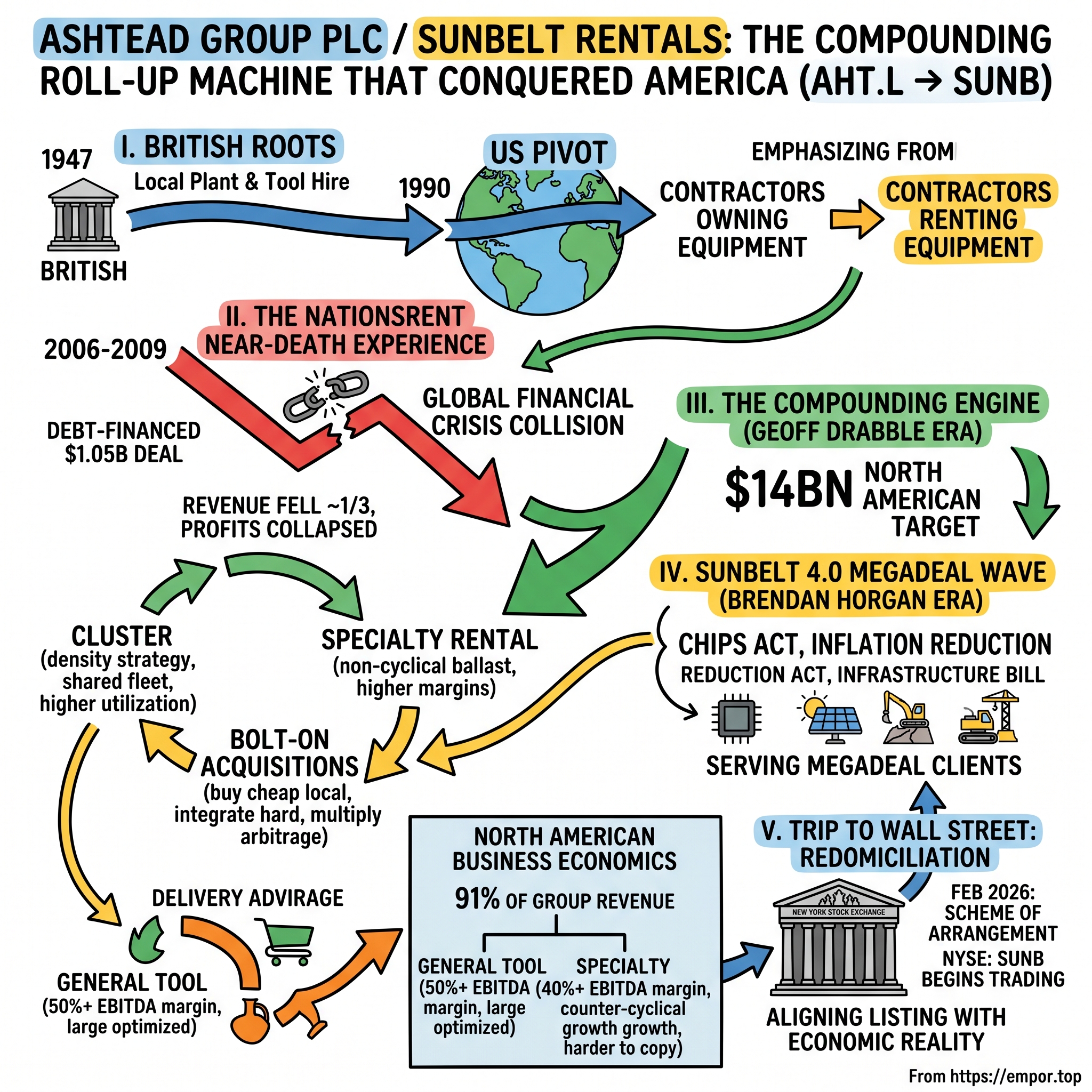
The roadmap runs in five movements. First, the British roots (1947–1990): a fragmented home market with a hard ceiling on ambition. Second, the US pivot (1990): a modest acquisition in North Carolina that turned out to be the entire ballgame, and the structural shift from owning equipment to renting it that made the bet work. Third, the NationsRent near-death experience (2006–2009): a billion-dollar, debt-financed deal that collided head-on with the Global Financial Crisis, when group revenue fell roughly a third and profits collapsed toward nothing. Fourth, the Geoff Drabble turnaround: the decade in which mere survival hardened into a compounding engine built on clusters, specialty rental, and a disciplined bolt-on acquisition machine. And fifth, the Brendan Horgan era: the 2019 succession, the "Sunbelt 4.0" master plan and its $14 billion North American target, the American megaproject wave, and the trip to Wall Street.
Throughout, we keep an independent posture. Management tells a clean and confident story — the redomiciliation, it argues, simply aligns the listing with the economic reality of the business. That may well be right. But a listing change does not create a single dollar of new cash flow, and a company that has told investors for years that it is disciplined and counter-cyclical is precisely the company whose discipline deserves testing when the cycle turns. As we will see, the cycle has already started asking the question.
Let's start where the money isn't yet — in postwar Surrey.
 Subscribe on LinkedIn
II. British Roots & The Pivot West (1947–1990)
Picture England in 1947. The war is two years over, the cities are pockmarked with bomb damage, rationing is still in force, and the country is short of everything — housing, steel, dollars, optimism. Into this landscape of reconstruction steps a small enterprise in the Surrey village of Ashtead, offering something a cash-starved, rubble-clearing nation badly needed: the ability to use a piece of machinery without having to buy it. The Ashtead Plant Hire Company — later Ashtead Plant and Tool Hire — was founded that year to rent excavators, mixers, compressors and hand tools to the men rebuilding Britain.12
It was a good business in a modest way, and for a long while it stayed modest. Equipment rental is, at heart, a spread business dressed up in diesel. You buy a durable asset, you rent it out enough times that it pays for itself several times over, you maintain it well enough that it keeps working, and eventually you sell it secondhand and recover part of your outlay. Do that with discipline and you earn a handsome return on the capital tied up in the fleet. Do it badly — over-buy in a boom, get stranded with idle steel in a bust — and the same operating leverage that made you rich takes it all back with interest. For its first several decades, Ashtead did it well enough to survive without ever threatening to conquer anything from Surrey.
The management buyout and the ceiling
The inflection came in 1984, when a management buyout led by Peter Lewis and George Burnett took control of a business then posting roughly £1.5 million in annual sales, with about sixty employees spread across a handful of branches.12 Two years later, in 1986, the reshaped company listed on the London Stock Exchange, handing management a public currency with which to buy things.12
And here the ambition ran headlong into a wall — the UK growth wall. The problem was structural rather than managerial, which is exactly what made it unsolvable by effort or cleverness. Britain is a small, mature, densely regulated island. Population growth is slow. Construction is chronically cyclical and heavily concentrated in the South East. Most damaging of all, the equipment-rental market was ferociously fragmented, with hundreds of local operators fighting over overlapping territories on price. In a market shaped like that, no single player can build durable scale advantages, because there is nowhere to put the scale — the fragmentation itself caps returns on capital and, with them, the ceiling on long-term compounding.
By the late 1980s, Ashtead's leadership had reached an uncomfortable conclusion: the home market simply could not support the company they wanted to build. If they intended to build something large, they would have to build it somewhere else.
Crossing the Atlantic
That somewhere was the United States. In 1990, Ashtead made the acquisition that would eventually swallow the entire company — a small regional equipment-rental operation based in Charlotte, North Carolina, called Sunbelt Rentals.12 At the time it was a footnote, a toehold in one corner of the American South, and nobody rang any bells. But the underlying logic was profound, and it rested on a macro shift that was only just getting started.
In 1990, American contractors owned almost everything they used. Rental penetration — the share of construction equipment out on rent rather than parked on a contractor's own balance sheet — sat under a quarter of the market. The prevailing instinct was that a serious builder bought his own excavators; renting was what you did in an emergency or a pinch. Over the following three decades that instinct inverted completely, with penetration climbing past half the market.8
Why did renting win? Because contractors gradually did the arithmetic and concluded that owning a depreciating steel asset you use only part of the year is a spectacularly inefficient use of capital. Renting converts a lumpy capital cost into a variable operating cost that scales with the order book. Just as importantly, it hands off every associated headache — maintenance, storage, transport, insurance, compliance, and above all the risk of what the machine is worth when you're finished with it — to somebody else. The rental company absorbs that residual-value risk in exchange for a rental yield. For a contractor whose workload swings with the seasons and the economy, it is close to a free lunch: you get the machine when you need it and you get nothing on your balance sheet when you don't.
And the American canvas dwarfed the British one. A continent-sized contiguous market with broadly uniform operating standards, a lighter regulatory and labor touch than the UK, and — for a well-run operator with genuine scale — structurally higher operating margins. Ashtead had spent forty years learning the mechanics of rental in a market that punished the very scale it was trying to accumulate. Now it held a beachhead in a market practically designed to reward it.
The question was no longer whether to grow in America, but how fast — and how far the company was willing to lean out over the edge of its own balance sheet to do it. In 2006, it leaned out very far indeed.
III. The NationsRent Near-Death Experience (2006–2009)
By the middle of the 2000s, Sunbelt had grown from a Carolina curiosity into a genuine American business, fattened along the way by deals such as the 2000 purchase of Rentokil Initial's US rental interests, which roughly doubled its size overnight. The US housing and non-residential construction markets were roaring. Credit was cheap, abundant, and offered on terms that in hindsight read almost as satire. And Ashtead's leadership looked out at the fragmented American landscape and saw an irresistible chance to buy scale in one stroke rather than build it branch by patient branch.
The megadeal
The target was NationsRent, a Florida-based operator with a genuinely national footprint. In the summer of 2006, Ashtead announced that Sunbelt would acquire it in a transaction valued at approximately $1.05 billion — a deal explicitly framed as a way to dramatically expand Sunbelt's reach and vault it up the American league table.1011 When it closed, the combined business ran 477 locations across 35 states with roughly 7,000 employees, planting Sunbelt firmly among the largest equipment-rental companies in the country.10
On paper it was a textbook consolidation play: instant scale, instant geographic diversity, instant relevance to national contractors who wanted a single phone number for jobsites in a dozen states. The strategic logic was not wrong. It was, in fact, the same logic that would make the company enormously valuable fifteen years later.
The problem was how it was paid for.
Two engines and no brakes
The acquisition was heavily debt-financed, layering roughly a billion dollars of obligations onto a business whose revenues were, by their nature, exquisitely sensitive to construction activity.11 This is the recurring hazard sitting at the dead center of the equipment-rental industry, and it deserves to be spelled out precisely, because it explains almost everything about how the company behaves today.
Rental demand is a leveraged bet on construction, which is itself a leveraged bet on the broader economy. When conditions are good, everyone wants steel, utilization climbs, and pricing firms up — revenue and profit rise together, and the profit rises faster. When conditions turn, projects are paused or cancelled, machines come back to the yard, utilization craters, and pricing collapses — all while the fixed costs of owning an enormous fleet grind on regardless of whether anything is rented. It is a high-beta business with punishing operating leverage in both directions.
Stacking high financial leverage on top of that is like bolting a second engine onto a car that already accelerates faster than you can steer. The arrangement works beautifully right up to the moment you need to brake.
The collision
Ashtead needed to brake in 2008. The Global Financial Crisis arrived precisely as the NationsRent integration was still in flight, and it hit American residential and non-residential construction like a wrecking ball. The effect on the group was brutal: revenue fell by roughly a third from its peak, profits collapsed toward zero, and a company that had just doubled down with borrowed money found itself staring at a wall of debt with a fraction of the cash flow it had underwritten.
This was not a difficult quarter to explain away on a call. This was an existential event — the kind that ends companies, and careers.
Enter Geoff Drabble
Into that emergency walked Geoff Drabble. Recruited from the engineering group Laird, he stepped into the chief executive role in early 2007, taking over from George Burnett just as the deal-fueled optimism was beginning to curdle.10 Drabble did not create the crisis; he inherited the job of surviving it. And the playbook he ran in those years became the company's operating DNA for the following decade.
The moves were unglamorous and painful, and they ran directly against every instinct a growth-oriented management team has. Slam capital expenditure to the bone. Halt fleet expansion entirely. And — counterintuitively — turn the fleet itself into a cash machine by selling older equipment into the secondhand market, then routing the proceeds straight into paying down debt as fast as humanly possible.
That last move is the one worth dwelling on, because it is the hidden superpower of a rental balance sheet. In a normal year, used-equipment sales are routine housekeeping — you cycle out old machines to keep the fleet fresh. In a crisis, they become a survival valve. A rental company under stress can shrink its own balance sheet and generate liquidity precisely when the rental market refuses to provide any, because its assets are liquid in a way that a factory or a hotel simply is not. There is a functioning global secondhand market for a five-year-old boom lift. Sunbelt could, in effect, eat its own fleet to stay alive.
The lesson that became doctrine
The company made it through. But the scars hardened into doctrine, and the most important lesson Drabble drew was not simply "carry less debt," though that mattered enormously and shows up in the leverage discipline the company advertises to this day.
It was strategic. Sunbelt could not safely remain a pure-play, cyclical, general-construction rental business. Tethered entirely to the swings of building activity, it would always be one recession away from the edge of the cliff, no matter how well it was run. To compound safely over decades, it needed demand that did not rise and fall with construction starts — non-cyclical, higher-margin, harder-to-replicate services that would keep the cash coming when the cranes stopped moving.
That insight, forged in the near-death of 2008, is the hinge on which the entire modern story turns. The crisis did not merely teach Ashtead how to survive a downturn. It handed management the blueprint for what to build next — and the next decade was spent building it.
IV. The Geoff Drabble Turnaround: The Birth of the Compounding Engine
To understand how Ashtead became one of the great compounding stories of the London market, you have to look at what Drabble did after the fire was out. Surviving 2008 proved the company was tough. What followed proved it was well-designed. Across the decade that followed, Drabble and his lieutenants — chief among them a rising American executive named Brendan Horgan — took a battered rental operator and rebuilt it into something closer to a machine: a system that took in capital, cheap acquisitions and steel at one end, and produced high returns, higher multiples and market share at the other.
The rebuild rested on three interlocking innovations. None of them was individually secret. The combination, executed consistently for a decade, was the moat.
Innovation one: the cluster, or turning geography into utilization
The first was logistical. Rather than run a scattering of isolated branches, each hoarding its own equipment like a squirrel with a private nut supply, Sunbelt reorganized around clusters built on hub-and-spoke logic.
Within a given metropolitan area, a large central "hub" yard holds the heavy, expensive, specialized machines that get rented less frequently — the equipment that is costly to own and disastrous to leave idle. Around it sits a constellation of smaller "spoke" branches placed close to customers, handling the high-turnover general tools that go out constantly and need to be five minutes from a jobsite.
The magic is that fleet can be shared across the whole cluster. A single specialized platform no longer has to sit in one branch waiting for local demand to materialize; it can be dispatched wherever in the metro area the work actually is. In industry language, this pushes up "time utilization" — the percentage of the day a machine is out earning rent rather than parked — which is the single most important lever on the return the fleet generates.
Think of it as the difference between every household on a street owning its own rarely-used pressure washer and the street sharing three of them. Same service delivered, a fraction of the capital deployed. Higher utilization from the same steel means more revenue per dollar invested and far less wasteful over-buying.
Crucially, this is a density strategy with a self-reinforcing quality: the more branches and machines you pack into a single market, the more efficiently the entire system runs, because there are more places to send an idle machine and more ways to fill a truck. That is precisely the advantage a subscale local competitor cannot replicate no matter how hard it works — it doesn't have enough machines or enough locations for the sharing to matter.
Innovation two: specialty, or buying ballast against the cycle
The second innovation was the direct strategic answer to 2008: the deliberate build-out of Specialty rental. If general-tool rental rises and falls with construction, specialty is the ballast in the hull.
Sunbelt pushed aggressively into power generation and HVAC — temporary climate control — plus trench safety and shoring, scaffolding, pumps, and the technical services that surround all of it. These are not simply different products; they are a different business with different customers and a different demand driver.
Why does management chase specialty so hard? Three reasons, and they compound on each other.
It earns rich margins, running EBITDA margins in the high-forties.5 Much of its demand is genuinely decoupled from new construction: temporary power and climate control get called in for emergency response after hurricanes and floods, for data centers and film productions and hospitals, for municipal work, and for the planned industrial maintenance shutdowns that happen on their own schedule regardless of the economic weather. A refinery turnaround needs temporary power whether or not housing starts are strong. And it is materially harder to copy, because it demands specialized fleet, genuine technical expertise, and trained people who know how to size a chiller or engineer a shoring system — which raises the barrier to entry and keeps the mom-and-pop competition firmly out.
Specialty, in short, does the two things a cyclical business most needs at once: it smooths the cycle and it defends the margin. That is a rare combination, and it explains why the segment has become the strategic centerpiece of every plan the company has published since.
Innovation three: the roll-up, or arithmetic plus an assembly line
The third innovation was less a product than a process, and it is where the financial returns really came from.
The American rental market was — and largely still is — a long tail of independent operators: family businesses running a few yards in a single region, frequently with an owner nearing retirement and no succession plan. Sunbelt turned acquiring them into an assembly line. It would buy a local operator at a low multiple of earnings, often in the neighborhood of four to six times EBITDA, and then execute a standardized integration: rebrand it Sunbelt almost immediately, upgrade and standardize the fleet, migrate it onto Sunbelt's digital and logistics systems, and fold it into a nearby cluster where its equipment could be shared and its utilization lifted.
Here is the quiet financial alchemy. Those same earnings, once they sit inside a large, liquid, publicly traded rental platform, get valued by the stock market at a far higher multiple — well into the double digits. Buy a dollar of EBITDA for five times and have the market re-rate it at twelve or fifteen, and you have manufactured value out of the spread between private and public multiples. This is multiple arbitrage, and it is one of the most reliable value-creation mechanisms in all of business.
It is also one of the most abused. The roll-up graveyard is stacked with companies that mistook the arithmetic for the achievement — that acquired indiscriminately, never truly integrated, and eventually drowned in operational complexity, goodwill writedowns and investor disgust. The arbitrage only holds if the integration is real, because what the market is actually paying up for is not the earnings themselves but the durability and controllability of those earnings inside a system that works.
Sunbelt's genuine edge was never that it discovered multiple arbitrage. Every private-equity associate can draw that on a napkin. It was that the company built the rigid, boring, repeatable integration machine that made the arbitrage stick — and, just as importantly, the discipline to walk away when the price wasn't right.
What it produced, and how much credit to give
Put the three together — density-driven utilization, counter-cyclical high-margin specialty, and a disciplined acquisition assembly line — and you have the compounding engine. The results were the kind that get a chief executive remembered: across Drabble's tenure, Ashtead's share price rose by a figure most commonly cited in the thousands of percent, turning a battered mid-cap survivor into one of the standout performers of the FTSE 100.
That number invites healthy skepticism, and an independent reading demands it. A meaningful share of that return came from the starting point: Drabble took over a stock that had been beaten to near-nothing in the crisis, so the arithmetic of recovery alone was flattering. A further share was a bet on the timing and unusual duration of the long American construction expansion that followed — a tailwind no management team creates, and one that lifted every operator in the industry, including competitors.
Drabble's genuine achievement was not conjuring the cycle. It was rebuilding the company so that it captured an outsized share of the cycle when it came, and would be structurally less likely to be destroyed by the next one. That is a real achievement, and it is a different claim from "management is brilliant" — the kind of distinction that matters when you are trying to work out how much of a track record will repeat.
But the engine was real, and crucially it was repeatable. So when Drabble prepared to hand over the keys in 2019, the obvious question was whether the machine depended on the man who built it — or whether it could keep running under someone who had helped build it from the inside.
V. The Brendan Horgan Era & The "Sunbelt 4.0" Megaproject Boom
Succession is where good companies quietly break. The standard failure mode is theatrical: hire a celebrated outsider, promise a bold new direction, and watch the culture that produced the results get dismantled by someone who never learned why it worked in the first place.
Ashtead did the opposite. In 2019 the group handed the chief executive role to Brendan Horgan, who had run the crown-jewel Sunbelt US division since 2011 and had spent most of his career inside the American engine that generated nearly all of the group's value. This was continuity by design — a bet that the machine was bigger than any single builder, and that the person most likely to keep it running was the one who had spent years running its most important part. It also placed an American operator, steeped in American customers and American competitive dynamics, in charge of a company still nominally British.
The pay question, and what it foreshadowed
Horgan's ascent crystallized a tension that had been building for years, and that would eventually help justify the trip to Wall Street: the widening mismatch between where Ashtead earned its money and where it was listed, priced and governed.
A British-listed company is expected to pay British-sized executive compensation and answer to British proxy advisers and UK governance conventions. But Ashtead's actual competitors — United Rentals, Herc — were American companies paying American, equity-heavy, performance-leveraged packages to hold on to American operating talent. Horgan's remuneration was deliberately structured toward that US benchmark rather than UK convention, weighted heavily toward long-term equity awards tied to multi-year earnings growth and return-on-investment targets, with a substantial personal shareholding intended to bind his outcome to the shareholders'.
It was a defensible retention logic — you cannot ask an executive to fight United Rentals for customers and for talent while paying on a scale United Rentals' own bench would find quaint — but it drew sharp criticism from UK proxy advisers and some shareholders who bristled at American-style pay on a London-listed company.
That friction was not a governance sideshow to be filed away. It was an early tremor of the deeper question of whether Ashtead was meaningfully a British company at all. The board would eventually answer that question about as definitively as a board can.
Sunbelt 4.0: a plan specific enough to be graded
The strategic centerpiece of the Horgan era arrived in April 2024, when management gathered analysts in Atlanta — not London, tellingly — to unveil a five-year plan branded "Sunbelt 4.0."9 The headline was blunt: turn Sunbelt into a $14 billion business in North America by the 2029 financial year.8
Beneath that number sat commitments concrete enough to grade over time, which is exactly what makes the plan worth taking seriously as a test of management credibility. The company laid out expected revenue growth of roughly 6–9% a year in the United States, 9–12% in Canada, and a more modest 2–5% in the UK. It committed to opening between 300 and 400 new "greenfield" locations, weighted toward specialty — roughly 180 to 240 specialty sites against 120 to 160 general-tool stores. And it set an ambition to grow the specialty segment alone past $5 billion in revenue.8 The whole plan implied enormous capital deployment, on the order of $20 billion across the five years covering both fleet purchases and acquisitions.8
Management organized it all under five pillars — customer service, growth, performance and efficiency, sustainability, and disciplined investment — which is corporate-speak of the standard variety.913 But the numbers underneath are specific enough to hold the company to, and that specificity cuts both ways. A plan that names a destination, a growth rate, a location count and a segment target cannot be quietly re-litigated later when conditions change. To management's credit, it is a falsifiable promise rather than an aspiration. Investors should note which way it has started cutting.
The megaproject wave — and what could puncture it
The engine meant to power all of this is the American megaproject boom. Across the early 2020s, three pieces of US federal legislation — the CHIPS Act, the Inflation Reduction Act, and the Infrastructure Investment and Jobs Act — combined to catalyze a surge of enormous, multi-year industrial construction: semiconductor fabrication plants, electric-vehicle battery gigafactories, clean-energy generation and transmission projects, and, increasingly, the vast data centers being built to feed artificial intelligence.
These are not ordinary jobsites, and the distinction matters commercially. A single semiconductor fab or hyperscale data center can be a multi-billion-dollar, multi-year undertaking requiring thousands of pieces of equipment on site simultaneously — general tools, aerial platforms, temporary power, climate control, trench and shoring, all of it, coordinated across years and multiple contractors.
Crucially, the number of rental companies that can actually service a job at that scale is very small. It requires fleet depth, logistics muscle, and a balance sheet capable of parking tens of millions of dollars of equipment on one site for years without blinking. In practice that means the two national players and essentially nobody else. If the megaproject thesis holds, it structurally advantages exactly the top of the market — and Sunbelt sits there.
But an independent investor has to press on whether the tailwind is as durable as a five-year plan requires it to be. Megaprojects are lumpy, politically contingent and financing-sensitive. The subsidies that catalyzed them can be trimmed, redirected or slow-walked by a different Congress with different priorities. Data-center demand is real but rests on assumptions about the AI capital-spending cycle that not even the hyperscalers themselves can guarantee across a five-year window. And a plan anchored on 6–9% annual US growth is, by construction, a plan that assumes no serious recession lands inside the window.
The early scorecard has been mixed in a way that matters. Growth slowed markedly in the two years after the plan was unveiled, even as the company kept returning cash to shareholders and opening greenfields — the capital deployment ran on schedule while the top line downshifted to low single digits, with management guiding to just 0–4% rental revenue growth for the 2026 financial year.6
That is not yet evidence the plan is failing; five-year plans are not graded in year two. But it is the beginning of a genuine test — specifically, whether management holds to the disciplined-investment pillar when the growth pillar is not cooperating, or quietly stretches for volume to defend the headline target. To judge whether the machine is still compounding or merely coasting, we have to open it up and look at the segments.
VI. Segment Breakdown & Core Business Economics
Strip away the branding and the strategy decks and Ashtead is really three businesses stitched together — and they could hardly differ more in quality. The first thing an honest look at the segments reveals is a startling geographic asymmetry: this is, functionally, an American business carrying two appendages.
The asymmetry
The United States is the whole game. In the year ended April 30, 2025, North American general-tool rental generated roughly $5.89 billion of revenue and North American specialty roughly $3.31 billion, with the US supplying the overwhelming majority of group revenue and an even larger share of profit.5 By the group's own account, some 91% of revenue now originates in North America.5
Canada, materially smaller, plays the role of growth option — a market where Sunbelt is still comparatively young and can, in principle, replicate the entire cluster-and-specialty playbook from a low base. That is precisely why management pencils in the fastest growth rates there.8 It is genuine optionality rather than proven value: the thesis is that the same machine works in Toronto and Calgary as in Houston and Atlanta, and the evidence so far is encouraging but not yet decisive.
And then there is the United Kingdom — the ancestral home market, the place where the whole thing started — which has become the group's problem child.
The UK as a control experiment
The UK is analytically valuable precisely because it functions as a control experiment. Same company, same playbook, same brand, same management incentives. Radically different result.
In the 2025 financial year, Sunbelt UK's rental revenue actually fell around 2% to roughly £503 million, dragged down by softer construction and infrastructure volumes.5 More revealing than the revenue is the margin: the UK operation earns EBITDA margins in the vicinity of 25%, roughly half what the North American business achieves.5
Why the gulf? Because the UK market carries every structural handicap we met earlier and none of the American advantages. It is fragmented, hyper-competitive and price-driven, geographically cramped, with labor and pricing dynamics that never let a single operator assemble the density that generates American-style returns. There simply isn't enough room to build a cluster the way you can across a Texas metro.
The UK is living proof that Ashtead's success was never purely about the playbook. It was about running the playbook in the right market. The same operating manual produces a world-beating business in Texas and a mediocre one in the Midlands.
For investors, that is a useful antidote to the temptation to credit management with everything. Execution mattered enormously — but so did the choice of terrain, and a skeptic would fairly ask why a business earning half-margins in a structurally unattractive market remains in the portfolio at all. It is the most obvious target for an activist arguing that the group should simplify.
What the North American segments actually earn
The two big North American segments have distinct personalities. General tool — aerial work platforms, earthmoving equipment, forklifts, the workhorses of any construction site — is the larger and, at scale, the more thoroughly optimized business, running EBITDA margins comfortably above 50%.5 Specialty runs at somewhat lower EBITDA margins in the high-forties but grows faster and carries the counter-cyclical, harder-to-replicate qualities that make it strategically precious.5 Both sit within a group whose overall EBITDA margin runs in the mid-forties, the gap explained largely by the low-margin used-equipment sales and central costs folded into the consolidated total.
That margin structure says something worth stating plainly, because it cuts against the way the strategy is usually narrated. The mix shift toward specialty that management is pursuing is not margin-accretive in the narrow sense — specialty actually earns less per dollar of revenue than mature general tool does. What it buys is growth and resilience. Management is knowingly trading a little current margin for a lower-beta, faster-growing revenue stream.
Whether that trade proves worthwhile depends entirely on how severe the next downturn turns out to be, which is a genuinely open question rather than a settled one. If the cycle stays mild, the trade looks like margin given away for nothing. If it turns hard, it looks like the smartest thing the company ever did.
The life of a single machine
To feel the business in your hands, follow one asset through its life.
Sunbelt buys an aerial work platform for, say, $100,000. Over the next seven or eight years it rents that machine out repeatedly, keeping it utilized on the order of 60–65% of the time. Across that working life, the cumulative rent collected substantially exceeds the purchase price — that is the entire point of the model, converting a single capital outlay into a long stream of rental yield. Then, at the end of its rental life, Sunbelt sells the machine secondhand, typically recovering perhaps 30–40% of the original cost.
That final disposal is not a rounding error, and understanding it is essential to understanding the company's cash flows. It is a genuine and meaningful source of cash, which is why used-equipment pricing is a variable management watches obsessively. When secondhand values are strong, the entire model enjoys a tailwind: machines can be cycled out earlier, the effective cost of ownership falls, and fleet renewal partly funds itself. When values soften, cash generation from disposals shrinks and the true cost of running the fleet quietly rises.
The awkward recent chapter
Which brings us to a revealing wrinkle. Group revenue in the 2025 financial year actually slipped about 1%, even as rental revenue grew.5 The culprit was the cooling used-equipment market: after a post-pandemic stretch of unusually elevated secondhand prices, values normalized, and lower used-equipment sales dragged the total line down.5
This is exactly the kind of moment that separates disciplined operators from spin artists. Management's task on the earnings calls was to explain that the headline "decline" reflected cyclical normalization in the disposal market rather than deterioration in core rental demand — a genuinely accurate framing, but also a convenient one, and analysts were right to probe it.
On the evidence, the company largely did the unglamorous thing rather than the flattering one. The subsequent quarters bore out caution rather than reacceleration: into the 2026 financial year, rental revenue kept growing only in the low single digits, while free cash flow ran near record levels and leverage sat around 1.6 times EBITDA, comfortably inside the target band.6 Capital expenditure was cut sharply — down roughly a third year-on-year in the first half of the 2026 financial year — while dividends and buybacks continued at pace, and half-year pre-tax profit fell about 10%.7
Read that pattern carefully and it says something specific about management behavior. When growth slowed, the company cut fleet spending rather than chasing volume, harvested cash, and returned it to shareholders. That is the 2008 doctrine operating in a mild downturn rather than an existential one — at least circumstantial evidence that the discipline is institutional rather than rhetorical, which is the single most valuable thing a cyclical company can demonstrate.
The tension for investors is that the cash machine is humming while the growth engine has downshifted, and the Sunbelt 4.0 targets were set in a faster world. Which raises the question of what, exactly, protects those cash flows if the slowdown deepens.
VII. Competitive Moat & Hamilton Helmer's 7 Powers Analysis
Every great compounding story eventually has to answer one question: what stops someone else from doing this?
Rental equipment is not a secret. The machines come from the same handful of manufacturers everyone can buy from. There is no patent on renting a scissor lift, no proprietary algorithm, no brand that commands a luxury premium. And yet the North American market has consolidated into something close to a duopoly at the top, with United Rentals and Sunbelt towering over a long tail of independents.
To understand why, it helps to run the business through Hamilton Helmer's 7 Powers — a disciplined framework for separating a durable advantage from a story management would like you to believe.
Scale economies: the primary power
This is the real one, and the advantage is genuine and quantifiable. When you buy tens of thousands of machines a year directly from original-equipment manufacturers — John Deere, JLG, Genie and the rest — you command volume discounts a local operator buying a handful of units can never access. That lower acquisition cost flows straight through to a structurally better return on every single machine, permanently, for as long as the scale gap persists.
Scale also drives the density advantage described earlier: the cluster model converts a large local footprint into lower transport costs and higher fleet utilization, meaning the biggest operator in a market is also the most efficient one. That is not vanity scale of the kind that flatters a revenue line while destroying returns. It is a cost position competitors cannot close by trying harder, only by getting bigger — which is precisely what they cannot do without the capital and the years.
Switching costs: more significant than they look
Switching costs are the second power, and they are stronger than a purely physical business would suggest.
Large general contractors increasingly sign "national account" relationships with a single rental partner and integrate that partner's digital tools — ordering, tracking, telematics, safety and compliance reporting — into their own project-management and billing systems. Once a contractor's workflow, equipment data and compliance records run through Sunbelt's rails across dozens of simultaneous jobsites, ripping that out to save a few percent by assembling a patchwork of local suppliers becomes a real operational headache with real project risk attached.
The switching cost is not the equipment. It is the plumbing wrapped around the equipment. That is the specific mechanism that lets national players hold pricing with their most valuable customers — and it is also the thing to watch for erosion. If national-account pricing ever starts slipping meaningfully, this power is weaker than advertised, and investors would want to know before management volunteers it.
Process power: real, but shared
Process power deserves a moderate rather than decisive grade, and it is worth being honest about why.
Orchestrating a multi-billion-dollar fleet — forecasting maintenance, positioning machines ahead of demand, scheduling transport, sustaining utilization across hundreds of branches — is genuinely difficult, and doing it well is a learned organizational capability that took Sunbelt more than a decade to build. It cannot be bought or copied quickly.
But United Rentals has demonstrably built the same capability. Process power therefore separates the top two from everyone else far more than it separates them from each other. It defends the industry structure rather than Sunbelt's position within it — a critical distinction, because it means process power protects the duopoly's profits without telling you which of the two captures more of them.
Brand and cornered resource: the weakest plank
These warrant honest skepticism. The Sunbelt name carries real trust with contractors, and the operating culture and leadership continuity — the Drabble-to-Horgan lineage, and the bench of American operators it produced — is a genuine institutional asset a competitor cannot simply hire away.
But a contractor renting a boom lift is not paying a brand premium the way a luxury buyer does. Availability, service reliability and price do most of the work in that decision. Brand supports the moat; it does not constitute it, and any bull case leaning heavily on it is leaning on the weakest plank available.
Porter's Five Forces: the same picture, sharper
Run the business through Porter and the structure comes into focus.
The threat of new entrants is low. Matching a national player would require billions in fleet, a branch network accumulated over years, and OEM relationships that reward existing volume — a wall of capital and time that deters all but the most determined and well-funded, and even then the newcomer arrives with worse unit economics on day one.
The bargaining power of buyers is genuinely mixed. A small local customer has little leverage and pays close to list. A giant contractor putting a megaproject out to tender has real negotiating power — though the fact that only two firms can realistically serve such a job caps how much of that leverage can actually be exercised. You cannot squeeze a supplier very hard when the alternative is one phone number.
The bargaining power of suppliers is low-to-moderate. The equipment manufacturers depend on United and Sunbelt for a large share of their own production volume, a mutual dependence that keeps the relationship rational rather than extractive in either direction.
The threat of substitutes is low. The only real alternative to renting is buying, and the entire secular shift of the past three decades has been contractors concluding that buying is the capital-inefficient option.
And competitive rivalry, the most interesting force, is bifurcated. Near the top it resembles a disciplined duopoly competing on service, availability and breadth rather than ruinous price war — which is what allows both companies to earn attractive margins simultaneously. At the bottom, the fragmented tail remains cut-throat, which is precisely the fragmentation the roll-up machine exists to consume.
The honest grade
Add it up and the moat is real, but it is a scale-and-density moat rather than a magic one. It is strongest exactly where scale matters most — national accounts and megaprojects — and thinnest in commoditized local rental, where a scrappy independent with a good relationship and low overhead can still win on price.
That distinction is not academic. It means Sunbelt's advantage compounds precisely in the segments management is betting the next five years on, and fades in the parts of the market it would rather leave behind anyway. But it also means the moat is conditional: it depends on the megaproject and national-account end of the market continuing to grow as a share of the whole. If construction demand shifts back toward smaller, local, fragmented jobs, the moat narrows without anyone at Sunbelt doing a single thing wrong. Structural advantages built on a market's shape are hostage to that shape.
VIII. Playbook: Business & Investing Lessons
Step back from the specifics and Ashtead's history offers a handful of transferable lessons — the kind that outlive any single company. Each is worth stating plainly, and each cuts both ways.
One: relocate to your market reality
The cleanest lesson of the whole saga is the NYSE re-listing. When roughly nine-tenths of your profits, essentially all of your principal competitors, and the talent pool you recruit from live in one country, a listing in another country is a form of self-imposed friction. It can depress your valuation relative to pure-play domestic peers whom investors know and benchmark daily. It can constrain your ability to pay competitively for operating talent. And it forces your governance to answer to norms disconnected from your actual economics.
Ashtead's answer — pick up the corporate parent and move it to where the business actually lives — is a striking act of institutional self-awareness, and a quiet rebuke to the sentimentality that keeps many companies anchored to a founding geography that stopped meaning anything decades ago.
The skeptic's footnote is essential, though. A redomiciliation changes the wrapper, not the contents. It can help close a valuation gap, but it earns nothing if the underlying cash flows disappoint. The move is a wager that the discount was about address rather than substance, and only years of results settle which. Investors should also be alert to a subtler risk: that a listing change becomes a narrative that substitutes for operating progress, giving management something exciting to talk about during a period when the growth numbers are dull.
Two: multiple arbitrage only works bolted to an integration system
The mechanics were covered earlier, so the lesson here is the inverse of the usual takeaway. The arithmetic of buying private earnings cheaply and having public markets value them richly is the easy part. The hard part — the part that is actually the competitive advantage — is the boring institutional capability to absorb a business in weeks without breaking it or yourself.
The lesson is not "do roll-ups." It is "do not attempt a roll-up until you can integrate in your sleep." And for investors evaluating any serial acquirer: grade the integration record, not the deal count. Deal announcements are free; integration is where the value either appears or quietly evaporates into goodwill.
Three: in a capital-intensive downturn, stop buying and squeeze the fleet
The most valuable habit Ashtead learned in 2008 is counter-cyclical and psychologically difficult. When demand falls, halt fleet purchases immediately and convert existing equipment into cash by selling it down.
It feels like surrender. You are deliberately shrinking during a crisis, ceding share to rivals who keep spending and look bolder in the trade press. But it is precisely how a high-fixed-cost, capital-hungry business survives a cycle it cannot control — and the operators who do the opposite are the ones who disappear or get acquired at distressed prices.
This is the single most important behavior to watch for at the next downturn. The temptation to keep buying to defend market share is what kills over-levered competitors, and it is also what creates the distressed acquisition opportunities the survivors subsequently feast on. Downturns are when the consolidation machine gets its cheapest inventory.
Four: protect a cyclical core with a non-cyclical, high-margin flank
The specialty build-out is a general principle wearing specific clothing: when your main business is hostage to a cycle you do not control, buy yourself ballast by building an adjacent business that marches to a different drummer entirely.
The strategic caution is that as an entire industry chases specialty's superior characteristics, its scarcity — and therefore its premium — erodes. A moat everyone is digging toward is a moat under pressure. The specialty advantage Sunbelt enjoys today is partly a first-mover advantage, and first-mover advantages have shelf lives that are rarely disclosed in the strategy deck.
None of these lessons is exotic. What makes Ashtead genuinely instructive is that it executed all four consistently for more than a decade, which is far rarer than merely knowing them. The open question is whether that execution survives a slower cycle, a higher cost of capital, and the loftier expectations now baked into both the share price and the five-year plan. That is the stress test.
IX. Analysis & Bear vs. Bull Case (Investor Stress Test)
Let's war-game this properly — not with cheerleading, but the way a thoughtful long and a determined short would actually argue it across a table.
The bear case
It begins with the one word management can never escape: cyclicality. Everything attractive about Sunbelt — the operating leverage, the fleet scale, the megaproject exposure — inverts violently in a deep recession. If US construction rolls over and megaprojects stall, utilization falls, pricing softens, and a business with enormous fixed costs sees profits fall far faster than revenue.
The company survived exactly this in 2008, but it survived by shrinking dramatically and nearly didn't. A repeat would test whether today's larger, more diversified Sunbelt is genuinely more resilient or simply bigger. And here the bear has a sharp point: the specialty ballast has never actually been tested in a severe downturn at its current scale. That it should prove counter-cyclical is a well-reasoned hypothesis with supporting logic, not a proven defense with supporting data. It deserves to be labeled as such rather than assumed into the base case.
The second pillar is the cost of capital. This is among the most capital-intensive business models in existence; you must keep buying steel to grow at all. A sustained higher-interest-rate environment raises both the cost of financing the fleet and the cost of refinancing the debt stack as it matures, quietly compressing the return on every machine.
The company carried net debt of over $10 billion at the most recent half-year, and while leverage sits comfortably within the target range, the cost of that debt as it rolls over is a real and ongoing drag that simply did not exist during the cheap-money decade that made the compounding look so effortless.7 A great deal of the historical return was earned in a world where capital was nearly free. That world is gone, and it is fair to ask how much of the track record goes with it.
Third is execution risk on the greenfield build-out. Three to four hundred new locations sounds impressive in a strategy deck, but greenfields lose money before they mature, and opening them into markets that are already well-served risks cannibalizing existing branches and diluting returns rather than adding to them.8 The plan commits enormous capital on the assumption that the density advantage keeps scaling indefinitely. If the best markets are already saturated, incremental locations earn progressively less, and the returns show up years after the capital does.
Fourth is the used-equipment squeeze that already bit in the 2025 financial year. A prolonged softening in secondhand values would keep pressuring disposal cash flows, and because those flows fund a meaningful part of the fleet-replacement cycle, weakness there quietly raises the true cost of running the business in a way that does not show up cleanly in any single reported line.5
And an activist would add a governance needle. A company that migrated to New York partly to justify US-scale executive compensation has, however defensibly, tied management's incentives to a re-rating narrative — and boards should always be pressed hardest on narratives that conveniently align with pay outcomes. A skeptic would also probe the pace of buybacks against a backdrop of decelerating growth. Returning cash is admirable discipline when investment opportunities are genuinely scarce; it can also flatter per-share metrics while the underlying business grows slowly. Both readings fit the same facts, which is exactly why it warrants watching rather than assuming. The persistence of the low-margin UK business inside the portfolio is the other obvious activist target — a structurally disadvantaged asset earning half the group's margins, retained for reasons that are more historical than economic.
The bull case
It rests, above all, on runway. Even the two giants together hold a minority of the fragmented North American market, which means the roll-up machine still faces a multi-decade supply of independent operators to acquire, integrate and re-rate. The compounding engine is not out of fuel; it is running through a slower stretch of road.
Demographics help here in a way that is easy to overlook. Many of those independents are owner-operated businesses facing succession decisions driven by age rather than economics, which creates a steady stream of willing sellers largely independent of the construction cycle — and sometimes more willing when times are hard.
Layer on the secular megaproject tailwinds — manufacturing reshoring, grid and clean-energy build-out, and the data-center construction wave — each a multi-year theme that disproportionately benefits the only two players large enough to serve the jobs at all. Even a partial realization of these themes supports years of above-GDP demand for exactly the fleet Sunbelt owns.
Add the specialty growth story. Pushing specialty past $5 billion at high margins genuinely improves both the growth rate and the cyclical resilience of the whole enterprise simultaneously.8 That combination — faster and steadier — is rare in industrial businesses, which usually force a choice between the two.
And finally the re-rating thesis. Bulls argue the company long traded at a valuation discount to United Rentals substantially because it sat on the "wrong" exchange, structurally invisible to the American index funds, passive flows and sell-side analysts who benchmark the sector daily. The NYSE listing should, on this view, close that gap over time.1[^15]
Whether the re-rating actually materializes is an empirical question the next few years will answer, not a fact to be assumed. Notably, the transition also brought a change of auditor to the US firm for the fiscal year ending April 30, 2026, part of a broader conversion to American reporting norms and standards.[^15] That conversion is routine in intent but not trivial in practice: shifting reporting frameworks introduces genuine transition risk in disclosure, comparability and accounting judgment, and investors should read the first full set of US-basis accounts with more than usual care, particularly around fleet depreciation policy and residual-value assumptions, which are the most judgment-heavy estimates in this business.
The honest synthesis
Both cases are true at once, which is usually the sign of an interesting company rather than a confused analyst.
Sunbelt is a genuinely advantaged operator with a long consolidation runway and real secular tailwinds — and it is a deeply cyclical, capital-hungry business whose current growth has slowed to low single digits while it promises considerably more, on the working assumption that reasonable conditions persist for five years.
The "why it wins from here" spine is credible and mechanism-based rather than rhetorical: procurement scale, logistics density, national-account switching costs, and a fragmented market ripe for consolidation are concrete, observable advantages that can be tested against competitors' results. The "what breaks it" spine is equally concrete: a construction recession, a higher-for-longer cost of capital, a megaproject air pocket, or a greenfield program that dilutes rather than accretes returns.
An investor does not have to pick a side to see that the entire thesis rides on the cycle — which is why the appropriate response is not a verdict but a watch-list.
The three KPIs that matter
Three metrics matter more than any others for tracking whether the machine is still working.
Time utilization — the share of the fleet actually out earning rent, which management targets in the 60–65% zone — is the truest early read on real demand. It moves before revenue does, because a contractor returns a machine before he cancels a project, and when it slips, everything downstream slips with it.
Return on investment — the group-level return on capital employed, which management targets in the mid-to-high teens — is the ultimate scorecard on whether all that steel is earning its keep. It is the single number that would reveal a greenfield program quietly destroying value, because dilution from immature locations shows up in returns long before it shows up in revenue or margin.
Net-debt-to-EBITDA leverage — held in a 1.5x–2.0x band, and running around 1.6x in the most recent reporting — is the discipline gauge.6 The entire survival lesson of 2008 lives inside that ratio. Any sustained drift above the band during a downturn, particularly if paired with continued fleet spending rather than fleet harvesting, would be the loudest possible signal that the company had forgotten its own history.
X. Outro & Epilogue
The arc is almost too neat to be true. A tool-hire shop opens in a Surrey village in the ashes of the Second World War, renting cement mixers to men rebuilding a broken country. Seventy-nine years later, its corporate descendant rings a bell on the floor of the New York Stock Exchange as an American industrial giant, generating the overwhelming majority of its profits an ocean away from where it was born, having finally decided to make the geography of its stock certificate match the geography of its cash flows.4
What connects those two points is neither luck nor a single genius. It is a machine — assembled painstakingly over three decades, nearly destroyed by a billion-dollar bet that collided with a financial crisis, and rebuilt into a disciplined compounding engine that converted cheap acquisitions, dense logistics clusters and counter-cyclical specialty services into market share and durable returns.
The redomiciliation is the final act of an unusually self-aware organization: an admission that legacy and sentiment are luxuries a business competing globally for capital and talent cannot always afford. There is something quietly radical in that. Most companies treat their founding geography as identity, something to be honored regardless of cost. Ashtead treated it as an operating variable — and when the variable stopped serving the business, it changed it. Whether that reads as clear-eyed pragmatism or as the erosion of something worth keeping is a genuine question, and one the London market will be arguing about for years.
But the story is not finished, and the ending is not written. Sunbelt today is a bigger, better-diversified, more resilient version of the company that nearly died in 2008 — and it remains, at its core, a cyclical, capital-hungry business making an ambitious five-year promise into a slowing top line and an uncertain macro sky. The plan is specific, which means it will be graded. The discipline has been demonstrated in a mild slowdown, which is encouraging but not conclusive. The moat is real but conditional on a market shape that could change.
The lessons it leaves behind are durable: relocate to your reality, integrate before you acquire, hoard cash when the cycle turns, and hedge a cyclical core with a non-cyclical flank. Whether those lessons carry a New York-listed Sunbelt through its next cycle as successfully as they carried a London-listed Ashtead through the last one is the question now sitting with every long-term owner of SUNB. The machine has been extraordinarily well-built. The cycle, as always, will be the judge.
References
-
Sunbelt Rentals to begin trading on NYSE March 2 under new US listing — Rental Management / American Rental Association, 2026 ↩↩
-
Effectiveness of the Scheme of Arrangement — Sunbelt Rentals Holdings, Inc. (Investor Relations), 2026-02-27 ↩
-
Ashtead Wins Court Approval to Shift Holding Company and Primary Listing to U.S. — TipRanks, 2026 ↩
-
Sunbelt Rentals Shares Begin Trading on New York Stock Exchange — Sunbelt Rentals Holdings, Inc. (Investor Relations), 2026-03-02 ↩↩
-
Ashtead reports moderate growth — results for the year ended 30 April 2025 — International Rental News, 2025 ↩↩↩↩↩↩↩↩↩↩↩↩
-
Sunbelt reports first-quarter rental revenue growth — Rental Management / American Rental Association, 2025 ↩↩↩
-
Higher revenues, lower profits for Ashtead — half-year results to 31 October 2025 — Vertikal.net, 2025 ↩↩
-
How Sunbelt Rentals plans to become a $14-billion company in five years — International Rental News, 2024 ↩↩↩↩↩↩↩
-
Ashtead unveils 'Sunbelt 4.0' plan — International Rental News, 2024 ↩↩
-
Sunbelt Rentals to Acquire NationsRent Companies — Construction Equipment Guide, 2006 ↩↩↩
-
Ashtead plans to double size of its US acquisition — Construction News, 2006-07-27 ↩↩
-
Ashtead Group plc — Company History — Company-Histories.com ↩↩↩↩
-
Ashtead Group Unveils Sunbelt 4.0 Strategy — TipRanks, 2024 ↩
 LinkedIn
 WhatsApp
 Reddit
 Hacker News
 Email
Email Kindle
 RSS Feed
 Spotify
 Apple Podcasts
 Amazon Music
 Audible
 YouTube