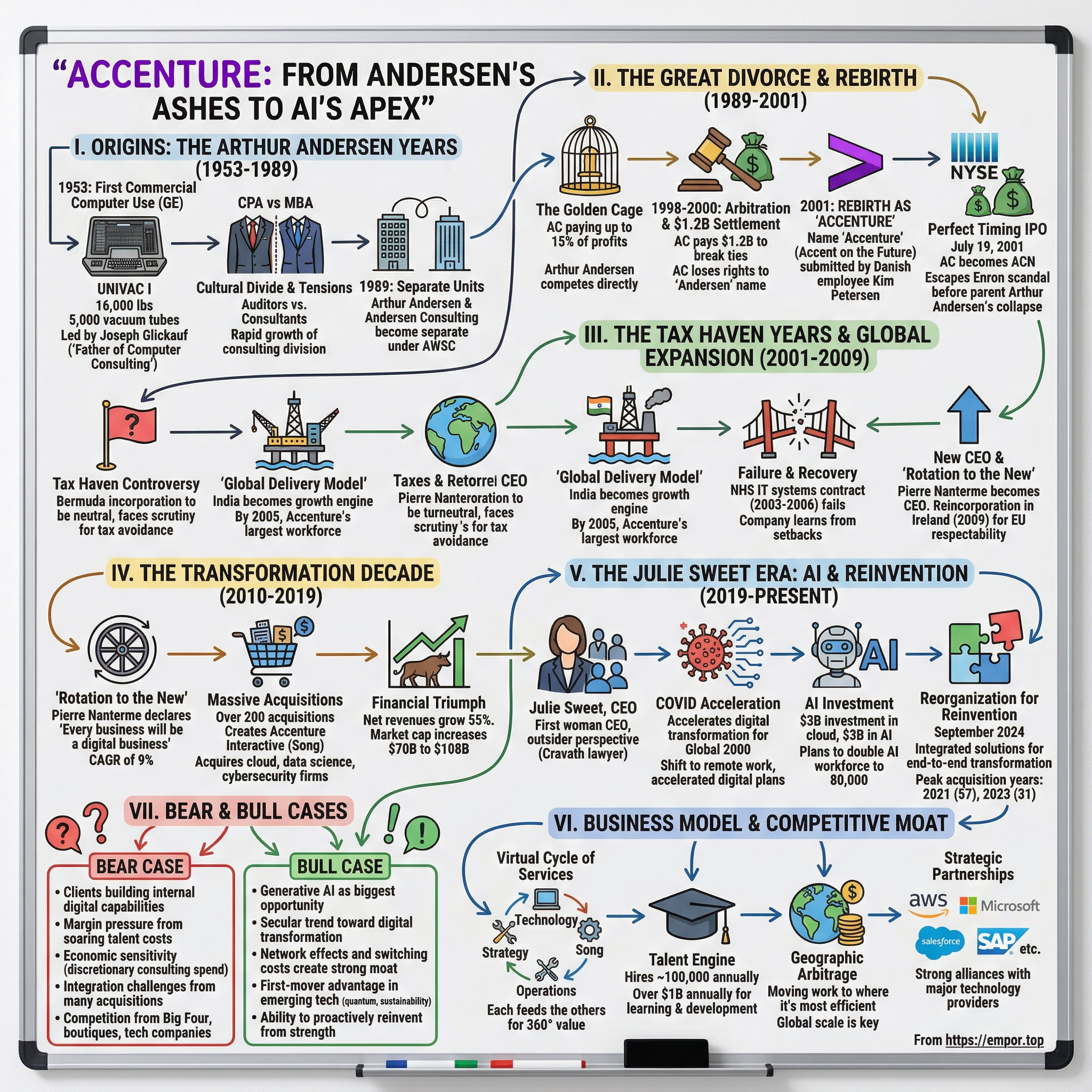
Accenture: From Andersen's Ashes to the AI Engineering Factory
I. Introduction & The $65B Professional Services Monopoly
On the morning of July 19, 2001, a company that had existed under its own name for barely six months rang the opening bell at the New York Stock Exchange. The ticker was ACN, the offering price was $14.50 per share, and the legal domicile was Bermuda. Its name—Accenture—was a coined term that had not existed in any language until roughly eighteen months earlier.[^1]
In retrospect, the timing was remarkably fortuitous. The dot-com bubble had burst, leaving the Nasdaq down roughly two-thirds from its March 2000 peak and making an initial public offering for a consulting firm a risky proposition. Yet the primary catalyst operating in the background had nothing to do with technology stocks. Ten months after that bell, Arthur Andersen—the ninety-year-old accounting partnership that gave birth to the firm—surrendered its U.S. public accounting licenses following its collapse in the Enron scandal. Accenture's consulting unit had separated, rebranded, and incorporated offshore just in time to survive its parent company's demise.
Twenty-five years later, the spin-off is one of the largest employers of white-collar labor in the world. For fiscal year 2025, ended August 31, 2025, Accenture reported $69.7 billion in revenue—a 7% increase in both U.S. dollars and local currency—backed by $80.6 billion in new bookings and a global workforce of roughly 779,000 serving clients across more than 120 countries.7 By the third quarter of fiscal 2026, ended May 31, 2026, headcount reached approximately 799,000, while trailing nine-month revenue stood at $55.5 billion.12 To put that scale into perspective, Accenture employs more people than the active-duty military of most nation-states, with the vast majority billing by the hour.
Accenture's total shareholder return since its Bermuda listing has outpaced the S&P 500 over the long term and outlasted nearly all of its original peers. That record warrants examination because, on paper, the business possesses no conventional economic moat. Accenture owns no proprietary intellectual property that clients cannot acquire independently. It manufactures no physical goods. Its principal assets are its employees, a third of whom turn over every few years. The core business involves implementing third-party software—from vendors like SAP, Salesforce, Microsoft, ServiceNow, Amazon, and NVIDIA—and charging for the labor required to deploy it.
How, then, did a niche electronic-computing unit inside an accounting partnership transform into the primary implementation contractor for the technology ambitions of the Fortune 500?
The answer lies neither in high-level management strategy akin to McKinsey nor in pure software engineering akin to Infosys or TCS. Instead, Accenture occupies a position between the two: an enterprise execution bridge. Every fifteen to twenty years, a new technology paradigm emerges—moving from mainframes to client-server architectures, packaged ERP systems, the public cloud, and now generative AI. While each technological shift offers clear utility, integrating it presents formidable challenges for corporate executives. Organizations must translate vendor promises into operational systems despite decades of accumulated legacy debt, fragmented regional subsidiaries, and strict regulatory oversight. Accenture monetizes that integration gap by converting emerging technologies into implementation hours and, ultimately, into multi-year managed-services contracts that generate recurring revenue long after initial deployment.
While this business model has proved effective, its durability in an era where software can generate its own code remains an open question. Recent financial results underscore this pressure: bookings in the most recent reported quarter fell 2% in U.S. dollars and 3% in local currency, triggering an 18% decline in the share price after management acknowledged that more of its full-year guidance range was in play.1213 The execution bridge remains standing, but for the first time since the onset of the cloud era, investors are actively debating who will be crossing it in the decade ahead.
To understand the stakes of that debate, the story begins with a UNIVAC I mainframe at a Kentucky appliance factory.
 Subscribe on LinkedIn
II. Origins & The Great Divorce: Arthur Andersen to Bermuda IPO (1953–2001)
In 1953, Arthur Andersen partner Joe Glickauf was asked to explore an unfamiliar question: General Electric wanted to know whether a room-sized electronic calculating machine could handle payroll at Appliance Park, its massive new manufacturing complex in Louisville, Kentucky. Glickauf, who had built a demonstration device out of a shoebox and blinking lights to show skeptical partners how a computer operated, helped GE install a UNIVAC I to automate its payroll processing. The project is widely recognized as the first commercial business application of a computer in the United States, establishing the founding story of the entire IT services industry.
What matters analytically, however, is not the machine itself, but the organizational chart. Because Glickauf's unit operated inside an accounting partnership governed by audit partners, that first computing engagement was structurally subordinated from birth. Arthur Andersen's Administrative Services division grew for three decades within a firm whose equity, governance, and prestige were controlled by partners who signed audit opinions.
By the late 1980s, that arrangement faced severe internal friction. Technology consultants generated an enormous and expanding share of total revenue, yet the firm's profit-sharing formula continued to direct earnings primarily toward audit partners. In 1989, Andersen Worldwide restructured into two distinct business units—Arthur Andersen for audit and tax, and Andersen Consulting for technology and systems integration—establishing a transfer-payment mechanism intended to maintain balance between the divisions.
It did not maintain balance; it merely postponed open conflict for eleven years.
The dispute that followed became one of the most contentious intramural conflicts in professional-services history. The trigger arrived when Arthur Andersen, watching its consulting counterpart compound gains, began building its own competing consulting practice. Andersen Consulting argued that this expansion violated the 1989 agreement and took the dispute to arbitration before the International Chamber of Commerce. In August 2000, the arbitrator issued a landmark ruling: Andersen Consulting secured complete independence and was released from future transfer payments, but it forfeited roughly $1 billion in escrowed funds and was required to surrender the Andersen name entirely.[^1]
Losing an established brand is a severe blow when reputation represents a firm's primary asset. The firm launched an internal naming competition, selecting an entry from Oslo-based consultant Kim Petersen, who proposed "Accenture" as a compression of "accent on the future." The virtue of the name lay in its clean slate: it carried no existing meaning, held no historical baggage, and could not be confused with the audit partnership from which the consultants were eager to separate. The rebrand took effect on January 1, 2001.
Six months later, the company went public. Accenture Ltd registered in Bermuda, listed its Class A shares on the NYSE, and raised approximately $1.7 billion at $14.50 per share.[^1] The public offering used a distinct corporate structure: partners converted their partnership interests into equity and exchangeable units under a governance framework designed to preserve the firm's collaborative culture within a publicly traded entity.
On June 15, 2002, Arthur Andersen was convicted of obstruction of justice for destroying Enron-related documents. Although the Supreme Court later overturned the conviction, the damage was irreversible; the accounting firm surrendered its CPA licenses, and its 85,000 employees dispersed across the remaining Big Four firms. Having separated from the parent partnership through arbitration, Accenture observed the collapse of its former affiliate from a safe distance.
Myth vs. reality: the "immediate success" story
The conventional narrative holds that independence brought immediate financial liberation—that freed from audit partners, margins and revenue growth expanded rapidly. Accenture's early regulatory filings present a more nuanced reality.
Separation eliminated a critical competitive asset: the audit relationship as an automatic lead-generation engine. An audit partner embedded in a client's finance organization for two decades understood precisely which corporate systems were failing and which executives held budget authority. Stripped of that channel, Accenture had to construct a standalone global sales infrastructure, corporate administration, and brand awareness almost overnight. Gross margins compressed during the transition as these standalone operating expenses hit the balance sheet, while the firm simultaneously absorbed rebranding costs and the escrow forfeiture. The IPO prospectus explicitly highlighted the loss of the Andersen relationship, the unproven brand name, and reliance on partner retention among its risk factors.[^1]
In retrospect, the separation was strategically vital yet financially costly. The timing of the Enron collapse transformed an expensive corporate restructuring into an existential rescue. This dynamic illustrates a recurring pattern throughout Accenture's history: the firm's most consequential structural moves have yielded their greatest benefits through unforeseen market shifts.
With its separation complete, Accenture faced a new competitive reality. It remained a Western consulting firm burdened with Western cost structures, just as offshore technology providers in Bangalore were developing the capacity to execute similar work at a fraction of the cost.
III. The Offshore Delivery Engine & Tax Haven Navigation (2001–2009)
The threat arrived quietly in the form of pricing pressure. Around 2002, corporate chief information officers evaluating proposals for IT application maintenance began comparing Accenture’s quotes against those from Indian technology firms offering identical project scopes for less than half the price. Within five years, that pricing gap appeared in thousands of corporate procurement decisions. Competitors such as Tata Consultancy Services, Infosys, and Wipro were winning market share not through technological superiority, but through a labor cost advantage that traditional account management could not overcome.
Accenture’s response proved to be its most consequential operational pivot of the post-IPO decade: rather than defending Western billing rates, the firm established its own offshore cost structure. It scaled delivery centers in Bangalore, Hyderabad, Chennai, Manila, and Dalian into what it branded the Global Delivery Network. The expansion continued until India surpassed the United States as Accenture's largest country by headcount by a wide margin. Today, a substantial majority of Accenture’s delivery workforce operates from lower-cost locations across India, the Philippines, Latin America, and Central and Eastern Europe.
This operational framework became the core structural foundation of the business. While offshore competitors could match Accenture on delivery costs, they initially struggled to replicate its front-end capabilities—specifically its C-suite access, industry domain knowledge, and executive credibility during complex organizational transformations. Accenture matched the offshore firms on price while retaining its premium advisory capabilities. The resulting "pyramid" delivery model—a thin layer of onshore partners and solution architects overseeing a broad base of offshore engineers—allowed the firm to bid competitively on commodity work while maintaining premium margins on high-judgment advisory services. That balance, rather than proprietary software, represents Accenture’s primary cost advantage.
The domicile question
Meanwhile, the firm's Bermuda incorporation had become a political liability. In 2002, the U.S. General Accounting Office (now the Government Accountability Office) published a review of federal contractors incorporated in tax-haven jurisdictions; Accenture featured in the resulting scrutiny, and members of Congress repeatedly attempted to bar such companies from federal contracts.2 For a firm expanding its U.S. public-sector practice, maintaining a tax-haven domicile created an unnecessary regulatory bottleneck.
In 2009, Accenture re-domiciled from Bermuda to Ireland, becoming Accenture plc. Management framed the move around corporate governance stability and proximity to European clients, both of which were genuine considerations given Ireland’s European Union treaty network and familiar legal framework for institutional investors. The relocation also preserved a favorable effective tax rate. While frequently characterized as a strategic masterstroke, the re-domiciling primarily resolved reputational and regulatory risks the firm had created for itself eight years earlier.
Myth vs. reality: does the delivery machine actually deliver?
The scale of the Global Delivery Network invites a compelling thesis: that an industrialized, multi-country delivery engine makes Accenture uniquely reliable on complex enterprise IT programs. However, the firm’s operational record during this era reveals clear boundaries to that capability.
In September 2006, Accenture withdrew from its contracts as a local service provider on the UK National Health Service's National Programme for IT, at the time the largest civilian IT program in the world.[^5] The exit followed sustained delays in delivering core clinical software from a subcontracted partner, leading Accenture to record a pre-tax charge of roughly $450 million. Management walked away from multi-billion-pound engagements because completing the work under the agreed terms threatened losses far exceeding the exit penalty.
Six months later, in March 2007, the Texas Health and Human Services Commission and Accenture agreed to dissolve an integrated eligibility contract originally valued at roughly $899 million.3 The initiative—designed to automate qualification processing for Medicaid, food assistance, and children's health insurance—suffered technical and operational failures, including lost applications, call-center backlogs, and dropped enrollments. Under the settlement terms, the contractor consortium forfeited tens of millions of dollars in scheduled fees and paid cash back to the state.
These two public-sector failures within eighteen months underscored a recurring pattern. Both involved large, fixed-price or fixed-scope contracts where technical requirements were shaped by political mandates, legacy systems were poorly documented, and operational scopes expanded continuously against fixed financial terms.
The investment lesson is specific: Accenture’s delivery model excels at standardized, repeatable programs at scale, such as global enterprise resource planning rollouts and long-term application management. Conversely, the firm faces elevated execution risk on novel, fixed-price megaprojects where it absorbs the financial risk of fluid scope. That distinction remains relevant as clients undertake generative AI transformations, which carry similar scope uncertainties. Key indicators of execution risk include contract-loss provisions and unfavorable revenue adjustments in annual 10-K filings, alongside disclosures regarding the adoption of outcome-based or fixed-price AI contract structures.8
By the end of the 2000s, Accenture had built a delivery network capable of competing with offshore providers and established a corporate domicile acceptable to federal regulators. Its next challenge was defining its growth strategy once enterprise resource planning implementations matured.
IV. The Digital & Cloud Transformation Decade (2010–2019)
Pierre Nanterme diverged sharply from the conventional archetype of a global consulting chief executive. A Frenchman who spent his entire career at the firm after joining the Paris office in 1983, Nanterme led Accenture's financial services practice before taking over as CEO in 2011. Formal, precise, and European in managerial temperament, he possessed a willingness to challenge internal consensus publicly as enterprise resource planning implementations matured.
Starting around 2013, Nanterme argued repeatedly that every corporate client would eventually transform into a digital business. While that assertion reads as commonplace today, it challenged prevailing norms in 2013. At the time, a major share of Accenture's revenue still derived from deploying and maintaining legacy packaged enterprise software, and corporate executives largely treated digital initiatives as isolated marketing projects.
Nanterme backed his thesis with capital reallocation rather than mere messaging. He established a new reporting category, "the New," comprising digital, cloud, and cybersecurity services, and systematically shifted the company's revenue mix through hiring, internal reskilling, and aggressive M&A. The New expanded from roughly a third of total revenue in the mid-2010s to a clear majority by decade's end. Having completed the strategic transition, Accenture retired the reporting category on the rationale that once digital services became ubiquitous, the distinction ceased to be informative.
That reporting shift warrants analytical scrutiny. "The New" was a non-GAAP, management-defined classification. When a company defines a custom metric, reports rapid growth under that label, and subsequently retires it once the strategic narrative takes hold, investors must evaluate the disclosure as communication strategy alongside operational performance. Although Accenture's revenue mix genuinely shifted toward cloud and digital services, the precise growth metrics attributed to "the New" were never independently verifiable by external auditors.
The roll-up machine
The principal engine of this transformation was an M&A strategy executed at an unprecedented volume within professional services. Accenture consistently acquired dozens of specialized targets annually—boutique design studios, cloud engineering providers, industrial automation specialists, cybersecurity firms, and regional SAP practices—integrating them directly into its Global Delivery Network.
The most prominent outcome of this roll-up was Accenture Interactive, later rebranded as Accenture Song. Beginning around 2013, the firm systematically acquired creative agencies, including Scandinavian service-design firm Fjord, London-based agency Karmarama, and, in 2019, New York creative agency Droga5 for a reported $475 million. The acquisition of a highly decorated advertising agency by a systems integrator struck industry observers as an unusual move. Accenture's rationale rested on the premise that chief marketing officers' budgets were shifting toward technology, and that the vendor controlling the customer-experience platform would ultimately capture the advertising spend that ran on top of it.
Myth vs. reality: does digital transformation actually transform?
In April 2019, The Hertz Corporation filed a lawsuit against Accenture in the U.S. District Court for the Southern District of New York, seeking more than $32 million in damages.4 Hertz alleged that after two years of work and tens of millions of dollars in fees, Accenture failed to deliver a functional website and mobile applications, missing deadlines, omitting responsive design for tablets, and producing defective code. Accenture disputed the allegations, and the parties eventually settled the dispute privately without public adjudication of the technical claims.
The litigation was less significant as a legal dispute than as an indicator of execution limits. Unlike the sprawling UK health services overhaul, a digital interface redesign for a car rental provider fell directly within Accenture's core marketing pitch. That a marquee corporate client resorted to federal litigation rather than private renegotiation underscored a breakdown in execution, challenging the assumption that hiring the world's largest systems integrator guarantees project delivery.
The agency roll-up also introduced financial and cultural friction. Creative agencies operate at lower billable utilization rates than traditional systems integrators, relying on compensation structures and talent models that conflict with a corporate consulting pyramid. Absorbing these agencies compressed operating margins during the integration period, while creating persistent challenges in retaining top creative talent within an organization that today exceeds 799,000 employees.
From an investment perspective, the roll-up strategy reflects neither flawless foresight nor mere empire-building. The empirical record demonstrates that Accenture excels at acquiring specialized capabilities and scaling them across its expansive client network—turning a boutique firm with twenty clients into a practice serving hundreds. However, the firm has proven far less adept at preserving distinct corporate cultures. That tension surfaced in Accenture's fiscal 2025 financial results, when its six-month optimization program incurred asset impairments associated with divesting two previously acquired businesses.7
Nanterme stepped down as chief executive in January 2019 due to ill health and died shortly thereafter at age 59. His successor inherited a firm mid-transformation, facing the challenge of sustaining growth as digital implementation matured into the cloud era.
V. The Julie Sweet Era: Cloud First, Gen AI & Reinvention Services (2019–Present)
Julie Sweet did not come up through consulting. She spent seventeen years at Cravath, Swaine & Moore, making partner in the corporate practice of one of the country's most prominent law firms. She joined Accenture as general counsel in 2010, became chief executive of its North America business in 2015, and assumed the role of global CEO in September 2019.5 She later added the chair title.
Her legal background shaped her executive style. Sweet has managed the firm with structural precision, establishing clear frameworks and standardized corporate vocabulary across an organization of roughly 799,000 employees. Accenture's external messaging under her tenure has been consistently disciplined—built around terms like "Cloud First," "total enterprise reinvention," and transitioning "from using AI to running on AI." While that consistency signals strong operational alignment, it also requires investors to test whether corporate messaging reflects underlying financial performance.
Compensation and alignment
Accenture's executive compensation is heavily equity-weighted, featuring long-term performance shares tied to a three-year cumulative earnings target, return on invested capital (ROIC), and relative total shareholder return against a peer group.15 Sweet's total target compensation sits in the mid-twenty-millions, primarily in equity, aligning her personal equity stake with long-term performance. The structure offers clear governance advantages: three-year cumulative earnings per share limit short-term manipulation, while relative shareholder return evaluates performance against industry peers rather than macro tailwinds.
From a capital allocation perspective, however, relying on ROIC presents an analytical challenge for an active acquirer. Because goodwill from acquisitions increases the invested capital base while revenue synergies are routinely attributed to organic growth, headline ROIC can obscure deal productivity. Evaluating management's capital discipline requires examining the ratio of cumulative acquisition spend to incremental organic revenue growth over multi-year windows, alongside the frequency of asset impairments.
KC McClure, the long-tenured chief financial officer who spent her entire career at the firm, provided operational stability through steady annual margin expansion of 10 to 20 basis points, high cash conversion relative to net income, and conservative financial guidance. Meanwhile, Manish Sharma, former head of Accenture Operations and the Americas, was appointed to lead the firm's most significant structural reorganization of the Sweet era.
The pandemic and the geographic collapse
In 2020, as global travel disruptions prevented on-site client engagements, Accenture executed a major structural reorganization. The firm dissolved its standalone growth-platform profit-and-loss units—"Digital," "Technology," "Strategy & Consulting," and "Operations"—and consolidated operations under three geographic markets: Americas, EMEA, and Asia Pacific. The strategic logic assumed that as digital capabilities became ubiquitous, separate product P&Ls created internal competition for client budgets rather than unified account execution.
In September 2020, the firm launched Accenture Cloud First, committing $3 billion over three years to expand cloud migration capabilities across Amazon Web Services, Microsoft Azure, and Google Cloud. The initiative illustrated the enterprise execution bridge in practice: rather than building proprietary cloud infrastructure, Accenture positioned itself as the primary integration contractor and toll operator across major cloud platforms.
Then AI arrived, and the toll booth got interesting
Accenture began reporting generative AI bookings as a separate disclosure in fiscal 2024. Fiscal 2024 generative AI new bookings reached approximately $3 billion, generating roughly $900 million in revenue; by fiscal 2025, generative AI bookings expanded to $5.9 billion, representing about 7% of total new bookings of $80.6 billion.67 To support this shift, the firm reskilled more than 550,000 employees in generative AI fundamentals by late fiscal 2025.10
These figures present a dual narrative. While $5.9 billion in AI bookings reflects rapid growth, it also indicates that in the third year of a major enterprise technology cycle, ninety-three cents of every booked dollar still derived from traditional services. Generative AI represents an expanding growth engine, but it has not yet replaced the broader IT services core.
Myth vs. reality: is Accenture defensive?
The premise that Accenture's business model is insulated from economic downturns was tested twice between 2023 and 2025, revealing clear cyclical vulnerabilities.
Fiscal 2024 marked the first test. Total revenue increased 1% in U.S. dollars and 2% in local currency to $64.9 billion. Discretionary consulting revenue declined 1% in local currency, while contractual managed services grew 4%.1 Management reduced full-year guidance as corporate clients paused discretionary projects, triggering a negative stock reaction.14 The performance demonstrated that when corporate finance officers tighten budgets, major transformation engagements are deferred.
The second test emerged from public-sector policy shifts. In March 2025, Sweet disclosed that the U.S. General Services Administration had directed federal agencies to review consulting contracts and terminate non-essential work, leading to immediate contract losses at Accenture Federal Services and a sharp decline in share price.9 With federal contracts representing roughly 8% of global revenue, management set fiscal 2026 revenue growth guidance at 2% to 5% in local currency, estimating a drag of 1 to 1.5 percentage points from the federal pullback.716 By the third quarter of fiscal 2026, the federal headwind continued to reduce growth by approximately one percentage point.13
These developments clarify the firm's risk profile. The strong claim of complete defensiveness is unsupported, as discretionary consulting revenue remains cyclical. However, the narrower stability thesis holds: managed services maintained growth through both disruptions. Accenture functions effectively as a financial barbell—combining a cyclical consulting arm with a stable managed-services base that buffers overall revenue during enterprise spending slowdowns.
Reinvention Services, and a $923 million bet on itself
That environment set the stage for the most significant internal reorganization of Sweet's tenure. Announced in late 2024 and implemented across fiscal 2025 and 2026, Accenture collapsed its historical five-pillar structure—strategy, consulting, technology, operations, and Song—into a single integrated unit named Reinvention Services, led by Manish Sharma.11
The restructuring required substantial financial commitments. Accenture recorded $615 million in business optimization charges in the fourth quarter of fiscal 2025, with an additional $250 million recognized in the first quarter of fiscal 2026, creating an $865 million program for severance and asset impairments.7 Reporting by Fortune placed the total restructuring cost at approximately $923 million.11 More than 11,000 employees exited within a three-month window, as Sweet noted in September 2025 that workers who could not be reskilled would be transitioned out on an accelerated timeline.10
The restructuring reflected an enterprise service provider reorganizing its workforce as software automation transforms traditional IT delivery. Sweet acknowledged publicly that the most demanding phases of the transition remained ahead.11 Management projected total headcount to resume growth in fiscal 2026—with global workforce reaching approximately 799,000 by May 2026—demonstrating that the initiative targeted skill composition rather than net headcount reduction.12
The central operational question is whether the integration delivers sustained efficiency gains. Early financial results show modest margin progress alongside slowing top-line growth: adjusted operating margin expanded 10 basis points in fiscal 2025 to 15.6% while absorbing optimization charges below the adjusted line,7 and third-quarter fiscal 2026 GAAP operating margin reached 17.0%, up 20 basis points year over year.12 However, overall revenue growth decelerated and new bookings turned negative over the same period. Operating margin expansion during a period of slowing top-line growth reflects rigorous cost management, but full validation of the Reinvention Services model will require a return to accelerated revenue growth.
VI. Segment Anatomy, Financial Drivers & Business Model Economics
To understand how Accenture actually makes money, forget the org chart and picture a single client relationship over a decade.
Year one: a strategy engagement, four partners and a dozen consultants, high rates, three months. Year two: that becomes a $60 million SAP S/4HANA implementation with two hundred people, most of them in Bangalore. Years three through eight: Accenture runs the resulting platform under a managed services agreement, with contracted annual productivity savings built into the pricing and a team that the client no longer employs. Year nine: the client wants to put AI agents on top of the platform, and the conversation starts again.
That arc is the business. It explains the segment structure, the margin structure, and the moat — such as it is.
The two halves
Accenture reports revenue by type of work. In fiscal 2025, consulting was $35.1 billion, up 5% in local currency, and managed services was $34.6 billion, up 9%.7 The split is close to even, and the difference between them is the difference between a project and a subscription.
Consulting revenue is advisory, systems integration, enterprise architecture, and custom application development. It carries higher rates and higher volatility, because it is funded out of change budgets that can be paused with a memo. Managed services — application management, cloud operations, infrastructure, and business process services — runs on multi-year contracts, typically three to seven years, with revenue that recurs until the contract ends. Its rates are lower and it is more price-competitive, but it does not evaporate in a downturn.
The mix tells you where clients' heads are. In fiscal 2024, managed services carried the company. In the third quarter of fiscal 2026, consulting revenue grew just 1% in local currency while managed services grew 5% — the same defensive pattern reasserting itself.12
Industries and geographies
Fiscal 2025 revenue by industry group: Products (retail, consumer goods, automotive, industrial) at $21.2 billion; Health & Public Service at $14.8 billion; Financial Services at $12.8 billion, the fastest grower at 10%; Communications, Media & Technology at $11.5 billion; and Resources (energy, utilities, chemicals, mining) at $9.5 billion.7 Geographically, the Americas produced $35.1 billion, EMEA $24.6 billion, and Asia Pacific $10.0 billion.
What the industry spread buys is genuine diversification — no single vertical is more than about 30% of revenue, and the verticals do not all cycle together. Financial services capital-markets spending and energy capex respond to different variables. What it does not buy is immunity from a synchronized CFO freeze, which is exactly what fiscal 2024 demonstrated.
There is one visible concentration risk hiding inside Health & Public Service: U.S. federal. Roughly 8% of global revenue sitting with a single buyer whose procurement behavior can change with an administration is a real exposure, and the 2025–26 experience quantified it at over a point of company-wide growth.916
The Diamond client engine
Accenture's most useful internal metric is its Diamond client count — relationships generating more than $100 million of annual revenue. The firm ended fiscal 2025 with 305 Diamond clients and recorded 129 quarterly client bookings above $100 million during the year, a record.17
Here is the detail worth noticing: 305 is lower than the 310 reported a year earlier.1 In a year when total revenue grew 7%, the count of largest relationships went down slightly. That is not a crisis — clients roll off the threshold for benign reasons, including a completed megaproject — but it undercuts any story of relentless mechanical account expansion. Through the first nine months of fiscal 2026, bookings of $100 million or more numbered 104, up 13% year over year, which points the other way.12 The signal is noisy. Treat the Diamond count as a slow-moving measure of wallet share, not a quarterly scoreboard.
Unit economics
The mechanics are simple enough to hold in your head. Roughly a third of revenue survives cost of services as gross margin. Sales, marketing, and general and administrative costs consume most of the rest, leaving a GAAP operating margin around 15% — 14.7% in fiscal 2025, with adjusted margin at 15.6%.7 Free cash flow was $10.9 billion, against which the firm returned $8.3 billion to shareholders through $4.6 billion of buybacks and $3.7 billion of dividends.7
Three levers drive the margin. Utilization — the share of consultant hours that are billable — is managed tightly; a few points of slippage flows almost directly to operating income, which is why hiring decisions and bench management are existential rather than administrative. Pyramid shape — the ratio of junior to senior staff — determines average cost per billable hour. Location mix — the offshore share of delivery — is the structural defense against onshore wage inflation, and it is why Accenture's India footprint is not a cost-cutting exercise but the core of its price competitiveness.
The uncomfortable implication is that in a labor-arbitrage business, revenue and headcount are bound together. Accenture grows revenue mostly by adding people. That worked beautifully for twenty-five years. It is precisely the mechanism that generative AI threatens, and we will come back to it.
Cash conversion near 100% of net income and a balance sheet carrying minimal net debt with $11.5 billion of cash at fiscal year-end 2025 give management genuine optionality — which it has used, consistently, to buy companies and buy back stock.7 For a business with no factories to build, that is the only capital allocation question that exists, and it is the one competitors are judged against.
VII. Competitive Landscape, Industry Structure & Moat Analysis
Consider a typical enterprise procurement scenario: a European industrial conglomerate seeks to consolidate eleven regional ERP instances, migrate its systems to a cloud provider, and layer AI-driven planning tools on top. Four distinct categories of competitors offer fundamentally different value propositions.
Offshore-heritage providers like TCS and Infosys pitch execution at scale with labor pricing roughly 30% below Western rivals. Deloitte emphasizes sector-specific advisory depth and partner-led implementation experience. McKinsey presents a board-level case for operating-model restructuring. Accenture proposes an end-to-end model: designing the strategy, building the platform, and managing it under a multi-year contract with guaranteed annual productivity savings.
That end-to-end capability defines Accenture's competitive positioning.
The field
The offshore-heritage giants. Tata Consultancy Services, Infosys, Cognizant, Wipro, and HCLTech built their initial scale on labor cost advantages and have spent two decades moving upmarket. They have narrowed the capability gap, with TCS building a highly capable delivery organization. However, they remain at a structural disadvantage in front-end advisory sales—securing transformation mandates before implementation scopes are defined—and in Western design and strategy capabilities that Accenture acquired through M&A. Their core advantage remains price, which drives victories in commoditized managed-services bidding.
The integrators. Capgemini, DXC Technology, and Atos occupy a middle tier combining Western corporate brands with offshore delivery networks. Capgemini represents the most direct European competitor. By contrast, structural restructurings at DXC and Atos have resulted in persistent market-share losses to rivals.
The Big Four. Deloitte, PwC, EY, and KPMG maintain extensive advisory practices and, in Deloitte's case, substantial technology implementation scale. Their key structural constraint remains auditor independence regulations, which restrict the services they can sell to audit clients. Accenture's 2000 separation from Arthur Andersen permanently removed that regulatory ceiling, granting it unrestricted access across the Fortune 500.
The strategy houses. McKinsey, BCG, and Bain maintain deep C-suite relationships and high-margin strategy practices, and each has expanded its digital implementation capabilities. However, none possess—or seek to construct—a global workforce of nearly 800,000 employees. They excel at enterprise architecture and strategy design but rely on third parties to build and operate systems at global scale.
Seven Powers, honestly applied
Process Power represents Accenture's strongest competitive attribute. Delivering multi-country, multi-vendor system integrations on predictable timelines and budgets requires codified methodologies, proprietary tooling, and tens of thousands of trained delivery leads. As demonstrated by the earlier public-sector contract failures in the UK and Texas, this operational capability applies primarily to standardized enterprise programs rather than novel, fixed-price megaprojects.
Scale Economies provide tangible but specific advantages. Accenture can amortize specialized platform certifications, proprietary AI tools, and industry research across a $70 billion revenue base. However, this reflects fixed-cost amortization rather than the winner-take-all network effects of a software platform; large rivals like TCS and Deloitte achieve sufficient scale to replicate many of these investments.
Switching Costs offer durable protection. Once Accenture assumes operational control of a client's core ERP platform, cloud infrastructure, and business processes under a multi-year managed contract, replacing the provider introduces substantial operational risk. This operational lock-in explains why managed-services revenue expanded through recent economic slowdowns. Conversely, because clients recognize these switching costs, price negotiations during contract renewals remain intense.
Cornered Resource represents the weakest claim. Accenture holds top-tier partner status across major technology vendors, including Microsoft—via the Avanade joint venture—SAP, Salesforce, Amazon Web Services, Google Cloud, Workday, ServiceNow, and NVIDIA. Software vendors route major implementation deals to partners capable of execution, and Accenture is frequently their largest partner. However, vendor partnerships are non-exclusive and shared with key competitors, making ecosystem positioning a valuable sales channel rather than a true cornered resource. Furthermore, this dynamic leaves Accenture exposed to vendor policy changes regarding partner margin sharing.
Porter's five forces
Buyer power is high and rising. Accenture's clients comprise sophisticated corporate procurement organizations that actively multi-source to prevent vendor lock-in and can freeze discretionary consulting spend on short notice, as demonstrated during the fiscal 2024 corporate spending pause.
Rivalry is intense, particularly in managed services where offerings approach commoditization and offshore providers bid aggressively on price.
Threat of substitutes is elevated and evolving. The primary substitute is client insourcing enabled by higher-level software abstractions. Low-code platforms, hyperscaler managed services, automated SaaS integration, and AI coding assistants reduce the labor hours required per deployment. Historically, technology abstractions created net new integration demand by encouraging enterprises to build more complex architectures. Whether generative AI follows that historical pattern or permanently compresses total implementation labor remains an unverified thesis.
Supplier power centers on human capital. Wage inflation in offshore delivery hubs and intense competition for specialized AI engineering talent represent continuous cost pressures.
Barriers to entry remain high for full-scale global delivery networks, as replicating a workforce of nearly 800,000 employees requires decades of capital accumulation. However, barriers are low for specialized boutiques that capture high-margin advisory niches, prompting Accenture to maintain a continuous acquisition strategy.
In summary, Accenture's competitive position is defensible and well-established, but not monopolistic. It leads a fragmented industry where even the largest provider commands a high-single-digit share of global IT services spending.
VIII. Hidden & Future Material Businesses: Gen AI & Accenture Song
When Accenture renamed Accenture Interactive to Accenture Song in 2022, advertising trade publications ridiculed the branding rationale—positioning songs as emotional connectors. For traditional holding companies, however, the strategic threat was clear.
Song
Song represents one of the world's largest digital marketing and customer-experience organizations, integrating creative agencies, service design, commerce platform deployment, and marketing operations. Its operational role within Accenture is distinct: securing and defending front-office client relationships.
Historically, a major consumer brand's chief marketing officer allocated budgets primarily to legacy agency holding groups such as WPP, Omnicom, Publicis, and Interpublic. Modern marketing strategies, however, require configuring platforms like Salesforce Marketing Cloud, engineering commerce front ends, connecting customer data platforms to core inventory enterprise resource planning systems, and adhering to strict privacy regulations. Under this model, executing a creative brief becomes a systems integration challenge. Accenture's value proposition rests on unifying brand experience with back-end enterprise infrastructure, eliminating friction across client handoffs.
For investors, Song functions as a mix trade—sacrificing short-term delivery margins to capture broader enterprise revenue pools. Creative agency operations generate lower billable utilization and prove harder to offshore than application maintenance, dampening delivery pyramid efficiencies. However, Song provides Accenture access to marketing budgets and C-suite discussions historically dominated by traditional agencies. Evaluating whether the unit has justified its cumulative acquisition costs remains difficult for external observers, as Accenture stopped breaking out Song's financials following its transition to geographic segment reporting. This financial opacity leaves shareholders unable to independently audit the performance of a unit built through substantial M&A capital.
The AI integrator thesis
The bull thesis for Accenture in generative AI does not depend on model development, an area where the firm explicitly does not compete. Instead, it assumes that enterprise AI adoption fails primarily due to integration and operational bottlenecks rather than model architecture.
A foundational model functions much like an exceptionally capable new employee who lacks enterprise access: it has no connection to internal systems, no authoritative data mapping across legacy databases, no governance permissions, and no transactional capabilities. Turning model intelligence into operational utility requires extensive backend infrastructure—consolidating data pipelines, building secure data warehouses, connecting legacy applications through APIs, configuring access controls, redesigning workflows, and managing the ongoing environment. This complex, industry-specific infrastructure represents Accenture's core implementation offering.
Financial evidence supporting this thesis is emerging. Generative AI new bookings expanded from approximately $3 billion in fiscal 2024 to $5.9 billion in fiscal 2025.67 On management's June 2026 earnings call, Chief Executive Julie Sweet characterized the enterprise shift as clients transitioning from experimental usage to core operations, noting the addition of roughly one hundred clients launching advanced AI programs alongside expanding average deal sizes.13 The firm has simultaneously expanded into operational technology security to capture adjacent enterprise complexity, acquiring a majority stake in Dragos and full ownership of runZero and NetRise in fiscal 2026—a portfolio management stated brings $208 million in annual recurring revenue growing at 48%, while claiming to more than triple Accenture's addressable market in that niche.13
The counterweight: deflation
The key risk to this expansion thesis lies in labor deflation. Because Accenture's core consulting revenue relies on billable hours multiplied by billing rates, automated code generation and testing tools threaten the underlying volume of routine software development. If AI tools reduce a project's labor requirement from one hundred engineers over eighteen months to sixty engineers over twelve, Accenture must secure two and a half times the project volume to maintain flat revenue on that account. Management maintains across earnings calls that clients reinvest productivity savings into expanded project scopes and that AI introduces more integration complexity than it removes.
While plausible, management's counterargument reflects standard corporate positioning. Its credibility rests partly on historical precedence: previous computing paradigms—from packaged software to cloud infrastructure—were expected to reduce integrator demand yet ultimately expanded total enterprise complexity. However, generative AI differs from prior technology cycles by directly automating the labor input itself.
Furthermore, capital allocation trends present an immediate headwind. Analysts raised concerns on the June 2026 call that rising enterprise spending on AI hardware and infrastructure may crowd out IT services budgets. Sweet acknowledged that corporate clients were reallocating existing IT spending rather than increasing overall budgets.13 This reallocation indicates that enterprise AI investment currently draws funding from traditional IT services line items toward graphics processing units, data centers, and model licensing fees.
Ultimately, validating the AI integrator thesis requires observing accelerated total revenue growth alongside rising AI bookings—demonstrating net market expansion rather than internal revenue substitution. Conversely, sustained low-single-digit total revenue growth accompanied by rising AI bookings would signal labor deflation and spending displacement. With full-year fiscal 2026 local-currency revenue growth guided to 3% to 4% as of June 2026, the long-term impact on Accenture's core business model remains unsettled.12
IX. Bear vs. Bull Case & Activist Stress Test
On June 18, 2026, Accenture delivered a quarterly report that beat consensus earnings per share, expanded operating margins, and generated $3.6 billion in free cash flow. Yet its stock tumbled roughly 18%.13
That market reaction compressed the central investment debate into a single trading session. Wall Street was not focused on past quarterly earnings; it was reacting to new bookings falling 3% in local currency, $2 billion in managed services engagements deferred into fiscal 2027, consulting growth slowing to 1%, and management acknowledging that the lower end of full-year guidance was increasingly in play. Investors have shifted from valuing Accenture on current earnings to evaluating whether its core business model can survive the technological shift it sells to clients.
What an activist would attack
Acquisition opacity. Accenture deploys billions of dollars annually across dozens of transactions without disclosing per-deal economics, acquired revenue contributions, or post-acquisition performance metrics. While the firm reports organic growth, the line between organic and inorganic performance becomes blurred once acquired teams are merged directly into geographic profit-and-loss units. An activist investor would raise a fundamental concern: whether continuous acquisitions obscure underlying deceleration in the core business. Accenture's fiscal 2025 disclosure of asset impairments from divesting two previously acquired businesses demonstrates that not all transactions succeed,7 yet the company provides no systematic reporting to evaluate overall deal productivity.
Reporting structure as a disclosure choice. The 2020 consolidation into geographic market units simplified internal operations while reducing external transparency. Shareholders can no longer evaluate the standalone financial performance of key growth drivers like Accenture Song, cybersecurity, or cloud services. While geographically unified management offers operational benefits, it limits investors' ability to audit individual segment productivity.
Fixed-price risk in a fluid-scope era. Generative AI transformations carry inherently fluid operational scopes. If Accenture assumes fixed-price or outcome-based contract risk to secure competitive mandates, historical execution failures—such as the UK National Health Service and Texas state contracts—illustrate the potential financial downside when scope expands beyond fixed fees.
Restructuring cadence. A restructuring program costing between $865 million and $923 million alongside more than 11,000 employee departures represents a substantial charge for an enterprise that historically highlighted workforce stability as a competitive strength. While a single restructuring functions as a strategic realignment, recurring programs over a short horizon would indicate that initial cost reductions failed to address structural mismatches between labor costs and client demand.
The bear case
The bear case does not assume operational dysfunction at Accenture; rather, it posits that Accenture remains a billable-labor business navigating the first major labor-automation cycle in software history.
If automated coding and testing tools reduce required project hours faster than new implementation scope can be sold, overall revenue contracts even if win rates remain constant. If corporate clients continue reallocating existing IT budgets toward AI infrastructure and model licenses rather than expanding total spending—a dynamic management has acknowledged on earnings calls—the addressable market for services stagnates. Furthermore, offshore wage inflation and rising compensation for specialized AI talent elevate labor costs, while clients demand productivity savings at contract renewal, pressuring operating margins. Simultaneously, federal spending pullbacks illustrate how policy shifts by a major client can eliminate a full percentage point of top-line growth.
A structural timing mismatch further complicates the outlook. Managed-services contracts typically reprice every three to seven years. Efficiency gains achieved during an active contract term accrue to Accenture's operating margin; however, upon contract renewal, clients renegotiate terms to capture those productivity gains for themselves. Consequently, the margin benefits of AI automation may prove front-loaded, while pricing pressure intensifies over time.
The bull case
The bull case relies on a consistent historical trend: enterprise technology complexity continuously increases across paradigm shifts.
Generative AI does not simplify corporate IT environments. Instead, it introduces model governance frameworks, agent management architectures, vector databases, novel cybersecurity vectors, emerging regulatory compliance requirements, and technical debt—all layered atop legacy mainframes, ERP platforms, and ongoing cloud migrations. Integrating these technologies across large enterprises with complex legacy infrastructure requires specialized execution bridge capabilities. Very few global service providers possess the scale, domain expertise, and delivery network required to manage such multi-jurisdictional deployments.
The managed-services model provides additional structural resilience. During periods of corporate budget discipline, outsourcing entire IT operations under long-term contracts with guaranteed cost reductions becomes increasingly attractive to clients—explaining why Accenture's managed-services segment maintained growth through recent spending slowdowns. Furthermore, major software vendors and cloud hyperscalers depend on large-scale implementation partners to convert software commitments into active enterprise workloads, reinforcing Accenture's position within the enterprise technology ecosystem.
Weighing it
Current financial and operational evidence supports a refined bull case rather than an unconstrained growth narrative. Accenture's competitive position relative to other services firms remains strong: the firm continues to capture market share, expand operating margins modestly, and sustain growth in managed services. What remains unverified is whether the overall IT services market will expand at the rates observed during the cloud transformation era. A business model producing low-single-digit organic revenue growth, stable margin expansion, and robust free cash flow conversion represents a mature, highly cash-generative enterprise. However, it represents a fundamentally different investment proposition than the high-single-digit compounder of the prior two decades. The market reaction in June 2026 reflects investors recalibrating their expectations for this lower-growth regime.
Ultimately, resolving this debate will depend not on strategic narratives, but on three critical metrics.
X. Key Investing KPIs & Strategic Lessons
Most companies provide investors with too many metrics. For Accenture, three metrics carry nearly all the analytical signal.
1. New bookings and the book-to-bill ratio, split between consulting and managed services. Bookings serve as the leading indicator, while revenue lags behind. A book-to-bill ratio sustained above 1.1x indicates that backlog is expanding faster than it is being consumed. However, composition matters more than the headline figure. Consulting bookings provide a direct measure of discretionary corporate confidence, whereas managed services bookings reflect clients locking in operational cost certainty. A quarter where total bookings are sustained entirely by managed services strength—as several recent quarters have been—represents a defensive performance disguised as growth. Investors should analyze the two lines separately and monitor whether reported deal slippage between quarters becomes a recurring pattern.
2. Diamond client count and the count of $100 million-plus quarterly bookings. These metrics indicate whether Accenture is expanding its presence within its largest enterprise accounts, where switching costs are most concentrated. The Diamond client metric is slow-moving and noisy—the count fell from 310 to 305 during a year when total revenue grew 7%—and should be evaluated over multi-year periods rather than quarterly cycles. Sustained expansion demonstrates that Accenture is capturing a larger share of client technology budgets. Conversely, stagnation during periods of revenue growth suggests that expansion is relying on a longer tail of smaller, less defensible client relationships.
3. The relationship between AI bookings and total revenue growth. This relationship adjudicates the labor-deflation debate and requires evaluating two metrics in tandem. Rising AI bookings accompanied by stagnant total revenue indicate substitution—where automated AI work replaces traditional implementation contracts at lower overall billings. Conversely, rising AI bookings alongside accelerating total revenue would signal net expansion, validating the thesis that emerging technologies create net enterprise integration complexity. As of mid-2026, the data points toward substitution, though the sample size remains limited and is currently distorted by federal spending pullbacks.
Deliberately excluded from this priority list are headcount, billable utilization, and operating margin. Operating margin has been managed within a tight, predictable band for years and is unlikely to produce operational surprises. Meanwhile, headcount has historically served as a direct proxy for revenue growth, but it is becoming less reliable as management attempts to decouple billable labor from revenue generation.
What the history teaches
Reinvent while the old engine still works. Pierre Nanterme began reallocating capital toward digital and cloud services in 2013, while legacy systems integration was still growing. Julie Sweet initiated the AI restructuring in 2024, while the firm was still generating record bookings. Both transitions required substantial capital and internal political effort at moments when core operations appeared robust. While counterfactuals cannot be proven, competitors that delayed strategic pivots—and subsequently engaged in serial restructurings—provide a clear baseline of comparison.
M&A works better for capability than for scale. Accenture's most effective acquisition strategy has been acquiring specialized boutique teams and scaling their capabilities across its broader client network. Conversely, acquisitions pursued primarily for revenue volume or entry into corporate cultures that conflict with the delivery model have proved far less successful. Investors should evaluate future transactions through this lens, treating subsequent asset impairments as the ultimate scorecard for deal discipline.
Structural agility compounds quietly. The Bermuda incorporation, the Irish redomiciliation, the consolidation of capability profit-and-loss units into geographic markets, and the 2024–2026 reorganization into Reinvention Services demonstrate that Accenture alters its corporate structure more frequently than most companies of its scale. Each transformation carried real costs—reputational friction in Bermuda, reduced segment transparency in the geographic restructuring, and nearly $1 billion in severance and optimization charges during the Reinvention Services realignment. This structural adaptability reflects a persistent corporate willingness to reorganize, though it should be viewed as proactive restructuring rather than flawless prescience, given that several moves resolved complications created by prior corporate decisions.
Escaping a doomed parent is not the same as foresight. The single most consequential event in Accenture's corporate history was losing an arbitration proceeding it spent eleven years fighting. Investors should remain appropriately cautious when attributing favorable corporate outcomes entirely to strategic foresight.
XI. Recent News & Transcripts Analysis
The two most revealing corporate events for Accenture over the past twelve months took place on earnings calls, presenting seemingly contradictory signals that ultimately point to the same structural tension.
September 2025 — fiscal 2025 results. Management reported a full year of headline growth, generating $69.7 billion in revenue—a 7% expansion in both U.S. dollars and local currency. Adjusted operating margin widened by 10 basis points, adjusted earnings per share rose 8%, and free cash flow reached $10.9 billion, supporting $8.3 billion in shareholder returns.7 However, alongside these financial results, management disclosed a $615 million business optimization charge, warned of additional charges in the subsequent quarter, and announced the corporate consolidation into Reinvention Services.
The call stood out for how management addressed the human capital requirements of the artificial intelligence transition. Chief Executive Julie Sweet explicitly detailed a compressed timeline for departing employees who could not be reskilled into AI roles—statements that generated extensive media coverage.10 Structurally, acknowledging that the business model demanded a different skill mix provided transparency regarding workforce realignment. Management set initial full-year fiscal 2026 local-currency revenue growth guidance at 2% to 5%, explicitly isolating an estimated 1.0 to 1.5 percentage point drag from U.S. federal contract reductions to present underlying baseline growth of 3% to 6%.7
Isolating a quantified, external drag clarifies core operating trends, provided the headwind remains temporary. However, if federal spending reductions persist over multiple years, what management framed as a temporary adjustment will effectively become an ongoing operational constraint.
June 2026 — third quarter fiscal 2026. Nine months later, Accenture delivered a quarterly report showing revenue of $18.7 billion—up 6% in U.S. dollars and 3% in local currency. Operating margin reached 17.0%, while diluted earnings per share grew 9% to $3.80, exceeding consensus estimates.12 Nevertheless, the company's share price dropped 18% following the release.13
The subsequent question-and-answer session revealed why investors reacted negatively. Analysts questioned the divergence between a consulting book-to-bill ratio of roughly 1.1x and actual consulting revenue growth of just 1%—a gap pointing to either delayed backlog conversion or smaller project scopes. Management attributed part of the shortfall to a roughly $100 million disruption from Middle East regional conflicts and revenue timing, while disclosing that approximately $2 billion in managed-services contract bookings had slipped into fiscal 2027.13
Tracking contract deferrals is critical for evaluating demand trends. Deferred engagements that close in subsequent periods indicate short-term scheduling shifts, whereas repeated postponements signal softening corporate demand. Consequently, evaluating deal execution over multiple quarters will determine whether these delays represent temporary timing adjustments or structural weakness.
Management also addressed enterprise budget allocations. When asked whether client investments in AI hardware and software licenses were crowding out IT services budgets, Sweet acknowledged that corporate clients were reallocating existing IT spending rather than increasing overall budgets.13 While management has consistently maintained that AI adoption will expand total services demand long term, this disclosure confirmed that near-term enterprise spending remains constrained within existing budget caps.
Following the third-quarter results, management narrowed its full-year fiscal 2026 local-currency revenue growth guidance to between 3% and 4%—or 4% to 5% excluding the federal drag—while projecting GAAP earnings per share of $13.38 to $13.50, free cash flow of $10.8 billion to $11.5 billion, and at least $9.5 billion in total capital returned to shareholders.12 Guiding to low-single-digit revenue expansion while returning nearly all generated free cash flow indicates that management sees limited opportunities to deploy incremental capital into high-return reinvestment.
Concurrently, the consolidation into Reinvention Services continued to reshape the organization. In April 2026, Sweet stated to Fortune that the most challenging phases of the restructuring remained ahead—extending the expected timeline for organizational alignment.11 Future operating margins and the presence or absence of secondary restructuring charges will demonstrate whether this extended timeline reflects prudent execution or prolonged operational friction.
Twenty-five years after its initial public offering, Accenture faces a technological transition that differs fundamentally from prior cycles. Having monetized every major computing shift since the UNIVAC I, the firm now confronts a paradigm that directly automates the billable labor underlying its core business model. Whether its enterprise execution bridge can adapt to this deflationary dynamic remains an open empirical question.
XII. Links & Resources
For readers seeking to examine the primary sources directly, the essential reference list is concise. Accenture's Form 10-K for the fiscal year ended August 31, 2025 details the risk factors, contract-loss disclosures, and segment data that quarterly releases omit.8 The fourth-quarter and full-year fiscal 2025 earnings release contains the complete breakdown of revenue by type, industry, and geography, alongside disclosures on the business optimization program and initial fiscal 2026 guidance.7 The third-quarter fiscal 2026 release and accompanying earnings presentation offer the most recent operational snapshot and updated financial outlook.1220
The proxy statement outlines executive compensation structures, performance metrics, and shareholder voting results, providing the record necessary to evaluate management alignment.15 Meanwhile, quarterly conference call transcripts in the investor relations archive capture executive responses during Q&A sessions, offering insights beyond prepared remarks.1819[^24]
For the historical record, the 2001 registration statement documents the IPO terms, the arbitration ruling, and the initial risk factors identified at separation.[^1] The 2002 Government Accountability Office report on federal contractors incorporated in tax havens provides contemporaneous context for the Bermuda domicile controversy.2 Contemporaneous reporting on the UK National Health Service withdrawal, the Texas contract termination, and the Hertz litigation supplies evidence regarding delivery execution constraints.[^5]34 Finally, coverage from March 2025 and September 2025 on U.S. federal contract reviews illustrates how rapidly policy shifts by a major client can alter a corporate growth trajectory.916
References
-
Accenture Reports Fourth-Quarter and Full-Year Fiscal 2024 Results — SEC EDGAR / Accenture 8-K Exhibit, 2024-09-26 ↩↩
-
Information on Federal Contractors That Are Incorporated Offshore — U.S. General Accounting Office, 2002-10-01 ↩↩
-
Accenture, Texas Say Adios to Outsourcing Contract — Washington Technology, 2007-03-13 ↩↩
-
The Hertz Corporation v. Accenture LLP (1:19-cv-03508) — U.S. District Court SDNY Docket, 2019-04-19 ↩↩
-
Accenture Gen AI Bookings Reach $4 Billion — Wall Street Journal, 2024-09-26 ↩↩
-
Accenture Reports Fourth-Quarter and Full-Year Fiscal 2025 Results — SEC EDGAR / Accenture 8-K Exhibit, 2025-09-25 ↩↩↩↩↩↩↩↩↩↩↩↩↩↩↩↩
-
Accenture plc Form 10-K for Fiscal Year Ended August 31, 2025 — SEC EDGAR, 2025 ↩↩
-
Accenture Is DOGE's First Corporate Casualty as Shares Dive on Warning That Contracts Will Be Cut — CNBC, 2025-03-20 ↩↩↩
-
Accenture Plans on 'Exiting' Staff Who Can't Be Reskilled on AI Amid Restructuring Strategy — CNBC, 2025-09-26 ↩↩↩
-
Accenture's Julie Sweet Blew Up 50 Years of Company History. She Says the Hardest Part Is Still Ahead — Fortune, 2026-04-29 ↩↩↩↩
-
Accenture Reports Third-Quarter Fiscal 2026 Results — SEC EDGAR / Accenture 8-K Exhibit, 2026-06-18 ↩↩↩↩↩↩↩↩↩↩
-
Earnings Call Transcript: Accenture Q3 2026 Results Spark Sharp Stock Selloff — Investing.com, 2026-06-18 ↩↩↩↩↩↩↩↩↩
-
Global Consulting Market Under Pressure as Clients Cut Discretionary Spend — Financial Times, 2024-04-15 ↩
-
Accenture plc Form DEF 14A Proxy Statement — SEC EDGAR, 2024-12-16 ↩↩
-
Accenture Sees Slower Growth on US Federal Consultancy Cuts — Bloomberg, 2025-09-25 ↩↩↩
-
Accenture Fourth Quarter Fiscal 2025 Conference Call Transcript — Accenture Investor Relations, 2025-09-25 ↩
-
Accenture Investor Events and Presentations — Accenture Investor Relations ↩
-
Accenture Earnings Presentation, Q3 Fiscal 2026 — Accenture Investor Relations, 2026-06-18 ↩
 LinkedIn
 WhatsApp
 Reddit
 Hacker News
 Email
Email Kindle
 RSS Feed
 Spotify
 Apple Podcasts
 Amazon Music
 Audible
 YouTube