ABN AMRO Bank N.V.: The Great Retreat and the Battle for the Dutch Core
I. Introduction: The Bank That Refused to Die
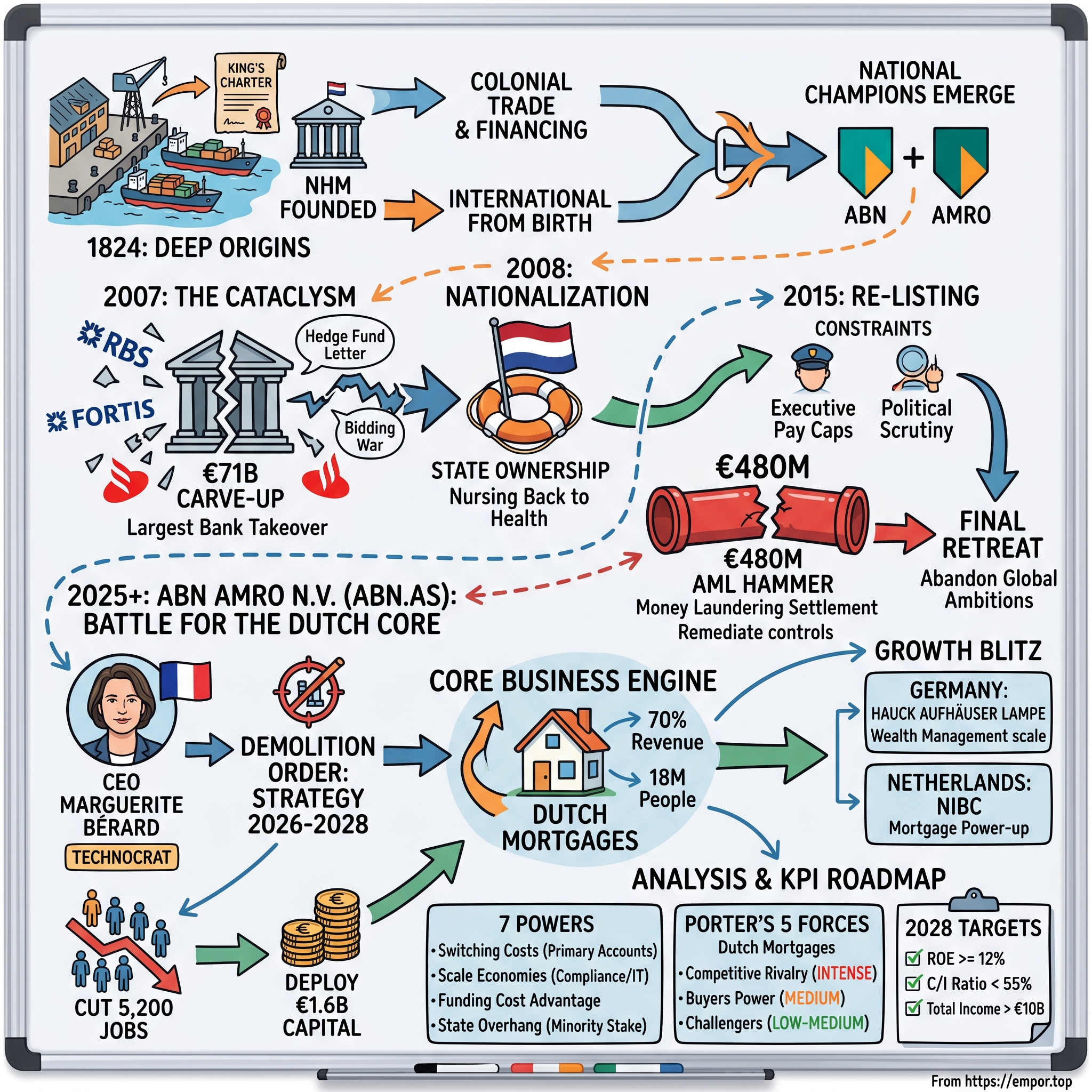
In the autumn of 2007, the boardrooms of European banking were consumed by a spectacle without precedent. A 183-year-old Dutch institution, one that had financed spice cargoes to the East Indies and syndicated loans on Wall Street, was being pulled apart limb by limb in a €71 billion feeding frenzy — the largest bank takeover in history.1 Three predators — Royal Bank of Scotland, Belgium's Fortis, and Spain's Santander — had banded together not to run ABN AMRO but to butcher it, each walking away with a different cut of the carcass. Within a year, two of the three hunters would themselves be lying in intensive care, kept alive only by emergency infusions of taxpayer money. The prize had turned out to be poison.
That is where most business stories about ABN AMRO end: a cautionary tale, a museum piece, a case study assigned to MBA students about the dangers of hubris. But the remarkable thing about ABN AMRO is that it did not die. The Dutch pieces were nationalized, stitched back together, nursed through a decade of state ownership, floated back onto the stock exchange, and then — just when the bank had finally settled into the quiet life of a domestic lender — hit with a €480 million criminal money-laundering settlement that forced it to abandon its last international ambitions entirely.[^2]
Fast-forward to today, July 2026. ABN AMRO (ABN.AS) is no longer an empire spanning seventy countries. It is a focused, mostly Dutch bank whose profit engine is a mortgage book concentrated in a country the size of Maryland. Yet the story has taken another sharp turn. In April 2025, the bank installed as its chief executive a French technocrat named Marguerite Bérard — a classmate of Emmanuel Macron at France's elite civil-service academy, and a veteran of BNP Paribas — and in November 2025 she unveiled a plan that reads less like a Dutch consensus document and more like a demolition order: cut 5,200 full-time jobs by 2028, roughly a quarter of internal staff, while deploying more than €1.6 billion of capital to swallow rivals in Germany and the Netherlands.23
Consider the strangeness of that sentence. Here is a bank whose central business is writing mortgages to Dutch families in a country of eighteen million people — one of the most competitive, lowest-margin, most transparently priced lending markets on earth — and whose chief executive has concluded that the path to a respectable return runs not through growth but through subtraction. This is not a growth story. It is a story about arithmetic: about whether a mature European bank in a low-growth economy can manufacture shareholder returns by shrinking its own cost base faster than competition and interest rates erode its revenue.
It is also, unavoidably, a story about the state. The Dutch government did not want to own a bank. It acquired one in an emergency, has spent more than a decade selling it back down in careful, pre-announced tranches, and remains — even now — a shareholder large enough to matter. That single fact colours everything: the pay the bank can offer, the capital it can return, the political scrutiny of every announced job cut. An investor evaluating ABN AMRO is not simply evaluating a business. They are evaluating a business in the final, awkward stage of being handed back to the private sector.
This is a story about what happens after the catastrophe. About whether a bank that was once the poster child for empire-building gone wrong can reinvent itself as a lean, disciplined, high-return machine — or whether the Dutch State, still clutching a stake through a foundation with an unpronounceable name, and the ghosts of past compliance failures, will keep it forever in purgatory.
The roadmap runs like this. First, the deep origins: a king, a collapsed trading empire, and the chartered company that became a bank. Then the century of consolidation that produced a "national champion" with a split personality it never reconciled. Then the cataclysm itself — the activist letter, the bidding war, the carve-up, and the crisis that killed the buyers. Then the long convalescence under state ownership, the 2015 re-listing, and the compliance failure that forced a final surrender of international ambition. Then the present: a French chief executive, a demolition plan, two acquisitions, and a set of 2028 targets specific enough to be proven wrong. And finally, the analysis — what actually protects this bank's profits, what could break the case, and the small handful of numbers that will tell you, quarter by quarter, which version of the story is coming true.
Let us begin where the money first flowed: the docks of Amsterdam.
 Subscribe on LinkedIn
II. Historical DNA: From the Spice Trade to the Modern Merger
To understand why ABN AMRO carries itself with the bearing of a national institution rather than a mere company, you have to go back to 1824 and to a king with a problem. The Dutch East India Company — the legendary VOC that had once been the most valuable corporation the world had ever seen — was long dead, bankrupt and dissolved. Dutch trade, the lifeblood of a small nation that had punched absurdly above its weight for two centuries, was withering. So King Willem I did what monarchs did when markets failed them: he chartered a company. The Nederlandsche Handel-Maatschappij, or NHM, was founded to revive the Dutch merchant trade, financing the flow of coffee, sugar, indigo, and spices between the Netherlands and its colonies, above all the Dutch East Indies.4
Two things about that founding matter for the modern story, and they are worth pausing on because they are not merely antiquarian colour.
The first is that ABN AMRO's ancestor was born as an instrument of state policy. It was not assembled by merchants pooling capital in a coffee house; it was created by royal decree to serve a national economic objective, with the king himself as its largest early backer. The idea that this institution is in some sense a public utility, answerable to the Dutch national interest rather than purely to shareholders, is not a modern accident of the 2008 bailout. It is written into the bank's genetic code. When Dutch politicians treat ABN AMRO as an instrument of policy — capping executive pay, scrutinizing lending decisions, weighing in on job cuts — they are behaving in a way the institution's founder would have found entirely natural.
The second is that the business was international from birth, and its internationalism was specifically about financing the movement of physical goods across long distances. Trade finance and commodity finance were not businesses ABN AMRO wandered into during the 1990s. They were the original business. That makes the eventual decision, two centuries later, to shut those operations down all the more striking: it was not the pruning of a peripheral limb but the amputation of the founding purpose.
The NHM began as a trading house, but the gravitational pull of finance is relentless. A firm that arranges the shipment of goods soon finds itself extending the credit that makes the shipment possible, then holding the deposits, then managing the payments, then discounting the bills of lading. Over decades, the NHM's financial arm quietly swelled until it dwarfed the trading business that had birthed it. By the twentieth century, the colonial merchant had become a bank in all but name — and when the Dutch colonial era ended after the Second World War, the trading rationale evaporated while the banking franchise remained.
The modern institution, though, is really the product of two great consolidations in the middle of the twentieth century. In 1964, the NHM merged with the Twentsche Bank to form Algemene Bank Nederland — ABN, "General Bank of the Netherlands." Almost simultaneously, two other pillars of Dutch finance, the Amsterdamsche Bank and the Rotterdamsche Bank, fused into AMRO Bank, a name assembled from the first syllables of the two cities. For a generation, ABN and AMRO circled each other as the two great rivals of Dutch banking — one with colonial and international roots, the other with a domestic commercial temperament.
Then came 1991, and the defensive merger that gave the modern bank its name. The looming integration of European markets terrified the mid-sized national champions of the continent: a Dutch bank of ordinary size might be swallowed by a German or French giant once the borders came down. Better, the thinking went, to combine into a single "national champion" large enough to survive. ABN and AMRO joined, and the new ABN AMRO emerged with a split personality that would haunt it for the next two decades. On one side sat the conservative, deposit-gathering retail machine rooted in the flat Dutch polders — the AMRO temperament. On the other stood a prestigious, globe-trotting wholesale and investment bank with outposts in New York, London, and across Asia — the ABN temperament, aristocratic and ambitious.
This matters more than an org-chart quirk. Two businesses were bolted into one balance sheet with fundamentally incompatible economics. Retail banking is a scale-and-patience business: you gather cheap deposits, lend them out at a modest spread, and grind out returns over decades with low volatility. Wholesale investment banking is a talent-and-risk business: returns are lumpy, the best people are mercenary and expensive, and the capital consumed per unit of profit is far higher. Housed together, the two divisions fight perpetually over the same scarce resources — capital, management attention, and the bank's risk appetite — and the honest answer to "what kind of bank are we?" becomes "both, badly."
There is a further, subtler problem. When a stable retail deposit base sits beneath a volatile trading operation, the retail side is effectively subsidizing the wholesale side's cost of funding. That looks like synergy in a good year. In a bad year it looks like a retail franchise being used as collateral for someone else's bets — which is precisely the structure that regulators across the world spent the decade after 2008 trying to unwind.
That cultural fault line — between the steady clerk who prized safety and the swashbuckling dealmaker who prized prestige — was not a footnote. It was the deep structural tension that would, a decade later, leave the bank strategically adrift, generating mediocre returns that no faction could agree how to fix. Neither side was strong enough to win outright, so the bank did what conflicted institutions do: it expanded in every direction at once, hoping scale would substitute for a decision.
And a bank that cannot agree on its own strategy, in the ruthless logic of capital markets, is a bank that invites others to decide its strategy for it. By the mid-2000s, the market had noticed.
III. The 2007 Cataclysm: Hubris, Hostility, and the €71B Carve-Up
Rijkman Groenink was a man who wanted his bank to matter on the world stage. Appointed chief executive in 2000, Groenink set a goal that sounded stirring in a boardroom and reckless in hindsight: ABN AMRO would become a top-five global bank measured by shareholder return. He went shopping. The bank scattered capital across acquisitions on multiple continents — most consequentially the 2007 stakes and holdings in the American Midwest, anchored by LaSalle Bank in Chicago. But the effect of all this deal-making was not focus; it was dispersion. ABN AMRO became a confederation of businesses spanning some seventy countries, none quite dominant, tied together by a share price that stubbornly refused to reward the ambition. By the mid-2000s, ABN AMRO's stock had lagged its European peers for years, and shareholders had grown from restless to mutinous.
It is worth being fair to Groenink, because his error was the standard error of his generation rather than an act of unique folly. The prevailing wisdom of European banking in the 2000s held that consolidation was destiny — that a wave of cross-border mergers would leave a handful of continental giants and that any bank not among them would be acquired. Under that logic, buying was not aggression; it was survival. Nearly every large European bank chief executive of the era operated on the same assumption, and several of them ended their careers the same way Groenink did.
The flaw was in the execution rather than the premise. ABN AMRO bought positions rather than franchises. It ended up with a strong bank in Brazil, a strong bank in the American Midwest, a solid Dutch retail operation, and a wholesale business that ranked nowhere in particular — a portfolio with no unifying logic beyond the fact that each piece had been available for purchase. There were no meaningful synergies between a Chicago commercial bank and an Amsterdam mortgage lender. There was only a holding company, and holding companies trade at discounts.
By 2006, the numbers told the story plainly. The bank's return on equity trailed the European leaders. Its cost-to-income ratio was persistently high. And its shares had gone essentially nowhere for years while peers advanced. Groenink himself had, earlier in his tenure, set an explicit target of ranking in the top five of a peer group by total shareholder return — a promise that had the unfortunate quality of being easy for shareholders to check. They checked. The bank was near the bottom.
Into that frustration stepped an activist with a sharp pen. In February 2007, Chris Hohn's hedge fund TCI — The Children's Investment Fund — wrote an open letter demanding that ABN AMRO break itself up, sell divisions, or merge, arguing bluntly that the sum of the bank's parts was worth far more than the sluggish whole.1 It was a classic sum-of-the-parts thesis, and in a bank with as many disconnected pieces as ABN AMRO, it was devastatingly plausible. The letter uncorked the pressure. Management, seeking a friendly way out, opened merger talks with Britain's Barclays — a genteel, all-share combination that would have preserved the institution largely intact.
But the plausibility of the break-up thesis had already summoned less genteel visitors. A consortium formed with a singular, almost surgical purpose: not to run ABN AMRO but to dismember it. Royal Bank of Scotland, led by the famously aggressive Fred Goodwin, wanted the crown jewels of the global wholesale and investment bank. Santander of Spain coveted the Latin American assets, above all Banco Real in Brazil. And Fortis, the Belgian-Dutch group with delusions of scale, craved the prize that mattered most to national pride — the Dutch retail and commercial bank, the heart of ABN AMRO's home franchise. Together they bid roughly €71 billion, mostly in cash, trumping Barclays and forcing the outcome.1
The bidding war that followed was conducted with a ferocity that, viewed from 2026, is almost hard to credit. Barclays and the consortium traded escalating offers through the spring and summer of 2007 while the first tremors of the American subprime crisis were already registering on the seismographs. Credit markets were beginning to seize. Two Bear Stearns hedge funds had collapsed in June. And still the bidding climbed, because the competitive logic of an auction is that nobody wants to be the one who blinked — and because the consortium had convinced itself, and its own shareholders, that the break-up arithmetic was too compelling to abandon.
There was a fascinating sub-plot that revealed how contested the whole affair was: ABN AMRO's management, plainly preferring the Barclays outcome, agreed to sell LaSalle Bank separately to Bank of America. Whether by design or effect, removing the American jewel made the consortium's prize less attractive and was widely read as a defensive manoeuvre. It went to the Dutch courts, where the Enterprise Chamber initially blocked the sale before the Supreme Court permitted it to proceed. The episode is a reminder that even at the peak of shareholder-primacy orthodoxy, Dutch corporate law gave management and employees real levers — levers that, in modified form, still shape how a chief executive can restructure this bank today.
In the end, cash won. The consortium's offer was overwhelmingly cash where Barclays' was largely shares, and in October 2007 shareholders took the money. And so the 183-year-old institution was carved into three, each buyer hauling away its chosen cut. It was the most audacious act of financial dissection ever attempted — and the timing could not have been worse.
Within months, the global financial crisis detonated. The consortium had paid a fortune, much of it in cash, precisely as the credit markets froze and asset values collapsed. RBS, having gorged on the riskiest slice at the top of the market, found its capital reserves catastrophically thin; it required one of the largest state bailouts in British history and effectively became a ward of the UK government. Fortis fared even worse. The Belgian-Dutch group had bitten off a chunk it could not digest, and as panic spread and depositors fled, Fortis simply buckled under the weight of what it had swallowed. In the frantic autumn of 2008, the Dutch State — under Finance Minister Wouter Bos — nationalized the Dutch operations of Fortis, including Fortis Bank Nederland and the Dutch parts of the former ABN AMRO.
The mechanics of the failure deserve a moment, because they explain something durable about why banks die. A bank does not usually fail because its loans go bad slowly. It fails because its funding disappears quickly. RBS and Fortis had both paid cash — real cash, raised through borrowings and share issues — leaving them with thinner capital buffers precisely when the wholesale funding markets that European banks depended on shut down. They had also, in the act of dismembering ABN AMRO, spent enormous management bandwidth on integration at the exact moment they needed all of it for crisis management. Overpay, overleverage, and distract yourself simultaneously, and the market does the rest.
Santander, notably, survived intact. It had bought a coherent business it understood — Latin American retail banking, its home turf — at a price it could digest, and it promptly sold pieces on. The one consortium member that behaved like a strategic buyer rather than a financial dismantler walked away fine. That contrast is the whole lesson of 2007 in a single comparison.
What the state now owned was a paradox: the pieces of a bank that had been destroyed by the act of buying it. Rather than let them rot, the government did something unusual. It merged the nationalized fragments back together — the Dutch ABN AMRO reunited with Fortis Bank Nederland — to reconstitute a new, state-owned ABN AMRO Bank N.V. The empire was gone. The global network was gone. What remained was a Dutch bank, owned by Dutch taxpayers, that would spend the next decade trying to remember how to be ordinary. For investors, the lesson was already written in blood: a break-up thesis can be arithmetically correct and still be a wealth-destroying catastrophe, because a bank is not a pile of separable parts but a living system of trust, liquidity, and funding that dies when you cut it apart.
IV. The Nationalized Era, Re-Listing, and the €480M AML Hammer
When the Dutch State handed the wreckage to Gerrit Zalm in 2009, it chose a steady hand deliberately. Zalm was a former finance minister, a man synonymous with fiscal prudence, and his mandate was not glory but repair. Under his stewardship, ABN AMRO became, by design, boring. It exited the volatile international markets that had nearly killed it. It simplified a tangled technology stack. It gathered Dutch deposits and wrote Dutch mortgages and prioritized capital safety over the intoxicating growth that had led its predecessors off a cliff. This was rehabilitation, and for a while it worked exactly as intended.
The integration itself was an extraordinary technical undertaking that rarely gets the attention it deserves. Merging two full-service banks means merging two core banking platforms, two sets of customer records, two payment infrastructures, two risk models, and two workforces with different cultures — while both banks continue to process millions of transactions a day without interruption. European competition authorities also required divestments to preserve competition in the Dutch commercial banking market, so parts of the combined entity had to be sold off even as the rest was being welded together. The engineering was largely successful. The strategic cost was that for the better part of five years, the bank's best people were focused inward, on plumbing, rather than outward, on customers and markets.
There is a second, less visible legacy of that period that matters enormously to the current story. A bank assembled from two predecessor institutions, each itself assembled from earlier mergers, ends up with an IT estate that is not a system but a sediment — layers of old platforms, each preserved because something critical still runs on it, connected by adapters nobody fully understands. When Bérard talks today about "phasing out legacy systems" and reducing the number of legal entities, she is excavating the archaeology of 1964, 1991, and 2010. That is why technology modernization at this bank is slow, expensive, and central to the cost story rather than incidental to it.
By 2015, the patient was deemed well enough to return to public life. In November of that year, ABN AMRO was floated back onto Euronext Amsterdam, with the state's holding vehicle NLFI selling an initial slice of around 23 percent to the market. The listing was greeted as a vindication — proof that a nationalized bank could be nursed back to health and returned to private hands at a respectable price. But it came with strings that would define the next decade. The state retained a controlling majority, and with it came a thicket of constraints: regulatory oversight, political scrutiny, and — most consequentially for talent — strict caps on executive pay that made it nearly impossible to compete for top-tier international banking leaders.
And beneath the reassuring narrative of the safe, simple retail bank, a rot was spreading in a place management had stopped watching. While leadership obsessed over cost cuts and capital ratios and returning money to the state, the bank had systematically underinvested in the unglamorous machinery of anti-money-laundering controls and customer due diligence — the "know your customer" plumbing that determines whether a bank is a gatekeeper or an unwitting laundromat. The controls had fallen years behind the volume and complexity of the accounts flowing through them. The back door had been left standing open.
It is worth explaining, in plain terms, what these controls actually are, because the phrase "anti-money-laundering failure" tends to slide past readers as bureaucratic noise. Under European law, a bank is not merely a service provider; it is a designated gatekeeper of the financial system. It has a legal duty to know who its customers are, to understand what they do, to form a view of what normal activity looks like for each of them, and to escalate transactions that do not fit. Practically, this means every account must have a file, every file must be current, and every deviation must be reviewed. Multiply that by millions of retail and business customers and you get an enormous, continuous, labour-intensive operation.
The temptation for management is obvious. Customer due diligence generates no revenue. It is pure cost, it scales with the customer base, and a bank that under-resources it will show better numbers for years before anything goes wrong. That is exactly what happened. Files went stale. Alerts went unreviewed. And because failure is invisible until a prosecutor makes it visible, the shortfall compounded quietly across the very years the bank was congratulating itself on cost discipline.
In April 2021, the Dutch Public Prosecution Service — the Openbaar Ministerie, OM — walked through it. ABN AMRO agreed to a €480 million settlement to resolve criminal findings that for years it had allowed accounts to be abused by clients laundering the proceeds of crime, including human trafficking and various frauds. The sum broke down into a €300 million fine and €180 million in disgorgement of gains the bank should never have earned.[^2] The prosecutors' language was withering: this was not a paperwork lapse but a serious, structural failure to perform the bank's most basic duty as a financial gatekeeper.
And the €480 million headline understated the true cost by a wide margin. The fine was a one-off; the remediation was not. Fixing years of accumulated deficiency meant hiring thousands of people to manually review and rebuild customer files — an operation that ran for years and consumed hundreds of millions of euros in ongoing expense. Part of the reason ABN AMRO's cost base looks bloated today, and part of the reason Bérard has so much to cut, is that the bank spent the first half of the 2020s staffing up an enormous manual remediation machine. An investor looking at the 5,200-role reduction should understand that some meaningful portion of it is the unwinding of a crisis response, not pure efficiency gain — which makes it more achievable than it first appears, and also less impressive.
The strategic consequence was even larger than the cash. Under Robert Swaak, chief executive from 2020, the settlement forced an unconditional surrender of ambition. The bank shut down the non-European operations of its Corporate & Institutional Banking arm, walking away from global trade finance and commodity finance — businesses that were profitable but sprawling, hard to monitor, and dense with exactly the cross-border risk that had produced the fine. ABN AMRO chose to shrink into something it could actually control: a pure-play Northwest European retail, commercial, and private bank. It was a humbling admission, and a clarifying one. The message to investors was that at this bank, compliance was no longer a cost line to be trimmed — it was the license to operate, and the price of neglecting it was the amputation of entire businesses. That hard-won focus is the platform on which the current chief executive now stands. She did not choose the retreat. She inherited it — and set out to make it pay.
V. The Marguerite Bérard Era: A Valedictorian's Restructuring Playbook
For a bank that had spent a decade cultivating a deliberately Dutch, deliberately unflashy identity, the choice of its next leader was a jolt. In January 2025, ABN AMRO announced its intention to install Marguerite Bérard as chief executive; she took the chair on 23 April 2025, becoming the first woman ever to lead one of the Netherlands' three big banks.5 She was also, pointedly, not Dutch.
Bérard's résumé reads like a map of the French establishment. She graduated from the École Nationale d'Administration — the ENA, the finishing school for the French elite whose alumni include presidents and prime ministers — alongside Sciences Po and a master's from Princeton.6 She began her career inside the French Ministry of Finance in 2004, advised the office of the President of the Republic on employment and social affairs, and served as chief of staff to a labour minister before crossing into banking. At BPCE she sat on the management board overseeing finance, strategy, legal, and compliance. Then at BNP Paribas, from 2019 to 2024, she ran French commercial and personal banking and sat on the group executive committee — a role in which she oversaw roughly 22,000 employees, a workforce almost identical in size to the one she now commands at ABN AMRO.6 She is, in other words, a technocrat and an operator, steeped in both the machinery of the French state and the profit-and-loss discipline of a global bank.
Two features of that background deserve emphasis because they bear directly on how she is likely to behave. First, she has run a large retail bank at scale before — not a division, but the entire French commercial and personal banking operation of one of Europe's biggest institutions, with a headcount essentially identical to ABN AMRO's. She is not learning the job. Second, her earlier remit at BPCE explicitly included compliance and legal alongside finance and strategy. For a bank whose defining wound of the last decade was a compliance failure, hiring a chief executive who has owned the compliance function is not an accident of the search process. It is a signal about what the supervisory board thought the institution needed.
There is also a less flattering reading available, and an honest analysis should hold it alongside the flattering one. Bérard departed BNP Paribas in 2024 after being passed over in that bank's own succession arrangements — a fact widely reported at the time of her appointment. Executives who arrive with something to prove tend to move fast and commit publicly to hard targets. That can be exactly what a sclerotic institution needs. It can also produce a plan whose ambition is calibrated to the chief executive's need for a legacy rather than to what the organization can absorb. Which of those is true at ABN AMRO will not be knowable for two or three more years, and the honest position today is that both remain live.
The significance of the appointment was cultural as much as operational. Dutch corporate life runs on the "poldermodel" — endless consultation, consensus, and a suspicion of top-down command. French banking hierarchy is, to put it gently, less consensual. Handing this consensus-bound institution to a sharp-elbowed graduate of the French administrative aristocracy was a bet that ABN AMRO needed a jolt of decisiveness more than it needed another round of harmony.
That bet came due on 25 November 2025, at Bérard's first Capital Markets Day, when she unveiled the Strategy 2026–2028. The diagnosis was unsentimental: ABN AMRO's cost base was bloated, its technology was clogged with legacy systems, and its returns were too thin for the capital shareholders had tied up in it. The remedy came in three parts — grow profitably, right-size the cost base, and allocate capital only where it earned its keep.2
The number that dominated the headlines was the human one. Bérard committed to reducing the workforce by 5,200 full-time-equivalent roles, net, by 2028 against a 2024 baseline — close to a quarter of internal staff.2 Roughly half of that would come through natural attrition, retirements and departures not backfilled; the remainder implied genuine, structural layoffs, achieved by simplifying the organization, collapsing legal entities, phasing out legacy IT, and — the modern lever every bank now reaches for — embedding artificial intelligence to automate middle- and back-office work. Management noted that over 1,000 FTEs had already come out in 2025.2
The growth half of the plan received far less attention than the cuts, but it is where the strategy is most vulnerable to scrutiny. Bérard committed to strengthening the Dutch retail position through digital innovation and investment in challenger propositions — including Tikkie, the peer-to-peer payment app that is genuinely beloved in the Netherlands to the point that "tikkie me" has entered the language as a verb — alongside expanding Wealth Management on the back of the German acquisition and growing Corporate Banking in specialized finance and energy-transition lending.2 The capital-allocation leg was the sharpest: reduce Corporate Bank risk-weighted assets by roughly €10 billion, exit unprofitable exposures, and redeploy the freed capital toward higher-returning uses.2
That last move is the one an analyst should watch most carefully, because it is the least reversible and the most revealing. Shrinking risk-weighted assets in a corporate bank is straightforward to announce and genuinely difficult to execute well. The easy version is to stop lending to your worst-returning clients, which improves ratios and costs you little. The hard version is that corporate relationships are bundled — the low-return loan is often the price of admission for the high-margin transaction banking, cash management, and advisory fees that sit alongside it. Cut the loan and you may lose the relationship. Whether ABN AMRO's €10 billion reduction lands as surgical pruning or as a quiet retreat from corporate banking altogether will show up in the fee line long before management describes it.
There is a genuine question, too, about whether a bank can simultaneously shrink its headcount by a quarter and grow its franchise. Management's answer is that technology substitutes for the removed labour and that the cuts fall on middle- and back-office functions rather than client-facing roles. That is the standard answer, and it is sometimes true. It is also the answer given by every restructuring that later discovered it had cut into muscle. The evidence that would distinguish the two cases is not in the strategy deck; it is in customer attrition, service complaint volumes, and whether mortgage and client-asset growth continue through the deepest phase of the cuts.
The financial targets attached to the plan were specific enough to be falsifiable, which is what makes them useful to an investor. By 2028, Bérard promised a return on equity of at least 12 percent, a cost-to-income ratio below 55 percent, total income above €10 billion, and a policy of distributing up to 100 percent of the capital generated over the plan period back to shareholders.2 The virtue of numbers this precise is that they leave nowhere to hide. The risk is equally clear: cutting a quarter of the workforce inside a consensus-driven culture, while integrating two acquisitions and modernizing core technology, is an extraordinary amount to attempt at once. The Works Councils — the Dutch employee bodies with real consultation rights — and the regulators will not simply wave it through. Bérard has operational credibility from two of Europe's largest banks, but credibility is a starting balance, not a guarantee. The plan will be judged not by the boldness of the slide deck but by whether the cost-to-income ratio actually holds below 55, quarter after quarter, once the easy attrition is spent. That is where the story moves from ambition to arithmetic.
VI. The Financial Engine: Segment Economics & the M&A Blitz
Strip away the history and the restructuring drama, and ABN AMRO is fundamentally a machine for turning Dutch deposits into Dutch mortgages. To see where the bank actually makes its money, follow the profit through its segments.
Before the segments, a word on the mechanism itself, because banking economics confuse otherwise sophisticated investors more than almost any other industry. A bank earns money in two fundamentally different ways. The first is net interest income: the gap between what it pays depositors and what it charges borrowers, multiplied across an enormous balance sheet. This is a spread business, it consumes capital, and — crucially — it is heavily influenced by central bank policy rather than by anything management does. When rates rose sharply from 2022, every deposit-funded bank in Europe earned windfall profits, because the rate paid on current accounts rose far more slowly than the rate earned on assets. That windfall was not skill. The second source is fee income: payments, advisory, asset management, clearing. Fees consume little capital, are far less rate-sensitive, and are consequently valued more highly by the market per euro earned.
Hold that distinction in mind, because it is the key to reading everything that follows. ABN AMRO's recent profits have leaned on the first source. Its strategy is a bet on growing the second while shrinking the cost of running both.
Where the money is made
The dominant engine is Personal & Business Banking, the retail and small-business arm. In 2024 it generated roughly €3.93 billion of operating income and around €1.17 billion of net profit — the single largest contributor, powered by a Dutch mortgage book north of €150 billion and a national market share of about 20 percent.7 This is the beating heart of the bank: sticky, deposit-funded, and comparatively low-risk. When people talk about ABN AMRO's "quality," this is what they mean.
Corporate Banking is the second pillar, contributing on the order of €3.36 billion of operating income and roughly €1.10 billion of net profit in 2024, though its earnings swing more violently because commercial lending carries the impairment risk that mortgages largely do not.7 Post-retreat, this is a deliberately de-risked, Northwest-European commercial lender rather than the globe-trotting wholesale bank of the Groenink era — and Bérard's plan explicitly targets shrinking its risk-weighted assets by around €10 billion to free capital for higher-returning uses.2
Wealth Management is the smallest of the three but strategically the most coveted. With roughly €1.57 billion of operating income and around €325 million of net profit in 2024, it generates the kind of sticky, capital-light fee income that investors prize precisely because it does not depend on interest rates or consume much balance sheet.7 It is also the segment Bérard is expanding most aggressively through acquisition.
Worth pausing on what makes the Dutch mortgage market so unusual, since it is the foundation of the whole enterprise. Dutch mortgages have historically been long-dated, with fixed-rate periods often running ten to twenty years or more — far longer than in Britain or the United States. A large share carries a government-backed guarantee scheme for smaller loans, and Dutch household credit losses have been remarkably low even through severe housing downturns, in part because the legal and social consequences of default are severe and personal liability persists. The result is one of the safest large consumer lending books in Europe: low loss rates, very long duration, extremely predictable cash flow.
The flip side is precisely what you would expect from a low-risk asset — thin margins and brutal competition, which we will come to. But the safety is real, and it is the single most underappreciated feature of ABN AMRO's balance sheet. The cost of risk in the first quarter of 2026 was just 9 basis points, with loan impairments of €67 million against a balance sheet of that size.10 That is a bank that is barely losing money on its lending.
The hidden jewel: ABN AMRO Clearing
Then there is the business almost no retail depositor has heard of but that quietly punches far above its weight. ABN AMRO Clearing — housed within the corporate bank — is one of the largest independent clearing houses in the world, the plumbing that stands between traders and exchanges to guarantee that trades settle. In 2025 it earned a net profit of about €298 million on operating income of €748 million, processing 6.54 billion transactions, up sharply from 5.39 billion the year before.8 What makes Clearing so valuable is its counter-cyclicality: it thrives on volatility. When markets convulse and trading volumes spike — the very moments that hurt a lending bank — Clearing's revenues surge. In the fourth quarter of 2025 and again in the first quarter of 2026, it was rising market volatility and Clearing fees that drove the fee-income line higher.910 It is a genuine hidden asset in the investment case, a high-margin infrastructure business bolted onto a mortgage bank.
To make the business concrete: when a professional trading firm buys a futures contract on an exchange, someone must guarantee that both sides actually deliver. That guarantor is the clearing member. It posts margin to the exchange, collects margin from the client, monitors positions in real time, and absorbs the risk if a client blows up. It is toll-booth economics — a small fee per transaction, multiplied by billions of transactions — with the important caveat that the toll booth is also taking real risk. A clearer that mismanages client risk in a violent market move can lose more in a day than it earns in years. The 2021 collapse of Archegos and the 2022 nickel-market chaos on the London Metal Exchange are reminders of what happens when a clearing or prime-brokerage relationship is mispriced.
So Clearing is not free money. But it has two properties that make it strategically valuable in this specific portfolio. First, it earns capital-light fee income of exactly the kind the market prizes. Second, and more importantly, its revenues rise when markets are chaotic — which is when a mortgage bank's world is getting worse. That negative correlation is genuinely rare, and it does more for the stability of ABN AMRO's earnings than its modest share of profits would suggest. The 21 percent jump in transactions processed during 2025 was, in essence, the market's turbulence being converted into the bank's revenue.8
The German wealth play: Hauck Aufhäuser Lampe
Bérard's predecessors had already teed up the wealth expansion, and in June 2025 — weeks into her tenure — the bank completed the acquisition of German private bank Hauck Aufhäuser Lampe (HAL) from a subsidiary of the Chinese conglomerate Fosun International, paying €672 million at closing.3 The logic was scale in the right market. Germany is Europe's largest pool of private wealth, and ABN AMRO already owned a respected but sub-scale private bank there, Bethmann Bank. Merging HAL into Bethmann created one of the largest private-banking players in Germany, with the combined entity managing roughly €70 billion in assets — HAL alone contributing around €26 billion.3 At a price near book value, it was a bet that a top-three position in German wealth management is worth far more than the two sub-scale halves were separately — the same "scale is everything in fee businesses" logic that runs through the whole Wealth strategy.
Two things should temper enthusiasm. The first is the seller. Fosun had bought Hauck & Aufhäuser during its acquisitive phase and was, by 2024, disposing of overseas assets to reduce debt — a motivated seller, which explains the reasonable price but also raises the question of how much investment the business had received under an owner heading for the exit. Note too that Fosun retained the Luxembourg fund administration arm, meaning ABN AMRO bought the private banking business rather than the whole enterprise.3
The second is that private banking integrations are notoriously leaky. The assets under management do not belong to the bank; they belong to clients who follow relationship managers. Merge two private banks and competitors immediately begin recruiting the bankers, who take their client books with them. The €70 billion figure is a starting balance, not an achievement. The honest test of whether this deal worked will be whether combined German client assets are still growing in 2027 and 2028 — not whether the two balance sheets added up correctly on day one.
The Dutch mortgage power-up: NIBC
If HAL was about wealth, the November 2025 deal was about doubling down on the mortgage core. ABN AMRO agreed to buy NIBC Bank from private-equity owner Blackstone for about €960 million, with completion expected in the second half of 2026.11 NIBC brought roughly 325,000 savings clients, 200,000 mortgage clients, and a portfolio of mortgages and commercial-real-estate assets across the Netherlands, Germany, and Belgium.11 The price equated to around 0.85 times NIBC's book value at closing and would cost roughly 70 basis points of CET1 capital.11 Management projected a return on invested capital of around 18 percent by 2029, arguing the synergies — funding NIBC's assets with ABN AMRO's cheaper deposit base and stripping out duplicated cost — carried "low execution risk."11 Notably, Blackstone appeared to exit close to the price it had paid on entry years earlier, which tells you something about how hard it has been for financial owners to mint outsized returns from mid-sized European banks — and should make an investor probe management's confident 18 percent projection rather than accept it.
The strategic logic, though, is more coherent than the HAL deal. The core insight is about funding. NIBC held assets — mortgages, commercial real estate loans — funded partly through wholesale markets and a savings franchise that, at NIBC's scale, had to pay up to attract deposits. ABN AMRO has one of the cheapest deposit bases in the Netherlands. Move NIBC's assets onto ABN AMRO's funding and the spread widens without a single new customer being acquired or a single loan being repriced. Layer on the elimination of a duplicate banking licence, a duplicate risk function, a duplicate compliance operation, and duplicate technology, and the synergy case writes itself. This is the most reliable kind of bank M&A: buying assets you can fund more cheaply and administer more efficiently than the seller could.
That said, an activist would push on three points. Buying at 0.85 times book means booking a gain on paper, but the discount exists for a reason and the acquirer inherits whatever caused it — in this case, a commercial real estate book at a moment when European CRE has been under sustained pressure. Second, the deal was announced on the very same day as the Capital Markets Day, alongside a plan to cut a quarter of the workforce; asking an organization to absorb its largest domestic acquisition in years while simultaneously dismantling a quarter of itself is a genuine bandwidth question, not a rhetorical one. Third, and most simply: a management team that promises capital discipline and then deploys over €1.6 billion on acquisitions within eighteen months invites the question of whether the buybacks shareholders were promised are being quietly substituted for empire-building. The counter-argument is that both deals are small, adjacent, and in the core competency — nothing like the LaSalle-era adventures. But the question is legitimate and the answer is not yet in the numbers.
The recent quarterly reality check
The numbers of the last two quarters capture the whole transformation in miniature. In the fourth quarter of 2025, net profit was €410 million, but the cost-to-income ratio spiked as the bank front-loaded restructuring charges tied to the 5,200-role plan — the pain of the plan showing up before the gain.9 Then, in the first quarter of 2026, the picture flipped. Net profit jumped 12 percent year-on-year to €693 million; net interest income rose 5 percent to €1,637 million; fee income surged 20 percent to €608 million on strong Clearing results; and the cost-to-income ratio fell to 55.9 percent from 61.0 percent a year earlier — within a whisker of the 2028 target, in the very first full quarter under the new plan.10 Return on equity reached 10.7 percent, the CET1 ratio strengthened to 15.5 percent, and management actually lowered its full-year 2026 cost guidance to around €5.5 billion.10
Three details in that print deserve more weight than the headline profit number. First, the 20 percent surge in fee income is the most strategically important line in the release, because it is the capital-light, rate-insensitive revenue the whole strategy is trying to grow — though the fact that it was driven by Clearing means it was partly a windfall from market volatility rather than a structural gain. Second, the headcount reduction of 528 FTEs in a single quarter, taking the bank roughly 40 percent of the way to its 2028 target, is running well ahead of a linear path.10 That is either impressive execution or evidence that the easy reductions were front-loaded and the difficult ones remain. Third — and this is the detail a seasoned bank analyst would flag first — management lowered its full-year cost guidance.10 Guidance cuts on costs are rare and meaningful. Anybody can promise savings at an investor day; reducing your own expense target one quarter later, in public, is a bank putting its credibility at risk on a specific number. It is the single most concrete evidence available that the plan is converting into results rather than rhetoric.
The counterweight is that net interest income grew only 5 percent while fee income grew 20 percent — a shape that flatters the quarter but confirms the underlying concern. The spread business, which is the majority of revenue, is close to flat. The growth came from a volatility-dependent fee business. If markets calm and rates fall in the same year, both drivers weaken at once.
One quarter is not a trend, and an investor should resist reading a single strong print as proof the plan works — the hardest, most contentious layoffs lie ahead, and the NIBC integration has not yet begun. But the direction is exactly what Bérard promised, delivered faster than the timetable implied. The question the rest of the story must answer is whether that momentum survives contact with falling interest rates, restive employees, and two simultaneous integrations.
VII. Moat Analysis: 7 Powers and Porter's 5 Forces
What, stripped of the narrative, actually protects ABN AMRO's profits? A bank's moat is rarely a single wall; it is a set of frictions and fixed costs that make it hard for customers to leave and hard for challengers to arrive. Run ABN AMRO through Hamilton Helmer's 7 Powers and Michael Porter's Five Forces, and a clear — if imperfect — picture emerges.
The powers that work
The most durable of ABN AMRO's advantages is switching costs. A primary current account is one of the stickiest relationships in consumer finance. Your salary lands there; your direct debits fire from it; your mortgage, your savings, and years of transaction history are entangled with it. Moving all of that to a competitor is a genuine hassle, and human beings avoid hassle. This is why, despite Europe's PSD2 open-banking rules — designed explicitly to make switching easier — and despite the marketing budgets of neobanks like bunq and Revolut, the big Dutch banks have kept their grip on primary relationships. Challengers win the second account, the "pocket-money" account, the travel card. They struggle to win the account that matters. Switching costs here are a high-power moat.
The second real advantage is scale economies, though of a distinctly modern kind. The largest fixed costs in banking today are not branches; they are compliance and technology. Building and running the anti-money-laundering, know-your-customer, and cyber-security machinery — the very machinery whose neglect cost ABN AMRO €480 million — now runs into the hundreds of millions of euros annually. A bank with a vast deposit base can spread that fixed cost across an enormous balance sheet; a small fintech cannot. The "big three" Dutch banks — ABN AMRO, Rabobank, and market leader ING — together control well over 85 percent of retail deposits, and that concentration lets them amortize the regulatory tax in a way smaller entrants simply cannot match. It is a medium-power moat, and, ironically, one that the ever-rising cost of compliance keeps strengthening. There is a genuine irony worth naming: the €480 million fine that humiliated ABN AMRO also raised the regulatory bar for everyone, and a higher bar advantages whoever can afford to clear it. The bank was punished by a force that, in the long run, protects it from smaller challengers.
The remaining Helmer powers are largely absent, and honesty requires saying so. Counter-positioning — the power that comes from a business model incumbents cannot copy without damaging themselves — belongs to the neobanks in this market, not to ABN AMRO. Branding exists in a mild form: the bank's name carries recognition and, post-nationalization, an implicit safety association, but nobody pays a premium interest rate for the privilege of banking with ABN AMRO. Cornered resources and process power are not meaningfully present. The Clearing franchise arguably has elements of both — long-standing exchange memberships, deep operational expertise, and relationships that take decades to build — but it is a modest share of group profit.
The one power the bank possesses that deserves more credit than it gets is a funding cost advantage, which is not on Helmer's list but functions like scale economies. A large, sticky, low-cost retail deposit base is the closest thing to a structural edge in commercial banking. It is the reason the NIBC deal makes sense, and it is why the deposit franchise, not the loan book, is the asset genuinely worth protecting.
The power that works against it
But ABN AMRO carries a peculiar negative power that most banks do not: the state overhang. The Dutch State, through NLFI, still held a meaningful minority stake — reduced to around 27.5 percent by the end of 2025, with a stated aim of falling toward roughly 20 percent — a legacy of the 2008 nationalization.12 This is a genuine double-edged sword. On one edge, implicit state backing reassures creditors. On the other, the state's steady, pre-announced selling creates a perpetual supply of shares hanging over the stock, and political ownership brings political strings — most damagingly the pay caps that have made it hard to recruit and retain top international talent, and the ever-present risk that Dutch political priorities override minority-shareholder interests. A moat that the owner keeps partially draining is not quite a moat; it is a managed liability.
The competitive battlefield
Porter's forces sharpen the picture in the segment that matters most — Dutch mortgages. Competitive rivalry is intense. ABN AMRO fights ING and Rabobank directly, but the Dutch mortgage market has a distinctive twist: banks also compete against domestic pension funds and insurers such as Aegon, who possess a lower cost of capital and are structurally happy to accept thin lending margins to match long-dated liabilities. That relentless competition is a permanent cap on how fat mortgage margins can get. The bargaining power of buyers is medium — Dutch consumers are financially literate and use comparison platforms to hunt the lowest mortgage rate, so pricing power on new loans is limited, even as those same customers remain loyal for everyday transaction banking. That pension-fund dynamic deserves elaboration because it is genuinely unusual and it structurally caps ABN AMRO's most important business. A Dutch pension fund holds enormous long-dated liabilities — promises to pay retirees decades from now. A twenty-year fixed-rate Dutch mortgage, with its very low default rate, is close to an ideal matching asset for those liabilities. The pension fund does not need to earn a banking return on it; it needs the duration and the safety. So it can rationally accept a spread that would be uneconomic for a bank required to hold regulatory capital against the same loan. In most countries, banks compete against other banks. In the Netherlands, banks compete against institutions with a structurally lower required return. That is a permanent headwind, and it is why the Dutch mortgage market can be both extraordinarily safe and persistently unprofitable at the margin.
The threat of new entrants is low-to-medium. Obtaining a European banking licence, building compliance infrastructure, and funding a mortgage book at competitive cost is a formidable barrier — but capital-light entrants that originate loans and sell them on, or that attack single product lines like savings or payments, need far less. Supplier power in banking translates mainly to the cost of deposits and of talent; on deposits ABN AMRO is advantaged by scale, on talent it is disadvantaged by state-imposed pay caps. And the threat of substitutes is low-to-medium: neobanks have peeled off secondary spending accounts but have not cracked the primary wealth, mortgage, and investment relationships that generate the real economics.
Set against peers, the picture is instructive. ING is larger, more international, and more diversified by geography — which means less exposure to a single national housing market but more exposure to emerging-market and cross-border risk. Rabobank is a cooperative, not a listed company, and therefore competes without the same shareholder return pressure, which makes it a structurally awkward competitor: it can accept lower returns indefinitely. ABN AMRO sits between them — listed and therefore accountable to shareholders, but domestically concentrated and therefore without ING's diversification. That positioning is the reason cost efficiency is not one lever among several for this bank. It is very nearly the only lever it has.
The honest synthesis for an investor is this: ABN AMRO's moat is real but not wide. Its switching costs and compliance-scale advantages protect the base; its exposure to margin-crushing rivals and a share-selling state owner cap the upside. This is a defensible franchise, not a fortress — which is precisely why management's ability to grind out cost efficiency, rather than any pricing power, is the crux of the whole case.
VIII. Playbook: Durable Business & Investing Lessons
Step back from ABN AMRO's particular drama, and its history offers a set of lessons that generalize far beyond one Dutch bank — the kind of durable principles that make the story worth studying.
The sum-of-the-parts trap. The 2007 carve-up remains the definitive warning against the seductive logic that a complex financial institution is worth more in pieces than whole. On a spreadsheet, TCI's arithmetic looked airtight. In reality, a bank is an integrated system — shared treasury, shared funding, shared liquidity, shared trust — and dismembering it destroys the very interdependencies that make the parts valuable. The buyers who believed the arithmetic (RBS and Fortis) were destroyed by acting on it. The lesson is not that break-ups never create value; it is that in businesses built on confidence and liquidity, the act of separation can annihilate more value than the separation unlocks.
Compliance is a license, not a cost center. The €480 million settlement crystallizes a shift that every regulated financial firm now lives with. For decades, anti-money-laundering and customer due diligence were treated as overhead to be minimized. ABN AMRO learned, expensively, that systemic underinvestment in the gatekeeper function does not merely risk a fine — it can force the surrender of entire profitable businesses, as the exit from global trade and commodity finance proved. In modern banking, the compliance budget is the price of admission, and the temptation to trim it is a value trap that pays out years later, all at once.
The power of the focused retreat. There is a quiet heresy in ABN AMRO's recent history: sometimes the best strategic move is to get smaller. By abandoning the fantasy of being a global investment bank and retreating to the "boring" business of Dutch mortgages and European private wealth, the bank traded prestige for predictability — and predictable, well-capitalized cash flows are exactly what long-term owners of a bank should want. Retreat is not always defeat; done deliberately, it can be the construction of a safer, more valuable machine.
The state is a shareholder with a different objective function. A decade and a half of Dutch government ownership produced a bank that is safe, well-capitalized, and conservatively run — genuine benefits that a purely private owner might not have insisted upon. It also produced pay caps that hollowed out senior talent recruitment, a permanent share overhang, and a strategy partly shaped by political rather than commercial considerations. The generalizable lesson is that when governments rescue companies, the rescue is never free and the bill is paid in strategic flexibility over many years. Investors in any bailed-out enterprise should model the exit path of the state as a first-order variable, not a footnote.
Beware the sub-scale position in a fee business. ABN AMRO's German private bank was respectable and unprofitable-in-spirit for years before the HAL deal — good enough to keep, too small to matter. Fee businesses in wealth and asset management have punishing fixed costs in technology, compliance, and product infrastructure, and returns are step-functions of scale rather than smooth curves. A sub-scale wealth manager is not a small good business; it is often a bad business that looks small. The choice is generally to buy scale or exit, and hovering in between destroys value quietly for years.
Squeezing the cost lemon. Bérard's entire plan rests on an unglamorous truth about mature European banking. In a low-growth economy where net interest income eventually plateaus and regulators cap risk-taking, the most reliable lever for expanding returns is not revenue heroics but relentless cost control. If you cannot grow the top line quickly, you must automate, simplify, and reduce headcount to widen the gap between income and expense. It is a lever with real limits — you can only cut so far before you damage the franchise — but in the current environment it is the lever that management can actually pull. Whether ABN AMRO can pull it hard enough, without breaking something, is the question the market is now pricing. And that question has two answers, depending on which investor you ask.
IX. Analysis & Bear vs. Bull Case
Put ABN AMRO in front of a skeptical long/short investor and the interrogation begins with the source of its recent prosperity — because a franchise that looks strong at the top of a rate cycle can look very different at the bottom.
The stress test
The NII plateau. ABN AMRO's earnings have been supercharged by the era of higher interest rates. Net interest income of €1,637 million in the first quarter of 2026 is the core of the profit engine, and much of it is a gift from the European Central Bank's rate cycle rather than a product of the bank's own genius.10 If the ECB cuts rates rapidly, deposit margins compress, and the bank must find the offsetting profit somewhere else. Can cost cuts alone fill a hole left by falling rates? That is the single most important uncertainty in the entire case.
Execution risk. Cutting 5,200 net roles inside a consensus-driven Dutch culture, mediated by Works Councils with real consultation power, is not a spreadsheet exercise. Push too hard and you risk labor unrest, service breakdowns, and the departure of the very people you needed to keep. Push too softly and the cost-to-income target slips out of reach. Bérard is threading a needle, and the market has seen restructuring plans of this ambition unravel before.
Integration risk. Digesting HAL in Germany and NIBC in the Netherlands simultaneously — a combined capital deployment north of €1.6 billion — is two large corporate meals eaten at once. The promised synergies, including that confident 18 percent return on NIBC by 2029, are projections, not results. Any slippage flows straight through to the return on equity that the whole equity story depends on.
Concentration risk. An activist would put this bluntly: this is a bank whose largest asset class is residential mortgages in a single small country whose housing market has risen for most of two decades and where affordability is stretched. The credit performance has been superb, but superb credit performance in a rising market is not evidence of underwriting quality — it is evidence of a rising market. The Dutch mortgage book's safety is real and structural, but its behaviour in a genuine, sustained house-price decline with rising unemployment has not been tested since the early 2010s, and the book is far larger now.
Technology and AI, cutting both ways. Management's cost plan explicitly leans on embedding AI to automate middle- and back-office work.2 This is the fashionable assumption of every bank in Europe in 2026, and it is unproven at the scale being promised. If AI-driven automation delivers less than assumed, the cost target is at risk. But the more interesting question runs the other direction: if AI genuinely collapses the cost of banking operations, it does so for challengers too — and a chunk of the compliance-scale moat described earlier erodes with it. A technology that lets ABN AMRO run its back office with a quarter fewer people also lets a well-funded entrant run one without ever hiring them.
Disclosure and complexity. To management's credit, the 2028 targets are unusually specific and therefore checkable — a genuinely investor-friendly choice, since vague targets are the standard refuge. The area deserving more scrutiny is the treatment of restructuring charges. When a bank front-loads costs, as ABN AMRO did in the fourth quarter of 2025, the subsequent quarters flatter by comparison, and the temptation to classify recurring expenses as one-off "incidentals" is a well-worn path. Watching whether the cost base actually converges toward the €5.5 billion guidance on a reported basis, rather than only on an adjusted one, is the discipline an investor should apply.
The bull case
The optimist's version is straightforward and, on the evidence of early 2026, not fanciful. Bérard executes the cuts, the cost-to-income ratio settles durably below 55 percent, and return on equity climbs into the low-teens — comfortably above the 12 percent floor. As NLFI completes its exit and the state's pay caps and share overhang finally lift, ABN AMRO is freed to hire top talent and to return capital aggressively; the "up to 100 percent distribution" policy becomes a genuine capital-return machine.2 The NIBC mortgage integration hits its 18 percent target, and the enlarged Bethmann-HAL emerges as a premier, high-margin German wealth manager. In this world, the counter-cyclical Clearing business cushions any market turbulence, and a focused, well-run bank re-rates toward the returns its balance sheet quality deserves.
The bear case
The pessimist's version is equally coherent. The ECB cuts faster than expected, net interest income falls, and cost savings — real as they are — cannot fully offset the revenue decline, leaving returns stuck below target. A fresh compliance failure, always possible in a bank still remediating years of underinvestment, brings another fine and another round of expensive manual file remediation, draining profit and management attention. And the wildcard that never fully disappears: political overlordship. As long as the Dutch State holds shares, there is a nonzero risk that Amsterdam blocks buybacks, leans on lending policy, or otherwise prioritizes a political agenda over minority-shareholder value.
Weighing management's credibility
The most useful discipline for an investor here is to judge Bérard's regime by behaviour rather than by promises, since she has now been in the chair long enough to have generated a short but real track record. Three observations stand out.
She set targets that are specific and dated rather than directional — an ROE floor, a cost-to-income ceiling, an income threshold, an FTE number, all attached to 2028.2 Management teams intending to underdeliver do not usually volunteer this much precision. She then lowered her own full-year cost guidance one quarter after setting it, which is the opposite of the sandbag-then-beat pattern that erodes trust over time.10 And the strategic narrative has been internally consistent: the Capital Markets Day framed the story as growth, cost, and capital allocation, and the first quarterly report was organized around the same three pillars with progress reported against each. Consistency of framing across an investor day and subsequent results is a small thing, but its absence is one of the more reliable early warnings of a strategy in trouble.
The open questions are equally clear. She has not yet had to explain a miss, which is when management character actually becomes visible. She has not yet navigated the confrontation with the Works Councils over the genuinely involuntary phase of the job cuts. And she committed over €1.6 billion to acquisitions in her first year while promising capital discipline — defensible given both targets are small and adjacent, but a pattern worth watching rather than dismissing. The verdict available today is provisional: early behaviour is consistent with a credible operator, and the sample is too short to be conclusive.
The framework synthesis — Porter and Helmer together — lands on a measured verdict. ABN AMRO's switching-cost moat and compliance-scale advantages give it a defensible, cash-generative core. But it lacks pricing power in its central mortgage market, its returns are levered to a rate cycle it does not control, and its largest shareholder is a government slowly heading for the exit. The bull case is a story about execution and self-help; the bear case is a story about forces beyond management's control. Both can be true at once, which is why the two or three numbers that separate them deserve to be watched more closely than any press release.
X. Epilogue & Key KPIs to Track
The market delivered its early verdict on Bérard's restructuring in the spring of 2026. When ABN AMRO posted that €693 million first-quarter profit and a cost-to-income ratio already brushing the 2028 target, the shares responded favorably — institutional investors read the print as evidence that the plan was not merely a slide deck but was actually converting into results, and faster than promised.10 Yet the applause was not universal. The Works Councils and much of the workforce remain hostile to a plan that, however elegant on paper, means thousands of colleagues losing their jobs. That tension — between the investor who cheers the falling cost line and the employee who is the cost being cut — is the unresolved human drama at the center of this chapter, and it will not be settled in a single quarter.
For an investor who wants to follow this story without drowning in detail, the entire thesis compresses into a small number of things worth watching:
1. Net interest income and net interest margin. This is the core profit engine and the variable most exposed to forces management cannot control. The question to keep asking: as the ECB moves rates, can ABN AMRO sustain net interest income around the €1.6 billion-per-quarter level, or does the plateau turn into a decline that cost cuts cannot offset?
2. The cost-to-income ratio. This is the single cleanest scoreboard for the restructuring. Management targets below 55 percent by 2028; the first quarter of 2026 already printed 55.9 percent.10 The test is durability — whether the ratio holds and improves through the hard, contentious phase of layoffs still ahead, or drifts back up once the easy attrition is exhausted.
3. Return on equity. The ultimate measure of whether all of this creates value for the owners of the bank. The target is at least 12 percent by 2028; the first quarter of 2026 delivered 10.7 percent.10 Sustained ROE above the target, coupled with the promised capital returns, would validate the whole transformation. Persistent shortfall would tell you the machine cannot generate the returns its ambitions require.
The arc is almost novelistic. A colonial trading company chartered by a king to revive a shrinking empire. A national champion assembled in fear of European integration. A global would-be giant carved into three at the top of a bubble, its buyers destroyed by the meal. A nationalized convalescent, nursed back to a deliberate dullness. A €480 million reminder that the boring work of the gatekeeper is the only work that keeps a bank alive. And now a lean, focused, mortgage-and-wealth machine, handed to a French technocrat with a demolition plan and a stopwatch. Whether Marguerite Bérard's arithmetic proves as sharp as her résumé is the open question — and the numbers above are how the market will keep score.
References
-
The carving up of ABN AMRO: how the world's biggest bank takeover went wrong — Financial Times, 2007-10-08 ↩↩↩
-
ABN AMRO presents roadmap for profitable growth and new financial targets for 2028 — ABN AMRO / GlobeNewswire, 2025-11-25 ↩↩↩↩↩↩↩↩↩↩↩
-
ABN AMRO completes acquisition of Hauck Aufhäuser Lampe in Germany — ABN AMRO, 2025-07-01 ↩↩↩↩
-
ABN AMRO — Integrated Annual Report 2024 (company history and origins) — ABN AMRO, 2025-03-11 ↩
-
ABN AMRO Bank intends to propose Marguerite Bérard as new CEO — ABN AMRO, 2025-01-10 ↩
-
ABN AMRO Bank N.V. Integrated Annual Report 2024 (segment results) — ABN AMRO, 2025-03-11 ↩↩↩
-
ABN AMRO Clearing Bank published its 2025 Annual Report — ABN AMRO, 2026 ↩↩
-
ABN AMRO posts net profit of EUR 410 million in Q4 2025 — ABN AMRO / Euronext, 2026-02-11 ↩↩
-
ABN AMRO posts net profit of € 693 million in Q1 2026 — ABN AMRO / GlobeNewswire, 2026-05-13 ↩↩↩↩↩↩↩↩↩↩↩
-
Dutch state to cut ABN Amro stake to around 20% — DutchNews.nl / NLFI, 2025-09-09 ↩
 LinkedIn
 WhatsApp
 Reddit
 Hacker News
 Email
Email Kindle
 RSS Feed
 Spotify
 Apple Podcasts
 Amazon Music
 Audible
 YouTube