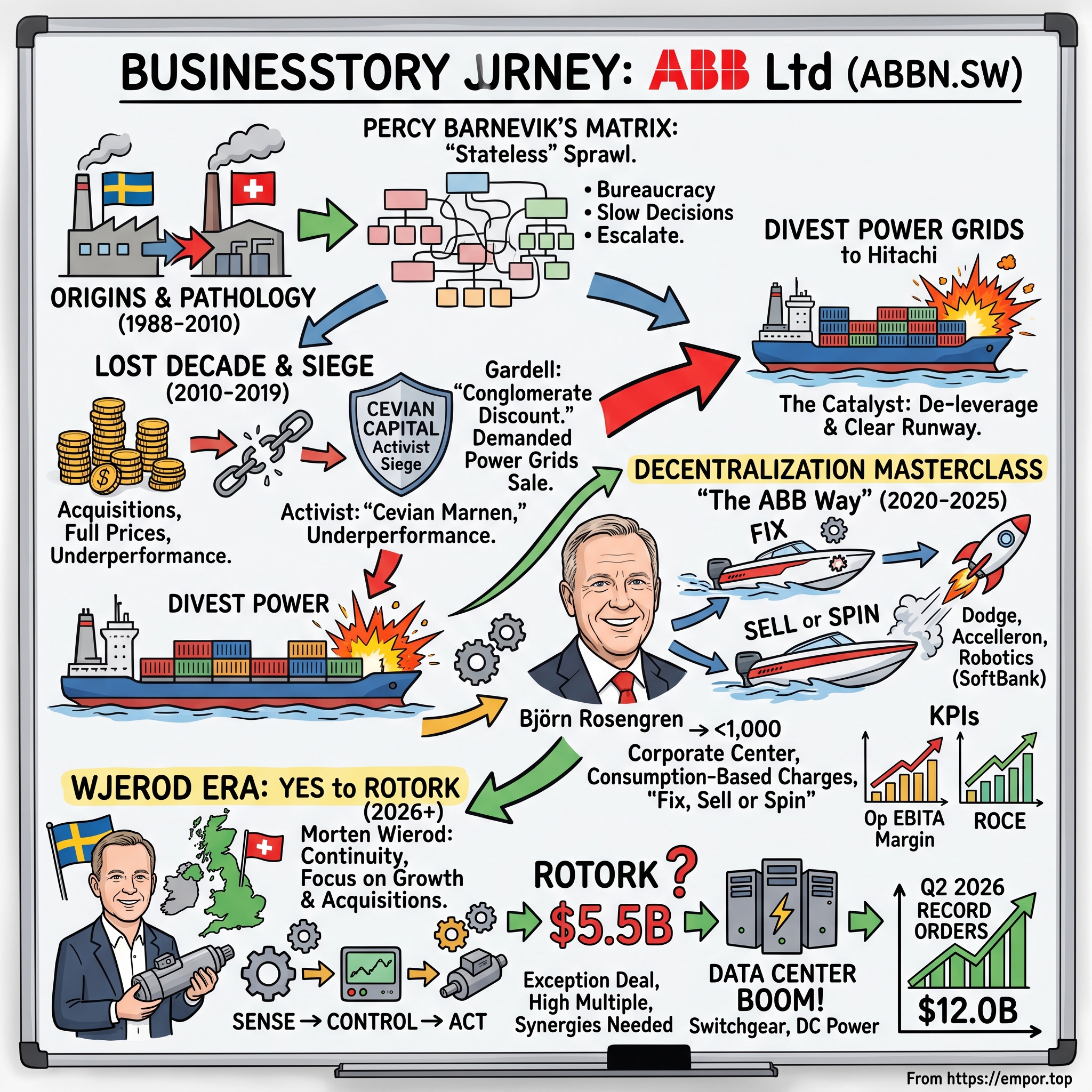
ABB Ltd: The Decentralization Masterclass
I. Introduction & Episode Roadmap
On the morning of July 16, 2026, ABB's head of investor relations, Ann-Sofie Nordh, opened the second-quarter call with the same unhurried Nordic calm the company has cultivated for half a decade. Then chief executive Morten Wierod did something that would have been unthinkable at the ABB of a few years earlier: he led not with the numbers, but with a shopping list. Three acquisitions in one breath — an Italian medium-voltage transformer specialist called Specialtrasfo, a Norwegian marine-automation house named Høglund, and, the headline, a GBP 5.03-per-share cash offer for the British valve-actuator champion Rotork worth roughly $5.5 billion.3[^32] Only after the deal-making did he arrive at the quarter itself, and the quarter was a record: orders of $12.0 billion, the first time the group had ever booked more than $12 billion in ninety days, up 28% on a comparable basis; revenues of $9.5 billion; and an Operational EBITA margin of 20.2%.3
Rewind to 2019 and none of this computes. Back then ABB was the industrial world's favorite disappointment — a sprawling, matrixed European conglomerate whose Operational EBITA margin sat around 11.5%, whose Zurich head office was a byword for bureaucracy, and whose shares had gone nowhere for years while activists circled and analysts openly asked whether the company should exist in its current form at all. The company that reported those 2026 numbers is a different animal. For the full year 2025, ABB generated revenues of $33.2 billion and a record Operational EBITA margin of 19.0%, up from 18.2% a year earlier, alongside a return on capital employed of 25.3% and free cash flow of $4.6 billion.1 The stock, which spent the mid-2010s as dead money, changed hands around CHF 80 in mid-2026, giving ABB a market capitalization near CHF 147 billion — having roughly climbed off a 52-week low of CHF 51.[^33]
Here is the thesis this story will test rather than assume. ABB's transformation is not, at heart, a tale of cost-cutting, nor is it simply a lucky ride on an electrification boom — though it is partly both. It is the most complete modern case study in dismantling a centralized corporate matrix and replacing it with radical decentralization: an operating system its managers call, without irony, "The ABB Way." The interesting question for an investor is not whether the numbers improved — they plainly did — but why, and whether the mechanism is durable. Reorganizations are the most over-claimed source of value creation in corporate life. Every large company that reorganizes and then prospers attributes the prosperity to the reorganization. Disentangling structural improvement from a favorable cycle is the analytical work this story has to do, because the market is now pricing ABB as though the answer is settled.
There is a second, subtler tension running underneath. A decentralized operating model is, by construction, a machine for saying no — no to empire-building, no to cross-subsidy, no to holding assets that earn less than their cost of capital. ABB spent five years proving it could say no, selling businesses it had spent billions assembling. In 2026 it is saying a very large yes. The Rotork offer is roughly an order of magnitude bigger than the bolt-on deals that characterized the recovery years, and it lands in the same twelve months as a $5.375 billion sale of the entire Robotics division to SoftBank.328 Whether the discipline that produced the turnaround survives the confidence the turnaround created is the live question of this era, and it is unresolved.
The roadmap. First, the merger and the near-death: how two nineteenth-century pioneers — Sweden's ASEA and Switzerland's Brown, Boveri & Cie — fused into a giant that nearly went bankrupt in the early 2000s under debt and a hidden mountain of asbestos claims. Second, the lost decade and the activist siege, in which Christer Gardell's Cevian Capital spent years arguing that ABB was a conglomerate-discount victim that should sell its capital-hungry Power Grids division. Third, the divestment and the "fix, sell, or spin" doctrine that followed. Fourth, the turnaround blueprint itself, built by a Swedish outsider named Björn Rosengren, who broke the company into twenty-odd self-governing divisions and let unit economics do the talking. Fifth, a deep look at the segment economics and what actually protects each business's profits. And finally, the analytical spine — the bull case, the bear case, the frameworks, and the handful of numbers that will tell an owner whether the thesis is intact. We start where the money is today: with the man now running the machine.
 Subscribe on LinkedIn
II. Succession & The Wierod Era: Current Management & Governance
The most revealing thing about ABB's August 1, 2024 CEO handover is what did not happen.[^28] There was no strategy reset, no "new chapter" slide deck, no freshly commissioned operating model from a consultancy. Björn Rosengren, the architect of the turnaround, walked out; Morten Wierod, a twenty-six-year ABB lifer who had joined in 1998 and gone on to run the Motion business and then the crown-jewel Electrification business area, walked in — and the operating system stayed exactly where it was. That continuity is the point, and it is rarer than it sounds. In most large-cap successions the incoming chief is implicitly expected to differentiate, because differentiation is how a new CEO justifies the job. At ABB the incoming chief was chosen precisely because he would not. His mandate was to shift emphasis from the margin repair Rosengren had wrung out of the portfolio toward organic growth and acquisitions, without touching the decentralized machine underneath.
Wierod is a Norwegian electrical engineer by training, and he presents like one — plainspoken, allergic to abstraction, quick to reach for a mechanical explanation where a chief executive might reach for a strategic one. Asked on the July 2026 call to justify the industrial logic of buying Rotork, he did not talk about synergy capture or platform adjacency. He described what he calls the "Sense, Control, Act" loop: sensors read a pressure or a temperature, controllers decide what should happen, and actuators physically move a valve to make it happen. ABB, he noted, had historically been strong at the sensing and the controlling and comparatively weak at the acting, and Rotork is one of the world's leading makers of the thing that acts.[^32] It is the kind of answer that tells you the man came up through the products rather than the boardroom, and it is worth noting that he gave it before he gave the price.
The incentive architecture
Governance at ABB is now built to keep management honest in ways that matter to outside owners, and the details reward a close read. The CEO's annual incentive is split across Group Operational EBITA margin (30%), revenues (30%), free-cash-flow conversion to net income (20%), return on capital employed (10%), and sustainability measures (10%).32 What makes this hard to game is that these are the identical metrics ABB reports publicly every quarter — there is no bespoke internal scorecard running alongside the external one, which is a common place for misalignment to hide.
The long-term plan is where alignment sharpens further. Performance shares vest over three years against average earnings-per-share growth (weighted 50%), relative total shareholder return against a peer group (30%), and Scope 1 and 2 carbon reduction (20%), with each component capped at 200% of the conditional grant.2 The TSR peer set is the industrial heavyweight class — Siemens, Schneider Electric, Legrand, Rockwell Automation, Eaton, and Emerson Electric among a wider group — which means a rising tide lifting all industrial boats does not, by itself, pay out.32 Most importantly, the CEO must build and hold ABB shares worth 500% of base salary, one of the more demanding ownership thresholds in European industrials, tying Wierod's personal balance sheet directly to the stock rather than to a bonus pool.32
One change deserves flagging rather than burying. From 2026 the long-term plan drops the sustainability component entirely, reweighting to EPS (60%) and relative TSR (40%), while the CEO's grant rises from 150% to 200% of base salary.32 Read charitably, that is a sharpening of focus onto the financial outcomes shareholders actually receive. Read skeptically, it is a quiet retreat from carbon accountability at a company whose entire external narrative rests on enabling the energy transition — and it arrives without much fanfare. Both readings are defensible; the point is that it happened, and that investors who bought ABB partly as an ESG-aligned industrial should know the pay structure no longer reflects that.
Behavior over time
On capital allocation, the behavioral record is genuinely strong, and it is worth being specific about why rather than asserting it. ABB ended 2025 with net debt of just $1.7 billion against more than $6 billion of Operational EBITA — roughly 0.3x net debt to EBITDA.12 It is worth correcting a common belief here: ABB does not actually publish a leverage ceiling of around 1.0x or any other number. It commits only to maintaining a strong investment-grade rating, which in practice has left the balance sheet conservatively financed and, arguably, under-levered for a business with this much recurring service revenue.33 Within that frame the priorities are explicit and, importantly, ranked: fund organic growth first through R&D and capacity, then a rising sustainable dividend, then acquisitions sufficient to add 1–2% of growth, and only then buybacks — whose size, management concedes, depends on what is left after deals.2 In 2025 that meant $1.3 billion of R&D (4.0% of revenue), capital expenditure up 25% to $1.0 billion, $1.3 billion of stock repurchased, and a dividend raised to CHF 0.94 per share from CHF 0.90.12 A company that tells you buybacks are the residual, and then actually treats them as the residual, is behaving consistently.
Guidance discipline has tightened measurably, and the best evidence is how management handles bad news. Compare the eras. The mid-2010s ABB was known for sweeping strategic narratives and targets that slipped quietly. The current version itemizes its own disappointments with something close to bluntness. In the second quarter of 2026, the Motion business area's margin fell 130 basis points, and rather than pointing at the macro environment, the finance chief named three specific causes: a recently acquired Spanish business, Gamesa Electric, running at a loss and diluting the margin by roughly 70 basis points; unresolved operational inefficiencies in the newly formed High Power division; and production-timing effects in the traction (rail) business — then volunteered that the problem would "partially linger throughout the year."[^32] Management also disclosed that a 70-basis-point chunk of Automation's margin improvement that quarter came from a one-time provision release on a project settlement, a helpful detail that a less scrupulous team would have let analysts discover for themselves.[^32] Volunteering the quality of your own earnings beat is a meaningful credibility signal.
A second-layer note that has gone underdiscussed: ABB changed chief financial officers between these calls. Timo Ihamuotila presented the third-quarter 2025 results; Christian Nilsson presented the second quarter of 2026.[^32] A CFO transition at a company mid-way through its largest acquisition in over a decade is a genuine execution risk worth monitoring, even when the handover looks orderly.
Which brings us to the seam a skeptical investor should press hardest. For years the story was disciplined bolt-on M&A — small to mid-size deals on a continuous basis, with larger ones explicitly framed as exceptions that would come "on top of" the normal flow.33 The Rotork offer is that exception arriving in force, struck at an enterprise value near 19.5x EBITDA before synergies, or the mid-teens after.3 On the call, an analyst from Octavian did the arithmetic out loud and suggested the implied return on the $5.5 billion invested looked like something in the 5–10% range, and that ABB would effectively need to double Rotork's operating profit to justify it. The CFO pushed back, disputing that the EBIT would need to double and pointing to a high-performing business accretive to EPS in year two, but conspicuously did not offer a competing return calculation.[^32] That exchange is the honest state of play: management's defense is credible but not yet demonstrated, and the surest way to unwind a decade of capital discipline is one large acquisition made near a cyclical high. To understand why ABB earned the right to even attempt a deal this size, you have to go back to how close the company once came to not existing at all.
III. Succinct Origins: From ASEA and BBC to Percy Barnevik's Matrix
The deep history can be told quickly, because what matters for a present-day investor is not the roll of nineteenth-century honors but the specific organizational pathology it produced — a pathology whose cure is the entire modern investment case.
ABB traces its Swedish root to 1883, when Ludvig Fredholm founded Elektriska Aktiebolaget in Stockholm to manufacture electrical lighting and generators. The name ASEA — Allmänna Svenska Elektriska Aktiebolaget — arrived in 1890, through a merger with a rival Swedish electrical firm.4 ASEA grew into a national champion in the most literal sense, the industrial spine of Swedish electrification: a pioneer of high-voltage direct-current transmission, a builder of locomotives and traction systems, and, in the 1970s, one of the earliest manufacturers of industrial robots — a business ABB would still own, and finally sell, half a century later. The Swiss root ran through the town of Baden, where in 1891 Charles Brown and Walter Boveri established Brown, Boveri & Cie, masters of turbines, generators, and alternating-current distribution.4 For a century the two firms were cross-border rivals and occasional collaborators in the same slow, capital-heavy, engineering-proud business of generating and moving electricity.
In 1988 they merged, and the merger had a face: Percy Barnevik, ASEA's chief executive, who became boss of the combined Asea Brown Boveri, headquartered in Zurich, with roughly $17 billion of revenue and 160,000 employees.45 Barnevik became a management celebrity of the era — arguably the European management celebrity — lionized in the business press for building what was admiringly called a "stateless" corporation. The vehicle for that admiration was his matrix. Every manager answered simultaneously along two axes: to a country organization and to a global product line. A drives manager in Finland reported both to the head of ABB Finland and to the global head of drives.
On a slide, the matrix looked like the resolution of capitalism's oldest organizational tension — local responsiveness and global scale, at the same time, without trade-off. In practice it did something closer to the opposite. When two bosses share authority over one manager, nobody truly owns a decision, and every genuine disagreement escalates. Escalation requires arbitrators, so head office swells. Arbitration takes time, so decisions slow. And because outcomes depend on winning internal arguments rather than winning customers, political skill starts to out-earn commercial skill. Layers multiplied between Zurich and the factory floor. The structure that made Barnevik famous seeded the bureaucracy that would nearly kill the company — and it is worth holding onto that mechanism, because ABB's modern operating model is not merely different from the matrix. It is the deliberate, point-by-point inversion of it.
The near-death arrived in the early 2000s, and it came from two directions at once. A debt-fueled acquisition spree had stretched the balance sheet just as a liability that had been sitting quietly on the books for a decade detonated. ABB had acquired the American boiler maker Combustion Engineering in 1990 and inherited with it a vast tail of asbestos claims arising from decades of industrial insulation work.31 By 2001–2002 the reserves ballooned as claim volumes climbed, and the liability threatened to swamp the parent company entirely — an object lesson in how a diligence failure can lie dormant for ten years and then present a bill large enough to end a corporation.
Restructuring specialists took the wheel. Jürgen Dormann, as chairman and chief executive, steered Combustion Engineering into a pre-packaged US Chapter 11 in early 2003 and negotiated an asbestos trust — a saga that ran through the American appellate courts and was finally resolved in April 2006, with ABB committing cash and assets worth roughly $1.43 billion to settle current and future claims.76 Simultaneously, Dormann sold non-core assets, including much of the old power-generation business, to raise cash and cut debt. He then handed a stabilized company to Fred Kindle, who joined in 2004 and became chief executive in 2005.8
Kindle steadied ABB and rode the mid-2000s industrial upcycle, but his tenure ended abruptly in February 2008 over what the board described as "irreconcilable differences" about how the company should be run.9 That phrase is worth pausing on, because it was an early signal of the unresolved question at ABB's core. The company had survived insolvency, but it emerged with the same fundamental architecture Barnevik had bequeathed: large centralized silos, a heavy and interventionist corporate center, and an ingrained habit of buying growth rather than earning it. Survival had been achieved without reform. That deferred reckoning is what set up the confrontation of the following decade.
IV. The Lost Decade & The Cevian Capital Siege
By the time Ulrich Spiesshofer took the top job in September 2013, ABB had become a case study in a particular and insidious kind of value destruction — not the dramatic sort that makes headlines, but the slow leak of a company that is perpetually busy and never quite compounding.10 Spiesshofer, a former strategy consultant by background, inherited the silos and the acquisitive reflex, and he leaned into both. Successive strategic programs were launched with confident names and multi-year targets; the org chart was rearranged more than once; and the shopping continued.
Three benchmark deals define the era, and read together they reveal a consistent pattern. In late 2010 ABB agreed to acquire the American motor manufacturer Baldor Electric for about $4.2 billion including roughly $1.1 billion of net debt, paying $63.50 a share — a 41% premium to the prior close — to plant a flag in North American NEMA-standard industrial motors.11 In early 2012 it announced the $3.9 billion purchase of Thomas & Betts at $72 a share, buying its way into the US low-voltage electrical products market and, crucially, that company's distributor relationships.12 And in 2017–2018 it completed the roughly $2.6 billion acquisition of GE Industrial Solutions, a low-margin and operationally troubled electrical business that would weigh on the Electrification segment's margins for years afterward.13
Each transaction had a defensible strategic rationale, and — this is the important analytical point — each has arguably been vindicated on a long enough timeline. Baldor became a strong franchise. Thomas & Betts's distribution turned out to be one of ABB's most durable competitive assets, as we will see. GE Industrial Solutions eventually turned the corner. But "eventually" is the enemy of compounding. ABB paid full prices for assets it then integrated slowly, so the returns on capital deployed lagged for years while the corporate center congratulated itself on the scale it had assembled. The through-line is a company that measured itself by size rather than by the return earned on each dollar invested — precisely the disease that a decentralized, returns-obsessed operating model would later be designed to cure. The market noticed the gap between activity and value creation long before management conceded it.
Enter Gardell
Into that gap stepped Christer Gardell. His firm, Cevian Capital — Europe's largest activist investor and among its most feared — built a position in ABB through 2015, disclosed at 3.1% in late May and lifted above 5% by that June, which made Cevian one of the company's largest shareholders alongside Sweden's Investor AB and BlackRock.1415 Gardell's diagnosis was blunt, unwelcome, and — with hindsight — substantially correct.
His argument ran as follows. ABB was suffering a conglomerate discount, and the discount had a specific, identifiable cause. Inside the group sat two genuinely world-class businesses: Electrification and industrial Automation, both characterized by high margins, modest capital intensity, and deep customer lock-in. Sitting alongside them was a third business of an entirely different character — Power Grids, which manufactured transformers and built large grid systems. Power Grids was lower-margin, ferociously capital-intensive, exposed to lumpy multi-year utility projects, and prone to execution risk on fixed-price contracts. Blended together in one reporting entity and one valuation, the grid business dragged down the group's margin profile, absorbed cash the better businesses generated, and — most damagingly — caused the market to apply a low multiple to all of ABB's earnings, including the excellent ones. Separate them, Gardell argued, and investors would finally price the good businesses as the good businesses they were.
Spiesshofer fought him, and fought him publicly. He launched expensive internal reorganizations and cost programs, and he made a strategic counter-argument that sounded compelling in 2015: the future belonged to "digitalization," and digitalization required an integrated offering spanning power and automation, because customers would want one partner to electrify and automate simultaneously. Selling Power Grids, in this telling, would amputate half of the combined proposition. For roughly three years, management and activist were locked in a war of attrition conducted through investor presentations and press interviews — and for roughly three years, ABB's shares continued to underperform its peers, which was the only argument that ultimately mattered.
Then, in December 2018, Spiesshofer capitulated in what remains the most consequential decision in ABB's modern history. The company announced it would sell an 80.1% stake in Power Grids to Japan's Hitachi at an enterprise value of $11 billion — roughly 11.2 times the division's Operational EBITA — retaining 19.9% and expecting net cash proceeds of $7.6–7.8 billion.16 Four months later, in April 2019, Spiesshofer stepped down, with chairman Peter Voser stepping in as interim chief executive.17 The activist had won the argument, and the CEO who lost it did not survive the victory.
The uncomfortable hindsight
There is a hindsight question here that deserves an honest answer rather than a convenient one. Power grids turned out to be the entry ticket to one of the great industrial supercycles of the modern era — driven by renewables integration, electric-vehicle charging load, grid reinforcement, and now the enormous electricity demands of AI data centers. Under Hitachi's ownership, the business, rebranded Hitachi Energy, has boomed.[^34] Judged purely on the asset, ABB sold near the bottom of a valuation cycle for exactly the wrong reason: because the business consumed capital at a moment when nobody had yet realized how much capital the world was about to want deployed into grids.
And yet, for ABB shareholders specifically, the sale was still the catalyst that made everything else possible. It de-levered the balance sheet decisively, funded years of buybacks, and — most importantly and least appreciated — removed the single asset whose scale, cyclicality, and capital appetite made a radical change in operating philosophy impossible. You cannot run a lean, decentralized federation of accountable divisions while one enormous, project-driven, capital-hungry division requires constant central coordination and central funding. Selling Power Grids did not merely tidy the portfolio. It cleared the runway. Both things are true at once: ABB sold a supercycle too cheaply, and selling it was the right decision for the company ABB was trying to become.
V. The Divestment of Power Grids & The "Fix, Sell, or Spin" Mandate
Closing the Hitachi transaction was itself a two-act drama, and the second act is more revealing than the first. The initial 80.1% sale completed on July 1, 2020, with the business operating as the jointly owned Hitachi ABB Power Grids.18 The tail came later, and the mechanics deserve precision because they are widely reported incorrectly. It was not ABB exercising a put option to shove its residual 19.9% onto a reluctant partner. It was Hitachi that exercised a pre-agreed call option, in September 2022, ahead of the schedule the parties had originally contemplated and on terms ABB's finance chief characterized as favorable — at an exercise value of about $1.68 billion, with ABB's net cash inflow near $1.4 billion, completing that December.1920 A subtle distinction, but a meaningful one for judging the negotiation: ABB was not desperate to be rid of the stake. The counterparty wanted it badly enough to reach for it early.
The man who inherited the cleaned-up company was, like Spiesshofer's fiercest critic, a Swede — but an operator rather than a strategist. Björn Rosengren was named chief executive in August 2019 and took the reins on March 1, 2020, arriving from the Swedish engineering group Sandvik, where he had been chief executive since 2015, with earlier stints running Wärtsilä and a long formative period at Atlas Copco.21 That Atlas Copco lineage matters more than any line on the résumé, because Atlas Copco is among the most admired practitioners of decentralized management in global industry, and Rosengren absorbed its core conviction: that the person closest to the customer should own the decision, and should be measured relentlessly on the result.
Rosengren did not believe in clever corporate strategy handed down from a headquarters. He believed in giving business managers genuine ownership of a profit-and-loss statement, and then holding them accountable with an unsentimental clarity that some found bracing and others found brutal. His timing was also, in retrospect, extraordinary: he took the job on the first of March, 2020 — days before the world shut down. The pandemic gave him something every reformer wants and few receive, which is a burning platform that makes radical change feel like prudence rather than provocation.
He moved quickly, and the first target was structural. He abolished the regional matrix outright, stripping out the tiers of country and regional management that had sat between Zurich and the operating businesses since the Barnevik era. This is easy to write and enormously difficult to do, because those tiers are populated by senior, capable, well-networked executives whose entire professional identity is bound up in the layer being removed.
Fix, sell, or spin
Alongside the structural surgery came a capital-allocation doctrine best summarized as "fix, sell, or spin." Every remaining asset was assessed on the returns it earned, and anything that could not clear the bar under ABB's ownership was moved along — frequently at prices that flattered the seller considerably.
The showcase example was Dodge, a mechanical power-transmission business making bearings and industrial couplings that ABB had acquired as part of Baldor. It was a fine business, but a mechanical one sitting inside a company increasingly defined by electrical and digital technology, and it earned its keep without ever being strategically central. In 2021 Rosengren sold it to RBC Bearings for $2.9 billion in cash.22 The multiple tells the story: RBC's own disclosure put the price at roughly 16.7 times Dodge's trailing EBITDA — a rich valuation for a mature mechanical industrial business, and for ABB a piece of capital allocation close to immaculate. Selling a good business at a great price, purely because someone else valued it more highly, is exactly the behavior a returns-driven framework is supposed to produce and exactly the behavior empire-building corporate cultures find impossible.
Two further moves rounded out the housecleaning, and instructively they went in opposite directions. Accelleron, ABB's large-engine turbocharging business, was separated in October 2022 — not as a cash sale but as a spin-off distributed directly to shareholders as a dividend in kind, one Accelleron share for every twenty ABB shares, listed on the SIX Swiss Exchange under the ticker ACLN.2324 The logic was that turbochargers for large marine and power-generation engines constitute a genuinely excellent niche business — high margin, heavy aftermarket service content, defensible — that simply had no strategic relationship to electrification or automation. Rather than sell it and hand the upside to a buyer, ABB handed the business itself to its owners and let them decide.
E-Mobility, the electric-vehicle charging arm, is the counterpoint and the cautionary tale. ABB postponed its planned initial public offering in June 2022 as markets soured, then raised roughly CHF 525 million across two pre-IPO private placements from investors including General Atlantic's BeyondNetZero, GIC, Just Climate, and Porsche SE, retaining about 80% of the equity.2526 The listing has been repeatedly deferred rather than executed. The business has run at a loss — management guided to roughly $50 million of losses across 2026, with a quarterly breakeven targeted by year-end and any exit explicitly framed as "a 2027 event."[^32] It is a useful corrective to the tidy narrative: not every asset earmarked for separation is ready to stand alone, ABB misjudged the EV-charging cycle, and to its credit it has kept the unit on a short leash and a specific timetable rather than dumping it into a bad market or letting it drift indefinitely. Cleaning the portfolio was the visible half of the transformation. The harder and more consequential half was rebuilding how the remaining company was actually run.
VI. "The ABB Way": The Decentralization Playbook
Picture the old ABB organizational chart as a spider's web, and the new one as a fleet of speedboats operating under a common flag, and you have the essence of what Rosengren unveiled in June 2020 under the deliberately unglamorous name "The ABB Way."27 The core idea was to relocate the highest level of genuine operating decision-making down to the divisions — roughly eighteen at launch, later around twenty — and to make each division a real company within the company: its own profit-and-loss statement, its own dedicated sales force, its own research and development roadmap, its own manufacturing footprint, and its own leadership held personally accountable for its own returns.274 Head office would stop attempting to run the businesses and would instead behave like a demanding, well-informed owner.
The scorecard is the whole trick
Decentralization without measurement is simply abdication, and this is where most corporate attempts at "empowerment" quietly fail. The mechanism that makes the ABB Way more than a slogan is the scorecard, and its underlying logic is a sequence rather than a menu. ABB's own framing is that each division must progress through strategic mandates in order: it must establish stability and profitability first, and only once the structure is robust and profitability adequate does it earn the right to deploy full focus on growth — organic or acquired.2 Growth capital is a privilege extended to divisions that have demonstrated they can earn a return on it, not an entitlement distributed by negotiation.
In practice this produces three loose categories. There are the stability-and-profitability franchises — the high-margin, cash-generative businesses like medium-voltage electrification and marine and ports — run for pricing power and capital efficiency. There are the growth businesses, aimed squarely at megatrend demand, which receive prioritized capital expenditure and acquisition funding. And there is the restructuring bucket: the under-performers, historically the GE Industrial Solutions integration and more recently the loss-making units, which must lift their Operational EBITA or face divestment. Layered on top is a continuous productivity obligation — divisions are expected to deliver productivity improvements of at least 5% each year, which prevents a comfortable business from simply harvesting its position.2
The critical question is whether the divestment threat is real, because a threat nobody believes changes no behavior. The evidence says it is. Dodge was sold. Robotics — ABB's most globally recognized brand, the business most associated with the company in the public imagination — was sold. When the highest-profile division in the portfolio can be divested on returns logic, every division manager understands the rules are not decorative.
Shrinking the center
The most quantifiable change was at headquarters, and the numbers are genuinely startling. When Rosengren arrived, roughly 18,000 employees sat in corporate functions. The ABB Way cut that to fewer than 1,000, and by 2025 the corporate function ran with under 800 employees against a total group workforce of about 110,000 across roughly 100 countries.272 To put that in proportion: the corporate center of a company generating over $33 billion in revenue employs fewer people than a mid-sized regional hospital.
Just as important as the headcount was an accounting change that received far less attention and may have mattered more. ABB stopped allocating central overhead across the divisions as a blanket charge, and instead began charging each division only for the services it explicitly consumed. This sounds like plumbing. It is actually the mechanism that makes the whole system honest. Under blanket allocation, a division's reported margin is partly an artifact of an arbitrary corporate cost assignment, which gives every under-performing manager a permanent and unfalsifiable excuse — and simultaneously shields the corporate center from having to justify its own existence, since its costs are absorbed automatically. Under consumption-based charging, a division's margin is genuinely its own to defend, and every central function must persuade internal customers that its service is worth buying. The cross-subsidies that let weak businesses hide behind strong ones disappeared, and so did the center's automatic funding.
Did it actually work?
The trajectory is hard to argue with. Group Operational EBITA margin climbed from roughly 11.5% in 2019 to 18.2% in 2024 and a record 19.0% in 2025, with return on capital employed reaching 25.3% and free cash flow a record $4.6 billion.1 Orders reached $36.8 billion against a backlog of $25.3 billion entering 2026.1
But an independent reading requires stating the caveats plainly, because the company will not state them for you. A meaningful portion of the margin improvement is arithmetic rather than operational: removing Power Grids, a structurally lower-margin business, mechanically raised the average margin of what remained. A further portion reflects a genuinely favorable demand environment across electrification and automation, and a post-pandemic pricing environment in which industrial companies pushed through price increases with unusual ease. Not every basis point is attributable to the operating model, and any analysis claiming otherwise is selling something.
What survives that skepticism is still substantial. The improvement has been consistent across businesses facing quite different cycles — Electrification booming, Motion mixed, Automation steady — which is difficult to explain purely through end-market luck. The cultural shift toward naming and owning misses rather than explaining them away is visible in the transcripts across multiple years. And the strongest signal is that management raised its own long-term targets at the November 2025 Capital Markets Day, lifting the group Operational EBITA margin target range to 18–22% from 16–19% and ROCE to above 20%, on the argument that all three business areas now sustainably earn more than they used to.332 The same framework sets comparable revenue growth of 5–7% plus 1–2% from acquisitions, EPS growth of at least high single digits, and R&D spending of 4.5–5.0% of revenue.33 Raising a public margin target is the easiest promise in corporate life to make and among the hardest to walk back; doing it while simultaneously committing to spend more on research is at least internally consistent. Whether it holds through a genuine downturn — which this management team has not yet faced — is the untested part of the thesis. To judge that, you have to look inside the businesses themselves.
VII. Core Business Deep Dive: Segment Economics & Competitive Moats
Follow the money and ABB's economics resolve into three business areas — the fourth, Robotics, is walking out the door, a story we will come to. As of 2025 the group reorganized around Electrification, Motion, and Automation (the business formerly called Process Automation, now enlarged by the absorption of the Machine Automation division), reporting Robotics separately as a discontinued operation ahead of its sale.2
The shape of the company in 2025 was roughly this: Electrification generated about $17.4 billion of revenue at a 23.5% Operational EBITA margin; Motion about $8.2 billion at 19.4%; and Automation about $8.1 billion at 14.0%.2 The proportional lesson is immediate and governs how we allocate attention here — Electrification is slightly more than half the company's revenue and the clear majority of its profit. Geographically, the Americas contributed $12.4 billion (the United States alone $9.7 billion), Europe $11.4 billion, and Asia, the Middle East and Africa $9.4 billion, of which China was $3.65 billion.2 That last figure matters for the bear case later, and it is smaller than commonly assumed.
Electrification — the engine
Electrification manufactures the unglamorous hardware that moves, distributes, and controls electricity inside a building or an industrial site: switchgear, circuit breakers, panelboards, medium-voltage systems, and the electrical spine of a factory, a hospital, or a data center. It is worth explaining what "medium voltage" means in plain terms, because ABB's edge lives there. Electricity arrives from the grid at very high voltage for efficient long-distance transport, and must be stepped down before equipment can use it. Medium voltage is the intermediate tier — powerful enough that the equipment handling it is genuinely dangerous and heavily engineered, and the domain where ABB's century of transmission heritage translates into present-day advantage.
The competitive set is an oligopoly of formidable names: Schneider Electric leads in low-voltage products, with Siemens, Eaton, Legrand, and specialists like Atkore and China's Chint competing across product groups; ABB is strongest in industrial medium-voltage.2 Two mechanisms protect its margins. The first is switching costs of a very physical kind. A switchgear array is bolted into a facility's architecture and wired into everything downstream, so replacing an ABB installation mid-life is not a procurement decision but an operational risk involving planned downtime — and a plant or data-center manager will do almost anything to avoid downtime. The second is distribution. The Thomas & Betts network gives ABB direct reach to North American electrical contractors and distributors, a channel that took decades to build and that a competitor cannot simply outspend its way into. This is the delayed payoff on that expensive 2012 acquisition, and it is the clearest example in the portfolio of a purchase that looked mediocre for years and then turned out to be a genuine competitive asset.
The demand driver of the moment is the AI data center, and the evidence in the order book is extraordinary. In the second quarter of 2026 alone, Electrification posted comparable order growth of 58%, passing $7 billion of quarterly orders for the first time, with data-center orders growing at a triple-digit rate and the segment's book-to-bill running at 1.39 — the sixth consecutive quarter above 1.0, with backlog up 59% to $13.7 billion.[^32]3 Revenue grew 19% and margin reached a record 24.9%.[^32]
The critical analytical question, which analysts pressed repeatedly on that call, is whether this reflects genuine build-out or a lead-time-driven pre-buy — customers ordering early to secure scarce capacity, which would inflate current orders at the expense of future ones. Wierod's answer was specific and checkable: lead times were unchanged, there was no pre-buy pattern, and the binding constraint was ABB's own capacity, which is why the company keeps adding it — including a $200 million European expansion announced that quarter and ongoing investment in the US, China, and India.[^32] He also declined to promise the trend would continue, volunteering that order intake would vary quarter to quarter and that he could not promise continued records — a notably unpromotional thing to say while announcing one.[^32]
Where ABB is winning is as important as how much. Management flagged share gains specifically in medium-voltage uninterruptible power supplies, and introduced a 34.5 kV version of its HiPerGuard product that lets a data center connect closer to the grid without an intermediate voltage conversion, cutting energy losses and infrastructure complexity.3 Further out, ABB is collaborating with NVIDIA on an 800-volt direct-current architecture for gigawatt-scale facilities.1 Wierod was refreshingly candid about the timing here: ABB has zero orders in backlog for 800 VDC data centers, and so does everyone else, because the necessary components are not yet available — commercial impact arrives from late 2027 or 2028.[^32] The company is buying its way toward readiness, including a French acquisition, Advantics, bringing silicon-carbide DC technology.[^32]
The plain conclusion for an investor: Electrification's growth is real, margin-rich, and backed by capacity commitments rather than optimism — but it is increasingly levered to one concentrated end-market whose capital-spending decisions ABB does not control, made by a small number of very large buyers.
Motion — selling efficiency as a product
Motion sells electric motors and the variable-speed drives that regulate them. The technology deserves a plain-English explanation because the value proposition is genuinely elegant. An industrial electric motor without a drive runs at one speed: full. If a pump only needs to move half as much water, the traditional approach was to run the motor at full speed and throttle the flow with a valve — the equivalent of driving with your foot flat on the accelerator and controlling speed with the brake. A variable-speed drive instead varies the electrical frequency fed to the motor, so it spins exactly as fast as the task requires. Because the power a pump or fan draws falls very steeply as its speed drops, modest reductions in speed produce large reductions in electricity consumption.
Scale that across the economy and the significance becomes clear: electric motors consume something close to half of the world's electricity. Tightening energy-efficiency regulation therefore functions, in effect, as legislated demand for ABB's higher-efficiency motors and drives. The competitive field is stiff — Siemens, the Japanese specialist ニデック Nidec, Brazil's WEG, and Rockwell Automation among them — and the moat here is narrower than Electrification's. It rests on a low-cost global manufacturing footprint and genuine specialization in power electronics and motor design, rather than on deep customer lock-in. A motor is more replaceable than a switchgear lineup.
Motion's recent results illustrate why no business inside ABB gets a free pass. Orders grew a robust 20% in the second quarter of 2026, helped by strong demand for rail, marine, mining, and — a newer driver — data-center cooling, where ABB supplies motors and drives to the specialist companies that build chillers and liquid-cooling systems rather than competing with them.[^32] Yet the margin fell to 18.5%, for the three specific reasons management itemized rather than obscured. That combination — strong top line, disclosed operational problems, no excuse-making — is itself a data point about how the culture now works. The softer areas, consistently across recent quarters, have been the process-related segments: chemicals, pulp and paper, metals.
Automation — the twenty-year lock-in
Automation sells the distributed control systems and safety systems that run continuous industrial processes — refineries, chemical plants, mines, pulp mills — together with the marine and ports business that includes ABB's Azipod gearless propulsion units, which hang beneath a ship's hull and rotate a full 360 degrees, letting large vessels steer without a conventional rudder. Competitors include Emerson Electric, Honeywell, Yokogawa, and Siemens.
This is the highest-switching-cost business ABB owns, and the mechanism is worth spelling out precisely. A distributed control system is the central nervous system of a process plant: thousands of sensors and actuators wired into software that keeps temperatures, pressures, and flows within safe operating bands, continuously, for years without interruption. When a refinery installs ABB's System 800xA, it does not merely buy software; it rebuilds its operating procedures, retrains its operators, and certifies its safety cases around that system. Replacing it means shutting the entire plant down — forgoing weeks of production — and re-certifying everything. Operators simply do not do it. Installations routinely run twenty to thirty years, and the reward for ABB is decades of high-margin service, spare parts, and software licensing that annuitize long after the original sale.
The evidence for that stickiness is striking: the business posted a positive book-to-bill for twenty consecutive quarters as of late 2025, with backlog around $9.4 billion.[^32] Demand has been strong in marine, ports, and oil and gas — including a Rotterdam shore-power project that will let up to 32 container ships charge simultaneously — with nuclear activity picking up and mining capital expenditure still muted.1[^32]
The catch is that Automation's headline margin, at 14.0%, is the lowest of the three. It is dragged by a mix skewed toward projects and system integration, which carry lower gross margins than products, and by the absorption of the near-breakeven Machine Automation division — the business ABB bought in 2017 as the Austrian factory-automation specialist B&R, and which has spent recent years unable to generate volumes sufficient to cover its fixed cost base.230[^32] This is precisely the gap the Rotork acquisition is meant to close: actuators are a product business earning around a 24.6% adjusted operating margin, and management estimates that absorbing Rotork would have lifted the Automation business area's margin by about 120 basis points to 15.2%, while adding roughly 12% to its revenue and running as a separate division under ABB Way principles.3[^32] Whether that accretion survives a purchase price near 19.5x EBITDA is the open question flagged earlier.
Robotics — the business ABB decided not to keep
Which brings us to the fourth leg, now being amputated. Robotics — industrial robot arms, competing against Japan's ファナック Fanuc and 安川電機 Yaskawa Electric, China's Midea-owned Kuka, and a rising tier of domestic Chinese players led by 汇川技术 Inovance Technology — has long been ABB's most cyclical and thinnest-moat business. Customers switch robot brands far more readily than they rip out a control system or a switchgear lineup, and a brutal downcycle in Chinese industrial automation, compounded by machine-builder destocking, pushed the segment through seven consecutive quarters of revenue decline.[^32]
ABB's first plan, announced in April 2025, was to spin Robotics off as a separately listed company.29 Then, in October 2025, SoftBank arrived with an unsolicited offer, and ABB changed course — agreeing on October 8 to sell the division at an enterprise value of $5.375 billion, a business generating about $2.3 billion of revenue at a 12.1% margin, producing an expected pre-tax book gain of roughly $2.4 billion and about $5.3 billion of net cash, with closing expected in mid-to-late 2026.2834 Robotics has been reported as a discontinued operation since the fourth quarter of 2025.28
Wierod's explanation on the October call was notably unsentimental: an inbound bid arrived, the board had a fiduciary duty to evaluate it, and the conclusion was that the business would be better owned by a partner with deep artificial-intelligence and next-generation computing capabilities.[^32]28 The candid reading is that ABB looked at the AI-robotics arms race — a capital contest against SoftBank-scale balance sheets and Chinese national champions — judged that it was not the natural winner, and took an excellent price for an asset the market was, for once, enthusiastic about. Selling your most fashionable business because someone offers more than it is worth to you, rather than holding it for the narrative value, is the purest possible expression of "fix, sell, or spin." It is also, for a company whose public identity was partly built on those yellow robot arms, an act of considerable institutional discipline.
VIII. The Investment-Story Spine: Why Win / Why Not
Why ABB wins from here
The bull case rests on three legs, and each deserves testing rather than assertion. The first is megatrend convergence. ABB genuinely sits at the intersection of electrification, energy efficiency, and industrial automation, and the AI data-center build-out has become a large, high-margin, and — crucially — concentrated demand driver for exactly the medium-voltage and DC products where ABB holds a technology edge. The evidence sits in the order book rather than the slideware: a group book-to-bill of 1.27 in the second quarter of 2026, record backlog of $30 billion up 28%, and orders up 62% in the United States, where even the base business excluding large project bookings grew about 30%.3[^32]
The second leg is operating leverage. With a corporate center under 800 people and consumption-based charging, incremental revenue drops through to profit at a high rate. The mechanism is visible in the arithmetic of the second quarter of 2026: 12% comparable revenue growth converted into 20% Operational EBITA growth.3 That gap between top-line and profit growth is the operating model expressing itself in numbers.
The third leg is pricing power, and here the evidence is genuinely persuasive rather than rhetorical — with an important qualification. Through the inflation surge, ABB kept price ahead of cost across its core portfolios, and in 2026 it was still capturing roughly 2% of price. But management described itself, candidly, as still carrying "a bit of a gap" on price versus input cost that it expected to close by year-end.[^32] The qualification came from an analyst at SB1 Markets, who asked the sharpest question of the July call: given how fast data-center construction costs are rising, why is ABB only getting 2%? Wierod's answer was revealing. Hyperscalers are very large customers with real negotiating leverage, and ABB has deliberately chosen a balance — protecting margin while winning share — rather than extracting maximum price.[^32] That is an honest answer, and it tells an investor something important: ABB's pricing power in its hottest end-market is real but bounded by customer concentration. Pricing is a choice being made, not simply a power being exercised.
Myth versus reality
Three consensus beliefs about ABB deserve correction, and each has been repeated widely enough to distort the debate.
The first myth is that ABB derives roughly 15% of its revenue from China and is therefore acutely exposed to the Chinese industrial downturn. The reality is smaller: China generated about $3.65 billion of ABB's $33.2 billion in 2025, or roughly 11%, and that figure declined year on year.2 The exposure is real but has been shrinking, and the 15% figure appears to be a legacy number that outlived its accuracy.
The second myth is that ABB targets net debt of around 1.0x EBITDA. As established, no such published target exists; the commitment is to a strong investment-grade rating, and actual leverage sits near 0.3x.331 This matters because it changes the read on the Rotork acquisition: ABB is not stretching a levered balance sheet to buy Rotork. It is deploying capacity that has been sitting idle, which is a materially different risk profile — and which also invites the opposite critique, that the balance sheet has been under-worked for years.
The third myth is that the decentralization story is complete and self-executing. It is not. The model has never been tested through a genuine industrial recession under this management team, and its central promise — that accountable divisions self-correct faster than a matrix — is precisely the sort of claim that is only falsifiable in a downturn.
What could break the case
The bear case has three genuine fronts, and a fourth that is more immediate than most investors appreciate.
First, China and structural competition. Beyond the cyclical weakness — management has repeatedly described Chinese buildings and residential demand as soft — sits the more dangerous structural threat. Domestic champions like Inovance in automation and 上海电气 Shanghai Electric in electrical equipment are climbing the quality ladder and compressing pricing across Asia and emerging markets, precisely where ABB's moat is thinnest. Tellingly, Wierod noted that the price declines ABB had been suffering in China had reversed by mid-2026 — welcome news, but a reminder that ABB was until recently a price-taker in that market rather than a price-setter.[^32]
Second, concentration and cyclicality. A large share of the order surge is levered to a small number of hyperscalers and colocation operators whose capital plans can change quickly. ABB's own management refuses to promise the run-rate continues. After roughly a 60% climb off its 52-week low, the shares embed a set of raised targets and assume continued flawless execution; a capex pause by two or three major buyers would test both the earnings and the multiple simultaneously.[^33]3 It is worth being explicit that ABB is a cyclical industrial company enjoying an exceptional cycle, not a subscription business — and cyclical industrials have historically been most expensive precisely when their end-markets look most unstoppable.
Third, the capital-allocation stress test. A skeptical activist — perhaps a successor to Gardell — would observe that a company which spent five years preaching bolt-on discipline has, within twelve months, agreed to sell Robotics for $5.375 billion and buy Rotork for roughly $5.5 billion, effectively round-tripping the proceeds into a single asset at a demanding multiple near a cyclical high.283 Management's defense — a rare strategic fit, run standalone under ABB Way governance, EPS-accretive in year two, synergies weighted toward revenue and service rather than cost — is coherent and may well prove right.[^32] But revenue synergies are the hardest kind to deliver and the easiest kind to promise, and the deal will not close until the first half of 2027, meaning the evidence will be slow to arrive.
Fourth, the risk radar items with genuine business mechanisms. Supply chain and input costs remain live: ABB flagged pressure on gross margin from unrealized derivatives on foreign exchange and commodities, and tariffs are an active management topic rather than a theoretical one.[^32]1 Component sourcing — particularly semiconductors and power electronics — is the genuine bottleneck in scaling capacity, and it constrains how fast a record backlog can be converted into revenue. Execution risk is elevated by simple arithmetic: ABB is integrating a large acquisition, separating an entire division, and expanding manufacturing capacity across four continents, all simultaneously, and all with a new chief financial officer. Finally, technology risk cuts both ways. ABB's own management has framed the 800 VDC transition as an opportunity, but architecture transitions are exactly when incumbents lose sockets, and a hardware-skewed portfolio competing against peers making large software and simulation acquisitions could find itself technologically outflanked in automation over a five-to-ten-year horizon.
IX. Hamilton Helmer's 7 Powers & Porter's 5 Forces Analysis
Run ABB through Hamilton Helmer's 7 Powers framework and the profit map comes into sharp relief. The dominant power is unambiguously switching costs, and it is unusually robust because it operates on two dimensions at once — physical and temporal. A control system embeds itself into a plant's operating procedures for decades; installed switchgear is welded into a facility's electrical fabric. This is the single largest source of ABB's durable profitability, and it explains why the service and software tails attached to those installed bases are disproportionately valuable relative to the original equipment sale.
The secondary power is scale economies operating alongside something close to a cornered resource in distribution: the North American contractor and distributor network, combined with a global manufacturing footprint that permits sourcing optimization and local content in markets that increasingly demand it. Process power deserves a mention that the standard analysis usually omits — the ABB Way itself, if it proves durable, is a candidate for exactly this category, since a genuinely superior operating system is difficult for a rival to copy without dismantling its own organization first. Siemens and Schneider cannot simply adopt ABB's decentralization by memo; they would have to endure the same wrenching structural surgery, which is a real barrier. But this power remains unproven, and will stay unproven until it survives a downturn.
Conspicuously absent is counter-positioning. ABB is the incumbent, not the insurgent. It operates no business model that rivals decline to copy for fear of cannibalizing themselves — the classic asymmetry that protects disruptors. Its defense against technological disruption is fast-following in software-defined automation rather than any structural advantage, which is precisely why the software ambitions of its largest competitors represent the most credible long-term threat to its position. Branding provides modest power in safety-critical categories, where an engineer specifying equipment for a hospital or refinery treats a century-old name as risk reduction, but it commands a premium measured in single-digit percentages, not multiples.
Porter's Five Forces largely corroborate the picture. The threat of new entrants is very low: utility- and industrial-grade electrical and control systems demand enormous capital, years of UL and IEC certification, and a safety-critical track record no startup can manufacture. This is a genuine regulatory-and-reputational moat, and it is why the disruption narrative that afflicts software incumbents does not readily transfer here. The threat of substitutes is low in any meaningful sense — there is no alternative to electricity distribution or industrial process control, only alternative suppliers of it.
Supplier power is low in aggregate: ABB's principal inputs are commodities like copper, steel, and aluminum, where it buys at scale. The exception, noted above, is semiconductors and specialized electronic components, where ABB is one buyer among many in a constrained market. Buyer power is mixed and shifting, and this is the force most worth watching. The historical base was gloriously fragmented — thousands of electrical contractors, engineering firms, and individual industrial plants, none with meaningful leverage. The emergence of hyperscale data-center buyers introduces genuine concentration for the first time in ABB's modern history. Those buyers do prioritize reliability and delivery certainty over squeezing the final dollar, which is why ABB can win their business while still taking price — but as the July call made plain, they have leverage and they use it.
The force that never relents is rivalry. The three-way contest among ABB, Siemens, and Schneider Electric is fought on lead times, software integration, and system reliability rather than on price alone, and it is intense precisely because all three are well-capitalized, technically excellent, and pursuing the same electrification demand. The framework's overall verdict: ABB's economics are genuinely well-protected in its core, but the protection is thinnest exactly where the future is being contested — in software, in China, and in the shift to new data-center architectures.
X. Key Performance Indicators (KPIs) to Track
Strip away the narrative and three numbers will tell an owner whether the ABB thesis remains intact. The discipline here is to watch few things closely rather than many things loosely.
The first is the book-to-bill ratio, at group level and especially within Electrification. The concept is simple: it compares orders booked against revenue shipped, so a ratio above 1.0 means the backlog underwriting future revenue is still growing. ABB ran 1.27 at group level and 1.39 in Electrification in the second quarter of 2026.3 This is the earliest and cleanest available signal of a turn. Because orders lead revenue by several quarters, a sustained slip below 1.0 — particularly in the data-center-exposed Electrification book — would flag destocking or a demand cliff long before it appeared in reported sales. Watch it as a trend across several quarters rather than reacting to a single reading, since large project bookings make any individual quarter lumpy, a caveat management itself repeatedly volunteers.
The second is the Operational EBITA margin, at both group and Electrification level. This is the ultimate scorecard for the ABB Way, because it is where operating leverage, pricing power, and cost discipline all net out into a single number. The group now targets 18–22% against 19.0% delivered in 2025, and Electrification is targeted at 22–26%.331 The analytically useful question is not whether the margin is high but whether it holds when volume growth slows — that is the specific test of whether the decentralized model is compounding structurally or simply coasting on an exceptional cycle.
The third is free-cash-flow conversion to net income, where management guides to greater than 95% — a bar it notably loosened from 100% when it raised its growth ambitions, which is itself worth remembering.33 This metric functions as a quality-and-accounting check. In long-cycle project businesses that recognize revenue on a percentage-of-completion basis, management exercises real judgment about how much of a multi-year contract has been earned in any given quarter, and that judgment is where aggressive accounting would show up first. Cash conversion is what confirms reported earnings are backed by money actually received. ABB's $4.6 billion of 2025 free cash flow suggests the earnings are, for now, real.1 Track these three and the quarterly press releases become largely optional.
XI. Epilogue & Durable Business Lessons
The durable lesson of ABB is not "decentralize." That instruction, followed naively, produces chaos — and the business landscape is littered with companies that granted autonomy, called it empowerment, and lost control of their cost base. The lesson is that decentralization creates value only when it is welded to an unforgiving measurement system and a credible consequence. Björn Rosengren did not simply hand division managers their freedom. He handed them a scorecard, a sequence they had to earn their way through, an annual productivity obligation, and a genuine threat: improve the returns or be sold. The disposals of Dodge and Robotics are the evidence that the threat had teeth, and teeth are what separate an operating model from a slogan. Freedom plus accountability is the entire formula. Freedom alone is just the Barnevik matrix with fewer boxes and worse reporting.
A related lesson concerns the least glamorous decision in this entire story: the change to how central costs were charged. Eliminating blanket overhead allocation in favor of consumption-based charging sounds like an accounting footnote, and it was arguably as important as any divestiture. It removed simultaneously the excuse that protected weak divisions and the automatic funding that protected the corporate center. Incentive systems are mostly plumbing, and plumbing determines where the water actually goes.
The second lesson is about activists, and it cuts firmly against the caricature. Christer Gardell was cast inside ABB as a short-horizon raider, and his central demand was resisted for three years as strategically illiterate. Yet that demand, once conceded, was the hinge on which the entire turnaround swung. The uncomfortable coda is that Gardell may also have been right that ABB sold a coming supercycle too cheaply — the asset thrived under Hitachi's ownership. Both propositions hold simultaneously: the sale was underpriced for the business, and it was correct for the company. Investors who need a single tidy verdict will get this story wrong.
The third lesson is the one still being written, and it is why this is not a victory lap. Every management system is easiest to admire during the cycle that flatters it. ABB spent the early 2020s proving that a bureaucratic, century-old European conglomerate can remake itself by dismantling its matrix, prioritizing returns over sheer size, and letting execution rather than narrative drive the numbers. But 2026 finds the company doing precisely what it forswore for five years: making a very large acquisition at a demanding multiple near a cyclical peak, while its most recognizable growth business departs for SoftBank, and while a new finance chief settles in. The order book is extraordinary; the end-market driving it is concentrated in the hands of a few buyers; and the operating model that produced this record has never once been tested by a recession.
The next chapter will therefore test something more interesting than whether ABB can grow. It will test whether the discipline that produced the turnaround can survive the confidence the turnaround created — whether a company that learned to say no under duress can keep saying it under success. That is the question every long-term owner of ABB now holds, and no quarterly record clears it.
References
-
ABB Asea Brown Boveri Ltd Company History — Company-Histories.com ↩
-
Asbestos plan finalized for ABB subsidiary in US — ABB Ltd, 2006-04-01 ↩
-
Ulrich Spiesshofer takes over as ABB's new Chief Executive Officer — ABB Ltd, 2013-09-16 ↩
-
ABB to acquire Baldor Electric Company to become a global leader in industrial motion — ABB Ltd, 2010-11-30 ↩
-
ABB to acquire Thomas & Betts for $3.9 billion — ABB Ltd, 2012-01-30 ↩
-
ABB completes acquisition of GE Industrial Solutions — ABB Ltd, 2018-07-02 ↩
-
Cevian Capital increases ownership of ABB — Transformer Magazine, 2015-06-24 ↩
-
Meet Christer Gardell, the activist investor shaking up Europe — Fortune, 2015-08-27 ↩
-
ABB shaping a leader focused in digital industries (Power Grids divestment to Hitachi) — ABB Ltd, 2018-12-17 ↩
-
ABB names Peter Voser as interim CEO; Ulrich Spiesshofer steps down — ABB Ltd, 2019-04-17 ↩
-
ABB completes divestment of Power Grids to Hitachi — ABB Ltd, 2020-07-01 ↩
-
ABB to sell remaining stake in Hitachi Energy to Hitachi — ABB Ltd, 2022-09-30 ↩
-
ABB completes sale of remaining stake in Hitachi Energy to Hitachi — ABB Ltd, 2022-12-28 ↩
-
ABB to divest Mechanical Power Transmission division (Dodge) to RBC Bearings for $2.9 billion — ABB Ltd, 2021-07-26 ↩
-
ABB shareholders approve Accelleron spin-off — ABB Ltd, 2022-09-07 ↩
-
ABB gives update on planned IPO of E-mobility business — ABB Ltd, 2022-06-20 ↩
-
ABB E-mobility raises additional CHF325 million from four investors in second and final round of pre-IPO private placement — ABB Ltd, 2023-02-01 ↩
-
ABB — Our way forward (The ABB Way operating model) — ABB Ltd, 2020-06-10 ↩↩↩
-
ABB to divest Robotics division to SoftBank Group — ABB Ltd, 2025-10-08 ↩↩↩↩↩
-
ABB plans to spin off its Robotics division as a separately listed company — ABB Ltd, 2025-04-17 ↩
-
ABB to acquire B&R to become an industrial automation leader — ABB Ltd, 2017-04-04 ↩
-
ABB and Combustion Engineering reach asbestos agreement — ABB Ltd ↩
-
ABB Capital Markets Day 2025 — updated financial targets — ABB Ltd, 2025-11-18 ↩↩↩↩↩↩↩
-
SoftBank Group to acquire ABB's Robotics business — SoftBank Group Corp., 2025-10-08 ↩
 LinkedIn
 WhatsApp
 Reddit
 Hacker News
 Email
Email Kindle
 RSS Feed
 Spotify
 Apple Podcasts
 Amazon Music
 Audible
 YouTube