 Chat with
this content: Summary, Analysis, News...
Chat with
this content: Summary, Analysis, News...
 Subscribe on LinkedIn


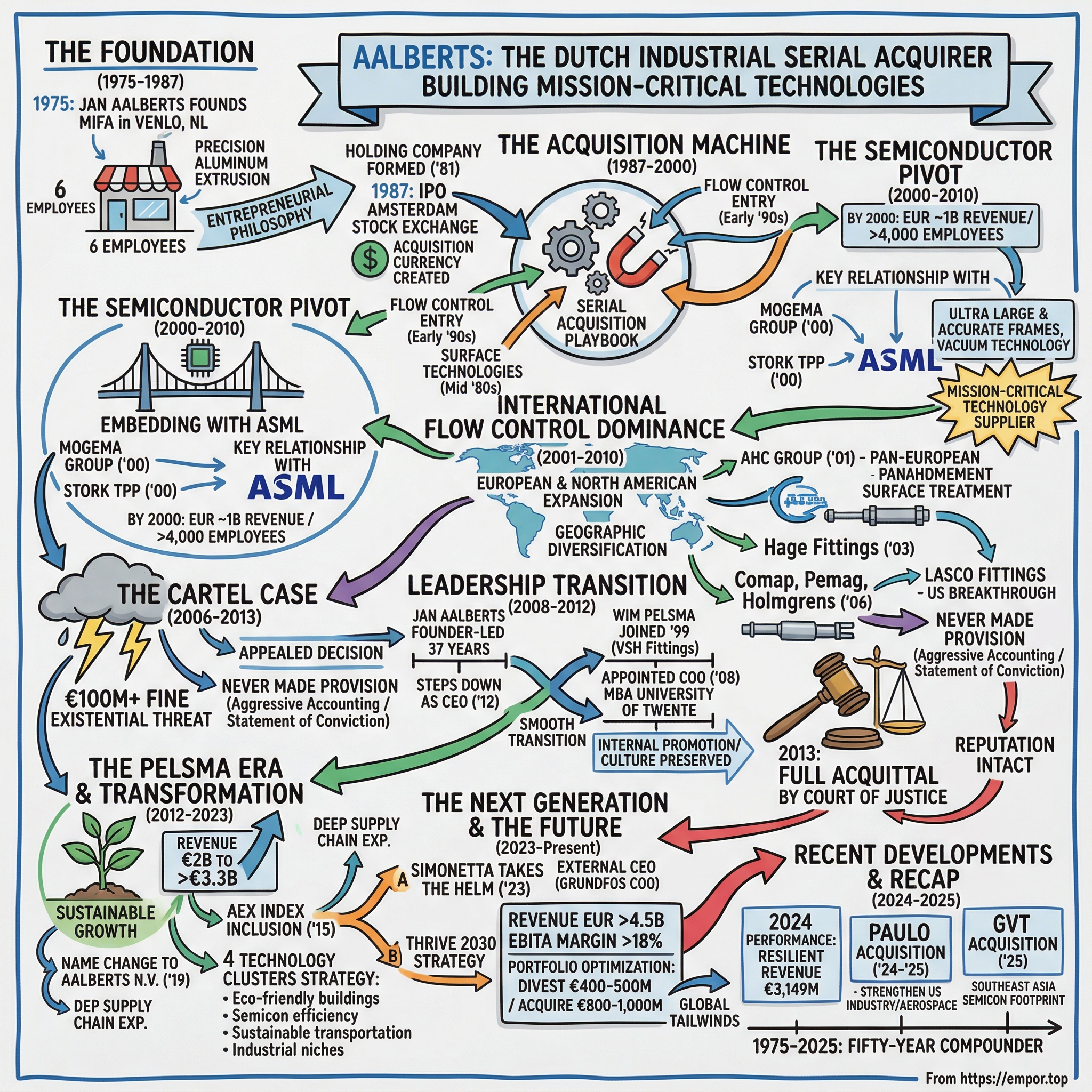
Aalberts: The Dutch Industrial Serial Acquirer Building Mission-Critical Technologies
The Monsoon Moment—Only Dutch-Style
Picture the industrial heartlands of 1975 Netherlands: smokestacks rising against grey skies, a reconstruction-era culture still humming with post-war engineering precision, and a young entrepreneur named Jan Aalberts standing in a modest aluminum extrusion shop in Venlo with exactly six employees. The machines were basic, the ambitions were not.
In 1975, Jan Aalberts established an aluminium precision extrusion company and Aalberts was born. He instilled a philosophy of dedication to progress and entrepreneurship, and now the company operates globally in more than 50 countries.
This wasn't just another small manufacturing business. It was the first brushstroke of what would become a €3+ billion masterpiece—a serial acquisition machine that would quietly thread itself into the most critical supply chains on Earth, from ASML's lithography equipment to the heating systems in Europe's eco-friendly buildings.
Today, Aalberts designs, develops, and manufactures integrated piping systems, hydronic flow control solutions, heat treatment processes, and surface technologies to enhance durability, efficiency, and performance. Headquartered in Utrecht, Aalberts operates 125 locations across more than 50 countries, employing 13,124 people as of December 2024, and reported revenue of €3,149 million for fiscal year 2024.
The question that makes this story compelling is simple: How does a six-person aluminum shop become a mission-critical supplier to the semiconductor revolution? The answer reveals one of Europe's most underappreciated industrial compounders—a company that has executed perhaps the most disciplined acquisition playbook on the continent, surviving near-death regulatory battles, executing flawless leadership transitions, and positioning itself at the nexus of three megatrends: energy-efficient buildings, semiconductor manufacturing, and advanced industrial technologies.
This is the story of Aalberts—and the remarkable fifty-year journey from a Dutch workshop to a global technology powerhouse.
The Founder's Vision: From Venlo to the World (1975-1987)
The Netherlands in 1975 was a peculiar place to build an industrial company. The country was still digesting the trauma of the 1973 oil crisis, which had forced car-free Sundays and sparked a national awakening about energy dependence. Yet it was also a hotbed of precision engineering talent, thanks to decades of proximity to Philips—the electronics giant that had spawned an entire ecosystem of high-tech suppliers in the southern Netherlands.
Jan Aalberts emerged from this milieu with a simple but powerful insight: there was money to be made in precision work. In 1975, Jan Aalberts established an aluminium precision extrusion company and Aalberts was born. He instilled a philosophy of dedication to progress and entrepreneurship.
The company began as Mifa Aluminium B.V., focused on high-precision aluminum components for various industrial uses. These weren't commodity products; they were specialized components that required deep technical expertise and consistent quality. From the beginning, Aalberts understood that differentiation—not scale—would be the path to profitability.
Jan Aalberts founds Mifa (aluminium precision extrusion) in Venlo NL with total revenue in 1975 of EUR 250 thousand. Then came the foundation of the holding company Aalberts Industries B.V., followed by Adex ('77) and quotation at the Amsterdam Stock Exchange with acquisitions including Germefa ('86).
The holding company structure established in 1981 was prescient. It signaled from the beginning that Aalberts intended to build not just a single manufacturing business, but a platform for consolidating specialized industrial capabilities.
The IPO in March 1987 was the inflection point. Aalberts n.v completed its initial public offering (IPO) on March 27, 1987. At the time of listing, the company had revenue of approximately €29 million—respectable for a twelve-year-old industrial firm, but hardly headline-grabbing.
What made the IPO significant wasn't the capital raised; it was the currency it created. Listed shares meant acquisition currency. And Jan Aalberts had every intention of using it.
The Dutch industrial context matters here. The Netherlands had long punched above its weight in precision manufacturing, partly because of historical trading culture, partly because the country's geography demanded sophisticated water management systems (which bred engineering talent), and partly because of the Philips effect—the tech giant's ecosystem had created generations of suppliers accustomed to exacting standards.
Aalberts positioned himself squarely in this tradition. The company has remained, at all times, true to the values established back in 1975. As a company, we are proud of our reputation as can-do innovators.
This wasn't empty rhetoric. The "Aalberts Way" that would later become famous was already taking shape: decentralized operations, entrepreneurial management, technical excellence, and relentless focus on specialized niches where quality trumped price.
Investment Implication: The 1987 IPO established a template that Aalberts would follow for decades: use public market capital and currency to consolidate fragmented industrial niches. The discipline began early—Aalberts never chased growth for growth's sake, instead building deliberately in areas where technical expertise created sustainable competitive advantages.
The Acquisition Machine Takes Shape (1987-2000)
The years between the IPO and the millennium were when Aalberts evolved from a manufacturing company into something different—an industrial holding company with a systematic approach to value creation through acquisition.
The numbers tell the story of transformation. Launched in 1975 with a staff of 6, Aalberts has grown into an international industrial group with more than 4,000 employees and turnover in 2000 of around one billion Dutch guilders.
That's roughly 660-fold employee growth and an even more dramatic revenue expansion in twenty-five years. How did it happen?
The playbook that emerged had several distinctive features:
Entry into Flow Control (Early 1990s): This evolution included entry into the flow control sector in the early 1990s, enabling solutions for fluid management in industrial applications. Flow control—valves, fittings, and related components—would become one of Aalberts' core capabilities. These products share key characteristics: they're technically demanding, mission-critical (a leaking valve can shut down an entire plant), and sold to customers who value reliability over price.
Surface Technologies (Mid-1980s): Surface treatments by the mid-1980s, with facilities established in key European locations to support coating and finishing processes. Surface treatment—heat treatment, coating, hardening—is another technically demanding field where expertise compounds over time. A customer who trusts you with their aerospace components doesn't switch suppliers casually.
The Acquisition Cadence: The company took over a series of companies domestically and abroad. Significant acquisitions in this period included Druckgasarmaturen (K M Schmöle, 1994) and metal hardening company Mamesta in Lomm (1995).
Aalberts Industries acquires companies in Germany, Nordic and Russia. Acquisitions DSI ('92), Broen ('93), VTI ('93), Mamesta ('95). By 1995, total revenue reached EUR 170 million. First steps in USA came by founding Ionic and acquiring Taprite.
The pattern was consistent: buy specialized industrial companies with strong technical capabilities, retain entrepreneurial management, extract synergies through shared knowledge rather than cost-cutting, and reinvest profits in the next acquisition.
Workforce Growth: The employee count tells its own story. The workforce grew from just over 500 in 1990 to approximately 1,500 in 1994. By the late 1990s, these efforts had scaled operations significantly, with employee numbers growing from six at inception to over 4,000 by 2000 and annual turnover reaching approximately one billion.
What's remarkable is what Aalberts didn't do during this period. It didn't chase dot-com bubbles or financial engineering. It didn't try to become a conglomerate by acquiring unrelated businesses. It stayed focused on industrial niches where technical expertise created durable advantages.
These internal milestones built on the company's founding principles of innovation, allowing it to develop core competencies in heat treatment and material improvement technologies, which enhanced component durability, wear resistance, and performance across industries.
The result was a company that, by 2000, had assembled a portfolio of specialized industrial businesses with genuine competitive moats—and was ready for the next chapter of growth.
Investment Implication: The 1987-2000 period established that Aalberts wasn't just lucky—it had a repeatable playbook. The key insight: in fragmented industrial markets, disciplined consolidation can create enormous value if you maintain operational excellence and resist the temptation to over-integrate acquired companies.
The Semiconductor Pivot: Embedding with ASML (2000-2010)
If there's a single strategic decision that elevated Aalberts from "solid industrial compounder" to "mission-critical technology company," it was the pivot toward semiconductor equipment supply chains—and specifically, the relationship with ASML.
ASML Holding N.V. is a Dutch multinational corporation and semiconductor company that specializes in the development and manufacturing of photolithography machines which are used to produce integrated circuits. As of 2023 it is the largest supplier for the semiconductor industry and the sole supplier in the world of extreme ultraviolet lithography (EUVL) photolithography machines.
ASML's rise from a Philips spinout in 1984 to the most critical company in the semiconductor supply chain is one of the great business stories of our time. What's less well known is how ASML's growth created opportunities for its suppliers—and how Aalberts positioned itself to capture those opportunities.
The key acquisition was Mogema Group in 2000. Aalberts Industries has reached agreement with the shareholders of the Mogema Group on the acquisition of virtually all of its operations. The Mogema Group - based in 't Harde and production facilities on five locations in the Netherlands, with a more than 200-strong payroll and annual turnover of some NLG 60 million - is in the business of supplying components and complete assembled units to a broad range of industrial customers.
What made Mogema strategic wasn't its size—it was its customer relationships. One of Mogema's most prominent customers is ASM Lithography with which the group works in close harness. Within the framework of this relationship Mogema is setting up an additional new production facility in the next six months for the manufacture of base frames for the new generation of ASML wafer stepper machines.
This is the kind of detail that separates great acquisitions from good ones. Aalberts wasn't just buying revenue; it was buying a relationship with what would become the most important technology company in Europe.
The strategic logic was clear: Mogema and Van Knegsel, already an Aalberts Industries Group company, will collaborate closely in the area of supplies to the semi-conductor industry. Other companies in the Aalberts Industries Group will also be able to profit from the position of Mogema and Van Knegsel as main suppliers.
The takeover is in line with Aalberts Industries' strategy of enhancing its position in the Industrial Services sector, through internal development on the one hand, and also through the acquisition of advanced specialised supply companies generating high added-value.
The Stork TPP acquisition followed similar logic. The company is specialised in the supply of high-precision componentry to a large number of industrial buyers. Its customers include Philips, ASML and Stork.
The relationship deepened over the decade. Aalberts Industries reached a long-term agreement with Key Account ASML, based in the Netherlands. The past 12 months teams of both companies worked on two big projects to intensify and expand the existing business partnership.
Why does this matter? Because ASML's supply chain is extraordinarily sticky. A competitor would also have to replicate the institutional supply chain knowledge base ASML has built up over the last 20 years to ensure each EUV machine ordered is built on time and meets the high output demand semiconductor manufacturers require.
ASML operates in a niche market characterized by the production of high-value products in relatively small quantities and involving thousands of specialized parts.
For Aalberts, being embedded in ASML's supply chain created something approaching a permanent competitive advantage. Qualification processes for semiconductor equipment take years. Once you're in, switching costs are enormous—for both parties.
Founded in 1956 and part of Aalberts since 2001, Mogema is based in 't Harde (the Netherlands). Today, Mogema is a high-tech expert in machining, welding, assembly and vacuum technology, specializing in fully-qualified (ultra) large and accurate machine frames, vacuum chambers and mechatronic (sub) systems. We serve the semiconductor, medical & analytical, oil & gas and defense industries.
The semiconductor pivot also included acquisitions like Integrated Dynamics Engineering (IDE) in 2008. In January 2008, Aalberts secured an 80% stake in Integrated Dynamics Engineering (IDE), a German-U.S. supplier of vibration isolation systems for the semiconductor industry, which bolstered its high-precision engineering offerings and access to cleanroom technologies.
The recognition of this strategy came full circle when during the annual ASML Suppliers' Day event, Aalberts advanced mechatronics was honoured with an award for Excellent Cost Performance. With the annual awards, ASML recognises key suppliers for their excellence in quality, technology, logistics, collaboration, cost, and sustainability performance.
Investment Implication: The ASML relationship demonstrates the power of being embedded in critical supply chains. Once you're a qualified supplier to the world's most important lithography company, you have a moat that's nearly impossible to replicate. This wasn't luck—Aalberts identified the opportunity early and executed systematically over a decade.
Building Flow Control Dominance: The International Expansion (2001-2010)
While the semiconductor pivot grabbed headlines, Aalberts was simultaneously executing an equally important strategy: building dominant positions in flow control across Europe and North America.
The European Expansion
A pivotal early move was the acquisition of Stork TPP in December 2000. This was followed in January 2001 by the purchase of AHC Group, Europe's largest network of surface treatment facilities across Germany, France, Switzerland, Austria, and Italy, enabling Aalberts to establish a pan-European platform for industrial coatings and heat treatments.
The AHC Group acquisition deserves attention because it exemplifies Aalberts' approach. Rather than building surface treatment facilities from scratch in each market, they bought the dominant player in Europe and immediately had scale, customer relationships, and technical expertise that would have taken decades to develop organically.
In 2003, another critical acquisition followed. The company acquired Hage Fittings, the largest manufacturer of stainless steel press fittings. Press fittings are a technology-driven product—they require specialized tooling and manufacturing processes, and customers value reliability over price.
In 2006, the expansion continued with the acquisition of Comap S.A. (water and gas products) in France, Pemag S.A. in Spain, and Holmgrens Försäljnings A.B. in Sweden.
The American Breakthrough
The LASCO Fittings acquisition in 2007 marked Aalberts' major entry into the U.S. market. Aalberts Industries N.V. has reached agreement with Tomkins Industries, Inc. to acquire 100% of the shares of LASCO Fittings, Inc., a leading US manufacturer and distributor of plastic fittings and related accessories for the plumbing, irrigation and pool/spa markets. With more than 500 employees generating an annual turnover of approximately USD 104 million (about EUR 80 million), LASCO Fittings is one of the key players in the American market for plastic plumbing, irrigation and spa & pool solutions.
The strategic rationale was explicit: Aalberts Industries has developed and introduced a range of plastic products through its German subsidiary Simplex Armaturen + Fittings and the recent acquisitions of KAN (Poland) and Comap (France). The LASCO Fittings acquisition will enable Aalberts Industries to consolidate its knowledge and accelerate the time to market for new plastic products and solutions both in Europe and the US.
To finance this acquisition, Aalberts Industries intends to issue 750,000 ordinary shares by way of an accelerated bookbuilt offering without a prospectus.
This is the Aalberts playbook in action: use stock as currency when valuations are favorable, finance acquisitions prudently, and focus on businesses where technical expertise matters.
Investment Implication: The 2001-2010 period demonstrated Aalberts' ability to execute simultaneously across multiple strategic fronts—semiconductor supply chains and flow control expansion. The geographic diversification also reduced risk: European construction cycles don't perfectly correlate with U.S. markets or semiconductor capital equipment cycles.
The Cartel Case: When Survival Hung in the Balance (2006-2013)
Every great company has moments where survival is genuinely uncertain. For Aalberts, that moment came in September 2006.
The European Commission has fined 30 companies a total of €314.76 million for participating in a copper fittings cartel, in violation of the EC Treaty's ban on restrictive business practices.
In 2006, Aalberts was fined over €100 million by the European Commission for allegedly being part of a cartel for copper fittings. Aalberts appealed the decision.
A €100+ million fine represented an existential threat. This was roughly 10% of the company's annual revenue at the time—a sum that could cripple the balance sheet, destroy credibility with customers, and undermine the acquisition strategy that had driven growth.
What happened next revealed something important about Aalberts' character.
Aalberts appealed the decision and in 2011 the European Court of Justice acquitted Aalberts. However, the European Commission appealed that ruling. In July 2013, the Court finally acquitted Aalberts on appeal. The company has always denied involvement in the cartel and never made any provision for the fine.
Read that last sentence again: "never made any provision for the fine."
In accounting terms, this was aggressive. Most companies facing a €100 million regulatory fine would take a provision, signaling to investors that they expected to pay at least some portion. Aalberts' refusal to provision wasn't just accounting—it was a statement of conviction about innocence.
The seven-year legal battle (2006-2013) was fought on multiple fronts. The 2011 acquittal was a major victory, but the Commission's appeal created years of additional uncertainty. Throughout this period, Aalberts continued executing its strategy, continued making acquisitions, and continued operating as if the fine didn't exist.
Judgment of the Court (Third Chamber) of 4 July 2013. European Commission v Aalberts Industries NV and Others. Appeals - Agreements, decisions and concerted practices - European market - Copper and copper alloy fittings sector - Commission decision - Finding of an infringement of Article 101 TFEU - Fines - Single, complex and continuous infringement.
The final vindication in July 2013 confirmed what Aalberts had maintained all along. The company emerged with its reputation intact—and with a valuable lesson for investors about management's willingness to fight when they believe they're right.
Investment Implication: The cartel case demonstrated two things. First, regulatory risk is real and can threaten even well-managed industrial companies. Second, management character matters—Aalberts' leadership showed conviction and discipline under extreme pressure. The fact that they never provisioned for a €100 million fine, and were ultimately vindicated, suggests a management team that makes decisions based on principle rather than expedience.
Leadership Transition: From Founder to Professional Management (2008-2012)
Founder-led companies face a recurring challenge: how do you maintain the entrepreneurial spirit that built the business while professionalizing management for the next phase of growth?
Most founder transitions fail. The new CEO brings corporate systems that stifle innovation, or lacks the founder's intuition about which acquisitions to pursue, or simply doesn't understand the culture that made the company successful.
Aalberts executed one of the smoother transitions in European industrial history.
The preparation began in 2008. Aalberts Industries N.V. announces that Mr W.A. (Wim) Pelsma will be appointed Chief Operating Officer as from 1 October 2008. This appointment fits within Aalberts Industries' desire to increase the interaction with and between the different group companies while maintaining its decentralised structure.
Wim Pelsma wasn't parachuted in from outside. Since May 1999 Wim Pelsma (1963) has been employed in different positions at Aalberts Industries, of which at this moment Group Director Flow Control Northern & Eastern Europe. At the time he started working in the Aalberts Industries Group as managing director of VSH Fittings in Hilversum.
Before then Wim Pelsma worked from 1993 to 1999 within different divisions of the Stork Group; he started his business career at Philips N.V. He studied Technical Business Economics and obtained his MBA at the University of Twente.
This background—Philips training, Stork experience, deep knowledge of Aalberts from running one of its key subsidiaries—made Pelsma an ideal successor. He understood both the Dutch industrial ecosystem and the specific Aalberts culture.
The formal transition came in 2012. In 2012 Jan Aalberts stepped down as CEO after running the company for 37 years. Since then the CEO position has been filled by Wim Pelsma, previously COO.
On 14 June 2012, Mr. Jan Aalberts, founder and President of Aalberts Industries N.V., received an honorary doctorate from Nyenrode Business University. "Jan Aalberts symbolises successful entrepreneurship in the Netherlands and abroad."
The founder didn't disappear entirely. He held the title of President, Member-Management Board & Press Contact from 2012 to 2014. Currently, Mr. Aalberts is the Chief Executive Officer of Aalberts Beheer BV since 2014.
And crucially, the Aalberts family retained significant ownership. Founder Jan Aalberts is still the largest single shareholder with 13.27% ordinary shares.
This combination—professional management, founder involvement, continued family ownership—created alignment that many founder transitions lack. Pelsma had room to run the company professionally while the founder's continued presence preserved institutional memory and strategic continuity.
Investment Implication: The 2012 transition is a masterclass in succession planning. Key elements: long runway (Pelsma was COO for four years before becoming CEO), internal promotion (he understood the culture), founder's continued involvement (as shareholder and advisor), and clear mandate for professionalizing while preserving the entrepreneurial culture.
The Pelsma Era: Transformation and Sustainable Growth (2012-2023)
Wim Pelsma's eleven-year tenure as CEO transformed Aalberts from a successful industrial acquirer into something more ambitious: a technology company serving mission-critical applications.
In April 2012 he was appointed as Chief Executive Officer. "Aalberts has undergone a considerable transformation over the last decade and realised sustainable profitable growth over many years."
The numbers support this claim. When Pelsma took over, Aalberts was a €2 billion revenue company. When he announced his retirement, it had grown to over €3.3 billion with dramatically improved margins and market positioning.
The Name Change
One of the most symbolically important decisions came in 2019. The company was formerly known as Aalberts Industries N.V. and changed its name to Aalberts N.V. in April 2019.
Dropping "Industries" from the name signaled an important strategic shift. Aalberts wasn't just an industrial holding company anymore—it was a technology company that happened to serve industrial markets. The distinction matters for valuation (technology companies command higher multiples) and for talent recruitment (engineers want to work for technology companies, not industrial conglomerates).
The AEX Index Inclusion
The market recognized Aalberts' transformation. Founded in 1975, Aalberts Industries has been listed on Euronext Amsterdam since 1987, was part of the AMX index since March 2005 and is included in the AEX index as of 23 March 2015.
Inclusion in the AEX—the Netherlands' premier stock index, alongside companies like ASML, Shell, and Unilever—was validation that Aalberts had joined the top tier of Dutch corporations.
The company was part of AEX index from 2015 to 2020 and is currently listed in the AMX index.
The Four Technology Clusters Strategy
Pelsma's most important strategic contribution was organizing the business around technology clusters rather than traditional industrial categories. The framework focused on four areas with high growth potential and sustainable impact: eco-friendly buildings, semicon efficiency, sustainable transportation, and industrial niches.
This wasn't just organizational shuffling. It reflected a genuine insight: Aalberts' competitive advantages were increasingly about technology rather than manufacturing scale. By organizing around technology clusters, the company could better allocate R&D spending, identify acquisition targets, and communicate value to investors.
Financial Performance
In 2022 we delivered a strong and resilient performance with an organic revenue growth of 8.7% and a record orderbook (+37% compared to last year). We realised a revenue of EUR 3,230 million, an EBITA of EUR 500 million and a net profit of EUR 372 million.
In 2023, we delivered another strong and resilient performance with 4.5% organic revenue growth, a revenue of EUR 3,324 million, a record EBITA of EUR 521 million and free cash flow of EUR 423 million.
The EBITA margin of 15.7% in 2023 reflected the premium positioning Aalberts had achieved—far above typical industrial manufacturing margins.
Investment Implication: The Pelsma era proved that Aalberts' success wasn't dependent on founder magic. A professional CEO could maintain the entrepreneurial culture while improving execution and strategic clarity. The technology cluster framework was particularly valuable—it gave investors a clear way to understand how different business lines connected to secular growth themes.
Capital Markets Day 2022: "Accelerate Unique Positioning"
In December 2021, Aalberts held a Capital Markets Day that laid out its most explicit strategic roadmap yet. The strategy, called "Accelerate Unique Positioning," articulated how the company would evolve over the following five years.
Strategic actions 2022-2026: increase organic revenue growth to 4-6% annually, increase capital expenditure to EUR 200-250 million per year, focus on 4 technology clusters and 4 end markets, additional divestment programme EUR 250-300 million revenue, bolt-on acquisitions EUR 250-500 million revenue, additional operational excellence programme, increase SDG impact, net zero carbon in 2050 or earlier.
Several elements of this strategy deserve attention:
The Divestment Program: The existing divestment programme will be finalised and an additional divestment programme of EUR 250-300 million revenue will be started. Our unique positions will be strengthened with EUR 250-500 million revenue through bolt-on acquisitions.
This represented a maturation in Aalberts' M&A philosophy. The company had always been a buyer. Now it was explicitly acknowledging that portfolio optimization—selling businesses that didn't fit the strategic focus—was equally important.
The LASCO divestment in 2021 exemplified this approach. Aalberts N.V. has reached an agreement to divest 100% of the shares of Lasco Fittings, Inc. (Lasco), based in Brownsville (Tennessee, USA), generating an annual revenue of approximately USD 150 million with 575 FTE.
Remember, Aalberts had acquired LASCO in 2007 as part of its U.S. expansion. Fourteen years later, it divested the business. Both companies are part of the divestment programme of the updated Aalberts strategy 'focused acceleration' 2018-2022. To build an even stronger and better Aalberts we focus on businesses where we have a compelling competitive advantage and where we can strengthen our market positions.
Capital Expenditure Increase: Capital expenditure increases to EUR 200-250 million per year. Innovation expenditure increases to more than 5% of total revenue.
This was a significant increase in organic investment—a signal that Aalberts saw substantial opportunities for growth in its existing businesses, not just through acquisition.
Investment Implication: The 2022 Capital Markets Day marked a strategic evolution. Aalberts was becoming more selective—willing to divest businesses that didn't meet the bar for "unique positioning" while simultaneously investing more in businesses that did. This discipline, if maintained, should improve returns on capital over time.
The Next Generation: Simonetta Takes the Helm (2023-Present)
Leadership transitions are always delicate moments for compounding businesses. When Wim Pelsma announced his retirement in December 2022, the question immediately became: could Aalberts find another CEO who understood the model?
Aalberts N.V. announces that its Supervisory Board nominates Stéphane Simonetta to become Chief Executive Officer. As a member of the Group Management, Stéphane Simonetta currently is CEO Industry Division of Danish-based Grundfos, after joining the company in 2015 as the Group COO.
The selection of Simonetta represented a different approach than the Pelsma transition. Rather than promoting from within, the board looked outside—but not far outside. Grundfos, the Danish pump manufacturer, operated in adjacent industrial markets with similar dynamics.
He is a French citizen, graduated in industrial engineering and computer science, has a broad international experience and a background in the manufacturing industry. Stéphane Simonetta started working for Thomson Multimedia in several supply chain roles in 1996 in Asia, North America and Europe. In 2005 he joined Valeo where his last position was Group China Supply Chain and Production System Director. In 2012 he moved to Swiss-based Honeywell Transportation Systems where he held various executive positions and ultimately became Vice President Global Operations.
The career trajectory—Thomson, Valeo, Honeywell, Grundfos—represented deep experience in industrial supply chains across multiple geographies. The China experience was particularly relevant given Aalberts' need to navigate the complexities of semiconductor supply chains increasingly shaped by U.S.-China tensions.
Peter van Bommel, Chairman "The Supervisory Board is pleased to nominate Stéphane Simonetta to lead Aalberts in its next growth phase. He has a wealth of experience as a business leader in global companies and working in the manufacturing industry. Under Pelsma's leadership, Aalberts has undergone a considerable transformation and realised sustainable profitable growth over many years. The company is in excellent shape and very well positioned for the future."
The transition was designed to be smooth. Subject to shareholder approval, Stéphane Simonetta will join the Management Board of Aalberts N.V. After approval, the Supervisory Board will appoint Stéphane Simonetta as Chief Executive Officer to take over responsibilities from Wim Pelsma, who will remain available as advisor until the end of 2023, to ensure a smooth transition.
Simonetta's arrival coincided with the development of a new strategic framework: "Thrive 2030."
The "Thrive 2030" Strategy: Setting the Ambition
In December 2024, Aalberts unveiled its most ambitious strategic plan yet at a Capital Markets Day held at its surface technologies site in Eindhoven—a location chosen deliberately to showcase the company's technological capabilities.
Aalberts 'thrive 2030': Aalberts will focus on leadership positions in three attractive end markets with high organic growth potential: industry, semicon and building. We will continue to optimise our portfolio to have a more balanced revenue per end market and region.
The headline targets were aggressive:
2030 Objectives: revenue EUR >4.5 billion, EBITA margin >18%, free cash flow conversion ratio >65%, ROICE 10-year period >18%, leverage ratio <2.5.
These targets represent roughly 43% revenue growth from 2024 levels (~€3.1 billion) and meaningful margin expansion (from ~15% to >18% EBITA).
Portfolio Optimization: An additional divestment programme of EUR 400-500 million revenue will be started. Aalberts will strengthen positions in industry (North America), semicon (South-East Asia, portfolio) and building (North America, portfolio) through acquisitions, with EUR 800-1,000 million revenue until 2030.
The math is straightforward: divest €400-500 million of lower-quality revenue, acquire €800-1,000 million of higher-quality revenue. If executed well, this portfolio rotation should improve both growth rates and margins.
Capital Allocation: Capital expenditure increases to EUR 250-300 million per year to drive sustainable growth and operational excellence, free cash flow conversion ratio more than 65%. Share buybacks are now part of capital allocation when excess cash is available.
The addition of buybacks to the capital allocation toolkit was significant. For a company that had traditionally deployed capital primarily through acquisitions, acknowledging that sometimes returning cash to shareholders is the best use of capital represented mature capital allocation thinking.
CEO statement Stéphane Simonetta comments: "Our goal is to unleash the full potential of Aalberts. We are committed to rebalance our portfolio, invest in a future-proof workforce through talent development and capability enhancement, invest in customer-centric supply chain and innovate to differentiate. These efforts will ensure we achieve both our short-term and long-term objectives."
Investment Implication: The Thrive 2030 strategy is ambitious but achievable. The key question is execution: can Aalberts divest €400-500 million of revenue without destroying value, and can it find €800-1,000 million of acquisitions that meet its quality standards? History suggests yes, but the semiconductor and building markets face near-term headwinds that create execution risk.
Recent Developments: Executing Through Turbulence (2024-2025)
The period since Simonetta took the helm has tested the new CEO's mettle. Market conditions have been challenging, but strategic execution has been impressive.
2024 Performance
In 2024, we managed to deliver a resilient performance with a revenue of EUR 3,149 million, an EBITA before exceptionals of EUR 471 million or 15% of revenue and free cash flow before exceptionals of EUR 334 million despite the challenging end market environment. But we faced headwinds with negative organic growth of 3.4% and a return of capital employed (ROCE) down to 14.7%.
We managed to sustain our added value margin with cost saving actions and robust price levels. We reduced inventories by EUR 23 million and managed cost inflation and lower volumes. Capital expenditure was EUR 231 million to support additional capacity, geographical expansions, innovation, and business development plans.
2025: Navigating Market Softness
Aalberts Industries NV (AMS:AALB) reported a 3.2% organic revenue decline in its first half of 2025 results, reflecting challenging market conditions. The company faced continued end market softness and increased uncertainty during the first half of 2025, prompting management to take proactive steps to protect margins and optimize free cash flow.
"We continue to take action to protect our EBITA margin, optimize our free cash flow, while at the same time we will continue to deploy and invest for the long term," said CEO Stéphane Simonetta during the presentation.
Performance varied significantly by segment:
-
The Building segment showed moderate growth with 1.4% organic revenue increase, driven by strength in America and APAC regions. The segment maintained a stable EBITA margin of 12.9%.
-
The Industry segment experienced a 4.9% organic revenue decline, though it maintained a strong EBITA margin of 16.8%. Growth areas included aerospace, power generation, and defense.
-
The Semicon segment faced the steepest challenges with a 13.4% organic revenue decline, though it sustained an EBITA margin of 11.5%. The company noted that Q2 performance was better than Q1 in this segment.
The Paulo Acquisition
Even amid market challenges, Aalberts continued executing its acquisition strategy. In December 2024, Aalberts announced that agreement was reached to acquire Paulo Products Company, North America's largest privately owned thermal processing platform, specializing in industrial heat treatment, brazing, and metal finishing.
Aalberts N.V. has reached an agreement to acquire 100% of the shares of Paulo Products Company (Paulo), operating five facilities in the USA and one in Mexico, generating an annual revenue of approximately USD 105 million with 522 employees. Paulo serves attractive end markets like automotive, aerospace, defence and power generation. In line with our 'thrive 2030' strategy, this acquisition will strengthen our geographical footprint in the USA.
The deal closed in May 2025. Aalberts announces successful regulatory approval, finalising the acquisition of Paulo Products Company, operating five facilities in the USA and one in Mexico, generating an annual revenue of approximately USD 105 million with 522 employees. With this transaction now completed, we are strengthening our presence in North America and enhancing our technology offering across key markets such as automotive, aerospace, defence, and power generation.
The Grand Venture Technology Acquisition
Perhaps more strategically significant was the GVT acquisition. Aalberts N.V. has entered into an agreement with Grand Venture Technology Limited (GVT) for the proposed acquisition of 100% of the company. The transaction is expected to be finalised by the end of 2025 and the results will be consolidated immediately thereafter. The acquisition will directly contribute to the earnings per share and will be financed from existing credit facilities.
With its head office in Singapore, GVT operates six facilities across Singapore, Malaysia and China, generating an annual revenue of SGD 160 million in 2024 and an adjusted EBITDA margin of 19% with approximately 1,800 employees. GVT is a leading precision engineering solutions and service provider of components, mechatronics, assembly and testing mainly for semiconductor, analytical life sciences, medical, aerospace and industrial automation industries.
This acquisition directly addresses ASML's strategic priorities. The acquisition aligns with the strategic demands of Aalberts' key semiconductor customer, ASML. The lithography manufacturer is expanding, seeking cost savings and urging its supply chain to localize and invest strategically. In short, to consider establishing a footprint in Asia.
With a single move, Aalberts gains a formidable footprint in Southeast Asia. The acquisition of Grand Venture Technology secures a presence in China, Malaysia and Singapore.
The GVT deal closed in October 2025. With this transaction now completed, we are expanding into the strategically important Southeast Asian semicon market, as part of our 'thrive 2030' strategy. It will establish a new customer base for Aalberts and will enhance our value proposition to existing customers who are investing in the region.
Investment Implication: The 2024-2025 period demonstrates that Aalberts can execute strategy even in challenging markets. The Paulo and GVT acquisitions both fit the stated strategic priorities, and the discipline around margin protection during downturns suggests mature operational management.
Business Model Deep Dive: The Aalberts Playbook
After fifty years of evolution, what exactly is Aalberts? The answer requires understanding both what the company does and how it operates.
The Three Segments
Aalberts N.V. offers mission-critical technologies for building, industry, and semicon markets in Europe, the United States, the Asia Pacific, the Middle East, and Africa. It operates through Building, Industry, and Semicon segments.
The company offers hydronic flow control systems for heating and cooling to enhance the energy efficiency; integrated piping systems to distribute and control liquids and gas; advanced mechatronics specializing in vibration isolation, ultra precision frames, and high purity fluid systems; and surface technologies for surface treatments, heat treatments, brazing, additive manufacturing, and post processing. It sells its products under the BROEN, Henco, ISIFLO, MIFA, and Metalis brands.
Segment Performance (H1 2025):
- Building: 1.4% organic growth, 12.9% EBITA margin
- Industry: 4.9% organic decline, 16.8% EBITA margin
- Semicon: 13.4% organic decline, 11.5% EBITA margin
The Decentralized Model
This appointment fits within Aalberts Industries' desire to increase the interaction with and between the different group companies while maintaining its decentralised structure.
Aalberts operates more than 125 locations globally, but the headquarters in Utrecht has only about 25 employees. This extreme decentralization is deliberate—it preserves entrepreneurial energy in individual businesses while central functions provide strategic direction, capital allocation, and best-practice sharing.
Our pragmatic culture 'The Aalberts Way' can be summed up in three simple words: winning with people. We explore and make dreams happen. We adapt, innovate and focus on our customers' requirements and give them back so much more than they expect. We are responsible for achieving our own commitments. Proactive, accountable, and empowered to perform.
The Acquisition Philosophy
The takeover is in line with Aalberts Industries' strategy of enhancing its position in the Industrial Services sector, through internal development on the one hand, and also through the acquisition of advanced specialised supply companies generating high added-value.
The philosophy has been consistent for fifty years: buy specialized leaders with strong technical capabilities, retain management, extract synergies through knowledge sharing rather than cost-cutting, and reinvest in growth.
The Value Creation Model
The Aalberts way of value creation is to achieve unique worldwide leading market positions with niche technologies in selective end markets. Relentlessly running the Aalberts playbook results in long-term shareholder value. Our track record of more than 45 years of sustainable profitable growth proves the sustainability of our business model. Continuously focusing our niche technology portfolio #leadingpositions, generating high customer added value #pricingpower, accelerating long-term innovation roadmaps #organicgrowth, driving operational excellence programmes relentlessly #freecashflow.
Porter's Five Forces Analysis
1. Threat of New Entrants: LOW
Aalberts operates in markets with substantial barriers to entry: - Technical expertise in heat treatment, surface technologies, and precision manufacturing takes decades to develop - Customer qualification processes—especially in semiconductor and aerospace—can take years - Certifications and regulatory approvals create formal barriers - Capital requirements for specialized manufacturing facilities are significant - Established supplier relationships create switching costs
2. Bargaining Power of Suppliers: MODERATE
- Aalberts sources raw materials (metals, plastics, specialty alloys) from multiple suppliers
- Some specialty materials may have concentrated supply
- Vertical integration in certain processes reduces dependency
- Scale provides procurement leverage across 125+ locations
3. Bargaining Power of Buyers: MODERATE-HIGH
- Key accounts like ASML have significant leverage given their importance
- However, switching costs are high for mission-critical components
- Close collaboration with major customers like ASML Lithography creates stickiness.
- Building segment customers (contractors, distributors) are more fragmented
- Technical specifications and qualification processes create customer lock-in
4. Threat of Substitutes: LOW
- Mission-critical components have few substitutes
- Regulatory and certification requirements create switching barriers
- In semiconductor equipment, precision requirements limit alternatives
- Surface treatment technologies have specific performance characteristics that are difficult to replicate
5. Competitive Rivalry: MODERATE
Aalberts's primary competitors include Parker Hannifin, Flowserve, Georg Fischer and 3 more.
In the Industrial Technology segment, Aalberts faces competition from specialized valve and flow control manufacturers including Emerson Electric (EMR), Flowserve (FLS), and Crane (CR). The company has differentiated itself through specialized technologies for critical applications, particularly in regulated industries.
The competitive landscape is fragmented across different end markets, allowing for niche leadership positions. Serial acquisition strategy has consolidated competition in certain segments. Technology differentiation reduces pure price competition.
Hamilton's 7 Powers Analysis
1. Scale Economies: MODERATE POWER
Aalberts' 125+ locations globally enable distribution efficiency and procurement leverage. R&D costs are spread across a larger revenue base. Capital expenditure increases to EUR 250-300 million per year—scale enables this level of investment. However, Aalberts competes with larger players (Parker Hannifin at ~$20B revenue) in some markets, limiting scale advantage.
2. Network Effects: LOW POWER
Limited network effects in industrial components. Some benefit from ecosystem positioning—being embedded in ASML's supply chain creates value, but it's not a true network effect where each additional node increases value for all participants.
3. Counter-Positioning: MODERATE POWER
Aalberts' decentralized "entrepreneurial" model differs from competitors' more centralized approaches.
Large industrial conglomerates like Parker Hannifin or Honeywell struggle to replicate the nimble, specialist approach. The entrepreneurial culture is embedded in how Aalberts operates—not easily copied through organizational change.
4. Switching Costs: HIGH POWER
This is Aalberts' strongest source of competitive advantage: - Qualification processes for semiconductor and aerospace customers take years - Components are embedded in customers' manufacturing processes - Regulatory certifications and approvals create lock-in - Technical specifications create dependency - As a supplier of high end parts and modules we deliver various key components to ASML. With many years of experience in designing and manufacturing of these complex modules Aalberts acts as the lift competence centre of ASML.
5. Branding: LOW-MODERATE POWER
It sells its products under the BROEN, Henco, ISIFLO, MIFA, and Metalis brands.
B2B industrial brands matter less than in consumer markets. However, reputation for reliability and quality is important in mission-critical applications. The Aalberts brand carries weight with investors and potential acquisition targets.
6. Cornered Resource: MODERATE-HIGH POWER
Mogema and Van Knegsel collaborate closely in the area of supplies to the semi-conductor industry. Other companies in the Aalberts Industries Group will also be able to profit from the position of Mogema and Van Knegsel as main suppliers.
Unique positioning in the Dutch semiconductor ecosystem represents a cornered resource. Geographic proximity to ASML (both Netherlands-based) provides advantages that distant competitors cannot replicate. Specialized technical talent and engineering expertise concentrated in the Netherlands is another cornered resource.
7. Process Power: HIGH POWER
These internal milestones built on the company's founding principles of innovation, allowing it to develop core competencies in heat treatment and material improvement technologies.
Decades of accumulated process knowledge in surface technologies, heat treatment, and precision manufacturing. Historically, Aalberts has prioritized organic growth and strategic acquisitions to drive returns. Its Surface Technologies division has been a consistent profit driver.
The "Aalberts Way" of integrating acquisitions represents embedded organizational knowledge that competitors cannot easily observe or replicate.
Bull Case vs. Bear Case
Bull Case
Secular Tailwinds: All three of Aalberts' segments benefit from powerful long-term trends: - Building: Energy efficiency regulations driving demand for hydronic heating/cooling systems - Industry: Aerospace recovery, defense spending, and power generation investment - Semicon: Moore's Law continues; ASML's expansion benefits suppliers
The Paulo acquisition builds on this track record, targeting sectors—such as defense and power generation—that are projected to grow at 4–6% annually through 2030.
Aerospace and defense, in particular, are buoyed by geopolitical tensions and infrastructure spending.
ASML Relationship: The embedded position in ASML's supply chain is exceptionally valuable. As ASML grows (and it has substantial growth ahead as semiconductor demand expands), Aalberts grows with it. The GVT acquisition extends this advantage into Southeast Asia.
Portfolio Optimization: The divestment of lower-quality businesses and acquisition of higher-quality assets should improve margins and growth rates over time. If management executes the €400-500 million divestment and €800-1,000 million acquisition targets, portfolio quality will be materially better by 2030.
Valuation: Aalberts' record 50% valuation discount to peers is set to narrow on improving earnings momentum, and progress towards Thrive 2030. If the discount narrows while earnings grow, equity returns could be substantial.
Balance Sheet Strength: Paulo's $105 million revenue expected to contribute meaningfully to Aalberts' 2025 EPS, and its balance sheet remains robust—debt-to-equity of 0.4x as of Q1 2025. Financial flexibility enables continued strategic execution.
Bear Case
Cyclical Exposure: All three segments are cyclical: - Building depends on construction activity - Industry depends on capital equipment spending - Semicon is notoriously cyclical
Aalberts reported a 3.2% organic revenue decline in H1 2025. The Semicon segment faced the steepest challenges with a 13.4% organic revenue decline.
Execution Risk: The Thrive 2030 strategy requires flawless execution of portfolio optimization—divesting businesses without destroying value, acquiring businesses without overpaying. History shows this is difficult.
Customer Concentration: The ASML relationship cuts both ways. Dependency on a single major customer creates risk if that relationship deteriorates or if ASML's growth slows.
Geographic Concentration: Aalberts remains heavily European, with significant exposure to German and Dutch industrial markets. European manufacturing competitiveness faces structural challenges.
Margin Pressure: Our organic revenue decline is 3.2% and our EBITA margin is 13.5%. The major cause to our EBITA margin drop versus last year is lower volume in our industry and semicon segment. Maintaining margins during volume declines is challenging.
Key Performance Indicators to Track
For investors monitoring Aalberts, three KPIs deserve particular attention:
1. Organic Revenue Growth
This is the most important near-term indicator. Aalberts' model depends on modest organic growth (4-6% target) plus bolt-on acquisitions. If organic growth turns persistently negative, it suggests either market share loss or secular challenges in end markets.
Current status: Negative in H1 2025 (-3.2%), but management expects improvement in H2 and recovery in 2026.
2. EBITA Margin
Margin is the best indicator of competitive positioning and pricing power. Aalberts targets >18% EBITA margin by 2030, up from ~15% currently. Progress toward this target indicates successful portfolio optimization and operational excellence.
Current status: 13.5% in H1 2025, down from 15.0% in H1 2024 due to volume pressure. The direction over the next 2-3 years will be telling.
3. Free Cash Flow Conversion
FCF conversion (free cash flow as percentage of EBITA) indicates operational efficiency and working capital management. Target is >65%. This metric matters because acquisitions are ultimately funded by free cash flow—if FCF conversion deteriorates, acquisition capacity shrinks.
Current status: FCF improved to €56 million in H1 2025 (up from €48 million in H1 2024) despite revenue decline, suggesting good working capital management.
Conclusion: The Fifty-Year Compounder
In 2025, Aalberts celebrates its 50th anniversary—a milestone that few industrial companies reach while still growing and innovating. This year, Aalberts celebrates an extraordinary milestone: 50 years of engineering mission-critical technologies.
The journey from six employees in a Venlo workshop to a €3+ billion global technology company is a testament to disciplined execution across multiple leadership generations. The playbook has remained remarkably consistent: acquire specialized businesses with technical moats, retain entrepreneurial management, focus relentlessly on mission-critical applications, and reinvest profits in growth.
The challenges ahead are real. European construction markets remain soft. Semiconductor cycles are unpredictable. Competition from larger global players never stops. But Aalberts has navigated challenges before—including an existential regulatory battle that could have destroyed the company.
"This year will be an important year for Aalberts as we will celebrate our 50th company anniversary. I remain optimistic for the future as our three segments are well positioned with attractive end market growth driven by global tailwinds", added Stéphane Simonetta.
For investors, Aalberts presents an interesting proposition: a proven compounder trading at a discount to peers, exposed to secular growth themes in energy efficiency and semiconductor manufacturing, with a management team executing a clear strategic plan. The risks are primarily cyclical and execution-related rather than structural.
The fifty-year track record suggests that when the next cycle turns—and cycles always turn—Aalberts will be positioned to compound once again.
Regulatory Note: Aalberts' 2006 cartel case was fully resolved in 2013 with complete acquittal. The company faces no material outstanding regulatory overhangs. Standard industrial regulatory requirements apply across its diverse operations in 50+ countries.


 RSS Feed
 Spotify
 Apple Podcasts
 Amazon Music
 Audible
 YouTube