 Chat with
this content: Summary, Analysis, News...
Chat with
this content: Summary, Analysis, News...
 Subscribe on LinkedIn


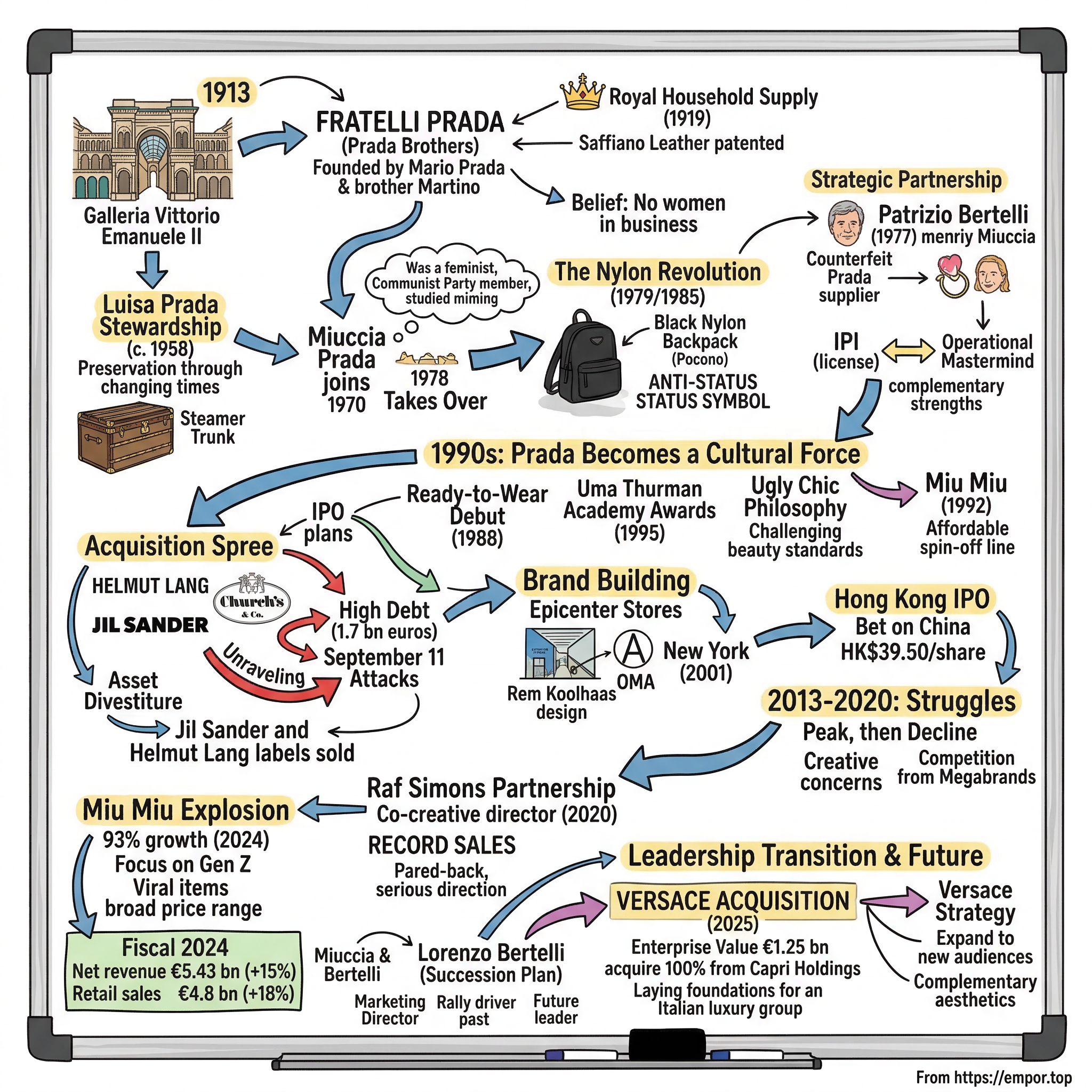
Prada: The Story of Italy's Intellectual Fashion Empire
Introduction: The Communist Who Built a Luxury Empire
Picture the streets of Milan in the late 1970s—a time of political upheaval, women's liberation marches, and radical student movements. Among the demonstrators, wearing Saint Laurent while her peers donned denim, stood a young woman named Maria Bianchi. She had a PhD in political science, had been a card-carrying member of the Italian Communist Party, and spent years training as a mime at the prestigious Piccolo Teatro. She considered fashion frivolous—perhaps even shameful. "I was a feminist in the 1970s," she would later confess, "my social life was in a circle of intellectuals, I was ashamed of thinking about fashion."
This unlikely revolutionary would soon change her name to Miuccia Prada, inherit a languishing leather goods shop from her grandfather, and transform it into one of the most influential fashion houses in history.
The central question of Prada's story is both paradoxical and profound: How did a sleepy leather goods shop, run by women despite its founder's explicit belief that women had no place in business, become the intellectual epicenter of global fashion? And now, with the April 2025 announcement that Prada S.p.A. entered into a definitive agreement to acquire 100% of Versace from Capri Holdings for an Enterprise Value of €1.25 billion—is it finally building Italy's answer to LVMH?
In fiscal year 2024, Prada Group achieved net revenues of €5.4 billion, up 17% year over year, well above market. Retail sales reached €4.8 billion, up 18% year over year, driven by like-for-like, full-price volumes. The company has delivered four consecutive years of double-digit, like-for-like growth, coupled with margin expansion and cash generation, resulting in a very sound balance sheet.
This is a story about family succession against the odds, the power of "anti-status" thinking, creative reinvention, and the art of building a luxury brand without selling your soul to conglomerates. It's a story that touches on feminism and communism, nylon and royalty, debt crises and cultural capital—and ultimately, on what happens when a family realizes that to survive, they must both honor their heritage and radically transform it.
Founding Era: Mario Prada & the Italian Royal Household
In 1913, in the heart of Milan's most prestigious shopping arcade, two brothers opened a leather goods shop that would eventually reshape global fashion. The company started in 1913 by Mario Prada and his brother Martino as Fratelli Prada—Prada Brothers—a leather goods shop in Milan. Initially, the shop sold animal goods, imported English steamer trunks, handbags.
The location they chose was strategic genius. The story of the Prada clothing brand begins in 1913, when Mario Prada founded a small leather goods shop in Milan called Fratelli Prada. Located in the prestigious Galleria Vittorio Emanuele II, this boutique specialised in the crafting and selling of luxury trunks, bags, and luggage. The Galleria, with its soaring glass ceiling and ornate ironwork, was the ultimate symbol of Milanese sophistication—a statement that Mario Prada intended to serve only the most discerning clientele.
From 1919, they even supplied their goods to the Savoy dynasty. The secret of success was a combination of exclusive design, high quality and special chic: the brand was associated with practical luxury and elegance. This royal appointment was transformative—the House of Savoy's coat of arms and knotted rope design became permanently incorporated into the Prada logo, a symbol of aristocratic endorsement that would endure long after the Italian monarchy itself.
One of Mario's early innovations still defines the brand today: Saffiano leather, which he patented in 1913. This distinctive cross-hatch textured leather, created through a heated stamping process, offered exceptional durability and scratch resistance—practical luxury in material form. Over a century later, Saffiano remains one of Prada's signature materials, a direct link to the founder's original vision.
Alongside these handcrafted leather goods, Prada also sold travel accessories, as well as beauty cases, jewellery, luxury items, and rare objects. Mario Prada opened an exclusive store in Milan's prestigious Galleria Vittorio Emanuele II that sold leather bags, trunks, beauty cases, jewels, luxury accessories, and rare objects.
Yet Mario Prada held a belief that would prove profoundly ironic. Prada did not believe women should have a role in business, so he prevented female family members from entering his company. He envisioned his son taking over the empire he was building. Life, however, had other plans.
The context matters: Milan in the early twentieth century was rapidly becoming Italy's fashion and industrial capital, a city where craft traditions met commercial ambition. The northern Italian region had long been famous for its leather work, and Mario positioned Prada at the intersection of artisanal excellence and cosmopolitan taste. His clientele traveled the world on ocean liners, carrying Prada trunks filled with custom-fitted compartments for their wardrobes and toiletries—practical luxury for the jet set before jets existed.
For investors, the founding era established several principles that still define Prada: location matters (premium real estate as brand statement), heritage credentials create lasting value (the royal appointment), and material innovation (Saffiano) can become intellectual property worth protecting for generations.
The Transition Years: Luisa Prada's Stewardship
The first great irony of the Prada story unfolded after Mario Prada's death in 1958. Ironically, Mario's son had no interest in the business, so it was Mario's daughter Luisa who succeeded Mario and ran Prada for almost twenty years. The man who believed women had no place in business would see his company saved by his daughter's dedication.
Luisa Prada's stewardship of the family business through nearly two decades represented a holding pattern—necessary survival more than aggressive expansion. The world was changing rapidly. Luisa's daughter, Miuccia Prada, joined the company in 1970, eventually taking over from Luisa in 1978.
Under Luisa's leadership, the brand adapted to postwar shifts in travel from ocean liners to airlines—a transition that fundamentally changed what luxury luggage needed to be. The massive steamer trunks that made Prada's early reputation became impractical relics. The company survived but didn't thrive.
At the age of 21, Miuccia joins the family business, the Prada brand, to manage one of the two remaining stores. Her mother, Luisa, had taken over the company in 1958, but by the time Miuccia joined, only one store remained. By 1978, when Miuccia inherited the company, it had shrunk dramatically—a sleepy, traditional leather goods house with revenues of approximately $450,000.
This was a business in quiet decline, yet the heritage remained intact. The Saffiano leather, the royal coat of arms, the Galleria location, the reputation for craftsmanship—all preserved like a time capsule waiting for someone to rediscover its potential.
For observers studying family businesses, this transition period illuminates a critical lesson: sometimes the best leadership is simply preservation—keeping the flame alive until the right person arrives to fan it into something larger.
Miuccia Takes Over: The Unlikely Revolutionary
The Background of an Unusual Heiress
Born Maria Bianchi on 10 May 1949 in Milan, she took the name Miuccia Prada in the 1980s, after being adopted by an aunt. This legal arrangement allowed her to officially carry the Prada surname—a necessary step for the woman who would become the brand's defining figure.
Her path to fashion leadership was anything but conventional. After attending Liceo Classico Berchet high school in Milan, Prada went to the University of Milan where she graduated with a degree in political science in 1971, while on the same time studying acting at the Piccolo Teatro in Milan. She eventually obtained a PhD in political science, developing the intellectual framework that would later distinguish her design philosophy.
Prada trained at the Teatro Piccolo to become a mime artist and performed for five years. She was a member of the Italian Communist Party and was involved in the women's rights movement during the seventies in Milan.
These were the years of political protest and the future fashion designer joined the Communist Party, alternating student demonstrations with rehearsals at Milan's Piccolo Teatro. From a young age she had to reconcile her sophisticated aesthetics with a soul with a marked political orientation; she marched in the streets for women's rights, participated in marches and demonstrations. Her activism dialogue with her love of fashion; while her peers took to the streets wearing jeans, Miuccia Prada was in Saint Laurent.
This contradiction—communist politics with haute couture tastes—would prove foundational. She told Vogue Italia: "I always thought there were only two noble professions: politics and medicine. Making clothes was a nightmare for me. I was ashamed, but I did it anyway. The love of beautiful things prevailed."
"No, in the Union of Women. I was active for years but hated speaking in public, so I gradually began working at my parents' company, which was the worst thing you could ever do in the '60s and '70s, as a feminist—to work in the fashion industry."
The Meeting that Changed Everything
Miuccia began making waterproof backpacks out of Pocono, a nylon fabric. She met Patrizio Bertelli in 1977, an Italian who had begun his own leather goods business at the age of 24, and he joined the company soon after.
The circumstances of their meeting contain a delicious irony. She hired as her primary supplier Patrizio Bertelli, a leather-goods manufacturer whom she had met the previous year at a trade fair where he was selling Fratelli Prada knockoffs. The man making counterfeit Prada bags would become the company's operational mastermind.
At age 21, while attending the University of Bologna he founded Sir Robert, a small leather goods company. Bertelli had already demonstrated entrepreneurial instincts that would prove essential to Prada's transformation. His company, I Pellettieri d'Italia (IPI), secured an exclusive license to manufacture and distribute Prada's leather goods.
Their professional relationship deepened over the following years, leading to Bertelli's formal integration into the company in 1978. Patrizio had already made a name for himself by running his own leather goods company since 1968, which he founded while still a university student. When he and Miuccia joined forces, it was a meeting of two creative and business-savvy minds. While Miuccia had a flair for design and an unconventional vision for fashion, Patrizio brought a sharp business mind and a knack for innovation.
Patrizio Bertelli married Miuccia Prada in 1987, forming a partnership that has seamlessly integrated her innovative design vision with his strategic business leadership. Their collaboration, which began professionally in 1977 when they met at a Milan trade fair, has emphasized complementary strengths, with Bertelli handling operational expansion and Prada focusing on creative direction.
Very few people know that it was Patrizio Bertelli who made Miuccia design women's ready-to-wear apparel and it was he who convinced Miuccia to take up menswear designing in 1990s. As a sign of her gratitude to him, Miuccia is known to confess openly that Bertelli was far more of provocateur than she was.
The partnership dynamic was crystalline from the start: Miuccia as creative visionary, Patrizio as operational strategist. He advised discontinuing the import of English goods and completely rethinking the product line. Together, they would transform a heritage leather house into something unprecedented.
The Nylon Revolution & Building a Brand
The Black Nylon Gamble
The transformation of Prada began with one of fashion's most counterintuitive decisions. The beginning of Prada's creative overhaul began in 1979 with the release of her first set of backpacks and totes made out of military grade nylon. An iconic symbol of the brand today, nylon, at the time, went against all existing notions of glamor that governed fashion before and well into the 1980's, and her utilitarian handbag designs were the antithesis of the luxury company's founding philosophy.
The inspiration behind this renegade creative act came on a visit to a factory specializing in the making and production of military tents and parachutes made from weaving super thin thread on 19th century machines. Fascinated by the water-resistant nylon, called Pocono, with which they were constructing the military equipment, Miuccia saw opportunity in the industrial material and decided to use Pocono nylon for a set of light, practical, seemingly indestructible handbags.
The "Vela", by which Prada's first backpack became known, featured a flap top, D-ring strap closure, drawstring opening, no lining or branding, and was available in black and brown water-resistant nylon. Shortly after, Prada introduced an updated mid-sized version called the "Rucksack," which featured exterior pockets and a small metal triangular label. While the style itself was already unconventional, Prada's industrial nylon backpacks would take another 10 years before receiving official 'it' status.
Initial success was not instant, as they were hard to sell due to the lack of advertising and high prices, but the lines would go on to become her first commercial hit. Next, Miuccia and Bertelli sought out wholesale accounts for the bags in upscale department stores and boutiques worldwide.
Her 1985 black nylon backpack became a cultural icon—durable, waterproof, and defiantly minimalist. Critics initially balked at its $450 price tag, but the backpack's stealthy sophistication resonated with a new generation.
By the early 1990s Miuccia introduced nylon in clothing designs and Prada's rucksack became an 'anti-status status symbol;' a symbolic mascot for the likewise duality by which the Italian brand had become known. This one-time hiking accessory became an emblem of urban mobility and – as a result of the logo – a gender-free prestige object. A design revolution compared to Marcel Duchamp's 1917 'Fountain,' Prada's early nylon handbags challenged preconceived ideas of what constitutes luxury.
Global Expansion
In 1983, Prada opened a second boutique in the centre of the Galleria Vittorio Emanuele in Milan's shopping heart, on the site of the previous historic "London House" emporium. That same year, the house of Prada began expansion across continental Europe and the United States by opening locations in prominent shopping districts within Florence, Paris, Madrid, and New York City.
It was a conscious decision by Prada to not have a prominent brand logo such as the logo of competitor Louis Vuitton. Even though Prada was a luxury brand and was as expensive as its competitors, it stayed away from a logo as wanted to have a "reverse snobbery" or "anti-status" brand image.
This positioning was radical. In an era of conspicuous consumption—when logos screamed from every handbag—Prada whispered. The strategy appealed to a new kind of luxury consumer: one who wanted quality without ostentation, intelligence without vulgarity.
For investors, the nylon revolution demonstrates how counterintuitive positioning can create durable competitive advantage. By challenging the definition of luxury itself, Prada carved out a space that competitors couldn't easily occupy.
The 1990s: Prada Becomes a Cultural Force
Ready-to-Wear & Fashion Week Dominance
In 1987 she wed Bertelli. The following year she debuted to critical acclaim her first ready-to-wear collection, which featured parkas fashioned out of nylon, affording customers durability without sacrificing style.
The move into ready-to-wear transformed Prada from an accessories brand into a complete fashion house. In the early 1990s Prada continued to expand the brand, launching a perfume line and several spin-off clothing lines including the more affordable Miu Miu (1992), her nickname.
Miu Miu was established in 1992 by Miuccia Prada. The name was conceived from Miuccia Prada's family nickname. It was publicly launched in 1993, with a cowgirl-themed collection of fringed suede jackets and patchwork prairie skirts.
In the same year, Prada launched a menswear line, and in 1995 she gained international recognition after top Hollywood actress Uma Thurman wore one of her gowns to the Academy Awards ceremony, quickly transforming the brand into an international status symbol. This red-carpet moment proved pivotal—Thurman's lavender Prada gown introduced the brand to millions who had never set foot in a luxury boutique.
By 1993, Prada was awarded the Council of Fashion Designers of America (CFDA) award for accessories.
Prada's progressive ideals were often reflected in her designs, which imparted an understated glamour and a refined elegance that stood in strong opposition to the overt sex appeal of many of the brand's competitors, prompting a reevaluation of femininity and challenging the industry maxim that only "sex sells." At the close of a decade of excess, Prada's idea of casual luxury caught on, and the brand quickly became associated with confident, intellectual, and affluent working women.
The Philosophy of "Ugly Chic"
As early as the early 2000s, Prada connoted Ugly Chic: it rejected traditional standards of beauty, opting for models that were deliberately unconventional and even ugly by common standards. An aesthetic that celebrated rough imperfection and challenged the idea that fashion should always be clean and pristine. Miuccia Prada challenged unconscious desires through glorification of the anti, the against, and the ugly.
She took what would be considered "out" and made it "in." Miuccia Prada's clothes are not always chic. They are not aseptic, elegant, or attractive. Yet they create desire. Her clothes speak of discomfort – aesthetic, ideological, and ephemeral at the same time. Ephemeral because Prada's ugliness this season becomes the new beauty.
This philosophy—that beauty could be found in the unconventional, that luxury didn't require obvious prettiness—became Prada's most powerful intellectual property. It couldn't be patented, but it could be deeply understood and consistently expressed.
The Acquisition Spree & Multi-Brand Ambitions
The Late 1990s Empire-Building
In 1996 Prada and Bertelli formally merged their respective operations to form Prapar BV (later renamed Prada SpA), a holding company for the Prada Group of businesses, with Bertelli serving as its chief executive officer.
Two years later Prada and Bertelli initiated a string of high-profile acquisitions—including the Helmut Lang and Jil Sander fashion houses as well as a stake in fashion companies including Fendi—transforming the Prada Group into a multimillion-dollar fashion conglomerate.
Prada purchased 51% of Helmut Lang's company based in New York for US$40 million in March 1999. Months later, Prada paid US$105 million to have full control of Jil Sander A.G., a German-based company with annual revenue of US$100 million. The purchase gained Prada a foothold in Germany, and months later Jil Sander resigned as chairwoman of her namesake company. Church & Company, an English shoemaker, also came under the control of Prada, when Prada bought 83% of the company for US$170 million.
An alliance between Prada and LVMH acquired a 51 percent stake in Fendi S.p.A. in October 1999 for a reported $520 million, outbidding rival Gucci. Fendi, which had been owned by the five sisters whose parents had founded the company in 1925, sold trendy $1,500 "Baguette" bags, furs, and sunglasses and was expected to benefit from international distribution in LVMH's global network of shops as well as Prada's production capacity in Italy. Prada paid L 525 billion ($241.5 million) for its 25.5 percent stake in Fendi, which had $321 million in sales in 1998.
Together, they would make a play for Fendi that the brand could not resist. The heads of the luxury goods rivals – LVMH and the Prada Group – had become fast friends just months prior, forging what the New York Times later called "an unusual alliance," when Bertelli assisted in Arnault's quest to buy any stake in Gucci. Bertelli – who was busy building a luxury fashion empire of his own at the time, taking control of fashion companies Helmut Lang and Jil Sander and shoemaker Church & Co., among others – had acquired a 9.5 stake in Gucci some years prior.
The Unraveling
Bertelli planned to finance these acquisitions through an IPO, scheduled for September 2001. However, the timing proved disastrous. The September 11 attacks triggered a global economic crisis, causing a collapse in the luxury goods market. Prada was forced to withdraw its initial public offering, finding itself with a debt of 1.7 billion euros, an amount equal to its annual turnover at the time. By the end of 2001, the company was in a precarious financial position, with its ambitious growth strategy halted.
Another company familiar with high debt is Prada. It has been looking to chip away at the pile it accumulated as it transformed itself from a Milan fashion house to a multibrand player by buying labels like Jil Sander and Helmut Lang, as well as shoemaker Church's & Co. Selling its 25.5 percent stake in Fendi to LVMH helped Prada lower its net debt to $807.2 million at the end of last year from $1.15 billion at the end of 2001.
In 2001, under the pressure of his bankers, Bertelli sold all of Prada's 25.5% share in Fendi to LVMH. The sale raised only US$295 million. By 2006, the Helmut Lang, Amy Fairclough, Ghee, and Jil Sander labels were sold. Jil Sander was sold to the private equity firm Change Capital Partners, which was headed by Luc Vandevelde, the chairman of Carrefour, while the Helmut Lang label is now owned by Japanese fashion company Link Theory.
Since Prada's acquisitions at the end of the 1990s of Helmut Lang and Jil Sander, which leading Prada shareholder Bertelli called "strategic mistakes", the group has largely steered clear of major dealmaking.
The lesson was painful but educational: Creative conflict and debt-fueled expansion nearly destroyed the group. For the next two decades, Prada would avoid major acquisitions, focusing instead on organic growth and brand building.
The Epicenter Era & Art/Fashion Convergence
Architectural Ambition
After three years of research and development in all areas, Prada opened the first Epicenter in the Guggenheim Museum Soho on Broadway in New York City in December 2001. The spectacular design by Rem Koolhaas / OMA features a zebra wood wave that undulates from street level to the floor below, motorized hanging display cages that travel on tracks in the ceiling, and a flip-out stage for special events. The design was an immediate sensation and remains one of the most successful of all contemporary Prada stores worldwide.
The Epicenter was first born from Mrs Prada's suspicion that shoppers were getting bored of the typical luxury shopping experience. A series of conversations with Koolhaas would reveal that he concurred. "I tried to inject instability to make a radical space. You never know what you are going to get here," he said at the time. For him, the Epicenter was a rejection of what he called "the Flagship syndrome" which was, in his words, "a megalomaniac accumulation of the obvious". The pair would later go on to create the Los Angeles Prada Epicenter together.
The epicenter store strategy was to create diversity within a single global brand, each store differentiated by its unique design (OMA also designed the LA store, Herzog and de Meuron the Tokyo store). The store itself would help maintain brand exclusivity – there was only one Koolhaas-designed Prada store in the capital of luxury (and of culture), New York.
Miuccia Prada gives back to society through culture, establishing Fondazione Prada in 1993. Since the redevelopment of Largo Isarco, the Foundation's headquarters were inaugurated in 2015. The project, led by OMA's Rem Koolhaas, includes the renovation of warehouses, laboratories and fermentation silos, part of an old 19th-century gin distillery. It also includes three adjacent buildings. The entire complex covers 19,000 m2, of which 11,000 m2 is for exhibitions. The Milan location includes seven pre-existing buildings and three newly constructed structures.
The strategy was clear: blur the line between fashion, art, and architecture to create cultural capital that transcended mere commerce. Prada wasn't just selling clothes; it was creating experiences, spaces, ideas.
The Hong Kong IPO: Asia Bet & Going Public
Why Hong Kong?
Prada had failed in four previous attempts to list over the past decade. The IPO aimed to raise funds through the sale of new shares to expand Prada's directly operated store network and pay down debt, as well as allowing existing shareholders to sell shares.
Prada had already made four attempts at an IPO listing, but a post-9/11 market gloom and the 2007/08 global financial crisis put pay to these efforts. The holding and operating companies were over €1bn in debt due to a series of ill-fated acquisitions at the turn of the millennium, so an expected near €2bn windfall from floating shares on the Hong Kong Stock Exchange was an extremely attractive proposition.
The Hong Kong stock market was given an important listing position, ranking first in the IPO results in the year 2009 as well as in the year 2010, and now it is starting to attract the international issuers. The main attraction is the company's expected premium of 10 to 15 percent as compared to other markets.
The Offering
Prada went public in June 2011, listing on the Hong Kong Stock Exchange, raising approximately €2.1 billion. The initial public offering (IPO) was a significant milestone, reflecting the brand's strong market position.
On 24 June 2011, the brand was listed on the Hong Kong Stock Exchange to raise $2.14 billion, but failed to meet expectations reported by AAP on 17 June 2011 and Bloomberg.
Given that the shares sold at HK$39.50, this valued the 2.5 billion shares at around €8.07 billion, while Prada traded 20.7 times its 2011 income before taxes of €388.2m. Prada is a relatively new company to the luxury goods market so comparatively this share price seems on the steep side since comparable companies such as Louis Vuitton SA traded at 18.62 times projected earnings while Gucci's parent company PPR SA traded at 13.5 times.
The Hong Kong listing reflected Bertelli's conviction that China would be the market of the future. It was a bet on Asia that would take years to fully pay off.
The Lost Decade: 2013-2020 Struggles
Peak and Decline
2022's financial results mark a milestone for Prada: the group's revenues finally topped their previous peak, back in 2013, when the brand's fashion leadership coincided with broad-based commercial success for its Galleria handbag, booming luxury sales in China and fresh investment following its IPO. Sales returned to growth in 2018, and were more resilient than some rivals during 2020's pandemic dip. But Prada continued to lag rival megabrands as big French conglomerates snapped up key real estate and marketing placements, and as the group worked to strengthen its business by trimming distribution.
On 24 June 2011, the brand was listed on the Hong Kong Stock Exchange to raise $2.14 billion. In 2015, Prada's turnover was 3,551.7 million euros, up 1 percent from 2014, while its gross operating profit fell 16.5 percent to 954.2 million euros.
As of March 2018, Prada's sales turned positive after declining since 2014, and their stock jumped 14% at the news.
The Challenges
The brand struggled as French conglomerates—LVMH and Kering—used their scale to dominate prime retail real estate and marketing opportunities. Prada found itself in that predicament where it was big, but wasn't quite big enough; luxurious, but not luxurious enough to command the same attention as the mega-brands.
There were concerns that Miuccia Prada had creatively checked out of the brand. The collections still garnered critical respect, but commercial momentum had stalled. The company worked on catching up in digital and supply chain—areas where it had fallen behind faster-moving competitors.
Competitors like Michael Kors had started copying Prada's famous saffiano leather, diluting what had once been a distinctive material. The brand's innovation advantage had eroded.
The Raf Simons Partnership & Creative Renaissance
The Unlikely Partnership
From 2 April 2020, Raf Simons will join the Prada brand as co-creative director, working in partnership with Miuccia Prada with equal responsibilities for creative input and decision-making.
In June 2005, Simons was appointed as Creative Director for the Jil Sander label, by its owner the Prada Group. This marked the first occasion when the designer had created women's clothing and accessories, whilst also designing the brand's male collections. During his tenure at Jil Sander, Simons moved the brand's aesthetic from an austere minimalism and expanded its commercial appeal.
Simons is one of the most influential designers in the industry and already has a relationship with the Prada Group. Miuccia Prada and Patrizio Bertelli hired Simons as creative director of Jil Sander in 2005 when they still controlled the brand and were looking for someone to fill the shoes of the namesake designer. Simons' seven-year tenure at the brand was a critical and commercial success.
"We've known Raf Simons for a very long time — back in 2005 when I first went to meet him in Antwerp," said Bertelli. "Besides being engaged in fashion... it's not just a professional relationship it's a human relationship we share."
In terms of the Simons tie-up, which has no official end date ("the contract is forever, there is no end date to the contract," per Prada), not only is it the first time than someone other than a Prada family member has been in the top creative spot.
The Impact
The appointment of Raf Simons as co-creative director alongside Miuccia Prada in 2020 kicked off a historic partnership between two of the world's most well-regarded design stars. On the runway, Simons' and Prada's collections have continued to supply the graphic, directional designs with an intellectual aura that clients are looking for from the brand. But the pair have pushed Prada in a pared-back, dressier, more serious direction.
The Milanese group, which also owns Miu Miu and Church's, leveraged a partnership between Miuccia Prada and Raf Simons to generate record sales.
The partnership also gave Miuccia more mental bandwidth to focus on Miu Miu—a decision that would prove strategically brilliant as that brand exploded.
Miu Miu's Explosive Growth & Modern Success
Retail sales of the Prada brand were up 4 percent at constant exchange rates in 2024, sustained by all categories and by a consistent like-for-like growth trajectory supported by a well-balanced category mix. Miu Miu continued its stellar growth, up 93 percent, lifted by all categories and regions.
Miu Miu reported stellar financial results in the first half of 2024, with sales up 93% in the six-month period ending June 30. Amid a luxury slowdown that has negatively affected other brands' sales figures, Miuccia Prada's label has outdone itself once more, surpassing its already impressive first-quarter sales increase of 89% thanks to continued consumer demand for its top-ranked products. "Miu Miu's strong performance is a testament to the strategy and disciplined execution implemented over the past years," said Andrea Guerra, the Prada Group's chief executive officer.
In 2024, Miu Miu has consistently posted impressive year-over-year growth, with retail sales skyrocketing by 50% in Q1, climbing further to 57% in Q2, and reaching a place with thin oxygen at 105% in Q3.
One contributor to Miu Miu's success this year has been its appeal to younger demographics and its strategic product lineup, which includes trending items like its viral microskirt. Ready-to-wear and accessory sales have been robust, showcasing the brand's ability to capture Gen Z and millennial interest. This contrasts with some of Miu Miu's high-fashion competitors, which rely more on traditional, higher-priced items that have faced mixed responses this year. Prada Group's strategy of expanding Miu Miu's offerings and broadening its price range has allowed the brand to balance luxury appeal with accessibility.
Prada Group posted net revenue of 5.43 billion euros, or about $5.7 billion, for fiscal 2024, up 15% year over year. Group net income was up 25% to 839 million euros.
"Competitors, including Brunello Cucinelli, Ralph Lauren Corporation and Hermès, also have complicated the slowdown narrative with strong year-over-year revenue increases, but they have not matched Prada Group's growth trajectory."
Leadership Transition & Versace Acquisition
The Succession Plan
At the Board Meeting of Prada S.p.A. to be held on January 26th, 2023, Andrea Guerra will be recommended as Chief Executive Officer of the Prada Group. Miuccia Prada shall remain Creative Director of Miu Miu and Prada (the latter together with Raf Simons) and Board Member. At the Annual Shareholders Meeting, Patrizio Bertelli will be recommended as Chairman of the Board of Directors. Miuccia Prada and Patrizio Bertelli pointed out that: "This is a fundamental step we have decided to undertake, while completely engaged in the company, to contribute more to the evolution of the Prada Group and to ease the succession of Lorenzo Bertelli, the future leader of the Group."
In 2015, Guerra transitioned to the food retail sector as Executive Chairman of Eataly, promoting Italian cuisine globally. From 2020 to 2022, he took on the role of CEO at LVMH Hospitality Excellence, overseeing prestigious brands such as Hôtels Cheval Blanc and Belmond Hotels & Luxury Trains. At Prada, Guerra has been focused on modernising the retail network and enhancing omnichannel strategies, with a particular emphasis on growing the leather goods and accessories segments. He is also a key advisor to controlling shareholders and former co-CEOs Patrizio Bertelli and Miuccia Prada, aiding in the transition to a new generation of leaders including their son Lorenzo Bertelli.
Prada heir Lorenzo Bertelli will have a major strategic role as executive chairman of Versace after the Prada Group completes its 1.25 billion-euro ($1.4 billion) deal to buy its rival, expected in the coming weeks. Bertelli, 37, has been previously announced as the future leader of the Prada Group, where he has been marketing director since 2019 and head of corporate responsibility since 2020. The elder son of acclaimed designer Miuccia Prada and Prada Group chairman Patrizio Bertelli joined the group in 2017 as head of digital communication.
Born in 1988, Lorenzo Bertelli is the son of Miuccia Prada and Patrizio Bertelli, the visionary power couple credited with transforming Prada into a global fashion empire. Unlike many scions typically groomed from an early age for corporate life, Lorenzo initially forged an unconventional path. He carved out a notable reputation in the high-octane world of professional motorsports, competing in World Rally Championship events. This period imbued him with a competitive drive, strategic acumen, and a disciplined approach that would prove invaluable. In 2017, he dramatically shifted gears, immersing himself full-time in the family enterprise. He brought not just a fresh perspective, but a keen interest in digital innovation, youth culture, and, crucially, sustainability.
The Versace Deal
Under the terms of the agreement, the Prada Group will acquire 100% of Versace for a total Enterprise Value of €1.25 bn on a debt and cash free basis. The final cash consideration will be determined at closing and is subject to adjustments based on the Net Working Capital and Net Financial Position.
The transaction will be funded by €1.5 bn of new debt composed of €1.0 bn term-loan and €0.5 bn bridge facility.
Observers have praised Prada for seizing a rare opportunity to acquire Versace at a significant discount, about 34% below the $2.1 billion Capri Holdings paid in 2018.
Prada is seeking to expand, having defied a slowdown in luxury demand, while Versace has been operating at a loss in the last few quarters. The merger strengthens Italy's hand in a luxury industry led by French conglomerates, the biggest being Louis Vuitton owner LVMH.
During a conference call, Bertelli referred to how "a lot of people may think that Versace is far away from the aesthetics of our existing brand portfolio, but I believe this is exactly a strength for our group, because there are no overlaps in terms of creativity and in terms of customers." For this reason, the acquisition "is super important to really reach new audiences and to express a different kind of message."
The European Commission has cleared Prada's purchase of Versace's parent company, Givi Holding, citing no competition concerns.
"The brand is much bigger than the revenue that it is generating," Bertelli said, noting that Versace remains among the top global fashion brands. Versace represented 20% of its current owner's 2024 revenue of 5.2 billion euros. In a presentation on the deal last spring, Prada estimated that Versace would make up 13% of the Prada Group's pro-forma revenues, with Miu Miu coming in at 22% and Prada at 64%.
On April 10, 2025, Prada acquired Versace from Capri Holdings group for 1.25 billion euros. With the acquisition of Versace, Prada begins to lay the foundations for the creation of a large Italian fashion group that can rival the French ones.
Investment Considerations: Bull & Bear Cases
The Bull Case
Brand Portfolio Strength: Prada now operates three distinct brands serving different aesthetics and demographics—intellectual minimalism (Prada), youthful irreverence (Miu Miu), and bold glamour (Versace). This diversification reduces dependence on any single creative vision or consumer segment.
Management Professionalization: The hiring of Andrea Guerra and the structured succession to Lorenzo Bertelli suggests mature corporate governance. The family retains creative control while professional management handles operations—an ideal balance for luxury houses.
Miu Miu Momentum: The 93% growth at Miu Miu in 2024 demonstrates the group's ability to capture new consumer segments. If this momentum can be sustained even partially, it represents significant upside.
Strategic Patience: Twenty-five years after the failed multi-brand experiment, Prada has returned to acquisitions with cleaner balance sheets and clearer strategy. The Versace purchase at a 34% discount to Capri's acquisition price suggests disciplined deal-making.
Italian Heritage Premium: As the only major independent Italian luxury group of scale, Prada offers investors unique exposure to Italian craftsmanship and heritage that cannot be replicated by French conglomerates.
The Bear Case
Versace Integration Risk: Versace has been operating at a loss and requires investment to rebuild. Integration of a maximalist brand into a minimalist-culture company presents execution risk.
Concentration in Founding Family: Despite professional management, the Prada-Bertelli family retains controlling influence. Succession risk remains material, particularly around creative direction.
Scale Disadvantage: LVMH's revenue exceeds €86 billion; Kering's exceeds €17 billion. Prada's €5.4 billion (soon €6.3 billion with Versace) may limit its ability to compete for prime retail locations and marketing placements.
China Exposure: Asia-Pacific remains the largest revenue region. Any sustained downturn in Chinese luxury consumption would disproportionately impact Prada.
Miu Miu Base Effect: 93% growth from a smaller base will inevitably decelerate. The question is whether Miu Miu can maintain double-digit growth at scale.
Porter's Five Forces Analysis
Threat of New Entrants (Low): The luxury industry has extremely high barriers to entry—brand heritage, craftsmanship reputation, and retail network take decades to build.
Bargaining Power of Suppliers (Moderate): Italian artisan suppliers have limited alternatives, but skilled craftspeople are scarce, giving some leverage to specialized suppliers.
Bargaining Power of Buyers (Low-Moderate): Luxury consumers are relatively price-insensitive, but increasing transparency through social media gives consumers more information and options.
Threat of Substitutes (Low-Moderate): "Affordable luxury" brands like Michael Kors can substitute at the margin, but true luxury positioning creates psychological switching costs.
Competitive Rivalry (High): Competition among LVMH, Kering, Hermès, and independents is intense for prime locations, talent, and marketing attention.
Hamilton Helmer's 7 Powers Framework
Brand: Prada possesses genuine brand power—the "anti-status" positioning and intellectual reputation command pricing power and create consumer loyalty.
Counter-Positioning: The Prada-Simons co-creative director model represents counter-positioning that competitors would find difficult to copy without organizational disruption.
Cornered Resource: Access to Italian artisanal supply chains and the Saffiano leather heritage represent somewhat cornered resources.
Scale Economies: Limited scale economies relative to LVMH/Kering—this represents a competitive weakness rather than power.
Network Effects: Minimal network effects apply to luxury fashion, where exclusivity often creates inverse network dynamics.
Switching Costs: Psychological switching costs exist through brand loyalty, but no structural switching costs lock in customers.
Process Power: Prada's design process—particularly the intellectual, conceptual approach—represents modest process power that is difficult to replicate.
Key Metrics to Monitor
For long-term investors evaluating Prada, three KPIs deserve particular attention:
1. Miu Miu Revenue Growth Rate Miu Miu's explosive growth has been the primary driver of Prada Group's outperformance. Monitoring whether this brand can sustain 20%+ growth at scale (now €1.2+ billion) will indicate whether Prada has found a durable growth engine or a temporary trend. Deceleration to low-single-digits would suggest the viral moment has passed; sustained double-digits would suggest structural brand strength.
2. Prada Brand Like-for-Like Sales While Miu Miu grabs headlines, the Prada brand still represents 64% of group revenue. Like-for-like sales (removing new store openings) indicate underlying brand health. The 4% growth in 2024 represented above-market performance but lagged Hermès and Louis Vuitton. Closing this gap would signal the Prada-Simons partnership is translating into commercial success.
3. Operating Margin Trajectory The group achieved 23.6% EBIT margin in 2024. As Versace integration costs flow through and investments continue, maintaining or expanding this margin would demonstrate operating discipline. Compression below 20% would signal integration challenges or competitive pricing pressure.
Conclusion: The Intellectual Empire's Next Chapter
From a communist who was ashamed of fashion to the helm of Italy's first true luxury conglomerate—Miuccia Prada's journey remains one of the most improbable in business history. The company that her grandfather built on the principle that women had no place in business has been saved, transformed, and expanded almost entirely by women and family members he would have excluded.
The Versace acquisition represents a philosophical as well as strategic shift. After twenty-five years of avoiding major deals following the Fendi/Jil Sander debacle, Prada has signaled that scale matters—that competing with LVMH and Kering requires more than artistic excellence and intellectual positioning.
Yet the core questions remain: Can Prada integrate Versace's maximalist glamour without diluting its own intellectual brand equity? Can Lorenzo Bertelli, the rally driver turned marketing chief, carry forward a creative legacy built by his mother and Raf Simons? Can Miu Miu's viral success be sustained and expanded?
For investors, Prada offers a unique proposition: exposure to Italian luxury heritage, a successful creative partnership model, and a growth engine in Miu Miu—all at a smaller scale and lower valuation than the French mega-conglomerates. The risks are real (integration, succession, scale disadvantage), but so are the potential rewards if execution continues.
The woman who once said "making clothes was a nightmare" has built something that transcends fashion: a cultural institution, an intellectual framework, and now, perhaps, Italy's answer to the French luxury empires. Whether that ambition can be realized remains the central question of Prada's next chapter.


 RSS Feed
 Spotify
 Apple Podcasts
 Amazon Music
 Audible
 YouTube