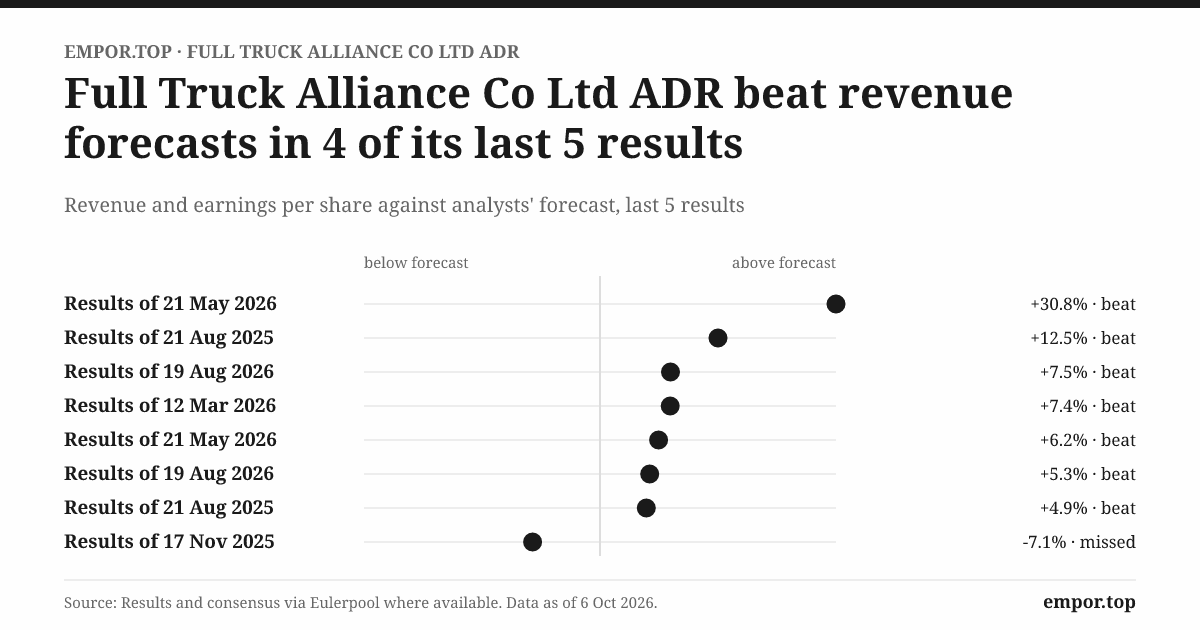
Full Truck Alliance: The Story of China's Digital Freight Marketplace That Learned to Make Money
I. Introduction & Episode Roadmap
It is five in the morning at a truck stop in Henan. A driver has just dropped a load of building materials, and the trailer behind him is empty. In the old China of road freight, that empty trailer was the start of a bad day. He would drive to a freight yard, stand among dozens of other drivers in front of a chalkboard or a noticeboard of paper slips, haggle with a broker over a load going roughly in his direction, and often take a poor price because the alternative was to drive home empty and earn nothing. Diesel, tolls and his own hours would burn away on the "empty miles."
Now he opens an app on his phone. Before he has left the depot, a list of loads heading back toward his home province is on the screen, with prices, shipper ratings and pickup times. He taps one, and the empty miles become paid miles.
That small tap is the business of 满帮集团 Full Truck Alliance (FTA), the company behind the 运满满 Yunmanman and 货车帮 Huochebang apps. It is one of the largest digital freight marketplaces in the world, built in the most fragmented trucking market on earth. And over the past five years it has written one of the more unusual turnarounds among Chinese internet listings: from deep losses to a business that now keeps more than forty cents of operating profit from every dollar of revenue in its best quarter.
The headline numbers make the case vivid. Over the last twelve months, FTA booked about $1.8bn of revenue1. In the quarter to June 2026, its operating margin reached about 44%, against a loss of roughly 82 cents on every dollar of revenue in 202112. The stock market values the company at about $8.8bn, but because it sits on an enormous pile of cash and investments, its enterprise value, the price of the operating business alone, is only about $5.3bn.
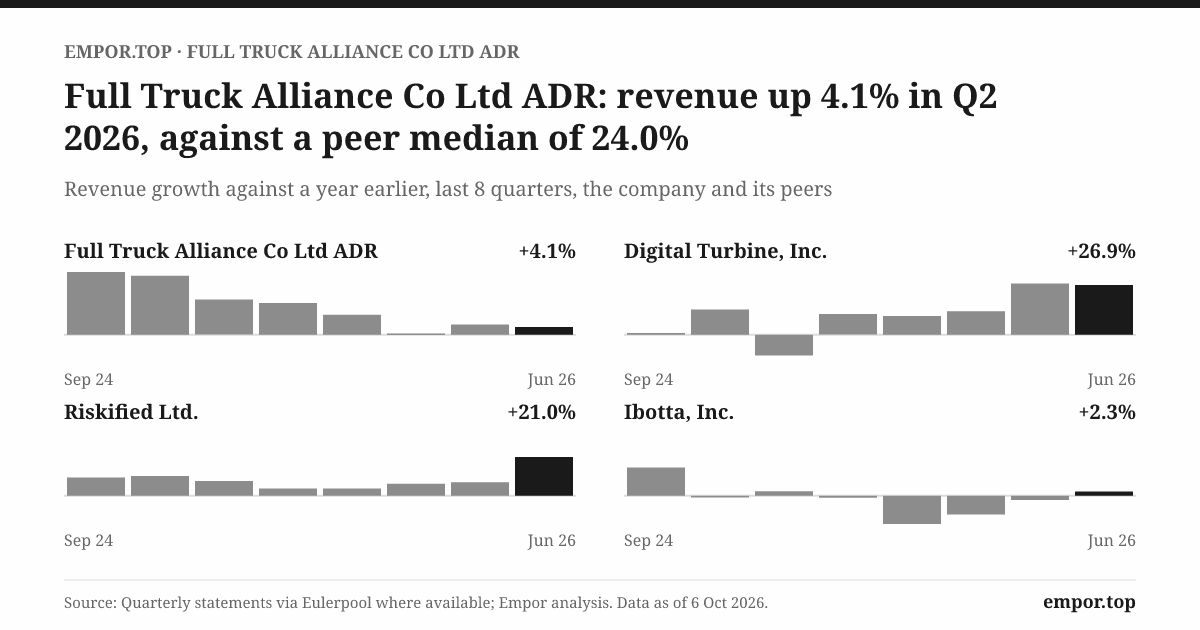
Here is the tension that runs through this story. The profit is rising much faster than the business. Revenue grew about 4% in the latest quarter1. Operating profit grew about 30%. A company can do that for a while by changing what it sells and how much it keeps. It cannot do it forever.
Before going further, it helps to know what investors actually own. FTA is a Cayman Islands holding company. Its American depositary shares (ADSs) trade on the New York Stock Exchange, and each ADS represents 20 Class A ordinary shares2. The Chinese operating businesses, Yunmanman, Huochebang and a smaller cold-chain arm called Manyun Cold Chain, are run through variable interest entities (VIEs), a contractual structure explained later2. Shareholders own the Cayman parent and its contracts, not the Chinese operating companies directly.
What does FTA sell? Five things, each priced differently. It charges a per-order transaction fee when a shipper and a driver close a deal on the platform. It sells freight listing memberships, a subscription that lets shippers post loads. It runs a brokerage business, where it acts as the principal on the freight contract and books the full freight price as revenue. It sells value-added services around the trucker's life. And it offers credit solutions, lending tied to the ecosystem2.
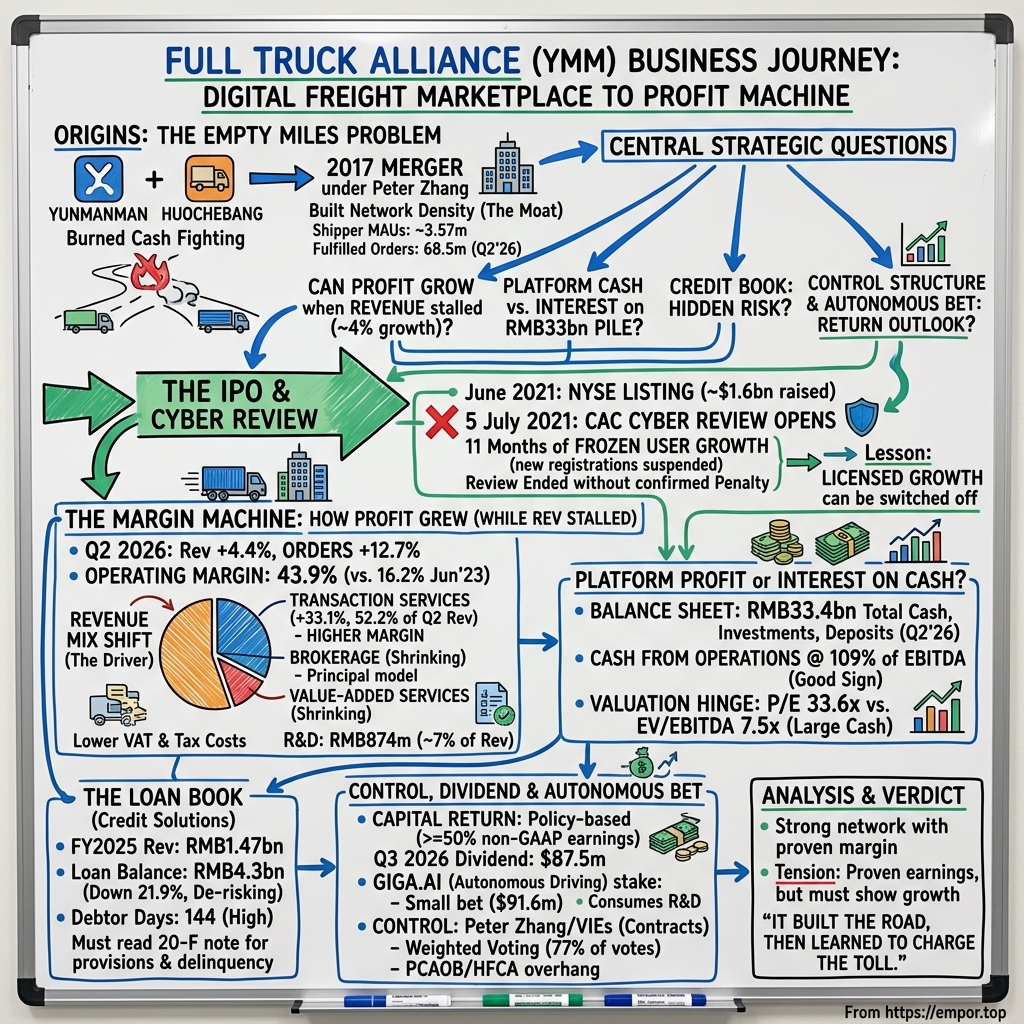
This story is organised around four questions:
- Can profit keep growing when revenue grows about 4%?
- How much of the profit is cash earned from the platform, and how much is interest on a pile of cash and investments worth about RMB33bn?
- Is the credit book a hidden risk?
- Does the control structure, or the bet on autonomous driving, change the return outlook?
To answer any of them, start where the network came from: two rivals who spent years trying to destroy each other.
 Subscribe on LinkedIn
II. Two Rivals, One Merger: Yunmanman, Huochebang and the Empty-Miles Problem
Picture China's highways in the mid-2010s. Millions of trucks, most of them owned by the person driving them. Hundreds of thousands of small factories, wholesalers and farm co-operatives needing to move goods. And in between, a layer of offline brokers, freight yards and "information departments" where loads were matched by phone calls, paper slips and personal relationships. Nobody had a clear view of where trucks were or where loads were waiting. The result was the empty-miles problem: trucks driving home without cargo, and shippers paying extra because supply was invisible to them.
That inefficiency was a prize, and two venture-funded companies went after it at the same time. Yunmanman, based in Jiangsu, and Huochebang, based in Guizhou, both built apps that let shippers post loads and drivers find them. Both understood that a marketplace like this is a winner-take-most game: drivers go where the loads are, and shippers go where the drivers are. So both did what Chinese internet companies of that era did. They spent heavily on subsidies to recruit users, fighting over the same truckers at the same stops.
The fight was expensive, and in 2017 the two merged under the founder-CEO of Yunmanman, 张晖 Peter Hui Zhang. The logic of the merger matters more than its details. Two half-networks, each subsidising users to stay, are worth much less than one full network that no longer needs to. The merger did not create new trucks or new shippers. It bought something more valuable: density. A shipper posting a load now reached nearly every active driver on either app, and a driver opening either app saw nearly every load. That density is the real asset FTA still owns.
What did the merged company look like financially in its early public years? Large, and very unprofitable. In 2020 it booked revenue of about $374m against an operating loss of about $524m2. For every dollar of revenue, it lost more than a dollar at the operating level, partly because of share-based pay and partly because it was still buying growth.
Today the network's scale shows up in two operating figures. In the quarter to June 2026, an average of about 3.6m shippers were active each month, up about 13% on a year earlier, and the platform fulfilled about 68.5m orders, also up about 13%1. Those are not the numbers of a stalling network. Volume is still growing at a double-digit rate even as revenue is not, a gap that is the subject of section IV.
A caveat belongs next to those user figures. FTA counts active shippers as registered accounts that posted at least one order, and one real business may hold several accounts2. So the headline overstates the number of distinct customers by an amount the company does not disclose.
Who competes? 货拉拉 Huolala, known abroad as Lalamove, is the best-known rival, but it built its business mainly on intra-city delivery with vans and small trucks, a different job from FTA's long-haul full-truckload matching. 滴滴货运 Didi Freight entered the same intra-city space. 京东物流 JD Logistics runs its own fleet and network, largely for JD's ecosystem and large corporate customers. And the oldest competitor of all is still alive: the offline broker with a phone and a list of trusted drivers. FTA's real competitive question is less about any one app and more about whether it keeps drawing business away from that offline layer.
How strong is the moat? The evidence for it is real but partial. Orders and active shippers keep growing, and no rival has built a comparable long-haul matching network. But the two figures that would prove the moat, how many shippers and drivers stay year after year, and how many also use rival channels at the same time, are not disclosed by the company. Drivers in particular can keep several apps on one phone at no cost. So the merger clearly bought density; whether density has become lock-in is still a claim, not a fact.
That distinction would matter the moment someone else gained the power to switch off the network's growth. In July 2021, someone did.
III. The IPO and the Cyber Review: Eleven Months of Frozen Growth
June 2021 was the high point of optimism. FTA listed its ADSs on the New York Stock Exchange that month, one of the largest Chinese technology listings of the year3. The pitch was simple: China's Uber for trucks, a dominant network in a giant, fragmented market, with losses that would shrink as scale arrived. Revenue that year grew about 80%2.
Then, days after the listing, the ground moved. On 5 July 2021, the 国家网信办 Cyberspace Administration of China (CAC) announced a cybersecurity review of the Yunmanman and Huochebang apps, and new user registrations on both were suspended24. The review was part of a wider campaign that summer, aimed at Chinese platforms that held large amounts of data and had listed abroad. For a marketplace whose value depended on continually adding shippers and drivers, it was like a shopping mall being told it could keep its existing customers but could not let anyone new through the door.
The suspension lasted almost a year. New registrations resumed on 29 June 20222. The company has not reported a penalty from the review2. During that time existing users kept trading, and revenue kept growing, but more slowly: from about 80% growth in 2021 to about 45% in 20222. Not all of that slowdown can be blamed on the review, since the economy and the platform's own maturity mattered too, but the timing is hard to ignore.
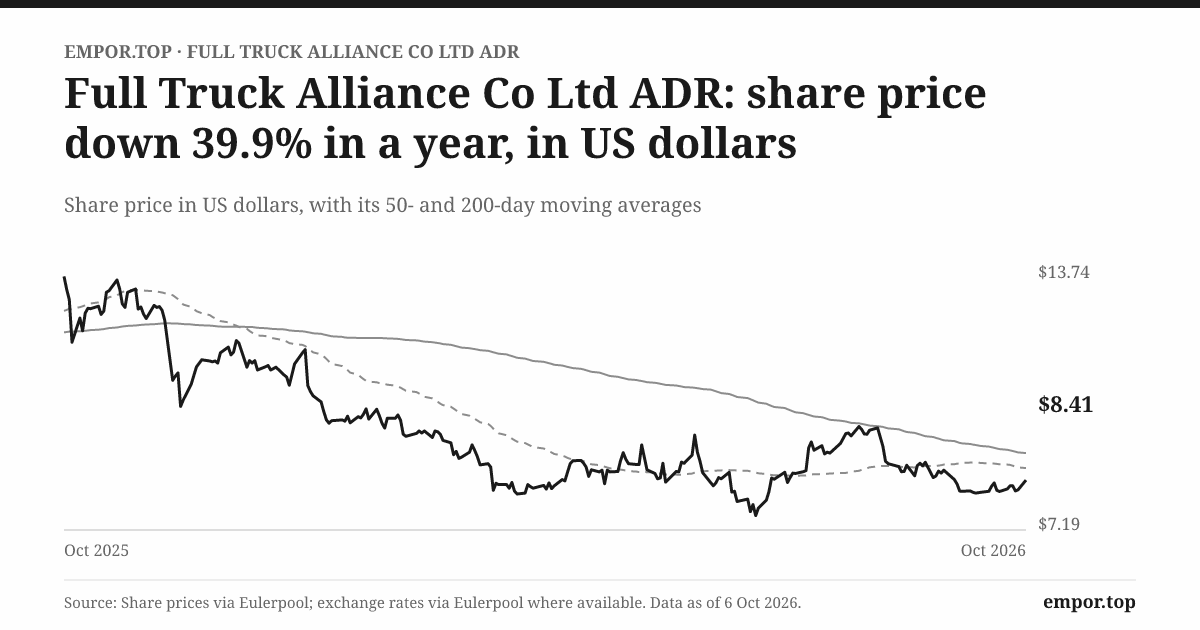
The share price told the story more harshly. From its post-IPO optimism, the stock suffered a largest fall of about 73% over the last five years, and today it trades about 40% below its 52-week high of $141. Investors who bought at the listing learned that a Chinese platform's user growth is, in an important sense, licensed by the state, not owned by the company.
The structure investors actually own
The review also drew attention to how FTA is put together. Chinese law restricts foreign ownership of internet businesses. So, like most Chinese tech companies listed abroad, FTA runs its main operations through VIEs. The two key ones, Manyun Software and Shan'en Technology, are owned 70% by Peter Hui Zhang and 30% by Guizhen Ma, a director2. The Cayman parent controls them through a web of contracts: loan agreements, exclusive service agreements and share pledges that route the economics to the listed company.
Think of it like renting a house with an exclusive, very long lease and an option to buy, rather than owning it. Most of the time the difference does not matter. It matters if the landlord, or a court, or a regulator decides the lease is not valid. The founder holds legal title to the operating companies that the shareholders depend on. That is not an accusation; it is a related-party fact with a legal-risk mechanism built in.
Control is also concentrated by design. At the end of 2025, FTA had about 18.75bn Class A shares with one vote each and about 2.10bn Class B shares with 30 votes each2. Class B is about 10% of the shares but, on that arithmetic, about 77% of the votes. Minority investors own most of the economics and very little of the say.
The auditor overhang
There was a second regulatory threat, this one from Washington. Under the Holding Foreign Companies Accountable Act, companies whose auditors the PCAOB could not inspect faced eventual delisting from US exchanges5. FTA was identified under the act, then that status was vacated after the PCAOB was able to inspect China-based audit firms in late 202262. The board can be revisited if access is withdrawn again. FTA's auditor is Deloitte Touche Tohmatsu CPA LLP, which signed the 2025 annual report and the internal-control attestation in April 20262.
Is regulatory risk behind it?
The strongest test of the claim that "regulatory risk is behind FTA" is the 2021 episode itself, and it cuts both ways. The review was serious: nearly a year without new users. But it ended, apparently without a penalty, and the platform's users and orders kept growing afterward. The honest verdict is that the risk is narrowed, not gone. A single regulator decision stopped the growth engine once; nothing in the structure prevents it happening again. The forward test is simple to watch: any new CAC or market-regulator action on the apps.
The company that came out of the review in mid-2022 was still losing money at the operating level. What happened next is the most interesting part of the story.
IV. The Margin Machine: How Profit Grew While Revenue Stalled
August 2026. FTA reported its second-quarter results, and on the surface the release looked contradictory. Revenue in renminbi rose only about 4%. Yet fulfilled orders rose about 13%, transaction-service revenue rose about 33%, and operating margin reached about 44%1. Slow growth at the top, strong growth everywhere that counts for profit. How?
The answer lies in what FTA sells, and how each line is priced.
Five ways to earn from a truckload
Start with the line that matters most. Transaction services are a fee FTA takes when a shipper and driver close a deal on the platform. It is a toll on each transaction. FTA does not carry the freight risk or book the freight price; it books only its fee. That makes it high-margin revenue. In the June 2026 quarter, transaction services brought in about RMB1.77bn, more than half of all revenue1.
Freight brokerage is the opposite kind of business. Here FTA steps in as the principal: it contracts with the shipper, hires a driver, and books the whole freight price as revenue while paying most of it out to the driver. The revenue is large and the margin is thin. A useful analogy: transaction services are like a stock exchange's trading fee, while brokerage is like a trader buying and reselling the shares. Brokerage revenue fell to about RMB1.0bn in the quarter, from about RMB1.18bn a year earlier1.
Freight listing is a membership: shippers pay to post loads. It was roughly flat, at about RMB251m1. Value-added services, which fell to about RMB369m from about RMB491m, cover services sold around the trucker's life1. And credit solutions, lending linked to the ecosystem, is the subject of section VI.
Now the puzzle resolves. When a dollar of thin brokerage revenue is replaced by fifty cents of transaction fees, revenue falls but profit rises. FTA is shifting its mix from low-margin to high-margin lines. Revenue barely moves, and profit jumps.
A warning on the annual split: the line items for 2025 as published in summary form do not add neatly to the company's reported total of about RMB12.5bn2, so the segment revenue note in the annual report is the place to check before relying on any one line.
The growth path
Look at the arc of revenue growth. It ran at about 80% in 2021, slowed to the mid-40s in 2022, sat in the mid-20s to low-30s in 2023 and 2024, and then dropped to about 11% for 20252. Across the last four quarters, it has run between almost zero and about 5.5%1. Over three years, revenue grew about 23% a year. A rate near 4% is not a gentle slowdown from that base. It is a break.
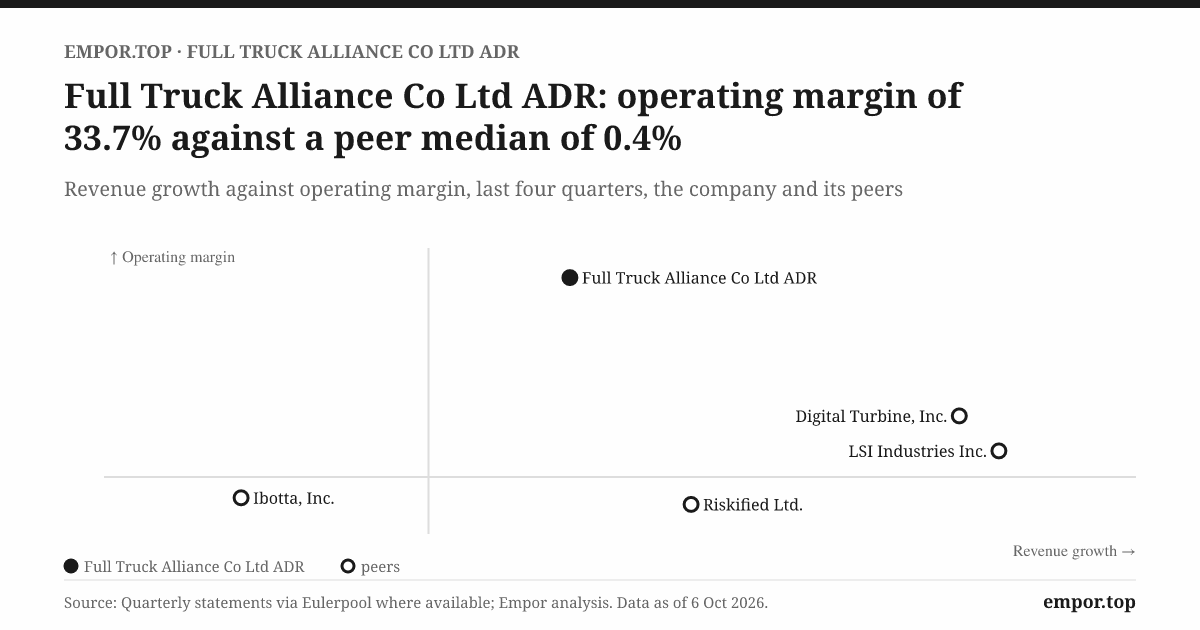
Profit tells the opposite story. Operating margin rose from about 16% in the June 2023 quarter to about 44% in the June 2026 quarter1.
Decomposing the margin
So how much of that improvement is the business model getting better, and how much is something else? The company gives two answers. The first is mix: brokerage and value-added services shrinking, transaction fees growing. That is a genuine improvement in what the platform earns per order. The second is less flattering: cost of revenues also fell because of lower VAT and related tax costs1. That is an accounting and tax gain, not proof that the platform is more valuable. Tax effects of that kind can reverse, or simply stop improving.
Then there is the net-profit line. Despite the strong operating quarter, net profit attributable to shareholders grew only about 7% on a year earlier1. Part of the reason is a higher tax rate, which rose from about 12% to about 19% over the year1. The gains at the operating level are being partly given back below it.
The verdict, then, is narrower than the headline. The mix story is real and well evidenced. The tax-cost story is a one-time gift until proven otherwise. The thesis that "profit can keep growing at 4% revenue growth" is intact on mix and unproven on tax. The next quarter offers a first test: management guided third-quarter revenue to RMB3.32bn to RMB3.42bn1, which implies little or no growth on the prior year. The KPI to watch over the next four quarters is transaction-services revenue against orders, a proxy for the take rate, and operating margin with the VAT and tax effect stripped out.
What management is reinvesting
A harvest is visible in the reinvestment pattern too. Research and development ran at about RMB874m in 2025, about 7% of revenue2, and rose to about 7.7% of revenue in the June 2026 quarter, partly because the autonomous-driving unit Giga.AI is now consolidated1. Sales and marketing ran at about 13.5% of revenue in the quarter, which the company attributed to higher spending on user protection1. Capital spending is tiny: about $18m in 2025, the gap between operating cash flow and free cash flow2. This is a business that needs almost no physical investment to grow. It does need to keep users safe and loyal, which is why the sales-and-marketing line is worth watching.
The mix shift also explains why brokerage shrinks: management is steering shippers toward matching directly with drivers on the platform rather than through the company as principal. That is strategically sensible. But mix shift is finite. Once brokerage is a small share of revenue, the lever stops working, and growth has to come from more orders and a higher fee per order.
Which raises the next question. If FTA's operating profit is about $577m a year, why is its profit before tax so much larger?
V. Platform Profit or Interest on a Pile of Cash?
Open FTA's balance sheet and the first thing that hits you is how much of it is money. At the end of June 2026, cash, investments and deposits totalled about RMB33.4bn1, roughly $4.7bn at current rates. Set that against a market value of about $8.8bn and the conclusion is startling: more than half of what investors pay for the stock is cash and investments, and the operating business is valued at only about $5.3bn.
Then look at the income statement. In 2025, operating profit was about $577m, but profit before tax was about $750m2. That gap of about $170m, roughly a fifth of pre-tax profit, is mainly interest and investment income on the cash pile.
Why does this matter? Because the two kinds of profit deserve very different prices. Platform profit can grow as the network grows. Interest income grows only if the pile grows or rates rise, and it shrinks when rates fall or the pile is paid out. Chinese interest rates have been falling. An investor paying 33 times earnings is paying a platform multiple for profit that is partly a bank deposit's.
Does the profit arrive as cash?
Here the record is reassuring, and it is the strongest evidence in the bull case. Over the last three years, cash from operations ran at roughly 94%, 116% and 109% of EBITDA2. In 2025, operating cash flow of about $644m exceeded net profit of about $613m2. In the June 2026 quarter, operating cash flow was about RMB2.15bn against net income of about RMB1.35bn1. The profit is real money.
A seven-year comparison shows operating cash many times larger than cumulative net profit. That figure flatters the business: the loss years were inflated by non-cash share-based pay, which depressed reported profit without consuming cash. The recent three-year record is the clean test, and it passes.
One reason cash runs ahead of profit is that receivables have been shrinking relative to revenue. Debtor days, the number of days of revenue sitting in receivables, peaked at about 248 in 2022 and fell to about 144 in 20252. As that ratio fell, cash was released. But 144 days is very high for a marketplace that collects a fee per order. A pure toll collector should collect within days. The explanation sits mostly in the credit book, the subject of the next section.
Trapped or free?
FTA earns in renminbi and reports in dollars. Chinese exchange controls limit how freely renminbi held inside China can be moved offshore to pay dividends or buy back ADSs2. The company's annual report warns of these limits but its summary disclosures do not break out how much of the RMB33bn sits inside China versus offshore in dollars or Hong Kong dollars.
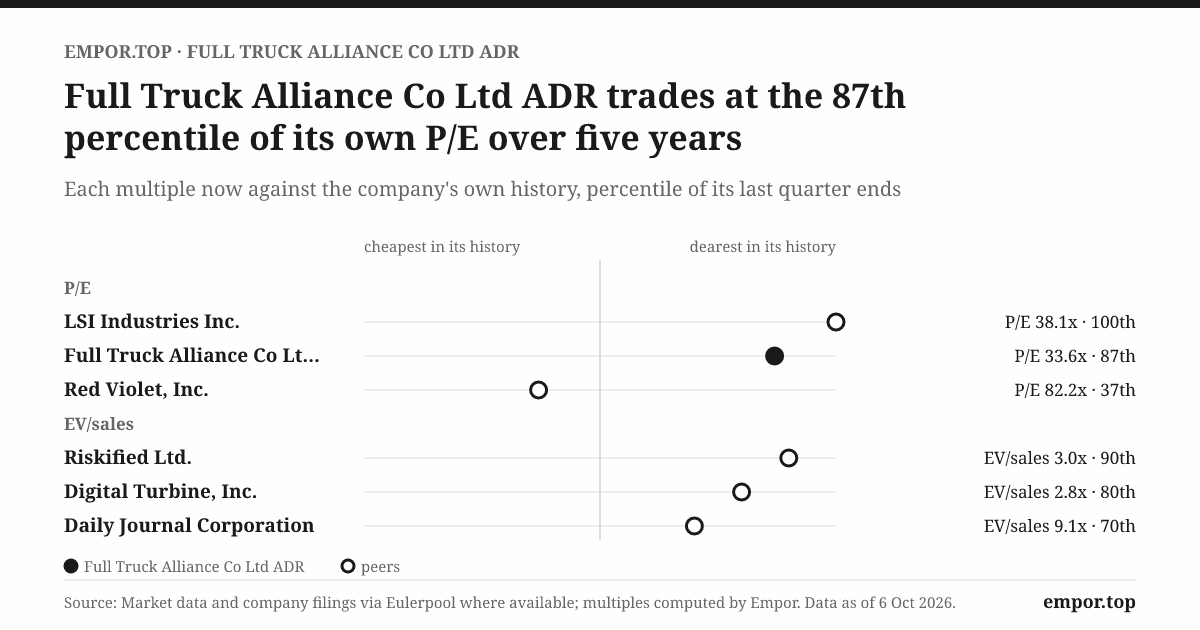
That split is the hinge of the valuation. On P/E, FTA looks expensive at about 33.6 times earnings, against a five-year median of about 23.7 times1. On EV/EBITDA, it looks cheap, at about 7.5 times, because the cash pile is subtracted1. Which number is right? If the cash is freely available to shareholders, the low enterprise multiple is the better guide. If much of it is effectively trapped in China, earning modest interest, then the market is right to treat it as worth less than face value, and the P/E is closer to the truth.
The honest conclusion: FTA's platform profit is real and converts well into cash, but roughly a fifth of pre-tax profit is treasury income that will not grow with the network, and the accessibility of the cash pile is the single most important unknown in the valuation.
Part of that cash, though, is not sitting in deposits. It is lent out to truckers.
VI. The Loan Book Nobody Asks About
A driver in Shandong needs fuel for a long run and a new tractor unit to replace an ageing one. He does not have a credit history a big bank would recognise. But he has two years of trip history on the FTA app: loads accepted, routes driven, payments received. That data is a credit score of a kind, and FTA uses it. Through its credit-solutions business, the platform helps finance drivers and shippers, often alongside partner lenders.
Credit solutions brought in about RMB1.47bn of revenue in 20252. That is a meaningful line, larger than listing fees and not far behind value-added services.
The size of the book is shrinking. The outstanding loan balance fell about 22% to roughly RMB4.3bn, according to the June 2026 results1. That figure is the credit-solutions book, not the company's own borrowings: FTA's corporate debt is close to nil, about $4.9m against about $5.6bn of equity at the end of 20252. In other words, the balance sheet risk is not in what FTA owes. It is in what FTA is owed.
Why it matters
Lending within an ecosystem is attractive in good times. It ties drivers more tightly to the platform, earns interest margins, and uses data nobody else has. But it carries a classic trap: the borrowers are all exposed to the same thing. When Chinese freight demand weakens, loads dry up, rates fall, and many drivers struggle at once. Defaults rise together, exactly when the platform's other revenue is also under pressure. A freight marketplace with a loan book is a freight business with a leveraged bet on freight.
The high debtor-day figure from the last section fits this picture. A per-order marketplace should carry small receivables; a lender carries large ones. FTA's receivables look like a lender's.
The adequacy of provisions, how much the company has set aside for expected losses and how many loans are overdue, is set out in the credit-loss allowance and loan-ageing notes of the annual report; the quarterly results do not report a delinquency rate. FTA has no published credit rating for the parent, so there is no outside agency's view to lean on.
What can be concluded? Two things. First, management appears to be de-risking: the book shrank by more than a fifth in a year while transaction revenue boomed, which suggests lending is no longer a growth engine. Second, the shrinking book removes one source of earnings growth. Credit revenue is unlikely to rise with a smaller book. The risk to earnings is bounded by the book's size, about RMB4.3bn against a cash pile almost eight times larger, but the trend in delinquencies in the next annual report is the figure that settles it.
A company with that much cash, that little debt and a shrinking loan book faces the oldest question in capital allocation: what to do with the money. FTA's answer has been shaped by the man who controls it.
VII. The Founder, the Dividend and the Autonomous-Driving Bet
In April 2024, FTA did something it had never done: it paid a dividend. About $150m went to shareholders, based on 2023 results2. For a company that three years earlier had been burning hundreds of millions a year, it was a statement that the subsidy era was over.
The payments grew. Dividends paid were about $148m in 2024 and about $198m in 2025, roughly a third of net profit each year2. In 2025 the company paid two semi-annual dividends2. Then it formalised a policy: return at least half of non-GAAP earnings each year through dividends and buybacks. For 2026 it planned about $400m in total returns, at least $300m of it as quarterly dividends and the rest through open-market buybacks2. With its second-quarter results, the board declared a dividend of $0.084 per ADS, about $87.5m1.
This is management credibility shown through behaviour rather than words. FTA said it would return cash, and it did, at rising amounts. That is the strongest evidence of discipline in the record.
The man in control
Peter Hui Zhang has led the business since the merger and controls it through the 30-vote Class B shares. His exact economic stake, the board's independence and executive pay are set out in the annual report; as a foreign private issuer, FTA files no US proxy statement and holds no say-on-pay vote. The combination of founder voting control, founder legal title to the VIEs and no say-on-pay vote means minority shareholders rely heavily on the founder's own judgement. So far, on capital return, that judgement has served them.
The skeptic's stress test
Now push on it. About $400m a year in returns is about 4.5% of the market value. That is sustainable while net profit runs around $600m and the cash pile sits at more than $4bn. But if revenue stays near 4% growth and the tax gains fade, the payout ratio will rise. A skeptical activist would also ask a sharper question: with the stock about 40% below its 52-week high, at $8.41, would buying back stock create more value than paying dividends? Buybacks at a depressed price shrink the share count permanently; dividends do not. FTA's mix leans toward dividends.
And the capital raised in 2021 has largely stayed on the balance sheet, now held as about $3.7bn of investments2. Retaining that much cash is a choice, not a law of nature.
The autonomous-driving bet
Then there is the bet that consumes some of the profit. In July 2025, FTA began consolidating Giga.AI Technology, formerly Plus PRC Holding, an autonomous-driving unit it owns a majority of2. It also holds a stake of about 17% fully diluted in Plus (US), for which it paid about $91.6m2.
Why give this any space at all, against $1.8bn of revenue? Because if self-driving trucks become practical in China, the long-run cost of moving freight, and the role of a platform that matches human drivers to loads, could change. And because the bet already shows up in costs: Giga.AI's consolidation pushed up R&D spending in 20261, R&D that would otherwise fall to profit.
But technical capability is not revenue. Autonomous trucking companies around the world have spent years producing pilots and demonstrations that did not become commercial businesses at scale. FTA has no record of converting autonomous-driving milestones into revenue, and Giga.AI should be viewed as a cost centre and an option, not a business, until it reports sales. The yearly losses of Giga.AI, disclosed in the annual report, are the number to watch against the R&D line.
A smaller related investment rounds out the picture: FTA invested about RMB323m for a 72.6% stake in the Yushi Fund, accounted for by the equity method, and took about RMB15m as its share of the fund's loss in 20252. It is small relative to the whole, but it is another sign that cash is being put to work in side bets.
The verdict on this section: capital return is real and policy-based, which is the best evidence that the founder's control has not been used against minorities. The autonomous bet is small, unproven and a drag on margins, and investors should treat it that way.
Before weighing bull against bear, it is worth drawing out what FTA's story teaches.
VIII. Playbook: Business & Investing Lessons
A network wins by merging, not by outspending. In 2017, Yunmanman and Huochebang had both spent heavily to win truckers who could use either app for free. Neither won the subsidy war. The merger did. For founders, the lesson is that in a two-sided market, the rival with half the network is often worth more as a partner than as a corpse. For investors, it is that a subsidy war tends to end in consolidation, and the consolidator inherits density that no amount of spending could have bought.
Licensed growth can be switched off in a day. On 5 July 2021, a single announcement stopped FTA adding new users for almost a year. The network survived, but investors learned that in China, the right to grow is granted, and the granting party has interests of its own. Price that risk not as a past event but as a standing option held by the state.
Profit that comes from mix is a one-time gift. FTA's margin leap came largely from shrinking low-margin brokerage and growing high-margin transaction fees, plus lower tax costs. That is real value, but it is a step, not a slope. Once the mix has shifted, the gift has been given. The next leg of profit growth has to come from more orders and higher fees, and those are the numbers that tell an investor whether the margin machine has a second gear.
Read cash flow beside net profit, and the interest line beside both. FTA's profit turns into cash, which is good. But about a fifth of pre-tax profit comes from interest on a renminbi cash pile, which is not a platform business at all. When a company's cash is a large share of its market value, the question is not only how much cash there is, but where it is and who can reach it.
Control without ownership is a promise written in contracts. FTA's shareholders own the Cayman parent; the founder holds legal title to the Chinese operating companies and most of the votes. The arrangement has worked, and the dividends prove the founder has shared the spoils. But the protection minorities enjoy is contractual and behavioural, not legal ownership. In the VIE world, the founder's character is part of the balance sheet.
IX. Analysis & Bear vs. Bull Case
Put two quarters side by side. In the June 2024 quarter, revenue grew about 34% and operating margin was about 20%1. Two years later, in the June 2026 quarter, revenue grew about 4% and operating margin was about 44%1. Same company, same network, two entirely different stories. One is a growth platform. The other is a harvest. Which is FTA?
The return figures help frame it. Return on equity was about 10% over the last twelve months, held down by the large cash pile sitting in equity1. Return on invested capital, which strips the cash out, was about 20%1. That gap is the whole story in one comparison: the operating business earns high returns, but the shareholder's capital, much of it in cash, earns modest ones.
Porter's Five Forces
Rivalry among competitors. Moderate. In long-haul full-truckload matching, FTA has no rival of comparable scale. Huolala and Didi Freight focus mainly on intra-city delivery, and JD Logistics serves its own ecosystem. The fiercest competition is the offline broker, which is fragmented but persistent.
Threat of new entrants. Low to moderate. A new app faces the same chicken-and-egg problem that cost Yunmanman and Huochebang years of subsidies. But a well-funded platform giant could try, and regulators may welcome competition.
Bargaining power of buyers (shippers). Low individually, since shippers are small and numerous and no single customer concentration is disclosed. Collectively their power shows up in price sensitivity: they will not pay much more for matching than they would to a broker.
Bargaining power of suppliers (drivers). Meaningful. Drivers can use several apps and offline brokers at once at no cost. FTA's toll depends on its loads being better than the alternatives.
Threat of substitutes. Moderate. Large shippers can build in-house logistics or use contract carriers. In the long run, autonomous trucking fleets owned by others could bypass a matching platform altogether, which is part of why FTA holds its own bet.
Helmer's 7 Powers
Network economies are FTA's main power. Each added shipper makes the app more useful to drivers, and each added driver makes it more useful to shippers. The evidence: orders and active shippers still growing at double-digit rates1. The missing evidence: retention and multi-homing, neither of which the company discloses.
Scale economies support it. A platform with tiny capital spending and very high incremental margins spreads its fixed technology costs over more orders each year.
Switching costs are weak, at least for drivers. A driver can change apps in seconds. Shippers using memberships and integrated tools face somewhat more friction.
Counter-positioning helped in the past: offline brokers could not match a free, instant digital marketplace without giving up their margins. That advantage is now largely spent.
Cornered resource is arguably FTA's trip data, years of history on routes, prices and driver behaviour that underpins pricing and credit decisions.
Branding and process power play small roles.
The verdict on the moat: strong network economies and scale, weak switching costs, and a regulatory overlay that can override both. A strong network with proven margins, but a moat not yet proven by retention data.
Peers
FTA has no close listed peer in China doing exactly what it does. Listed logistics companies such as JD Logistics carry physical assets and thin margins, so their multiples are not comparable. The most useful comparison is FTA against its own history: a P/E of about 33.6 times against a five-year median of about 23.7 times1. On earnings, the market is paying more than usual, perhaps because it trusts the margin. On enterprise value, it is paying little, perhaps because it doubts the cash. The market appears to assume either that platform profit keeps compounding or that the cash is partly trapped, and the two assumptions point in opposite directions.
The three KPIs that matter
- Fulfilled order growth. Latest reading: about 13% in the June 2026 quarter1. This is the health of the network itself. If it slows to the revenue rate, the harvest story wins.
- Transaction-services revenue against orders, a proxy for the take rate. Transaction services grew about 33% against about 13% order growth1, implying a rising fee per order. Whether that continues is the core of the margin case.
- Operating margin excluding VAT and tax effects. The reported reading is about 44%1. The underlying number is what tells investors whether the margin machine is improving or whether a tax gift is fading.
The bull case
FTA has the dominant long-haul freight network in the world's largest trucking market. Its margins have risen above 40% at the operating level, its profit converts fully into cash, it carries almost no debt, and it returns hundreds of millions of dollars a year to shareholders under a stated policy. Strip out the cash pile and the operating business trades at a single-digit multiple of EBITDA. Orders still grow at double digits, and the fee per order is rising.
The bear case
Revenue growth has collapsed to about 4%, and guidance for the third quarter implies roughly flat revenue. Net profit grew only about 7% in the latest quarter. Part of the margin gain came from lower tax costs that may not repeat, and the mix shift away from brokerage is a lever with a natural limit. A fifth of pre-tax profit is interest on cash that may be hard to move offshore. The loan book is a cyclical risk tied to the freight economy. And over all of it sit risks the company cannot control: a regulator that has already frozen growth once, a VIE structure whose legal standing depends on Chinese authorities, a US audit regime that could change, and a founder who controls three-quarters of the votes.
The case, in the end, turns not on volume but on take rate and the tax effect. If the fee per order keeps rising while the tax tailwind fades without hurting margin, FTA is a toll road. If not, it is a harvest.
X. Epilogue
Tonight, FTA stands as a company that has solved one problem and not yet the other. It has proved it can make money: operating margin in the mid-forties, profit that turns into cash, a balance sheet thick with renminbi. It has not yet proved it can grow.
The next chapters are already scheduled. The first arrives with third-quarter results, measured against guidance of RMB3.32bn to RMB3.42bn1. A result at the top of that range, with order growth holding in double digits, would suggest revenue has found a floor and the mix shift is giving way to real growth. A result at the bottom, with orders slowing, would tell investors the network itself is maturing.
The second chapter runs across the next four quarters. As the VAT and tax benefit laps itself, the operating margin either holds or slips. If it holds while transaction fees keep rising faster than orders, the answer to the first central question is yes: profit can grow without much revenue growth, for a while longer. If it slips, much of the 2025–26 margin leap will be revealed as a one-time gift.
The third chapter is quieter but just as telling: the next annual report's loan note, showing delinquencies and provisions on the credit book. A clean note would close the third question. A rising delinquency rate in a weak freight economy would open it wide.
The fourth is Giga.AI. Each year its losses will appear in the filings beside FTA's R&D spending. A shrinking loss, or the first real revenue, would turn the autonomous bet from a drag into an option. A growing loss would confirm it as a tax on the core business.
And in the background sit the two regulators who have already shaped this story: Beijing's cyberspace watchdog, which can freeze user growth, and the PCAOB, whose access to Chinese auditors keeps FTA's US listing on solid ground. Neither has a scheduled date. Both have a vote.
The tension that remains is the one this story began with. FTA has learned to charge for the network it built. What it must show next is that the network still has room to grow.
XI. Outro
Back at the truck stop in Henan, the driver has his load. The trailer is full, the empty miles are paid, and somewhere in the cloud a small fee has moved from a shipper's account to FTA's. Multiply that moment by tens of millions of orders a quarter and you have a business with a 44% operating margin, built from the inefficiency of China's roads.
But the driver does not care whether FTA grows. He cares whether the next load is there. As long as it is, the toll keeps flowing. The question for investors is whether the road gets any longer. It built the road, then learned to charge the toll.
References
-
Full Truck Alliance Announces Second Quarter 2026 Unaudited Financial Results — PR Newswire, 2026-08-19 ↩↩↩↩↩↩↩↩↩↩↩↩↩↩↩↩↩↩↩↩↩↩↩↩↩↩↩↩↩↩↩↩↩↩↩
-
Full Truck Alliance 2025 Form 20-F extract — StockTitan, 2026-04-14 ↩↩↩↩↩↩↩↩↩↩↩↩↩↩↩↩↩↩↩↩↩↩↩↩↩↩↩↩↩↩↩↩↩↩
-
Cyberspace Administration of China — official site (cybersecurity review notices) ↩
-
SEC — Holding Foreign Companies Accountable Act and conclusive list ↩
 LinkedIn
 WhatsApp
 Reddit
 Hacker News
 Email
Email Kindle
 RSS Feed
 Spotify
 Apple Podcasts
 Amazon Music
 Audible
 YouTube