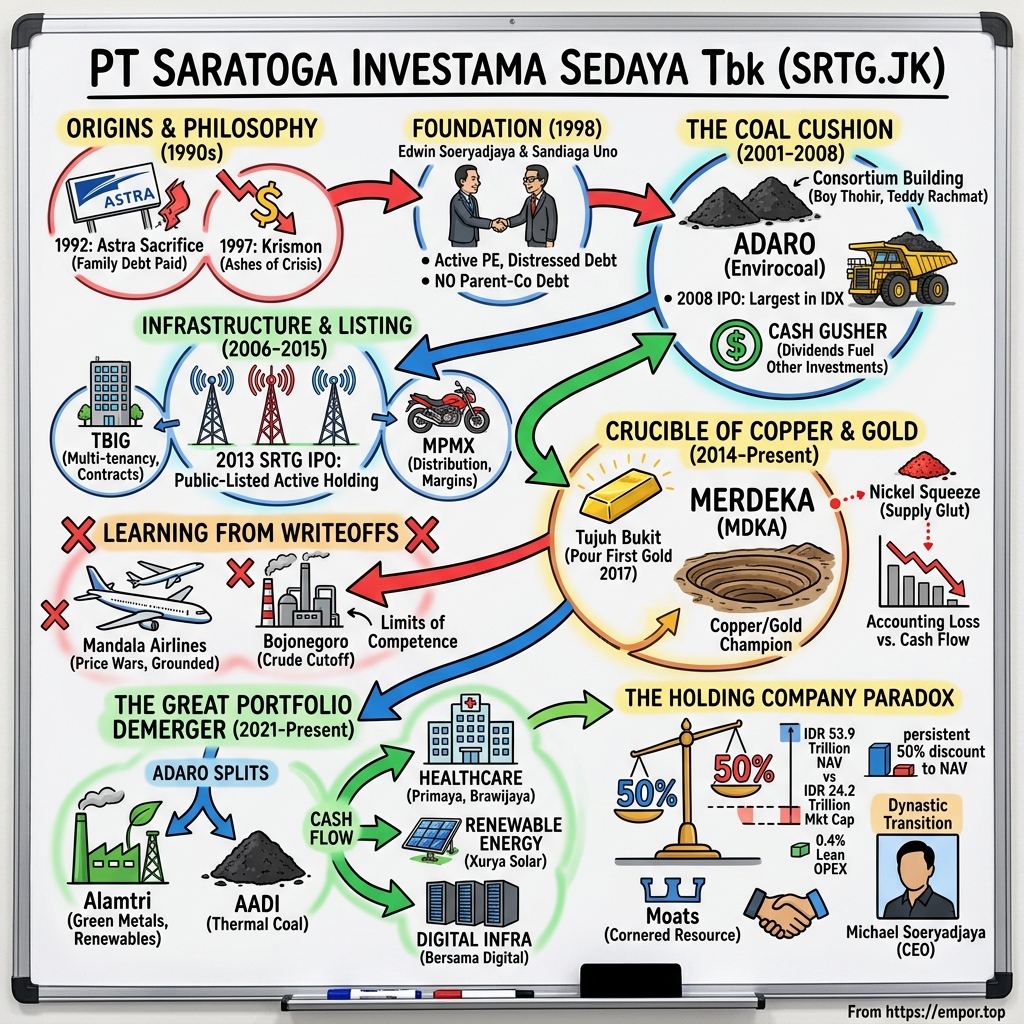
PT Saratoga Investama Sedaya Tbk (SRTG.JK): The House of Rebirth and the Fifty-Percent Discount
I. Introduction & Episode Roadmap: The Holding Company Paradox [00:00 – 14:00]
On 26 June 2013, a new ticker lit up the boards of the Indonesia Stock Exchange in Jakarta: SRTG.1 Saratoga Investama Sedaya had sold 430.9 million new shares at Rp5,500 each, and in doing so became something Indonesia had rarely seen: a listed company whose whole business was owning pieces of other businesses and actively steering them.1 Behind the listing stood two men from very different worlds. Edwin Soeryadjaya was the second son of William Soeryadjaya, the founder of Astra International, who had lost that empire two decades earlier. Sandiaga Uno was a young financier who had learned deal-making in North America and come home into the wreckage of the Asian financial crisis.2
The story the founders told was simple. Saratoga had found distressed Indonesian assets nobody wanted, rebuilt them with trusted partners, and listed several of them. Now outside investors could own a slice of the machine that made those deals.
The market's answer has been just as consistent, and much less flattering. It has priced Saratoga's shares well below the value of the stakes it holds.
Here is the puzzle in numbers. At the end of 2025, Saratoga reported net asset value, or NAV, of about Rp60.3 trillion. That is the marked value of its portfolio minus its debts.1 In June 2026 the shares traded around Rp1,435.3 Across roughly 13.6 billion issued shares, that put a market value of about Rp19.5 trillion on the company.13 So the market valued the whole house at about a third of what management says its contents are worth. The usual line about a "fifty-percent discount" understates the current gap.
Why would anyone sell a rupiah of listed coal, copper, tower and hospital equity for 30-odd sen? The obvious answer is that the holding company is bloated. That answer does not hold up. Saratoga's borrowings fell to about Rp1.45 trillion at the end of 2025, and management put its loan-to-value ratio at 0.8%.1 Directors and commissioners together were paid about Rp35 billion. That is a rounding error against a Rp60 trillion portfolio.1 This is not a conglomerate drowning in debt or perks.
The real answer has three parts, and this story tests each one in turn. First, control. Edwin Soeryadjaya, his family vehicle PT Unitras Pertama and Sandiaga Uno together held about 89% at the end of 2025. Foreign institutions held under 3%.1 Second, volatility. Reported profit swung from a Rp10.2 trillion loss in 2023 to a Rp7.3 trillion profit in 2025. It then went back to a Rp3.9 trillion loss in the first half of 2026.14 Third, substitution. Most of what Saratoga owns trades on the same exchange, so an investor who wants Adaro or Merdeka can simply buy it directly.
The roadmap follows the outline's ten acts: Astra's fall and Saratoga's birth in the ashes of krisis moneter; the Adaro coal coup; towers, wheels and the 2013 listing; Merdeka's gold and the nickel squeeze; the graveyard of failed bets; Sandiaga's exit into politics and Michael Soeryadjaya's succession; the great portfolio demerger; the moat debate; lessons; and the epilogue.
The working verdict going in: Saratoga is a lean allocator with an authentic deal-sourcing network. Its public shareholders, however, are paid mainly in dividends and NAV growth, not in a narrowing discount. Whether that bargain is good depends on a story that starts with a family losing everything.
 Subscribe on LinkedIn
II. The Fall of Astra and the Ashes of Krismon (1992–1998) [14:00 – 28:00]
A father pays his son's debts
In the early 1990s, William Soeryadjaya was one of the most admired industrialists in Indonesia. Astra, the company he had built from a small trading house, assembled Toyotas, distributed Honda motorcycles and sold heavy equipment across the archipelago. Then Bank Summa failed. It was a bank run by his eldest son, Edward, and it had expanded aggressively into property lending. William chose to honour the bank's obligations, and he did it by selling the family's controlling stake in Astra.2
By late 1992, control of the crown jewel had passed to other hands. Edwin, the second son, had worked inside Astra for years. He watched the family's life's work go out the door to pay for a bank most of them had not run.2
Hold onto that image, because it explains almost everything Saratoga later did with its balance sheet. The Soeryadjayas did not lose Astra because Astra was a bad business. They lost it because a related entity's debts could reach into the parent's equity. The lesson they drew was blunt: keep each asset's liabilities in its own box, and keep the box at the top nearly empty.
Krismon and a young banker's reset
Five years later the whole country got the same lesson at scale. The 1997–98 Asian financial crisis, known locally as krisis moneter or krismon, collapsed the rupiah. Dollar debts across corporate Indonesia became unpayable overnight. Banks failed in waves, and good assets went to whoever had cash and nerve.
Sandiaga Uno had been working in finance overseas. When his employer was hit by the crisis, he came home. In 1998 he and Edwin founded Saratoga.25 The pairing worked on paper. Edwin brought a famous name, decades of relationships across the Astra diaspora, and a family's hunger to rebuild. Sandiaga brought corporate-finance technique: restructuring debt, structuring consortia, and talking to foreign creditors in their own language.
Their opening was distressed advisory and principal investing. Foreign capital was fleeing Indonesia. Domestic owners were trapped under dollar loans. Assets with real long-term value, especially natural resources with dollar-priced output, could be bought from creditors who mostly wanted out.
The operating philosophy
From the start, Saratoga said it would not be a passive fund. It would assemble partners, take board seats, professionalise management, and let each investee carry its own debt without guarantees from the parent.5 Twenty-seven years later, the balance sheet shows that rule has largely held. Holdco borrowings at the end of 2025 were small against the portfolio, and most fall due between 2028 and 2029.1
There is a caution here. The no-debt-at-the-top discipline protects Saratoga from a forced sale. It does not protect it from volatility, as the 2023 loss would later show. A fortress built against contagion is not the same as one built against commodity cycles.
The first test of the philosophy was a coal concession in South Kalimantan that almost nobody could buy cleanly.
III. The Adaro Coup: Rebuilding an Empire on "Envirocoal" (2001–2008) [28:00 – 46:00]
The coal nobody could untangle
Deep in South Kalimantan sat a deposit of thermal coal with an unusual selling point. It had very low sulphur and ash, and its owners marketed it as "Envirocoal" to power plants that wanted to burn cleaner fuel. The geology was world-class. The capital structure was a mess. Through the early 2000s, ownership of PT Adaro Indonesia was tangled in creditor claims and shareholder litigation left over from the crisis years.6
That mess was exactly Saratoga's kind of opportunity. Edwin and Sandiaga built a domestic consortium to buy out contested stakes and refinance the concession. The partners included Garibaldi "Boy" Thohir, a coal and trading entrepreneur, and T.P. "Teddy" Rachmat, a long-time Astra executive close to the Soeryadjaya family.26
Was this operating genius or deal-making arbitrage? Mostly the latter at the start, and that is not an insult. In crisis-era Indonesia, the scarce skill was getting a credible, well-connected and financeable group around one table. The consortium then turned the asset into an integrated machine: mine, haul road, barging, and transshipment. That integration is what pushed Adaro down the global cost curve.
The IPO that funded everything
In 2008, Adaro Energy listed on the Indonesia Stock Exchange in what was then the largest IPO in the exchange's history.6 For Saratoga, the listing did two things. It gave the stake a public market price. It also created a dividend stream that would fund the next fifteen years of investing without new Saratoga shares or holdco debt.
The scale of that stream in 2025 showed what the coup had built. Saratoga's biggest single dividend payer was Alamtri, the renamed Adaro parent, at about Rp1.5 trillion. Adaro Andalan, the spun-out coal miner, added about Rp0.6 trillion. Together they made up roughly four-fifths of Saratoga's Rp2.7 trillion total dividend income.1
The entity boundary
Precision matters here. The pits, barges and power plants belong to Adaro and its successors, not Saratoga. Saratoga owns a minority economic interest, much of it held through shared consortium vehicles such as Adaro Strategic Capital and Adaro Strategic Lestari. It receives its proportional dividends and books the fair-value change of its shares through profit or loss.1
That structure has two consequences investors must hold together. First, those vehicles count as related parties. In 2025, related-party dividends were about Rp2.5 trillion, and at year-end Saratoga was still owed about Rp0.7 trillion in declared but uncollected dividends, mostly from three Adaro-linked payors.1 Second, Saratoga's cash income depends on decisions taken in boardrooms it shares rather than controls.
The Adaro coup proved the playbook. It also created the dependency the rest of this story keeps running into. Next came the attempt to repeat the trick in businesses that did not dig anything out of the ground.
IV. Towers, Wheels, and the 2013 Listing (2006–2015) [46:00 – 62:00]
Steel in the sky
By the mid-2000s, Indonesia's prepaid mobile boom was in full swing. Every operator was racing to cover the archipelago, and many were building their own towers, which duplicated each other's capital spending. The insight behind Tower Bersama was the same one that made American Tower famous. A tower is a piece of real estate in the sky. Build it once, rent it to several operators, and each new tenant is almost pure margin.7
Saratoga backed Tower Bersama Infrastructure alongside telecom entrepreneur Sakti Wahyu Trenggono.7 The analogy for listeners is an office building signed to long leases. The landlord's revenue is contracted for years. The economics improve every time another floor is let without a new building going up.
Tower Bersama grew from a startup into one of Indonesia's largest independent tower companies and listed in 2010.7 For Saratoga it became the counterweight to coal: contracted rupiah income from telecom operators rather than a commodity price. It is still a dividend contributor, with about Rp0.2 trillion paid to Saratoga in 2025, and its share price produced a fair-value gain that year.1
Wheels and the margin trap
Not every non-commodity bet behaved like a tower. Mitra Pinasthika Mustika (MPMX) began as a motorcycle distribution and auto-services business tied to Honda. It shows the opposite profile. A distributor sits between a powerful manufacturer and price-sensitive buyers, so its margin is whatever the brand allows.5 MPMX has still been a steady cash contributor, paying Saratoga about Rp0.3 trillion in dividends in 2025, more than Tower Bersama.1 So the lesson is not that MPMX failed. It is that it never had the pricing power of a contracted tower.
Why list the holding company?
The 2013 IPO raised long-term capital. A private equity fund must sell its assets and return cash within about ten years. A listed holdco never has to. That suits Saratoga's style of holding winners for decades.18
The first annual report after listing showed the trade-off immediately. Profit attributable to owners fell from about Rp1.8 trillion in 2012 to about Rp0.25 trillion in 2013 as portfolio marks moved. It then recovered to about Rp0.8 trillion in 2014.89 Management stressed NAV instead, which rose about a quarter in 2014 to roughly Rp22 trillion.9
That mismatch is the origin of the discount. One stock was trying to be both a coal tracker and a tower annuity, and its income statement swung with both. The mix was hard to model and easy to haircut.
The next bet would make the volatility larger and the prize larger too: a gold mine almost everyone had given up on.
V. The Gold and Battery Crucible: Merdeka Copper Gold (2014–Present) [62:00 – 80:00]
Seven hills in Banyuwangi
At the eastern tip of Java sits Tujuh Bukit, the "Seven Hills". It held a known gold oxide deposit sitting above a much larger copper-gold system deeper down. International explorers had worked it and walked away amid licensing disputes and local opposition.10 Saratoga, with Boy Thohir and other partners, backed the vehicle that became Merdeka Copper Gold. They listed it on the IDX in 2015 and poured first gold in 2017.10
The technique was heap leaching, and it is easier to explain than it sounds. Crushed ore is stacked on lined pads and a weak solution drips through it, dissolving the gold. The solution is collected and the gold is recovered. There is no big tailings dam and no milling plant. That made it cheap, fast to build and well suited to a first-production asset.
Merdeka then added the Wetar copper operation and the Pani gold project in Gorontalo, and became a multi-asset miner.10 For Saratoga, this was the best evidence yet that the playbook travelled. The team had taken a stranded concession through licensing and financing into production.
The nickel squeeze
Then came the counterweight. Merdeka pushed downstream into nickel through Merdeka Battery Materials (MBMA), which listed in 2023, and invested in Sulawesi ore and processing.10 The timing collided with a wave of Chinese-financed Indonesian nickel capacity that drove prices down hard. Merdeka's earnings suffered, and so did its share price.
Saratoga reported a loss attributable to owners of about Rp10.2 trillion in 2023, driven by mark-to-market declines in its listed holdings.1 Operating cash flow that same year was still positive, about Rp1.4 trillion.1 The paper loss was enormous. The cash loss did not exist.
Merdeka has since bounced around. In 2025 its share price contributed a fair-value gain.1 In the first half of 2026, Saratoga again booked net investment losses of about Rp4.8 trillion while its dividend and interest income rose about 31%.4
The verdict narrows the claim. Merdeka proves Saratoga can turn an exploration prospect into production. It does not prove that the group can pick the right moment to move into a processing industry dominated by Chinese cost leaders. The first claim is supported by the record. The second is still unproven, and Saratoga's NAV carries that risk.
If Merdeka is the case for Saratoga's judgement, the next section is the case against it.
VI. The Graveyard of Capital Discipline: Mandala Airlines, Bojonegoro, and Venture Write-Offs [80:00 – 98:00]
Grounded at Soekarno-Hatta
On 1 July 2014, Tigerair Mandala stopped flying.11 The airline had already died once, in 2011. Saratoga then led a revival with Singapore's Tiger Airways as a strategic partner, betting that a lean budget carrier could carve out room in Indonesia's booming air travel market.11 It could not. Lion Air and AirAsia Indonesia dominated the low-cost segment, fares were brutal, fuel was priced in dollars, and passengers switched airlines for a few thousand rupiah. Within three years, the partners pulled the plug.11
Falsification test #1: Saratoga can turn around anything. The airline record rejects that claim. Aviation offered no concession, no contract and no switching cost, nothing for active ownership to protect. Saratoga's skills of restructuring debt and installing governance cannot fix an industry where the leaders are willing to lose money longer than you are.
The refinery without crude
Falsification test #2: downstream energy margins. Saratoga also backed Tri Wahana Universal, a privately owned mini-refinery in Bojonegoro, East Java, built to process crude from nearby fields.5 The bet depended on a feedstock supply and price set largely by state actors. When those terms moved against it, the refinery's economics fell apart.5 The lesson is narrower than "never do energy". Do not build a business whose input is allocated by a regulator who owes you nothing.
The smoothing thesis
Falsification test #3: diversification smooths results. The record since 2023 is decisive here: reported profit swung sharply, including a Rp3.9 trillion half-year loss in 2026.14 The 2025 profit relied on about Rp4.1 trillion of investment gains.1 Even in 2025, Alamtri and Adaro Andalan posted large fair-value losses while TBIG and Merdeka gained.1 Towers and hospitals have not smoothed accounting earnings. They are too small next to the listed resource stakes.
The cash record is different and kinder. Dividends kept arriving through the 2023 loss and the 2026 mark-down.14 So the revised claim is that diversification smooths cash, not earnings. The KPI that would confirm or break that is dividend income per year against holdco costs.
What links the failures is clear. Saratoga wins where it holds a concession, a contract or a scarce licence. It loses where it is just another operator in an open fight. That pattern matters for the healthcare bet still to come. But first, Saratoga had to survive losing one of its founders to politics.
VII. Sandiaga's Political Pivot and the Dynastic Transition to Michael (2015–Present) [98:00 – 114:00]
The co-founder walks out the door
In 2015, Sandiaga Uno stepped back from Saratoga's management to enter public life.2 What followed was one of the most visible political careers in Indonesia. He became Vice Governor of Jakarta, ran as Prabowo Subianto's vice-presidential partner in 2019, and later served as Minister of Tourism and Creative Economy.2
The market's fear was easy to state. Campaigns are expensive. Would a co-founder holding a fifth of the company become a forced seller?
The answer, a decade later, is no. Sandiaga still held about 21.5% at the end of 2025, unchanged through that year, and the March 2026 register showed the same broad structure.112 Whatever he sold over the years, he did not dump the stock. The fear of an overhang turned out to be wrong.
Michael takes the chair
Edwin's son, Michael W. P. Soeryadjaya, became President Director and held that role in 2025.1 A second-generation chief executive at a family holding company invites a simple question: is this governance or inheritance?
The evidence is mixed but leans positive. Holdco leverage has stayed low under Michael. Borrowings more than halved in 2025.1 In June 2025 two new independent commissioners joined, taking independents to 40% of the board of commissioners.1 The 2024 accounts received an unqualified audit opinion, and KPMG-network firm Siddharta Widjaja & Rekan is the auditor.1
What minorities still cannot see
This is where an activist would push. Board and commissioner pay was about Rp35 billion in both 2024 and 2025, through a loss-to-profit swing, and the company does not break pay out by individual.1 The flat figure is modest in absolute terms. It also means the claim that "pay tracks performance" cannot be tested from outside. Related-party dividends dominate cash income, and the company does not disclose transaction-by-transaction pricing for related-party dealings.1 The remuneration resolution at the 2025 AGM passed with 99.69% approval.1 With 89% of shares held by insiders, that vote tells you little about what outside shareholders think.
The ownership matrix at year-end 2025 was Edwin at 35.9%, Unitras at 31.6%, Sandiaga at 21.5%, and foreign institutions at just 2.8%.1 Unitras was the one holder whose stake shrank during the year.1
The verdict: the succession has held, and there has been no evidence of a fire sale or of value being drained through related parties. The structure, though, gives minorities continuity, not a voice. That matters because the next act was the most important portfolio reshaping in Saratoga's history.
VIII. The Great Portfolio Demerger: Adaro's Green Split, Tower Securitization, and the Pivot to Healthcare & Solar [114:00 – 134:00]
Splitting the coal from the future
In late 2024, Adaro carried out a structural break. It spun off its thermal coal business as Adaro Andalan Indonesia (AADI), listed it separately, and renamed the parent Alamtri Resources Indonesia. Alamtri was positioned around minerals, renewable power and a planned aluminium smelter in North Kalimantan.13
The logic is a sorting machine. Many global funds cannot own thermal coal under their mandates, and many domestic yield investors want nothing else. Separate the two and each set of owners can pick its own risk.
For Saratoga, the split did not reduce coal exposure overnight. It changed the plumbing. In 2025 Alamtri was the largest dividend payer and AADI the second. Both posted large fair-value losses that same year.1 Coal still pays the bills while the transition is being built.
Towers into a platform
Saratoga and the Tower Bersama group also partnered with DigitalBridge around a regional digital-infrastructure platform. That brought in global infrastructure capital and widened the opportunity from towers toward data centres.14 It is a familiar move for a sponsor: invite a specialist fund to share the capital load and validate the valuation.
The new core sectors
Management has said the next decade's growth should come from outside commodities, mainly healthcare, renewable energy and digital infrastructure.1516 Saratoga has backed hospital platforms including Primaya and Brawijaya Healthcare, and invested in Xurya, a commercial rooftop solar developer.1517 MPMX has moved from motorcycle distribution toward auto services and used-car partnerships.5
The money trail shows how much of this is still a promise. In 2025, Saratoga received about Rp2.5 trillion of dividends and about Rp1.8 trillion from investment sales. It put about Rp2.8 trillion into new and follow-on investments.1 So the holdco is recycling cash, harvesting coal and reinvesting in growth, without new equity. That is the self-funding transition management describes.
But healthcare and solar do not yet appear among the named large dividend payers.1 Funds made up about Rp2.9 trillion of a roughly Rp60.7 trillion book of shares and securities.1 By that measure, the non-commodity pivot is still a minority of the portfolio.
Applying the juxtaposition rule: management calls this a shift beyond commodities, but resource holdings still dominated both 2025 cash income and 2025 earnings swings.1 The claim is intact but unproven. It will be confirmed when a non-resource holding becomes a top-three dividend payer, or when a healthcare exit is priced at or above its carrying value.
The demerger shows a family managing a long goodbye to coal. Whether the result deserves a smaller discount is a question of moats.
IX. Frameworks, Moats & Bear vs. Bull Case [134:00 – 152:00]
The analyst's whiteboard
Picture an investment committee in Jakarta with two columns on the whiteboard. On the left is "a rupiah of blue-chip assets for 30-something sen". On the right is "a trapped minority in a family vehicle". Both are true. The work is deciding which one is the price and which is the value.
Hamilton Helmer's 7 Powers
Cornered resource — real, but shared. Saratoga's core asset is its position inside Indonesia's consortium network: the Adaro group, Merdeka's founders and Tower Bersama's operators. The 2025 dividend book is close to a map of that network, and most of it is related-party income.1 The resource is real. It is not exclusive, though. Boy Thohir and Teddy Rachmat sit in the same rooms.
Process power — moderate. The repeatable skill is recapitalising stranded assets and getting them to listing. Adaro, Tower Bersama and Merdeka all followed that path.6107 Mandala and the Bojonegoro refinery show that the process does not work outside protected industries.115
Scale economies — weak. A holdco gains little from size except cheaper borrowing, and Saratoga barely borrows.1
Switching costs — none for shareholders. Investors can buy Alamtri, AADI, Merdeka or Tower Bersama directly on the same exchange.
Counter-positioning, network economies, branding — not applicable in any meaningful sense.
Porter's Five Forces, applied to a listed holdco
Buyers of the stock: strong. Outside shareholders hold about 11% and have no path to control, so they demand a large discount.1
Substitutes: strong. The underlying assets are mostly listed and more liquid than SRTG itself.
Rivalry for deals: moderate to high. Indonesia's family groups, including Salim, Djarum, Sinar Mas and Barito, along with global funds, compete for the same private assets.
Suppliers of capital: weak. With LTV under 1% and cash of about Rp1 trillion, banks have little leverage over Saratoga.1 There is no current PEFINDO rating to test the company's credit.18
New entrants: low at the top. Twenty-five years of relationships cannot be bought quickly.
The bull case
The first bull argument is the discount itself. On the June 2026 price, the market valued Saratoga at roughly a third of its year-end 2025 NAV.13 Even allowing for the first-half mark-downs, a large gap remained.4
The second is cash. Dividends of Rp2.7 trillion in 2025 and rising dividend and interest income in 1H 2026 dwarf a holdco cost base measured in tens of billions.14
The third is survival. Net debt was about Rp0.5 trillion, and most borrowings fall due in 2028–29.1 Saratoga will not be forced to sell into a slump.
The bear case
The first bear argument is the value trap. Management has publicly explained why it held off buybacks despite the gap.19 With 89% insider control, nobody can force the gap closed.
The second is commodity dependence. Coal, copper, gold and nickel still drive both dividends and marks, and the 1H 2026 loss showed how fast that bites.1416
The third is concentration. A few related payors account for most income, and about Rp0.7 trillion of their dividends was still receivable at year-end.1
Three KPIs that matter
Dividend income. It was Rp2.7 trillion in 2025, with 1H 2026 dividend and interest income up about 31%.14 The trend is rising.
NAV per share including distributions. NAV rose from about Rp54.0 trillion to Rp60.3 trillion in 2025, then fell back in the first half of 2026 after the marks.14
Holdco net debt and LTV. Net debt was about Rp0.5 trillion and LTV 0.8%, both falling in 2025.1
The calibrated conclusion: the moat is a network, not a structure. It earns cash reliably. It does not give minorities any lever to close the discount.
X. Playbook: Business & Investing Lessons [152:00 – 166:00]
Lesson 1: Starve the holding company of debt. A father sold Astra to pay for a son's bank. Saratoga's tiny LTV is that memory in balance-sheet form.21 For emerging-market founders, the line to remember is: debt at the top turns a bad year into an inheritance lost.
Lesson 2: Industry structure beats operating talent. Tigerair Mandala's grounded jets showed that no board seat can out-manage a fare war.11 You can restructure a balance sheet. You cannot restructure an industry with zero switching costs.
Lesson 3: Build consortia from different superpowers. Adaro worked because each partner brought something the others lacked: Edwin's name and network, Sandiaga's finance, Boy Thohir's coal know-how, and Teddy Rachmat's operating discipline.26 A syndicate of clones is just a crowd. A syndicate of complements is a moat.
Lesson 4: The mark is weather; the dividend is climate. In 2023 Saratoga lost Rp10.2 trillion on paper while generating positive operating cash.1 Judge a holding company by the cash it collects, not the prices it is forced to print.
Lesson 5: The discount is the rent paid for sovereignty. The family controls the outcome, and minorities pay for that in price.13 If you buy a fortress you cannot vote in, the only return you are owed is what the owners choose to share.
XI. Epilogue: The Next Inflection Points [166:00 – 174:00]
Tonight, in October 2026, Saratoga sits in an odd position. Its cash income rose. Its paper value took a Rp4.8 trillion first-half hit.4 And its shares remain at a discount.3
Four moments will decide the next chapter.
Alamtri's aluminium smelter. If the project comes in on budget, Saratoga's largest payer gains a non-coal earnings stream. If capital costs overrun, coal dividends will be diverted into the project and paid out more slowly to Saratoga.13
Merdeka Battery Materials' nickel margins. A recovery would restore a large share of NAV. A prolonged surplus of Chinese capacity would make the 2023 loss look like a preview rather than an exception.10
A healthcare or solar realisation. One priced exit would do more for the pivot's credibility than any presentation slide.17
Capital return. Will management finally buy back stock at a third of NAV, or keep funding new deals? Its own past explanation for not buying back sets the bar it now has to address.19
The 2026 year-end numbers will show whether the half-year mark-down was weather or climate: net debt, cash proceeds, and collection of the related-party receivables.14
XII. Outro: The Ghost of Astra and the Art of the Comeback [174:00 – 180:00]
In 1992 a family walked away from the company that bore their life's work, because a debt in the wrong box reached up and took it.2 Thirty-four years later, the son who watched that happen and his own son sit atop a house of mines, towers, hospitals and solar roofs whose marked value runs to tens of trillions of rupiah, built without leaning on the parent's balance sheet.1
The market still prices that house at a fraction of its contents. Perhaps that is the final irony. A family that lost an empire to other people's claims has built a new one that outsiders can own a share of but never control. Saratoga is the comeback the Soeryadjayas wanted: rebuilt, low-debt at the top, and entirely their own. The discount is what the market charges for exactly that.
References
-
2025 Annual Report — PT Saratoga Investama Sedaya Tbk., 2026 ↩↩↩↩↩↩↩↩↩↩↩↩↩↩↩↩↩↩↩↩↩↩↩↩↩↩↩↩↩↩↩↩↩↩↩↩↩↩↩↩↩↩↩↩↩↩↩↩↩↩↩↩↩↩
-
Edwin Soeryadjaya & Sandiaga Uno: The Private Equity Pioneers of Indonesia — Forbes Asia, 2013-12-04 ↩↩↩↩↩↩↩↩↩↩
-
Harga Saham SRTG – Saratoga Investama Sedaya Tbk. — Ajaib, 2026 ↩↩↩↩↩
-
Saratoga Investama (SRTG) Rugi Rp3,87 Triliun Semester I — Kontan via TradingView, 2026-08-31 ↩↩↩↩↩↩↩↩↩↩↩
-
Saratoga Investama Sedaya Investor Relations Portal — Saratoga Official Website ↩↩↩↩↩↩↩
-
PT Saratoga Investama Sedaya Tbk Initial Public Offering Prospectus and Adaro Energy listing records — Indonesia Stock Exchange ↩↩↩↩↩
-
PT Tower Bersama Infrastructure Tbk Annual Report 2024 — Tower Bersama IR, 2025-04-20 ↩↩↩↩
-
2013 Annual Report — PT Saratoga Investama Sedaya Tbk., 2014 ↩↩
-
2014 Annual Report — PT Saratoga Investama Sedaya Tbk., 2015 ↩↩
-
PT Merdeka Copper Gold Tbk Annual Report 2024 and JORC Mineral Resources Statement — Merdeka Copper Gold IR, 2025-04-10 ↩↩↩↩↩↩
-
Tigerair Mandala Ceases Operations as Saratoga and Tiger Pull the Plug — The Jakarta Post, 2014-06-19 ↩↩↩↩↩
-
PT Adaro Energy Indonesia Tbk Restructuring & Spin-Off of PT Adaro Andalan Indonesia Circular — Adaro IR / IDX, 2024-10-18 ↩↩
-
DigitalBridge and Saratoga Partner to Expand Bersama Digital Infrastructure Asia — Bloomberg, 2022-04-20 ↩
-
Indonesia's Saratoga Shifts Focus Beyond Commodities to Healthcare and Green Energy — Reuters, 2024-06-25 ↩↩
-
Kinerja Saratoga Investama (SRTG) Bisa Prospektif Seiring Kenaikan Saham Komoditas — Kontan ↩↩
-
Brawijaya Healthcare Acquisition and Expansion Strategy — Kontan, 2024-09-12 ↩↩
-
Harga Saham Diskon Gede, Saratoga (SRTG) Belum Buyback, Ini Pertimbangannya — Investor.id ↩↩
 LinkedIn
 WhatsApp
 Reddit
 Hacker News
 Email
Email Kindle
 RSS Feed
 Spotify
 Apple Podcasts
 Amazon Music
 Audible
 YouTube