Space Pioneer (天兵科技): China's Falcon 9 Contender and the Race for Satellite Megaconstellations
I. Introduction, Teaser, & Episode Thesis
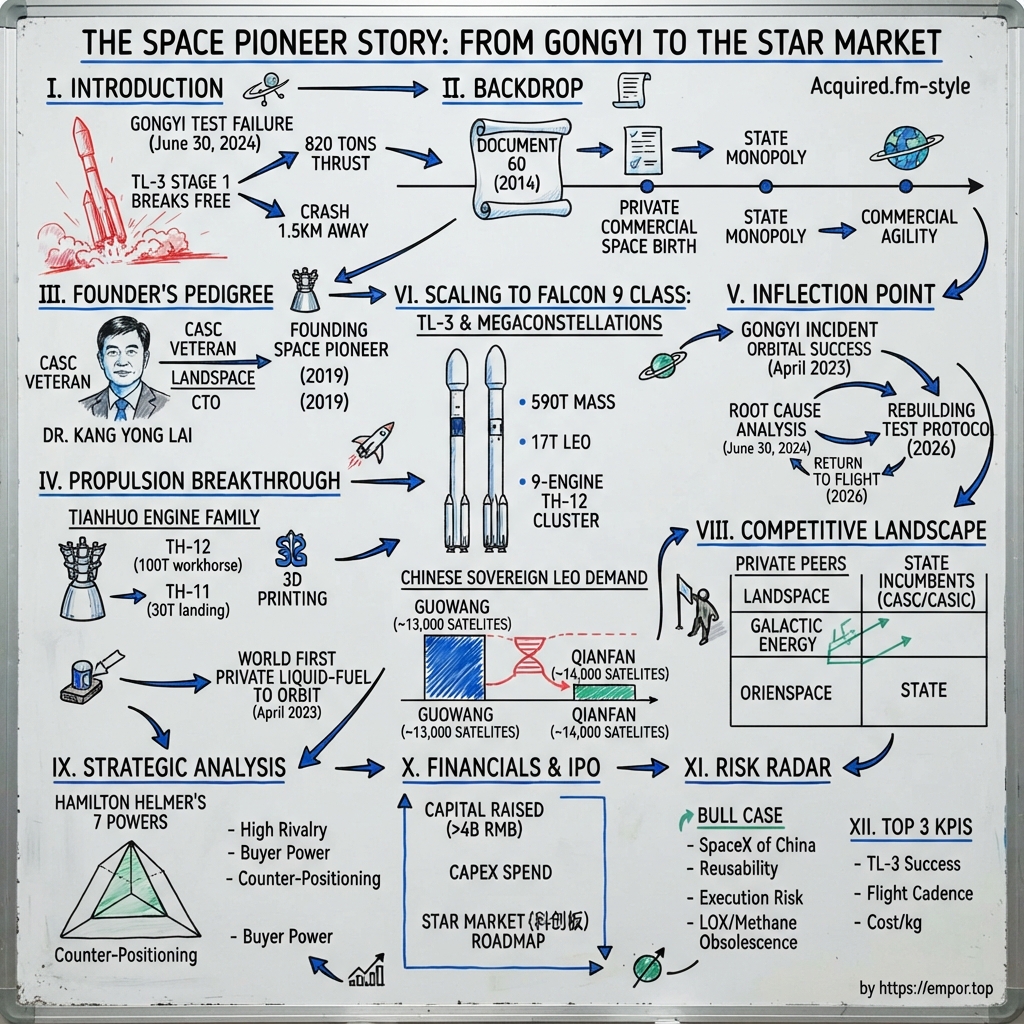
On the afternoon of June 30, 2024, in the hills outside 巩义 Gongyi in Henan province, a rocket that was never supposed to leave the ground took off. Space Pioneer's engineers were conducting a full-duration static-fire test of the 天龙三号 Tianlong-3 first stage, firing nine clustered engines throttled up to roughly 820 tonnes-force of sea-level thrust.1 The structural anchor connecting the rocket to the test stand failed. The vehicle tore loose, climbed under its own power, and — after the onboard flight computer triggered an emergency engine shutdown — crashed into a mountainside roughly 1.5 kilometres away. Local residents filmed the resulting fireball on mobile phones, and no casualties were reported.2 Space Pioneer issued a formal public apology two days later.3
The incident was simultaneously viewed as the most visible industrial accident in the brief history of Chinese commercial spaceflight and a tangible demonstration that Space Pioneer had built a functional, Falcon 9-class propulsion system. Both perspectives held weight: the engines produced expected thrust, but the ground-test fixtures failed under load.
The two ledgers
That afternoon captures the central investment question facing the company. Space Pioneer was founded in April 2019 by a rocket engineer with nearly two decades of experience within China's state launch-vehicle establishment.4 Four years later, in April 2023, its 天龙二号 Tianlong-2 became the first privately developed liquid-propellant rocket globally to reach orbit on its maiden flight — a milestone that eluded SpaceX's Falcon 1, LandSpace's Zhuque-2, and Relativity Space's Terran 1 on their debut attempts.[^5] By July 2026, the company had secured over RMB 6 billion across more than a dozen financing rounds, closing its latest round at a post-money valuation exceeding RMB 30 billion (approximately $4.2 billion).56 Space Pioneer has also initiated pre-listing IPO tutoring on Shanghai's STAR Market with CSC Financial serving as sponsor.7
Yet the operational record presents a stark contrast. Tianlong-2 has not flown again since its April 2023 debut, despite company announcements at the time citing ten signed commercial launch contracts.5 Meanwhile, Tianlong-3's maiden orbital flight on April 3, 2026, failed roughly thirty seconds into ascent and did not reach orbit.8
Two days ago, on August 19, 2026, commercial competitor 蓝箭航天 LandSpace completed its second orbital flight of 朱雀三号 Zhuque-3 and landed its first stage on deployable legs in Gansu, achieving the first successful land recovery of an orbital-class booster by a private Chinese enterprise.9 Six weeks earlier, state-owned incumbent 中国航天科技集团 CASC recovered a Long March 10B first stage at sea utilizing a net-capture mechanism.10 Space Pioneer, despite commanding the highest private valuation in China's commercial launch sector, enters late 2026 without an operational medium-lift launcher or recovered hardware.
This divergence — between a sector-leading valuation and an unproven operational cadence — forms the core of the company's investment profile. This analysis evaluates that gap from an underwriting perspective.
Episode roadmap and key themes
The macro setup. China has authorized two national low-Earth-orbit megaconstellations: 国网星座 Guowang, managed by China Satellite Network Group, and 千帆星座 Qianfan, backed by Shanghai Spacecom Satellite Technology. Together, these programs target deployments exceeding 20,000 satellites. Both initiatives lag behind their deployment schedules, with the primary bottleneck centered on domestic launch capacity rather than satellite production throughput.11 Bridging this lift capacity deficit provides the fundamental commercial justification for Space Pioneer.
The engineering bet. Space Pioneer selected liquid oxygen and kerosene (kerolox) propellants, contrasting with the liquid oxygen and methane (methalox) architecture pursued by peers LandSpace and iSpace. Kerosene provided access to mature domestic supply chains and established industrial precedent, whereas methane offered lower soot accumulation and simpler refurbishment for rapid reusability. For three years, the kerolox decision appeared to accelerate development; by 2026, as reusable methane stages reached orbit, the strategic trade-offs became more pronounced.
The capital machine. Backed by over RMB 6 billion in cumulative funding, a RMB 4 billion automated manufacturing facility in 张家港 Zhangjiagang designed for an annual capacity of thirty-plus vehicles, and a capitalization table featuring state-affiliated investment vehicles and municipal guidance funds,512 Space Pioneer operates with heavy operating leverage. Whether that capital base functions as a durable barrier to entry or a burdensome fixed cost depends on achieving a sustained commercial launch cadence.
The analytical frameworks. Hamilton Helmer's 7 Powers and Porter's Five Forces are applied to evaluate unit economics and structural leverage: the domestic institutional launch market operates effectively as a sovereign duopsony, a dynamic that influences pricing power and volume allocation far more directly than traditional competitive moat models.
A note on evidence
Regarding data availability: Space Pioneer has filed for pre-listing regulatory guidance rather than a formal initial public offering. Consequently, there is no public prospectus, audited income statement, full share register, risk-factor disclosure, or verified order backlog. The analysis below is constructed from corporate announcements, financing releases, regulatory filings for listing guidance, government and state-media documentation, orbital launch logs, and public filings from peer aerospace enterprises. Where empirical data is unavailable, the analysis identifies the limitation directly rather than relying on unverified estimates.
 Subscribe on LinkedIn
II. The Backdrop: China's "Document 60" and the Birth of Commercial Space
For six decades following 1956, spaceflight in China functioned strictly as an arm of the state. Launch vehicles were designed inside 中国运载火箭技术研究院 CALT, manufactured in state-owned factories, launched from military ranges, and funded directly through national budgetary allocations. Private launch enterprises did not exist because there was neither a legal mechanism nor a commercial market to accommodate them.
Document 60 and what it did not do
That policy environment shifted in November 2014, when the State Council issued its Guiding Opinions on Innovating Investment and Financing Mechanisms in Key Sectors and Encouraging Social Investment — universally known within the domestic aerospace sector as 60号文 Document 60. Tucked among its provisions was language encouraging private capital into the development, launch, and operation of civil space infrastructure.13 Document 60 did not establish a formal licensing regime, nor did it privatize state assets. Instead, it provided a clear political signal that private investment in commercial launch vehicles would no longer be treated as an impermissible intrusion into state territory.
The domestic aerospace sector was already primed for this signal by the rapid rise of SpaceX. The propulsive landing of a Falcon 9 first stage in December 2015, followed by the reflight of a recovered booster in 2017, reshaped strategic thinking across the Chinese aerospace establishment.
The challenge was not merely that an American commercial venture had achieved operational milestones ahead of state programs. More fundamentally, SpaceX demonstrated that an agile, venture-backed organizational model — characterized by rapid iteration and tolerance for public test failures — could achieve a cost structure that China's traditional 举国体制 (whole-of-nation) model was not structured to match. State procurement necessarily prioritizes near-absolute mission assurance for high-value national payloads over high-cadence manufacturing at declining marginal cost.
The solid-propellant ceiling
The initial cohort of Chinese commercial launch startups founded between 2015 and 2018 — including 星际荣耀 iSpace, 蓝箭航天 LandSpace, and 零壹空间 OneSpace — concentrated primarily on solid-propellant rockets. Solid-fuel motors offered lower mechanical complexity, long-term storability, and direct compatibility with existing missile-industrial supply chains. This approach yielded quick early milestones: iSpace's Hyperbola-1 became the first privately developed Chinese vehicle to reach orbit in July 2019.
However, solid propulsion imposes structural commercial limitations. Solid motors cannot be throttled, shut down, or restarted in flight, and their unit costs scale unfavorably with vehicle mass without offering a pathway to hardware recovery and reuse. For megaconstellation operators deploying dozens of identical satellites into precise orbital planes on recurring schedules and strict cost-per-kilogram parameters, small solid-propellant rockets offer insufficient payload capacity and unfavorable unit economics.
Liquid propulsion represents the primary technical barrier in commercial rocketry, shaping the sector's competitive structure. Unlike solid motors, which burn continuously along a cast propellant grain once ignited, a liquid rocket engine functions as a continuous thermodynamic machine. Turbopumps rotate at tens of thousands of revolutions per minute, injecting cryogenic oxygen and fuel into a combustion chamber where temperatures exceed the melting point of the surrounding metal alloy, requiring regenerative cooling channels milled into the chamber walls. The entire propulsion loop — pump velocity, chamber pressure, thrust output, vehicle acceleration, propellant slosh, and flight control authority — is tightly coupled. This mechanical complexity enables throttling, mid-flight engine shutdowns, restarts, and controlled propulsive landings, while concentrating industry capabilities among very few organizations.
Developing medium-lift liquid-propellant launchers with restartable engines and reusable architecture required an entirely different engineering talent pool.
China's state aerospace establishment had spent decades cultivating this specialized workforce. CALT and the broader CASC and 中国航天科工集团 CASIC complexes trained generations of propulsion engineers, structural analysts, avionics specialists, and chief systems designers capable of overseeing end-to-end vehicle integration. While abundant inside state research institutes, these multidisciplinary systems engineers were virtually non-existent in the private market. The talent arbitrage available to founders capable of recruiting state-trained specialists with equity incentives, operational autonomy, and faster development cycles became the foundational catalyst for China's commercial space sector.
The talent arbitrage
This talent dynamic defined Space Pioneer's founding thesis. The company did not pioneer liquid oxygen/kerosene propulsion, gas-generator cycles, or nine-engine clustering; those architectures represent established engineering refined by CALT across legacy programs like the Long March 5. Instead, Space Pioneer set out to execute proven designs on a commercial development schedule, targeting strict unit costs within an independent supply chain. The core investment thesis was not a bet on novel physics, but on manufacturing throughput and execution speed. That distinction dictates how setbacks must be evaluated: while a venture pursuing fundamental physics breakthroughs can absorb extended delays if the underlying science holds, a company predicated on production throughput is measured by launch cadence and manufacturing volume.
Equally important is what Document 60 did not establish: it created neither a codified launch-licensing framework comparable to the US Federal Aviation Administration's nor a private range-management system outside military control, nor a mature third-party liability and insurance regime. Chinese commercial launch enterprises operate in an environment that is permissive yet discretionary: they launch from state-controlled ranges, on schedules approved by state authorities, primarily serving state-owned or state-backed constellation operators. While this structure provides access to domestic capital and anchor demand, it also establishes structural constraints on commercial independence that differentiate Chinese launch startups from private Western peers like SpaceX.
III. The Founder’s Pedigree & Founding Space Pioneer
康永来 Kang Yonglai does not fit the typical Silicon Valley archetype. He holds a doctorate in aerospace engineering and spent nearly two decades inside CALT — China's First Academy, the foundational institution behind the Long March family — working across research, launch vehicle systems engineering, strategic planning, market development, and large-scale manufacturing. He led overall design work on national launch programs including the Long March 11.514 When Kang frames commercial rocketry, his reference point is industrial production rather than scientific exploration: "We have to run rockets like manufacturing — large batches, low cost, high reliability, the way an automotive company operates."14
The founding thesis
In April 2019, Kang registered Beijing Tianbing Technology alongside co-founder 罗毅 Luo Yi in Beijing's Yizhuang development zone.4 The founding thesis rested on two commercial, rather than purely technical, calculations.
The first was propellant selection. LandSpace, established four years earlier, had committed to liquid oxygen and methane (methalox) — the propellant combination selected by SpaceX for its Raptor engine, favored because methane burns cleaner, generates less coking in regenerative cooling passages, and theoretically enables faster engine turnaround and reuse. Kang chose liquid oxygen and kerosene (kerolox). The justification was industrial availability: kerolox was the propellant architecture China's aerospace complex already possessed extensive operational experience designing, fabricating, and testing. If the commercial priority was reaching a paying market before depleting early venture capital, adopting an established architecture to compress development timelines by several years represented a pragmatic trade-off. It reflected the same industrial logic that kept refined kerosene in continuous service across Atlas, Soyuz, and Falcon 9 architectures for decades.
The pivot management does not advertise
The second calculation was a timing bet on constellation deployment demand — an initial hypothesis that proved misaligned with the market. Space Pioneer's earliest propulsion program was not kerolox-based, but a high-concentration hydrogen peroxide (HCP) propulsion line designed for light, responsive launch. The intended debut launcher, Tianlong-1, was canceled before reaching flight.4 In 2021, the company abandoned the HCP architecture and pivoted entirely to liquid oxygen and kerosene, having concluded that domestic demand was consolidating around megaconstellation deployment requiring medium-lift capacity rather than niche, responsive micro-launch.5 While recognizing a strategic miscalculation early and writing off sunk development costs demonstrated managerial flexibility, the pivot also underscores that Space Pioneer's narrative of reaching orbit four years from inception rested on an architecture restarted mid-course.
The syndicate and what it wants
Capital followed rapidly. By early 2024, the company had completed twelve financing rounds in under five years, reaching an estimated post-money valuation of roughly RMB 15 billion cited by Kang, with a syndicate comprising private venture funds, state asset managers, and municipal guidance vehicles.14 Following the October 2025 Pre-D and D rounds — which secured nearly RMB 2.5 billion from investors including 国裕高华, Jigang Group, China Orient Asset Management, Shenwan Investment, BOC Asset Investment, and the Guiyang Industrial Development Fund — cumulative capital raised surpassed RMB 6 billion across sixty-five registered shareholders.155
This shareholder register illustrates a critical governance dynamic. A substantial portion of Space Pioneer's capital originates from entities whose mandates extend beyond financial returns: regional and municipal guidance funds invest to anchor industrial supply chains in their jurisdictions, while state asset managers allocate capital to advance national strategic priorities. This support provided significant advantages during the private phase — directly enabling the financing of the RMB 4 billion manufacturing base in Zhangjiagang — but introduces structural considerations for prospective public shareholders. State-backed stakeholders may prioritize regional employment, local supply-chain integration, and project delivery timelines over pure operating margins. Consequently, future public disclosures will require close examination for related-party procurement, localized manufacturing covenants attached to municipal subsidies, and performance guarantees extended to state investment vehicles.
Control at 23.49%
According to the listing-tutoring filing submitted to the Jiangsu Securities Regulatory Bureau on October 17, 2025, the listing vehicle is Jiangsu Tianbing Aerospace Technology Co., Ltd., with registered capital of RMB 390 million; Kang Yonglai serves as legal representative and controlling shareholder with a 23.49% direct equity stake.716
A direct holding of 23.49% does not confer outright majority voting control. It indicates that operational control relies on a combination of acting-in-concert agreements, employee-holding platforms, and the structural fragmentation of the remaining equity among sixty-plus institutional co-investors. While this governance structure is standard among pre-IPO companies targeting China's STAR Market, it makes diligence on undisclosed voting pacts, concert-party covenants, and special shareholder rights essential for prospective public investors.
Space Pioneer reports a workforce comprising several hundred aerospace technical and operational specialists, with an average age of 38, of whom 67% hold senior professional titles and 95% hold master's degrees or above — reflecting a direct talent migration from state research institutes incentivized by equity participation.17
This dynamic highlights the central retention mechanism. Recruiting senior systems designers away from CALT requires competing against institutional prestige, lifetime tenure, and participation in flagship national programs. Equity participation has served as the primary mechanism for Chinese private launch ventures to attract state-trained engineering talent. However, Space Pioneer has not publicly disclosed the scale of its employee equity pool, vesting schedules, exercise terms, or the proportion of its RMB 390 million registered capital allocated to employee-holding partnerships versus external financial sponsors.7 The company has likewise not disclosed executive compensation structures, board governance, or the appointments of independent directors. While typical for a company in pre-listing tutoring, these omissions leave the operational alignment and oversight mechanisms of senior management unverified ahead of a formal prospectus filing.
IV. The Propulsion Breakthrough: The Tianhuo Engine Family
In launch-vehicle economics, the primary cost driver is propulsion. Engines represent the highest-value, longest-lead, and most difficult-to-qualify subsystems on a rocket. On a first stage clustered with nine engines, propulsion dominates the vehicle's bill of materials. Engines are also where hardware recovery yields the greatest financial return: economically, a recovered booster is primarily a recovered set of engines. Any commercial strategy targeting an order-of-magnitude reduction in launch costs fundamentally depends on engine manufacturing yields and refurbishment cycles.
The Tianhuo family
Space Pioneer's core propulsion platform is the 天火 Tianhuo family. Following the 2021 retirement of its early hydrogen-peroxide TH-1, TH-2, and TH-3 development lines, the company consolidated production around liquid oxygen and kerosene engines: the TH-11 and TH-12 series, alongside the TH-31 and TH-32 upper-stage units.417 The primary workhorse is the 天火十二 TH-12, a gas-generator engine in the 110-tonne class producing roughly 1,090 kilonewtons (kN) of sea-level thrust; a cluster of nine powers the Tianlong-3 first stage to generate approximately 8.0 meganewtons (MN) of total liftoff thrust, while a vacuum-optimized variant, the TH-12V delivering about 1,350 kN, powers the second stage.1 Space Pioneer also reports developing China's only high-pressure staged-combustion closed-cycle LOX/kerosene engine — an architecture that offers superior specific impulse at the cost of substantial mechanical complexity, indicating the design direction for future heavy-lift vehicles.17
The family's secondary variants carry critical implications for recovery. Propulsive first-stage recovery is fundamentally a throttle-control challenge rather than purely a navigation problem. A returning booster arrives at touchdown nearly empty of propellants, resulting in a very high thrust-to-weight ratio; the descent engine must throttle deeply and stably to avoid accelerating back upward before touchdown. SpaceX addresses this dynamic on the Falcon 9 by landing on a single center engine throttled to a fraction of its rated output. Space Pioneer's architecture reflects a similar approach, maintaining the smaller TH-11 and TH-11V alongside the TH-12 line.17 However, Space Pioneer has not published verified operational throttle ranges for any engine in the Tianhuo family. By contrast, competitor Galactic Energy has disclosed that its CQ-50 engine demonstrated deep throttling between 32% and 105% across more than 10,000 seconds of cumulative hot-fire testing.18 Disclosing verifiable throttle performance separates an operational recovery program from a conceptual roadmap.
Printing the hard parts
Space Pioneer's primary industrial claim centers on additive manufacturing. The company states that approximately 92% of the TH-12's components are produced via 3D printing.5 In conventional aerospace manufacturing, complex engine assemblies — including injector heads, regenerative cooling jackets, and turbopump housings — require machining, welding, and brazing hundreds of individual parts through multi-month tooling cycles. Consolidating these components into monolithic printed structures eliminates tooling lead times and reduces assembly part counts, turning major design revisions from physical retooling cycles into digital CAD updates. For a manufacturer targeting hundreds of engines per year while continuing to iterate vehicle architecture, additive manufacturing functions as an essential scheduling mechanism rather than a marginal cost reduction.
The coal-based kerosene edge
The propellant formulation introduces an operational distinction tailored to domestic resource endowments. In April 2023, Tianlong-2 became the first launch vehicle globally to achieve orbit using coal-based aerospace kerosene (煤基航天煤油) rather than conventional petroleum-derived RP-1.19 Because China possesses abundant domestic coal reserves while relying heavily on crude oil imports, synthesizing aerospace kerosene from coal feedstock mitigates sovereign supply-chain exposure. The chemical process also yields engineering benefits: synthetic kerosene can be refined with narrower hydrocarbon distributions and fewer impurities than standard petroleum cuts, reducing coking — the carbon residue that accumulates in fine regenerative cooling channels during combustion. Lower coking minimizes post-flight refurbishment requirements, addressing a primary maintenance hurdle in kerosene engine reusability.
Zhangjiagang, and the cost of building ahead
To support serial production, Space Pioneer initiated construction of an intelligent manufacturing base in 张家港 Zhangjiagang, Jiangsu province, in 2021, deploying roughly RMB 4 billion in capital before commissioning the site in April 2024. Municipal disclosures describe the facility as China's only ground-up manufacturing complex designed specifically for large-scale liquid launch vehicles, featuring Asia's largest single rocket final-assembly hall by floor area, sized for an annual throughput exceeding thirty Tianlong-3 vehicles.12
Space Pioneer has stated that the Zhangjiagang assembly base, paired with launch and test infrastructure at the Jiuquan Satellite Launch Center, could support more than sixty launches per year, with total manufacturing capacity rated at fifty Tianlong-series rockets and five hundred Tianhuo engines annually.1215 Regional industrial clustering has expanded around the site, with approximately twenty supply-chain partners establishing local operations, allowing roughly 80% of Tianlong components to be sourced within a 100-kilometre radius.12
Capacity is not throughput
From an underwriting perspective, installed capacity must be distinguished from operational throughput. A production facility sized for thirty rockets annually that completes two operates with high unabsorbed overhead rather than economies of scale. Process power — a durable cost and quality advantage derived from proprietary operational learning — requires running assembly lines at sustained volume to move down the unit-cost curve. While Space Pioneer has built extensive manufacturing infrastructure, translating installed capacity into process power requires an operational vehicle. Following the April 2026 maiden flight failure of Tianlong-3, the capital base remains committed while manufacturing learning remains unaccumulated. Fixed depreciation on a RMB 4 billion industrial asset base continues to accrue, burdening the corporate cost structure ahead of commercial revenue generation.
V. The Inflection Point: Tianlong-2 and the Historic Maiden Orbital Flight
On April 2, 2023, at the Jiuquan Satellite Launch Center in the Gobi Desert, a 32.8-metre, 3.35-metre-diameter, 153-tonne launch vehicle lifted off carrying a small remote-sensing satellite. Roughly ten minutes later, 爱太空科学号 reached a 500-kilometre Sun-synchronous orbit, marking the first time a privately developed liquid-propellant rocket had achieved orbit on its maiden flight.[^5]5
Why maiden liquid flights fail
The significance of that debut requires industry context. Maiden flights of liquid-propellant rockets routinely fail. SpaceX's Falcon 1 failed three consecutive times before reaching orbit. LandSpace's Zhuque-2 failed on its debut in December 2022, and Relativity Space's Terran 1 failed in March 2023, two weeks before Tianlong-2's launch. The underlying challenge is structural: a liquid-propellant launch vehicle is a tightly coupled system of turbomachinery, cryogenic propellants, feed lines, pressurized tanks, structural joints, and flight control algorithms whose dynamic interactions cannot be fully replicated on the ground. Static-fire testing qualifies isolated subsystems, but the integrated vehicle faces its definitive test only during ascent. Succeeding on the first attempt required executing every coupled interaction flawlessly without prior operational flight data — reflecting rigorous engineering qualification alongside favorable initial flight conditions.
What the flight actually bought
Tianlong-2's debut delivered three distinct strategic assets. First, it transitioned Space Pioneer from an unproven design team into a flight-qualified launch provider — a formal qualification threshold in Chinese institutional space procurement rather than a commercial branding milestone. Second, it validated coal-based kerosene as an operational aerospace propellant under flight conditions. Third, it lowered the company's cost of capital, accelerating subsequent fundraising rounds through 2023; by January 2024, Kang stated that the company had secured capital across twelve financing rounds at an estimated valuation of roughly RMB 15 billion while claiming the largest commercial order book in China's private space sector.14
Yet the mission's customer detail signaled future commercial friction: the payload was a single small remote-sensing satellite rather than an operational constellation manifest.5 Tianlong-2 was sized for roughly two tonnes of payload capacity to low-Earth orbit in a domestic market whose procurement focus was already shifting decisively toward 18-tonne-class batch deployment for megaconstellations. The debut confirmed the engineering team's ability to build a functioning orbital-class liquid vehicle; it did not demonstrate the presence of recurring, paying commercial demand for a light-medium launcher. The subsequent three years underscored the divide between achieving technical qualification and establishing a sustainable commercial cadence.
The silence that followed
Following its April 2023 debut, Tianlong-2 has not conducted another orbital flight. As of August 2026, more than three years after the maiden mission, there is no public record of a second Tianlong-2 launch, despite corporate announcements at the time stating that ten commercial launch contracts had been signed for the vehicle.5
This multi-year operational hiatus provides critical evidence regarding Space Pioneer's commercial reality. Two plausible explanations account for the absence of follow-on flights, each carrying distinct implications for investors.
The constructive interpretation is strategic prioritization: because Tianlong-2 was a two-tonne-class expendable launcher in a market that turned decisively toward heavy batch constellation deployments, management rationally curtailed capital allocation to a vehicle with a narrowing addressable market, redirecting engineering resources toward Tianlong-3 and a planned Tianlong-2 upgrade powered by three TH-12 engines.4 The skeptical interpretation is contractual fragility: the ten announced launch agreements may have represented preliminary letters of intent, non-binding memorandums of understanding, or milestone-contingent framework pacts that failed to materialize into funded missions, indicating that commercial demand was considerably softer than corporate releases suggested.
The available public record does not conclusively resolve which factor predominated.
Crucially, both explanations lead to the same structural conclusion: Space Pioneer's primary operational asset — a flight-proven liquid orbital launcher — generated no sustained commercial revenue stream. Three years of potential launch cadence, operational learning, customer account management, and recurring cash flow went unrealized. For an enterprise whose valuation and strategic thesis rest on industrial manufacturing throughput, deploying a flight-proven vehicle for a single mission highlights the unresolved gap between technical validation and operational scale.
Weighting management's forward statements
This dynamic introduces an essential governance and underwriting consideration. The claim of ten signed launch orders was communicated during an active capital-raising cycle and did not subsequently translate into operational flights. This performance history informs how prospective investors must evaluate corporate guidance. A similar pattern appears in subsequent forward projections: in January 2024, management announced that Tianlong-3 would conduct its maiden flight in June 2024, projected that the vehicle would reduce launch pricing to between RMB 20,000 and RMB 30,000 per kilogram compared to prevailing market rates of RMB 70,000 to RMB 80,000, and guided toward 2025 corporate revenues in the billions of renminbi.14 In practice, Tianlong-3's maiden orbital flight took place in April 2026 and failed during ascent, while no public evidence indicates corporate revenues reached that projected scale in 2025. Aggressive development timelines are common across the global aerospace sector, but underwriting Space Pioneer's long-term valuation requires applying a disciplined discount to management's forward schedule and revenue guidance.
VI. Scaling to Falcon 9 Class: The Tianlong-3 Architecture & The Megaconstellation Market
The strategic rationale behind Space Pioneer's concentration of resources on Tianlong-3 stems directly from the structure of domestic launch demand.
The demand: two constellations running late
China has authorized two sovereign low-Earth-orbit broadband megaconstellations. Guowang, managed by China Satellite Network Group, serves as the state-owned national backbone. Qianfan, operated by Shanghai Spacecom Satellite Technology and commonly known as the G60 constellation, is the Shanghai-anchored commercial-adjacent network with approximately 15,000 satellites approved for deployment. Both systems are designed to exceed 10,000 spacecraft, and both operate against strict regulatory timelines: under International Telecommunication Union filing rules, designated orbital shells and frequency spectrum must be brought into use within specified windows before allocations expire. This strategic urgency is encapsulated in the domestic aerospace dictum 占频保轨 ("occupy the frequency, secure the orbit").20
The deployment cadence, however, has lagged these mandates. As of mid-May 2026, Qianfan had approximately 162 satellites in orbit and was targeting 324 by year-end to establish baseline service capabilities — representing low single-digit percentages of its planned network seven years after initial conception.11 Roughly 80% of Qianfan's completed 2026 launches were conducted by state-owned Long March 8 and Long March 6A launchers. Industry participants identify the primary deployment bottleneck in explicit terms: domestic launch capacity cannot keep pace with satellite manufacturing throughput, while domestic launch pricing remains elevated relative to international benchmarks.11 By April 2026, China maintained 37 launch-vehicle manufacturing facilities with a cumulative planned annual capacity of 610 launches, compared to 55 satellite factories capable of producing roughly 7,360 spacecraft annually.11 Satellite fabrication is not the constraint; orbital lift capacity remains the fundamental bottleneck.
Industry projections indicate that deploying the two national constellations will require approximately 700 to 800 launches of 18-tonne-plus medium-lift rockets over a seven-to-ten-year horizon.20
This projected launch volume defines the addressable domestic market that underwrites every Chinese medium-lift liquid-propellant rocket program currently in development.
The vehicle
Tianlong-3 represents Space Pioneer's dedicated vehicle to capture this deployment volume. The rocket is a two-stage launcher measuring 3.8 metres in diameter, 71 to 72 metres in height, and roughly 590 to 600 tonnes at liftoff, powered by nine TH-12 engines on the first stage and a single vacuum-optimized TH-12V on the second stage. Space Pioneer quotes payload capacity at 17 tonnes to low-Earth orbit and 14 tonnes to Sun-synchronous orbit in an expendable configuration, with secondary domestic industry estimates citing up to 22 tonnes to LEO depending on mission profile and trajectory parameters. The first stage is architected for autonomous vertical propulsive landing and reuse up to ten times, configured to accommodate batch deployments of 18 satellites — and up to 36 satellites in ground dispenser qualification tests.111 These dimensions, propulsion configurations, and performance envelopes deliberately parallel the specifications of SpaceX's Falcon 9.
The price anchor nobody can argue with
The competitive dynamics of the sector are defined by institutional procurement pricing, where an external tender provides an explicit pricing baseline. In July 2025, Qianfan operator Shanghai Yuanxin Satellite issued a commercial procurement tender for seven launch missions scheduled for delivery by March 2026, structured across two distinct packages: four "one rocket, ten satellites" missions requiring 2.8 tonnes to a 950-kilometre polar orbit with verified flight heritage, capped at a maximum clearing price of RMB 55,000 per kilogram of payload; and three "one rocket, eighteen satellites" missions requiring 4.8 tonnes to an 800-kilometre polar orbit with a maiden flight committed by December 2025, capped at RMB 50,000 per kilogram.21
In August 2025, LandSpace, Space Pioneer, and CAS Space were shortlisted for the 18-satellite package.11
This procurement cycle reveals three structural realities of the Chinese launch sector. First, constellation operators function as sovereign buyers setting hard price ceilings while enforcing strict flight-heritage requirements; launch providers operate in a structured institutional procurement regime rather than an open spot market. Second, a price ceiling of RMB 50,000 per kilogram (approximately $7,000 per kilogram) illustrates the distance between prevailing domestic commercial pricing and the RMB 20,000 per kilogram (~$2,800 per kilogram) threshold broadly recognized as necessary for megaconstellation business models to achieve positive unit economics.22 Third, the contracted missions were ultimately reassigned to state-owned Long March launchers because the private commercial bidders remained in technical qualification and could not meet delivery schedules.11 Space Pioneer secured a shortlist position for launch requirements it lacked the operational flight readiness to fulfill.
The cost curve as hypothesis
Management's long-term unit-cost model projects that Tianlong-3 will achieve launch costs between RMB 20,000 and RMB 30,000 per kilogram in expendable mode, with booster reusability reducing per-mission costs to approximately 60% of a newly built vehicle across six or more reflights.2022 The underlying accounting model is standard: amortizing first-stage manufacturing costs across multiple flights, combined with incremental recovery and refurbishment expenses, causes marginal launch costs to converge toward expendable upper-stage fabrication, propellant loading, and range operations. However, every variable in this equation remains unvalidated for Space Pioneer. Baseline booster production costs are undisclosed; refurbishment expenses cannot be calculated without recovered hardware; the company's verified reuse count is zero; and operational cadence currently stands at a single failed orbital test flight. The projected cost curve functions as an operating target rather than an empirical result, carrying substantial variance across every underlying operational input.
VII. The Crucible: The Gongyi Test Failure, Crisis Management, & Return to Flight
The operational context of the June 30, 2024 accident outside Gongyi highlights both engineering risk and organizational response. During a full-duration nine-engine static-fire test of the Tianlong-3 first stage, the structural connection anchoring the vehicle to the test stand failed under load. Producing full thrust, the stage detached from the test fixture and ascended under its own power. The onboard flight computer detected the off-nominal state and commanded an emergency engine shutdown; the stage crashed roughly 1.5 kilometres away, disintegrating upon impact in a mountainous area. Local authorities had evacuated nearby residents in advance of the test, and no casualties were reported.24
Crisis management, graded
The company's crisis response diverged from prevailing domestic aerospace norms. Space Pioneer issued a preliminary statement the same day and a formal public apology on July 2, acknowledging the structural hold-down fixture failure directly rather than characterizing the event as an ambiguous "anomaly."34 For underwriters assessing governance transparency, direct attribution of mechanical failure provides a meaningful baseline for evaluating future corporate disclosures.
127 corrections, and what they proved
The subsequent technical overhaul was extensive and systematically documented. Space Pioneer implemented 127 reliability improvement measures across structural load paths, pressurization redundancy, control-system diagnostics, engine health monitoring, and launch-system backup, while adding 13 ground verification tests to its qualification program; company disclosures indicated that structural safety margins were raised to roughly 1.5 times industry-standard baselines.2322
In July 2025, the company completed a nine-engine combined static load test on the modified first stage, physically demonstrating that the redesigned load path could withstand nearly 900 tonnes-force of thrust across ground handling, erection, fueling, ascent, and recovery load profiles. Space Pioneer reported that the structural modifications were validated and the corrective measures effective.23 Two months later, in September 2025, it conducted a full-system sea-based hot-fire test of a Tianlong-3 first stage on the HOS-1 platform at the 海阳 Haiyang Oriental Spaceport in Shandong, establishing a domestic thrust record for commercial liquid propulsion.15
April 3, 2026
On April 3, 2026, at 12:17 Beijing time, Tianlong-3 Y1 launched from Space Pioneer's dedicated pad at the Dongfeng Commercial Space Innovation Test Zone within the Jiuquan Satellite Launch Center, carrying the TW-4 remote-sensing satellite for Xiamen Tianwei Technology.
All nine TH-12 first-stage engines ignited at liftoff. Approximately 33 seconds into flight, one engine appeared to experience a nozzle overexpansion failure. While nine-engine clusters incorporate engine-out redundancy to absorb single-engine shutdowns, the vehicle subsequently diverged from its planned trajectory late in first-stage flight or around second-stage ignition, failing to achieve orbit.824
Space Pioneer confirmed the mission failure the same day, initiating the formal 归零 ("return to zero") root-cause investigation alongside external aerospace specialists — the institutional failure-investigation protocol requiring a fault to be isolated, mechanically understood, physically reproduced, corrected, and verified before flight operations resume.253 As of late August 2026, no formal root-cause findings have been published, and no return-to-flight schedule has been announced. Industry reporting indicates a second Tianlong-3 airframe is nearing completion, rendering a follow-up orbital attempt plausible before year-end 2026.24
Reading the sequence
Evaluating this operational sequence yields three distinct conclusions that pull in divergent directions.
First, the two failures represent structurally distinct failure modes. The Gongyi incident was a ground-support equipment and test-stand structural failure rather than an inflight vehicle breakup. By contrast, the April 2026 debut failed due to propulsion and flight-control dynamics during atmospheric ascent. The 127 corrective measures addressed ground-structural load paths, as validated by the July 2025 static load test, indicating institutional engineering learning rather than recurring systemic oversight.
Second, technical iteration does not offset commercial displacement. During the twenty-two months between June 2024 and April 2026, Space Pioneer conducted zero orbital flights while domestic peers achieved major operational milestones. LandSpace placed Zhuque-3 into orbit in December 2025 and recovered its booster on land in August 2026. CAS Space successfully debuted Lijian-2 on March 30, 2026 — four days before the Tianlong-3 failure.22 Meanwhile, state incumbent CASC recovered a Long March 10B first stage in July 2026.10 In an institutional market where flight heritage governs procurement eligibility and megaconstellation deployments operate under rigid regulatory timetables, operational downtime directly transfers market share to competing architectures.
Third, private capital markets maintained an accommodating posture. In July 2026, three months after the maiden orbital failure, Space Pioneer completed a financing round at a post-money valuation exceeding RMB 30 billion — up from roughly RMB 22.5 billion in October 2025 — with Hengdian Capital contributing a RMB 200 million strategic investment alongside the Zhangjiagang Emerging Industry Investment Fund and a Suzhou advanced equipment fund-of-funds.6 Participating investors characterized the allocation as underwriting underlying propulsion architecture, manufacturing capacity, and long-term iteration speed rather than penalizing a single flight test, with proceeds designated for medium-to-large liquid launchers, reusability systems, heavy propulsion development, and orbital transportation infrastructure.6
This valuation expansion following an orbital launch failure represents a critical underwriting dynamic. The transaction reflects a negotiated price point for a limited tranche of preferred equity led primarily by regional entities with localized industrial development mandates, rather than an independent market appraisal of underlying commercial earnings power.
VIII. Competitive Landscape: The Battle for China's Commercial Launch Leadership
China's private launch sector has consolidated around six primary contenders chasing the same sovereign megaconstellation demand, with five of the six initiating IPO tutoring between July and October 2025.20 By late August 2026, the competitive environment for Space Pioneer has deteriorated markedly compared to its market standing two years earlier.
The five private rivals
LandSpace has established itself as the sector's operational benchmark. Its 朱雀三号 Zhuque-3 reached orbit on December 3, 2025, despite an unsuccessful first-stage recovery attempt, before flying a second orbital mission from Jiuquan on August 19, 2026. That flight successfully deployed the Honghu-03 satellite and landed its first stage on deployable legs at a dedicated pad in Minqin County, Gansu — marking the first land recovery of an orbital-class booster by a private Chinese enterprise and the second booster recovery nationwide.9 LandSpace plans to inspect and re-fly the recovered booster, potentially on upcoming Qianfan deployment missions.9 Zhuque-3 targets a payload capacity of 11.8 to 21.7 tonnes to low-Earth orbit, a minimum of twenty reuses per airframe, and launch costs below RMB 20,000 per kilogram.20 LandSpace's methane architecture, which reached orbit three years after Space Pioneer's kerolox debut, is now three orbital flights ahead in demonstrated stage reusability.
CAS Space (中科宇航), backed by the Chinese Academy of Sciences, successfully debuted its 12-tonne-class 力箭二号 Lijian-2 on March 30, 2026, with an airframe scalable toward 22 tonnes to low-Earth orbit; its mixed-ownership structure facilitates state procurement access, supported by dedicated infrastructure spanning both solid and liquid pads.2220
Galactic Energy (星河动力) leads the private cohort in small-launch cadence: its solid-propellant Ceres-1 has flown repeatedly, including a sea-launch mission in January 2026 delivering four satellites, with commercial launch commitments booked into 2028. Its medium-lift liquid launcher, 智神星一号 Pallas-1 — a 52-metre, 283-tonne vehicle designed for 7 tonnes to low-Earth orbit, powered by a CQ-50 engine that demonstrated continuous throttling between 32% and 105% across more than 10,000 seconds of cumulative hot-fire testing — was scheduled for its maiden orbital flight from Jiuquan in the second half of August 2026.18
iSpace (星际荣耀) is preparing the 4.2-metre Hyperbola-3 for late 2026, offering 14 tonnes of expendable LEO capacity and 8.5 tonnes in a reusable configuration, having completed ground verification for sea-based recovery despite a historical orbital success rate near 50%.2620
Orienspace (东方空间), having flown the heavy solid Gravity-1, is developing the reusable liquid Gravity-2 with 21.5 tonnes of LEO capacity, targeting first-flight readiness in the fourth quarter of 2026.18
The state incumbents are not standing still
Above the private cohort stand China's state-owned aerospace incumbents. CASC's commercial Long March variants — including the Long March 8, 6A, 6C, and 12 — currently carry the bulk of sovereign constellation deployment missions. In July 2026, CASC introduced flight-proven reusability to the state fleet with the Long March 10B, demonstrating a 16-tonne reusable LEO capacity and a sea-based net-capture recovery that the enterprise expects to convert into a reflight attempt before year-end.10
China conducted 87 orbital launches in 2025, with private enterprises accounting for 23; by August 19, 2026, the national launch total had reached 59.279 The state aerospace establishment is not a passive legacy incumbent vulnerable to straightforward disruption. It operates simultaneously as the market's largest launch supplier, the domestic technical leader in stage recovery, and — through China Satellite Network Group and associated state entities — effectively half of the addressable demand base.
Pads, ranges, and the easing bottleneck
Infrastructure access represents another shifting axis. As of July 2025, China maintained 18 operational commercial launch pads with seven additional facilities under construction.27 At the Hainan Commercial Spacecraft Launch Site, two operational pads are each engineered for 16 launches annually, while a second construction phase adding pads three and four targets launch readiness by late 2026, expanding the site's aggregate capacity beyond 60 missions per year.27 Space Pioneer conducted Tianlong-3's maiden flight from its dedicated pad in the Dongfeng zone at Jiuquan and has scheduled future missions from the Wenchang commercial LC-2 pad in Hainan.81 Launch pad availability is therefore expanding rather than contracting — a dynamic that improves industry-wide launch cadence while preventing scarce launch slots from functioning as a defensible barrier to entry.
Where Space Pioneer actually stands
This competitive reality presents clear underwriting challenges for the sector's highest-valued enterprise. Across the three primary criteria that constellation operators evaluate — flight heritage in the required payload class, demonstrated schedule reliability, and unit cost per kilogram — Space Pioneer currently leads on none. Its 2023 maiden flight record remains a notable engineering milestone, but it applies to a light-launch category the market has largely bypassed. The company's core assets remain latent: a large-scale manufacturing facility, an extensive engine lineup, an established kerolox supply chain, and a vehicle design that closely mirrors the Falcon 9 architecture. Latent manufacturing capacity carries substantial value if the underlying vehicle achieves operational reliability; it delivers limited economic return when the vehicle remains grounded, and depreciates in strategic value while a direct competitor successfully recovers and re-flies orbital hardware.
This operational divergence also provides clarity on the kerolox-versus-methalox debate that divided the sector for half a decade. Proponents of methane argued that cleaner combustion would minimize coking, reduce refurbishment overhead, and enable faster turnaround times. Proponents of kerosene argued that established domestic industrial maturity would compress development cycles and secure an earlier time-to-market. Through 2023, the kerolox thesis appeared validated when Space Pioneer reached orbit while LandSpace was resolving early test failures on Zhuque-2. By August 2026, the competitive balance has shifted. LandSpace has flown a methane launcher to orbit twice and executed a controlled land landing of its booster, whereas Space Pioneer has flown its medium-lift kerolox vehicle once and suffered a mission loss.98 This outcome does not disprove kerosene on thermodynamic grounds — the divergence reflects operational execution rather than propellant chemistry, as demonstrated by CASC's recovery of a kerosene-powered Long March 10B stage in July through net capture.10 Instead, it indicates that propellant selection is no longer the decisive strategic differentiator. The fundamental competitive metric is flight cadence, and on that metric Space Pioneer's early lead has been overtaken.
IX. Strategic Analysis: 7 Powers & Porter's Five Forces
Strategic frameworks provide clarity when evaluating Space Pioneer only if applied with discipline regarding what has been operationally demonstrated versus what remains prospective. Evaluated against those criteria, the industry's structural dynamics present clear challenges, and Space Pioneer's structural moats remain largely unrealized.
The seven powers, scored on evidence
Scale economies — potential, not realised. The long-term unit economics of Tianlong-3 depend entirely on manufacturing and launch volume. Spreading the fixed overhead of the Zhangjiagang facility — sized for thirty-plus vehicles annually — across only two airframes yields unsustainably high unit costs, whereas amortizing those fixed costs across twenty or more missions produces the cost structure management envisions.12 While additive manufacturing accounting for roughly 92% of engine components facilitates rapid production scaling, tooling-free 3D printing primarily reduces the cost and lead time of modifying designs rather than lowering the marginal unit cost of fabricating them at volume.5 Until verified annual production and launch volumes materialize, scale economies remain an operational objective rather than an established moat. Crucially, if achieved, high-volume production would establish a substantial cost barrier for smaller-funded competitors to replicate.
Process power — early and unbanked. Manufacturing expertise and operational efficiency compound through repetition. Space Pioneer possesses notable process assets: coal-based kerosene flight qualification, extensive additive engine production, and an integrated supply-chain cluster sourcing roughly 80% of components within 100 kilometres of Zhangjiagang.1912 However, because the company has not run its assembly lines at scale, it has yet to move down the operational learning curve. Meanwhile, competitor LandSpace is positioned to capture an asset Space Pioneer cannot readily duplicate: detailed inspection and structural teardown data from an orbital-class booster that successfully landed on deployable legs, providing the essential empirical input required to optimize reusable flight hardware.9 In commercial launch, process power accrues to the operator sustaining the highest flight cadence — an operational lead Space Pioneer does not currently possess.
Cornered resource — partially real, partially eroding. Kang Yonglai's systems-engineering pedigree and the recruited core of state-institute propulsion specialists represent scarce human capital; an engineering workforce where 95% hold master's degrees or above and 67% possess senior professional titles cannot be assembled quickly.17 However, competing commercial space ventures executed comparable talent lift-outs from the same state institutions. Launch-pad access, occasionally characterized as a cornered resource, is also being diluted as regional spaceports construct dedicated commercial launch pads.27 What remains non-replicable is the RMB 4 billion purpose-built assembly base in Zhangjiagang — an asset that translates into a competitive advantage only when operational launch demand fills the factory floor.
Switching costs — low, and structurally so. Constellation satellites engineered for standard dispenser interfaces can transition between Long March, Zhuque-3, Lijian-2, and Tianlong-3 launchers with straightforward interface integration rather than deep structural redesigns. The commercial structure of the Shanghai Yuanxin tender underscores this interchangeability: the operator specified payload mass, orbital parameters, verified flight heritage, and a hard price ceiling, inviting qualified providers to compete primarily on schedule and cost.21 Launch services operate as a specification-and-price procurement market with minimal customer lock-in.
Counter-positioning — weak, because the incumbent copied the move. The traditional counter-positioning hypothesis argued that state-owned aerospace conglomerates could not adopt commercial development cycles without compromising mission-assurance standards. CASC's successful sea recovery of a Long March 10B first stage via net capture in July 2026 substantially challenges that premise: the state incumbent is pursuing booster recovery directly at scale, leveraging dedicated sovereign funding and priority launch-range scheduling.10 The state establishment is actively contesting reusability rather than ceding the operating model to private entrants.
Network effects — absent. Commercial launch exhibits no direct or indirect network effects. A customer booking payload capacity on a specific launch vehicle does not increase the vehicle's utility or value for subsequent customers.
Branding — real but depreciating. Becoming the first privately developed liquid-propellant rocket globally to achieve orbit on its maiden flight established a genuine historical milestone that accelerated Space Pioneer's early capital raising in 2023.[^5] Three years later, following a multi-year operational pause and a failed Tianlong-3 orbital debut, the procurement value of that milestone has largely diminished. Institutional buyers of launch services allocate flight contracts based on verifiable mission heritage and operational reliability rather than historical narratives.
The five forces, with the buyer axis dominant
Applying Porter's Five Forces reveals that buyer power overwhelmingly dictates market economics.
Bargaining power of buyers is very high, defining the sector's commercial structure. Domestic launch demand is heavily concentrated across China Satellite Network Group, Shanghai Spacecom Satellite Technology (SSST/Yuanxin), and government agencies. This customer base effectively constitutes two sovereign constellation programs alongside the state apparatus. Yuanxin's launch tender demonstrated this leverage by establishing rigid price ceilings and flight-heritage prerequisites, illustrating a procurement environment where buyers dictate commercial terms.21 Furthermore, because one of the primary constellation operators is state-owned while the dominant launch supplier is also state-owned, commercial allocation is shaped by sovereign industrial planning alongside price competition. A private launch provider operates as a commercial supplier to a sovereign duopsony capable of internalizing its launch requirements through state-owned launchers.
Threat of new entrants is low. Capital requirements exceed billions of renminbi prior to an initial orbital attempt — illustrated by Space Pioneer raising over RMB 6 billion while continuing to pursue orbital qualification for Tianlong-3.5 Stringent regulatory oversight, access to military-managed launch ranges, scarce propulsion engineering talent, and rigorous flight-heritage requirements create formidable barriers to entry. The domestic competitive field is effectively closed, concentrating rivalry among established contenders.
Supplier power is moderate and well-managed. Vertical integration across propulsion systems, paired with a regional supply cluster providing roughly 80% of components locally, limits the pricing power of tier-two component vendors; raw materials and standard structural alloys remain largely commoditized.12 The primary supply-chain vulnerabilities are external and geopolitical, centered on high-precision machine tools, radiation-hardened microelectronics, and high-grade carbon fiber subject to international export controls.
Threat of substitutes is low in the near term. From a physics perspective, orbital launch has no direct technological substitute. However, state-owned launch fleets function as direct institutional substitutes with preferred political access to sovereign payloads — a dynamic demonstrated when contracted Qianfan 18-satellite deployment missions were reassigned to Long March 8 and Long March 6A vehicles.11
Rivalry is extreme. Six well-capitalized private launch ventures alongside the state aerospace complex are competing for the same 700 to 800 medium-lift launches required to deploy national constellations.20 Across China, planned annual manufacturing capacity reaches 610 launch vehicles, creating an aggregate industrial capacity that substantially exceeds near-term deployment manifests.11 This structural imbalance sets the stage for aggressive pricing pressure, in which low-cost operators sustaining high launch cadences survive while higher-cost, underutilized manufacturing bases face consolidation. Kang Yonglai's projection that the domestic commercial space sector will undergo an industry consolidation cycle aligns with these structural conditions; the decisive question for investors is whether Space Pioneer consolidates competitors or is consolidated itself.
X. Financials, Capital Allocation, & IPO Pathway
Evaluating Space Pioneer's financial condition requires establishing what remains undisclosed. The company has published no revenue figures, net losses, gross margins, research-and-development expenditures, cash balances, debt schedules, verified order backlogs, or share counts beyond its registered capital. Having filed for listing tutoring rather than a formal initial public offering, it has issued no prospectus. Statements regarding its balance sheet and income statement are necessarily analytical inferences.
What is actually known
Capital inflows. Cumulative equity raised exceeds RMB 6 billion across more than a dozen financing rounds since 2019.5 The October 2025 Pre-D and D rounds secured nearly RMB 2.5 billion from a syndicate including 国裕高华, Jigang Group, China Orient Asset Management, Shenwan Investment, BOC Asset Investment, the Guiyang Industrial Development Fund, and several provincial investment vehicles, earmarked for serial production tooling, raw materials, and next-generation propulsion and vehicle development.15 The July 2026 round raised post-money valuation above RMB 30 billion from a pre-money level of roughly RMB 26 billion to RMB 28 billion, anchored by Hengdian Capital's RMB 200 million strategic investment alongside Zhangjiagang and Suzhou municipal industrial funds.6
Capital deployment. Planned capital expenditure for the Zhangjiagang manufacturing base totals roughly RMB 4 billion.12 Space Pioneer also maintains a Beijing systems R&D centre, a Xi'an propulsion R&D facility, a Zhengzhou and Gongyi comprehensive test centre, and a dedicated launch pad in the Dongfeng zone at Jiuquan.178 Two flight-class vehicles have been expended without generating commercial revenue: the June 2024 test article and Tianlong-3 Y1.
Revenue quality and contractual visibility. Launch services operate on transactional rather than recurring commercial models. Each mission represents a discrete contract priced per kilogram or per dedicated launch, recognized upon orbital insertion rather than ratably, without subscription dynamics or net revenue retention mechanisms. The closest approximation to recurring revenue in commercial spaceflight is a multi-launch framework agreement with a constellation operator, which Space Pioneer has not publicly disclosed holding. Disclosed indicators point in the opposite direction: ten Tianlong-2 commercial orders announced in 2023 yielded no follow-on flights, while a shortlisting for Qianfan's 18-satellite launch package ultimately saw the contracted missions reassigned to state-owned launchers.511 When revenue does materialize, customer concentration will be structurally high, with two sovereign constellation programs and government institutional payloads dominating aggregate demand. Contract durations, clearing prices, cancellation rights, and performance penalties remain undisclosed. For an enterprise valued at RMB 30 billion, commercial revenue generation at scale has yet to be demonstrated.
Reading the RMB 30 billion mark
Valuation versus pricing. A valuation of RMB 30 billion represents a negotiated transaction price for a small tranche of newly issued preferred equity, agreed between the company and a syndicate comprising regional entities with local industrial development mandates. Hengdian Capital's disclosed RMB 200 million investment accounts for less than 1% of the post-money capitalization.6 Extrapolating enterprise worth across an entire capitalization table from a sub-1% primary issuance reflects an arithmetic convention rather than a comprehensive valuation appraisal. The headline figure incorporates neither an illiquidity discount nor adjustments for the preferred equity stack.
The preference stack. Chinese growth-stage private financings routinely incorporate liquidation preferences, redemption rights exercisable if an IPO is not completed by a designated date, anti-dilution ratchets, and veto provisions. Space Pioneer has not disclosed these specific terms. A RMB 30 billion valuation on preferred stock bearing senior liquidation preferences and redemption rights represents an economically distinct instrument from RMB 30 billion of common equity. Venture funds that invested in 2019 under standard five-to-seven-year fund horizons are approaching the end of their lifecycle mandates — the precise window during which redemption covenants typically activate.22 Prospective public shareholders inherit common equity; the structural gap between preferred downside protections and common share claims remains unquantified under current disclosures.
Building the capitalization from what exists
Capitalization structure. The listing vehicle, Jiangsu Tianbing Aerospace Technology Co., Ltd., reports registered capital of RMB 390 million across sixty-five shareholders, with Kang Yonglai holding a 23.49% direct equity stake.7165 In Chinese joint-stock corporations, registered capital generally corresponds to the number of shares at RMB 1 par value, implying approximately 390 million shares outstanding and a direct holding of roughly 92 million shares for Kang. Under this baseline convention, an aggregate equity value of RMB 30 billion translates to roughly RMB 77 per share. Every step in this calculation carries analytical limitations: the share-count convention remains an estimate, employee-holding vehicles and option pools are not separately broken out, subsequent funding rounds may have altered registered capital, and it is unconfirmed whether all sixty-five institutional investors sit directly within the listing entity. Furthermore, because a STAR Market listing typically requires issuing at least 10% in new post-IPO shares, the initial tradable float will constitute a small fraction of total equity.28 Total equity capitalization and tradable float describe distinct financial dynamics and cannot be evaluated interchangeably.
Enterprise value limitations. Cash reserves, outstanding debt, lease liabilities, government subsidies classified as liabilities, and expected primary IPO proceeds remain undisclosed. Multiples calculated for Space Pioneer are necessarily equity-value metrics and cannot be compared directly with enterprise-value multiples of publicly traded peers.
Peers, real and aspirational
The peer group. Direct comparables are restricted to domestic private liquid-propellant launch developers sharing customer access, procurement structures, regulatory environments, capital intensity, and pre-profit operating profiles: LandSpace, CAS Space, Galactic Energy, iSpace, and Orienspace. As of mid-2026, reported private valuations stood at roughly RMB 22.5 billion for Space Pioneer as of October 2025, RMB 20.7 billion for LandSpace as of April 2025, approximately RMB 15 billion each for Galactic Energy and iSpace, and roughly RMB 11.1 billion for CAS Space.28 Space Pioneer's July 2026 step-up to RMB 30 billion placed it at the top of the domestic private cohort.6
SpaceX does not provide a direct valuation baseline: it operates in a separate regulatory jurisdiction, maintains an established launch cadence, generates the majority of its revenues from a vertically integrated commercial satellite broadband network, and holds long-term national security launch contracts. Similarly, US-listed launch developers like Rocket Lab, Relativity Space, and Astra operate under different cost structures, customer bases, and capital-market risk appetites, remaining useful primarily as reference points for capital efficiency.
The only audited window in the sector
LandSpace's audited disclosures. LandSpace filed its STAR Market prospectus on December 31, 2025, seeking RMB 7.5 billion — allocating RMB 2.77 billion to reusable rocket manufacturing infrastructure and RMB 4.73 billion to reusable propulsion R&D — offering at least 40 million shares, representing no less than 10% of post-IPO share capital.28 Its audited filings offer the sole public window into the income statement of a Chinese private launch developer. LandSpace reported revenues of RMB 782,900 in 2022, RMB 3.95 million in 2023, RMB 4.28 million in 2024, RMB 36.43 million in the first half of 2025, and RMB 52.1 million for full-year 2025. Against that top line, net losses attributable to the parent reached RMB 804 million in 2022, RMB 1.187 billion in 2023, RMB 876 million in 2024, and RMB 1.711 billion in 2025, accompanied by operating cash outflows of RMB 1.22 billion in 2025 and annual R&D expenditures ranging between RMB 487 million and RMB 830 million. Inventory stood at RMB 1.002 billion by mid-2025. Management's equity-incentive performance milestones target minimum revenues of RMB 500 million in 2026 and RMB 1 billion in 2027, with internal projections placing initial profitability around 2029.2829
These figures contextualize the sector's operational economics: China's most advanced private launch developer — with an orbital-class booster recovered on land — generated roughly RMB 52 million in annual revenue against a net loss of RMB 1.7 billion, reflecting a revenue-to-loss ratio of roughly 1:33. Space Pioneer operates in the same procurement environment with an unproven medium-lift vehicle, indicating that its current financial profile carries comparable structural burn.
Reconciling price and value
Valuation mechanics on the STAR Market. LandSpace's primary valuation of RMB 20.7 billion against reported IPO market expectations near RMB 75 billion demonstrates the pricing mechanism governing deep-tech public offerings: listings under the STAR Market's fifth standard price primarily on strategic IP assets and market scarcity rather than near-term profitability.28 The fifth listing standard was established specifically to accommodate pre-profit enterprises in strategic sectors, with the Shanghai Stock Exchange providing specialized guidance for commercial space ventures and admitting LandSpace as the initial private applicant under this framework.28 Limited public float, strong domestic thematic demand for aerospace assets, and benchmark index inclusions can support secondary trading prices above fundamental DCF valuations for sustained periods.
An intrinsic scenario model requires projecting launch cadences, pricing per mission, gross margins, fixed overhead absorption, capital reinvestment, and cost of capital reflecting binary technical execution risk. Anchoring against the estimated domestic requirement of 700 to 800 medium-lift launches over roughly a decade, and assuming mature clearing prices near RMB 20,000 per kilogram for an 18-tonne payload, yields an implied mission value of roughly RMB 250 million to RMB 350 million — aligning with the ceiling rates established in the Yuanxin tender adjusted for heavier payloads.2021
In an optimistic scenario, Space Pioneer captures 20% to 25% of that aggregate volume at maturity — representing 15 to 20 launches annually — generating top-line revenue of roughly RMB 4 billion to RMB 7 billion. Assuming hardware gross margins reach 30% to 40% through high booster reusability and full capacity utilization at Zhangjiagang, and assuming operating expenses scale sub-linearly, the business could generate RMB 800 million to RMB 1.8 billion in annual operating profit by the early 2030s, following several billion renminbi in cumulative pre-profit capital deployment. Discounting those cash flows at a rate reflecting a single failed orbital test flight yields a present intrinsic value whose midpoint aligns with or falls below the current RMB 30 billion private mark. Under a base case capturing 10% to 15% market share at narrower margins, or a downside case where qualification extends by several years while rivals secure multi-year constellation manifests, intrinsic value contracts substantially, introducing significant dilution risk if follow-on capital must be raised under tighter terms.
Space Pioneer's current private valuation effectively prices in flawless Tianlong-3 flight qualification, operational first-stage recovery and reuse, an immediate transition to double-digit annual launch cadences, and securing over 20% of sovereign constellation procurement against a state-owned incumbent that has already achieved booster recovery.
The counterargument that holds
Milestone capital efficiency. Space Pioneer's historical capital deployment presents a defensible milestone record. The company deployed roughly RMB 6 billion (approximately $850 million) to design a Falcon 9-class launcher, qualify a 110-tonne-class engine family, build a purpose-built manufacturing base, establish a dedicated launch pad, and achieve orbit once with a lighter vehicle. By comparison, Western venture-backed developers like Relativity Space and Astra consumed comparable or larger capital allocations before abandoning their initial launch vehicles. While domestic supply-chain integration, regional engineering cost structures, and municipal infrastructure support explain part of this efficiency, Space Pioneer's milestone-per-yuan ratio remains competitive. However, capital efficiency in development does not substitute for achieving operational flight reliability.
The listing path from here
IPO pathway and timeline. Space Pioneer submitted its listing-tutoring filing on October 17, 2025, to the Jiangsu Securities Regulatory Bureau, with CSC Financial acting as sponsor.7 Listing tutoring serves as a preparatory compliance phase; a formal application is lodged only after the sponsor certifies operational readiness, while regulatory guidance for commercial rocket issuers requires demonstrated orbital insertion capability alongside reusable vehicle technology.22 Following this standard, the April 2026 maiden flight failure of Tianlong-3 did not merely disrupt market sentiment — it deferred the necessary technical qualification milestone, with industry analysts noting the failure's likely drag on listing momentum.5 LandSpace's regulatory progression illustrates the scrutiny facing private space issuers: its application was initially accepted, paused, and subsequently restored to "inquiry" status following a financial reporting update on June 29, 2026, with regulatory reviews focusing on revenue authenticity and equity structures.2830 A 2026 public listing for Space Pioneer remains unlikely; a 2027 listing timeline is contingent upon achieving a successful Tianlong-3 orbital flight and demonstrating verifiable booster recovery capabilities.
XI. The Risk Radar & Bear vs. Bull Case
The risk radar, in order of how quickly each could bite
Flight qualification risk is the dominant term and everything else is subordinate to it. Tianlong-3 has logged one attempt and one failure, and its root cause has not been formally published. A second failure would not merely delay an initial public offering; it would raise fundamental questions about the mechanical integrity of the vehicle's nine-engine cluster and structural airframe, particularly after LandSpace has demonstrated the recovery of an orbital-class booster. The distribution of operational outcomes is binary, and financial modeling cannot substitute for flight qualification.
Procurement displacement risk is already materialising. Space Pioneer was shortlisted for Qianfan's 18-satellite launch package, but the contracted missions were ultimately reassigned to state-owned Long March 8 and Long March 6A launchers because private commercial bidders were not flight-ready.11 Constellation operators face strict ITU filing deadlines and cannot afford extended launch delays. With each quarter Tianlong-3 remains grounded, multi-launch framework commitments migrate toward LandSpace, CAS Space, and CASC.
Refinancing risk. While the July 2026 financing round extended the company's operating runway, Space Pioneer operates with an annual cash burn on the order of RMB 1 billion to RMB 2 billion based on the LandSpace analogue, carrying high unabsorbed depreciation on its industrial asset base without an operational commercial revenue engine.28 If a STAR Market listing slips beyond 2027, the company will need to secure additional private equity capital under tighter terms, draw on municipal debt facilities, or pursue a public listing in Hong Kong, where several aerospace peers have initiated preparatory steps.31 Each financing alternative remains accessible, but each carries higher cost of capital or greater dilution.
Technology-embargo risk. High-precision five-axis machine tools, radiation-hardened microelectronics, and high-modulus carbon-fiber prepreg remain vulnerable to shifting international export controls. While domestic substitution has advanced across Chinese aerospace supply chains, a disruption in a single qualified component could interrupt assembly operations in Zhangjiagang.
Governance and structural risk. Direct founder ownership stands at 23.49% across sixty-five shareholders, with undisclosed preferred equity covenants, a share register heavily weighted toward municipal guidance funds with local industrial development mandates, and unverified disclosures regarding related-party procurement across those jurisdictions.165 These structural factors do not prove underlying governance distress; rather, they demonstrate that comprehensive due diligence cannot be completed until formal prospectus disclosures become available. An absence of disclosed risk does not equate to an absence of risk.
The bull case, stated at its strongest
The commercial thesis rests on substantial sovereign demand: an estimated 700 to 800 medium-lift launches required over seven to ten years to deploy two national megaconstellations that face rigid ITU timetables and cannot meet target deployment schedules using state lift alone.2011 Space Pioneer operates the only dedicated manufacturing complex in China's commercial space sector sized for that industrial scale — a RMB 4 billion assembly base engineered for an annual throughput of thirty-plus vehicles, supported by a regional supply cluster providing roughly 80% of components locally.12 Tianlong-3's technical specifications mirror the Falcon 9 architecture more closely than any competing domestic launcher, with multi-satellite dispenser integration validated for up to 36 payloads in ground testing.11
The engineering organization has demonstrated the ability to achieve orbital insertion on a maiden liquid-propellant flight, alongside systematic corrective capability: implementing 127 reliability enhancements and 13 ground verification tests, validated by a nine-engine static load test and a full-system sea-based hot fire.2315 Furthermore, coal-based aerospace kerosene provides an operational cost and supply-chain advantage tailored to domestic fuel resources, reducing coking during combustion to support reusability.19 Institutional investors with full access to company data rooms marked Space Pioneer's valuation up by roughly 33% to RMB 30 billion three months after an orbital test failure.6 If Tianlong-3 achieves orbital qualification in late 2026 or 2027 and demonstrates first-stage recovery between 2027 and 2028, Space Pioneer would transition from a capital-intensive development story into China's primary high-rate launch manufacturer as constellation deployment accelerates.
An export opportunity represents an additional strategic dimension, though it remains speculative. Chinese commercial launch services operate outside US International Traffic in Arms Regulations (ITAR), theoretically offering orbital access to emerging markets and Belt and Road partners seeking launch capacity without US export licensing restrictions. However, ITAR restrictions simultaneously prohibit satellites containing US-origin components from launching on Chinese vehicles, excluding a substantial portion of the international commercial satellite market from the addressable customer base. Because Space Pioneer has disclosed no international commercial launch contracts, export potential represents a long-term strategic option rather than a verifiable revenue line.
The bear case, stated at its strongest
Stripped of forward projections, the empirical operating record reflects one successful orbital launch in 2023 of a light launcher that has not flown since, despite ten announced commercial contracts; a destroyed static-fire test article in 2024; a failed maiden orbital flight of Tianlong-3 in 2026; zero recovered flight hardware; zero disclosed commercial revenue; and a shortlisted tender award reassigned to state-owned launchers.5811 The strategic argument for kerosene over methane has been challenged by operational events: LandSpace has placed Zhuque-3 into orbit and successfully recovered its booster on land, while CASC has recovered a Long March 10B first stage at sea, undermining the thesis that kerolox maturity would secure a decisive time-to-market advantage.910
Space Pioneer's primary operational asset — development cadence — was transferred to competitors during a twenty-two-month hiatus between orbital attempts. Meanwhile, the demand environment functions as a sovereign duopsony that imposes strict price ceilings, enforces flight-heritage prerequisites, and retains the institutional capacity to self-supply through state-owned launch providers.2111 Across China, planned manufacturing capacity reaching 610 launch vehicles annually is being deployed into a market requiring perhaps one hundred launches per year, creating conditions for severe price competition where only operators with verified low marginal costs and high cadences can sustain profitability.11 Audited filings from peer LandSpace illustrate the sector's financial profile, generating RMB 52 million in annual revenue against a net loss of RMB 1.7 billion, with profitability projected no earlier than 2029 for an enterprise that leads the private cohort in booster recovery.28 Finally, Space Pioneer's headline RMB 30 billion valuation is anchored by a sub-1% primary equity issuance involving municipal entities with regional development mandates, negotiated under undisclosed preferred terms.6
The criteria that would falsify each thesis are straightforward and quantifiable. The bull case is falsified if Tianlong-3 suffers a second orbital flight failure, or if a successful orbital insertion is followed by another extended multi-year operational pause. The bear case is falsified if Space Pioneer executes a successful orbital mission, recovers a first stage within roughly twelve months, and secures an awarded, binding constellation launch contract. The empirical data required to resolve these opposing theses will arrive on a clear operational schedule.
The synthesis
The analytical synthesis is not that one case is definitively correct today. Rather, both cases resolve on the same empirical evidence, governed by a defined operational timeline. The outcome of Tianlong-3's second orbital flight will determine which trajectory materializes.
XII. Top 3 KPIs to Watch & Final Playbook Lessons
The three metrics that confirm or falsify the underwriting
First: Tianlong-3 return to flight, followed by booster recovery. This involves two distinct milestones evaluated separately. A successful orbital insertion on the second vehicle — reportedly nearing completion, with a potential flight before the end of 2026 — would restore flight heritage, satisfy the exchange's technical qualification threshold for a commercial rocket listing, and restore eligibility for sovereign constellation procurement tenders.2422 A successful first-stage vertical landing, which Space Pioneer has yet to demonstrate in flight, is the operational milestone required to validate the reusability cost curve upon which long-term valuation models rely.
The operational gap between those two milestones defines the next phase of the company's trajectory. A second consecutive flight failure would severely challenge the underwriting thesis, stranding the enterprise behind a direct competitor with proven booster recovery while ongoing cash consumption continues.
Second: operational launch cadence, not launch attempts. The fundamental unit of analysis remains manufacturing and launch throughput. Two launch attempts per year represent an extended development program; eight to twelve annual missions establish an operational commercial business. Fixed depreciation and operating expenses at the Zhangjiagang facility continue to accrue; higher vehicle throughput is required to absorb that fixed overhead.
Key operational indicators include whether Space Pioneer secures awarded — rather than merely shortlisted — volume allocations in upcoming Guowang or Qianfan procurement rounds, and whether Tianlong-2 or an upgraded three-engine variant resumes flight operations to demonstrate multi-vehicle production capabilities.
Third: realized clearing price per kilogram against the RMB 20,000 benchmark. The Yuanxin commercial tender established 2025 launch service price ceilings between RMB 50,000 and RMB 55,000 per kilogram; domestic industry consensus views pricing below RMB 20,000 per kilogram as necessary for megaconstellation deployments to achieve positive unit economics; management's stated target for Tianlong-3 in expendable mode ranges from RMB 20,000 to RMB 30,000 per kilogram.212220 The timing of when a Chinese commercial launch contract clears at or below the RMB 20,000 per kilogram threshold — and which provider secures it — will serve as the clearest indicator of cost leadership. This pricing benchmark will become observable through constellation tender awards well before audited financial statements are published.
The near-term catalyst calendar remains concentrated. The initial milestone is the publication of formal root-cause findings from the April 2026 launch failure, clarifying whether the anomaly was an isolated propulsion defect or a broader structural issue. The second milestone is the return-to-flight attempt of Tianlong-3, potentially before the end of 2026.24 Three external catalysts run concurrently: LandSpace's attempt to re-fly its recovered booster, which would establish an operational reusability benchmark for the domestic sector; subsequent Qianfan and Guowang procurement tenders, which will test whether private launchers capture sovereign deployment volume; and the regulatory progression of LandSpace's STAR Market listing application, which will clarify listing disclosure and qualification requirements for pre-profit commercial space enterprises.91128 Any eventual public offering is likely to trade on theme-driven market sentiment and limited initial float; long-term valuation will ultimately reprice around sustained launch cadence and contracted backlog.
What is genuinely portable from this story
Being first is distinct from maintaining structural advantage. Space Pioneer's selection of kerosene propulsion was validated in April 2023 when Tianlong-2 reached orbit on its debut. The strategic premise was that reaching orbit three years earlier with an established propellant architecture would compound into an enduring commercial lead over ventures developing complex methane engines. However, that timing advantage required continuous conversion into operational cadence, customer contracts, and manufacturing learning. Following an extended operational hiatus after its debut flight, that early lead was overtaken by competitors. First-mover advantage is a perishable asset that depreciates unless reinforced by operational execution.
In capital-intensive industrial manufacturing, fixed capacity functions as a liability until converted into operational throughput. A purpose-built facility engineered for thirty vehicles annually provides a significant barrier to entry only when filled with operational launch demand. When flight operations are delayed, installed capacity generates heavy unabsorbed depreciation and fixed operating costs, transforming a manufacturing asset into a capital drag.
In markets where the primary buyer is the state and the dominant competitor is also state-owned, market structure dictates commercial outcomes. A sovereign customer base that establishes price ceilings, enforces flight-heritage prerequisites, and retains the capacity to self-supply through state-owned launch fleets captures the majority of economic surplus generated by private cost efficiencies. Private providers operate within an institutional procurement framework rather than a free market, placing a ceiling on long-term operating margins and challenging the application of software-style valuation multiples to state-procurement launch businesses.
Private funding rounds in strategic sectors reflect policy alignment and municipal sponsorship alongside standalone enterprise value. A 33% valuation expansion following an orbital launch failure, anchored by municipal guidance funds invested in local manufacturing bases, demonstrates sustained sovereign commitment to commercial space infrastructure. However, negotiated valuations on preferred equity bearing structural protections do not equate to fundamental common equity values in the public market.
The empirical evidence required to resolve these strategic questions approaches on a clear operational schedule: inside the Zhangjiagang manufacturing base, assembly of the second Tianlong-3 airframe continues toward its return-to-flight attempt.
References
-
Chinese Rocket Static-Fire Test Goes Wrong, Stage Launches and Crashes into Hillside — Reuters, 2024-06-30 ↩↩
-
Official Statement on Tianlong-3 Hot-Fire Test and Flight Anomalies — Space Pioneer Official Website ↩↩↩
-
Space Pioneer's Tianlong-3 Fails During Maiden Flight From Jiuquan — China in Space, 2026-04-03 ↩↩↩↩↩↩
-
LandSpace Recovers China's Second Rocket Booster, Deploys Demo Satellite — China in Space, 2026-08-19 ↩↩↩↩↩↩↩↩
-
新动向!千帆星座步入全球组网快车道,国产商业火箭正加紧补上运力短板 — 证券时报, 2026 ↩↩↩↩↩↩↩↩↩↩↩↩↩↩↩↩↩
-
国务院关于创新重点领域投融资机制鼓励社会投资的指导意见(国发〔2014〕60号) — 中华人民共和国国务院, 2014-11-26 ↩
-
垣信卫星发布火箭发射招标公告,民营液体火箭商业化运营有望实现"从零到一"突破 — 中信建投 / 新浪财经, 2025-07-24 ↩↩↩↩↩↩
-
天兵科技完成天龙三号大型液体运载火箭归零后的九机联合静力试验 — 北京市科委、中关村管委会, 2025-07-14 ↩↩↩
-
China's Tianlong-3 rocket fails on maiden launch — Aerospace Global News, 2026-04 ↩↩↩↩
-
蓝箭航天IPO:207亿一级估值,750亿二级预期——谁的定价更接近真相? — 腾讯新闻, 2026-07-02 ↩↩↩↩↩↩↩↩↩↩
-
China Space Start-ups Rush IPOs as Beijing Opens STAR Market Listing Door — Eastern Herald, 2026-06-13 ↩
 LinkedIn
 WhatsApp
 Reddit
 Hacker News
 Email
Email Kindle
 RSS Feed
 Spotify
 Apple Podcasts
 Amazon Music
 Audible
 YouTube