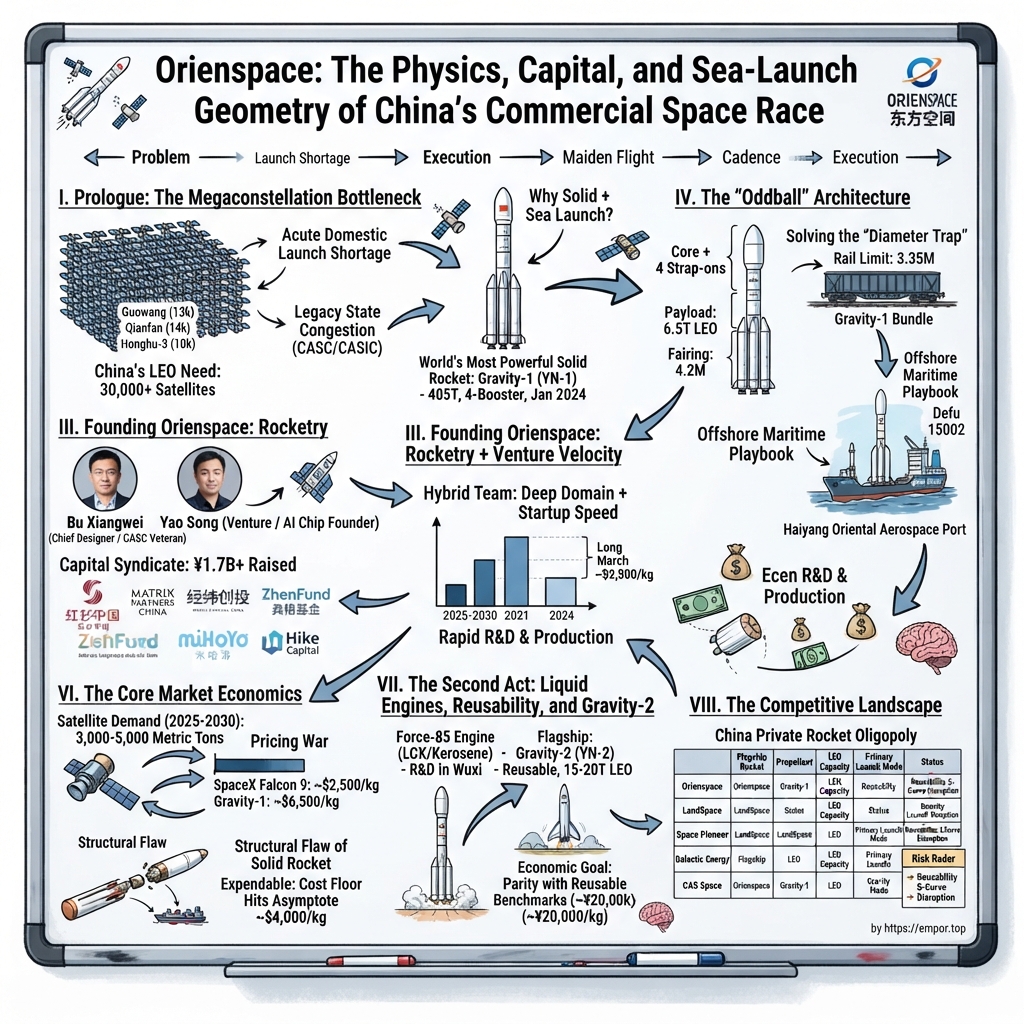
Orienspace: The Physics, Capital, and Sea-Launch Geometry of China's Commercial Space Race
I. Prologue & The Megaconstellation Bottleneck
At 10:54 on the morning of 22 July 2026, a squat, four-boostered rocket lifted off from a barge in the East China Sea, roughly a day's sailing from Shanghai, and placed nine satellites into sun-synchronous orbit.1 The vehicle was 引力一号 Gravity-1, built by six-year-old startup 东方空间 Orienspace. By the standards of the commercial launch industry, the mission was routine: a rideshare carrying small remote-sensing spacecraft for a mix of commercial and academic customers.2 What made it notable was that this was only the rocket's third flight, all three had succeeded, and the company had spent the preceding thirty-one months making an unusual case to investors: that an expendable rocket burning solid propellant—the architecture of tactical ballistic missiles rather than reusable orbital boosters—could serve as the cornerstone of a sustainable commercial business.
Four weeks later, on 19 August 2026, a domestic competitor challenged that premise directly. 蓝箭航天 LandSpace launched its methane-fuelled 朱雀三号 Zhuque-3 for the second time, delivered a satellite to orbit, and guided the first stage back to a landing pad in Gansu on deployable legs—marking the first propulsive vertical recovery of an orbital-class booster by a Chinese commercial launch firm. A post-landing fire in the aft section underscored the gap between recovering a booster and routinely reusing one, but the underlying engineering had been proven in flight.3 LandSpace has stated it intends to refly that stage within six months.4 For Orienspace, whose operational fleet is entirely expendable by design, the competitive clock on launch costs began ticking louder.
This story centers on an acute industrial bottleneck and a company that engineered an unconventional machine to capitalize on it. China has filed plans for and begun deploying two massive low-Earth-orbit broadband constellations: the state-backed 中国星网 China Satellite Network Group (Guowang), planned at roughly 13,000 satellites, and Shanghai's 千帆星座 Qianfan (the G60 constellation), targeting up to 15,000 satellites by 2030.5 As of mid-2026, Qianfan had approximately 238 operational satellites in orbit and Guowang had around 195—a combined total representing barely one percent of their targeted filings.5 Published deployment schedules outline an aggressive ramp: Guowang targets 310 satellites in 2026, 900 in 2027, and 3,600 annually thereafter; Qianfan targets 324 satellites in both 2026 and 2027 before scaling toward 4,000 per year.5 China's existing launch fleet lacks the capacity to deliver those payloads on that timetable.
The constraint stems from the structure of China's state-owned aerospace primes—中国航天科技集团 CASC and 中国航天科工集团 CASIC. Their launch infrastructure is not a merchant fleet. Core capacity is prioritized for national objectives: crewed spaceflight, lunar and planetary exploration, national security, and reconnaissance missions, leaving commercial broadband constellations to compete for the remainder. This dynamic has created an atypical market: politically guaranteed, high-volume demand facing severe supply bottlenecks, with private launch ventures invited by state policy to bridge the shortfall. Orienspace's founding premise was that meeting this demand quickly did not require seven years of developing a clean-sheet reusable liquid engine. Instead, the company assembled proven, off-the-shelf solid rocket motors, adapted them for offshore sea launches, and began commercial operations.
Evaluating this strategy requires examining three core questions:
- Strategic Architecture: Did opting for solid propulsion and maritime launch represent genuine operational foresight—delivering medium-lift orbital capacity years ahead of private competitors—or an interim shortcut that locks the company into a permanently uncompetitive cost floor?
- Operational Track Record: While three successful orbital launches in thirty-one months represents a flawless success rate, it also reflects a modest launch cadence. The underwriting case hinges on understanding the operational constraints driving that pacing.
- The Capital and Technology Pivot: Can Orienspace convert the near-term cash flow of an expendable solid launcher into a viable reusable liquid-propellant future? That transition depends on the
引力二号 Gravity-2programme, powered by the company's proprietary原力-85 Force-85engine, with a debut orbital flight targeted for the fourth quarter of 2026 following delays from its initial late-2025 timeline.67
The analysis follows this sequence:
- The bottleneck: How two state-backed megaconstellations generated an unprecedented launch deficit, and how a pivotal 2014 policy document opened China's space sector to private venture capital.
- The architecture: Why a rocket bundled like multiple solid boosters reflects railway transportation constraints, and why solid propulsion aligns strategically with maritime launch infrastructure.
- The record: Three successful flights in thirty-one months, a flawless operational record, and the logistical realities behind a twenty-one-month gap between launches.
- The economics: The prevailing price per kilogram to orbit in China, the structural cost floor of solid-fuel rockets, and how competitive unit economics shifted following the 19 August 2026 booster recovery.
- The capital: Over ¥1.7 billion raised across five venture rounds, disclosed valuation benchmarks, a contested founder departure, and a cap table reconstructed from regulatory filings and enterprise registries.
- The test: The core operating conditions required for Orienspace's business model to succeed, and the specific milestones that would challenge the investment thesis.
Orienspace remains a private enterprise. The company has stated that it initiated preparations for pre-IPO tutoring in August 2026, aims to complete its restructuring into a joint-stock corporation by year-end, and plans to formally enter the listing tutoring pipeline in 2027 targeting the Shanghai Stock Exchange's STAR Market.78 Without a public prospectus, fundamental financial metrics—audited revenues, gross margins, contracted order backlogs, balance-sheet cash reserves, and preferred share rights—are either private or accessible only through fragmented corporate registry disclosures and public briefings. What follows evaluates the verifiable public record, noting clearly where disclosures end.
 Subscribe on LinkedIn
II. Context: Document 60 and China's Commercial Space Big Bang
For the first six decades of China's space programme, private launch companies did not exist because there was no regulatory framework to permit them. Rockets were built exclusively by research academies inside state-owned conglomerates, funded directly through the state budget, and launched from military-operated ranges. That changed in November 2014, when the State Council issued guiding opinions on encouraging private capital into previously closed strategic sectors. Known across the domestic industry as Document 60, the directive formally opened satellite navigation, remote sensing, and commercial launch vehicle development to non-state investment.9
A classic first-wave venture cycle followed. Between 2015 and 2018, engineers departing state academies established startups including 蓝箭航天 LandSpace, 星际荣耀 iSpace, 零壹空间 OneSpace, and later 天兵科技 Space Pioneer and 星河动力 Galactic Energy. Backed largely by domestic venture capital funds with little prior aerospace exposure, these early entrants focused almost universally on small, solid-fuelled launchers capable of delivering payloads well under one tonne to low-Earth orbit. The thesis appeared straightforward on paper: small launchers required limited development capital, solid-rocket motors were a mature industrial technology inherited from legacy defence programmes, and reaching orbit quickly provided the technical validation needed to unlock subsequent financing rounds.
In the commercial marketplace, however, the thesis faltered. Sub-tonne launchers proved ill-suited to the operational demands of China's emerging satellite sector. A vehicle with a 300-kilogram payload capacity could not efficiently deploy broadband constellations composed of 300-kilogram satellites requiring batch launches of fifteen to twenty spacecraft at a time. Payload fairings were too narrow to accommodate stacked flat-panel designs, and unit economics remained prohibitive because fixed campaign expenses—range fees, tracking telemetry, mission insurance, and ground personnel—do not scale down linearly with vehicle size. Several first-wave startups suffered maiden flight failures that consumed years in recovery. By 2019, the private space sector had demonstrated that commercial Chinese ventures could reach orbit, but had yet to prove they could sustain a profitable enterprise.
Every launcher startup confronted the same fundamental architectural trade-off. A solid-rocket motor consists essentially of a composite or steel casing packed with a solid propellant grain—typically ammonium perchlorate oxidiser cast within a hydroxyl-terminated polybutadiene binder. Once ignited, it burns continuously until depleted, without throttle control, shutdown, or restart capability. In return, solid propulsion provides immense thrust density, rapid launch readiness, minimal ground infrastructure, zero boil-off, and access to a mature domestic defence supply chain refined over five decades. Liquid-propellant propulsion represents the inverse engineering bargain: complex turbomachinery, cryogenic propellant handling, intricate plumbing, and a five-to-eight-year engine development cycle requiring capital-intensive test infrastructure—balanced against the capacity to throttle, restart, and propulsively recover a booster stage, the only proven pathway to reducing launch costs by an order of magnitude.
When Orienspace was founded in 2020, its management chose an unconventional hybrid path: pursue both architectures sequentially, deploying an expendable solid-fuelled launcher to generate near-term commercial revenue and operational flight heritage while funding long-term reusable liquid engine development. That strategy gained urgency because of a critical regulatory constraint: the International Telecommunication Union's spectrum allocation rules mandate strict deployment milestones, requiring operators to launch defined proportions of their planned constellations within set multi-year windows or forfeit their orbital priority rights. With China's megaconstellation programmes racing against these regulatory deadlines, the domestic deployment pace through mid-2026 lagged far behind filed schedules.510 Meeting those international commitments required immediate orbital lift capacity rather than waiting for private reusable liquid rocketry to mature.
Orienspace engineered its initial vehicle fleet to capitalize on that immediate supply-demand imbalance. The central operational and financial question is how long that market window will remain open, and how rapidly competitor advances are closing it.
III. Founding Orienspace: The Cross-Pollination of Rocketry and Venture Velocity
Orienspace Technology (Shandong) Co., Ltd. was established on 9 June 2020 and headquartered in Yantai, along the northern coast of Shandong province.11 The geography was strategic: Shandong had spent the preceding years developing 海阳东方航天港 Haiyang Oriental Aerospace Port, China's only dedicated maritime launch facility. For a launch startup designed around offshore operations, proximity to deep-water dockside infrastructure was an operational prerequisite.
The founding team brought together two distinct backgrounds. 布向伟 Bu Xiangwei entered from the state aerospace establishment as a systems engineer with deep operational experience on the solid-fuelled 长征十一号 Long March 11—the vehicle that pioneered Chinese sea launches and provided the country's primary body of offshore operational flight data. 魏凯 Wei Kai, another co-founder, emerged from the same programme's project office, contributing supply-chain relationships and launch campaign logistics. Alongside this engineering core were two Tsinghua University graduates: 姚颂 Yao Song, an electronic engineering alumnus who previously founded AI chip venture 深鉴科技 DeePhi Tech before selling it to Xilinx in 2018, and 彭昊旻 Peng Haomin, who joined as co-founder and vice president.
The initial operational model proposed a clean division of responsibilities: state-system engineers would oversee propulsion physics, vehicle architecture, and quality assurance, while venture-side executives managed capital formation, organizational scaling, and commercial strategy. While frequently cited in domestic media as a benchmark model for commercial aerospace partnerships, the corporate governance structure proved more complex in practice—an area that provides critical visibility for potential investors assessing pre-listing disclosures.
Corporate registry filings reported in Chinese financial media indicate that Orienspace has 42 shareholders, anchored by two primary employee and founder holding vehicles: Ningbo Xinghejia at 48.21% and Ningbo Yibaijia at 8.5%. Within Xinghejia, Peng Haomin holds 73.046%, giving him an effective look-through equity stake of roughly 35% and establishing him as the company's largest shareholder and ultimate beneficial controller under regulatory definitions. Yao Song's equity in the same holding entity stood at 14.66%.12 In practice, the venture co-founder who maintained the lowest public profile held controlling equity.
In December 2024, leadership dynamics spilled into public view. TMTPost reported that Yao Song had stepped down, that Bu Xiangwei had assumed the dual roles of chairman and chief executive, and that Peng Haomin characterized Yao's primary contribution as capital raising. The report also indicated that Orienspace was marketing a Series B+ financing round at a pre-money valuation of roughly ¥7 billion—described as a conservative benchmark among China's tier-one commercial launch startups—and noted that the round had stalled as prospective investors waited for flight validation of the Gravity-2 booster.12 The following day, Jiemian reported conflicting accounts from people familiar with the matter who asserted that Yao remained active as co-founder and co-CEO, citing an official industry appearance on 15 December in that capacity.13 By 2026, the corporate leadership structure solidified in practice: Bu Xiangwei serves as chairman and CEO, while Yao Song is no longer listed in active executive management.
For prospective institutional investors, the leadership transition underscores three structural considerations. First, a venture advancing toward a domestic public listing experienced an unresolved public dispute regarding executive leadership that concluded without formal regulatory clarification—a governance ambiguity that standard listing prospectuses are structured to eliminate. Second, the separation of capital formation from technical leadership resulted in the departure of the primary fundraising executive precisely as the company entered its most capital-intensive development phase. Third, media reporting asserted that neither Yao nor Peng possessed prior aerospace operating backgrounds, noting that the founding team's early technical network drew in part from Peng's father, reported as a former chief designer on the Long March 11 programme.12 While unconfirmed by official company statements, this familial connection represents the type of related-party relationship that standard listing disclosures must formally address.
Capital mobilization remained active throughout this period. By mid-2026, Orienspace had secured more than ¥1.7 billion across five financing rounds—with ¥1.73 billion cited across domestic financial reporting—from a syndicate combining institutional venture capital with municipal and provincial state investment platforms.146 In January 2024, two weeks after the maiden flight of Gravity-1, the company closed a Series B round of approximately ¥600 million backed by the Liangxi Sci-Tech Innovation Fund of Wuxi, Shenyin Wanguo Investment, Hongtai Fund, and Xinding Capital, with capital dedicated to advancing the Force-85 liquid engine and Gravity-2 vehicle.15 Financing activity continued in 2026: Orienspace announced a pre-C round of several hundred million yuan from Vertex Capital, Shanghai STVC, AVIC Honghua, and Yuanyou Ruize in conjunction with its pre-IPO tutoring preparations, alongside July reports of an additional ¥400 million round marketed at a Shanghai investment forum.8614
The syndicate's structure reflects three distinct investor profiles:
- Institutional venture capital, pursuing equity upside alongside customary downside protections common to domestic RMB investment structures.
- Strategic and corporate investors, securing long-term supply-chain access and commercial optionality.
- Municipal and provincial state funds—including Wuxi's Liangxi Sci-Tech Innovation Fund in the Series B, and Shanghai STVC and AVIC Honghua in the pre-C round—allocating capital to support regional industrial development mandates.156
This regional government participation explains an atypical geographic footprint: Orienspace established its liquid propulsion headquarters and engine test facilities in Wuxi, Jiangsu province, roughly 800 kilometres from its Shandong assembly complex and coastal launch terminal.11 Municipal investment in China frequently carries local industrial siting commitments. While offering low-cost development capital, this arrangement distributes operational facilities across multiple provinces, creating ongoing logistical coordination requirements and corporate relationships that require comprehensive disclosure in future listing documentation.
The broader fundraising pattern demonstrates that Orienspace's capital access is closely tied to operational flight milestones. The Series B followed the maiden orbital launch by fourteen days, while the 2026 financing rounds coincided with the resumption of launch operations and progress toward the Gravity-2 flight campaign. While this milestone-driven cadence enforces operational discipline, it leaves little margin for technical delay—an operational sensitivity made acute by the revised timeline for the Gravity-2 programme.
IV. The "Oddball" Architecture: Why Gravity-1 Bet on Solid Bundles and the Sea
Visually, 引力一号 Gravity-1 departs sharply from conventional launcher design. Rather than a slender, single-column cylinder, the vehicle resembles a squat cluster of solid boosters. A three-stage solid core is encircled by four solid strap-on boosters—all within the 2.2- to 2.65-metre diameter class—generating a liftoff mass of approximately 405 tonnes. It can deliver 6.5 tonnes to low-Earth orbit and 4.2 tonnes to a 500-kilometre sun-synchronous orbit beneath a 4.2-metre fairing. Upon its maiden flight in January 2024, Gravity-1 became the most powerful solid-propellant launch vehicle ever flown and the most capable Chinese commercial rocket to reach orbit.[^16]1116
That unconventional profile is not a stylistic choice; it is an engineering solution to a domestic logistical bottleneck. China's railway cargo loading gauge caps the diameter of freight transiting national tunnels and bridges at roughly 3.35 metres—the physical parameter that dictated the Long March family's core diameter for decades. Unlike a liquid-propellant stage, a solid-rocket motor cannot be shipped empty and fuelled on the launch pad. The propellant grain is cast directly into the casing during manufacturing, leaving the factory as a fully loaded, hazardous, monolithic unit. Consequently, rail gauge imposes a strict upper limit on the diameter—and thus the propellant mass—of any single solid stage.
Orienspace resolved this constraint by clustering five smaller motors, each fitting comfortably within the national transport envelope, while sizing the payload fairing independently of the core stages. That distinction is crucial: placing a 4.2-metre fairing atop a 2.65-metre core creates an aerodynamically complex and structurally demanding vehicle, but it provides the internal volume necessary to make the rocket commercially viable. Flat-panel broadband satellites are primarily constrained by volume rather than mass. A rocket capable of lifting 4.2 tonnes into orbit offers little utility for constellation deployment if its fairing can accommodate only six satellites. Company disclosures state that Gravity-1 can deploy upwards of thirty satellites per flight, depending on customer dispenser configurations.17
The company's second foundational design choice was maritime launch. China's legacy inland spaceports—Jiuquan, Taiyuan, and Xichang—were constructed when downrange drop zones were sparsely populated. Today, inland launches routinely require evacuating communities beneath spent stage impact footprints, restricting launch azimuths and limiting orbital insertion flexibility. Offshore sea launches bypass those terrestrial constraints entirely: spent stages fall into open water, launch azimuths can be adjusted by repositioning the launch barge, and commercial schedules are decoupled from state-operated inland range congestion. Maritime operations also offer a geographic efficiency, allowing operators to sail southward to lower latitudes and capture additional rotational velocity.
Solid propulsion and maritime operations are well-suited to each other. Staging a cryogenic liquid-fuelled rocket aboard a sea vessel introduces severe boil-off challenges: liquefied gases vaporize continuously from the moment of loading, fuel tanks require constant replenishment, and a rolling deck complicates precision propellant transfer. A solid-propellant motor, by contrast, is stable and self-contained. It can be integrated inside a shore-based facility, rolled onto a launch vessel, transported for days across open water, and ignited on demand. The Haiyang complex was designed around this operational workflow: vehicle manufacturing, integration bays, and deep-water quays sit within several kilometres of one another, enabling a fully assembled rocket to move from the factory floor to the launch barge without entering the national railway or road network.
Yet evaluating Orienspace's competitive moat requires distinguishing proprietary advantages from shared regional infrastructure. Haiyang Oriental Aerospace Port is not Orienspace's exclusive facility; it is a Shandong provincial development initiative that operates as an open-access maritime spaceport. The facility hosts launches for state-owned primes as well as private operators. According to provincial and municipal disclosures, the port has supported the orbital delivery of 133 satellites, houses an assembly and testing capacity of roughly 50 launch vehicles per year, and targets an annual throughput of 100 rockets and 150 commercial satellites by 2027.18[^20] CASC's 捷龙三号 Jielong-3 solid-fuelled launcher operates from the same maritime berths, while Galactic Energy conducts its own offshore missions in the Yellow Sea. While Orienspace serves as the port's anchor commercial tenant and primary private beneficiary—enjoying geographic proximity and launch scheduling access—it does not control the port as a proprietary asset.
What Orienspace does possess is specialized operational knowledge: the marine engineering procedures required to stabilize, align, and launch a 405-tonne vehicle from a floating platform, establish sea-keeping boundaries, and enforce go/no-go criteria amidst ocean swell. Developed in part from the Long March 11 maritime flight heritage carried over by its founding engineering team, this operational expertise is difficult to replicate quickly. However, the long-term economic value of that advantage depends on whether offshore launching remains a differentiated capability or becomes a standardized, commoditized service provided by the port authority to any commercial operator—a transition that Haiyang's own open-access expansion suggests is underway.
V. Flight Heritage: From Haiyang Sea Trials to Operational Far-Sea Launches
The operating record of Orienspace's launch fleet is short enough to state in full—a brevity that represents one of the most critical factors in evaluating the business.
Flight 1 — 11 January 2024. Gravity-1 lifted off from a maritime platform off the coast of Haiyang, Shandong, and placed three 云遥一号 Yunyao-1 meteorological satellites into orbit on its maiden attempt.1611 Maiden flights of new orbital launch vehicles fail roughly half the time across aerospace history. A clean debut of a five-body clustered solid-propellant vehicle from an offshore barge was a notable engineering achievement that simultaneously established three industry benchmarks: the largest solid-propellant launch vehicle flown globally, the most capable Chinese commercial rocket to reach orbit, and the largest payload fairing mounted on an all-solid vehicle.[^16]
Flight 2 — 11 October 2025. Gravity-1 conducted its second mission, placing Jilin-1 and Shutianyu satellites into orbit.11 The primary operational challenge lay in the calendar: twenty-one months separated the first flight from the second, during a period in which management had publicly guided to three launches in 2024 and eight to ten across 2025 and 2026.19
Flight 3 — 22 July 2026. The Y4 vehicle lifted off at 10:54 Beijing time from the East China Sea off Shanghai—marking the first maritime launch by a private Chinese commercial firm in the Yangtze River Delta region—and delivered nine satellites plus an experimental payload into sun-synchronous orbit.12 The manifest was structured as a rideshare: six Dongpo Earth-observation satellites for the Huantian constellation, the 50-kilogram Tianyi-49 remote-sensing spacecraft, a hyperspectral imager, and a research satellite for the Harbin Institute of Technology.214 Company disclosures characterized the mission as the transition of Gravity-1 into mature, scaled commercial operations, outlining plans for three additional batch missions during the remainder of 2026, including orbital networking launches for satellite-internet constellations.7
Three successful orbital missions in three attempts represents an unblemished flight reliability record. In the commercial launch sector, operational reliability is an invaluable asset: it governs mission insurance rates, customer willingness to manifest high-value payloads, and eligibility for state constellation contracts. Yet three flights across thirty-one months reflects an extended demonstration campaign with early commercial revenue rather than a high-cadence merchant launch service.
What the gap reveals
Independent industry reporting provides critical context on why Orienspace's operational cadence stalled between early 2024 and late 2025. The company reportedly encountered difficulties securing solid-propellant rocket motors from its primary suppliers, including the state-owned Academy of Aerospace Solid Propulsion Technology (the Fourth Academy of CASC), beginning around August 2024.19 If accurate, that supply bottleneck highlights three structural aspects of Orienspace's operational model:
- Borrowed manufacturing capacity: The company's near-term delivery capability is structurally dependent on third-party production. Orienspace does not manufacture its own solid motors; it integrates propellant stages cast by the state defence-industrial complex.
- Supplier-competitor overlap: That manufacturing base belongs to CASC, the parent enterprise of state-backed launch vehicles like Jielong-3 and the Long March series, which compete directly for the same commercial constellation deployment contracts.
- Throughput constraints: An industrial conglomerate affiliated with a primary market competitor exercises effective supply-chain control over the propulsion hardware underpinning Orienspace's only operational vehicle.
The same industry analysis identified a second operational friction: Orienspace's vehicle development roadmap involves producing four distinct first-stage booster configurations across its Gravity-2 and Gravity-3 vehicle families—a proliferation of hardware variants that complicates the manufacturing standardisation required to capture economies of scale.19
Guidance versus results
Evaluating executive execution requires comparing public guidance against realized operational milestones:
- 2024 launch target: Management targeted three Gravity-1 flights in 2024; the company delivered one.19
- 2025–2026 launch target: Management guided to eight to ten flights across 2025 and 2026; the company conducted one in 2025 and one by late July 2026, with three additional missions guided for the remainder of the year.117
- Gravity-2 development timeline: Management targeted a test article in 2024 and a maiden flight by late 2025; the debut flight has been rescheduled to the fourth quarter of 2026.196
- Capital allocation commitments: Management stated at the Series B round that proceeds would fund the Force-85 engine and Gravity-2 development; the engine completed ground hot-fire testing and the vehicle advanced into pre-flight qualification campaigns.157
The broader pattern reveals an engineering organization that delivers on its technical hardware designs while maintaining persistent optimism regarding operational schedules. Timeline slippage is common across the global space industry. For prospective investors, however, capital requirements, customer manifests, and the competitive market window are benchmarked against dates that have historically experienced twelve-to-eighteen-month deferrals. Furthermore, the solid motor supply constraints identified by outside analysts as the most plausible operational cause for the 2024–2025 launch pause have not been formally detailed in public company disclosures.19
What the manifest reveals about revenue
The July 2026 rideshare mission provides the clearest available view into the company's near-term commercial revenue profile. While a manifest of nine satellites indicates active commercial engagement, the individual satellite masses reflect modest payload utilization. Tianyi-49 is a 50-kilogram-class spacecraft, the Dongpo satellites are compact Earth-observation platforms, and the accompanying university payloads are smaller still.2 Relative to Gravity-1's rated capacity of 4.2 tonnes to sun-synchronous orbit, total delivered mass on the mission represented a fraction of the vehicle's lift capability, though aggregate payload mass was not publicly disclosed.
Payload utilization directly determines mission profitability. Launch revenue is contracted either on a dedicated-vehicle basis or per kilogram of manifested payload. Domestic financial reporting indicates that a dedicated Gravity-1 launch is priced at roughly ¥30,000 per kilogram, and that Orienspace's market entry helped push prevailing commercial launch pricing from an industry baseline near ¥100,000 per kilogram toward approximately half that rate since early 2024.177
A fully manifested dedicated sun-synchronous flight at ¥30,000 per kilogram implies gross top-line revenue of roughly ¥125 million, whereas a rideshare carrying small fractional payloads generates substantially lower gross proceeds. While Orienspace has stated that it has closed its commercial operating loop and established stable revenue-generating capability, the company has not published audited financial statements, contracted order backlogs, or net per-flight realizations.7
To supplement launch operations, industry reports indicate that Orienspace has diversified into supplying aerospace components and instrumentation for unmanned aerial vehicles and related applications as an ancillary source of near-term cash flow.19 While providing auxiliary funding during launch cadence gaps, commercial diversification outside orbital launch underscores the financial demands of sustaining capital-intensive vehicle development alongside a measured flight cadence.
VI. The Core Market Economics: The Chinese LEO Constellation Supercycle
The commercial investment case for Orienspace does not depend primarily on technological superiority; it depends on an acute domestic launch deficit. Assessing that thesis requires distinguishing paper filings from funded procurement.
The demand that is actually contracted versus the demand that is filed
- Guowang: approximately 13,000 satellites planned, roughly 195 in orbit by mid-2026, and a stated deployment schedule of 310 satellites in 2026, 900 in 2027, and 3,600 annually from 2028.5
- Qianfan: up to 15,000 satellites planned by 2030, roughly 238 in orbit by mid-2026 after crossing the 200 mark in the first half of the year, with deployment targets of 324 satellites in each of 2026 and 2027 before scaling toward 4,000 annually.510
- Honghu-3: an additional constellation of roughly 10,000 satellites filed under LandSpace-affiliated entities, currently in the prototype phase—with the second Zhuque-3 flight carrying an initial Honghu communications satellite prototype.3
These figures represent regulatory filings and stated deployment goals rather than signed launch contracts. In commercial aerospace underwriting, that distinction is critical: an orbital spectrum filing secures regulatory priority, a funded deployment schedule indicates budgeted intent, and an executed launch contract represents bankable commercial revenue. Orienspace's addressable opportunity currently draws largely from the first two categories.
Yet the aggregate launch shortfall is structural. If Qianfan's first-generation flat-panel satellites weigh approximately 300 kilograms each and China's flagship constellations require thousands of satellites in orbit before the decade ends, total orbital mass requirements scale into thousands of tonnes—demanding hundreds of medium-lift launches not currently supported by domestic launch manifests. Chinese state media has reported that Qianfan reduced its per-satellite manufacturing cost by more than 96%, resolving upstream spacecraft production bottlenecks and leaving orbital launch capacity as the primary binding constraint.20 Satellites are achieving mass manufacturing faster than rockets can be built to loft them.
The reachable market, not the category market
A common analytical misstep is multiplying total filed satellites across theoretical constellation targets by prevailing launch rates to calculate a vast addressable market. The market Orienspace can realistically capture is far narrower:
- Filings differ from funded procurement: Spectrum filings preserve orbital slots, but commercial constellations are frequently descoped. Orbital shells beyond initial baseline deployments depend on follow-on capital and commercial demand that have not yet been fully committed.
- State programmes favour state launchers: Orbital deployment for Guowang and Qianfan has to date been dominated by state-owned CASC launch vehicles.5 Commercial startups must negotiate access against state primes that maintain captive sovereign launch demand.
- Payload class filters vehicle utility: Deploying stacks of twenty 300-kilogram satellites requires a medium-lift launcher rated above six tonnes with a wide fairing—the core design argument for Gravity-1. However, constellation deployment equally requires sustained launch cadence, which remains an operational constraint for Orienspace.
- The commercial rideshare sector is limited: Small-satellite remote sensing, Internet of Things, and academic research payloads comprise the customer manifests Orienspace has flown to date.2 While commercially viable, this segment supports an annual revenue pool measured in hundreds of millions of yuan rather than billions.
Orienspace's reachable market is therefore defined by a specific operational intersection: the portion of Chinese constellation and commercial tonnage that is firmly contracted, unallocated to state-owned launchers, compatible with a four-to-six-tonne payload envelope, and executable within the throughput limits of the company's motor supply chain.
The price curve, honestly stated
Evaluating unit economics requires comparing domestic rates against global benchmarks:
- SpaceX's Falcon 9 operates at prevailing commercial pricing between $2,000 and $3,000 per kilogram, equivalent to roughly ¥14,000 to ¥21,000 per kilogram in domestic market conversions.17
- Legacy Chinese state expendables have historically operated well above that threshold.
- Gravity-1 is marketed at roughly ¥30,000 per kilogram for dedicated missions—approximately half the historical domestic baseline cited by the company, though roughly double Falcon 9 rates.177
- Gravity-2 targets a launch price of approximately ¥20,000 per kilogram, which management frames as achieving parity with Falcon 9 commercial pricing.177
This pricing structure defines the company's commercial position: Gravity-1 is cost-competitive within China's domestic market while remaining uncompetitive against global reusable benchmarks. In the near term, that global disparity is mitigated by geopolitical barriers that prevent Chinese commercial satellite operators from procuring Western launch services. Orienspace's pricing power is sustained by a closed domestic market rather than a structural cost advantage. If domestic competitors achieve reliable, scaled booster reusability, that competitive buffer will erode from within China's own launch sector.
The structural ceiling on solid propellant
Expendable solid-propellant launchers operate under a structural cost floor that operational efficiencies cannot bypass. In a reusable liquid-fuelled rocket, capital-intensive hardware—turbomachinery, propellant tanks, structural airframes, and avionics—is recovered and amortized across multiple missions, with fuel representing a marginal fraction of operating expenses. In a solid-fuelled vehicle, the motor casing and propellant grain form a single integrated unit that is entirely expended on each flight. Every Gravity-1 mission requires purchasing and expending five fully loaded solid rocket motors alongside sea-launch maritime operations. Unit costs can decline only through incremental manufacturing scale and supplier procurement negotiations—a gradual learning curve rather than a step-change cost reduction.
This mechanical reality defines the core economic asymmetry facing investors. A reusable liquid rocket offers the potential to lower marginal launch costs by eighty to ninety percent once recovery and refurbishment mature. An expendable solid launcher cannot achieve comparable cost compression. Orienspace's strategic rationale treats Gravity-1 as a transitional bridge to generate commercial revenue and flight heritage during the multi-year development window required for domestic reusable liquid rocketry to mature. Following LandSpace's propulsive booster recovery in August 2026, the critical strategic question is how quickly that bridge will be overtaken.
VII. The Second Act: Liquid Engines, Reusability, and Gravity-2
Everything material about Orienspace's long-term valuation rests on a vehicle programme that has not yet flown.
The engine
原力-85 Force-85 is a roughly 100-tonne-class liquid oxygen and kerosene engine operating on an open gas-generator cycle—the same broad architectural family as SpaceX's Merlin engine, and a deliberate departure from the methane-liquid oxygen pathway chosen by LandSpace. Disclosed performance specifications outline approximately 85 tonnes of sea-level thrust and 95 tonnes in vacuum, incorporating the deep-throttling and multi-restart capabilities required for a booster stage to decelerate and execute a controlled vertical landing.21 The propulsion development sequence is traceable across the public record: a half-system hot-fire test in December 2023, the assembly and rollout of the first complete engine at the company's Wuxi propulsion facility in early 2024, and progressive integrated test firings thereafter.2221
By mid-2025, development transitioned from component validation into vehicle-level ground testing, including aerodynamic wind-tunnel campaigns, structural manufacturing, and a July 2025 "three-in-one" integrated hot fire verifying the first-stage engine operating in concert with servo actuators and onboard propellant valves—the primary coordination milestone preceding a full-stage static fire.23 Domestic industry reporting in 2026 indicated that the Force-85 engine had completed full-system qualification testing and that the Gravity-2 airframe was conducting its final large-scale pre-flight ground testing campaigns.87
The vehicle
引力二号 Gravity-2 is designed as a two-stage reusable liquid-propellant launcher measuring approximately 70 metres in length and 4.2 metres in diameter. Powered by nine Force-85 engines on its first stage, the vehicle is rated to deliver 21.5 tonnes to low-Earth orbit and 15 tonnes to a 500-kilometre sun-synchronous orbit—more than three times the payload capacity of Gravity-1.67 Its maiden flight is scheduled for the fourth quarter of 2026, following schedule revisions from an initial late-2025 target outlined after the January 2024 Series B round.156 Behind it on the product roadmap sits 引力三号 Gravity-3, a three-core clustered heavy-lift configuration rated at over 30 tonnes to low-Earth orbit and targeted for 2027.1119
What has to be true
For prospective investors, the Gravity-2 transition presents specific operational and technical failure modes that carry distinct economic consequences:
- Engine reliability at cluster scale: Operating nine liquid engines simultaneously introduces severe engineering complexities absent in single-engine test stands, including acoustic vibration coupling, complex propellant manifolding, multi-axis thrust-vector control, and engine-out contingency redundancy. Maturing a nine-engine first stage has historically required years of iterative flight testing across the global aerospace industry.
- Recovery versus true reuse: While LandSpace demonstrated booster recovery in August 2026, the post-landing aft fire and the company's guided six-month turnaround window underscore that commercial value depends on rapid, low-cost refurbishment rather than touchdown alone.34 Orienspace has yet to validate propulsive recovery in flight.
- Schedule discipline and capital runway: The development timeline has already adjusted from early milestones toward late-2025 and subsequently to late 2026.196 While development slippage is common in rocket engineering, recurring delays compress the commercial window before competing reusable vehicles establish market pricing.
- Hardware proliferation: Maintaining four distinct booster configurations across two separate vehicle families risks fragmenting production lines and undermining the manufacturing standardisation necessary to achieve reusable unit cost reductions.19
Why the pivot is still the right strategy
These operational risks do not invalidate the strategic transition; rather, they demonstrate that the liquid programme defines the company's enterprise value. In economic terms, Gravity-1 serves primarily as a credential, a near-term revenue bridge, and operational validation to qualify for sovereign constellation contracts. Management's capital allocation has remained consistent with this objective: Series B proceeds were directed toward Force-85 development and Gravity-2 tooling rather than expanding solid-motor assembly lines.15 The critical investment question is not whether the strategic rationale is sound, but whether Orienspace can execute the transition before domestic reusable competitors permanently reset commercial launch economics.
VIII. The Competitive Landscape: China's Private Rocket Oligopoly
After a decade of fragmented experimentation, China's private launch sector consolidated across 2025 and 2026 into a concentrated cohort of well-capitalized enterprises. In the first half of 2026 alone, the domestic commercial space industry raised approximately ¥15.1 billion, with roughly fifteen companies advancing toward domestic public listings.24 Orienspace operates within this competitive environment not as an isolated outlier, but as one of five or six well-funded ventures competing for the same megaconstellation manifests.
The companies that actually matter
- LandSpace (
蓝箭航天): The sector's methane-liquid oxygen pioneer, which achieved the world's first orbital launch of a methalox rocket with Zhuque-2 in July 2023. Its stainless-steel Zhuque-3, powered by nine Tianque-12A engines, conducted its second mission on 19 August 2026, delivering an orbital payload and executing a controlled vertical touchdown of its first stage on land—China's first propulsive recovery of an orbital-class booster. Although a post-landing fire in the aft section highlighted the technical distance between recovering a booster and routinely reusing one, LandSpace announced plans to refly the recovered stage within six months and established a design target of at least twenty flights per booster.34 That flight established the technological benchmark for the entire private launch cohort. - Space Pioneer (
天兵科技): The first private Chinese enterprise to reach orbit with a liquid-propellant launcher, in April 2023, and developer of the medium-lift Tianlong-3—a programme that experienced significant disruption following a static-fire accident in which a first-stage test article broke away from its test stand. - Galactic Energy (
星河动力): The launch cadence leader among private Chinese firms, with an extensive flight record for its solid-fuelled Ceres-1 launcher across both land and maritime platforms. The company is developing the partially reusable, 283-tonne Pallas-1 liquid-propellant vehicle, rated at up to 7 tonnes to low-Earth orbit, with its maiden flight scheduled for late August 2026 from a dedicated launch pad at Jiuquan.25 - iSpace (
星际荣耀): Developing Hyperbola-3, a partially reusable two-stage vehicle rated at 13.6 tonnes to low-Earth orbit in an expendable configuration and 8.6 tonnes in reusable mode, with an initial flight targeted for 2026.26 - CAS Space (
中科宇航): A commercial spin-off of the Chinese Academy of Sciences operating the solid-fuelled Lijian-1 (Kinetica-1). Backed by institutional state ties, it competes directly for sovereign and commercial small-to-medium payload manifests. - Deep Blue Aerospace (
深蓝航天): Developing the Nebula-1 launcher, with development resources concentrated primarily on vertical takeoff and propulsive landing technologies.
Where Orienspace actually sits
Against this competitive field, Orienspace's operational differentiation is narrower than initial market narratives suggested:
Demonstrated operational strengths: - Flight-proven lift capacity: Gravity-1 provides the largest operational payload capability of any commercial Chinese launcher in service, at 6.5 tonnes to low-Earth orbit. By comparison, Galactic Energy's Ceres-1 is a sub-tonne vehicle, LandSpace's Zhuque-2 was rated around 1.5 tonnes, and heavier competitor vehicles remain in pre-operational testing or early qualification. - Mission reliability: An unblemished record of three successful orbital insertions in three attempts. - Maritime infrastructure integration: Operational sea-launch capability integrated directly alongside coastal assembly and integration facilities at Haiyang.
Structural competitive constraints: - Propulsion and reusability deficit: The company has yet to fly a liquid-propellant vehicle, validate propulsive recovery in flight, or demonstrate stage refurbishment. - Supply-chain exposure: Near-term launch throughput relies on third-party solid-motor suppliers tied to state-owned primes that compete for the same commercial payloads. - Cadence limits: On flight frequency—the operational throughput that converts rated capacity into commercial revenue—Galactic Energy maintains a substantial lead. Meanwhile, LandSpace has demonstrated orbital stage recovery, and both iSpace and Galactic Energy are preparing maiden flights of larger liquid vehicles within the same calendar window as Gravity-2.
In strategic terms, Orienspace holds a temporary payload capacity lead in an expendable solid architecture while working to close the gap in reusable liquid propulsion. That sequence represents a viable interim bridge if Gravity-2 meets its technical milestones on schedule; it does not constitute a permanent competitive moat.
On comparables, and why the usual exercise fails here
In standard equity underwriting, valuation models rely on peer trading multiples. For China's commercial launch sector, constructing a standard comparable table introduces false precision for several structural reasons:
- Absence of public pure-play peers: Every direct operating competitor—LandSpace, Space Pioneer, Galactic Energy, and iSpace—remains privately held. Valuations circulate as unverified private funding marks rather than audited disclosures, and none of these firms publishes audited revenues, gross margins, or contracted order backlogs.
- Structural divergence from Western benchmarks: Publicly listed US launch enterprises operate in merchant markets serving diverse commercial and government clients, price contracts in US dollars, operate within export-controlled supply chains, and access public equity markets. Orienspace sells into a domestic market anchored by two dominant state-backed constellation programmes, prices in renminbi, and depends on state defence suppliers for its primary propulsion hardware. Applying Western revenue multiples to domestic launch ventures represents an analytical mismatch.
- SpaceX as a conceptual rather than financial benchmark: SpaceX is referenced throughout domestic industry analysis as a long-term cost and pricing target—a comparison useful for illustrating strategic ambition, but inapplicable for near-term equity valuation.
- Limitations of A-share space-adjacent multiples: Publicly traded domestic aerospace component suppliers, satellite manufacturers, and advanced materials firms trade at valuations reflecting domestic market demand for strategic hard-technology assets. While these multiples provide an anchor for prospective STAR Market pricing, they do not reflect commercial launch operating economics.
The most instructive comparative data point in the public record is relative rather than absolute: TMTPost's December 2024 report that Orienspace's roughly ¥7 billion pre-money valuation represented the lowest mark among China's top-tier private launch ventures.12 Regardless of the exact baseline figure, the relative ranking indicates that the private market applied a valuation discount to an expendable solid-propellant architecture relative to peers with advanced reusable liquid programmes—reflecting an investor consensus that near-term expendable lift is valued below credible reusable capability.
IX. Strategic Frameworks: Helmer's 7 Powers & Porter's 5 Forces
Strategic frameworks are useful here only insofar as they force a rigorous distinction between what Orienspace has operationalized and what it has merely claimed. Evaluated against fundamental economic benchmarks, the company's structural moats are narrower than its corporate narrative suggests.
Helmer's 7 Powers
Counter-positioning — real but shallow. The classic form of counter-positioning is adopting a business model that an incumbent cannot copy without damaging its core business. Orienspace's version is only partial: state-owned primes CASC and CASIC possess the technical capability to build clustered solid sea-launch launchers, and CASC's Jielong-3 operates from the very same maritime facility. What state academies structurally cannot do is prioritize commercial broadband constellation deployment over sovereign national spaceflight, exploration, and defence missions, because their manifest allocations are determined by state policy. The counter-positioning is therefore operational rather than technological: it is defined by whose launch schedule the vehicle prioritizes. While this provides a tangible near-term advantage, it is an eroding one as state primes introduce dedicated constellation launchers including the Long March 6A, Long March 8A, and Long March 12.
Cornered resource — weaker than claimed. Industry commentary typically points to two potential cornered resources. The first is human capital: the engineering cohort from the Long March 11 programme, who pioneered offshore sea launches in China and now serve among Orienspace's founders and technical leads. While this flight experience is real and difficult to replicate quickly, its differentiation inevitably depreciates as commercial peers accumulate offshore operational hours. The second candidate is Haiyang Oriental Aerospace Port. Here, the thesis fails on the facts: the port is an open-access Shandong provincial facility built to serve multiple operators, featuring a declared throughput capacity of approximately 50 vehicles per year and a provincial development target of 100 rockets annually by 2027.18[^20] Orienspace is an anchor commercial tenant, not the facility's proprietor. Crucially, the single resource that would provide a decisive competitive moat—domestic solid-propellant rocket motor production—is not cornered by Orienspace. It is controlled by state-owned defence chemical suppliers that reportedly throttled motor deliveries to the company starting in 2024.19
Process power — plausible, unquantified. Proprietary marine engineering procedures, offshore vessel stabilization routines, and dockside factory-to-quay integration workflows constitute genuine operational process power. Three successful orbital launches confirm that the operating sequence functions; they do not prove that it is rapid, standardized, or low-cost. In commercial space logistics, true process power is validated through launch cadence—and cadence remains the most constrained dimension of Orienspace's track record.
Scale economies — not yet present. Standardizing on 2.2- and 2.65-metre motor casing diameters across core stages and strap-on boosters represents an efficient architecture for volume production. That volume, however, has not materialized. Three flights across thirty-one months falls well below the operational throughput required to capture manufacturing learning-curve efficiencies. Furthermore, the company's roadmap of fielding four distinct first-stage booster configurations across the Gravity-2 and Gravity-3 families works directly against hardware standardization.19
Network effects — none. Orbital launch is industrial infrastructure. A customer's launch service experience is unaffected by how many other satellite operators fly on the same vehicle class.
Switching costs — low, with contract-level stickiness. Mechanical and electrical satellite-to-fairing interfaces are largely standardized across the aerospace sector, with custom payload dispensers fabricated on a per-mission basis. The primary switching friction is schedule coordination: unwinding a multi-launch constellation deployment campaign mid-stream imposes operational delays. This dynamic creates contractual lock-in across a one-to-two-year horizon rather than a permanent structural switching cost.
Branding — none in the economic sense. Launch procurement decisions are governed by verified flight heritage, insurance underwriting premiums, payload scheduling, and political eligibility. A flawless mission record is a commercial asset, but it functions as an actuarial track record rather than brand equity.
Porter's Five Forces
Threat of new entrants: low, and falling further. The capital barrier to reaching orbit now reaches into billions of renminbi, domestic aerospace propulsion talent is finite and largely concentrated among established ventures, and institutional venture capital has coalesced around existing frontrunners. The domestic space sector's ¥15.1 billion in first-half 2026 financing flowed almost entirely to enterprises with demonstrated orbital flight heritage.24
Supplier power: high, and specifically dangerous. This structural vulnerability is demonstrated directly in Orienspace's operating history. The company's primary commercial product depends on solid rocket motors procured from state defence chemical manufacturers whose corporate parent competes directly for commercial launch contracts. The reported 2024–2025 supply interruption illustrates that this supply-chain exposure represents an active operational risk rather than a theoretical concern.19 Vertically integrating motor production would resolve this dependency, but would demand years of development and substantial capital that the company has allocated elsewhere.
Buyer power: very high. Domestic demand is heavily concentrated in two state-backed megaconstellation operators, Guowang and Qianfan, supplemented by a fragmented tier of commercial remote-sensing and IoT satellite developers. Missing a single multi-launch constellation procurement tranche can leave vehicle manufacturing capacity underutilized for an entire operating cycle. The July 2026 manifest—nine compact satellites deployed for academic research institutes, a regional geological bureau, and a private remote-sensing venture—illustrates a company generating revenue from the commercial tail rather than the high-volume constellation core.2
Threat of substitutes: high and rising. State expendable launchers, including the Long March 6A, 8A, and 12, are expanding dedicated constellation launch capacity, while private reusable liquid architectures now include a vehicle that has achieved propulsive vertical landing.3 Either development can permanently reset market pricing below the structural cost floor of expendable solid propulsion.
Rivalry: extreme. Five or six well-financed commercial launch enterprises are competing for a limited pool of flagship constellation deployment contracts in a market where demonstrating scaled booster reusability sets the pricing benchmark for the entire industry. LandSpace's August 2026 booster recovery functioned as a competitive repricing event across China's commercial launch landscape.
X. Risk Radar & The Skeptical Investor Stress Test
A pre-IPO enterprise is underwritten as much on the quality of its disclosure gaps as on its disclosed milestones. For prospective public-market investors, the primary operational and structural risks fall into seven areas, ranked in descending order of impact on the investment thesis.
1. The reusability S-curve arrived early
The core bear thesis on an expendable architecture was always that a domestic competitor would demonstrate propulsive vertical recovery before Gravity-1 could fully amortize its development capital. That inflection point occurred on 19 August 2026.3 The commercial fallout will not be instantaneous: an orbital booster that sustained an aft fire upon touchdown remains far from a routinely reflown launcher, and LandSpace's guided six-month turnaround represents an operational target rather than an established commercial cadence.4 Yet the downstream economic trajectory is clear: proven recovery compresses marginal launch costs, compressed marginal costs exert downward pressure on market pricing, and expendable launchers are inevitably repriced against the new benchmark. Orienspace's quoted launch rate of roughly ¥30,000 per kilogram becomes difficult to defend against competitors targeting reusable economies of scale. The company's strategic response—targeting ¥20,000 per kilogram with Gravity-2—is the necessary architectural countermeasure, but it trails competitor flight validation.
2. Supplier dependence on a competitor's parent
Orienspace does not manufacture the solid-propellant motors that power its operational fleet. The reported supply constraints from the state-owned Academy of Aerospace Solid Propulsion Technology beginning around August 2024 provide the most direct operational explanation for the twenty-one-month launch pause between the company's first and second flights.19 This structural dependency presents significant strategic friction: internally building solid-motor manufacturing capacity requires a multi-year, capital-intensive expansion, while qualifying secondary suppliers is exceptionally slow within a defence-adjacent propulsion ecosystem. Most crucially, relying on hardware produced by a corporate affiliate of market competitors directly undermines the commercial premise of operational autonomy from the state complex.
3. Execution risk in the liquid transition
The Force-85 engine has advanced through single-engine qualification and integrated vehicle-level ground hot-fire tests, while the Gravity-2 airframe is undergoing final pre-flight ground testing ahead of its targeted fourth-quarter 2026 debut.723 Yet transitioning from ground validation to a functional, reusable orbital vehicle requires navigating the most failure-prone engineering hurdles in rocketry: coordinating a nine-engine cluster under high aerodynamic loads, executing stage separation, deploying grid fins and landing legs, withstanding re-entry thermal environments, and avoiding test-stand anomalies that can consume both hardware and eighteen months of operational runway. Maiden flight failures remain common across the launch industry, but Orienspace's financing and commercial timelines assume a rapid, successful transition.
4. Customer concentration and the manifest that does not fill
Orienspace's addressable commercial revenue is anchored by two flagship megaconstellations from which it has not yet publicly confirmed major launch contracts. Payloads deployed across its operational missions have consisted primarily of compact remote-sensing, educational, and experimental research satellites.2 If Guowang and Qianfan continue allocating the majority of their early deployment batches to state-owned Long March vehicles, Orienspace's large manufacturing footprint in Haiyang and propulsion facilities in Wuxi risk turning into fixed-cost overhead carried by a low-volume rideshare manifest. Conversely, if satellite mass production itself experiences bottlenecks—a historical friction across domestic constellation programmes—launch schedules slip across the entire sector regardless of contracted vehicle allocations.
5. Governance, control, and the disclosure gap
The absence of a formal listing prospectus is most evident in corporate governance, where available registry filings leave critical operational questions open:
- Concentrated control held outside executive management: Corporate registry data indicates that Peng Haomin holds an effective look-through equity stake of roughly 35% via Ningbo Xinghejia, identifying him as the company's ultimate beneficial controller, while Bu Xiangwei serves as chairman and CEO.12 While concentrated founder equity is standard in Chinese technology startups, this particular arrangement—in which controlling ownership sits with a non-operating co-founder while the operating chief executive holds a smaller stake—represents a governance dynamic that future listing prospectuses must clarify.
- Unresolved executive leadership reporting: Media coverage surrounding Yao Song's reported departure in December 2024 produced conflicting public accounts within twenty-four hours: one report cited his resignation alongside statements characterizing his role as capital-raising, while another cited sources asserting he remained active in corporate leadership.1213 The company did not issue a formal regulatory clarification to resolve the contradictory accounts.
- Reported related-party relationships: Industry reporting noted that the founding team's early technical network drew in part from a familial relationship with a former chief designer on the Long March 11 programme.12 While unconfirmed by official company disclosures, such ties represent standard related-party disclosures under domestic STAR Market listing guidelines.
- Undisclosed equity and governance mechanics: The public record provides no visibility into employee option pools, executive compensation structures, board independence, voting pacts within the Ningbo holding partnerships, or potential dual-class share rights.
A comprehensive listing prospectus would need to disclose several fundamental items that press reporting cannot verify:
- Audited annual revenues, gross margins, and operating losses, with launch services clearly segregated from aerospace component and drone instrument sales.
- Contracted order backlogs by customer, detailing firm commercial commitments versus uncommitted constellation memorandums.
- Balance-sheet cash reserves, outstanding debt, lease liabilities, and the net cash burn rate that informed the sizing of 2026 financing rounds.
- The complete preference stack across private funding series, along with the specific terms governing their conversion upon restructuring into a joint-stock corporation.
- Supplier concentration metrics in solid propulsion hardware, including whether secondary motor suppliers have been qualified.
- Related-party transactions involving founders, executive family members, or municipal co-investment vehicles hosting operating facilities.
- Board composition, independent director representation, and the formal voting mechanisms through which beneficial control is exercised.
- History of insider share transfers, clarifying whether founder or employee equity transactions included secondary liquidity alongside primary capital formation.
6. Capital structure: what can and cannot be built
Attempting to derive an enterprise valuation from fragmented private funding marks introduces significant analytical distortion:
- Disclosed capital metrics: The company raised more than ¥1.7 billion across five financing rounds through mid-2026, alongside a 2026 pre-C round of several hundred million yuan and an additional ¥400 million round reported in domestic financial media.6814 Corporate filings record 42 shareholders on the register, with two founder and employee holding vehicles controlling 48.21% and 8.5%.12 Disclosed valuation benchmarks include a pre-money valuation of roughly ¥7 billion in late-2024 reporting and an unverified ¥10 billion valuation mark circulating in October 2025 coverage.1217
- Undisclosed terms: The total share count, the ratio of common to preferred equity, and specific preferred rights—liquidation preferences, anti-dilution ratchets, redemption obligations, or performance-contingent repurchase terms standard in domestic venture financing—remain private. Similarly, the terms attached to municipal state fund investments, which frequently carry local capital deployment or employment requirements, are undisclosed, as are exact cash reserves and lease commitments.
These gaps lead to three structural valuation constraints. First, implied equity value cannot be calculated simply from private round prices, because preferred shares equipped with downside protections trade at a premium to standard common equity. Second, enterprise value cannot be calculated without audited disclosures of net cash, debt, and capitalized lease obligations. Third, the eventual public free float remains entirely undefined pending the structuring of a formal offering.
The planned conversion into a joint-stock corporation, which Orienspace targets for completion by the end of 2026, represents the corporate milestone where preferred share structures are typically standardized or terminated, establishing the clean equity register required for formal listing tutoring.7
7. The path to durable profitability
In the absence of audited financial statements, the underwriting case for long-term profitability must be evaluated through operational structure:
- Gross margin realities: A dedicated Gravity-1 mission delivering 4.2 tonnes to sun-synchronous orbit at ¥30,000 per kilogram generates top-line launch revenue of approximately ¥125 million. Direct mission costs include five fully loaded solid rocket motors, avionics suites, fairing fabrication, stage integration labor, launch vessel charter, and offshore range operations. While exact cost breakdowns remain undisclosed, the fact that commercial launch pricing has fallen by roughly half from earlier industry baselines suggests that aggressive pricing has been used to secure early market share.7
- Fixed-cost operating leverage: Orienspace maintains a substantial capital footprint: an assembly complex in Haiyang, a propulsion center and test campus in Wuxi, and an R&D facility in Beijing.11 Sunk operating overhead must be amortized across mission volume; at a cadence of three flights in thirty-one months, fixed costs remain largely unabsorbed.
- Capital expenditure and development intensity: Running parallel development campaigns for Gravity-2 and Gravity-3 across four first-stage booster variants creates capital requirements that exceed the near-term cash flow generated by an expendable launch fleet.19
- Operating conditions required for cash flow generation: Establishing sustainable operating cash flow requires achieving double-digit annual launch cadences, maintaining realized pricing per kilogram without severe margin erosion, successfully introducing Gravity-2 to triple delivered payload capacity on a shared operational base, and validating booster recovery before competitive repricing eliminates unit margins.
- Specific thesis-challenging milestones: Key indicators that would invalidate the commercial thesis include a maiden-flight failure on Gravity-2, renewed solid-motor supply interruptions, competitor commercialization of reflown boosters at lower price points, or an operational launch cadence of fewer than four flights in 2027.
XI. The Bull vs. Bear Case & 3 Critical KPIs
The bull case
The bridge holds long enough. Through roughly 2028, Gravity-1 remains the only flight-proven Chinese commercial vehicle capable of delivering 6.5 tonnes to low-Earth orbit, arriving at the exact moment China's two flagship broadband constellations must scale from a few hundred satellites to several thousand.5 Capturing even a modest share of that volume, at the tonnage Gravity-1 can deploy, represents a substantial commercial revenue stream—and unlike most private peers, Orienspace is generating operational launch revenue today rather than marketing future capacity.
Sea launch becomes the default, not the exception. Shandong province has targeted an annual throughput of 100 launch vehicles by 2027 from Haiyang, China's only dedicated maritime launch port.[^20] If offshore launching becomes the standard high-cadence mode for constellation deployment—driven by congested inland ranges and populated terrestrial drop zones—an operator with manufacturing facilities adjacent to deep-water berths and a founding engineering team steeped in Long March 11 maritime flight heritage can compound a tangible logistical advantage.
Gravity-2 succeeds on schedule. A successful debut in the fourth quarter of 2026, followed by booster recovery demonstrations in 2027, would position Orienspace in direct competition with LandSpace in Chinese reusable commercial launch. Offering 21.5 tonnes of low-Earth-orbit capacity—exceeding Zhuque-3—at a targeted price of ¥20,000 per kilogram, Gravity-2 would transform the business.617 Under this scenario, expendable solid launchers transition into a high-margin niche for rapid-response and dedicated missions, while the reusable liquid fleet becomes the core enterprise driver.
The bear case
The solid propulsion dead end. Gravity-1 operates against a structural cost floor. If constellation operators standardize on reusable liquid launchers, an expendable solid rocket is relegated to low-volume, schedule-sensitive missions at price points that cannot support a large fixed-cost operating base.
Propulsion execution stumbles. The Force-85 engine has passed ground hot-fire trials but has not flown in an orbital mission. A maiden-flight anomaly or an extended multi-year recovery development cycle would exhaust capital reserves before revenue scales—a material exposure given that 2026 funding rounds were raised specifically to underwrite the Gravity-2 programme.8
State primes absorb constellation volume. State-developed vehicles including the Long March 6A, 8A, and 12 are being scaled specifically for broadband constellation deployment, supported by the same state industrial base that supplies Orienspace's solid rocket motors. If state launchers capture the overwhelming majority of Guowang and Qianfan deployment tonnage, private operators will be left competing for the commercial remote-sensing tail—the precise segment reflected in Orienspace's flown manifests to date.2
Valuing the business rather than pricing the round
Two valuation benchmarks exist in the public record, neither of which constitutes an audited financial disclosure: a pre-money valuation of roughly ¥7 billion at the Series B+ stage in late 2024, reported as the lowest among China's top-tier private launch ventures, and an unverified ¥10 billion valuation mark circulating in October 2025 reporting.1217 Both figures represent prices negotiated for preferred equity by institutional investors holding structural downside protections—such as liquidation preferences and redemption rights—that common equity holders do not share. A private round price for a protected security reflects capital terms rather than the intrinsic value of the enterprise or its common shares.
In the absence of published financial statements, any intrinsic valuation framework must rely on explicit operating assumptions rather than audited metrics:
- Downside scenario (roughly 30% probability). Gravity-2 slips beyond 2027 or suffers a maiden-flight failure. Gravity-1 achieves four to six flights annually with realized pricing eroding toward ¥20,000 per kilogram and partial payload fill. Top-line revenue plateaus in the mid-hundreds of millions of yuan against fixed manufacturing overhead built for higher throughput, requiring dilutive emergency capital. Under these operating conditions, the enterprise is valued between ¥2 billion and ¥4 billion, primarily as strategic asset and intellectual property value, with common equity impaired by preferred liquidation stacks.
- Central scenario (roughly 45% probability). Gravity-2 debuts within twelve months of its target date and enters commercial service by 2028, with scaled reusability economics materializing later in the decade. By 2030, an annual launch mix of roughly a dozen Gravity-2 missions and several Gravity-1 flights yields average realized revenue of ¥150 million to ¥200 million per liquid flight and ¥80 million to ¥100 million per solid flight. This generates annual revenue of ¥2.5 billion to ¥3.5 billion, operating margins in the mid-teens, and net income of roughly ¥400 million to ¥550 million under a preferential 15% high-tech enterprise tax rate. Capitalized at 25 to 30 times earnings—a multiple supported by domestic hard-technology public listings—and discounted at 20% for execution risk, present equity value lands between ¥5 billion and ¥7 billion.
- Upside scenario (roughly 25% probability). Gravity-2 achieves orbital insertion, booster recovery, and rapid reflight; Gravity-3 debuts in the 2027–2028 window; and annual launch cadence expands into the mid-twenties, supported by large Guowang or Qianfan allocation tranches. Revenue approaches ¥6 billion by 2030–2031 at a 25% operating margin, producing net income of roughly ¥1.2 billion to ¥1.3 billion. Capitalized at 30 times and discounted back, equity value reaches ¥11 billion to ¥15 billion prior to offering dilution.
Weighting these probabilities yields a blended equity value between ¥5 billion and ¥9 billion today—below the unverified ¥10 billion benchmark cited in late-2025 coverage and broadly aligned with the ¥7 billion valuation reported earlier. The model's primary sensitivities are, in order of impact: whether Gravity-2 validates flight and recovery milestones on schedule; realized revenue per mission, which depends on payload fill rather than quoted headline rates; and annual flight cadence, which remains constrained by a third-party propulsion supply chain. An order-of-magnitude shift in annual launch throughput moves intrinsic value far more than any variation in valuation multiples.
Public listing mechanics introduce dynamics distinct from intrinsic business valuation. A STAR Market offering by an early private commercial launch company would command scarcity value, access strong domestic investor demand for sovereign technology assets, and offer a limited public float. These factors have historically driven Chinese hard-technology listings to substantial early trading premiums above fundamental valuation ranges. For long-term investors, however, holding through the Gravity-2 flight campaign ultimately underwrites operational engineering execution rather than initial market sentiment.
The three KPIs that decide it
1. Tonnage delivered to orbit annually, rather than flight count. Flight totals can be misleading when a 6.5-tonne launcher carries fractional rideshare payloads. Total orbital mass delivered—and net realized revenue per mission—separates a demonstration campaign from a sustainable commercial launch business. The historical baseline is modest: Orienspace has never flown more than once in a single calendar year. Delivering four or more Gravity-1 missions in 2026, as guided by management, would provide the first operational confirmation that third-party solid-motor supply constraints have eased.7
2. Gravity-2's orbital debut, followed by booster recovery and stage reflight. These represent three distinct engineering hurdles. An initial orbital flight validates stage separation and the nine-engine cluster; a successful landing validates supersonic guidance and structural landing systems; and a reflyable booster validates the underlying unit economics. LandSpace's recovered yet burning first stage demonstrates the substantial engineering gap between touchdown and rapid reuse.34 Full-duration, mission-duty-cycle static firings of the Force-85 engine serve as the primary leading indicator.
3. Realized price per kilogram to 500-kilometre sun-synchronous orbit. Contracted realizations, rather than published rate cards, determine commercial viability. Orienspace's market entry contributed to lowering prevailing domestic commercial launch pricing by roughly half, and industry pricing pressure continues to intensify.7 If realized revenue per kilogram falls faster than per-flight operating costs, expanding orbital tonnage will compress rather than expand operating margins—the standard structural failure mode for capital-intensive launch enterprises.
XII. Playbook: Business & Investing Lessons
Strip away the rocketry and Orienspace serves as a case study in a classic strategic dilemma: how to build an operating business when the ideal long-term technology requires years of development but the market demands capacity immediately. Five strategic lessons generalize beyond aerospace.
1. The second-best technology, deployed today, can build a viable business—provided management remains clear-eyed about its expiration date. Solid propulsion is inferior to reusable liquid rocketry across almost every long-term economic dimension. Yet it could be engineered within three years using an established industrial supply chain, delivering a 6.5-tonne-class launcher to orbit on its maiden attempt while better-funded competitors were still qualifying engines.[^16] The operational insight was sound. The underlying hazard is that enterprises that succeed with an interim bridge technology often fall in love with the bridge—defending their legacy architecture, underfunding the subsequent transition, and realizing too late that the crossing was the entire objective. Orienspace has largely avoided that trap: management directed Series B proceeds toward the Force-85 engine and Gravity-2 vehicle rather than expanding solid-motor production capacity.15 Whether that transition arrives quickly enough to counter competitor reusability remains the decisive commercial question.
2. Design around physical and logistical bottlenecks, not just propulsion physics. The most instructive element of Gravity-1's architecture is not its liftoff thrust; it is that the vehicle was engineered specifically around national railway loading gauges. China's rail network caps cargo diameter at roughly 3.35 metres, solid motors must be transported fully loaded, and no individual solid stage can exceed that envelope. Clustering five sub-2.65-metre motors beneath an independently sized 4.2-metre fairing turned a transportation constraint into a core design parameter. The maritime launch architecture resolves a parallel terrestrial bottleneck—avoiding inland drop zones over populated areas—while the Haiyang complex's dockside integration layout eliminates inland transportation entirely. In capital-intensive hardware, logistics and site selection are as decisive as thermodynamics.
3. Pairing technical domain depth with venture velocity is powerful, but inherently fragile. The founding thesis was compelling, but the governance outcome is instructive. State-system aerospace engineers remained in executive management; the venture-side co-founder who spearheaded early fundraising departed amid conflicting public accounts.1213 The takeaway is not that hybrid leadership teams fail, but that equity allocations, voting control, and executive boundaries established at inception dictate how an organization navigates cultural friction—and those founding agreements are executed years before operational disputes emerge. For outside investors, cap-table governance structures serve as leading indicators of corporate resilience under stress.
4. Using an interim product to self-fund the next generation is an ambitious model that demands high operational cadence. The commercial thesis—that near-term revenue from expendable solid launchers can finance capital-intensive liquid engine R&D while minimizing dilutive equity rounds—is a textbook strategy for industrial scaling. Yet the operational record demonstrates the difficulty of execution. Three launches across thirty-one months cannot self-fund parallel development campaigns for two liquid vehicle families featuring four booster variants, requiring the company to raise multiple follow-on funding rounds since its maiden flight alongside additional capital marketed in 2026.1914 Self-funding remains an aspiration governed by launch throughput. Investors should treat claims that current products will fund next-generation R&D as a testable hypothesis requiring demonstrable cadence growth.
5. In a concentrated market, customer selection is the strategy. Every pillar of the commercial bull case—payload capacity lead, maritime launch logistics, and competitive domestic pricing—ultimately resolves into a single commercial milestone: securing high-volume constellation deployment tranches from Guowang or Qianfan. Flown manifests to date have consisted of academic research institutes, a regional geological bureau, and private Earth-observation operators.2 Engineering a capable machine that serves the commercial tail can sustain a viable niche; it cannot support the valuation multiples of a cornerstone constellation infrastructure provider.
XIII. Epilogue & What to Watch
Six years after its founding in Yantai, Orienspace has achieved an operational milestone that eludes most orbital launch ventures: it built a medium-lift vehicle, launched it successfully across three consecutive missions, and generated commercial revenue.111 Yet that operational record represents an interim bridge to a business model that has yet to be proven at scale. The commercial window for that bridge is narrowing, and the company crossing it does not control the manufacturing base that supplies its primary propulsion hardware.
The next eighteen months will resolve much of this strategic ambiguity. Gravity-2 is scheduled for its maiden flight in the fourth quarter of 2026, following ground testing campaigns that the company characterizes as largely complete.78 Management has guided to three additional Gravity-1 batch missions before year-end, which would triple the vehicle's cumulative flight count and test whether third-party solid-motor supply constraints have genuinely eased.7 Meanwhile, the planned restructuring into a joint-stock corporation by late 2026 and formal listing tutoring in 2027 will provide institutional investors with their first verified view of audited financial results, cap-table governance, related-party ties, and the preference rights governing private funding rounds.78 Over the same horizon, competitive benchmarks will continue to shift: LandSpace aims to refly its recovered booster within six months, Galactic Energy and iSpace are preparing maiden flights of larger liquid launchers, and state primes are expanding dedicated constellation launch capacity.42526
In one reading of this trajectory, pragmatic sequencing prevails. Orienspace recognized an immediate domestic launch deficit, bypassed years of pre-revenue engine development by integrating proven solid motors, adapted the architecture for offshore maritime operations, and used the resulting flight heritage and commercial cash flow to finance its transition into reusable liquid rocketry. If Gravity-2 achieves orbit and validates booster recovery, that hybrid development roadmap will stand out as one of the most effective strategic executions in China's commercial space sector.
In an alternative reading, the expendable bridge proves to have been a costly detour. In this scenario, solid propulsion consumed development capital and organizational focus while competitors advanced liquid engine architectures, locking the operational fleet into a structural cost floor and leaving Orienspace entering the reusable market behind a competitor that has already recovered an orbital booster from flight. Both interpretations align with the public record today. What distinguishes them is neither executive narrative nor private valuation benchmarks, but the performance of a single vehicle on a launch pad in late 2026—and the fate of its booster stage once it separates.
References
-
Gravity-1 sea launch off Shanghai puts 9 satellites into orbit — SpaceNews, 2026-07-22 ↩↩↩
-
Orienspace Performs Sea-Based Satellite Rideshare for Third Mission (Gravity-1 Y4) — China in Space, 2026-07 ↩↩↩↩↩↩↩↩↩
-
LandSpace becomes first commercial Chinese company to land an orbital-class booster — Spaceflight Now, 2026-08-19 ↩↩↩↩↩↩↩
-
Landspace aims to refly recovered Zhuque-3 booster within six months — SpaceNews, 2026-08 ↩↩↩↩↩↩
-
China's Mega-Constellations Mega-Article — China in Space, 2025-12 ↩↩↩↩↩↩↩↩
-
Chinese launch startup Orienspace targets IPO, secures funding for reusable Gravity-2 rocket — SpaceNews, 2026-08 ↩↩↩↩↩↩↩↩↩↩
-
火箭发射三战三捷 东方空间距离IPO还有多远? — 新浪财经 Sina Finance, 2026-07-23 ↩↩↩↩↩↩↩↩↩↩↩↩↩↩↩↩↩↩↩
-
东方空间:已启动IPO辅导准备工作 — 证券时报 Securities Times (stcn.com), 2026-08 ↩↩↩↩↩↩↩
-
国务院关于创新重点领域投融资机制鼓励社会投资的指导意见(国发〔2014〕60号)— State Council of the PRC, 2014-11-26 ↩
-
Qianfan constellation deployment hits 200 satellites with Long March 8 and 6A launches — SpaceNews, 2026-06 ↩↩
-
钛媒体独家|声称做中国SpaceX的东方空间,清华创始人被踢出局、估值70亿头部最低 — TMTPost via 凤凰网财经 ifeng Finance, 2024-12-16 ↩↩↩↩↩↩↩↩↩↩↩
-
独家|商业航天"独角兽"东方空间联席创始人姚颂离职?知情人士:仍在职 — 界面新闻 Jiemian News, 2024-12-17 ↩↩↩
-
东方空间完成6亿元B轮融资 "引力二号"计划两年内首飞 — 21世纪经济报道 21jingji, 2024-01-24 ↩↩↩↩↩↩
-
Chinese startup launches most powerful solid-fuel rocket in debut — Reuters, 2024-01-11 ↩↩
-
东方空间拟明年冲刺科创板,引力二号发射成本有望低于SpaceX — 新浪财经 Sina Finance, 2025-10-12 ↩↩↩↩↩↩↩↩
-
海阳东方航天港累计将133颗卫星送入预定轨道 — 烟台市人民政府 Yantai Municipal Government, 2026 ↩↩
-
Where is OrienSpace? — China in Space, 2025-03 ↩↩↩↩↩↩↩↩↩↩↩↩↩↩↩↩
-
How China cut the cost of its Qianfan satellites by over 96% — CGTN, 2026-06-09 ↩
-
东方空间自研"原力-85"百吨级液氧煤油发动机半系统热试车圆满成功 — 中国航天网 chinaerospace.com, 2023-12 ↩↩
-
Galactic Energy's Reusable Pallas-1 Launcher Nears First Flight — Aviation Week, 2026-07 ↩↩
-
China's latest batch of new and reusable rockets are close to launch — SpaceNews, 2026 ↩↩
 LinkedIn
 WhatsApp
 Reddit
 Hacker News
 Email
Email Kindle
 RSS Feed
 Spotify
 Apple Podcasts
 Amazon Music
 Audible
 YouTube