Mitsubishi UFJ Financial Group: The Rise, Reinvention, and Return of Japan’s Banking Colossus
I. Introduction & The Macro Inflection: Japan’s Banking Titan Awakes
A Check Nobody Could Wire
On Monday, October 13, 2008, American commercial banks were closed for Columbus Day, and global markets were bracing for the possibility that Morgan Stanley might not reopen. Lehman Brothers had collapsed four weeks earlier, short sellers were pressuring the last two independent Wall Street investment banks, and Morgan Stanley's shares were in free fall. To many traders, the $9 billion rescue agreement struck two weeks earlier by Mitsubishi UFJ Financial Group looked like a commitment the Japanese lender would inevitably abandon.
Instead, the bank followed through. Negotiators restructured the terms at the eleventh hour, and in an episode now cemented in Wall Street lore, the capital arrived as a physical paper check for $9 billion because the federal holiday had shuttered standard wire clearing channels.1 That same day, the two institutions announced that MUFG had closed its investment: $7.8 billion in perpetual convertible preferred stock carrying a 10% dividend and a conversion price of $25.25, alongside $1.2 billion in non-convertible preferred shares, securing an initial 21% fully diluted equity stake in Morgan Stanley.2 John Mack, Morgan Stanley's chairman and chief executive at the time, said he was "honored to welcome Mitsubishi UFJ" as a long-term investor.2 The partnership proved exceptionally lucrative for both sides, evolving into one of the most profitable cross-border financial transactions in modern history.
The transaction illustrates the defining characteristics of the institution behind it. MUFG has rarely operated as a flashy investment house, and for decades following Japan's asset price collapse, it generated subdued returns. Yet at pivotal junctures, the group possessed an immense, patient balance sheet and the willingness to deploy capital when liquidity elsewhere had evaporated.
The Scale of the Beast
三菱UFJフィナンシャル・グループ Mitsubishi UFJ Financial Group (NYSE: MUFG, TSE: 8306) reported total consolidated assets of ¥433.9 trillion and consolidated deposits of ¥236.9 trillion as of June 30, 2026.3 Converted at exchange rates in the low ¥150s per dollar, that represents a balance sheet approaching $3 trillion—a sum exceeding the annual gross domestic product of most G20 economies. Domestic deposits across its commercial banking and trust banking entities stood at approximately ¥182 trillion, with roughly ¥95 trillion held by retail depositors, representing generations of Japanese households that have entrusted their savings to legacy Mitsubishi or Sanwa branches.3
The institution's commercial reach is equally entrenched. MUFG reports serving approximately 33 million retail accounts and roughly one million corporate clients, while corporate surveys by Tokyo Shoko Research have ranked the group as the primary "main bank" for Japanese enterprises for 13 consecutive years.4 Very few major corporations in Japan operate without a lending or transactional relationship with MUFG.
On July 13, 2026, the group reached a milestone unseen since the asset bubble era: MUFG's market capitalization briefly crossed ¥42 trillion, overtaking トヨタ自動車 Toyota Motor to become Japan's most valuable publicly traded company. The last financial institution to occupy the top spot in the Japanese equity market was 住友銀行 Sumitomo Bank in 1986.5
The Core Paradox
Explaining that market milestone requires addressing a long-standing paradox. For nearly three decades—from the early-1990s crash through the 日本銀行 Bank of Japan's prolonged era of negative interest rates—investors viewed Japanese megabanks as low-yielding utilities burdened by structural deflation. In the fiscal year ended March 2024, MUFG generated a return on equity of 7.6%.4 The macroeconomic environment shifted decisively when the BOJ terminated its negative interest rate policy on March 19, 2024, abandoned yield curve control, and restored the overnight call rate as its operational policy target.6 On September 18, 2026, the central bank lifted its policy rate to 1.25%, marking its highest benchmark rate since 1995.7
Benefiting from wider lending spreads, MUFG reported ¥2.43 trillion in profit attributable to owners of the parent for the fiscal year ended March 2026—a 30% increase that marked its third consecutive year of record earnings—while return on equity rose to 11.3%.4 For the fiscal year ending March 2027, executive management set a net income target of ¥2.7 trillion.4
Rising interest rates provide the most visible catalyst for this earnings expansion, but monetary tightening accounts for only part of the turnaround. The broader story centers on an industrial-era institution that survived near-insolvency in the 1990s, prevailed in a high-stakes domestic consolidation battle, executed a decisive Wall Street alliance alongside more volatile ventures in California and Southeast Asia, and is now working to prove that its double-digit return on equity reflects fundamental structural reform rather than a transient interest rate cycle.
The Roadmap
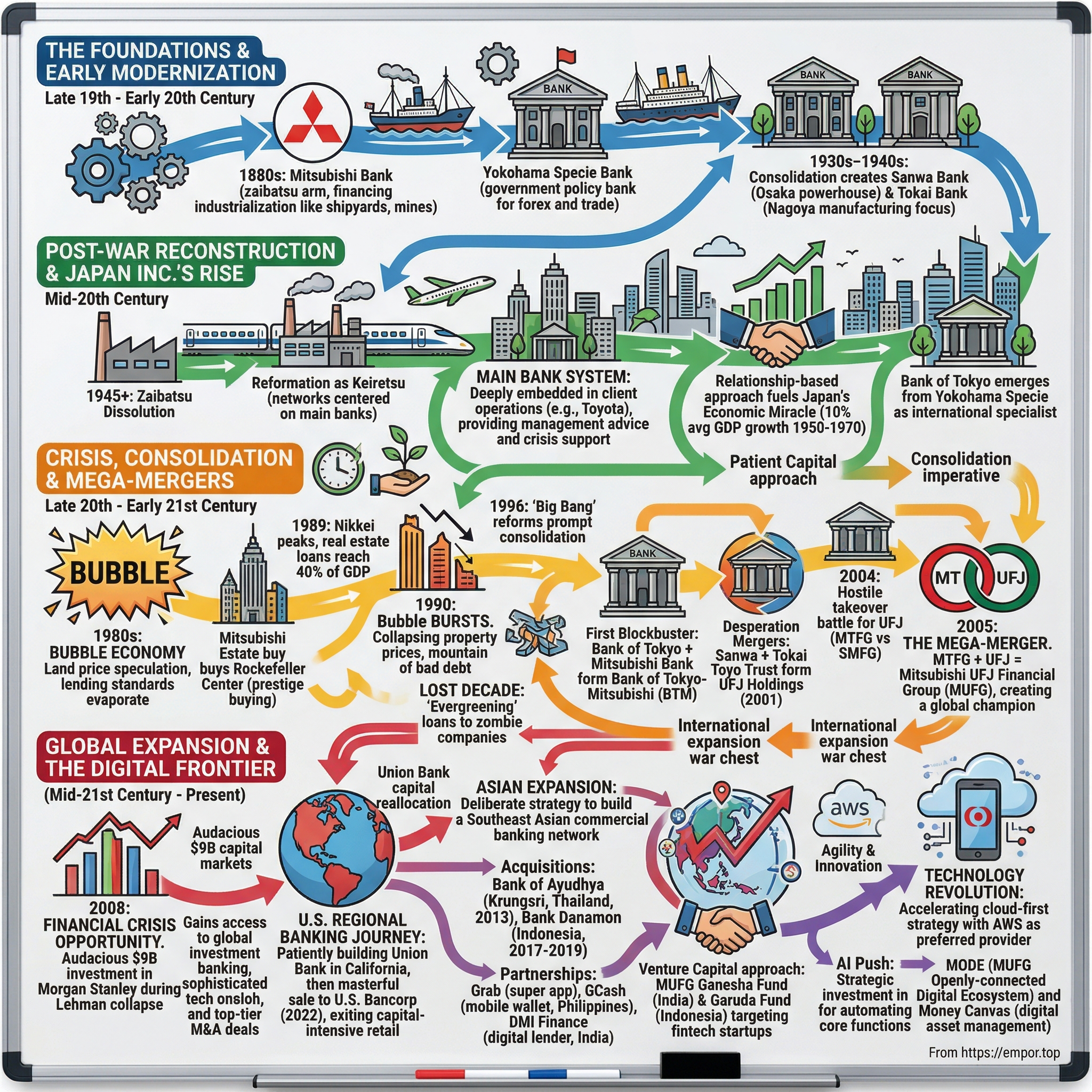
The group's evolution traces a path from nineteenth-century zaibatsu shipping roots through the post-bubble banking crisis, into the fierce 2004–2005 consolidation battle for UFJ that established the modern institution, through the emergency recapitalization of Morgan Stanley and an extended retail presence in California, across an ongoing strategic expansion into Southeast Asia and India, and finally into its contemporary operational model. Under a mathematician chief executive who prioritized balance-sheet efficiency and capital returns, MUFG systematically shed unprofitable assets before passing leadership in April 2026 to an executive steeped in compliance and strategic planning. The narrative begins in the Meiji era, when the institutional habits that rendered MUFG exceptionally resilient—and deliberately cautious—were first established.
 Subscribe on LinkedIn
II. Zaibatsu Roots & The Post-War Main Bank System (1880–1990)
Two Offices, One Year
In 1880, two financial institutions opened that would eventually merge to form MUFG. In Tokyo, 岩崎弥太郎 Iwasaki Yatarō, the shipping entrepreneur behind the Mitsubishi zaibatsu, established the Mitsubishi Exchange House to finance his expanding industrial operations. Down the coast in Yokohama, the 横浜正金銀行 Yokohama Specie Bank opened to finance Japan's foreign trade, establishing an office in New York that same year.8 The two entities pursued fundamentally different mandates: one existed to finance a domestic family-owned industrial conglomerate, while the other linked an opening Japanese economy to international capital markets. That split—domestic corporate banking on one side and cross-border trade finance on the other—continues to shape MUFG's identity.
The Mitsubishi exchange house became 三菱銀行 Mitsubishi Bank in 1919.8 It developed a lasting reputation for conservative credit underwriting, elite recruitment from top state universities, and close ties to Japan's premier corporations. Meanwhile in Osaka, a much older lineage of merchant finance, tracing back to the Konoike exchange bureau established in 1656, eventually produced 三和銀行 Sanwa Bank in 1933. In Nagoya, 東海銀行 Tokai Bank was founded in 1941.8 Sanwa and Tokai became commercial lenders to Japan's small and mid-sized manufacturers, regional merchants, and retail consumers. Rooted in the Kansai and Chūbu industrial regions, both operated aggressively and developed corporate cultures far removed from Mitsubishi's Marunouchi headquarters.
Dissolution and Rebirth
Following World War II, Allied occupation authorities dissolved the family-controlled 財閥 zaibatsu holding companies. In 1946, the Yokohama Specie Bank was reconstituted as 東京銀行 Bank of Tokyo, which became Japan's designated foreign-exchange specialist.8 Concurrently, the severed Mitsubishi operating companies regrouped as a horizontal 系列 keiretsu—an enterprise confederation bound by reciprocal cross-shareholdings, regular presidents' council meetings, and mutual commercial loyalty rather than centralized ownership. Mitsubishi Bank anchored this network as its primary financial hub, standing alongside 三菱商事 Mitsubishi Corporation and 三菱重工業 Mitsubishi Heavy Industries at its core.
The Main Bank Machine
The financial architecture that funded Japan's postwar economic boom rested on the "main bank" relationship. Under this arrangement, an enterprise's primary lender extended long-term credit, held an equity stake in the company, placed senior executives on its board during operational distress, and organized informal rescue syndicates when restructuring became necessary. In return, corporate borrowers held shares in the bank. These reciprocal stakes—formally designated as 政策保有株式 policy (strategic) shareholdings—insulated corporate executives from hostile takeovers and entrenched commercial exclusivity.
The structure supported rapid industrial growth for three decades, but it also institutionalized commercial habits that modern Japanese lenders are still unwinding. Commercial banks competed on relationship depth and lending volume rather than credit pricing, measuring institutional stature by total asset size rather than return on equity. Regulators shielded the sector under the 護送船団方式 "convoy system," a protective supervisory framework in which authorities ensured no bank was allowed to fail and the pace of expansion matched the survival capacity of the weakest institution.
The Bubble
The macroeconomic environment shifted abruptly following the September 1985 Plaza Accord. As the yen strengthened rapidly against the dollar, the Bank of Japan responded by easing monetary policy to cushion domestic growth. Asset prices soared. At the same time, Japan's highest-quality corporate borrowers found they could raise capital more cheaply in domestic and international bond and equity markets than through bank loans. Having lost their prime industrial borrowers, commercial banks redirected balance sheets into real estate developers, construction companies, and speculative land projects, treating real estate as collateral that would appreciate indefinitely. Bank of Tokyo remained relatively insulated due to its international focus. Mitsubishi Bank participated more cautiously than its peers, maintaining tighter credit controls. In contrast, Sanwa and Tokai lent aggressively into regional property and commercial booms across Osaka and Nagoya.
This historical divergence shaped modern MUFG in two critical ways. First, the strategic shareholding portfolio that MUFG is currently selling down represents a direct legacy of this postwar framework rather than a modern portfolio choice. Second, the cultural divide between Tokyo's elite corporate establishment and the more aggressive regional banking cultures of the Kansai and Chūbu regions persisted for decades. When the asset price bubble burst at the start of the 1990s, the constituent lenders entered the prolonged banking crisis in starkly different financial condition.
III. The Crash, The Lost Decade, & The Mega-Merger Crucible (1990–2005)
The Slow-Motion Collapse
Japan's banking crisis did not arrive in a single dramatic week. It unfolded over the course of the 1990s as equity values retreated from their December 1989 peak, commercial and residential land prices declined year after year, and the real estate collateral backing vast corporate loan books quietly deteriorated. Under the unwritten rules of the regulatory convoy system, financial institutions routinely rolled over non-performing credit to keep insolvent borrowers afloat rather than recognizing loan losses—a practice of forbearance tacitly permitted by authorities. As a result, massive unacknowledged losses accumulated on balance sheets that banks continued to report as solvent.
Mitsubishi Bank responded by pursuing scale and international diversification. On April 1, 1996, it merged with Bank of Tokyo on equal terms to form The Bank of Tokyo-Mitsubishi.8 The strategic logic was clear: Mitsubishi held premier corporate lending relationships across domestic blue chips, while Bank of Tokyo contributed an established worldwide operating network. Together, they could provide Japanese multinationals with end-to-end commercial banking services, from domestic payroll management in Nagoya to cross-border trade letters of credit in São Paulo. It was the first of Japan's major banking consolidations and proved to be the most structurally coherent.
UFJ: A Merger of the Wounded
Sanwa Bank, Tokai Bank, and 東洋信託銀行 Toyo Trust pursued a far more troubled course. Between 2001 and 2002, they combined to form UFJ Holdings—a defensive consolidation driven less by strategic industrial vision than by shared structural distress. Having lent aggressively into regional commercial and property booms across Osaka and Nagoya, UFJ carried non-performing loan burdens that were widely recognized as the most severe among Japan's major lenders. By 2004, the Financial Services Agency had grown openly adversarial toward management over its repeated delays in classifying and resolving bad debts. UFJ faced critical capital depletion and needed an outside partner immediately.
The Battle for UFJ
In the summer of 2004, UFJ agreed to sell its trust banking arm to 住友信託銀行 Sumitomo Trust. Shortly thereafter, UFJ abruptly terminated the transaction to negotiate a comprehensive corporate merger with Mitsubishi Tokyo Financial Group (MTFG), which offered a vital ¥700 billion capital injection.9 Sumitomo Trust filed for legal relief and obtained a preliminary injunction in Tokyo. The higher courts subsequently overturned that decision, and on August 30, 2004, Japan's Supreme Court rejected Sumitomo Trust's final appeal, permitting the Mitsubishi–UFJ negotiations to proceed.9
The merger contest escalated further when 三井住友フィナンシャルグループ Sumitomo Mitsui Financial Group (SMFG) launched an unprecedented move in Japanese corporate banking: an unsolicited hostile counterbid offering to acquire UFJ for ¥3.2 trillion, or roughly $29 billion.9 The contest pitted two competing visions of mega-consolidation against each other. An MTFG–UFJ combination would command roughly ¥188 trillion in consolidated assets, while an SMFG–UFJ merger would assemble about ¥184 trillion—either pairing creating the largest commercial banking institution in the world.9
UFJ's board selected Mitsubishi, guided by both financial pragmatism and corporate conservatism. MTFG offered a much cleaner balance sheet, and financial authorities favored institutional stability over an unpredictable takeover battle. The two groups formalized a basic integration agreement in August 2004. MUFG was officially formed on October 1, 2005, through the merger of MTFG and UFJ Holdings, followed by the operational union of their core commercial lending units as The Bank of Tokyo-Mitsubishi UFJ on January 1, 2006. That same year, MUFG completed repayment of public funds.10
The Long Tail of Integration
The formal legal closing marked only the opening chapter of an integration process that spanned more than a decade. Aligning disparate corporate entities and legacy technology systems required years of phased execution across each operating vertical. Mitsubishi UFJ Trust and Banking and Mitsubishi UFJ Securities debuted in 2005. The consumer credit and leasing divisions merged in 2007 under Mitsubishi UFJ NICOS and Mitsubishi UFJ Lease & Finance. In 2008, consumer lender ACOM became a consolidated subsidiary. Yet organizational consolidation progressed at a deliberate, cautious pace: the corporate lending units of the core commercial bank and trust bank were not merged until 2018, the same year The Bank of Tokyo-Mitsubishi UFJ was rebranded as MUFG Bank.10 Thirteen years passed between the initial holding company union and the emergence of a single brand for the bank.
That extended integration reflected deep institutional friction rather than mere bureaucratic inertia. Combining three distinct regional banking traditions, a trust bank, a securities firm, and a consumer credit specialist under one Tokyo holding company required resolving continuous battles over governance, credit underwriting philosophy, and IT system architecture. While UFJ contributed the broad Kansai and Chūbu branch footprint and retail deposit base that supported the enterprise, Mitsubishi's elite corporate banking culture dominated senior management. The group's subsequent reorganizations into business divisions, including the establishment of the Digital Service Business Group in 2021, can be read as continued efforts to organize the group by customer instead of by the bank each business came from.10
Myth vs. Reality: The Synergy Illusion
Promoters of the megamerger originally heralded massive cost efficiencies, a unified technology stack, and domestic operating margins that would lead the Japanese banking sector. The historical record tells a more sobering story.
The transaction undoubtedly averted a systemic insolvency, and marrying a premier Tokyo corporate bank with an extensive Kansai–Chūbu retail and small-business franchise provided MUFG with the low-cost deposit foundation underpinning its modern profitability. On operational efficiency, however, the returns took far longer to materialize than promised. As recently as the fiscal year ended March 2024, the group's expense ratio—operating costs divided by gross profits—stood at 61.0% on a managerial basis, reaching 58.0% only in fiscal 2025, helped by a revenue windfall from rising rates.4 Meanwhile, the Retail & Digital business, which houses much of the legacy UFJ consumer network, still operated at an elevated 74% expense ratio and generated an ROE of just 6% in fiscal 2025.4
The historical evidence substantially narrows the synergy thesis. The merger delivered unmatched domestic scale and an invaluable funding engine, but size did not automatically generate operational efficiency. Because recent improvements in the expense ratio stemmed from top-line revenue expansion rather than structural cost reduction, those gains remain vulnerable if interest rate margins compress. The central test is whether MUFG can keep its cost ratio near 60% when rate tailwinds fade. That test is still ahead.
The merged giant was only three years old when it faced its first major decision on the global stage.
IV. The Deal of the Century: Saving Morgan Stanley on Columbus Day (2008)
Two Weeks in Hell
By late September 2008, Wall Street's institutional fabric was unraveling. Lehman Brothers had collapsed, Merrill Lynch had sold itself to Bank of America, and both Goldman Sachs and Morgan Stanley had converted to bank holding companies to access the Federal Reserve's emergency discount window. While Goldman secured a $5 billion cash injection from Warren Buffett, Morgan Stanley chief executive John Mack urgently sought an anchor investor capable of reassuring paralyzed wholesale funding markets, opening discussions with Chinese sovereign wealth funds, American peers, and Japanese lenders.
On September 29, MUFG signed an agreement to acquire roughly 21% of Morgan Stanley for $9 billion. The initial term sheet called for investing approximately $2.95 billion in common equity at $25.25 per share alongside $6.05 billion in 10% convertible preferred stock, granting MUFG a board seat and the right to maintain a 20% interest.11 Over the subsequent two weeks, however, Morgan Stanley's share price plummeted well below the agreed entry price, and financial markets began pricing in an imminent transaction failure. Rather than abandoning the transaction, negotiators restructured the terms: MUFG eliminated the common equity purchase entirely, directing the full $9 billion into preferred stock yielding a fixed 10% dividend, with the convertible portion retaining the $25.25 conversion price.2 That structural pivot shielded MUFG's principal with senior income while preserving full equity upside in Morgan Stanley's recovery. When the physical check arrived on the October 13 federal holiday, MUFG president 畔柳信雄 Nobuo Kuroyanagi observed that both sides had "demonstrated our mutual commitment" by revising the terms.2
Why a Japanese Bank Could Do This
In late 2008, while Western commercial and investment banks hoarded liquidity to survive balance-sheet contagion, Japan's megabanks occupied the opposite position. Having endured their own grueling banking crisis a decade earlier, they had cleared non-performing property debt, held minimal exposure to U.S. subprime mortgage-backed securities, and sat on an immense, stable domestic deposit base. At closing, MUFG positioned itself as "the world's second largest bank holding company with $1.1 trillion in bank deposits."2 In a global financial system starved for cash, that surplus liquidity provided rare, decisive bargaining leverage.
From Rescue to Alliance
The emergency recapitalization soon evolved into a permanent institutional architecture. In May 2010, the two institutions merged their Japanese securities operations into a dual joint-venture structure. 三菱UFJモルガン・スタンレー証券 Mitsubishi UFJ Morgan Stanley Securities (MUMSS), owned 60% by MUFG and 40% by Morgan Stanley and consolidated by MUFG, was tasked with domestic retail wealth management and corporate debt underwriting. Conversely, モルガン・スタンレーMUFG証券 Morgan Stanley MUFG Securities (MSMS), which granted Morgan Stanley 51% of voting rights but limited its economic interest to 40%, was consolidated by Morgan Stanley to handle institutional sales, trading, and global capital markets.12
On June 30, 2011, MUFG exercised its option to convert its $7.8 billion in convertible preferred shares into Morgan Stanley common stock. Favorable adjustments to the conversion terms gave MUFG an approximate 22.4% voting stake, formally designating Morgan Stanley an equity-method affiliate.13 The accounting transition carried significant financial implications: from that point forward, MUFG recognized its proportional share of Morgan Stanley's net income on a quarterly basis. By March 2026, MUFG's voting stake had grown to approximately 23.9%.14
The Scorecard
Financially, the investment stands as one of the most profitable cross-border allocations in commercial banking history. MUFG disclosures recorded the carrying value of its Morgan Stanley stake—including goodwill and preferred shares—at approximately ¥4.3 trillion as of March 2026, with equity-method contributions delivering a 16% return on that book value during fiscal 2025.4 Consolidated equity-method earnings across all affiliates climbed to ¥845.5 billion in fiscal 2025, an increase of ¥248.5 billion that management attributed primarily to the "strong performance of Morgan Stanley."4 By the end of March 2026, MUFG's internal ranking of global financial peers assessed Morgan Stanley's market valuation at ¥42 trillion, eclipsing MUFG's own ¥31 trillion market capitalization.4 Having secured nearly a quarter of that equity base for an initial $9 billion outlay in 2008, MUFG holds an investment whose public market value substantially exceeds its book carrying value—creating the kind of unrealized surplus that corporate governance advocates and activist investors frequently highlight.
The underlying earnings profile of that stake underwent a structural transformation as well. Under the leadership of James Gorman and subsequently Ted Pick, Morgan Stanley pivoted aggressively toward fee-based wealth and investment management, segments that generated more than half of its net revenues by 2025.4 In effect, MUFG recapitalized an embattled Wall Street trading house during a liquidity panic and emerged owning nearly a quarter of a premier global wealth manager whose recurring advisory revenues are far less cyclical than investment banking fees. While that strategic shift reflected Morgan Stanley's internal execution rather than MUFG's operational direction, it provided MUFG's shareholders with a compounding, high-return foreign earnings engine.
Myth vs. Reality: The Synergy Thesis Meets the Firewall
From the outset, executive leadership promoted a strategic rationale extending well beyond passive capital returns: pairing MUFG's balance sheet and corporate lending ties with Morgan Stanley's advisory and underwriting capabilities would capture cross-border mandates neither institution could win independently. The collaboration has produced tangible marquee transactions. Management highlighted an $8.5 billion project financing for U.S. artificial-intelligence infrastructure in March 2026 alongside roughly $4 billion in jointly marketed convertible debt in Taiwan under its expanded "Alliance 2.0" initiative.4
Domestically, however, the seamless integration narrative collided with regulatory boundaries. On June 24, 2024, the 金融庁 Financial Services Agency (FSA) issued formal business improvement orders to MUFG Bank, MUMSS, and MSMS after investigators uncovered widespread compliance breaches. Supervisory findings revealed that the entities had "repeatedly shared non-public client information" despite explicit customer objections. In one documented practice, a MUFG Bank executive officer leaked confidential corporate client intelligence to a MUMSS board director to facilitate business solicitation. Furthermore, commercial bank officers negotiated underwriting allocations on behalf of MUMSS, at times explicitly conditioning credit facility agreements on borrowers awarding larger securities underwriting mandates to the joint venture.15 The regulatory fallout deepened on October 1, 2024, when the 東京証券取引所 Tokyo Stock Exchange levied a ¥40 million penalty against MUMSS, citing at least 13 confirmed instances of illicit information sharing and noting that a then-deputy president had personally received confidential corporate data and used it to pitch underwriting business.16
These enforcement actions strike at the foundational operational premise of the alliance. Japanese financial regulations impose strict bank-securities firewall restrictions specifically to prevent commercial lenders from leveraging credit power to coerce underwriting business or misusing non-public borrower data. The FSA and TSE sanctions demonstrated that certain operational synergies were achieved through regulatory evasion rather than legitimate cross-selling advantages, underscoring the narrow legal boundaries governing Japanese financial conglomerates. While the investment thesis regarding Morgan Stanley's overseas earnings remains intact, the narrative of frictionless domestic bank-brokerage coordination has been dismantled and replaced by a heavily monitored, compliance-constrained operating model. The critical operational test moving forward is whether MUMSS can maintain its domestic underwriting league-table standing and generate joint deal flow under strict regulatory boundaries without triggering further supervisory sanctions.
While the Morgan Stanley investment compounded into an extraordinary balance-sheet asset, MUFG pursued a parallel retail banking experiment in the United States that yielded a far more complicated outcome.
V. The American Dream and California Exit: The MUFG Union Bank Odyssey (1996–2022)
A Japanese Bank on the Pacific Coast
For decades, Japanese lenders sought to establish a genuine American retail bank—complete with street-level branches, local deposits, and residential mortgages—rather than operating solely through wholesale lending desks in New York. MUFG came closest to realizing that ambition. In 1996, as Bank of Tokyo and Mitsubishi merged in Japan, their California subsidiaries, Union Bank and Bank of California, combined into UnionBanCal Corporation, majority-owned by the Japanese parent from that point forward.17
In August 2008, only weeks before committing $9 billion to Morgan Stanley, MUFG agreed to buy out UnionBanCal's minority shareholders at $73.50 per share in cash. That transaction valued the roughly 34.6% minority stake it did not already own at about $3.5 billion and the whole enterprise at approximately $10.1 billion.17 UnionBanCal's independent committee had rejected earlier offers of $58 and $63 per share, prompting MUFG to raise its bid and pay a full valuation just as the U.S. banking system plunged into crisis.17
The Structural Trap
The strategic goal behind the buyout—building a top-tier U.S. commercial and retail franchise—encountered three persistent structural obstacles.
The first was geographic concentration. The franchise operated primarily across California, Washington, and Oregon. While these were affluent, growing markets, MUFG lacked the national footprint of money-center rivals such as JPMorgan Chase, Bank of America, or Wells Fargo, which amortized technology investments and marketing expenditures across vastly larger customer bases. At the time of its sale, MUFG Union Bank operated 305 branches, held approximately $90 billion in deposits, and served roughly one million consumer customers.18 While those figures represented a substantial regional franchise, they fell far short of national scale.
The second barrier was regulatory overhead. Following the 2008 financial crisis, U.S. regulators mandated that large foreign banking organizations consolidate their American operating subsidiaries under an Intermediate Holding Company, subject to standalone capital adequacy, liquidity, and stress-testing requirements. These compliance and governance expenses imposed a disproportionate drag on a sub-scale regional balance sheet.
The third challenge was the relentless pace of technological investment. Staying competitive in American digital banking demanded continuous, costly core-banking and mobile-platform upgrades, yet the subsidiary never generated the operating margins required to justify that capital expenditure. While MUFG has not disclosed a cumulative lifetime return for its U.S. retail operations, management ultimately concluded that the regional retail network failed to earn its cost of capital—and moved decisively to resolve the shortfall.
The Exit
On September 21, 2021, U.S. Bancorp agreed to acquire MUFG Union Bank’s core regional banking franchise for approximately $8 billion, structured as $5.5 billion in cash and roughly 44 million shares of U.S. Bancorp common stock, leaving MUFG with an approximate 2.9% equity stake in the acquiring lender. MUFG retained its Global Corporate & Investment Bank alongside select middle- and back-office functions.18 The transaction closed on December 1, 2022.19 MUFG's shareholder-return records show that part of the capital released by the sale funded an additional share buyback.4
Capital Allocation Scorecard
From a capital-allocation perspective, the Union Bank odyssey yielded an ambiguous record. Committing $3.5 billion for full ownership in 2008 and operating the franchise for fourteen years failed to produce the scaled American retail platform envisioned at the time of the buyout. The eventual divestiture did not retroactively transform the venture into a winning trade; rather, it stemmed the ongoing drain on managerial attention and balance-sheet capacity.
Yet the timing of the divestiture proved remarkably fortuitous. The sale concluded barely three months before the March 2023 U.S. regional banking turmoil, when rapid deposit flight and steep unrealized losses on fixed-income portfolios forced several West Coast institutions into failure. A California-centric regional lender owned by a foreign parent, navigating a historic Federal Reserve tightening cycle with a low-yielding securities portfolio, would have faced severe balance-sheet pressure. By completing the sale at the end of 2022, MUFG sidestepped that crisis entirely.
What MUFG Kept
The most telling aspect of the transaction was the franchise MUFG elected to retain. In 2014, the group had integrated Union Bank's operations with MUFG Bank's Americas business, unifying retail and wholesale operations under a single U.S. structure.10 The 2021 agreement effectively unwound that integration: the retail branches, consumer deposits, and small-business accounts transferred to U.S. Bancorp, while the corporate and investment banking business stayed with MUFG.18
That retained corporate franchise has emerged as the cornerstone of MUFG's American presence. Management reported steady growth in Americas net operating profit following the divestiture, and management cited LSEG data ranking the bank as the leading arranger of U.S. project finance for sixteen consecutive years.4 The current strategic initiative in the Americas focuses on underwriting gigawatt-scale data centers and distributing the resulting credit facilities to institutional investors. The bank reported that the number of institutional investors participating in its data-center project-finance deals roughly doubled compared with fiscal 2023, while the time required to distribute underwritten debt across the Americas fell by about a quarter.4 In essence, MUFG ceased gathering consumer deposits in California to concentrate on wholesale credit syndication, leveraging its balance-sheet depth and structuring capabilities where it held a clear competitive advantage.
This originate-to-distribute model introduces significant sector concentration risk, however. Digital and artificial-intelligence infrastructure financing has become one of the most crowded segments in wholesale credit. During the May 2026 investor briefing, analysts noted that the secondary distribution of data-center financings remained under close observation.20 Should corporate demand for AI infrastructure falter or institutional appetites contract before underwritten debt is placed, an originate-to-distribute strategy could rapidly revert to an involuntary originate-and-hold position at a vulnerable point in the credit cycle.
The Verdict
The strategic retreat from California demonstrates an institutional willingness to abandon an underperforming multi-decade venture and redeploy capital toward higher-yielding activities—a pragmatic discipline historically rare among risk-averse Japanese conglomerates. Yet exiting an unprofitable asset does not establish an exceptional record in cross-border acquisitions. Even as MUFG unwound its retail commitments on the West Coast, the group was deploying substantial capital at premium valuations into commercial lenders across Southeast Asia, shifting its international retail ambitions to an entirely different emerging-market theatre.
VI. The Southeast Asian Pivot & The Digital Frontier (2012–Present)
The "Second Home Market" Doctrine
By the early 2010s, MUFG's domestic commercial engine faced relentless structural pressure. The Bank of Japan under Governor 黒田東彦 Haruhiko Kuroda embarked on aggressive quantitative and qualitative monetary easing, eventually introducing negative interest rates in 2016 and compressing domestic net interest margins toward zero. Coupled with a shrinking domestic population, Japanese megabanks confronted diminishing returns at home. With trillions of yen in surplus deposit liquidity and a century of experience financing Japanese corporate supply chains across Asia, the Association of Southeast Asian Nations (ASEAN) presented a natural geographic frontier. Across Southeast Asia, rapidly expanding middle-class populations were borrowing for motorbikes, housing, and small enterprises at lending spreads unimaginable in Tokyo. In 2013, MUFG formally designated comprehensive financial services across ASEAN as a core growth pillar.10
Thailand: Krungsri
The initial platform acquisition targeted Thailand's ธนาคารกรุงศรีอยุธยา Bank of Ayudhya, widely known as Krungsri. When GE Capital sought to divest its strategic holding, MUFG launched a tender offer at 39 baht per share, closing the transaction in December 2013. MUFG Bank acquired approximately 72.01% of Krungsri's equity, absorbing GE Capital's 25.33% holding, for roughly 170.6 billion baht—amounting to approximately ¥536 billion at prevailing exchange rates. Management subsequently integrated MUFG's existing Bangkok commercial branch into Krungsri, raising its total ownership to approximately 76%.21 The transaction represented a premium valuation for a mid-sized Thai lender, justified internally by the conviction that Thailand's robust consumer-lending spreads would amortize the purchase premium.
Indonesia: Danamon
The group replicated that acquisition playbook in Southeast Asia's largest economy. In 2018, MUFG initiated a strategic equity investment in Indonesia's PT Bank Danamon Indonesia, progressively increasing its shareholding until Danamon became a consolidated subsidiary in 2019.10 To complement these controlling stakes, MUFG assembled a regional network of minority strategic partnerships, acquiring stakes in Vietnam's VietinBank in 2013 and the Philippines' Security Bank in 2016.10
Myth vs. Reality: Emerging-Market Execution
The strategic thesis held that exporting Japanese corporate relationships while capturing Southeast Asian retail and consumer-finance margins would generate sustainably higher returns on capital. The historical record, however, presents a more nuanced reality.
The counter-evidence arrived swiftly. Amid the market dislocation triggered by the COVID-19 pandemic in early 2020, Southeast Asian equity valuations dropped sharply, forcing MUFG Bank to book substantial one-time goodwill impairment charges in the fiscal year ended March 2020. The bank recognized an estimated impact on net income attributable to owners of the parent of ¥212.8 billion for Danamon and ¥130.5 billion for Krungsri, following a decline in Danamon's market capitalization of 50% or more below MUFG's acquisition cost.22 These impairments amounted to an accounting acknowledgment that MUFG had overpaid for Danamon's franchise and that Krungsri's valuation premium had compressed under stress.
More recent operational metrics paint a healthier underlying picture. For the fiscal year ended March 2026, Krungsri generated a 15% return on equity on a local-currency basis alongside a net interest margin of 4.51%, while Danamon delivered a 14% return on equity with a 7.05% margin—spreads orders of magnitude wider than anything achievable in Japan.4 Yet when evaluated against MUFG's invested capital—incorporating goodwill amortization—the group's Global Commercial Banking business generated an ROE of only 7%, trailing far behind MUFG's consolidated group ROE of 11.3%.4 In essence, while the acquired institutions are solid, profitable operating businesses, the return on the premium capital MUFG deployed to acquire them remains underwhelming.
Corporate actions reflect management's recognition of those structural limitations. In May 2026, MUFG announced plans to merge Danamon with MUFG Bank's Jakarta branch during fiscal 2027 to achieve local scale. Yet even following that consolidation, the combined entity would rank only fifth among Indonesian commercial lenders, trailing domestic giants Bank Mandiri, Bank Rakyat Indonesia (BRI), Bank Central Asia (BCA), and Bank Negara Indonesia (BNI).4 Over time, the group's regional playbook has pivoted away from multi-billion-dollar takeovers of full-service commercial banks toward consumer-finance sub-segments, digital platforms, and minority equity partnerships. The broader ASEAN expansion narrative thus holds true only in a qualified sense: while regional lending margins remain attractive, MUFG has yet to demonstrate that acquiring controlling stakes at premium valuations can consistently exceed its consolidated return on equity. The key benchmark for validating this strategy remains whether Global Commercial Banking ROE, after factoring in goodwill, can sustainably converge toward the group average.
Fintech and Next-Generation Options
Parallel to its commercial banking stakes, MUFG deployed venture-style capital into regional digital platforms, though these commitments remain modest relative to group balance-sheet scale:
- In February 2020, MUFG agreed to invest up to $706 million in Southeast Asian ride-hailing and financial-services platform Grab, securing "First Choice Bank" status across the region for itself and its banking affiliates.23 亀澤宏規 Hironori Kamezawa, then deputy president and chief digital transformation officer, observed that the alliance would "generate additional momentum" for MUFG's internal digital transformation initiatives.23
- In August 2024, MUFG invested $393 million to secure an 8% equity interest in Mynt, the parent company of dominant Philippine mobile wallet GCash, valuing the fintech operator at approximately $5 billion.24
- That same month, MUFG Bank injected an additional 2,798 crore rupees (approximately $334 million) into DMI Finance, an Indian digital-first non-bank lender, expanding its cumulative investment in the firm to roughly $565 million.25
Collectively, these minority digital allocations total less than $2 billion—representing less than one-tenth of one percent of MUFG's consolidated balance sheet. They function primarily as exploratory options for technological exchange and customer acquisition rather than material drivers of group net earnings.
India: The Bet That Isn't Small
MUFG's subsequent deployment in South Asia, by contrast, represented an institutional commitment on an entirely different scale. On December 22, 2025, MUFG Bank announced an agreement to acquire a 20% equity stake in Shriram Finance, one of India's premier retail asset-financing non-banking financial companies, through a preferential share allotment valued at approximately $4.3 billion to $4.4 billion (roughly ₹39,618 crore). The transaction secured MUFG two board seats alongside equity-method earnings recognition.26 In its strategic disclosures, MUFG highlighted the allocation as an entry into "a top NBFC in India," pointing to Shriram's 19% compound annual growth rate in net profit between fiscal 2022 and 2025 and a 16.5% return on equity.4
The transaction matched the scale of the earlier Krungsri acquisition, and public equity markets felt its capital impact immediately. The outlay reduced MUFG's Common Equity Tier 1 (CET1) capital ratio by roughly 0.65 percentage points on a fully implemented Basel III basis, contributing to a decline to 9.2%—slipping below management's internal target corridor of 9.5% to 10.5%.4 The lessons of Southeast Asia bear directly on this Indian commitment: while high underlying profitability in an expanding market is essential, the definitive test remains whether the earnings yield on the price paid can clear MUFG's cost of capital. Furthermore, holding a minority 20% position affords MUFG far less strategic and operational control than the majority stakes it acquired in Thailand and Indonesia. Evaluating that capital risk redirects focus to the core domestic engine that finances these overseas ambitions.
VII. Anatomy of a ¥400 Trillion Balance Sheet & Segment Economics
A Walk Through the Engine Room
Inside a suburban Osaka branch of MUFG on a weekday morning, the transactions appear routine. A retired couple rolls over a time deposit. A machine-tool manufacturer inquires about credit to fund a factory expansion in Vietnam. An office worker establishes a tax-advantaged investment account. Individually, these interactions are unremarkable. Scaled across millions of customer accounts and linked to a centralized treasury desk in Tokyo, a loan syndication team in New York, and an equity-method stake in Morgan Stanley, they combine to form one of the global financial system's most lucrative profit engines.
MUFG operates this engine across seven distinct business groups rather than the five commonly referenced in equity research. Net operating profit before credit costs for fiscal 2025, tracked on management's internal accounting basis, outlines precisely where the group's earnings originate.4
The Business Groups
Japanese Corporate & Investment Banking (JCIB) serves as the group's domestic anchor. The division generated ¥616.4 billion in net operating profit in fiscal 2025, running at an efficient 38% expense ratio and producing a 14% return on equity.4 JCIB embodies the postwar main-bank franchise adapted for modern wholesale finance: providing yen and foreign-currency credit to Japan's premier multinationals alongside transaction settlement, currency and rates derivatives, M&A advisory, and debt underwriting. Because prime corporate borrowers have long maintained strong pricing power, the division's domestic yen lending spread stood at just 0.67%, but that thin spread is offset by enormous transaction and balance-sheet volume.4
Global Corporate & Investment Banking (GCIB) covers multinational corporate clients across the Americas, EMEA, and the Asia-Pacific region. The division generated ¥388.3 billion in net operating profit with a 9.5% ROE in fiscal 2025, moderating from 13.5% in the prior year as credit-cost reversals rolled off.4 GCIB focuses heavily on an originate-to-distribute model: underwriting large-scale facilities, such as AI-infrastructure and data-center project finance, and placing the majority with institutional debt investors to capture fee income while minimizing balance-sheet capital consumption. Management reported that the global division's expense ratio declined from roughly 60% in fiscal 2022 to below 50% in fiscal 2025.4
Commercial Banking & Wealth Management (CWM) is the group's quietest high-margin engine. Catering to mid-tier Japanese corporations and their controlling owners, the unit delivered ¥399.2 billion in net operating profit and a 16.5% ROE in fiscal 2025, up 3.5 percentage points year over year.4 The division benefits from the confluence of widening lending spreads, business-succession loans, and private wealth management services tailored to family-business founders.
Global Commercial Banking (GCB) houses the retail and commercial banking subsidiaries in Southeast Asia, principally Krungsri in Thailand and Danamon in Indonesia. While the division generates the widest net interest margins across the group, its return on equity remains modest once acquisition goodwill is incorporated.
Asset Management & Investor Services (AM/IS) combines 三菱UFJ信託銀行 Mitsubishi UFJ Trust and Banking, fund administration for hedge funds and private equity firms, and First Sentier Investors. Often promoted as a capital-light asset-gathering arm, the segment's underlying metrics reflect a more constrained performance. In fiscal 2025, AM/IS earned ¥140.6 billion in net operating profit while operating at an elevated 74% expense ratio, generating a 10% ROE after goodwill amortization, or 13.5% on a pre-amortization basis.4 The business benefits from low capital intensity and recurring fee streams, but it carries high operating overhead and remains subscale relative to global custody leaders.
Retail & Digital (R&D) encompasses domestic residential mortgages, payment cards through 三菱UFJニコス Mitsubishi UFJ NICOS, consumer lending via アコム ACOM, and digital-banking initiatives. The segment remains the group's weakest operating division, posting a 74% expense ratio and a 6% ROE in fiscal 2025.4 Its primary financial value to the holding company lies in the roughly ¥83 trillion in average domestic deposits it gathers, providing the low-cost liquidity that funds the rest of the institution.4
Global Markets manages group treasury operations, foreign exchange, interest-rate trading, and the group's massive securities portfolio. Its fiscal 2025 net operating profit dropped to ¥57.7 billion, compressed by the substantial balance-sheet costs incurred while restructuring fixed-income holdings accumulated during the negative-rate era.4
The BOJ Shift: How a Deposit Base Becomes a Gold Mine
The mechanics of MUFG's domestic deposit franchise reflect a classic asset-liability mismatch in a rising-rate regime. For a decade under the Bank of Japan's ultra-loose monetary policy, holding tens of trillions of yen in cash deposits generated minimal yield because lending margins and sovereign bond yields hovered near zero. When monetary policy tightens, commercial lending rates adjust upward almost immediately, whereas the interest paid on retail deposits rises sluggishly because the vast majority of depositors leave savings in liquid transaction accounts rather than moving funds to competitive time deposits.
As of March 2026, approximately 77% of MUFG's domestic yen deposit base consisted of liquid current and savings balances rather than time deposits, while roughly 43% of its yen loan book carried floating rates that repriced promptly.4 According to group sensitivity models, each 25-basis-point increase in the BOJ policy rate generates approximately ¥180 billion in additional annual net interest income by the third year: roughly ¥100 billion in the first year, expanding to ¥150 billion in year two as maturing fixed-rate loans and securities roll over into higher yields.4 MUFG's earnings plan for the fiscal year ending March 2027 was calibrated on a conservative policy-rate assumption of "approx. 1%."4 When the BOJ lifted its policy target to 1.25% in September 2026,7 it eliminated the risk management had highlighted at the May 2026 results briefing, when executives estimated a potential downside of ¥33 billion if rate increases stalled.20 Instead, the central bank's tightening move unlocked immediate earnings upside relative to management's baseline assumptions.
Myth vs. Reality: "The Rate Windfall Is Free Money"
The earnings surge accompanying higher interest rates is frequently characterized as an unmitigated windfall, but MUFG's own financial disclosures demonstrate that the transition required substantial upfront costs. As global and domestic yields rose from historic lows, long-duration sovereign bonds purchased during the zero-rate years suffered steep price declines. To rebalance its balance sheet, the group recorded approximately ¥780 billion in losses on debt securities in fiscal 2024, followed in fiscal 2025 by roughly ¥200 billion in charges resulting from a "review of JPY interest rate hedging operations."4 In total, MUFG absorbed nearly ¥1 trillion in pre-tax restructuring costs over two years to dismantle fixed-income positions engineered for a negative-rate environment.
Management moved aggressively to insulate the balance sheet by shortening portfolio duration. During fiscal 2025, MUFG reduced its available-for-sale domestic debt portfolio by ¥8.33 trillion to ¥14.78 trillion, driven primarily by a ¥7.83 trillion liquidation of 日本国債 Japanese Government Bonds, narrowing net unrealized losses on domestic bonds to a manageable ¥0.28 trillion.4
The broader analytical takeaway is that the rate windfall was neither costless nor entirely structural: part of the benefit was prepaid through balance-sheet write-downs, and future gains depend on whether the BOJ can sustain its tightening trajectory. Looking ahead, the group's net interest margin sensitivity hinges on deposit beta—the speed and degree to which MUFG must pass rate increases through to retail and corporate savers—which stands as the primary performance indicator examined in Section XI.
The ultimate return on that balance sheet, however, depends on the executive leadership tasked with deploying it.
VIII. Management, Governance, & The Cross-Shareholding Revolution
The Number Theorist in the Corner Office
When 亀澤宏規 Hironori Kamezawa became president and group CEO in April 2020, he departed noticeably from the traditional profile of a Japanese megabank chief executive. He joined Mitsubishi Bank in April 1986 after earning a master’s degree from the University of Tokyo’s Graduate School of Science.27 His academic discipline was pure mathematics, specializing in number theory.28 After spending his early career in credit policy, Kamezawa served as group chief information officer and chief digital transformation officer beginning in 2017, before advancing to deputy president and chief operating officer in 2019.27 He assumed leadership just as the COVID-19 pandemic unfolded, taking charge of an institution generating returns well below its cost of capital while the Bank of Japan’s negative interest rates showed no signs of ending.
Over his six-year tenure, Kamezawa established a distinct operational record by establishing return on equity, rather than balance-sheet asset scale, as the group’s primary scorecard. He negotiated and executed the divestiture of MUFG Union Bank, redirecting capital toward core wholesale activities. He also made substantial share repurchases routine practice: completing ¥450 billion in buybacks in fiscal 2022, ¥400 billion in each of the subsequent two fiscal years, and ¥500 billion in fiscal 2025, an allocation management designated as an institutional record.429 Concurrently, he raised the annual dividend from ¥32 per share in fiscal 2022 to ¥86 per share in fiscal 2025—representing a compound annual growth rate of approximately 32% while maintaining a target payout ratio of roughly 40%.4 Consolidated return on equity expanded from 7.6% to 11.3% across his final three years at the helm.4
A Deliberately Conventional Successor
On April 1, 2026, Kamezawa transitioned to the role of chairman, and 半沢淳一 Junichi Hanzawa assumed office as president and group CEO.27 Hanzawa represents a more conventional corporate archetype. Joining Mitsubishi Bank in 1988, he spent formative years in corporate planning, served as group chief compliance officer and chief legal officer beginning in 2019, and was appointed to lead core commercial lender MUFG Bank in 2021.27 An institutional insider throughout his career, Hanzawa presided over the core bank during the group's two most damaging recent supervisory and operational failures: the bank-securities firewall breaches that drew FSA penalties and an internal theft scandal in which an employee used duplicate keys to steal from approximately 60 customer safe-deposit boxes across two Tokyo branches over more than four years. Addressing the safe-deposit box thefts, Hanzawa acknowledged that the incident "threatens the foundations of the banking business, which is built on trust."30
A critical perspective emphasizes that the board elevated the very executive tasked with operational oversight during these control breakdowns. Conversely, a pragmatic defense argues that a leader with extensive legal and compliance credentials is well suited to guide the bank when institutional misconduct poses a greater immediate threat than loan-book default. Hanzawa’s initial strategic platform struck an expansive tone: pledging to evolve MUFG "from a leading financial institution in Japan to a leading global comprehensive services group," targeting a "global top 5 position," and seeking to transform the organization into an "AI-native company."4 Whether those declarations represent disciplined strategic ambition or promotional rhetoric remains to be tested across an economic cycle.
Incentives
To align management interests with equity holders, MUFG established a performance-based stock compensation plan utilizing a trust structure in fiscal 2016, replacing traditional stock options, and currently discloses executive pay split across base salary, annual cash bonuses, and performance-adjusted and fixed stock components.31 By international standards, executive remuneration remains restrained. In the group’s latest corporate disclosures, total consolidated compensation for named corporate executives generally ranged between ¥120 million and ¥170 million.31 That scale is a modest fraction of typical Wall Street executive pay, leaving senior management with comparatively limited direct personal equity exposure. In practice, the primary impetus for capital discipline has arrived not from internal remuneration design, but from external pressure applied by the Tokyo Stock Exchange.
The Cross-Shareholding Unwind
In 2023, the TSE launched an initiative urging listed companies trading below book value to formulate and disclose explicit plans for improving capital efficiency. For Japanese megabanks, the most visible drag on balance-sheet efficiency was the extensive portfolio of strategic cross-shareholdings inherited from the postwar main-bank framework. While these equity stakes yield dividend income, they consume valuable regulatory capital under Basel standards and expose institutional earnings to equity market volatility.
MUFG’s formal divestiture commitment is more measured than market commentary often assumes. The group pledged to sell ¥700 billion in strategic shareholdings over the three-year plan spanning fiscal 2024 to 2026, while working to keep the total market value of such holdings below 20% of consolidated net assets.31 That commitment does not entail an outright liquidation of the portfolio. As of March 2025, the group’s principal strategic holdings held an aggregate market value of approximately ¥2.5 trillion against an acquisition book value of only ¥0.8 trillion, representing roughly 70% of the group banks’ listed strategic equity portfolio.31 In its U.S. regulatory filings, MUFG recorded total strategic equity investments at approximately ¥3.7 trillion.14
Monetizing these positions has generated substantial realized capital: gains on sales of equity securities contributed ¥643.5 billion to pre-tax earnings in fiscal 2024 and ¥504.4 billion in fiscal 2025.4 That realized income introduces a vital analytical caveat. MUFG disclosed that its fiscal 2025 return on equity excluding equity-holding impacts was approximately 10.4%, rather than the headline 11.3%.4 A meaningful portion of reported profitability derives from liquidating a legacy equity reserve whose embedded gains are inherently finite. Management’s stated medium-to-long-term ambition is to sustain a 12% ROE "without gains from the sale of equity holdings."4 That benchmark provides the true test of underlying operating efficiency, and the institution has yet to clear it on a sustainable basis.
The Activist Stress Test
A disciplined long-short investor evaluating the group would raise four central concerns.
First, target credibility. MUFG initially targeted a fiscal 2025 net profit attributable to owners of the parent of ¥2.0 trillion, raised that forecast to ¥2.1 trillion in November 2025, and ultimately reported ¥2.43 trillion.294 While that sequence suggested conservative guidance, roughly ¥380 billion of the year-over-year earnings expansion stemmed from non-operating items and "others"—including a negative-goodwill accounting gain from expanding its equity stake in consumer lender JACCS and a transaction gain from Krungsri's consolidation of Tidlor—alongside roughly ¥100 billion generated by favorable foreign-exchange translation.4 During the May 2026 results conference, a Daiwa Securities analyst characterized management’s new targets as framed around a "moonshot approach, on the premise that downward revisions will be made if the external environment deteriorates."20 The group's forecasting philosophy appeared to shift from prudent under-promising toward ambitious stretch projections.
Second, capital constraints. On a fully implemented Basel III basis, the group’s Common Equity Tier 1 (CET1) ratio fell by 1.6 percentage points to 9.2% as the Shriram Finance equity transaction and risk-weighted loan growth absorbed balance-sheet capital, leading management to trim its first-half fiscal 2026 share buyback to ¥100 billion.32 Equity analysts from Mizuho and Nomura both challenged the constrained size of that repurchase authorization against management’s full-year net profit target of ¥2.7 trillion.20 Under current transitional regulatory accounting, MUFG’s CET1 ratio stood at an adequate 12.95% as of June 30, 2026, confirming that the constraint involves management's internal risk tolerance rather than institutional solvency.33 Nonetheless, falling below its preferred 9.5% to 10.5% corridor limits management's flexibility to simultaneously fund balance-sheet expansion and aggressive cash returns.
Third, conduct risk. The institution sustained two serious operational and compliance failures within twenty-four months: regulatory enforcement actions over bank-securities firewall breaches and the safe-deposit box thefts. These episodes demonstrate that administrative complexity continues to test internal control systems.
Fourth, the hidden asset surplus. MUFG carries its approximately 24% equity-method stake in Morgan Stanley at a book value far below its prevailing market capitalization. A traditional activist investor would question whether management should partially monetize that surplus to finance domestic share repurchases or higher-yielding core lending. MUFG leadership has consistently rejected that approach, citing the strategic deal-making and distribution synergies generated by the global partnership.
Management’s primary rebuttal to these criticisms remains its delivered financial performance. The group attained an 11.3% ROE a year ahead of its original schedule, prompting leadership to lift its medium-to-long-term return target from approximately 9% to roughly 12%.4 The balanced conclusion is that while Kamezawa’s tenure established greater capital discipline and shareholder responsiveness than any prior administration, management’s financial targets have expanded faster than the underlying regulatory capital supporting them. Whether MUFG can achieve its ¥2.7 trillion net income target without further eroding its CET1 ratio stands as the definitive measure of executive discipline.
IX. Strategic Moat: 7 Powers & Porter’s Five Forces
A War Game
Evaluating an institution with a balance sheet approaching $3 trillion requires distinguishing between structural competitive advantages and cyclical macroeconomic windfalls. A clarifying thought experiment tests the difference: suppose a well-capitalized global challenger set out to displace MUFG in Japan with virtually limitless financial resources. What structural barriers stand in its path? Testing MUFG’s operating model against Hamilton Helmer’s 7 Powers and Michael Porter’s Five Forces reveals which corporate advantages are durable and which remain contingent on shifting economic conditions.
7 Powers
Scale economies (strong, but shared). MUFG distributes heavy compliance, cybersecurity, and core-banking technology investments across the largest asset base in Japan. Yet while massive scale creates an insurmountable barrier for prospective new entrants, it provides only a modest operational edge against its domestic peers. Rival megabanks SMFG and みずほフィナンシャルグループ Mizuho Financial Group also operate at national scale, and MUFG’s managerial expense ratio—hovering near 60%—does not sit materially below theirs. Scale insulates the incumbent triumvirate from outside disruption, but it does not confer a decisive cost advantage over its immediate domestic rivals.
Cornered resource (the Morgan Stanley stake). Management characterizes its relationship with Morgan Stanley as "the only one strong partnership between global banks in the world."4 That claim carries considerable weight. No other Japanese financial institution holds an equity-method interest approaching a quarter of a premier Wall Street investment and wealth management firm, tied to a joint venture that integrates domestic brokerages. Although regulatory enforcement over domestic firewall breaches has circumscribed how freely client intelligence can be leveraged across commercial and investment banking lines, the capital asset itself cannot be replicated. It remains MUFG’s most distinctive structural possession.
Switching costs (entrenched in wholesale, moderate in retail). A major Japanese multinational that relies on MUFG for payroll processing, global trade settlement, syndicated loan facilities, trust administration, and overseas subsidiary financing faces formidable friction in untangling that relationship. Corporate surveys confirming MUFG’s 13-consecutive-year run as Japan's most-cited "main bank" reflect those deep administrative and operational ties.4 Yet high switching costs do not automatically translate into pricing power: the domestic corporate division's yen lending spread stood at just 0.67%.4 High switching costs effectively prevent prime corporate clients from defecting, but corporate borrowers retain sufficient leverage to keep credit spreads razor-thin. The lock-in manifests as balance-sheet volume and cross-selling access rather than high lending margins.
Network effects (selective). In syndicated wholesale lending, network dynamics generate tangible momentum: MUFG ranks first globally in project finance arrangement, according to data it cites from LSEG, as institutional debt capital naturally gravitates toward lead underwriters controlling the deepest transaction flow.4 In domestic retail banking, however, network effects are negligible, as Japan's clearing, settlement, and payment rails operate primarily as shared industry utilities rather than proprietary walled gardens.
Counter-positioning, branding, and process power (negligible). None provides a sustainable competitive advantage. As an incumbent giant, MUFG cannot counter-position against challengers, while banking brands in Japan convey safety and institutional lineage rather than pricing premiums, and internal process efficiencies remain constrained by legacy IT architecture.
Porter's Five Forces
Buyer power (corporate borrowers): historically dominant, currently moderating. For three decades, Japan’s prime corporate borrowers held the upper hand, capitalizing on deflationary competition to push commercial lending spreads near zero while accumulating massive cash reserves on their own balance sheets. As interest rates normalize and corporate clients increasingly seek complex cross-border M&A financing, structured currency solutions, and international credit facilities, pricing leverage has begun shifting back toward the megabanks. Commercial Banking & Wealth Management's return on equity rising from 13% to 16.5% in a single year demonstrates that this re-pricing dynamic has taken hold most rapidly among mid-sized corporate enterprises.4
Supplier power (depositors): structurally low, but the critical swing factor. Japanese retail depositors have long exhibited exceptional inertia, leaving roughly ¥95 trillion in liquid savings accounts earning negligible interest regardless of alternatives. With the Bank of Japan lifting its policy rate to 1.25%, the central question is whether domestic deposit beta—the share of rate increases passed on to savers—remains near zero or whether competitive pressure from digital banks and online brokerages forces higher payouts on domestic deposits.
Threat of new entrants: negligible in corporate banking, active in retail. Constructing a ¥430 trillion balance sheet with institutional regulatory licenses and global clearing capability is virtually impossible for a greenfield competitor. In retail banking, by contrast, digital challengers such as 楽天銀行 Rakuten Bank and the PayPay ecosystem have aggressively captured transaction volumes and younger customer demographics. MUFG’s establishment of a dedicated digital bank represents a direct defensive response to prevent deposit leakage among tech-savvy consumers.4
Threat of substitutes: moderate and evolving. Corporate bond issuance, commercial paper, and non-bank private credit increasingly serve as viable substitutes for traditional bank lending. Rather than resisting disintermediation, MUFG has sought to intermediate it, expanding an originate-to-distribute model that underwrites large-scale credit facilities and syndicates them to private debt funds and institutional investors. During the May 2026 results conference, executive management confirmed that its direct balance-sheet exposure to private credit remained limited, focusing instead on syndication fees.32
Competitive rivalry: a disciplined three-player oligopoly. MUFG, SMFG, and Mizuho control the vast majority of Japan's wholesale banking and syndicated debt markets. As of March 2026, MUFG’s market valuation of ¥31 trillion stood well ahead of SMFG’s ¥19 trillion and Mizuho’s ¥15 trillion.4 While competition for marquee international mandates and lead-arranger titles remains intense, all three megabanks face relentless pressure from the Tokyo Stock Exchange and institutional shareholders to expand return on equity rather than chasing unprofitable loan-book volume, dampening the historical appetite for price wars.
The Verdict on the Moat
Synthesizing these frameworks yields a clear conclusion: MUFG’s competitive moat is extraordinarily wide, yet historically shallow. The franchise is nearly impossible for an outside challenger to breach, but for decades it proved exceedingly difficult to translate that defensive entrenchment into double-digit returns on equity. The Bank of Japan’s monetary tightening has dramatically altered that equation by unlocking the earnings power of a massive, sticky deposit base.
The critical analytical task is separating structural advantages from cyclical fortune. The permanent components of MUFG’s moat are its entrenched corporate client relationships, its peerless balance-sheet scale, and its unique Morgan Stanley equity partnership. The cyclical component is the surge in net interest margin generated as lending rates reset higher ahead of retail deposit costs. Disentangling the durable institutional franchise from the macroeconomic tide leads directly to the broader strategic lessons of MUFG's modern reinvention.
X. Playbook: Strategic & Operating Lessons
Four Decisions, Four Lessons
Four defining executive decisions spread across eighteen years illustrate how MUFG built its modern operating model. In 2008, Tokyo executives on an emergency transpacific call decided to honor a $9 billion rescue commitment to an embattled Wall Street investment bank. In 2013, an acquisition team calculated how large a premium Thailand's high-margin consumer lending could sustain. In 2021, management abandoned a multi-decade retail effort in California to sell MUFG Union Bank to a domestic peer. And across fiscal 2024 and 2025, an asset-liability management committee absorbed roughly ¥780 billion in sovereign bond losses to reposition the balance sheet for the return of positive interest rates.4 Each of these crossroads produced strategic lessons that explain the group's current profitability—alongside distinct operational limits exposed by its subsequent execution.
1. Patient Liquidity Is an Asymmetric Weapon
The Morgan Stanley transaction demonstrated that during systemic market panics, the most potent asset is patient balance-sheet capacity capable of committing when counterparties cannot. MUFG's decisive edge in October 2008 was not complex financial engineering, but a domestic deposit-funded balance sheet that had resolved its non-performing loans a decade earlier. Crucially, the transaction's ultimate success rested on renegotiation: as Morgan Stanley's market valuation collapsed, MUFG restructured the agreement to place the entire $9 billion into preferred stock yielding a 10% dividend, shielding its principal while retaining full conversion upside in common equity.2 Abundant liquidity secured a seat at the table; contractual discipline protected the downside.
That asymmetric advantage carries a hard prerequisite: countercyclical capital deployment only works when the institution itself remains unconstrained. The $4.4 billion Shriram Finance investment in late 2025—which pushed MUFG's fully phased Basel III Common Equity Tier 1 ratio to 9.2%, below management's internal 9.5% to 10.5% target corridor—illustrated what occurs when balance-sheet discipline softens. A lender operating below its self-imposed capital buffer loses the flexibility to write the next crisis check on advantageous terms.
2. Pruning Matters as Much as Planting
The divestiture of MUFG Union Bank established that exiting an underperforming, sub-scale regional business at a favorable valuation creates far more shareholder value than persisting with an uncompetitive asset. Within corporate Japan, where asset sales historically carried connotations of reputational retreat, shedding the West Coast branch network represented a notable advance in capital allocation discipline.
Yet that lesson demands a critical counterweight. While MUFG demonstrated disciplined timing in liquidating its California franchise, it had concurrently paid premium multiples for commercial lenders across Southeast Asia, subsequently incurring substantial goodwill impairments when regional valuations dropped. Divesting an underperforming asset and successfully allocating capital into new acquisitions require entirely different management capabilities, and MUFG has executed the former far more convincingly than the latter. The decision to merge Bank Danamon with MUFG Bank's Jakarta branch during fiscal 2027 suggests management is beginning to apply restructuring discipline to its emerging-market banking platforms rather than waiting passively for returns to clear internal hurdle rates.4
3. Partnership Can Beat Ownership, Within Limits
Securing an approximate 24% equity-method interest alongside domestic joint ventures preserved Morgan Stanley's corporate culture, executive talent, and operational autonomy. Attempting a full takeover of a Wall Street investment bank would almost certainly have triggered an exodus of senior dealmakers—an outcome repeatedly documented across Japanese financial history. By limiting its holding to a minority anchor, MUFG captured substantial economic compounding and dividend cash flows while insulating itself from day-to-day managerial liabilities.
The partnership model nonetheless encountered strict operational limits. Cooperative structures cannot circumvent statutory firewalls, and supervisory sanctions against MUFG Bank and its securities joint ventures proved that attempting to force commercial synergies across bank-brokerage boundaries carries severe regulatory consequences. The 20% equity investment in Shriram Finance mirrors that same structural template in South Asia: acquiring board representation, alliance agreements, and equity-method earnings participation without assuming full operational control.26
4. Hard Times Can Force Useful Discipline
A decade of negative interest rates forced MUFG to consolidate domestic branches, automate administrative workflows, and expand non-interest fee businesses. Net fees and commissions reached ¥2.39 trillion in fiscal 2025, approaching the group's ¥3.01 trillion in net interest income; as monetary policy normalized, widening lending spreads flowed into a revenue base that had already diversified away from pure credit intermediation.4
The analytical caveat is that this efficiency was compelled by macroeconomic adversity rather than initiated as proactive reform. Furthermore, the domestic retail and digital division’s 74% expense ratio confirms that legacy operating overhead remains a persistent drag once interest rate windfalls are stripped away.4
5. Fixing the Balance Sheet Costs Money Up Front
The least celebrated operational lesson may ultimately prove the most critical for risk management. Across fiscal 2024 and 2025, MUFG absorbed nearly ¥1 trillion in pre-tax securities losses and hedging adjustments to dismantle a sovereign bond portfolio accumulated during the deflationary era. Accepting those charges depressed interim earnings, but it substantially shortened portfolio duration and protected capital from subsequent surges in Japanese government bond yields. Financial institutions that deferred that balance-sheet reckoning—most notably several U.S. regional lenders in early 2023—faced liquidity crises under far more punitive market conditions.
The objective takeaway is not that MUFG exhibited flawless asset-liability management; after all, the group had accumulated excessive bond duration during the zero-rate years. Rather, management demonstrated the resolve to crystallize structural losses while core wholesale earnings were robust enough to absorb the write-downs. These strategic trade-offs—balancing countercyclical patience, capital constraints, partnership firewalls, and portfolio restructuring—lead directly into the central investment debate governing MUFG's valuation.
XI. The Investment Thesis: Bull vs. Bear Case & What to Watch
The KPIs That Matter Most
Three operational metrics capture the institutional debate over MUFG's long-term earnings durability:
- Domestic yen loan-deposit spread and net interest margin. This spread measures how effectively Bank of Japan rate hikes translate into operating profit and tests whether Japanese savers remain passive as yields rise. MUFG’s modeled sensitivity—roughly ¥180 billion in additional annual net interest income per 25 basis points of monetary tightening—serves as the benchmark against which reported results must be evaluated.4
- Return on equity, particularly excluding gains from strategic equity sales. Headline ROE reached 11.3% for the fiscal year ended March 2026, but the core figure excluding divestitures of corporate shareholdings stood at approximately 10.4%. Management's medium-term target of roughly 12% ROE ultimately requires delivering double-digit returns without relying on balance-sheet equity sales.4
- Expense ratio. The consolidated cost-to-income ratio stood at 60.0% in fiscal 2025 against an internal plan target of roughly 60%, while wage inflation and investments in artificial intelligence and technology continue to push operating costs higher.4
The Bull Case
Compounding rate tailwinds. Each incremental rate hike by the Bank of Japan generates recurring net interest income that accumulates over a multi-year repricing cycle as maturing fixed-rate loans and securities roll over into higher yields. Following the central bank's move to lift its policy rate to 1.25% in September 2026, benchmark rates now stand above the approximately 1% baseline assumed in the fiscal 2026 plan.74 That momentum showed clearly in early fiscal 2026 results, when first-quarter profit attributable to owners of the parent climbed 48.2% year on year to ¥809.4 billion.3
A structural floor under capital returns. Management's target payout ratio of roughly 40%, full-year guidance lifting dividend per share to ¥96, and the steady monetization of strategic shareholdings establish a reliable floor of cash distributions even while share repurchases pause.4
Morgan Stanley as an earnings stabilizer. Recurring equity-method earnings from Morgan Stanley's global wealth and investment management franchises provide a high-return counterweight to Japan's domestic demographic contraction, granting MUFG direct participation in U.S. capital markets without the operational overhead and regulatory liabilities of a standalone American branch network.
Valuation re-rating potential. In its institutional disclosures, MUFG presents its price-to-book multiple as trading at a discount to Western banking peers generating comparable or lower returns on equity, framing that gap as room for valuation re-rating if returns hold.4 That represents management's core pitch to global investors. Yet the group's July 2026 milestone—briefly overtaking Toyota as Japan's most valuable company—suggests that public markets have already priced in much of that re-rating.5
The Bear Case
Resurging credit costs. Consolidated credit costs more than tripled from ¥108.7 billion in fiscal 2024 to ¥355.8 billion in fiscal 2025, driven in part by precautionary provisions linked to tensions in the Middle East—an exposure management indicated could require an additional ¥100 billion if regional instability deteriorates.432 At the same time, any economic slowdown in the United States or China would directly pressure Southeast Asian commercial banking units Krungsri and Bank Danamon, where credit costs already run at approximately ¥160 billion annually.4
Deposit beta acceleration. The foundation of the bull case rests on Japanese household passivity. If retail savers begin actively transferring balances from liquid transaction accounts into higher-yielding time deposits or digital alternatives, funding costs could accelerate well ahead of management's conservative modeling. Because Japan has not experienced an extended monetary tightening cycle in three decades, historical depositor behavior under deflation offers little predictive guidance for an inflationary environment.
Residual fixed-income exposure. While MUFG has already absorbed approximately ¥1 trillion in pre-tax balance-sheet repositioning losses and interest-rate hedging adjustments over two fiscal years,4 sovereign debt exposure remains a live risk. Aggressive portfolio duration reduction has insulated the bank from modest yield shifts, but a disorderly rise in Japanese government bond yields would still erode regulatory capital through available-for-sale securities portfolios and complex rate hedges.
Regulatory capital constraints. A fully phased Basel III Common Equity Tier 1 ratio of 9.2% sits below management's preferred target corridor of 9.5% to 10.5%, constraining share buybacks and reducing balance-sheet flexibility to execute another transaction on the scale of Shriram Finance.4
Conduct and supervisory vulnerability. Suffering two significant operational and compliance breakdowns within two years—the bank-securities firewall breaches and widespread safe-deposit box thefts—leaves the group under heightened regulatory scrutiny. Any further internal control failure could prompt supervisory authorities to impose even stricter statutory boundaries on domestic bank-brokerage coordination, undermining the cross-selling premise of the Morgan Stanley alliance.
The Competitive Lens on the Debate
Applying strategic frameworks sharpens the bull and bear arguments into concrete operational tests. In Porter terms, the bull case requires two structural forces to move in MUFG's favor simultaneously: retail depositors must remain passive suppliers of cheap capital, while corporate borrowers must yield their decades-long pricing power. Disclosed results demonstrate that this transition remains incomplete. During fiscal 2025, Commercial Banking & Wealth Management's lending spread barely moved, ticking from 0.55% to 0.56%, while Japanese Corporate & Investment Banking's yen spread actually narrowed from 0.69% to 0.67%.4 The initial surge in net interest income stemmed almost entirely from deposits regaining yield value rather than corporations accepting higher borrowing spreads. If the shift in corporate pricing leverage asserted by bulls is genuine, it must materialize as widening lending spreads over the next two years. Without that pricing expansion, the earnings windfall remains entirely dependent on deposit stickiness.
Viewed through the 7 Powers lens, the core question is whether current profitability reflects sustainable institutional power or a cyclical macroeconomic tide. Of MUFG's competitive strengths, only its cornered Morgan Stanley partnership and wholesale switching costs represent defensible advantages. Balance-sheet scale is shared with Sumitomo Mitsui Financial Group and Mizuho Financial Group, both of which enjoy identical monetary tailwinds from the Bank of Japan. Relative performance against domestic peers therefore provides a far more rigorous test of MUFG's operational execution than absolute earnings growth. As of March 2026, MUFG's market capitalization of ¥31 trillion roughly matched the combined market values of SMFG and Mizuho—a substantial premium the market has already granted.4 Sustaining that valuation multiple requires management to demonstrate structural return-on-equity leadership over domestic rivals rather than merely floating on an industry-wide rate tide.
Weighing It
MUFG has transitioned from an institution once priced as a structurally impaired utility into a re-rated market leader whose valuation assumes the current rate cycle will endure. That observation does not predict future share performance; rather, it defines the demanding expectations already embedded in the equity price. The group's core structural advantages—a massive, low-cost domestic deposit base, entrenched corporate relationships, and a high-yielding Morgan Stanley stake—are durable assets built across decades. Yet its recent record earnings remain a hybrid creation: accelerated by cyclical rate increases, bolstered by non-operating accounting gains, and sustained by liquidating legacy cross-shareholdings. Monitoring domestic loan-deposit spreads, underlying ROE excluding equity sales, and the consolidated expense ratio will reveal whether MUFG is achieving permanent structural reinvention or simply enjoying a temporary macroeconomic summer.
XII. Epilogue: The Next Decade for MUFG
The New Japanese Capitalism
On the morning of July 13, 2026, trading desks in Kabutochō watched MUFG's shares cross ¥3,500, briefly lifting its market valuation above Toyota's. For a generation of Japanese investors who associated domestic bank equities with the protracted bad-debt crisis of the 1990s, the milestone was striking. Commentators framed the moment as Japan's transition from "an ultra-low interest rate environment" to "a world with interest rates."5 That characterization captures a broader structural shift. MUFG stands at the intersection of several concurrent economic developments: wages and consumer prices rising in tandem for the first time in three decades, the Tokyo Stock Exchange pressing listed corporations to enhance capital efficiency, public policy encouraging households to redirect savings into investment accounts, and a central bank lifting benchmark policy rates to levels unseen since 1995. The group is exposed to each of these forces, and benefits directly from most of them.
Yet domestic concentration remains the group's defining characteristic. As of March 2026, approximately 59.9% of MUFG's total assets were Japan-related, 18.8% were U.S.-related, and 10.1% were located in Asia and Oceania outside Japan.14 Management's declared ambition of evolving into "a leading global comprehensive services group" will require years of sustained deployment to alter that geographic balance meaningfully.4 For the coming decade, MUFG's underlying earnings power will continue to depend primarily on whether Japan's escape from deflation proves permanent.
The India Bet
Having moderated its appetite for majority-controlled acquisitions across Southeast Asia, MUFG has established India as its next international frontier. The multi-billion-dollar Shriram Finance equity partnership and the investment in DMI Finance represent the core pillars of that deployment. Backing those balance-sheet commitments is an exploratory venture portfolio: in March 2022, MUFG launched the Ganesha Fund, with an investment ceiling of $300 million, to finance Indian fintech and software enterprises, followed in January 2023 by a $100 million Garuda Fund focused on Indonesian startups.34
The group's recent actions indicate that executive leadership has applied key lessons from its earlier ASEAN expansion: acquiring a minority stake in a high-return non-bank lender sidesteps the substantial control premiums and goodwill impairments that eroded capital in Thailand and Indonesia. Whether the entry valuation proves justified, however, will be demonstrated only across a full Indian credit cycle, particularly under conditions of financial stress within the commercial-vehicle and micro-enterprise lending sectors where Shriram's borrowers concentrate.
What Would Change the Story
Three developments would force an analytical reassessment of the investment thesis. First, a pause or reversal in Bank of Japan monetary policy would stall the domestic net interest income expansion underpinning management's ¥2.7 trillion net income target. Second, a third significant compliance breakdown would shift supervisory engagement from operational remediation to statutory business restrictions. Third, a persistent shortfall in the Common Equity Tier 1 capital ratio would indicate that international balance-sheet ambitions have outpaced internal capital generation. Conversely, sustaining a return on equity near 12% without the aid of strategic shareholding divestitures, while maintaining an expense ratio around 60%, would provide definitive evidence that the group's turnaround reflects structural management reform rather than a cyclical rate windfall.
Final Reflection
Throughout much of its initial two decades, MUFG was an institution respected for its balance-sheet scale rather than its capital efficiency: dependable, systemically indispensable, and structurally slow. Honoring the $9 billion check to Morgan Stanley demonstrated what that scale could accomplish during an acute liquidity crisis. Selling Union Bank confirmed that management could recognize an uncompetitive capital allocation and exit cleanly. The normalization of domestic monetary policy has finally revealed the latent earnings power of its massive deposit base. Hanzawa's primary institutional task is to prove that double-digit returns on equity originate from how the bank is managed, rather than central bank tightening alone. While early financial momentum remains strong, the true measure of that reinvention will arrive when the macroeconomic tide next recedes.
References
-
The Historic 2008 Morgan Stanley Rescue: How Mitsubishi UFJ Wired $9 Billion — Wall Street Journal, 2008-10-14 ↩
-
Mitsubishi UFJ Financial Group Closes $9 Billion Equity Investment in Morgan Stanley as Part of Global Strategic Alliance — Morgan Stanley, 2008-10-13 ↩↩↩↩↩↩
-
Consolidated Summary Report for the First Quarter Ended June 30, 2026 — Mitsubishi UFJ Financial Group, 2026-08-14 ↩↩↩
-
FY2025 Financial Results and FY2026 Targets Investor Presentation — Mitsubishi UFJ Financial Group, 2026-05-15 ↩↩↩↩↩↩↩↩↩↩↩↩↩↩↩↩↩↩↩↩↩↩↩↩↩↩↩↩↩↩↩↩↩↩↩↩↩↩↩↩↩↩↩↩↩↩↩↩↩↩↩↩↩↩↩↩↩↩↩↩↩↩↩↩↩↩↩↩
-
Japan's Stock Market Has a New King: Mitsubishi UFJ Briefly Tops ¥42 Trillion in Market Cap, Surpassing Toyota — BigGo Finance, 2026-07-13 ↩↩↩
-
Changes in the Monetary Policy Framework — Bank of Japan, 2024-03-19 ↩
-
Bank of Japan raises rate to 1.25%, highest in 31 years — UPI, 2026-09-18 ↩↩↩
-
Japan's top court OKs UFJ-Mitsubishi talks — NBC News / Associated Press, 2004-08-30 ↩↩↩↩
-
Mitsubishi UFJ Financial Group Form 6-K (Morgan Stanley investment) — U.S. SEC, 2008-10 ↩
-
Completion of Conversion of Morgan Stanley Convertible Preferred Stock into Morgan Stanley Common Stock — Mitsubishi UFJ Financial Group, 2011-07-01 ↩
-
MUFG details global risks and capital in 20-F — Stock Titan, 2026-07-06 ↩↩↩
-
Administrative Actions, etc. against Mitsubishi UFJ Morgan Stanley Securities Co., Ltd., Morgan Stanley MUFG Securities Co., Ltd. and MUFG Bank, Ltd. — Financial Services Agency, 2024-06-24 ↩
-
TSE Imposes Disciplinary Action Against Mitsubishi UFJ Morgan Stanley Securities Co., Ltd. — Japan Exchange Group, 2024-10-01 ↩
-
UnionBanCal Corporation Schedule TO-C: MUFG and UnionBanCal Merger Agreement — U.S. SEC, 2008-08-18 ↩↩↩
-
U.S. Bancorp to Acquire MUFG Union Bank — U.S. Bank, 2021-09-21 ↩↩↩
-
U.S. Bancorp Completes Acquisition of Union Bank — U.S. Bancorp Investor Relations, 2022-12-01 ↩
-
Mitsubishi UFJ Financial Group FY2025 Earnings Call: Net Profit Surges, ROE Jumps to 11.3% as CET1 Ratio Falls to 9.2% — BigGo Finance, 2026-05-15 ↩↩↩↩
-
Results of a Voluntary Tender Offer by BTMU to Krungsri — The Bank of Tokyo-Mitsubishi UFJ, 2013-12-18 ↩
-
MUFG Bank Records One-Time Extraordinary Losses as Shares in Asian Commercial Banks Plunge — ABL Advisor, 2020-03-31 ↩
-
Mitsubishi UFJ Financial Group Invests US$706 Million in Grab — Mitsubishi UFJ Financial Group, 2020-02-25 ↩↩
-
Globe's GCash took $393M from MUFG at $5B valuation — Philstar, 2024-08-05 ↩
-
DMI Finance announces an INR 2798 crore (USD 334 million) equity investment by Mitsubishi UFJ Financial Group — DMI Finance, 2024-08-22 ↩
-
MUFG Bank to acquire 20% stake in India's Shriram Finance for $4.3bn — Retail Banker International, 2025-12-22 ↩↩
-
Career Summary of Members of the Board of Directors — Mitsubishi UFJ Financial Group ↩↩↩↩
-
MUFG H1 FY2025 presentation slides: Record profits lead to upward revision of targets — Investing.com, 2025-11-14 ↩↩
-
Japan's MUFG Bank apologises for safe deposit box thefts, vows better compliance — MarketScreener / Reuters, 2024-12-16 ↩
-
Corporate Governance Report — Mitsubishi UFJ Financial Group, 2026-07-01 ↩↩↩↩
-
Mitsubishi UFJ Financial Group Q4 Earnings Call Highlights — Yahoo Finance, 2026-05-18 ↩↩↩
-
Risk-Adjusted Capital Ratio Based on the Basel 3 Standards for the First Quarter Ended June 30, 2026 — Mitsubishi UFJ Financial Group, 2026-08-14 ↩
-
MUFG expands investments in Indonesia with $100m fund — Global Venturing, 2023-01-31 ↩
 LinkedIn
 WhatsApp
 Reddit
 Hacker News
 Email
Email Kindle
 RSS Feed
 Spotify
 Apple Podcasts
 Amazon Music
 Audible
 YouTube