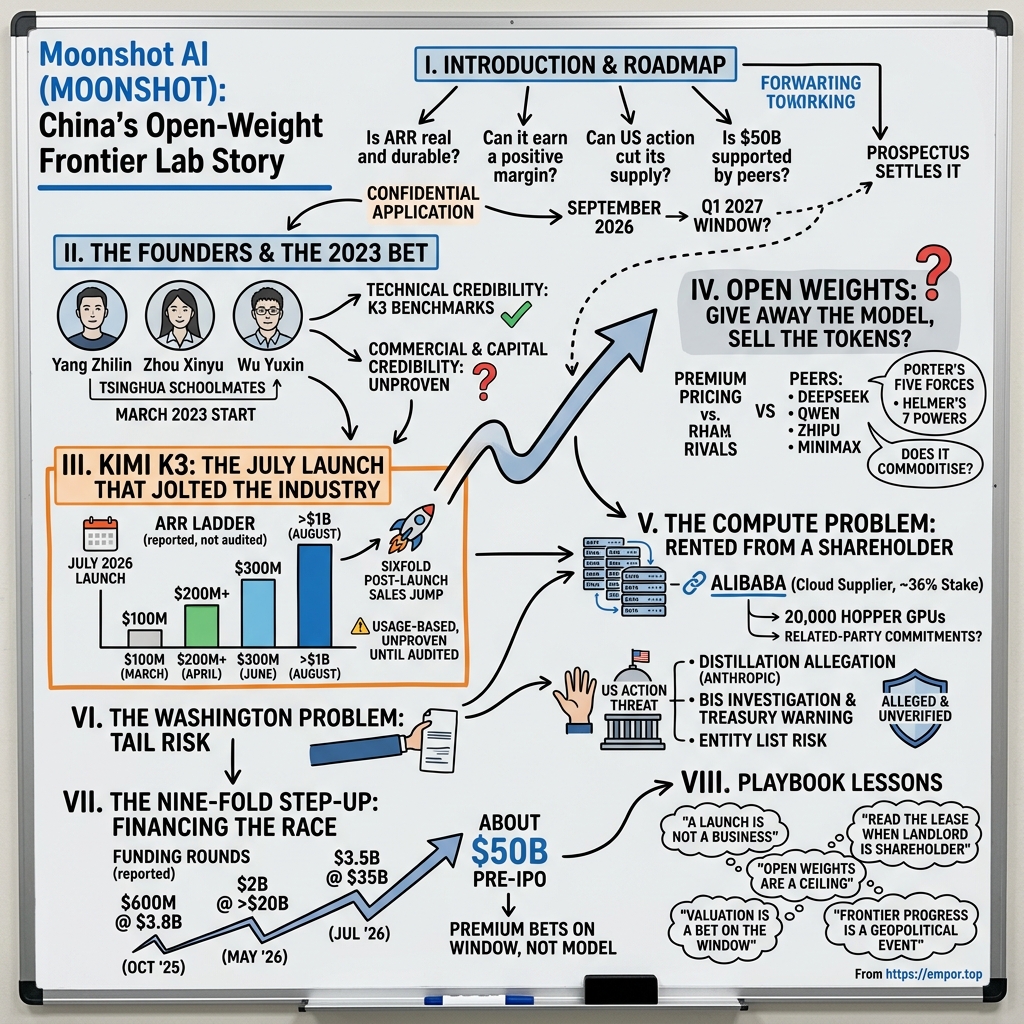
Moonshot AI (月之暗面): The Story of China's Open-Weight Frontier Lab
I. Introduction & Episode Roadmap (8 min)
In the first week of September 2026, a confidential listing application reached the Hong Kong stock exchange. It was not published, and there was no bell or roadshow. The only statement from the applicant was a refusal. Asked about reports that it had filed, Moonshot AI said it "had no comment on the market report and currently had no information to disclose".1
Hong Kong's rules allow the company to say nothing. They also explain why this story is unusual. A listing applicant's accounts, risk factors, related-party dealings and cap table normally become public in an Application Proof on HKEXnews once the filing is published. Moonshot's has not been, so no offer document can yet be read, and the Chinese securities regulator still has to approve an overseas listing by a mainland company.1 Anyone trying to judge Moonshot today has leaks, benchmark tables and a series of funding rounds that each set a price higher than the last.
Those prices are the reason to pay attention. TechNode reported that Moonshot was raising a new round at a pre-money valuation of about $50 billion, possibly its last before listing.1 In October 2025, press accounts put the company's pre-money value at about $3.8 billion.4 That is roughly a thirteen-fold rise in under a year. Even from the July 2026 round, reported at $35 billion, the step up is sizeable.2 Over the same months, reported annualised revenue went from about $100 million in March to more than $1 billion in August.23 Moonshot was founded in March 2023.4 It is three and a half years old, and the market may soon be asked to value it at about what it currently pays for Zhipu, the most valuable listed Chinese model lab.6
Moonshot is joining a crowded field. Zhipu and MiniMax, its two closest Chinese rivals in the independent-lab category, listed in Hong Kong in January 2026. Their prospectuses and first annual results are now the best public evidence of what this kind of business looks like from the inside.567 Moonshot's own case rests on one product event. On 16 July 2026 it released Kimi K3, an open-weight model it presented as frontier-class. Bloomberg reported, and Forkast relayed, that daily sales rose about sixfold after the launch.3 Demand then outran the company's GPUs, and it paused new subscriptions.2
The story works through four questions in order, because an investor would need all four answered before paying a public-market price for this company.
The first is whether the revenue is real and durable, or a surge that followed one launch. The second is whether Moonshot can earn a gross margin by selling tokens from a model it gives away, on compute it rents. The third is whether the United States can cut off its chips, cloud access or overseas customers. The fourth is whether a valuation of about $50 billion is supported by the listed peers, or depends on a listing window that may not stay open.
None of these can be settled until a prospectus is public, and the story does not pretend otherwise. What it can do is set out what each reported figure shows, what it cannot show, and which line in the eventual filing will decide the question. Until then, the reported figures are the only evidence.
 Subscribe on LinkedIn
II. Founders, Tsinghua Schoolmates & the 2023 Bet (14 min)
In March 2023, a few months after ChatGPT made large language models a board-level topic around the world, three Tsinghua University schoolmates started a company in Beijing. Yang Zhilin became chief executive. Zhou Xinyu and Wu Yuxin were his co-founders.4 Yang had gone from Tsinghua to a PhD at Carnegie Mellon, where he worked on language modelling before the field became famous.4 Its Chinese name, 月之暗面, means "the dark side of the moon", and the English name, Moonshot, sounds like a pitch.
The founders' bet was specific. Chinese investors were then funding dozens of "hundred-model" start-ups, and Moonshot chose long context as its way in: a chatbot, Kimi, that could take in and reason over very long documents, when most models lost the thread after a few pages.4 It was a sensible choice. Long context is something users can see for themselves, since a lawyer can paste in a contract and a student a textbook, and it made a research team's technical strengths look like a product.
Investors paid for that thesis in rounds, and the prices describe the bargaining. The first round was reported at about $60 million on a $300 million valuation.4 In February 2024 Moonshot raised about $1 billion at roughly $2.5 billion in a round led by Alibaba, which Wikipedia reports left Alibaba with about 36% of the company.4 Tencent and Gaorong joined in August 2024 in a $300 million round at about $3.3 billion.4 Other reported holders include Meituan's venture arm Long-Z, HongShan, IDG, 5Y Capital and Andon Health.4
Alibaba's stake matters more than any other entry on that list. A single strategic holder with more than a third of the company is more than a passive shareholder. As Section V shows, Alibaba is also, by Bloomberg's account, the company that supplied the compute on which Kimi was built.8 In 2024 Moonshot needed capital and GPUs, and one counterparty could provide both. A founder in that position has little leverage. The terms Alibaba received, including any board seats, vetoes, information rights or preferences, are not public. They are the first thing a public investor should look for in the prospectus's shareholder section.
What the record says about management. Yang has built technical credibility the ordinary way, by shipping models that did well. K3's reception in July 2026 is evidence that the research organisation can compete at the frontier, whatever one thinks of its commercial prospects.2 Commercial credibility is a separate question, and on that the record is thin in three specific ways.
First, the company does not disclose how its founders are paid, how much of the company they own after successive dilutions and a reported corporate restructuring, or who its chief financial officer is.13 None of this is unusual for a Chinese private company, but it means the incentive structure that will govern a $50 billion public company is unknown. The onshore conversion reported by Forkast, discussed in Section VI, also means that whatever founder-control arrangements existed offshore may have been redrawn.3
Second, a pattern shows up when promises are compared with outcomes. Moonshot's demand arrives in surges tied to releases, and its capacity has at least once failed to keep up. Pausing new subscriptions after K3 was a sign that customers wanted the product.2 It was also a planning miss. A company that expected the launch to succeed should have lined up the GPUs to serve it, or else chose to launch knowing it could not. Neither explanation is disqualifying, but management has not publicly given either one, and a public-market investor should want to hear it.
Third is transparency. Moonshot's public stance on its own economics has been consistent silence. It declined to comment on the IPO report.1 It has not confirmed the ARR figures attributed to it, the funding amounts, the Alibaba cluster or the regulatory allegations covered below. The company's own website and product pages describe models and features, not finances. Silence is legal and, before a listing, often required by counsel. It still means every commercial claim in the market about Moonshot comes from people other than Moonshot. Wherever a figure in this story came from, it did not come from a statement the company stands behind.
The fair verdict is split. Technical credibility has been shown with a shipped product. Commercial credibility, meaning revenue quality, cost control, capital allocation and governance, is untested, because the company has kept almost all of the evidence private. A founder team of researchers can run a capital-hungry business. This one has not yet shown that it can, and the prospectus will be its first chance.
III. Kimi K3: The July Launch That Jolted the Industry (16 min)
On 16 July 2026 Moonshot released Kimi K3. It shipped as an open-weight model, meaning anyone could download the parameters and run it, and it was also available through Moonshot's own API and Kimi app.2 Industry reaction was immediate, and so was the commercial effect. Bloomberg reported, as relayed by Forkast, that Moonshot's daily sales rose about sixfold after the launch.3 Within weeks demand had outgrown the available GPUs, and Moonshot stopped taking new subscribers.2
That is the event behind every valuation figure in this story. The question is what exactly it produced.
The ARR ladder. Put together from press reports, Moonshot's annualised revenue rose from about $100 million in March 2026 to more than $200 million in April, about $300 million in June and above $1 billion in August. A target of about $2 billion annualised by the end of 2026 has also been reported.23 Wikipedia places the $300 million mark in April, not June.4 The disagreement is small, but it matters because it changes the story: an April date implies the business had tripled before K3, while a June date means most of the acceleration came afterwards.
Taken at face value, both versions describe an extraordinary rise, something like a tenfold increase in five months. Face value is also the problem.
What ARR means here. Annual recurring revenue is a metric from subscription software. It usually means the annualised value of contracts customers have committed to renew, and investors pay up for it because it is sticky. Moonshot does not publish its definition.2 It does not publish any figure at all, and the numbers attributed to it come through unnamed sources. What is reported is that more than 70% of revenue comes from API services, with the rest from Kimi chatbot subscriptions.3
API revenue is usage-billed. A developer pays per million tokens processed, and the price quoted on OpenRouter in September was about $2.40 per million input tokens and $12 per million output tokens.9 Nothing obliges that developer to keep sending tokens next month. "ARR" for a usage-billed API is therefore very likely a recent run rate multiplied up: a strong week or month annualised. In a surge that inflates the figure, and in a decline it collapses just as fast. A run rate is like a car's speedometer, and ARR in the software sense is like its odometer. The reported $1 billion is a speedometer reading taken with the car going downhill.
That is not a claim that the revenue is fake. More than 70% API usage suggests real enterprise and developer adoption, not viral consumer curiosity, and developers who wire a model into their products incur some cost to switch.3 The point is that the figure measures current demand, not committed demand, and a valuation priced on committed demand would overstate the business.
Capacity was the constraint. The subscription pause shows that in the weeks after K3, Moonshot's revenue was limited by supply rather than demand.2 Bulls read that as unmet demand the company will capture once it has more GPUs. Bears point out that capacity costs money, that more of it has to be rented (Section V), and that customers turned away in a surge often go to a rival or to one of the third-party hosts serving the same open weights. A constrained surge helps prove demand. It proves nothing about margin.
Testing the growth claim against history. The strongest disconfirming evidence for any claim that a surge will persist is the category's own base rate, and the most relevant version of it is Moonshot's own past.
Kimi has had a surge before. The chatbot attracted heavy consumer attention in China in 2024 on its long-context appeal, in a market where ByteDance, Baidu, Alibaba and others were spending heavily to win chatbot users.4 Consumer chatbot usage in China has since concentrated in the apps with the biggest distribution budgets, and the independent labs' consumer franchises have found it hard to keep share against platform owners. That earlier cycle is the closest same-company evidence available. It suggests that Moonshot's consumer business has been a launch-and-fade product, and it is part of why the company's revenue today leans so heavily to API.3 The company does not publish user or retention figures for Kimi, so the size of any plateau cannot be measured.
Peers add a second, weaker check. MiniMax's revenue did grow through 2025, but on a small base: FY2025 revenue was about $79 million.7 Zhipu's FY2025 revenue was about CNY 724 million (roughly $105 million).6 Both companies had frontier-adjacent releases that year, and neither turned them into anything close to a billion-dollar run rate. That makes Moonshot's reported figure either an outlier on product quality, which is the bull case, or partly an artefact of annualising a peak, which is the bear case. It also means peer history offers little comfort either way. No Chinese independent lab has yet shown a billion-dollar run rate that persisted for a year.
The verdict on Question 1. History narrows the claim. The growth is real enough to reprice the company: sixfold daily sales and a subscription pause do not come from nothing.23 The claim that this is durable recurring revenue at a $1 billion scale remains unproven, and the one comparable episode in the company's own history, Kimi's earlier consumer cycle, points towards decay rather than persistence. Three things would decide it: audited revenue for FY2025 and the first half of 2026 in the prospectus, monthly revenue after August set against the reported run rate, and whether the reported $2 billion year-end target is met.2 If September to December revenue holds near the August pace without a new model release, the bull case gains a great deal. If it has to be propped up by the next launch, the business is a sequence of spikes, and the market should price it that way.
IV. Open Weights: Give Away the Model, Sell the Tokens? (14 min)
Open OpenRouter's page for K3 and the business model's central tension is right there: at least sixteen providers serve the model, at different prices.92 Moonshot is one of them. The others downloaded the weights Moonshot published and are reselling the same product. Moonshot's licence sets one limit: a company offering K3 as a model-as-a-service business with more than $20 million of aggregate revenue must sign a separate commercial agreement.2 Below that line, anyone can compete.
That is the strategy of open weights. Moonshot gives away the model and hopes to earn money three ways: selling the tokens itself on the strength of a first-party service, collecting licence fees from large resellers, and sharing revenue with the big clouds. Tech Wire Asia reports that Moonshot is negotiating with Microsoft, Amazon and Google for roughly 30% of K3-related revenue on their platforms, and that it has an existing arrangement with Chinasoft.2
Pricing. Moonshot's first-party price for K3, about $2.40 per million input tokens and $12 per million output tokens, is a clear premium to its Chinese rivals.9 DeepSeek's V4.1 Flash has been quoted at about $0.15 to $0.30 per million input tokens, and Alibaba's Qwen3.5 Plus at about $0.40 input and $2.40 output.2 For output tokens, where the cost of generating text is concentrated, Moonshot charges about five times Qwen's price. A premium like that holds only while buyers believe the model is better, and in this market a few months is a long time for that belief to last.
Industry structure. The competitive field has four layers. At the top are the US frontier labs, OpenAI, Anthropic and Google, whose closed models set the benchmark ceiling and whose prices set a global reference point. Next come China's platform giants, Alibaba with Qwen and ByteDance with Doubao, which can subsidise models from cloud and advertising businesses many times Moonshot's size. Then comes DeepSeek, an open-weight lab known for pushing prices down. Last are the independent labs: Zhipu, MiniMax, StepFun and Moonshot. Among the listed independents, Moonshot's reported run rate now appears several times larger than either peer's latest annual revenue, although that compares a run rate with an audited annual figure, and the gap is exaggerated.67
Unit economics as clues. Moonshot does not disclose its gross margin, its inference cost per million tokens or its compute spend.2 What is public are some physical facts about the model and some peer numbers.
K3 is reported to have about 2.8 trillion parameters.2 It is very likely a mixture-of-experts design, in which only a fraction of the parameters work on any given token, but even so the whole model has to sit in GPU memory. That makes it expensive to serve. Every server that hosts K3 needs a great deal of high-bandwidth memory, which is the scarcest and most expensive part of an AI server.
The peers show how varied margins are in this category. MiniMax's gross margin rose from about 12% to about 25% in FY2025, a sign that scale helps.7 Zhipu's fell from about 56% to about 41%, as a mix that had leaned on high-margin government and on-premises deployments shifted towards cheaper, more competitive API work.65 Moonshot's mix, more than 70% API, looks more like the direction Zhipu is moving in than where it started.3 Moonshot charges more per token than its Chinese rivals, which helps. It also serves a bigger model on rented hardware, which hurts.
Five forces, briefly. Buyer power is high. At the API layer, switching models often means changing one line of code, and developers routinely route traffic to whichever model offers the best price for adequate quality. Supplier power is high as well. Nvidia controls the chips, and Alibaba controls the rented cluster Moonshot reportedly depends on.8 Substitutes are plentiful and cheaper, as DeepSeek's and Qwen's price lists show.2 Rivalry is intense: frontier releases arrive every few months, and each one resets the rankings. Only the threat of new entrants is moderating, because training a frontier model now costs billions. In this industry, though, a new entrant is often simply an incumbent's next release.
Seven Powers. Hamilton Helmer's framework asks which durable advantage lets a business earn more than its cost of capital. Checking each in turn:
- Scale economies. Thin for now. Moonshot rents its compute instead of owning a large fleet, and its reported scale is still small next to Alibaba or ByteDance.8
- Network effects. Largely absent. One developer's use of K3 does not make it better for another in any direct way.
- Counter-positioning. This is the most interesting candidate. Closed-model incumbents cannot easily give away their weights without undercutting their own API businesses, and Moonshot can. Open weights have given it distribution the closed labs cannot copy. That is a real edge, but it is also why margins are hard to earn.
- Switching costs. Low, as described above.
- Branding. Partly evidenced. Among developers, "Kimi" now means frontier-class open weights, and the July surge shows the name brings in traffic.3 Brand in developer tools tends to follow benchmark results, and it fades when they slip.
- Cornered resource. Weak. The team is strong, but frontier researchers move between labs, and the key input, compute, belongs to someone else.
- Process power. Possible but unproven. Repeatedly training frontier models at lower cost than US labs would count, but Moonshot's training costs are not public.
The history of open-weight pricing. The claim to test is that frontier quality lets Moonshot keep a price premium over faster followers. The recent record in China argues against it. Across 2024 and 2025, each round of Chinese open-weight releases was followed by price cuts from competitors, and DeepSeek in particular used low prices as a weapon, forcing platform owners to match.5 The current quotes, with Qwen and DeepSeek far below Moonshot, show that the price floor has kept falling.2 For an open-weight model the fast follower may not even be a rival lab: it may be a third-party host serving Moonshot's own weights at a lower price. Weighted most heavily on recent Chinese pricing, the record says open-weight leaders keep a premium for a quarter or two, until the next release.
The verdict on Question 2. The moat claim is unproven, and the history narrows it. Moonshot's pricing is a premium that depends on keeping benchmark leadership, and open weights put a ceiling on that premium by letting others sell the same product. Counter-positioning and brand are the credible powers, and neither guarantees a margin. The deciding figures in the prospectus are gross margin and inference cost per million tokens. A gross margin moving towards 40% or higher on a mostly API mix would be strong evidence of pricing power. One stuck in the 10% to 25% range MiniMax has occupied would show that the market treats K3 as a commodity with a fashionable name.7
V. The Compute Problem: 20,000 Hoppers, Rented from a Shareholder (12 min)
On 31 July 2026, two weeks after K3's launch, Bloomberg published a story under the headline "Moonshot's Kimi Built on 20,000 Nvidia Chip Cluster from Alibaba".8 The headline answered a question the industry had been asking: how did a start-up that could not openly buy Nvidia's best chips train a frontier model? Its answer raised a harder one. Alibaba, the company that reportedly supplied the cluster, was also the investor that took about 36% of Moonshot in the February 2024 round.4
Renting instead of owning. A cluster of about 20,000 Hopper-generation GPUs is a serious amount of compute. Nvidia's H100 and H800 chips, bought outright, would put its value in the billions of dollars.8 Moonshot did not have to buy them. That changes where the cost appears. A company that owns its GPUs records them as capital spending, depreciates them over several years, and then has a fixed cost base that gets cheaper per unit as usage grows. A company that rents records compute as operating expense, in cost of revenue for serving and in research spending for training. Its costs rise with usage, and the landlord sets the price.
Renting has real benefits. It keeps capital free and lets the company scale capacity without building data centres. It also puts cash burn on a close track with growth: every surge in demand is a surge in rented GPU hours, which is exactly what the July subscription pause showed happens when rented capacity runs short.2
Alibaba's three roles. Alibaba appears in Moonshot's story as a large shareholder, a compute supplier and a potential distributor through its cloud. It is also a competitor, through its own Qwen models, which undercut Moonshot's prices.482 No public document sets out how Moonshot's compute contracts with Alibaba are priced. Moonshot does not disclose what it pays Alibaba, the contract terms, any minimum commitments, or whether any of Alibaba's investment was effectively paid back as cloud spending.
That last point is the one to watch. In American AI financing, strategic cloud investors have sometimes invested cash that flowed back to them as compute purchases. The structure is legitimate, but it makes the investor's economics very different from a pure equity holder's, and it can make a start-up's reported spending partly circular. Whether anything like this applies to Moonshot and Alibaba is not public. The prospectus's related-party note will have to answer it, because Hong Kong listing rules require continuing connected transactions with a substantial shareholder to be disclosed, and usually capped.
Other strategic holders. Tencent, Meituan and China's National AI Industry Investment Fund, which Forkast describes as an $8.8 billion state vehicle, are also on the reported register.34 Tencent and Meituan are potential distribution partners with large consumer platforms. The state fund signals policy alignment. Each is a strategic link that a public investor should examine for preferential terms, both in deals and in any governance rights that sit above ordinary shares.
Capital deployment. No acquisitions by Moonshot have been reported. Its capital allocation record is simply its spending on research and compute, neither of which it discloses. The peers show the scale to expect. Zhipu spent about CNY 3.18 billion on R&D in FY2025, about 4.4 times its revenue.6 MiniMax spent about $253 million, roughly 320% of revenue, down from over 600% a year earlier.7 A Chinese frontier lab spends several times its revenue on research, and the only question is how quickly that ratio falls. If Moonshot's revenue really has reached a billion-dollar run rate, it may be the first in the group whose ratio falls below one, which would be the most important sign in its favour. That cannot be known until its costs are public.
What the peers' filings suggest. Zhipu's prospectus showed heavy exposure to government and state-owned customers, a customer base that pays well and makes an unusual peer for a developer-API business.5 MiniMax's showed a mostly overseas, consumer-app-driven business.7 Moonshot looks different from both: API-heavy and developer-focused, with an unknown share of overseas sales.3 That makes the comparison instructive but loose. What both peers did disclose, and Moonshot must as well, is compute commitments and customer concentration, the two lines that show how exposed a lab is to its landlord and its biggest buyer.
The verdict. Who controls Moonshot's supply chain is an open question, and the evidence so far points more towards Alibaba than towards Moonshot. The prospectus will settle it in three places: the related-party note on transactions with Alibaba, the compute and capacity commitments, and any disclosed cost per GPU-hour or inference cost. Until then, part of the story of Moonshot's growth is Alibaba's story too.
VI. The Washington Problem: Distillation, Chips & the Entity List (14 min)
In February 2026, Anthropic accused Moonshot of what it called "distillation attacks".4 Distillation is a well-known technique in which a smaller or newer model is trained on the outputs of a stronger one, like a student copying from the best student's exam paper at scale. Doing it against a commercial model through its API usually breaches the terms of service. When the accused is a Chinese lab and the target is an American one, it also becomes a matter of national policy. Wikipedia records that a September 2026 report described activity across about 5,380 accounts and more than 23 million exchanges.4
Moonshot has not publicly accepted the allegation. Sceptics of the accusation have argued that K3's testing timeline predates the release of the Claude model named in it.4 Each claim here is an allegation and should be read as one. No court or regulator has made a finding against Moonshot in public.
The allegations still matter, whether or not they are proven, because US action does not require proof to a court's standard.
Chips. Forkast reports an active investigation by the US Bureau of Industry and Security into how Moonshot came by restricted Nvidia chips.3 Further claims about the routes by which chips may have been acquired have circulated but have not been confirmed on the record. The investigation connects with Section V. If Moonshot's training ran on Alibaba's cluster, the chips' origin is Alibaba's question as much as Moonshot's, but a finding against Moonshot would still land on Moonshot.
The Entity List. The worst outcome would be designation on the Commerce Department's Entity List, which bars US companies from supplying the listed firm without a licence that is usually denied.10 For Moonshot, the mechanism runs through three channels. Chips: new Nvidia hardware and much of the software stack would become harder to reach even through intermediaries. Cloud: the negotiations with Microsoft, Amazon and Google would probably end, since those companies could no longer carry a listed firm's model on commercial terms.2 Customers: US developers and companies would face legal risk in paying Moonshot for API access.
The third channel is already visible. In April 2026, a US House committee pressed DoorDash and Anysphere, the company behind the Cursor coding tool, over their reported use of Kimi models.4 This was congressional pressure, not a legal prohibition, but it shows US customers the reputational cost of choosing a Chinese model, well before any designation.
The precedents. The closest precedents are Chinese AI and chip companies. When the US listed SenseTime, Megvii and other vision-AI firms, and later chip makers such as SMIC, the pattern was consistent. Access to US technology became harder and more expensive. Western customers and investors withdrew. The companies kept operating, often with strong domestic support, but their overseas ambitions shrank and their valuations came to reflect a domestic business. Huawei is the most extreme case: its survival shows resilience, and its shrunken overseas handset business shows the cost. Unrelated precedents, such as sanctions on consumer apps, count for less because their supply chains differ.
Capital sourcing. Beijing has been drawing a line from its own side. Forkast reports that in April 2026 the National Development and Reform Commission told Moonshot, ByteDance and StepFun not to accept US-origin capital without explicit approval.3 It also reports that Moonshot moved from an offshore "red-chip" holding structure to an onshore joint-stock company and unwound its variable-interest-entity arrangement, after Beijing declined to exempt frontier AI labs.3 Forkast is the only outlet reporting this, and it should be treated as unconfirmed until the prospectus shows the corporate structure.
If it is accurate, the change matters in two ways. It lowers one US risk: a company with no US investors and an onshore structure gives Washington fewer points of leverage over its capital. It raises questions for Hong Kong investors about foreign ownership limits, the rights of offshore preferred holders during the conversion, and how closely a state-aligned frontier lab will be steered by policy rather than profit. Forkast's headline calls the listing "Beijing's blueprint for sovereign AI capital", which is a fair description of the risk as well.3
Overseas exposure. Moonshot does not disclose its revenue by geography. Its API is priced in US dollars through global aggregators such as OpenRouter, and its developer following is international, so meaningful overseas revenue is plausible.9 MiniMax earned more than 70% of its FY2025 revenue outside mainland China, which shows how far a Chinese lab's business can lean abroad.7 Moonshot's own figure is unknown, and it is the number that decides how much a US designation would cost.
The verdict on Question 3. This is the tail risk that matters most to the investment case, because it is binary and outside the company's control. The allegations are contested, and several are single-sourced. The route to harm is concrete: chips, cloud distribution and overseas customers, all of which sit behind US decisions. The prospectus's risk factors and legal-proceedings section will show how management describes the exposure, and the Entity List itself will show how Washington does. A designation before listing would not end the company. It would very likely end the case for valuing it as a global frontier lab rather than a domestic champion.
VII. The Nine-Fold Step-Up: Financing the Race (14 min)
Laid out in order, Moonshot's funding history looks like an exponential curve. About $600 million was reported at a pre-money value of about $3.8 billion in October 2025, led by IDG.4 About $2 billion followed in May 2026 at a valuation above $20 billion. About $3.5 billion came in July 2026 at about $35 billion.2 Then TechNode reported a pre-IPO round at a pre-money valuation of about $50 billion.1 From October to July alone, the value rose about nine-fold in nine months.
How reliable is the ladder? It is less reliable than it looks. The round sizes in Wikipedia's history do not add up to the larger totals reported elsewhere, and Tech Wire Asia puts total funding raised above $5.5 billion, while other accounts give higher totals.24 The honest range for capital raised is at least $5.5 billion and possibly a good deal more. No round has been confirmed by the company with an amount, a price per share or a lead investor. Whether the reported valuations are pre-money or post-money is often unclear. So is whether any round included secondary sales by early holders, which would mean less cash reached the company than the headline suggests.
The rounds also say nothing about terms, and in private markets terms are much of the price. Chinese late-stage rounds commonly use preferred shares with liquidation preferences, redemption rights and anti-dilution protection. A $35 billion valuation on preferred shares carrying a one-times preference and a redemption right does not equal $35 billion of common equity, because the preferred holders get paid first if the outcome disappoints. Moonshot's preferred terms are not public. Nor is its option pool, any warrants, or any convertible notes. A fully diluted share count cannot be built from the public record, so any "market value" for Moonshot today is a headline mark, not a figure per common share.
The multiples. On the reported numbers, $50 billion pre-money is about 50 times August's reported run rate of $1 billion, and about 25 times the reported $2 billion year-end target.12 The July round, at $35 billion, was about 35 times the same August figure. Those are equity value divided by an annualised run rate, which is the loosest possible comparison. Moonshot's cash and commitments are undisclosed, so an enterprise value, and therefore an EV multiple, cannot be calculated.
The peers. The two listed Chinese peers are the only direct comparables that disclose audited numbers, and both help and hurt the case.
Zhipu had a market capitalisation of about HK$408 billion, roughly $52 billion, on 1 April 2026, on FY2025 revenue of about CNY 724 million (roughly $105 million) and a net loss of about CNY 4.72 billion.6 That is an equity-value-to-trailing-revenue multiple of roughly 500 times. Next to it, Moonshot at 50 times run rate looks cheap, which is the bulls' point. The bears' point is that Zhipu's valuation says more about scarcity and policy status in Hong Kong's AI listing wave than about operating value, and that Zhipu loses several times its revenue each year.
MiniMax listed at about $4 billion in January 2026, on FY2025 revenue of about $79 million and a gross margin of about 25%.7 That is about 50 times trailing revenue at listing, a similar headline multiple to Moonshot's on run rate, but at a twelfth of the equity value.
The honest peer set therefore has one listed company valued far above Moonshot's multiple and one that listed near it, with none profitable. Aspirational comparisons, meaning the valuations of OpenAI or Anthropic, are excluded here. They are private, carry US-market access and have revenue bases many times larger. Recent US software IPOs are excluded as well, because their recurring revenue and gross margins are not comparable to a usage-billed Chinese model lab's.
The dilution the peers have already shown. Both peers' accounts show a pattern that will almost certainly appear in Moonshot's. MiniMax's FY2025 net loss included about $1.59 billion of non-cash loss from remeasuring preferred shares at fair value, against an adjusted net loss of about $251 million.7 As a company's valuation rises before listing, its preferred shares, carried as liabilities, become more valuable, and accounting treats the increase as a loss. Moonshot's valuation rose about nine-fold in nine months, so its first published statements may show a headline loss in the billions of dollars, most of it this accounting item. A reader of the prospectus should strip that line out, then look closely at what is left: the cash operating loss.
Burn and cash. Moonshot's cash burn and cash balance are not disclosed. MiniMax held about $960 million of cash and short-term investments at the end of 2025, for comparison.7 If Moonshot has raised more than $5.5 billion, and much of it came in 2026, it may hold more cash than either listed peer.2 It is also spending on rented compute that grows with every surge. Without the burn figure, runway cannot be calculated. The one thing that can be said is that a lab raising about $5.5 billion in 2026 and then seeking a large IPO is not planning to be self-funding soon.
A transparent intrinsic-value frame. A scenario framework shows what $50 billion assumes. Suppose a public investor wants a 15% annual return, reasonable for a young, loss-making, sanctions-exposed company. For $50 billion today to earn that over six years, the company must be worth about $115 billion in 2032. If a mature, still-growing AI lab then trades at about 20 times earnings, it needs net income of about $5.8 billion. At a mature net margin of about 25%, which is generous for a business whose gross margin is unknown and whose peers' gross margins sit between 25% and 41%, that implies revenue of about $23 billion.67
That is more than twenty times the reported August run rate, sustained for six years, followed by a swing from heavy losses to software-like profitability. It does not yet count the dilution from the IPO itself or from future employee equity, which would raise the bar further. With a 30% net margin, the revenue required falls to about $19 billion. With a 15% margin, it rises to nearly $40 billion. The range is wide, and that is the point. At $50 billion, the price assumes Moonshot becomes one of the few AI labs in the world with tens of billions of dollars of revenue, and it assumes that happens despite price wars, open weights and possible US restrictions.
The listing. Forkast reports a raise of about $3 billion in Hong Kong.3 The underwriters, the price and the timing are not publicly confirmed by the company, and approval from the China Securities Regulatory Commission is still required.1 Moonshot is also joining a queue: the Hong Kong AI listing wave that took Zhipu and MiniMax public has priced them generously so far.56 Windows like this close when a big peer disappoints, when interest rates rise or when US policy tightens, and they tend to close faster than they opened.
The verdict on Question 4. On the data available, a premium valuation is defensible only if the reported run rate turns into audited revenue and margins visibly improve. Zhipu's price makes $50 billion look modest. MiniMax's listing and the intrinsic arithmetic make it look like a price that assumes near-perfect execution. The round history is low-confidence, and its terms are unknown. At this point the valuation says more about Hong Kong's appetite for Chinese AI than about Moonshot's business, and the prospectus, together with the price the public market pays, will show how far the two can be separated.
VIII. Playbook: Business & Investing Lessons (8 min)
A launch is not a business. In July, Moonshot's daily sales rose sixfold and it had to turn customers away.23 Most companies would count that as their best month, and it may be one of Moonshot's. But a sales line that jumps on the day of a release and depends on the next release to hold is a product calendar, not a revenue engine. Founders in frontier AI are tempted to treat every launch as proof of product-market fit, and investors are tempted to annualise the peak. The lesson: annualise the plateau, never the spike. In a category that releases a new model every quarter, the only revenue that deserves a multiple is what is still there after the next rival's launch.
When your landlord is your shareholder, read the lease. Moonshot's frontier model reportedly ran on 20,000 GPUs rented from the company that owns about a third of it.48 That arrangement may have been the only way to build K3 in a sanctioned market, and it may be on fair terms. But when one counterparty owns the equity, sets the price of the main input and sells a competing model, the shareholder's interests and the company's can quietly diverge. For investors, the cap table and the cost of goods are one document, not two. The lesson: in AI, the related-party note is the income statement.
Open weights are a marketing budget and a pricing ceiling at the same time. Sixteen hosts serving K3 is the best free distribution a start-up could buy, and each of those hosts can undercut Moonshot on its own model.9 The open-weights strategy wins developers and gives away pricing power in the same move. It is a very effective way to build a brand and a hard way to build a margin. The lesson for founders choosing between open and closed is plain: if you give away the model, the business has to be something the model cannot copy, whether that is service quality, enterprise contracts or a platform built on top. Moonshot has not yet said publicly which of these it will be.
Valuation is a bet on the window, not only on the model. Moonshot went from about $3.8 billion to about $35 billion in nine months, with its most dramatic revenue growth arriving in the last two.24 Much of that repricing happened before K3 shipped, on the strength of Zhipu's and MiniMax's listings and what they implied about exit prices. The lesson for late-stage investors is uncomfortable: a round priced off a peer's IPO is a trade on the IPO market, not a verdict on the company. When the window closes, the model is just as good as it was, but the price is not.
Frontier progress is also a geopolitical event. In February 2026 an American lab accused Moonshot of distillation. By April a House committee was writing to American companies about their use of Kimi, and Beijing was telling Moonshot whose money it could not take.34 A lab that reaches the frontier from China becomes a policy matter in two capitals at once. For founders, the lesson is to plan for it from the first day. For investors, it is that in Chinese frontier AI, sanctions risk belongs in the base case, not the appendix.
IX. Analysis & Bear vs. Bull Case (12 min)
Imagine a sceptical fund manager opening Moonshot's prospectus on the day it becomes public. They will read three pages before anything else: audited revenue against the reported run rate, gross margin, and the largest related-party line. Everything else in this story comes down to those three numbers.
The bull case. Moonshot has shipped a frontier-class model that the industry treated as a genuine step forward, and demand followed quickly enough to overwhelm its capacity.2 Its reported revenue has reached a scale neither listed Chinese peer has matched. It earns most of that from developers and enterprises through APIs, the part of the market least exposed to the consumer-app subsidy wars.3 Its open-weight strategy has given it distribution through at least sixteen hosts and a route into the three largest US clouds, which a closed Chinese model could not easily get.29 Its shareholders include China's largest platforms and a state AI fund, so it has capital, compute and political cover.34 The listing path is already open: Zhipu's and MiniMax's listings show that Hong Kong will take this kind of company, and Zhipu's price suggests Moonshot may even look cheap next to it.6 On this view, K3 is the first of several releases, and each one raises the plateau.
The bear case. The revenue figure is an undefined, unaudited run rate from a usage-billed business, measured just after one launch.2 The company's own consumer history suggests that chatbot surges fade. Its compute is rented from a shareholder that sells a competing, much cheaper model.82 Its premium pricing sits five times above Qwen's for output tokens, in a market with a record of price wars, and the open weights let third parties undercut it with its own model.29 A US investigation and a distillation allegation hang over its access to chips, clouds and American customers, and its overseas revenue share, which would measure that exposure, is not disclosed.34 Its valuation rose nine-fold in nine months, on terms nobody can see, and the arithmetic says $50 billion needs revenue more than twenty times today's run rate within about six years.
The short seller's questions. A sceptical investor would ask three things, and they should become the questions the prospectus has to answer.
First, what exactly is "ARR"? Is it last month's revenue multiplied by twelve, the best week's revenue multiplied by fifty-two, or committed contracts? How much of it comes from customers who were active six months ago? If the prospectus reports audited monthly revenue, these questions answer themselves.
Second, how much of Moonshot's cost base flows to Alibaba, at what price, and with what commitments? Is any compute provided at below-market rates that would reverse after listing, or above-market rates that transfer value to a shareholder? The related-party note and any continuing connected-transaction caps will show this.
Third, what does Moonshot say, in a legal document with liability attached, about distillation and chip sourcing? A risk-factor section that calls these matters "allegations we dispute" is very different from one that discloses a settlement, an investigation or a change in training practice.
Risk radar, material items only.
US regulation and chips. A designation or BIS finding would limit hardware, end US cloud partnerships and deter overseas API buyers. That would shrink the reachable market to China and its friends overnight.
Commoditisation. Every rival release, and every third-party host serving K3 cheaply, pushes down the price Moonshot can charge per token. Because its costs scale with usage on rented GPUs, a falling price with fixed unit costs squeezes gross margin directly.
Compute and capacity. Revenue is capped by the GPUs Moonshot can rent. If it cannot secure capacity for the next surge, customers go elsewhere. If it commits to capacity and the surge does not come, it pays for idle hardware. Both paths run through a contract with a shareholder.
Cost of capital if the window shuts. Moonshot's business model needs outside capital for years. If Hong Kong's appetite for AI listings fades, the next raise would come at a lower price or on harsher terms, and the preferred shares issued at $35 billion to $50 billion would start to affect common shareholders through their preferences.
The moat analysis in Section IV is not repeated here. Its conclusion stands: counter-positioning and brand are real, and neither yet guarantees a margin.
The three KPIs. If only three numbers could be tracked after listing, they should be these. First, audited revenue, and monthly revenue against the reported run rate, because that shows whether the growth is recurring. Second, gross margin and inference cost per million tokens, because that shows whether the model can be sold at a profit. Third, cash burn against cash raised, because that shows how long the company can compete before it needs the market again.
The balance. The growth is well evidenced, and the rest is not. Moonshot has proved it can build a frontier model and sell a lot of tokens quickly. It has not shown that it can keep selling them at a margin, on compute it controls, in markets Washington lets it reach. The case is intact but unproven, and the gap between the valuation and the evidence is as wide as for any AI company approaching a listing.
X. Epilogue (6 min)
Tonight, at the end of September 2026, Moonshot is a company with a confidential application at the Hong Kong exchange, a reported valuation of about $50 billion, and no published financial statement.1 K3 is still serving tokens, through Moonshot and its sixteen rival hosts.9 A run rate reported above $1 billion is either still climbing, holding or quietly fading, and outsiders will not know which until the company tells them.2
The next few months will decide the four questions, one event at a time.
The first is Beijing's. The China Securities Regulatory Commission has to approve the listing, and its decision will reflect policy as much as paperwork.1 Approval followed by a public Application Proof on HKEXnews would turn this story from reported figures into audited ones. A delay would say something about how Beijing sees a state-aligned frontier lab listing abroad.
The second is the prospectus itself. The first audited revenue figure settles Question 1. If it shows FY2025 revenue that was small, and first-half 2026 revenue that rises steeply but falls well short of what the run-rate headlines implied, the market will learn how much of the "ARR" was annualised hope. The gross margin line settles Question 2. A figure near Zhipu's 41% would change the company's standing.6 A figure near MiniMax's 25% would confirm a commodity.7 The related-party note settles who controls the supply chain.
The third is the calendar. The reported target of about $2 billion annualised by the end of 2026 is Moonshot's first measurable public promise, even if it was never made on the record.2 If it is met without a new model, the surge becomes a trend. If it is missed, or met only by launching a K3.5 in December, the spike pattern is confirmed.
The fourth is Washington. Any Entity List designation, BIS finding or new congressional action against Kimi's US users would shrink the reachable market before the first public share is sold.3410 Each month without one lowers the risk, though it never disappears.
The fifth is the competition. DeepSeek, Qwen and the US labs will ship again, and the next price cut will show how much K3's premium was worth. Moonshot will ship again as well, and its next release will show whether the July surge was a peak or a floor.
The tension that remains is simple. Moonshot's growth is visible to everyone and its economics to no one. A $50 billion valuation bets that the two will turn out to match.
XI. Outro (2 min)
In the first week of September, a company that would not confirm a single figure about itself asked the Hong Kong exchange to let it sell shares to the public.1 It had given away its best model to the world, allowed rivals to resell it, rented the chips to build it from its largest shareholder and been accused in Washington of copying its way to the frontier. The market has priced it at $50 billion on the strength of a sixfold jump in daily sales that it has never publicly confirmed.
Moonshot's founders named it after the side of the moon that cannot be seen from Earth. For now that describes its accounts. A model can be given away. Whether the business around it can be sold is what the prospectus will show.
References
-
Moonshot AI reportedly submits confidential Hong Kong IPO filing — TechNode, 2026-09-03 ↩↩↩↩↩↩↩↩↩↩↩
-
Moonshot's Kimi growth tests the business case for open-weight AI — Tech Wire Asia, 2026-09 ↩↩↩↩↩↩↩↩↩↩↩↩↩↩↩↩↩↩↩↩↩↩↩↩↩↩↩↩↩↩↩↩↩↩↩↩
-
Moonshot AI's $3B Hong Kong IPO Filing Is Beijing's Blueprint for Sovereign AI Capital — Forkast ↩↩↩↩↩↩↩↩↩↩↩↩↩↩↩↩↩↩↩↩↩↩↩↩↩
-
MiniMax FY2025 Earnings — Beancount.io, 2026-07-13 ↩↩↩↩↩↩↩↩↩↩↩↩↩
-
Moonshot's Kimi built on 20,000 Nvidia chip cluster from Alibaba — Bloomberg, 2026-07-31 ↩↩↩↩↩↩↩↩
 LinkedIn
 WhatsApp
 Reddit
 Hacker News
 Email
Email Kindle
 RSS Feed
 Spotify
 Apple Podcasts
 Amazon Music
 Audible
 YouTube