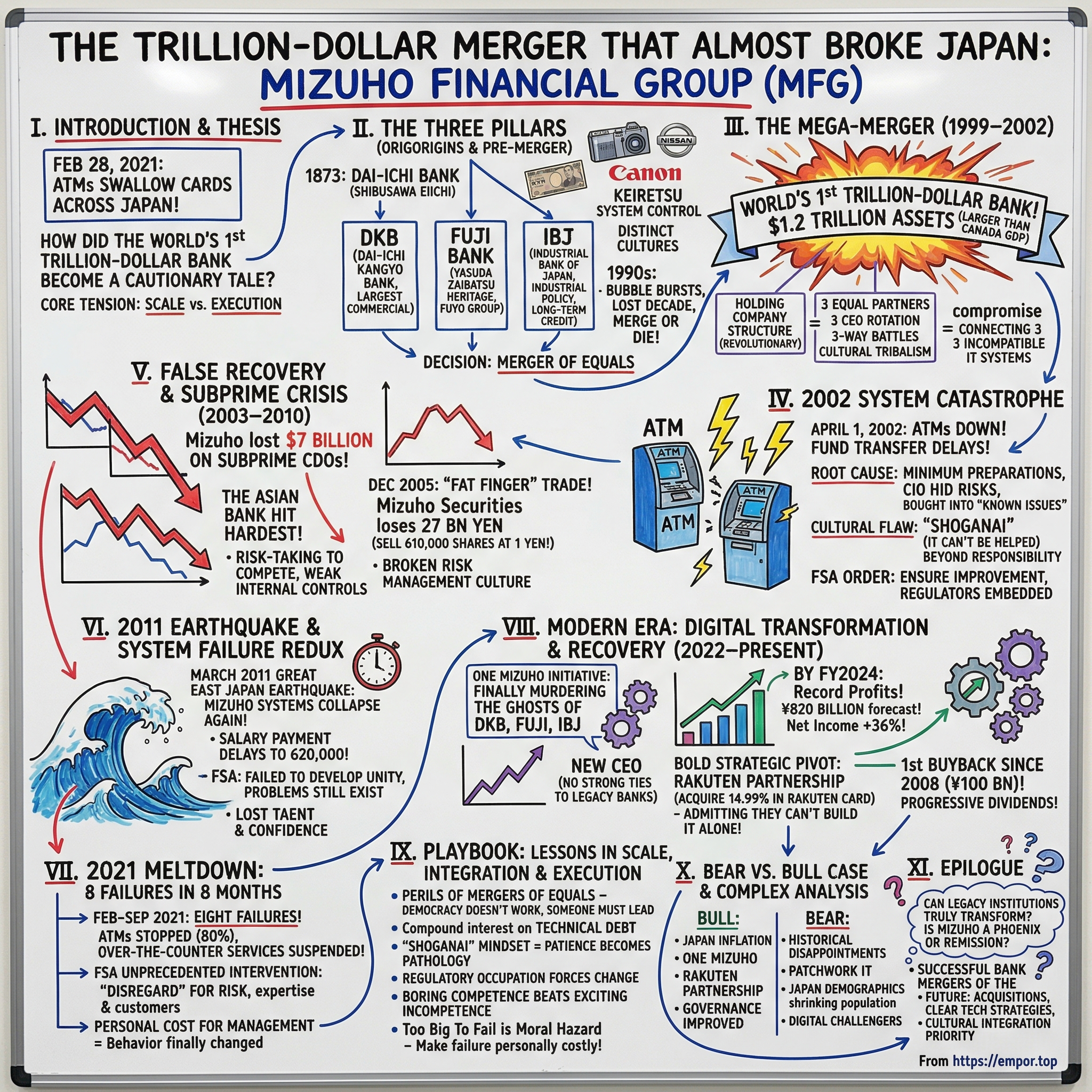
Mizuho Financial Group: The Trillion-Dollar Mega-Merger, the System Meltdowns, and the Struggle to Reinvent Japan's Megabank
I. Introduction & Episode Thesis
The Machines That Ate the Cards
On Sunday, February 28, 2021, during a quiet late-winter weekend when Tokyo families were running errands and withdrawing cash for the week ahead, the green screens on Mizuho's automated teller machines across Japan began to fail. Out of the bank's 5,395 terminals, 4,318 stopped working properly.1 The machines did not merely decline transactions; they swallowed cards and passbooks. By the end of the day, 5,244 cash cards and paper passbooks were trapped inside the hardware.2 Customers who had inserted their cards waited for hours in chilly branch vestibules for bank staff to arrive, unlock the terminals, and return their property. Because branches were closed on Sunday, the recovery dragged on into the evening.
The technical cause was mundane: roughly 250,000 routine data updates collided with an internal migration of about 450,000 accounts into a new digital-passbook format, causing the system to choke.2 For Mizuho's leadership, however, the timing was devastating. The bank's core banking architecture (勘定系システム, the accounting system that records every deposit, withdrawal, and transfer) was known as MINORI. It had been operating since July 2019 following more than ¥400 billion of development expenditure.1 MINORI was supposed to be the engineering overhaul that finally brought an end to two decades of humiliating outages.
Instead, it was the start of an acute operational crisis. Mizuho suffered eight system failures between February and late September 2021. On November 26, 2021, Japan's Financial Services Agency (金融庁, or FSA) issued business improvement orders against both Mizuho Bank and its parent holding company.3 In the executive fallout, the group chief executive officer, the bank president, and the group chairman all resigned.
A Giant Built by Committee
Understanding why automated teller machines swallowing cash cards on a Sunday afternoon toppled an entire leadership team requires tracing the bank's origins to 1999. That summer, three of Japan's most storied financial institutions—Dai-Ichi Kangyo Bank (第一勧業銀行, or DKB), Fuji Bank (富士銀行), and the Industrial Bank of Japan (日本興業銀行, or IBJ)—agreed to combine. With consolidated assets of roughly ¥153 trillion, the combined entity surpassed Deutsche Bank to become the largest banking group in the world.4 In dollar terms, it was the first banking group to cross the trillion-dollar threshold.
Over most of the subsequent quarter-century, that unprecedented scale generated remarkably little strategic advantage. The entity now known as Mizuho Financial Group (みずほフィナンシャルグループ; NYSE: MFG) operated as a textbook case study in integration dysfunction. The group endured three catastrophic core-system failures—in 2002, 2011, and 2021—absorbed heavy writedowns on U.S. subprime securities, and weathered nearly two decades during which the Bank of Japan (日本銀行, or BOJ) pinned interest rates near or below zero.
The Question
Today the picture looks very different on the surface. In the fiscal year ended March 2026, Mizuho reported a record ¥1.25 trillion in net profit—its first year exceeding the ¥1 trillion mark—with a return on equity of 11.4%.5 The macroeconomic backdrop has also turned favorable: on September 18, 2026, the BOJ raised its policy rate to 1.25%, the highest benchmark level in three decades.6 Group CEO Masahiro Kihara (木原正裕) has established a target of stably generating an ROE above 12% by fiscal 2028, describing it as "quite an ambitious target" and "probably the minimum level we must achieve."7
The central question surrounding the institution is therefore not whether Mizuho can generate strong profits in a rising-rate environment; the central bank's policy shifts ensure that it can. The more demanding question is whether Kihara can convert Mizuho's corporate reach into a durable, high-return franchise that sustains profitability when the tailwind of rising interest rates fades. Mizuho reports business relationships with roughly 80% of Japan's listed corporations.7 What remains unresolved is whether the group has fundamentally reformed its operational execution, or whether it remains the bronze medalist among Japan's three megabanks (三大メガバンク)—an institution whose financial fortunes are dictated by central bank policy rather than distinct competitive advantages.
The Roadmap
The story unfolds across five movements:
- The three predecessor institutions and the post-bubble crisis that compelled them to merge;
- The mechanics of three core-system collapses and the factional governance failures behind them;
- The capital-allocation record, spanning subprime losses, a 16-year share-buyback drought, and the 2023 acquisition of Greenhill;
- Where Mizuho's operating revenue and net profit originate today;
- The Kihara turnaround plan and the Rakuten alliance, tested against the bank's historical execution record.
The story begins more than a century before anyone had heard the name Mizuho.
 Subscribe on LinkedIn
II. Zaibatsu Roots & The Post-Bubble Reckoning: The Three Predecessors
Three Banks, Three Worldviews
In central Tokyo during the late 1980s, three corporate headquarters housed three institutions, each convinced it was the most important bank in Japan. Each had a credible claim.
The oldest lineage belonged to DKB. It traced its roots to the First National Bank of 1873, championed by Eiichi Shibusawa (渋沢栄一), the industrialist often called the father of Japanese capitalism.8 Nippon Kangyo Bank, the other half of DKB, had been established in 1897 to finance agriculture and industry.8 The merged DKB was a populist commercial power: the bank with the largest domestic branch network, the widest reach into small and medium-sized enterprises, and a sprawling roster of corporate affiliates.
The second was Fuji Bank, descended from Yasuda Bank, founded by Zenjiro Yasuda (安田善次郎) during the Meiji era.8 After the Second World War, Allied occupation authorities dismantled the Yasuda zaibatsu (財閥, family-run business conglomerates), and Fuji emerged as the financial anchor of the Fuyo Group (芙蓉グループ)—a looser corporate alliance bound by commercial ties and reciprocal cross-shareholdings. Fuji was the aggressive commercial lender of the trio. During the 1980s bubble economy, that aggressive underwriting pointed straight toward commercial real estate.
The third was the aristocrat. IBJ, chartered in 1902, was a quasi-public institution established to finance Japan's heavy industrialization.8 It operated virtually no retail branches. Instead, it funded itself by issuing long-term bank debentures—special coupon-bearing bonds that only a licensed cadre of long-term credit institutions were permitted to sell. It then channeled those long-duration proceeds to steelmakers, shipbuilders, electric utilities, and chemical conglomerates. IBJ bankers viewed themselves as intellectual partners of the Ministry of Finance in directing post-war industrial development. They were elite, cerebral, and famously proud.
A useful shorthand captures the three distinct institutional cultures: DKB was a department store, Fuji was a commercial trading house, and IBJ was a patrician private club. Each possessed a different product suite, served a distinct client base, and maintained a fundamentally different philosophy of what a bank was for.
The Scandal That Broke DKB's Confidence
The 1990s humbled all three, but DKB's humiliation was the most acute. In 1997, public prosecutors uncovered that DKB had extended nearly ¥30 billion in illicit financing to Ryuichi Koike, a sōkaiya (総会屋), a corporate racketeer who extorted management teams by threatening to disrupt annual shareholder meetings.9 Eleven DKB executives and officials were arrested.9 Former chairman Kuniji Miyazaki (宮崎邦次) took his own life at his home in late June 1997.9
The scandal carried systemic significance beyond the sensational headlines. It revealed that one of Japan's preeminent financial institutions had maintained financial relationships with organized racketeering for years, and that no internal control mechanism had stepped in to stop it. That institutional pattern—critical operational vulnerabilities hidden from view because subordinates refused to escalate bad news—would resurface repeatedly in the decades ahead.
The Lost Decade Arrives at the Door
Meanwhile, as Japan's asset bubble deflated, bad debt accumulated across the banking sector. Loans collateralized by heavily depreciated real estate were routinely rolled over through forbearance rather than written off. In the autumn of 1997, the failures of Hokkaido Takushoku Bank and Yamaichi Securities shattered the post-war assumption that major Japanese financial institutions were too big to fail. International lenders began charging Japanese banks the "Japan premium"—a punitive interest rate surcharge on interbank borrowing that signaled acute market doubts regarding their solvency.
To avert a broader financial collapse, the Japanese government stepped in with taxpayer recapitalizations. Between March 1998 and March 1999, the three predecessor banks received a combined ¥2,949.0 billion in public capital injections through a mixture of preferred stock and subordinated debt.10
That capital infusion carried strategic strings. Once taxpayers had injected nearly ¥3 trillion into their capital structures, the three institutions no longer fully controlled their independent corporate futures.
The Pact
On August 20, 1999, DKB, Fuji, and IBJ formally agreed to a three-way alliance and a joint holding company planned for autumn 2000.4 Contemporary reports put the combined group's assets at about $1.3 trillion, against Deutsche Bank's $735 billion, and projected roughly 6,000 job cuts and up to 150 branch closures.11 Mizuho Holdings was established on September 29, 2000.12 Two days later, the three banks' securities arms merged into Mizuho Securities, and their trust banks became Mizuho Trust & Banking.12
The consolidation was inherently defensive—a merger compelled by financial distress rather than shared strategic ambition. None of the three lenders was strong enough to absorb the other two, yet none was willing to surrender independence. The union was therefore structured as a "merger of equals" among three rival institutions that harbored deep mutual suspicion and fundamentally incompatible operating cultures.
The structural flaw established at inception would reverberate across the group's history: Mizuho was assembled to achieve the defensive balance-sheet scale necessary to survive, not to execute an integrated operating vision. The combined balance sheet was unprecedented, but operational unity was nonexistent. That divide was about to manifest in the most mission-critical infrastructure a modern bank operates: its core computer systems.
III. The Original Sin: Mergers of Equals, Tribal Warfare, and the 2002 Systems Disaster
Day One
On April 1, 2002, the newly consolidated Mizuho Bank opened for business. The branding was fresh and deliberately optimistic: "Mizuho" evoked an "abundant rice harvest" in classical Japanese imagery. By the end of the day, however, automated teller machines across the country were malfunctioning. Bloomberg, reporting three weeks later, noted that roughly 2.5 million automatic transfers had gone unpaid.13
The full operational breakdown, reconstructed years later by Nikkei's technology journal, revealed even deeper systemic disruption. Beyond the delayed transfers, roughly 30,000 customers were debited twice, and two weeks after the launch, 400,000 transactions were still unprocessed.14 These were not abstract bookkeeping entries; they were utility bills, payroll deposits, credit-card settlements, and mortgage payments. Families watched the same living expenses deducted twice from their accounts, while corporate clients waited in vain for critical commercial payments to clear.
The Structure That Made It Likely
In April 2002, the three predecessor institutions were broken apart and reassembled into two operating banks.12 Mizuho Bank took retail depositors and small-business customers, while Mizuho Corporate Bank took large corporates and was dominated by IBJ culture.12 Above them sat a holding company intended to mediate disputes and coordinate group policy.
The underlying technology architecture reflected that political division. Each predecessor ran its core banking operations on a different vendor's mainframe: DKB ran on Fujitsu, Fuji on IBM, and IBJ on Hitachi.14 Selecting a single vendor platform and retiring the others would have required two of the three banks to surrender their established workflows, engineering teams, and institutional pride. Unwilling to force that reckoning, Mizuho management kept all three legacy platforms operating simultaneously and linked them through a "relay computer," a translation hub that passed transactions between the old platforms.14
The operational fragility of that compromise was acute. Rather than standardizing on a single operating system, the bank placed a digital translator between three legacy platforms to relay every transaction in real time. While a bridge of that kind could handle routine mid-month volume, the start of the Japanese fiscal year on April 1 brought an unprecedented wave of month-end transactions, salary payments, and direct debits. Under that concentrated surge, the translation layers fell behind, message queues backed up, and debits were duplicated.
What Actually Broke
Subsequent technical autopsies challenged the initial public narrative. While early criticism focused on the relay computer running on Fujitsu Unix servers, reporting by Nikkei's technology journal found that the primary root causes lay elsewhere: software bugs in DKB's external-connection system compounded errors in newly built settlement programs on the Hitachi mainframe.14 The breakdown did not stem from a single weak bridge; it was the systemic consequence of an organizational compromise that mandated simultaneous modifications across three legacy platforms, overseen by rival factions working against an inflexible political deadline.
Regulatory retribution followed swiftly. On June 19, 2002, the Financial Services Agency issued an administrative business improvement order against Mizuho Financial Group, citing ATM malfunctions on April 1 and April 8, transfer delays at some Mizuho Corporate Bank branches on May 20, delayed automatic debits, and duplicate debits.15 The FSA ordered the group to carry out its improvement plans and report progress every three months.15
The Organizational Diagnosis
The 2002 disaster was fundamentally a failure of governance rather than software engineering. In a conventional acquisition, a single leadership team owns the outcome, sets technical standards, and overrides internal dissent. In a three-way merger of equals, executive authority was fragmented to preserve factional parity. The practical result was that no single decision-maker possessed both the institutional authority and the incentive to delay the launch or insist that two of the three legacy systems be decommissioned.
This failure illustrated Conway's Law—the observation that organizations inevitably design technical systems that mirror their internal communication structures. In 2002, Mizuho consisted of three rival bureaucracies communicating through intermediaries; its IT architecture was three legacy mainframes talking through a translation hub. The system diagram was a direct reproduction of the organization chart.
Mizuho continued to streamline its corporate structure. Mizuho Financial Group was established as the new top holding company on January 8, 2003, and took over from Mizuho Holdings through a share exchange on March 12, 2003.12 A decade later, the retail and corporate banks were finally merged into a single Mizuho Bank in 2013.8 Yet the core IT compromise outlived those corporate reorganizations by more than a decade.
In commercial banking, an architectural shortcut compelled by merger politics does not fade away. It sits on the balance sheet as an unbooked operational liability, accumulating technical risk until management spends the capital and political capital to retire it. Whether Mizuho had absorbed that lesson would soon be tested.
IV. False Dawn, the $7B Wall Street CDO Disaster, and the 2011 Relapse
The Recovery Years
The mid-2000s appeared to signal a genuine comeback. Under Prime Minister Junichiro Koizumi (小泉純一郎) and his financial services minister, Heizo Takenaka (竹中平蔵), the Japanese government pushed the major banks to aggressively resolve their non-performing loans. Mizuho steadily wrote down its bubble-era bad debt. In July 2006, the group repurchased the final tranche of its government-held preferred stock, paying ¥603.5 billion for shares originally issued at ¥600.0 billion, "thereby completing the repayment of all public funds."10 For an institution that had required nearly ¥3 trillion in taxpayer support less than a decade earlier, the full repayment stood as a major operational milestone.
Yet the underlying operating culture had evolved far less than the balance sheet.
A Typo Worth ¥40 Billion
On December 8, 2005, a trader at Mizuho Securities intended to sell a single share of J-Com, a newly listed recruitment agency, for ¥610,000. Instead, the trader entered an order to sell 610,000 shares at ¥1 each—more than 41 times the total volume of J-Com shares outstanding.16 When Mizuho attempted to cancel the erroneous order, the Tokyo Stock Exchange's trading systems failed to process the cancellation request, and market participants rapidly executed the trades. Mizuho incurred an ultimate loss of ¥40.7 billion.17 In December 2009, the Tokyo District Court ruled that the exchange was 70% liable and ordered it to pay Mizuho ¥10.7 billion.17
The court's apportionment of responsibility was instructive. While the exchange's software had malfunctioned during the cancellation attempt, the initial failure occurred inside Mizuho, where internal risk controls failed to flag or block an order to sell dozens of times more stock than the underlying company had ever issued. The J-Com fat-finger trade was minor compared to the balance-sheet shocks that followed, but it exposed an ongoing institutional vulnerability: risk controls predicated on the assumption that operators would not commit catastrophic errors.
Subprime: The Region's Largest Casualty
Then came the global credit crisis. In April 2008, Mizuho disclosed approximately ¥565 billion ($5.5 billion) in subprime-related losses for the fiscal year ended March 2008. Forbes described the group as "the region's largest casualty to date of the U.S. credit crisis."18 Mizuho Securities alone posted a ¥420 billion net loss, leading management to slash consolidated profit guidance to ¥310 billion.18
While market commentary and financial press accounts frequently cited subprime-related losses approaching $7 billion, primary filings did not disclose a single cumulative total across the crisis years. The documented damage, however, was severe: Mizuho was struck earlier and harder than its domestic peers by U.S. structured credit—a market in which it held no proprietary insight or underwriting edge. Seeking yield that Japan's zero-interest-rate environment could not supply, Mizuho aggressively purchased and structured collateralized debt obligations (CDOs), pools of mortgage-backed securities sliced into varying risk tranches.
The losses rapidly eroded the group's capital base. For the fiscal year ended March 2009, Mizuho reported a consolidated net loss of approximately ¥1.08 trillion.19 To shore up its balance sheet, the bank had already issued ¥274.5 billion of preferred securities in January 2008 and ¥303.0 billion in July 2008.20 It followed those with another ¥139.5 billion of preferred securities in June 2009, culminating in a ¥529.2 billion global common stock offering in July and August 2009.19 That equity issuance was heavily dilutive to shareholders, executed at depressed, crisis-trough valuations.
The Counterfactual That Haunts Mizuho
The strategic cost of those losses becomes apparent when contrasted with Mizuho's larger rival, Mitsubishi UFJ Financial Group (三菱UFJフィナンシャル・グループ, or MUFG). On October 13, 2008, amidst peak market panic, MUFG finalized a landmark $9 billion investment in Morgan Stanley, securing a 21% fully diluted equity stake and a seat on the board.21 That partnership proved transformative: MUFG's equity stake subsequently expanded to approximately 23.6%.22 While MUFG emerged from the global financial crisis aligned with a premier Wall Street investment banking franchise, Mizuho was forced to dilute its own shareholders simply to replenish core regulatory capital.
This contrast illustrates a fundamental principle of capital allocation: during a systemic crisis, competitive advantage does not belong to the largest balance sheet, but to the balance sheet that does not require emergency recapitalization. Mizuho's subprime writedowns did not merely inflict direct financial losses; they stripped the institution of the dry powder needed to capitalize on generational distressed asset valuations.
March 2011: The Relapse
On March 11, 2011, the Great East Japan Earthquake devastated northeastern Japan. In the days that followed, citizens across the country poured disaster-relief donations into designated relief accounts, many of which were hosted at Mizuho Bank. On the night of March 14 and the early morning of March 16, Mizuho's core batch processing collapsed: incoming donations overwhelmed hard-coded limits on the volume of daily transactions an individual account could receive.23
Batch processing functions as a bank's overnight ledger clearing, the critical window when the day's accumulated transactions are reconciled and posted in bulk. When that processing fails overnight, the following morning's live transactions pile on top of the unresolved queue, creating a compounding operational backlog. Unprocessed transfers quickly surged to a peak of 1.16 million.24 To stem the paralysis, Mizuho was forced to shut down its automated teller machines and internet banking services entirely from March 19 to March 21—disrupting roughly 440 branches and 1,600 ATMs—and transaction backlogs were not fully eliminated until March 24.24
Regulatory sanctions once again followed. On May 31, 2011, the Financial Services Agency issued business improvement orders against both Mizuho Bank and Mizuho Financial Group.23 The executive suite was reshuffled: holding company president Takashi Tsukamoto (塚本隆史) stepped down from the parent group to run the retail bank, while Yasuhiro Sato (佐藤康博), then head of Mizuho Corporate Bank, assumed leadership of the holding company.25 Explaining the transition, Tsukamoto noted, "To ride out this crisis, we decided we needed to show a new direction for Mizuho and unite behind it."25 In its regulatory filing, Mizuho candidly acknowledged the systemic pattern: "this is the second time that our systems failed."26
Two catastrophic system breakdowns in nine years, each occurring under acute transaction surges: first during the bank's inaugural launch in 2002, and again during a national humanitarian crisis. Both failures were rooted in an IT architecture that management had left fragmented to appease internal factions. The operational reality could no longer be ignored: the legacy patchwork had to be dismantled. Mizuho's response would be the largest and most expensive software overhaul in Japanese corporate history—an engineering undertaking that would ultimately transition the bank's saga from operational mishap to profound strategic irony.
V. The MINORI Mirage & The 2021 Meltdown: Eight Failures in Eight Months
The Sagrada Família of IT
Japan's technology press maintains a sardonic nickname for engineering initiatives that seem never-ending: the "Sagrada Família" of the IT industry (IT業界のサグラダ・ファミリア), after Antoni Gaudí's Barcelona basilica under construction since 1882. Mizuho's new core banking system earned that moniker.27
The project was christened MINORI, from the Japanese word for a ripe harvest (実り)—a deliberate symbolic nod to a financial group whose own name evokes an abundant rice crop. Development commenced in 2011 and concluded in July 2019, following two separate postponements.28 Mizuho officially disclosed the development expenditure in the "mid-¥400 billions," while Nikkei estimated the cumulative labor at roughly 350,000 person-months.28 At its peak, approximately 8,000 engineers and specialists worked on the project, drawn from roughly 1,000 vendor firms.27
Yet even in constructing a modern platform, the bank's foundational instinct resurfaced. Rather than selecting a single prime contractor with unified end-to-end accountability, Mizuho divided the core architecture among four domestic heavyweights: Fujitsu, IBM Japan, Hitachi, and NTT Data.29 Each vendor was assigned a distinct subsystem, with the requirement that all modular components integrate seamlessly. The theoretical rationale was commercially defensible: avoiding single-vendor lock-in while assigning specific functional domains to the firms best equipped to build them. The practical operational risk, however, was identical to the compromise of 2002, merely repackaged in modern modular software. The finished architecture was so sprawling and compartmentalized that no single vendor—and arguably no single executive—commanded a comprehensive, end-to-end view of the entire system.
When customer account migration was finalized in July 2019, the overwhelming reaction across Tokyo's financial district was palpable relief. The largest and most complex IT overhaul in the history of Japanese banking had crossed the finish line without an immediate Day One collapse.
What Happened in Between
The operational vulnerability emerged in the post-launch transition. In the late 2010s, Mizuho faced an unforgiving financial environment: protracted negative benchmark interest rates from the Bank of Japan were compressing commercial lending margins, prompting group CEO Tatsufumi Sakai (坂井辰史) to institute an aggressive group-wide cost-reduction campaign. Just as a vastly intricate architecture went live, operational prudence demanded retaining the specialized engineering talent required to monitor and stabilize it. Instead, institutional cost discipline intervened. Mizuho's internal investigation into the early 2021 disruptions, later corroborated by the Financial Services Agency, highlighted acute operational deficits in system governance, specifically identifying critical gaps in the institution's ability to anticipate systemic risks and mount rapid, coordinated responses when anomalies occurred.303
In operational terms, an immensely complex platform with untested failure modes was handed over to an organization that had systematically thinned the in-house engineering expertise required to diagnose and resolve emergencies under pressure.
The Sequence
The operational breakdown began on February 28, 2021, when automated teller machines across the country froze and swallowed thousands of cards and passbooks. Far from an isolated operational hiccup, that weekend collapse inaugurated an unrelenting cycle of systemic failures:
- March 3: A network interface card failure shut down ATMs and paralyzed Mizuho Direct, the bank's flagship retail digital platform.30
- March 7: An overnight software update to a card-loan processing program caused fixed-deposit transactions on Mizuho Direct to abort.30
- March 12: A hardware disk breakdown delayed cross-border currency transfers.30 Reuters, dating the disruption to March 11, reported that 263 international remittances totaling ¥50 billion were delayed.1
- August 20: A core hardware malfunction suspended in-person teller window transactions across all domestic branches.3
- August 23: Approximately 130 ATMs went offline nationwide during the midday peak, from roughly noon until 1:30 p.m.31
Nikkei Asia's post-mortem on the August outages carried a headline that captured public and corporate incredulity: "Where's the backup?"32 Redundant backup architectures had indeed been engineered; the mechanisms to execute a failover in production simply failed to operate as intended.
By September 10, 2021, the political tolerance of regulators had broken. Finance Minister Taro Aso (麻生太郎) addressed the press directly to censure the bank following its seventh disruption of the year, which had paralyzed operations on September 8.33
The Regulator Steps In
On September 22, 2021, the Financial Services Agency took an intervention that domestic financial media widely characterized as the regulatory authority seizing direct administrative supervision of a megabank's technology infrastructure. The formal administrative action was narrower but nonetheless extraordinary: the FSA ordered Mizuho Bank to reexamine and justify all future system updates and maintenance schedules, and to establish an enforceable management oversight framework. The parent holding company was mandated to audit and verify those remediation efforts, submitting formal findings by October 29, 2021.34 Nikkei's technology commentators rightly contested the sensationalist "FSA takes control" narrative.35 The distinction was critical: regulators were not operating the code repositories or data centers; they were requiring Mizuho's management to demonstrate that it possessed the basic competency to do so itself.
Before that mandate could be resolved, an eighth breakdown struck. On September 30, while attempting an emergency recovery from a telecommunications network failure, Mizuho processed international remittances without executing the mandatory statutory screenings required under Japan's Foreign Exchange and Foreign Trade Act, bypassing asset-freeze sanctions lists and established anti-money-laundering controls.3 A routine operational outage had escalated into an overt regulatory and sanctions-compliance violation.
On November 26, 2021, the FSA issued sweeping administrative business improvement orders against both Mizuho Bank and Mizuho Financial Group, demanding comprehensive structural reform plans by January 17, 2022, backed by mandatory quarterly compliance updates.3 Simultaneously, the Ministry of Finance issued an administrative corrective action order under the Foreign Exchange Act.36 Reuters noted that it represented the first corrective order leveled against a major Japanese bank since the statute's comprehensive revision in 1998.37
The Price Paid by Leadership
The administrative penalties forced an immediate purge of the executive suite. On November 26, 2021, Mizuho announced that group CEO Sakai would resign effective April 1, 2022, while group Chief Information Officer Satoshi Ishii would depart in January 2022.38 Mizuho Bank president Koji Fujiwara (藤原弘治), whose pending departure had circulated in financial reports since June, stepped down on April 1, 2022. Holding company chairman Yasuhiro Sato—the IBJ veteran who had been elevated to lead the group in the wake of the 2011 earthquake disaster—also resigned his chairmanship, remaining on the board of directors until the annual meeting in June.39
For investors and credit analysts, the 2021 crisis dismantled a long-standing corporate narrative. For nearly two decades, executive leadership had maintained that Mizuho's vulnerability was legacy technical debt—an awkward patchwork of bubble-era mainframes that a modern architecture would finally solve. The empirical reality proved far less forgiving. A state-of-the-art core banking platform, built at a cost exceeding ¥400 billion, had collapsed eight times in eight months because the institution tasked with operating it lacked organizational depth, clear lines of technical escalation, and operational resilience. The fundamental challenge confronting the megabank was never merely a matter of software engineering; it was a matter of institutional culture.
VI. The Current Regime: Masahiro Kihara and the Strategic Reset (2022–Present)
The Unlikely Candidate
When Mizuho announced its new group chief executive on January 17, 2022, the selection surprised many industry observers. Masahiro Kihara was 56 and had not advanced through the conventional track of retail branch management and prestigious commercial-banking directorships.40 Having joined IBJ in 1989, he held a Master of Laws from Duke University and had spent much of his career within the group's securities division.40 He is also the brother of Seiji Kihara (木原誠二), who at the time served as deputy chief cabinet secretary, one of the most influential political positions in the Japanese government.40
His career trajectory reflected that of a risk-and-finance technocrat rather than a traditional relationship lender. In 2014, he led a project to overhaul group-wide risk governance. In 2017, he became head of risk management at Mizuho Securities, before taking over financial planning for the securities unit in 2018. By 2020, he was directing strategic planning and financial control for the parent holding company, and in 2021 was named head of the Global Products Unit.41 He formally assumed office as president and group CEO on February 1, 2022, and joined the board of directors that June.41
"Following the series of system failures, Mizuho is at a crucial point," Kihara acknowledged when his appointment was announced.40 That was an understatement. He inherited an institution under binding regulatory orders, a demoralized workforce, a consumer franchise synonymous with frozen teller machines, and a equity valuation depressed by persistent operational skepticism.
The choice of Kihara signaled what the board believed the crisis required. Rather than a charismatic commercial leader brought in to enforce top-down discipline, Kihara was a balance-sheet specialist who had studied the institution's capital allocation and structural vulnerabilities from the inside. Alongside his appointment, Seiji Imai was named chairman effective April 2022.40
The Board Today
The governance framework continued to evolve in the years that followed. Takashi Tsukioka, an outside director and former chairman of oil refiner Idemitsu Kosan, had been appointed to chair the board in June 2021.42 On April 1, 2026, Hidekatsu Take succeeded Imai as executive chairman, and Imai retired from the board at the June 2026 annual shareholders' meeting.43 Positioning an independent outside director as board chair represented a meaningful shift in Japan, where megabank boards had long been dominated by internal careerists. It provided an institutional safeguard against the upward-reporting bottlenecks that had suppressed critical warnings during the 2021 crisis.
While contemporary press commentary often highlighted specific targets for internal reform—such as tying executive compensation to relative shareholder returns and expanding dedicated IT personnel—the most reliable gauge of operational progress was the formal regulatory record.
Getting Out From Under the FSA
Mizuho submitted its comprehensive business improvement plan to the Financial Services Agency in January 2022.44 The bank then submitted quarterly progress reports to the regulator. In its final progress filing as of December 31, 2023, Mizuho reported that all prescribed remediation measures had been implemented by the end of fiscal 2022.45 On January 19, 2024, the FSA notified Mizuho that mandatory periodic reporting could conclude, a step financial media characterized as the effective lifting of the regulatory order.46 That milestone arrived more than two years after the initial business improvement orders, and nearly three years after the automated teller machines first shut down across Japan.
Whether that regulatory conclusion signaled a permanent fix remained an open question. It demonstrated that authorities were satisfied with the execution of the compliance blueprint. Mizuho had suffered no publicized outages of comparable severity in the intervening years. Yet that brief track record offered only preliminary comfort for an institution that had previously allowed nine years to elapse between catastrophic meltdowns. The ultimate test of operational resilience is never routine transaction processing, but an acute stress event: a market panic, an infrastructure disruption, or an unexpected surge in payment volumes. On both prior occasions, the bank's systems had buckled under pressure.
From Defense to Offense
With the regulatory overhang lifted, Kihara shifted the bank's tone from public contrition to commercial expansion. An earlier medium-term target of generating an ROE above 10% by fiscal 2027 was reached two years early, coming in at approximately 10.5% on a normalized basis.7 In May 2026, management raised the bar, setting targets to stably generate an ROE above 12% and consolidated net business profits of ¥1.8 trillion to ¥2.0 trillion by fiscal 2028.7
The macroeconomic assumptions underpinning that upgraded plan revealed an important nuance. The fiscal 2028 plan assumed a domestic policy interest rate of 0.75% and an exchange rate of ¥150 to the U.S. dollar, compared to assumptions of 0.50% and ¥140 in the prior guidance.7 In effect, a significant portion of the higher profit guidance stemmed from updating interest-rate baselines rather than executing new operational initiatives. Kihara was candid about that rate sensitivity, noting that every 25-basis-point increase in the central bank's policy rate lifted group ROE by roughly 0.6 to 0.7 percentage points.7
That disclosure set up the central analytical question of Mizuho's modern era: how much of the bank's record performance reflects genuine managerial and operational reform, and how much is simply the rising tide of central bank policy? Answering that requires examining the underlying business engine—and tracing where Mizuho's revenue and profits actually originate.
VII. Core Business Deep Dive: Segment Economics & Profit Drivers
A Bank Built Like a Holding Company
Instead of operating strictly through separate corporate charters, modern Mizuho functions as a federation of businesses organized around an in-house company system (カンパニー制). Each internal company cuts across the group's commercial banking, trust banking, and securities subsidiaries to serve a distinct client segment: Retail & Business Banking, Corporate & Institutional, Global Corporate & Investment Banking, Global Markets, and Asset Management.
This structure reverses the fragmented compromise of 2002. Rather than segregating operations into distinct legal fiefdoms that entrenched predecessor rivalries, the model aligns the franchise by customer profile. A major Japanese manufacturer works with a single integrated coverage team capable of delivering syndicated loans, debt underwriting, trust administration, and strategic M&A advisory, regardless of which legal entity ultimately books the revenue.
While Mizuho reports results by in-house company in its investor presentations, verified segment percentage breakdowns are not consistently disclosed across reporting periods; assessing the franchise therefore requires analyzing the documented economic engines that drive group profitability.
The Group-Level Picture
At the consolidated level, Mizuho generated gross profits of ¥3,477.2 billion and net business profits of ¥1,461.1 billion, including ETF-related gains, in fiscal 2025 (the year ended March 31, 2026).5 Net business profit—a domestic banking benchmark that approximates core operating earnings prior to credit costs and equity disposal gains—supported a 41.0% surge in net profit to ¥1,248.6 billion, while the group's common equity Tier 1 ratio closed at 9.9%.5 In fiscal 2024, net profit stood at ¥885.4 billion, yielding an ROE of 8.5%.5
That financial momentum continued into the subsequent fiscal year. In the first quarter of fiscal 2026 (April through June 2026), consolidated net profit rose 45.5% year-on-year to ¥422.9 billion, leading management to raise its full-year earnings guidance from ¥1.30 trillion to ¥1.40 trillion.47
An earnings acceleration from roughly ¥885 billion to nearly ¥1.25 trillion in a single year reflects external macro forces far more than sudden branch-level efficiency gains. The primary catalysts have been rising domestic interest rates, buoyant capital markets, and accelerated gains from the sale of legacy client equity stakes. While Mizuho is well positioned to capture these tailwinds, distinguishing cyclical windfalls from structural operating leverage is essential for assessing the durability of the franchise.
Corporate & Institutional: The IBJ Inheritance
The anchor of Mizuho's domestic franchise remains corporate Japan. Mizuho reports business relationships with approximately 80% of Japan's listed companies, while an earlier version of the disclosure on its Japanese website placed the figure at about 70%.748 This client density is the institutional legacy of IBJ: multi-generational relationships cultivated with boardroom leadership and treasury teams across Japan's industrial establishment.
That structural breadth provides undeniable origination access. Whenever a listed Japanese corporation plans a debt offering, executes an overseas acquisition, divests a non-core subsidiary, or undertakes corporate restructuring, Mizuho is invariably positioned at the advisory table. As governance reforms by the Tokyo Stock Exchange have pressured corporate boards to optimize balance sheets and improve capital efficiency, that corporate transaction volume has surged across syndicated loans, bond issuances, and advisory mandates.
What that access does not guarantee, however, is commercial exclusivity. Japan's premier corporate accounts maintain primary banking ties across all three domestic megabanks simultaneously. While Section XI examines that competitive dynamic in detail, it represents the foundational test of Mizuho's pricing power and economic moat.
The Rate Machine
The most consequential macroeconomic catalyst of the Kihara era originated outside the bank's executive offices. On March 19, 2024, the Bank of Japan formally exited its negative interest rate policy, establishing a baseline short-term policy target between 0% and 0.1%.49 The central bank followed with a succession of incremental rate increases: to 0.25% on July 31, 2024,50 to 0.5% on January 24, 2025,51 to 0.75% on December 19, 2025,52 to 1.0% on June 16, 2026,53 and to 1.25% on September 18, 2026.6
For a commercial megabank, this monetary pivot acts as a powerful earnings multiplier. Mizuho funds a vast domestic balance sheet with low-cost sticky deposits—predominantly consumer payroll accounts and corporate operating cash that yield minimal interest. Meanwhile, its loan assets and floating-rate debt securities reprice upward as benchmark yields climb. Because liability costs adjust slowly while asset yields rise promptly, the expanding net interest margin drops almost entirely to pre-tax operating income without requiring incremental overhead, branch expansion, or technology expenditures.
Mizuho's internal disclosures illustrate the scale of this operating leverage. Management estimates that cumulative policy tightening will contribute approximately ¥345 billion in pre-tax net interest income in fiscal 2026, representing an incremental increase of roughly ¥90 billion over fiscal 2025. Furthermore, Mizuho estimates that each additional 25-basis-point increase in the policy rate yields approximately ¥120 billion in annualized pre-tax earnings.7 These projections remain sensitive to the "deposit beta"—the pace and proportion at which deposit yields follow central bank rate hikes—as well as the potential migration of corporate deposits toward higher-yielding alternative instruments.
Crucially, the BOJ's prevailing policy rate of 1.25% already surpasses the 0.75% benchmark assumed in Mizuho's medium-term fiscal 2028 targets. While this gap provides management with a substantial earnings buffer, it also indicates that reaching multi-year profit thresholds under current rate conditions reflects monetary policy tailwinds rather than verified operational breakthroughs.
Global CIB, Markets and Asset Management
Beyond the domestic market, the Global Corporate & Investment Banking company serves multinational accounts across the Americas, Europe, and Asia. Mizuho has developed a substantial corporate debt financing and syndicated lending platform in the United States over several decades, subsequently acquiring boutique advisory firm Greenhill in 2023 to expand its cross-border M&A capabilities. Alongside this, the Global Markets unit conducts sales, trading, and asset-liability management across the bank's extensive fixed-income and securities portfolios, while the group's asset management division, Asset Management One, oversaw $540 billion in assets under management as of June 30, 2026.54
Strategically, the international franchise represents both Mizuho's primary geographic growth engine and its most challenging capital allocation test. Cross-border corporate lending is intensely competitive and balance-sheet intensive. The fundamental strategic hurdle is whether Mizuho can translate extensive debt underwriting into lucrative fee-based advisory and capital-markets mandates, rather than merely committing balance-sheet capital at thin spreads.
Unwinding the Web of Cross-Shareholdings
The final major contributor to Mizuho's capital profile is the systematic divestment of strategic corporate shareholdings. For decades, Japanese financial institutions accumulated equity stakes in their commercial borrowing clients as an expression of mutual loyalty—a practice known as policy shareholdings (政策保有株式), or cross-shareholdings. This reciprocal ownership bound substantial capital, exposed bank regulatory capital to equity market fluctuations, and compromised governance by positioning the lender simultaneously as a creditor and a conflicted shareholder.
Mizuho has pursued an ongoing divestment program to unwind this legacy portfolio. A five-year divestment plan through March 2024 targeted a reduction of ¥450 billion, followed by a three-year plan targeting ¥300 billion through March 2026. Management's current framework targets a further reduction exceeding ¥350 billion between March 2025 and March 2028.7 In fiscal 2025, Mizuho completed ¥114.6 billion in sales, or ¥152.4 billion when including finalized contracts, representing approximately 45% of the multi-year target in its opening year.7 Over the medium term, the bank aims to reduce the total market value of policy shareholdings below 20% of net assets, down from 30.1%.7
The bank's corporate governance filings frankly acknowledge the historic inertia behind these assets, noting that approximately 30% of its ¥817.4 billion in listed holdings, evaluated at acquisition cost, "did not have a clear rational basis."55
For investors evaluating earnings quality, this equity unwind introduces two distinct financial dynamics. First, because these corporate holdings were largely accumulated decades ago at nominal historic cost, their liquidation generates substantial realized capital gains. These non-operating gains temporarily inflate reported net profit and return on equity—a major factor explaining why normalized ROE of approximately 10.5% trails the headline reported ROE of 11.4%. Second, the sales permanently release regulatory capital, enhancing the group's capacity to fund cash dividends and share repurchases. Because these gains are intrinsically non-recurring, their expiration will eventually leave group profitability dependent on core operational efficiency—raising the crucial question of how Mizuho allocates the capital it liberates.
VIII. Capital Deployment & M&A: Greenhill & The Rakuten Card Alliance
The Advisory Gap
Consider a recurring scenario in corporate Tokyo: a major Japanese manufacturer decides to acquire an overseas competitor for several billion dollars. It turns to Mizuho, its primary corporate lender, to structure and fund the syndicated debt package. Mizuho executes the financing capably, committing substantial balance-sheet capital. Yet the high-margin advisory mandate—determining target valuation, framing strategic negotiations, and collecting lucrative advisory fees—invariably goes to a Wall Street or European investment bank. Mizuho earns the commoditized return of a balance-sheet lender, while foreign boutiques pocket the advisor's premium.
That structural disadvantage was Mizuho's acute dilemma heading into 2023. Japan's other two megabanks had each addressed the advisory deficit through strategic U.S. partnerships: MUFG held its transformative equity stake in Morgan Stanley, while Sumitomo Mitsui Financial Group (三井住友フィナンシャルグループ, or SMFG) had built an alliance with Jefferies Financial Group. On September 19, 2025, SMFG agreed to raise its economic stake in Jefferies from 14.5% to 20% for approximately ¥135 billion.22 Mizuho chose a different route: acquiring an advisory firm outright.
Greenhill
On May 22, 2023, Mizuho announced an agreement to acquire Greenhill & Co., the independent New York advisory firm founded by Robert Greenhill, for $15 per share in cash. The transaction was valued at approximately $550 million including assumed debt—an enterprise value rather than an equity purchase price.56 Under the acquisition structure, Scott Bok remained chairman, while Kevin Costantino and David Wyles became co-heads of the business.56 The acquisition closed on December 1, 2023, bringing more than 370 advisory professionals into the group while retaining the Greenhill brand.57 The franchise now operates globally as "Mizuho | Greenhill," maintaining offices across Europe, the Asia-Pacific region, and Canada.58
The transaction announcement did not disclose the acquisition premium.56 Financially, Mizuho acquired an established boutique following an industry-wide cyclical slump in cross-border M&A activity, at an outlay that was modest for a banking group generating over ¥1 trillion in annual profit. The immediate financial risk was negligible; the deeper strategic risk centered on talent retention.
In an independent advisory boutique, the principal assets leave through the elevator every evening. Firm value resides almost entirely in several dozen senior dealmakers and their corporate relationships. If those partners depart after their retention packages vest, Mizuho will be left carrying goodwill and intangible assets on its balance sheet while advisory revenues disappear. Public filings and reviewed sources provide no empirical disclosures on senior-banker retention rates at Greenhill post-acquisition. Group CEO Masahiro Kihara's January 2026 letter to shareholders addressed the unit in broad terms, noting only that "with the acquisition of US M&A advisory firm Greenhill, we have been advancing our strong presence in US capital markets."59
Mizuho subsequently indicated that Greenhill marked the start of a broader international advisory expansion. On December 17, 2025, Mizuho Securities agreed to acquire a controlling stake of more than 60% in Avendus Capital, an Indian investment bank, from KKR-affiliated holders, subject to regulatory clearance.60 Kihara framed the transaction as a step to "evolve into a truly global financial institution."60 As of January 2026, the acquisition was still awaiting formal regulatory approval.61
Rakuten: Buying the Front Door
The second major capital deployment under Kihara targeted Mizuho's historically weakest operating segment: domestic consumer banking. While Mizuho maintains approximately 24 million retail customer accounts,48 its retail brand had been damaged by repeated ATM outages. Furthermore, its proprietary digital offering lagged far behind SMFG's Olive—an integrated financial super-app combining banking deposits, payment cards, consumer credit, brokerage accounts, and insurance. Olive launched in March 2023 and surpassed five million accounts by March 2025.62
Rather than undertaking an expensive ground-up rebuild of its consumer interface, Mizuho bought into an established consumer gateway. On November 13, 2024, Mizuho announced it would acquire a 14.99% equity stake in Rakuten Card (楽天カード), the credit card arm of Rakuten Group (楽天グループ), for ¥164,997 million (approximately ¥165 billion).63 Under the transaction terms, Rakuten Card remained a consolidated subsidiary of Rakuten Group.63 The commercial logic was straightforward: Rakuten Card is one of Japan's preeminent consumer payment platforms. In December 2023, Rakuten reported having issued more than 30 million cards, generating over ¥20 trillion in annual shopping transaction volume.64
The 14.99% threshold was carefully calibrated. Under Japanese and international accounting conventions, holding an equity stake below 15% avoids the presumption of significant influence, thereby bypassing equity-method accounting and complex capital-deduction requirements. The deal was designed as a strategic distribution partnership backed by a minority equity investment, rather than an operational takeover.
The Structure Changes Again
In mid-2026, the partnership structure shifted. On May 20, 2026, Mizuho announced a corporate reorganization in which Rakuten Bank would bring both Rakuten Card and Rakuten Securities Holdings under its corporate umbrella as subsidiaries through a share exchange. Under the revised agreement, effective October 1, 2026, Mizuho Bank will receive shares giving it 10.52% of the voting rights in the expanded Rakuten Bank.65 Mizuho stated that its underlying commercial alliances with Rakuten Card and Rakuten Securities would remain unchanged.65
Effective October 1, 2026—just six days away—Mizuho will hold a direct equity stake spanning Rakuten's online bank, credit card franchise, and digital securities brokerage, rather than a standalone interest in the card issuer. While this broadens Mizuho's exposure to Rakuten's digital finance ecosystem, it also links Mizuho more closely to the corporate orbit of Hiroshi Mikitani (三木谷浩史), whose parent conglomerate has shouldered heavy debt loads from financing its mobile telecommunications network.
The skeptical perspective warrants careful examination. Rakuten Group faced pressing liquidity demands, and Mizuho supplied substantial equity capital. An investor evaluating the arrangement must weigh three critical questions: First, what proprietary commercial access does Mizuho secure that an arm's-length commercial partnership would not deliver? Second, what concrete rights does Mizuho hold to customer transaction data under Japan's rigorous personal privacy statutes? And third, what contractual recourse exists if cross-selling fails to meet projections?
Purchasing a minority stake in an external consumer platform is fundamentally different from owning the customer relationship. The true gauge of value creation will be verified commercial conversion: Mizuho mortgages, investment trusts, and corporate banking products originated through Rakuten channels. To date, the exact commercial revenue-sharing terms governing the alliance have not been publicly disclosed.
Under Kihara, Mizuho's M&A deployment reflects a coherent strategic blueprint: Greenhill and Rakuten address long-standing vulnerabilities in cross-border advisory and consumer retail at manageable financial cost. Yet neither move is backed by public operating data demonstrating that it has structurally enhanced Mizuho's underlying profitability. Assessing the durability of Mizuho's transformation therefore requires looking beyond internal milestones to measure the bank against its two domestic peers.
IX. Competitive Benchmark: The Battle of Japan's Three Megabanks
The War Room
A side-by-side comparison of Japan's three megabanks highlights three distinct strategic models. Mitsubishi UFJ Financial Group brings the nation's largest balance sheet, an extensive international commercial banking footprint, and an integrated alliance with Morgan Stanley. Sumitomo Mitsui Financial Group brings a disciplined cost culture, a formidable consumer-finance franchise, and the fastest-growing digital retail platform in Japanese banking. Mizuho counters with deep boardroom relationships across corporate Japan, substantial debt-underwriting capabilities, and a protracted record of operational remediation it is attempting to put behind it.
MUFG: The Goliath
MUFG remains the undisputed titan of the group. Its landmark October 2008 investment in Morgan Stanley secured a premier global investment banking and wealth management partner, resulting in an equity stake worth far more than the initial $9 billion outlay.22 MUFG's principal competitive advantage is sheer institutional breadth: an unparalleled international footprint, a massive low-cost domestic deposit base, and elite global advisory reach. Yet its primary vulnerability stems from that same scale. With an enormous asset base spanning multiple continents, generating high incremental returns on equity requires navigating heavy organizational complexity and sluggish strategic agility.
SMFG: The Commercial Shark
SMFG has long cultivated a reputation as the most commercially aggressive and cost-disciplined of the three megabanks. Its strategic pivot toward Olive represents the clearest domestic example of a megabank constructing an internal consumer digital platform from scratch rather than outsourcing user acquisition. Olive surpassed five million accounts within two years of its launch.62 Concurrently, SMFG expanded its partnership with Jefferies Financial Group, securing Wall Street capital-markets and advisory capabilities through an equity stake rather than taking on the operational integration hazards of an outright acquisition.22
Mizuho: The Relationship Specialist
Mizuho occupies the most concentrated and idiosyncratic position among the trio. Its primary strength lies in its legacy corporate relationships, anchoring lead-bank arrangements across Japan's industrial establishment, while consumer banking has historically represented its most vulnerable flank. In overseas advisory, Mizuho chose 100% ownership through Greenhill over minority alliance stakes. In consumer banking, it opted to tap Rakuten's existing digital ecosystem rather than build an internal flagship application.
These divergent paths carry sharp operational trade-offs. By taking minority equity stakes in Morgan Stanley and Jefferies, MUFG and SMFG secured institutional-grade Wall Street origination and placement power without having to manage complex foreign compensation structures or corporate cultures directly. Mizuho acquired full operational control and a specialized brand, but on a substantially smaller boutique platform, leaving it directly exposed to key-person attrition. Similarly, while SMFG controls its consumer relationships and proprietary user data end-to-end through Olive, Mizuho's Rakuten strategy delivers rapid, capital-efficient distribution at the cost of direct customer ownership and commercial independence.
What the Market Is Saying
Equity valuations illustrate how dramatically the competitive gap has narrowed. In April 2026, Mizuho traded at a price-to-book ratio of 1.49.7 For nearly two decades, Japanese megabanks traded at persistent discounts below 1.0 times book value, reflecting structural market skepticism that their returns on equity would ever exceed their cost of capital. A valuation near 1.5 times book indicates that investors now price in sustained double-digit returns on capital across the banking sector.
While live market multiples fluctuate daily, the broader structural takeaway is clear: the valuation gulf that once isolated Mizuho from its domestic peers has largely closed. The institution is no longer mired in the crisis era of 2008, when it was forced to execute dilutive emergency capital increases while MUFG deployed dry powder to acquire generational assets. Today, the bronze medalist is competing on comparable valuation footing.
The War-Game Verdict
Viewed through a competitive war-game lens, each lender's trajectory is well defined. MUFG will continue leveraging its peerless balance sheet and Morgan Stanley integration to dominate cross-border corporate finance. SMFG will press its dual advantages in Olive and Jefferies to expand retail deposits and institutional market share. Mizuho must convert its corporate client density into higher-margin fee revenue through Greenhill, Avendus, and domestic underwriting, while utilizing the Rakuten tie-up to shore up its consumer retail base.
Yet Mizuho's ultimate competitive trajectory depends less on dislodging its rivals than on eliminating the operational vulnerabilities that historically derailed its momentum. In a domestic oligopoly buoyed by rising interest rates and corporate governance reform, sustainable outperformance does not require reinvention so much as disciplined execution. The critical question is whether Mizuho possesses a durable structural moat that can outlast the current interest-rate cycle—or whether its resurgence remains dependent on an uncommonly forgiving macroeconomic tide.
X. Strategic Frameworks: Porter's Five Forces & Hamilton Helmer's 7 Powers
Seven Powers, One Honest Scorecard
Hamilton Helmer's 7 Powers framework poses an exacting test: what delivers both an operational benefit that translates into superior cash flow, and a barrier that prevents competitors from arbitraging it away? Evaluated against Mizuho, the framework produces an instructive diagnostic.
Switching costs: high for corporates, low for retail. For a major Japanese corporation, replacing its primary lender or main bank (メインバンク) is extraordinarily disruptive. It requires re-engineering cash management and payroll systems, rewiring syndicated credit lines, renegotiating foreign-exchange facilities, and untangling multi-generational cross-shareholdings. That friction provides a formidable defense. Yet while it preserves access, it does not guarantee pricing power. Because Japan's corporate titans deliberately distribute credit facilities across all three megabanks, high switching costs ensure Mizuho retains a seat at the underwriting table rather than the leverage to command premium spreads. In retail banking, by contrast, switching costs are negligible: moving a payroll deposit or transferring liquid savings to an online bank takes minutes on a smartphone.
Scale economies: real but shared. Mizuho's low-cost domestic deposit base provides a structural funding advantage over smaller regional lenders, especially as benchmark interest rates climb. However, Mitsubishi UFJ Financial Group and Sumitomo Mitsui Financial Group command equivalent or larger balance sheets with identical access to cheap corporate and consumer deposits. Scale insulates Japan's three megabanks from outside challengers, but it offers Mizuho no competitive separation from its two primary peers.
Network effects: weak. In consumer payments, network effects belong to the ecosystems consumers interact with daily: credit card clearinghouses, mobile payment applications, and integrated e-commerce platforms. Mizuho does not own an operating ecosystem of this scale. Its minority investment in Rakuten Card and Rakuten Bank represents an attempt to rent access to an established digital network rather than build a proprietary one.
Cornered resource: moderate. The Industrial Bank of Japan's historic legacy as the primary financier of post-war heavy industry affords Mizuho institutional prestige in large-scale corporate restructurings and debt syndications. However, that heritage functions as a reputational credential rather than a legally protected or proprietary asset; it must be defended against rival bids on every transaction.
Counter-positioning: absent. As an incumbent megabank carrying extensive physical branches, massive core-banking technology commitments, and traditional relationship-lending overhead, Mizuho cannot adopt a disruptive business model that competitors would find economically irrational to replicate. It operates from within the established institutional architecture, with significant legacy assets to protect.
Process power: historically negative. Process power represents the ability to execute complex operations with superior efficiency through embedded, non-replicable institutional know-how. For Mizuho, this dimension has historically functioned as an operational liability rather than a source of competitive advantage. Decades of factional compromise, fragmented vendor oversight, and upward-reporting bottlenecks culminated in the systemic meltdowns of 2002, 2011, and 2021. Whether post-2022 governance reforms under Masahiro Kihara have permanently transformed that execution record into a neutral or positive capability remains the central unanswered question of the framework.
Branding: split. Mizuho's brand equity remains bifurcated by customer segment. In retail banking, repeated automated teller machine failures and public regulatory censures inflicted lasting reputational damage. In corporate boardrooms, however, Mizuho's standing as a reliable underwriting and debt-financing partner remains intact.
The resulting scorecard yields a clear conclusion: Mizuho's durable strategic advantages—corporate switching costs and low-cost funding scale—are shared equally with its two domestic megabank rivals. Conversely, the operational characteristics that historically differentiated Mizuho were systemic vulnerabilities. This structural reality does not prevent the bank from generating strong earnings during a rising-rate cycle; rather, it indicates that its profitability is propelled primarily by favorable industry structure and macroeconomic monetary policy rather than a proprietary economic moat.
Porter's Five Forces
Michael Porter's framework shifts the analytical lens from internal differentiation to broader industry attractiveness, evaluating whether the domestic banking environment naturally supports robust capital returns.
Threat of new entrants is low in wholesale corporate banking, where stringent regulatory capital ratios, banking licenses, and multi-generational corporate relationships create prohibitive barriers to entry. In consumer retail and transactional payments, however, the threat is elevated: digital neo-banks, e-commerce ecosystems, and smartphone-based payment platforms continue to contest transactional volume and customer engagement.
Buyer power is high among large corporate clients. Japanese corporate treasurers routinely maintain credit facilities across all three megabanks simultaneously, utilizing competitive bidding processes across debt syndications, bond underwritings, and advisory mandates to keep bank fee margins compressed.
Supplier power is mixed. Domestic depositors historically possessed negligible bargaining power during the zero-interest-rate era, but their leverage increases as rising benchmark rates encourage depositors to seek competitive yields. Concurrently, specialized human capital—particularly senior cross-border advisory bankers and specialized software engineers—commands considerable bargaining power, as evidenced by the high cost of talent retention following the Greenhill acquisition and the engineering shortages that contributed to the 2021 outages.
Threat of substitutes is moderate. Major corporate borrowers can bypass direct bank lending by issuing commercial paper and corporate bonds in public capital markets. However, because Mizuho Securities actively co-leads domestic bond underwriting syndicates, corporate disintermediation largely converts lending margins into fee-based capital markets revenue, retaining the transaction within the group.
Rivalry is intense but disciplined. Three well-capitalized megabanks offering largely fungible balance-sheet products compete for the same corporate rosters. While competition over corporate loan spreads is sharp, rivalry is tempered by a rational oligopolistic structure in which all three participants prioritize regulatory capital discipline, credit quality, and expanding fee-generating services.
The broader industrial landscape reflects an established oligopoly shielded by strong regulatory barriers and low-cost funding, yet constrained by powerful corporate buyers and aggressive peer parity. While this structure enables robust profitability during an interest-rate upswing, it underscores that Mizuho's future outperformance depends on whether its operational execution has fundamentally changed—a question that requires examining the bank's forward strategy against the weight of its own institutional history.
XI. The Historical Falsification Layer: Testing Mizuho's Thesis Claims
Why Test the Story
Every investment thesis rests on a handful of foundational claims that, if disproved, would cause the entire thesis to collapse. Rigorous analysis requires moving beyond a simple balance sheet of arguments for and against to ask a more demanding question: what in the institution's own operating history would falsify these claims, and how robust is that empirical evidence?
Claim 1: "Relationships with most listed Japanese companies form a moat that guarantees superior wholesale profits."
The disconfirming evidence. Mizuho's institutional reach is beyond dispute: management reports business relationships with approximately 80% of Japan's listed corporations.7 The analytical question is whether client breadth translates into pricing power. Japan's commercial banking tradition directly undermines that assumption. Blue-chip corporate borrowers deliberately distribute their credit facilities across multiple lenders, compelling all three domestic megabanks to contest the same syndication and advisory mandates. Furthermore, the systematic unwind of policy cross-shareholdings is dissolving the historic glue that bound those accounts. Mizuho's own corporate governance disclosures acknowledged that roughly 30% of its listed strategic shareholdings lacked a clear rational basis.55 This disclosure indicates that historical client ties frequently depended on reciprocal balance-sheet entanglements rather than differentiated service quality or superior execution.
Weighing it. The disconfirming evidence is structural, persistent, and directly observed across the core client segment in question. Nothing in Mizuho's corporate operating history indicates that it can command premium underwriting fees or higher loan spreads from major corporate clients relative to its megabank rivals.
Conclusion: the claim is narrowed. Mizuho commands an enduring right to compete across corporate Japan, but that presence provides no guarantee of superior wholesale profitability. The validated claim is more modest: client density affords Mizuho a seat at the table on more transactions, leaving the ultimate return contingent on how effectively it converts lending relationships into high-margin fee revenue. The key performance indicator that will confirm or falsify this claim over time is the growth of corporate non-interest fee income, not aggregate balance-sheet loan volume.
Claim 2: "MINORI solved Mizuho's IT problem for good."
The disconfirming evidence. This hypothesis was tested in production and failed decisively. MINORI completed its final account migration in July 2019, only for the bank to suffer eight systemic disruptions across 2021. Subsequent regulatory and internal investigations revealed that the primary vulnerability was not defective core software architecture, but systemic deficits in operational governance: inadequate risk anticipation, fragmented escalation protocols, and sluggish crisis response.303 The underlying software was modern; the human and organizational apparatus operating it was deficient.
Weighing it. The historical record is recent, recurring, and directly linked to the operational environment in question. The breakdown triggered severe reputational damage and unprecedented regulatory intervention. Although formal remediation has since concluded, culminating in the Financial Services Agency ending its mandatory periodic reporting regime in January 2024,46 that benchmark merely confirms procedural compliance rather than battle-tested operational resilience.
Conclusion: the claim, as stated, is rejected. A more measured proposition remains viable: that the organizational and governance reforms implemented under Masahiro Kihara since 2022 have elevated operational resilience to peer parity. That hypothesis is plausible, yet empirically unproven. Conclusive validation requires an extended operating record free of major disruptions that successfully navigates an acute macroeconomic or operational stress test—such as a market liquidity crunch, a severe natural disaster, or an unprecedented surge in transaction volume. Both of Mizuho's earlier core-system breakdowns occurred under precisely those conditions.
Claim 3: "Mizuho has entered a new era of disciplined capital allocation."
The disconfirming evidence. For the vast majority of its existence, Mizuho functioned as an institution that consumed shareholder capital rather than returning it. The group required ¥2.9 trillion in government recapitalizations during the late 1990s, followed by more than ¥1.2 trillion in emergency capital raises during 2008 and 2009 that included a highly dilutive ¥529.2 billion common stock offering at market lows.1920 Between 2008 and late 2024, the bank did not execute a single share repurchase. That sixteen-year drought ended on November 14, 2024, when Mizuho raised its annual earnings forecast and authorized a share buyback of up to ¥100 billion, an inflection CEO Masahiro Kihara described as entering "a new dimension."66
What has happened since. Capital returns have accelerated significantly over the subsequent two years. Mizuho deployed ¥102.9 billion into share buybacks in fiscal 2024 and ¥404.3 billion in fiscal 2025, lifting its fiscal 2025 total shareholder payout ratio to approximately 60%.57 That momentum included repurchases of ¥100 billion announced in May 2025 and ¥200 billion in November 2025.6768 In fiscal 2026, an initial ¥100 billion program authorized in May was expanded on July 30, 2026, to ¥200 billion, with the retirement of those repurchased shares scheduled for October 23, 2026.569 Cash dividends followed an identical upward path: distributions climbed from ¥105 per share in fiscal 2023 to ¥140 in fiscal 2024 and ¥145 in fiscal 2025, with management forecasting ¥150 for fiscal 2026 under a formal policy of increasing the payout by roughly ¥5 annually while targeting a total payout ratio of 50% or higher.705 Achieving that fiscal 2026 projection would mark the group's sixth consecutive year of dividend growth.71
Weighing it. This capital return framework represents a substantive and quantifiable departure from historical practice. However, this shift has unfolded against the most advantageous macroeconomic backdrop Japanese commercial banking has enjoyed in three decades, bolstered by finite capital gains generated from liquidating legacy corporate shareholdings. Balance-sheet discipline cannot be fully verified during cyclical upswings when net interest margins are widening and capital is plentiful. Genuine discipline is tested when organic revenue growth stalls, or when management is tempted to pursue dilutive, late-cycle corporate acquisitions.
Conclusion: the claim is intact but unproven. Mizuho's capital returns currently align with those of a disciplined capital allocator. The definitive proof will be whether management defends its total payout framework and avoids value-destructive acquisitions if domestic interest rates plateau or credit cycles turn. The pending acquisition of Avendus Capital serves as an early barometer of how aggressively management intends to pursue international dealmaking in this next phase.
Claim 4: "Rakuten gives Mizuho an instant digital consumer engine."
The disconfirming evidence. Public operating data offers no verifiable evidence of material financial product origination through Rakuten consumer channels. Furthermore, the commercial architecture has already undergone a fundamental restructuring: less than two years after the initial agreement was signed, Mizuho's direct holding in Rakuten Card is being folded into a minority equity stake in Rakuten Bank.65 Holding a minority interest in an external corporate platform provides equity exposure, but it does not confer proprietary ownership of the underlying retail consumer relationship.
Conclusion: this is an option, not an engine. The critical metric for investors to monitor is not the marked-to-market valuation of Mizuho's equity holding in Rakuten. It is verifiable cross-selling volume: consumer mortgages, retail investment trusts, and primary payroll deposit accounts originated through Rakuten channels, together with the net fee revenue those customer conversions generate.
Across all four investment claims, a consistent analytical pattern emerges: Mizuho's contemporary financial profile is demonstrably stronger than its historical record, yet its primary advantages are either shared equally with domestic peers or unverified across a complete economic cycle. How leadership navigates that tension in its communications with the capital markets represents the next chapter of the turnaround.
XII. Transcripts & Conference Calls: The Tone Shift & Analyst Scrutiny
Three Voices, Three Eras
Tracking executive commentary across fifteen years reveals how closely leadership rhetoric has mirrored Mizuho's evolving institutional condition.
In 2011, following the post-earthquake systems failure, Takashi Tsukamoto spoke the language of crisis management and institutional solidarity, emphasizing the need to "show a new direction for Mizuho and unite behind it."25 In 2022, facing regulatory sanctions, Masahiro Kihara spoke the language of operational contrition, acknowledging that Mizuho was "at a crucial point."40 By November 2024, as the bank initiated its first share repurchase in sixteen years, executive communication shifted to assertive confidence, framing the buyback as entering a "new dimension."66 By May 2026, Kihara was presenting a 12% ROE target not as a distant stretch goal, but as a minimum threshold required to achieve parity with global banking peers.7
That rhetorical evolution marks a dramatic transformation in little more than four years. The central question for investors and analysts is whether that confidence reflects enduring operational transformation or simply borrowed momentum from an unprecedented interest-rate upswing.
What the Disclosures Themselves Reveal
Because verbatim transcripts of Mizuho's analyst question-and-answer sessions were not available across primary public filings, analyzing executive responsiveness requires examining the strategic themes management chose to emphasize in its investor presentations. Those disclosures highlight several critical analytical pivot points:
The rate question. Management has placed interest-rate sensitivity at the center of its equity story, projecting approximately ¥120 billion in incremental annual pre-tax interest income and a 0.6 to 0.7 percentage point lift in ROE for every 25-basis-point increase in the policy rate.7 The unstated assumption underpinning those projections is deposit stability—that low-cost retail and corporate balances will remain largely quiescent as liability costs adjust gradually. After three decades of near-zero benchmark yields, that deposit inertia has rarely been tested. As interest rates climb, Japanese corporate treasurers and retail depositors have a tangible incentive to reallocate liquidity for the first time in a generation, and digital platforms—including Rakuten Bank—stand well positioned to capture migrating funds. In practice, deposit behavior at a 1.25% policy rate and above lacks any modern historical precedent in Japan.
The target question. Management's decision to explicitly articulate higher policy-rate and currency baselines provides welcome transparency. At the same time, that disclosure confirms that the upward revision in medium-term profitability targets is substantially an accounting adjustment to a favorable macroeconomic environment rather than pure operational leverage.7 A disciplined reading of the revised targets suggests they measure central bank policy tailwinds as much as managerial execution.
The capital question. The evolution from an initial buyback authorization in late 2024 to a formalized framework targeting a total payout ratio of 50% or higher marks a meaningful institutional shift.5 With several consecutive repurchase programs and dividend increases completed, this capital return framework now provides a concrete benchmark against which capital allocation discipline can be evaluated.
Credibility Through Behavior
Ultimately, management credibility is established not through rhetoric, but through demonstrated operational consistency. On its stated financial benchmarks, Kihara's leadership team has compiled a credible recent record. The group achieved its initial medium-term ROE target two years ahead of schedule, raised consolidated profit guidance mid-year in both fiscal 2024 and fiscal 2026,6647 and formally concluded its regulatory remediation under the Financial Services Agency. Yet two essential qualifications remain. First, this turnaround unfolded alongside the most accommodating monetary backdrop in Japanese commercial banking in three decades. Second, more demanding commitments—including verified operational IT resilience under stress and sustained returns on cross-border acquisitions—can only be confirmed across a complete economic cycle.
For capital markets, the meaningful change is that executive commitments are now framed in quantifiable, falsifiable metrics, establishing clear accountability for future performance. The critical analytical question is what structural vulnerabilities could disrupt that trajectory—a question that leads directly into the risks confronting the group.
XIII. Risk Radar: Material Threats to the Thesis
The Rate Cycle Turns
The bull case for Mizuho rests heavily on the Bank of Japan's tightening path. While cumulative rate hikes are already expanding net interest income, and management projects that each additional 25-basis-point increase contributes roughly ¥120 billion in annualized pre-tax earnings,7 the monetary tailwind is not guaranteed to persist. The BOJ's policy hike to 1.25% on September 18 was approved by a 7–2 vote, with two board members dissenting.6 If domestic wage growth falters, global economic expansion cools, or currency volatility triggers sharp yen appreciation, the central bank could pause or reverse course. Under that scenario, the margin expansion that has propelled record earnings would stall, precisely as non-recurring capital gains from liquidating strategic cross-shareholdings begin to run out.
Operational Resilience
Although formal regulatory remediation under the Financial Services Agency has concluded and Mizuho has avoided major public outages since 2021, the group's history across 2002, 2011, and 2021 illustrates an enduring pattern: systemic breakdowns reliably cluster around acute transaction surges. A recurring failure would inflict damage far beyond direct remediation expenses, risking fresh regulatory sanctions, executive upheaval, and corporate customer defections at a critical juncture in the bank's recovery. As the September 2021 sanctions-screening breakdown demonstrated, an operational disruption can escalate into a statutory compliance and anti-money-laundering violation within hours.3
Deposit Competition
Rising benchmark interest rates also alter domestic depositor behavior after three decades of near-zero yields. Digital challengers—including Rakuten Bank, in which Mizuho is acquiring an equity stake—can compete aggressively by offering higher deposit yields and superior mobile interfaces. If corporate treasurers and retail depositors begin actively reallocating idle cash toward higher-yielding alternative platforms, Mizuho could face a faster-than-anticipated deposit beta. Compelling the bank to raise deposit rates to defend its funding base would compress net interest margins and reduce the earnings windfall management has projected.
Advisory Integration
Mizuho's push into cross-border advisory through Greenhill and the pending acquisition of Avendus Capital centers entirely on human capital. Independent advisory boutiques generate revenue through the expertise and corporate relationships of senior dealmakers; retaining those partners once transaction earnouts and initial retention packages vest is notoriously difficult. If key personnel depart, advisory revenues will contract while Mizuho remains saddled with balance-sheet goodwill, risking eventual asset impairments. Public disclosures have yet to supply verifiable partner retention metrics, leaving the long-term return on that deployed capital unproven.
Credit and Geopolitics
The bank's overseas balance-sheet expansion exposes it to international credit cycles beyond domestic control, including commercial real estate portfolios and multinational borrowers exposed to geopolitical fragmentation and global trade tensions. While domestic corporate credit quality has remained exceptionally benign during Japan's economic recovery, credit costs are an inevitable reality of commercial banking. An unexpected spike in loan-loss provisions would directly compound any deceleration in net interest income.
Partner Concentration
Effective October 1, 2026, Mizuho will become a significant minority shareholder in Rakuten Bank through the group's fintech corporate reorganization.65 Consequently, Mizuho's consumer digital strategy is tied directly to the commercial fortunes of Rakuten Group, an ecosystem still managing substantial balance-sheet leverage from building out its mobile network. Relying on an external consumer platform rather than an in-house digital engine means that the success of Mizuho's consumer retail expansion remains dependent on an entity where it exercises neither operational control nor commercial exclusivity.
In isolation, each of these headwinds is manageable for a banking group operating with roughly ¥1.4 trillion in annual earnings momentum. The structural hazard lies in their correlation: a macroeconomic turning point could simultaneously stall central bank rate hikes, accelerate deposit repricing, trigger credit provisioning across overseas loan books, and chill cross-border advisory activity. That interconnected vulnerability provides the essential context for weighing the bull and bear cases for Japan's third megabank.
XIV. The Bull vs. Bear Case
The Bull Case
The rate machine is real and quantified. Japan has exited decades of zero interest rates. Because liability costs reprice slowly while asset yields rise promptly, each incremental rate increase flows almost directly into pre-tax operating earnings without requiring new branches, staff, or technology commitments. Management has estimated the impact at approximately ¥120 billion in annual pre-tax income per 25-basis-point rate hike, and its fiscal 2028 plan assumes a policy benchmark below the prevailing 1.25% level.7
Corporate Japan is restructuring. Regulatory pressure from the Tokyo Stock Exchange and institutional investors is driving listed companies to divest non-core subsidiaries, pursue cross-border acquisitions, enhance shareholder payouts, and unwind historical cross-shareholdings. This wave of corporate activity generates lucrative debt financing, bond underwriting syndicates, and M&A advisory mandates, directly playing to Mizuho's reach across roughly 80% of Japan's listed companies.
Capital returns have shifted from recovery to distribution. A progressive dividend policy, a formalized total payout ratio target of 50% or more, and substantial share repurchases executed in consecutive years signal a decisive departure from the capital-replenishing, dilutive mindset that defined the post-crisis era.5
Governance structures have tightened. Establishing an independent outside director as board chair, formally concluding regulatory remediation under the Financial Services Agency, and appointing a group CEO with an extensive background in risk and financial planning demonstrate an institution actively addressing its historical governance bottlenecks.
The digital shortcut expands retail reach. Securing an equity stake in Rakuten Bank provides Mizuho direct exposure to one of Japan's largest consumer payments and digital finance ecosystems, bypassing the substantial capital expenditure and execution risk of building a proprietary consumer super-app from scratch.
The Bear Case
Macroeconomic tailwinds mask underlying leverage. A significant portion of Mizuho's earnings expansion stems from central bank policy rate hikes, buoyant equity markets, and non-recurring capital gains from strategic share sales. None of these dynamics is proprietary to Mizuho, and divestment gains will eventually run dry. When evaluated through competitive frameworks, the bank's genuine advantages—low-cost funding scale and corporate switching costs—are shared equally with its megabank peers.
The bronze-medal position remains structural. Mitsubishi UFJ Financial Group commands a larger balance sheet and an entrenched partnership with Morgan Stanley. Sumitomo Mitsui Financial Group operates a formidable consumer franchise anchored by Olive alongside an expanding alliance with Jefferies. While Mizuho competes effectively, it has yet to demonstrate a sustainable operational advantage its two domestic rivals cannot match.
The operational record demands a longer test. Three catastrophic core-system failures across two decades cannot be erased by several years of quiet stability. Because historical meltdowns clustered around severe transaction spikes, the institution's operational resilience remains unproven until it navigates an acute market panic or volume shock.
Acquisitions carry elevated execution risk. Transactions including Greenhill, the pending purchase of Avendus Capital, and the Rakuten alliance demonstrate a strategy of buying external capabilities. Each initiative requires rigorous integration. If dealmaker retention falters or consumer cross-selling lags, Mizuho risks carrying unproductive balance-sheet goodwill while advisory and retail revenues erode.
Deposit beta and customer drift threaten funding margins. Younger retail depositors and corporate treasurers are increasingly directing liquidity toward digital-first platforms offering higher yields. Mizuho's minority investment in Rakuten Bank acknowledges that trend, yet leaves the megabank exposed to the risk of maintaining an expensive legacy branch footprint while its core deposit base gradually reprices or migrates away.
The Three KPIs That Matter
For investors assessing Mizuho's trajectory, three metrics will determine whether the turnaround is durable:
- Return on equity, reported and normalized, evaluated against management's target of stably exceeding 12% by fiscal 2028.7 The spread between reported and normalized returns reveals how much of the bank's profitability relies on non-operating gains from cross-shareholding liquidations.
- Domestic net interest income compared with management's rate sensitivity projections. Tracking actual net interest margin expansion against the projected ¥120 billion per 25-basis-point hike will verify whether domestic deposits remain as low-cost and sticky as leadership assumes.
- The operational incident log. Monitoring for core-system anomalies, transaction processing bottlenecks, and regulatory scrutiny. For Mizuho, operational stability remains the threshold variable that has repeatedly destroyed shareholder value in the past.
Taken together, the bull and bear cases converge on a shared reality: Mizuho is a markedly more profitable and disciplined institution than it was during its crisis years, operating in the most favorable domestic monetary environment in three decades. The decisive question for investors is how much of that resurgence reflects genuine institutional reform, and how much is simply borrowed from the tide of rising interest rates.
XV. Epilogue & Playbook Lessons: What Would Excellence Look Like?
Back to the ATM
Return to that Sunday in February 2021, when retail depositors waited in branch vestibules for bank staff to unlock automated teller machines and return their swallowed cash cards and passbooks. That scene was more than an isolated operational mishap; it captured a quarter-century of institutional dysfunction: a banking group that became the world's largest by assembling three historic institutions, yet spent decades struggling to operate as one.
The Lessons
A merger of equals is a merger without a commander. Mizuho's founders prioritized factional parity over organizational clarity. For two decades, that compromise manifested in fragmented technology architectures, tribal executive promotion politics, and chronic reluctance to make difficult operational decisions.
Technical architecture is corporate culture made visible. The three incompatible mainframes of 2002 mirrored three rival predecessor bureaucracies. The repeated breakdowns of 2021 on a modern core system reflected an institution that had hollowed out the internal engineering expertise required to operate it under pressure. In both cases, the breakdown was organizational rather than technical.
Scale is not an economic moat. Assembling the world's largest balance sheet in 2000 did not insulate Mizuho from multi-billion-dollar subprime losses, dilutive emergency recapitalizations, or repeated regulatory sanctions. Balance-sheet scale provided an enduring right to compete, but competitive advantage depended entirely on governance, risk controls, and capital-allocation discipline.
Macroeconomic tailwinds are not management skill. Benchmark rate hikes by the Bank of Japan are lifting net interest margins across all three megabanks simultaneously. Lasting shareholder value will be determined by the operational leverage and fee income that monetary policy alone cannot explain.
What Excellence Would Look Like
For Mizuho, excellence cannot be defined by a single record year during a generational interest-rate upswing. It requires delivering sustained performance across a complete economic cycle without the recurrence of historic failure modes.
Operationally, that means maintaining uncompromised IT resilience through an acute volume surge, a severe market panic, or a national infrastructure shock. Financially, it means sustaining an ROE above 12% after non-recurring capital gains from unwinding corporate cross-shareholdings have expired. Strategically, it means corporate fee and advisory revenues expanding faster than balance-sheet loan volume, proving that banking relationships across 80% of Japan's listed corporations have finally translated into genuine pricing power. And internationally, it means cross-border advisory investments—such as Greenhill and Avendus Capital—visibly earning returns in excess of their cost of capital through senior talent retention and sustained deal origination.
If management meets those benchmarks, Mizuho's saga will be remembered not as the definitive cautionary tale of mega-merger inertia, but as one of the most significant institutional turnarounds in modern Japanese finance. If it falters, the next economic downturn will lay bare how much of its recent resurgence was forged by genuine organizational reform—and how much was simply borrowed from the tide of rising interest rates.
References
-
Mizuho's system failures: timeline — Reuters via Nippon.com, 2021-04-05 ↩↩↩
-
Mizuho ATM outage triggered by digital passbook shift — ATM Marketplace, 2021-03-04 ↩↩
-
Administrative Actions against Mizuho Financial Group and Mizuho Bank — Financial Services Agency of Japan, 2021-11-26 ↩↩↩↩↩↩↩
-
The Latest Wave of Consolidation in Japan's Financial Sector — Nomura Institute of Capital Markets Research, 1999 ↩↩
-
Consolidated Financial Statements for Fiscal 2025 — Mizuho Financial Group, 2026-05-15 ↩↩↩↩↩↩↩↩↩
-
Statement on Monetary Policy — Bank of Japan, 2026-09-18 ↩↩↩
-
Investor Presentation for FY25 — Mizuho Financial Group, 2026-05-19 ↩↩↩↩↩↩↩↩↩↩↩↩↩↩↩↩↩↩↩↩
-
Mizuho Financial Group Annual Report on Form 20-F (fiscal 2006) — U.S. SEC, 2007 ↩↩
-
Japanese banks announce mega-merger — Money Marketing, 1999-08-20 ↩
-
Mizuho Financial Group Registration Statement on Form 20-F — U.S. SEC, 2006 ↩↩↩↩↩
-
Mizuho's computer glitches (Bloomberg) — Taipei Times, 2002-04-23 ↩
-
みずほ銀行発足初日に大障害、「必然」だった2002年の二重引き落とし — Nikkei xTECH, 2019-07-19 ↩↩↩↩
-
Administrative Order Against Mizuho Financial Group — Financial Services Agency of Japan, 2002-06-19 ↩↩
-
$121M award for botched transaction rocks Tokyo exchange — InvestmentNews, 2009-12 ↩↩
-
Mizuho Financial Group Annual Report on Form 20-F (fiscal 2008) — U.S. SEC, 2009 ↩↩↩
-
Mizuho Financial Group Annual Report on Form 20-F (fiscal 2007) — U.S. SEC, 2008 ↩↩
-
Morgan Stanley and MUFG Close $9 Billion Investment — Morgan Stanley (Form 8-K exhibit), 2008-10-13 ↩
-
SMBC to boost stake in Jefferies to 20% — Banking Dive, 2025-09-19 ↩↩↩↩
-
Administrative Actions against Mizuho Bank and Mizuho Financial Group — Financial Services Agency of Japan, 2011-05-31 ↩↩
-
大震災直後に老朽化リスクが露呈、2011年にみずほ2度目の大障害 — Nikkei xTECH, 2019-07-25 ↩↩
-
Mizuho president to step down (Reuters) — The Globe and Mail, 2011-05-23 ↩↩↩
-
Mizuho Financial Group Form 6-K: Business Improvement Plans — U.S. SEC, 2011-06-29 ↩
-
みずほシステム統合の謎、総費用35万人月はスカイツリー何本分か — Nikkei xTECH, 2019-09-04 ↩↩
-
検証みずほ統合、富士通・IBM・日立・NTTデータへの分割発注を決定 — Nikkei xTECH, 2019-07-26 ↩
-
Mizuho Financial Group Form 6-K: System Failure Special Investigative Committee Report — U.S. SEC, 2021-06-07 ↩↩↩↩↩
-
Mizuho suffers another ATM glitch (Reuters) — Nippon.com, 2021-08-23 ↩
-
Where's the backup? Behind Mizuho's scramble over system crash — Nikkei Asia, 2021-08-24 ↩
-
Press Conference by Minister for Financial Services Taro Aso — Financial Services Agency of Japan, 2021-09-10 ↩
-
Administrative Actions against Mizuho Bank and Mizuho Financial Group — Financial Services Agency of Japan, 2021-09-22 ↩
-
Administrative Actions and Corrective Order regarding System Failures — Mizuho Financial Group, 2021-11-26 ↩
-
Japan orders Mizuho to fix systems, first FX-law corrective order since 1998 (Reuters) — Nippon.com, 2021-11-26 ↩
-
Management Accountability for System Failures — Mizuho Financial Group, 2021-11-26 ↩
-
Mizuho group CEO resigns amid spate of IT woes — Banking Dive, 2021-11 ↩
-
Japan's No. 3 bank Mizuho names senior executive Kihara as next CEO (Reuters) — Nippon.com, 2022-01-17 ↩↩↩↩↩↩
-
Business Experience of Members of the Board of Directors — Mizuho Financial Group ↩↩
-
Mizuho Financial Group Announces Management Changes — MarketScreener, 2026-02-27 ↩
-
Business Improvement Plan and Remediation Measures for System Failures — Mizuho Financial Group, 2022-01-17 ↩
-
Progress Report on Business Improvement Plan — Mizuho Bank, 2024-01-15 ↩
-
Consolidated Financial Statements for the First Quarter of Fiscal 2026 — Mizuho Financial Group, 2026-07-30 ↩↩
-
Changes in the Monetary Policy Framework — Bank of Japan, 2024-03-19 ↩
-
Change in the Guideline for Market Operations — Bank of Japan, 2024-07-31 ↩
-
Change in the Guideline for Market Operations — Bank of Japan, 2025-01-24 ↩
-
Change in the Guideline for Market Operations — Bank of Japan, 2025-12-19 ↩
-
Change in the Guideline for Market Operations — Bank of Japan, 2026-06-16 ↩
-
Assets Under Management — Asset Management One, 2026-06-30 ↩
-
Mizuho to Acquire Premier M&A Advisory Firm Greenhill (Form 8-K Ex. 99.1) — U.S. SEC, 2023-05-22 ↩↩↩
-
Mizuho Closes Acquisition of M&A and Restructuring Advisory Firm Greenhill (Ex. 99.1) — U.S. SEC, 2023-12-01 ↩
-
Mizuho | Greenhill International Presence — Mizuho Financial Group ↩
-
Acquisition of Shares of Avendus Capital — Mizuho Financial Group, 2025-12-17 ↩↩
-
KKR to Sell Majority Stake in Avendus to Mizuho Securities — Simpson Thacher, 2026-01-05 ↩
-
SMBC's Olive exceeds 5m customers in two years since launch — Fintech Observer, 2025 ↩↩
-
Announcement Regarding Strategic Capital and Business Alliance between Rakuten Card and Mizuho Financial Group — Rakuten Group, 2024-11-13 ↩↩
-
Rakuten Card surpasses 30 million cards issued — Rakuten Group, 2023-12-18 ↩
-
Strengthening of Strategic Capital and Business Alliance Between Mizuho Bank and Rakuten Bank — Mizuho Financial Group, 2026-05-20 ↩↩↩↩
-
Japan's biggest banks raise profit forecasts, unveil buybacks (Bloomberg) — i3investor, 2024-11-14 ↩↩↩
-
Mizuho Financial Group says it will buy back up to 1.6% of own shares worth 100 billion yen (Reuters) — MarketScreener, 2025-05-15 ↩
-
Mizuho Financial Group says it will buy back up to 2.4% of own shares worth 200 billion yen (Reuters) — MarketScreener, 2025-11-14 ↩
-
Notice Regarding Partial Amendment of Share Repurchase — Mizuho Financial Group, 2026-07-30 ↩
-
Mizuho Financial Group Form 6-K: Fiscal 2024 Results and Dividends — U.S. SEC, 2025-05-15 ↩
 LinkedIn
 WhatsApp
 Reddit
 Hacker News
 Email
Email Kindle
 RSS Feed
 Spotify
 Apple Podcasts
 Amazon Music
 Audible
 YouTube