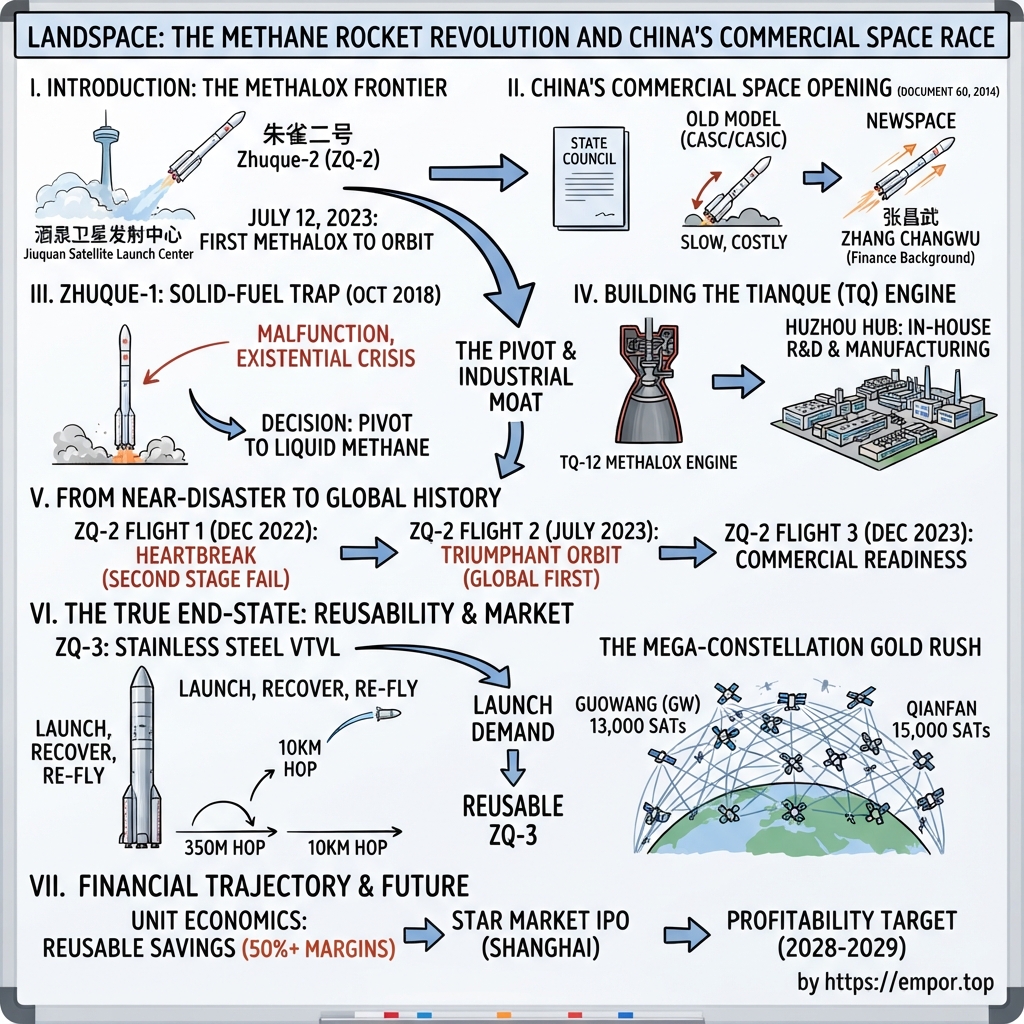
LandSpace: The Methane Rocket Revolution and China's Commercial Space Race
I. Introduction & The Methalox Frontier (00:00 – 15:00)
At 7:35 a.m. Beijing time on 19 August 2026, a stainless-steel rocket lifted off from the Dongfeng Commercial Space Innovation Pilot Zone in the Gobi Desert, deployed an internet satellite named Honghu-03 into low Earth orbit, and completed a maneuver unprecedented in Chinese spaceflight: its first stage flipped, relit its engines, traveled roughly 390 kilometers downrange, deployed landing legs, and touched down vertically on a desert pad in Minqin County, Gansu.12 The flight took eight minutes from liftoff to touchdown. LandSpace — LandSpace Technology Corporation (蓝箭航天空间科技股份有限公司) — became the third company globally, after SpaceX and Blue Origin, to recover an orbital-class booster, and the first to do so using a methane-fueled, stainless-steel vehicle carrying a live commercial payload.12
Moments later, a fire broke out in the aft section of the booster. One landing leg failed, and the rocket toppled.1
Those two outcomes capture the company's operating reality. LandSpace has demonstrated the capacity to solve complex propulsion engineering challenges ahead of peers, only to face the steeper operational hurdle of building a repeatable, durable launch system. Three years earlier, on 12 July 2023, its Zhuque-2 (朱雀二号) became the first liquid oxygen–methane rocket in history to achieve orbit, beating SpaceX's Starship, Relativity Space's Terran 1, and United Launch Alliance's Vulcan Centaur to a milestone sought across the global aerospace industry.3 Yet in calendar year 2025, the company generated RMB 52.1 million in revenue (approximately $7.3 million) while recording a net loss attributable to shareholders of RMB 1.711 billion.4
That commercial gap forms the core of LandSpace's trajectory. LandSpace filed for an initial public offering on the Shanghai Stock Exchange's STAR Market (科创板); the exchange accepted its application on 31 December 2025, and the company submitted an updated prospectus on 29 June 2026 that restored its review status from suspended to inquiry.56 The listing seeks RMB 7.5 billion (about $1.1 billion) in public capital.4 Unlike early-stage startups trading on unverified projections, LandSpace has published audited three-year financial statements, a defined use of proceeds, a disclosed ownership structure, and a formal forecast targeting profitability in 2029.67 The regulatory filing provides a detailed factual record that offers a more measured picture of the business.
The central question is commercial rather than technical. Founded by a former HSBC and Santander banker rather than an executive from China's state aerospace apparatus, LandSpace reached orbital methalox flight and vertical stage recovery ahead of domestic and international competitors.8 The economic challenge is whether a company that absorbed RMB 2.365 billion in research and development expenses over three years against cumulative revenue of RMB 60.34 million — an R&D-to-revenue ratio approaching 3,920 percent — can scale into an enterprise that earns its cost of capital.6
The analysis that follows examines the 2014 State Council policy shifts that opened China's commercial space sector; the 2018 failure of Zhuque-1 and the subsequent decision to abandon solid propulsion; the vertical integration of the Tianque (天鹊) engine series and the Huzhou (湖州) manufacturing facility; the Chinese satellite megaconstellations — Guowang (国网) and Qianfan (千帆星座) — that represent its primary addressable market; the reusable stainless-steel Zhuque-3 architecture; and the STAR Market listing, where an implied valuation of up to RMB 75 billion must be weighed against an operating base generating tens of millions in annual revenue.9
Throughout this analysis, market pricing and underlying business value remain distinct. Private investment marks, IPO pricing targets, and broader industry momentum reflect investor sentiment, but sustainable valuation depends on operational economics and execution.
 Subscribe on LinkedIn
II. China’s Space Opening & The Founder With a Spreadsheet (15:00 – 40:00)
For the first six decades of the Chinese space program, there was functionally one customer and one supplier, and they were the same institution. The China Aerospace Science and Technology Corporation (CASC) built and flew the Long March (长征) rocket family, while the China Aerospace Science and Industry Corporation (CASIC) handled missiles and a parallel set of solid-fuel launchers. Both were state-owned conglomerates funded through the national budget on cost-recovery terms and staffed by design academies whose incentives prioritized mission assurance and schedule discipline over cost per kilogram. Nobody inside that system was rewarded for making launch cheaper, because nobody inside that system was buying launch on price.
The opening came in November 2014. The State Council issued Guiding Opinions on Innovating Investment and Financing Mechanisms in Key Areas — universally known as Document 60 (60号文) — which covered seven broad categories of infrastructure and, in a single subsection, invited private capital to develop, launch, and operate commercial satellites.10 It was not a sweeping Commercial Space Launch Act; it was a single paragraph. But in a system where the binding constraint had been regulatory permission rather than capital, a paragraph was enough. Within four years, a cohort of privately funded Chinese launch companies emerged where none had existed before.
The strategic logic behind the policy shift was apparent on American launch manifests. SpaceX was driving down launch costs per kilogram at a pace the Long March family was never designed to match, while emerging satellite architectures — calling for thousands of small spacecraft in low Earth orbit rather than dozens of large satellites in geostationary orbits — signaled demand that state academies, already committed to crewed spaceflight, lunar exploration, and defense missions, could not absorb alone. China needed a second supply curve.
LandSpace was founded in Beijing in June 2015 as one of the sector's earliest entrants.1112 Its founder, Zhang Changwu (张昌武), was an unconventional aerospace chief. A Tsinghua-trained finance graduate, he worked at HSBC China from April 2008 to September 2011 and subsequently in Banco Santander's Asia-Pacific strategic investment unit from 2013 to 2015.8 He had never designed a turbopump. What he possessed was an understanding of how capital is raised, priced, and deployed across long development cycles — a critical asset in an industry where the gap between incorporation and first commercial revenue spans most of a decade.
The founding thesis held that a launch provider should operate as commercial infrastructure rather than a government contractor: own the design, manufacturing, and test capacity, and sell launch capacity at a fixed market price rather than through a cost-plus program. Executing that plan required engineers the founder could not personally evaluate. LandSpace recruited propulsion and avionics veterans out of CASC research institutes — including the Academy of Aerospace Propulsion Technology — offering two incentives state academies could not match: equity ownership and the mandate to iterate rapidly in public.
That hiring model established the company's core technical capabilities while embedding a structural vulnerability. LandSpace's engineering foundation consists of state-trained specialists working under private-sector incentives. While that technical transfer is substantial and lasting, it also means LandSpace's engineering edge over domestic competitors is narrower than its launch milestones might imply; every private Chinese space startup recruits from the same state academies using the same equity-based pitch. According to the updated prospectus, LandSpace employed 451 research personnel, representing 31.08 percent of its workforce — implying a total headcount of roughly 1,450.6 It is a formidable engineering organization, but not a unique one.
Early financing reflected a blend of private venture capital and regional industrial policy that came to define the sector. Backers included HongShan (formerly Sequoia Capital China), Country Garden's venture arm, and the China SME Development Fund; a 2020 funding round secured RMB 1.2 billion (approximately $170 million), followed in December 2024 by an RMB 900 million investment from the state-backed National Manufacturing Transformation and Upgrading Fund.1113 Meanwhile, the municipal governments of Huzhou and Jiaxing (嘉兴) in Zhejiang province provided land, subsidies, and local industrial-fund capital in exchange for LandSpace constructing its primary manufacturing and testing facilities within their jurisdictions.11
Published estimates for cumulative private financing range from roughly RMB 3.5 billion to more than RMB 7 billion, depending on reporting methodologies and the classification of local government support.1312 That wide variance reflects the complexity of the company's capital structure: across approximately seventeen rounds since 2015, LandSpace accumulated layers of preferred equity, employee shareholding platforms, municipal investment funds, and secondary share transfers that obscured outside visibility.9 Prior to the STAR Market prospectus filing, assessing the company's true valuation was virtually impossible for anyone outside its cap table.
III. Zhuque-1: The Solid-Fuel Trap and the Pivot to First Principles (40:00 – 65:00)
Every Chinese launch startup founded in the wake of Document 60 faced the same foundational choice. Solid-propellant rockets — derived from established military missile architectures — were relatively inexpensive to develop, fast to assemble, and capable of reaching the launchpad within two to three years. Liquid-propellant rockets, by contrast, required developing engines from the ground up: a capital-intensive engineering undertaking that would demand five years and hundreds of millions of yuan before generating initial revenue.
Most of the sector chose the solid path. LandSpace pursued it initially, then abandoned it.
On 27 October 2018, Zhuque-1 (朱雀一号) lifted off from a mobile launch platform at Jiuquan, marking the first orbital launch attempt by a private Chinese enterprise. A 19-meter, three-stage solid-propellant vehicle designed to carry 300 kilograms to low Earth orbit, it completed nominal first- and second-stage burns and fairing separation before a third-stage anomaly prevented orbital insertion, resulting in the loss of the Weilai-1 (未来号) satellite built for China Central Television.14 The company had expended three years of development and a substantial portion of its early venture funding without reaching orbit.
The strategic implications of that failure proved more consequential than the technical setback. Solid-fuel rockets cannot throttle, cannot reignite, and cannot be recovered; the motor casing is consumed during flight, and the solid propellant is cast in a single grain. The architecture delivers structurally poor unit economics because solid propellant has a comparatively low specific impulse, requiring large amounts of expensive mass to loft small payloads. For a provider whose long-term commercial viability required reducing launch costs per kilogram by an order of magnitude, solid fuel was an operational dead end. Every yuan invested in scaling it was capital diverted from reusable architectures.
A critical detail in the aftermath is often minimized in corporate retrospectives. Following the launch failure, LandSpace's third-party solid-motor supplier terminated its contract, eliminating the option to iterate on the existing vehicle before management could formally decide whether to preserve it.14 The subsequent pivot was therefore a combination of strategic conviction and commercial necessity — a distinction often obscured by founding narratives.
The genuine strategic choice was where to allocate capital next. Zhang's decision to bypass replacement solid suppliers and transition directly to medium-lift liquid oxygen–methane propulsion was an aggressive capital-allocation bet. It committed the company to roughly four additional years without meaningful commercial revenue in exchange for an architecture designed for eventual reusability. The decision was executed under significant peer pressure: domestic rivals i-Space (星际荣耀) and Galactic Energy (星河动力) were securing successful solid-fuel orbital launches and the associated commercial visibility, with Galactic Energy's Ceres-1 establishing the longest continuous launch track record among private Chinese providers.
LandSpace also bypassed the standard intermediate technology. The established liquid-propellant path was kerosene and liquid oxygen (RP-1/LOX) — the architecture underpinning SpaceX's Falcon 9 and the most mature liquid propulsion system available. Competitor Space Pioneer (天兵科技) adopted that route. LandSpace committed directly to methalox, calculating that methane's clean-burning characteristics and resistance to carbon soot buildup during engine burns would deliver superior economics for stage reuse over a ten-year horizon, outweighing the short-term development advantages of kerosene.
In retrospect, the pivot positioned LandSpace ahead of global propulsion trends, but it represents an unusual case rather than a standardized playbook. The same capital allocation by a company with less technical depth or investors less tolerant of a multi-year pre-revenue timeline would have resulted in insolvency rather than flight records. The strategy was sustained by the willingness of Chinese state and municipal funds to finance hard-technology development through a prolonged gestation period — a financing dynamic tied to a specific policy cycle rather than an easily replicated corporate formula.
The pivot also created a long-term operational dependency. By committing to an architecture whose core economic justification is multi-flight reusability, LandSpace tied its business model and valuation to the execution of vertical recovery. An expendable methalox launcher offers modest propellant savings over kerosene without fundamentally transforming unit economics. The August 2026 landing was not an optional operational milestone; it was the essential engineering requirement initiated by the 2018 pivot.
IV. The Industrial Moat: Building the Tianque (TQ) Engine and Huzhou Facilities (65:00 – 95:00)
The engineering logic for methane over kerosene rests on physical properties that translate directly into refurbishment economics. Kerosene is a heavy hydrocarbon that leaves carbon soot—coking—inside injectors and turbomachinery during combustion. Every flight accumulates residue, requiring kerosene-fueled engines to undergo detailed inspections and periodic teardowns before reflight. Methane (CH₄), by contrast, burns cleanly, substantially reducing the labor and turnaround time required between launches. Methane also occupies a manageable thermal middle ground: it liquefies at −162 °C, demanding less complex insulation than liquid hydrogen at −253 °C, while retaining sufficient density to avoid outsized fuel tanks. It is also an inexpensive, widely available industrial commodity.
The operational challenge in 2018 was that no provider globally had flown an orbital-class methalox rocket. LandSpace had to develop and qualify its own propulsion systems from scratch.
The Tianque (天鹊) engine family was the core product of that effort. The baseline TQ-12 is an open-cycle, gas-generator methalox engine generating roughly 80 tonnes of sea-level thrust, paired with the smaller TQ-11 as a vernier and upper-stage unit; the original Zhuque-2 flew four TQ-12s on its first stage alongside a vacuum-optimized TQ-12 and a TQ-11 vernier on the second.3 Upgraded variants increased thrust: nine TQ-12A engines generate approximately 7,200 kilonewtons at sea level on the Zhuque-3, while nine TQ-12B engines produce roughly 9,000 kilonewtons on the enlarged Zhuque-3E; meanwhile, the TQ-15A and TQ-15B took over second-stage propulsion with 944 kilonewtons and 1,183 kilonewtons of vacuum thrust, respectively, incorporating engine restart and throttling capabilities essential for orbital maneuvers and recovery profiles.15
The company's more capital-intensive investment was in dedicated manufacturing and testing infrastructure. LandSpace constructed a propulsion manufacturing and test base in Huzhou, Zhejiang, and a rocket assembly and test facility in Jiaxing, complemented by operations in Beijing, Shanghai, Wuxi, Xi'an, and Jiuquan—expanding to seven sites by mid-2025.13 The Huzhou plant has designed capacity exceeding 100 methalox engines annually and completed its 100th unit in April 2025, including the nine TQ-12A engines powering the August 2026 Zhuque-3 flight. Across its primary manufacturing hubs, LandSpace has targeted an eventual annual final-assembly capacity of 20 Zhuque-3 launch vehicles.
Proprietary test infrastructure provides a distinct operational advantage in China's launch sector. Engine hot-fire test stands are scarce nationally and heavily booked by state-run aerospace programs; startups relying on state facilities often face testing cycles stretched over months. Dedicated test stands compress those iteration loops to days. This physical asset base forms a capital-expenditure moat that is straightforward in concept yet difficult to compress in time: building and permitting proprietary hot-fire stands requires substantial capital and local regulatory approvals that take years to duplicate.
That lead is already being challenged. State-backed competitors are moving quickly to match the footprint; CAS Space (中科宇航), a spinoff of the Chinese Academy of Sciences, completed its own high-capacity rocket manufacturing complex in Zhejiang in 2026.16 As municipal governments across China have recognized commercial space as a high-prestige sector eligible for regional industrial subsidies, capital has flowed into competing manufacturing parks. The Huzhou complex represents an early head start rather than an insurmountable barrier to entry.
The financial burden of establishing that infrastructure is reflected throughout LandSpace's regulatory disclosures. Annual R&D spending totaled RMB 830 million in 2023, RMB 613 million in 2024, and RMB 922 million in 2025—a year-over-year increase of more than 50 percent—bringing cumulative three-year R&D expenditures to RMB 2.365 billion.6 Operating cash outflows accelerated in tandem, climbing from RMB 809 million in 2023 to RMB 1.141 billion in 2024 and RMB 1.220 billion in 2025, consuming more than RMB 3 billion in aggregate cash.6 To finance these capital requirements, LandSpace increased balance-sheet leverage: its debt-to-asset ratio rose by more than 23 percentage points in a single year, from 31.79 percent in 2024 to 54.99 percent in 2025, pushing annual interest expense up from RMB 19.87 million to RMB 29.57 million.7
A notable balance-sheet disclosure from the interim period highlights the company's treasury management. As of June 2025, LandSpace carried approximately RMB 71 million in short-term borrowings and RMB 896 million in long-term debt—up more than a hundredfold from end-2022 levels—while concurrently maintaining roughly RMB 627 million in trading financial assets, primarily structured deposits and bank wealth-management products that generated RMB 8.21 million in fair-value gains.8 Cash and cash equivalents stood at approximately RMB 704 million.8 While holding liquidity in yield-bearing products alongside outstanding debt is common in Chinese corporate treasury practice—and portions of those assets may serve as collateral for credit facilities—the arrangement represents a focal point for regulatory scrutiny on the STAR Market and illustrates how pre-IPO balance-sheet mechanics differ from top-line engineering narratives.
V. From Near-Disaster to Global History: The Zhuque-2 Flights (95:00 – 120:00)
On 14 December 2022, Zhuque-2 Y1 became the first methalox vehicle in history to attempt an orbital flight. The first stage operated nominally, stage separation succeeded, and the second-stage main engine ignited. However, an anomaly in the vernier engines—the gimballed thrusters providing fine attitude control and terminal velocity trim—caused a loss of thrust, leaving the vehicle and its payload, the Zhixing-1B satellite, short of orbital velocity.3
From an engineering perspective, falling short on upper-stage attitude control isolated the failure mode while validating the broader airframe and propulsion systems. LandSpace deployed design modifications within seven months. On 12 July 2023, Zhuque-2 Y2 successfully inserted a test payload into sun-synchronous orbit, making LandSpace the first entity globally to reach orbit with a liquid oxygen–methane rocket—ahead of SpaceX's Starship, United Launch Alliance's Vulcan Centaur, and Relativity Space's Terran 1.3
Five months later, on 8 December 2023, Zhuque-2 Y3 deployed the Honghu-1 and Honghu-2 satellites alongside Tianyi-33 into sun-synchronous orbit, completing the vehicle's first commercial mission.3 The sequence delivered two successful orbital flights and an industry-first milestone across three attempts within a twelve-month window.
The operational transition that followed proved more demanding than the initial milestone. LandSpace retired the baseline Zhuque-2 after three flights to introduce the Zhuque-2E, an uprated variant featuring TQ-12A first-stage engines and a TQ-15A second stage that expanded payload capacity to 6,000 kilograms to low Earth orbit and 4,000 kilograms to sun-synchronous orbit, up from 4,000 kilograms and 1,500 kilograms, respectively.3 Zhuque-2E Y1 flew successfully in November 2024 carrying the Guangchuan-01 and Guangchuan-02 satellites, followed by Y2 in May 2025 with six Tianyi spacecraft.3
The cadence stalled on 15 August 2025 when Zhuque-2E Y3 failed. At T+258 seconds, an electrical arc in the second stage's 450-volt direct-current power bus short-circuited the control actuators, triggering flight termination and destroying an undisclosed commercial payload.17 In its public disclosure, LandSpace pledged to enforce stricter risk-process management and tighten quality control over outsourced components—pointing to a component-level supply-chain defect rather than a fundamental propulsion design flaw.17 The failure compressed the company's operating schedule: LandSpace had targeted six Zhuque-2E launches in 2025 but completed three, while the anomaly also raised schedule risks for the Zhuque-3 development program, which shared the TQ-15A upper-stage propulsion architecture.17
The financial consequences of the anomaly were documented in subsequent regulatory filings. Inventory impairment provisions increased from RMB 15.6 million in 2023 to RMB 157.1 million in 2024 and RMB 225.8 million in 2025, with management attributing the expanding 2025 net loss in part to asset write-downs following the mission failure.418
Flight operations resumed in mid-2026: Zhuque-2E Y5 delivered a test mass to sun-synchronous orbit on 14 May 2026, and Y6 deployed Qianfan DTC-01 and China Mobile-02 on 9 June 2026.3 By mid-2026, the Zhuque family had completed eight orbital launch attempts, achieving six mission successes.3
These operating results highlight the structural contrast between technical milestones and commercial performance. A 75 percent success rate—six successes across eight attempts—is typical for an early-stage launch system and compares favorably with historical industry peers, but remains well below the mission assurance thresholds and insurance risk models demanded by commercial constellation operators. Furthermore, that flight record generated RMB 4.28 million in revenue in 2024 and RMB 52.1 million in 2025.6 While launch services accounted for 71.54 percent of 2025 revenue as the company's primary commercial business line, the figures underscore the financial gap between proving an orbital architecture and achieving sustainable commercial scale.4
VI. The True End-State: Zhuque-3, Stainless Steel, and VTVL Reusability (120:00 – 145:00)
The core economic driver across the commercial launch sector is cost per kilogram to orbit. LandSpace's launch costs have been estimated in the range of RMB 50,000 to RMB 100,000 per kilogram, compared to roughly RMB 17,000 to RMB 20,000 (about $2,500 to $3,000) for SpaceX's Falcon 9.12 A three- to five-fold cost premium against the global price benchmark cannot be closed through supply-chain procurement or incremental manufacturing efficiencies alone. It requires stage reusability, sustained over high flight counts.
That economic reality dictated the architecture of Zhuque-3. The launch vehicle is a two-stage, 4.5-meter-diameter rocket with a stainless-steel primary structure, powered by nine TQ-12A engines on the first stage and a single vacuum-optimized TQ-15A engine on the second, while the enlarged Zhuque-3E variant incorporates uprated TQ-12B and TQ-15B engines.15 Published vehicle heights across industry reports range between 66 meters and 76.6 meters, reflecting specifications for different airframe configurations; the Zhuque-3E is listed at 76.2 meters with a liftoff mass of 654.5 tonnes.1215 Low Earth orbit payload capacity to a 450-kilometer orbit is rated at 11,800 kilograms in an expendable profile and 8,000 kilograms with downrange recovery for the baseline Zhuque-3, expanding on the Zhuque-3E to 21,300 kilograms expendable, 18,300 kilograms with downrange recovery, and 12,500 kilograms with return-to-launch-site recovery.15 The booster's structural design targets a minimum operational service life of twenty flights.19
Selecting stainless steel mirrors the design rationale adopted by SpaceX for Starship. While aerospace-grade aluminum-lithium alloys and carbon-fiber composites offer lower dry mass, they carry raw-material costs roughly an order of magnitude higher, demand specialized tooling and curing autoclaves, and present difficult maintenance profiles in the field. Cold-rolled stainless steel, by contrast, is an inexpensive industrial commodity that can be fabricated using standard welding techniques, exhibits increased tensile strength at cryogenic temperatures, and withstands atmospheric reentry heating that would compromise aluminum structures. Launch operators accept a structural mass penalty in exchange for lower production costs and faster turnaround—an engineering tradeoff whose economic validity depends entirely on achieving high reuse cadence.
The flight-test campaign followed a structured sequence: a 350-meter vertical takeoff and vertical landing hop in January 2024; a 10-kilometer test flight in September 2024 demonstrating engine throttling, reignition, grid-fin aerodynamic control, and terminal guidance; a nine-engine first-stage static fire in June 2025; and a full propellant-loading rehearsal followed by an additional static fire in October 2025.15 The maiden orbital mission, Zhuque-3 Y1, launched on 3 December 2025, successfully deployed its payload, but lost the first stage during descent after an engine anomaly and abnormal combustion prevented a nominal landing burn, causing the booster to impact near the recovery zone.1519
The 19 August 2026 flight of Zhuque-3 Y2 closed that operational loop by pairing orbital insertion of the Honghu-03 satellite with a powered descent and vertical touchdown on a designated landing pad in Minqin.12 LandSpace characterized the flight as transitioning Zhuque-3 "beyond technology demonstration towards the engineering phase of reusability," stating that engineering teams were proceeding with post-recovery inspection and refurbishment ahead of a planned reflight, alongside an operating target of approximately ten Zhuque-3 launches annually.2
The subsequent aft fire and landing-leg failure, however, underscore the remaining technical obstacles.1 The economics of reusable rocketry depend not merely on returning a booster to the ground, but on recovering an undamaged airframe that can be inspected, refurbished, and reflown with minimal capital and labor. A booster that achieves a precision landing but sustains structural damage demonstrates guidance, navigation, and control capabilities while leaving operational turnaround economics unproven. Until LandSpace refliees a recovered stage and discloses the associated turnaround duration and refurbishment expense, reusability remains a demonstrated technical maneuver rather than an established commercial model. For comparison, SpaceX required fifteen months between its first orbital-booster landing in December 2015 and its first commercial reflight in March 2017. Industry analyses accompanying LandSpace's public filings indicate that mature commercial reuse economics across Chinese private launch providers could take three to seven years to materialize.12
Reusability also introduces distinct balance-sheet dynamics. A booster capitalized over an assumed twenty-flight amortization schedule generates lower per-mission depreciation only if high flight frequencies are sustained. If launch cadence remains low, carrying underutilized reusable hardware results in higher unit costs per mission than flying fully depreciated expendable airframes.
VII. Market Structure & The Mega-Constellation Gold Rush (145:00 – 175:00)
The core commercial thesis for Chinese private launch providers rests on a straightforward premise: China has committed to deploying tens of thousands of satellites into low Earth orbit over the coming decade, and the state-owned launch apparatus cannot fly them all alone.
The underlying demand projection is genuine. Whether that demand converts into private-sector revenue on the schedule investors are underwriting, however, is a separate matter—and operating data through mid-2026 indicates that deployment is progressing at a measured pace.
The demand side, as planned.
- Guowang (国网), operated by China Satellite Network Group, has filed for 13,992 satellites across two sub-constellations—GW-A59 at 6,080 spacecraft and GW-2 at 6,912—under an International Telecommunication Union (ITU) filing dating to September 2020.20
- Qianfan (千帆星座), the "Thousand Sails" constellation operated by Shanghai Spacecom Satellite Technology (often designated G60), targets 15,000 satellites by 2030, with phased deployment milestones of 648 by end-2025 and a further 648 by end-2027.20
- Honghu-3 (鸿鹄三号), filed with the ITU in May 2024 by Hongqing Technology, plans 10,000 satellites across 160 orbital planes at altitudes between 340 and 550 kilometers; LandSpace holds a 48 percent equity stake in Hongqing, and the Honghu-3 architecture is designed around Zhuque-3.20
Together, those programs represent roughly 39,000 planned spacecraft. ITU bring-into-use regulations make these deployment schedules legally binding rather than aspirational: operators forfeit spectrum priority if orbital milestones slip, which accounts for the heavily front-loaded launch targets between 2025 and 2030.21
The demand side, as delivered.
- Guowang had approximately 136 spacecraft in orbit as of January 2026 against a stated 2026 target of 310, alongside deployment goals of 900 in 2027 and 3,600 annually starting in 2028.20
- Qianfan reached 200 satellites in orbit by June 2026, following an eight-month operational pause between its maiden launch in August 2024 and the resumption of flight cadence.20
- Independent industry assessments describe both programs as unlikely to meet their ITU milestone deadlines, citing satellite manufacturing bottlenecks, technical challenges, and launch procurement constraints.20
This dynamic represents the central operational reality in the LandSpace investment thesis, and it cuts both ways. While the launch deficit is real—forming the core commercial opportunity—the binding constraint across the sector has not been launch capacity alone, but satellite fabrication. A launch provider cannot fly satellites that have not yet been manufactured. LandSpace's addressable revenue is therefore gated by an upstream production bottleneck it neither controls nor can resolve, residing inside customer organizations whose procurement decisions are guided by state planners.
What LandSpace has actually won.
The company has secured inclusion on China Satellite Network Group's core supplier list, establishing the requisite regulatory qualification for Guowang launch contracts.21 However, its disclosed commercial backlog remains modest. Contracts signed with Shanghai Yuanxin Satellite (the manufacturing arm of the Qianfan operator) in November and December 2025 totaled roughly RMB 300 million according to public reports and RMB 223 million under prospectus disclosures, of which RMB 77 million had been recognized and RMB 146 million remained outstanding; the regulatory filing also references seven planned launches carrying 94 satellites.6217 At an estimated Zhuque-3 list price of approximately RMB 150 million per flight, that remaining backlog represents roughly one and a half to two dedicated missions.18
Customer concentration is correspondingly pronounced. In 2024, LandSpace's top five customers accounted for 97.96 percent of revenue, with the single largest customer representing more than 80 percent.21 For a company projecting a decade-long wave of megaconstellation demand, relying on a narrow set of contracted buyers creates material revenue volatility. This concentration also shifts pricing dynamics: the purchaser is a state-backed program operating under fixed budgets with alternative launch options, while the supplier is a capital-intensive startup requiring high flight cadence to absorb substantial fixed operating costs.
The competitive field.
- CAS Space (中科宇航), a spinoff of the Chinese Academy of Sciences, submitted an updated STAR Market prospectus on the same day as LandSpace, 29 June 2026, seeking RMB 4.18 billion; the company operates at a substantially larger commercial scale, generating 2025 revenue of RMB 277 million against a net loss of RMB 1.119 billion—more than five times LandSpace's revenue alongside roughly two-thirds the net loss.21
- Galactic Energy (星河动力) maintains the longest cumulative flight record among private Chinese launch providers with its solid-fuel Ceres-1, while transitioning into medium-lift liquid propulsion with Pallas-1.
- Space Pioneer (天兵科技) pursued kerosene-liquid oxygen propulsion with Tianlong-2 and Tianlong-3, though its development timeline was disrupted by a widely publicized test-stand structural failure.
- Orienspace (东方空间) and Deep Blue Aerospace (深蓝航天) compete across solid heavy-lift and liquid vertical-takeoff-vertical-landing architectures, respectively.
- i-Space (星际荣耀), an early leader in private solid propulsion, has faced ongoing vehicle reliability challenges.
More than ten Chinese commercial launch and aerospace supply-chain companies were preparing public listings across Shanghai and Hong Kong in mid-2026. Rather than an undersupplied market, the private launch ecosystem is moving toward capital saturation across multiple domestic contenders.
The competitor nobody underwrites properly.
The most formidable competitive pressure does not come from venture-backed startups, but from CASC. The state-owned incumbent is developing its own reusable launch vehicles—including the Long March 8R, Long March 12, and follow-on architectures—while controlling dedicated launch pads, national range access, primary regulatory relationships, and substantial balance-sheet resources. In an operating environment where the primary customers and the dominant competitor are both state entities, private market share is shaped as much by national industrial policy as by commercial execution. LandSpace's core differentiators—proven orbital methalox flight heritage, scaled in-house engine manufacturing, and a recovered orbital booster—represent genuine engineering milestones unmatched among domestic private peers. Over a five-year horizon, however, that technical lead represents a head start measured in development cycles rather than an unassailable structural barrier.
VIII. Unit Economics, Capital Allocation & The STAR Market IPO (175:00 – 200:00)
The company's regulatory filings outline an operating baseline defined by substantial research spending and early-stage revenue.
- Revenue: RMB 3.95 million in 2023, RMB 4.28 million in 2024, and RMB 52.10 million in 2025—an elevenfold increase in the most recent fiscal year.
- Net loss attributable to shareholders: RMB 1.188 billion in 2023, RMB 876 million in 2024, and RMB 1.711 billion in 2025, with losses nearly doubling year over year.
- R&D expenses: RMB 830 million in 2023, RMB 613 million in 2024, and RMB 922 million in 2025—bringing cumulative three-year R&D spending to RMB 2.365 billion, equal to 3,919.87 percent of cumulative revenue (RMB 60.34 million).
- Operating cash outflows: RMB 809 million in 2023, RMB 1.141 billion in 2024, and RMB 1.220 billion in 2025.
- Consolidated undistributed profit: Negative RMB 5.955 billion as of 31 December 2025, and negative RMB 4.024 billion at the parent-company level.
- Debt-to-asset ratio: 54.99 percent at end-2025, up from 31.79 percent a year earlier.
Gross margins remain deeply negative, reported at roughly −334 percent in the first half of 2025 and substantially lower in 2023, when minimal commercial revenue was offset against the full manufacturing and operating costs of flight hardware.8 LandSpace does not yet sell launches above direct production and operating costs. Consequently, the company's trajectory toward profitability depends on achieving manufacturing scale and operational efficiencies that have not yet materialized in its financial statements.
The unit economics of a launch.
LandSpace prices Zhuque-3 at approximately RMB 150 million (about $22 million) per flight.18 At that list price, achieving the company's stated target cadence of ten flights annually would generate roughly RMB 1.5 billion in top-line revenue.218 However, against a 2025 operating cost baseline that includes RMB 922 million in R&D alongside selling, general, administrative, and depreciation expenses across an expanding asset base, ten flights operating at a 40 percent gross margin would yield approximately RMB 600 million in gross profit—insufficient to cover annual R&D expenditures alone.
That arithmetic underpins the company's formal forecast targeting profitability in 2029. Reaching breakeven requires a combination of higher annual flight frequency, gross margins well in excess of 40 percent, and a deceleration in annual R&D spending. The regulatory disclosures outline specific operating milestones required to achieve that target: frequent Zhuque-3 launches with high mission success rates, operational first-stage reuse supporting rapid turnaround, rising revenue per launch as payload capacity scales, and an orbital booster capable of exceeding twenty flights by 2029.217 Brokerage summaries also note a minimum operating baseline of at least five commercial launches per year as a floor condition.18
Meeting those conditions requires an operational state characterized by more than twenty Zhuque-3 flights per year, boosters completing multiple reflights with low refurbishment costs, gross margins between 40 and 50 percent, and normalized R&D outlays. While an annual final-assembly capacity of twenty vehicles is designed to support that cadence, the company's operating record through mid-2026 remains in the early demonstration phase.
Secondary revenue lines.
Third-party engine sales and test-stand leasing at the Huzhou and Jiaxing complexes provide incremental optionality. However, these lines do not represent a material diversification of revenue: launch services accounted for 71.54 percent of 2025 revenue and remain designated in the prospectus as the company's sole core commercial revenue stream.4 For analytical purposes, non-launch revenue operates as a call option rather than a diversified business foundation.
Capital allocation and vertical integration.
The relationship between LandSpace and Hongqing Technology illustrates the strategic and structural nuances of China's commercial space ecosystem. LandSpace holds a 48 percent equity stake in Hongqing, which is developing a 10,000-satellite constellation tailored to Zhuque-3, and the two companies are jointly establishing a combined rocket-and-satellite production facility in Wuxi.20 The payload deployed during the August 2026 recovery flight was Hongqing's Honghu-03 satellite.2
This arrangement mirrors SpaceX's vertical integration model, where internal Starlink demand underwrites Falcon 9 launch cadence. From a public-market governance perspective, however, revenue from an affiliate in which the launch provider holds a 48 percent stake does not provide the same external validation of commercial product-market fit as contracts secured from independent, arm's-length buyers. Furthermore, launch cadence financed by a pre-revenue satellite affiliate reflects internal ecosystem investment rather than self-sustaining commercial demand—a distinction that forms a key focal point in the listing review process.
The listing structure.
- The Shanghai Stock Exchange accepted LandSpace's STAR Market listing application on 31 December 2025, sponsored by China International Capital Corporation (CICC).51322
- The company seeks to raise RMB 7.5 billion, designating RMB 2.77 billion for reusable-rocket production capacity and RMB 4.73 billion for reusable-rocket technology development, with no proceeds earmarked for debt repayment or working capital.49
- The offering comprises no fewer than 40 million new shares, representing at least 10 percent of post-issue share capital.9 Registered capital stood at RMB 360 million as of August 2025, corresponding to approximately 360 million shares outstanding prior to the offering.13
- Founder Zhang Changwu holds 6.7277 percent of equity directly and controls 23.4724 percent in aggregate through five employee shareholding partnerships: Xinghan Information, Yihang Management, Silu Hangtong, Qiyu Hangke, and Hangyan Management. These shares carry weighted voting rights at a 10:1 ratio, granting him 75.2019 percent of voting control.69
- The prospectus includes a binding governance mechanism: if LandSpace fails to achieve profitability by fiscal year 2029, the lock-up period for committed controlling shareholders automatically extends by twelve months.7
The STAR Market allows pre-profit listings for enterprises demonstrating core technological innovation and growth potential, providing the regulatory framework that makes LandSpace's IPO application possible.13 This reflects a deliberate national policy initiative to direct domestic capital into strategic hard-technology sectors rather than an endorsement of near-term commercial profitability.
IX. Strategic Frameworks: Hamilton Helmer’s 7 Powers & Porter’s Five Forces (200:00 – 220:00)
                      ┌────────────────────────────────────────┐
                      │        LANDSPACE COMPETITIVE MOAT      │
                      └───────────────────┬────────────────────┘
                                          │
            ┌─────────────────────────────┼─────────────────────────────┐
            ▼                             ▼                             ▼
   【 PROCESS POWER 】          【 CORNERED RESOURCE 】        【 SCALE ECONOMIES 】
 Proprietary methalox tooling,   Private hot-fire stands,     Huzhou gigafactory &
 stainless steel fab, rapid      world's first orbital        reusable ZQ-3 booster
 iterative flight testing        methalox flight heritage     amortization
Strategic frameworks are useful in hard-technology sectors only when applied against verifiable operating data, which requires separating proven capabilities from prospective ambitions.
Helmer’s 7 Powers, assessed against evidence.
- Cornered Resource — moderate and depreciating. LandSpace holds proprietary technical assets unmatched by domestic private peers: operational methalox flight telemetry across eight Zhuque missions, a recovered orbital-class booster, and an in-house propulsion team that has progressed through multiple engine upgrade cycles.315 Flight data and early demonstration records, however, are perishable advantages. As domestic rivals—including Space Pioneer, Galactic Energy, Deep Blue Aerospace, and state-backed CASC—advance their own recovery programs, the uniqueness of that operational record diminishes over successive quarters.
- Process Power — plausible but unverified. Automated thin-gauge stainless-steel welding, scaled engine manufacturing capacity exceeding 100 units annually, and test-turnaround loops measured in days rather than months constitute the company's core process claims. While the physical infrastructure in Huzhou and Jiaxing is established, evidence that these processes deliver structurally lower unit costs remains unproven in financial disclosures, where gross margins remain negative and per-vehicle production costs are not broken out.8 Until manufacturing efficiencies translate into lower cost of goods sold, process power remains an unverified operating hypothesis.
- Scale Economies — prospective rather than operational. Spreading high fixed manufacturing and test-stand overhead across dozens of annual launches defines the long-term economic model. At a cadence of three to five flights per year, however, that infrastructure represents an underutilized cost burden rather than an economic moat. Realizing scale economies depends entirely on demonstrating rapid, low-cost booster reuse.
- Counter-Positioning — historical and largely exhausted. Committing to methalox in 2018 while competitors pursued solid-propellant launchers was an effective counter-positioning strategy that state incumbents could not immediately follow without disrupting existing programs. That strategic window has largely closed: domestic competitors have shifted resources into liquid propulsion, and CASC is developing its own reusable architectures. Counter-positioning explains how LandSpace established its current position, but offers little protection against future competition.
- Switching Costs, Branding, Network Economies — absent. Commercial launch procurement is driven primarily by cost, schedule reliability, and payload capacity. Constellation operators face minimal switching costs when shifting between qualified launch providers, and orbital launch exhibits no structural network effects.
In aggregate, LandSpace possesses a temporary technical lead supported by owned test infrastructure, alongside a prospective scale advantage that has yet to show up in its operating results.
Porter’s Five Forces.
- Threat of new entrants — low in theory, high in practice. Severe capital intensity and stringent regulatory approvals from state defense agencies prevent early-stage entrants from emerging easily. However, a well-funded cohort of existing domestic contenders already shares access to state and municipal industrial capital, with more than ten commercial space and supply-chain enterprises pursuing public listings.
- Bargaining power of buyers — high. The common industry narrative that a national launch deficit grants launch providers pricing power is challenged by LandSpace's regulatory disclosures. A customer concentration where the top five buyers generated 97.96 percent of revenue, with a single customer accounting for more than 80 percent, combined with negative gross margins and a backlog representing roughly one to two missions, describes a supplier with limited pricing leverage negotiating with centralized state-directed buyers.218
- Bargaining power of suppliers — low, with supply-chain exposure. Extensive vertical integration across propulsion, structural fabrication, avionics, and dedicated test stands minimizes reliance on outside vendors. However, the August 2025 Zhuque-2E Y3 failure, traced to a defect in an outsourced electrical power component, demonstrated that supply-chain vulnerabilities persist at the sub-tier component level where inspection is most demanding.17
- Threat of substitutes — low for launch services, high for provider type. While no technological substitute exists for orbital rocket launch, commercial providers face direct competition from state-owned Long March architectures that are concurrently undergoing capacity expansions and reusable upgrades.
- Competitive rivalry — high and intensifying. Domestic competition includes four to six capitalized launch startups, a state-owned incumbent modernizing its fleet, and an international cost benchmark established by a global market leader operating at high launch frequency.9
Examined through standard strategy frameworks, LandSpace operates not as an enterprise protected by structural barriers to entry, but as a capital-intensive manufacturer with a temporary technical lead, working to achieve commercial scale against concentrated institutional buyers.
X. The Bull vs. Bear Case & Critical KPIs (220:00 – 240:00)
What the market has actually paid
Four observable valuation benchmarks exist in recent transaction records, and they diverge sharply:
- December 2024: The National Manufacturing Transformation and Upgrading Fund invested RMB 900 million—a state strategic commitment guided as much by industrial policy objectives as direct investment return.1113
- January 2025: Internal company valuation references placed equity value at approximately RMB 20.55 billion.8
- April 2025: Country Garden Holdings sold an 11.063 percent equity stake for RMB 1.305 billion, implying an enterprise-wide equity valuation of roughly RMB 11.8 billion.513 During the same month, a primary capital injection from two strategic investors was executed at a reported valuation of approximately RMB 20.7 billion.9
- June 2025: Internal reference marks eased to approximately RMB 17.797 billion, while the Hurun Global Unicorn Index valued LandSpace at RMB 20 billion, ranking it 418th globally.1398
Three analytical takeaways follow from these data points. First, private marks were flat to down throughout the first half of 2025—an unusual pricing dynamic for a company preparing an initial public offering. Second, the April 2025 spread is revealing: a secondary transaction at RMB 11.8 billion alongside a primary round at RMB 20.7 billion in the same month represents a 43 percent pricing gap. Part of that divergence reflects seller circumstances: a real estate developer liquidating non-core assets under balance-sheet strain sells at a liquidity discount. But structural mechanics explain the remainder: primary preferred shares typically carry liquidation preferences, anti-dilution provisions, and enhanced information rights absent from common shares. Valuing an entire enterprise by applying a preferred share price across all equity classes remains a frequent pitfall in pre-IPO analysis.
Third, the specific terms governing those preferred shares—including participation rights, valuation ratchets, conversion triggers, redemption rights, and side letters—remain undisclosed in public filings. While Chinese pre-IPO restructurings standardly eliminate preferred rights before listing to establish a single share class, public investors cannot independently verify what economic concessions or compensatory terms accompanied that conversion.
The RMB 75 billion number, and why it is arithmetic rather than a price
The widely cited implied valuation of RMB 75 billion (approximately $10.4 billion) represents a mathematical ceiling rather than a negotiated market price.9 The listing mechanics explain why: LandSpace proposes to issue no fewer than 40 million shares, representing at least 10 percent of post-issue share capital, to raise RMB 7.5 billion.9 If the company issues precisely that minimum 10 percent float, the implied issue price reaches RMB 187.50 per share, yielding a post-money equity valuation of RMB 75 billion.
However, a 10 percent offering is a regulatory floor, not an operational target. If the offering comprises 20 percent of post-issue equity, the implied post-money valuation falls to RMB 37.5 billion; at a 25 percent float, it drops to RMB 30 billion. The RMB 75 billion figure is therefore the maximum valuation consistent with the minimum allowable public float—an upper boundary produced by exchange listing rules that has circulated as a baseline appraisal. Consequently, the public float at debut could encompass as little as 10 percent of outstanding shares.
An enterprise-value bridge cannot be constructed with precision from the interim disclosures. As of June 2025, LandSpace held roughly RMB 704 million in cash against RMB 71 million in short-term debt and RMB 896 million in long-term borrowings, representing modest net debt.8 By year-end 2025, the debt-to-asset ratio rose to 54.99 percent, though full year-end cash and gross debt figures were not fully detailed in the reviewed reporting.7 Post-listing, RMB 7.5 billion in gross primary proceeds would expand the balance sheet, with the entire sum earmarked for manufacturing capacity and propulsion development rather than debt retirement.9 Until the final offering structure, issue price, and year-end balance-sheet figures are formalized, enterprise value cannot be calculated with certainty.
A transparent scenario framework
Rather than reverse-engineering a target valuation, a more grounded approach evaluates the operating requirements necessary to support different valuation tiers. Assuming 2032 as a normalized maturity year, applying a discount rate of 13 to 15 percent (reflecting a capital-intensive, single-architecture hardware business exposed to industrial policy cycles), and incorporating China's 15 percent high-technology enterprise tax rate yields three distinct operating scenarios:
Bear — Reuse matures slowly or incurs high turnaround expense. Zhuque-3 achieves a cadence of five to seven launches annually. First stages are recovered, but thermal damage and mechanical refurbishment keep turnaround costs elevated, holding gross margins between 10 and 15 percent while annual R&D outlays remain near RMB 900 million. Under these conditions, the business does not reach self-sustaining profitability and requires additional equity capital. Valuation rests primarily on replacement asset value, engine manufacturing infrastructure, and strategic optionality, supporting a defensible equity range of RMB 8 billion to RMB 15 billion, with downside risk if capital markets tighten.
Base — Operational reuse succeeds, with launch cadence paced by constellation deployment. By 2032, LandSpace conducts 18 to 20 Zhuque-3 launches annually at an average realized price of RMB 150 million, supplemented by modest third-party engine sales and testing services, generating RMB 3.0 billion to RMB 3.5 billion in annual revenue. Gross margins expand to 40 to 45 percent, yielding RMB 1.3 billion to RMB 1.5 billion in gross profit. As R&D normalizes to RMB 800 million and overhead settles near RMB 350 million, operating profit reaches RMB 150 million to RMB 350 million, translating to roughly RMB 130 million to RMB 300 million in net income. Factoring in minority equity value in Honghu-3 and auxiliary revenue lines, discounted cash flows support an equity valuation between RMB 12 billion and RMB 28 billion.
Bull — LandSpace operates as a vertically integrated launch and constellation provider. Launch cadence exceeds 30 missions annually against an annual factory capacity of 20 airframes (achievable only through reliable, multi-flight booster reusability). Revenue per flight increases with uprated payload capacity, gross margins approach 50 percent, and the Honghu-3 satellite constellation generates recurring service revenue in which LandSpace captures its 48 percent equity share. Generating RMB 6 billion to RMB 9 billion in revenue with mid-teens net margins by the mid-2030s supports an equity value in the range of RMB 35 billion to RMB 60 billion—a trajectory contingent on the commercial success of the underlying satellite constellation.
Sensitivity analysis highlights the volatility in these estimates. A shift of five annual launches alters top-line revenue by RMB 750 million. A 10-percentage-point change in gross margin across 20 flights moves gross profit by RMB 300 million—exceeding total baseline operating income. Furthermore, a 200-basis-point adjustment in the discount rate shifts present value by 10 to 15 percent.
Evaluating the implied RMB 75 billion listing valuation against these fundamentals illustrates the operational hurdle. Projecting RMB 75 billion forward at a 13 percent discount rate to 2033 implies a future equity value of approximately RMB 180 billion. At a 40-times price-to-earnings multiple, justifying that valuation requires roughly RMB 4.5 billion in annual net income. At a 20 percent net margin, that demands RMB 22 billion in annual revenue—the equivalent of roughly 150 launches per year at current list prices, compared to a planned manufacturing capacity of 20 vehicles annually. The disclosed launch business cannot support that valuation under operational assumptions grounded in existing factory capacity.
The comparable set, constructed honestly
Direct operating peers—capital-intensive providers offering commercial orbital launch services:
- CAS Space (中科宇航) represents the most direct domestic analogue across customer base, regulatory environment, and business model. Generating 2025 revenue of RMB 277 million against a net loss of RMB 1.119 billion, it submitted an updated prospectus seeking RMB 4.18 billion on the STAR Market on the same date while targeting profitability in the 2029–2030 window.21 Operating at more than five times LandSpace's revenue base without a recovered booster, its ultimate pricing multiple provides the most relevant domestic market comparison.
- Rocket Lab offers the closest international structural analogue, though operating within a distinct market. Trading at $72.57 per share on 21 August 2026, it held a market capitalization of approximately $43.4 billion against trailing-twelve-month revenue of $769 million and a net loss of $165 million—representing roughly 56 times trailing revenue on an equity-value basis, alongside 2025 revenue of $602 million reflecting 38 percent annual growth.23 The company maintains a proven launch cadence, a $2.2 billion commercial backlog, and an established space-systems component division, though its medium-lift Neutron vehicle has not yet flown.
- Firefly Aerospace trades at an equity valuation of approximately $4.09 billion against $287 million in trailing revenue—roughly 14 times sales—having recorded a $370 million net loss and a 38 percent decline from its post-listing highs.24 It serves as an industry reference for launch providers experiencing multiple contraction following an initial public debut.
Category reference: SpaceX listed on Nasdaq on 12 June 2026 at $135 per share, closing its first trading session at $160.95 for a market capitalization of roughly $2.1 trillion, before reaching an intraday high of $225.64 four days later.25 Its launch segment generated 2025 revenue of approximately $4.09 billion against a $657 million operating loss, with enterprise value predominantly anchored in Starlink broadband subscriptions.12 Applying SpaceX's revenue multiples to LandSpace conflates a global consumer satellite utility with an early-stage launch contractor. Nevertheless, the SpaceX listing fundamentally shifted broader industry valuation multiples: Rocket Lab's market capitalization rose 121 percent over the trailing twelve months.23
Excluded comparables: State-owned aerospace prime contractors and listed domestic satellite operators (which operate under regulated utility returns and cost-plus state programs); Blue Origin (privately held without public financial disclosures); and traditional defense primes (which benefit from mature, recurring program revenue and positive operating margins).
On trailing revenue, a listing valuation of RMB 75 billion would price LandSpace at approximately 1,440 times 2025 sales, while an RMB 30 billion valuation represents roughly 575 times sales.4 Even the lower bound stands well above multiples observed across publicly listed launch providers, reflecting the early commercial stage of the business.
Reconciling the two views
Fundamental analysis grounded in disclosed launch cadence, pricing, and margin structures supports an equity valuation in the low tens of billions of renminbi. The comparable company set, adjusted for commercial operating stage, aligns with that range, as do private funding marks between RMB 11.8 billion and RMB 20.7 billion. The listing arithmetic, by contrast, indicates a theoretical ceiling of up to RMB 75 billion.
That pricing disparity reflects structural market factors rather than immediate cash flows:
- Scarcity: As potentially the first publicly listed commercial launch provider in China, LandSpace commands an A-share premium historically accorded to pioneering entrants in strategic industries.
- Float dynamics: A 10 percent public float concentrates market demand across a constrained supply of tradeable shares, allowing early trading prices to decouple from balance-sheet fundamentals.
- Market momentum: The SpaceX listing elevated aerospace valuation multiples globally, while LandSpace's August 2026 vertical recovery provided tangible milestone visibility across domestic investment networks.
- Policy support: A high-profile listing under the STAR Market framework carries implicit investor assumptions regarding ongoing state procurement support and regional industrial backing.
These factors explain why market valuations can diverge from operating fundamentals over the near term, while illustrating how share prices may adjust if operational cadence lags expectations.
The bull case, stated at its strongest
- China has filed ITU registrations for approximately 39,000 satellites across three national megaconstellations under binding deployment timetables, establishing a substantial domestic launch deficit.20
- LandSpace has achieved qualification on China Satellite Network Group's core supplier registry, backed by operational methalox flight telemetry and the first orbital booster recovery by a private Chinese enterprise.221
- The underlying manufacturing infrastructure is operational, with Huzhou producing more than 100 engines annually and final assembly configured for an eventual run-rate of 20 Zhuque-3 vehicles per year.
- Structural cost advantages in domestic steel fabrication, machining, and engineering labor provide a viable path toward lower per-kilogram launch economics once multi-flight reuse is mastered.
- Exemption from United States ITAR restrictions positions the company to address commercial satellite launch demand across emerging markets, including the Middle East, Southeast Asia, and Latin America.
- The 2029 profitability target is reinforced by a mandatory twelve-month lock-up extension for controlling shareholders if breakeven is not met.7
The bear case, stated at its strongest
- The current financial base is defined by negative gross margins, RMB 52.1 million in 2025 revenue against an RMB 1.711 billion net loss, RMB 5.955 billion in accumulated deficits, and a debt-to-asset ratio that climbed 23 percentage points in a single year.467
- Booster reusability has been demonstrated once under testing conditions that resulted in an aft fire and structural toppling, with no stage yet refurbished or reflown, leaving turnaround expenses unproven.1
- Revenue remains highly concentrated: five buyers accounted for 97.96 percent of 2024 revenue—with one representing over 80 percent—while disclosed commercial backlog covers only one to two dedicated Zhuque-3 flights.217
- Upstream satellite manufacturing delays at Guowang and Qianfan pace the launch manifest, imposing delivery bottlenecks outside the launch provider's control.20
- CASC is developing reusable Long March architectures, positioning the state prime as both an infrastructure gatekeeper and a direct competitor for constellation launch manifests.
- The cost premium relative to Falcon 9 remains at three to five times, while industry estimates project three to seven years before mature commercial reuse economics are realized, extending past the 2029 profitability window.12
- Voting control remains highly concentrated, with the founder exercising 75.2 percent voting power on 23.5 percent economic ownership, alongside substantial strategic exposure to a 48 percent-owned satellite affiliate acting as both customer and partner.6209
- More than ten institutional shareholders exited fully through secondary share transfers during 2024 and 2025, highlighting pre-IPO liquidity realization among early financial backers.12
The three KPIs that will settle it
- Reflight of a recovered booster, accompanied by disclosed turnaround intervals and refurbishment expenses. Achieving vertical landing validates guidance, navigation, and control systems; executing a low-cost reflight validates the commercial business model. The operational metric to track is the calendar duration between booster recovery and subsequent liftoff, alongside the capital required to re-qualify the propulsion system.
- Annual orbital launch cadence and mission success rates. The operational threshold for the 2029 profitability target requires at least five commercial launches annually, with management targeting ten flights and breakeven economics pointing to twenty or more.218 Tracking annual flight volume against an operating baseline of three flights in 2025 and three through August 2026 directly measures capacity expansion.
- Gross margin inflection and third-party backlog expansion. Transitioning to positive gross margin across dedicated missions—accompanied by contract expansion from independent, arm's-length constellation operators rather than the 48 percent-owned affiliate—provides the primary financial verification of operating scale.
Secondary indicators include Guowang's deployment progress toward its 310-satellite 2026 objective, the relative valuation multiple established by CAS Space in its public listing, and the final offering structure determining LandSpace's tradeable public float.2021
XI. Playbook & Core Business Lessons (240:00 – 255:00)
Eleven years separate the founding of LandSpace from its booster touchdown in the Gansu desert. Four core strategic lessons emerge from that trajectory, each presenting a different calculation for underwriters than for founders.
1. Resist the local maximum — but recognize what makes resistance affordable.
The decision to bypass a solid-fuel Zhuque-1B and skip kerosene entirely for methalox is the defining capital-allocation choice in the company's history. It exchanged several years of near-term revenue for an architecture with a higher theoretical ceiling, executed immediately after a mission failure when commercial pressure was acute.
The conventional takeaway emphasizes entrepreneurial conviction, but the more instructive lesson centers on balance-sheet structure. LandSpace could pursue that long-term architecture because state manufacturing funds, municipal industrial vehicles, and venture backers were willing to finance more than RMB 3 billion in operating cash outflows across 2023 through 2025 alone, atop prior capital commitments.6 Strategic patience depends directly on access to patient capital. Replicating that technical roadmap without equivalent institutional financing recreates operational vulnerability rather than technological success.
2. Dedicated capital expenditure creates an operational moat — and a fixed-cost burden.
Constructing the engine manufacturing complex in Huzhou and private test stands in Jiaxing compressed iteration cycles from months to days, reducing reliance on overbooked state test facilities. This infrastructure represents a defensible operational asset, built through capital deployment rather than proprietary physics.
Yet those same physical assets explain why the company's debt-to-asset ratio reached 54.99 percent at year-end 2025, alongside annual interest expenses approaching RMB 30 million.7 Heavy fixed infrastructure operates as a competitive moat only when amortized across high launch volumes. At a cadence of three to six launches annually, design capacity exceeding 100 engines and final assembly for 20 airframes functions as a substantial overhead burden, generating depreciation against minimal operating revenue. The infrastructure transforms into a moat only when flight cadence accelerates; until then, carrying costs and interest expenses accumulate continuously.
3. Engineering agility accelerates development, but supply-chain discipline determines mission reliability.
The seven-month transition from the December 2022 vernier engine anomaly to the July 2023 orbital milestone demonstrated organizational agility and validated the core propulsion engineering team.3
However, the August 2025 Zhuque-2E Y3 failure—traced to an electrical arc in an outsourced 450-volt power component—destroyed a commercial payload, reduced planned 2025 flight cadence from six missions to three, and triggered asset write-downs that contributed to a near-doubling of annual net losses.417 Management's commitment to enforce tighter oversight of outsourced manufacturing acknowledged the operational failure mode.17 The incident illustrates the inherent limits of internal design speed: launch vehicle reliability is fundamentally bounded by component-level quality control, and vertical integration ends where outsourcing begins.
4. Founder-engineer symbiosis resolves early coordination problems, but concentrates corporate governance.
Pairing a finance-trained chief executive with propulsion specialists recruited from state academies addressed the sector's central organizational hurdle: maintaining capital access across a decade-long development cycle while maintaining engineering discipline. Zhang Changwu raised capital across approximately seventeen funding rounds, navigated an initial vehicle loss, and directed a strategic technology pivot outside his technical domain.98
The structural consequence is concentrated control: the founder exercises 75.2 percent of voting power against a 23.5 percent economic stake through a 10:1 weighted voting structure across five employee shareholding partnerships where he serves as general partner.69 Co-founder Wang Jianmeng holds equity through investment platforms rather than direct board control, while several board seats represent early institutional investors.8 For a private hardware startup, dual-class control protects long-horizon development from short-term liquidity pressures. For public-market investors, however, it concentrates capital allocation, related-party agreements, and affiliate dealings—such as the Hongqing relationship—under single-person oversight. The regulatory inquiry on the STAR Market serves to evaluate these governance dynamics, making formal disclosures and lock-up terms essential reading for public shareholders.
XII. Epilogue: The Dual-Polar Orbit (255:00 – 265:00)
For most of the space age, there was a single orbital economy with two national governments driving it. What is emerging now is structurally distinct: two parallel commercial launch ecosystems, priced in different currencies, serving largely non-overlapping customer bases, and converging on the same propulsion physics.
On one side sits SpaceX, which listed on Nasdaq in June 2026 and briefly carried a market capitalization above $2 trillion, with a launch business anchored by an internal consumer broadband network.25 On the other sits a cohort of Chinese enterprises—with LandSpace leading on methalox propulsion and vertical stage recovery—financed through a domestic exchange structured to channel capital into strategic hardware, serving constellations whose deployment schedules are governed by spectrum deadlines and national industrial policy rather than consumer subscription growth.
Geopolitics ensures that this separation persists. Export controls keep Western payloads off Chinese rockets, while Chinese constellation operators will not procure American launch services. The two ecosystems do not compete directly for the same contracted buyers; instead, they compete along the same manufacturing and operational learning curve. The decisive strategic question over the coming decade is which economic framework—private capital disciplined by public markets, or state capital guided by industrial policy targets—drives launch costs per kilogram down faster.
For LandSpace specifically, the eleven-year trajectory from an initial business plan in Beijing to an orbital methalox launch over the Gobi and a booster touchdown in Gansu represents a substantial engineering milestone. The operational record demonstrates an organization capable of resolving complex propulsion engineering challenges rapidly. What that record has not yet demonstrated is whether advanced aerospace engineering can be converted into a commercial enterprise that generates sustainable cash flows.
Those remain distinct propositions, and the public listing will price them together. Technical capability was proven in July 2023 and August 2026. The commercial model, by contrast, carries a target breakeven date of 2029 and a demanding set of operational prerequisites: rapid, low-cost booster reuse, sustained double-digit annual flight cadence, positive gross margins, and upstream customers capable of manufacturing satellites at scale. Between now and then, the decisive data will arrive in the form of reflight intervals, operational launch counts, and the first reporting period in which mission revenue exceeds total production and operating costs.
Market dynamics surrounding the debut—the A-share scarcity premium, a constrained public float, and post-listing sector enthusiasm—reflect short-term pricing sentiment. Sustainable business value will ultimately be determined not by market momentum, but by the operating economics of the launchpad.
References
-
LandSpace becomes first commercial Chinese company to land an orbital-class booster — Spaceflight Now, 2026-08-19 ↩↩↩↩↩↩↩
-
LandSpace makes history with China's first land-based orbital booster recovery — Aerospace Global News, 2026-08-19 ↩↩↩↩↩↩↩↩↩
-
LandSpace Wins Nod for $1 Billion IPO Amid China's Space Ambitions — Caixin Global, 2026-01-03 ↩↩↩
-
营收猛增11倍!蓝箭航天IPO恢复问询,大额亏损与流动性风险待解 — 南方财经网 (SFC Media), 2026-06-30 ↩↩↩↩↩↩↩↩↩↩↩↩↩↩
-
LandSpace Restarts STAR IPO After Three-Year Loss of 3.8 Billion Yuan, Pledges Profitability by 2029 for the First Time — BigGo Finance, 2026 ↩↩↩↩↩↩↩↩↩↩
-
LandSpace's $10.4B IPO Bet: Chasing China's SpaceX Crown Amid Mounting Losses — China Biz Insider ↩↩↩↩↩↩↩↩↩↩↩↩↩↩
-
Space: China's commercial space sector — International Institute for Strategic Studies, 2025-08 ↩
-
Explainer: How LandSpace became SpaceX's biggest Chinese challenger — Reuters, via Yahoo Finance ↩↩↩↩
-
LandSpace Eyes IPO on Shanghai Stock Exchange — China in Space, 2025 ↩↩↩↩↩↩↩↩↩
-
Chinese private space firm CAS Space Co completes construction of 'super rocket factory' in Zhejiang Province — Global Times, 2026-04 ↩
-
LandSpace Discloses Cause of Zhuque-2E Failure — China in Space, 2025 ↩↩↩↩↩↩
-
Burning Through $252 Million a Year, LandSpace Bets IPO on Reusable Rocket Priced at $22 Million Per Launch — BigGo Finance, 2026 ↩↩↩↩↩↩
-
LandSpace's Zhuque-3 Set for Critical Vertical Landing Test, Pivotal for $11.1 Billion IPO Valuation — BigGo Finance, 2026-08 ↩↩
-
Chinese LEO Satellite Internet Update: Guowang, Qianfan, and Honghu-3 — CircleID ↩↩↩↩↩↩↩↩↩↩↩
-
LandSpace and CAS Space Refresh IPO Filings, Both Targeting 2029 Profitability Inflection Point — BigGo Finance, 2026-06-29 ↩↩↩↩↩↩↩↩↩↩↩
-
中国国际金融股份有限公司关于蓝箭航天空间科技股份有限公司首次公开发行股票并在科创板上市的上市保荐书 — Shanghai Stock Exchange, 2025-12-31 ↩
-
Rocket Lab (RKLB) Stock Price & Overview — StockAnalysis, accessed 2026-08-24 ↩↩
-
Firefly Aerospace (FLY) Stock Price & Overview — StockAnalysis, accessed 2026-08-24 ↩
-
SpaceX IPO: Market cap tops $2 trillion after shares gain 19% — CNBC, 2026-06-12 ↩↩
 LinkedIn
 WhatsApp
 Reddit
 Hacker News
 Email
Email Kindle
 RSS Feed
 Spotify
 Apple Podcasts
 Amazon Music
 Audible
 YouTube