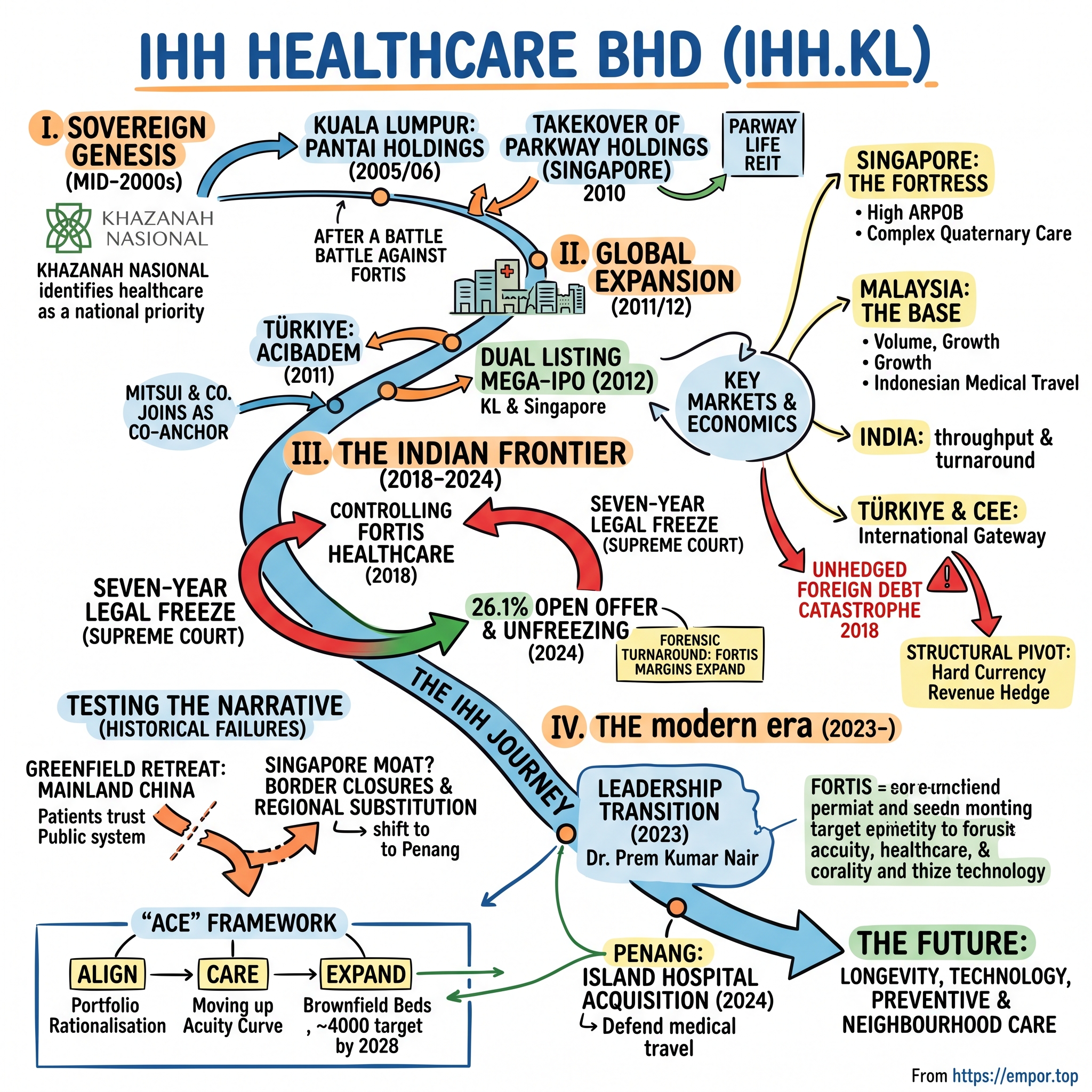
IHH Healthcare: The Sovereign Blueprint, Quaternary Empires, and the Bedside Balance Sheet
I. Introduction & Episode Roadmap
There is a particular kind of corporate strategy that almost never succeeds, and IHH Healthcare is the rare exception that forces observers to ask why.
The playbook unfolded in stages. A state investment arm—Malaysia's sovereign wealth fund, Khazanah Nasional—identified acute healthcare as a strategic national priority. It consolidated a domestic hospital chain. It then secured the private medical crown jewel of neighbouring Singapore, prevailing in a contested 2010 takeover battle against an Indian pharmaceutical family. Next came the acquisition of Türkiye's Acıbadem, followed by a concurrent dual listing in Kuala Lumpur and Singapore that ranked among the world's largest initial public offerings of 2012. Years later, it stepped directly into the aftermath of a major Indian corporate governance scandal, taking control of Fortis Healthcare—only to see the transaction ensnarled by Supreme Court proceedings in New Delhi for the better part of seven years.
Under conventional industry logic, cross-border acute-care consolidations face overwhelming structural friction. Healthcare remains one of the world's most hyper-local businesses: regulated by national health ministries, governed by domestic insurers, dependent on clinical talent rooted in regional referral pathways, and funded in currencies exposed to sharp macro volatility. The sector's corporate history is replete with failed multinational roll-ups.
Yet by the mid-2020s, IHH Healthcare Berhad operated one of the largest private hospital networks in the world by enterprise value—commanding more than 80 hospitals and over 12,000 operational beds across four regional pillars: Singapore, Malaysia, India, and Türkiye alongside its Central and Eastern European subsidiaries.1 For the financial year ended December 31, 2024, the group generated revenue of roughly RM24.4 billion—approximately US$5.5 billion—up 16.5% year over year, with earnings before interest, taxes, depreciation, and amortisation (EBITDA) of about RM5.4 billion and core net profit attributable to shareholders climbing 32% to roughly RM1.7 billion.23 Its primary equity listing trades on Bursa Malaysia under the ticker 5225, alongside a secondary listing on the Singapore Exchange.1
This tension forms the core analytical paradox of the company. Healthcare delivery is intrinsically local, yet IHH maintains a multi-currency, multi-payer hospital network spanning cash-paying Indonesian medical tourists in Penang, private integrated-shield insurance claimants in Singapore, institutional third-party administrators in India, state social security reimbursement in Türkiye, and European medical travellers paying in euros in Istanbul. These payment ecosystems share minimal operational architecture. The fundamental question is whether IHH has developed a truly transferable operational platform, or whether it simply holds a collection of distinct, defensive local assets while bearing the foreign-exchange volatility and jurisdictional risks of the holding company.
The operational record demonstrates that the reality sits between those two extremes, presenting complexities that neither pure bulls nor committed bears can easily dismiss.
The narrative unfolds across seven parts. Act I details the sovereign genesis: Khazanah's domestic consolidation and the high-stakes 2010 bidding battle against Fortis Healthcare for Singapore's Parkway Holdings. Act II charts the global expansion—the integration of Türkiye's Acıbadem, the 2012 dual-market IPO, and the entry of Japanese trading house Mitsui & Co. (三井物産) as a strategic co-anchor. Act III analyses India: winning the contested five-way auction for Fortis Healthcare and managing the multi-year legal freeze imposed by the Supreme Court of India. Act IV deconstructs the unit economics, capital intensity, and pricing dynamics across the four geographic clusters. Act V tests management's strategic narrative against its primary historical setbacks—the unhedged foreign debt exposure in Türkiye, hyperinflationary accounting adjustments, and capital losses in mainland China. Act VI reviews executive leadership and the operational "ACE" framework. Finally, Act VII evaluates the durability of the group's economic moat, presenting the bull and bear arguments alongside the primary operational metrics that will determine future performance.
The chronicle begins not inside a surgical suite, but within the portfolio planning sessions of a sovereign wealth fund.
 Subscribe on LinkedIn
II. Sovereign Genesis: Khazanah, Pantai, and the 2010 Parkway Takeover War
In the mid-2000s, Khazanah Nasional Berhad was executing what sovereign wealth funds pursue when an emerging market attempts to move up the value chain. Malaysia had spent three decades anchoring its economy in palm oil, petroleum, and electronics assembly. The national policy agenda—eventually formalised under the New Economic Model—focused on escaping the middle-income trap. Healthcare emerged as a core priority for straightforward commercial reasons: it is an exportable service requiring no shipping logistics, it employs high-skilled domestic labour, and regional demand expands predictably as populations age and household wealth rises.
Khazanah began by consolidating domestic acute care. Between 2005 and 2006, it acquired control of Pantai Holdings Berhad, then one of the premier private hospital operators in Peninsular Malaysia. The transaction carried immediate cross-border implications: Pantai's other major shareholder was Singapore-listed Parkway Holdings, which held an approximate 31% stake. By absorbing Pantai, Khazanah placed itself directly across the negotiating table from Singapore's pre-eminent private healthcare group.
Why Parkway Was the Prize
Singapore's private healthcare sector is a global outlier, and understanding its structural mechanics explains why two well-capitalised regional forces fought so fiercely for control.
Most international private hospital markets fall into one of two archetypes: an elective private tier layered over a dominant public system (typical of the United Kingdom and Western Europe), or a fragmented, cash-pay private sector compensating for an underfunded public network (common across much of the developing world). Singapore fits neither model. Its public hospital system is sufficiently well-resourced and clinically rigorous that private operators cannot survive merely by absorbing state overflow. To thrive, private operators are forced up the clinical acuity curve into tertiary and quaternary care—complex oncology, organ transplants, and advanced cardiothoracic surgery. Crucially, Singapore pairs that clinical capacity with an affluent domestic population covered by Medisave and private Integrated Shield Plans, while serving as the primary medical travel hub for Southeast Asia, South Asia, and the Middle East, where wealthy patients travel for specialized procedures unavailable locally.
Parkway commanded the physical infrastructure at the centre of that ecosystem: Mount Elizabeth Hospital on Orchard Road, in the heart of Singapore's premier retail and commercial district; Gleneagles Hospital on Napier Road, adjacent to the diplomatic quarter; and Parkway East. These facilities are virtually impossible to replicate. Prime land in central Singapore is strictly zoned, new hospital operating licences face extensive regulatory hurdles, and commercial parcels of comparable scale are non-existent.
Parkway had also engineered a critical corporate finance innovation: in 2007, it spun much of its real estate into Parkway Life REIT, a Singapore-listed real estate investment trust, leasing back the underlying hospital properties. The sale-and-leaseback structure separated capital-intensive property ownership from high-return operating activities, allowing Parkway to retain high-margin clinical cash flows while freeing up balance-sheet capacity.
Enter the Singh Brothers
In March 2010, private equity firm TPG Capital agreed to sell its 23.9% stake in Parkway to Fortis Healthcare for S$959 million. Fortis was the healthcare vehicle of Malvinder and Shivinder Singh, two Indian entrepreneurs who had generated substantial liquidity after selling their family's controlling stake in generic drugmaker Ranbaxy Laboratories to Japan's Daiichi Sankyo (第一三共) in a transaction valuing Ranbaxy at approximately US$4.6 billion. The Singh brothers declared their objective immediately: to construct a pan-Asian healthcare conglomerate, installing Malvinder as Parkway's executive chairman.
Backing that ambition was substantial capital, and for several months the transaction appeared positioned to succeed. Khazanah, which held a significant minority stake in Parkway, faced the prospect of being marginalised inside the most strategic clinical asset in its portfolio.
The battle that followed became a textbook demonstration of corporate takeover mechanics.
In May 2010, Khazanah's operating vehicle—then named Integrated Healthcare Holdings—countered with a voluntary partial takeover offer at S$3.78 per share, targeting a 51.5% controlling interest. A partial offer is an aggressive structural manoeuvre: it seeks operational control without paying a control premium across the entire shareholder register. Khazanah aimed to secure governance dominance at a substantial discount to a full buyout.
Fortis refused to concede. In July 2010, the Singh brothers responded with a competitive offer of S$3.95 per share, valuing Parkway at approximately S$3.2 billion. At that juncture, the balance-sheet asymmetry between a private entrepreneurial entity and a sovereign wealth fund determined the outcome. Rather than entering an escalating incremental bidding contest, Khazanah matched the S$3.95 price but eliminated the ownership ceiling, converting its bid into an unconditional, all-cash offer for the entire company. The revised offer valued Parkway at roughly S$3.5 billion, or approximately US$2.5 billion.
Faced with a sovereign fund prepared to fully fund an all-cash buyout, Fortis withdrew from the contest. The Singhs tendered their entire 25.3% holding, securing an estimated profit of S$116 million on a four-month trade. It was a lucrative exit for Fortis, but it also established an adversarial dynamic between the two corporate entities that would resurface under dramatically altered circumstances eight years later in New Delhi.
Did Khazanah Overpay?
In 2010, prevailing market consensus suggested Khazanah had paid an excessive price. The transaction valued Parkway at approximately 22 times enterprise value to EBITDA—a multiple that drew sharp scepticism from equity analysts at a time when global acute-care peers traded at substantial discounts to that valuation.
With the benefit of hindsight, the analytical verdict is more nuanced than simple retrospective vindication. Khazanah acquired a cornered, long-duration asset: prime central-Singapore hospital properties generating EBITDA margins consistently exceeding 30%, complemented by an efficient capital recycling vehicle in Parkway Life REIT. Over the subsequent decade and a half, the Singapore operations functioned as the financial fortress of the group, generating steady cash flows that supported regional capital expenditure and cushioned operating volatility in Türkiye and China. Paying a 22-times multiple for an asset protected by insurmountable clinical and regulatory barriers that compounds returns over decades is fundamentally distinct from paying that multiple for an enterprise vulnerable to competitive erosion.
Yet viewing the transaction purely as sovereign brilliance overlooks the underlying capital discipline. Khazanah paid full fair value—arguably a premium—and was ultimately rewarded by the exceptional durability of the Singapore healthcare franchise rather than pricing acumen. A consistent pattern in IHH's corporate development is that the group has demonstrated an exceptional eye for irreplaceable clinical infrastructure, paired with an indifference to paying premium valuations. That dynamic would re-emerge more than a decade later during the group's 2024 expansion in Penang.
With Singapore secured, Khazanah possessed a premier clinical foundation. The subsequent strategic imperative was transforming that local flagship into a pan-regional healthcare conglomerate.
III. The Global Rollup: Acıbadem, the 2012 Dual-Listing Mega-IPO, and Mitsui & Co.
If Singapore provided IHH with a premier clinical flagship, Türkiye supplied the growth thesis.
Mehmet Ali Aydınlar had spent two decades building Acıbadem Sağlık Hizmetleri from a single facility in the Acıbadem district of Istanbul into Türkiye's dominant private hospital network. The enterprise was founder-led, clinically ambitious, and positioned across the geographic nexus linking Europe, the Middle East, and Central Asia. With Istanbul located within a three- to four-hour flight radius of major population centres across Western Europe, the Gulf, and the Caucasus, the network possessed an expansive international catchment area for complex, cash-pay procedures.
In late 2011, Khazanah agreed to acquire a 60% controlling interest in Acıbadem from Aydınlar and private equity firm Abraaj Capital for roughly US$1.2 billion in cash and shares. As part of the transaction, Aydınlar rolled equity into the enlarged group and continued overseeing Turkish operations—establishing an operational template IHH would replicate in subsequent cross-border transactions: acquire controlling governance, but retain incumbent clinical and management leadership.
On paper, the strategic portfolio fit was compelling. Singapore delivered high-acuity, premium-priced clinical services; Malaysia provided patient volume and a domestic medical-travel corridor; and Türkiye added a complementary medical-tourism gateway serving Eastern Europe and the Middle East, with an operational bridgehead into Bulgaria and North Macedonia. Together, the three clusters offered diverse regional demand pools operating on a unified clinical delivery platform.
What that portfolio framework failed to fully price, however, was structural macro exposure. Acıbadem carried substantial unhedged foreign-currency borrowings, an operational vulnerability that would severely compress consolidated earnings in 2018 when the Turkish lira underwent a historic depreciation.
The 2012 Mega-IPO
In July 2012, Integrated Healthcare Holdings was renamed IHH Healthcare Berhad and completed a concurrent dual listing, selecting Bursa Malaysia as its primary venue and the Singapore Exchange as its secondary market. The public offering raised approximately US$2.1 billion—roughly RM6.3 billion—ranking as the third-largest initial public offering globally that year, behind only Facebook and Santander Mexico.
The dual-listing structure was a calculated capital-markets strategy rather than a symbolic gesture. Listing on Bursa Malaysia satisfied domestic political expectations for a sovereign-backed national champion, tapping the substantial and stable liquidity of Malaysian pension and provident institutions. Concurrently, the Singapore listing established exposure to international institutional investors familiar with the Mount Elizabeth and Gleneagles brands, while providing IHH with an equity currency suited for Singapore-dollar-denominated transactions. Crucially, the arrangement subjected the enlarged group to two independent regulatory regimes and continuous disclosure frameworks—an important governance signal for a corporate entity controlled by a state investment vehicle.
The cornerstone order book reflected that institutional appeal, securing allocations from sovereign investors such as Singapore's GIC, major pension funds, and most notably, Japanese general trading house Mitsui & Co. (三井物産).
Mitsui's Long Game
Mitsui entered the register as a strategic investor with an initial holding of approximately 18%. For a Japanese sōgō shōsha historically anchored in natural resources, physical infrastructure, and industrial logistics, acute healthcare services represented a counter-cyclical growth pillar positioned to capture demographic tailwinds across developing Asia—a transition Japan had already navigated.
The decisive governance shift occurred in November 2018, when Khazanah sold a 16% equity stake in IHH to Mitsui for RM8.42 billion. The transaction transformed the shareholding structure: Mitsui became a co-anchor shareholder alongside Khazanah, with each party holding roughly comparable stakes of approximately 32% to 33%.
That ownership balance fundamentally distinguished IHH from conventional state-directed healthcare operators in emerging markets. A single sovereign parent frequently risks capital allocation skewed toward domestic political objectives rather than risk-adjusted returns. In contrast, pairing a sovereign fund with a commercial corporate shareholder introduced operational checks and balances. Khazanah contributed regional regulatory alignment and sovereign stability; Mitsui added international procurement scale, cross-border supply chain integration, and rigorous return-on-capital benchmarks.
The structural trade-off was a constrained public float. With two corporate anchors controlling nearly two-thirds of the equity, minority institutional and retail investors retained limited governance leverage, while creating the underlying risk of strategic inertia if the two primary owners diverged on long-term capital allocation. While subsequent senior leadership changes and board realignments in the early 2020s reflected the ongoing complexity of managing dual-anchor oversight, the company never formally attributed executive turnover to shareholder misalignment.
With an active public currency, two well-capitalised anchor investors, and three regional hospital networks, IHH had assembled the components of an international healthcare group. It was at this stage that the company moved into one of the most protracted corporate governance crises in contemporary Indian business history.
IV. The Indian Frontier: Fortis Healthcare, the Singh Brothers Scandal, and the Seven-Year Legal Siege
By early 2018, Fortis Healthcare—the same entity that had contested Khazanah for control of Parkway eight years earlier—was unravelling publicly amid an escalating corporate governance crisis.
Founding promoters Malvinder and Shivinder Singh were forced off the board following allegations that hundreds of crores of rupees had been diverted through related-party transactions. External auditors raised formal red flags, lenders invoked pledges over promoter shares, and the company's hospital network—encompassing critical intensive care units and clinical wards—slid toward a severe working-capital crisis as unpaid medical suppliers threatened to halt consumable deliveries.
What made Fortis compelling to strategic acquirers despite the boardroom turmoil was that operational distress was primarily concentrated at the shareholder level rather than within the clinical facilities. Fortis commanded approximately 4,000 operational beds across India's most attractive metropolitan healthcare catchments: the National Capital Region (NCR)—including Fortis Memorial Research Institute in Gurugram and the prominent Escorts Heart Institute—alongside major tertiary facilities in Mumbai, Bengaluru, and Kolkata. The company also held a controlling stake in SRL Diagnostics (later rebranded Agilus Diagnostics), one of the country's largest clinical laboratory and pathology networks.
The Five-Way Auction
The bidding battle that erupted across the first half of 2018 was among the most fiercely contested in Indian corporate history. IHH Healthcare competed against Manipal Hospitals backed by TPG Capital, a domestic consortium formed by Hero Enterprise and the Burman family, Radiant Life Care backed by KKR, and China's Fosun. The Fortis board revised its recommendations repeatedly amid vocal shareholder dissent and continuous public scrutiny.
IHH prevailed in July 2018 with a structurally differentiated recapitalisation proposal. Rather than purchasing secondary shares from existing holders—which would have directed capital toward encumbered promoter-linked entities without stabilising the hospitals—IHH agreed to subscribe to roughly ₹4,000 crore (approximately US$585 million) of fresh primary equity at ₹170 per share. The transaction secured a 31.1% controlling stake while injecting liquidity directly into the operating company, resolving the immediate cash crunch and establishing governance control within a single transaction.
On a valuation basis, IHH gained control of India's second-largest private hospital system and an expansive national diagnostics network at an implied enterprise value to EBITDA multiple in the mid-teens—a steep discount to the trading valuation of market leader Apollo Hospitals. That discount, however, reflected substantial legal and regulatory contagion risk, which materialised almost immediately.
The Trap
The acquisition soon became entangled in one of the most protracted legal deadlocks in cross-border corporate finance.
In 2016, Daiichi Sankyo had secured an international arbitration award in Singapore of roughly ₹3,500 crore against the Singh brothers, stemming from the 2008 sale of Ranbaxy Laboratories after a tribunal concluded that the promoters had concealed regulatory investigations into Ranbaxy's US manufacturing operations. Daiichi subsequently sought enforcement of that award against assets linked to the brothers, including their residual shareholding in Fortis.
Under Indian securities regulations, IHH's acquisition of a 31.1% controlling interest triggered a mandatory open offer to public shareholders for an additional 26.1%—a commitment requiring up to roughly ₹3,300 crore. In December 2018, as IHH prepared to launch the offer, the Supreme Court of India stayed the transaction in connection with contempt proceedings initiated by Daiichi Sankyo against the Singh brothers.
The resulting legal stay placed IHH in an unusual operational position. The group controlled the board, managed clinical operations, and implemented its group-wide procurement protocols. Yet it could neither execute the mandatory open offer to increase its economic ownership nor formally rebrand the network under the IHH umbrella. For years, the company operated as a controlling custodian without full legal finality.
A conventional private equity fund with a standard ten-year lifecycle would have struggled to navigate a seven-year judicial freeze. The episode provided tangible support for the thesis of sovereign patience: not that IHH was immune to legal miscalculations, but that its anchor shareholder base provided the patient capital and balance-sheet durability necessary to absorb prolonged litigation.
The Unfreezing
Throughout the proceedings, the unresolved status of the Indian operations weighed on IHH's public market valuation, as equity analysts applied a holding discount to account for unquantifiable legal tail risks.
The regulatory path cleared in late 2024, when IHH confirmed it had received formal approval from the Securities and Exchange Board of India to proceed with the long-delayed 26.1% open offer.4 Extensive forensic reviews and court proceedings did not implicate IHH in the historical conduct of Fortis's former promoters; the delay had stemmed from the collateral enforcement of external liabilities.
More significant from an operational perspective was the financial turnaround of the hospital network during the multi-year freeze. Fortis's hospital EBITDA margins, which sat in the low single digits at the time of acquisition in 2018, expanded into the high teens and above over subsequent years. Management rationalised the corporate cost base, shifted the payer mix toward higher-margin private medical insurance, scaled high-acuity quaternary specialties, and plugged legacy cash leakages. For proponents of IHH's cross-border platform thesis, this turnaround provided evidence that the group possesses transferable operational capabilities rather than merely an assortment of regional assets. The operational restructuring occurred in a market where IHH had no deep prior operating presence and under legal constraints that barred corporate restructuring.
A balanced assessment requires an important analytical distinction: stabilising an under-managed, cash-starved hospital network is operationally distinct from outperforming well-capitalised, disciplined incumbents over an entire market cycle. While the initial turnaround demonstrated IHH's ability to rehabilitate distressed clinical assets, it does not guarantee structural outperformance against domestic peers such as Apollo Hospitals or Max Healthcare. Long-term leadership in the Indian market will depend on sustaining margins and average revenue per occupied bed (ARPOB) as new brownfield and greenfield capacity comes online.
This operational contrast between corporate legal complexity and bedside cash generation leads directly into the core financial mechanics of the group: the unit economics, pricing power, and capital intensity that govern each of its regional operating pillars.
V. Anatomy of the Four Empires: Materiality, Scale, and Unit Economics
A visitor walking through Mount Elizabeth Novena in Singapore on a weekday morning and then, days later, through a Fortis hospital in Delhi's National Capital Region would find it difficult to believe both facilities belong to the same parent company. The contrast does not stem from clinical capability—both deliver complex oncology and advanced cardiovascular care—but from fundamentally divergent economic models.
In FY2024, the group's four geographic pillars carried roughly comparable revenue weights, a distribution that obscures stark variations in underlying profitability. Singapore generated between 25% and 30% of group revenue but roughly a third of group EBITDA, supported by the highest operating margins in the portfolio.2 Malaysia contributed just over a fifth of revenue with an above-average EBITDA share, standing out as the fastest-growing division. India generated roughly a quarter of group revenue but a significantly smaller share of earnings, reflecting domestic pricing that sits at a fraction of Singapore levels. Türkiye and Europe presented a similar dynamic: substantial revenue weight, a muted profit contribution, and the group's highest translation volatility against the Malaysian ringgit. Operations in Greater China and other non-core markets remained immaterial to revenue, contributed negligible or negative earnings, and were subject to active portfolio rationalisation.2
The primary metric illuminating these regional divergences is ARPOB—average revenue per occupied bed per day. The healthcare equivalent of retail revenue per square foot, ARPOB measures the daily economic yield of a fixed physical asset, capturing procedural complexity and underlying pricing power in a single figure.
1. The Singapore Fortress
Roughly 1,000 beds across Mount Elizabeth on Orchard Road, Mount Elizabeth Novena, Gleneagles, and Parkway East generate an ARPOB in the range of RM10,000 per day—multiples of what an equivalent bed yields elsewhere in the IHH network.
This premium is not an arbitrary pricing mechanism; it reflects clinical acuity. A private hospital bed in Singapore is disproportionately dedicated to high-complexity interventions: advanced oncology requiring targeted therapies, complex cardiothoracic surgery, neurosurgery, and organ transplantation. The daily revenue is high because the care delivered is resource-intensive, staffed by clinicians who rank among the most highly compensated in Asia.
Underpinning this infrastructure is Parkway Life REIT, a financing vehicle that warrants careful examination. IHH does not hold direct freehold ownership over most of its Singapore hospital properties; instead, it leases them from the separately listed real estate investment trust under a master-lease agreement that was extended in 2021 by twenty years through 2042. The structural trade-off is evident: while the original sale-and-leaseback liberated equity capital from mature real estate, it requires IHH to distribute a recurring portion of its operating cash flow as rental expense, leaving the operator with a contractual leasehold rather than freehold title to its most lucrative assets. Although the 2021 lease extension eliminated renewal risk through the early 2040s, the ongoing rental liability remains an inescapable operating cost.
Competitively, Singapore functions as a disciplined private oligopoly alongside Raffles Medical Group and Thomson Medical, while restructured public health clusters—such as SingHealth and the National University Health System—anchor reference pricing and absorb high-volume demand. With strict zoning and land scarcity precluding new acute-care hospital construction in prime commercial districts like Orchard Road, competitive rivalry remains orderly, preserving industry-wide pricing discipline and stable operating margins.
The principal structural threat to the Singapore division stems not from private rivals, but from payer oversight. Singapore's Ministry of Health has progressively introduced fee benchmarks and tightened claim scrutiny on private Integrated Shield Plans to curb medical cost inflation—a regulatory headwind examined later as a key element of the bear thesis.
2. The Malaysia Base
Malaysia serves as IHH's volume foundation and its fastest-growing market. The group operates an extensive network of Pantai and Gleneagles facilities across Peninsular Malaysia, alongside Prince Court Medical Centre in Kuala Lumpur—acquired in 2020—and, following a 2024 transaction, Island Hospital in Penang.5
ARPOB in Malaysia averages roughly one-third of the Singapore level, paired with bed occupancy typically ranging between the high 60s and mid-70s percent. This profile reflects lower headline pricing, higher patient throughput, and a private medical insurance market expanding alongside the country's rising middle class.
The critical strategic geography within Malaysia is Penang, which functions as the primary inbound corridor for Indonesian medical travel. The corridor is sustained by geography and culture: North Sumatra and Medan sit a short flight across the Malacca Strait, linguistic barriers are minimal, and procedural costs run dramatically below Singapore benchmarks for equivalent clinical outcomes. For an Indonesian family seeking tertiary cardiovascular or oncological care, Penang provides clinical reassurance at a fraction of the cost.
This dynamic introduces a strategic friction across IHH's Southeast Asian footprint: every Indonesian patient who selects Penang over Singapore trades down within—or potentially outside—the group's operating network. The 2024 acquisition of Island Hospital in Penang represents management's effort to consolidate inbound medical travel and defend against patient leakage.
Domestically, the Malaysian market is more fragmented and competitive than Singapore. KPJ Healthcare operates a broad domestic footprint, Sunway Medical has expanded rapidly from its base in the Klang Valley, and Columbia Asia serves mid-market urban catchments. Within this landscape, IHH operates as the premium market leader rather than a structural monopolist.
3. India: High Acuity at a Fraction of the Price
In India, Fortis Healthcare operates a network of major tertiary and quaternary institutes—including flagship facilities in Gurugram, Mulund in Mumbai, Bannerghatta Road in Bengaluru, and the Escorts Heart Institute—alongside Agilus Diagnostics, which maintains a nationwide network of laboratories and collection centres.
Expressed in ringgit, Indian ARPOB sits at approximately one-quarter to one-third of Singapore levels. A surgical procedure commanding a five-figure fee in Singapore yields only a fraction of that amount in Delhi. This structural discount explains why India accounts for a smaller share of group operating profit than its revenue weighting suggests, framing the Indian operation primarily as a story of throughput and clinical case mix rather than aggressive pricing.
Two structural constraints influence the trajectory of the Indian business. First, private operators are subject to government price intervention: the National Pharmaceutical Pricing Authority has repeatedly capped maximum retail prices on coronary stents, knee implants, and essential medications, directly compressing the consumable margins that historically subsidized private hospital operations. Second, Agilus Diagnostics represents distinct operational optionality—a high-volume diagnostics business operating on different return characteristics from acute-care hospitals, which management has identified as a candidate for independent monetisation. Stated optionality, however, translates into shareholder value only upon disciplined execution, a factor investors must evaluate against IHH's broader record of capital recycling.
The competitive landscape in India is the most aggressive across IHH's footprint. Incumbents such as Apollo Hospitals, Max Healthcare, Medanta, and Manipal Hospitals are well-capitalised, expanding aggressively, and possess established clinical reputations. India remains the one geographic pillar where IHH is an active contender rather than the undisputed incumbent.
4. Türkiye and Central/Eastern Europe
Acıbadem operates a dominant network across Türkiye, anchored by Istanbul flagships including Maslak, Altunizade, and Ataşehir, with cross-border operations extending into Bulgaria, North Macedonia, and the Netherlands.
The operational architecture resembles a barbell: a domestic practice serving local Turkish patients in lira, paired with an inbound international medical-travel division serving patients from Western Europe, the Gulf, and the Balkans who settle bills in euros and US dollars. This hard-currency revenue stream is not an incidental bonus; it serves as a necessary structural hedge against severe emerging-market currency depreciation.
Synthesising the four pillars reveals the portfolio's underlying composition: Singapore provides the high-margin cash-flow foundation, Malaysia acts as the volume and growth driver, India delivers scalable clinical turnaround potential, and Türkiye represents the highest-variance asset in the group—clinically sophisticated, yet exposed to macroeconomic volatility beyond operational control.
Examining that structural vulnerability leads directly into the group's historical setbacks: foreign-currency debt shocks, hyperinflationary accounting adjustments, and international capital misallocations.
VI. Historical Falsification Layer: Foreign Debt Catastrophe, Hyperinflation, and the China Retreat
Every investment thesis is a set of claims, and the most rigorous way to evaluate those claims is to test them against a company's historical missteps. IHH Healthcare has accumulated sufficient operating history—and disclosed enough capital misallocations—to conduct this audit systematically: three corporate claims, subjected to three empirical tests.
Claim 1: "Acıbadem is an unconstrained international growth engine."
The breaking mechanism: currency mismatch.
Throughout the 2010s, Acıbadem funded an aggressive hospital build-out through a familiar emerging-market mechanism: borrowing in hard currency. Because US dollar and euro-denominated debt carried dramatically lower nominal interest rates than Turkish lira facilities, Acıbadem accumulated substantial foreign-currency bank borrowings against an operating revenue base billed predominantly in lira.
That capital structure was an unhedged macroeconomic bet—specifically, that the Turkish lira would not depreciate faster than the interest-rate differential between hard currencies and domestic borrowing.
In 2018, that assumption collapsed when the lira plunged by more than 40% against the dollar and euro. The balance-sheet consequence was immediate: massive non-cash foreign-exchange translation losses on the Turkish debt pushed IHH into a reported net loss in the third quarter of 2018, effectively wiping out consolidated group earnings. While the underlying clinical assets continued generating positive operational cash flow, the capital structure buckled under the foreign-currency debt service.
The remediation proved both slow and costly. Management executed equity injections, restructured and refinanced hard-currency debt into local or hedged facilities, and initiated a structural pivot to expand the hard-currency revenue base. By growing international medical tourism in Istanbul and expanding European clinic networks billed in euros, cash inflows were aligned directly with foreign-currency liabilities—a structural hedge far more durable than expiring derivative contracts.
The residual scar is an accounting one. Türkiye has been classified as a hyperinflationary economy since 2022, requiring IHH to apply MFRS 129 / IAS 29 hyperinflation accounting to its Turkish subsidiaries—restating non-monetary items for inflation and recognising net monetary gains or losses directly in the income statement.2 For public market investors, reported group earnings consequently contain a substantial, non-cash component dictated by Turkish inflation indices. Headline profit after tax and minority interests (PATMI) therefore provides an unreliable gauge of underlying operational run-rate profitability. This distortion explains why management reports "core" PATMI, and why investors must carefully reconcile statutory figures against operating cash generation rather than taking headline numbers at face value.3
Verdict: The claim does not survive in its original form. It holds only in a narrowed, conditional capacity: Acıbadem is a formidable clinical operating platform whose financial contribution remains structurally volatile due to Turkish macroeconomic instability. While the structural debt-currency mismatch of 2018 was permanently addressed by expanding hard-currency receipts, the label of an "unconstrained growth engine" must be revised to "resilient clinical assets navigating a volatile currency regime." The primary operational key performance indicator (KPI) that tests this ongoing remediation is the proportion of Acıbadem's revenue generated in hard currency relative to its foreign-currency debt service, disclosed segment by segment.
Claim 2: "IHH is an elite capital allocator that can expand anywhere."
The breaking mechanism: greenfield expansion in mainland China.
During the mid-2010s, executive leadership repeatedly promoted mainland China as IHH's "fifth home market." The investment thesis appeared compelling on the surface: the world's largest population, an expanding upper-middle class, and a public hospital system under strain. Anchoring this ambition was the 350-bed greenfield Gleneagles Chengdu Hospital, which opened in 2019, alongside plans for a second tertiary facility in Shanghai.
The initiative faltered because the underlying market dynamics inverted the structural conditions that had driven IHH's success across Southeast Asia.
In Singapore, Malaysia, India, and Türkiye, private hospitals are viewed by affluent patients as the gold standard for clinical care. In mainland China, patient psychology differs fundamentally: the public system commands the clinical pinnacle. Chinese patients overwhelmingly place their trust in top-tier "Class 3A" public academic hospitals (三甲医院, sānjiǎ yīyuàn), where the most eminent clinical specialists, complex interventions, and prestigious medical reputations reside. Rather than competing against an underfunded public network, private operators in China must compete against the country's most elite academic medical institutions—and historically, foreign private greenfields struggled to match their clinical prestige.
Compounding this disadvantage, private commercial medical insurance expanded far more slowly than corporate forecasts had projected, leaving private operators without the institutional payer base that sustains high-acuity private healthcare elsewhere. Furthermore, the expatriate and high-net-worth patient base—the traditional foundation for foreign-branded hospitals in tier-one Chinese cities—contracted markedly following pandemic-era disruptions.
Greenfield hospitals are structurally capital-intensive, running multi-year operating deficits as they recruit clinicians without established patient panels, build referral pathways from scratch, and secure commercial insurer accreditation while absorbing high fixed depreciation and overhead costs. IHH's Chinese greenfields absorbed those losses without ever approaching the bed occupancy required to reach operational breakeven. Across FY2022 and FY2023, management moved to divest and restructure the group's mainland China hospital portfolio, including the Chengdu facility, absorbing substantial impairment charges and write-offs in the process.2
Verdict: The claim of universal expansion capability is decisively disproven. The historical record indicates that IHH's operating model succeeds where the company can acquire established clinical referral networks within mature private-payer ecosystems—as demonstrated by Parkway, Acıbadem, Pantai, Prince Court, Fortis, and Island Hospital. The group falters when forced to build clinical trust, specialist referral networks, and payer relationships entirely from scratch through greenfield development. This distinction defines a clear boundary condition for IHH's platform thesis, serving as an analytical filter for any future cross-border expansion proposals.
This track record also demands a re-evaluation of the group's transaction history. The historical record encompasses a full-price buyout of Parkway, an unhedged debt structure in Türkiye that required balance-sheet intervention, an aborted and written-off Chinese greenfield venture, and an Indian acquisition that remained legally frozen for seven years. These outcomes do not support characterisations of effortless capital discipline. Rather, they reveal a company with an exceptional capability for identifying irreplaceable clinical assets, paired with a historical indifference to acquisition multiples and—prior to China—an insufficient scepticism regarding the geographic transferability of its operating model.
Claim 3: "Singapore medical tourism is an unshakeable, permanent moat."
The breaking mechanism: border closures and regional cost substitution.
The initial stress test arrived during the COVID-19 pandemic. When Singapore closed its borders in 2020, international patient arrivals at Mount Elizabeth and Gleneagles collapsed overnight—erasing a demand pool long treated as permanent clinical infrastructure. A competitive advantage that evaporates upon a public health directive is not a structural moat; it is a geographic flow.
The more significant challenge proved to be structural rather than transient, persisting long after cross-border travel resumed. Wealthy Indonesian medical travellers—historically the largest international patient cohort across Mount Elizabeth and Gleneagles—developed local or regional care routines during the border closures. Facilities in Penang and Kuala Lumpur deliver clinically comparable tertiary care at roughly half the cost of Singapore private hospitals. Simultaneously, the Indonesian government moved to stem capital outflows by establishing specialized healthcare hubs—such as the Sanur Special Economic Zone in Bali, developed in partnership with international clinical institutions—specifically aimed at capturing the billions of dollars Indonesian citizens spend abroad annually on healthcare.
This shift marks a decisive competitive realignment across IHH's Southeast Asian footprint: Singapore's pricing premium faces structural pressure from Malaysian cost efficiency below and emerging Indonesian domestic capacity from behind.
Verdict: The claim fails in its absolute formulation, requiring a sharper definition of Singapore's competitive advantage. Singapore's enduring moat is not cross-border volume; it is quaternary clinical complexity. Patients facing complex oncological conditions, organ transplants, or rare paediatric diseases show minimal price sensitivity, prioritizing clinical reputation and advanced medical technology over travel expense. IHH's strategic realignment reflects this reality: repositioning its Singapore hospitals toward high-acuity domestic and regional quaternary care, while absorbing price-sensitive Indonesian patient flows within its own network by expanding hospital capacity in Penang.
This transition represents a pragmatic operational hedge, but it carries clear margin implications: revenue retained in Penang generates approximately one-third of the ARPOB achieved in Singapore. The critical metric tracking this transition is Singapore ARPOB paired with case-mix acuity. If clinical complexity continues to climb, Singapore ARPOB should expand even if foreign patient volumes remain below pre-2020 levels. Conversely, if Singapore ARPOB plateaus while Malaysian volumes surge, the group risks cannibalizing its highest-margin clinical revenues at a substantial discount.
Testing these three claims reveals an operating reality far more nuanced than promotional corporate narratives suggest. The critical question moving forward is whether current executive leadership has institutionalised these historical lessons into its capital allocation framework.
VII. The Modern Era: Leadership Transition, Capital Reallocation, and the "ACE" Blueprint
Boardroom churn is usually noise. At IHH between 2023 and 2024, it represented a near-total reconstitution of executive and board leadership.
In February 2023, Managing Director and Group CEO Dr Kelvin Loh Chi-Keon resigned after roughly three years in the role, with contemporary reporting pointing to disagreements with the board over the pace of divestments and capital redeployment. IHH did not disclose a fuller explanation, and the specific substance of any internal dispute remains unconfirmed. What is verifiable is the sequence: an executive departure mid-strategy, followed within eighteen months by the appointment of a new group CEO, a new group CFO, and a new chairman.
Dr Prem Kumar Nair
In October 2023, Dr Prem Kumar Nair was elevated to Group Chief Executive Officer.6 A trained physician and long-serving IHH insider, he had previously led the group's Singapore operations during the operational ramp-up of Mount Elizabeth Novena and the Parkway Life REIT master-lease renegotiations.
That operational background provides a clear indication of the company's strategic orientation. A clinician-operator who rose through the Singapore business and negotiated a twenty-year property master lease is not cast in the mould of an aggressive empire builder. Rather, his career reflects an executive tasked with defending and compounding established franchises—managing clinician relations, optimizing patient throughput, refining case mix, enforcing cost discipline, and undertaking the unglamorous operational work of lifting hospital occupancy from 68% toward 74%.
For observers who view the China greenfield programme and historical Turkish debt exposure as the costly fallout of a growth-at-any-price posture, an operator CEO represents an essential correction. For those who argue that IHH's long-term shareholder value creation depends on securing the next transformative Parkway-scale acquisition, an operator-led focus may appear overly cautious.
In April 2024, Dilip Kadambi became Group Chief Financial Officer, having previously overseen corporate finance, treasury, and business transformation inside the group.6 The internal elevation of a treasury specialist to CFO in an enterprise whose most severe historical losses stemmed from unhedged foreign-currency borrowings was a pointed institutional choice.
In May 2024, Tan Sri Mohammed Azlan Hashim retired as chairman after thirteen years, handing over to Tan Sri Dr Nik Norzrul Thani, whose professional background centres on commercial law and corporate governance.7 Appointing a legal and governance specialist to chair a company that had spent six years navigating Supreme Court proceedings in New Delhi was equally deliberate.
Taken together, the three appointments signaled that the board had identified operational execution and balance-sheet discipline—rather than aggressive geographic expansion—as the primary binding constraints on the group.
The "ACE" Framework
Management codified this operational posture under the "ACE" framework: Align, Care, and Expand. Translating each pillar from corporate phrasing clarifies the tangible operational commitments involved.
Align denotes portfolio rationalisation—concentrating capital in the four core geographic pillars and divesting non-core or non-performing assets. The clearest evidence that this represented more than corporate rhetoric was the disposal of the group's stake in International Medical University (IMU Health) in 2023 for approximately RM1.34 billion in cash, alongside the phased exit from mainland China.2 While an academic medical institution offers theoretical vertical synergies for a hospital operator, monetising it demonstrated management's willingness to narrow group focus and release locked-up capital.
Care signifies moving up the clinical acuity curve—investing in advanced oncology, proton beam therapy, robotic surgery, and organ transplantation. The financial logic is direct: higher clinical acuity yields higher ARPOB, while complex quaternary cases remain insulated from price-based competition by cheaper regional hospitals. This focus directly operationalises the lessons learned from post-pandemic shifts in Singapore medical travel.
Expand targets adding close to 4,000 beds across the group by 2028—a roughly 30% capacity increase—executed primarily through brownfield expansion across existing campuses in Malaysia, India, and Türkiye.2
The reliance on brownfield development is strategically significant. Expanding an existing hospital leverages established clinical faculties, local referral pathways, diagnostic infrastructure, operating suites, administrative overhead, and commercial payer accreditations. Consequently, brownfield beds typically reach operational breakeven far more rapidly than greenfield facilities, where patient demand and clinical trust must be constructed from scratch. Following the write-offs in Chengdu, this approach reflects management adopting the lessons of past capital misallocations. Even so, adding 4,000 beds remains a substantial capital commitment whose ultimate returns depend on regional demand materialising as projected.
The Island Hospital Transaction
In September 2024, IHH agreed to acquire 100% of Island Hospital in Penang for RM3.92 billion in cash from private equity firm Affinity Equity Partners.589 Island Hospital is a roughly 600-bed tertiary facility and Malaysia's premier medical-travel asset, accounting for a leading share of inbound foreign medical travellers entering the country.8
The transaction addressed the regional patient substitution dynamic directly. If affluent Indonesian patients increasingly substitute Penang for Singapore, acquiring Island Hospital ensures that regional patient flows remain captured within the IHH network rather than leaking to domestic competitors. Combined with Gleneagles Penang, the acquisition gave IHH a commanding position—exceeding 1,000 operational beds—in Southeast Asia's most active medical-travel corridor.8 The transaction effectively converted an external competitive risk into an internal network transfer.
On valuation, the transaction was agreed at an enterprise value in the high teens of trailing EBITDA before synergies, with management targeting an effective multiple in the mid-teens once operational synergies and planned capacity expansions materialize.9 That multiple represents a premium valuation, continuing the pattern established with Parkway in 2010: IHH has consistently demonstrated a willingness to pay full value for irreplaceable clinical infrastructure. While the strategic logic is clear, the acquisition multiple leaves minimal cushion for operational slippage. The empirical test of the transaction will be measurable in Island Hospital's subsequent contribution to Malaysian segment revenue and EBITDA, and whether the asset enhances or dilutes group-wide Malaysian ARPOB as integration proceeds.
What Management Says When Pushed
Earnings calls provide an unvarnished view of executive priorities. Across the FY2023 and FY2024 results briefings, three consistent themes emerged.23
On return hurdles, analysts pressed management repeatedly on whether the capital-intensive acute-care model can sustain double-digit return on equity (ROE) while absorbing the accounting drag of Turkish hyperinflation. Management responded by anchoring its double-digit ROE target to operating leverage and disciplined brownfield additions rather than large, debt-funded acquisitions—a more constrained, verifiable target than the expansionary pledges of the previous decade.
On payer pressure, management acknowledged escalating private medical insurance claims in Singapore and Malaysia, outlining a structural response: shifting routine, low-acuity procedures into ambulatory care centres to lower treatment costs for insurers and patients, while preserving high-cost inpatient beds for complex tertiary and quaternary admissions. That initiative acknowledges that traditional fee-for-service inpatient delivery faces intensifying scrutiny from private and institutional payers.
On capital allocation, management maintained that brownfield projects in Malaysia and India retain capital priority, while Acıbadem is expected to self-fund its capital expenditure from operating cash generation—a disciplined stance dictated by Türkiye's historical macro and currency volatility.
This operational message has remained remarkably consistent across reporting periods. The unresolved question is whether disciplined narrative positioning will translate into enduring financial outperformance across a multi-year investment cycle.
VIII. Playbook: Business, Strategy & Investing Lessons
Five transferable strategic lessons emerge from IHH Healthcare's operating history, none of which is exclusive to acute healthcare.
1. Asset-heavy network businesses are not real estate plays, and confusing the two destroys value. It is tempting to look at physical assets like Mount Elizabeth on Orchard Road and conclude that a hospital group is essentially a commercial property company with a clinical overlay. The Parkway Life REIT model demonstrated why that interpretation fails: by spinning off the physical properties into a dedicated vehicle and leasing them back, IHH isolated the low-yield property asset while preserving the higher-margin operating cash flows. The primary economic engine is the clinical referral flywheel—general practitioners feeding specialist clinics, which in turn channel complex cases into intensive care units and surgical suites where procedural margins reside. Real estate provides the necessary physical container, but clinical throughput and case complexity generate the enterprise value.
2. A patient shareholder base is a genuine competitive weapon, not a governance footnote. The Fortis takeover offers a clear case study. A conventionally structured acquirer, such as a private equity fund with a standard ten-year lifecycle, would have faced severe structural pressure when confronted with a seven-year judicial freeze: forced to divest, absorb steep write-downs, or accept an unfavourable exit dictated by mandate expirations. Backed by Khazanah Nasional and Mitsui & Co., IHH possessed the sovereign balance sheet and patient capital required to stabilise operating facilities, expand EBITDA margins, and await regulatory clearance. Capital duration is an institutional advantage that surfaces infrequently, but proves decisive when legal or macroeconomic shocks occur.
3. Borrowing in a currency you do not earn is a macroeconomic gamble disguised as corporate financing. Acıbadem's pre-2018 capital structure was not an isolated aberration; it reflected a standard corporate treasury practice across emerging markets, driven by lower nominal interest rates on US dollar and euro borrowings. The interest savings accumulate predictably each quarter, but an abrupt currency devaluation arrives all at once, overwhelming years of debt-service savings. Short-dated currency hedges often prove expensive or illiquid in a crisis. The only durable operational hedge against foreign-currency debt is a matched revenue stream denominated in the same currency—an alignment IHH achieved in Türkiye only after deliberately expanding Acıbadem's euro- and dollar-denominated medical tourism and European clinic operations.
4. Brownfield expansion structurally outperforms greenfield development. The critical divergence between the two models lies not in construction expenditure, but in the velocity of the demand ramp. A greenfield hospital must simultaneously construct physical infrastructure, recruit established specialists away from competing practices, cultivate physician referral networks from scratch, and secure commercial insurer accreditation. These developmental milestones unfold sequentially across multiple years, consuming capital while absorbing fixed overhead. By contrast, a brownfield addition inherits an established clinical faculty, active referral channels, diagnostic capacity, and commercial payer contracts on day one. The capital write-downs at Gleneagles Chengdu reflected the compounding drag of an unanchored greenfield ramp; management's 2028 target of adding approximately 4,000 beds is explicitly weighted toward brownfield expansions to bypass those friction points.
5. Patients follow clinicians, not hospital brands. In private tertiary and quaternary care, the primary referral relationship exists between a referring physician and an individual specialist, rather than between a patient and a corporate brand. Consequently, a hospital operator's core commercial function is maintaining an environment that attracts and retains premier clinical talent: providing advanced surgical platforms, robotic systems, proton beam therapy infrastructure, specialised nursing staff, efficient operating-theatre scheduling, and attractive remuneration structures. This dynamic introduces a structural vulnerability: a meaningful portion of the enterprise's earning power departs the building each evening and can, in theory, relocate to a competing facility. An acute-care operator's competitive moat is never purely physical; it remains an ongoing commercial alignment with its medical faculty.
IX. Strategic Moat Stress-Test: 7 Powers & Porter's 5 Forces
When evaluated through formal competitive frameworks, IHH Healthcare emerges as an advantaged enterprise, yet with a narrower and more fragile set of structural moats than its headline scale suggests.
Hamilton Helmer's 7 Powers
Cornered Resource — durable, but highly concentrated. This represents IHH's most defensible power, and it is almost entirely geographic. Mount Elizabeth on Orchard Road, Gleneagles on Napier Road, and Prince Court in Kuala Lumpur's Golden Triangle occupy physical parcels that cannot be replicated at any practical price. Urban core land is finite, municipal zoning is restrictive, and acute-care hospital licences are strictly rationed by health ministries. That scarcity logic extends, in varying degrees, to Acıbadem's premier Istanbul campuses and Fortis's flagship institutions across Delhi's National Capital Region. The essential qualification is that this power resides within specific prime facilities across Singapore, Malaysia, and India—it does not blanket the entire portfolio, nor does it automatically protect new greenfield or brownfield capacity.
Scale Economies — moderate to high, and frequently underestimated. Operating more than 80 hospitals provides IHH with measurable procurement leverage over global medical device manufacturers, clinical consumable vendors, and pharmaceutical distributors—counterparties that routinely extract premium pricing from standalone or sub-scale operators. Centralised clinical governance, standardized IT infrastructure, and enterprise cybersecurity protocols further distribute overhead across a wide operational base. The structural limit is that procurement efficiency does not cross foreign currencies, import tariffs, or sovereign regulatory regimes as seamlessly as it does in global retail; volume discounts negotiated for Singapore or Malaysia do not automatically transfer into Turkish lira or Indian rupee supply contracts.
Switching Costs — high for high-acuity care, minimal for routine volume. For an admitting specialist, moving a clinical practice entails relocating support staff, re-establishing operating theatre access, re-licensing proprietary diagnostic equipment, and disrupting a patient referral panel cultivated over decades. That friction creates genuine physician lock-in, explaining why private hospital market share shifts incrementally. For patients, switching costs diverge sharply by clinical acuity: an elective diagnostic screening or routine day procedure carries virtually zero friction, whereas a patient undergoing a multi-year oncological regimen with an established multidisciplinary team and longitudinal medical records inside the network is effectively captive. Management's strategic push into quaternary care represents a deliberate realignment toward patient cohorts facing high clinical switching costs.
Brand Power — moderate to high, grounded in credence-good dynamics. Acute healthcare represents a classic credence good: consumers cannot fully assess the clinical quality of the service before, during, or often even after treatment. Under conditions of clinical uncertainty, institutional brand reputation serves as the primary proxy for patient safety and procedural efficacy—an assurance for which patients and families facing critical illnesses pay substantial premiums. Mount Elizabeth and Gleneagles extract pricing power precisely because of this accumulated trust. The vulnerability is structural asymmetry: credence-good prestige takes decades of clean clinical outcomes to build, but can be compromised rapidly by a single systemic clinical failure or public safety scandal.
Counter-Positioning — essentially absent. IHH operates a conventional, capital-intensive private hospital model. Domestic peers such as Apollo Hospitals, KPJ Healthcare, Sunway Medical, and Max Healthcare run directly comparable operational architectures. The group commands no business-model innovation or structural economic asymmetry that incumbents are structurally disincentivised or unable to replicate.
Process Power and Network Economies — limited to unproven. A hospital network generates negligible direct network effects: an additional patient admitted in Istanbul creates no clinical utility or network value for a patient undergoing surgery in Singapore. On process power, management demonstrated repeatable turnaround capabilities by rehabilitating Fortis's hospital margins under adverse judicial conditions. Yet that operational discipline reflects competent traditional hospital administration rather than proprietary, non-transferable process intellectual property.
Porter's Five Forces
Threat of new entrants: very low. Constructing a 300-bed quaternary greenfield hospital requires a capital commitment running well into nine figures in US dollar terms, followed by multi-year licensing approvals and a prolonged operational ramp against entrenched incumbents with established specialist referral rosters. Beyond physical capital, the definitive barrier to entry remains credentialed clinical talent—specialised surgeons, oncologists, perfusionists, and intensive-care nurses—which remains in structural global shortage.
Supplier power: moderate to high, and intensifying. Premier clinicians command significant bargaining power, negotiating favourable revenue-share and facility-fee splits. On the medical technology side, the diagnostic and surgical platforms required for high-acuity interventions—such as robotic surgery consoles, proton beam therapy systems, and advanced linear accelerators—are manufactured by tight global oligopolies or outright single-source suppliers. IHH's group procurement scale softens these costs but cannot eliminate supplier pricing power where clinically differentiated equipment has no functional substitute.
Buyer power: rising significantly. Historically, acute hospital operators confronted weak, fragmented buyers: individual cash-paying patients and private insurers that routinely absorbed medical inflation by raising policy premiums. That payer passivity has largely ended. Institutional insurers, corporate employers, and third-party administrators across Southeast Asia are aggressively scrutinising hospital charges. Regulators are reinforcing this resistance: Bank Negara Malaysia has mandated minimum co-payment features in private health insurance plans, while Singapore's Ministry of Health continues to enforce procedural fee benchmarks and tighten claims scrutiny on Integrated Shield Plans. Across key markets, reimbursement models are progressively drifting from open-ended fee-for-service billing toward bundled, case-based payments—a structural shift that converts hospital billable items into internal cost-management constraints.
Threat of substitutes: low for quaternary care, rising for secondary care. Nobody telemedicines a craniotomy. Quaternary surgical procedures, complex cardiovascular interventions, and inpatient oncology remain securely anchored within physical hospital facilities. However, routine consultations, diagnostic monitoring, and minor day surgeries are migrating toward ambulatory care centres, standalone diagnostic labs, and digital health platforms operating at a fraction of the capital and overhead cost of a tertiary hospital. Management's ambulatory expansion strategy represents an operational acknowledgement of this migration, aiming to retain outpatient volumes within the group's wider network.
Competitive rivalry: elevated in India, disciplined in Southeast Asia. In India, IHH competes against well-funded, disciplined operators such as Apollo Hospitals and Max Healthcare in an environment characterised by rapid capacity additions. In Singapore and Malaysia, the private market functions as an established oligopoly with disciplined historical pricing behaviour. Those stable Southeast Asian profit margins reflect benign market concentration and zoning barriers rather than unassailable competitive distinctiveness.
The composite assessment: IHH Healthcare commands a durable economic moat anchored in irreplaceable physical locations and institutional clinical reputations. However, that advantage is concentrated in specific geographic flagships and faces mounting compression not from new hospital builders, but from institutional payers and health ministries demanding clinical cost containment.
X. The Bull vs. Bear Case, Material Risk Radar & 3 Decisive KPIs
The Bear Case
1. The payer squeeze represents a structural, thesis-level headwind that is already unfolding. Private medical insurance premiums have escalated at rates that have triggered political and regulatory pushback across Southeast Asia. The policy response has focused squarely on enforcing clinical cost discipline—from mandated co-payment structures in Malaysia to published fee benchmarks and tighter claims scrutiny in Singapore. If hospital reimbursement shifts permanently from itemised fee-for-service billing toward bundled, case-based payments, high-margin ancillary revenue streams—such as diagnostic mark-ups, pharmaceutical consumables, and discretionary length-of-stay charges—stop functioning as profit centres and become internal cost constraints. Average revenue per occupied bed (ARPOB), the primary gauge of procedural pricing power, would compress first. This is not a theoretical tail risk; it reflects the explicit regulatory trajectory across two of IHH's core operating markets.
2. Turkish macroeconomic volatility creates a structural drag on reported equity returns. Hyperinflation accounting under MFRS 129 / IAS 29 injects substantial non-cash restatements into reported earnings, while ongoing lira depreciation diminishes the ringgit-denominated value of roughly a quarter of group revenue. An investor evaluating return on equity must recognise that a substantial portion of the asset base operates within an economic environment where statutory earnings require extensive reconciliation before underlying cash-generation capacity can be understood.
3. Execution risk across the 4,000-bed expansion programme is front-loaded and constrained by clinical labour. Capital expenditure for physical hospital infrastructure is incurred upfront, whereas cash flows follow only as wards fill. The financial viability of the programme depends on populating new beds at stable or expanding ARPOB, which in turn requires hiring sufficient numbers of specialised physicians and nursing staff. A global shortage of acute-care clinical personnel serves as the binding operational bottleneck, driving specialised wage inflation across the precise segments where IHH is adding capacity. If bed occupancy across the expanded network falls below the high-60% threshold, incremental return on invested capital will slip beneath the cost of capital, turning the expansion programme value-destructive.
4. Indian regulatory intervention and competitive intensity persist despite resolving the legal freeze. Regulatory clearance for the Fortis open offer removed a prolonged corporate overhang, but it did nothing to mitigate domestic operational risks. The National Pharmaceutical Pricing Authority continues to cap retail prices on cardiac stents, orthopaedic implants, and essential clinical consumables, directly squeezing legacy operating margins. Simultaneously, competition across major metropolitan catchments remains fierce, with well-capitalised domestic hospital networks aggressively building and acquiring regional capacity.
5. The institutional activist critique: portfolio complexity, capital discipline, and governance. A sceptical investor evaluating IHH points to three structural vulnerabilities. First, portfolio complexity: navigating four distinct regulatory jurisdictions, multiple operating currencies, hyperinflation accounting in Türkiye, a partially consolidated Indian subsidiary, and a publicly listed diagnostics business raises legitimate questions about an entrenched conglomerate discount. Second, capital allocation discipline: the group's historical record includes a full-price buyout of Parkway, unhedged Turkish borrowings that required balance-sheet intervention, written-off Chinese greenfield assets, and a high-teens EBITDA multiple paid for Island Hospital. The pattern reflects an organisation adept at securing premier assets, but consistently paying valuations that leave minimal margin for operational error. Third, corporate accountability: the unexplained resignation of the group chief executive in 2023, followed by a wholesale replacement of the board chair and chief financial officer, highlighted governance opacity, particularly given that two corporate anchors control nearly two-thirds of the shareholder register, leaving public minority holders with limited influence over strategic direction.
The Bull Case
1. Demographic tailwinds across key operating territories are structural and predictable. Populations across Singapore, Malaysia, and urban India are aging while household wealth expands. The epidemiological consequence is a compounding incidence of complex chronic conditions—oncology, cardiovascular disease, neurodegenerative disorders, and metabolic complications—that require the exact high-acuity, quaternary hospital care IHH provides. Concurrently, private medical insurance penetration across Malaysia and India's tier-one and tier-two cities remains comparatively low by developed-market standards, offering a long runway for secular volume expansion.
2. IHH commands defensible, premier positions across structurally attractive healthcare markets. In Singapore, the group operates an entrenched, duopoly-adjacent acute network in Asia's highest-priced private medical market. In Malaysia, the integration of Island Hospital provides commanding scale across Southeast Asia's primary cross-border medical travel corridor. In India, Fortis provides a scaled, premier platform in one of the world's fastest-growing private hospital sectors. Few multinational healthcare operators possess a comparable portfolio of high-barrier urban assets.
3. Operating leverage across brownfield capacity offers a viable mechanism for ROE expansion. Acute-care hospitals operate with high fixed cost bases; once baseline expenses are covered, incremental patient admissions flow through to operating profit at high incremental margins. Increasing occupancy across existing facilities, commissioning brownfield capacity where clinical faculties already exist, elevating case mix toward complex quaternary procedures, and decanting routine day cases into ambulatory centres represents an operationally viable path toward mid-teens returns on equity without requiring speculative entries into untested geographic markets.
4. Unrealised balance-sheet optionality remains available to create shareholder value. Completing the Fortis open offer establishes clean corporate control, enabling deeper operational integration across the Indian network. In addition, the potential monetisation or public listing of Agilus Diagnostics offers an identifiable avenue to unlock value and recycle capital. While balance-sheet optionality warrants an analytical discount until realised, it represents identifiable upside embedded within the group structure.
Weighing the arguments. The bull case is anchored in demographic expansion and operating leverage—mechanisms supported by verifiable population and cost dynamics. The bear case centres on rising buyer power and regulatory cost containment—pressures that are newer, intensifying, and less fully priced by public markets. The definitive synthesis is that while IHH's patient volume growth is structurally supported by regional demographic trends, its long-term margin trajectory remains an active battleground. For an acute-care operator built on premium pricing, sustaining procedural yield against concerted institutional payer resistance represents the central operational test.
The Risk Radar
Clinical labour — high. A worldwide shortage of specialised surgical talent, intensivists, and certified acute-care nurses drives wage inflation and threatens to delay planned bed openings regardless of capital committed. This labour bottleneck represents the most immediate operational hurdle to executing the group's capacity targets.
Regulatory and price containment — medium to high. Statutory fee benchmarks, compulsory insurance co-payment mandates, retail price caps on clinical consumables, and the structural migration toward bundled reimbursement exert persistent downward pressure on procedural margins across all four primary markets.
Foreign currency and hyperinflation accounting — medium. While operational hedging through hard-currency medical tourism and debt refinancing has reduced systemic balance-sheet risk since 2018, Turkish macroeconomic volatility and IAS 29 hyperinflation adjustments continue to distort reported statutory earnings.
Cybersecurity and data integrity — moderate but critical. As a custodian of confidential clinical records across four jurisdictions with divergent data-privacy regimes, IHH faces acute operational and reputational exposure to digital security threats. In a sector where consumer trust is the primary commercial foundation, a systemic patient data breach would carry severe clinical, regulatory, and commercial consequences.
The Three KPIs That Decide It
1. Return on equity (ROE) and core return on invested capital (ROIC). These metrics deliver the definitive verdict on whether IHH's capital-intensive balance sheet is generating adequate returns for shareholders, serving as the benchmark against which executive compensation and strategic commitments are measured. Because statutory net profit contains distortionary hyperinflation adjustments, tracking core profitability metrics—and the variance between headline and core figures—remains essential to evaluating underlying operational health.
2. Average revenue per occupied bed (ARPOB), by segment, paired with case-mix acuity. This is the primary empirical indicator of whether IHH's pricing power can withstand institutional payer scrutiny and whether the group is successfully elevating its procedural complexity. Singapore ARPOB serves as the leading indicator: if procedural yield in Singapore continues to expand as low-acuity foreign volume migrates to Penang, management's quaternary strategy is functioning as intended. If Singapore ARPOB plateaus while Malaysian volumes expand, the group faces revenue dilution across its highest-margin clinical infrastructure.
3. Operational bed additions and occupancy rates. The commercial viability of the 2028 capacity programme reduces to whether newly commissioned capacity is occupied. For tertiary and quaternary hospitals, an occupancy range between 68% and 75% represents the operational sweet spot: below that threshold, fixed facility and staffing overheads fail to be absorbed; substantially above it, clinical bottlenecks arise and emergency surge capacity is compromised. Tracking net operational beds added against prevailing occupancy percentages provides an objective score on capital execution.
XI. Epilogue & The Long-Term Horizon
The frontier IHH's management points toward is not another country; it is a fundamentally different relationship with the patient.
In public remarks, Group CEO Dr Prem Kumar Nair has framed the group's next two decades around longevity, preventive care, technology-assisted diagnostics, and shifting clinical care out of large central hospitals into neighbourhood settings.10 Strip away the futurism, and a clear commercial logic emerges: an acute-care hospital generates revenue only when a patient is ill enough to require admission, leaving the enterprise structurally dependent on the most expensive and least predictable moments in personal health. An operator that controls the longitudinal relationship—routine screening, genomics-guided oncology surveillance, chronic disease management, and ambulatory care—anchors the referral funnel feeding its surgical suites while reducing exposure to institutional payers seeking to curb costly inpatient admissions.
Whether IHH can execute that transition remains unproven. Building a distributed neighbourhood network and a preventive care franchise requires capabilities fundamentally distinct from operating tertiary and quaternary hospitals—resembling the greenfield development challenge that faltered in mainland China far more than the acquisitions the group has repeatedly executed. The historical record indicates that IHH excels at acquiring established clinical ecosystems, but struggles when tasked with building clinical trust and referral pathways from scratch. Applying that empirical lesson to the longevity ambition warrants scepticism until tangible revenue materialises.
What the narrative leaves behind is an enterprise that is neither the triumphant sovereign champion depicted in promotional materials nor the unwieldy conglomerate described by sceptics. Over two decades, IHH assembled a collection of genuinely irreplaceable clinical assets across four core pillars, generally paid full value to secure them, absorbed two costly strategic missteps—the unhedged Turkish balance sheet and the Chinese greenfield build-out—remediated both, and demonstrated in India that its operational playbook could rehabilitate a distressed network in an unfamiliar market. It benefits from demographic tailwinds as predictable as any secular trend in global investing, while confronting an institutional payer environment turning decisively against the pricing model that sustained its historical margins.
The fundamental insight at the core of the business model has not been falsified: when health is at stake and procedural quality cannot be independently evaluated, patients pay a premium for clinical trust. The open question—which subsequent reporting on ARPOB, bed occupancy, and return on invested capital will answer—is whether the institutions writing the cheques will continue to let them.
References
-
IHH Healthcare Official Investor Relations Portal — IHH Healthcare Bhd ↩↩
-
IHH Healthcare Annual Report 2024 (PDF) — IHH Healthcare Bhd, 2025-04-15 ↩↩↩↩↩↩↩↩
-
IHH Healthcare Q4 and Full Year 2024 Analyst Briefing Presentation (PDF) — IHH Healthcare Bhd, 2025-02-28 ↩↩↩
-
SEBI Clears IHH Healthcare's Long-Stalled 26.1% Fortis Open Offer After Multi-Year Legal Battle — CNBC-TV18, 2024-11-20 ↩
-
IHH Healthcare to Buy Island Hospital in Penang for $1.18 Billion — The Straits Times, 2024-09-04 ↩↩
-
IHH Healthcare Board of Directors and Executive Leadership — IHH Healthcare Bhd ↩↩
-
IHH Healthcare Chairman Tan Sri Mohammed Azlan Hashim Retires at AGM — The Edge Malaysia, 2024-05-21 ↩
-
Strategic Acquisition of 600-Bed Island Hospital in Penang for RM3.92 Billion — IHH Healthcare Newsroom, 2024-09-04 ↩↩↩
-
Proposed Acquisition of Island Hospital Penang Investor Presentation & Press Release (PDF) — IHH Healthcare Bhd, 2024-09-04 ↩↩
-
How IHH Healthcare CEO Prem Kumar Nair is Planning for Longevity, Technology, and Neighborhood Care — Fortune, 2026-08-25 ↩
 LinkedIn
 WhatsApp
 Reddit
 Hacker News
 Email
Email Kindle
 RSS Feed
 Spotify
 Apple Podcasts
 Amazon Music
 Audible
 YouTube