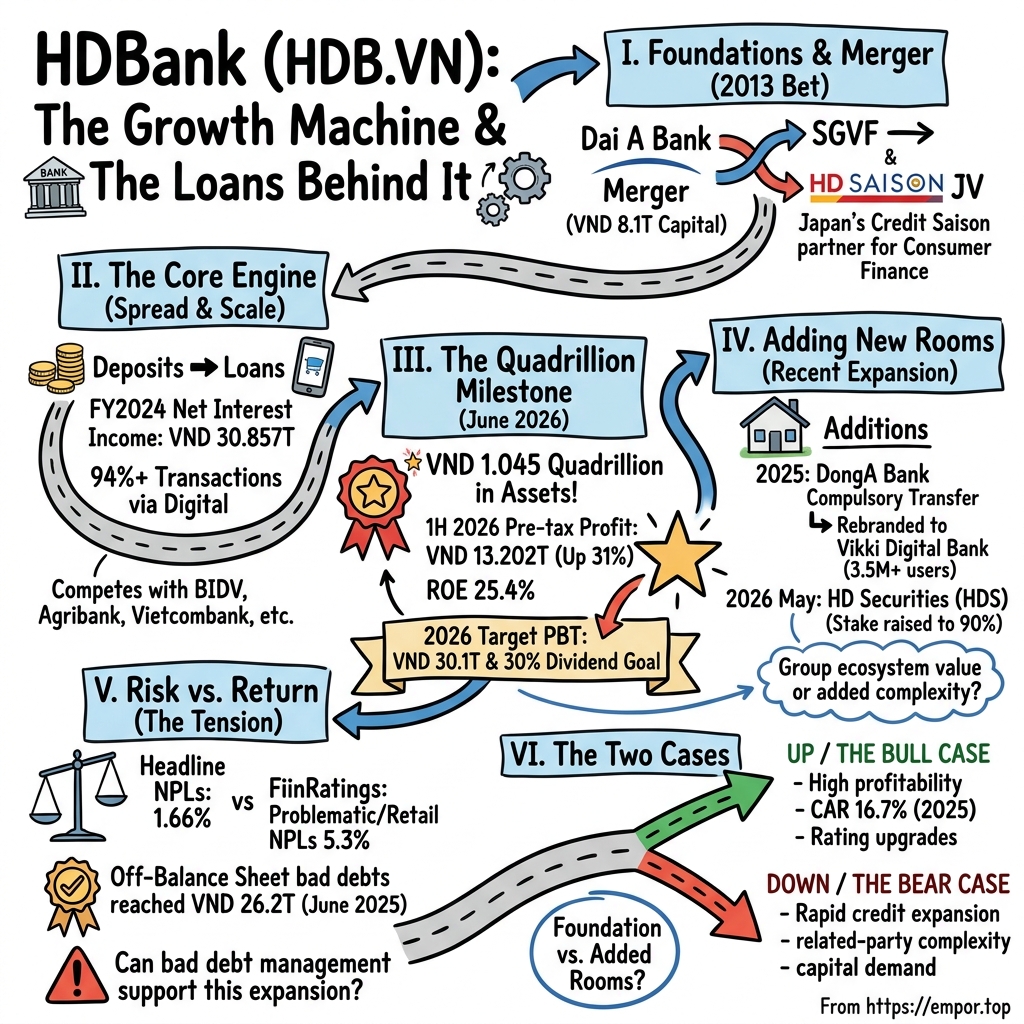
HDBank: The Growth Machine and the Loans Behind It
I. The Bank That Crossed One Quadrillion
At the end of July 2026, Ho Chi Minh City Development Joint Stock Commercial Bank, known as HDBank, published a number few Vietnamese private lenders had ever been able to print. Its total assets stood at roughly VND1.045 quadrillion, a figure with fifteen zeros, up about 12% in six months.1 The same release reported first-half pre-tax profit of about VND13.2 trillion, up 31% from a year earlier, and a return on equity of 25.4%.1 Translated into dollars, the profit was a little over half a billion for six months of work. The balance sheet, at about US$40 billion, had become larger than the economies of several small countries.
The milestone had a neat symmetry with the bank's past. In September 2013, when the shareholders of a provincial lender called DaiABank voted to fold their bank into HDBank, the combined institution expected to hold a little over VND70 trillion of assets.10 Thirteen years later the balance sheet was about fifteen times that size. Vietnam has a club of banks with assets above one quadrillion dong, and its members are mostly the state-owned giants. HDBank's entry was a statement that a city-chartered bank, founded in the first years of Đổi Mới, the reform era, could grow into the same weight class.
Milestones like this are easy to celebrate and harder to read. The numbers in that July release were not all made of the same material. The first half of 2026 was also the first period in which HDBank consolidated HD Securities Corporation, a brokerage it had just taken to 90% ownership.2 Its digital-bank subsidiary, Vikki, was the former DongA Bank, handed to HDBank by the State Bank of Vietnam in a compulsory transfer in January 2025.3 And for more than a decade the group has included HD SAISON, a consumer-finance company in which HDBank owns half the capital and holds control.3 So the question behind the headline is the one this story pursues. Where is HDBank's growth actually earned? What risks travel with it? And can a financial group that keeps adding rooms deliver for the people who own HDB shares?
Precision about the boundary matters, because the perimeter is moving. HDBank is the listed issuer on the Ho Chi Minh City Stock Exchange, and it has no parent company above it.3 HD SAISON was already inside its consolidated accounts in 2024 and 2025 at 50% ownership with control.3 Vikki is wholly owned, yet HDBank's audited 2025 consolidated statements excluded it, because the Law on Credit Institutions does not require a bank to consolidate a lender it received through compulsory transfer.5
HD Securities, or HDS, is a different company again. HDBank held 29.99% of it at the end of 2024 and 2025. On 28 April 2026 the board passed Resolution 09/2026/NQ-HĐQT to raise that stake to 90%, and on 22 May the bank disclosed that the purchase was complete and that consolidation began in the second quarter.43 HDS is a securities firm. It is not HD SAISON, and the 2026 transaction gave HDBank no additional ownership in the consumer-finance business.
The ambition for 2026 is large. At the annual general meeting in April, shareholders approved a pre-tax profit target of VND30.1 trillion, 41% above 2025, and a plan to grow outstanding credit by 37% to about VND804.6 trillion.6 They also approved a distribution of roughly 30% for 2025, paid in new shares from a stock dividend and a bonus issue rather than in cash.6 Against that target, the VND13.2 trillion earned in the first half represents about 44% of the year's goal. To hit the plan, the second half must produce more than VND16.9 trillion, about 28% more than the first.
That gap is the first clue. The second sits in a detail of the target itself. When management first briefed investors in early March 2026, it guided to profit "above VND27.7 trillion," growth of about 30%.7 Seven weeks later, with a plan to make HDS a subsidiary on the agenda, the AGM figure was VND30.1 trillion.6 HDBank did not publish a bridge between the two numbers. The upgrade may be entirely reasonable, since HDS reported record profit of more than VND1.4 trillion for 2025, but it means part of the jump in the 2026 promise came from a change in what counts as HDBank.7
None of this makes the growth fake. It makes it layered. HDBank is today a large, fast-growing, highly profitable private bank, and its reported returns sit at the top of the Vietnamese industry. The test of the next few years is whether the core business of gathering deposits and making loans can carry that pace without credit quality giving way, and whether the newer subsidiaries add value rather than fog. To answer it, the story has to go back to the year HDBank decided it would not remain a mid-sized city bank: 2013, when it merged with one lender, bought a finance company from a French bank, and laid the foundations of the house it lives in now.
 Subscribe on LinkedIn
II. The 2013 Bet: A Merger, a Finance Company, and a New HDBank
HDBank began modestly. The Ho Chi Minh City People's Committee approved its creation on 11 February 1989, and in 1992 the State Bank of Vietnam licensed it as Ho Chi Minh City Housing Development Commercial Joint Stock Bank, with charter capital of just VND5 billion.3 For two decades it was a housing-finance lender in a city learning to be a market economy. In September 2011 the central bank approved a new name, Ho Chi Minh City Development Joint Stock Commercial Bank, and the word "housing" disappeared from the brand.3 The change was small on paper. In practice it announced a broader ambition, and leadership later said that 2011 was the year it identified mergers and acquisitions as a strategic direction, back when HDBank "was still relatively small."6
The moment to act arrived with Vietnam's first great bank clean-up. By October 2013 the State Bank had classified nine commercial banks as weak and approved restructuring plans for eight of them, a list that included mergers, absorptions and recapitalisations by new shareholders.9 One of the lenders looking for a partner was DaiABank, based in Dong Nai province, the industrial belt east of Ho Chi Minh City. It had VND3.1 trillion of charter capital and nearly 70 transaction units. HDBank had VND5 trillion of capital and 106 transaction points.10
DaiABank's shareholders met in September 2013 and approved a one-for-one share swap. The combined bank would keep the HDBank brand, hold VND8.1 trillion of charter capital, operate 210 transaction points and serve about 420,000 customers with roughly 3,600 staff, and the plan promised that every DaiABank employee would keep their job and salary.10 The State Bank signed its approval on 18 November 2013, effective 20 December, and DaiABank handed back the operating licence it had held since 1993.9 It was a voluntary merger, described by the regulator as a way to increase scale, management capacity and efficiency.9 In plain terms, HDBank bought a regional map: branches, depositors and borrowers across the southeast that it would otherwise have spent years building.
The second deal of 2013 was a different animal. Société Générale owned a small Vietnamese consumer-lending company, Société Générale Viet Finance, or SGVF. On 30 October 2013, after State Bank approval, the French group transferred 100% of SGVF to HDBank, which renamed it HDFinance.3 Consumer finance in Vietnam meant motorbike instalment loans, phone and appliance loans, cash loans to factory workers and teachers: high-yield, high-volume, and high-loss lending to customers most banks did not reach. Banks could not easily do this inside their own branches, so the subsidiary gave HDBank a door into a different customer base.
Then came the move that made the door credible. In March 2015 Japan's Credit Saison (クレディセゾン), one of the country's major card and consumer-credit companies, bought 49% of HDFinance's charter capital, and a further 1% went to Ho Chi Minh City Securities Corporation. The company became a multi-member limited liability company and took the name HD SAISON.3 HDBank kept 50%, with control under the agreement among the capital contributors.5 That arrangement deserves to be remembered whenever the group reports a "consolidated" consumer-finance number. Half of HD SAISON's profit after tax belongs to other owners, and it flows out through the minority-interest line before it reaches HDB shareholders.
Why did this pair of deals matter? Consider what each one bought. The merger bought distribution and a deposit base in exactly the region where Vietnam's manufacturing boom would later concentrate. The finance company bought a credit-scoring and collections machine for small loans, and the Credit Saison sale brought in a foreign partner with decades of experience in Japanese consumer credit while recovering capital. The stated logic still runs through the present. HD SAISON reported profit after tax of more than VND1.1 trillion in 2025, up about 13%, with outstanding loans above VND22 trillion.3 It has become a real business, not a side project.
What the record cannot support is a confident verdict on price. HDBank does not disclose what it paid Société Générale for SGVF, or what Credit Saison paid for its 49%, in any of the filings that describe those transactions. The DaiABank merger was a share swap at one-for-one between two banks whose book values the public documents do not reconcile. Without purchase prices or the book value acquired, there is no credible way to say whether HDBank paid too much, too little, or exactly the right amount. The honest version is narrower: the 2013 transactions changed HDBank's capital, footprint and product range, and the businesses they created still exist and still earn money.
They also set a pattern. Management at the 2026 AGM described M&A as "a core competency of HDBank," naming DaiABank, the Société Générale finance company, and DongA Bank as the notable cases.6 Two of those three were acquisitions from distressed or exiting owners, and one was a government-assigned rescue. HDBank's growth strategy has repeatedly made use of moments when others needed a buyer. That can be a genuine skill. It can also become a habit that makes the group steadily harder to analyse.
By January 2018, when HDBank listed on HOSE at a reference price of VND33,000, it had charter capital of more than VND9.8 trillion and a market value of about VND32.4 trillion, and foreign financial investors had paid around US$300 million for 21.5% of the bank before listing.8 The merger and the finance company were part of the equity story investors bought. Yet the most important question about HDBank was never whether its adjacent businesses were clever. It was whether the plain business at its centre, taking deposits and making loans, was good enough to compound. That is where the money is actually made.
III. The Spread That Pays for the Story
Picture a garment worker in Binh Duong who keeps her savings in an HDBank term deposit, and a family-owned building-materials distributor in Dong Nai that borrows working capital from the same bank. Neither knows the other exists. Between them sits the whole economic machine of HDBank. The bank pays the worker interest on her deposit, charges the distributor a higher rate on his loan, and keeps the difference. If the distributor repays, the bank earns a spread on money that was never its own. If he does not, the loss eats several years of spread on many good loans. Everything else HDBank does, from its app to its subsidiaries, is decoration on that basic transaction.
The numbers show how dominant the spread is. In 2024 HDBank earned about VND58 trillion of interest income and paid about VND27 trillion of interest expense, leaving net interest income of VND30.9 trillion.13 That was about 91% of its total operating income of VND34 trillion.16 The bank's own operating review for that year framed 2024 as a year of digitalisation and network expansion, but the arithmetic is unambiguous: this is a lending business first, second and third.12
Fees, foreign exchange and securities trading made up the rest, and they were small and volatile. Gains on investment securities, for instance, fell from about VND1.2 trillion in 2023 to under VND0.1 trillion in 2024.13 When a bank's second-largest income line can almost vanish in a year, it is not a foundation. It is weather.
HDBank's spread has been wide. FiinRatings, the Vietnamese rating agency affiliated with FiinGroup, measured its net interest margin at 5.3% in the first half of 2025, second-highest in the industry, while its average cost of funds held at 4.8%.16 A margin that size is the reward for lending to customers who pay more: small and medium enterprises, households, consumer-finance borrowers through HD SAISON. It is also the clearest signal of where the risk lies, because borrowers who pay more are generally borrowers other lenders regard as riskier.
Non-interest income has grown fast in the last two years, and management wants investors to see it as diversification. In 2025 non-interest income rose about two and a half times and reached 18.6% of total operating income.11 FiinRatings traced the first-half 2025 jump to an 858% surge in "other" service income, mainly from receivables bought under letters of credit without recourse, along with a 79% rise in payment fees.16 Some of that is recurring transaction banking. Some of it is trade-finance discounting, which behaves more like lending than like fee income. In the first half of 2026 non-interest income rose another 23.1% while total operating income grew only 8.8%.1 That is the first sign of a pattern: the core spread was under pressure.
Where does HDBank sit among its competitors? Vietnam's banking system is large and concentrated. At the end of 2025 the 30 domestic commercial banks tracked by VietNamNet held about VND15.8 quadrillion of loans, and the five largest lenders, BIDV, Agribank, VietinBank, Vietcombank and MB, held about 56% of the total.15 Four of those five are state-controlled. BIDV alone had about VND2.3 quadrillion of loans. HDBank's customer loans on the same measure were about VND518 trillion, less than a quarter of BIDV's and roughly half of MB's VND1.02 quadrillion.15 Among private lenders it sat behind VPBank, at VND833 trillion, Techcombank, above VND713 trillion, and ACB, above VND660 trillion, and alongside Sacombank and SHB.15 FiinRatings put its loan market share at about 3.4% in mid-2025.16
Scale matters in banking for reasons a listener can feel. The giant state banks gather cheap deposits from government agencies, state enterprises and millions of payroll accounts, so they pay less for money. Their size lets them lend to the biggest borrowers in the country at rates a smaller bank cannot match. A bank of HDBank's size therefore competes elsewhere, with mid-sized companies, households, rural customers and consumers, and with service speed and willingness to lend. HDBank's own description of its book says about 44% of the loan portfolio serves rural and remote areas.6
The physical footprint is modest by the standards of the giants. At the end of 2025 HDBank operated 87 branches and 288 transaction offices, and the whole group employed about 18,300 people, of whom roughly 7,800 worked in subsidiaries.6 That is a lean network for a balance sheet of nearly VND1 quadrillion, and it explains much of the cost advantage. It also explains why distribution beyond the branch matters so much to the strategy.
That distribution leans on the founder's wider business group. HDBank's annual report describes acquiring customers through "the HDBank - Sovico ecosystem," and it highlights a multi-currency payment gateway, built with the payments company Galaxy Pay, that accepts more than 16 currencies for Vietjet Aviation.5 An airline that sells millions of tickets a year is a natural feeder of payment flows, card customers and foreign-exchange business. It is also a related party, a point that will matter later in this story. The ecosystem is a real channel. Its economic contribution is not separately disclosed.
Funding is the other half of the spread. Customer deposits rose from about VND437.5 trillion at the end of 2024 to about VND478.7 trillion by June 2025, and HDBank supplemented them with more than VND80 trillion of issued valuable papers.16 FiinRatings expected issued paper to stay at around 13% to 15% of funding.16 In the first half of 2026 the bank widened its sources again with a US$721 million social syndicated loan, about 60% larger than first planned, and said it was preparing a US$500 million international green bond programme.1 Its loan-to-deposit ratio of about 72% leaves room to lend.1 The money is available. The question is its price.
There is a second, peculiarly Vietnamese constraint: the State Bank allocates credit growth limits to each lender. A bank cannot simply lend as fast as demand allows. For 2026 HDBank was again assigned a limit of 35%, among the highest in the system, and management said the regulator plans to keep its quota above 30% for five years from 2025, partly in recognition of its role in restructuring weak banks.6 That is a real advantage. It is a quota granted by a regulator, which means the regulator can also reduce it.
So what is HDBank's edge? The bank points to efficiency and digital reach, and the evidence on efficiency is real. Its cost-to-income ratio fell to 24.9% in the first half of 2026.1 FiinRatings recorded 25.5% for the first half of 2025, against an industry median of 36.6%.16 More than 94% of individual customers' transactions run through digital channels, and digital channels bring in more than 60% of new customers.1 A bank that spends 25 dong to earn every 100 dong of income has a cost structure most peers would envy.
Efficiency, however, is not the same as a moat. A moat is something that lets a business earn more than competitors for a long time, because customers will not or cannot leave. The test for a bank is deposit pricing. Does HDBank pay less for its money than rivals because customers value it? The evidence points the other way. Its share of current and savings accounts, the cheap, sticky money that underpins the best bank franchises, was only about 11% in the second quarter of 2026, and its cost of funds rose to 6.14% in that quarter.2 Banks with a strong deposit franchise in Vietnam, Techcombank being the textbook example, have built far higher current-account shares. HDBank funds itself mainly with term deposits and issued paper, which means it buys its money at something close to market rates.
The 94% digital transaction figure is similar. Every large Vietnamese bank has pushed customers to apps, and transaction-channel share says nothing about whether customers would stay if a rival offered a better rate. HDBank does not publish customer retention, deposit-account churn or a long series of market-share gains by segment. On the evidence available, its advantage is a lean cost base, a willingness to lend to segments larger banks underserve, a generous regulatory credit quota and a group ecosystem that sends customers its way. That is a real edge, but a narrower one than the word "moat" implies, and it is more cyclical.
The forces that can compress HDBank's returns are therefore easy to name. The regulator can tighten credit quotas. Depositors can chase higher rates at other banks, which pushes funding costs up. The State Bank can steer lending rates down to support the economy, which squeezes the spread from the other side. Borrowers can choose among dozens of lenders. And above all, loans can go bad.
That is the trade-off at the centre of this bank. Every year since 2021 HDBank has grown its loan book faster than the system and earned a wide spread for doing so. Growth of that kind lifts profit right away, because new loans earn interest from the first month. The cost arrives later, when some of those borrowers stop paying. Whether the trade works depends on underwriting and on funding holding up as the book grows. For that, the story has to leave the income statement and walk into the loan book.
IV. The Growth Rate Meets the Loan Book
In September 2024 a loan of more than VND1 trillion to Lộc Trời Group, one of Vietnam's best-known rice and agricultural-services companies, fell due. The loan was unsecured, and when it was not repaid it became non-performing.16 HDBank moved quickly. That same month it sold VND915 billion of the debt, and in March 2025 it wrote off the remaining VND99 billion. By the end of June 2025 the exposure had been fully resolved.16 FiinRatings cited the episode as evidence of effective debt resolution, and on its own terms it was. It was also a small window into how a fast-growing bank keeps its headline bad-loan ratio low: by selling and writing off problems quickly, so they leave the balance sheet before they can sit in the ratio.
Start with the growth, because it is genuine. HDBank's pre-tax profit rose from about VND5.8 trillion in 2020 to VND16.7 trillion in 2024.16 It reached VND21.3 trillion in 2025, up 27.6%; management described its compound growth rate from 2021 through 2025 as about 27.5% a year.111 Return on equity stayed around 25% throughout.1 A longer series would be misleading, because the 2013 merger and later changes in the group perimeter make older years a different bank. Over the five years that can be compared, the profit growth is real and it is exceptional by any international standard.
Loans grew even faster than profit. Gross customer loans rose from about VND178 trillion in 2020 to about VND508 trillion by June 2025, nearly three times larger in four and a half years.16 In 2025 alone total credit grew 34.3%, essentially the full quota the regulator allowed.6 In the first half of 2026 the parent bank's credit grew another 18%, against 8.5% for the system.2 HDBank was lending at more than twice the industry pace.
Now the clues on the other side. HDBank reported a non-performing loan ratio of 1.66% at the end of 2025, calculated under the State Bank's Circular 31.6 Its 2026 plan promises to keep that ratio at or below 2%.6 On its face that is a clean book. FiinRatings, measuring on its own adjusted basis, told a different story in its September 2025 surveillance report. It found the NPL ratio had risen to 2.5% by June 2025, in line with the industry median. Retail NPLs, mainly from mortgages, had climbed to 5.3% from 3.8% at the end of 2024. "Problematic loans," which add the special-mention category, the loans one step from default, stood at 6.4%, against an industry median of 3.6%. And the reserve coverage ratio, the provisions set aside per dong of bad loans, had dropped to 47.2%, against a median of 62.7%.16
These numbers are not contradictory. They are different rulers. The bank's headline ratio counts only loans formally classified in groups 3 to 5 at the parent bank under Vietnamese rules. FiinRatings adjusts for bad debt sold to the state asset-management company, uses consolidated figures that include HD SAISON's much riskier consumer book, and adds the watch-list loans that tend to become tomorrow's NPLs. The gap between them is the useful information. It says the loans already classified as bad were moderate, while the pipeline of loans that could become bad was unusually large.
The direction of reserve coverage matters even more than its level. FiinRatings' history shows HDBank's coverage falling from about 82% in 2020 to 69% in 2024 and then to 47% by mid-2025.16 Over the same period loans nearly tripled. A bank that grows quickly while setting aside less per bad loan is leaning on its future profits to absorb losses as they come rather than reserving ahead of them. FiinRatings judged that HDBank's strong profitability "provides ample buffer for provisioning and write-offs," while also writing that rapid credit expansion "has significantly increased its potential risk exposure."16 Both are true at once.
Concentration adds texture. Lending to real estate and construction reached about 28.3% of the book by mid-2025, up from 25.6% at the end of 2024, which FiinRatings described as "a change in the Bank's risk appetite."16 Corporate bonds, which made up about 1.8% of loans, were 77.7% from issuers in real estate and construction. The 20 largest corporate clients made up about 12.8% of loans, lower than at most rated banks.16 None of this is alarming by itself. Together it describes a bank leaning harder into property and construction just as Vietnam's property market was recovering from its 2022–2023 bond crisis.
Write-offs are where the hidden pressure shows. Under Vietnamese accounting a bank can write off a bad loan against provisions and track it off the balance sheet while it keeps trying to recover. HDBank's written-off debts still being pursued rose from about VND20.1 trillion at the end of 2024 to VND26.2 trillion by June 2025, an increase of about VND6 trillion in six months.14 For scale, that six-month increase was larger than the bank's pre-tax profit for the whole of 2020. FiinRatings measured net write-offs at 1.6% of average loans in the first half of 2025, against an industry median of about 1%.16 When a bank writes off this much, its NPL ratio looks better than its credit experience. The losses are real. They have simply left the denominator.
The cash-flow statement shows how a growing bank consumes money, and here it is easy to draw the wrong conclusion. In 2024 HDBank earned net profit of VND13.2 trillion and reported operating cash flow of only VND8.7 trillion, largely because it put about VND99 trillion of new money into customer loans.13 For an industrial company, a gap like that would be a warning that profits are not turning into cash. For a bank, lending is the operating activity, and deposits and issued paper that fund it also run through operating cash flow. The gap reflects balance-sheet expansion, not weak earnings. The one cash signal that does matter is funding: FiinRatings noted that deposits did not keep pace with loans and off-balance-sheet commitments in early 2025, and its stable-funding ratio fell from 108% to about 98%.16
Then came the first half of 2026, and the clues began to rearrange themselves. Profit rose 31%, and second-quarter profit rose about 51%.2 But look at what moved. Vietcap's analysts found that consolidated provisions fell about 30% year on year to VND3.8 trillion. The net interest margin had dropped to 4.11% in the second quarter from 5.69% a year earlier, as the cost of funds climbed. Subsidiaries contributed about VND2.3 trillion, roughly 17% of first-half profit, with HDS consolidated for the first time.2 In other words, the 31% growth was built mostly from lower provisioning, a larger perimeter and fee income, while the core spread narrowed.
The provisioning comparison deserves a second look, because the base year was unusual. In the first half of 2025 HDBank had set aside about VND5.5 trillion for credit losses, more than double the VND2.4 trillion set aside in the same period a year earlier, in the same months it was writing off billions and disposing of the Lộc Trời exposure.14 A 30% drop from that elevated level flatters the 2026 comparison. Viewed across two years, provisions rose sharply and then partly normalised. That is a pattern worth remembering whenever a single year's earnings growth is presented as the bank's run rate.
It is also instructive to set the first half of 2026 against what the rating agency expected a year earlier. FiinRatings' base case assumed HDBank would grow credit at about 27% a year in 2025 and 2026, below the bank's own target of 32% to 33%, and keep its net interest margin above 5%.16 The bank beat the credit assumption, growing 34.3% in 2025.6 It missed the margin assumption by a wide distance in the second quarter of 2026.2 Growing faster while earning a thinner spread is the classic shape of a lender buying volume. It does not prove that underwriting has slipped. It does mean that each new dong of loan is earning less to cover its eventual losses.
At the same time, asset quality worsened by Vietcap's measures. The consolidated NPL ratio rose to 2.79%. Loans in group 2, the special-mention bucket, jumped to 4.70%, up more than two percentage points in a single quarter. Loan-loss reserves covered about 50% of NPLs, unchanged from the prior quarter.2 Vietcap concluded that the rise in group 2 loans could mean higher provisions in the second half of 2026 and flagged provisioning as a risk to sustained earnings.2
Put the pieces together and the verdict is reasonably clear. HDBank's earnings growth is real, and the bank has proved that its high margins can pay for heavy credit costs. But the headline NPL ratio does not settle the asset-quality question, and the most recent quarter moved in the wrong direction on every forward-looking measure: watch-list loans rose sharply, margin fell, and profit growth relied on provisioning less. The forward tests are specific. Investors will learn the most from whether group 2 loans migrate into NPLs or cure, from new NPL formation per quarter, from whether reserve coverage rises back toward the industry median, from recoveries on the VND26 trillion of written-off debt, and from whether credit costs rise to the 1.5% of loans FiinRatings assumed in its base case.16
That leaves the question the bank's own strategy poses. HDBank's answer to the limits of a spread business has been to build an ecosystem around it: consumer finance, a digital bank, a brokerage. Do those engines improve the balance between risk and return, or do they add a second layer of execution risk on top of the first?
V. Consumer Credit, the Transferred Bank, and the Securities Bet
Three different companies stand beside HDBank in its annual report, and they could hardly be more different. One is a 50%-owned consumer lender with a Japanese partner and more than a decade of operating history. One is a bank the government handed over after years under special control. One is a brokerage that was an associate until May 2026. Management presents them together as an ecosystem serving more than 34 million customers.5 For an investor, the right approach is to take them one at a time.
HD SAISON is the established piece. It lends to people buying motorbikes, appliances and phones, and to people who need cash for school fees, medical bills, weddings and home repairs.3 It operates through about 28,600 points of sale and reported more than 17.5 million customers by mid-2026.1 In 2025 it earned profit after tax of a little over VND1.1 trillion, up about 13%, and its loans grew about 21% to roughly VND22 trillion.3 Its return on equity was about 22% in the first half of 2026.1
The risk sits in plain sight. HD SAISON's NPL ratio was 7.17% in March 2026 and about 7.1% in mid-2026.32 In consumer finance that is not unusual, because the yields are high enough to absorb heavy losses, but it does show up in the consolidated ratios and makes group NPL figures look worse than the parent bank's. HD SAISON's capital adequacy ratio stood at about 23.6% in March 2026, far above banking minimums.3 It is an established adjacent business that earns its keep. The caveats are its size, since its loans were roughly 3% to 4% of HDBank's group credit, and the fact that half of its profit belongs to Credit Saison and the other minority holder.3 It was already consolidated before 2026. Nothing about it changed in the second quarter.
Vikki is the restructuring case. On 17 January 2025 the State Bank announced Decision 116/QĐ-NHNN on the compulsory transfer of DongA Joint Stock Commercial Bank to HDBank. DongA became a one-member limited-liability bank wholly owned by HDBank, and on 14 February 2025 the regulator approved its new name, Vikki Digital Bank.5 Its headquarters moved from Ho Chi Minh City to Hanoi, and it rebranded as a "new-generation digital bank."17 Management reported more than 2.1 million app downloads in its first year and said Vikki "turned a profit."5 In the first half of 2026 it added more than 1.6 million downloads and passed 3.5 million users.1 Its full story, and the burden that came with it, is a tale of its own.
HDS is the newest piece, and the one most likely to be confused with others. It began life in 2006 as Phu Gia Securities, with VND43 billion of capital, became HDB Securities in 2018 and HD Securities in 2022.5 HDBank injected capital in June 2024 to lift HDS's charter capital to about VND1.46 trillion, while holding 29.99%, so HDS was an associate rather than a subsidiary.53
At the April 2026 AGM shareholders approved a policy to raise HDBank's stake to at least 51% and up to 90%, with 92.08% of votes cast in favour, and authorised the board to set "the timing, method of execution, purchase price, and total investment amount."6 The board's resolution of 28 April set the target at 90%, to be completed in 2026, and delegated execution to the CEO, including contracts to take over rights to buy HDS shares and contracts to buy HDS shares.4 On 22 May the bank disclosed completion. From the second quarter of 2026, HDS's financial statements are consolidated.3
The purchase price for that stake does not appear in the resolution, and HDBank has not published it alongside the completion notice. For an acquisition that moved a business from equity accounting into full consolidation, that is a material gap. HDS reported pre-tax profit of about VND1.47 trillion in the first half of 2026, up 286%, with a return on equity above 28%.1 Management said in March that it planned to list the brokerage in 2026 and targeted profit above VND4 trillion over time.7 Brokerage profits in Vietnam rise and fall with stock-market turnover and margin lending. A securities firm whose profit nearly quadrupled in a strong market is a cyclical business, not a second spread engine.
The consolidation effect is easy to see in the quarterly pattern. First-quarter 2026 pre-tax profit rose about 14% year on year; second-quarter profit, the first quarter with HDS consolidated, rose about 51%.202 Vietcap attributed the second-quarter jump to credit growth, a margin recovery from the first quarter, lower provisions and stronger subsidiary contributions.2 HDBank's releases describe each subsidiary's own profit, but they do not publish a reconciliation showing how much of the group's year-on-year growth came from the change in HDS's accounting treatment. Without that bridge, nobody outside the bank can say precisely how much of the 31% first-half growth was organic.
Management's own capital-allocation question is the right one to borrow. What does each unit require from the parent? The 2026 AGM approved a standing authority for transactions with Vikki and HD SAISON, including deposits, securities and bond trading, credit and debt purchases, each up to or above 20% of HDBank's charter capital.6 The 2025 governance pages record board approvals of a special lending limit for Vikki.5 That is balance-sheet support, and it is ordinary inside a banking group. It also means the subsidiaries can draw on the parent's capital and liquidity in ways that do not show up as an investment cost.
The verdict for this part of the story is that the three businesses are not one growth story. HD SAISON is a mature consumer lender whose economics are partly shared. Vikki is a regulatory restructuring that has produced users but not yet a published earnings contribution. HDS is a cyclical brokerage newly consolidated after a stake purchase whose price is undisclosed. Any one of them may add value. Together, they make HDBank's reported growth harder to read than the growth of a bank that only lends. What investors need is a consistent-perimeter profit bridge: the parent bank's earnings on a like-for-like basis, then each subsidiary's contribution attributable to HDB shareholders. Until that exists, the ecosystem is a claim rather than a result. And the strangest room in the house is the one HDBank did not choose to build.
VI. The Mandate to Repair DongA Bank
The announcement came on 17 January 2025, closing a long chapter in Vietnamese banking. DongA Bank, once a well-known Ho Chi Minh City lender, had spent years as a specially controlled bank, the State Bank's term for a lender it has taken under direct supervision because it can no longer stand on its own.18 That day the regulator transferred it compulsorily to HDBank.5 In the same period VPBank received GPBank, and a few months earlier Vietcombank and MB had received CBBank and OceanBank.17 Vietnam was finally clearing out the weak banks left from its last credit cycle, and it was handing each one to a healthier lender.
That context matters more than anything else about the transaction. A compulsory transfer is not a priced acquisition. There was no auction, no bid, no purchase price for shareholders to judge against a multiple of earnings. HDBank linked its role in restructuring weak lenders to the credit quota it said would stay above 30% for five years from 2025.6 The transfer arrangements also let HDBank keep Vikki outside its consolidated financial statements and capital adequacy ratio.5
There was a third benefit, less discussed but potentially just as valuable. In March 2025 Decree 69/2025/NĐ-CP allowed foreign investors to hold up to 49% of the charter capital of banks that receive a compulsorily transferred lender, well above the normal 30% ceiling.16 At the time, foreigners owned about 17.5% of HDBank, and shareholders had approved raising that to 27% through the conversion of US$325 million of international convertible bonds.16 For a bank that needs a steady stream of new equity to fund 30%-plus credit growth, a wider door for foreign capital is a strategic asset. In effect, the state paid HDBank for taking DongA partly in currency it could not have bought: growth quota and foreign-ownership room.
Seen that way, the DongA mandate looks less like charity and more like a negotiated exchange. HDBank took on a bank that needed repair. In return it received regulatory concessions that support the lending pace that drives its profits. Whether that exchange was a good one for shareholders depends on a number nobody outside the bank can yet see: how much capital, liquidity and management attention Vikki will absorb before it pays its way.
Management's account of how it got there was revealing. At the April 2025 AGM, Pham Quoc Thanh, then acting CEO, told a shareholder that HDBank was not newly involved. Its restructuring plan for DongA had been developed over more than five years and revised continuously before the takeover. Before the transfer, HDBank had provided financial and human-resources support and helped prepare DongA's transformation into a digital bank, including its brand identity and operations.18 After the transfer, he said, the bank began a comprehensive restructuring of finances, capital and personnel, and he predicted that "the restructuring of Vikki Bank will soon be implemented and succeed."18 The same meeting approved the creation of an HD financial-banking group, with HDBank and Vikki as its two core banks.18
The speed was real. Management said that within a month DongA was fully rebranded as Vikki, and new-look branches opened in mid-February 2025.5 HDBank's 2025 annual report described Vikki's first year as "a powerful revival" and said it "turned a profit."5 By mid-2026 the app had a 4.7-star rating, and management said deposits on digital and physical channels grew faster than the prior year.1
Here an investor has to separate milestones that are easy to confuse. A transfer is a legal event. A rebrand is a marketing event. App downloads measure curiosity. Active users measure habit. Deposits measure trust. Profitable loans measure a business. Contribution to consolidated earnings measures value for HDB shareholders. Vikki has passed the transfer, rebrand and user-growth milestones. HDBank's disclosures give user and download figures, a qualitative comment on deposits, and a statement that Vikki turned a profit, but not Vikki's profit figure, its loan book, its deposit balances, the bad assets it inherited or the support the parent has extended. Because Vikki sits outside the consolidated statements, its results do not appear in group profit at all.
That cuts both ways. Exclusion means Vikki's losses, if it has any, are not dragging on HDBank's reported earnings or capital ratio today. It also means investors cannot see what they own. A wholly owned bank with millions of users is an asset if it can be made profitable, and a liability if it needs repeated capital and liquidity support from the parent. HDBank's 2025 board pages record a special lending limit and new transaction limits for Vikki, and the 2026 AGM authorised large transactions with it.56 Those are channels through which support can flow.
What would falsify the optimistic reading? Repeated capital or liquidity support to Vikki without any disclosed path to standalone returns would. So would a prolonged absence of segment-level disclosure as the exemption from consolidation runs its course. So would evidence that Vikki's users are mainly HDBank's existing customers moved across rather than new ones. What would confirm it? Published Vikki accounts showing growing deposits, a clean loan book and profit large enough to matter at the scale of a bank earning over VND20 trillion a year.
The broader point is about credibility. Rescues earn regulatory goodwill, and that goodwill appears to have translated into a credit quota that is itself a competitive advantage. But a bank that takes on a government mandate should set measurable milestones and then report against them. Management has set out the ambition. The measurements, so far, are mostly the ones that are easiest to achieve. Which raises the question of who is setting the targets, and how well past targets have held.
VII. The New Team, the 41% Promise, and the Cost of Confidence
On 24 April 2026, shareholders representing about 80% of HDBank's voting shares gathered for the annual meeting in Ho Chi Minh City.6 At the front of the room sat Kim Byoungho, a Korean banker born in 1961, as chairman, and Nguyen Huu Dang as chief executive.3 The meeting approved almost everything put before it, including a large capital increase. Then the voting record, read carefully, revealed where the doubts were.
The two men leading HDBank have very different backgrounds. Kim spent most of his career at Hana Bank and Hana Financial Group in Korea, rising from New York branch director to chief financial officer, then to chairman and CEO of Hana Bank in 2014–2015, and vice chairman of the group.3 He started at the First National Bank of Chicago in 1988 and holds an MBA from Berkeley's Haas School.3 He has chaired HDBank as an independent board member since April 2022. His presence gives the board a seasoned outsider's voice and an international credibility that matters to foreign investors and rating agencies.
Dang is the insider's insider. Born in 1970, he started his career at the State Bank's Dong Thap branch supervising non-state credit institutions, worked as a credit officer at a Long An bank, and joined HDBank in 1999.3 He became deputy CEO in 2007 and was HDBank's CEO from December 2010 to April 2020, the decade that included the DaiABank merger, the SGVF purchase and the listing.3 He then served as vice chairman and, from 2020 to 2023, as CEO of Galaxy One, before chairing Vikki Bank from February 2025.3 On 13 May 2025 he returned as CEO of HDBank, replacing Pham Quoc Thanh, a former HSBC credit head who had run the bank since 2020 and became vice chairman.3 Dang's return means the executive who built the 2013 platform now has to deliver the 2026 one.
The handover itself was handled quietly. Thanh, a career credit man who had worked at VPBank, HSBC, ACB, ABBank and Techcombank before joining HDBank as deputy CEO in 2013, stayed on as vice chairman and remains on HD SAISON's board.3 HDBank did not explain the change in leadership in strategic terms in its public materials, and the transition did not disturb results, since the bank met its 2025 plan. Still, the shape of the team matters for the credit question. The CEO who led HDBank during its fastest five years of loan growth, from 2020 to 2025, was a lender trained in foreign and private banks. His successor is the long-time HDBank insider who then chaired Vikki. The new structure puts the rescue and the core bank under the same hands.
Guidance discipline is the first test of any management team. For 2025, shareholders approved a profit target of about VND21 trillion.18 HDBank delivered VND21.3 trillion, about 101% of the plan, and its total assets and deposits came in about 5% above target.6 That is a clean record of meeting the numbers, with one footnote: credit grew 34.3%, essentially the full regulatory quota, so the bank used all the room it had.6 A management team that hits its target by growing at the limit has proved it can execute growth. It has not yet proved it can hit targets when growth is constrained.
For 2026 the target is far more ambitious. Profit is to rise 41%, credit 37%, equity 41% to about VND110 trillion, and assets 28% to about VND1.19 quadrillion.6 The profit target had already been lifted before the AGM.76 The first-half results left the bank with a demanding second half.1 Vietcap warned that watch-list loans could force higher provisions in the second half.2
Then there is the question of whose interests the managers share. The CEO held no HDBank shares as of late April 2026, according to the bank's own disclosures.3 He received basic pay of about VND2.9 billion for 2025, including his time as vice chairman, and no ESOP shares that year; in 2024, as vice chairman, he had received 200,000 ESOP shares.3 Kim held about 276,000 shares, worth well under 0.01% of the bank.3 His pay was about VND15.1 billion in 2024 and VND7.5 billion in 2025.3 HDBank disclosed executive shareholdings and ESOP purchases in its 2024 annual report, but the people with real economic exposure to HDBank are not its professional managers.21
They are the Sovico group and its founder. Nguyen Thi Phuong Thao, permanent vice chairwoman of HDBank since 2003, is also chairwoman of Vietjet Aviation and chairwoman and CEO of Sovico Group, and she chaired HDFinance after its purchase in 2013.3 She personally held about 3.39% of HDBank in April 2026.3 Sovico, HDBank's only shareholder above 5%, held 9.99%.35 At the end of 2024 Sovico's stake had been 14.27%, and foreign investors held about 17%.21 HDBank's disclosures do not explain the fall to 9.99%, which cannot be the product of the pro-rata share dividends alone. No single shareholder controls a majority. But the founder group's influence, through the board seat, the vice chairwoman's role and the group's companies, is far larger than its percentage.
That influence shows up in the related-party record. In 2024, HDBank recorded related-party credit limits and transactions involving HD SAISON and Sovico-connected entities in its governance report, including a bid-bond guarantee for a Sovico-group company.21 In 2025, HDBank's board approved an increase in the credit limit for Vietjet Aviation, listed as a related party of insiders.5 FiinRatings found that loans to related companies rose from 0.8% of total loans in 2024 to 1.5% by mid-2025.16 At HDBank's scale, 1.5% of loans is more than VND7 trillion. The level is not extreme, but it nearly doubled in six months, and the bank does not publish the transaction-level pricing and collateral that would let outside shareholders judge whether those loans are made on ordinary commercial terms.
The 2026 votes add one more clue. The board's report and the CEO's business plan each passed with 99.85%. But the proposal on contracts with HDBank's subsidiaries, Vikki and HD SAISON, passed with 93.19%, the board's authority over development strategy with 92.69%, the HDS investment and the capital increase with 92.08% each, and the remuneration cap and board operating fund with 96.51%.6 When the founder group and its allies own a large block, a 7% to 8% dissent on capital and related-party items is a meaningful signal from minority holders. One shareholder also asked, politely, for cash dividends. The answer was that the bank was in "a strong growth phase" and prioritised building equity.6
That answer explains HDBank's capital history. Its charter capital grew from about VND9.8 trillion at listing in 2018 to about VND50 trillion by the end of 2025, largely through share dividends and bonus issues.85 The 2026 plan adds up to VND9.9 trillion more in par value: about 289 million shares to convert bonds at VND13,100 each and up to 700 million shares in a private placement at no less than book value.6 That is roughly a fifth more shares. Paying dividends in stock keeps capital inside the bank, which supports growth, but it means per-share growth will run behind headline profit growth. The question for outside shareholders is whether growth, governance and transparency can move forward together. That brings the argument to its two sides.
VIII. The Two Cases for HDBank
Set two documents side by side. The first is FiinRatings' September 2025 surveillance report, which kept HDBank at A with a positive outlook while describing rising NPLs, problematic loans well above the industry median and falling reserve coverage.16 The second is the stack of 2026 rating actions. In May, Moody's affirmed HDBank's B1 ratings and moved its outlook to positive, citing expectations that the capital increase and strong profitability would strengthen loss-absorbing buffers "against potential risks stemming from high loan growth."19 In July, Fitch assigned a first-time BB- rating with a stable outlook, one notch above Moody's B1, citing profitability, stable funding and market position.20 In September, FiinRatings announced an upgrade to A+.22 The ratings moved up. The underlying asset-quality warnings have not yet been formally retired.
The bull case is strong and has the numbers behind it. HDBank has become a top-tier private lender by both scale and profitability. Its return on equity has held around 25% for years, and few banks anywhere grow loans by a quarter a year while doing that.1 Its cost-to-income ratio is among the lowest in the industry.1 Its capital ratio was reported at about 16.4% at the end of 2025 and 16.2% in March 2026.620 It has a regulatory quota for growth that peers would envy, and it has shown it can raise money internationally, including a US$721 million social syndicated loan in the first half of 2026.1 Three rating agencies have moved in its favour.
The bear case is also concrete. HDBank's growth is built on credit, and credit risk arrives late. Its reserve coverage has trended down for five years, watch-list loans jumped in the second quarter of 2026, and its margin fell sharply year on year.162 Its capital ratio fell from about 16% in March 2026 to "above 14%" by June, a quarter in which loans grew quickly and HDS moved inside the group, and the results release did not break down the decline.201 Its earnings now include a cyclical brokerage, a consumer lender with a 7% NPL ratio and half its profits shared, and a transferred bank outside the consolidated statements.25 Related-party lending is rising.16 And its shareholders are being asked to accept another large capital raise.6
A simple frame helps weigh these. Michael Porter's five forces ask who holds power over an industry's profits. In Vietnamese banking, the largest force is the regulator, which sets credit quotas, rates and capital rules. The big state banks dominate deposits and lending, which caps the pricing power of private challengers. Borrowers can shop among dozens of lenders, and HDBank's high-margin segments are precisely the ones where competition for good customers is growing. Depositors can and do move money for a better rate, as HDBank's rising funding cost shows. Substitutes from fintech and payment platforms nibble at fees. Suppliers barely matter in the industrial sense, except that capital itself is a supply HDBank keeps needing more of. It is a structurally competitive industry in which a smaller private bank earns high returns only by being faster, leaner or bolder than the giants.
Hamilton Helmer's seven powers ask a narrower question: which durable advantage lets a company earn above-normal returns? The plausible candidates for HDBank are scale economies in operations, reflected in its cost ratio, and a form of counter-positioning in segments the state banks do not want to serve. A cornered resource of a peculiar kind may exist in its regulatory credit quota and its standing as a restructuring partner. The evidence does not show switching costs, since depositors are rate-sensitive and its share of cheap current accounts is low.2 It does not show a brand that lets HDBank charge more or pay less. Network effects within the Sovico ecosystem, with airline customers flowing into the bank, are asserted by management but not quantified. The honest conclusion is that HDBank's edge is operational and regulatory, real but contingent, and not the kind of power that protects returns automatically through a downturn.
How does the market weigh all this? HDBank's management was asked that question directly at the 2026 AGM, when a shareholder said the share price did not reflect the bank's growth, asset quality and potential. Management replied that valuation indicators such as price-to-book had "improved significantly in recent years" but still did not fully reflect intrinsic value.6 That is the answer every management team gives. The more useful observation is structural.
A bank that pays its distributions in shares, plans a private placement at no less than book value and grows its equity by 41% in a year is asking the market to price per-share compounding, not headline profit. If the market applies a lower multiple to HDBank than to peers with similar returns, the most likely reasons are the ones this story has tracked: credit risk not yet tested by a downturn, a moving perimeter, and related-party links that are disclosed only in part.
A skeptical long-short investor would frame the challenge simply. If credit growth is the engine, show that risk-adjusted returns and reserve coverage improve alongside it rather than declining. If the ecosystem is the differentiator, publish subsidiary earnings attributable to HDB shareholders on a consistent basis, along with the price paid for HDS and Vikki's financial statements. If related-party exposure is ordinary, publish the balances, pricing and collateral. And if dividends must stay in stock to fund growth, show that the growth earns more than its cost of capital after credit losses, per share.
Three numbers will settle much of the debate, and they are worth tracking above all others. The first is the migration of group 2 loans into NPLs, alongside reserve coverage, which stood at about 4.7% and 50% respectively in mid-2026, both moving the wrong way or flat.2 The second is the net interest margin, which recovered to 4.11% in the second quarter of 2026 but remained far below the 5.69% of a year earlier.2 The third is profit contribution by entity: the parent bank, HD SAISON, HDS and Vikki, on a consistent perimeter. Subsidiaries contributed about 17% of first-half profit, and that share is likely to rise as HDS's full-year results come in.2
The verdict on the two cases is that the history narrows the bull case rather than rejecting it. HDBank has proved it can grow profitably and quickly, and that its margins have absorbed heavy write-offs. It has not proved that it reserves ahead of its growth, that its ecosystem adds value per share, or that its competitive edge would survive a tighter credit cycle. The 2026 rating upgrades are supportive evidence. They are built in part on a capital raise that has not yet been completed and an asset-quality trend that has not yet turned. The next full-year report will either make HDBank simpler to understand or make it more dependent on a reconciliation that only management can provide.
IX. Lessons From a Bank That Grew by Adding New Rooms
Go back to Dong Nai in the autumn of 2013, when DaiABank's shareholders voted their bank out of existence in a one-for-one share swap with HDBank.10 Then move through a decade: the French bank selling its finance company, the Japanese partner buying half, the government handing over DongA, the brokerage moving from associate to subsidiary. HDBank's history is a sequence of rooms added to a house. Each room teaches something.
The first lesson comes from DaiABank: a merger can buy a map, but integration decides whether it buys a business. The swap gave HDBank a regional footprint. What made that worth having was what came after, the decade of credit growth in the very provinces where Vietnam's factories were moving. The broader lesson for investors is that merger value is not revealed at closing. It is revealed in the deposit and loan growth of the acquired footprint years later, and in banking that proof often takes a full credit cycle.
The second lesson belongs to HD SAISON: a partner can make an adjacent business more credible, but the economics still belong in the numbers. HDBank consolidates the whole business but keeps only half its profit, while carrying the credit risk of its roughly 7% NPL ratio. For founders and investors alike, a joint venture's headline belongs to both owners. Its value to each one is the share that reaches them.
The third lesson is DongA's: a rescue mandate is an option with obligations attached. HDBank accepted a bank that needed repair, with regulatory concessions attached. That may turn out to be a brilliant trade. But the option can only be valued if the obligations are measured: the capital consumed, the liquidity extended, the inherited bad assets resolved. A bank that takes on a public mission owes its private shareholders a ledger of the cost.
The fourth lesson is the one HDS made unavoidable: growth is not one number when the perimeter keeps moving. HDS moved inside the walls in 2026, and second-quarter profit growth jumped. Nothing about that is improper. All of it means that "31% growth" is a sentence that needs a second sentence explaining what was being compared. The wider rule is simple and applies well beyond Vietnam: when a company's boundaries change, judge its growth on a like-for-like basis, or do not judge it at all.
X. Epilogue
Tonight, at the end of October 2026, HDBank stands in an unusual place. It is larger, more profitable and better rated than at any point in its history. It is also more complex, more dependent on a regulatory quota and carrying more forward-looking credit risk than its headline ratios suggest. The third-quarter results are due within days, and the full-year results will follow in early 2027. Those reports will begin to answer the questions this story has been asking.
The first moment to watch is the gap between the plan and the result. HDBank still needs to close the gap to its VND30.1 trillion pre-tax profit target.61 If it gets there with provisions rising toward FiinRatings' 1.5% credit-cost assumption and margins holding, the plan will have been met the hard way, and the bull case will look stronger.16 If it gets there by provisioning less, relying on HDS's market-driven profits or booking one-off treasury gains, the target will have been met while the risk underneath it grew. If it falls short, the first real guidance miss of the Dang era will tell investors how management explains a disappointment.
The second is the loan book. The credit plan implies another year of growth far above the system.6 The quarter after mid-2026, when group 2 loans rose above 4.7%, will show whether those loans cured or migrated into NPLs.2 Rising reserve coverage would suggest the bank is reserving ahead of its growth for the first time in years. Falling coverage, alongside rising write-offs, would confirm the concern.
The third is the subsidiaries. HDS's first full-year contribution will reveal how much of HDBank's 2026 growth came from consolidation and how much from banking. Its planned listing, if it proceeds, will put a market price on what HDBank bought. Vikki's progress from users to profitable balances remains the least disclosed piece of the group, and its first separate financial disclosure would be one of the most important documents HDBank could publish.
The fourth is governance. The next audited related-party note will show whether the rise in loans to connected companies continued.16 The capital increase will show at what price and to whom HDBank sells new equity.6 And the next full FiinRatings rationale will show whether the 2025 asset-quality warnings have truly receded or have merely been outpaced by capital.
The tension remains unresolved. A strong bank can grow quickly. Only time and credit outcomes show whether it has grown wisely.
XI. Outro
Return to that July release and the number with fifteen zeros. A bank chartered by the city government in 1989, with a few billion dong of capital and a mission to finance housing, now carries a consumer-finance partnership with a Japanese card company, a rescued bank operating under a new name in Hanoi, and a brokerage it bought into in the spring.31 It is a larger group than ever. Whether it is a stronger bank is a different question, and it will be answered in recurring earnings, in credit performance and in returns on capital measured per share.
HDBank has spent a decade adding rooms to the house; the next question is whether the foundation can carry them.
References
-
HDBank joins trillion-dong bank group with profit above VND13,200 billion — Government of Vietnam (baochinhphu.vn), 2026-07-31 ↩↩↩↩↩↩↩↩↩↩↩↩↩↩↩↩↩↩↩↩↩
-
HDB: Strong earnings growth supported by subsidiaries' contribution; asset quality to be key watchpoint — Vietcap, 2026-07-31 ↩↩↩↩↩↩↩↩↩↩↩↩↩↩↩↩↩↩↩
-
HDBank public bond offering, prospectus and updated prospectus documents — HDBank via SSI, 2026-06-12 ↩↩↩↩↩↩↩↩↩↩↩↩↩↩↩↩↩↩↩↩↩↩↩↩↩↩↩↩↩↩↩↩↩
-
Announcement of BOD Resolution 09/2026/NQ-HĐQT on the plan to increase HDBank's ownership in HD Securities Corporation — HDBank, 2026-04-28 ↩↩
-
2026 Annual General Meeting minutes and resolutions — HDBank, 2026-04-24 ↩↩↩↩↩↩↩↩↩↩↩↩↩↩↩↩↩↩↩↩↩↩↩↩↩↩↩↩↩↩
-
HDBank targets profit above VND27,700 billion in 2026, prepares HDBS listing — Mekong ASEAN, 2026-03-05 ↩↩↩↩
-
HDBank shares debut on HOSE at VND33,000 — Government of Vietnam (baochinhphu.vn), 2018-01-05 ↩↩
-
State Bank approves merger of Dai A Bank and HDBank — Government of Vietnam (baochinhphu.vn), 2013-11-18 ↩↩↩
-
Shareholders approve DaiABank–HDBank merger — Vietstock, 2013-09-30 ↩↩↩↩
-
HDBank's high profit growth and solid capital base ready for a new development cycle — Government of Vietnam (baochinhphu.vn), 2026-01-30 ↩↩
-
Annual Report 2024 — Audited financial statements — HDBank, 2025 ↩↩↩
-
Reviewed interim consolidated financial statements for 1H2025 — HDBank via MarketScreener, 2025-08-28 ↩↩
-
Loan market share concentrates in five largest banks as credit hits new record — VietNamNet, 2026-02-25 ↩↩↩
-
HDBank issuer rating reaffirmed at A with Positive outlook: surveillance report — FiinRatings, 2025-09-29 ↩↩↩↩↩↩↩↩↩↩↩↩↩↩↩↩↩↩↩↩↩↩↩↩↩↩↩↩
-
Private Vietnamese lender DongA Bank renamed Vikki Bank — The Investor, 2025-02-15 ↩↩
-
HDBank pays 28% dividend, steps up restructuring of DongA Bank — Sai Gon Giai Phong, 2025-04-24 ↩↩↩↩↩
-
Moody's upgrades HDBank's outlook to "Positive," paving the way for a rating upgrade — Bizhub (Viet Nam News), 2026-05-05 ↩
-
Fitch Ratings assigns first-time rating to HDBank — Government of Vietnam (baochinhphu.vn), 2026-07-13 ↩↩↩↩
-
Annual Report 2024 — Corporate governance — HDBank, 2025 ↩↩↩
-
FiinRatings rating upgrade announcement for HDBank — FiinRatings, 2026-09-29 ↩
 LinkedIn
 WhatsApp
 Reddit
 Hacker News
 Email
 Kindle
 RSS Feed
 Spotify
 Apple Podcasts
 Amazon Music
 Audible
 YouTube