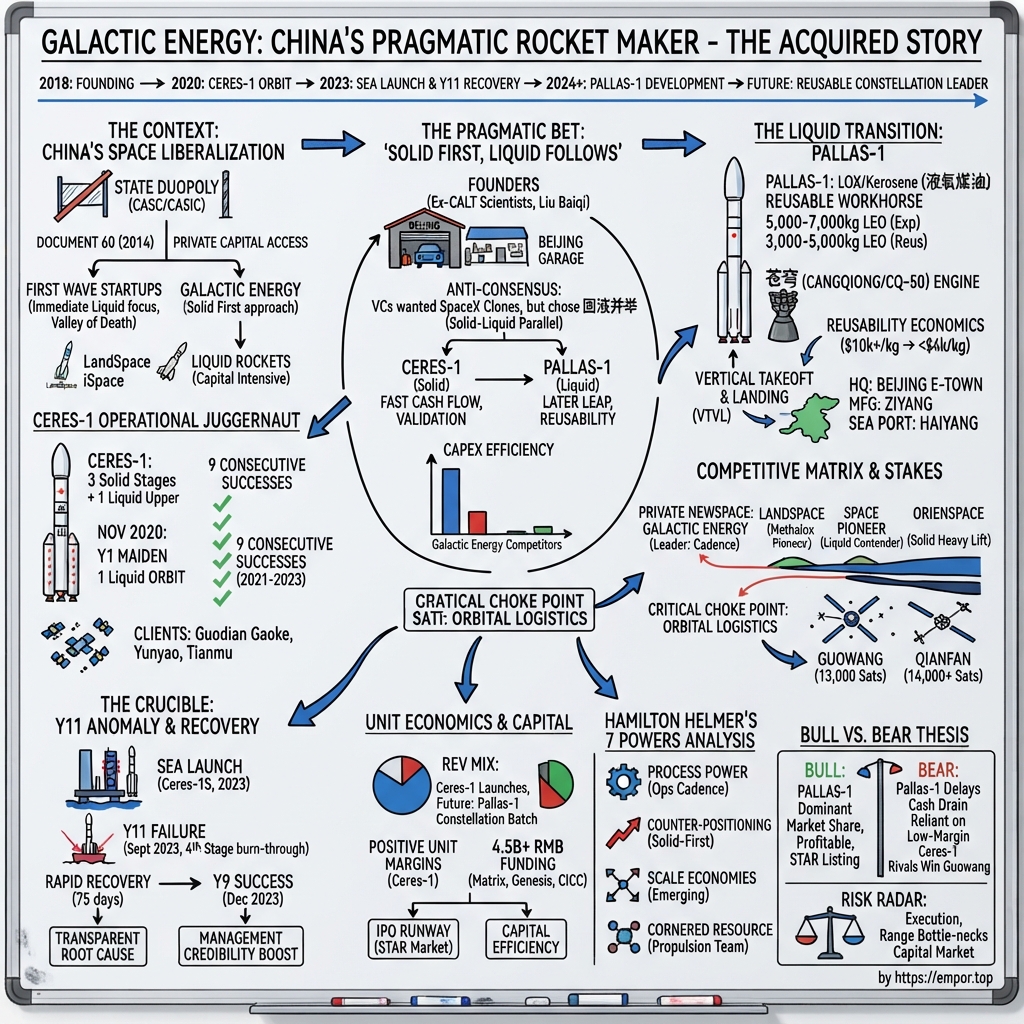
Galactic Energy: The Pragmatic Rocket Maker of China's New Space Age
I. Introduction & Episode Roadmap (00:00 – 12:00 | 12 Mins)
In the second week of August 2026, a scene unfolded at the Jiuquan Satellite Launch Center that had never occurred in Chinese private spaceflight: two identical medium-lift liquid-propellant rockets stood on the site simultaneously. The first, Pallas-1 Y1, had been on the pad since spring. The second, Y2, arrived on 10 August. Galactic Energy told domestic media that Y1 would launch in mid-to-late August on an orbital test flight under the mission name Jia Qingqiu Xi Fan Xinghe (驾青虬兮泛星河), with recovery testing deferred to Y2's inaugural first-stage landing attempt.1
The dual rollout was an unmistakable demonstration of serial manufacturing throughput. It was also an acknowledgment of falling behind.
On 18 August 2026, three days before this report's publication, a domestic rival achieved the milestone Galactic Energy had targeted since 2021. LandSpace's Zhuque-3 lifted off on its second test flight, placed its upper stage into orbit, and executed a controlled vertical landing on deployable legs in Minqin County, Gansu. The mission marked the first propulsive recovery of an orbital-class booster by a private entity outside SpaceX and Blue Origin, and the first in China.2 The domestic race for reusable launch capacity—previously contested through static fires and corporate releases—established its first operational benchmark, leaving Galactic Energy's recovery tally at zero.
That tension defines the central investment question: can a launch operator that has executed more orbital missions than any domestic peer close the gap on the reusable architectures that dictate long-term launch economics?
The hook. Galactic Energy (星河动力) was established in Beijing on 6 February 2018 by Liu Baiqi and Xia Dongkun, two senior engineers from China's state aerospace apparatus.3 The company's core research and development staff numbers several hundred, including 41 PhDs and 107 master's degree holders. Approximately 90% of those engineers bring eight or more years of institutional experience from China Aerospace Science and Technology Corporation (CASC), China Aerospace Science and Industry Corporation (CASIC), or the state aviation conglomerate AVIC.4 Rather than unproven entrants, the founding team comprised veteran system architects focused on building low-cost, repeatable launch vehicles for commercial manifests.
The core paradox. While global attention focused on stainless-steel structures and methalox propulsion, Galactic Energy built its operational base using solid propellant. Its Ceres-1 (谷神星一号) vehicle is a 20-metre, 33-tonne, four-stage rocket—utilising three solid stages and a liquid upper stage—capable of placing roughly 400 kilograms into low Earth orbit or 300 kilograms into a 500-kilometre sun-synchronous orbit at a public list price near US$4.5 million.5
Despite relying on simpler solid-motor technology, Ceres-1 established the only repeatable commercial flight manifest in China's private sector, logging 23 orbital attempts with 21 successes between November 2020 and January 2026.5 By October 2025, Galactic Energy accounted for 51.3% of all successful orbital launches completed by Chinese private launch firms, deploying 85 commercial payloads for 27 customers.6
The stakes. China is currently deploying two primary low Earth orbit megaconstellations: the state-backed Guowang network under China Satellite Network Group, and the Shanghai-backed Qianfan (千帆星座) constellation managed by Yuanxin Satellite, each designed for over 10,000 spacecraft. Deployment schedules remain constrained by launch availability. Qianfan surpassed 200 operational satellites in 2026, exceeding Guowang's 168.7 Relative to SpaceX's Starlink network, the combined Chinese orbital count remains an early-stage deployment bottlenecked by medium- and heavy-lift capacity—the exact segment Galactic Energy seeks to supply.
What this story tests. Galactic Energy remains privately held. The company commenced IPO tutoring with the Beijing bureau of the China Securities Regulatory Commission on 22 October 2025, sponsored by Huatai United Securities, without designating a specific listing board.6 Without a formal prospectus, audited financial statements, a disclosed share structure, or published liquidation preferences, this analysis relies on verifiable filings, regulatory disclosures, state procurement records, technical milestones, peer reporting, and performance against prior management guidance.
The analysis covers:
- Origins. How State Council Document 60 opened commercial space in 2014, and why state-trained systems engineers founded the venture.
- The solid gamble. How Ceres-1 diverged from venture capital consensus to generate near-term flight volume and revenue.
- The crucible. Offshore launch logistics, the September 2023 Y11 flight failure, the 75-day return to flight, and the distinct execution challenges of 2026.
- The next leap. Pallas-1 architecture, CQ-50 engine performance, and the structural economics of booster reuse.
- The arena. Competitive positioning against LandSpace, Space Pioneer, CAS Space, Orienspace, and state-owned launch contractors.
- The money. Ten funding rounds totaling RMB 5.3 billion, a private valuation of RMB 15 billion, and the operational assumptions underpinning that mark.
- The verdict framework. Strategic competitive advantages, macro sector dynamics, deployment scenarios, and the key financial metrics that will determine long-term returns.
 Subscribe on LinkedIn
II. The Launchpad of History: China's Space Industry & Document 60 (12:00 – 25:00 | 13 Mins)
Every Chinese launch startup is a spin-out from a system that was never designed to produce spin-outs.
For six decades, Chinese access to space ran through two state-owned conglomerates. CASC built and operated the Long March family—the workhorse rockets behind crewed spaceflight, lunar exploration, and the country's strategic satellite networks. CASIC, its sibling conglomerate, emerged from missile development and retained deep institutional expertise in solid-propellant propulsion. Between them, the two state entities controlled the design institutes, test stands, propellant supply chains, engineering talent, and military-operated launch ranges across the country.
The Long March architecture excelled at its core mandate: mission assurance and strategic priority. It was never designed to optimise cost per kilogram. Inside state institutes, engineering performance was never measured on gross margins, and production cadence was dictated by annual state flight manifests rather than commercial demand. When commercial satellite demand emerged—first from hundreds of small Earth-observation and Internet-of-Things platforms, then from proposals for low Earth orbit broadband megaconstellations—the state system responded by introducing more Long March variants rather than restructuring its underlying cost base.
The 2014 catalyst. On 26 November 2014, the State Council published Guofa [2014] No. 60, a policy directive aimed at encouraging private capital participation in key infrastructure sectors.8 It was not a formal commercial space programme akin to NASA's Commercial Orbital Transportation Services or Commercial Crew initiatives. Rather, it served as a broad mandate opening historically state-controlled sectors, including satellite launch and space infrastructure, to private investment.
In an industry where the primary barrier to entry was regulatory permission rather than capital, that directive proved decisive. Document 60 became the foundational charter cited by Chinese private launch ventures, establishing market access through broad policy enablement rather than prescriptive technical specifications.
The strategic logic behind the opening combined international competitive pressure with orbital regulatory deadlines. By 2014, SpaceX had demonstrated with Falcon 9 that privately financed launch vehicles could substantially undercut legacy pricing and that propulsive booster reuse was an achievable engineering goal.
More critically for Beijing, low Earth orbit capacity is finite. Constellation operators file for orbital slots and radio frequencies through the International Telecommunication Union (ITU), with allocations tied to strict deployment deadlines: miss the milestone schedule, and the spectrum rights are reduced or forfeited. Like a mineral claim held only by active extraction, orbital rights converted satellite production and launch schedules into strategic time limits. This dynamic explains why Chinese industrial planners funded and encouraged multiple competing private rocket developers rather than consolidating resources behind a single national champion: redundancy became state policy, and commercial launch capacity evolved from a procurement line item into a strategic bottleneck.
The first wave. Between 2015 and 2017, the initial cohort of private rocket companies formed, including LandSpace, iSpace, and Space Pioneer, largely staffed by veteran engineers from CASC and CASIC institutes. Almost all of them pursued liquid-propellant architectures from inception. The technical rationale was clear: liquid engines can throttle, shut down, restart, and support propulsive landing for booster reuse, whereas solid rocket motors cannot.
However, that approach exposed startups to the industry's steepest development cycle. A clean-sheet liquid engine programme demands dedicated test infrastructure, cryogenic propellant management, complex turbopump metallurgy, and extensive hot-fire testing before delivering a payload to orbit. Early entrants spent hundreds of millions of renminbi without establishing flight heritage or operating revenue.
The scale of that capital burn is no longer theoretical. LandSpace, the best-funded pioneer of that initial cohort, disclosed in its STAR Market prospectus annual research and development expenditures of RMB 830 million in 2023, RMB 613 million in 2024, and RMB 922 million in 2025. Against that spending, the company generated RMB 52.1 million in revenue in 2025 while recording a net loss attributable to shareholders of RMB 1.711 billion, bringing accumulated undistributed losses to RMB 5.955 billion by the end of 2025.9
Nine years after its founding, China's leading methalox rocket developer was generating annual revenue equal to less than 6% of its single-year R&D budget.
That capital-intensive valley of death was precisely what Galactic Energy was founded to bypass. Whether avoiding that initial burn through solid propulsion was a durable strategic advantage or merely a deferral of the same development costs is the central question underlying the company's trajectory.
III. The Beijing Garage: Founding Galactic Energy & The Pragmatic Bet (25:00 – 40:00 | 15 Mins)
Galactic Energy registered in Beijing on 6 February 2018, entering the market well behind its peer cohort.3 LandSpace was already three years old and iSpace two, with both competitors funding clean-sheet orbital programmes. While arriving late to a capital-intensive sector is frequently fatal, the timing provided analytical clarity: Galactic Energy's founders could observe firsthand how long and capital-intensive liquid engine development was proving for early movers.
The founders. Chairman Liu Baiqi holds a doctorate from Beihang University and previously worked within the state space establishment. President Liu Jianshe serves as his primary operational partner. Under Chinese securities definitions, the two are formally recognized as parties acting in concert, holding a combined 32.36% direct and indirect equity interest that makes them the company's joint actual controllers.10 Vice President Xia Dongkun, the third core executive, oversees commercial operations and schedule disclosures, having publicly detailed the launch window for Pallas-1.1
The operational model relied on engineering arbitrage: recruit technical talent trained within state institutes, offer equity incentives and operational autonomy, and focus on near-term commercial execution. By November 2025, the company reported more than 400 patent applications and over 150 granted invention patents.4 While patent volumes in domestic aerospace often serve regulatory qualification and subsidy benchmarks rather than defensive moats, they reflect substantial technical output from an eight-year-old hardware business.
The anti-consensus bet. The founding decision that defined Galactic Energy was building a solid-propellant vehicle first. Early private space venture capital broadly favored liquid-propellant architectures modeled on SpaceX. Liu Baiqi countered that copying foreign architectures overlooked local constraints: "if we believe first principles are correct, then we cannot simply copy Musk," arguing that China's distinct industrial base and commercial satellite demand required the most practical, lowest-cost near-term launch solution rather than the most technically sophisticated one.11
The economic rationale behind prioritizing solid motors comprised three operational advantages:
- Time to revenue. Solid motors function largely as propellant castings, avoiding the cryogenic turbopumps, fluid management systems, and multi-year test-stand campaigns that prolonged development at liquid rocket startups. Galactic Energy completed an orbital flight 33 months after incorporation.
- Capital intensity. The lower fixed-cost base of a solid programme enabled early financing rounds to fund flight hardware and orbital missions rather than expensive ground-test infrastructure.
- Operational infrastructure. Orbital launch capability requires more than engine propulsion; it demands range clearance with military-operated launch facilities, regulatory licensing, payload integration, and customer contracting. Ceres-1 established those operational relationships and commercial credibility at a fraction of the cost of developing a medium-lift liquid vehicle.
This phased strategy also shaped corporate governance. By generating commercial launch revenue as early as 2020, Galactic Energy negotiated subsequent equity rounds on operational performance rather than conceptual roadmaps. That commercial traction explains how the founding team retained effective control while raising substantial institutional capital across ten funding rounds.
Capital formation. Although Galactic Energy's full cap table remains private, disclosed financing milestones outline its fundraising trajectory: approximately RMB 500 million across seed and early rounds between 2018 and 2020; RMB 1.27 billion in Series B and B+ capital in 2021, led by Oriental Fortune Capital and Huaqiang Capital; RMB 1.1 billion in Series C and C+ during 2023; a strategic round exceeding RMB 100 million in early 2025; and a RMB 2.4 billion Series D on 28 September 2025, bringing cumulative capital raised across ten rounds to more than RMB 5 billion.121310
The capital-efficiency narrative surrounding Galactic Energy is valid for its early operations: through 2023, the company converted under RMB 3 billion into more successful orbital launches than any domestic private peer. However, that comparative advantage was largely a function of solid-rocket economics. As the company transitions into medium-lift liquid architectures, development costs reset toward peer levels. The RMB 2.4 billion Series D round—the largest single financing completed by a private Chinese launch venture—underscores the capital scale required to fund that transition.12
IV. Workhorse in Orbit: The Ceres-1 Operational Juggernaut (40:00 – 56:00 | 16 Mins)
On 7 November 2020, Ceres-1 Y1 lifted off from Jiuquan and placed the 50-kilogram Tianqi-11 satellite into sun-synchronous orbit.3 Thirty-three months from company registration to orbit was rapid by any standard and, at the time, the fastest turnaround in China's private sector.
The maiden flight proved less significant than what followed. Reaching orbit once is an engineering milestone; reaching orbit repeatedly is an operating business. On 7 December 2021, Galactic Energy became the first Chinese private launch venture to reach orbit twice—a threshold that highlights how few commercial launch startups achieve repeat flight heritage.3
The cadence, honestly counted. The full Ceres-1 flight manifest through early 2026 totaled 23 orbital attempts, with 21 successes and two failures.5 Distributed chronologically, the flight record comprised one flight in 2020, one in 2021, two in 2022, seven in 2023, five in 2024, six in 2025, and one in January 2026.5
The nine consecutive successes from November 2020 through August 2023 established the company's operational reputation. Yet an examination of the broader flight log reveals that launch cadence plateaued. Galactic Energy never scaled beyond six or seven Ceres-1 missions annually, in an addressable market where each additional launch yielded approximately RMB 35 million in top-line revenue.
That plateau represents the defining operational reality of the solid-propellant business. It stems from three interrelated variables that management has not disaggregated publicly: range and pad availability at military-operated spaceports, factory production throughput, and commercial price elasticity. An eventual IPO prospectus will need to separate these drivers. Until formal filings clarify the constraint, underwriters must evaluate the six-flight annual ceiling as the observed operational capacity of the solid franchise rather than a temporary bottleneck.
Who actually buys. The customer registry serves as a direct barometer for the health of China's commercial satellite sector, revealing a profile far more concentrated than the headline tally of 27 clients implies.6 Repeat constellation operators dominate the manifest: Guodian Gaoke's Tianqi Internet-of-Things constellation, which contracted multiple dedicated four-satellite maritime launches; Yunyao Aerospace's Yunyao-1 meteorological constellation, which booked dedicated vehicle capacity across 2024 and 2025; and Chang Guang Satellite Technology's Jilin-1 Earth-observation network.5 The January 2026 offshore mission deployed four additional Tianqi satellites for Guodian Gaoke.14
This repeat pattern presents both validation and vulnerability. Sustained procurement from constellation developers demonstrates genuine commercial utility—these operators returned to the manifest even after a flight anomaly destroyed payload hardware. However, relying on three or four satellite operators creates an acutely concentrated revenue base. If Guodian Gaoke or Yunyao slows deployment or migrates to lower per-kilogram pricing on medium-lift rideshares, a substantial share of Ceres-1 volume evaporates. Customer concentration will represent a primary disclosure item in any equity filing; LandSpace's prospectus showed its top five customers generating over 90% of revenue, with a single anchor account contributing 97.96% in the first half of 2025—an industry baseline rather than an anomaly.15
What the vehicle is. Architecturally, Ceres-1 stacks three solid-propellant stages beneath a small liquid upper stage designed for final orbital injection.5 The configuration reflects a calculated engineering trade-off: solid motors deliver inexpensive, storable, mechanically simple thrust but cannot throttle or shut down dynamically, leaving precise orbital trimming to a compact, low-cost liquid stage.
Those operational characteristics define the commercial value proposition. A solid rocket can be integrated horizontally, transported, erected, and launched on short notice, requiring minimal pad dwell time and eliminating cryogenic fueling procedures. For a satellite customer requiring dedicated orbital insertion on a tight schedule without access to a Long March manifest, that responsiveness commands a pricing premium over rideshare slots.
However, that premium is constrained by insurance economics. A satellite operator's true mission cost equals the launch fee plus payload insurance premiums, which underwriters price directly against vehicle flight heritage. A 91% success rate imposes materially higher insurance costs on a customer than a 98% track record, and that differential reduces the net price a launch operator can extract. In commercial spaceflight, reliability is not a branding attribute; it is a structural component of customer pricing, where every failure permanently compresses achievable margins.
Unit economics, from the founder's own numbers. Liu Baiqi has stated publicly that a small solid launch yields roughly RMB 35 million in revenue, that each flight is unit-level profitable, and—critically—that "the money made from solid rockets is not enough to support liquid rocket R&D."11 That disclosure provides the clearest financial anchor for evaluating the business model.
An annual cadence of six flights at RMB 35 million generates approximately RMB 210 million in gross launch revenue. Even modeling an optimistic 30% gross margin yields around RMB 60 million in gross profit—against a liquid development programme where peer R&D expenditures run near RMB 1 billion annually.9 The solid franchise is not a self-sustaining engine for liquid propulsion development; it is an operational credential.
The supply-chain question. Galactic Energy's operating model pairs internal design of avionics, structural airframes, and separation mechanisms with external procurement of rocket motors and casing materials from state-affiliated suppliers serving CASC and CASIC. Vertical integration has since expanded on the production side: a manufacturing facility in Ziyang, Sichuan entered trial operations in August 2024, designed for an annual output of ten Ceres-1 vehicles alongside 100 Jifeng-1 supersonic target vehicles and 20 Jifeng-2 hypersonic targets.1617
Two strategic insights emerge from this infrastructure. First, a designed capacity of ten Ceres-1 units annually against an executed cadence of five to seven flights demonstrates that manufacturing throughput is not the gating constraint; range access, market demand, or both dictate the ceiling. Second, the target-vehicle portfolio represents a significant, under-analyzed asset: Jifeng-1A is configured as a Mach 2.5 low-altitude supersonic target, while Jifeng-2 operates as a near-space hypersonic target reaching Mach 8 across a 700-kilometre operational range.17 These systems serve military defense training, operating on distinct procurement timelines, margin structures, and disclosure standards compared to commercial launch. While Galactic Energy has not published segment revenue breakdowns, this defense-adjacent line provides both a potential margin buffer and a layer of regulatory complexity ahead of an IPO.
V. The Crucible: Sea Launches, The Y11 Failure, and Recovery (56:00 – 1:10:00 | 14 Mins)
Two weeks in September 2023 captured both the operational peak and the core vulnerability of Galactic Energy's business model—and the way management responded to the setback explained why institutional capital continued to flow.
Going to sea. On 5 September 2023, a Ceres-1S lifted off from a converted barge in the Yellow Sea carrying four Tianqi satellites, completing the company's inaugural maritime launch.5
The operational rationale combined orbital geometry with regulatory liability. China's inland launch centers sit upwind of populated areas, requiring spent stages and fairings to fall on land; clearing designated drop zones imposes strict constraints on launch azimuths and flight windows. A mobile offshore platform eliminates inland drop-zone hazards, enables low-inclination trajectories that inland sites cannot access efficiently, and—critically for a commercial operator—bypasses the competition for scarce pad availability at military ranges.
The maritime architecture delivered immediate utility. Six Ceres-1S missions had flown by January 2026 with a 100% success rate, establishing the platform as the company's most reliable operational asset.14 It also created a tangible competitive differentiator: offshore operations require a dedicated coastal integration base, specialized port logistics, and launch vessel infrastructure. Galactic Energy anchored that capability around the Haiyang Oriental Aerospace Port in Shandong while domestic peers were still competing for inland range access.
The Y11 anomaly and rapid recovery. On 21 September 2023, sixteen days after the maritime debut, the tenth Ceres-1 mission failed, destroying the Jilin-1 Gaofen-04B satellite and terminating a nine-flight success streak.5 While detailed technical root-cause documentation for this specific flight was not made publicly available in the review materials, the company attributed the anomaly to the upper portion of the vehicle and moved swiftly into corrective action.
The decisive indicator for underwriters was the return-to-flight timeline. Ceres-1 Y9 launched successfully on 5 December 2023—just 75 days after the failure.5 For context, state-run investigations into Long March anomalies routinely extend over several quarters. A 75-day turnaround by an early-stage private launch operator was interpreted by the market as proof of engineering depth, institutional discipline, and supply-chain accountability. It also demonstrated pragmatic crisis management: the company acknowledged the loss publicly, stabilized its customer accounts, and returned to the pad before narrative momentum dissipated. Chang Guang Satellite subsequently booked follow-on missions with Galactic Energy—the commercial validation that matters most in launch services.
Yet evaluating that 2023 turnaround requires precision regarding what it proved and what it left untested. The incident confirmed that the engineering team could diagnose and rectify a failure on an established vehicle architecture it had flown ten times, within a subsystem it had designed and a supply chain it controlled. It did not prove that the organization could absorb a clean-sheet vehicle failure while concurrently managing a complex, first-of-type liquid engine development programme. That second test arrived in 2026, establishing a far more revealing baseline for underwriting the Pallas era.
The second failure and shifting dynamics. On 10 November 2025, Ceres-1 Y19 failed when its fourth stage shut down prematurely 510 seconds into the burn, resulting in the loss of Jilin-1 Gaofen-04C and secondary payloads.5 Across 23 orbital attempts, two total mission losses translate to a 91% success rate—respectable for an emerging light-lift launcher, but materially below the 98%-plus threshold expected by commercial constellation operators, and an operational discount that directly inflates customer insurance costs.
The 2026 crucible. On 15 January 2026, Galactic Energy opened the year with a successful Ceres-1S maritime launch, recording the first commercial launch in China for the calendar year.14 Two days later, on 17 January at 12:08 Beijing time, the maiden flight of Ceres-2 failed. The vehicle—a roughly 100-tonne solid-propellant rocket featuring a liquid upper stage, rated to deliver 1.6 tonnes to a 500-kilometre low Earth orbit and 1.3 tonnes to sun-synchronous orbit—suffered an anomaly shortly after liftoff, lost altitude, and crashed near the launch pad, destroying all commercial satellites on board.18 Galactic Energy issued a formal public apology to its mission partners and committed to a comprehensive technical investigation and return to flight.1018
However, the operational response diverged sharply from the 2023 playbook. Galactic Energy published its failure analysis on 17 June 2026—five months after the accident, rather than 75 days.19 The disclosed root cause cited insufficient structural design margins in the support assembly at the rear of the first-stage nozzle throat liner, which allowed the liner to shift under flight loads, opening a hot-gas leak path that ablated adjacent structures and triggered vehicle loss; the company reported that the failure mechanism was successfully reproduced on ground test stands and resolved through verified design modifications.19 The disclosure provided an unusually detailed, technically transparent accounting of a propulsion failure.
The broader operational consequences proved far more disruptive. As of August 2026, Ceres-1 has not flown since its 15 January mission—leaving a launch system with a 21-of-23 flight record grounded for seven months following an anomaly on an entirely different vehicle class.19 Whether driven by shared subcomponents, joint regulatory review procedures, engineering resource diversion toward Pallas-1, or range scheduling conflicts, the commercial outcome is clear. In the pivotal year when Chinese commercial spaceflight was projected to accelerate deployment cadence, the sector's historical volume leader conducted a single successful launch alongside one catastrophic pad failure, putting full-year 2026 launch services revenue on track to contract sharply relative to 2025.
Where the 2023 recovery highlighted rapid operational resilience, the 2026 grounding reveals a structural vulnerability: Galactic Energy's revenue-generating flight operations remain acutely sensitive to single-point failures, and organizational complexity appears to have amplified rather than mitigated that exposure as the product portfolio expanded.
VI. The Liquid Transition: Engineering Pallas-1 & The Reusable Core (1:10:00 – 1:28:00 | 18 Mins)
The reason Galactic Energy cannot stay in the solid business is arithmetic, and the arithmetic is brutal.
Ceres-1 sells for roughly US$4.5 million and lifts 300 kg to a 500 km sun-synchronous orbit.5 That is about US$15,000 per kilogram to SSO, or about US$11,000 per kilogram at its 400 kg low-orbit rating.
Now look at what the megaconstellation buyers actually pay. When Yuanxin Satellite tendered launch services for Qianfan in 2025, the package requiring at least 4.8 tonnes to an 800 km polar orbit carried a budget of about RMB 720 million for three missions — roughly RMB 240 million, or about US$33 million, per launch.20 Per kilogram, that is on the order of RMB 50,000, or roughly US$7,000 — less than half Ceres-1's price per kilogram, for an orbit that is harder to reach.
Solid propulsion cannot close that gap. Solid motors are single-use by construction, their propellant is expensive per unit of impulse, and small vehicles carry the full fixed cost of a launch campaign — range fees, mission management, telemetry, insurance — across a tiny payload. There is also a volume problem that pricing alone hides: a constellation customer needs to deploy eighteen satellites on one dispenser, and Ceres-1's fairing cannot physically hold them at any price.
Reuse itself is worth stating carefully, because it is routinely oversold. Recovering a first stage does not make a launch free; the first stage is perhaps 60–70% of vehicle hardware cost, and that saving is only realised net of recovery hardware mass, the payload performance sacrificed to reserve landing propellant, the cost of the landing site and recovery operations, and refurbishment between flights. A booster that lands but requires months of inspection saves nothing. The economic prize is not the landing — it is the second, fifth and twenty-fifth flight of the same hardware at declining marginal cost, which is why the design target of not fewer than 25 reuses is the number that matters in the specification, and also the number that is hardest to believe before it is demonstrated.
Pallas-1. The answer is a two-stage kerosene/liquid-oxygen vehicle. As described by the company at the August 2026 flight announcement, Pallas-1 (智神星一号) is about 52 metres long with a 3.35-metre core diameter, 283 tonnes at liftoff, 350 tonnes of liftoff thrust, seven in-house CQ-50 engines clustered on the first stage, a vacuum-optimised CQ-50V on the second, a payload capacity of 7 tonnes to low Earth orbit, an optional upper stage, and a design life of not fewer than 25 reuses per booster.121 Reported dimensions have varied across sources and reporting periods; the 52-metre figure is the one attached to the flight configuration.
Two features of that spec sheet carry economic weight. The 3.35-metre diameter is the standard Chinese aerospace tooling and transport dimension, shared with much of the Long March family — a deliberate choice that lets Galactic Energy use existing suppliers, jigs, rail clearances and factory infrastructure instead of inventing them. And 7 tonnes to LEO clears the Qianfan tender's 4.8-tonne threshold with margin, which is the number that determines whether the company can bid at all.
The CQ-50. The engine is the company's real technology asset: a roughly 50-tonne-thrust gas-generator-cycle kerosene/LOX engine, clustered seven-up for 350 tonnes of liftoff thrust.1 Clustering is itself the hard part. Seven engines must ignite within milliseconds of each other, share a common feed system, tolerate one another's vibration and heat, and — for recovery — shut down and later restart a subset in flight. A gas-generator cycle is the pragmatic choice here, exactly as staged combustion is the ambitious one: it is less efficient, simpler, cheaper and better understood, which is the same trade the company made with solids.
Reuse imposes requirements the engine's specification alone does not reveal. A booster returning to a landing site must throttle deeply — an engine that cannot run well below its rated thrust cannot hover-slow a nearly empty stage — and it must restart in flight, twice, having already been through ascent heating. Kerosene engines coke: unburned hydrocarbons leave carbon deposits in cooling channels and injectors that must be inspected or cleaned between flights, which is precisely why refurbishment cost, not landing success, decides whether reuse pays.
Where the programme actually stands. The second stage completed its powerplant test in late September 2025.21 On 4 November 2025 the first stage fired all seven engines in a full static test at the Haiyang facility, which the company described as completing the vehicle's major ground testing.2221 Phase one of a dedicated Pallas launch position at the Dongfeng commercial space innovation zone near Jiuquan was completed in May 2026.23 On 3 August 2026 the company announced the maiden flight for mid-to-late August, orbital insertion only, with no recovery attempt because the recovery hardware — restartable engines, landing legs, grid fins — is not on this vehicle.123 Recovery verification is planned to be phased in across the following two to three flights, beginning with Y2.1
Schedule credibility. This is where management must be judged by behaviour rather than statement. Pallas-1's first flight was targeted for June 2025.24 It slipped to "conditions for first flight by year-end 2025," then to the first half of 2026, then to mid-to-late August 2026.2421 In January 2024, Liu Baiqi told an interviewer that orbital-stage recovery might be possible within three years and multiple reuse within five.25 Those statements were not reckless — they are roughly the industry's realised pace — but they were consistently optimistic by twelve to eighteen months, and a public-market investor should apply that same discount to every forward date the company gives after listing.
The infrastructure bill. The liquid transition is also where the asset-light story ends. Beyond Ziyang, the company has a liquid-rocket manufacturing base in Chizhou, Anhui, planned for 24 liquid vehicles a year, and an assembly base in the Luhe district of Nanjing with reported investment of about RMB 2 billion, phase one targeted for completion in June 2026.16 Add a dedicated Jiuquan launch position, the Haiyang test and sea-launch infrastructure, and engine production tooling, and the company has committed to a fixed-cost base sized for a cadence it has never demonstrated. Twenty-four liquid rockets a year is roughly four times the total number of orbital launches Galactic Energy has conducted in any year of its existence. That capacity is either the foundation of the bull case or the largest single source of future operating leverage running the wrong way.
One further consideration belongs in any assessment of the Pallas programme's cost base: none of this infrastructure is optional or reversible. A launch pad, a landing site, a cryogenic test stand and a 24-vehicle assembly hall are single-purpose assets with negligible resale value. Unlike a software company that can slow hiring, a launch company that overbuilds cannot shrink its way back to breakeven. The commitment is the strategy, and it is why the financing question and the technical question are the same question.
VII. The Chinese Commercial Space Arena: Industry Structure & Competitors (1:28:00 – 1:44:00 | 16 Mins)
On 14 August 2025, Yuanxin Satellite published the winning bidders for the Qianfan constellation's commercial launch tender. Three names appeared for the eighteen-satellite manifest: LandSpace, Space Pioneer, and CAS Space.20
Galactic Energy was not among them.
That procurement outcome provides a clearer assessment of competitive positioning than any cumulative launch tally: it marked the first time China's largest commercial constellation operator allocated capital across the private sector through competitive bidding. The tender carried a total budget of roughly RMB 1.336 billion across seven missions, split into a first tranche of four ten-satellite launches valued at RMB 616 million, and a second tranche of three eighteen-satellite flights budgeted at RMB 720 million.20 Qualifying for the second package required delivering at least 4.8 tonnes to an 800-kilometre polar orbit alongside a maiden flight completed before the end of 2025.20 Pallas-1 met the payload threshold but missed the flight-heritage deadline. Ceres-1 satisfied neither requirement.
Equally revealing was the fate of the first package: the RMB 616 million tender failed twice due to a lack of three qualified bidders.20 In 2025, Chinese commercial launch was not a market burdened by oversupply; it was an environment where a funded commercial buyer could not identify three qualified domestic launchers.
The three tiers.
- Tier 1: The state primes. CASC and CASIC control crewed spaceflight, lunar exploration, deep-space programmes, and sovereign national payloads. They also operate the Long March variants that have carried the vast majority of Guowang and Qianfan satellites to date, including Long March 5B, 6A, 8, and 12.7 These state conglomerates operate without private capital constraints, and their capacity expansions at coastal launch sites like Wenchang directly reduce the addressable shortfall private entrants aim to capture.
- Tier 2: State-adjacent commercial entities. CAS Space, backed by the Chinese Academy of Sciences, operates the solid-propellant Lijian-1 and secured an allocation in the Qianfan procurement.20 Its IPO counselling achieved acceptance on 17 January 2026, with reports indicating a targeted raise of approximately RMB 4.18 billion.1026 In a market where anchor buyers remain state-backed, institutional pedigree serves as a structural distribution advantage.
- Tier 3: Venture-backed private operators. Galactic Energy, LandSpace, Space Pioneer, iSpace, and Orienspace, all competing against compressed constellation deployment deadlines.
LandSpace. The methalox pioneer, and as of August 2026, the technical pacesetter. While Zhuque-3 reached orbit on its December 2025 maiden flight before losing the booster during descent, its second mission on 18 August 2026 achieved orbital insertion and completed a controlled propulsive landing on deployable legs in Minqin, Gansu.2 LandSpace also provides the only audited peer financial baseline in the sector: in 2025, revenue grew eleven-fold to RMB 52.1 million against a net loss of RMB 1.711 billion, driven by RMB 922 million in R&D spending, an operating cash outflow of RMB 1.221 billion, and a debt-to-asset ratio escalating from 31.79% to 54.99%, alongside management guidance projecting profitability no earlier than 2029.9 Its STAR Market listing application was accepted on 31 December 2025 and resumed active regulatory review on 29 June 2026, seeking RMB 7.5 billion—comprising RMB 2.77 billion for reusable production capacity and RMB 4.73 billion for reusable technology development.279
Space Pioneer. The most aggressive liquid-propellant programme, and the most volatile. After reaching orbit on its maiden Tianlong-2 launch, the company conducted the first test flight of its Falcon 9-class Tianlong-3 on 3 April 2026 from a dedicated pad at Jiuquan in an expendable configuration, which resulted in a vehicle loss; the company implemented over 120 engineering modifications prior to the launch and is assembling a follow-on airframe.28 Space Pioneer commanded the highest private valuation in the cohort at approximately RMB 22.5 billion in late 2025.6
Orienspace. The heavy-solid specialist. Gravity-1—configured with three solid core stages and four solid strap-on boosters, generating 600 tonnes of liftoff thrust at a 400-tonne launch weight, rated for 6.5 tonnes to LEO and 4.2 tonnes to a 500-kilometre SSO—completed its third consecutive successful mission from a maritime platform in July 2026, deploying nine commercial payloads, while the company progresses development on its liquid-propellant, recoverable Gravity-2 rated for 25.6 tonnes to LEO.29 Orienspace highlights a crucial market reality: large solid vehicles can fulfill multi-satellite constellation deployment immediately, contesting Pallas-1's addressable commercial manifest before Pallas-1 conducts its maiden flight.
iSpace. The first Chinese private startup to achieve orbit, and subsequently the most failure-prone, continues to secure capital: the company closed a RMB 1 billion Series E round in August 2026, funded primarily by bank-affiliated asset management platforms rather than venture capital—reflecting a broader shift toward state-linked, long-duration institutional balance sheets.26
Where Galactic Energy stands. Galactic Energy retains the lead in cumulative private orbital missions, satellite deployment volume, and historical success rates, operating the only demonstrated repeat commercial franchise in the sector. However, it trails on the defining technical benchmark of the coming decade: operational medium-lift liquid capability with booster recovery. LandSpace has successfully recovered an orbital-class first stage. Space Pioneer has flight-tested a multi-engine liquid booster. Galactic Energy has completed seven-engine static ground fires and awaits its inaugural launch window.
The core competitive challenge is precise. Reusable economics are not established by a single landing; they depend on rapid recovery turnaround, low refurbishment expense, and high flight cadence. LandSpace's lead is real but currently rests on a single recovery, and the operational gap between landing a booster and flying it again profitably remains substantial. Galactic Energy's strategic defense rests on five years of institutional learning in range coordination, launch campaign turnaround, and payload logistics—the execution capabilities that convert recovery hardware into an operating business. That thesis is internally consistent, but until Pallas-1 flies, it remains unproven.
VIII. Business Model, Unit Economics, & Capital Allocation (1:44:00 – 1:58:00 | 14 Mins)
Galactic Energy sells transportation. That structural reality dictates how the business must be evaluated: it is an asset-heavy industrial logistics provider generating lumpy, project-based revenue, not a software company with recurring cash flows.
The revenue engine, as it exists. Essentially all realized revenue to date stems from Ceres-1 and Ceres-1S flight contracts, executed as dedicated launches for anchor constellation operators or multi-payload rideshares. Chairman Liu Baiqi has stated that each small launch generates approximately RMB 35 million in revenue and operates profitably at the unit level.11 An annual volume of six missions in 2025 translates to roughly RMB 200 million to RMB 210 million in gross launch revenue, before factoring in contributions from the Sichuan target-vehicle line. The company has not publicly disclosed audited top-line figures, gross margins, contracted backlog, or segment breakdowns.
Structurally, the commercial launch model exhibits five defining characteristics:
- Transactional revenue. Every mission operates under a discrete contract. There are no subscriptions, automated renewals, or software-style retention metrics; the closest operational analogue is repeat procurement from constellation developers.
- Capacity-gated step functions. Revenue recognizes strictly upon flight execution. The seven-month operational hiatus following the January 2026 anomaly represents a near-total revenue freeze within the primary launch business.
- Customer concentration. A small cohort of commercial constellation programmes—including Tianqi, Yunyao, and Jilin-1—accounts for the vast majority of historical flight volume.5
- Marginal price-taking. Commercial customers can substitute dedicated small launchers for rideshare slots on larger vehicles. The Qianfan tender's implied baseline of RMB 240 million for an 18-satellite deployment establishes a firm price ceiling per kilogram across the domestic sector.20
- Unproven scale economics. Unit profitability on a RMB 35 million expendable solid flight provides no assurance that a RMB 240 million reusable liquid mission will generate positive net margins once launch pads, recovery infrastructure, sea barges, refurbishment facilities, and factory overhead are amortized.
The second engine: target systems. The Ziyang manufacturing facility's planned annual capacity of 100 Jifeng-1 supersonic targets and 20 Jifeng-2 hypersonic vehicles operates alongside a ten-unit Ceres-1 production line.1617 In unit volume, serialized target manufacturing represents a distinct revenue profile from launch services: a defense-adjacent, higher-frequency procurement stream that potentially carries more stable cash flows and superior operating margins. While financial terms remain undisclosed, an expansion into defense training systems alters corporate risk exposure, balancing commercial launch volatility against state procurement cycles and stringent disclosure requirements.
Addressable market size. The Pallas-1 investment thesis rests on capturing batch megaconstellation deployment. Bounding that addressable market requires examining procurement behavior rather than theoretical constellation sizes. Domestic market research estimates 2026 combined satellite manufacturing and launch expenditures for Guowang and Qianfan at approximately RMB 26.8 billion, representing 49% annual growth, within an aggregate national manifest expected to exceed 60 commercial launches and over 100 total orbital attempts.30
Satellite fabrication consumes the majority of that capital. If commercial launch procurement across both constellations totals low single-digit billions of renminbi annually over the near term, capturing a 20% market share would yield roughly RMB 1 billion in annual launch revenue—a transformative expansion above Galactic Energy's historical RMB 200 million base, yet materially below the multi-billion-dollar scale frequently assumed in private market narratives.
The strategic challenge stems from buyer concentration. Commercial launch procurement is dominated by two state-linked megaconstellation operators, both facing compressed deployment timelines and enforcing rigorous technical qualification thresholds.20 In this environment, market share is not secured through brand equity or commercial distribution; it requires an operational, qualified launcher when procurement windows open.
Constellation contracts convert irregular project revenue into multi-year delivery schedules, providing forward operational visibility. Conversely, these awards remain government-linked procurement allocations subject to periodic re-tendering, technical re-qualification, and macro policy shifts, offering limited structural lock-in after a deployment tranche is fulfilled. Contracted backlog value and delivery schedules represent the single most vital operational disclosures required in an IPO prospectus.
Capital allocation. Galactic Energy's financing history reflects a disciplined escalation of capital deployment that accelerated rapidly ahead of operational milestones:
- Approximately RMB 500 million raised through 2020 funded small-launcher development and demonstrated initial orbital capability.12
- RMB 1.27 billion secured in 2021, led by Oriental Fortune Capital and Huaqiang Capital, financed serial Ceres-1 manufacturing and early liquid propulsion research.13
- RMB 1.1 billion raised in 2023 supported the CQ-50 engine programme and offshore launch infrastructure.12
- RMB 2.4 billion closed in September 2025—the largest single equity round completed by a private Chinese launch venture—funded Pallas-1 industrialization, Ceres-2 development, and dedicated launch infrastructure, led by Beijing's commercial aerospace and low-altitude economy fund alongside Nanjing and Sichuan municipal investment vehicles.12
- In July 2026, nine institutional and government-affiliated investors committed a further RMB 400 million.23
Two structural trends define this cap-table evolution. First, the shareholder base shifted decisively from early venture capital firms toward municipal state-owned guidance funds tied to manufacturing locations in Beijing, Nanjing, and Sichuan. Regional public capital frequently requires local capital expenditure and facility commitments, meaning industrial footprints may reflect regional development agreements rather than pure supply-chain optimization. Related-party transactions and government subsidies will form a critical scrutiny area for public market underwriters.
Second, the RMB 400 million raised in July 2026—arriving ten months after a RMB 2.4 billion round during a prolonged launch pause—functions as bridge financing ahead of the Pallas-1 maiden flight rather than an expansion round.
The allocation strategy also reflects a deliberate structural omission: Galactic Energy has not pursued the vertical integration model of operating its own satellite constellation or commercial data network. While avoiding direct competition with its customer base is a rational choice in a market where sovereign entities control orbital networks, it leaves the company as a pure-play transportation supplier exposed to the pricing power of its buyers.
Forward capital requirements. Galactic Energy's future capital intensity centers on fixed-asset deployment, ground infrastructure, and working capital rather than pure engine design. Supporting the Pallas programme requires operationalizing the Chizhou liquid-propellant base designed for 24 vehicles annually, completing the RMB 2 billion Nanjing assembly facility, maintaining dedicated Jiuquan pad positions, and financing component inventory for unproven flight cadences.16 LandSpace's 2025 operating cash outflow of RMB 1.221 billion illustrates the annual cash burn typical of this scaling phase.9 Having raised roughly RMB 5.3 billion across eight years, executing the reusable medium-lift transition will likely demand an additional RMB 4 billion to RMB 6 billion—the primary financial driver behind the company's IPO registration.
IX. Strategy Playbook: Hamilton Helmer’s 7 Powers & Porter’s 5 Forces (1:58:00 – 2:12:00 | 14 Mins)
Strategic frameworks are valuable here primarily because they force a disciplined distinction between the structural advantages Galactic Energy possesses and those it merely projects. Evaluated against fundamental competitive dynamics, the analysis reveals how narrow the company's defensive moat remains.
Process Power — real, narrow, and currently impaired. Galactic Energy's most defensible operational asset is its accumulated procedural expertise in executing launch campaigns: pre-launch checkout protocols, transport and erection logistics, range coordination with military-operated spaceports, offshore platform integration, and standardized payload interfaces. Managing 24 orbital campaigns across inland pads and maritime barges represents genuine institutional learning that cannot be quickly duplicated by capital alone, as evidenced by the 21-of-23 Ceres-1 mission record and six consecutive successful sea launches.514
However, process power in launch services is highly vehicle-specific. Integrating a 33-tonne solid-propellant rocket does not prepare an engineering team to manage cryogenic propellant loading, hold countdowns through tanking aborts, or inspect and refurbish recovered liquid boosters. Furthermore, the 2026 operational pause demonstrates that this process power lacks structural insulation: a seven-month flight stand-down triggered by an anomaly on an entirely different vehicle class reflects shared engineering bandwidth and overlapping regulatory review authorities rather than an insulated, industrialized operation.19
Counter-Positioning — historically decisive, but now exhausted. Between 2018 and 2023, the decision to prioritize solid propulsion functioned as textbook counter-positioning. Incumbents and venture-backed competitors pursuing liquid engines could not pivot to small solid launchers without abandoning the reusable narratives on which their capital was secured. This strategy delivered orbital heritage, near-term revenue, anchor customer relationships, and range access years ahead of peers. Yet counter-positioning is inherently transitional; the advantage expired the moment market economics required a medium-lift liquid vehicle. Galactic Energy is now pursuing the same methalox and kerolox architectures as its rivals, arriving later than LandSpace and operating under identical physical and economic constraints.
Scale Economies — aspirational rather than realized. In theory, operating dual vehicle families allows fixed ground support equipment, sea vessels, avionics platforms, and propulsion manufacturing lines to be amortized across broader flight volume. In practice, the company established manufacturing capacity for ten solid rockets and 24 liquid vehicles annually while flying five to seven missions per year.165 Until annual launch cadence matches that capital footprint, an enlarged physical plant creates negative operating leverage rather than cost leadership. The defining financial variable in commercial launch remains annual flight throughput per unit of fixed overhead, a metric that came under pressure during the 2026 launch pause.
Cornered Resource — partial and localized. The core engineering corps, drawn from CASC, CASIC, and AVIC with 90% bringing eight or more years of state aerospace experience, represents a scarce human resource in an industry where talent development is concentrated across state design institutes.4 However, domestic private rivals recruited from the identical state talent pool. The more defensible cornered resource is physical infrastructure: a dedicated Pallas-1 launch position at the Dongfeng commercial zone, specialized offshore integration facilities at Haiyang, and established range scheduling relationships.23 Launch pad access across Chinese spaceports is strictly rationed, making proprietary pad infrastructure a genuine barrier to entry.
Missing powers. Galactic Energy commands no network effects, which do not exist in contract launch logistics. It lacks brand-driven pricing power, as commercial constellation operators allocate contracts through technical tenders evaluated on cost and payload qualification rather than consumer prestige. Switching costs are also negligible; while payload adapter integration requires engineering work, those frictional costs are immaterial compared to multi-million-dollar pricing differentials across competitive bids.
Porter’s Five Forces applied to Chinese commercial launch.
- Threat of new entrants: low and declining. Licensing operates through strict national regulatory authorities, capital requirements to reach orbit exceed billions of renminbi, pad allocations are constrained, and senior engineering talent is finite. The five primary private ventures currently in IPO counselling effectively define the private field.6
- Buyer power: structural and dominant. Procurement is concentrated between two state-linked megaconstellation operators that purchase capacity through competitive tenders with rigorous technical thresholds and can substitute commercial launchers with state-owned Long March vehicles.207 The design of the Qianfan tender—imposing hard qualification gates, capping budgets, and splitting tranches among multiple vendors—demonstrates a buyer structured to commoditize launch suppliers. A customer base capable of setting price ceilings and enforcing payload thresholds prevents individual operators from extracting durable margin premiums.
- Supplier power: moderate to high. Key inputs, including solid-propellant motor castings, specialized aerospace alloys, high-grade avionics, and specialized test stands, originate within the state aerospace industrial complex. That same supply chain services national defense priorities and state-owned space programmes, which routinely take priority over commercial delivery schedules during component shortages.
- Threat of substitutes: institutionally formidable. While no technological substitute exists for orbital rocketry, Long March variants such as the 6A, 8, and 12 serve as a permanent institutional backstop, having deployed the vast majority of Guowang and Qianfan satellites to date.7 Every capacity expansion across state launch infrastructure directly compresses the addressable market left for commercial startups.
- Rivalry: intense and accelerating. Multiple well-capitalized private ventures, state-adjacent operators, and state primes are targeting the same constellation deployment manifest, simultaneously developing reusable medium-lift vehicles on overlapping timelines to fill newly built assembly facilities. This dynamic creates the standard conditions for industry capacity overbuild and aggressive price competition—an advantageous outcome for national satellite networks, but a persistent headwind for private operating margins.
The strategic synthesis indicates a challenging path to sustained equity outperformance. Galactic Energy’s primary historical advantage—a sequencing strategy that generated early operational cash flows from solid motors—has been fully utilized. Its primary operational asset—campaign execution discipline—remains unproven on cryogenic liquid architectures. Crucially, the company sells into a monopsonistic buyer structure explicitly organized to prevent transportation suppliers from retaining excess profits. While proprietary pad access, launch campaign experience, and RMB 5.3 billion in invested capital position Galactic Energy as a viable competitor for sovereign constellation volume, structural industry dynamics limit its ability to convert launch volume into sustained, high-return margins.
X. The Investment Spine: Bull vs. Bear Case, Risk Radar, & Core KPIs (2:12:00 – 2:26:00 | 14 Mins)
Evaluating the investment thesis begins with what private markets have priced. Galactic Energy's Series D closed on 28 September 2025 at RMB 2.4 billion, establishing a reported post-money valuation of RMB 15.0 billion to RMB 15.8 billion; a separate unicorn index published in June 2025 pegged the enterprise at roughly RMB 16 billion.106 Converted at approximately RMB 7.15 to the US dollar, an RMB 15 billion headline valuation equates to roughly US$2.1 billion.
That figure represents a negotiated transaction price rather than a fundamental enterprise valuation, and four structural constraints limit how much analytical weight it can carry:
- Primary capital into a pre-revenue-scale operator. The RMB 2.4 billion equity injection established the benchmark for the entire enterprise. The round was heavily anchored by municipal and state-backed guidance funds across Beijing, Nanjing, and Sichuan—institutions whose capital allocation mandates blend commercial return requirements with regional industrial policy, local job creation, and supply-chain clustering.12 A valuation multiple set in part by regional development objectives cannot be treated as a pure reflection of discounted cash flows.
- Undisclosed security terms. Late-stage Chinese growth financings frequently incorporate downside protections, including redemption rights, liquidation preferences, anti-dilution ratchets, and founder repurchase obligations triggered by failed or delayed public listings. None of Galactic Energy's specific share-class covenants have been disclosed. If preferred investors hold structural downside protections that extinguish upon an initial public offering, the headline pre-IPO valuation materially overstates the current intrinsic value of common equity.
- Undisclosed share structure. The company has not published common and preferred share counts, employee option pools, or convertible instruments. Without a disclosed share denominator, a fully diluted per-share value cannot be computed, leaving any implied market capitalisation at listing contingent on eventual prospectus filings.
- Incomplete balance-sheet visibility. Cash reserves, bank borrowings, lease commitments, and government subsidy repayment obligations remain undisclosed, alongside the targeted size of primary proceeds. Consequently, multiples must be evaluated on an equity-value basis rather than an enterprise-value framework, precluding direct comparison with debt-adjusted multiples of publicly traded peers.
What is known about the capital structure. Liu Baiqi and Liu Jianshe act in concert to control 32.36% of direct and indirect equity, formally establishing them as joint actual controllers.10 The company is structured as a joint-stock corporation, having registered for IPO counselling with the Beijing bureau of the CSRC on 22 October 2025 under the sponsorship of Huatai United Securities, without designating a specific exchange or board.6 Ten financing rounds totaling more than RMB 5.3 billion sit alongside that control block, indicating that external institutional and state-affiliated investors hold the substantial majority of underlying economic interests.10
The remaining variables constitute routine underwriting diligence items rather than settled facts: board composition and independent oversight, executive remuneration, related-party agreements with municipal shareholders providing land and infrastructure subsidies, weighted-voting structures, lock-up schedules, use of proceeds, revenue-recognition policies for multi-year launch campaigns, and the capitalization versus expensing of propulsion R&D. The absence of public disclosure represents an analytical vacuum rather than an indicator of structural stability.
The comparable cohort. The only direct peers are fellow venture-backed Chinese orbital launch providers competing for the same megaconstellation manifests under the identical national regulatory regime. As of October 2025, combined private valuations across the five domestic launch firms in IPO counselling totaled approximately RMB 85.5 billion: Space Pioneer at roughly RMB 22.5 billion, LandSpace at RMB 22 billion, Galactic Energy at RMB 15 billion, iSpace at RMB 15 billion, and CAS Space at RMB 11 billion.6
Among these peers, only LandSpace has published audited financial statements, making it the primary analytical anchor despite structural differences in propellant choice and payload class. On 2025 revenue of RMB 52.1 million, LandSpace's April 2025 private financing round at an implied RMB 20.7 billion valuation represented an equity multiple of roughly 400 times trailing sales; its proposed RMB 7.5 billion STAR Market offering at a statutory 10% minimum public float implies an eventual listing valuation near RMB 75 billion, or roughly 1,400 times 2025 revenue.159
Multiples of that magnitude reflect the statistical distortion of near-zero revenue denominators. More actionable insights emerge from relative peer comparisons:
- Relative revenue multiples. If Galactic Energy generated roughly RMB 200 million in gross launch revenue during 2025, it delivered nearly four times LandSpace's top-line volume while carrying a private-market valuation roughly 30% lower.119 On a trailing revenue-per-yuan-of-valuation basis, Galactic Energy represents the least expensive asset in the private peer group.
- Technology option pricing. LandSpace has successfully recovered an orbital-class booster; Galactic Energy has not.2 The valuation spread reflects the market pricing long-term option value on reusable architectures over current cash flows generated by expendable solid launchers. That premium is analytically sound: expendable small-launch revenue does not compound, whereas a functioning reusable medium-lift franchise transforms operating leverage.
- Comparison to listed state aerospace. Mature A-share aerospace contractors historically trade at 8 to 10 times sales, reflecting established profitability, defense margins, and state-backed balance sheets.15 Applying that mature benchmark to Galactic Energy's estimated RMB 200 million launch revenue yields an equity valuation of roughly RMB 2 billion—approximately one-seventh of its private valuation mark. The spread between those figures represents the speculative growth premium awarded to private commercial space entrants.
- Free-float dynamics. Total equity value must be distinguished from public trading float. If Galactic Energy follows LandSpace's template of issuing roughly 10% in new equity, the vast majority of shares will remain locked up with founders, regional state funds, and pre-IPO institutional syndicates. A tight initial float amplifies secondary price volatility, rendering early trading performance a poor gauge of underlying operational execution. The fundamental valuation test arrives once statutory lock-up periods expire and early institutional investors assess liquidity.
- Inapplicable international benchmarks. SpaceX trades in secondary private transactions at roughly 92 times sales, an equity valuation supported primarily by recurring, high-margin Starlink broadband subscriptions.15 Galactic Energy operates strictly as a transportation provider, does not own an orbital constellation, and sells no consumer connectivity. Applying satellite constellation multiples to a pure-play launch services contractor represents a fundamental category error.
Other industry segments are equally non-comparable. Western small-launch operators such as Rocket Lab operate within separate regulatory jurisdictions, serve different commercial customer bases, and generate substantial revenue from integrated satellite components. Similarly, domestic satellite manufacturers operate on high-volume production cycles with distinct working-capital profiles. At present, no publicly traded, profitable, reusable orbital launch provider exists anywhere in global capital markets.
Scenario framework and valuation ranges. Setting 2031 as the maturation horizon and modeling a cost of equity between 18% and 22% for a pre-profit industrial tech venture yields three operational scenarios based on launch cadence and achievable pricing:
- Bull Case. Pallas-1 achieves orbit in 2026, demonstrates propulsive booster recovery in 2027, and reaches operational reusability by 2029, lowering refurbishment expense enough to bid profitably near the RMB 240 million constellation baseline.20 An annual manifest of 20 Pallas flights alongside a restored solid launcher line yields RMB 4.0 billion to RMB 4.5 billion in annual revenue by 2031. Assuming a mature reusable operator achieves a mid-20s operating margin and pays China's 15% high-tech corporate tax rate, the business generates RMB 800 million to RMB 950 million in net profit. Capitalized at 30 times earnings and discounted back five years with 25% to 35% equity dilution from future capital raises, the implied present value to current shareholders lands between RMB 8 billion and RMB 12 billion.
- Base Case. Pallas-1 enters operational service, but booster recovery development stretches past 2028 and reuse remains restricted to limited cycles. The company captures a secondary allocation of megaconstellation volume alongside three domestic rivals as price competition compresses margins. Conducting 10 to 12 liquid missions annually at RMB 200 million, supplemented by solid launchers and target systems, generates RMB 2.3 billion to RMB 2.8 billion in revenue with low-teens operating margins. Net present value after dilution settles between RMB 4 billion and RMB 7 billion.
- Bear Case. The Pallas-1 maiden flight fails or suffers multi-quarter slips, the 2026 operational hiatus extends, and expensive factory tooling sits underutilized. The company is forced to raise dilutive bridge capital at flat or down valuations while LandSpace and Space Pioneer absorb primary constellation deployment contracts. Equity value converges toward the distressed replacement cost of physical launch pads, assembly buildings, and engineering assets—a fraction of the Series D mark.
Galactic Energy's RMB 15 billion private valuation sits above the operational base case and requires substantial execution within the bull case. It assumes an unblemished Pallas-1 flight debut, rapid recovery verification, a fourfold increase in annual launch cadence, and durable market share against buyers actively engineering vendor competition. These assumptions are not impossible, but they leave no cushion for prolonged operational stand-downs.
Market dynamics and listing premiums. Chinese hard-tech offerings under the STAR Market's fifth listing standard—the framework accommodating pre-profit technology enterprises, which LandSpace utilized—have frequently listed at material premiums to their private rounds.9 This dynamic is driven by structural scarcity: constrained free floats, retail enthusiasm for domestic space capabilities, dedicated thematic fund inflows, and an issuance window where initial rocket offerings face limited direct equity comparables. The differential between LandSpace's RMB 20.7 billion private financing and its RMB 75 billion implied listing valuation illustrates that scarcity mechanism.15 That spread reflects technical float mechanics rather than expanded cash-generation capacity, and it remains vulnerable to subsequent operational delays.
The Risk Radar.
- Execution risk. The maiden orbital attempt of Pallas-1 remains unproven, while two of the company's previous three launch campaigns across all vehicle lines ended in mission losses. Propulsive recovery introduces a complex second phase of flight testing beyond initial orbital insertion.
- Operational fragility. A seven-month flight stand-down following a single vehicle anomaly highlights how heavily fleet throughput relies on a shared engineering core across both solid and liquid programs.19
- Range allocation and scheduling. Chinese spaceports remain military-administered facilities where commercial operators cannot dictate launch priority; dedicated commercial pad infrastructure at Dongfeng mitigates but does not fully resolve range scheduling constraints.23
- Capital intensity and dilution. Developing, industrializing, and proving booster reusability will require an estimated RMB 4 billion to RMB 6 billion before reaching self-sustaining operating cash flows. Delays in IPO timing or equity market volatility would necessitate dilutive private funding rounds.
- Competitive encroachment. LandSpace's orbital booster landing, Orienspace's operational heavy-solid missions, and ongoing Long March capacity expansions each reduce the addressable launch volume available to venture-backed entrants.2297
- Governance and related-party complexity. Substantial ownership by regional state funds acting simultaneously as industrial landlords, local subsidy sources, and state-linked commercial affiliates creates structural related-party exposure requiring rigorous disclosure.
- Geopolitical market limitations. Western export controls and satellite licensing regulations fully exclude Western commercial satellites from Chinese launch manifests. Galactic Energy's addressable commercial market is permanently bounded by domestic programs and international operators willing to launch within China's regulatory orbit.
The bull case summarized. Galactic Energy remains the only Chinese private rocket developer with an established commercial track record, demonstrated customer retention, active maritime launch capability, dedicated pad infrastructure, a historically unit-profitable product line, and completed manufacturing plants. If Pallas-1 achieves orbit and validates booster recovery within two to three test flights, the company is positioned to transition from small-payload niche missions into a core logistics provider for national megaconstellations—entering that expansion from a lower private valuation base than its primary competitors.16
The bear case summarized. Solid propulsion provided early operational cash flows but created no enduring technological moat. Galactic Energy enters the reusable liquid-propellant market behind the technical front-runner, selling to monopsonistic buyers structured to commoditize launch suppliers, while carrying fixed overhead sized for unprecedented flight volumes. Per-launch profitability on RMB 35 million expendable solid rockets offers no economic insulation against the high capital requirements of reusable liquid operations.
The three core KPIs.
- Pallas-1 milestone progression. Successful orbital insertion on the maiden Y1 flight, followed on Y2 and subsequent missions by controlled aerodynamic descent, grid-fin guidance, and vertical landing. The defining operational threshold is a subsequent re-flight with disclosed refurbishment duration and turnaround costs. Demonstrating booster recovery is a technical milestone; reflying the hardware economically establishes the business model.
- Fleet-wide flight cadence and mission success rates. Resuming regular Ceres-1 launches, validating the redesigned Ceres-2 configuration, and expanding annual flight totals across the fleet. Achieving fewer than ten total orbital missions in 2027 would directly challenge the operating-leverage thesis regardless of individual Pallas test outcomes.
- Contracted megaconstellation payload volume. Formal procurement allocations from Yuanxin Satellite or China Satellite Network Group detailing contracted payload mass and contract value, rather than preliminary intent disclosures.20 Securing formal awards in subsequent megaconstellation procurement tranches serves as the definitive signal that the commercial transition is succeeding.
XI. Epilogue & Final Verdict (2:26:00 – 2:34:00 | 8 Mins)
There is a distinct industrial pattern across Chinese manufacturing that Galactic Energy illustrates with unusual clarity, explaining both the company's early operational success and its current structural risk.
That pattern follows a proven sequence: enter at the accessible end of a technology, capture market share through cost and launch cadence, deploy the resulting commercial revenue and credibility to finance more complex architectures, and arrive at the technological frontier as an industrialized manufacturer rather than a pure pioneer. This sequencing model shaped Chinese market leadership across photovoltaics, commercial batteries, electric vehicles, and high-speed rail. It prioritizes manufacturing execution over novel invention, often building businesses that appear unglamorous during early scaling before establishing substantial operational gravity.
Galactic Energy executed that playbook systematically. The company reached orbit 33 months after incorporation using proven solid propulsion, developed the only repeatable commercial flight manifest in China's private sector, secured 51.3% of all successful Chinese private orbital launches through late 2025, and leveraged that operating record to complete the largest single financing round in domestic commercial space history.612
However, the fast-follower manufacturing playbook rests on a critical assumption: that the technological frontier remains stationary. In solar modules and battery cells, incumbent innovation moved gradually, allowing fast followers with superior scale and factory economics to close the gap. Reusable orbital rocketry presents a fundamentally different economic dynamic. An orbital booster that lands and reflies dozens of times does not merely compete with expendable launch vehicles; it renders them economically obsolete via a structural step function. If propulsive booster reuse functions reliably at scale, the launch operator with the most flight-proven hardware compounds a unit-cost advantage that fixed manufacturing capacity alone cannot overcome.
That operational dynamic is why the events of 18 August 2026 carry decisive weight for this narrative: a domestic competitor achieved booster recovery first.2
Strategic and investment takeaways.
- Operational sequencing is an effective initial strategy with a definitive expiration date. Prioritizing solid propulsion generated near-term revenue, range access, customer relationships, and five years of operational launch campaign experience at a fraction of peer capital burn. However, that competitive advantage expired the moment market demand mandated medium-lift liquid architectures. Counter-positioning rooted in divergent product choices dissolves once competitors converge on identical vehicle classes.
- Operating cash flow that supports launch operations cannot fund capital-intensive propulsion development. Galactic Energy's leadership acknowledged this structural constraint early: per-launch profitability on solid vehicles cannot cover the substantial research and development budgets required for liquid rocket programs.11 Generating commercial revenue from early flight manifests establishes institutional credibility and extends operational runway, but it cannot substitute for the billions of renminbi required to develop reusable liquid propulsion.
- Anomaly recovery timelines reflect institutional capability and can diverge under operational strain. The 75-day return to flight following the Ceres-1 Y11 failure in 2023 established market confidence that translated directly into customer retention and equity financing.5 Conversely, the 2026 sequence—taking five months to publish root-cause findings alongside a seven-month launch stand-down across all vehicle lines—demonstrates the operational friction that emerges when managing expanded product complexity. Underwriters must evaluate how organizational discipline holds during future flight anomalies.
- Buyer concentration establishes the market ceiling. Commercial space procurement is ultimately governed by customer tender specifications rather than vehicle spec sheets. A formal constellation tender outlining rigid payload thresholds, firm budgetary caps, and multi-vendor allocations dictates which vehicle architectures achieve commercial viability.20 Launch developers that align technical roadmaps with procurement criteria secure manifest volume; those that miss qualification windows face prolonged deployment delays.
What is actually being underwritten. Galactic Energy is not an analogue to SpaceX. SpaceX's underlying valuation is supported by operating its own global satellite broadband constellation, which serves as a captive anchor customer for internal launch capacity. Galactic Energy operates strictly as a transportation provider, owning no orbital satellites and selling launch services to state-linked megaconstellation operators structurally incentivized to commoditize launch pricing.
The realistic upside scenario is an operationally profitable, high-cadence transportation contractor—an orbital freight provider capturing a durable share of a domestic launch market that represents low single-digit billions of renminbi in annual procurement, complemented by a defense-adjacent target-vehicle line with undisclosed margin structures.1730 That profile represents a solid industrial enterprise, but it does not support a speculative hundred-billion-renminbi valuation when grounded in discounted cash-flow fundamentals.
The immediate operational test. In the immediate term, Pallas-1 Y1 will attempt its inaugural orbital insertion flight. If the vehicle succeeds, Y2 stands ready at Jiuquan to initiate the recovery verification campaign.1 If the maiden flight fails, a company that has completed a single launch in 2026 will enter its ninth year facing two consecutive maiden-flight failures, fixed factory tooling sized for 34 vehicles annually, and substantial capital requirements without an executed flight milestone to support valuation marks.
Both operational outcomes remain live. What is certain is that the technical answer is imminent, that it will directly impact the company's valuation, and that initial market sentiment—in a pre-IPO listing environment where structural float scarcity can price private rocket developers at extreme multiples of trailing revenue—will offer little guidance regarding the long-term cash-generation capability of the underlying business.15
Galactic Energy built its foundational reputation on disciplined execution in small solid rocketry. Whether the enterprise can replicate that operational success in reusable liquid propulsion is now an empirical question about to be settled on the launch pad.
References
-
星河动力智神星一号 8 月中下旬首飞,任务代号"驾青虬兮泛星河" — Sina Finance / 新浪科技, 2026-08-03 ↩↩↩↩↩↩↩↩
-
Touchdown! Private Chinese rocket aces landing on 2nd-ever flight — Space.com, 2026-08-19 ↩↩↩↩↩
-
Qianfan constellation deployment hits 200 satellites with Long March 8 and 6A launches — SpaceNews, 2026 ↩↩↩↩↩
-
国务院关于创新重点领域投融资机制鼓励社会投资的指导意见(国发〔2014〕60号) — State Council of the PRC, 2014-11-26 ↩
-
蓝箭航天更新IPO招股说明书:营收5210万却亏17亿,为何仍敢冲刺75亿募资? — 新浪财经, 2026-06-30 ↩↩↩↩↩↩↩↩
-
星河动力 刘百奇:商业航天不必照搬 SpaceX | Founder 100 — 极客公园 GeekPark, 2022-06-07 ↩↩↩↩↩
-
24亿元!星河动力完成国内民营火箭企业最高单笔融资 — 界面新闻 Jiemian, 2025-09-28 ↩↩↩↩↩↩↩
-
2026民营航天"第一箭"!星河动力谷神星一号海射型送4星入轨 — 财联社 Cailianshe, 2026-01-16 ↩↩↩↩
-
蓝箭航天IPO:207亿一级估值,750亿二级预期——谁的定价更接近真相? — 钛媒体 TMTPost, 2026 ↩↩↩↩↩↩
-
Maiden flight of Chinese privately developed commercial rocket CERES-2 ends in failure — Global Times, 2026-01-17 ↩↩
-
Galactic Energy Says Ceres-2 Debut Failure Caused by Faulty Nozzle — China in Space, 2026-06-17 ↩↩↩↩↩
-
垣信卫星7.2亿元火箭发射项目公示中标候选人 — 未来天玑 Future Phecda, 2025-08-14 ↩↩↩↩↩↩↩↩↩↩↩↩
-
China's private space firm Galactic Energy completes reusable rocket test for forming satellite constellations — Global Times, 2025-11 ↩
-
Pallas-1 Expected to Debut in August, Developer Raising Funds — China in Space, 2026-07-27 ↩↩↩↩↩
-
Space Pioneer's Tianlong-3 Fails During Maiden Flight From Jiuquan [Tianlong-3 Y1] — China in Space, 2026-04-03 ↩
-
China's record-breaking Gravity-1 rocket launches 9 satellites from a ship at sea — Space.com, 2026-07-22 ↩↩
 LinkedIn
 WhatsApp
 Reddit
 Hacker News
 Email
Email Kindle
 RSS Feed
 Spotify
 Apple Podcasts
 Amazon Music
 Audible
 YouTube