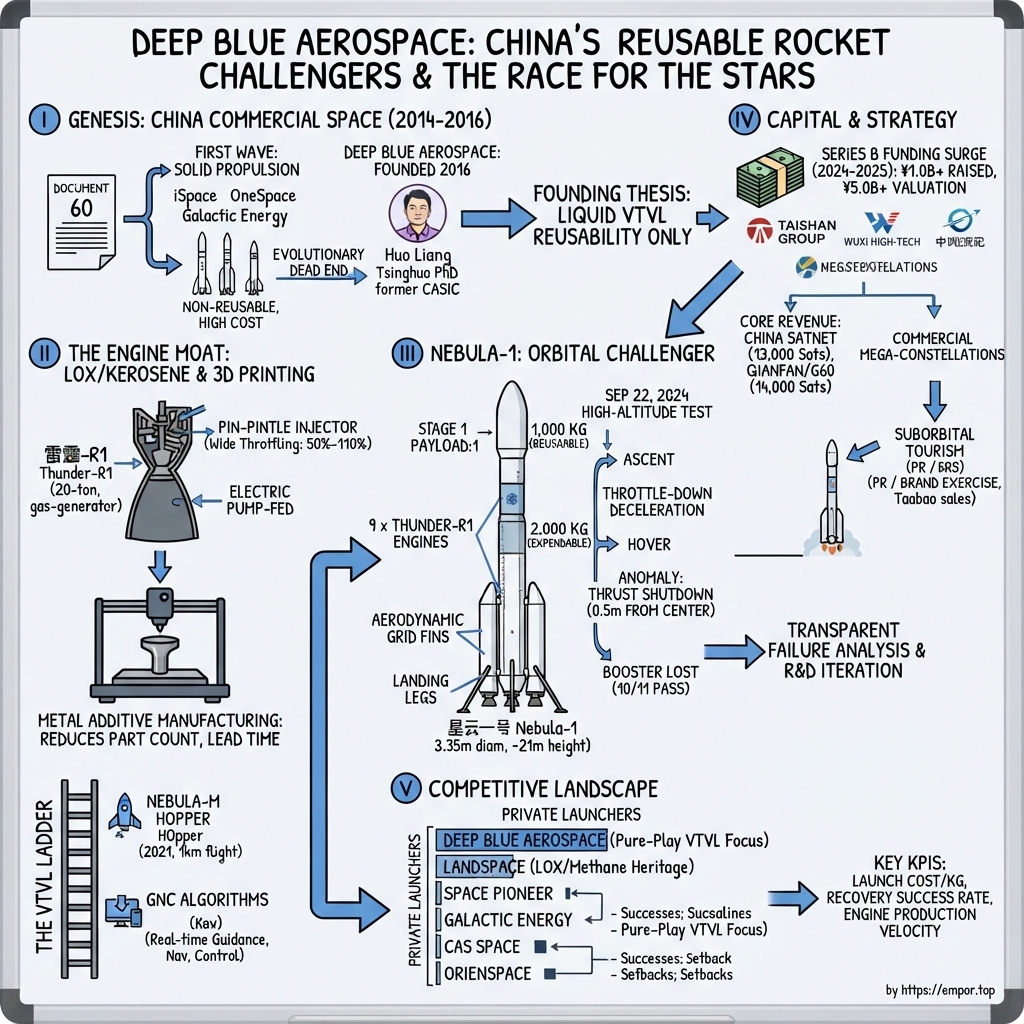
Deep Blue Aerospace: China's Reusable Rocket Challengers & the Race for the Stars
I. Introduction & Episode Roadmap
On the morning of 19 August 2026, at 07:35 Beijing time, a 76.6-metre stainless-steel rocket lifted off from the Dongfeng Commercial Space Innovation Pilot Zone in the Gobi Desert. Eight minutes later, its first stage settled onto a concrete pad in Minqin County, Gansu, on four landing legs. Although a fire broke out in the aft section shortly after touchdown, the milestone remained intact: LandSpace's Zhuque-3 had become the first orbital-class booster recovered on land by a Chinese commercial enterprise.1
Two days later, on 21 August 2026, Deep Blue Aerospace announced its own milestone: the completion of a 100-second long-duration hot-fire test of the Thunder-RS, a 130-tonne-class liquid oxygen/kerosene engine designed for Nebula-2, a rocket that has not yet been built.2
The contrast between those two events frames this story. Deep Blue Aerospace committed earlier and more decisively than any other Chinese private launch startup to vertical recovery as its core thesis. The company was the first in China to hop a liquid oxygen/kerosene vehicle off a pad and land it successfully. It conducted the country's first high-altitude recovery test of an orbital-class stage and positioned itself as China's answer to the Falcon 9. Yet as of August 2026, Deep Blue has never achieved orbit, while two domestic peers — one state-backed and one private — have already recovered boosters.
The inflection point that established Deep Blue's profile occurred on 22 September 2024. At 13:40 at a test site near Ejin Banner in Inner Mongolia, a single-stage Nebula-1 test article ignited three Thunder-R engines and climbed. At altitude, two engines shut down and the vehicle coasted before descending under the throttled thrust of a single engine. The flight lasted 179 seconds. Landing legs deployed, and the stage positioned itself over the pad. In the final seconds, an anomaly in the engine shutdown sequence left the stage higher than the flight computer calculated, causing it to drop the remaining distance and ignite on impact.34 Deep Blue stated that 10 of 11 planned verification objectives were met and characterized the mission as "not completely successful."3
That test marked a milestone as the first high-altitude recovery attempt by an orbital-class Chinese launch vehicle, earning Deep Blue recognition for transparency after management acknowledged the failure immediately on the day of the test.3 Two years later, that narrative faces scrutiny. A second hop attempt in late July or early August 2025 at the same site went unannounced; the vehicle veered off course and was destroyed roughly 630 metres from the pad — an outcome reconstructed by independent analysts from satellite imagery and ground scorch marks rather than disclosed by the company.5
The core paradox. How did a company founded in November 2016 by a Tsinghua mechanical engineering PhD, targeting the most demanding propulsion architecture in Chinese commercial space, secure a reported valuation of roughly ¥5.0 billion (approximately $700 million) — only to watch better-capitalized competitors achieve orbit and recover stages ahead of it?61
The macro imperative. China has mandated the development of low-Earth-orbit mega-constellations at a scale that exceeds current domestic launch capacity. Guowang (China SatNet) is planned for up to 13,000 satellites; Qianfan, the Shanghai-backed constellation also known as G60 or Spacesail, is targeted at 15,000 satellites by 2030; and a third network, Honghu-3, has filed for up to 10,000 satellites.7 As of mid-August 2026, Qianfan had 238 satellites in orbit and Guowang had 195.7 These figures represent a fractional start against planned targets, and the 2026 deployment goals — 324 satellites for Qianfan and 310 for Guowang — illustrate the scale of the ongoing launch bottleneck.7
However, the commercial underwriting case faces a fundamental structural constraint: both constellations currently launch exclusively on state-owned CASC vehicles from national launch sites.7 The commercial launch demand underpinning Deep Blue's valuation has not yet converted into high-volume commercial contracts. It remains an addressable opportunity rather than an active revenue backlog.
The organizing questions.
- The technology bifurcation. Why deep-throttling liquid oxygen/kerosene engines with pintle injectors represent the steepest technical curve for a propulsion startup, yet remain the prerequisite for vertical takeoff and vertical landing (VTVL).
- The manufacturing bet. Whether in-house metal additive manufacturing provides a durable margin and cycle-time advantage or represents a shared industry standard across Chinese launch providers.
- The capital structure. What a ¥5.0 billion private valuation established by a municipal state fund signals about underlying equity value, and what remains unverifiable without audited public filings.
- The commercial focus. Whether commercializing suborbital space tourism tickets via e-commerce livestreams provides meaningful optionality or signals capital diversion.
- The competitive position. What strategic frameworks (Helmer's 7 Powers and Porter's Five Forces) reveal when applied to a pre-orbital launch venture facing state-backed buyers and a commercial rival that has already demonstrated stage recovery.
The analytical scope. First, the propulsion architecture: why deep-throttling liquid engines govern the economics of vertical recovery, and whether Deep Blue's additive manufacturing creates a proprietary process moat. Second, the operating track record: a decade of technical milestones, schedule revisions, and two destroyed test vehicles measured against management commitments. Third, the financing: an audit of disclosed funding rounds, the practical meaning of the ¥5.0 billion private benchmark, and the structural realities of pre-IPO capitalization in China. Fourth, the valuation benchmarks: examining LandSpace's STAR Market prospectus, which targets ¥7.5 billion for at least 10% of post-issue share capital, implying an enterprise valuation near ¥75 billion.89 Fifth, the unit economics: evaluating whether a two-tonne reusable vehicle can generate positive free cash flow in an environment where domestic expendable launchers quote ¥30,000 per kilogram.10
That cost threshold defines the competitive hurdle. In April 2026, CAS Space leadership stated that the expendable Kinetica-2 had reached a launch price of roughly ¥30,000 per kilogram, approximately matching the reusable Falcon 9 benchmark of $5,000 per kilogram.10 Deep Blue founder Huo Liang has projected that mature stage recovery and reuse can reduce per-launch costs by 60% to 70% relative to expendable architectures.11 Both economics can hold true simultaneously, yet leave Deep Blue vulnerable if competitors deploy operational reusable fleets before Deep Blue achieves flight-proven commercial cadence.
 Subscribe on LinkedIn
II. Founding Context & The Genesis of China's Commercial Space (2014–2016)
Chinese commercial space has a definitive starting point. On 26 November 2014, the State Council issued Document 60 — formally titled the "Guiding Opinions on Innovating Investment and Financing Mechanisms in Key Areas and Encouraging Social Investment" — which explicitly encouraged private capital to develop, launch, and operate commercial remote-sensing satellites and to participate in national civil space infrastructure.12 Launch vehicles were not the primary focus of the document, but the regulatory door had been opened, and a generation of state-institute engineers stepped through it.
The policy framework expanded over the following decade. In December 2023, the State Council designated commercial space a strategic emerging industry, shifting the sector from tolerated private initiative to prioritized national objective.[^13] By 2025, the Shanghai Stock Exchange had extended the STAR Market's fifth listing standard — the pre-revenue, loss-making pathway originally designed for biotechnology firms — to commercial rocket companies, prompting five launch ventures to enter the IPO pipeline.13 Understanding that trajectory is essential: Deep Blue's enterprise valuation rests on a regulatory environment that has consistently supported commercial space, but which remains administrative rather than contractual.
The first wave chose the easy path. The private launch companies founded in 2015 and 2016 — including iSpace, OneSpace, and Galactic Energy — initially focused on solid-propellant rockets. That logic was sound in the short term: solid motors draw on mature defence-sector technology, require no cryogenic infrastructure, can be stored and launched quickly, and allowed startups to reach orbit years faster. Galactic Energy built a viable commercial operation on that premise with Ceres-1.
Yet solid propulsion is a technical dead end for reusability. A solid motor burns until its propellant is fully consumed; it cannot be throttled, shut down, and reignited. Reusability requires all three capabilities because of an unforgiving piece of structural arithmetic: a first stage returning to the landing pad is essentially an empty aluminium shell, weighing less than a tenth of its liftoff mass. To hover or touch down softly, engine thrust must be throttled down to match that dramatically reduced weight. An engine unable to throttle below 40% to 50% of rated thrust will push an empty stage back upward. Deep throttling is not an optional enhancement; it is the fundamental prerequisite of vertical recovery.
A distinct pattern in that founding cohort recurs across Chinese deep technology. The founders were not outside disruptors; they were mid-career state-institute engineers with security clearances, systems engineering experience, and personal networks inside state aerospace primes. They left because the policy window opened and state design bureaus rarely offered a thirty-four-year-old chief designer the autonomy to build an orbital vehicle. The technical talent that populated commercial space came almost entirely from the state-owned incumbents it now competes with — meaning no private startup holds exclusive access to that talent pool.
The founder. Huo Liang was born in November 1982 and earned a doctorate in mechanical engineering at Tsinghua University in 2011, studying under Liu Baicheng, an academician and leading Chinese authority on casting and materials forming.14 Huo then spent five years in the general systems design department of CASIC, China's second aerospace prime, rising to chief designer and project lead.14 In 2016, he became a co-founder and vice-president of OneSpace, one of the first-wave solid-rocket startups.1415
Huo did not stay long. Later that year, he left to establish what became Jiangsu Deep Blue Aerospace, betting that the solid-fuel route was a detour.14 Huo's core thesis was not merely that liquid engines were superior — an established industry consensus — but that the years spent developing an expendable solid rocket could never be recovered. He wagered that moving directly to deep-throttling liquid engines would bring the company to reusability sooner, even if it reached orbit later.
A decade later, the outcome of that bet remains mixed. Deep Blue achieved VTVL flight before any other private Chinese firm. Yet as of August 2026, it has not achieved orbit, while LandSpace — which pursued orbital capability through Zhuque-2 before attempting vertical recovery — has reached orbit repeatedly, recovered a booster, and filed for an IPO.18
The founding thesis rested on four core assumptions:
- That reusability, rather than expendable orbital cadence, would be the decisive capability in commercial launch — an assumption that has proven correct and is now industry consensus.
- That the fastest route to reusability was building the landing vehicle before reaching orbit — a contestable choice that has lengthened Deep Blue's path to commercial revenue.
- That an agile team with modest capital could out-iterate better-funded rivals through in-house additive manufacturing — an advantage demonstrated in engine development, but not yet in orbital flight.
- That commercial mega-constellation launch demand would open to private providers just as the technology matured — a thesis that remains unresolved and represents the venture's primary market risk.
The company. Deep Blue Aerospace was incorporated in November 2016 in Jiangsu, establishing its principal operating base in Wuxi, followed by R&D centres in Beijing's Yizhuang district and Xi'an, alongside a manufacturing and propulsion test base in Tongchuan, Shaanxi.16 This geographic footprint reflects the financing mechanics of Chinese commercial space: municipal industrial funds expect local manufacturing, employment, and tax contributions in exchange for equity capital. Wuxi, Tongchuan, and later Tai'an in Shandong became municipal stakeholders as well as operating locations.
The company's early funding was modest venture capital. Shunwei Capital, founded by Xiaomi's Lei Jun, backed Deep Blue's seed round in 2018, followed by a Series Pre-A round exceeding ¥100 million in 2020.6 For an enterprise developing cryogenic liquid propulsion, these were lean capital injections — sufficient to build test stands and prototype engines, but far short of the capital required to manufacture orbital-class launch vehicles. That financial constraint shaped Deep Blue's iterative engineering strategy from the start.
III. The Engine Moat: Liquid Kerosene, Pin-Pintle Injectors, and 3D Printing (2017–2021)
Every serious reusable-launch venture is, at its foundation, a propulsion programme. Airframe fabrication and guidance algorithms present steep engineering hurdles, but the decisive variable for booster recovery is whether an engine can throttle down to a fraction of its rated thrust, maintain combustion stability, shut off, re-ignite in mid-air, and repeat that operating cycle across multiple flights. Deep Blue spent its first five years focused on that propulsion challenge, and the progression of its engine family outlines its underlying technical strategy.
Why kerosene. Deep Blue selected liquid oxygen and refined kerosene (kerolox), whereas LandSpace chose liquid oxygen and methane (methalox) — two choices reflecting different engineering trade-offs. Kerosene is dense, allowing for smaller propellant tanks for an equivalent total impulse; it remains storable at ambient temperatures; and Chinese aerospace possesses decades of operational heritage with it through state launch programmes. Methane burns cleaner, producing minimal soot (coking) inside combustion chambers and turbomachinery, which theoretically simplifies rapid refurbishment and reuse — the rationale behind SpaceX's Raptor for Starship. Kerosene's principal operational drawback is that coking: soot deposits necessitate inspection and refurbishment between launches. Deep Blue's strategic wager is that mature kerolox supply chains allow a reusable vehicle to reach flight readiness sooner, and that refurbishment overhead can be managed through engineering discipline. That premise remains unproven in practice, as no Deep Blue stage has yet flown a second time.
Thunder-5: the proof of concept. The company's initial engine, Thunder-5, was a five-tonne-thrust demonstrator built around two architectural choices that would define all subsequent development. The first was the pintle injector — a design where propellants enter the combustion chamber through a single central plug rather than through hundreds of discrete orifices in a traditional injector faceplate. Pintle injectors offer mechanical simplicity and maintain stable combustion across a wide throttling range, which is critical for landing maneuvers. This architecture shares its heritage with the Apollo Lunar Module Descent Engine and SpaceX's Merlin.
The second foundational choice was manufacturing methodology. Deep Blue reported that 85% of Thunder-5's parts by weight were produced via metal additive manufacturing, describing it as China's first pintle-injector LOX/kerosene engine built with 3D printing.17 That milestone established the company's identity as a "3D-printed rocket maker," a label applied by Chinese technology media as early as its Series A+ financing round in April 2022.17
What additive manufacturing actually buys. In traditional aerospace production, an engine combustion chamber and injector comprise hundreds of individually machined components, each requiring tooling, brazing, or precision welding, and each representing a potential failure point. Selective laser melting allows an entire chamber, complete with internal regenerative cooling channels, to be grown as a single monolithic part. Part counts fall, manufacturing lead times contract, and engineering iteration becomes significantly cheaper, since modifying a design requires updating a CAD model rather than retooling a factory line. For a capital-constrained startup running through rapid prototyping cycles, this approach provides meaningful operational agility.
By 2026, however, additive manufacturing is no longer proprietary. Relativity Space built its core identity on additive manufacturing in the United States, while LandSpace, Space Pioneer, and Chinese state-owned aerospace primes all routinely 3D-print engine hardware. Deep Blue moved early in applying metal additive manufacturing to Chinese commercial liquid propulsion, building in-house expertise in nickel- and copper-alloy fabrication. Yet this represents an execution lead of several years rather than a permanent structural moat. A true manufacturing moat requires verified evidence of lower unit costs, superior production yields, or faster delivery cadences relative to peers — none of which have been publicly disclosed.
Thunder-R1: the working engine. Deep Blue's production engine is the Thunder-R, an open-gas-generator-cycle LOX/kerosene engine in the 20-tonne-thrust class, delivering approximately 22 tonnes of sea-level thrust in its first-stage configuration alongside continuous deep-throttling and in-flight restart capabilities.18 A vacuum-optimized variant powers the upper stage; in a September 2025 static-fire test, this engine operated for 308 seconds at 21.1 tonnes of thrust, validating propellant loading, system interfaces, and thrust-transition sequences.19 Nine Thunder-R engines power the Nebula-1 first stage in a cluster producing approximately 1,800 kN at sea level, paired with a single 207 kN vacuum engine on the second stage.18
Clustering nine engines mirrors the architecture of SpaceX's Falcon 9 for the same physical reasons: achieving a soft vertical touchdown requires throttling down to match a depleted stage's landing weight, which is simpler to accomplish by shutting down outer engines and throttling a single central unit than by demanding extreme throttle depth from one large engine. Yet this architecture carries the same operational trade-offs: nine sets of high-speed turbomachinery, nine ignition sequences, and nine potential points of propulsion failure on every ascent.
Technically, the most demanding component of any liquid rocket engine is the combustion chamber. Operating under flame temperatures far above the melting point of its structural metals, the chamber relies on regenerative cooling — circulating cold propellant through internal wall channels before it enters the combustion zone. Additive manufacturing allows these cooling channels to be grown directly into the structure rather than assembled from brazed tube bundles, driving the bulk of the part-count reduction in modern propulsion hardware.
Scaling a pintle-injector kerolox engine from five tonnes of thrust to twenty-two, and ultimately to one hundred and thirty tonnes, involves far more than simply enlarging component dimensions. Combustion dynamics shift at larger scales; turbopump hydrodynamic loads increase; regenerative cooling channels must dissipate substantially higher heat fluxes; and mechanical stresses on printed chambers outpace wall-thickness growth. Deep Blue has demonstrated the transition from Thunder-5 to Thunder-R and is in the midst of the next scale step. What remains unproven across the entire engine family, however, is the defining benchmark of reusable rocketry: an engine that completes an orbital flight profile, undergoes non-destructive inspection, and re-ignites for subsequent missions without major overhaul.
Thunder-RS: the future engine. The 130-tonne-class Thunder-RS represents a distinct technical scale, designed to power the medium-to-heavy-lift Nebula-2. Huo has stated that over 85% of its core components are manufactured via metal 3D printing and that the engine achieves a throttling range of 50% to 110% of rated thrust.11 The engine was displayed publicly for the first time at a commercial space exhibition in Wuxi in June 2026 and completed a 100-second hot-fire test on 21 August 2026.2 While a 100-second burn marks a legitimate development milestone for a large engine, it must be viewed in operational context: an operational first-stage burn lasts 150 to 180 seconds, and establishing reusability qualification requires accumulating multiple full-duration firing cycles on a single engine article.
The unglamorous economics of printing rockets. Additive manufacturing is frequently described as an outright cost-reduction mechanism, but in practice, it shifts expenses from variable labor to fixed capital investment. Industrial metal 3D printers, specialized powder handling, inert heat-treatment furnaces, hot isostatic pressing equipment, and non-destructive testing systems require substantial capital outlays and possess finite throughput constraints. Furthermore, printed blanks still require precision machining, and build failures result in the scrap of expensive raw alloy powders. The primary economic advantage lies in rapid prototyping and component consolidation, not in low-volume unit-cost reduction.
Deep Blue and its backers frequently point to sharp reductions in part counts and manufacturing lead times achieved through additive methods. However, because the company has not published verified operational metrics — such as per-unit engine manufacturing costs, annual production output, or manufacturing yield rates — this claimed advantage remains a qualitative management narrative rather than an audited operational proof. For an enterprise whose primary competitive thesis centers on manufacturing efficiency, this data gap represents a critical uncertainty that public-market investors would expect to see addressed.
Capital discipline, or capital constraint. Rather than queuing for limited test slots and paying user fees at state-run facilities, Deep Blue built its own dedicated liquid-engine hot-fire test complex in Tongchuan, Shaanxi.16 Management frames this decision as vertical integration designed to accelerate development cycles. It is also the practical response of a startup facing structural slot rationing at state test stands. In either case, the decision converted ongoing operating expenses into capitalized fixed infrastructure — an economically sound posture for an enterprise that will need to fire engines thousands of times, yet a substantial capital commitment for a pre-revenue business.
IV. The VTVL Ladder: From Hopper Tests to Kilometers (2021–2023)
Vertical recovery is learned in incremental steps: hovering several metres off the pad, climbing to a hundred metres, reaching a kilometre, and only then attempting descent from orbital velocities. Deep Blue progressed through that developmental ladder faster than any domestic peer, establishing its operational reputation between 2021 and 2023.
The flight test sequence progressed in rapid succession:
- July 2021 — 10 metres. A Nebula-M test article lifted off, hovered, and touched down softly. Deep Blue reported the flight as China's first vertical recovery test of a liquid oxygen/kerosene rocket.6
- October 2021 — 100 metres. A low-altitude VTVL flight achieved a controlled return to the pad, which the company designated as another domestic first at that scale for a kerolox vehicle.6
- May 2022 — 1 kilometre. In its primary proof of concept, the Nebula-M ascended to roughly 1,000 metres, transitioned to unpowered coast, re-ignited its Thunder-5 engine with continuous deep throttling, deployed landing legs, and touched down near the pad centre.20
What the kilometre flight proved, and what it did not. The one-kilometre test validated core low-altitude propulsion dynamics: an additive-manufactured, pintle-injector kerolox engine could shut down, re-ignite in mid-air, and throttle dynamically during descent while flight-control algorithms solved for the landing trajectory in real time. Demonstrating closed-loop thrust modulation during descent is a genuine engineering hurdle and the prerequisite capability for any prospective vertical landing.
However, low-altitude hops do not replicate the flight regimes that present the greatest risk to returning orbital stages. A kilometre-scale test never reaches supersonic speeds, encounters no aerodynamic heating or severe re-entry pressures, bypasses the transonic buffet where grid fins must actively trim the vehicle, and requires none of the long-range guidance precision demanded when guiding a stage back to a pad or downrange landing vessel from tens of kilometres downrange. Transitioning from a one-kilometre hop to an orbital-class recovery is not merely a scaling factor in altitude; it represents a fundamentally distinct domain of physics.
That distinction extends directly to the guidance architecture. Vertical booster recovery is a dynamic, real-time optimization challenge: the flight computer must continuously recalculate a trajectory that touches down at a designated coordinate with near-zero vertical and horizontal velocity, using an engine with bounded throttling authority against variable atmospheric winds. Deep Blue's kilometre flight confirmed that its flight software could close that control loop at low velocities. However, the September 2024 test failure highlighted that the guidance stack remained vulnerable to discrepancies between commanded thrust and actual engine shutdown dynamics during the final terminal descent — leaving the control loop unclosed precisely at touchdown.34
The differentiation trade. While Deep Blue focused on low-altitude recovery, domestic competitors pursued orbital qualification. Space Pioneer's Tianlong-2 reached orbit in April 2023, marking the first successful orbital launch by a privately developed Chinese liquid-propellant rocket.21 LandSpace followed on 12 July 2023 with Zhuque-2, achieving the world's first orbital flight by a methane-fueled launch vehicle.21
Deep Blue management characterized its path as a calculated trade-off: bypass expendable orbital records to focus capital and engineering resources entirely on reusability. In 2023, that posture appeared to be disciplined focus. By August 2026, the strategic consequences of that trade-off are evident.
Orbital flight serves as an indispensable operational forcing function. Launch campaigns generate critical empirical data across staging events, payload-fairing jettison, vacuum engine ignition, orbital telemetry, telemetry range safety, and countdown operations under operational weather constraints. Orbital launches also generate commercial revenue, qualify providers on customer procurement lists, and establish regular manufacturing rhythms. LandSpace's approach — establishing operational cadence with an expendable vehicle before scaling to reusability — allowed its engineering and manufacturing operations to compound faster. By August 2026, LandSpace had flown Zhuque-3 twice and recovered a stage on land, whereas Deep Blue had yet to attempt an orbital launch.1
In competitive terms, the 2021–2023 development window carried distinct strategic costs:
- Absence of launch revenue. Competitors reaching orbit entered commercial launch manifest pipelines and generated initial operational cash flow.
- Limited range operations experience. Hop tests do not replicate the logistical complexity of orbital launch campaigns, including hazardous propellant management, national range coordination, and strict launch-window constraints.
- Nascent production and supply-chain cadence. Fabricating single annual test articles does not exercise vendor networks, rigorous quality-assurance systems, or volume manufacturing workflows to the degree required for orbital-class serial production.
- Compressing technical lead time. While Deep Blue demonstrated vertical landing mechanics early, better-capitalized peers that attained orbital capability were able to apply their operational scale and balance sheets to the reusability challenge.
Contextualizing the "second in the world" milestone. Deep Blue and industry observers have often described the company as the second entity globally, after SpaceX, to complete a comprehensive low-altitude VTVL engineering test cycle with a kerolox vehicle.14 While technically precise, that claim relies on narrow architectural parameters: Blue Origin had repeatedly flown and landed its New Shepard booster on liquid hydrogen by 2021, and LinkSpace had conducted lower-altitude Chinese kerolox hop tests beginning in 2018. Highly qualified technical records are a hallmark of commercial launch marketing, and investors must distinguish narrow development claims from full operational capability.
V. Setbacks, Capital Injection, and the High-Altitude Test (2024–2025)
If sections III and IV describe an engineering team systematically navigating a demanding propulsion roadmap, the 2024–2025 period reveals where that development schedule broke down.
The vehicle. Nebula-1 is a two-stage kerolox launch vehicle standing 30.2 metres tall, with a 3.35-metre-diameter first stage, a 2.25-metre second stage, a liftoff mass of approximately 150 tonnes, and a propulsion stack comprising nine Thunder-R engines on the booster and a single vacuum engine on the upper stage.18 Deep Blue quotes a nominal payload capacity of roughly 2,000 kilograms to low Earth orbit and approximately 1,000 kilograms to a 500-kilometre sun-synchronous orbit, with booster recovery reducing expendable capacity; third-party compilations estimate up to 2,800 kilograms to LEO in fully expendable mode.1822 That variance underscores an ongoing information gap: without audited regulatory filings, the baseline payload specifications for the company's primary near-term vehicle remain unstandardized.
A two-tonne payload class places Nebula-1 in the light-to-medium launcher bracket — a capacity profile with significant commercial implications evaluated in section VI.
The September 2024 anomaly. The high-altitude recovery test conducted on 22 September 2024 represented, from a systems-validation perspective, a near-complete technical flight profile: 179 seconds of duration, three-engine liftoff, dual-engine shutdown at apogee, unpowered coast, throttled single-engine descent, landing leg deployment, and terminal positioning over the landing zone.34 The vehicle was destroyed in the final seconds when an engine shutdown anomaly occurred at an incorrect altitude, causing the stage to drop onto the pad.3 Deep Blue acknowledged the outcome on the day of the test, reporting that 10 of 11 flight objectives had been verified, and stated that a follow-up test would take place within approximately two months.3
The unannounced 2025 failure. That follow-up test did not occur in two months; it took nearly a year. When it took place in late July or early August 2025, the test failed and was not publicly disclosed. Independent analysts identified the attempt through satellite imagery of scorch patterns at the Ejin Banner test site — located on the opposite side of the pad from the recovery area — determining that a replacement test article had drifted off course and been destroyed roughly 630 metres away.5 Following that incident, public reporting on first-stage vertical recovery flight tests ceased.19
This episode highlights an important shift in management communication. An organization that established market credibility through immediate transparency following a high-profile near-miss chose silence after a catastrophic test failure. For investors assessing corporate governance, the contrast between the disclosed 2024 test and the undisclosed 2025 attempt indicates selective disclosure: comprehensive reporting when performance supported the company's narrative, and silence when it diverged.
Ground testing and platform milestones in 2025–2026. Deep Blue's disclosed technical progress in late 2025 centered on static-fire verifications: a 308-second burn of the Thunder-R vacuum engine at 21.1 tonnes of thrust in September 2025, followed by a first-stage static-fire test in November 2025.1922 By late March 2026, an integrated Nebula-1A vehicle was positioned at Haiyang, Shandong, on the Lianli Island offshore recovery platform, an artificial island facility commissioned that month.22 Industry observers noted that the vehicle was not equipped with landing legs, indicating that its initial flight profile was planned as an expendable mission ending in a controlled ocean splashdown rather than a pad recovery.22
The maiden orbital timeline. In a February 2026 interview, Huo Liang stated that Nebula-1 would conduct its maiden orbital flight following the 2026 Lunar New Year, attempting both orbital insertion and high-altitude first-stage recovery on the same mission.11 Lunar New Year 2026 occurred in mid-February. As of 21 August 2026, no orbital launch has taken place, and the company's recent public engineering disclosures have shifted to the Thunder-RS engine under development for Nebula-2.2 Launch site selections have also evolved, transitioning from earlier plans at the commercial pad in Wenchang, Hainan, to the Haiyang offshore platform.1922
The schedule track record. Nebula-1's maiden orbital flight target has slipped repeatedly: initially slated for late 2024, it moved to mid-2025, late 2025, early 2026, and then the second quarter of 2026, without reaching the launch pad for flight.1619 Schedule slippage is routine across commercial launch development; SpaceX, Rocket Lab, and Blue Origin each experienced multi-year delays. For underwriters, however, the critical metric is whether the cadence of delay is stabilizing. In Deep Blue's case, the flight article has remained on the pad in Haiyang since March 2026 — roughly five months without an ignition attempt — pointing to unresolved technical or regulatory clearances rather than fabrication bottlenecks.
Disclosed financing history. Deep Blue's developmental milestones have been supported by a sequence of venture and state-backed financing rounds:
- 2018 — Seed Round. Backed by Shunwei Capital, the venture firm co-founded by Xiaomi's Lei Jun.6
- 2020 — Series Pre-A. Exceeding ¥100 million in aggregate proceeds.6
- January 2022 — Series A. Approximately $31.5 million raised.16
- April 2022 — Series A+. Nearly ¥200 million led by CMBC International Holdings, allocated toward Nebula-1 development, the Thunder engine series, and manufacturing tooling.1716
- August 2024 — Series B2. Nearly ¥1.0 billion in committed capital, led by Wuxi High-Tech Zone Investment Holding Group.6
- March 2025 — Series B4. Nearly ¥500 million, led by the Tai'an Yuanwang New Energy Industry Investment Fund, managed by the state-owned Taishan Industry Development Investment Group.623
Disclosed B-series funding rounds total more than ¥1.5 billion, with reporting surrounding the B4 financing establishing a private company valuation of approximately ¥5.0 billion.6 Cumulative lifetime capital raised likely falls in the ¥2.0 billion to ¥2.5 billion range, though unannounced round sizes prevent an audited lifetime total.
Deconstructing the ¥5.0 billion valuation benchmark. The ¥5.0 billion headline valuation reflects a specific transaction structure: an approximate ¥500 million primary preferred investment — roughly 10% of post-money equity — completed by a municipal industrial fund tasked with developing an aerospace supply chain in Tai'an.623
This capital structure carries three clear analytical implications. First, the marginal investor was an economic development entity seeking municipal employment, tax base expansion, and local manufacturing footprint, rather than a purely return-maximizing financial sponsor. Second, the investment was executed via preferred shares with downside protections — including liquidation preferences, anti-dilution clauses, and redemption rights tied to IPO listing deadlines — that are standard in Chinese growth equity. Third, extrapolating a preferred share valuation across the entire share register overstates common equity value by failing to discount for those senior protections.
Because detailed transaction terms remain private, the ¥5.0 billion figure must be interpreted strictly as the pricing benchmark of a protected, state-directed equity placement in March 2025, rather than an unencumbered enterprise valuation in August 2026, seventeen months later and following two booster recoveries by domestic peers.
VI. Commercial Strategy & The Space Tourism Sidecar: Substance vs. PR
On 24 October 2024, Huo Liang appeared on a Taobao livestream and sold two tickets to space. They were priced at ¥1.5 million each — about $210,900 — against a ¥50,000 deposit, for a twelve-minute suborbital flight scheduled for 2027 that would carry passengers to 100–150 kilometres, deliver at least five minutes of weightlessness and return under parachutes.24 It was the most widely covered thing the company has ever done, and it is worth roughly nothing.
Understanding why requires starting with the business that actually matters.
The market Deep Blue is building for. China's planned LEO constellations are enormous on paper: up to 13,000 satellites for Guowang, up to 15,000 for Qianfan by 2030, up to 10,000 for Honghu-3, plus smaller programmes including Geely's 6,012-satellite plan and a 1,132-satellite Tianqi constellation of roughly 360-kilogram spacecraft.7 Add them and the category tops 45,000 satellites.
That number is a category TAM, and category TAMs are the most dangerous input in a pre-IPO underwriting. The reachable market is much narrower, and four constraints define it.
- Constraint one: the buyers are not buying from private launchers yet. Both Guowang and Qianfan currently fly exclusively on state-owned CASC vehicles from state launch sites.7 Not a single Chinese private launch company has been publicly confirmed as a contracted volume supplier to either programme. The demand is real; the procurement relationship is not yet established.
- Constraint two: deployment is running far behind plan. Qianfan reached 200 satellites in orbit in June 2026 and 238 by mid-August, across 14 launch groups; Guowang stood at 195 across 24 groups.257 Against 2026 targets of 324 and 310 respectively, and against 2028–2030 plans requiring thousands of satellites per year, the programmes are behind — which is simultaneously the argument for more launch capacity and the evidence that the money is not yet flowing.7
- Constraint three: Nebula-1 is small. At roughly 2,000 kg to LEO, a Nebula-1 flight carries perhaps five 360-kilogram constellation satellites.227 A Long March 6A launch group for Qianfan carries eighteen.25 Constellation operators buy by the batch because integration, range time and orbital plane management all favour fewer, larger launches.
- Constraint four: the price to beat is already low. The Long March 6 was offered at a starting bid of ¥80,000 per kilogram in a 2023 commercial auction, which is the number Deep Blue's cost narrative was built against.26 But in April 2026, CAS Space's vice-president stated that the expendable Kinetica-2 had reached about ¥30,000/kg — roughly $4,200 — and described that as comparable to the reusable Falcon 9 at about $5,000/kg.10
That last point is the single most underappreciated fact in the Chinese reusability debate. Deep Blue's business case assumes reuse is required to reach low cost. A competitor has demonstrated that a large expendable rocket, built cheaply and flown often, can get most of the way there without any of the mass penalty, recovery infrastructure, refurbishment labour or landing risk that reusability imposes. Huo's own claim — that stable reuse could cut single-launch cost 60–70% versus expendable vehicles — is a claim about Deep Blue's own expendable baseline, not about the industry's best cost curve.11
What the economics actually have to do. Launch is an asset-heavy, project-based industrial business, not a software business, and the metrics that matter are correspondingly physical:
- Recoverable fraction and refurbishment cost. The whole thesis reduces to: what fraction of vehicle cost sits in the recovered stage, how many times can it fly, and what does it cost to make it flight-ready again? Falcon 9's economics work because the first stage is most of the vehicle cost and refurbishment is cheap. Kerosene coking makes the refurbishment side harder, and Deep Blue has no data on it, because it has never refurbished a flown stage.
- Cadence. Fixed costs — factory, test stands, launch site, engineering headcount — are amortised over flights. One flight a year amortises nothing. This is why the maiden flight matters less than the fifth.
- Payload utilisation. A rocket flown half-empty carries its full cost. With a 2-tonne class vehicle serving customers who want to launch in batches, utilisation risk is structural.
- Recovery-configuration payload. Reserving propellant for the landing burn cuts payload materially — Deep Blue's own figures imply roughly halving it.22 The reusable vehicle is therefore competing at an even smaller effective payload against expendable rivals.
Revenue quality: there is almost nothing to assess. Deep Blue has not disclosed revenue, backlog, contract values, customer names or gross margin. The strongest commercial statement on record is Huo's February 2026 remark that the company has "preliminary launch agreements with multiple satellite constellation companies" for Nebula-2.11 Preliminary agreements in launch services are typically non-binding memoranda contingent on vehicle qualification. They are a marketing asset, not a backlog. Until a first flight succeeds, Deep Blue has no product to sell, and therefore no revenue quality to test — no recurring versus transactional mix, no pricing evidence, no concentration disclosure, no contract duration.
For context on what a real early launch P&L looks like, LandSpace — with an operational rocket — recorded revenue of ¥0.78 million in 2022, ¥3.95 million in 2023, ¥4.28 million in 2024, ¥36.43 million in the first half of 2025 and ¥52.10 million for full-year 2025.827 That is the scale of revenue an orbital-capable Chinese private launch company generates while its net losses run to hundreds of millions of yuan a year.8 Deep Blue's revenue today is very likely smaller than the earliest of those figures.
Now the tickets. The suborbital tourism programme is coherent as a brand exercise and incoherent as a business line. Two tickets at ¥1.5 million gross ¥3 million; the collected deposits were ¥50,000 each.24 The economics do not scale into materiality within any plausible forecast horizon, because the binding constraint is not demand but human-rating: certifying a vehicle to carry people requires abort systems, redundancy, life support and a flight-proven reliability record that Deep Blue's cargo vehicle does not yet possess in any configuration.
It is also not costless. Three risks attach to it. First, engineering attention: human-rated hardware is a separate development programme, and this company's central problem is that it has too many programmes for its capital base. Second, regulatory: China has no established commercial human-spaceflight licensing regime, and a private company selling seats ahead of one invites the rule-making to be written around its own risk profile. Third, reputational and legal: the tickets were sold in October 2024 for a 2027 flight, and as of August 2026 the vehicle that would fly them has not reached orbit even uncrewed. A slipped consumer promise creates refund obligations and a credibility cost that a slipped engineering milestone does not.
The right materiality weighting is that space tourism represents a small single-digit percentage of any defensible estimate of terminal equity value, while orbital launch for constellations represents nearly all of it. The tourism programme should be read as evidence about management's promotional instincts rather than as an asset.
VII. Competitive Landscape: China's Private Space Arena
The competitive position is best understood by asking a simple question: as of today, who has flown, who has landed, and who has been paid?
The field.
- LandSpace. The clear leader. Zhuque-2 reached orbit in July 2023 as the world's first methalox rocket to do so.21 Zhuque-3 — 76.6 metres, stainless steel, methalox, nine engines — reached orbit on its December 2025 maiden flight with an unsuccessful recovery attempt, then flew again on 19 August 2026 and landed its booster in Gansu, with a post-landing fire in the aft section.1 It has filed for a STAR Market listing seeking ¥7.5 billion.8
- Space Pioneer. Reached orbit with the kerolox Tianlong-2 in April 2023.21 Its much larger reusable Tianlong-3 conducted a maiden flight in 2026 that failed.28 Reported private valuation above ¥20 billion, with roughly ¥2.5 billion raised across pre-D and D rounds in October 2025.29
- Galactic Energy. The cadence leader, with a long run of successful Ceres-1 solid-rocket launches and the reusable liquid Pallas-1 in development. Reported valuation around ¥15 billion; raised over ¥1 billion in strategic financing plus a ¥2.4 billion D round in September 2025, and entered IPO guidance in October 2025.29
- CAS Space. The Chinese Academy of Sciences spinout. Kinetica-2 flew successfully on 30 March 2026.28 Its IPO application was accepted on 31 March 2026 with a first regulatory inquiry on 15 April 2026; reported valuation around ¥11 billion.3029
- iSpace. Reported valuation around ¥15 billion, with the reusable Hyperbola-3 targeting a mid-2026 orbital launch.29
- Orienspace. Solid-liquid hybrid heavy-lift with Gravity-1 and sea-launch capability; Gravity-2 was among the vehicles slated for a 2026 debut.24
And above all of them sits the state. CASC recovered the first stage of a Long March 10B in July 2026 — China's first recovery of an orbital-class booster, ahead of every private company.281 The incumbent is not a slow cost-plus dinosaur waiting to be counter-positioned. It is reusing rockets too.
Where that leaves Deep Blue. On the two metrics that determine commercial standing — orbital flights completed and boosters recovered — Deep Blue is at zero and zero. On private valuation, at roughly ¥5.0 billion it is the smallest of the recognised launch startups, marked at roughly a quarter of LandSpace's reported private level and a third of Galactic Energy's or iSpace's.629 On IPO process, it is the only one of the group with no publicly reported listing guidance, while five peers are at various stages of the STAR Market pipeline.29
The company's defence is genuine focus. It is the purest VTVL play in the field: a single architecture, a single propellant, a single engine family scaled from 5 to 22 to 130 tonnes, and a decade of landing-specific flight data that nobody else in China accumulated as early. If reusability is the only thing that matters in the end, being second or third to orbit but first to a mature recovery process could still win. That is the bull thesis in one sentence, and it now requires believing that a company with no orbital flights will out-execute a company that has already landed a booster.
Geography as strategy. Deep Blue's operational footprint is a map of municipal support: Wuxi in Jiangsu, where a Huishan district plant was completed and handed over in 2026 and where the local government has set a "hundred rockets, thousand satellites" manufacturing goal for 2030; Tongchuan in Shaanxi for propulsion testing; Tai'an in Shandong following the Taishan-led B4 round; and Haiyang in Shandong for launch and sea recovery.31162322 Meanwhile China operated 18 commercial launch pads as of July 2025 with seven more under construction, so pad access — a genuine constraint two years ago — is easing.24
Constructing the comparable set, and what it can support.
The only Chinese launch peer with audited public financials is LandSpace, and its prospectus disclosures are the anchor for everything that follows: revenue of ¥52.10 million in 2025; cumulative net losses of roughly ¥3.46 billion from 2022 through the first half of 2025; a full-year 2025 net loss of ¥1.711 billion; R&D spending of ¥487 million, ¥830 million, ¥613 million and ¥360 million across 2022, 2023, 2024 and the first half of 2025; roughly ¥3.5 billion raised across seventeen disclosed rounds; and internal option-incentive revenue targets of at least ¥500 million in 2026 and ¥1.0 billion in 2027.8279
Against that operating record, LandSpace is seeking to issue no fewer than 40 million shares representing 10% of post-issue share capital to raise ¥7.5 billion, which implies a post-money equity value near ¥75 billion.89 On 2025 revenue that is a price-to-sales ratio in the region of 1,400 times. It is an equity-value multiple, not an enterprise-value multiple, and it should not be compared against EV-based multiples for Western launch companies.
Several exclusions are deliberate. SpaceX — valued near $800 billion in December 2025 secondary trading — is an aspirational category leader with a different scale, market and customer base, and is not a peer for pricing a pre-revenue Chinese startup.29 Rocket Lab and Firefly operate in a Western market with dollar pricing, export-control regimes and commercial customers Deep Blue cannot serve. Virgin Galactic is a cautionary tale about suborbital tourism, not a launch-services comparable. And 电科蓝天 (CETC Lantian), the space power-systems supplier whose STAR Market debut in 2026 opened up 750% and closed up 596% at roughly ¥114.5 billion of market capitalisation before falling for four consecutive sessions, is a recent-IPO sentiment comparable — evidence about Chinese listing dynamics, not about launch economics.32
What the peer set genuinely supports is narrow. First, Chinese private launch equities are being priced off narrative and policy access rather than off financial results, because no company in the group has meaningful revenue. Second, the private marks form a rough ladder ordered by demonstrated flight capability, and Deep Blue sits at the bottom of it. Third, the public market has been willing to pay several multiples of the last private mark for scarcity and thematic exposure — which is a statement about pricing, not about value.
VIII. Strategic Analysis: 7 Powers & Porter's 5 Forces
Strategic frameworks are illuminating for a pre-revenue launcher only when applied strictly against operational reality. For Deep Blue, that discipline yields a stark assessment: established competitive powers remain absent, and industry forces are intensely adversarial.
Hamilton Helmer's 7 Powers, applied.
- Process Power — early and unproven. Deep Blue has accumulated technical expertise in additive manufacturing for propulsion: Thunder-5 was reported as 85% 3D-printed by weight, and Thunder-RS incorporates over 85% printed parts in its core components.1711 However, process power requires proprietary capabilities that competitors cannot replicate even after observing them. In-house metal 3D printing of engine components has become standard across LandSpace, Space Pioneer, and state-owned aerospace primes. Without audited yield rates, engine manufacturing unit costs, or volume delivery schedules, there is no empirical evidence that Deep Blue's additive process is structurally superior rather than simply competent. Additive fabrication remains an operational capability rather than an enduring strategic power.
- Scale Economies — entirely prospective. The economic case for reusability rests on scale economies: amortizing fixed vehicle production costs across ten to twenty flights so that marginal launch costs converge toward propellant and refurbishment expenses. Yet every variable in that equation remains unmeasured for Deep Blue. Competitors that have already recovered orbital-class stages can begin quantifying turnaround economics; Deep Blue has yet to generate its first operational data point.
- Cornered Resource — weak and eroding. Potential candidates for cornered resources include dedicated testing infrastructure, launch pad access, and state-institute propulsion engineering talent. The proprietary test stands at Tongchuan represent tangible physical assets.16 However, dedicated pad access is a diminishing scarcity as China's commercial launch pad inventory expands from 18 toward 25.24 Furthermore, engineering talent from CASIC and CASC is the shared heritage of the entire commercial launch sector rather than a proprietary asset exclusive to any single firm.
- Counter-Positioning — misapplied. Classic counter-positioning requires an incumbent unable to respond without cannibalizing its core economic model. CASC's July 2026 recovery of a Long March 10B booster demonstrated that the state aerospace prime possesses both the technical capability and the institutional mandate to pursue vertical reuse.28 There is no structural business-model conflict preventing state primes from developing reusable architectures, especially given national launch volume mandates and constellation deployment targets.
- Switching Costs, Branding, and Network Economies — absent. Commercial launch services are procured through competitive tenders governed by price, schedule reliability, and payload capacity. Constellation operators face negligible switching costs between compatible launch vehicles, institutional buyers place minimal weight on consumer brand equity, and the launch sector exhibits no direct network effects.
In summary, Deep Blue possesses no established Helmer power today. The company holds a plausible pathway to one — scale economies driven by stage recovery and reuse — but unlocking that power requires flight-proven recoveries, sustained launch cadence, and disclosed refurbishment unit economics.
Porter's Five Forces, applied.
- Buyer power — structurally very high. Effectively two primary institutional customers define the domestic market: China SatNet for Guowang and Shanghai Spacecom for Qianfan, both state-backed and both currently procuring launch services exclusively from CASC.7 A commercial supplier facing two state-directed monopsonists — in a market where the state also owns the leading launch incumbent and holds equity in the startup's municipal shareholders — possesses virtually no pricing leverage. This structural dynamic constrains optimistic margin assumptions.
- Threat of substitutes — high and accelerating. Domestic expendable launch vehicles represent a mature and cost-effective substitute. CAS Space's Kinetica-2, quoting launch prices around ¥30,000 per kilogram, offers an expendable alternative that eliminates the mass penalty of landing legs, grid fins, recovery fleet logistics, and stage refurbishment lines.10 In parallel, the Long March family provides unmatched historical reliability, while rideshare arrangements and heavy-lift batch deployments reduce the demand for small dedicated launchers.
- Barriers to entry — extreme. Reaching reusable orbital capability requires billions of yuan in capital, specialized propulsion expertise, launch licenses, range infrastructure access, and years of iterative testing. New entrants are effectively locked out. However, while high barriers protect companies within the industry, the primary beneficiaries of those protections are better-capitalized incumbents such as LandSpace, Space Pioneer, and CASC, rather than pre-orbital startups.
- Supplier power — low to moderate. Deep Blue's vertical integration across engine fabrication, structural assembly, and additive manufacturing limits external supplier leverage, supported by the dedicated manufacturing base in Wuxi.31 While specialized cryogenic ground equipment, avionics components, and aerospace-grade alloys remain third-party dependencies, none of these suppliers command pricing power over the rocket developer.
- Rivalry — intense and accelerating. More than half a dozen venture-backed launch startups and state enterprises are competing for a constellation deployment window that will reward providers qualified when commercial procurement opens. Five of those private competitors are advancing through the STAR Market IPO pipeline, securing capital resources that Deep Blue currently lacks.2933
What would change this verdict. These strategic conclusions are dynamic and would shift meaningfully upon specific operational milestones:
- Achieving orbital insertion followed by three or more stage recoveries within twelve months, accompanied by verified turnaround times, would begin translating prospective scale economies into a demonstrated cost advantage.
- Securing a binding, priced multi-launch contract with a national constellation operator would prove that buyer power is not insurmountable and confirm that commercial procurement has formally opened to private launchers.
- Disclosing engine manufacturing unit costs and production cadences that demonstrably outperform industry benchmarks would elevate additive manufacturing from a baseline capability into verifiable process power.
Without those milestones, strategic frameworks describe a business holding a development option rather than a defensive commercial franchise.
The composite assessment reveals an enterprise protected by high entry barriers within a market it has not yet operationally entered, confronting monopsonistic buyers with substantial leverage, a state incumbent that has already demonstrated booster recovery, and commercial rivals entering public capital markets. In commercial space, theoretical frameworks cannot substitute for operational execution: only a successful orbital flight and stage recovery will alter the competitive calculus.
IX. Management, Governance, & Capital Allocation
In November 2024, two months after the Nebula-1 test vehicle burned at Ejin Banner, a Deep Blue executive told a Chinese financial paper that commercial space had reached its "hand in the exam paper" moment and that the company would begin "chopstick catch" tower-capture trials the following year.34 Tower capture — catching a descending booster with mechanical arms on the launch tower rather than landing it on deployable legs — represents the most demanding recovery architecture in modern rocketry, demonstrated by SpaceX in October 2024. Deep Blue proposed to attempt it in 2025, a year in which its actual first-stage test article veered off course and was destroyed without public acknowledgement.5
That contrast encapsulates the management team: technically capable and ambitious, yet consistently running ahead of its operational realities in public commitments.
The founder. Huo Liang's background — a Tsinghua doctorate in mechanical engineering under academician Liu Baicheng, five years at CASIC as a chief designer, and co-founding OneSpace before establishing Deep Blue — aligns directly with the materials-forming and additive-manufacturing strategy that anchors the company.1415 Huo has also demonstrated an ability to secure capital from municipal and state-affiliated industrial funds across multiple provinces, which in China's commercial space ecosystem represents an essential commercial capability.
Assessing track record over intent. The operational record reveals four consistent patterns:
- Public commitments have repeatedly outpaced flight results. Nebula-1's maiden orbital flight was successively scheduled for late 2024, mid-2025, late 2025, early 2026, and the second quarter of 2026, yet remains unattempted as of August 2026.1619 Tower-capture trials were projected for 2025 without subsequent reporting.34 Suborbital tourism tickets were sold in 2024 for a 2027 flight before the underlying booster achieved orbital insertion.24
- Disclosure has been selective. Management provided same-day transparency following the September 2024 high-altitude test anomaly, detailing verified flight objectives.3 By contrast, the summer 2025 crash went unacknowledged, leaving the loss to be identified through satellite imagery analysis.5 Communicating setbacks only when performance partially validates the corporate narrative indicates public-relations management rather than institutional governance.
- Capital allocation is spread across multiple concurrent initiatives. With its baseline orbital vehicle still unflown, Deep Blue is simultaneously funding Nebula-1, the 130-tonne Thunder-RS engine for Nebula-2, a suborbital space tourism capsule, production plants in Jiangsu and Shandong, and test infrastructure in Shaanxi.113116 Part of this geographical dispersion is driven by municipal equity financing, introducing a structural governance friction: local government partners seeking municipal industrial clusters operate with different return timelines than commercial capital allocators.
- Strategic priorities have shifted toward future architectures. Disclosures throughout 2026 have increasingly highlighted Thunder-RS and Nebula-2 development while Nebula-1 remains stationary on the Haiyang pad.2 While targeting larger payload capacities responds to constellation batch-launch demand, shifting resources to a next-generation heavy launcher before proving the initial vehicle is a classic pattern among capital-constrained aerospace startups.
Capital structure and disclosure gaps. As a private enterprise without audited public filings, Deep Blue's disclosed capitalization remains incomplete:
- Disclosed financing history: A seed round in 2018, Series Pre-A in 2020, Series A in January 2022, Series A+ in April 2022, Series B2 of nearly ¥1.0 billion in August 2024, and Series B4 of nearly ¥500 million in March 2025 — totaling more than ¥1.5 billion in B-series rounds and establishing an implied valuation benchmark near ¥5.0 billion.6161723
- Undisclosed terms: Total shares outstanding; preferred-to-common share distribution; conversion ratios; liquidation preference seniorities; anti-dilution provisions; redemption rights tied to IPO listing milestones; board composition and independent oversight; employee stock option pool allocation and strike prices; founder voting structures and equity holding vehicles; executive remuneration; related-party transactions with municipal shareholders; and outstanding corporate debt or lease obligations.
- Valuation implications: Without these baseline figures, a fully diluted share count cannot be verified and true enterprise value cannot be calculated. The widely cited ¥5.0 billion valuation represents an implied pricing benchmark derived from a single preferred-share placement rather than an unencumbered equity market capitalization.
These disclosure gaps represent standard diligence items for a future listing prospectus rather than indicators of financial distress; however, their absence precludes rigorous balance-sheet verification.
Governance alignment in a state-backed capital model. When primary equity backers are municipal entities providing land, industrial subsidies, and manufacturing facilities, and target buyers are state-directed constellation operators, shareholder incentives diverge from public-market equity holders. Municipal industrial funds evaluate success through regional employment, tax revenue, and supply-chain clustering; public equity investors demand return on invested capital. Any future STAR Market prospectus will face rigorous regulatory review regarding related-party transactions, government subsidies, founder voting control, and board independence.
Cash burn, operating runway, and refinancing needs. In the absence of published financial statements, operating burn must be inferred from peer benchmarks. LandSpace, operating an active orbital launch program, posted net losses of ¥876 million in 2024 and ¥1.711 billion in 2025, with annual R&D expenditure reaching ¥613 million in 2024.829 While Deep Blue operates at a smaller operational scale, funding two vehicle programs, three engine classes, and multi-province manufacturing bases suggests an annual cash burn of several hundred million yuan. Against its last reported financing of approximately ¥500 million in March 2025 — seventeen months prior — the company either completed undisclosed bridge funding or is operating on a constrained cash runway.23 Both scenarios carry strategic consequences: unannounced financing implies additional equity dilution, while a tightening balance sheet reduces management's bargaining power in prospective funding rounds.
Scenario-based intrinsic valuation framework. While precise discounted cash-flow modeling is impractical for a pre-revenue launch venture, structural unit economics clarify the underlying valuation dynamics:
- Nebula-1 capacity caps standalone valuation. At a 2,000-kilogram LEO capacity and a competitive launch price of roughly ¥30,000 per kilogram, a fully booked Nebula-1 mission generates approximately ¥60 million in gross revenue.2210 An ambitious cadence of twenty annual launches — for an unflown vehicle — would generate roughly ¥1.2 billion in annual revenue. Assuming mature margins of 35% gross and 15% operating profit yields approximately ¥180 million in pre-tax operating earnings, a cash-flow profile insufficient to support a ¥5.0 billion equity valuation on a standalone basis.
- Long-term valuation hinges on Nebula-2. A 25-tonne-class reusable launcher priced at ¥20,000 per kilogram would gross roughly ¥500 million per mission at full payload utilization. A cadence of ten to fifteen annual launches represents a ¥5.0 billion to ¥7.5 billion revenue profile, capable of generating ¥750 million to ¥1.1 billion in post-tax operating profit at a 20% operating margin. That operational scale could support a multi-billion-dollar enterprise value.
- Capital requirements and development timelines impose substantial dilution. Nebula-2's Thunder-RS engine achieved its first 100-second static-fire test in August 2026.2 Bringing a 25-tonne-class vehicle through fabrication, static testing, orbital qualification, and recovery infrastructure will require several billion yuan in incremental capital before commercial operations begin. Securing that funding against a ¥5.0 billion base would require significant equity dilution — potentially 40% to 60% — before free cash flows materialize.
- Downside risk remains binary. If Nebula-1's maiden orbital flight and recovery attempt encounter a catastrophic failure, Deep Blue would face capital markets where domestic competitors have already proven stage recovery. Realistic downside outcomes would include a severe down-round financing, a state-directed consolidation, or the acquisition of its propulsion and additive-manufacturing assets by a larger prime.
- Cost of capital must price binary execution risk. Hardware ventures exposed to single-point flight failures warrant venture-scale hurdle rates of 25% to 35%, which heavily discount projected cash flows arriving after 2030.
Synthesizing these variables indicates that Deep Blue's current intrinsic value sits below its ¥5.0 billion private benchmark, with a bimodal return distribution: a successful orbital launch and stage recovery in upcoming quarters could validate a higher valuation multiple, whereas another test failure would compress equity value substantially. The primary determinant of long-term enterprise value is not theoretical reuse economics, but whether and when the vehicle achieves verified orbital flight.
X. Bull vs. Bear Case & Key KPIs to Watch
A complete Nebula-1A vehicle has stood on the Lianli Island offshore platform in Haiyang since late March 2026, configured without landing legs for a controlled ocean splashdown rather than a pad recovery.22 The central investment debate now hinges on performance during that inaugural ignition.
The bull case, stated at its strongest.
- The vehicle and recovery profiles succeed. Achieving orbital insertion alongside a controlled first-stage splashdown would represent a major technical milestone, prompting an immediate re-evaluation of a venture currently valued at a fraction of its domestic peers.629 The September 2024 high-altitude test failed in the final moments of a flight that validated 10 of 11 verification objectives, demonstrating that the engineering architecture is operating near operational thresholds.3
- Propulsion and landing focus yields structural advantages. Deep Blue has dedicated a decade almost exclusively to vertical recovery mechanics. If stage reuse proves to be an operational discipline governed by inspection standards, refurbishment protocols, and turnaround cadence rather than a single flight demonstration, accumulated flight-control data could establish an enduring operational lead over competitors with limited recovery experience.
- Constellation launch demand remains urgent and unfulfilled. National constellation programmes Guowang and Qianfan are tracking behind their planned deployment schedules, while 2028–2030 targets require thousands of satellites annually—a volume that state-owned launch capacity alone cannot accommodate.7 Once commercial procurement formally opens to private suppliers, flight-qualified launch vehicles will command premium market demand.
- Nebula-2 addresses the core batch-deployment market. A 25-tonne-class reusable launch vehicle matches the payload requirements for multi-satellite constellation deployment, and its Thunder-RS engine is advancing through key ground validations—debuting publicly in June 2026 and completing a 100-second static-fire test in August.2
- Public capital markets offer an accessible liquidity pathway. The Shanghai Stock Exchange's fifth listing standard on the STAR Market accommodates pre-revenue rocket developers, five domestic peers have entered the listing pipeline, and public investors have demonstrated strong demand for commercial space exposure, as evidenced by a space power-systems supplier closing its trading debut up 596% at a valuation of roughly ¥114.5 billion.133332 A successful orbital campaign would provide Deep Blue with public financing options that were unavailable in prior cycles.
The bear case, stated at its strongest.
- Domestic competitors hold the recovery lead. CASC recovered an orbital-class Long March 10B booster in July 2026, followed by LandSpace's commercial recovery on 19 August 2026.281 The distinction of achieving China's first booster recovery—the core operational claim underpinning Deep Blue's historical market narrative—has been claimed by peers.
- The high-altitude landing record reflects consecutive test vehicle losses. The September 2024 test resulted in vehicle destruction upon pad impact, while the unannounced 2025 follow-up veered off course and was destroyed roughly 630 metres from the pad.35 Vertical landing remains unproven for the engineering team, and an orbital-class re-entry regime introduces substantially harsher thermal and aerodynamic stresses than either suborbital attempt.
- Nebula-1 faces structural payload limitations. A two-tonne LEO capacity is undersized for batch constellation deployment, and reserving propellant for first-stage recovery reduces usable payload even further.22 The vehicle risks proving technically viable while remaining commercially marginal, shifting capital requirements toward Nebula-2 before the baseline platform generates operational cash flow.
- The cost advantage of reusability remains unvalidated against cheap expendable alternatives. Domestic expendable launch vehicles such as Kinetica-2 already quote launch pricing around ¥30,000 per kilogram.10 A reusable architecture must beat that benchmark after absorbing the mass penalties of recovery hardware, landing propellant reserves, recovery fleet logistics, and the labor required to refurbish kerosene-coked engines—an economic trade-off that is difficult to sustain at low launch cadences.
- Monopsonistic buyer power limits commercial margins. Two state-directed constellation operators, currently procuring launches exclusively from CASC, will dictate contract pricing and schedule terms.7 Launch margin projections modeled on commercial Western pricing dynamics do not translate to this domestic procurement structure.
- Balance-sheet constraints increase refinancing risk. Deep Blue's last disclosed funding round was an approximate ¥500 million Series B4 in March 2025.23 In contrast, commercial peers secured single-round capital injections of ¥2.4 billion and ¥2.5 billion in late 2025 while advancing through the IPO pipeline.29 A company forced to raise capital following an unsuccessful flight test will face severe valuation discounts and restrictive financing terms.
- Commercial space tourism commitments create near-term reputational risk. Suborbital tickets sold in October 2024 for a 2027 flight represent commercial obligations against a vehicle architecture that has not yet demonstrated uncrewed orbital insertion.24
Reconciling the two views. Market comparable benchmarks and fundamental intrinsic economics present conflicting signals, highlighting the valuation gap facing private space ventures.
The comparable valuation framework reflects strong market enthusiasm. LandSpace's implied listing valuation near ¥75 billion against ¥52.10 million in 2025 revenue cannot be justified by near-term earnings, representing a pricing premium for strategic optionality in Chinese reusable launch, state policy access, and public-market scarcity.8929 Beside that benchmark, Deep Blue's ¥5.0 billion private valuation appears modest—pricing at approximately one-fifteenth the level of a peer whose recovery development timeline was recently comparable.6
Conversely, intrinsic valuation arithmetic remains conservative. Fundamental value hinges on an unflown vehicle program, requiring unraised capital, targeting institutional customers that have not yet issued commercial purchase orders, at price points already challenged by low-cost expendable competitors.
These perspectives reflect different analytical frameworks. The ¥5.0 billion private benchmark embeds several explicit operational assumptions: achieving a successful orbital flight within twelve months; proving stage recovery within twenty-four months; scaling to double-digit annual launch cadence by 2030; securing commercial constellation launch awards; funding Nebula-2 development with several billion yuan in dilutive capital; and sustaining mid-to-high-teens operating margins against state monopsony buyers. Each assumption represents an operational hurdle, and the maiden orbital mission serves as the gate for the entire sequence.
Public equity markets may price shares above fundamental cash-flow ranges due to structural dynamics: scarcity of pure-play launch assets, limited free floats on STAR Market debuts, retail thematic demand, policy-directed investment funds, and post-launch momentum. The market debut of CETC Lantian—which surged 596% on its first trading day before declining across four consecutive sessions—illustrates how market pricing can detach from fundamental value before eventually reconverging.32 Market enthusiasm reflects the liquidity environment in which enterprise value is discovered rather than intrinsic operating strength.
The three KPIs that confirm or falsify the underwriting.
- Orbital insertion and first-stage recovery outcome, followed by recovery success rate. Initial performance is binary: the maiden mission either delivers a payload to orbit and executes a controlled splashdown or it fails. Subsequent performance is statistical: evaluating recovery consistency across three to five subsequent flights, where a single recovery proves engineering feasibility while repeated recoveries establish operational process control. This milestone represents the primary gate for the investment case and the only metric observable from public disclosures.
- Levelized launch cost per kilogram to LEO, driven by turnaround time. The relevant commercial benchmark is not historical expendable auctions at ¥80,000 per kilogram, but the roughly ¥30,000 per kilogram currently quoted by domestic expendable vehicles.2610 Observable proxies include commercial launch quotes, turnaround days between booster flights, and cumulative reuse counts per booster. Reusable operations that require extensive refurbishment between flights fail to deliver a structural cost advantage.
- Contracted revenue backlog with named constellation customers. The decisive commercial indicator is binding, priced multi-launch commitments with Guowang, Qianfan, or Honghu-3 operators, rather than non-binding memoranda.117 Securing commercial procurement contracts validates the underlying business model, whereas an absence of customer commitments following a successful orbital flight would signal that market demand assumptions were fundamentally flawed rather than simply premature.
Catalysts and the eventual reckoning. Near-term operational catalysts include the Nebula-1 maiden orbital launch, subsequent Thunder-RS qualification milestones, disclosed constellation procurement awards, an IPO guidance filing aligning Deep Blue with its listing peers, and the regulatory outcome of LandSpace's STAR Market review, which will establish baseline public-market valuation multiples for Chinese commercial launch equities.29
Fundamental profitability will ultimately be tested against public reporting requirements. A newly listed launch venture with nominal revenue can trade on thematic narrative for several quarters, but must eventually report audited launch revenues, gross margins, capital expenditures, and net cash burn. LandSpace's internal option-incentive revenue milestones—targeting at least ¥500 million in 2026 and ¥1.0 billion in 2027—indicate the revenue scale required for commercial viability, while illustrating the distance commercial space ventures must travel to offset accumulated developmental losses.9
XI. Epilogue & Playbook Lessons
Deep Blue Aerospace identified the right long-term strategic thesis but stumbled on operational execution, and the distance between those two outcomes offers the most instructive lesson of China's commercial space race.
On choosing the harder path. In 2016, bypassing expendable solid rockets to focus directly on deep-throttling liquid propulsion was analytically sound. Solid motors cannot throttle, shut down, or reignite, making them incapable of vertical landing; optimizing for that architecture would have meant perfecting an expendable dead end. Huo Liang identified that structural reality earlier than most.14
Yet the strategic takeaway is not simply to select the more demanding technical path, but to recognize that an ambitious engineering bet must be matched by an effective organizational strategy. LandSpace took the intermediate route: it developed an expendable methalox vehicle, achieved orbit, built operational launch cadence, and then scaled into reusability—recovering an orbital-class booster before its pure-play competitor reached orbit.211 Intermediate milestones are not necessarily distractions; they are often the only way an aerospace enterprise acquires the launch-campaign experience and operational maturity that ground test stands cannot provide.
On vertical integration. In a nascent industrial sector lacking a specialized merchant supply chain, building capabilities in-house is an operational necessity. Deep Blue's internal additive-manufacturing operations and dedicated hot-fire test stands in Tongchuan allowed a leanly capitalized startup to iterate on propulsion without queuing for congested state test facilities.1617 The trade-off, however, is substantial: vertical integration converts variable operating costs into fixed capital assets, raising the revenue threshold required to achieve breakeven. It is an operating model that rewards high-cadence production but penalizes ventures that stall before reaching operational scale.
On transparency as an asset. Deep Blue's same-day disclosure following the September 2024 high-altitude landing anomaly—cataloguing verified flight objectives alongside the engine shutdown failure—earned the company genuine market credibility.3 The silence surrounding the summer 2025 crash expended that goodwill.5 Corporate transparency builds institutional trust only when practiced consistently; applied selectively, it becomes a governance liability as soon as external observers identify the discrepancy. For an enterprise that will eventually ask public-market investors to underwrite extensive developmental losses, disclosure discipline is an essential governance signal that will heavily influence future prospectus scrutiny.
On the state as customer, competitor, and shareholder. Deep Blue's capitalization and commercial prospects are intertwined with state entities across three dimensions: municipal and provincial industrial funds anchor its share register, state-directed constellation operators represent its primary addressable buyers, and state-owned aerospace primes act as formidable competitors capable of recovering boosters ahead of commercial startups.236728 Each relationship is rational in isolation yet restrictive in aggregate. Municipal equity capital requires establishing local manufacturing and employment footprints across multiple provinces, which can disperse operational focus. This regional development dynamic is a defining feature of Chinese deep-technology ventures that must be evaluated as a core structural risk rather than treated merely as strategic policy support.
On the limits of geopolitical tailwinds. Reusable launch has evolved into a strategic national priority. Independent analysts monitor China's commercial space expansion because responsive, high-cadence orbital access carries critical dual-use capabilities alongside commercial utility.[^36] High-level policy support guarantees that the launch sector will receive state backing, but it does not guarantee that any single startup will be the designated beneficiary. The state can fulfill its constellation deployment mandates through CASC, through leading private peers like LandSpace, or through sector consolidation—utilizing whichever path provides reliable, low-cost access to orbit.
On the difference between being early and being right. Deep Blue established a multi-year head start in Chinese commercial VTVL development, creating tangible option value that attracted early capital and municipal backing. However, a technical lead translates into sustainable equity value only if it is preserved until commercial procurement materializes. In capital-intensive hardware industries, a developmental head start decays rapidly once better-funded competitors commit resources to the same objective—precisely the dynamic that unfolded between 2023 and 2026. In deep tech, an initial engineering lead is a depreciating asset whose competitive lifespan is governed by rivals' balance sheets rather than early technical conviction.
The playbook, compressed:
- Define the right end state, but remain pragmatic about the developmental route. Deep Blue's reusability thesis was validated, but its path assumed that focused propulsion engineering could substitute for orbital operational scale.
- Vertical integration is a balance-sheet commitment as much as an engineering choice. Owning production tooling and test infrastructure raises the capital required to achieve operational profitability, making access to patient growth capital integral to the technology roadmap.
- Corporate disclosure is a governance policy, not a public-relations tool. Transparency retains value only when maintained through operational setbacks.
- In a market defined by monopsonistic buyers and state-backed incumbents, procurement access is the ultimate moat. Technical capability grants entry to the tender; customer relationships and operational qualification dictate who wins the launch manifest.
Where the story stands. As of 21 August 2026, Deep Blue Aerospace holds a decade of specialized propulsion and landing experience, an engine architecture scaled from five to 130 tonnes, production facilities in Wuxi, test infrastructure in Shaanxi, an unflown vehicle on an offshore pad in Shandong, a private valuation benchmark of roughly ¥5.0 billion established seventeen months ago, and no orbital flight record, disclosed revenue, or confirmed constellation procurement contract.62211
Two days ago, a domestic commercial rival successfully landed an orbital-class booster in Gansu.1 The fundamental question confronting Deep Blue is no longer whether reusable rocketry will define the future of Chinese spaceflight—that issue has been settled in the company's favor. The unresolved question is whether the venture that pioneered the concept domestically will achieve orbital operational capability in time to participate in the market it anticipated.
References
-
LandSpace becomes first commercial Chinese company to land an orbital-class booster — Spaceflight Now, 2026-08-19 ↩↩↩↩↩↩↩↩↩
-
深蓝航天"雷霆-RS"发动机完成100秒长程试车("星云"专题新闻流)— 未来天玑 Future Phecda, 2026-08-21 ↩↩↩↩↩↩
-
China's first high-altitude recovery test of Nebula-1 rocket encounters a landing malfunction; next test scheduled for Nov — Global Times, 2024-09-24 ↩↩↩↩↩↩↩↩↩↩↩
-
Deep Blue Aerospace hop test suffers anomaly moments before landing — SpaceNews, 2024-09-24 ↩↩↩
-
Scorch marks at Deep Blue's test site in China point to reusable rocket failure — South China Morning Post, 2025-08 ↩↩↩↩↩↩
-
无锡杀出未来独角兽:一把融资10亿,估值50亿,国内首例 — 36氪, 2025-03-10 ↩↩↩↩↩↩↩↩↩↩↩↩↩↩↩↩
-
China's Mega-Constellations Mega-Article — China in Space, 2026-08-16 ↩↩↩↩↩↩↩↩↩↩↩↩↩↩
-
蓝箭航天IPO遭现场抽检,募资75亿押注可重复使用火箭,何时能兑现业绩?— 界面新闻, 2026-01 ↩↩↩↩↩↩↩↩↩
-
Is China's commercial rocket now cheaper than Elon Musk's SpaceX Falcon 9? — South China Morning Post, 2026-04-01 ↩↩↩↩↩↩↩
-
商业航天领军企业深蓝航天完成5亿元B4轮融资,清华博士创始人霍亮曾任零壹空间副总裁 — 腾讯新闻, 2025-03-07 ↩↩↩↩↩↩↩
-
Nebula-1's Second-Stage Conducts Static Fire Ahead of Launch Campaign — China in Space, 2025-10-01 ↩↩↩↩↩↩
-
China's Deep Blue Aerospace completes kilometre-level rocket recovery test — Reuters, 2022-05-08 ↩
-
China's LandSpace reaches orbit with methane-powered Zhuque-2 rocket — SpaceNews, 2023-07-12 ↩↩↩↩↩
-
Deep Blue Aerospace's Nebula-1A Appears in Haiyang Ahead of Potential First Launch — China in Space, 2026-04-05 ↩↩↩↩↩↩↩↩↩↩↩↩
-
Tickets for Chinese private firm's space travel sold online, scheduled for 2027 — Global Times, 2024-10-25 ↩↩↩↩↩↩↩
-
Qianfan constellation deployment hits 200 satellites with Long March 8 and 6A launches — SpaceNews, 2026-06 ↩↩
-
Sharing Rockets: China opens first auction for Long March 'carpooling' — CGTN, 2023-07-10 ↩↩
-
商业航天"资本赛"开跑:SpaceX瞄准年内上市,中国五箭客冲刺"第一股" — 36氪, 2026-01-23 ↩↩↩↩↩↩↩↩↩↩↩↩↩
-
China Space Start-ups Rush IPOs as Beijing Opens STAR Market Listing Door — The Eastern Herald, 2026-06-13 ↩↩
-
专访深蓝航天赵亚:商业航天迎来"交卷"时刻,明年将启动"筷子夹"试验 — 21世纪经济报道, 2024-11-15 ↩↩
 LinkedIn
 WhatsApp
 Reddit
 Hacker News
 Email
Email Kindle
 RSS Feed
 Spotify
 Apple Podcasts
 Amazon Music
 Audible
 YouTube