Alibaba Group Holding Limited (NYSE: BABA): The Empire Strikes Back
I. Cold Open & The Great Reversal: From Imperial Peak to Battle for Survival
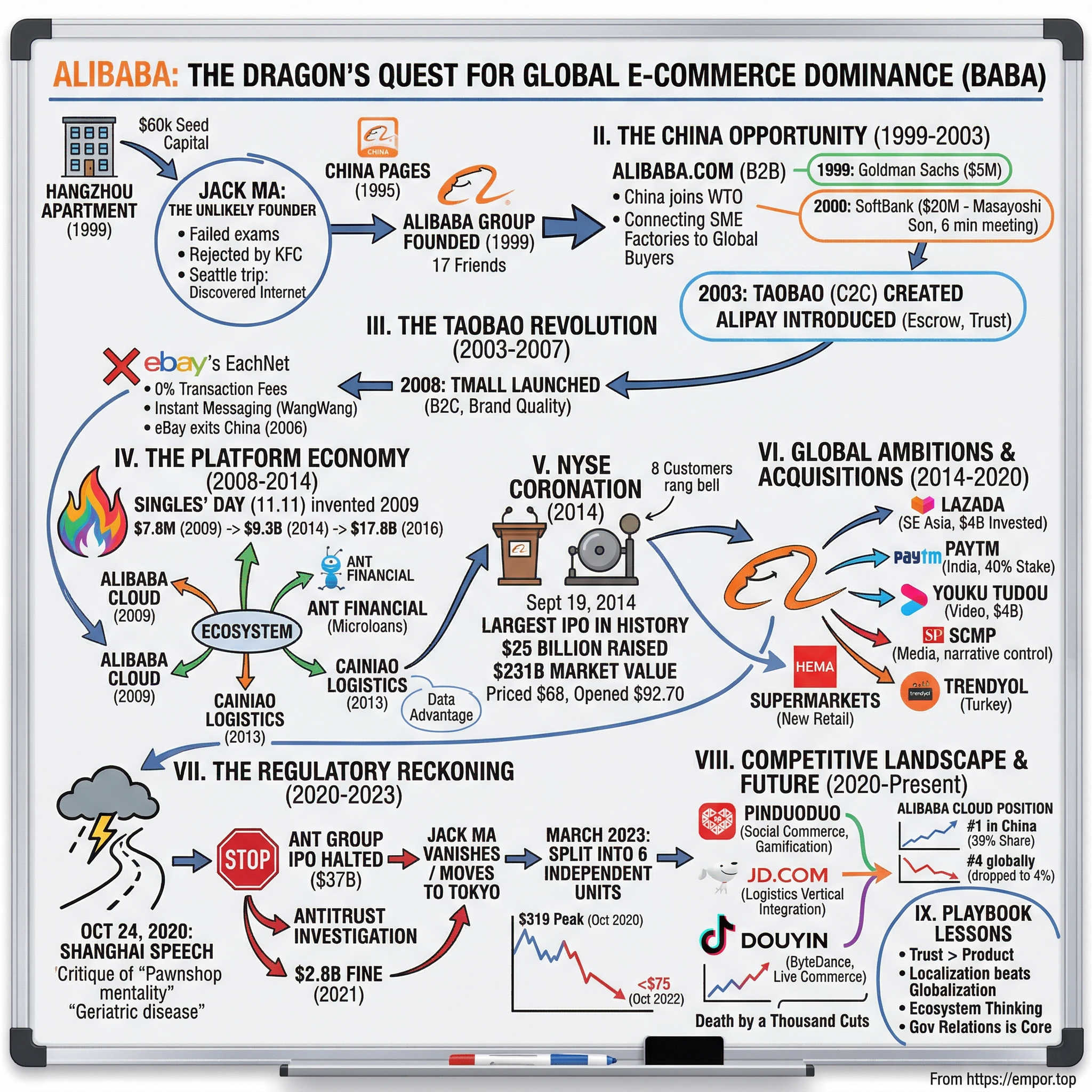
The Speech
On the afternoon of October 24, 2020, Jack Ma (马云) walked onto the stage at the Bund Finance Summit in Shanghai. In the audience sat the senior leadership of Chinese finance: regulators, state bankers, and officials who had spent a decade managing the country's debt load. People close to Ma had urged him to soften his remarks. He did not.1
Ma told the room that China's banks operated with a "pawnshop mentality" (当铺思想), lending only against collateral instead of judging creditworthiness.1 Senior financial officials reportedly left the hall furious.1 Eleven days later, on November 3, the Shanghai Stock Exchange suspended the initial public offering of Ant Group (蚂蚁集团), the payments and lending affiliate Ma controlled. The IPO, planned as a roughly $37 billion dual listing in Shanghai and Hong Kong, was scheduled to debut on November 5.21 According to later reporting by the Wall Street Journal, the decision to halt it was taken at the very top of the Chinese state.3
That speech became the turning point of this story. Before it, Alibaba Group (阿里巴巴集团) was the most important private company in China: the operator of the country's largest online marketplaces, its leading cloud provider, and the corporate affiliate of its dominant digital payments network. After it, Alibaba became a case study in what happens when a platform company's market power outgrows the political settlement that allowed it to expand.
The Descent
The regulatory punishment came in layers. In April 2021, the State Administration for Market Regulation (SAMR, 国家市场监督管理总局) fined Alibaba RMB 18.228 billion—about $2.8 billion, equal to 4% of its 2019 domestic revenue—for abusing its dominance in online retail.4[^5] The central practice was 二选一 ("choose one of two"), in which merchants were pressured to sell only on Alibaba's platforms.4
At the same time, competitors Alibaba had once dismissed were growing into formidable peers. Pinduoduo (拼多多), the discount marketplace run by PDD Holdings, and ByteDance's (字节跳动) short-video app Douyin (抖音) captured shoppers and advertising budgets that Alibaba had long treated as guaranteed. On November 30, 2023, PDD's market value closed at about $196 billion, slightly above Alibaba's roughly $190 billion. It was the first time the upstart had overtaken the incumbent.5 A company whose valuation in the autumn of 2020 put it alongside the biggest American technology firms had lost the majority of that value in about three years.
The Turning Point
Then the founders returned. In June 2023, Alibaba announced that co-founder Joe Tsai (蔡崇信) would become chairman and Eddie Wu (吴泳铭), a member of the original founding team, would take over as chief executive. They replaced Daniel Zhang (张勇), who had led the company since 2015.6 In April 2024, Tsai gave an unusually candid interview to Nicolai Tangen of Norges Bank Investment Management. "We forgot about who our real customers are," he said. "Our customers are the users who use our apps, that are shopping, and we did not give them the best experience." Alibaba, in his words, had "stepped on our own foot."7
The Thesis
This story traces how Alibaba built much of the digital infrastructure of modern China, including online marketplaces, escrow payments, logistics coordination, and enterprise cloud computing. It then examines why the conglomerate cracked under pressure from low-cost social commerce and algorithmic video, and whether the retrenchment under Wu and Tsai can produce a durable turnaround.
That question has become harder over the past eighteen months, not easier. Management has directed the company's cash flow into two capital-intensive campaigns: a subsidy-heavy battle in instant delivery and local commerce, and one of the largest artificial intelligence infrastructure programs outside the United States. In fiscal 2026, which ended March 2026, free cash flow was negative.8 Share buybacks, which had shrunk the share count by about 5% in a single year, slowed to a small fraction of their previous pace.910
For investors, the investment case now rests on two questions. The first is whether Alibaba's two remaining moats—the Taobao and Tmall shopping habit and the Alibaba Cloud compute grid—still generate returns high enough to justify reinvesting almost everything they produce. The second is whether the executives making that capital allocation call have earned the benefit of the doubt. Evaluating either requires returning to where the company began: an apartment in Hangzhou.
 Subscribe on LinkedIn
II. Founding Myth & The Digital Desert (1999–2003)
The Apartment at Lakeside Gardens
In early 1999, eighteen people gathered in an apartment in the Lakeside Gardens (湖畔花园) complex in Hangzhou. They pooled their savings to start an internet company, led by a former English teacher.11 Jack Ma was not an engineer and never claimed to be one. He had accumulated a string of conventional failures: rejected by employers, turned down by schools, and frustrated by his first internet venture, China Pages (中国黄页). After a stint in Beijing working on e-commerce projects for the foreign trade ministry, he returned with a teacher's gift for persuasion and an evangelical belief that the internet could help small Chinese businesses reach the world.
The first product, Alibaba.com, was a business-to-business directory. China was preparing to enter the World Trade Organization, and millions of small factories across the Yangtze and Pearl River deltas had goods to sell but no direct channel to foreign buyers. Alibaba.com did not process transactions. It solved an information problem: a buyer in Ohio could find a zipper manufacturer in Zhejiang.
The Money and the Lawyer
Capital arrived quickly because the founding team included an unlikely recruit. Joe Tsai was a Taiwan-born, Yale-educated tax lawyer who had moved into private equity at Investor AB, the Wallenberg family's holding company.11 He walked away from a lucrative career to join a start-up paying almost nothing. Tsai brought structure to Ma's vision. In October 1999, he helped close a roughly $5 million funding round led by Goldman Sachs.12 In early 2000, Masayoshi Son (孙正义) of SoftBank met Ma and committed $20 million after a conversation that, in Ma's retelling, lasted only six minutes.13
That partnership—pairing a Japanese investor's risk appetite with a Chinese founder's charisma and a Taiwanese lawyer's structural discipline—shaped Alibaba's corporate governance for the next two decades.
Surviving the Crash
Then the dot-com bubble burst. Alibaba had opened overseas offices in its initial burst of ambition, but Ma quickly retrenched, cutting international staff and refocusing the business on selling paid memberships to Chinese exporters under the "China Gold Supplier" program. It was an unglamorous sales operation, but the upfront revenue kept the company solvent through the crash.
Myth vs. Reality: Was B2B the Moat?
The prevailing myth holds that Alibaba.com built an unassailable network effect in global wholesale. The historical record narrows that claim considerably.
A simple directory offers low switching costs; buyers and suppliers can list across multiple sites simultaneously. It also provided no transaction protection, a vulnerability that eventually erupted into scandal. In February 2011, Alibaba.com disclosed that across 2009 and 2010, some 2,326 verified Gold Suppliers—roughly 1% of the total—had defrauded international buyers. Around 100 company salespeople had knowingly or negligently permitted the fraudulent storefronts to bypass vetting. Chief executive David Wei and chief operating officer Elvis Lee resigned.14
The wholesale business still operates today. In the quarter ended June 2026, global wholesale revenue reached approximately RMB 13.9 billion, a 7% increase.15 Yet wholesale never became the group's primary profit engine. Alibaba's defining franchise emerged from an entirely different market: one built for consumers rather than factories, and developed in complete secrecy.
III. Slaying the Dragon: Taobao vs. eBay EachNet (2003–2006)
The Secret Project
In the spring of 2003, the SARS outbreak emptied offices across China, and Hangzhou was no exception. Jack Ma sent a small team led by Sun Tongyu (孙彤宇) back to the Lakeside Gardens apartment with instructions to build a consumer marketplace in complete secrecy. The resulting platform launched in 2003 as Taobao (淘宝), meaning roughly "digging for treasure."11
The secrecy made sense given the opponent. eBay, then the world's most dominant e-commerce company under chief executive Meg Whitman, had acquired a stake in Shanghai-based auction site EachNet (易趣) in 2002 before buying it outright in 2003. EachNet controlled the vast majority of China's nascent consumer-to-consumer market, with some estimates placing its share near 80%.16
How the War Was Fought
eBay followed the standard playbook for multinational tech platforms: it migrated EachNet onto its global technology stack and introduced its established Western model of listing and transaction fees. Taobao countered across three fronts:
- Free versus fee. Taobao charged merchants nothing to list or sell goods. In Ma's frequently quoted metaphor, eBay was a shark in the ocean while Taobao was a crocodile in the Yangtze River: if they fought in the ocean, the shark would win, but in the river, the crocodile prevailed.
- Chat versus control. eBay restricted direct communication between buyers and sellers to prevent transactions from migrating off-platform. Taobao did the opposite, introducing AliWangwang (阿里旺旺), an instant-messaging tool that allowed shoppers to haggle, ask questions, and build rapport with storefront owners—mirroring how Chinese commerce operated in traditional bazaars.
- Guerrilla traffic. eBay locked up exclusive advertising agreements with China's major web portals. Blocked from those mainstream gateways, Taobao bypassed them by striking marketing deals with thousands of personal websites, affiliate networks, and grassroots forums.
The competitive balance shifted rapidly. By 2006, eBay's market share had reportedly fallen below 30%, while Taobao's had surged to around 60%. By the end of that year, eBay had invested roughly $300 million in China with almost nothing to show for it.16 On December 20, 2006, Whitman flew to Shanghai to announce a joint venture with domestic portal Tom Online, in which eBay retained a minority 49% stake. In practice, it was a retreat.1617
Why Taobao Won
Viewed through business strategy, Taobao combined two classic sources of power.
The first was counter-positioning. eBay could not eliminate seller fees in China without undermining the take-rate model that generated its global revenue and supported its Wall Street guidance. The incumbent's existing economics prevented it from replicating the challenger's strategy.
The second was a two-sided network effect. As shoppers flocked to Taobao for free listings and direct merchant communication, sellers had no choice but to follow. A broader catalog attracted even more shoppers, and once that self-reinforcing flywheel tipped toward Taobao, eBay's scale disadvantage proved fatal.
Myth vs. Reality: Was Free a Moat?
The enduring myth is that zero commissions created a permanent lock on merchants. The reality is more nuanced, and it remains critical to evaluating Alibaba's business model today.
Because Taobao charged nothing to list or complete a transaction, it had to invent an alternative revenue engine. It found one in search advertising: merchants bid against one another to appear higher in keyword search results through a pay-for-performance system known as Zhitongche (直通车). Merchants were not paying Alibaba a commission to clear a sale; they were paying an escalating marketing tax simply to be seen.
That advertising model proved exceptionally lucrative as long as Taobao remained the default search box for Chinese retail. Yet it was inherently vulnerable to any competitor that could offer merchants cheaper traffic or recommend products to consumers algorithmically rather than through keyword auctions. Taobao's monetization was anchored in controlling consumer attention, not owning the underlying transaction. That structural distinction would shape the next twenty years. Before any commercial model could work, however, Alibaba had to solve an even more fundamental challenge: in 2003, strangers across China did not trust each other with money.
IV. Building the Institutional Rails: Alipay, Escrow, and the VIE Split (2004–2011)
The Trust Problem
Picture a buyer in Chengdu in 2004. She wants to purchase a jacket from a seller in Guangzhou whom she has never met. She has no credit card, because almost no one in China held one at the time. There is no national credit bureau she can consult. If she wires money directly and the jacket never arrives, she has no practical recourse. Multiply that hesitation across hundreds of millions of prospective consumers, and the central hurdle facing early Chinese e-commerce becomes clear.
The Escrow Invention
Alibaba's solution was Alipay (支付宝), launched in 2004.11 Its core mechanism was escrow (担保交易): the buyer transferred payment to Alipay, which held the funds in trust until the buyer confirmed that the goods had arrived as described. Only then did the platform release the money to the seller. Alibaba stepped into the middle to shoulder the counterparty risk that neither buyer nor seller would take.
The arrangement functioned like a trusted village elder holding the purse during a trade. Deceptively simple in concept, it proved to be one of the most consequential products Alibaba ever developed. It turned a marketplace of suspicious strangers into a functioning commercial ecosystem, and it established the foundation for what would later grow into Ant Group.
The Yahoo Deal
Winning the competitive war against eBay required deep capital reserves. In August 2005, Yahoo agreed to invest $1 billion in cash and transfer its China operations to Alibaba in exchange for an approximately 40% economic interest and 35% of the voting rights.18 In terms of dollar-for-dollar return, it became one of the most lucrative corporate investments in technology history. Yet it also created a dominant foreign shareholder bloc—SoftBank and Yahoo combined—whose strategic priorities would eventually clash with those of Alibaba's founders.
The Alipay Split
That clash arrived in 2011. The People's Bank of China (PBOC, 中国人民银行) was drafting regulatory guidelines for third-party payment licenses that effectively favored domestic ownership. Facing that regulatory hurdle, Jack Ma transferred ownership of Alipay out of Alibaba Group and into an onshore entity under his personal control, without first securing formal approval from Yahoo or SoftBank. Yahoo's shareholders reacted with fury. Alibaba was structured as a Cayman Islands holding company, and foreign public investors held the vast majority of its underlying economic value.
The resulting settlement, announced on July 29, 2011, entitled Alibaba to financial compensation upon a future Alipay initial public offering or liquidity event: 37.5% of Alipay's equity value, bounded by a $2 billion floor and a $6 billion ceiling. Alibaba was also granted a royalty and software technology service fee equal to 49.9% of Alipay's pre-tax income.19 That arrangement was subsequently restructured into a direct equity stake in the Ant business.11
Governance Test: Does the Partnership Put Shareholders First?
Alibaba has long argued that its partnership structure and founder stewardship protect the long-term interests of all shareholders. The Alipay spinoff remains the most potent counterargument, and it is the case study that skeptical emerging-market investors still point to today.
When domestic regulatory requirements collided with the property rights of foreign shareholders, management acted unilaterally and negotiated restitution only after the asset had been moved. The eventual settlement did preserve meaningful economic value for Alibaba, meaning accusations of outright expropriation overstate the case. Even so, the episode exposed the fundamental vulnerability of the variable interest entity (VIE) structure—a constellation of contracts designed to mimic equity ownership without granting direct legal title to licensed domestic assets. When stress-tested, contractual claims held by foreign shareholders offered far weaker protection than direct equity in a traditional public corporation.
The historical record qualifies management's claim. While the founders have generally worked to compound value across the group, whenever state policy and foreign shareholder rights have come into direct conflict, shareholder rights have yielded. That dynamic would return with far greater consequence in 2020. Before that reckoning, however, the company embarked on the most lucrative decade in its history.
V. The Double Engine: Singles' Day, Tmall, and the Mobile Pivot (2008–2014)
From Bazaar to Mall
By the late 2000s, Taobao had become a vast, chaotic bazaar. While it offered endless bargains, it was also flooded with counterfeit goods. Established global brands refused to sell alongside unauthorized knockoffs, and without top-tier brands, Alibaba could not capture China's highest-spending urban consumers.
Daniel Zhang, a former auditor who had joined the company as chief financial officer of Taobao, championed a dedicated business-to-consumer marketplace: Taobao Mall (淘宝商城), later rebranded as Tmall (天猫).11 Tmall hosted verified brand flagships and introduced sales commissions alongside advertising fees. For the first time, Alibaba began collecting revenue from completed transactions rather than relying solely on keyword auctions for search traffic.
The transition came at a price. In October 2011, when Tmall sharply increased its annual service fees and required security deposits, thousands of small merchants organized online demonstrations, flooding brand storefronts with fake orders to protest the policy. Alibaba made minor concessions on the timing, but it held its strategic course. It was the moment the company prioritized established corporate brands over the long tail of independent sellers. A decade later, Pinduoduo would build an empire by rallying those neglected vendors.
Singles' Day
On November 11, 2009, Zhang launched an experiment. He seized on an informal student tradition celebrating singlehood—Singles' Day, chosen for the four solitary ones in the date 11/11—and repurposed it into a promotional sales event for Tmall. Only twenty-seven merchants participated, generating roughly RMB 50 million in sales.20
Over the following decade, Double 11 (双十一) expanded into the largest retail event in the world and an annual stress test for every piece of software and logistics Alibaba operated. By 2021, Alibaba reported RMB 540.3 billion in gross merchandise volume across an extended 11-day campaign period. Yet that total represented growth of roughly 8.5%—the first single-digit expansion in the event's history.21 That deceleration proved to be an early warning of broader retail saturation.
All In on Mobile
Around 2013, Tencent's WeChat (微信) spread rapidly across Chinese smartphones, posing an existential threat to Alibaba's desktop-era search model. If consumers discovered products inside a private messaging feed, a PC search box lost its relevance. Alibaba responded with an urgent company-wide reorganization around mobile devices. Under product executives including Jiang Fan (蒋凡), Mobile Taobao was re-engineered from a simple search directory into a personalized algorithmic feed.
The transition required Alibaba's leadership to accept near-term cannibalization of its lucrative desktop ad rates to secure user attention on mobile screens. It remains one of the clearest examples of the company enduring short-term financial pain to win a platform shift—a willingness management conspicuously failed to repeat a decade later when algorithmic short video challenged its core apps.
The Infrastructure Bets
Two other infrastructure investments from this period continue to shape the group's asset base today.
Alibaba Cloud (阿里云), founded in 2009, began out of operational necessity.11 Surging Double 11 transaction volumes were threatening to overwhelm the commercial hardware and enterprise software powering the marketplace. Chief architect Wang Jian (王坚) pushed to replace imported IBM minicomputers, Oracle databases, and EMC storage hardware with Alibaba's proprietary distributed operating architecture, called Apsara (飞天). Known internally as "de-IOE," the initiative taught Alibaba how to link thousands of low-cost commodity servers so they functioned as a single virtual computer. That internal technical capability soon became an external enterprise service.
Cainiao (菜鸟), established in 2013, pursued a strategy diametrically opposed to that of rival JD.com (京东).11 While JD spent heavily to build and operate its own warehouses and dedicated courier fleet, Cainiao was designed as an asset-light data layer coordinating China's fragmented independent express delivery networks.
Myth vs. Reality: Was Asset-Light Logistics Superior?
The initial thesis held that pure data coordination would outperform JD's capital-intensive, owned-and-operated model. The commercial record has refuted the stronger claims made for that approach.
JD's integrated logistics network delivered fast, dependable fulfillment in high-value categories like consumer electronics and home appliances, where delivery speed and product authenticity commanded a pricing premium. Alibaba gradually moved away from its purely asset-light stance: it acquired significant equity stakes in major private delivery carriers, financed physical fulfillment hubs, and eventually brought Cainiao onto its consolidated balance sheet. In 2024, Alibaba offered up to $3.75 billion to buy out Cainiao's minority investors after withdrawing the unit's planned Hong Kong IPO.22
The asset-light coordination model was not a failure; it allowed Alibaba to scale nationwide parcel volumes at negligible capital cost during its decade of peak expansion. However, it did not provide a durable competitive advantage over vertically integrated logistics, as Alibaba's own subsequent capital expenditures demonstrated. By 2014, with its retail engine surging and its supporting infrastructure in place, Alibaba was prepared to stage the largest initial public offering the global capital markets had ever seen.
VI. The NYSE Coronation & The Alibaba Partnership Architecture (2014)
The Hong Kong Rejection
Alibaba initially sought to list in Hong Kong, but management insisted that its partnership retain control of the board. Hong Kong regulators refused to compromise on the principle of "one share, one vote," and in the autumn of 2013, negotiations collapsed.23 Rebuffed in Asia, Alibaba took its initial public offering to New York.
The Record IPO
In September 2014, the company priced its shares at $68, and the stock opened on the New York Stock Exchange above $92. After underwriters exercised their option to sell additional shares, the offering raised about $25 billion—surpassing the 2010 record set by Agricultural Bank of China to become the largest IPO in history at that point.24 Yahoo sold part of its holding in the offering, realizing a lucrative gain on its 2005 investment.25
How the Partnership Works
The governance structure that had triggered the standoff in Hong Kong was unusual even by Silicon Valley standards. The Alibaba Partnership (阿里巴巴合伙人), a self-renewing group of founders and senior executives, has the exclusive right to nominate a simple majority of the board of directors, whatever the partners' combined shareholding.1123
While American technology giants like Google and Meta insulate their founders through dual-class shares with super-voting rights, Alibaba's model separates board control from equity ownership entirely. At the time of the IPO, SoftBank and Yahoo were by far the company's largest shareholders, yet the partners, who owned much less, chose most of the board.11 Hong Kong regulators later overhauled their listing rules to attract high-growth tech firms, clearing the way for Alibaba to add a secondary listing there in 2019.
Capital Allocation Test: Did Insulation Produce Better Decisions?
The governance defense holds that shielding management from short-term market pressure allows executives to compound capital over multi-decade horizons. The subsequent seven years offered the most direct empirical test of that claim, and the evidence proved weak.
Freed from external discipline and flush with both IPO proceeds and Taobao cash flow, management deployed tens of billions of dollars across offline retail, entertainment, local services, and an array of minority investments. As those bets matured, they pointed toward a consistent conclusion: the partnership insulated management from public shareholders, but it did not insulate the company from strategic error.
The claim therefore does not survive in its strong form. What remains is narrower. The partnership gave founders the leeway to make swift, contrarian decisions without outside interference—a dynamic that yielded genuine breakthroughs, including the early mobile pivot and the cloud infrastructure build-out. Yet that same lack of accountability also allowed expensive missteps to persist for years without effective challenge. With that structure firmly in place, the post-IPO shopping spree began.
VII. The "New Retail" Crusade & Capital Allocation Stumbles (2015–2020)
The Manifesto
In October 2016, speaking at a computing conference in Hangzhou, Jack Ma told the audience that pure e-commerce would soon be an outdated concept. In its place, he unveiled five "news": New Retail, New Finance, New Manufacturing, New Technology, and New Energy. The logic behind New Retail (新零售) was straightforward: because the vast majority of Chinese retail transactions still took place offline, the company's next growth frontier lay in digitizing brick-and-mortar storefronts. The capital expenditures that followed were enormous.
The Portfolio
- Freshippo (盒马鲜生, Hema) was built from scratch as a digitally integrated supermarket where shoppers could dine on fresh seafood in-store or order groceries through an app for delivery within thirty minutes. It quickly became one of China's most distinctive retail experiments.
- Intime Retail (银泰), a nationwide department store chain, was taken private in a $2.6 billion buyout.26
- Sun Art Retail (高鑫零售), the operator of RT-Mart (大润发) hypermarkets, received two substantial rounds of investment. The second, announced in October 2020, cost $3.6 billion and lifted Alibaba's effective equity stake to about 72%, giving the group outright control of 481 big-box hypermarkets across the country.27
- Ele.me (饿了么), the on-demand food delivery platform, was acquired in April 2018 at an implied enterprise value of $9.5 billion to mount a direct challenge against Meituan (美团).28
- Youku Tudou (优酷), the online video streamer, was acquired in 2016 to anchor a consumer entertainment ecosystem.
- International expansion accelerated through control of Lazada in Southeast Asia, Trendyol in Turkey, and AliExpress globally.
The Autopsy
The financial outcome of that deployment became visible when Alibaba wrote down large portions of the portfolio on its own balance sheet.
Hypermarkets and department stores. In fiscal 2024, Alibaba recorded an impairment charge of RMB 12.1 billion against Sun Art's intangible assets.29 In December 2024, management agreed to offload its entire equity interest in Sun Art to private equity firm DCP Capital for approximately $1.6 billion to $1.7 billion, booking an estimated loss of RMB 13 billion—roughly $1.8 billion—attributable to shareholders.3026 That same month, Alibaba sold Intime back to Youngor Fashion and the chain's operating management, absorbing a loss of approximately RMB 9.3 billion.26 The core premise—that Alibaba's cloud data and algorithmic routing could revitalize big-box retail—collided with a secular decline in hypermarket foot traffic as discount specialists and thirty-minute instant delivery drew consumers away.
Digital media. Alibaba booked an RMB 10.5 billion goodwill impairment on Youku in fiscal 2024.29 Long-form video streaming in China turned into a cash-draining licensing war against Tencent Video and Baidu-backed iQiyi, and Youku never evolved into a self-sustaining profit center.
Local services. Ele.me never dislodged Meituan from its dominant position in food delivery. In fiscal 2024, Alibaba's Local Services segment, which housed Ele.me alongside mapping provider Amap (高德地图), generated an adjusted EBITA loss of RMB 9.8 billion.29
Cross-border commerce. In Southeast Asia, Lazada suffered from repeated leadership turnovers and bureaucratic friction, ceding its early regional lead to Sea Limited's Shopee.
What the Record Says About Capital Allocation
Throughout the New Retail campaign, the strategic pattern remained consistent. Physical assets acquired to generate "synergies" with the online marketplace delivered minimal cross-selling momentum. Instead, they weighed on consolidated margins with heavy fixed costs, consumed executive bandwidth, and culminated in cumulative impairments measured in tens of billions of renminbi.
This commercial record provides an essential baseline for evaluating management's current capital discipline, including its heavy artificial intelligence commitments. During the late 2010s, cash generation from Taobao and Tmall was abundant enough to absorb those strategic missteps without threatening the core business. What transformed these misallocations into an existential crisis was the moment Beijing decided the platform had grown too powerful to operate unchecked.
VIII. The Regulatory Reckoning: The Bund Summit, Ant, & SAMR Crackdown (2020–2022)
Why the Speech Landed So Hard
The confrontation at the Bund Finance Summit landed with such force because Ant Group had evolved into a regulatory flashpoint. Through consumer credit products like Huabei (花呗) and Jiebei (借呗), Ant originated billions of renminbi in personal loans directly within the Alipay app. Yet Ant carried only a tiny fraction of that debt on its own balance sheet. Commercial partner banks supplied the vast majority of the capital and absorbed the credit risk, while Ant collected lucrative technology service fees. When Jack Ma attacked conventional banking rules and dismissed the Basel accords as an "old people's club," he was not simply speaking as an outspoken entrepreneur; he was challenging regulators from the helm of an institution state officials already viewed as privatizing financial gains while shifting systemic risk onto the state. The speech gave authorities the immediate justification to intervene.
The Ant Restructuring
Following the suspension of the IPO, Chinese financial authorities ordered Ant to reconstitute itself as a financial holding company under the direct oversight of the central bank. Regulators required the business to hold substantially higher capital reserves against its balance-sheet lending and severed the direct data linkages connecting Alipay's ubiquitous payment channel with its consumer credit operations.
The enterprise that emerged from that overhaul was a tightly supervised, utility-style financial institution with far lower growth prospects than the fintech giant Ma had planned to take public. For Alibaba, which held a 33% equity interest in the affiliate, the restructuring meant the asset was worth far less than its implied value at the 2020 IPO price.2
The SAMR Decision
While SAMR's RMB 18.2 billion penalty in April 2021 set a record for domestic antitrust enforcement, the structural remedies imposed on Alibaba's retail business proved far more consequential than the headline fine. The regulator's investigation, which examined company practices from 2015 to 2019, concluded that Alibaba had systematically abused its market dominance by compelling merchants to "choose one of two" (二选一)—blocking storefronts from selling on competing platforms under threat of algorithmic demotion or traffic throttling. SAMR ordered an immediate halt to the practice.4[^5]
Common Prosperity and the Delisting Threat
The regulatory settlement required further financial commitments. In September 2021, Alibaba pledged RMB 100 billion, roughly $15.5 billion, through 2025 toward the government's "common prosperity" (共同富裕) agenda. The funds were earmarked for initiatives including technology infrastructure in less developed regions and improved welfare protections for gig workers.31
Simultaneously, a second regulatory front opened in the United States. In July 2022, the Securities and Exchange Commission added Alibaba to its provisional identification list for potential delisting under the Holding Foreign Companies Accountable Act, because American inspectors could not review the working audit papers of Chinese issuers.32 While an agreement granting access for U.S. audit inspectors was reached in August 2022,33 the persistent geopolitical tension prompted Alibaba to pursue a dual-primary listing in Hong Kong as a structural hedge. Around the same time, escalating U.S. export controls on advanced semiconductors began to restrict the hardware infrastructure Alibaba Cloud could deploy—a constraint that would reshape its technical roadmap.
Myth vs. Reality: Technology or Enforced Loyalty?
The prevailing bull thesis held that Tmall's pricing power and monetization rates reflected superior platform technology and organic two-sided network effects. The SAMR enforcement action provided a rare natural experiment to test that assertion.
Once platform exclusivity was prohibited, the barrier fell. Major consumer brands quickly opened flagship storefronts across JD.com, Pinduoduo, and Douyin without facing punitive downgrades on Tmall. The rapid diversification of merchant inventories confirmed that a meaningful portion of Tmall's commercial leverage had been sustained through coerced exclusivity rather than voluntary merchant loyalty.
The historical record does not eliminate Tmall's moat, but it significantly narrows it. Tmall remained the premier flagship destination for established brands, yet its pricing power over merchants had been artificially inflated by practices that were now outlawed. Stripped of forced exclusivity, Alibaba had to defend its core marketplaces on operating merit alone—just as Chinese consumers were beginning to migrate toward low-cost competitors.
IX. The Siege: How Pinduoduo and Douyin Cracked the Fortress (2020–Present)
The Mood Shift
By 2022, the economic mood across China's lower-tier cities had shifted markedly. Property prices were falling, youth unemployment was elevated, and middle-class households were tightening budgets. Consumers who had once viewed Tmall purchases as aspirational milestones were comparing the prices of basic household goods across competing discount applications. Domestic commentators termed this behavioral retrenchment 消费降级 (xiaofei jiangji, or "consumption downgrading"). Tmall's marketplace had been designed for an era of consumers trading up; it now confronted a retail environment where shoppers were determined to trade down.
The Value Hammer: Pinduoduo
Colin Huang (黄峥), a former Google engineer, built Pinduoduo around three operating principles that directly attacked Taobao's economic foundation:
- Social group buying. Shoppers shared product links within Tencent's WeChat to unlock volume discounts, acquiring customers through organic social circles rather than keyword search auctions.
- Factory-direct supply. Unbranded manufacturers shipped merchandise directly to consumers from regional production hubs, eliminating distributor markups.
- Buyer-first governance. Policies such as refunds without returns (
仅退款) shifted counterparty dispute risk almost entirely onto merchants, establishing immediate consumer trust.
Crucially, Pinduoduo organized the long tail of unbranded, white-label manufacturers that Alibaba had neglected during its strategic drive to prioritize corporate brand flagships on Tmall. In business strategy terms, this was counter-positioning in reverse. Taobao's operating income depended on merchants bidding against one another for search visibility. Pinduoduo, by contrast, allocated platform traffic based on transaction volume and absolute low price. Alibaba could not replicate that discovery model without forfeiting its own advertising revenue. The challenger's structure proved excruciating for the incumbent to copy—mirroring the dilemma Taobao had imposed on eBay two decades earlier.
The Content Ambush: Douyin
While Pinduoduo competed on price, ByteDance's Douyin attacked consumer attention from an entirely different angle. Taobao's commercial engine relied on purchase intent: a user opened the application looking for a specific item and entered a search query. Douyin created spontaneous demand during passive entertainment through live-stream commerce (直播带货). Its algorithmic feed tracked user engagement and placed product recommendations into video streams before shoppers had consciously formulated a purchasing decision.
By one industry estimate, Douyin generated nearly RMB 2 trillion in gross merchandise value across the first ten months of 2023, expanding roughly 60% year over year.34 That growth landed squarely in apparel and beauty, historically two of Tmall's highest-margin advertising categories. The structural divergence was decisive: Douyin acquired consumer attention organically through entertainment, whereas Alibaba had to pay marketing acquisition costs to direct users into a dedicated commerce utility.
The Scoreboard
Because Alibaba stopped regularly reporting total gross merchandise volume, precise market-share calculations vary by methodology. Yet independent industry estimates all pointed in the same direction: Alibaba's share of Chinese e-commerce had fallen significantly from its mid-2010s peak. The market delivered its verdict in late November 2023, when PDD's market capitalization surpassed Alibaba's.5 That same week, Jack Ma posted a rare internal message to staff, praising PDD's execution and urging the company to reform its operations.35
Alibaba's Counterattack
The operational response under Eddie Wu, who assumed direct leadership of the Taobao and Tmall Group, showed that management recognized the structural threat:
- Tmall waived its annual merchant service fees, and Taobao revised its "refund only" dispute resolution policies to alleviate merchant friction.36
- A 0.6% basic software service fee on completed transactions took effect in September 2024, formally ending two decades of zero-commission transactions on Taobao while providing fee rebates for smaller vendors.[^38]
- Quanzhantui (全站推广), an algorithmic advertising system, began automating merchant bidding across the entire marketplace to hit targeted return thresholds, becoming management's primary tool to lift monetization rates.37
- Taobao integrated WeChat Pay in September 2024, dismantling a decade-old walled garden to capture shoppers embedded in Tencent's ecosystem.38
Myth vs. Reality: Is Search Intent a Moat?
The conventional defense of Alibaba's core business argues that the habit of opening Taobao to initiate a product search provides an enduring switching cost. The competitive evidence indicates that while search intent remains real, it can be bypassed or diluted.
When unbranded items sell at lower prices on Pinduoduo and product discovery occurs within video feeds, conventional search habits lose their exclusivity. Alibaba's own policy shifts confirmed this vulnerability: the company had to waive fees, restructure dispute rules, and subsidize prices simply to preserve platform engagement.
The defensible claim is narrower. Taobao and Tmall retain an entrenched position among high-spending, brand-loyal urban consumers. The company's paid 88VIP loyalty program reached approximately 64 million members in the quarter ended June 2026, maintaining double-digit growth.15 Yet mass-market, price-sensitive shoppers show limited loyalty to any single platform. The test of whether management can translate this defensive posture into sustainable profit growth resides in the segment financials.
X. Segment-by-Segment Engine Room & Unit Economics
A Company Funded by One Business
Examine Alibaba's financial results for fiscal 2024, the year ended March 2024, and one structural reality immediately stands out. Group revenue reached RMB 941.2 billion, an increase of 8%, while total adjusted EBITA came in at about RMB 165.0 billion.29 The Taobao and Tmall Group alone generated RMB 194.8 billion of adjusted EBITA on RMB 434.9 billion of revenue.29 Put simply, the core domestic marketplace earned more profit than the entire corporation combined. Every other operating division lost money, as did corporate overhead.
The rest of the portfolio that year reflected that imbalance:
- Cloud Intelligence generated RMB 6.1 billion in adjusted EBITA, up 49%, on revenue of RMB 106.4 billion, which grew just 3% as the division deliberately shed low-margin, customized project work.29
- International commerce (AIDC) expanded revenue by 46% to RMB 102.6 billion but recorded an adjusted EBITA loss of RMB 8.0 billion.29
- Cainiao produced RMB 1.4 billion of adjusted EBITA on RMB 99.0 billion of revenue.29
- Local Services lost RMB 9.8 billion, Digital Media and Entertainment lost RMB 1.5 billion, and All Others—which housed Sun Art, Freshippo, and Intime—lost RMB 9.2 billion.29
Customer management revenue (CMR), the advertising and commission income collected from Taobao and Tmall merchants, totaled RMB 304.0 billion, up just 4%.29 That figure crystallized the group's central commercial dilemma: gross merchandise volume was expanding, but Alibaba was failing to capture a proportionate share of the spend.
What Changed After FY2024
Management subsequently overhauled its financial reporting twice: first into a consolidated China E-commerce Group, and then, beginning in the quarter ended June 2026, into four distinct operating segments. The revised structure comprised Alibaba E-commerce Group, which combined domestic and international commerce alongside Freshippo; AI Cloud and Compute Services, integrating Alibaba Cloud with the T-Head semiconductor division; AI Labs and Applications, housing the frontier model labs and the consumer-facing Qwen application; and All Others.15 These recurring reorganizations complicated multi-year tracking, obscuring direct longitudinal comparisons.
Beneath the structural shifts, the underlying unit economics moved sharply.
The take-rate adjustments provided brief relief. In the quarter ended September 2025, CMR rose 10% year over year to RMB 78.9 billion. Management credited the acceleration to higher monetization rates unlocked by Quanzhantui's algorithmic ad bidding and the new software service fee.37 Across fiscal 2026, CMR increased 5% on a reported basis and 7% on a like-for-like basis.8
Then monetization stalled. In the quarter ended June 2026, reported CMR fell 7%. Excluding the accounting drag of a newly introduced "business development program"—which reduced reported revenue—CMR grew just 1%. Management attributed the deceleration to "weaker transaction activities," while overall China e-commerce revenue declined 8%.15 That deceleration represented the most troubling metric in recent disclosures: accounting treatments aside, organic marketplace monetization had nearly ground to a halt.
International commerce moved toward breakeven. The international segment's adjusted EBITA loss narrowed by 86% to approximately RMB 2.1 billion in fiscal 2026.8 AliExpress then turned an operating profit in the quarter ended June 2026, which leadership attributed to supply-chain optimization and disciplined cost management.15 Because AliExpress's Choice program had absorbed heavy subsidies to compete directly against PDD's Temu, that margin improvement represented tangible progress—though it remained nascent and untested across a broader retail cycle.
The Quick-Commerce War
The most aggressive capital allocation campaign under Eddie Wu emerged late in 2025. When JD.com expanded into on-demand food delivery and Meituan mobilized to protect its turf, Alibaba folded Ele.me's delivery network into a Taobao-branded instant-commerce offering: Taobao Instant Commerce (淘宝闪购). On July 2, 2025, management pledged RMB 50 billion in subsidies over the following twelve months to attract consumers and storefronts.39
The scale of that outlay proved staggering. One industry analysis estimated Alibaba's incremental marketing spend between June 2025 and December 2025 at more than RMB 80 billion, significantly outpacing both competitors.40 Promotional pricing cut app orders to a few cents for items like coffee.41 The financial toll showed up immediately: in the quarter ended September 2025, group adjusted EBITA dropped 78% to RMB 9.1 billion, and China e-commerce adjusted EBITA plunged 76%.37 By the quarter ended March 2026, Alibaba swung to an operating loss of RMB 848 million, down from an operating profit of RMB 28.5 billion in the prior-year period.8
For the full 2026 fiscal year, China e-commerce adjusted EBITA declined 44% to RMB 107.5 billion, dragging consolidated adjusted EBITA down 56% to RMB 76.4 billion.8 Quick-commerce revenue grew 47% to RMB 78.5 billion.8 Under the reconfigured reporting lines, China quick commerce generated RMB 53.3 billion in revenue for the quarter ended June 2026, up 45% year over year, with management asserting that unit economics had improved sequentially while platform market share held steady.15
The Bull and Bear Reading of Quick Commerce
The bullish case contends that instant fulfillment re-establishes Taobao as an essential daily consumer habit, driving high-frequency engagement and offering corporate partners an omnichannel delivery pipeline. Management highlighted that roughly 3,500 Tmall brand flagships had integrated their brick-and-mortar storefronts into the network.37
The bearish critique argues that Alibaba has merely reignited an expensive war of attrition in on-demand delivery—a battleground where the acquisition of Ele.me previously demonstrated that Meituan's merchant density and courier routing efficiency are remarkably difficult to disrupt. Because management does not disclose standalone profitability for quick commerce, public shareholders cannot directly verify the return on invested capital.
Until leadership demonstrates that instant commerce can produce self-sustaining unit economics without promotional subsidies, or clearly proves that high-frequency grocery runs translate into higher customer management revenue for core retail, the strategy remains unproven and dilutive to operating cash flow. And while the commerce empire was burning cash on thirty-minute delivery, an even more capital-intensive demand was mounting across the cloud infrastructure business.
XI. The Cloud & AI Frontier: Qwen, ModelScope, and the GPU Sanctions Wall
The Chip Announcement
On September 22, 2026, Eddie Wu walked onto a stage in Hangzhou holding a new processor: the Zhenwu V900, designed by T-Head (平头哥), Alibaba's in-house semiconductor design unit. Wu called it "the most powerful AI chip in China today" and said it offered three times the performance of its predecessor.42 Mass production was scheduled for the first quarter of 2027. Wu said the processors could be networked in clusters of up to 500,000 units, while Alibaba pledged to expand its total data-center capacity to more than 20 gigawatts by 2032.4344 Management also announced plans to train frontier models scaled to between 5 trillion and 10 trillion parameters.42
The presentation marked a striking repositioning. Three years after citing tightening U.S. chip restrictions as the primary justification for canceling the planned spinoff of its cloud division, Alibaba was presenting itself as a vertically integrated provider across the entire artificial intelligence stack, spanning silicon, compute infrastructure, foundation models, and consumer applications.
Market Position
Alibaba Cloud remains the market leader in Chinese enterprise infrastructure. In the first quarter of 2025, research firm Canalys estimated its share of mainland China's cloud infrastructure market at 33%, ahead of Huawei Cloud at 18% and Tencent Cloud at 10%.45 In AI-specific cloud workloads, one industry estimate credited Alibaba with 35.8% of the market, outpacing ByteDance's Volcano Engine (火山引擎) at 14.8% and Huawei at 13.1%.46
The Acceleration
That operational turnaround represents the most convincing element of Alibaba's recent corporate performance. The recovery gained traction after management moved aggressively to prioritize standardized public cloud workloads over low-margin bespoke integration projects. In February 2024, Alibaba cut prices across more than 100 core cloud products by up to 55%, igniting enterprise adoption.47
The financial results followed. For fiscal 2026, cloud revenue rose 34% to RMB 158.1 billion, while segment adjusted EBITA grew 35% to RMB 14.3 billion.8 In the quarter ended June 2026, under the reconfigured AI Cloud and Compute Services segment, revenue expanded 45% year over year to RMB 48.4 billion. Adjusted EBITA jumped 133% to RMB 5.6 billion, lifting segment margins to approximately 12%, as AI-related product revenue grew at triple-digit rates for the twelfth consecutive quarter.15 Simultaneous revenue acceleration and margin expansion provided tangible evidence of underlying customer demand alongside operating leverage.
The Open-Source Bet
Alibaba's software strategy diverged sharply from the proprietary approaches favored by leading American labs. Rather than walling off its models behind closed application programming interfaces, Alibaba open-sourced its Tongyi Qwen (通义千问) family. By January 2026, Qwen models had recorded approximately 700 million downloads on Hugging Face, establishing Qwen as the most downloaded open-source model family in the world.48 Domestically, the company cultivated a parallel developer ecosystem through its ModelScope (魔搭社区) open-source community platform.
The strategic calculation mirrored a classic platform playbook: open-source the model weights to establish an architectural standard, then monetize downstream as enterprise developers deploy and fine-tune those models on Alibaba Cloud compute infrastructure.
The Consumer Bet
Management paired that developer push with a direct consumer play, launching a standalone Qwen assistant application in November 2025. The app surpassed 10 million downloads in its first week.49 By the quarter ended June 2026, management reported that 250 million consumers had completed their first AI-assisted purchase through the assistant. Yet consumer scale brought immediate financial friction: the newly separated AI Labs and Applications segment posted an adjusted EBITA loss of RMB 13.9 billion, widening from RMB 3.2 billion a year earlier, driven in part by "higher inference cost related to Qwen app."15 Because inference costs scale directly with user query volume, every conversation consumed server capacity ahead of clear monetization.
The Capex Bill
Supporting those ambitions required a capital deployment program of unprecedented scale. In February 2025, Alibaba pledged to invest at least RMB 380 billion in cloud and AI infrastructure over three years—a commitment exceeding its aggregate capital spending on cloud and AI over the entire preceding decade.50 Disclosed spending tracked that pace. Capital expenditures reached RMB 126.1 billion in fiscal 2026 and surged 75% year over year to RMB 67.7 billion in the single quarter ended June 2026, driving quarterly free cash flow to a negative RMB 44.7 billion.815
Myth vs. Reality: Will Cloud Earn AWS-Like Margins?
The prevailing bull thesis holds that Alibaba Cloud's accelerating scale and proprietary AI stack will ultimately allow the division to generate operating margins comparable to Western hyperscalers like Amazon Web Services or Microsoft Azure. The operating evidence qualifies that ambition across three fronts:
- Hardware bottlenecks and sanctions. Since 2022, U.S. export restrictions have severed Alibaba's access to the most advanced AI processors from suppliers like Nvidia. In November 2023, management cited the "uncertainties" created by those export controls when abruptly canceling the planned spinoff of the cloud unit.51 While the in-house Zhenwu V900 is positioned as an architectural workaround, its performance claims come entirely from Alibaba and have not been independently benchmarked. Mass production has not begun, and scaling domestic chip fabrication within China faces severe equipment and manufacturing constraints.
- Structural public-sector headwinds. State-owned enterprises and government ministries have progressively routed procurement contracts toward state-backed telecom operators, placing an informal ceiling on Alibaba Cloud's addressable market in the public sector. Geopolitical friction has also disrupted key commercial relationships, as seen when ByteDance migrated its international workloads off Alibaba's overseas infrastructure.
- Endemic domestic price competition. While the 2024 price reductions stimulated volume, they confirmed that enterprise cloud buyers in China remain acutely price-sensitive, with ample options to pit Alibaba against aggressive pricing from Volcano Engine, Huawei, Tencent, and Baidu.
The defensible conclusion is that while Alibaba Cloud's commercial resurgence is authentic, its path to Western-style profitability remains unproven. A 12% segment adjusted EBITA margin after heavy investment represents meaningful progress, yet it remains far below the 30%-plus margins achieved by mature U.S. hyperscalers. Crucially, depreciation from the current RMB 380 billion capital-expenditure surge has only begun to flow through the income statement.
The critical variable for investors is whether high-margin AI revenue can continue compounding faster than incoming depreciation charges once newly constructed data centers enter service. Management's track record in translating engineering breakthroughs into enduring shareholder value remains mixed: the early mobile pivot and the initial cloud build-out succeeded, whereas New Retail and digital media squandered tens of billions. That massive capital commitment also sat uncomfortably beside the aggressive shareholder return pledges management made in 2023 and 2024—raising the immediate question of what became of the company's cash flow.
XII. The Great Reset: Dismantling "1+6+N," Current Leadership, & Capital Return
The Breakup That Wasn't
On March 28, 2023, Daniel Zhang announced what was billed as the most radical reorganization in Alibaba's history: the "1+6+N" structure. Under that blueprint, the parent group would step back into an asset-holding vehicle presiding over six semi-autonomous business groups: Taobao Tmall, Cloud Intelligence, International Digital Commerce, Cainiao, Local Services, and Digital Media and Entertainment. Each unit was slated to install its own chief executive and board of directors, and each would hold the autonomy to pursue external financing or stage an independent initial public offering.52 Many market observers interpreted the move as a dual-purpose maneuver: a mechanism to unlock the conglomerate's sum-of-the-parts discount and an accommodating political signal that Alibaba was voluntarily dismantling its concentration of platform power.53
The plan unraveled in rapid succession:
- September 2023. Zhang handed the group chief executive role to Eddie Wu while intending to retain leadership of the Cloud Intelligence division. Then, in an abrupt departure that surprised investors, he stepped down from the cloud unit as well.53
- November 2023. Alibaba canceled the planned full spinoff of the cloud business, citing uncertainties created by expanded U.S. export controls on advanced artificial intelligence semiconductors. The company's market capitalization fell by more than $20 billion in a single trading session.5154
- March 2024. Cainiao withdrew its Hong Kong initial public offering application, and Alibaba reversed course entirely, offering up to $3.75 billion to buy out minority investors and fold logistics back into the corporate fold.22
By June 2026, the strategic reversal was complete. The reconfigured segment reporting consolidated Chinese retail, international commerce, and Freshippo back into a unified Alibaba E-commerce Group.15 In practice, financial engineering had failed to eliminate the conglomerate discount. Public equity markets had never clamored for six smaller, fee-generating listings; investors wanted operational improvement and sustained cash generation across the core businesses.
The New Command
Joe Tsai, serving as chairman, functions as the group's diplomat and senior dealmaker. A prominent figure in global business and the owner of the NBA's Brooklyn Nets, Tsai has spent a quarter of a century interpreting Chinese commercial realities for Western institutional investors.
Eddie Wu, who operates out of the public spotlight, represents technical continuity. As a member of the original Lakeside Gardens founding team and one of the company's earliest software engineers, he was instrumental in developing Taobao's underlying technology and early search-advertising engine.6 Since taking the helm, Wu has consolidated direct operational control over both the domestic commerce engine and cloud computing, establishing artificial intelligence as the company's organizing strategic thesis. On the investor call announcing the RMB 380 billion capital expenditure program, he framed the campaign as "the most intensive period of infrastructure development in the company's history."55
Skin in the Game
In the fourth quarter of 2023, with the company's valuation hovering near multi-year lows, Tsai's family office purchased approximately $152 million of Alibaba American depositary shares, while Jack Ma acquired roughly $50 million worth of Hong Kong-listed shares.56 The transactions did not alter corporate governance or board control, which remain securely anchored in the Alibaba Partnership regardless of direct equity stakes. Yet the purchases provided a visible signal of founder conviction, transacted at valuations that reflected deeply depressed growth expectations.
The Capital Return Promise and What Followed
In fiscal 2024, Alibaba repurchased $12.5 billion of its own shares, driving a 5.1% net reduction in outstanding share count, while declaring $4.0 billion in total dividends through a regular dividend of $1.00 per ADS and a special cash payout of $0.66.29 That capital discipline carried into fiscal 2025, when the company spent another $11.9 billion on share repurchases to retire an additional 5.1% of its net share count.9 Across that two-year window, Alibaba stood as one of the most aggressive returners of cash in the global technology sector, offering public investors a near-double-digit shareholder yield as an explicit defense of the equity.
Then corporate priorities pivoted. In fiscal 2026, as cash flow was redirected into instant delivery subsidies and computing data centers, Alibaba repurchased only about $1.0 billion in shares.10 The regular annual dividend was maintained at $1.05 per ADS, returning roughly $2.5 billion to shareholders.8 By the quarter ended June 2026, repurchases slowed to a near-halt at $162 million.15 As a result, the diluted weighted-average share count utilized for calculating earnings per share settled at 19.32 billion, ticking slightly higher than the prior-year level as employee equity compensation outpaced the shrunken buyback.15 To finance its capital commitments while preserving onshore liquidity, Alibaba also issued convertible notes and exchangeable bonds, instruments carrying prospective equity dilution that totaled approximately RMB 64 billion on the June 2026 balance sheet.15
The Credibility Assessment
Management made no effort to conceal the shift, consistently framing artificial intelligence infrastructure and quick-commerce subsidies as generational investments essential to reignite structural growth. Disclosures had previously confirmed approximately $19.1 billion in remaining share repurchase authorization valid through March 2027, meaning the buyback program was never formally terminated; executive leadership simply ceased utilizing it at scale.37
An analytical reading suggests a sharp reordering of strategic priorities rather than an explicit breach of contract. Yet for public shareholders, the practical consequence was identical: the dependable shareholder yield that had anchored the value thesis in 2023 and 2024 evaporated. In its place, investors were asked to underwrite a high-stakes, capital-intensive expansion led by a management structure whose last major capital-allocation offensive—the New Retail crusade—had culminated in tens of billions of renminbi in balance-sheet impairments.
Divestments
Alongside the retrenchment in buybacks, the program to streamline non-core holdings generated tangible transactions. Management exited its physical retail experiments by offloading Sun Art and Intime, while trimming minority equity positions across external tech holdings such as electric-vehicle maker XPeng and video platform Bilibili. While the steep accounting losses booked on those retail divestments underscored the high price tag of the original New Retail thesis, the sales demonstrated an authentic willingness to dismantle legacy experiments and prune the perimeter of the conglomerate.
XIII. Playbook: Business & Investing Lessons
1. The Counter-Positioning Boomerang
The same strategic mechanism that propelled Alibaba's early rise eventually turned against it. Taobao defeated eBay because eBay could not eliminate listing and transaction fees without destroying its own commission-driven business model. Nearly two decades later, Pinduoduo and Douyin eroded Taobao's core franchise because Alibaba could not embrace absolute low-price ranking or algorithmic video feeds without cannibalizing its lucrative search-advertising revenue.
The broader lesson for platform investors is that a commercial model built on auctioning scarce consumer attention remains inherently vulnerable to any competitor capable of generating or aggregating attention at lower cost. Alibaba's current response—monetizing through transaction software fees and algorithmic bidding systems like Quanzhantui rather than relying solely on keyword search auctions—is a pragmatic adaptation, but it does not eliminate that structural exposure.
2. Synergy Is a Hypothesis, Not a Fact
Acquisitions across hypermarkets, department stores, video streaming, and food delivery were each justified by promised synergies with Alibaba's core marketplace. The subsequent write-downs and loss-making divestments across the New Retail portfolio proved that those theoretical commercial linkages were far weaker than the heavy fixed costs required to support physical operations.
The aggressive push into instant commerce represents the latest iteration of that same strategic thesis. Management has argued that thirty-minute grocery and meal deliveries will drive high-frequency engagement back to the core shopping app. Yet investors have good reason to treat that synergy as unproven until disclosed data shows a clear, sustained uplift in customer management revenue or core retail margins.
3. Regulatory Arbitrage Is Rented, Not Owned
Enforced merchant exclusivity and thinly capitalized consumer lending generated outsized returns for years, but only until state authorities intervened. In economies where regulatory authority is concentrated and unconstrained by independent courts, excess returns that rely on administrative forbearance or supervisory gray zones must be discounted as temporary.
The same principle applies to aggressive capital allocation in reverse. A high-profile subsidy war waged in public view, where promotional pricing cut consumer orders for items like coffee to pennies,41 directly invites regulatory scrutiny as the kind of "disorderly competition" that Chinese authorities have repeatedly moved to discipline.
4. Porter's Five Forces Today
- Threat of new entrants. Low in cloud infrastructure, where capital expenditure requirements, cluster scale, and restricted access to advanced silicon create formidable barriers to entry. High in consumer commerce, where any digital platform with concentrated consumer attention—whether Douyin, Kuaishou (快手), or Xiaohongshu (小红书)—can layer e-commerce onto an existing user base.
- Bargaining power of buyers. High. Chinese consumers incur zero switching costs to move between applications and routinely compare prices across Taobao, JD.com, Pinduoduo, and live-streaming channels.
- Bargaining power of suppliers. Bifurcated. Premium consumer brands still require a Tmall flagship storefront to establish authenticity and reach high-spending 88VIP loyalty members. Conversely, unbranded, white-label manufacturers operate with little loyalty to any single venue, migrating wherever traffic and commission structures are most favorable.
- Threat of substitutes. Severe. Algorithmic video feeds and social commerce channels intercept consumer intent during passive entertainment, manufacturing demand before a shopper ever opens a dedicated search box.
- Competitive rivalry. Intense. As the quick-commerce battle demonstrated, Alibaba, Meituan, and JD.com remain willing to absorb steep operating losses and commit tens of billions of renminbi in subsidies to protect or contest domestic market share.
5. Hamilton Helmer's Seven Powers Today
- Scale economies. Genuine in cloud computing, though increasingly contested by massive capital deployment from state-backed telecom operators and well-capitalized tech peers like ByteDance. In commerce, scale alone has proven insufficient to deter low-cost entrants.
- Network effects. Still present across Taobao and Tmall, but significantly diluted by multi-homing: merchants and shoppers now operate across multiple competing applications simultaneously without friction.
- Counter-positioning. Operating as a headwind in core retail, where Alibaba's ad-reliant revenue model struggles against low-price discovery engines. Conversely, it serves as an advantage in artificial intelligence, where open-sourcing the Qwen model family creates an architectural standard that proprietary Western and domestic model builders cannot easily replicate without undermining their closed API business models.
- Switching costs. Negligible for online retail consumers. Substantial for enterprise cloud clients once proprietary workflows, distributed data pipelines, and custom models are embedded directly into Alibaba Cloud's infrastructure.
- Branding. Tmall's reputation for verified authenticity and brand prestige continues to command loyalty among high-value urban consumers and international luxury houses.
- Cornered resource. Effectively absent. Far from holding exclusive access to critical hardware, geopolitical export controls on advanced semiconductors remain an operational constraint rather than a competitive moat.
- Process power. Highly developed in large-scale distributed computing and peak traffic orchestration, honed through years of running Singles' Day. However, the conglomerate's New Retail misadventures demonstrated that software engineering competence does not automatically translate into operational mastery of physical supply chains or brick-and-mortar storefronts.
The strategic reality is that Alibaba retains two defensible competitive powers: scale in enterprise cloud infrastructure and brand-anchored network effects within Tmall's top-tier retail ecosystem. Yet the company no longer commands the multi-dimensional, self-reinforcing platform monopolies it held a decade ago. That transition—from an unchallenged commercial tollbooth to a contested incumbent fighting on two capital-intensive fronts—defines the core debate for investors.
XIV. Skeptical Investor Stress Test & Bull vs. Bear Case
The Activist's Opening Question
Consider how an activist fund might frame its presentation to Alibaba's board. The opening slide would highlight cash and liquid investments of RMB 474.5 billion—roughly $70 billion—on the balance sheet as of June 2026.15 The second slide would ask why, holding that immense liquidity cushion, management burned more than RMB 40 billion of free cash flow in a single quarter15 while scaling share repurchases down to a crawl. The third slide would trace the history of capital allocation from the New Retail campaign through the eventual multi-billion-renminbi write-downs on Sun Art.
Management's defense is that it is constructing China's premier artificial intelligence infrastructure at a moment when compute demand outstrips supply. In Wu's words, Alibaba is "mobilizing every resource" to meet customer AI demand.42
The Structural Traps
An activist would confront several structural constraints that no strategic realignment can eliminate:
- Onshore cash. A large share of Alibaba's cash is held by mainland Chinese operating subsidiaries in renminbi. Moving that capital to the offshore Cayman holding company to fund dollar-denominated share repurchases and dividends incurs withholding taxes and requires navigating regulatory oversight of cross-border capital flows. As a result, the consolidated cash figure overstates the liquid reserves freely distributable to foreign public shareholders.
- The VIE structure. Foreign shareholders hold equity in a Cayman Islands vehicle whose claims on key Chinese operating licenses rest on contractual arrangements rather than direct legal asset ownership. The 2011 Alipay restructuring demonstrated how those contractual claims hold up when regulatory priorities collide with foreign shareholder interests.
- Control without ownership. The Alibaba Partnership retains the exclusive right to nominate a simple majority of the board of directors, regardless of how much stock its members hold.11 Without board representation or proxy leverage, external shareholders lack the governance mechanisms to compel a change in capital allocation.
- Geopolitics. U.S. export controls on advanced semiconductors, regulatory scrutiny, and broader geopolitical frictions keep many Western institutional investors permanently underweight. Alibaba's transition to a dual-primary listing in Hong Kong in August 2024 and its subsequent inclusion in Southbound Stock Connect on September 10, 2024, opened direct access to mainland Chinese retail and institutional capital, partially buffering those offshore outflows.5758
Accounting and Disclosure Notes
Several reporting practices and accounting treatments warrant scrutiny when evaluating the group's earnings quality:
- Recurring segment reorganizations. Repeated reshuffling of reporting lines—from the original business units into six groups under "1+6+N," then to the China E-commerce Group, and most recently into four revised segments in mid-2026—complicates multi-year tracking and obscures direct longitudinal comparisons.
- Contra-revenue programs. In the quarter ended June 2026, results included a newly introduced "business development program" that reduced reported customer management revenue, an accounting item whose commercial terms and merchant mechanics were not detailed in the quarterly earnings release.15
- Opaque quick-commerce economics. Management does not break out standalone profitability or unit-level burn for Taobao Instant Commerce, preventing public investors from directly assessing the return on invested capital in on-demand delivery.
- Investment volatility versus operational earnings. Mark-to-market fluctuations across Alibaba's equity investment portfolio create wide swings in reported GAAP net income. In fiscal 2026, GAAP net income declined 19%, whereas non-GAAP net income tumbled 62% as core operating profits contracted.8 While non-GAAP metrics offer a clearer window into underlying operations, they routinely exclude substantial, recurring expenses such as share-based compensation.
The Bull Case: A Cash-Flow Base Plus an AI Option
- China's leading enterprise cloud franchise. Alibaba Cloud holds the top domestic market position, characterized by accelerating top-line expansion, triple-digit growth in AI-related product revenue for twelve consecutive quarters, and expanding segment margins even amidst a massive capital-expenditure cycle.15
- A global open-model ecosystem. The worldwide developer adoption of the Tongyi Qwen model family provides an architectural standard and distribution pipeline that no domestic competitor matches at scale.48
- A path to chip independence. If the newly unveiled Zhenwu V900 processor performs in production as Alibaba projects, the company will secure greater autonomy over its computing cluster supply chain, insulating operations against foreign export curbs.44
- A still-profitable core. Even during an aggressive investment phase and severe competitive pressure, the domestic commerce engine generated RMB 107.5 billion in adjusted EBITA in fiscal 2026, providing substantial internal cash generation.8
- An improving international business. The international digital commerce division has narrowed its losses toward overall breakeven, while AliExpress achieved operating profitability in the quarter ended June 2026 through supply-chain efficiencies.15
- Operating leverage if subsidies fall. If promotional spending across Taobao Instant Commerce moderates while customer retention and market share hold firm, reduced subsidies could drive an immediate rebound in consolidated operating income.
The Bear Case: A Capital Trap
- Core monetization has stalled. Customer management revenue dropped 7% on a reported basis and grew just 1% on a like-for-like basis in the quarter ended June 2026, while overall China e-commerce revenue contracted 8%, indicating that core retail demand remains soft.15
- A repeat of past mistakes. Pouring tens of billions of renminbi into quick-commerce subsidies mirrors the protracted, cash-draining battle Ele.me waged against Meituan's courier density and merchant network.
- AI costs may outrun revenue. Frontier model training alongside consumer adoption of the Qwen application consumes immense server capacity without generating proportional revenue, driving the newly formed AI Labs and Applications segment to a quarterly adjusted EBITA loss of RMB 13.9 billion.15
- Negative free cash flow and minimal buybacks. The collapse in quarterly free cash flow to negative levels and the near-total cessation of share repurchases have stripped away the double-digit capital return thesis that anchored the equity in 2024.
- Chip claims are unverified. Proprietary chip claims remain unverified by independent testing, while incoming depreciation charges from the three-year RMB 380 billion capital-spending plan will weigh on consolidated operating margins for years to come.
- Governance and geopolitics. The combination of variable interest entity contracts, Partnership control uncoupled from equity ownership, and escalating geopolitical friction imposes an enduring structural discount on foreign-listed shares.
Weighing the Two
Examining Alibaba's historical trajectory qualifies both extreme narratives. The catastrophic thesis that the core retail business is terminal is refuted by the sheer volume of operating profit Taobao and Tmall still produce even at a cyclical trough. Conversely, the triumphant thesis that artificial intelligence has magically transformed the group into an unassailable tech utility is tempered by a documented history of sprawling, multi-billion-dollar capital allocation campaigns that failed to compound shareholder value.
The most defensible position is that Alibaba has evolved into a high-stakes, leveraged wager on whether enterprise AI adoption in China can translate into paying cloud workloads faster than the group's capital expenditures and delivery subsidies exhaust cash flow. An established retail marketplace, growing slowly in an era of consumer caution, serves as the balance sheet funding that bet. The concluding section identifies the critical operating metrics that will determine whether that wager succeeds.
XV. Epilogue: 1–3 Essential KPIs & What to Watch
The Three Numbers That Matter
1. Customer management revenue growth compared with GMV growth. This metric reveals whether Taobao and Tmall can still convert marketplace shopping activity into advertising and commission income. Algorithmic ad bidding through Quanzhantui and the introduction of a basic software service fee drove a modest take-rate recovery through 2025.37 Yet disclosures for the quarter ended June 2026 showed that recovery stalling.15 If customer management revenue matches or outpaces gross merchandise volume expansion on a like-for-like basis, the domestic retail core retains pricing power. If it continues to lag, aggressive delivery subsidies and rival discount platforms are continuing to erode merchant monetization.
2. AI Cloud revenue growth and segment margin, compared with the capex pace. Year-over-year cloud revenue growth of 45% alongside a 12% segment adjusted EBITA margin provided the most compelling evidence for the bull case in mid-2026.15 The critical question for investors is whether that top-line acceleration can hold as the three-year, RMB 380 billion infrastructure commitment50 begins flowing through the income statement as heavy depreciation, and whether high-margin AI product revenue continues compounding fast enough to absorb those fixed costs.
3. Free cash flow and the net change in diluted shares. This pair of metrics indicates whether heavy internal reinvestment is translating into cash generation and whether public shareholders are receiving a tangible capital return. The aggressive capital-allocation discipline of fiscal 2024 and fiscal 2025—which delivered net annual share count reductions of approximately 5%299—has given way to negative free cash flow and a slightly expanding diluted share count.15 A sustained return to positive free cash flow alongside continued cloud expansion would validate management's thesis that aggressive capital deployment was warranted. Persistent cash burn alongside ongoing share dilution would confirm the bear thesis.
Catalysts and Watch Items
- Quick-commerce economics. Watch for any standalone disclosure of segment profitability or burn rates in Taobao Instant Commerce, alongside evidence that promotional subsidies are moderating without surrendering market share to Meituan.
- Mass production of the Zhenwu V900 in early 2027 and the release of verified, independent performance benchmarks to validate in-house silicon capabilities.43
- Consumer AI monetization. The critical test is whether the 250 million shoppers who completed their first AI-assisted purchase via the Qwen assistant application15 convert into recurring, high-margin commerce revenue or remain an expensive server drain.
- Mainland capital inflows. The pace of domestic share accumulation through Southbound Stock Connect,58 which has increasingly cushioned the exit of Western institutional capital.
- Regulatory scrutiny. Any renewed supervisory intervention targeting aggressive quick-commerce delivery subsidies or the deployment of commercial foundation models.
The Closing Picture
Alibaba built the institutional rails of modern Chinese commerce, transforming a cash-based, low-trust retail landscape into one of the most digitized commercial ecosystems in the world. Along the way, the conglomerate survived the scuttled Ant Group initial public offering, a record antitrust penalty, an aborted corporate breakup, and agile competitors that deployed its own counter-positioning playbook against its core marketplaces.
Management has abandoned the imperial impulse to own every layer of Chinese commerce: the hypermarket chains and department stores have been sold, and the corporate breakup has been reversed. Yet Alibaba has not evolved into the lean, predictable capital-return vehicle that the buybacks of 2024 briefly suggested. Under the stewardship of its original founding team and Partnership governance structure, the company is betting the balance sheet once again—channelling its cash generation into computing capacity and on-demand delivery, anchored by an enterprise cloud business with stronger commercial momentum than ever before.
For long-term investors, the central question is no longer whether Alibaba remains indispensable to China's digital economy. It clearly does. The question is whether its two remaining moats—the retail platforms where China shops and the distributed computing grid where China's artificial intelligence runs—can earn a satisfactory return on the immense capital being poured into them. Unlike earlier corporate campaigns justified by theoretical synergies, the incoming quarterly disclosures will deliver a definitive verdict.
References
-
Ant Group IPO suspended after Jack Ma criticizes regulators — The China Project, 2020-11-03 ↩↩↩↩
-
Ant Group's $37 Billion IPO Suspended by Chinese Regulators — Financial Times, 2020-11-03 ↩↩
-
Chinese President Xi personally halted $37bn Ant IPO: Report — Al Jazeera, 2020-11-12 ↩
-
China slaps Alibaba with $2.8 billion fine in anti-monopoly probe — CNBC, 2021-04-09 ↩↩↩
-
Alibaba's Value Slips Below PDD's in Landmark for China — Bloomberg, 2023-11-30 ↩↩
-
Alibaba Group Announces Management Changes — Business Wire, 2023-06-20 ↩↩
-
We "stepped on our own foot" in recent years, admits Alibaba chairman Joe Tsai — TechNode, 2024-04-07 ↩
-
Alibaba Group Announces March Quarter 2026 and Fiscal Year 2026 Results (Form 6-K) — U.S. SEC, 2026-05-13 ↩↩↩↩↩↩↩↩↩↩↩
-
Share Repurchase Update as of March 31, 2025 — Alibaba Group, 2025 ↩↩↩
-
Alibaba Group Holding Ltd Form 20-F for Fiscal Year Ended March 31, 2026 — U.S. SEC, 2026 ↩↩
-
Alibaba Group Form F-1 Registration Statement (IPO Prospectus) — U.S. SEC, 2014-05-06 ↩↩↩↩↩↩↩↩↩↩↩
-
How Goldman Sachs won and lost with China's Alibaba — The Globe and Mail, 2014 ↩
-
Japan's SoftBank concludes run as Alibaba's biggest shareholder — South China Morning Post via Yahoo Finance ↩
-
Top Alibaba executives resign after fraud probe — Phys.org / AFP, 2011-02-21 ↩
-
Alibaba Group Announces June Quarter 2026 Results (Form 6-K) — U.S. SEC, 2026-08-20 ↩↩↩↩↩↩↩↩↩↩↩↩↩↩↩↩↩↩↩↩↩↩↩↩
-
eBay's Deal with Tom Online Offers Some Timely Lessons for Managers of Global Online Companies — Knowledge at Wharton, 2007 ↩↩↩
-
Yahoo! and Alibaba.com Form Strategic Partnership (Exhibit 99.1, Form 8-K) — U.S. SEC, 2005-08-11 ↩
-
Alibaba Group, Yahoo!, and SoftBank Reach Agreement on Alipay — Business Wire, 2011-07-29 ↩
-
How Alibaba invented the world's biggest online shopping holiday — Quartz, 2014 ↩
-
Alibaba Singles' Day Posts Record 540.3 Billion Yuan in Sales — Bloomberg, 2021-11-11 ↩
-
Alibaba withdraws Cainiao IPO, plans to purchase remaining stake for up to $3.75 billion — TechNode, 2024-03-27 ↩↩
-
Open Sesame? Not for now, Alibaba — Harvard Law School Forum on Corporate Governance, 2014-05-12 ↩↩
-
How Alibaba Boosted Its IPO Size by Taking a Walk in Greenshoes — Bloomberg, 2014-09-22 ↩
-
Yahoo Inc. Form 8-K regarding sale of Alibaba shares in IPO — U.S. SEC, 2014 ↩
-
Alibaba to sell Sun Art stake, record $1.8 billion loss — Bamboo Works, 2025-01 ↩↩↩
-
Alibaba to buy controlling stake in hypermarket chain Sun Art in $3.6 billion deal — CNBC, 2020-10-19 ↩
-
Alibaba will buy Chinese food delivery app in an implied $9.5 billion deal — CNBC, 2018-04-01 ↩
-
Alibaba Group Announces March Quarter 2024 and Fiscal Year 2024 Results (Form 6-K) — U.S. SEC, 2024-05-14 ↩↩↩↩↩↩↩↩↩↩↩↩
-
Alibaba sells hypermarket operator Sun Art for US$1.7 billion to refocus on e-commerce — South China Morning Post, 2025-01-01 ↩
-
Alibaba pledges $15.5 billion to help China achieve 'common prosperity' — CNN Business, 2021-09-03 ↩
-
Alibaba added to SEC's delisting watchlist, shares fall — Euronews, 2022-07-30 ↩
-
A surprise deal may save $1.3T of US-listed China stocks from delisting — Fortune, 2022-08-26 ↩
-
Douyin racks up $274 billion in e-commerce sales in the first ten months of 2023 — TechNode, 2023-11-10 ↩
-
We should all be paying more attention to the PDD-Alibaba rivalry — TechCrunch, 2023-12-11 ↩
-
Alibaba's Tmall waives annual service fee, while Taobao relaxes 'refund only' policy — South China Morning Post, 2024-07 ↩
-
Alibaba Group Announces September Quarter 2025 Results (Form 6-K) — U.S. SEC, 2025-11-25 ↩↩↩↩↩↩
-
Alibaba to allow payment through Tencent's WeChat Pay for the first time on e-commerce apps — CNBC, 2024-09-04 ↩
-
Alibaba's US$7 billion subsidy deepens China's instant e-commerce war with JD.com, Meituan — South China Morning Post, 2025-07 ↩
-
China's food-delivery price war sees Meituan, Alibaba, JD.com incur $14B in costs across two quarters — TechNode, 2025-12-01 ↩
-
Coffee at 30 cents escalates into billion-dollar burn for JD.com, Meituan, and Alibaba — CNBC, 2025-07-11 ↩↩
-
China's Alibaba unveils new powerful chip and ambitious AI model plans — ABC News / Associated Press, 2026-09-22 ↩↩↩
-
Alibaba Unveils AI Chip as Cloud Infrastructure Push Deepens — Caixin Global, 2026-09-22 ↩↩
-
Alibaba Unveils New AI Chip, Calls It China's Most Powerful — Bloomberg, 2026-09-22 ↩↩
-
Mainland China's cloud infrastructure market growth accelerated in Q1 2025 — Canalys, 2025 ↩
-
Alibaba holds wide lead over rivals ByteDance, Huawei, Tencent in China's AI cloud market — South China Morning Post, 2025 ↩
-
Alibaba Cloud Slashes Prices by Up to 55% to Ignite China AI Price War — Reuters, 2024-02-29 ↩
-
Alibaba's Qwen leads global open-source AI community with 700 million downloads — Xinhua, 2026-01-13 ↩↩
-
Alibaba's Qwen App Surpasses 10 Million Downloads within the First Week of Public Beta Launch — Alibaba Group, 2025-11 ↩
-
Alibaba to Invest RMB380 billion in AI and Cloud Infrastructure Over Next Three Years — Alizila, 2025-02 ↩↩
-
Alibaba Q2 2023 earnings, shelves cloud spinoff — CNBC, 2023-11-16 ↩↩
-
Aliviews: Daniel Zhang on Alibaba's Reorganization and Q4 Earnings — Alizila, 2023 ↩
-
Former Alibaba CEO Daniel Zhang quits cloud in surprise move amid landmark restructuring — CNN Business, 2023-09-11 ↩↩
-
Alibaba sheds over $20 billion in market value after scrapping plans to list its cloud business — CNBC, 2023-11-17 ↩
-
Alibaba CEO Eddie Wu drops a bold AI bombshell for investors — TheStreet, 2025 ↩
-
Alibaba stock up after Jack Ma and Joe Tsai buy shares — CNBC, 2024-01-23 ↩
-
Alibaba Changes Hong Kong Listing Status To Primary To Tap Chinese Investors — Forbes, 2024-08-23 ↩
-
Alibaba Group Announces Inclusion of its Ordinary Shares in the Shanghai-Hong Kong Stock Connect and the Shenzhen-Hong Kong Stock Connect Programs — Alibaba Group, 2024-09 ↩↩
 LinkedIn
 WhatsApp
 Reddit
 Hacker News
 Email
Email Kindle
 RSS Feed
 Spotify
 Apple Podcasts
 Amazon Music
 Audible
 YouTube