Atlas Consolidated: The Billion-Dollar Copper Fortress of Toledo
I. Prologue: The Mountain in Cebu and the Two Dynasties
The trucks never really stop in Toledo City. On the western flank of Cebu, a road climbs from the coast into hills that were once green and are now cut open. From the rim of the Carmen pit you look down into a terraced amphitheater of red-brown rock, benches stepping down like the seats of a stadium built for giants. Haul trucks the size of a small house crawl along the ramps. Shovels scoop broken rock into their beds, and the trucks carry it to a mill that grinds it to powder, around the clock, every day of the year. The next pit over, Lutopan, holds even more of the same rock. Between them, the operator reports proven and probable reserves of about 467 million tonnes of ore at an average grade of 0.29% copper3. That is enough, at current rates, for something like three more decades of mining.
About 550 kilometres north, in the business districts of Metro Manila, the people who own this mountain almost never appear in the mining press. They sit on the boards of two of the most powerful family groups in the Philippines. One is SM Investments Corporation, the holding company built by the late Henry Sy Sr., whose empire runs from shopping malls to BDO Unibank and China Banking Corporation. The other is the Ramos group, whose investment vehicles Anglo Philippine Holdings and Alakor Corporation sit alongside the family's retail and publishing businesses. Together they control 71.20% of Atlas Consolidated Mining and Development Corporation6.
Here is the puzzle this story tries to solve. At the end of September 2026, the market valued Atlas at about PHP 70.7 billion, roughly $1.1 billion, with the shares at PHP 19.882. Over the ten years to FY2024 the business generated about PHP 38.9 billion of cash from operations34. And over those same ten years it paid shareholders exactly nothing in cash dividends3. Not a reduced dividend. Not a token one. Zero.
How can a business throw off that much cash and hand none of it to its owners? The answer runs through geology, accounting, a pile of bank debt that falls due in November 2026, and a decision made in 2017 that still sits on the balance sheet like an unpaid IOU. It also tells you what kind of asset this really is. Atlas is not a junior explorer hoping to find something, and it is not a diversified conglomerate. It is a single mine, a single processing plant, and a single port, wrapped in a listed holding company whose shares behave like a leveraged bet on copper and gold prices, with the controlling families' banks standing behind the debt.
The entity boundary
Before going further, it helps to be precise about who does what, because the corporate structure shapes everything that follows.
The listed company, Atlas Consolidated Mining and Development Corporation (ticker AT on the Philippine Stock Exchange), employs just seven people: three executive officers and four junior managers3. It is a holding and treasury vehicle. The mine itself belongs to its wholly owned subsidiary, Carmen Copper Corporation, which holds the mining rights, runs the pits and the mill, employs about 2,578 people, books all the revenue and carries all the bank debt3. A handful of other subsidiaries exist, including AquAtlas, Atlas Exploration, Amosite Holdings and a 70%-owned environmental venture, CC Ecomine Solutions, but none of them moves the numbers3.
So when this story says "Atlas," read "Carmen Copper, owned through a listed shell." There is no hidden second business, no diversification, no optionality buried elsewhere in the group. What happens in Toledo is the whole story.
The two dynasties
The ownership table reads like a map of Philippine corporate power. SM Investments holds about 1.21 billion shares, or 34.05%. The Ramos family holds about 1.32 billion shares, or 37.15%, split between Anglo Philippine Holdings at 28.64% and Alakor at 8.51%67. Isidro Consunji of the DMCI construction and mining group, who sits on the board, holds another 2.70%7. Once all the insiders are counted, the public float is 25.81%, and foreign investors hold a sliver of about 2.5% through the depository6.
That concentration is the lens through which every later decision should be read. When the banks that lend to the mine are affiliates of the largest shareholder, when the second-largest shareholder's family supplies the chief executive, and when the minority holds barely a quarter of the votes, the ordinary checks of a public company work differently. Not necessarily badly, but differently.
The road ahead
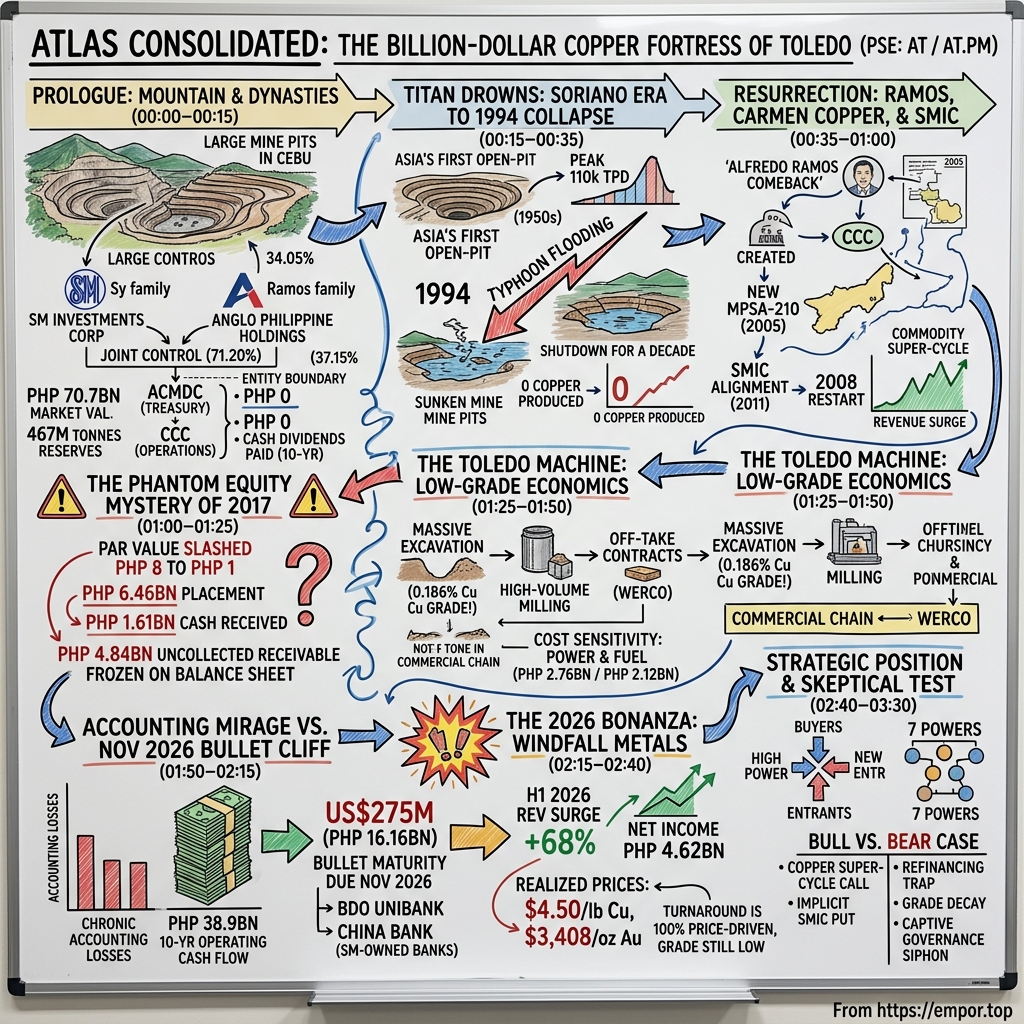
The story has five acts. The first is the rise and collapse of the original Atlas under the Soriano family, a once-great Asian copper producer that went quiet for a decade after 1994. The second is the resurrection under Alfredo Ramos and the arrival of the SM Group. The third is the 2017 recapitalization that left PHP 4.84 billion of promised capital uncollected for nine years. The fourth is the engine room: how a mine with rock this poor makes money at all, and why it reports losses while banking cash. The fifth is now: a US$275 million loan that matures in November 2026, and a sudden 2026 windfall from copper and gold prices that has more than doubled the stock off its lows.
To understand why the present looks the way it does, start with how the past went wrong.
 Subscribe on LinkedIn
II. Asia's Copper Titan Drowns: The Soriano Era to the 1994 Collapse
Picture Toledo in the years after the Second World War. Japan is rebuilding. Its smelters are hungry for copper concentrate, and the Philippines, a short sea voyage away, has rock in the hills of central Cebu that contains it. The copper there is not rich. It is spread thinly through a huge body of rock, the way sugar dissolves through a pot of water rather than sitting in lumps at the bottom. Geologists call this kind of deposit a porphyry. Individually, each tonne carries only a few kilograms of copper. The only way to make money is to move enormous amounts of rock very cheaply.
That was the bet the Soriano family made. Andres Soriano, one of the most prominent industrialists of the mid-century Philippines, built Atlas into the country's flagship mining company1. The Toledo operation became one of the largest copper mines in Asia, feeding concentrate to Japanese smelters through the long post-war boom1. For decades Atlas was a blue chip, a name that Filipino investors and foreign fund managers alike associated with the country's industrial ambitions.
What a porphyry demands
The economics of a deposit like Toledo are unforgiving, and they have not changed in seventy years. Think of it like running a flour mill where the wheat is 99.7% chaff. Every tonne of rock has to be blasted, loaded, hauled, crushed, ground to a fine powder and floated in chemical baths to skim off the copper-bearing minerals. The costs of all that work are mostly fixed per tonne: diesel for the trucks, electricity for the grinding mills, wages for the crews. The revenue per tonne depends on one thing the miner cannot control — the copper price — and one thing it only partly controls: the grade of the rock it happens to be digging that year.
When the price is high and the grade holds, the margin on each tonne is thin but the volume turns it into a flood of cash. When the price falls or the grade slips, the same machine can lose money on every truckload. There is no middle gear. And because the mill has high fixed costs, running it at less than full capacity is often worse than running it flat out.
The downward spiral
By the 1980s, the conditions that had made Atlas great were turning against it. The Philippines went through a sovereign debt crisis that sent interest rates soaring and starved local companies of foreign capital. Copper prices were weak for long stretches. Atlas had borrowed heavily to build its scale, and debt that looks sensible in a boom becomes a noose in a bust. Labor relations deteriorated, and the grades in the older parts of the ore body were declining.
This is the part of the Atlas story that most investors today have never heard, and it matters because it is the first and clearest test of the claim, made loudly in 2026, that Toledo is a fortress. In 1994, operations at Toledo were suspended1. They would stay suspended for roughly a decade. The pits, no longer pumped, filled with water. Thousands of jobs disappeared, and the listed shares drifted into the backwaters of the Philippine market.
The outline of this episode's myth has typhoons drowning the pits, and water did indeed swallow them. But the deeper cause was financial: a low-grade mine with a heavy debt load, facing a weak copper price, simply could not cover its costs. The water came after the pumps stopped, not before. That distinction is the lesson. The ore body did not fail. The capital structure and the cost base did.
Why the collapse still matters
For a modern investor, the Soriano-era collapse sets three base rates that the rest of this story keeps returning to.
First, reserves are not the same as value. Toledo had hundreds of millions of tonnes of copper-bearing rock in 1994, just as it does today. That did not stop the mine from sitting idle for ten years.
Second, debt is what turns a cyclical downturn into a shutdown. A mine that owns its equipment outright can idle, wait and restart. A mine that owes money on a schedule has to keep paying through the trough.
Third, cost discipline and throughput are survival, not optimization. At grades this low, the mill must keep grinding at scale, and power and diesel must stay affordable, or the arithmetic breaks.
Keep those three lessons in mind. Every one of them reappears — the grade slipping, the throughput falling, the debt bunched into a single date — in the Atlas of 2025 and 2026. The question the next decade answered was whether anyone could bring the drowned mine back without repeating the mistakes that killed it.
III. The Resurrection: Alfredo Ramos, Carmen Copper, and the SMIC Alliance (2004–2014)
The man who brought Toledo back did not come from mining. Alfredo "Fred" Ramos was best known as the businessman behind National Book Store, the retail chain his family built into a fixture of Filipino life, and as the patriarch behind Anglo Philippine Holdings, a listed investment company with interests in natural resources10. He had a reputation as a patient, low-profile dealmaker, the sort who accumulates positions quietly and waits. In the early 2000s, when almost nobody wanted a flooded copper mine in a country with a difficult reputation for mining, the Ramos group took control of Atlas.
Why would a bookseller want a drowned copper mine? The answer is a classic contrarian bet. The ore was still there. The infrastructure — the pits, the port, the land rights — was still there. What had broken was the financing and the timing. If copper prices recovered and the mine could be restarted with a cleaner balance sheet, the option value was large, and the entry price, after a decade of neglect, was small.
A new vessel for an old mine
The key structural move was to put the operating rights in a new company. Carmen Copper Corporation became the operating vehicle, 100% owned by the listed parent3. It holds three Mineral Production Sharing Agreements with the Philippine government covering about 2,156 hectares of Toledo: MPSA-210 for the Carmen area, approved on 28 April 2005; MPSA-264 for Lutopan, approved in July 2008; and MPSA-307, approved in December 2009311. An MPSA is essentially a long lease from the state: the government owns the minerals, and the contractor gets the right to mine them in return for taxes and a share of output. Each runs for 25 years and can be renewed for another 253.
Then came the physical work. The pits had to be pumped dry, the mill rebuilt, the fleet replaced. That rehabilitation took years and hundreds of millions of dollars. Commercial shipments of concentrate resumed around 20081. The timing, as it turned out, was extraordinary. The Chinese commodity super-cycle was in full swing. Copper, which had spent much of the 1990s and early 2000s in the doldrums, climbed to levels the old Atlas management could only have dreamed of. A mine that had been written off became, almost overnight, a cash generator.
Enter the Sy family
The second pivotal decision was bringing in a partner with a deep balance sheet. SM Investments Corporation, the flagship holding company of the Sy family, took a strategic stake in Atlas, which it built over time to 34.05%69.
Why would a group best known for shopping malls and banks buy into a copper mine? SM has not framed it in grand terms, and the reasons have to be inferred from behavior. The stake gave SM exposure to hard commodities, a natural counterweight to a portfolio built on Philippine consumer spending and property. It placed an industrial exporter earning US dollars inside a peso-based group. And, as the later chapters show, the relationship came with real commercial traffic: SM-affiliated banks became the mine's lenders, SM group companies became its source of foreign exchange, and SM's logistics affiliate 2GO became part of its fuel supply chain3.
The alliance solved the problem that sank the Soriano-era company. International capital markets have long been wary of Philippine mining, with its history of environmental conflict, regulatory shocks and permitting fights. A Philippine mine that depends on foreign lenders is at the mercy of foreign risk committees. A Philippine mine whose largest shareholder owns the country's biggest banks is not. That is the central insight of the resurrection, and it cuts both ways: it gave Atlas access to cheap, patient money, and it tied the company's financial destiny to the priorities of its sponsors.
The second generation
Leadership of the operating company passed to the next generation of the Ramos family. Adrian Paulino S. Ramos, Fred Ramos's son, became president and chief executive of Atlas3. His style, as reflected in the company's filings, is conservative and understated: pay for the top five officers has been held flat at about PHP 28.2 million a year, with no bonuses, stock options or performance incentives in FY2024 or FY20253. That is modest by any standard for a company worth a billion dollars, and it cuts against the stereotype of family executives extracting value through pay. The flip side is that management's rewards do not rise with shareholder returns either. Whatever alignment exists runs through the families' ownership stakes, not through compensation.
The governance model that emerged is a partnership. The Ramos family supplies the executives and the resource know-how; SM supplies balance-sheet backing and treasury oversight. Three of the nine directors are independent3. Everything that follows — the financing, the recapitalization, the dividend policy — was decided inside that partnership.
For a while, the partnership looked like a triumph. But the super-cycle ended, copper fell hard in 2015, and the restarted mine found itself facing the same question the Sorianos had faced: what happens to a heavily financed low-grade mine when prices turn? The answer came in the form of a very unusual piece of financial engineering.
IV. The Phantom Equity of 2017: Where Did the PHP 4.8 Billion Go?
In 2015 the copper price broke. Atlas's revenue fell by about a third in a single year, and its operating margin swung from about +16% to about -8%3. Net losses followed for four straight years from FY2015 through FY20183. The company had spent heavily to expand the mine after the restart, and much of that spending had been financed with debt. Once again, a low-grade mine with a leveraged balance sheet was staring at a downturn.
This time the owners did not walk away. They restructured. What they built over 2016 and 2017 is the single most important thing a minority investor needs to understand about Atlas's balance sheet today.
The mechanics
Step one came in 2016. Shareholders approved an 87.5% cut in the par value of the shares, from PHP 8.00 to PHP 1.00 each, shrinking the authorized capital from PHP 24 billion to PHP 3 billion3. Par value is the nominal face value printed on a share certificate, and in the Philippines it matters because companies generally cannot issue shares below par. With the market price well below PHP 8, Atlas could not raise equity at all without first lowering par. The cut also created accounting room to absorb accumulated losses.
Step two came in 2017. Authorized capital was expanded to about PHP 8.89 billion, and minority shareholders waived their pre-emptive rights — their right to buy new shares in proportion to their holdings — so that a block could be sold privately to the controlling shareholders3. The placement was large: 1,472,500,000 new shares at PHP 4.3842 each, worth about PHP 6.46 billion in total3. Anglo Philippine took 845 million shares, SM Investments about 598 million, and Alakor about 29 million3.
On paper, this was a vote of confidence. The two families were pouring more than six billion pesos into a struggling mine at the bottom of the cycle.
The reveal
Here is the catch. Only about PHP 1.61 billion was paid in cash3. The remaining PHP 4.84 billion was recorded as a "subscription receivable" — money the subscribers promised to pay but had not yet paid3. Under Philippine rules, subscribed shares can be partly paid, and the unpaid balance sits in the equity section of the balance sheet as a deduction.
Nine years later, it is still there. Atlas reported the same PHP 4.84 billion receivable outstanding at the end of FY2025, and there have been no new share issues, rights offerings or buybacks since 20173. The families subscribed. They paid a quarter. The rest has never been called.
What did this achieve? It gave the controlling shareholders about 1.47 billion additional shares, cementing their combined stake above 70%, for roughly a quarter of the headline price in cash. It did bring in fresh money when the company needed it. But it also meant that most of the "recapitalization" was a promise rather than a transfer. The mine's balance sheet was repaired less by new cash than by the commitment of its owners, and by the cash flows that returned when copper recovered in 2019–2021.
How much does it matter?
Put it in proportion. At 30 June 2026, book value per share was about PHP 14.735. Across roughly 3.56 billion shares, that implies equity of a little over PHP 52 billion. The subscription receivable is already deducted in that figure, so equity is not literally overstated by it. The more precise point is about quality. Equity at Atlas includes about PHP 19 billion of goodwill and a large base of mining assets whose value depends on assumptions about prices and mine life — so large that the auditor flagged the impairment test as the key audit matter3. The unpaid PHP 4.84 billion is a claim the company holds against its own controlling shareholders, one that carries no interest and has no disclosed payment date.
That last phrase is the governance issue. A receivable from an ordinary debtor would be chased. A receivable from the people who elect the board, and who own the banks that lend to the company, can simply wait. The independent directors have had several natural moments to push for collection — the losses of 2018, the operational slump of 2024–2025, the refinancing cliff now approaching — and there is no public record of the balance being called at any of them.
Myth versus reality
The myth: in 2017, the families recapitalized Atlas with PHP 6.46 billion of fresh equity, proving their commitment.
The reality: they committed PHP 6.46 billion, paid about PHP 1.61 billion, and have carried the rest as an open promise for nine years while holding more than seven in ten votes. The commitment is real in the sense that it is legally owed. It is unproven in the sense that nobody has been asked to honor it.
For minority shareholders, that uncollected balance is both a risk and an option. It is a risk because it shows how capital decisions get made: by the controllers, for the controllers, with minority rights waived. It is an option because, if the November 2026 refinancing requires fresh equity, there is already PHP 4.84 billion of capital the company can call without diluting anyone — provided the board is willing to call it. Which path the board chooses will say more about how Atlas is governed than any statement in a proxy.
But capital structure only matters if the underlying machine produces cash. To see whether it does, go down into the pit.
V. The Toledo Machine: Low-Grade Geology, Smelter Tolls, and Operating Levers
Stand at the bottom of the Carmen pit and look at the rock in a truck bed. It looks like any other broken rock: grey, brown, flecked here and there with a faint greenish tint. In FY2025, that rock carried on average 0.186% copper3. Put another way, a 100-tonne truckload contained less than 200 kilograms of copper, about the weight of two large adults, spread through the whole load as tiny mineral grains. Most mining majors would call rock like this waste. At Toledo, it is the product.
A factory that happens to sit in a hole
The best way to understand Carmen Copper is to stop thinking of it as a mine and start thinking of it as a bulk-materials processing plant. The pit is the raw-material yard. The real business happens in the concentrator.
The sequence runs like this. Rock is blasted loose, loaded by shovels and hauled to crushers. Crushed rock goes into ball mills — giant rotating drums full of steel balls that tumble and grind the ore into a fine powder. That powder is mixed with water and reagents in flotation cells, where air is bubbled through the slurry. The copper-bearing minerals cling to the bubbles and float to the top as froth; everything else sinks and is sent to the tailings pond. Skim the froth, dry it, and you have concentrate, a dark powder that is roughly a quarter copper by weight, plus small amounts of gold and silver. That concentrate is trucked to the company's port and loaded onto ships.
Nothing in this chain is exotic. The competitive edge, such as it is, comes from running it continuously at scale and knowing, from decades of data, exactly how Toledo's ore behaves in the mill.
How the money comes in
In FY2025, copper accounted for about 79% of revenue and gold about 18%, with silver a rounding error3. Gold matters more than its tonnage suggests: it is a by-product, so every ounce is almost pure margin on top of costs already paid to recover the copper.
Carmen Copper does not sell refined metal. It sells concentrate to international traders and smelters, and its customer list is short. Output in FY2024 went under multi-shipment off-take agreements with WERCO Trade AG, a Swiss-based trading house, which also took the dominant share in FY2025; two customers accounted for all trade receivables at the end of FY20253.
The pricing formula is standard across the industry. The buyer pays for the contained copper, gold and silver at London Metal Exchange and London Bullion Market Association prices, averaged over a "quotational period," typically the month after shipment. From that, the buyer deducts treatment and refining charges — the smelter's fee for turning concentrate into pure metal — and penalties for impurities3. Carmen Copper is paid a provisional invoice in full, in cash, when the concentrate is loaded, calculated on prices from the days before delivery; a final settlement follows once the quotational period ends and the assays are agreed3.
That structure has a quiet virtue: there is essentially no credit risk. Receivables are small, overdue balances are nil, and the loss allowance is trivial3. The company's receivables are marked to market only because metal prices move between shipment and final pricing. Whatever else is wrong with Atlas, customers not paying is not on the list.
The flip side is total dependence on the market. Atlas has no brand, no pricing power and no negotiating leverage beyond the quality of its concentrate. It is a price-taker in the purest sense.
The cost side: power, diesel and people
If revenue is set in London, costs are set in Toledo, and three items dominate.
Power is the biggest. The grinding mills are enormous electricity consumers. Carmen Copper buys its power from Toledo Power Company under long-term energy conversion agreements covering about 72 megawatts of capacity, with a fixed non-fuel rate of PHP 2.45 per kilowatt-hour, recently extended to 25 December 20263. Utilities cost about PHP 2.76 billion in FY2025, down from about PHP 3.78 billion the year before, largely because the mill ran less3. That extension date is worth flagging: the power contract, like the bank debt, comes up for renewal at the end of 2026.
Diesel is next. The fleet of trucks and shovels runs on fuel supplied exclusively by Shell Pilipinas, procured through 2GO Group, an SM-affiliated logistics company3. Fuel cost about PHP 2.12 billion in FY20253.
People are the third. Carmen Copper employs about 2,578 staff, including 1,981 rank-and-file workers, about 88% of whom are unionized3. The five-year collective bargaining agreement covering about 1,748 miners expired on 30 April 20263. As of this writing, no successor agreement has been disclosed.
The 2025 de-rating
Now watch the machine misfire. In FY2025 the mill processed about 15.6 million dry tonnes, down 14% from about 18.2 million the year before3. At the same time the head grade fell about 10%, from 0.205% to 0.186% copper3. Those two declines compound: less rock, each tonne poorer. Copper output fell 23% to about 54 million pounds, and gold output dropped 35% to about 15,900 ounces3. Revenue slipped to about PHP 17.2 billion3.
Because so much of the cost base is fixed, falling volume pushed unit costs up sharply. The company's all-in cost per pound of copper rose to about $4.363. That is uncomfortably close to the copper price itself. The quarterly numbers show the damage in real time: from the September 2024 quarter through the June 2025 quarter, Atlas posted four consecutive operating losses35.
What the filings do not offer is a detailed explanation of why throughput dropped so sharply — whether it was mill downtime, harder ore, a deliberate shift in mine sequencing, or constraints in the pit. That is a gap investors should notice. For a business whose whole economics rest on volume, a 14% fall in the key operating metric deserves a fuller account than the company has published.
The conclusion from the engine room is blunt. Carmen Copper is a competent, long-lived processing operation, but it runs with a thin cushion. A few percentage points of grade and a few million tonnes of throughput separate a strong year from a loss. And yet, even in the loss years, the bank balance kept growing. That paradox is the subject of the next chapter.
VI. The Accounting Mirage: Profit into Cash and the Nov 2026 Bullet Cliff
Imagine the audit committee meeting as the FY2025 books close. The external auditor, SGV & Co., the Philippine member firm of EY, has signed an unmodified opinion with no qualifications3. But the balance sheet in front of the directors looks alarming. Every peso of the company's bank debt — about PHP 16.16 billion — now sits in current liabilities, because it all falls due within twelve months3. Current liabilities exceed current assets by about PHP 12.41 billion3. On the income statement, the company has lost money for a second straight year.
And yet the same statements show the business generating PHP 4.33 billion of operating cash flow in FY2025 and PHP 4.22 billion in FY20243. How can both be true?
The non-cash wall
Start with the ten-year view. From FY2015 through FY2024, Atlas reported cumulative net profit of about PHP 2.1 billion. Over the same stretch, it generated about PHP 38.9 billion of cash from operations — roughly eighteen times its reported profit34.
The gap is not a trick of revenue recognition or working capital. It is depreciation, depletion and amortization. When Atlas spends money to build mill capacity, buy trucks or strip waste rock to expose ore, it does not expense that spending at once. It capitalizes it, then writes it off gradually over the life of the assets and the reserves. The mining rights themselves are "depleted" as ore is extracted. In FY2025 those charges totaled about PHP 5.05 billion; in FY2024, about PHP 5.45 billion3. Against revenue of roughly PHP 17–19 billion, that is a charge of more than a quarter of sales that never touches the bank account in the year it is booked.
That is why FY2025 could show a net loss of about PHP 246 million alongside more than PHP 4 billion of operating cash3.
But depreciation is not free money. It is the income statement's way of recognizing that the equipment wears out and the ore body gets used up. The honest measure is free cash flow — operating cash minus the capital spending needed to keep the mine going. Capital spending ran at about PHP 2.6–3.7 billion a year recently, or roughly 15–20% of revenue3. After capex, free cash flow was about PHP 1.75 billion in FY2025 and about PHP 560 million in FY20243. Over the full decade, free cash flow was around PHP 7.9 billion, positive but a fraction of the headline operating figure — and much of it came from a strong three-year run in 2020–202234.
So the right reading is neither "Atlas is secretly hugely profitable" nor "Atlas loses money." It is this: in normal price years, the mine generates enough cash to sustain itself and service its debt, with a modest surplus. In strong price years, the surplus becomes large. In weak years, it shrinks toward zero.
The loan that became a cliff
Now the debt. Carmen Copper's borrowings consist of a single syndicated facility of up to US$420 million, of which US$275 million was outstanding at the end of FY2025: about US$166.5 million owed to China Banking Corporation and about US$108.5 million to BDO Unibank3. Both banks are affiliates of SM Investments. The loans are unsecured — no collateral pledged — and carry a fixed interest rate of 3.75% a year3.
Pause on that rate. For a single-asset copper miner in an emerging market with no public credit rating, borrowing unsecured dollars at 3.75% is remarkable. It is the kind of pricing normally reserved for investment-grade corporates. The simplest explanation is the obvious one: the lenders are lending, in effect, to their own group's investment.
In February 2024, the facility was amended for a second time. Regular quarterly repayments were waived, and all principal was pushed into a single bullet maturity in November 2026 — BDO's notes due on 6 November, CBC's on 8 and 26 November38. Covenants require a debt-to-equity ratio no higher than 1.5 times and total equity of at least US$300 million; Carmen Copper was in compliance at the end of FY2025 and at mid-202635.
The amendment was a gift in one sense: it freed cash that would otherwise have gone to principal repayment during two difficult operating years. It was a trap in another: it converted a manageable amortizing loan into a single date on which everything falls due at once. That date is now weeks away.
The treasury funnel
The SM relationship reaches beyond lending. Carmen Copper earns dollars and reports in dollars; the listed parent reports in pesos. When the group needs to move money between currencies, it does so largely through SM sister companies. In FY2025, Carmen Copper bought about PHP 2.61 billion worth of foreign currency from SM entities, including SM Prime Holdings, SM Development Corporation, SM Investments itself and Philippine Geothermal Production Company; in FY2024 the figure was about PHP 7.54 billion3. The company pays no brand, royalty or management fees to its parents3, and nothing in the disclosures suggests the FX deals are priced off-market. But the pattern is unmistakable: Atlas does not operate as an independent treasury. It operates inside the SM group's.
Meanwhile, several leaks sit between operating cash and shareholders. Net finance costs were about PHP 633 million in FY2025, nearly all of it bank interest3. Foreign exchange losses took another PHP 132 million3. And the company wrote off about PHP 396 million of input VAT — tax credits on purchases that it concluded it would never recover from the government3. That last item is a small but telling cost of operating as an exporter in the Philippines: VAT paid on inputs is supposed to be refundable, but in practice refunds are slow, contested and sometimes never arrive.
The verdict on this chapter is two-sided. The reported losses of 2024 and 2025 were largely an accounting artifact; the mine never stopped generating cash. But the November 2026 maturity is not an artifact. It is a real, dated obligation larger than anything the company could repay from a single year's free cash flow. What makes it survivable is not the balance sheet alone. It is who the lenders are. And then, just as the cliff came into view, the metals markets threw Atlas a lifeline.
VII. The 2026 Bonanza: Windfall Metals vs. Grade Dilution
In August 2026, Atlas released its first-half results, and the numbers looked like they belonged to a different company. Six-month revenue jumped about 68% from a year earlier to roughly PHP 13.7 billion5[^9]. Net income swung from a loss of about PHP 653 million in the first half of 2025 to a profit of about PHP 4.62 billion5[^9]. In a single half, Atlas earned more than twice what it had reported in cumulative net profit over the entire previous decade.
The market noticed. The stock, which had touched a 52-week low of PHP 7.34, climbed to a high of PHP 23.10 and ended September at PHP 19.882. For shareholders who had sat through years of losses and no dividends, it was a spectacular reversal.
Anatomy of a windfall
What changed? Mostly the price of what Atlas sells. Gold had been climbing to historic highs, and Atlas's realized gold price in FY2025 averaged about $3,408 an ounce, up from about $2,358 the year before3. Copper realized about $4.50 a pound, up from about $4.143. Because gold is a by-product, every dollar of higher gold price flows almost straight to profit, effectively subsidizing the cost of producing copper. And with costs largely fixed, a higher copper price widens the margin on every pound even when grades stay low.
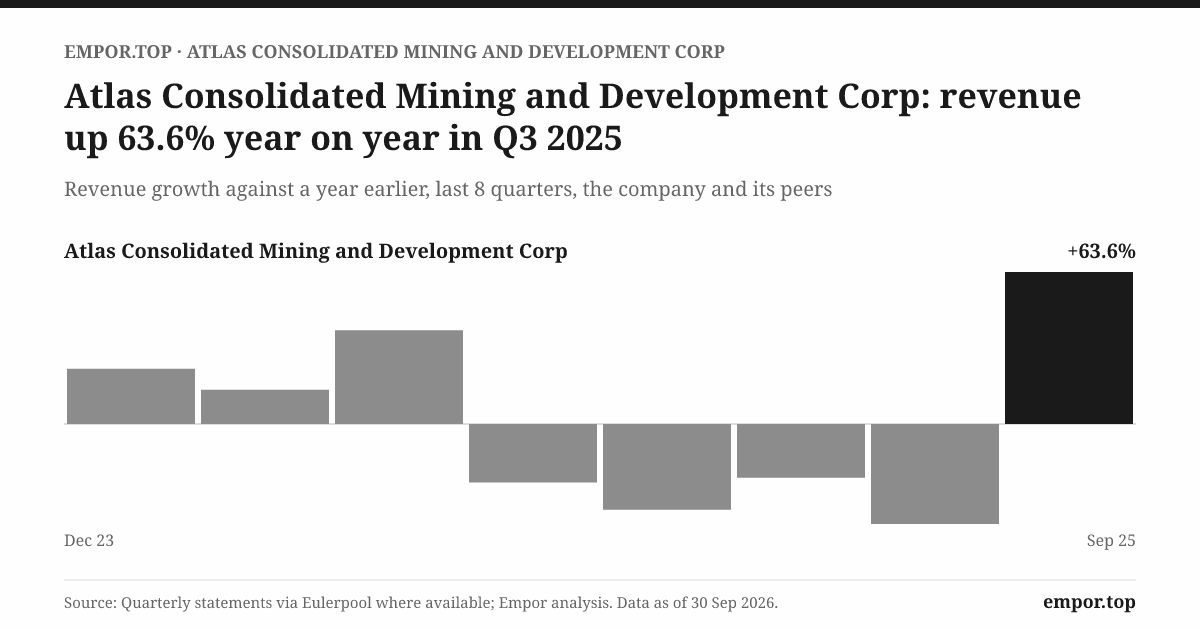
The quarterly progression shows the turn. Revenue in the September 2025 quarter rose about 64% from a year earlier and operating margin swung to about +20% from deeply negative3. By the first half of 2026 the effect was in full flight.
Testing the "structural" claim
The bull narrative now circulating is that Atlas has entered a multi-year margin expansion that justifies a richer valuation. That claim deserves the full falsification treatment, because it is the claim on which the current share price most depends.
Start with the long record. Over ten years to FY2024, revenue in pesos grew about 2.3% a year3. Over five years, about 2.9%; over three, about 1.3%3. That is essentially flat in real terms. The ore body has not been producing more copper over time; it has been producing roughly the same, at fluctuating prices.
Now look at margins across cycles. When copper fell in 2015, operating margin went from about +16% to about -8%3. At the 2021 peak, it reached about 31.5%; one year later, in 2022, it was about 1.8%3. In 2024 it was 0.7%3. Margins at Atlas do not trend. They swing — hard, fast and in both directions — with metal prices.
And the operating base going into this boom was weakening, not strengthening. The mill processed less ore in FY2025 than in FY2024, at a lower grade3. The first-half 2026 windfall arrived on top of that diminished base. There is no disclosed evidence yet that throughput or grades have recovered to earlier levels.
The verdict: the history rejects the "structural" framing. What Atlas has is a cyclical windfall on a flat-to-declining volume base. That is not a criticism of the windfall — the cash is real — but it is a statement about durability. If metal prices hold, profits hold. If they fall, the record says margins will fall with them, quickly. The KPI that would change this verdict is the head grade: a sustained recovery toward the reserve average would mean more copper per tonne and genuinely lower unit costs, independent of price.
Preparing for November
The windfall has had one very important effect: it has filled the treasury. At 30 June 2026, Atlas held about PHP 3.56 billion in bank cash plus about PHP 3.80 billion in US dollar money market funds invested in US Treasury bills — roughly PHP 7.36 billion, or about $125 million, of liquid reserves5. At the end of FY2025, cash and short-term investments together had been only about PHP 2.6 billion3.
That changes the arithmetic of November. Against US$275 million of debt, Atlas now holds about US$125 million in liquid assets. It cannot repay the full facility from cash, but it could repay a substantial portion, leaving a much smaller balance to refinance. Retained earnings have also climbed to about PHP 30.77 billion5, meaning that if the debt is dealt with, there is ample accounting room to declare dividends for the first time in a decade.
A second aside: the peso's weakness has also flattered the balance sheet. Because Carmen Copper's accounts are in dollars and the parent reports in pesos, a depreciating peso inflates the translated value of the group's net assets; the cumulative translation adjustment in equity rose to about PHP 6.8 billion by mid-20265. That helps book value but does nothing for cash.
So the question for November is no longer "can Atlas survive?" It plainly can. The question is what the owners will choose to do with the cushion the metals market has handed them. And to judge that choice, it helps to know what, if anything, protects this business when the windfall passes.
VIII. Strategic Position & Moat Analysis
Look at a map of Philippine mining and one thing stands out: how hard it is to build anything new. In 2017 the Department of Environment and Natural Resources banned new open-pit mines for metals, a ban that stayed in place until late 202111. Local governments have blocked projects. Environmental groups are organized and effective. Permitting timelines stretch for years. In this landscape, Carmen Copper does something rare: it operates a large, permitted, producing open-pit copper mine with its own port and tailings infrastructure, under agreements that run for decades.
That is the core of any moat argument for Atlas. Everything else is commodity.
Porter's five forces
Buyers: very strong. Carmen Copper sells to a handful of traders and smelters, led by WERCO Trade AG3. Prices are set by the LME and LBMA, and the buyer deducts smelter charges on top. Atlas has no ability to raise its price and little room to negotiate terms. If one buyer walked away, the concentrate could be sold elsewhere — copper concentrate is a global market — but at the same benchmark prices. Buyer power is less about hold-up and more about the complete absence of pricing discretion.
Suppliers: strong. Power and diesel are the two largest cash costs, and neither has a real substitute. Electricity comes from a single local provider, Toledo Power, under a contract that expires at the end of 20263. Diesel comes through one supply chain3. When the power contract is renegotiated, the supplier will know exactly how dependent the mill is on it.
Substitutes: low to moderate. Copper remains the default conductor for power grids, electric vehicles and data centers. Aluminum can substitute in some transmission applications, but conductivity and physical limits constrain it. Demand for copper is not the risk here; the price of copper is.
New entrants: very low. A new large open-pit copper mine in the Philippines would face a decade of permitting and fierce opposition. Toledo's existing footprint — pits, mill, port, tailings facilities — cannot realistically be replicated.
Rivalry: low domestically, pure commodity globally. Atlas does not compete with other Philippine miners such as Philex Mining or Nickel Asia for customers. It competes with every copper mine in the world for a place on a smelter's schedule, on price alone.
Hamilton Helmer's 7 Powers
Cornered resource: real, but conditional. The 467 million tonnes of reserves, the three MPSAs and the port infrastructure are the closest thing Atlas has to a durable advantage3. But the history tests this claim hard. The same resource sat idle for a decade after 1994. The resource is cornered in the sense that nobody else can mine it; it is not cornered in the sense of guaranteeing profits. It is a permission to operate, not a pricing power.
Process power: modest. Decades of operating data on how Toledo ore behaves in the mill are genuine know-how. But the FY2025 throughput collapse shows that know-how has not insulated the operation from sharp performance swings.
Scale economies: moderate. Running a mill at around 45,000–50,000 tonnes a day spreads fixed costs, and that scale is essential at these grades. But scale is a necessity for survival here, not an edge over rivals; larger, higher-grade mines elsewhere have far better economics per pound.
Switching costs, network effects, counter-positioning and brand: none. Refined copper from Toledo concentrate is chemically identical to copper from Chile or Indonesia. Nobody pays more because it came from Cebu.
The overall verdict: Atlas has a narrow, regulatory-and-geological moat that protects its right to exist, not its margins. It protects against competition; it does not protect against price.
The sovereign and tenement radar
That permission has an expiry date. MPSA-210, the agreement covering the Carmen pit, expires on 28 April 20303. It is renewable for 25 years under the Mining Act, but renewal requires government approval, and the government's leverage peaks just before expiry. The Lutopan and third agreements run to 2033 and 20343.
Fiscal risk is live too. The Philippine Congress has spent years debating a new mining fiscal regime, including higher royalties on mines outside government mineral reservations and taxes on windfall profits. A regime like that would bite hardest at exactly the moment Atlas is enjoying its windfall.
And the smaller frictions add up: the PHP 396 million input VAT write-off in FY2025 is a reminder that operating costs in the Philippines include a tax system that does not always refund what it owes3.
The moat, then, is best described as a toll gate with a lease. The question for investors is who collects the tolls. That is where the bull and bear cases part ways.
IX. The Skeptical Investor Stress Test: Bull vs. Bear Case
Imagine a fund manager in Singapore or Hong Kong comparing Atlas with a basket of global copper miners. On the September 2026 price, Atlas trades at about 4.3 times trailing sales — though that figure uses revenue through September 2025, before the windfall2. On annualized first-half 2026 revenue it is closer to 2.6 times. It trades at about 1.35 times book value5. It pays no dividend. Its entire debt stack matures in November. Philippine copper-gold peer Philex has historically traded around 1.5–2.5 times sales, and Nickel Asia around 2–3 times2.
What is the market assuming at this price? Roughly, that the current metal prices hold long enough for Atlas to refinance comfortably and, eventually, to start distributing some of its cash. That is a reasonable assumption in a strong commodity market, and a fragile one if prices turn.
The bull case
One: a long-lived call option on copper and gold. Atlas sits on roughly three decades of reserves. At current metal prices, the first half of 2026 implies annualized net profit above PHP 9 billion5. Against a market value of about PHP 70.7 billion, that is a single-digit multiple of run-rate earnings. If the copper market stays tight because of electrification and data-center demand, and gold holds near record levels, the cash generation is enormous relative to the company's size.
Two: an implicit conglomerate put. SM Investments owns about a third of Atlas and controls the banks that hold its debt63. Those banks have already amended the facility twice without demanding collateral3. Foreclosing on a mine partly owned by your own parent would be self-defeating. The overwhelmingly likely outcome for November is a rollover, a new multi-year facility, or a partial repayment from the cash pile.
Three: a dividend waiting to be declared. With retained earnings of about PHP 30.77 billion and liquid reserves of about PHP 7.36 billion, Atlas has the accounting capacity and, post-refinancing, the cash to start paying5. The first dividend in a decade would change how the market values the stock.
The bear case
One: the refinancing could cost minorities. If the banks demand principal reduction, the company has three sources: the cash pile, a call on the PHP 4.84 billion subscription receivable, or new equity. The first depletes the cash that might have funded dividends. The third would dilute minorities, potentially at a discount, with the controlling families again positioned to take up the shares. Only the second is neutral to minorities — and it is the one the controllers have avoided for nine years.
Two: grade decay. The FY2025 head grade of 0.186% sits well below the reserve average of 0.29%3. If grades stay low and copper retreats toward $3.50 a pound, the FY2025 all-in cost of about $4.36 a pound means the mine would again be losing money per pound3. The windfall does not fix the geology.
Three: the captive-governance question. Zero dividends across a decade of PHP 38.9 billion in operating cash3. Billions in currency trades with SM affiliates. Fuel through an SM logistics company. Debt with SM banks. An unpaid capital commitment from the controllers. None of these individually proves that minorities are being disadvantaged, and the concentrate is sold at arm's length to outside buyers, which rules out the most damaging form of transfer pricing. But taken together they describe a company run primarily for the convenience of its controlling group. An activist would ask four questions: why has the receivable never been called; why no dividend policy; why are FX conversions channeled through affiliates rather than tendered to banks; and why was the entire debt stack bunched into one maturity.
Four: labor and regulation. The collective bargaining agreement covering about 1,748 unionized miners expired at the end of April 20263. A strike at a mill that must run continuously would be far more damaging than at a business with inventory buffers. And the 2030 MPSA-210 expiry gives the state leverage to impose new royalties just as windfall profits make the company a tempting target.
Weighing it
The operational turnaround of 2026 is genuine, and the refinancing risk is lower than the balance sheet alone suggests, because of who holds the debt. But history narrows both bull arguments. The windfall is cyclical, not structural, as the margin record shows. And the "conglomerate put" protects the company, not necessarily its minority shareholders: the same relationship that makes bankruptcy unlikely also makes it easy for the controllers to decide how the cash is used. The case is intact but unproven on the point that matters most to outside investors — whether the cash will ever reach them.
The three KPIs that decide the story
Copper head grade milled. Latest reading: 0.186% in FY2025, down from 0.205% in FY20243. Direction: falling. A recovery toward the reserve average would be the one genuinely structural improvement available, lowering unit costs regardless of price.
The refinancing terms of the US$275 million facility. Latest status: a single bullet due 6–26 November 2026 at 3.75% fixed3. Direction: approaching. Watch the rate, the tenor, any amortization schedule, and above all whether the deal requires new equity.
A cash dividend from retained earnings. Latest reading: zero, for at least ten years3. Retained earnings of about PHP 30.77 billion5. Direction: capacity rising. This is the litmus test of whether Atlas is run for all shareholders.
X. Playbook: Business & Investing Lessons
Lesson one: in low-grade mining, throughput is the moat. In FY2025, the Toledo mill processed 14% less rock at a 10% lower grade, and a business that had just posted solid profits swung to a loss3. No competitor caused that, and no customer walked away. The machine simply ran slower on poorer rock, and with its fixed costs, that was enough. The lesson extends far beyond copper: any business with high fixed costs and a commodity output lives or dies by utilization. The metric to obsess over is not revenue or even margin, but how much volume passes through the fixed asset. "When you mine 0.18% copper, you are not in the mining business. You are in the bulk-materials handling business, and the mill must never sleep."
Lesson two: accounting profit is an opinion; depletion cash flow is a fact — but so is capex. Over a decade, Atlas reported about PHP 2.1 billion of net profit and banked about PHP 38.9 billion of operating cash34. Investors who read only the income statement would have seen a chronic loss-maker. Investors who read only operating cash flow would have seen a gold mine. Both would have been wrong. After the capex required to keep the pit open, the real surplus was far smaller. The discipline is to look past the headline on both statements to the free cash that is genuinely available. "Depreciation can hide a mountain of cash from the income statement. It cannot hide the fact that you have to keep buying trucks."
Lesson three: captive lenders are a double-edged sword. In February 2024, SM-affiliated banks waived all scheduled principal repayments and rolled the entire US$275 million into a single November 2026 bullet, at 3.75%, unsecured38. For a small copper miner, that is extraordinary support. It also means the company's most important financial decision is made by its largest shareholder's banks. For founders and investors, the lesson is that sponsor money is never just money: it comes with the sponsor's priorities attached. "When your biggest shareholder owns your lenders, bankruptcy is off the table — and so is independence."
Lesson four: an uncollected subscription is a promise, not capital. In 2017, the controlling families subscribed for PHP 6.46 billion of new shares and paid about a quarter of it3. The remaining PHP 4.84 billion has sat on the balance sheet for nine years3. The shares were issued, the votes were counted, and the control was locked in. The money is still owed. For minority investors anywhere, the lesson is to read the equity section line by line, and to ask who benefits from a recapitalization when those subscribing are also those deciding when to collect. "A capital injection that lives as a receivable is not a recapitalization. It is a permanent IOU hanging over the boardroom."
XI. Epilogue: The November 2026 Cliff and the 30-Year Horizon
Tonight, Atlas stands at the strongest point it has reached in years. Metal prices are high. The treasury holds more liquid assets than at any time in the recent record. Retained earnings are deep. The stock has more than doubled off its lows. And within weeks, the entire US$275 million debt facility falls due.
Somewhere in Makati and Pasay, bankers from BDO and China Bank and executives from SM and the Ramos group are almost certainly working through the terms. What they decide will be disclosed to the Philippine Stock Exchange. The shape of that disclosure matters more than any earnings release this year.
November 2026: the refinancing. Three broad outcomes are possible. A straight rollover into a new multi-year term loan at a competitive rate, with no equity required, would confirm the conglomerate put and preserve the cash cushion. A partial repayment from the treasury combined with a smaller new facility would reduce leverage but also consume cash that might otherwise fund dividends. A deal that requires new equity would be the most revealing: if the board calls the PHP 4.84 billion receivable, it would signal that controllers are willing to honor their 2017 commitment; if it instead launches a rights offering, minorities would be asked to put in fresh money while the old promise remains unpaid.
The FY2026 production report. Early 2027 will reveal whether the mill recovered throughput in 2026 and whether grades climbed back above 0.20% copper. If copper output recovers toward 60 million pounds or more, the windfall rests on a firmer operating base. If not, the profits of 2026 are entirely a gift from the metals market.
The collective bargaining agreement. A new five-year agreement with the union representing Toledo's miners would remove one of the most acute near-term risks to continuous operation. A prolonged negotiation or a strike would test the thin operating cushion described earlier.
The power contract and the tenement. The Toledo Power agreement runs to 25 December 20263. MPSA-210 expires in April 20303. Both renewals will set costs and terms for the next era, and in both cases the counterparty knows how much Atlas needs them.
And behind all of it sits the question that has hovered over this story from the start: with the debt handled and the treasury full, will Atlas declare a dividend? The answer will tell outside investors whether they own a piece of a copper mine, or a ticket to watch one.
XII. Outro: The Copper Fortress that Pays No Toll
Go back to the rim of the Carmen pit. The trucks are still crawling down the ramps. The mill is still grinding. Thirty-two years ago, this same hole was filling with water, its pumps silent, its workers gone, its shares forgotten. The mining industry had written it off as a relic of Asia's post-war boom. Two families bet otherwise, and the bet worked: the mine came back, survived another bust, and now earns more in a half-year than it once reported in a decade.
What makes Atlas unlike any other company on the Philippine exchange is not its copper, which is ordinary, or its grade, which is poor. It is the way the whole structure bends toward the people who control it — their banks lending the money, their companies converting the currency, their unpaid promise sitting in the equity, their votes deciding whether the cash leaves Toledo. You can drown a copper mine for a decade and starve its public shareholders of dividends for another. But as long as the world keeps wiring itself with copper and the conglomerate banks hold the paper, the mountain in Cebu will keep grinding. The only open question is for whom.
References
-
Atlas Consolidated Mining and Development Corporation Official Website — Atlas Mining, 2026-09-30 ↩↩↩↩
-
Company Profile & Stock Data: Atlas Consolidated Mining (AT) — Philippine Stock Exchange EDGE, 2026-09-30 ↩↩↩↩
-
SEC Form 17-A FY2025 Annual Report & Audited Consolidated Financial Statements — Philippine Stock Exchange EDGE, 2026-04-22 ↩↩↩↩↩↩↩↩↩↩↩↩↩↩↩↩↩↩↩↩↩↩↩↩↩↩↩↩↩↩↩↩↩↩↩↩↩↩↩↩↩↩↩↩↩↩↩↩↩↩↩↩↩↩↩↩↩↩↩↩↩↩↩↩↩↩↩↩↩↩↩↩↩↩↩↩↩↩↩↩↩↩↩↩↩↩↩↩↩↩↩↩↩
-
SEC Form 17-A FY2024 Annual Report & Audited Consolidated Financial Statements — Philippine Stock Exchange EDGE, 2026-04-16 ↩↩↩↩
-
SEC Form 17-Q Q2 2026 Quarterly Report (Six Months Ended 30 June 2026) — Philippine Stock Exchange EDGE, 2026-08-17 ↩↩↩↩↩↩↩↩↩↩↩↩
-
Public Ownership Report as of 30 June 2026 — Philippine Stock Exchange EDGE, 2026-07-15 ↩↩↩↩↩
-
List of Top 100 Stockholders as of 30 June 2026 — Philippine Stock Exchange EDGE, 2026-07-15 ↩↩
-
SEC Form 17-C Notice of Loan Agreement Amendment with BDO and CBC — Philippine Stock Exchange EDGE, 2024-02-15 ↩↩
-
SM Investments Corporation Annual Report 2025: Portfolio Investments & Mining — SM Investments, 2026-04-15 ↩
-
Anglo Philippine Holdings Corporation SEC Form 17-A FY2025 — Philippine Stock Exchange EDGE, 2026-04-25 ↩
-
Philippine Mines and Geosciences Bureau (MGB) Tenement Portal: MPSA-210-2005-VII — Department of Environment and Natural Resources, 2026-01-10 ↩↩
 LinkedIn
 WhatsApp
 Reddit
 Hacker News
 Email
Email Kindle
 RSS Feed
 Spotify
 Apple Podcasts
 Amazon Music
 Audible
 YouTube