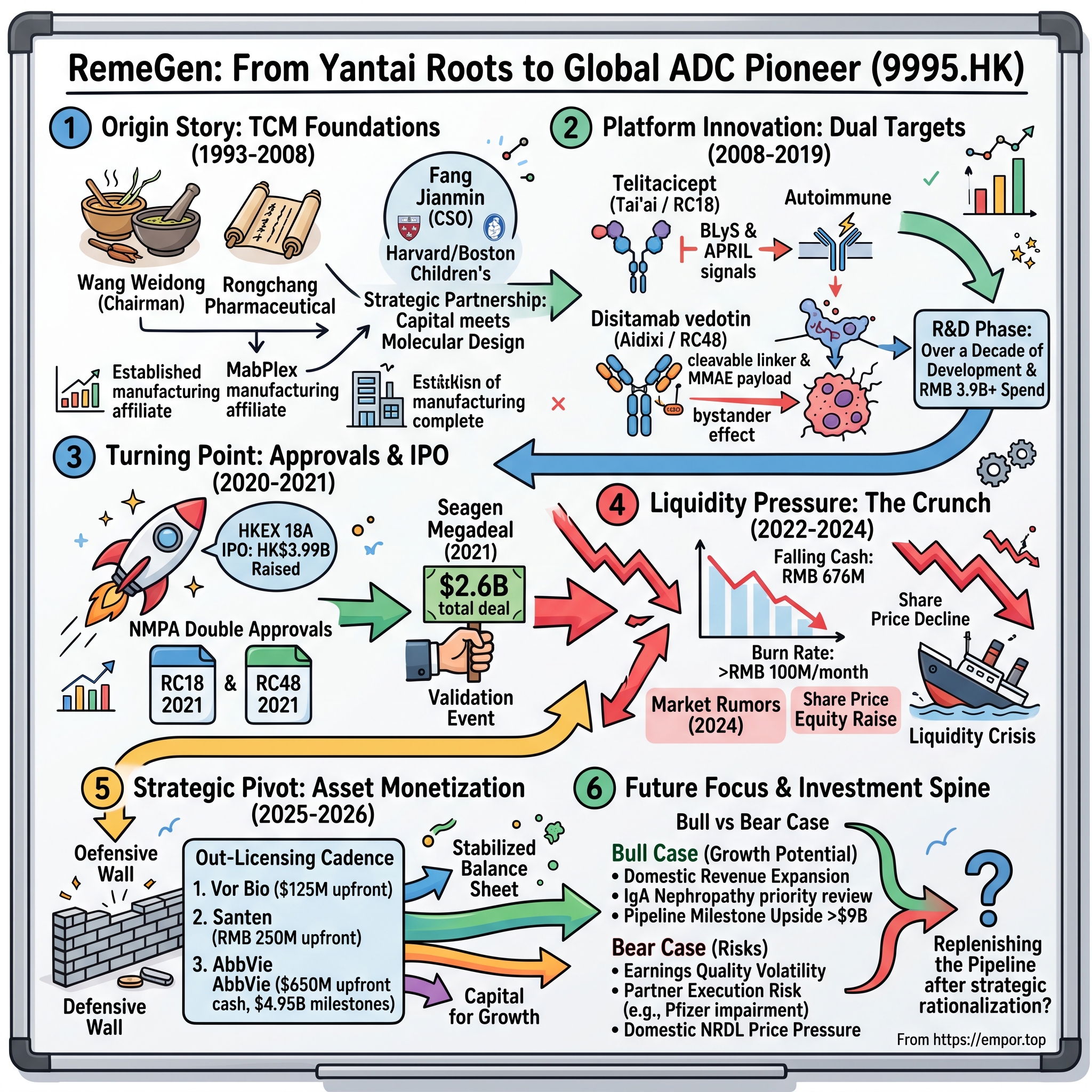
RemeGen: From Yantai Roots to Global ADC Pioneer
I. Introduction & Episode Roadmap [00:00 - 08:00]
On January 12, 2026, during the annual healthcare conference week in San Francisco, AbbVie announced a $650 million upfront cash payment for the rights outside Greater China to RC148, a bispecific antibody engineered to simultaneously target the PD-1 immune checkpoint and the VEGF vascular pathway feeding tumor growth. The agreement included potential development and commercial milestones of up to $4.95 billion, alongside tiered double-digit royalties.1
The seller was RemeGen, a biotech enterprise headquartered in Yantai, a port city in Shandong province. Cumulatively, RemeGen had spent approximately RMB 222 million — roughly $31 million — to develop RC148 up to that point.2
Just two years prior, RemeGen faced severe liquidity pressure. In early 2024, market rumors alleging pulled credit lines triggered a 22.73% single-session decline in its Hong Kong-listed shares, which subsequently lost nearly half their value over two weeks. Although management issued urgent clarifications, hosted an investor briefing, and coordinated insider share purchases, these efforts failed to fully restore market confidence.3 By the end of September 2024, RemeGen Co., Ltd. held roughly RMB 665 million in cash against RMB 1.027 billion in short-term borrowings — leaving the biotech with less than a year of cash runway while burning over RMB 100 million per month during a stalled equity raise.4
The period between that liquidity crunch and the AbbVie transaction highlights a structural dilemma in contemporary biopharma. RemeGen succeeded in developing two first-in-class or near-first-in-class biologics from its base in Yantai, addressing molecular targets that major multinational pharmaceutical companies like Merck KGaA, Roche, and GSK had struggled to commercialize. However, discovering and early-stage testing in China represents only the initial, less capital-intensive phase. Conducting global Phase III clinical trials and establishing worldwide commercial infrastructure requires financial resources far exceeding what RemeGen's balance sheet could support.
Out of necessity, RemeGen systematically monetized geographic rights rather than selling the firm outright. Seagen acquired the ex-China rights to its antibody-drug conjugate (ADC) platform in 2021. In June 2025, Vor Bio acquired ex-Greater China rights to RemeGen's flagship autoimmune therapy. Two months later, Japan's Santen secured Greater China and Asian rights for its ophthalmology candidate. Finally, AbbVie licensed ex-Greater China rights to RC148 in January 2026. Through these four transactions, RemeGen exchanged global commercial upside for immediate capital, enabling the company to stabilize its balance sheet and record paper profitability.
For investors evaluating RemeGen (9995.HK) today, the key question is whether this licensing cadence represents a sustainable operating strategy or a gradual liquidation of core pipeline assets. RemeGen reported a net profit of RMB 709.7 million in 2025 — its first year of meaningful profitability — driven almost entirely by a single licensing deal and mark-to-market appreciation on the warrants received in that transaction.5 Excluding those non-recurring items, core operations remained loss-making. Its domestic commercial operations — supported by two approved drugs, roughly 1,400 sales representatives, and coverage across 1,200 hospitals — expanded revenue by 35.8% in 2025, yet still failed to cover its own costs.5
This analysis details how a business rooted in traditional Chinese medicine transformed into an ADC pioneer, how its scientific platform addressed complex biological hurdles, how severe cash constraints nearly derailed the firm during clinical validation, and what remains after pre-selling much of its international commercial future.
 Subscribe on LinkedIn
II. The Origin Story: Traditional Medicine to Biotech Frontier (1993–2008) [08:00 - 20:00]
Wang Weidong (王威东) was born in September 1959 and graduated in July 1982 from what was then Heilongjiang Business College with a bachelor's degree in traditional Chinese medicine pharmacy. In March 1993, he founded Rongchang Pharmaceutical (榮昌製藥) in Yantai and has served as its chairman and legal representative since.2
That background explains much of how RemeGen was later financed and governed. Wang was neither a returnee scientist, a venture capitalist, nor a state-enterprise appointee. He was a provincial pharmacy graduate who built a conventional Chinese pharmaceutical business in the first major wave of post-Deng private enterprise—a company that generated revenue selling established formulations through distribution relationships built hospital by hospital. While initially profitable, traditional Chinese medicine and generic small molecules faced twin pressures in the 2000s that compressed the entire sector: low barriers to entry and an increasingly assertive state buyer that systematically lowered margins.
The escape route from that margin compression was biologics—complex proteins whose manufacturing processes are difficult to copy. However, developing biologics required scientific capabilities that Yantai did not possess.
Fang Jianmin (房健民) was born in May 1962. He earned his PhD in biology from Dalhousie University in Canada in May 1998 and served as a postdoctoral researcher in surgery at Harvard Medical School and Boston Children's Hospital from 1997 to 2000, focusing on oncology.2 In China, Fang is best known as the inventor of conbercept, a VEGF-trap fusion protein for wet age-related macular degeneration that became one of the country's first original biologics—proving his ability to guide an engineered protein through regulatory approval.
In October 2008, Fang became director, chief executive, and chief scientific officer of the new venture, holding those executive roles until 2020 and serving as an executive director today.2 The partnership between Wang and Fang established a clear division of labor. Wang supplied what Chinese biotech startups in 2008 typically lacked: patient domestic capital, an established manufacturing base, and experience navigating government regulators. Fang provided molecular design.
The arrangement endured because neither founder could easily replace the other. While Chinese returnee scientists of that era usually raised dollar-denominated venture capital and established operations in Shanghai's Zhangjiang or Suzhou's BioBAY, Fang located the venture in a coastal city 700 kilometers from China's primary biotech clusters, building inside an operating pharmaceutical company. While recruiting talent to Yantai presented an ongoing handicap, the structure insulated RemeGen from venture capital milestone pressures, allowing the team to spend over a decade developing its initial candidates.
The group also established its own manufacturing infrastructure. MabPlex (迈百瑞), founded as a dedicated biologics contract development and manufacturing organization, was chaired by Fang from June 2013 and led by him as president until March 2020.2 Formally a separate entity in which RemeGen holds a minority stake, MabPlex provided early access to antibody-drug conjugate (ADC) conjugation capacity when few facilities in China could handle cytotoxic payloads under Good Manufacturing Practice (GMP) conditions. While efficient, maintaining a listed innovator alongside a founder-controlled manufacturing partner created corporate governance complexities that resurfaced when MabPlex's own IPO attempt collapsed.
The partnership formed in 2008 effectively leveraged a traditional pharmaceutical business to fund an ambitious biologics venture. It required thirteen years to produce a single approved drug.
III. The Platform Innovation: Dual-Target Fusion Proteins & ADC Chemistry (2008–2019) [20:00 - 35:00]
The two molecules that RemeGen bet its existence on shared a single design philosophy: take a mechanism the biopharma industry had already validated, then address the specific flaw that limited the original version.
Cutting both cords. In autoimmune diseases such as systemic lupus erythematosus, the body's B cells produce antibodies against its own tissue. Depleting B cells entirely can relieve symptoms, but over-suppression leaves patients vulnerable to severe infection. The alternative approach is to starve them. B cells depend on survival signals from two circulating proteins, BLyS (also known as BAFF) and APRIL, which operate like dual support lines for cell survival. GlaxoSmithKline's Benlysta, the first drug approved for lupus in half a century, targets only BLyS.
RemeGen's telitacicept — marketed in China as Tai'ai (泰爱) and designated RC18 in development — targets both proteins. It was engineered from the extracellular domain of the human TACI receptor, the natural binding site for both BLyS and APRIL, fused to the Fc fragment of human immunoglobulin G.5 The Fc component acts as a structural stabilizer, keeping the molecule stable in circulation and enabling weekly subcutaneous dosing, while the TACI domain acts as a decoy to intercept both survival signals before they reach B cells.
The insight that TACI binds both ligands was basic immunology rather than a proprietary RemeGen discovery; Merck KGaA had previously spent years developing a TACI-Fc fusion protein. RemeGen's distinction lay in completing clinical execution in a lower-cost jurisdiction. The dual-inhibition design carried a clear risk: cutting both survival pathways could trigger profound immunosuppression. Yet clinical data yielded an unexpected outcome. In a Chinese Phase III trial for generalized myasthenia gravis, the rate of infection-related adverse events in the telitacicept arm was actually lower than in the placebo group, at 45.6% versus 59.6%.5 Steroid-sparing effects likely explained part of that difference, but the result indicated a wider therapeutic window than the mechanism implied.
The clinical efficacy proved substantial. In the same myasthenia gravis trial, patients receiving telitacicept achieved a 5.74-point improvement on the MG-ADL daily-activities scale at 24 weeks, compared with 0.91 points for placebo. Furthermore, 98.1% of treated patients achieved at least a three-point clinical improvement, compared with 12% on placebo.5
Making the missile leak. The second candidate required a different engineering solution. An antibody-drug conjugate (ADC) functions as a targeted payload: a monoclonal antibody that recognizes a specific protein on cancer cells, chemically bound to a cytotoxin too potent for systemic injection. Roche's Kadcyla, the first approved HER2-targeted ADC, proved the concept but highlighted its primary constraint. Its payload was linked so stably that the toxin remained trapped within the target cell after cell death. Because tumors are heterogeneous, cells expressing lower levels of HER2 survived a targeted attack.
Disitamab vedotin — brand-named Aidixi (爱地希) and coded as RC48 — pairs a proprietary humanized HER2 antibody with monomethyl auristatin E (MMAE), a potent tubulin inhibitor, via a cleavable linker. Because the linker degrades inside the cell and MMAE is membrane-permeable, the toxin diffuses into adjacent cells regardless of their HER2 expression levels—a mechanism known as the bystander effect. Consequently, an ADC with bystander killing can address HER2-low tumors that first-generation ADCs miss. Daiichi Sankyo and AstraZeneca later validated this same principle on a large scale with Enhertu; RemeGen developed its version concurrently in Yantai on a far smaller budget.
Developing these candidates required significant time and capital. Cumulative R&D expenditure reached approximately RMB 2.31 billion for telitacicept and RMB 1.63 billion for disitamab vedotin.2 Both figures accumulated over more than a decade before either drug generated commercial revenue, and largely preceded China's 2017 regulatory reforms, when the National Medical Products Administration joined the International Council for Harmonisation to align domestic clinical trial standards with global regulatory expectations. RemeGen conducted international-standard trials before China had fully established a framework to support them.
While the scientific hypotheses were ultimately validated, the financial model—funding two decade-long biologic development programs from the cash flow of a Shandong traditional pharmaceutical company—proved unsustainable. By the late 2010s, RemeGen required public equity markets, which were opening to pre-revenue Chinese biopharma companies for the first time.
IV. The Turning Point: Double Approvals, HKEX IPO, and the $2.6B Seagen Megadeal (2020–2021) [35:00 - 52:00]
Introduced in 2018, Chapter 18A of the Hong Kong Stock Exchange rules allowed pre-revenue biotech companies to list. The mechanism created a crucial funding channel for Chinese drug developers previously faced with choosing between selling to a multinational or waiting years for a Shanghai listing that required historical profits.
RemeGen listed on the exchange in November 2020, raising HK$3.99 billion—approximately $515 million—at the top of its marketed range.6 At the time, it represented the largest primary listing under Chapter 18A on record. The operational milestones promised during the offering followed shortly after: telitacicept secured conditional approval from the National Medical Products Administration (NMPA) in March 2021 for moderate-to-severe systemic lupus erythematosus inadequately controlled by standard therapy, while disitamab vedotin received approvals in June and December 2021 for HER2-expressing advanced gastric cancer and advanced urothelial carcinoma, respectively.2 Telitacicept's conditional authorization was converted to full approval in November 2023.5
Those regulatory approvals were soon followed by the transaction that reshaped RemeGen's international profile.
The Seagen deal. On August 9, 2021, Seagen—then a leading pure-play ADC developer and pioneer of the vedotin payload chemistry underlying RemeGen's platform—agreed to pay $200 million upfront and up to $2.4 billion in potential development and regulatory milestones for ex-Asia rights to disitamab vedotin, alongside tiered royalties ranging from high single digits to the mid-teens. RemeGen retained rights in Greater China and the rest of Asia excluding Japan and Singapore.7
"This license agreement highlights the global potential of disitamab vedotin in the ADC arena and is a major milestone for us," Fang said at the time.7 The transaction served as a major validation event, marking a rare instance where a prominent Western ADC specialist opted to license a Chinese-developed candidate rather than relying solely on its internal HER2 pipeline. Within the domestic industry, the agreement became a benchmark for Chinese biopharmaceutical asset licensing—a prime example of the chuhai (going-to-sea) strategy.
Yet the transaction was financially asymmetric. The $200 million upfront payment represented roughly two weeks of revenue for Seagen, functioning effectively as an option on a late-stage asset. For RemeGen, however, the cash infusion exceeded all prior operational revenue combined, temporarily pushing the company into reported profitability and funding two years of clinical development. That dependency became starkly apparent in 2022: as the upfront payment was not repeated, annual revenue dropped 45.9% and RemeGen posted a net loss of RMB 999 million while commercialization and R&D expenses continued to rise. By March 2023, the company was seeking bank credit facilities of up to RMB 5 billion.8
Subsequent market comparisons underscored how rapidly valuation standards evolved. Daiichi Sankyo's 2019 partnership with AstraZeneca for DS-8201 included $1.35 billion upfront, while Kelun-Biotech's subsequent ADC licensing deals with Merck in 2022 and 2023 commanded significantly higher aggregate values. Out-licensing valuations for Chinese ADCs expanded roughly tenfold in the four years following RemeGen's deal. While RemeGen secured essential early funding, the company monetized its flagship international rights prior to a broader market re-rating of Chinese ADC assets.
The buyer changed hands. In December 2023, Pfizer completed its $43 billion acquisition of Seagen, transferring ex-Asia rights for disitamab vedotin to one of the world's largest oncology commercial networks. However, within a massive corporate integration, RemeGen's candidate became one asset among many competing for capital and commercial prioritization.
The strategic shift became clear in Pfizer's fourth-quarter 2024 earnings report, which recorded a $200 million impairment against disitamab vedotin due to changes in the competitive landscape and confirmed that development of certain indications would be halted.9 The write-off matched the exact upfront sum Seagen had paid three years earlier. By that point, Daiichi Sankyo and AstraZeneca's Enhertu had established dominant positions across global HER2 indications, making it difficult for a candidate backed primarily by Chinese clinical trial data to gain market share without extensive Western clinical studies.
For RemeGen, the outcome illustrated a fundamental vulnerability in cross-border licensing: out-licensing converts clinical development risk into partner execution risk. When Pfizer deprioritized disitamab vedotin, RemeGen lacked the contractual leverage to compel further investment. The projected milestone payments and royalties remained uncollected, leaving the company reliant once again on domestic drug sales at government-regulated prices within China's single-buyer reimbursement system.
V. Deep-Dive: Core Business Economics & Product Portfolios [52:00 - 68:00]
In 2025, RemeGen generated RMB 2.307 billion in product revenue—a 35.8% increase year-over-year.5 That revenue was driven by sales of 2.255 million vials of telitacicept, up 47.9%, and 301,923 vials of disitamab vedotin, up 27.3%.2
Comparing volume growth against revenue highlights the central economic tension facing Chinese biopharma developers. While combined vial volume grew by approximately 45%, product revenue rose by 35.8%. That discrepancy stems from price reductions and a shifting product mix: each year, RemeGen's therapies reach more patients, but generate less revenue per patient.
This margin compression reflects the deliberate structure of China's pharmaceutical market. The National Reimbursement Drug List (NRDL)—administered by the National Healthcare Security Administration, a single payer covering more than one billion citizens—conducts annual negotiations where manufacturers trade steep price concessions for national coverage. Declining an offer restricts sales to the small self-pay market, while accepting guarantees volume at the cost of recurring price cuts. Telitacicept has completed three negotiation cycles: entering the NRDL in 2021, renewing in 2023, and renewing again in late 2025 when its generalized myasthenia gravis indication was added alongside systemic lupus erythematosus. Disitamab vedotin followed a similar path, securing inclusion for gastric cancer in December 2021 and urothelial carcinoma in January 2023, with both indications renewing at the end of 2023 and again in late 2025.2
Despite these price cuts, RemeGen expanded its gross margin on biologics by 2.79 percentage points to 83.4% in 2025.2 Manufacturing scale temporarily outpaced price erosion, as fixed conjugation and fill-finish overhead were spread across 2.5 million vials rather than 1.7 million. If unit production costs fall faster than reimbursement prices, compounding volumes can protect gross profitability.
However, capturing that volume requires substantial commercial expenditure. RemeGen closed 2025 with approximately 900 commercial staff supporting telitacicept across more than 1,200 hospitals, alongside 500 representatives marketing disitamab vedotin across more than 1,050 hospitals.2 Selling and distribution expenses totaled RMB 1.111 billion, representing 48% of product revenue.5 By comparison, mature specialty pharmaceutical companies typically maintain sales expense ratios in the twenty-percent range. RemeGen continues to fund intensive, hospital-by-hospital sales coverage across thousands of tertiary medical centers where no centralized purchasing shortcut exists.
Telitacicept is becoming a franchise, not a drug. The autoimmune asset represents RemeGen's primary engine for domestic expansion because targeting B-cell survival factors addresses multiple autoimmune conditions. Beyond established approvals in lupus and rheumatoid arthritis, 2025 brought approval for generalized myasthenia gravis in May, a positive Phase III trial in Sjögren's disease in August, and a positive Phase III Stage A readout in IgA nephropathy that same month. Marketing applications for both Sjögren's disease and IgA nephropathy were accepted by the Center for Drug Evaluation, with the IgA nephropathy filing receiving priority review.5
The IgA nephropathy data provided strong clinical support for dual BLyS/APRIL inhibition. IgA nephropathy is an autoimmune kidney disease where defective antibody complexes damage the glomeruli, causing proteinuria and eventual renal failure. At 39 weeks, telitacicept achieved a 58.9% reduction from baseline in 24-hour urine protein-to-creatinine ratio compared with 8.8% for placebo. Crucially, kidney function remained stable: estimated glomerular filtration rate declined by just 1.0% in the treatment group versus 7.7% for placebo, while only 6.3% of treated patients experienced a 30% or greater filtration decline compared with 27.0% in the placebo arm.5
While proteinuria reduction serves as a surrogate endpoint, preserved filtration rate represents the definitive clinical metric for disease modification. If these results persist through Stage B evaluation, telitacicept could establish itself as a primary disease-modifying therapy for a condition that affects a high proportion of Chinese patients and frequently leads to chronic dialysis.
Disitamab vedotin found its ground in bladder cancer. Domestically, disitamab vedotin's strongest market position lies in urothelial carcinoma. The RC48-C016 trial—evaluating disitamab vedotin combined with the PD-1 inhibitor toripalimab as a first-line treatment for HER2-expressing advanced urothelial cancer—was published in The New England Journal of Medicine on October 19, 2025, reporting a median progression-free survival of 13.1 months and an objective response rate of 76.1%.10 Publication in the Journal marked a notable clinical milestone for a Chinese urological oncology trial, establishing a potential first-line treatment paradigm.
RemeGen also expanded the drug's label in breast cancer, securing approval in May 2025 for HER2-positive advanced breast cancer with liver metastases, followed by a March 2026 approval for HER2-low breast cancer with liver metastases—a setting where the molecule's bystander effect provides a distinct therapeutic advantage.5
The pipeline, sized honestly. Although RemeGen's public disclosures outline over a dozen drug candidates, the company initiated significant pipeline rationalization in 2025. Management terminated RC88 (a mesothelin-targeted ADC) and RC108 (a c-Met-targeted ADC)—programs that had collectively absorbed several hundred million yuan—citing modest clinical efficacy and intensifying competition. RemeGen also curtailed spending on RC118 (a Claudin18.2-targeted ADC) to reallocate capital toward RC148.11 In August 2025, the company out-licensed Greater China and Southeast Asian rights for its ophthalmology candidate, RC28, to Japan's Santen for RMB 250 million upfront and up to RMB 1.045 billion in potential milestones—monetizing domestic commercial rights rather than building a dedicated eye-care sales organization.12
This capital reallocation led to a 20.9% decline in total R&D expenses in 2025, down to RMB 1.219 billion, while R&D headcount was reduced from 926 to 864.52 While trimming secondary assets reflects necessary financial discipline, reducing research expenditures during a period of clinical validation underscores the ongoing cash constraints shaping RemeGen's operating strategy.
VI. Capital Deployment, Cash Burn, & Management Credibility [68:00 - 80:00]
RemeGen's second public listing marked the moment the capital market shifted. In March 2022, the company launched an initial public offering on Shanghai's STAR Market, aiming to raise RMB 4.0 billion. Instead, it priced at RMB 48 per share, sold 54.4 million shares, and netted RMB 2.6 billion—one-third below its target.13 The generous Hong Kong financing window that supported its 2020 listing was shutting across the biotech sector, just as RemeGen committed to expensive, dollar-denominated global multi-center clinical trials.
What followed was a three-year struggle to outrun an escalating cash burn.
By mid-2024, the financial pressure became acute. Cumulative losses since listing surpassed RMB 3 billion, leaving roughly RMB 60 million in unused proceeds from the RMB 6.4 billion raised across its two public offerings. Total cash reserves dropped to RMB 676 million—its lowest level since listing. In September 2024, reports of research and production layoffs surfaced, which management described as strategic personnel adjustments.14 Meanwhile, a RMB 2.55 billion A-share private placement announced in March 2024 was scaled back to RMB 1.953 billion and ultimately stalled.15 By that point, RemeGen's A shares traded at half their issue price, while its Hong Kong-listed H shares dropped to one-fifth of their offering price.14
Key leadership departures soon followed. In February 2025, Executive Director and Chief Medical Officer Dr. He Ruyi (何如意)—the former chief scientist at China's drug regulator and a pivotal executive hire—resigned to join another firm, following the earlier exits of RemeGen's president and chief financial officer.9 That same month, MabPlex withdrew its ChiNext listing application after an 18-month review, eliminating a key path for the founders' manufacturing affiliate to raise independent capital.9
Within eight months, however, RemeGen executed a dramatic financial reversal.
The Vor transaction. In May 2025, RemeGen issued 19 million new H shares at HK$42.44, raising a net HK$796 million in a dilutive placement priced far below its 2020 listing—a clear emergency financing.16 Six weeks later, on June 25, RemeGen licensed telitacicept's ex-Greater China rights to Vor Bio, a Nasdaq-listed entity that had discontinued its gene-editing programs to pivot around the asset. Vor paid $45 million in cash and $80 million in warrants, representing $125 million in upfront consideration, alongside more than $4 billion in potential milestone payments and tiered royalties. Former MorphoSys CEO Jean-Paul Kress assumed the role of Vor's CEO and chairman that same day, as Vor secured $175 million in a concurrent private placement.17
This deal structure was central to RemeGen's 2025 financial turnaround. The company recognized RMB 895 million in licensing revenue in 2025, reflecting the full $125 million initial valuation of cash and warrants.2 As Vor's share price subsequently rose, RemeGen revalued those warrants, recording RMB 642 million in fair-value gains under other income.5
Combined, those two line items contributed roughly RMB 1.54 billion to pre-tax results, compared to a total reported pre-tax profit of RMB 710 million for 2025.5 Strip away the Vor transaction, and RemeGen's core operations generated an underlying pre-tax loss of approximately RMB 800 million in the very year it announced profitability. Furthermore, cash generated from operating activities stood at RMB 52.3 million—reaching positive territory for the first time, but only by a thin margin.5
While standard under accounting rules and fully disclosed, these details redefine RemeGen's reported profit. In 2025, the company's core commercial operations continued to consume cash, while reported earnings stemmed primarily from out-licensing intellectual property and mark-to-market gains on a partner's equity warrants.
The AbbVie transformation. The RC148 transaction announced on January 12, 2026, fundamentally reshaped RemeGen's capital structure. AbbVie's $650 million upfront payment—received in full on April 15, 2026, after the agreement took effect on March 10—translated to approximately RMB 4.6 billion, surpassing RemeGen's total cumulative product revenue for a drug candidate that cost roughly RMB 222 million to develop.1182
That return on development capital illustrates the core financial logic of successful Chinese biotech innovation: developing a differentiated biologic through early clinical validation for tens of millions of dollars, then monetizing global rights for hundreds of millions. AbbVie's strategic rationale centered on combining RC148's dual PD-1 and VEGF targeting mechanism with its own antibody-drug conjugate portfolio.1 Through this agreement, RemeGen effectively monetized nearly two decades of protein engineering expertise.
This capital influx stabilized the balance sheet. RemeGen closed 2025 with bank and other borrowings of RMB 2,158.6 million against RMB 1,154.6 million in cash, lowering its gearing ratio from 63.9% to 50.2%.5 The arrival of AbbVie's cash in April 2026 effectively resolved the immediate debt concerns that had shadowed the company since 2022.
Evaluating management execution. RemeGen's leadership record reflects a sharp contrast between scientific productivity and financial discipline.
On research and development, execution has been remarkably efficient relative to capital expended. With fewer than 3,000 employees and an annual R&D budget smaller than the cost of a single major Western Phase III trial, RemeGen brought two biologics to market, published first-line clinical data in The New England Journal of Medicine, completed four international licensing deals, and developed an asset that AbbVie valued at up to $5.6 billion in total deal consideration.5
On capital allocation, management originally overextended before pivoting under financial pressure. Committing to self-funded global Phase III trials in 2022 and 2023 while building a 1,400-person domestic sales force severely strained cash reserves that could not support both initiatives simultaneously. As disclosed in company filings, operating capital became heavily dependent on external credit lines and related-party financing.8 Under mounting liquidity constraints, management executed a necessary pivot: terminating secondary pipeline programs, reducing annual R&D spending by 20.9%, streamlining research headcount, and monetizing international rights.
Executive alignment, however, remains closely tied to long-term equity performance. In 2025, Chairman Wang Weidong earned approximately RMB 2.1 million in pre-tax compensation, while Chief Scientific Officer Fang Jianmin received RMB 5.3 million—modest cash salaries relative to international biopharma standards.2 Dr. Fang directly holds 26.2 million A shares, representing roughly 4.65% of equity, while the founding group maintains broader oversight through Yantai-based limited partnerships, the largest holding an 18.16% stake.2 Without dual-class voting structures or supermajority controls, management's financial interests remain bound to equity value.
The primary remaining question touches on strategic consistency. Throughout 2023 and 2024, management publicly maintained that RemeGen would independently guide telitacicept through global regulatory approval. In June 2025, the company abandoned that strategy by licensing ex-China rights to Vor Bio. While out-licensing addressed an urgent cash shortage, the pivot underscored the gap between corporate guidance and capital realities—a shift borne largely by investors who funded the earlier global expansion vision through the dilutive May 2025 share placement.
VII. Strategic Frameworks: Hamilton Helmer's 7 Powers & Porter's 5 Forces [80:00 - 92:00]
In early July 2026, RemeGen's most durable competitive claim was surpassed in its key target market.
On July 7, 2026, the U.S. FDA granted accelerated approval to Vera Therapeutics' atacicept, branded Trutakna, to reduce proteinuria in adults with primary IgA nephropathy—designating it as the first BAFF and APRIL inhibitor approved for the disease. Atacicept is a recombinant fusion protein containing the TACI receptor.19
In structural terms, atacicept uses the same mechanism as telitacicept: a TACI receptor decoy that blocks both B-cell survival signals. RemeGen pioneered this approach in China, securing approval in 2021 with clinical data showing a 58.9% reduction in proteinuria from baseline in Phase III trials, compared with Trutakna's 46% reduction at its interim analysis—though direct cross-trial comparisons across distinct patient populations and endpoints remain unvalidated.519 Yet relative trial metrics offer little protection if commercial timing is lost: in the world's largest biopharmaceutical market, RemeGen arrived second.
This outcome illustrates the limits of counter-positioning when an innovator lacks the capital to commercialize globally. In Hamilton Helmer's 7 Powers framework, counter-positioning assumes an incumbent is constrained from copying a breakthrough mechanism by its existing business model. GlaxoSmithKline was indeed slow to pivot away from single-target BLyS inhibition. However, the decisive constraint was not GSK's business model, but RemeGen's balance sheet. RemeGen developed dual BAFF/APRIL blockade first, yet commercialized it fourth—behind Vera Therapeutics in the United States, Otsuka's APRIL-directed antibody program, and through its partnership with Vor Bio, whose global Phase III trial in generalized myasthenia gravis is not scheduled to read out until the first half of 2027.20 Counter-positioning is not merely a theoretical mechanism; it requires bringing a product to market before competitors adapt.
By contrast, RemeGen's most enduring strength aligns with Helmer's concept of Process Power. The company's antibody-drug conjugate platform and multi-specific antibody engineering have been validated through three transactions with global biopharma partners: Seagen in 2021, Santen in 2025, and AbbVie in 2026. Each buyer conducted independent technical due diligence before committing hundreds of millions of dollars in upfront cash and milestones. Complex, repeatable scientific execution is difficult to replicate, but for RemeGen, Process Power currently generates upfront licensing fees rather than proprietary product sales—monetizing intellectual property by selling rights rather than retaining long-term commercial ownership.
Through the lens of Porter's Five Forces, buyer power dominates the domestic landscape. China's National Healthcare Security Administration operates as a monopsony, setting reimbursement prices for both of RemeGen's commercial therapies across the domestic market. The agency renegotiates coverage periodically, consistently demanding price concessions. This regulatory structure places a permanent cap on domestic margins, reinforcing a common pattern across Chinese biopharma: the domestic market provides clinical volume and regulatory validation, while international licensing provides financial return.
Competitive rivalry further compresses this window. China's ADC sector features established developers such as Hengrui Pharma, Kelun-Biotech, and Innovent Biologics, many of which pursue similar out-licensing strategies. Similarly, the PD-1/VEGF bispecific class targeted by RC148 includes over a dozen clinical-stage candidates, predominantly developed in China. RC148 was neither the first molecule in this class nor the most advanced in clinical trials, but its clinical profile was sufficiently differentiated to command a $650 million upfront payment from AbbVie. In China's fast-moving biopharma sector, the window to monetize a novel asset class is measured in quarters rather than years.
VIII. The Investment Spine: Bull vs. Bear Case & Skeptical Stress Test [92:00 - 102:00]
The strategic debate over whether RemeGen should abandon self-funded Western clinical trials in favor of out-licensing to conserve capital and achieve profitability was effectively settled between August 2021 and January 2026. Management executed four major international licensing agreements over that span. The essential questions now center on what this pivot produced and what pipeline assets remain to monetize.
What the bulls have. The domestic business is approaching operating self-sustainability. In the first quarter of 2026, RemeGen reported revenue of RMB 656 million, representing a 24.8% year-over-year increase, while its net loss excluding non-recurring items narrowed dramatically to RMB 35 million from RMB 252 million a year earlier.18 Excluding warrant revaluations and upfront licensing fees, core operations came within RMB 35 million of quarterly breakeven. Operating leverage is emerging directly in the financials, driven by nearly 25% revenue growth alongside a 36% reduction in research spending and a stabilized sales force.
Near-term label expansions offer additional domestic growth. Marketing applications for telitacicept in Sjögren's syndrome and IgA nephropathy are under review by China's Center for Drug Evaluation—with the IgA nephropathy filing granted priority review—addressing patient populations substantially larger than systemic lupus erythematosus.5 Each additional indication leverages the existing 900-person autoimmune sales team and 1,200 hospital accounts, driving incremental commercial efficiency.
Furthermore, RemeGen holds substantial milestone upside. Across its agreements with Vor Bio, AbbVie, and Santen, the company retains contingent claims on more than $9 billion in potential development and commercial milestones, alongside tiered royalties across three distinct assets in three therapeutic areas, without bearing the ongoing clinical trial expenses.17112 Should any of these partner-funded programs achieve commercial approval, high-margin royalty streams would flow directly to a domestic platform that is already reaching scale.
What the bears have. The primary concern centers on earnings quality and volatility. Consensus estimates compiled in mid-2026 project 2026 revenue of approximately RMB 7.08 billion and net profit of roughly RMB 3.25 billion, followed in 2027 by revenue of RMB 4.81 billion—a 32% decline—and net profit of RMB 932 million, down 71%.21 Capital markets recognize that 2026 results reflect a single upfront payment from AbbVie rather than sustainable baseline performance. An enterprise whose reported net profit triples before contracting by two-thirds operates less like a compound interest franchise and more like a regional drugmaker supplemented by periodic licensing windfalls.
Second, partner execution risk is a demonstrated reality rather than a theoretical hazard. Pfizer's $200 million impairment of disitamab vedotin illustrated how quickly an out-licensed asset can stall inside a large corporate partner, yielding an initial upfront payment but no subsequent milestone progress.9 While Vor Bio held $491.5 million in cash at the end of March 2026—providing cash runway into early 2029 to support two global Phase III trials—its entire corporate strategy revolves around telitacicept.20 Nevertheless, Vor Bio remains a smaller clinical-stage firm tasked with financing an international program that exceeded RemeGen's internal capacity, leaving RemeGen's ex-China commercial economics tied to a single partner's execution.
Third, commercial timing has slipped. Following the U.S. FDA approval of Trutakna in July 2026, an established BAFF and APRIL inhibitor will have been available on the American market for nearly a year by the time Vor Bio's UPSTREAM Phase III trial in generalized myasthenia gravis reads out in the first half of 2027.1920 Consequently, telitacicept's international commercial proposition must rely on demonstrating clinical superiority rather than first-mover advantage, raising the burden of proof for market adoption.
Fourth, domestic reimbursement pressures remain persistent. Both commercial products were renewed on National Reimbursement Drug List coverage in late 2025 and face recurring price renegotiations.2 In 2025, a 45% expansion in unit volume yielded a 35.8% increase in product revenue. If volume growth moderates as hospital coverage matures while mandatory price adjustments continue, domestic revenue expansion could flatten under pricing mechanics beyond management's control.
In balance, the bear case presents concrete structural constraints, whereas the bull case relies on encouraging recent operational momentum. RemeGen has fundamentally transformed its operating model: shifting from an enterprise aiming to independently commercialize global therapies to one that discovers candidate molecules, validates them cost-effectively in China, and licenses international rights to global partners. While this represents a viable and increasingly prevalent biopharmaceutical model, it differs markedly from the fully integrated vision presented during its 2020 initial public offering—carrying distinct margin structures, heightened partner dependence, and a lower long-term financial ceiling on individual assets.
The critical strategic question facing RemeGen is no longer whether out-licensing is necessary, but what occurs once its core intellectual property is fully monetized. International rights for telitacicept, disitamab vedotin, and RC148 have been transferred to partners, alongside Asian regional rights for RC28. The remaining unpartnered pipeline consists primarily of the domestic commercial business, a Claudin18.2-targeted ADC operating under reduced funding, and two early-stage oncology candidates—RC278 and RC288—entering a crowded solid-tumor therapeutic landscape.5 Because an out-licensing model requires a continuous supply of novel candidates, RemeGen must replenish a pipeline that two years of strategic rationalization have substantially narrowed.
IX. Epilogue & Playbook Lessons for Biotech Investors [102:00 - 110:00]
Wang Weidong signed the announcement confirming receipt of AbbVie's $650 million upfront payment on April 15, 2026, in his capacity as chairman—the same role he has held since founding a traditional Chinese medicine business in Yantai in March 1993.182 Spanning thirty-three years, that trajectory saw a provincial pharmacy graduate and a Harvard-trained protein engineer establish, in a regional port city without an existing biopharmaceutical hub, molecules that global pharmaceutical companies including Pfizer, AbbVie, and Santen chose to acquire or license.
While Chinese biotech startups launched outside major industry clusters in 2008 frequently stalled, merged, or reverted to low-margin manufacturing, RemeGen developed two approved first-in-class or near-first-in-class biologics and generated first-line clinical data published in The New England Journal of Medicine.
The company's evolution yields three primary structural lessons for biopharmaceutical investors:
The platform is real; the ownership is not. RemeGen's fusion protein and antibody-drug conjugate (ADC) engineering capabilities have been validated through repeated transactions with major international drugmakers. However, because the firm monetizes assets before completing global Phase III development, its platform produces irregular licensing income rather than a compounding commercial revenue base. Investors must value a licensing engine accordingly, discounting transaction pipelines by the probability of subsequent deals rather than capitalizing single-year windfalls.
Out-licensing transfers risk in both directions. Licensing converts early-stage scientific risk into immediate cash, but substitutes partner execution risk for long-term commercial upside. Pfizer's $200 million impairment of disitamab vedotin incurred no immediate accounting loss for RemeGen, yet effectively stalled global development of a core asset. A licensor cannot compel a partner to prioritize clinical enrollment or recover an asset deprioritized for strategic reasons. Upfront payments represent guaranteed capital; all subsequent milestones depend entirely on partner execution.
Balance sheets determine which good ideas become good businesses. RemeGen validated dual BLyS/APRIL inhibition years before competing molecules reached Western regulators, yet it was not first to secure U.S. market approval. Facing fewer than eight months of cash runway and a delayed equity placement in 2024, management monetized international commercial rights to secure operational liquidity. In biopharmaceuticals, balance-sheet endurance serves as a competitive factor as decisive as molecular design.
Looking ahead, three key metrics will determine RemeGen's long-term trajectory:
First is the quarterly net loss excluding non-recurring items, which narrowed to RMB 35 million in the first quarter of 2026.18 If domestic product sales reach sustained profitability, RemeGen will transition into a self-funding enterprise where future licensing deals provide upside rather than vital liquidity. If margin expansion stalls under National Reimbursement Drug List price renegotiations, the company will remain structurally reliant on asset sales.
Second is the international clinical progression of telitacicept. Vor Bio's Phase III trial readout in generalized myasthenia gravis, anticipated in the first half of 2027, will test whether Chinese registrational data translate into Western clinical outcomes—now in a market where Vera Therapeutics' competing BAFF/APRIL inhibitor has already secured U.S. regulatory approval.
Third is pipeline replenishment. After curtailing secondary research programs in 2025 and monetizing primary assets in 2026, RemeGen's long-term growth depends on whether its Yantai laboratories can produce new clinical candidates while operating on an R&D budget reduced by roughly twenty percent.
RemeGen's interim financial results for the first half of 2026, scheduled for release on August 25, 2026, will show the full impact of the AbbVie transaction. Beyond that non-recurring influx, the critical metric remains whether domestic hospital sales of its two commercialized therapies can achieve self-sustaining operating profitability.
References
-
AbbVie and RemeGen Announce Exclusive Licensing Agreement to Develop A Novel Bispecific Antibody for Advanced Solid Tumors — AbbVie, 2026-01-12 ↩↩↩↩
-
荣昌生物制药(烟台)股份有限公司2025年年度报告 — RemeGen, 2026-03-27 ↩↩↩↩↩↩↩↩↩↩↩↩↩↩↩↩↩↩
-
Announcement of Annual Results for the Year Ended December 31, 2025 — RemeGen, 2026-03-27 ↩↩↩↩↩↩↩↩↩↩↩↩↩↩↩↩↩↩↩↩
-
RemeGen nets $515m from Hong Kong IPO — GlobalCapital, 2020-11-04 ↩
-
Seagen Strikes $2.6 Billion ADC Deal with China's RemeGen — BioSpace, 2021-08-09 ↩↩
-
上市首年巨亏近10亿,运营资金靠外借,荣昌生物拟申请50亿授信额度 — Securities Times (证券时报), 2023-03-29 ↩↩
-
Santen Announces New Licensing Agreement with RemeGen for RC28-E Intravitreal Injection, an Anti-VEGF/FGF Dual-Target Fusion Protein — Santen Pharmaceutical, 2025-08-19 ↩↩
-
荣昌生物配售求生录:58%营收增长难掩14亿元亏损的资本困局 — China Times via Sina Finance, 2025-05-23 ↩
-
Vor Bio Enters into Exclusive Global License Agreement with RemeGen for Late-Stage Autoimmune Asset — Vor Bio via GlobeNewswire, 2025-06-25 ↩↩
-
Voluntary Announcement: Receipt of US$650 Million Upfront Payment from AbbVie under the Exclusive License Agreement for RC148 — RemeGen, 2026-04-15 ↩↩↩↩
-
Vera Therapeutics Receives FDA Accelerated Approval for TRUTAKNA for Adult Patients with Primary IgA Nephropathy — Vera Therapeutics, 2026-07-07 ↩↩↩
-
Vor Bio Reports First Quarter 2026 Financial Results and Provides Corporate Update — Vor Bio via GlobeNewswire, 2026-05-13 ↩↩↩
 LinkedIn
 WhatsApp
 Reddit
 Hacker News
 Email
Email Kindle
 RSS Feed
 Spotify
 Apple Podcasts
 Amazon Music
 Audible
 YouTube