Horizon Robotics: Can the Chipmaker Turn Design Wins into Cash?
I. The Profit That Wasn't
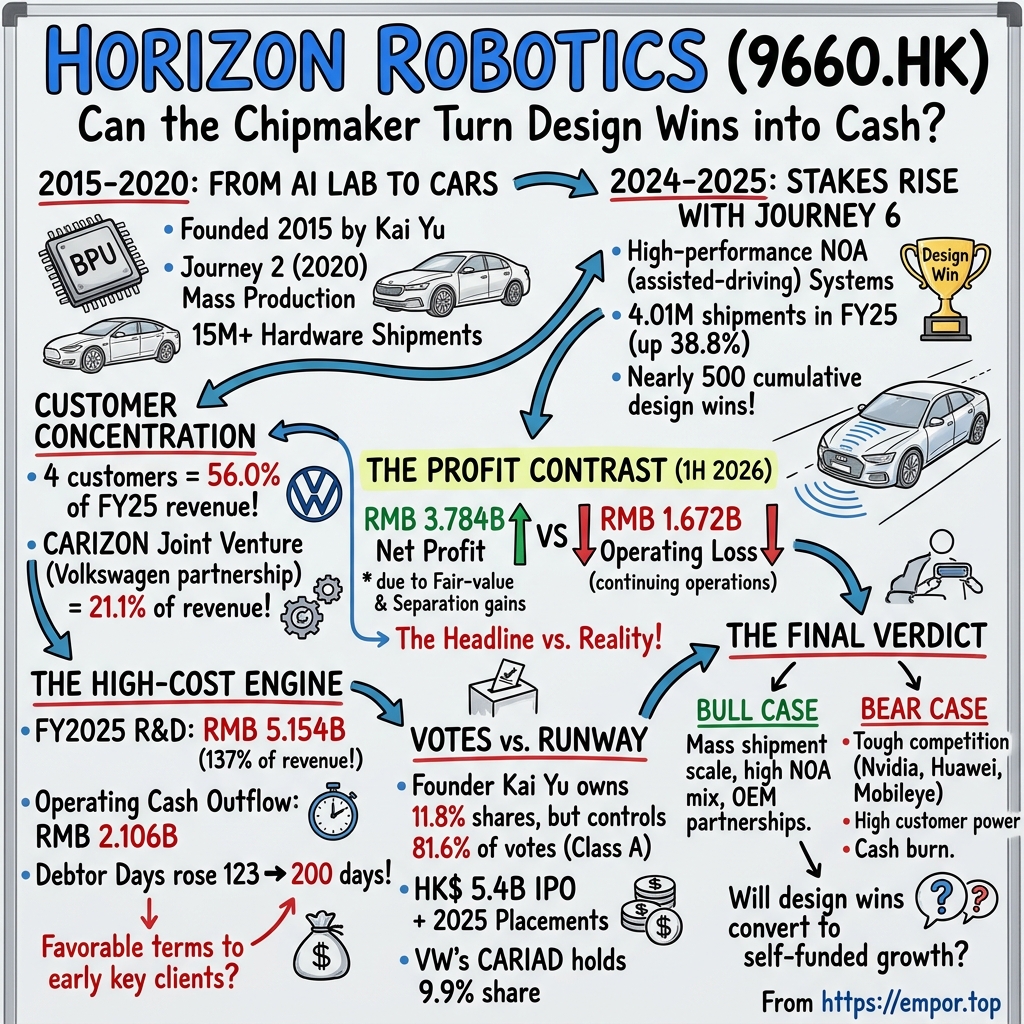
At the end of September 2026, 地平线 Horizon Robotics published a half-year income statement that seemed to describe a company that had finally arrived. For the six months to June, the Chinese maker of computing chips for cars reported a net profit of RMB3.784 billion.1 For a business that had never earned a sustained profit from selling its products, that looked like the moment every long-suffering backer waits for: the turn.
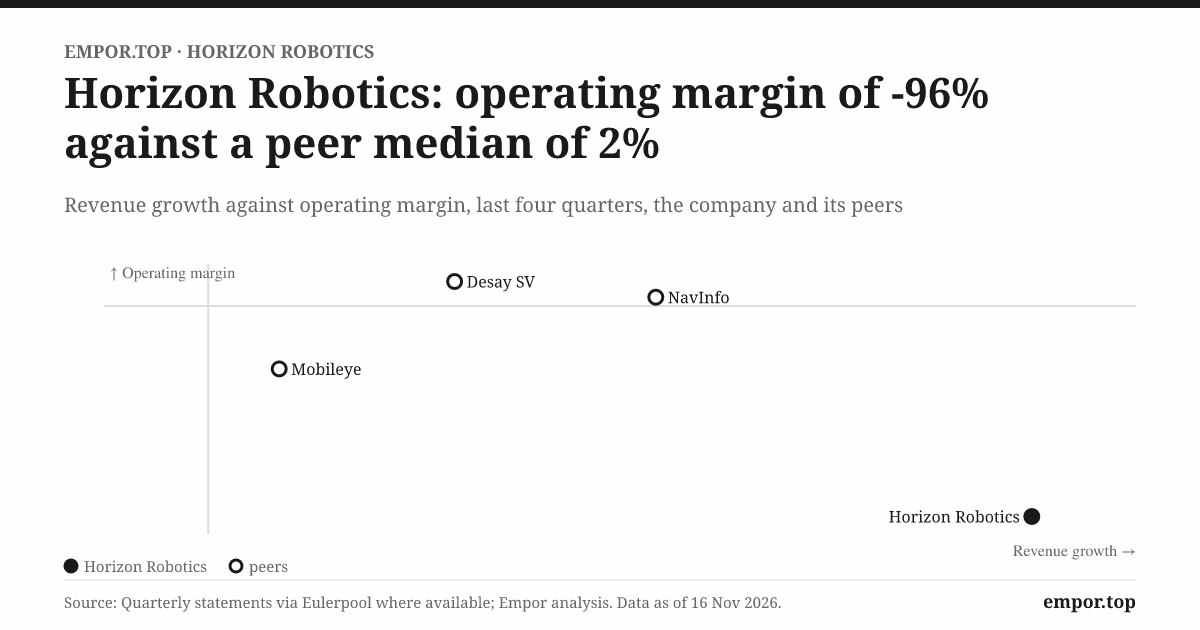
Read a few lines higher on the same page, and the turn disappears. The continuing business, the part that designs chips, writes driving software and sells both to carmakers, lost RMB1.672 billion at the operating line in those same six months.1 On management's own adjusted measure, which strips out share-based pay and valuation swings, the company lost RMB1.671 billion.1 The products were still costing far more to build than they earned. The profit came from somewhere else.
It came, in large part, from two events with nothing to do with selling chips that half-year. The first was a non-cash gain of about RMB5.2 billion on the fair value of a convertible loan from CARIAD, Volkswagen's software arm.1 The loan's value was tied to Horizon's share price, so when the shares rose in 2025, the accounts booked a RMB6.664 billion loss; when they fell in 2026, the same liability shrank and the accounts booked a gain.2 The second was a RMB2.779 billion gain from deconsolidating D-Robotics, a robotics business Horizon had incubated and stopped controlling on March 31, 2026.1 Those two items alone exceeded the entire reported profit.
So here is the strange arithmetic at the heart of this story. In 2025, when investors were most excited about Horizon, its reported loss swelled to RMB10.469 billion, largely because the excitement raised the value of what it owed CARIAD.2 In 2026, as the shares slid more than 60% from their 52-week high, the accounts flipped to profit.1 A company whose income statement improves when its stock falls is a company whose headline earnings tell you very little about the business. The real question has to be asked another way.
That question is whether Horizon can turn its design wins, the moments when a carmaker picks a Horizon chip for a future vehicle, into a business that funds itself. It is a question with three parts. The first is economic: can revenue growth outrun the research spending that makes each new chip generation possible? The second is about demand: how durable is it when a handful of customers, and one Volkswagen-linked joint venture, account for so much of the revenue? The third is about ownership: can the growth justify the fresh capital public shareholders have supplied, given that the founder controls the votes?
Before going further, it is worth drawing the boundary of the story. The listed company, ticker 9660 on the Hong Kong Stock Exchange, is a Cayman Islands holding company with its consolidated subsidiaries.3 It is not Volkswagen, though Volkswagen's software arm is now a shareholder and a joint-venture partner. It is not D-Robotics either, at least not anymore. When this story talks about Horizon's revenue, losses and cash, it means that holding company and the businesses it controls.
To understand how a company ends up reporting a profit on top of an operating loss, you have to go back to the beginning, to a researcher who believed the future of artificial intelligence would be decided not in data centers but inside machines that move. His bet was that cars would need their own brains, and that someone in China should build them. The bet was right about the cars. Whether it was right about the economics is the story that follows.
 Subscribe on LinkedIn
II. A Computer-Vision Lab Goes Looking for a Car
In the summer of 2015, 余凯 Kai Yu walked away from one of the most prestigious jobs in Chinese artificial intelligence. He had been one of the leading figures in deep learning at 百度 Baidu, the search company whose research labs were then among the most ambitious in the world, and before that had worked at NEC Laboratories America on machine learning and computer vision.3 He had a doctorate in computer science from Germany and a reputation as one of China's early evangelists for neural networks.3 Leaving to start a chip company was not an obvious move. Chips are slow, expensive and unforgiving; software researchers usually stay in software.
Yu's argument was that they could not. Neural networks, the mathematical engines behind modern image recognition, were hungry for a particular kind of computation, millions of simple multiplications done in parallel. General-purpose processors handled that badly. If AI was going to leave the data center and live inside a car, a robot or a camera, it would need a chip designed around those networks, one that was cheap and frugal with power. Horizon was incorporated in July 2015, and the company describes itself as among the first to propose a focus on deep-neural-network computing.4 Yu's stated ambition, repeated on the company's own pages, was to become the "Wintel of the robotic era", supplying the standard brain for a new class of machines the way Intel and Microsoft had supplied the standard brain for personal computers.4
He did not do it alone. Among the founding team was 黄畅 Huang Chang, a fellow alumnus of Baidu's deep-learning research effort, who became chief technology officer and an executive director.3 Together they started with architecture rather than products. In March 2016, Horizon launched the first generation of what it called the BPU (brain processing unit), its own design for running neural networks efficiently.4 By January 2017 it had built a driver-assistance perception prototype on the BPU, and in December 2017 it introduced its first commercial computing solutions under two names: Journey, for cars, and Sunrise, for cameras and other devices.4
Here the story runs into the wall that every automotive supplier meets. A chip that works on a lab bench is not a chip a carmaker will put in a vehicle. Automotive parts must survive years of heat, cold and vibration, meet functional-safety standards, and be qualified through test programs that can take longer than the development of a consumer phone. A carmaker picking a chip today is choosing for a vehicle that may launch two or three years later, and that will then be produced for several more. So there are four separate moments in a supplier's life that are easy to confuse: technical progress, the design win, the vehicle's launch, and the arrival of meaningful revenue. Years can separate the first from the last.
Horizon spent those years doing things that made headlines without making much money. In May 2018 it said it had enabled the commercial deployment of Robotaxi autonomous driving.4 In June 2020 its researchers won four titles at the Waymo Open Dataset Challenge, a competition run on data from Alphabet's self-driving unit.4 Those were real technical achievements, and they mattered for recruiting and credibility. They were not a second business. The Robotaxi work never became a scaled revenue line in Horizon's filings, and the competition wins did not ship in cars. The pattern worth noticing is that Horizon's revenue would come not from the futuristic demonstrations but from the humbler job of helping ordinary cars see lane lines and pedestrians.
That job arrived with Journey 2. Launched in August 2019 and described by the company as China's first such computing solution for intelligent driving, it entered mass production in passenger vehicles in June 2020.4 Five years after incorporation, Horizon had a chip on the road. The next generations came faster. Journey 3 launched in September 2020 and debuted in mass production with 理想汽车 Li Auto in May 2021; Journey 5 launched in July 2021 and went into production in the Li Auto L8 in September 2022.4 By December 2021, cumulative Journey shipments had passed one million units; by March 2024, five million.4 By the company's latest count, the total has passed 15 million.5
Commercial scaffolding went up around the chips in the same years, and it says a lot about how Horizon chose to grow. In September 2021 it completed a joint venture with Continental in Shanghai, tying itself to one of the largest tier-one suppliers in the world.4 In March 2022 it introduced a model for licensing its BPU designs to others, and in April 2023 it said that model had its first carmaker customer.4 In April 2022 it announced a further joint venture with 中科创达 ThunderSoft, a software company.4 By February 2023, Horizon said it had mass-production partnerships with all ten of China's largest car groups by sales.4 The choice embedded in that list is important. Rather than trying to sell a finished product to every carmaker on its own, Horizon spread itself through partners, licenses and joint ventures. That made it ubiquitous faster than a lone chip vendor could have managed. It also meant that more of its future would be negotiated with partners rather than dictated to customers.
Those numbers prove one important thing: Horizon made the leap from research to production-grade automotive products, which many chip start-ups never do. They do not prove a second thing that investors care about just as much. A shipment count says nothing about the price each chip fetched, how much engineering support each customer demanded, or whether the business behind the chips earned a return. Millions of units can be sold at a loss.
The early years also set up a tension that has never left the company. Each Journey generation broadened the range of vehicles Horizon could serve, from basic driver assistance to more demanding functions. But each one also required a new round of research, new chip tape-outs (the costly step of sending a finished design to a foundry for manufacture), and new rounds of qualification with carmakers before it earned anything. The product kept getting better, and the bills kept arriving first. That tension came to a head with the generation Horizon launched in 2024, the one meant to carry it from the cheap end of the market into the expensive one.
III. Journey 6 Raises the Stakes
In April 2024, at the Beijing auto show, Horizon unveiled the Journey 6 series alongside a full driving-software system it called Horizon SuperDrive, or HSD.4 The pitch was not a single chip but a family. At the bottom sat versions for basic driver assistance, the systems that keep a car in its lane and brake for obstacles. At the top sat high-performance versions for what Chinese carmakers call NOA, or navigate on autopilot: assisted driving that can follow a route on highways and, in its most demanding form, through city streets. One architecture, many price points. The idea was to let a carmaker standardize on Horizon across a whole lineup.
To see why that matters, it helps to understand what Horizon actually sells. Its largest business is automotive product solutions: the processing hardware paired with algorithms and software.2 Around that it sells licenses for its technology and technical services, which can include helping a carmaker adapt software to a particular vehicle.2 Customers can buy different combinations. One carmaker may buy a chip with Horizon's full software stack; another may buy the chip and write much of its own software; a third may license Horizon's intellectual property. Pricing depends on what is in the box, and license and service contracts vary with the scope of the project, the staff it needs and how long it runs.2
That last point deserves emphasis, because it is often misunderstood. License and service revenue at Horizon sounds like the recurring, high-margin software revenue investors love. It is not quite that. In 2025, about RMB3.4 billion of automotive revenue was recognized at a point in time, meaning when a deliverable was handed over, and only about RMB138 million was recognized over time.2 The company does not disclose a recurring-revenue percentage or general minimum customer commitments. This is project revenue, earned deal by deal. A strong licensing year can be followed by a weaker one if fewer projects land.
From more units to richer units
Journey 6 was where the numbers started to show a change in the kind of business Horizon was running. In 2025, automotive hardware shipments rose 38.8% to 4.01 million units.2 More interesting than the unit count was the mix: 45% of those shipments supported NOA functions, and the company said the average dollar content per vehicle rose by more than three-quarters.2 Put simply, Horizon was not just selling more chips; it was selling more expensive ones into more ambitious systems. That is exactly the shift a supplier needs if it wants revenue to grow faster than the car market.
There is a quiet dependency inside that growth. More than 95% of Horizon's shipments in 2025 went through ecosystem partners, the tier-one suppliers that build complete driver-assistance modules and sell them to carmakers.2 That is how the automotive supply chain typically works: a carmaker buys a finished camera or domain controller, and the chip sits inside it. The arrangement extends Horizon's reach, because one partner can carry its chip into many vehicle programs. It also means Horizon is relying on others to integrate, deliver and support its product in the field. When the partner stumbles, the chip ships late.
The company is fond of counting design wins, and it has a lot of them. By mid-2026 it reported nearly 500 cumulative design wins.1 In the first half of 2026, Journey shipments rose 12.1% to 2.218 million units.1 Both numbers are real. They measure different things, and the difference is the crux of how to read Horizon.
A design win is a carmaker's decision to use a product in a vehicle program. Some of those programs launch on time and sell well; some launch late; some sell poorly; some are cancelled. A cumulative tally also never shrinks, because a win counted in 2021 stays in the total even after the car it went into stops production. Shipments, by contrast, are chips that actually left the building. They are the better predictor of revenue, but they say nothing about margin, and they lag the decisions that created them. The measure closest to repeat revenue would be the number of customers who, having shipped one Horizon program, chose Horizon again for the next one. The company does not publish that figure.
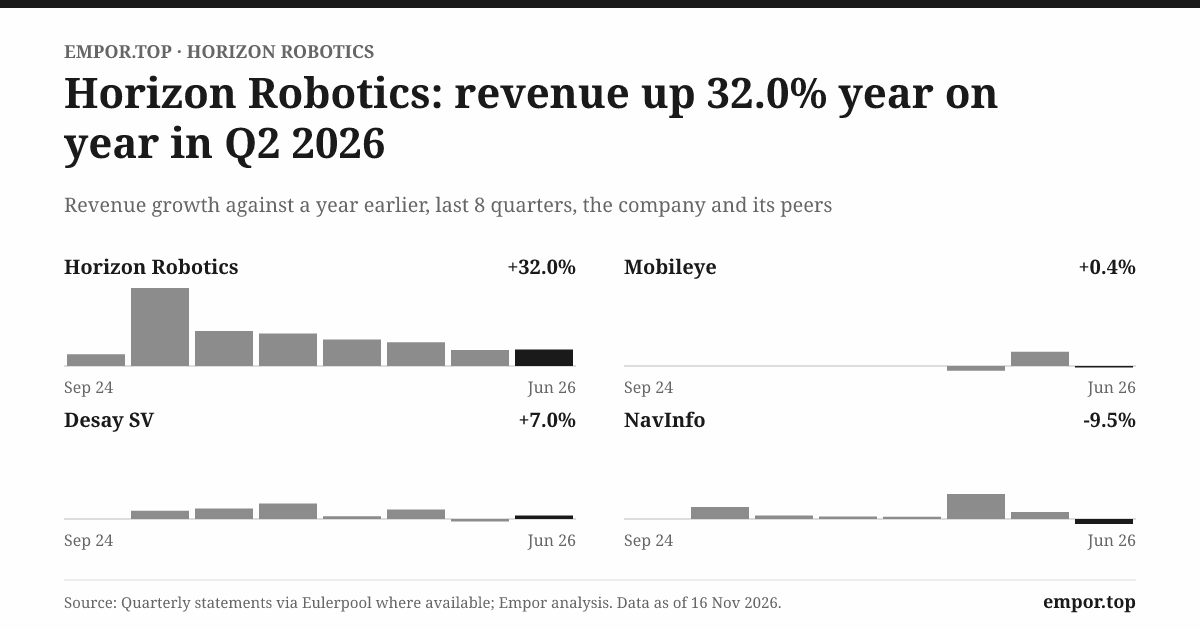
So the honest reading is this. The jump in NOA mix and content per vehicle suggests Journey 6 is changing what Horizon sells, not just how much. Growth in the first half of 2026 also slowed sharply, to 12.1% in units, after the 38.8% of the year before.2 By the company's account, that came against a 20.2% decline in China's passenger-car retail sales over the period, which would make unit growth of any kind an achievement.1 Even so, the slowdown is a reminder that Horizon's volumes ride on a car market it does not control.
The next rung up
The stakes rise further with HSD, Horizon's own full-stack system for higher-level assisted driving. The company moved it into mass production, and it is the clearest example of Horizon trying to capture more of the value in a car than the chip alone.1 The research spending behind it was heavy: the 2025 increase in research and development was driven in part by cloud and technical services for HSD and Journey 6.2 Whether HSD becomes broadly adopted is a different question from whether it works. Being in production in some vehicles proves that it can be built and qualified. It does not yet prove that many carmakers will hand over the core of their driving experience to an outside supplier, or that they will pay enough for it to cover the cost of building it.
That is the line where Journey 6 meets its toughest test. At the basic end of the market, Horizon competes on cost and reliability. At the top end, it competes for the most strategic piece of software in a modern car, against rivals with deeper pockets and carmakers who would rather keep that piece in-house. What happens when a carmaker sits down to choose who gets that job is the next part of the story.
IV. The Customer Has More Than One Chip to Choose From
Picture the room where a Chinese carmaker chooses the brain for a new model. On the table are several offers. Each has a price per unit, a performance figure, a power budget and a promise about software. The engineers want the chip that will run the most demanding features without overheating. Finance wants the cheapest bill of materials. The product team wants features that rivals do not have. And somewhere in the room is a strategic question that has nothing to do with any single offer: how much of this car's intelligence does the carmaker want to own, and how much is it willing to rent?
Horizon is one of the names on that table, and in some parts of the market it is the default. Horizon reported a 47.7% share of basic driver-assistance solutions among domestic Chinese brands in 2025, and 14.4% in advanced NOA.2 A separate industry ranking compiled by the research firm GGII put Horizon at about 48% of China's front-camera driver-assistance chip market in 2025, ahead of Mobileye at about 28%.6 In the entry segment, in other words, Horizon has displaced the company that once defined it. Mobileye, the Israeli supplier owned by Intel, built the global business of selling vision chips for driver assistance, and in China it now runs a distant second.
Different scoreboards for different games
The higher end looks very different, and here the definitions matter. The same GGII ranking measured the chips behind urban NOA, the most demanding version of assisted driving, in factory-installed systems in 2025. Nvidia led with about 49%, 华为 Huawei followed with about 23%, and Horizon came third with about 18%; together the three held about 90% of that market.6 Horizon's own 14.4% figure covers a wider "advanced NOA" category, while its 2026 interim report gave a 22.8% share of urban NOA among domestic-brand passenger vehicles in the first half of 2026.1 These numbers cannot be lined up as a neat trend, because each one slices the market differently: by brand nationality, by function, by period. What they collectively show is that Horizon is a credible top-three player in high-end assisted driving and that its share in that segment has been rising. They do not show it leading. Even the high-end category itself is growing fast enough to flatter everyone in it: GGII counted about 2.07 million passenger vehicles with factory-installed urban NOA in China in 2025, up roughly 156% in a year, still only about 15% of deliveries.6 In a market that is growing that quickly, share gains can coexist with intense price pressure, and the real contest is over the vehicles that have not yet been fitted.
The competitors bring different weapons. Nvidia sells enormous computing power and a software ecosystem that engineers already know from data centers; carmakers that want to write their own driving software often choose it as a blank canvas. Huawei sells something closer to a complete system, often bundled with its own branding and deep involvement in the vehicle's design. Mobileye sells a mature, low-cost package at the entry level. And the carmakers themselves are a fourth competitor. The GGII data found that automakers' self-developed platforms made up less than 5% of mass-produced vehicles in 2025, which suggests that in-house chips are, for now, more threat than reality.6 But Horizon's own risk disclosures flag customers developing similar systems themselves as a risk.2 A carmaker does not need to build a chip to hurt Horizon; it only needs to build the software and buy a cheaper or more open chip from someone else.
Where the power sits
Michael Porter's five forces give the clearest frame for that room. Buyer power is the dominant force. Horizon's customers are carmakers, a concentrated group that buys in huge volumes, runs competitive tenders and, as the next section shows, accounts for a large share of Horizon's revenue in a handful of names. Rivalry is intense: four serious alternatives in the high end, at least two in the low end. The threat of substitutes comes from in-house development. Supplier power is real too, since Horizon designs chips but depends on outside foundries to make them, and it discloses supply-chain dependence as a risk without quantifying its reliance on any single supplier.2 The threat of new entrants is the one force working in Horizon's favor, because the years of qualification and the cost of each chip generation keep start-ups out. Four forces against, one for: this is a hard industry in which to earn high returns.
Hamilton Helmer's seven powers ask a narrower question: what, specifically, would let Horizon earn better returns than its rivals for a long time? Three candidates are worth testing. The first is switching costs. Once a carmaker has validated a chip, integrated its software and passed safety tests, changing suppliers mid-program is expensive. That is real, but it protects a program, not a customer. At the next model cycle, the carmaker can reopen the tender, and nothing in Horizon's disclosures quantifies how often customers come back. The company publishes no retention rate and no measure of price realization.
The second candidate is scale economies. Horizon has shipped more driver-assistance chips into Chinese brands than anyone else, and spreading research across more units should lower cost per chip. The evidence for that is mixed, as the story of its research spending will show; so far, scale has not translated into operating profit. The third is a kind of cornered resource in local engineering: teams in China who can tailor software to a domestic carmaker's needs faster and more cheaply than a foreign supplier. That advantage is plausible, and the displacement of Mobileye at the low end is consistent with it. But it is not exclusive, because Huawei and dozens of domestic software houses have the same proximity.
Weighed against the record, the moat claim narrows. Horizon has a defensible position at the entry level, where its share is large and its main rival is foreign and slower. It has a growing position at the high end, where it is the challenger to Nvidia and Huawei. The evidence supports a competitive position, not a durable moat. The way to tell which way it goes is not product launches; it is whether existing customers award repeat programs, whether content per vehicle keeps rising, and whether gross margin, which held at a high 66.0% in the first half of 2026, survives the push into more competitive territory.1 If buyer power is the dominant force, the next place to look is who those buyers are.
V. Four Customers and One Joint Venture Carry the Growth
Deep in the notes to Horizon's 2025 annual report sits a short disclosure that tells you more about the business than most of the glossy pages before it. It lists customers that each accounted for more than 10% of revenue. In 2025 there were four of them. One was about 18% of revenue, the next about 15%, then about 12% and 11%.2 Together, four buyers accounted for about 56% of the company's sales.2 Their names are not given.
A year earlier the picture was more lopsided but less crowded: two customers exceeded 10%, at about 32% and 17%.2 By the first half of 2026, one customer accounted for about 24% and another for about 10%.1 Read across the three periods, the mix has clearly shifted. The single largest customer was a smaller slice in 2025 than in 2024, and more names crossed the 10% line. That is diversification of a kind. But a business where four buyers make up more than half of revenue is still a business where the loss or delay of one program can change the year.
The partner that is also a customer
One of the most important customers is not anonymous at all, because it is partly Horizon's own. In October 2022, Volkswagen announced that CARIAD would form a joint venture with Horizon to develop full-stack driver-assistance and automated-driving systems for its electric vehicles in China, with CARIAD holding 60% and the Volkswagen Group investing about €2.4 billion in the cooperation.7 The joint venture, Carizon, was formally established in December 2023.4 Volkswagen's executives framed it as central to the group's realignment in China; Kai Yu framed it as Horizon bringing its mass-production expertise to the next generation of smart vehicles.7
For Horizon, Carizon is three things at once. It is a route into one of the world's largest carmakers. It is a customer that buys Horizon's licenses, technical services and product solutions. And it is an investment whose losses Horizon shares. In 2025, Horizon recorded RMB791.1 million of revenue from Carizon before eliminations, roughly 21% of group revenue.2 The year before, the comparable figure was RMB814.5 million.2 On that basis, Carizon's contribution was flat while the rest of the business grew by more than half, so the joint venture went from roughly a third of revenue to roughly a fifth. That is the clearest single piece of evidence that Horizon's growth was broadening beyond its Volkswagen link.
The other side of the ledger matters just as much. Because Horizon owns a minority stake, it records its share of Carizon's results below the operating line. In 2025, equity-accounted losses totaled RMB853.1 million, primarily associated with Carizon and with Horizon Continental Technology, a joint venture with the German supplier Continental, as both ramped up research.2 Put the two figures next to each other and the shape of the relationship becomes visible: Horizon earned revenue from Carizon roughly equal to the losses it absorbed from Carizon and its sister venture combined. The joint venture is both a source of sales and a source of cost, and the sales are recognized where investors look first.
Horizon's connected-transaction rules include pricing safeguards, and the company reports these transactions under Hong Kong's listing rules.2 There is no suggestion in the filings of improper dealing. The analytical issue is simpler: revenue from a partly owned affiliate is economically real, but it is not the same as revenue from an arm's-length customer who chose Horizon in an open tender. Investors should weigh it accordingly.
The robotics spin-out
A smaller related-party stream ran through 地瓜机器人 D-Robotics, the robotics-computing business Horizon incubated. In 2025, Horizon's connected sales of products to D-Robotics came to RMB62.8 million, exactly at a revised annual cap, and the 2026 cap was set at RMB119 million, with prices to reference Horizon's costs and comparable third-party quotes.8 2 That stream was small. What changed in 2026 was the relationship itself: D-Robotics left the consolidated group at the end of March 2026, became a discontinued operation and is now accounted for as an associate.1 Sales that were once intra-group became sales to an outside affiliate.
It is also worth noting what Horizon does not disclose. Its filings do not quantify how concentrated its suppliers are, and they name no major customer loss, bankruptcy or contract exit in the prospectus or the 2025 annual report.3 2 They do record, in the first half of 2026, that Horizon gave preferential credit terms to certain early key customers, a fact that will matter a great deal when the story turns to receivables.1
The question that follows is whether new programs can broaden the base. Horizon has reported mass-production launches with joint ventures of Volkswagen and of トヨタ Toyota, alongside other carmakers.1 If those programs scale, the largest customers will shrink as a share of the total, the way Carizon's share fell in 2025. If they do not, Horizon will remain a company whose year is decided by a few procurement departments. Either way, every one of those programs has to be paid for before it pays, and that brings the story to the biggest cost line Horizon has.
VI. The Chip Wins Are Not Yet Paying for the Lab
The 2025 annual report should have been a victory lap. Revenue rose 57.7% to RMB3.758 billion, more than eight times the RMB466.7 million the company had recorded in 2021.2 9 Over the three years to 2025, revenue compounded at about 68% a year.2 Few companies of any kind grow that fast for that long.
Then comes the next line. Research and development expense rose 63% to RMB5.154 billion.2 That is 137% of revenue: for every 100 yuan Horizon brought in from customers, it spent 137 yuan on research before paying for sales staff, administration or anything else.2 The company's operating loss was RMB3.339 billion, and net cash outflow from operations was RMB2.106 billion, a sharp reversal from a small inflow of RMB17.6 million in 2024.2 The business had grown faster than ever and burned more cash than ever in the same year.
Two kinds of cost
To understand whether that is a problem or a phase, it helps to separate two kinds of cost. The first is the cost of delivering the product: the chip from the foundry, the packaging, the support for a customer's launch. Those costs scale with volume, and Horizon's gross margin suggests that this part of the business is healthy.1 A chip that sells for meaningfully more than it costs to make is a good product.
The second is the cost of building the business: the engineers who design the next generation, the cloud computing to train driving software, the tape-outs that send each new design to a foundry. Those costs do not scale with this year's volume; they are bets on the next three years. In 2025, Horizon said its research increase was driven by cloud and technical services for HSD and Journey 6, by research labor and by chip tape-outs.2 This is the cost that has to become a smaller share of revenue for Horizon to ever make money. That is what investors mean by operating leverage: fixed costs growing more slowly than sales, so that each additional yuan of revenue drops more to the bottom line.
The long trend shows how slow that process has been. Research spending fell from about 245% of revenue in 2021 to about 132% in 2024, which looks like steady progress.9 2 Then in 2025 it ticked back up to 137%.2 Six years after its first car chip entered production, Horizon was still spending substantially more on research than it collected in revenue. The improvement since 2021 was real, but it came mostly from revenue catching up, and it stalled exactly when Journey 6 and HSD demanded the next wave of investment.
The first half of 2026 offered the first glimmer of the opposite pattern. Revenue rose 32.9% while research spending rose 21.9% to RMB2.755 billion.1 For once, the lab grew more slowly than the sales. The adjusted operating loss, however, still widened, to RMB1.276 billion from RMB1.051 billion a year earlier.1 One half-year in which research grew more slowly than revenue is a data point, not a trend; it came during a period when revenue growth itself had slowed by more than 20 percentage points from 2025. To call it operating leverage, investors would need to see the loss narrowing, not just the ratio improving.
Machines and people
Capital spending is a smaller part of the story than research, because Horizon designs chips rather than making them. Cash spent on property, plant and equipment and intangible assets fell to RMB701 million in 2025 from RMB912 million in 2024, from about 38% of revenue to about 19%.2 That is a meaningful decline in intensity, and it means the cash burn is mostly about people and research rather than buildings and machines.
The people tell their own story. Horizon had 2,078 full-time employees at the end of 2024 and 2,215 at the end of 2025, an increase of only about 7% in a year when revenue rose by more than half.2 By June 2026 the headcount had fallen to 2,052.1 Some of that fall may reflect the departure of D-Robotics from the consolidated group, but the company does not explain the decrease, and it would be a mistake to read it as a productivity breakthrough without more detail. What it does show is that Horizon was not hiring its way to growth in 2025. The money was going into cloud computing, tape-outs and pay per head, not into a much larger workforce.
A sceptic would put the issue bluntly. Horizon has been told for years that scale will fix its economics, and scale has arrived: millions of units, a leading share in basic driver assistance, a rising share at the high end. The economics have not followed. The company's defenders would answer that the business is being deliberately reinvested, that each chip generation opens a bigger market, and that harvesting now would surrender the high end to Nvidia and Huawei. Both arguments can be true. The evidence so far supports a narrower claim than "operating leverage is coming": the product earns strong gross margins, but the company has not yet shown that it can grow while shrinking its research burden in absolute terms.
The test is easy to state. Watch the continuing-operations operating loss and operating cash flow across several reporting periods, alongside revenue and research spending. If the loss narrows while revenue grows, the lab is starting to pay for itself. If the loss stays flat or widens, the company is buying growth. And there is one more line on the balance sheet that can turn a sales story into a cash story, faster than any research budget.
VII. Receivables Turn the Growth Story into a Cash Question
Buried on page thirteen of Horizon's 2026 interim report is a sentence that a careful reader should pause over. Impairment losses on financial assets, mostly the provision for customers who may not pay, rose 421.4% year on year to RMB77 million in the first half.1 Management's explanation was unusually candid. The increase, it said, reflected preferential credit terms granted to certain early key customers and a receivables mix that had aged.1
Translated into plain language: Horizon let some important customers pay later than usual, and some of that money had been outstanding long enough that the accounting rules required a bigger provision against it. That is not an accounting accident. It is a commercial decision, disclosed as such. Horizon chose to extend credit to customers it considered strategically important, presumably to win or deepen business with them.
There was a warning of this in the annual numbers. Debtor days, a measure of how many days of revenue are sitting in unpaid receivables, rose from 123 in 2024 to 200 in 2025.2 For context, Horizon's previous peak was 202 days in 2022, during a much smaller and messier period of its history.2 In a single year, the company's collection cycle went from about four months to about six and a half. Combined with the jump in revenue, that is a big part of why operating cash flow swung so sharply into the red in 2025, even as sales grew. Growth that is not collected is growth that has to be financed.
Reading the aging schedule
The details sit in the year-end aging schedule. At December 31, 2025, gross trade receivables were RMB1.834 billion.2 Most of that was recent, but RMB89.1 million had been outstanding for more than a year.2 The allowance for expected losses rises with age, reaching about 31% for balances older than twelve months, so the older the debt, the more of it Horizon assumes it will never see.2 Separately, a RMB36.4 million balance was assessed individually and written down in full, a 100% expected loss.2 None of these numbers is alarming on its own relative to the company's cash. Together, they show that the quality of Horizon's revenue is now an open question in a way it was not when debtor days were 123.
Horizon's auditor, PwC, gave the 2025 accounts an unmodified opinion, and expected credit losses on trade receivables were one of three key audit matters, alongside revenue recognition for automotive licenses and services and the valuation of preferred shares.2 Key audit matters are not red flags; they are the areas where the auditor judged that management's estimates carried the most risk. It is notable, though, that two of the three, license revenue and receivables, sit exactly where a growth-hungry company has the most discretion over how its numbers look.
It is tempting to connect the dots: perhaps the early key customers are among the largest buyers. The filings do not say so, and the customers are anonymized in both disclosures, so drawing that line would be speculation.2 1 The safer point is structural. When a few large buyers dominate, the supplier has less power to insist on prompt payment, and favorable credit becomes part of what it costs to win the business. That is buyer power showing up in the balance sheet rather than the price list.
Inventory is the other side of the working-capital story. Horizon held about 301 days of inventory relative to its cost of revenue in 2025, down from a much higher level in 2023, which suggests that the stockpiles of the pre-production years were being worked through.2 The improvement in inventory partly offset the deterioration in receivables. But the cash conversion cycle, the time between paying for a chip and collecting cash for it, was still more than a year.2
So what did the preferential terms buy? If they helped Horizon land programs with key customers that then ramp up and pay on schedule, the RMB77 million provision will look like a modest marketing cost. If the receivables keep aging, the cost will rise, and the revenue that was booked will turn out to have been partly a loan. The answer will show up in three numbers: debtor days, the share of receivables more than a year old, and the impairment expense, all measured against revenue growth. Sales growth alone is not proof of demand quality. Collection is.
Receivables are one kind of bet Horizon makes on its customers. Its joint ventures and investments are a much bigger one, and the largest of those comes back to the Volkswagen partnership.
VIII. Volkswagen's Partnership Becomes a Capital-Allocation Test
There are two ways to read the Carizon joint venture, and both are visible in the same set of accounts.
The first reading is strategic. In 2022, one of the world's largest carmakers, facing a collapse in its competitiveness in China's electric-vehicle market, chose a Chinese chip company to build the driving brain for its Chinese cars and committed billions of euros to the effort.7 For Horizon, that was validation of a kind no marketing budget could buy. It brought a foreign carmaker into its ecosystem, secured years of license and service work, and later turned into an equity relationship. Carizon, on this view, is not an expense but a door.
The second reading is financial. Horizon recorded RMB853.1 million in equity-accounted losses in 2025, primarily associated with Carizon and Horizon Continental Technology during their research ramp-up.2 It booked RMB791.1 million of revenue from Carizon in the same year.2 Some of the research Carizon pays for flows back to Horizon as revenue, and Horizon then absorbs its share of Carizon's losses below the operating line. That circularity is common in joint ventures, and it is not improper, but it means the investor should be careful about counting the revenue without counting the losses.
A partnership, not a purchase
It is important to be precise about what Carizon is. It is a strategic operating partnership in which CARIAD holds the majority, not an acquisition by Horizon.7 There is no conventional purchase price, no goodwill to write down and no comparable deal against which to judge whether Horizon overpaid. The returns will come, if they come, from license and service revenue earned over years, from Volkswagen vehicles that ship with Horizon technology, and from the strategic benefit of being Volkswagen's partner of choice in China. The filings do not yet allow anyone to calculate a return on the capital and effort Horizon has committed. So the fair verdict is not that the investment failed; it is that its returns remain undemonstrated, while its costs are measurable.
The same caution applies to Horizon's broader portfolio. At the end of 2025, the company held RMB20.2 billion in cash and cash equivalents and RMB4.8 billion in investments, including equity-accounted interests, strategic minority stakes, joint ventures, investments in partners' IPOs, funds and low-risk wealth-management products.2 That is a large treasury relative to a business with RMB3.8 billion of revenue. But it was assembled from investors' money, not from operating cash. Operating cash flow was negative by RMB2.1 billion in the same year.2 Treasury assets and cash generated by the business are not the same thing, and the first can make the second look less urgent than it is. By June 2026, cash had fallen by about a quarter to RMB14.9 billion.1
The treasury also generated income that flattered the operating picture. In 2025, Horizon recorded RMB335.2 million of other income, mostly RMB312.4 million of government subsidies, and RMB402.4 million of fair-value gains on financial assets.2 Subsidies and investment gains are welcome, but they do not establish that the products are profitable, and they cannot be relied on to recur at the same size.
The debt side of the balance sheet is often misread for the same reason. Data providers show a debt-to-equity ratio of about one at the end of 2025, which would suggest a heavily borrowed company.5 Most of that, however, was the CARIAD convertible loan carried at fair value, not ordinary bank borrowing. Ordinary borrowings were only RMB528 million, with lease liabilities of about RMB117 million on top.2 Once CARIAD converted, the largest item disappeared from the liability side. Horizon's constraint was never debt. It was the steady drain of operating cash, and the need to replace it with equity.
Letting go of D-Robotics
The biggest scope change came in 2026. D-Robotics, the robotics-computing business Horizon had developed internally, was consolidated until March 31, 2026, when Horizon lost control of it.1 Horizon reclassified it as a discontinued operation, recognized a RMB2.779 billion gain on deconsolidation and now carries its remaining stake as an associate.1 That gain was a large part of the headline profit that opened this story, and it is entirely non-cash: it reflects the revaluation of Horizon's retained interest, not money received.
The economic meaning of the D-Robotics separation is narrower and more interesting than the gain. It shrinks Horizon's consolidated perimeter to the automotive business, removing a second set of research costs and a second set of ambitions from the income statement. For an investor trying to judge whether the automotive engine can fund itself, that is clarifying. It also means that comparisons between 2025 and 2026 need care, and the right comparison is the continuing automotive business against its own past, with D-Robotics excluded.
An activist looking at this record would ask a pointed question. Horizon has a joint venture with Volkswagen, a joint venture with Continental, another with ThunderSoft announced in 2022, a portfolio of strategic minority stakes and a robotics spin-out.4 2 Each has a plausible strategic story. Together, they spread capital and management attention across several bets while the core business still loses money. The defense is that in the Chinese automotive supply chain, partnerships are how a supplier secures programs, and that D-Robotics' separation shows a willingness to narrow focus. Both points have merit. What the record does not yet show is that any of these investments has produced a return that could be measured in cash.
The question for the next few years is what Horizon funds next. If the answer is more research for Journey and HSD, the test is whether shipments and customer programs earn enough to justify it. If the answer is more ventures, the test is harder. And either way, the money has come from shareholders, under a structure that gives one shareholder unusual say over how it is spent.
IX. A Founder Controls the Votes; Public Investors Fund the Runway
On October 24, 2024, Horizon's shares began trading in Hong Kong.3 The listing priced at HK$3.99, the top of its range, and was set to be the largest Hong Kong IPO of the year; cornerstone investors including Baidu and an Alibaba-linked entity had committed about US$220 million.10 The company sold about 1.36 billion new Class B shares and later another 170.4 million when underwriters partly exercised their over-allotment option.3 The IPO raised about HK$5.4 billion.10
What new shareholders bought was a specific kind of company. Kai Yu, through his holding vehicle Everest Robotics and a family trust, owned about 1.73 billion Class A shares at the end of 2025.2 Economically, that was about 12% of the company.2 But each Class A share carries ten votes, and Yu held about 82% of that class.2 Hong Kong permits this weighted-voting structure for innovative companies, and its purpose is explicit: to let founders keep control while raising large sums from outside. In Horizon's case, it means that the person who owns roughly one-eighth of the economics has decisive say over strategy, capital raising and the board.
The board itself has twelve members, four of them independent non-executive directors.2 Yu remains chairman and chief executive in both the 2025 annual report and the 2026 interim report, with no change in the top role since founding.2 1 Dr. Jian Xu is among the executive directors, following his election in 2025.1 2 The filings do not identify a chief financial officer role or a CFO tenure history, an unusual gap for a company of Horizon's size and capital needs.2
Going back to the market, twice
The IPO was not the last raise. In 2025, Horizon came back to public investors twice, through top-up placements. In June it placed 681 million new shares at HK$6.93, raising net proceeds of about HK$4.67 billion; in October it placed 639 million at HK$9.99, raising about HK$6.34 billion.11 12 Horizon raised about RMB10.1 billion from ordinary-share issuance in 2025.2 Both placements were priced well above the IPO, so by that measure Horizon raised money opportunistically, selling shares when investors were enthusiastic. That is often good capital management. It is also dilution: the share count rose to about 14.65 billion by the end of 2025.2
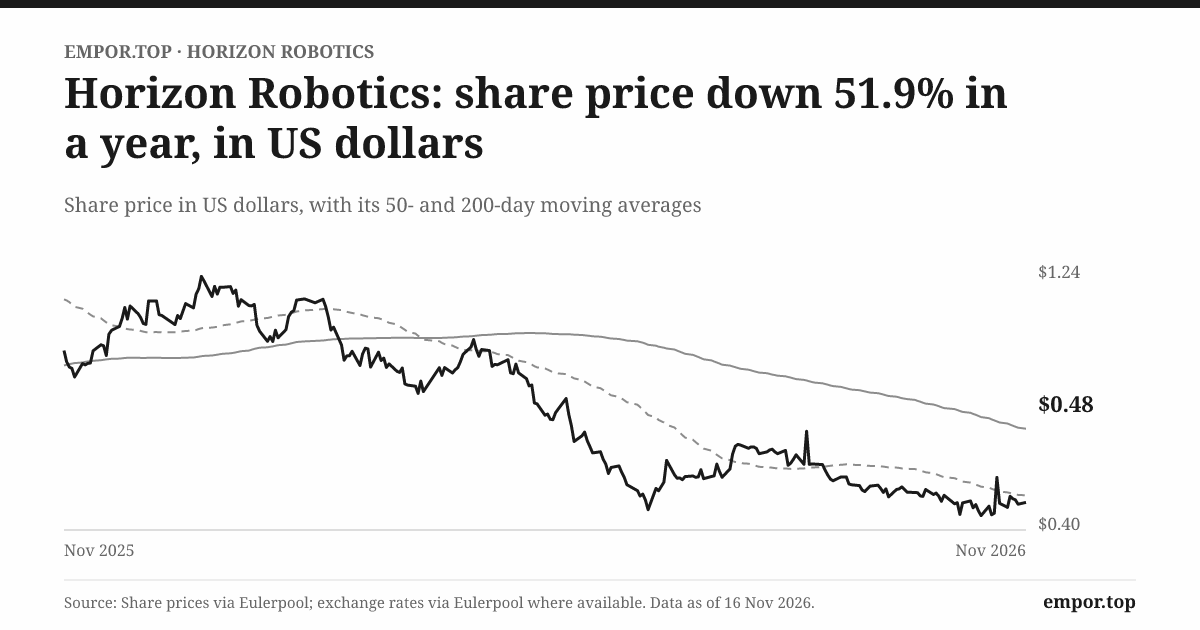
Today the shares trade at around CN¥3.23, or roughly HK$3.8 at current exchange rates, just below the IPO price and far below both placement prices.5 Investors who bought in the October 2025 placement have lost well over half their money. That does not mean the company did anything wrong by selling; it means the market priced the growth story very differently a year ago, and the company was wise or lucky to sell when it did.
The CARIAD relationship added a second dilution channel. CARIAD's US$800 million convertible loan sat on the balance sheet as a financial liability carried at fair value, which is why it produced the wild swings in reported earnings that opened this story.2 Its expected settlement date was December 7, 2026.2 Instead, on August 3, 2026, CARIAD converted, becoming a 9.9% shareholder and agreeing to a voluntary 12-month lock-up, while Horizon redeemed the excess conversion rights at a discount.1 The company said this reduced potential dilution by about 4.9% of pre-closing share capital.1 That was a sensible outcome. It removed a large, price-sensitive liability, avoided a cash repayment and turned a creditor into a locked-up strategic shareholder. It also brought an automaker inside the shareholder register, which can cut both ways when that automaker is also a joint-venture partner and a customer.
What management is paid to deliver
Compensation is meaningful for a loss-making company. In 2025, one member of senior management was paid in the band of HK$70 million to HK$130 million, and the four highest-paid employees who were not directors fell in bands from HK$32 million to HK$66 million.2 Group share-based payments rose to RMB965.8 million in 2025 from RMB550.8 million in 2024.2 Share-based pay is a real cost to shareholders even though it does not consume cash; it is paid in ownership instead. In 2025, it was about a quarter of revenue.
Shareholders have shown little appetite to object, but their votes carry limited weight. At the June 2026 annual meeting, every resolution passed, and on adoption of the 2025 accounts less than 0.1% of total votes were against; among Class B holders, the ones without weighted votes, opposition was about 0.2%.13 That is a calm result, but it is not a referendum on governance. Under a ten-to-one voting structure, the outcome of any ordinary resolution is effectively settled before the meeting begins, and the Class B dissent figure is the more informative number. It was low.
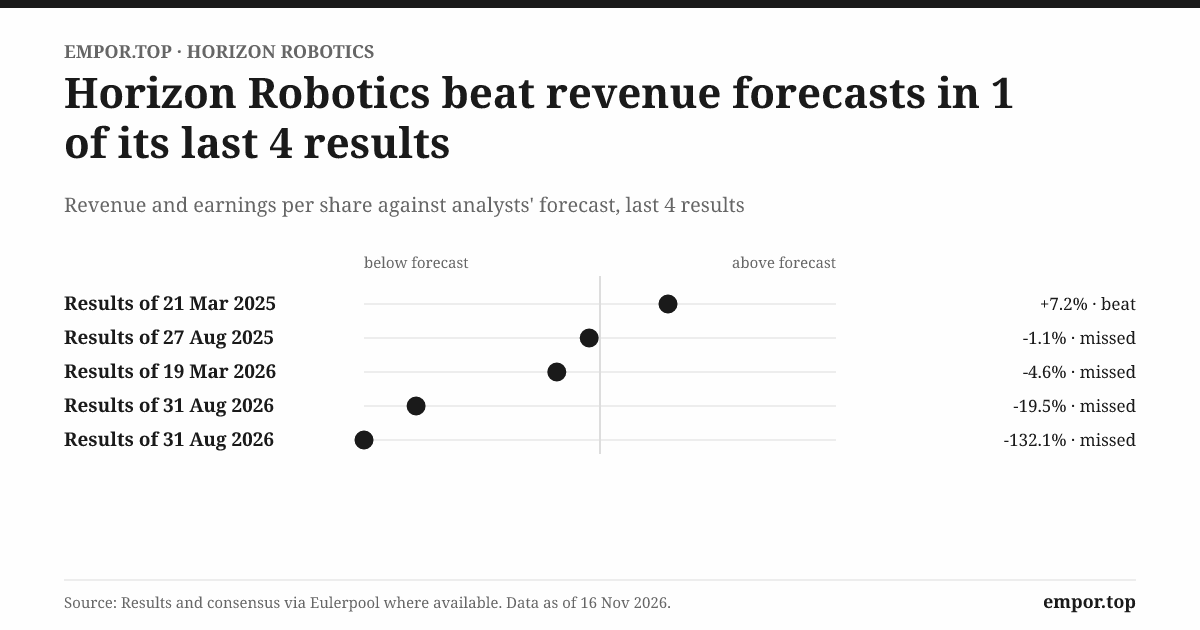
The deeper test of management credibility is behavior over time. Horizon held its 2025 results call in March 2026 and its interim call in August 2026, setting out its outlook for 2026 revenue and its path toward breakeven.14 15 The right way to judge those targets is not by their ambition but by follow-through: whether the next results match what was promised, whether misses are explained with specifics, and whether the prepared remarks and the answers to analysts tell the same story. On the record so far, the company has delivered on product milestones and on revenue growth, while the promise implicit in its listing, that scale would bring profitability, remains unfulfilled. For a founder who controls the votes, per-share outcomes are the most honest measure available to everyone else. Which brings the story to what the market is currently willing to pay for those shares.
X. Analysis & Bear vs. Bull Case
On November 16, 2026, Horizon's shares closed about 61.5% below their high of the previous twelve months.5 At that price, the company was worth about CN¥48.5 billion.5 For a stock that has fallen that far, it is still not cheap by conventional yardsticks. The market value is about 7.7 times the last twelve months of sales, and enterprise value, which adjusts for cash and debt, is about 6.6 times sales.5 Free cash flow is negative, at roughly minus 7% of the market value.2 5 And in 2025, the business lost at the operating line roughly as much as it sold.2
Those figures describe what the price assumes. A sales multiple in the high single digits for a company with no operating profit means investors are paying for revenue that does not yet exist, and for margins that have not yet been seen. The bet is that today's revenue is the bottom rung of a much larger business, and that the research spending now consuming more than the company earns will one day shrink to a manageable share of sales. The valuation is lower than it was a year ago, but it still asks investors to underwrite future scale before the cash economics are established.
Two common valuation anchors are not useful here. The price-to-earnings ratio that data providers show, about 23 times, is based on the twelve months to June 2025, a period distorted by fair-value movements and before both the 2025 loss and the 2026 accounting changes.5 It is a statistical artifact, not an earnings multiple. Nor is there a long trading history to compare against: Horizon has been listed only since October 2024, so there is no five-year record of how the market has valued it through a full cycle.3
The bull case starts with product adoption that is plainly real. Horizon took a chip from a research lab into mass production in 2020 and, by its own count, has shipped more than 15 million Journey units since.5 It overtook Mobileye in China's entry-level driver-assistance market, reaching nearly half of that segment by both its own and an independent count.2 6 With Journey 6, it moved up the value chain: by 2025, almost half its shipments supported NOA functions and content per vehicle rose by more than three-quarters.2 Its gross margin of 66% says the products command a real premium over their cost.1
On this view, Horizon is following the classic path of a successful chip company. The early years are expensive because every generation needs a new design and a new round of qualification. Once a supplier is embedded across a carmaker's lineup, though, each new program reuses much of the old work, and revenue can grow much faster than the research team. The first-half 2026 numbers, in which research grew more slowly than revenue, are the first sign of that turn. CARIAD's conversion to equity removed a liability that had distorted the accounts, and D-Robotics' separation left a cleaner automotive business. If the share gains in urban NOA continue, the bull argues, Horizon becomes one of a very small number of independent suppliers of high-end driving computers in the world's largest car market.
The case against
The bear case starts with the same facts and reads them differently. Horizon's customers are powerful. Four of them accounted for more than half of 2025 revenue, one partly owned joint venture for about a fifth.2 Those customers can multi-source, demand favorable payment terms and, in the case of the largest carmakers, build their own systems. The rise in debtor days and the preferential credit terms disclosed in 2026 suggest that some of that power is already being exercised.2 1
At the high end, Horizon is the third player behind Nvidia and Huawei.6 Nvidia's chips are the default for carmakers that want to write their own software; Huawei offers a complete branded package. Horizon's argument is that it can offer a cheaper, locally tailored alternative, but that is a position that invites price competition rather than one that escapes it. Licensing and service revenue, which sounds recurring, is project-based and can fall in a year when fewer projects land.2
Then there is the money. Over the five years to 2025, the company's cumulative operating cash outflow was about CN¥6.5 billion, and free cash flow was about minus CN¥9.3 billion, financed almost entirely by investors.2 9 The IPO and two placements extended the runway, but they diluted shareholders, and if operating cash does not improve, Horizon will eventually need more. The founder's voting control means public shareholders cannot stop that.
Run the business through Porter's five forces, as the competitive picture already suggested, and buyer power dominates: concentrated carmaker customers who can tender, multi-source and in-source.2 6 Rivalry with Nvidia, Huawei and Mobileye is intense, substitution from in-house systems is a live threat even if it is small today, and reliance on outside foundries gives suppliers leverage.6 2 Only the barrier to entry, years of automotive qualification and the cost of each chip generation, works clearly in Horizon's favor.
Among Helmer's seven powers, Horizon has the beginnings of scale economies and some program-level switching costs, but neither is yet visible in its profit and loss. It has no network effect of note, no brand power with end consumers, and no cornered resource that rivals cannot match. Its counter-positioning, as a neutral, local, cheaper supplier that does not compete with its customers in building cars, is perhaps its most interesting asset; Huawei's deeper role in vehicle branding gives some carmakers a reason to prefer a supplier that stays in the background. But counter-positioning only lasts as long as the incumbent cannot copy it, and Nvidia, which also stays in the background, already occupies that space at the top end.
Weighed together, the evidence leaves the bull case intact but unproven, and narrower than it is usually told. Horizon is not a monopoly supplier of car brains. It is a strong entry-level supplier with a credible, growing high-end business, operating in an industry where the customers hold most of the power. The question is whether its scale in the entry segment and its share gains at the top can produce enough volume to shrink its research burden faster than customers squeeze its prices. Nothing in the record yet answers that.
Three numbers to watch
The scorecard can be kept short. The first number is the continuing-operations operating loss, quarter by quarter, alongside revenue. In the first half of 2026, the adjusted operating loss widened to about RMB1.28 billion even as revenue grew by about a third.1 A narrowing loss would be the first hard evidence of operating leverage.
The second is shipments and the share of them supporting NOA. In the first half of 2026, Journey shipments grew about 12% to 2.218 million.1 Rising unit growth and a rising high-end share would confirm that Journey 6 and HSD are changing the mix; stalling would suggest the high end is harder to win than the company hopes.
The third is debtor days and operating cash flow. Debtor days reached 200 in 2025, and operating cash flow was a RMB2.1 billion outflow.2 A business that is growing healthily collects its money; a business that is buying growth lets receivables pile up. Of the three numbers, this is the one most likely to separate the bull and the bear, because it measures the thing the headline profit obscured: cash.
XI. Business & Investing Lessons
Go back to the moment Journey 2 entered mass production.4 For a company that had spent five years in research, it was the moment that mattered most: a chip qualified, a car on the road, a customer paying. Everything since has built on that moment. And yet six years and more than 15 million units later, the operating business still consumes cash.2 5 The distance between those two facts is where the lessons live.
The first lesson is about what a design win is worth. Horizon has nearly 500, but they are only the start of the journey to cash.1 The worsening collection cycle is the reminder that revenue can be booked before it is banked.2 A design win is a door into the factory; cash collection tells you whether the business made it through.
The second lesson is about specialization. Horizon's chips are good precisely because they are designed for a narrow job, running neural networks in cars, cheaply and with little power. That specialization is the source of its 66% gross margin.1 It is also why each new generation is so expensive: a specialized chip must be redesigned, retaped and requalified for each new frontier of the job, and the customer's test can take years. In 2025, research spending rose faster than revenue as Journey 6 and HSD moved toward production.2 The more specialized the chip, the longer the customer's test, and the longer the company must finance the bet.
The third lesson is about partnerships that look like revenue. Carizon gave Horizon a route into Volkswagen and roughly a fifth of its 2025 revenue, alongside equity-accounted losses from its joint ventures.2 A partner that buys your services with money you partly supply is not the same as a customer who walked in from the street. For investors, the discipline is simple: count the revenue and the losses together, and judge the partnership by what reaches the cash-flow statement.
The fourth lesson is about who pays for patience. The product record shows the value of Kai Yu's consistent course, but that patience has been funded by an IPO, two placements in a single year and CARIAD's conversion into a strategic stake.10 2 1 A founder can keep the roadmap intact through a long build; investors still need to measure what each new share buys.
And the final lesson is the one that opened the story. In the year investors loved Horizon most, its reported loss was at its largest; in the half-year after they lost faith, it reported a profit.2 1 When a company's accounts improve as its share price falls, the income statement has become a mirror of the market rather than a window into the business. The only honest view comes through the operating line and the cash-flow statement, which is where the next chapter of this story will be written.
XII. Epilogue
Tonight, Horizon stands at an awkward but clarifying point. The CARIAD loan that whipsawed its earnings is gone, converted into a locked-up 9.9% stake.1 D-Robotics has left the consolidated group.1 What remains is, for the first time in years, a mostly automotive business whose results should be readable without a guide to fair-value accounting. That is a gift to investors, because it means the coming reporting periods will show the economics more plainly than any period before them.
The next moment that matters is the full-year 2026 result, expected in the spring of 2027 if Horizon follows the timing of its March 2026 announcement.16 It will be the first full year in which the effects of the D-Robotics separation and the CARIAD conversion can be seen together. If revenue keeps growing at a pace close to the first half's third while research spending grows more slowly, the operating loss should begin to narrow, and the bull case will have its first hard evidence. If revenue slows further, as China's car market weakens, or if research spending accelerates again for the next chip generation, the loss will persist and the question of future funding will return.
The next moment after that is less visible but just as important: the production ramps of Journey 6 and HSD in vehicles launching across 2026 and 2027, including those with the Volkswagen and Toyota joint ventures.1 Each successful launch converts design wins into shipments, and each new major customer reduces the weight of the few accounts that carried 2025. If the top customer's share keeps falling and new names cross the 10% line, the concentration risk will start to fade. If the same few accounts keep carrying the growth, it will not.
Then there are the quieter numbers. Debtor days and the aging of receivables will show whether the preferential terms granted to early key customers were an investment that paid off or a cost that kept rising.1 Operating cash flow will show whether the business is starting to fund itself. And management's explanations, when the results come in above or below the outlook it set out on its calls, will show whether a founder-controlled company holds itself to its own targets.15
None of these outcomes is settled. Horizon has proved it can make chips that carmakers buy in millions. It has not proved it can make money doing so. The story's central questions remain open: whether growth becomes self-funded, whether demand broadens beyond a few buyers, and whether public shareholders' capital will be rewarded on a per-share basis. The next few reporting periods will begin to answer them.
XIII. Outro
Return, one last time, to that half-year income statement from September 2026, where reported profit sat above an operating loss.1 Two numbers, a few lines apart, telling opposite stories about the same company.
Horizon has done what few chip start-ups ever do: put AI chips into millions of vehicles. The business that works for its owners, collecting more cash than it spends, remains unproven. The distance between those two is the whole of Horizon's story so far, and the next few years will decide whether it closes.
References
-
2026 Interim Report — Horizon Robotics, 2026-09-30 ↩↩↩↩↩↩↩↩↩↩↩↩↩↩↩↩↩↩↩↩↩↩↩↩↩↩↩↩↩↩↩↩↩↩↩↩↩↩↩↩↩↩↩
-
2025 Annual Report — Horizon Robotics, 2026-04-30 ↩↩↩↩↩↩↩↩↩↩↩↩↩↩↩↩↩↩↩↩↩↩↩↩↩↩↩↩↩↩↩↩↩↩↩↩↩↩↩↩↩↩↩↩↩↩↩↩↩↩↩↩↩↩↩↩↩↩↩↩↩↩↩↩↩↩↩↩↩↩↩↩↩↩↩↩↩↩↩↩
-
About Us and company history — Horizon Robotics ↩↩↩↩↩↩↩↩↩↩↩↩↩↩↩↩↩
-
Horizon Robotics and Nvidia are key players in China's advanced-driving chip market share rankings in 2025 — CarNewsChina, 2026-02-01 ↩↩↩↩↩↩↩↩
-
Volkswagen to strengthen regional development competence for autonomous driving in China through joint venture between CARIAD and Horizon Robotics — Volkswagen Group, 2022-10-13 ↩↩↩↩
-
Revision of Annual Caps of Continuing Connected Transactions — Horizon Robotics, 2025-08-27 ↩
-
Financial Information section of IPO Prospectus — Horizon Robotics, 2024-10-16 ↩↩↩
-
China's Horizon Robotics seeks $696 million in Hong Kong IPO — Reuters via ThePrint, 2024-10-16 ↩↩↩
-
Placing and Top-up Subscription — Horizon Robotics, 2025-09-26 ↩
-
2025 Full Year Results Conference Call — Horizon Robotics, 2026-03-19 ↩
-
2026 Interim Results Conference Call — Horizon Robotics, 2026-08-31 ↩↩
-
Annual Results Announcement for 2025 — Horizon Robotics, 2026-03-19 ↩
 LinkedIn
 WhatsApp
 Reddit
 Hacker News
 Email
 Kindle
 RSS Feed
 Spotify
 Apple Podcasts
 Amazon Music
 Audible
 YouTube