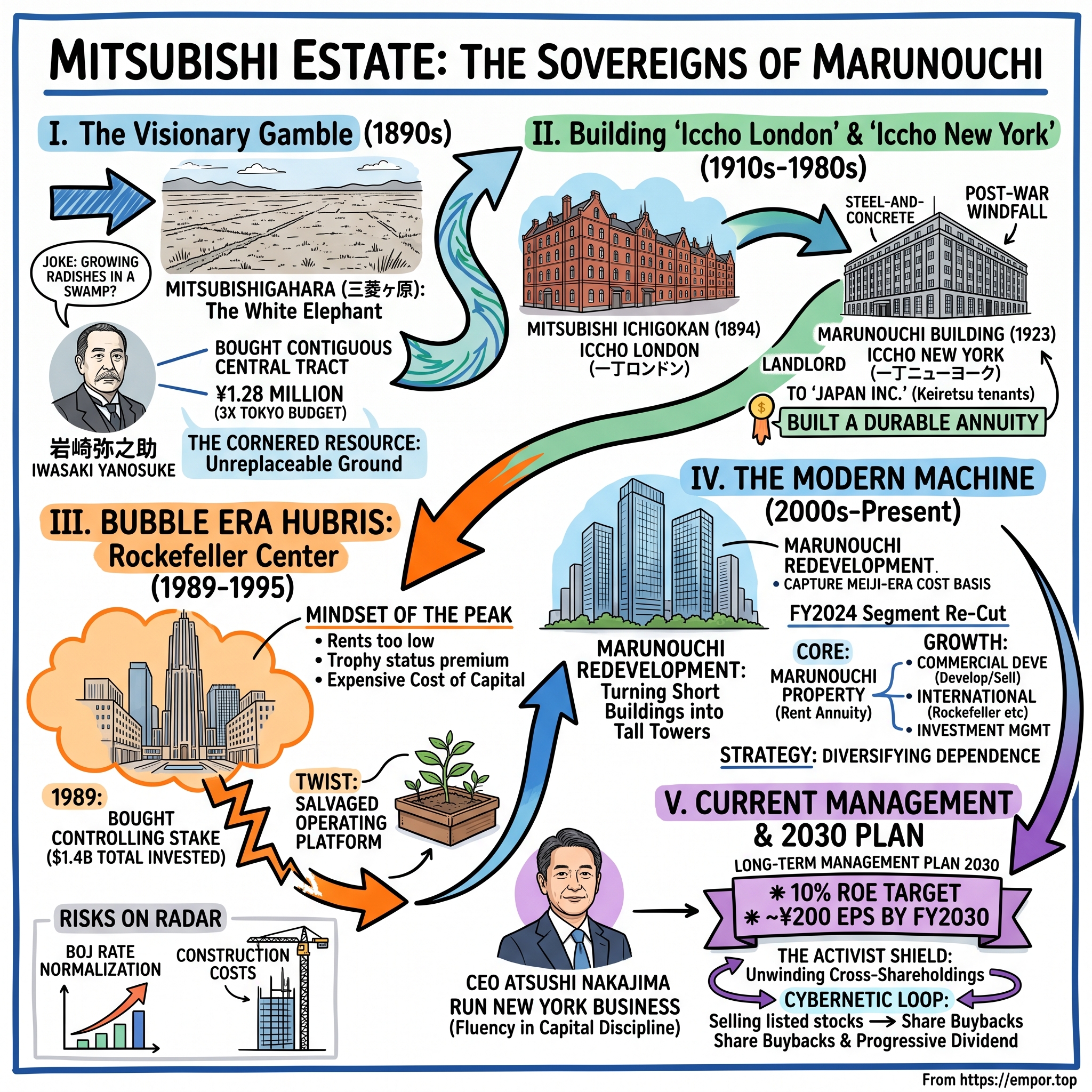
Mitsubishi Estate: The Sovereigns of Marunouchi
I. Introduction & Episode Roadmap
Picture central Tokyo in 1890. A carriage rolls out beyond the outer moat of the old shogun's castle, onto a flat, weed-choked plain where soldiers had been drilling for two decades. There are no buildings worth the name — just mud, grass, and a few crumbling barracks. This is the site the Meiji government, desperate for cash to modernize its army, is trying to sell. And no one wants it.
The buyer who finally steps forward is a man named 岩崎弥之助 Iwasaki Yanosuke, the second head of the 三菱 Mitsubishi combine. He pays a sum so large — three times the entire annual budget of the city of Tokyo — that Japan's newspapers and merchant class openly laugh at him. They nickname the barren tract 三菱ヶ原 Mitsubishigahara, "Mitsubishi Fields," and joke that he has bought a swamp to grow radishes.1
That "swamp" is now called 丸の内 Marunouchi. It is the single most valuable concentration of commercial real estate in Japan, and arguably one of the densest cash machines in global property. The company built to manage it, 三菱地所株式会社 Mitsubishi Estate Co., Ltd. (8802.T, listed on the 東京証券取引所 Tokyo Stock Exchange under the umbrella of Japan Exchange Group, JPX), reported record consolidated operating profit of ¥329.7 billion for its fiscal year ended March 2026 (FY2025), on operating revenue of roughly ¥1.75 trillion.2 It carries a market capitalization in the ¥3–4 trillion range, and it functions, in effect, as the landlord to Japan's corporate establishment — the banks, the trading houses, the insurers who cluster around Tokyo Station because that address still signals that you have arrived.
This is a story about the most durable competitive advantage in business: owning the ground itself, in a place they are no longer making any more of. But it would be lazy to tell it only as a triumph. The interesting question for an investor in 2026 is not whether the land is valuable — of course it is — but whether a company that spent a century collecting rent on an inherited monopoly can behave like a modern, capital-efficient enterprise now that the cheap-money era underwriting Japanese property is ending.
To frame the scale of what is at stake: Marunouchi and the adjacent Otemachi and Yurakucho districts that Mitsubishi Estate dominates hold roughly a hundred buildings and count among their tenants a huge slice of Japan's largest listed companies. This is not a diversified portfolio spread across a nation; it is an extraordinarily concentrated bet on a few dozen city blocks whose value is a function of Tokyo remaining the political and financial center of the world's third- or fourth-largest economy. Concentration is the source of both the moat and the risk. The same geographic focus that makes the rent roll uncopyable also means the company's fate is tethered, more than almost any large corporation, to a single location's continued primacy — and to the interest-rate regime that sets the value of every square meter of it.
So here is the roadmap. First, the origin: how a mocked land purchase became an irreplaceable "cornered resource." Second, the building of Marunouchi across the twentieth century, from Victorian red brick to earthquake-proof concrete. Third, the great humbling — the 1989 Rockefeller Center acquisition, a monument to bubble-era hubris that ended in a New York bankruptcy court. Fourth, the modern machine: how management has re-cut its segments to show off the crown jewel, and pushed hard into overseas fund management. Fifth, the man now running it and the numbers he has staked his credibility on. Then the governance turn — buybacks, dividends, and the quiet dismantling of Japan's cozy cross-shareholding web, done partly to keep activists at bay. And finally the frameworks, the risks, and the honest bull-and-bear ledger, in a world where the 日本銀行 Bank of Japan has, at last, walked away from zero.
The tension threaded through all of it: an asset so good it almost forgives bad decisions — and the discipline required to stop relying on that.
 Subscribe on LinkedIn
II. The Origins of "Mitsubishigahara" (三菱ヶ原): The Ultimate Cornered Resource (1890–1910s)
To understand why Marunouchi was worth a gamble, you have to understand what it had been. During the Edo period, this crescent of land sat directly between the outer moat of Edo Castle — today's Imperial Palace — and the merchant city beyond. It was reserved for the estates of the 大名 daimyo, the feudal lords who were required to keep residences near the shogun. This was, quite literally, the most politically central real estate in the country: the address of power.
Then the world turned over. The Meiji Restoration of 1868 abolished the feudal order, the daimyo dispersed, and their mansions were cleared. The new government handed the land to the army, which used it as barracks and a parade ground. For twenty years it produced nothing but the tramp of marching boots. By 1890, the Meiji state was pouring money into railways, a navy, and industry, and it needed liquidity fast. It put Mitsubishigahara up for sale.
The problem was that the plain was genuinely unattractive. It was low, damp, and empty, cut off from the commercial districts of Nihonbashi and Ginza by open ground. There was no obvious tenant, no cash flow, no comparable transaction to price it against. Domestic buyers passed. It was, in the language of the time, a white elephant.
Yanosuke Iwasaki saw something else. Mitsubishi men returning from London had urged him to build Japan a proper business district — a financial center on the model of the City of London or lower Manhattan, a place where a modernizing nation could house its banks and companies in dignity. Yanosuke concluded that a rising industrial power needed such a district, and that this contiguous, government-cleared block beside the future rail hub was the one place large enough to build it from scratch. In March 1890 he signed a contract for roughly 110,000 tsubo — about 90 acres, some 35 hectares in the immediate core, part of a broader tract often cited at around 120 hectares — for ¥1.28 million.13
The number is worth pausing on, because it explains the mockery. ¥1.28 million was, contemporaries recorded, about three times the annual budget of the city of Tokyo.1 Committing that kind of capital to empty land with no near-term income looked, to the merchant mind, like vanity. And in the short run the critics had a point: for years the fields sat largely undeveloped while Mitsubishi absorbed the carrying cost. This is the uncomfortable truth beneath every celebrated "visionary" real estate bet — early on, it is indistinguishable from a blunder, and only time adjudicates.
But consider what Yanosuke had actually bought. Not a building, not a lease, but a single, unbroken, enormous parcel of land at the exact center of a capital city that would spend the next 130 years growing denser and richer around it. Central Tokyo land is physically finite; a contiguous block of it, adjacent to what would become the nation's busiest railway station, is a thing that literally cannot be manufactured by a competitor no matter how much capital they raise. In the vocabulary we'll use later, this is a cornered resource in its purest form — an asset a rival cannot replicate at any price, because there is only one of it and Mitsubishi holds the deed.
There is also a family dimension worth naming, because it explains why a single institution could hold this asset for so long. Mitsubishi had been founded by 岩崎弥太郎 Iwasaki Yatarō, a fiercely ambitious shipping magnate; Yanosuke was his younger brother, and he inherited leadership of a combine that was still, in the 1890s, a family-controlled empire answerable to no public shareholders. That structure was itself an advantage. A modern listed company facing quarterly scrutiny would have struggled to justify parking three years of a city's budget in an income-less field and then absorbing the carry for a decade. A patriarch running a private zaibatsu could simply decide to be patient and impose that patience on the organization. The cornered resource was made possible not only by geography but by a governance model — concentrated, long-horizon, unaccountable to outside capital — that is almost the inverse of the shareholder-responsive company Mitsubishi Estate is trying to become today. That irony sits underneath the whole modern story: the very asset that demands twenty-first-century capital discipline was assembled precisely because nineteenth-century Mitsubishi answered to no one.
The lesson here is not "buy land and wait," which is the kind of pablum that survivorship bias produces. Plenty of speculative land bets have vaporized. The lesson is subtler: the value came from the combination of scarcity (one contiguous central parcel), a structural tailwind (a nation urbanizing and centralizing for a century), and an owner with the balance sheet and the temperament to hold through decades of ridicule and thin returns. Remove any one of those and the story doesn't work. Yanosuke supplied the patience and the capital; Tokyo supplied the growth; geography supplied the scarcity. The next generation had to supply the buildings — and that meant importing an entire architectural civilization.
III. The Building of "Iccho London" (一丁ロンドン) & "Iccho New York" (一丁ニューヨーク) (1910s–1980s)
Empty land collects no rent, and Mitsubishi knew it. So in 1892 the company began raising a business district out of the mud, and the first thing it imported was not steel or capital but an aesthetic. It hired the British architect Josiah Conder — the foreign expert who had effectively founded modern Western architecture in Japan and trained the country's first generation of native architects — to design its inaugural office block. The result, 三菱一号館 Mitsubishi Ichigokan, was completed in 1894: a three-story, red-brick, Queen Anne–style building that looked as though it had been transplanted brick by brick from Victorian England.4
More red-brick blocks followed along a broad avenue, and the district acquired a nickname that captured the ambition perfectly: 一丁ロンドン Iccho London, the "London Block." For a Meiji Japan straining to be taken seriously by the Western powers, the symbolism was the product. A Japanese corporation housed in a building that could pass for the City of London was making a statement about competence, permanence, and belonging to the modern world. That is the birth of the Marunouchi brand — the idea that the address itself confers status — and it is a power the company still monetizes today.
The Ichigokan story has a coda that says something about how the company thinks about its own history as an asset. The original 1894 building was demolished in 1968, in an era when postwar Japan had little sentimentality about Meiji-era brick. But in 2009, Mitsubishi Estate rebuilt it — a faithful reconstruction on the original site, using Conder's surviving drawings, and reopened it as the Mitsubishi Ichigokan Museum. A cynic would call it expensive nostalgia; a sharper reading is that the company understood the brand value of visibly owning its own origin story, of giving the district a heritage anchor that no glass tower could supply. In a business where the entire premium rests on prestige and permanence, physically resurrecting your founding building is a marketing investment, not a museum donation.
Then tastes, and engineering, moved on. By the 1920s the reference point had shifted from London to Manhattan. Mitsubishi pivoted to larger, steel-and-concrete structures, and in 1923 completed the 丸ビル Marunouchi Building, a big American-style block that dwarfed the Victorian terraces around it.4 The timing was extraordinary: the Great Kantō Earthquake struck Tokyo that same year, flattening much of the city. The district's newer, more robust construction came through comparatively well, a brutal real-world stress test that validated the shift to modern engineering and seeded the next nickname — 一丁ニューヨーク Iccho New York, the "New York Block." The lesson embedded in that quake is one the company would relearn every generation: in Tokyo, seismic resilience is not a feature, it is the price of admission, and it is a recurring, non-negotiable claim on capital.
For decades the property operation ran as a division inside the sprawling Mitsubishi conglomerate. In 1937 it was formally incorporated as a separate company, 三菱地所株式会社 Mitsubishi Estate Co., Ltd.4 That corporate event matters less for its drama than for what it institutionalized: a dedicated vehicle whose single purpose was to develop and steward the Marunouchi land — a permanent custodian for Yanosuke's bet.
There is a governance footnote to the 1937 incorporation that matters for what came later. In the postwar period the American occupation ordered the dissolution of the zaibatsu, and the Mitsubishi combine was broken into independent companies. Mitsubishi Estate emerged as a standalone, publicly traded entity rather than a division of a family empire — but the old relationships did not vanish so much as reconstitute themselves horizontally, as the postwar 系列 keiretsu: a loose federation of Mitsubishi-group firms bound together by cross-held shares, shared banking, and a habit of doing business with one another. That web is exactly the structure the company is now, three-quarters of a century later, deliberately unwinding. For decades, though, it was pure tailwind: a captive roster of Mitsubishi-group tenants who would no more move out of Marunouchi than change their own names.
The real windfall came after the war. Japan's 高度経済成長 kōdo keizai seichō, the high-speed growth miracle of the 1950s through the 1980s, turned Marunouchi into the natural headquarters address for the engines of that boom: the great 総合商社 sōgō shōsha general trading houses, the mega-banks, the heavy-industry champions. Mitsubishi Estate became, in effect, their landlord. And here the economics reveal themselves. A landlord to blue-chip corporate Japan collects rent that is remarkably stable — these tenants do not fail, do not skip payments, and do not casually relocate — and that stream tends to rise with the broader price level over time. It was, functionally, an inflation-resistant annuity backed by the strongest credits in the country, sitting on land carried at a fraction of its worth. Few businesses in the world throw off cash with that combination of stability and low underlying cost.
But comfort of that magnitude has a cost of its own, and it is cultural. A company that collects rent from a captive base for two generations does not develop the muscles of a hungry competitor. It develops the reflexes of a steward — cautious, consensus-driven, allergic to risk in some domains and, paradoxically, careless about return on equity because return on equity never seemed to be the point. This is the 稟議 ringi style of Japanese corporate decision-making, where proposals circulate for collective seal-stamping and bold individual bets are rare. For most of its history that conservatism served Mitsubishi Estate well; the asset was so good that not screwing it up was a perfectly adequate strategy. The exception — the moment the steward reached for something bold — is the episode that nearly defined the company in the eyes of the world.
That very comfort, though, planted the seed of the next chapter's trouble. A company sitting on an annuity this reliable, generating cash faster than it could reinvest at home, in a country where money had become almost free — such a company starts looking abroad for somewhere to put the money. And in the late 1980s, at the peak of the most inflated asset market in modern history, it found the most famous address in America.
IV. Bubble Era Hubris: The Rockefeller Center Catastrophe (1989–1995)
On October 30, 1989, the announcement landed in New York like a thunderclap. Mitsubishi Estate had agreed to buy a controlling 51% stake in the Rockefeller Group — the entity that owned Rockefeller Center, the Art Deco cathedral of Manhattan, complete with Radio City Music Hall and the skating rink where America lit its Christmas tree. The reported price for that initial stake was around $846 million, and Mitsubishi would go on to lift its holding toward 80%, with total investment climbing to roughly $1.4 billion.56
To grasp why this happened, you have to inhabit the mindset of Japan Inc. in 1989. The Nikkei was weeks from its all-time high. Japanese land values were so absurd that the notional worth of the Imperial Palace grounds was said to exceed that of the entire state of California. Capital at home was nearly free, and Japanese corporations were buying trophies across America — Hollywood studios, Pebble Beach, Manhattan towers. Mitsubishi Estate, flush and trading at a stratospheric multiple, was doing what its cost of capital told it to do. When money is that cheap, almost any acquisition clears the hurdle rate on a spreadsheet.
There is a detail that makes the purchase even more revealing about the psychology of the moment. Rockefeller Center in 1989 was not, on a straightforward yield basis, a good buy. Its rents were partly locked into long-term leases at below-market rates, and its trophy status meant it commanded a premium price precisely because of what it symbolized rather than what it earned. A disciplined buyer runs the cash flows and walks away when the yield does not clear the cost of the capital plus a margin for risk. But when your cost of capital is near zero and your stock trades at fifty or a hundred times earnings, the discipline dissolves — the math tells you to buy almost anything with a name. Mitsubishi was not being uniquely reckless; it was behaving exactly as the incentives of a bubble instruct a company to behave. That is the deeper warning, and it generalizes far beyond one Japanese landlord: the most dangerous moment for any acquirer is when its own currency — its stock, its cheap debt — feels free, because that is precisely when it will overpay for trophies and call it strategy.
The cultural reaction was ferocious. Rockefeller Center was not just a building; it was, to Americans, a piece of the national self-image, and the sight of a Japanese company buying it triggered a wave of anxiety about the "selling of America." Congressmen gave speeches; columnists wrote elegies; the transaction was folded into a broader panic that also swept up Sony's purchase of Columbia Pictures and Mitsubishi Estate's fellow travelers snapping up Californian golf courses and Hawaiian hotels. That backlash, in hindsight, was noise — the real story was financial, and it was about timing.
Because Mitsubishi had bought at the exact top. The purchase was struck just weeks before Japan's own market began its long collapse, and it landed at the crest of the U.S. commercial property cycle too. What followed in New York was grim: soft rents, stubborn vacancy, and a mountain of debt sitting against an asset that was not producing enough to service it. The partnerships that held Rockefeller Center could not make the numbers work. In May 1995, they filed for Chapter 11 bankruptcy protection — a humiliation splashed across financial pages worldwide.[^7] Later that year Mitsubishi Estate walked away from its controlling stake in the core Rockefeller Center buildings, taking a write-off on the order of $2 billion. Control eventually passed to a group led by the Rockefeller interests, Tishman Speyer, and Goldman Sachs.6
By the standard telling, that is the end: a textbook case of a bubble-drunk buyer overpaying for a trophy at the peak and getting carried out. And as a warning about peak-cycle M&A, it deserves its infamy. But the standard telling misses the twist that actually matters for the modern company.
Mitsubishi did not lose everything. When it surrendered the flagship buildings, it kept the Rockefeller Group operating company and several Manhattan office assets that had not defaulted.6 What looked like the wreckage of a disaster turned out to contain a functioning American real estate platform — brand, people, market relationships, and a development capability inside the United States. Over the following three decades that platform stabilized, expanded, and became the seed of Mitsubishi Estate's international business. The company that had been mocked in New York in 1995 would, twenty years later, install one of its own executives as head of Rockefeller Group and then promote him to run the entire parent.
It is worth being precise about the mechanism of the salvage, because it is easy to mythologize. When the mortgages defaulted, Mitsubishi's exposure to the specific buildings — Rockefeller Center itself — was ring-fenced inside the partnerships that filed for bankruptcy. By surrendering those partnership interests, the company cut its losses on the trophy while keeping the corporate entity, the Rockefeller Group, that carried the brand, the development staff, and the non-defaulted assets. In effect, Mitsubishi amputated the bad limb and kept the body. That was not luck; it was a deliberate legal and financial structuring decision made under duress, and it reflected a hard-headed recognition that the operating platform was worth more than the sentimental real estate. An organization famous for consensus-bound caution proved, when cornered, capable of a cold triage that many prouder companies would have refused.
So the honest verdict is double-edged. The acquisition, as an acquisition, destroyed a great deal of shareholder value and stands as a permanent monument to what cheap capital and national euphoria can do to underwriting discipline. Yet the residual platform became genuinely valuable, which teaches a second, quieter lesson: in real estate, even a catastrophic entry can leave behind an option worth holding, if the buyer survives with enough of the operating business intact to compound from. Whether that after-the-fact salvage justifies the original bet is exactly the kind of thing an investor should refuse to let management round up into a win. It survived. That is not the same as having been right. And the man who would eventually run that salvaged American platform, decades later, would carry its lessons back to the top of the parent company in Tokyo.
V. Modern Era: Redefining Tokyo's Skyline & Segment Dynamics (2000s–Present)
Walk through Marunouchi today and the low Victorian terraces are gone, replaced by a canyon of gleaming towers with glass-and-stone lower floors given over to luxury retail and restaurants, and dozens of stories of premium office space stacked above. That transformation was a deliberate strategy, and it began in earnest in the early 2000s, when management confronted an awkward truth: its own buildings were too short. The legacy blocks of Iccho London and Iccho New York, however handsome, used only a fraction of the development rights that Marunouchi's land could support. In real estate terms, the company was leaving enormous value unbuilt.
So it embarked on a multi-decade redevelopment program, tearing down aging low-rises and replacing them with high-density, mixed-use towers — the classic modern formula of Grade A offices above, high-end retail and public space below. The genius of doing this in Marunouchi is that the land was already owned, at its ancient near-zero cost basis, so the redevelopment captured the full uplift of far greater floor area on ground that never had to be purchased. This is why the district's economics are so hard for any rival to match: a competitor buying land at 2020s prices and building the same tower earns a return on the whole cost; Mitsubishi earns a return calculated against a cost basis set in the Meiji era.
The redevelopment also required something less visible than capital: the cooperation of the city itself. Rebuilding an active central business district means negotiating the transfer of development rights, relaxations of floor-area ratios, and the coordination of public infrastructure — new station exits, underground pedestrian networks, plazas — with Tokyo's metropolitan government. Mitsubishi Estate spent years cultivating exactly this kind of public-private planning capability, and it is part of why the Marunouchi "redevelopment" was as much an exercise in urban diplomacy as in construction. That competence is genuinely hard to replicate and rarely shows up on a balance sheet, but it is one of the reasons a newcomer could not simply buy a block and match the district — even setting aside that there are no blocks to buy.
To make that superior economics legible to public-market investors, management re-cut its segment reporting in FY2024, splitting the old commercial-property lump into two lines. The first is 丸の内プロパティ事業 the Marunouchi Property Business — the pure, high-margin core: collecting rent from the crown-jewel district. The second is 商業デベロップメント事業 the Commercial Property Business — domestic development beyond the core, offices elsewhere, logistics, and the capital-recycling transactions where the company builds or buys, stabilizes, and sells assets for gains. The unbundling was a governance signal as much as an accounting choice: it forced the market to see just how profitable the untouchable core really is, separate from the lumpier, sale-driven development engine.
The numbers management put against those segments tell the strategic story. For the Marunouchi Property Business, operating profit of ¥97.5 billion in FY2025 is guided to rise toward ¥120.0 billion in FY2026 — recurring, high-margin cash flow, powered by rising rents.72 The Commercial Property Business, by contrast, earned ¥135.7 billion in FY2025 but is guided down toward ¥110.0 billion in FY2026 — and that direction is the tell, because a large chunk of its profit comes from capital gains on asset sales, which are inherently lumpy and cannot simply be repeated on command.7 The Residential Business, centered on high-end domestic condominiums, is guided from ¥57.3 billion toward ¥65.0 billion; the International Business, riding the Rockefeller-descended overseas platform, from ¥57.1 billion toward ¥80.0 billion; and the small but fast-scaling Investment Management arm from ¥1.4 billion toward ¥15.0 billion.7 That investment-management jump deserves a flag: FY2025's figure was depressed by one-off M&A and incentive-fee reversals in the U.S., so the FY2026 number is partly a recovery off a suppressed base rather than pure organic explosion — a nuance management's headline growth rate glosses over.8
The through-line of the modern era is that Mitsubishi Estate is trying to bolt two higher-return, more capital-efficient engines onto its rent annuity: overseas development and asset-light fund management. The clearest expression came in June 2025, when its 三菱地所グローバルパートナーズ Mitsubishi Estate Global Partners (MEGP) platform agreed to buy a majority stake in the London-based private-equity real estate firm Patron Capital, committing up to €600 million in the form of equity into Patron's funds and financing for new strategies including real estate credit.910 Patron, which had raised roughly €5.3 billion across its funds, joined a stable that already included the U.S. manager TA Realty (acquired 2015) and Europe's Europa Capital (2010).9 The logic is that fee income on other people's capital earns high returns without tying up much of Mitsubishi's own balance sheet — the opposite of the land-heavy legacy model. Under the 三菱地所グローバルパートナーズ MEGP umbrella, the three acquired managers give the group reach across the United States (TA Realty), continental Europe (Europa Capital), and now, with Patron, the United Kingdom and pan-European distressed and credit strategies — a deliberate assembly of regional platforms rather than a single global fund. The appeal of fee-based real estate management to a company like Mitsubishi is precisely that it decouples growth from its own capital: assets under management can multiply without the balance sheet swelling in step, and management fees plus performance fees can, in good years, produce returns on equity that a rent roll structurally cannot. The catch, again, is durability. Fund management is a business of relationships and track record housed in people, and Mitsubishi is buying majority stakes while leaving founders in place with minority equity — a structure that works beautifully while everyone is aligned and can unravel quickly if they are not.
Step back and the modern segment map reveals a company deliberately diversifying away from a single point of dependence, even a magnificent one. For a century, "Mitsubishi Estate" essentially meant "Marunouchi rent." Today the core district contributes well under half of group operating profit, with the balance spread across domestic development, condominiums, an overseas platform, and fund management. A skeptic can read that two ways. The charitable reading is prudent diversification: reducing reliance on a single asset class and geography, and adding higher-return, more capital-efficient businesses that can lift the whole group's ROE toward the 2030 goal. The uncharitable reading is 多角化 diworsification — a cash-rich incumbent wandering into businesses (U.S. data centers, Australian offices, European credit funds) where it holds no structural advantage, chasing growth its core can no longer provide, and importing execution risk it does not fully understand. The truth is probably somewhere in between, and the way to tell which is winning is to watch whether the non-core segments earn returns above their cost of capital over a full cycle, or merely add revenue and headline profit while diluting returns. Revenue growth is easy to buy; return on capital is the honest scoreboard.
The skeptic's question, which we'll return to, is whether buying your way into fund management actually builds a durable franchise or just rents one. Keith Breslauer and Patron's senior partners retained a significant minority stake and continued to run the business.9 In fund management, the talent can walk; owning the holding company is not the same as owning the returns, and a manager whose founders hold equity and manage the funds can, in a dispute, take the relationships and the track record out the door. For now, though, the strategic intent is unmistakable, and it points squarely at the person who has staked his tenure on hitting a set of numbers Japanese property companies have historically treated as optional.
VI. Current Management Profile: Atsushi Nakajima & The 2030 Long-Term Plan
In April 2023, a career Mitsubishi Estate man named 中島篤 Atsushi Nakajima took over as President and CEO.11 On paper he is the archetype of the Japanese corporate lifer: he joined the firm in 1986, straight out of university, and spent the next several decades climbing a single organization — the kind of unbroken salaryman tenure that, to a Western investor, can read as a warning sign about fresh thinking.12
But Nakajima's résumé has one feature that separates him from the standard Marunouchi mandarin: he ran the New York business. Starting in the mid-2010s he served as President and CEO of Rockefeller Group International, the very platform that emerged from the 1989 catastrophe.12 That posting matters more than a line on a bio. It means the man now allocating Mitsubishi Estate's capital spent years inside American commercial real estate — a market that, unlike Japan's, has long demanded that developers earn a real return on equity, recycle assets aggressively, and answer to unsentimental capital. He came home fluent in a discipline his domestic peers were only beginning to learn.
There is a generational dimension to Nakajima's appointment, too. He took the chief-executive seat in April 2023, with Junichi Yoshida moving to the chairmanship — a handover choreographed in the deliberate, seniority-respecting manner of Japanese corporate succession, where the incoming CEO is rarely a surprise and almost never an outsider.11 From a Western governance perspective, this is the standard critique of Japanese boards: leaders are chosen from within a narrow internal pool, dissent is muted, and true independent challenge is scarce. Mitsubishi Estate is not exempt from that critique. What makes Nakajima marginally different is not that he broke the mold — he is, by background, the purest of insiders — but that his one formative posting abroad exposed him to a capital-markets culture his predecessors never lived inside. Sometimes reform arrives not through an outsider but through an insider who spent long enough on the outside to see his own institution's blind spots clearly.
That fluency shows up in the plan he has hung his tenure on: the Long-Term Management Plan 2030. Its headline financial targets are a 10% return on equity and roughly ¥200 in earnings per share by FY2030.13 To understand why that is provocative, you have to know the sector's history. Japanese real estate companies spent decades content with ROEs in the 4–6% range, and they had a rationale: debt was nearly free, and the land on their books appreciated so much over time that low returns on stated equity didn't feel like failure. The book value understated reality, so why chase efficiency? Nakajima is explicitly rejecting that complacency. For FY2026 the company guided to roughly 9% ROE and about ¥196 EPS — meaning it is running right up against the 2030 target years early, which is either evidence of real momentum or a sign the target was set conservatively.8
On alignment, the picture is mixed and worth stating plainly. Nakajima's direct shareholding is tiny — on the order of 66,564 shares, a rounding error against a multi-trillion-yen company and a level of personal ownership that would be considered trivially low by U.S. standards. This is entirely typical of Japanese executives, who are generally not compensated through large equity stakes, and management points instead to performance-linked stock incentives tied to the 2030 plan. But an investor should be honest that "incentives tied to the plan" is a weaker form of skin in the game than a founder-sized holding, and it means the alignment rests on the design and disclosure of the comp scheme rather than on the CEO's own wealth being on the line.
It is worth dwelling on why the ROE paradigm shift is so hard, culturally and mechanically, rather than treating it as a simple management choice. Return on equity is net profit divided by shareholders' equity, and a company can raise it in two very different ways: by earning more profit on the same equity, or by shrinking the equity — buying back stock, distributing cash, carrying more leverage. Japanese real estate ROEs were structurally low for a reason that was not entirely irrational: these companies held vast, appreciating land at cost, financed cheaply, and let equity balloon on retained earnings and revaluation reserves. A low ROE on an understated equity base masked genuinely strong underlying economics. Nakajima's challenge is therefore not merely to earn more — it is to be willing to let the equity base shrink through buybacks, to sell assets rather than accumulate them, and to accept the risk that comes with running a leaner balance sheet. That is a psychological reversal for an institution whose entire identity was built on accumulation and permanence. Asking a company like this to prioritize ROE is asking a hoarder to become a distributor, and the fact that management is even attempting it is more notable than the specific target.
Where Nakajima has earned more credibility is behavior. Over his tenure the company has sold assets to fund buybacks rather than hoarding cash, held its guidance through domestic construction bottlenecks rather than quietly walking numbers back, and re-cut its disclosure to expose the core's economics — the kinds of moves that a management team playing defense against efficiency critics does not make unless it intends to be measured. On the FY2025 call he framed rent growth in vivid operating terms — noting that an extra ¥10 billion of Marunouchi rental profit was "profit equivalent to one large-scale building," a way of translating an abstract rent revision into the tangible unit his organization understands.8 That kind of concrete, operator's language, rather than IR boilerplate, tends to signal a management team that actually runs the numbers it reports. The test still ahead is whether that discipline survives contact with a rising-rate environment that will make every one of those targets harder to hit. And the discipline is not happening in a vacuum: it is happening because a generation of activist investors has taught Japanese boards that the alternative to reforming yourself is having someone reform you.
VII. The Activist Shield: Capital Allocation Reform & Unwinding the Cross-Shareholdings
For most of the postwar era, Japanese blue chips lived inside a fortress of mutual ownership. Companies held each other's shares — 政策保有株式 seisaku hoyū kabushiki, "strategic" or policy shareholdings — as a gesture of relationship and a defense against takeover. Your bank owned you, you owned your suppliers, everyone held everyone, and no outside shareholder could ever assemble enough leverage to demand change. It was clubby, capital-inefficient, and, for decades, impregnable.
That fortress is now being dismantled, and the wrecking crew is a mix of the Tokyo Stock Exchange and foreign activists. In recent years the TSE has publicly pressed listed companies — especially those trading below book value — to improve capital efficiency, an unusually blunt intervention by an exchange into how its members allocate capital. Meanwhile, activist funds have gone hunting in Japanese real estate specifically. Elliott Investment Management, among the most feared activist shops in the world, built positions in and pushed reform at Mitsubishi Estate's direct rivals, 三井不動産 Mitsui Fudosan and, in the broader sector, 住友不動産 Sumitomo Realty & Development, agitating for asset sales, unwound cross-holdings, and cash returns. The message to every property boardroom in Tokyo was that the old defense of "we hold trophy assets at low book value and answer to no one" had become an invitation.
Mitsubishi Estate's response has been to reform preemptively — to make itself a harder target by doing much of what an activist would demand before an activist shows up. The centerpiece is the cross-shareholding unwind. In 2025 the company committed to reducing the balance of its listed strategic shareholdings by 50% or more by the end of FY2027 versus the FY2024 level, and — crucially — stated that thereafter it intends, in principle, to hold no such shares at all.14 That is a genuine break with the keiretsu tradition, converting a pile of relationship equity that earned almost nothing into deployable cash. In FY2024 alone it sold 11 listed stocks for about ¥58.9 billion, part of a cumulative reduction running to roughly ¥118 billion over five years.14
There is an economic subtlety here that is easy to miss but central to the reform's logic. A cross-shareholding is, from a return-on-equity standpoint, one of the worst assets a company can hold: it is a chunk of equity capital tied up in another firm's stock, generating only a thin dividend yield, contributing almost nothing to earnings, yet sitting on the balance sheet inflating the equity base against which ROE is measured. Selling it does double duty — it converts a near-dead asset into cash, and by returning that cash it shrinks the equity denominator, mechanically lifting ROE even before any operational improvement. This is why the cross-holding unwind and the ROE target are not two separate initiatives but one: dismantling the keiretsu web is, in accounting terms, the single most direct lever management has to hit its 2030 efficiency goal. The reform that placates the activists and the reform that raises returns are the same reform.
Then comes the flywheel, which is what makes the reform more than cosmetic. Rather than sitting on the sale proceeds, the company is recycling them into growth investment and, pointedly, into shareholder returns. In FY2025 it executed a large ¥130 billion share buyback, and for FY2026 it authorized a ¥50 billion base buyback — up to 20 million shares, about 1.66% of shares outstanding — alongside a progressive dividend policy.152 Management has been raising the dividend by ¥3 per share a year, guiding to ¥49 for FY2026 and signaling a path toward ¥60-plus by FY2030.2 Selling dead cross-holdings to fund buybacks and a rising dividend is precisely the capital-allocation logic activists preach, executed voluntarily. The word "voluntarily" deserves a small asterisk, though: reform undertaken in the shadow of a credible activist threat and an exchange breathing down the sector's neck is voluntary the way a student's decision to study the night before an exam is voluntary. The pressure is real even when the campaign never formally arrives, and the honest question is whether the discipline outlasts the pressure or dissolves the moment the spotlight moves on.
But a neutral read requires pressing on the part management would rather glide past, and analysts have. On the FY2025 earnings call the pointed question was about the quality of the profit: a meaningful share of current operating profit comes from capital gains on selling properties — the lumpy, non-recurring kind — rather than from organic rent growth. Is that gain-on-sale engine sustainable, or is it a convenient way to hit headline numbers and paper over rising construction costs while the core matures? Management's defense was to point to the robustness and depth of its development pipeline as evidence the transactions can keep coming.8 That is a reasonable answer, but it is not a settled one: a pipeline generates gains only if the transaction market stays liquid and cap rates stay friendly, both of which depend on interest rates that are now moving the wrong way. An investor should treat "sustainable capital gains" as a claim to be monitored, not a fact to be assumed — which brings us to the frameworks that separate the durable advantages from the cyclical ones.
VIII. Hamilton Helmer's 7 Powers & Porter's 5 Forces Analysis
Strip away the narrative and ask the cold structural question: why does this company earn excess returns, and what protects them? Two frameworks — Hamilton Helmer's 7 Powers and Michael Porter's Five Forces — are useful precisely because they force you to name the mechanism rather than admire the outcome.
Hamilton Helmer's 7 Powers. The dominant power, the one that anchors everything, is the cornered resource: the contiguous Marunouchi land assembled from Yanosuke's 1890 purchase, sitting directly against Tokyo Station. A cornered resource is an asset a rival cannot obtain at any reasonable price, and central-Tokyo land next to the nation's busiest transport hub is the definition — physically finite, already owned, carried at a Meiji-era cost basis. No competitor can buy their way to parity. This is the moat that makes the others possible.
The second power is branding. The Marunouchi address has, for over a century, signaled corporate solidity and elite status in Japan; a headquarters there tells the market a company has arrived. That intangible lets Mitsubishi charge a premium a physically identical building elsewhere could not command — brand power expressed as rent.
Third, scale economies operate at the district level in a way standalone competitors cannot copy. Because Mitsubishi controls a whole cluster of contiguous blocks, it runs shared infrastructure — notably private district heating and cooling systems that serve the entire portfolio — spreading fixed costs and lowering per-building utility and carbon costs below what an isolated tower can achieve. Owning the neighborhood, not just the buildings, is what unlocks this.
Fourth, switching costs. Relocating a corporate headquarters is expensive, operationally disruptive, and, for tradition-minded Japanese blue chips, culturally fraught. Tenants are sticky not because they are contractually trapped but because moving is genuinely painful — which hands the landlord durable pricing power at lease renewal, visible in the recent rent revisions of 5% to over 20% that management said tenants largely accepted.8
Fifth, process power: the accumulated, hard-to-transfer capability to redevelop active city blocks — demolishing and rebuilding 40-story towers without shutting the subway lines beneath them, decanting tenants, and phasing construction over years. That coordination competence is learned over decades and does not transfer with a hire.
Porter's Five Forces tells the complementary story of the competitive environment. The threat of new entrants is extremely low — the capital and, more bindingly, the physical land simply are not available. The threat of substitutes is low: remote work looked briefly threatening during the pandemic, but Tokyo's return-to-office rate is among the developed world's highest, and Marunouchi's Grade A vacancy sits near zero. The bargaining power of tenants is moderate: they are sophisticated corporate clients who could decamp to rival nodes like Roppongi, Shibuya, or Nihonbashi, which caps how far rents can be pushed, but Marunouchi's prestige and location keep the prestige-sensitive anchored.
The two forces that genuinely bite are on the cost and rivalry sides. The bargaining power of suppliers — the general contractors — is high, and rising. Japan's construction is dominated by a handful of super-general contractors (Taisei, Obayashi, Kajima, Shimizu), and amid nationwide labor and material shortages they hold real pricing leverage over a developer with a multi-hundred-billion-yen pipeline that has to be built. This is not an abstraction; it is the single biggest live threat to the 2030 return targets. And competitive rivalry is high: this is an oligopoly, with Mitsui Fudosan dominant in Nihonbashi and Hibiya and Sumitomo Realty strong in Shinjuku, all three competing for the same trophy tenants and the same redevelopment rights.
Two of Helmer's seven powers are conspicuously absent, and naming their absence is as instructive as cataloguing the ones present. There is no network economy — a bigger Marunouchi does not make each tenant's space more valuable to other tenants in the way a social network or a marketplace compounds. And there is no counter-positioning — Mitsubishi Estate is not a disruptive newcomer with a business model incumbents cannot copy without cannibalizing themselves; it is the incumbent, and its advantages are the classic, defensive kind rather than the offensive kind. That matters because defensive powers protect what you have but do not, on their own, generate growth. The land moat guarantees the annuity; it does not guarantee that the annuity compounds faster than the cost of capital. Growth has to come from redevelopment uplift, rent escalation, and the newer overseas and fund-management bets — and each of those is more contestable than the land itself.
The synthesis for an investor is this: Mitsubishi Estate's powers are unusually deep on the revenue and asset side — the land and brand are close to unassailable — but they provide little protection on the cost side, where contractors have leverage, or against the macro forces of interest rates and cap rates. The moat protects the rent roll magnificently and the construction budget not at all. That asymmetry is the whole risk profile in one sentence: the thing that cannot be taken away is also the thing that has stopped being the source of growth, and the sources of growth are the things that can be taken away.
IX. Risk Radar: BOJ Rate Normalization & Construction Realities
For thirty years, the deepest structural subsidy under every Japanese property company was the price of money: essentially zero. That era ended, and the ending is the defining risk of this investment case.
The interest-rate regime shift. On December 19, 2025, the Bank of Japan raised its short-term policy rate to 0.75%, the highest level since 1995, and the yield on the 10-year Japanese Government Bond pushed past 2% for the first time since 1999.1617 Market projections point toward further tightening, with the policy rate potentially reaching 1.25–1.75% over the medium term. The mechanism that should worry a real estate investor is the capitalization rate. Property values move inversely to cap rates, and cap rates tend to track bond yields; as the "risk-free" JGB yield climbs, the cap rate the market applies to Tokyo office buildings tends to rise too, which mathematically pressures the book and market value of the very assets on Mitsubishi's balance sheet. Rising rates also lift the cost of financing a large debt load, and they thin out the transaction market that the company's capital-gains engine depends on.
The mitigants are real but partial. Mitsubishi Estate has historically funded itself with long-duration, largely fixed-rate debt, which insulates it from immediate refinancing shocks — the higher rates bite gradually, as old debt matures, not all at once. And crucially, the same mild inflation that is pushing rates up is also pushing rents up: management reported it was successfully raising Marunouchi rents by 5% to more than 20% on renewals, which offsets cap-rate pressure if it persists.8 The honest framing is a race: rents rising versus rates rising. If rents keep pace, the land's value holds; if rates gallop ahead of rents, the asset base is marked down. Which wins is not knowable in advance, and that uncertainty is the price of admission to the stock right now.
The Torch Tower execution risk. The concrete embodiment of the cost-side threat is トーチタワー Torch Tower, the centerpiece of the Tokyo Torch (Tokiwabashi) redevelopment beside Tokyo Station. At a planned 390 meters, it is set to become the tallest building in Japan on completion, targeted for 2028, with total project costs widely reported around ¥500 billion (roughly $4.8 billion).1819 Construction began in 2023. The risk is straightforward and already discussed under supplier power: Japan's acute construction-labor shortage and material-cost inflation can drive budget overruns and delays on a project of this scale, and every yen of overrun comes directly out of the return on a fixed-value trophy. A landmark this size is a source of prestige and, eventually, income — but until it tops out, it is a large, fixed, escalating cash commitment exposed to the one input Mitsubishi cannot control.
Residential mortgage pullback. The third, smaller risk is on the consumer side. As the rate cycle turns, major Japanese banks have been lifting fixed mortgage rates, with some offers pushing past 3% by mid-2026. Higher mortgage rates cool demand for exactly the high-end condominiums that drive the Residential segment's margins. It is not an existential threat — the segment is a minority of profit — but it is a reminder that rate normalization squeezes the company from multiple directions at once: cap rates on the assets, financing on the debt, and demand on the residential book.
There is a subtler, second-order risk hiding inside the rate story that deserves a mention: the political economy of a normalizing Japan. For decades, the Bank of Japan's ultra-loose policy was underwritten by a government able to borrow at essentially no cost despite a debt-to-GDP ratio among the highest in the developed world. As JGB yields climb past 2%, the government's own interest bill rises, fiscal room tightens, and the pressure on the central bank to move slowly — or the temptation for authorities to lean on the yen and the bond market — grows. For a domestically anchored real estate company, this macro backdrop cuts both ways: mild inflation supports rents and nominal asset values, but a disorderly move in yields, or a policy misstep, could jolt cap rates faster than rents can adjust. Mitsubishi Estate cannot hedge the sovereign; it can only position its own balance sheet conservatively and hope the transition stays orderly. Management's fixed-rate, long-duration funding is the visible expression of that hope.
None of these risks negates the franchise. They do, however, convert what was for thirty years a one-way bet — own scarce land, borrow free money, collect rising rents — into a genuine two-sided proposition. Which is exactly the debate an investor has to adjudicate.
X. The Investment Spine: Bull vs. Bear Case
Every real estate story eventually reduces to a single argument between two reasonable people. Here it is.
The bull case starts with the balance sheet's great secret. Because the Marunouchi land is carried at a cost basis rooted in acquisitions stretching back to 1890, its stated book value is a small fraction of its true market worth under Japanese accounting. That gap is a deep, silent buffer: the reported equity understates the real asset value, so the "expensive" stock may be cheap against liquidation reality, and the company can sell a building periodically and book an enormous gain against a near-zero cost. The second pillar is Grade A resilience. The flight-to-quality in office demand is real and measurable — Marunouchi's vacancy rate stood at roughly 0.55% as of March 2026, effectively full, against far higher vacancy in non-prime Tokyo submarkets, while average central-Tokyo rents rose on the order of 8% year over year.220 Near-zero vacancy is not a soft metric; it is direct evidence of pricing power, because a landlord with no empty space sets the terms at renewal. The third pillar is the emerging asset-light overlay: the Investment Management segment, guided toward ¥15.0 billion, is a high-margin fee engine that earns on other people's capital and could re-rate the whole company toward a higher-multiple business if it scales.7
The bear case attacks each pillar at its seam. On returns, the 10% ROE target is hostage to construction costs; if Torch Tower and the broader pipeline run over budget, capital efficiency slips, the 2030 goals are missed, and the international investors who bought the reform story mark the stock down for broken promises. On the asset base, the low book value is a buffer only if you never have to transact at distressed cap rates — and a faster-than-expected BOJ tightening cycle could expand cap rates, chill the transaction market, and gut the capital-gains line that currently flatters profit. And that is the sharpest bear point: a large share of today's operating profit is not organic rent growth but gain-on-sale from recycling properties. Strip out the transactional profit and the underlying growth rate of the pure annuity is more pedestrian — which means the company's recent earnings momentum may be partly a function of a favorable selling environment that rates are about to end.
It is worth weighing the two cases against the competitive field rather than in isolation, because the bull and bear arguments land differently depending on which rival you hold Mitsubishi Estate against. Versus Mitsui Fudosan, the more aggressive and internationally expansive of the two giants, Mitsubishi looks more concentrated, more conservative, and more reliant on a single trophy district — which is a strength in a downturn and a limitation in a land grab. Versus Sumitomo Realty, famous for its stubbornly high leverage and buy-and-hold discipline in Shinjuku, Mitsubishi looks more balanced and more shareholder-responsive. The point is that "quality of the land" is not in dispute among any of them; what separates them is capital allocation and appetite for risk, and on that axis Mitsubishi has positioned itself as the disciplined steward. Whether the market rewards that positioning depends on the cycle: in a rising-rate, risk-off environment, the conservative balance sheet and the near-full core become precisely the attributes investors pay up for.
Management-credibility stress test. An activist looking at this company would find less to attack than at its peers, precisely because management moved first — the cross-holding unwind, the buybacks, the progressive dividend, the segment transparency are all pre-emptive concessions. The residual challenges an activist would still press: the persistent gap between the stock's price and the vast hidden land value (why not surface it faster?); the reliance on gain-on-sale to hit numbers; the wisdom of buying its way into overseas fund management, where key talent retains equity and can leave; and executive ownership so low that alignment rests on comp design. These are legitimate, and they are the questions a careful investor should keep asking rather than accepting the reform narrative at face value.
Three KPIs to track. Cutting through everything, three numbers tell you whether the thesis is intact. First, the Marunouchi office vacancy rate — as long as it stays below roughly 1.5%, the core's pricing power is preserved; a sustained climb would be the first crack in the annuity. Second, progress on the strategic-shareholding sales — whether the company stays on track to cut listed cross-holdings by 50%-plus by the end of FY2027, the clearest test of whether the capital-return flywheel keeps turning. Third, the refinancing cost spread — the gap between Mitsubishi's average cost of debt and the rising JGB benchmark, which measures in real time how fast the end of free money is closing in on the business. Watch those three and you are watching the whole case.
XI. Epilogue & Core Lessons
Return, one last time, to the weed-choked field of 1890 and the man ridiculed for buying it. More than 130 years later, that plain generates the single richest concentration of commercial rent in Japan, and the joke about growing radishes has become one of the most vindicated capital-allocation decisions in the country's business history. The first lesson is the oldest one in real estate and the hardest to actually practice: the ultimate competitive advantage is physical location, and its payoff is counted in generations, not quarters. Yanosuke's genius was not that he predicted Marunouchi's exact future — no one could — but that he bought the one irreplaceable thing and then his successors had the patience to hold it through a century of wars, earthquakes, and cycles.
The second lesson is the counterweight, and Mitsubishi supplied it to itself. The Rockefeller Center debacle remains a clean warning about what happens when a company lets a domestic bubble inflate its cost of capital and goes shopping for foreign trophies at the top of a cycle. The asset was iconic; the timing was ruinous; the write-off was real. That the company salvaged a durable platform from the wreckage should not launder the original error — it should stand as a reminder that even great franchises make value-destroying acquisitions when money is free and confidence is high, which is precisely the moment discipline matters most.
For the long-term investor, the analytical discipline this story demands is to hold two ideas at once. The first is that the asset is genuinely, almost uniquely, extraordinary — a cornered resource with a Meiji-era cost basis and near-full occupancy in a district whose prestige is self-reinforcing. The second is that an extraordinary asset does not guarantee an extraordinary investment, because the price you pay and the returns the operator chooses to earn on it are separate questions from the quality of the land. For a century the operator was content to under-earn on a magnificent base; the entire bull case now rests on the wager that this has changed and will keep changing as money stops being free. The evidence to watch is behavioral and measurable — vacancy, the pace of cross-holding sales, the spread between rents and rates — not rhetorical.
The third lesson is the one still being written. Mitsubishi Estate's recent transformation — the cross-holding unwind, the buybacks, the progressive dividend, the ROE and EPS targets a Japanese property company was never supposed to care about — shows that even the most conservative, legacy-heavy corporate institution can adopt the language and, so far, the behavior of capital efficiency when the combination of exchange pressure, activist example, and an internationally seasoned CEO converges. Whether it is genuine reform or a well-executed defensive crouch will be revealed not in the easy years but in the hard one now arriving, as the Bank of Japan drains away the cheap money that made the old model effortless. The land will still be there, as it always has been. The open question is whether the company on top of it has truly changed, or merely learned to say the right things while the tide was still high.
References
-
vol.14 Yanosuke Resolves to Build Japan's First Modern Business District — Mitsubishi Corporation ↩↩↩
-
Mitsubishi Estate Lifts Earnings, Dividends and Sets Growth Forecast for FY2026 — TipRanks ↩↩↩↩↩
-
Experience and Track Record in Marunouchi (Asset Book) — Mitsubishi Estate Co., Ltd. ↩
-
History of Mitsubishi Estate Company, Limited — FundingUniverse ↩↩↩
-
Japanese to Buy 51% of Rockefeller Center — The Washington Post, 1989-10-31 ↩
-
M&A Flashback: The Takeover of Rockefeller Center — Forbes, 2017-07-18 ↩↩↩
-
Long-Term Management Plan 2030 — Mitsubishi Estate Co., Ltd. ↩↩↩↩
-
Mitsubishi Estate (8802.T) FY2025 Full-Year Earnings Call — BigGo Finance, 2026-05-15 ↩↩↩↩↩↩
-
Patron Capital Secures Major Investment From Mitsubishi Estate — Mitsubishi Estate Co., Ltd. Press Release, 2025-06-12 ↩↩↩
-
Mitsubishi Buys Stake in Private Equity Real Estate Firm Patron — Bloomberg, 2025-06-11 ↩
-
Mitsubishi Estate Co., Ltd. Announces CEO Changes — MarketScreener ↩↩
-
The Rockefeller Group Names Nakajima Acting President, CEO — Commercial Property Executive ↩↩
-
Long-Term Management Plan 2030 (Strategic Overview) — Mitsubishi Estate Co., Ltd. ↩
-
Other Initiatives — Corporate Governance (Cross-Shareholding Reduction) — Mitsubishi Estate Co., Ltd. ↩↩
-
Mitsubishi Estate Co., Ltd. Announces an Equity Buyback for 20,000,000 Shares for ¥50,000 Million — MarketScreener ↩
-
Bank of Japan Raises Benchmark Rates to Highest in 30 Years, Lifting 10-Year JGB Yield Past 2% — CNBC, 2025-12-19 ↩
-
BOJ Takes Rates to a 30-Year High; 10-Year Japanese Government Bond Breaks 2% — The Japan Times, 2025-12-19 ↩
-
Work Begins on $4.8bn Torch Tower Tokyo, Japan's Tallest Building — Global Construction Review ↩
-
Torch Tower Breaks Ground — Tokyo's Tallest High-Rise in 2028 — World-Architects ↩
-
Tokyo Office Market Report & Vacancy Data — Cushman & Wakefield ↩
 LinkedIn
 WhatsApp
 Reddit
 Hacker News
 Email
Email Kindle
 RSS Feed
 Spotify
 Apple Podcasts
 Amazon Music
 Audible
 YouTube