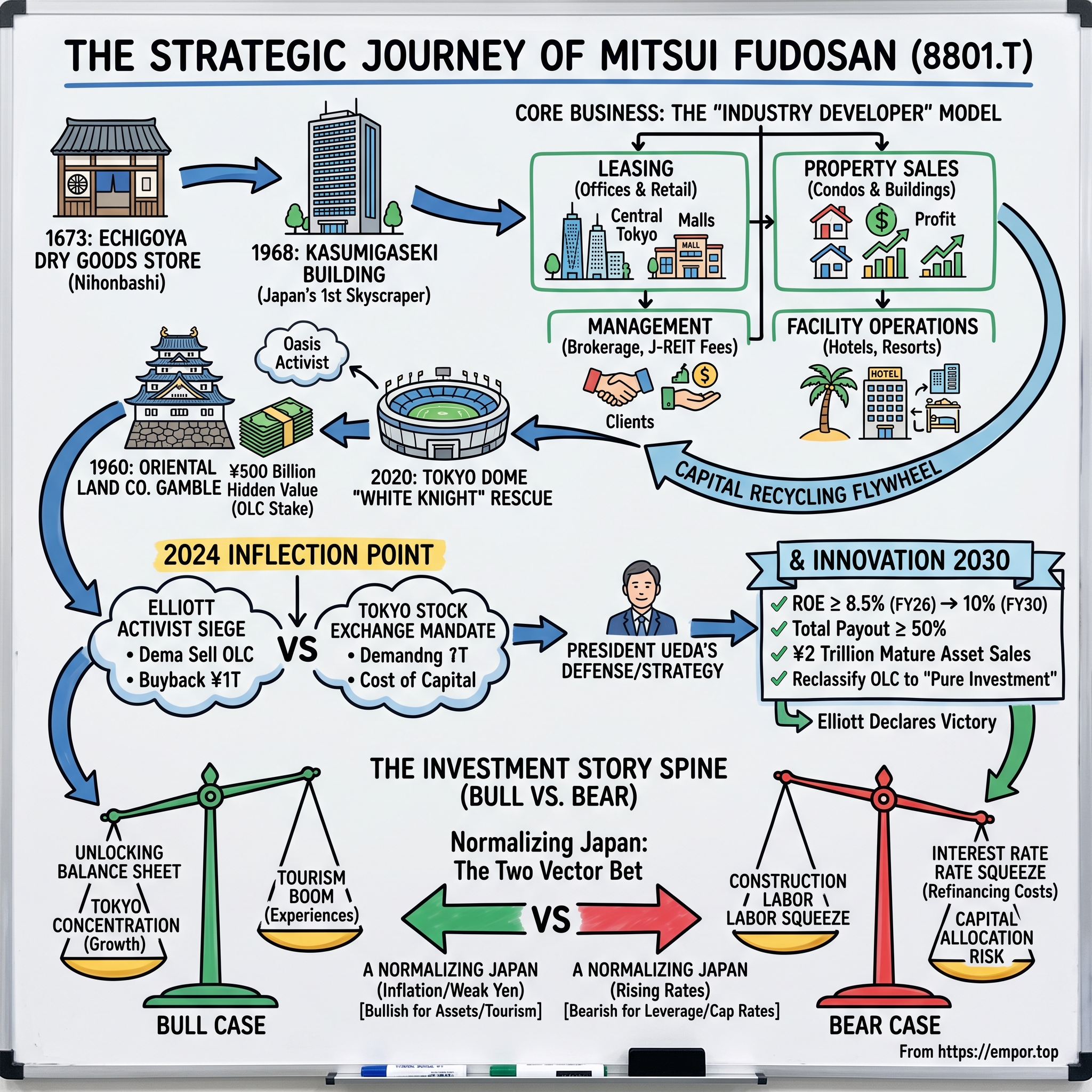
三井不動産株式会社 Mitsui Fudosan Co., Ltd.: Tokyo's Sovereign Developer and the Great Capital Awakening
I. The Opening Hook: Tokyo's Sovereign Developer and the Activist Siege
In the first weeks of 2024, a memo began circulating among the fund managers who watch Japan. A New York hedge fund — 名うての Elliott Investment Management, the firm that had once cornered a nation's sovereign debt and chased an Argentine navy vessel into a Ghanaian port — had quietly built a position in one of the oldest names on the 東京証券取引所 Tokyo Stock Exchange. The target was 三井不動産株式会社 Mitsui Fudosan Co., Ltd. (8801.T), a company whose corporate DNA runs back 350 years to a kimono shop in 日本橋 Nihonbashi, and whose land holdings sit at the physical and spiritual center of the Japanese capital. Elliott had accumulated a stake variously reported at around 2% to 2.5% — worth roughly a billion dollars — and it wanted a revolution.12
The demands were blunt. Buy back ¥1 trillion of your own stock. Sell the roughly ¥500 billion stake you hold in the operator of Tokyo Disney Resort, a position sitting on your books at a fraction of its market value. And, most pointedly, stop running a trillion-yen balance sheet like a private club for corporate friends.12 This was not a fringe agitation. It was a well-capitalized, technically precise challenge to the way a pillar of corporate Japan had allocated capital for generations.
To appreciate the drama, you have to understand who was doing the demanding. Elliott, founded by Paul Singer, is not a passive index fund that files a polite letter and waits. It is arguably the most feared activist franchise on Earth, a firm that has taken on sovereign governments, forced management changes at conglomerates from SoftBank to Samsung's affiliates, and cultivated a reputation for relentlessness that makes a board's general counsel reach for the antacids. When Elliott appears on a share register with a nine-figure position, it is not making a suggestion. And yet the target it had chosen was, in some ways, the least likely candidate for a bare-knuckle brawl: a company so deeply woven into the fabric of Japanese establishment life that its name is practically a synonym for corporate respectability, run by executives whose entire careers had been spent inside its walls. The irresistible force had met a very immovable object.
The collision is the whole story. On one side, a 350-year lineage tracing to Edo-era drapers, a company that owns some of the most valuable dirt on Earth — prime blocks of central Tokyo carried on the balance sheet at conservative, heavily depreciated book values that bear little relation to what the land would fetch today. On the other, a modern activist demanding that this hidden value be crystallized and returned. Underneath sits the fundamental question this article will test: can a legacy Japanese giant, long run on relationship capital and cross-held shares, actually transition into a high-efficiency capital allocator in an era of 金利上昇 interest rate hikes and Tokyo Stock Exchange governance reform? Management says yes. The evidence, as we'll see, is genuine but incomplete.
To grasp why an activist would bother, understand the peculiar accounting at the heart of old Japanese real estate. Land, unlike a machine or a building, is not depreciated on the books — but it is generally carried at what the company originally paid for it, sometimes decades or even a century ago. A parcel in Nihonbashi acquired generations back may sit on the balance sheet at a value that is a small fraction of its worth in today's market. The consequence is a company whose accounting net worth systematically understates its true asset value, and whose reported return on that understated equity is nonetheless mediocre — a maddening combination for an outside investor, who sees enormous latent worth generating disappointing measured returns. This gap between book value and market value is the treasure map every activist in Japan has been reading, and Mitsui Fudosan sits near the very top of the list of buried hoards. The reforms of the last few years are, at bottom, a national argument about whether and how to dig that treasure up.
To orient the reader, here is the machine at a glance. For the fiscal year ended March 2025 — which the company itself labels FY2024, since its years begin in April — Mitsui Fudosan reported revenue from operations of about ¥2.63 trillion, business income of roughly ¥399 billion, and net income of ¥249 billion, all record highs, on a return on equity of 7.95%.3 Those results break into four segments, and the shape of them tells you what kind of company this is.
The Leasing business — offices and retail — generated about ¥937 billion of revenue and ¥177 billion of business income.4 This is the cash cow: stable rents from central Tokyo towers and suburban malls. The Property Sales business — condominiums sold to families and completed buildings sold to investors — produced ¥729 billion of revenue and ¥193 billion of business income, the single most profitable segment.4 This is the high-margin capital recycler, the part of the company that builds, sells, and reinvests. Management — brokerage, property management, and REIT fees — contributed ¥511 billion of revenue and ¥81 billion of business income: the asset-light compounder that barely consumes capital.4 And Facility Operations — hotels, resorts, and the crown jewel of a domed stadium — added ¥244 billion of revenue and ¥46 billion of business income, the high-growth optionality bet on Japan's tourism and entertainment boom.4
The journey to that income statement runs through some remarkable turns: from silk merchants to the engineers who built Japan's first skyscraper; an accidental multi-decade windfall in a theme-park operator; a pandemic-era "white knight" rescue of a baseball stadium; and the strategic playbook of a career insider, President and CEO 植田俊 Takashi Ueda, now trying to prove that a 350-year-old giant can learn to dance to an activist's tune without losing its footing. Start where the money started: in a draper's shop.
 Subscribe on LinkedIn
II. From Edo-Era Silk to Japan's First Skyscraper: The Foundation of the Industry Developer
The founding scene is almost too neat. In 1673, a merchant named 三井高利 Takatoshi Mitsui opened a kimono and dry-goods store called the 越後屋 Echigoya in Nihonbashi, the beating commercial heart of the shogun's city.5 What made Echigoya revolutionary was not the silk but the business model. In an age when merchants sold on credit and haggled every price, Mitsui posted fixed prices, sold for cash, and refused to bargain — a retail innovation so radical it drew crowds and the fury of rivals.5 The store threw off enormous cash, which the Mitsui house parlayed into money-changing and banking, seeding one of the great 財閥 zaibatsu conglomerates of imperial Japan.
The genius of Echigoya deserves a moment, because it establishes a family DNA that echoes across three and a half centuries. Cash-only, fixed-price, no-haggling retail was not a gimmick; it was a systems innovation. It let Mitsui turn over inventory faster, hold less capital tied up in customer credit, and serve ordinary townspeople rather than only aristocratic households buying on account. The store also pioneered selling cloth by the measured length rather than only by the bolt, and it advertised aggressively. In other words, the founding Mitsui fortune came not from owning a scarce resource but from re-engineering the economics of a business — a lesson worth holding in mind, because the modern company's most durable advantage would eventually come from re-engineering the economics of real estate rather than merely owning it.
For this story, the crucial thread is the land. The Mitsui family accumulated property, and in 1914 the group established a real estate section inside Mitsui & Co. to manage the land and buildings the family owned.5 That section was carved out into a standalone company in 1941, christened Mitsui Fudosan.5 So the company was not born a developer; it was born a caretaker of inherited real estate — a landlord for the family's ground rents. That distinction matters, because the transformation from passive holder into aggressive creator is the origin of everything that makes this company interesting.
Then history intervened violently. Japan's defeat in 1945 brought the American occupation, which set out to dismantle the zaibatsu — the family conglomerates it blamed for fueling militarism. The Mitsui empire was broken up, its holding company dissolved, its constituent firms cut loose to sink or swim as independent enterprises. Mitsui Fudosan emerged from that dissolution as a modest, standalone real estate company with a proud name and a fraction of its former backing. The post-war decades of Japanese reconstruction and the subsequent economic miracle were the crucible in which it had to reinvent itself — no longer the sheltered property arm of an all-powerful house, but a company that had to earn its returns in a rebuilding nation hungry for offices, housing, and modern commercial space. Necessity, as usual, was the mother of the aggressive reinvention that followed.
The man who forced that transformation was 江戸英雄 Hideo Edo, the long-serving post-war president whose name — Edo, like the old name of Tokyo itself — reads almost like destiny. Under Edo, Mitsui Fudosan stopped thinking of itself as a rentier and started behaving like an entrepreneur that manufactured value out of the ground: reclaiming land from the sea, assembling fragmented plots, driving rezoning, and conjuring entire districts where there had been marsh or barracks. This was the birth of what the company would later brand the "industry developer" model, and it stood in deliberate contrast to the more patrician, hold-forever posture of its great rival across town.
The defining act came in 1968. For decades, Japanese building law had capped structures at roughly 31 meters — about 100 feet — a limit rooted in a national terror of earthquakes flattening tall buildings onto crowded streets. In a country that sits atop the collision of tectonic plates, where the 1923 Great Kanto earthquake had killed more than a hundred thousand people and seared itself into national memory, the height cap was not bureaucratic timidity; it was rational fear. To build tall was, in the conventional wisdom, to build a tomb.
The cap was lifted in 1963 once engineers developed flexible structural systems that could sway with a quake rather than snap, and Mitsui Fudosan seized the opening.6 It built the 霞が関ビルディング Kasumigaseki Building, a 36-story tower rising about 147 meters, which opened in April 1968 as the first modern skyscraper in Japan.6 The engineering insight was counterintuitive and beautiful: rather than making a building rigid enough to resist an earthquake — a losing arms race against physics — you make it flexible enough to bend and absorb the energy, like a bamboo stalk in a typhoon rather than a brittle oak. The tower was designed with a flexible steel frame and energy-dissipating features that let it sway safely. That single structure did more than break a height limit; it shattered a psychological one. It proved that Tokyo could build vertically and survive, and it effectively wrote the engineering and regulatory template for the high-rise city that exists today. Every glittering tower in the modern Tokyo skyline is, in a sense, a descendant of that first act of nerve.
For Mitsui Fudosan the building was also a statement of identity. This was not a landlord collecting rent on inherited ground; this was a company willing to fight a regulatory and engineering battle to create an asset class that had not previously existed in Japan. The "industry developer" was not a marketing slogan bolted on later — it was demonstrated in steel and concrete, and it set the strategic personality that distinguishes the company to this day: a developer that makes markets rather than merely occupying them.
Here it is worth introducing the rival that shadows the entire narrative: 三菱地所株式会社 Mitsubishi Estate Co., Ltd. (8802.T), the landlord of the 丸の内 Marunouchi district by Tokyo Station, which had bought its central estate from the Meiji government in 1890 and spent a century collecting rent on it. Mitsubishi Estate came to embody the conservative, own-and-hold model — the aristocratic landlord. Mitsui Fudosan defined itself as the opposite number: the creative, risk-taking developer that would reclaim, rezone, and build rather than simply inherit and lease. It is a genuine strategic distinction, not merely a branding one, and it explains why Mitsui Fudosan ended up with a more diversified, more retail- and residential-heavy, and ultimately more capital-hungry business than its rival.7
The rivalry with Mitsubishi Estate is worth dwelling on, because the two firms represent a genuine philosophical fork in how to make money from land, and each embodies a different bet. Mitsubishi's model is concentration and permanence: own the single best district in Japan and hold it forever, collecting ever-rising rents from a fortress of prime offices. Mitsui's model is diversification and velocity: spread across offices, malls, condominiums, logistics, and hotels nationwide, and keep the assets moving — building, selling, recycling. Neither is obviously superior; they are different risk-and-return profiles. Mitsubishi's is lower-variance and more concentrated; Mitsui's is more diversified but more operationally intensive and more exposed to development cycles. Understanding this fork is essential, because when investors compare the two developers' returns, they are really comparing two theories of what a great real estate company should be.
That appetite for creation is exactly what makes the modern activist debate so pointed. A company built on the conviction that it can manufacture value from land will always be tempted to keep building rather than to return cash. And nowhere is that tension — between holding an asset for strategic reasons and monetizing it for shareholders — more vivid than in the strangest asset on the balance sheet: a small stake in a muddy patch of Chiba that became a money-printing kingdom with a castle at its center.
III. The Golden Goose of Tokyo Bay: The Oriental Land Gamble
In 1960, Hideo Edo made a bet that had nothing to do with skyscrapers and everything to do with mud. Together with 京成電鉄 Keisei Electric Railway and the government of Chiba Prefecture, Mitsui Fudosan helped establish 株式会社オリエンタルランド Oriental Land Co., Ltd. (4661.T).8 The premise was not a theme park. It was land reclamation: the partners would fill in the shallow, muddy tidal flats off 浦安 Urayasu on Tokyo Bay and build a leisure facility that would lift the value of the whole reclaimed district. This was the industry-developer instinct applied to the sea itself — create the land, then create demand for it.
For more than two decades, Oriental Land was a slow, unglamorous reclamation project searching for an anchor tenant grand enough to justify the ambition. Reclaiming hundreds of hectares from Tokyo Bay was a capital-intensive slog that produced acreage but not yet magic; the reclaimed land needed a reason for people to come. Executives reportedly considered various leisure concepts before setting their sights on the most valuable brand in family entertainment. The answer arrived from California. After grueling negotiations with Walt Disney Productions — negotiations that stretched over years and repeatedly threatened to collapse over money and control — Oriental Land opened 東京ディズニーランド Tokyo Disneyland on April 15, 1983, the first Disney park built outside the United States.9 The deal structure was the fascinating part, and it still shapes the story today. Disney did not co-invest. Instead of a joint venture, Oriental Land financed and built the entire park itself and paid Disney royalties under a licensing agreement — making Oriental Land, to this day, the only Disney resort operator on the planet with no capital relationship to Disney.9 Oriental Land took all the risk; it also kept nearly all the upside.
And the upside was staggering. Tokyo Disneyland, later joined by Tokyo DisneySea, became one of the most successful theme-park operations in the world, and Oriental Land grew into a company worth trillions of yen. Mitsui Fudosan's slice of that success — a stake of roughly 5.8%, far smaller than the "controlling" position some assume — quietly compounded into one of the most valuable financial assets on its books, worth on the order of ¥500 billion, or about $3.6 billion, by early 2024.101 (This is a place where the popular narrative overstates the holding; Keisei Electric Railway, not Mitsui Fudosan, is Oriental Land's dominant shareholder, with roughly a fifth of the company.10)
Here is where the fairy tale curdles into a governance problem. Because Mitsui Fudosan carried the Oriental Land shares at their ancient historic cost, the stake generated almost no measured return relative to its true market value. To make the arithmetic concrete without belaboring it: imagine holding an asset worth roughly ¥500 billion in the market that throws off a dividend yield of well under 1%. That asset contributes only a trickle to reported profit, yet — because it is carried on the balance sheet and marked to something closer to market in shareholders' equity — it bloats the equity base against which return on equity is measured. The result is a boat anchor: a valuable thing that mathematically drags down the very ratio that global investors use to judge the company. A holding that a private family might treasure as a jewel becomes, for a public company graded on capital efficiency, a self-inflicted wound.
For years this was tolerated, even prized, under the logic of 政策保有株式 cross-shareholdings — the web of strategic equity stakes that Japanese companies held in one another to cement relationships and, not incidentally, to insulate management from outside pressure. A Japanese company would hold shares in its banks, its suppliers, its customers, and its partners; they would hold shares in it right back. The stakes were rarely sold, rarely questioned, and rarely earned their keep on a pure-return basis. What they bought instead was loyalty and quiet: a fortress of friendly shareholders meant no raider could ever assemble enough votes to mount a challenge, and management could plan in decades rather than quarters. It was, in its way, a coherent system — one optimized for stability and relationships rather than for the return on a marginal yen of capital.
That was the comfort. It was also the trap. Every yen locked in a low-yielding legacy stake was a yen not recycled into a higher-returning development or returned to shareholders. The cross-shareholding culture protected managers from accountability precisely by protecting them from the market's discipline — and it left an enormous reservoir of unrealized value sitting idle, visible to anyone with a calculator.
The Oriental Land holding became, in time, the perfect emblem of this dilemma — which is exactly why an activist would later single it out. It is a beautiful asset attached to a beloved brand, a genuine strategic partnership with real history, and simultaneously a textbook example of dead capital: a stake so large and so appreciated that selling it feels like betraying a family friend, yet so lightly-yielding that keeping it quietly punishes every shareholder. There is no clean answer. Sell it and you crystallize value but sever a relationship and perhaps forgo future appreciation in one of Japan's best businesses; keep it and you accept a permanent drag on returns for the sake of sentiment and optionality. That irresolvable tension — between the relationship-driven capitalism of old Japan and the return-driven capitalism the world now demands — is the philosophical core of the entire Mitsui Fudosan story, embodied in a single line item on the balance sheet. An activist with a calculator, it turned out, was exactly what was coming. But before Elliott arrived, Mitsui Fudosan had already begun teaching itself a different, more disciplined way to grow — one born, as these things often are, out of a near-death experience.
IV. The Post-GFC Awakening: Designing the Capital-Recycling Flywheel
The lesson arrived in 2008, and for Japanese developers it landed on ground already scarred. This was a country that had lived through the mother of all property crashes — the collapse of the late-1980s asset bubble, when Tokyo land prices had reached such delirious heights that the grounds of the Imperial Palace were said to be worth more than all the real estate in California, before the whole edifice imploded into a "lost decade" of deflation and bad debt. That memory was seared into the institutional psyche. So when the Global Financial Crisis froze credit markets and cratered asset prices in 2008, it was not an abstract shock; it was a fresh reminder of an old terror.
The crisis exposed the fatal flaw in the classic developer model: leverage stacked on top of illiquid inventory. A developer that builds towers and holds them all on its own balance sheet must fund every project with debt and equity that stays trapped in the asset for decades. When markets seize and unsold inventory piles up while the debt still comes due, that developer can drown in its own real estate — asset-rich and cash-dead at the worst possible moment. Highly leveraged property companies around the world learned this the hard way in 2008 and 2009; several did not survive. The survivors drew a lesson about the danger of holding everything on one balance sheet.
Mitsui Fudosan drew a structural conclusion rather than merely a cautious one. Over the following years it built out what became known as its "turnover-type" or capital-recycling model — a flywheel designed to grow development volume without ballooning the balance sheet. The mechanics are worth walking through slowly, because this flywheel is the analytical key to the entire business.
Step one: develop. Build a premium asset — a high-spec office tower in central Tokyo, a ららぽーと LaLaport regional shopping center, a modern logistics park. Step two: stabilize. Lease it up with blue-chip tenants until it throws off dependable, contracted cash flow, which is what turns a construction project into a bond-like income stream. Step three: recycle. Sell the matured, stabilized asset — often to a real estate investment trust that Mitsui Fudosan itself sponsors, such as 日本ビルファンド投資法人 Nippon Building Fund Inc. (NBF), the largest office-focused J-REIT in Japan, or its logistics-focused REIT.11 The sale crystallizes a development gain, converting years of patient building into an immediate profit. Step four: retain the fees. Even after selling the bricks, Mitsui Fudosan keeps the master-lease and property-management contracts, so the asset keeps paying it a high-margin, recurring stream of fee income long after it has left the balance sheet.
Think of it as a chef who owns the recipe and the kitchen but sells each finished dish to a customer who then pays the chef to keep cooking it. The developer captures the creation profit up front, offloads the capital-heavy asset to a yield-hungry investor, and retains an annuity for running the property. This is why the Management segment — brokerage and fees — can compound with almost no capital, and why Property Sales can post such fat margins: the "investor sales" line is the flywheel turning.
The J-REIT structure that makes this possible deserves a word, because it is the plumbing beneath the whole model. A real estate investment trust is a listed vehicle that owns income-producing property and passes the rents through to investors, typically with tax advantages, in exchange for distributing most of its cash. For a pension fund or an insurer that wants steady real estate income but has neither the expertise nor the appetite to develop buildings, a professionally-managed REIT is the ideal buyer. Mitsui Fudosan sponsors several: Nippon Building Fund, which it helped pioneer as one of the very first J-REITs when the market launched in 2001 and which has grown into the largest office-focused trust in Japan, holding on the order of ¥1.5 trillion of properties at occupancy above 98%.11 In logistics, its Mitsui Fudosan Logistics Park REIT expanded materially when, on November 1, 2024, it absorbed an Itochu-sponsored rival to create a larger, dual-sponsored industrial trust — a sign of how the developer keeps scaling the "exit ramps" for its own developments.29 The sponsor relationship is the elegant part: Mitsui Fudosan is not selling to arm's-length strangers who might drive a hard bargain, but into vehicles it manages and earns fees from, keeping it close to the asset long after the sale.
The strategic significance is that this decoupled Mitsui Fudosan's growth rate from the size of its physical balance sheet. It could scale development activity far faster than a pure buy-and-hold landlord, because it kept freeing up capital to redeploy. That said, an honest reader should note the flywheel's dependence: it works beautifully only when there is a deep, willing pool of buyers — the J-REITs and institutional investors — paying full prices for stabilized assets. That demand, in turn, rests on low interest rates and tight capitalization rates. When rates rise, cap rates can widen, asset prices soften, and the recycling gains that flatter Property Sales can thin out. The flywheel is real, but it is not rate-proof, a caveat that looms large in the bear case below.
For now, the flywheel gave Mitsui Fudosan a reputation as the most sophisticated capital allocator among Japan's traditional developers — a reputation it would soon put to a very public test, not through a quiet REIT sale, but through a hostile-defense drama played out under stadium lights.
V. The White Knight's Gambit: Rescuing Tokyo Dome from the Oasis
In the autumn of 2020, with Japan in the grip of the pandemic and its stadiums eerily empty, a Hong Kong activist fund went to war with a baseball institution. The target was 株式会社東京ドーム Tokyo Dome Corporation, owner of the "Big Egg" — Japan's premier covered stadium, home of the beloved 読売ジャイアンツ Yomiuri Giants and the anchor of an entire entertainment district in central Tokyo. The aggressor was Oasis Management, which had accumulated more than 9.6% of the company and launched a public campaign, cheekily branded "A Better Tokyo Dome," accusing management of squandering a trophy asset through operational sloppiness.12
Oasis's critique was not without merit — activists rarely pick targets that are flawless. The fund argued that Tokyo Dome's management was under-earning on a genuinely irreplaceable set of assets: a domed stadium, an amusement park, a spa complex, and a hotel, all clustered in central Tokyo, that a sharper operator could have made far more profitable. It escalated to a demand for an extraordinary general meeting to dismiss the company's president and two long-serving external directors, a vote held in December 2020.12 For the incumbents, the situation was existential — the kind of public accountability that Japanese managers had spent decades building cross-shareholding walls to avoid. And so they reached for the most Japanese of solutions: rather than fight the activist on the merits or accede to its demands, they found a friendly rescuer who would take the whole problem private and make it disappear.
Mitsui Fudosan stepped in as the "white knight." In late 2020 it launched a tender offer to take Tokyo Dome private, bidding ¥1,300 per share to acquire an 84.8% stake, in a deal valuing the whole enterprise at roughly ¥120.5 billion — about $1.2 billion.13 The tender ran from November 30, 2020 into January 2021, and the price represented a premium of roughly 45% over the stock's level before the activist campaign lit it up.1314 To keep the baseball family intact, 読売新聞 Yomiuri Shimbun — the media empire that owns the Giants — agreed to take a 20% stake from Mitsui Fudosan afterward, cementing a capital-and-business alliance.13
Did Mitsui Fudosan overpay? A skeptical analyst would note that it paid a chunky premium for a stadium operator at a pandemic-depressed operational trough, when live events were shuttered and the asset's earnings were artificially crushed. On the reported metrics, the price sat somewhere around book value — not the fire-sale bargain that counter-cyclical mythology likes to celebrate. Paying up during a crisis is either brilliant or reckless depending entirely on what you do next, and the answer turns on a question of framing: were you buying a low-margin events business, or were you buying a permanent generator of foot traffic on a plot of central Tokyo land that will still be valuable in a hundred years?
The strategic rationale was unmistakably the latter. Mitsui Fudosan saw the dome not as a baseball venue but as the anchor tenant of a multi-decade urban-entertainment redevelopment — a fixed magnet for crowds around which it could layer hotels, retail, offices, and experiences, each feeding the others. This is the industry-developer instinct that runs through the entire company: buy the anchor, then create the neighborhood. A pure financial buyer would have valued Tokyo Dome on its depressed cash flows and walked away; a developer that manufactures districts valued it on the ecosystem it could build around a captive stream of tens of millions of annual visitors. That is the same logic Hideo Edo applied to a muddy bay in Chiba, now applied to a stadium under lights.
The proof of that thesis shows up in the numbers management later reported. Post-acquisition, Mitsui Fudosan set about doing exactly what a developer does that a stadium operator does not: it folded Tokyo Dome into the group's vast customer database and loyalty ecosystem, cross-selling to the tens of millions of people who pass through Mitsui's malls, hotels, and offices; it upgraded premium suites and hospitality to capture higher-spending fans; it modernized ticketing and digital operations; and it applied its retail-leasing expertise to the commercial space around the ballpark, treating the whole precinct as a shopping-and-entertainment district rather than a venue that happens to have some concession stands. In other words, it did to a stadium what it had spent decades doing to office blocks and waterfronts — turning a single-use asset into a multi-use ecosystem.
By the fiscal year ended March 2025, the Facility Operations segment that houses the stadium and the group's hotels was contributing ¥244 billion of revenue and ¥46 billion of business income, riding the post-pandemic recovery in events and tourism.4 An independent observer should be careful attributing all of that to the Tokyo Dome turnaround — the segment also captured a broad rebound in hotels and inbound travel that would have lifted results regardless of who owned the ballpark — but the direction is clear: an asset bought in an operational trough was integrated into a recovery. That is textbook counter-cyclical capital allocation, converting a defensive rescue into an offensive growth engine, and it is precisely the kind of move that made the next activist confrontation so interesting. Because this time, Mitsui Fudosan was not the rescuer. It was the target.
VI. The Elliott Siege and the Reign of Takashi Ueda
To understand how Mitsui Fudosan responded to Elliott, you have to understand the man in the chair, and the reformed stage on which he was standing. In April 2023, 植田俊 Takashi Ueda became President and CEO — the company's first leadership change in more than a decade.15 Ueda was the definition of an insider: he had joined Mitsui Fudosan in April 1983, the same year Tokyo Disneyland opened, and had spent four decades inside the company, rising through the Office Building Division to serve as chief operating officer of that core business before ascending to the top job.15 (A note on a common misconception: Ueda is a career office-leasing executive, not, as sometimes described, a logistics or venture-capital specialist — his official biography records a classic core-real-estate path.15) He was, in short, a company man asked to dismantle some of the company's oldest habits.
The reason such a man could contemplate radical capital reform has a great deal to do with something that happened one month before he took office. In March 2023, the Tokyo Stock Exchange issued an extraordinary and, by the standards of a stock exchange, almost scolding request: it asked every company on its Prime and Standard markets to become "conscious of cost of capital and stock price," to understand their own capital efficiency, and to publish concrete plans to improve it.30 The trigger was a national embarrassment. Roughly 43% of Japanese listed companies traded below their book value — meaning the market judged them worth less than the accounting value of their net assets, a damning collective verdict that the businesses were destroying rather than creating value.30 The TSE, in effect, weaponized shame, and it gave activists like Elliott a powerful new ally: they were no longer lone agitators demanding foreign-style capitalism, but partners echoing the express wishes of Japan's own establishment exchange. Ueda thus inherited not just a company but a mandate, and the winds of national policy were at the activist's back.
The test arrived within a year. In early 2024, Elliott disclosed its roughly ¥1 billion-dollar position and delivered a pointed agenda: execute a ¥1 trillion share buyback, and sell the Oriental Land stake, redeploying the proceeds into shrinking the share count.12 The logic was pure capital efficiency. Mitsui Fudosan's ROE sat around 7%, visibly trailing more disciplined peers, and Elliott argued that a company carrying idle legacy assets and a bloated equity base had no excuse for it.1 The confrontation was a stress test not just of a balance sheet, but of a governance culture.
What Ueda did next is the crux of the "credibility" question. The traditional corporate-Japan playbook offered him defensive tools — poison-pill takeover defenses, stonewalling, mobilizing the cross-shareholding fortress. He reached for none of them. Instead, roughly two months after Elliott surfaced, Mitsui Fudosan unveiled a long-term vision, "& INNOVATION 2030," announced on April 11, 2024, that read less like a defense and more like a partial capitulation dressed as strategy.16 The blueprint set concrete, numeric commitments — the kind activists can hold a board to.
On capital efficiency, the plan targeted an ROE of 8.5% or higher by the fiscal year ending March 2027 (the company's FY2026), scaling to 10% or higher around FY2030, against a history of hovering near 6–7%.16 It paired this with a target of 8% or higher annual growth in earnings per share and a return on assets above 5%, the kind of granular, multi-metric targeting that signals a company trying to be graded on capital discipline rather than sheer size.16 On shareholder returns, it committed to a total payout ratio of 50% or more each year — combining a progressive dividend with opportunistic buybacks — while lifting the dividend along a rising path from ¥31 for the year ended March 2025 toward the high ¥30s in subsequent years.1617 On the balance sheet, management pledged to sell around ¥2 trillion — some $13 billion — of mature assets over three years to fund higher-returning development and buybacks, and to cut its strategic cross-shareholdings substantially over the same window.18 And on the specific object of Elliott's ire, it moved to reclassify the Oriental Land stake away from "strategic" and toward pure investment, opening the door to a structured, tax-efficient sell-down while preserving the underlying business relationship.18
The reclassification deserves a beat, because it is a small masterstroke of corporate diplomacy. By relabeling the Oriental Land shares from a "strategic" holding — one held for relationship reasons — to a "pure investment," Mitsui Fudosan signaled that the stake was now on the table to be monetized, satisfying the letter of the reform and Elliott's core demand, without slamming the door on the decades-old partnership behind Tokyo Disney Resort. It is the difference between announcing a divorce and announcing that you have opened a joint conversation about the future. Whether the sell-down is executed quickly, slowly, or opportunistically became a matter of management discretion rather than activist ultimatum — a subtle reclaiming of control inside an apparent concession.
Elliott, predictably, declared victory. In a statement on April 11, 2024, the firm called the new vision "a positive step forward," welcoming the moves to raise ROE, lift asset turnover, boost capital returns, cut cross-shareholdings, and improve governance.19 The company followed through in visible ways: it completed a ¥40 billion buyback in October 2024, repurchasing about 29.5 million shares, and a further ¥45 billion program that ran into late 2025.2021
The independent read is more nuanced than either the bull or the activist would have it. On one hand, this is a genuine and unusually constructive response — Ueda used the activist pressure as air cover to accelerate reforms that a slower internal consensus might have taken years to reach, and he set falsifiable targets rather than vague aspirations. That is a real marker of management credibility: numbers you can be held to. On the other hand, the targets remain promises. An 8.5% ROE by FY2026 is a meaningful lift from ~8% today but hardly heroic, and the harder 10% goal sits comfortably out in FY2030, beyond the tenure horizon of current leadership. The ¥2 trillion of asset sales must be executed into whatever market conditions prevail, not the ones management is hoping for. The scorecard to watch is not the rhetoric but the follow-through — whether the cross-shareholding pile actually shrinks on schedule, whether the buybacks keep coming, and whether ROE climbs. So far the direction is right and the pace is credible. The verdict is not yet earned. To judge whether the underlying business can support those promises, it is time to look inside the engine room.
VII. Inside the Core Business: How Mitsui Fudosan Wins
Walk into a gleaming new office tower in the Nihonbashi or 日比谷 Hibiya districts and you can see the leasing thesis in physical form. In an era when Japanese corporates have grown obsessive about seismic safety and environmental certification, tenants have staged a "flight to quality" — abandoning older, lower-spec buildings to cluster in the newest, greenest, most earthquake-resilient towers. Mitsui Fudosan builds precisely those. The result is that its premium offices command pricing power and high occupancy even when the broader market softens, because the supply of genuinely top-tier space in central Tokyo is scarce and slow to grow. This is the Leasing segment's quiet strength: it is not exposed to the average office market so much as to the premium tier of it.
The Property Sales engine tells a different, more cyclical story. Tokyo's residential condominium market has run red-hot, and Mitsui Fudosan sits at the luxury end of it with brands like "Park Court" and "Park Tower" that command a meaningful premium over mid-market rivals. That premium is not vanity; it is a shock absorber. When construction wages and material costs rise — as they have relentlessly — a developer selling to affluent, price-insensitive buyers can pass those costs through in the sticker price, protecting margins, whereas a mass-market builder gets squeezed. The brand, in other words, is a pricing mechanism. The vulnerability is that this same luxury market is the most sensitive to mortgage rates and to any wobble in the wealth of its buyers, which is why rising rates are a live threat rather than an abstract one.
Then there is the quiet compounder, 三井のリハウス Mitsui Rehouse, the residential brokerage arm. It has ranked number one in Japan by number of brokerage transactions for 39 consecutive years, since 1986 — a streak so long it has become a self-reinforcing asset in its own right.22 Brokerage requires almost no capital: it is a network of agents matching buyers and sellers and clipping a commission. Decades of market leadership have made the Mitsui Rehouse brand the default trusted intermediary for ordinary Japanese households selling the largest asset they will ever own, which lowers customer-acquisition costs and throws off high-margin cash with essentially no balance sheet attached. It is the purest expression of the asset-light Management segment, and it is the sort of business — a trusted brand attached to an infrequent, high-anxiety transaction — that is extraordinarily hard for a challenger to dislodge, because the incumbent's four-decade reputation is precisely the product being sold.
The fourth segment, Facility Operations, is where the story turns forward-looking. Beyond the domed stadium, Mitsui Fudosan has been layering premium hospitality onto its portfolio — bringing the ultra-luxury Bulgari Hotel to Tokyo atop its Tokyo Midtown Yaesu tower, and operating the storied Halekulani brand out of Hawaii — as part of the hotels-and-resorts business that sits inside this segment.4 These are not, in isolation, large earnings contributors, and a skeptic could fairly ask whether running trophy hotels is a distraction from a developer's core competence — a mild case of "diworsification." The strategic answer is that the hotels are the highest-visibility expression of the neighborhood-creation model: a Bulgari suite or a Halekulani spa is both a profit center and a magnet that raises the desirability, and therefore the rents and condo prices, of everything around it. The optionality is real, but investors should watch that the ambition to run trophy experiences does not quietly consume capital that the reform program has promised to return.
Here a useful myth deserves puncturing. The popular framing of Mitsui Fudosan — reinforced by the activist narrative — is of a sleepy landlord sitting on treasure, coasting on inherited land. The reality is more complicated and, for an investor, more important. This is not a passive rentier; it is one of the more operationally sophisticated developers in the world, running a genuine capital-recycling machine, a market-leading brokerage, sponsored REITs, and a growing experiential-property business. The problem it was accused of was never operational sloth; it was capital allocation — specifically, the habit of hoarding low-yielding legacy assets and under-returning cash — a distinct and more curable failing than bad operations. Conflating the two leads to the wrong diagnosis. The bull-and-bear debate is not about whether Mitsui Fudosan can run buildings well (it plainly can) but about whether it will allocate capital as ruthlessly as its new targets promise.
It helps to run the business through two classic strategy lenses, because they clarify where the durable advantages actually live — and where they don't.
Using Hamilton Helmer's 7 Powers, three powers stand out. The first is Cornered Resource: Mitsui Fudosan's historic landholdings in Nihonbashi, 六本木 Roppongi, and Hibiya are, quite literally, irreplaceable. No competitor can buy central Tokyo land that has already been assembled and held for a century; scarcity of location is the deepest moat in all of real estate. The second is Process Power, expressed in the grinding art of 地上げ jiage — land assembly. Redeveloping a Tokyo mega-block means negotiating individually with dozens or hundreds of small landowners to compile a single clean parcel, then threading the needle of Japanese zoning bureaucracy. Mitsui Fudosan has done this for decades and possesses relationships and institutional know-how that a newcomer cannot simply hire. The third is Brand, discussed above, which lowers acquisition costs and supports rental and sales premiums across offices, condos, and brokerage.
Using Porter's Five Forces, the binding constraint is clearly supplier power. Japan's construction industry faces an aging, shrinking labor force, and from April 2024 new overtime caps on construction workers — the so-called "2024 problem" — tightened the labor supply further, driving up building costs and threatening project timelines.23 For a company whose margins depend on building cheaply and selling dearly, this is the most acute and structural squeeze on the model, and it falls hardest on the segments that build to sell rather than build to hold. Competitive rivalry, by contrast, is only moderate. Mitsui Fudosan competes with two great rivals of contrasting temperament. Mitsubishi Estate is the aristocratic office landlord of Marunouchi, deriving the bulk of its profit from prime central-Tokyo leasing. 住友不動産株式会社 Sumitomo Realty & Development Co., Ltd. (8830.T) is the lean, high-margin operator — a company that has run a famously disciplined office-leasing and condominium model and posted revenue of roughly ¥1.01 trillion for the year ended March 2025.31 Against these, Mitsui Fudosan is the largest and most diversified of the three, with by far the heaviest exposure to retail and to the capital-recycling flywheel.7
Crucially, the top developers frequently co-develop the largest projects rather than bidding each other into the ground. The Harumi Flag redevelopment of the former Tokyo 2020 Olympic Village, for instance, was built by a consortium of eleven developers — sharing risk and, conveniently, muting the kind of head-to-head price wars that would erode everyone's returns.24 The oligopoly at the top of Japanese development is more a cartel of collaborators than a battlefield, which is excellent for incumbent margins but is precisely the cozy dynamic that outside investors and the reforming exchange have grown suspicious of. Comfortable rivalry and low capital efficiency are, after all, two sides of the same coin.
Put together, the picture is of a business with genuinely deep moats around location and know-how, real but cyclical pricing power in its products, and a serious, non-negotiable cost headwind in construction. That mix is exactly what makes the investment case a live argument rather than a foregone conclusion — which is where the bull and the bear finally meet.
VIII. The Investment Story Spine: The Bull vs. Bear Stress Test
Every real investment debate comes down to a wager on which force wins, and Mitsui Fudosan offers an unusually clean one: a balance-sheet unlocking story running headlong into a rising-rate regime. Take each side on its own terms.
Before weighing the two, it is worth naming why this is such an unusually clean case study. Most investment debates are muddied by uncertainty about the assets themselves — is the technology real, is the brand fading, will the product sell. Here, almost none of that is in doubt. The land is real, prime, and scarce; the buildings are full; the brands lead their categories. The entire argument reduces to two variables: how aggressively management converts latent value into shareholder returns, and what interest rates do to the value of leveraged property. That clarity is rare, and it is why the bull and bear cases can be stated so crisply.
The bull case — the "why win" — rests on three pillars. The first is the unlocked balance sheet. For decades Mitsui Fudosan sat on a hoard of low-yielding legacy assets — cross-shareholdings, the Oriental Land stake, mature buildings carried at historic cost. The reform program now systematically liquidates that hoard and recycles the cash into higher-yielding development and share buybacks, mechanically expanding ROE and earnings per share. If management executes even most of the ¥2 trillion asset-sale and 50%-payout program, the per-share math improves substantially regardless of what the underlying property market does.18 The second pillar is the Tokyo moat: even as Japan's national population shrinks — it fell by roughly 550,000 in the year to October 2024 — Tokyo's population continues to grow, one of only two prefectures where the Japanese population rose, concentrating talent, capital, and demand in exactly the districts where Mitsui Fudosan owns the ground.25 Prime central Tokyo has become a resilient, globally-sought asset class, a place where international capital parks money the way it once did in Manhattan or Mayfair. The third pillar is the experience tailwind: Japan drew a record 36.9 million foreign visitors in 2024, up 47% year over year and well past the pre-pandemic peak, and Mitsui Fudosan is a prime corporate beneficiary through Tokyo Dome, its LaLaport and outlet retail, and luxury hospitality ventures like the Bulgari Hotel Tokyo and the Halekulani brand.26
The bear case — the "why lose" — is equally coherent and, crucially, targets the same mechanisms. The first threat is the interest-rate squeeze, and it is not hypothetical. The 日本銀行 Bank of Japan ended its negative-rate policy in March 2024, its first hike in 17 years, declaring that its yield-curve-control experiment had "fulfilled its role."27 It did not stop there: it raised the policy rate to around 0.25% in July 2024, to around 0.5% in January 2025, and to around 0.75% by December 2025 — the highest short-term rate in Japan in roughly two decades.323328 This is the single most important regime change in the entire story, because the whole edifice of Japanese property valuation was built on the assumption that money would be free forever.
For a developer sitting on a multi-trillion-yen debt stack, higher rates lift financing costs directly as debt is refinanced; worse, they threaten the ultra-cheap mortgage environment that has fueled the luxury-condo boom, since a buyer's purchasing power shrinks as mortgage rates climb. Most insidiously, rising rates can widen the capitalization rates that determine what investors will pay for stabilized buildings — and since the recycling flywheel depends on selling those buildings at rich prices, even a modest widening of cap rates thins the development gains that flatter the Property Sales segment. The very engine that recycles capital runs slower, and turns less profitably, when money is no longer free. A bear would argue that Mitsui Fudosan is being pressed to accelerate asset sales into precisely the moment when the buyers for those assets are becoming more cautious. The second threat is the construction labor squeeze already described — a structural cost headwind that can delay mega-projects and erode Property Sales margins. The third is subtler and more provocative: capital-allocation risk. Selling stable, appreciating assets — including a stake in one of Japan's great compounding businesses — to fund buybacks may look brilliant if executed near a market peak and foolish if the assets keep compounding faster than the shares. An activist's demand to monetize the Oriental Land stake assumes the cash is better deployed elsewhere; that is a judgment, not a certainty, and reasonable investors can doubt it.
This is where the activist stress test sharpens the picture. A skeptical long-short investor would press three points. On governance, has the cross-shareholding fortress genuinely come down, or has the company sold the easy, liquid stakes while retaining the relationship-critical ones? On capital allocation, is management buying back stock because it is cheap relative to intrinsic value, or merely to placate Elliott and pad EPS at whatever price — a distinction that separates value-creating buybacks from value-neutral ones? And on disclosure, does the widening gap between the book value of the land and its true market value get honestly framed, or left as a permanent "trust us, it's worth more" asterisk? These are the right questions, and management's answers to date are encouraging but unfinished.
For the investor trying to cut through all of this, three metrics matter more than any others as the story unfolds. The first is return on equity against the stated path — is the company actually climbing from roughly 8% toward its 8.5% and then 10% targets, or are the targets slipping? ROE is the single number that captures whether the balance-sheet unlock is real, because it rises only if idle assets are genuinely being converted into returns or returned to shareholders. The second is the pace of asset sales and cross-shareholding reductions against the ¥2 trillion pledge — this is the tangible evidence of capital discipline, and it is measurable quarter by quarter; a program that stalls would expose the reform as rhetoric. The third is Facility Operations business income, the cleanest read on whether the Tokyo Dome and hospitality bet on Japan's tourism-and-experience economy is compounding or plateauing. These three dials, more than headline revenue, will reveal whether the transformation is working.
The single most important synthesis is this: Mitsui Fudosan is simultaneously the biggest beneficiary and one of the more exposed victims of the same macro shift. A normalizing Japan — with inflation, rising rents, a weak yen drawing tourists, and global capital rediscovering Tokyo — is bullish for the land and the experiences. A normalizing Japan — with rising rates repricing debt and cap rates — is bearish for the leverage and the recycling gains. The investment case is a bet on which vector dominates over a given horizon, and honest analysts can land on opposite sides. What is not in doubt is that the company has, at last, stopped pretending the question doesn't exist.
IX. The Playbook: Business and Investing Lessons from Mitsui Fudosan
Strip away the specifics and Mitsui Fudosan offers three transferable lessons, each earned rather than asserted.
The first is neighborhood creation over building development. The company's deepest insight, running from Hideo Edo's reclamation gambles to the Tokyo Dome acquisition, is that a single tower is a commodity but an integrated district is a franchise. By weaving premium offices together with curated LaLaport retail, luxury hotels, and sports-and-entertainment anchors like the domed stadium, Mitsui Fudosan manufactures a self-reinforcing loop of foot traffic that lifts the rental yield of every asset in the cluster. The whole becomes worth more than the sum of the buildings — a network effect rendered in concrete and glass. The caution for investors is that this same instinct, unchecked, is what tempts a developer to keep building empires when shareholders would be better served by cash returned; the lesson and the risk are two faces of one coin.
The second is the power of capital recycling. Holding 100% of one's real estate on the corporate balance sheet is a recipe for asset bloat and structurally low returns. The develop-stabilize-sell-to-a-REIT-and-keep-the-fees flywheel is arguably the single most important financial innovation in modern real estate, because it lets a developer scale value creation without scaling its balance sheet — capturing the creation profit, offloading the capital drag, and retaining an annuity. The discipline it demands, and the reason so few master it, is the willingness to sell your best finished work rather than fall in love with owning it.
The third is constructive activist engagement. Ueda's response to Elliott is becoming a case study in corporate Japan precisely because it inverts the reflex. For decades the instinctive Japanese response to a foreign activist was to circle the wagons — deploy poison pills, lean on friendly cross-shareholders, and wait for the barbarian to lose interest. Ueda did the opposite: he treated the activist's demands as a mandate, an external forcing function to accelerate reforms the organization already knew it needed but might never have summoned the internal consensus, through Japan's careful 稟議 ringi consensus-building, to enact on its own. Activist pressure gave him the cover to move faster than corporate culture would otherwise allow. The lesson is not that activists are always right — they can be dangerously short-term, and selling compounding assets to fund buybacks at a cyclical top is a genuine risk — but that a confident management can convert their pressure into velocity while retaining control of the steering wheel. Whether Mitsui Fudosan ultimately validates that lesson depends entirely on execution over the next several years, which is exactly the story still being written.
A fourth lesson lurks beneath the other three, and it is the one most relevant to any investor studying legacy companies anywhere: hidden value is not the same as realized value. Mitsui Fudosan's land was always worth a fortune, but for decades that fortune sat inert, doing nothing for the shareholder who could see it on paper. Value locked inside a balance sheet at historic cost, or inside a cross-shareholding held for sentiment, is a promise, not a payment. The entire drama of the last few years — the exchange's prodding, the activist's arrival, the new targets — is the machinery by which a promise is, slowly and imperfectly, converted into cash. The investor's job is to watch the conversion, not to admire the promise.
X. Epilogue: The Future of Tokyo's Skyline
Return, finally, to Nihonbashi, where a 350-year-old draper's shop once posted fixed prices and refused to haggle. Today Mitsui Fudosan is tearing down and rebuilding that same district — burying an elevated expressway, raising new towers, reweaving the historic waterfront into a modern quarter — while integrating stadiums and hotels and shopping streets into megaprojects across the capital. The physical continuity is almost eerie: the company is redeveloping the very ground where its founding fortune was made.
The deeper transformation, though, is not architectural but financial. For most of its life Mitsui Fudosan behaved like a Japanese landlord — patient, relationship-bound, indifferent to the return on its equity, insulated by a wall of friendly shareholders. The pressure of a normalizing interest-rate world, a reforming stock exchange, and a determined activist is pushing it to become something else: a more agile, more accountable global capital manager that measures itself against a cost of capital. The legacy of Hideo Edo's skyscrapers — the audacity to build what had never been built — now meets the discipline of Takashi Ueda's capital targets, the audacity to sell what had never been sold.
There is a neat symmetry in that pairing. Edo's genius was creation: conjuring skyscrapers and theme-park kingdoms out of height limits and tidal mud, expanding the company's footprint through sheer developmental nerve. Ueda's challenge is the opposite discipline: subtraction — shrinking the share count, shedding legacy stakes, pruning the balance sheet so that what remains works harder. A company spends its youth learning to build and its maturity learning what to let go of. Both are forms of ambition; the second is simply less romantic and, for a firm steeped in three and a half centuries of accumulation, arguably harder. The Japanese establishment did not historically celebrate executives for selling the family silver, however sensibly. That Ueda has staked his tenure on doing exactly that, under the gaze of a foreign activist and a scolding exchange, is the real measure of how much the ground has shifted beneath corporate Japan.
Whether the transformation fully takes is the open question, and it is the right one for a long-term investor to keep watching. The moat around the land is real and close to permanent. The pricing power in the products is real but cyclical. The reform program is real but unproven. And the macro backdrop cuts both ways at once. If there is a single thing worth tracking above all others, it is the honest arithmetic of the reform: ROE against the 8.5%-then-10% path, the pace of asset sales and cross-shareholding reductions against the ¥2 trillion pledge, and the trajectory of Facility Operations as the tourism-and-entertainment bet compounds or stalls. Those three dials will tell you, quarter by quarter, whether a 350-year-old giant has genuinely learned to dance — or is merely swaying to keep an activist at bay.
References
-
Activist investor presses Mitsui Fudosan to offload Tokyo Disney Resort operator shares, proposes $6.7B buyback — Sahm Capital, 2024-02-06 ↩↩↩↩↩
-
Elliott Management calls for ¥1tn buyback at Japan's Mitsui Fudosan — Financial Times, 2024-02-05 ↩↩↩
-
Segment Information — Mitsui Fudosan Investor Relations ↩↩↩↩↩↩
-
Mitsui Fudosan is one of Japan's largest property developers with more retail leasing than rivals — Morningstar ↩↩
-
Oriental Land Co., Ltd. Investor Relations — Oriental Land ↩
-
Oasis Launches "A Better Tokyo Dome" Campaign — Business Wire, 2020-10-20 ↩↩
-
Mitsui Fudosan Set to Bid for Tokyo Dome to Ward Off Oasis — Bloomberg Law, 2020-11-27 ↩↩↩
-
Mitsui Fudosan to acquire Tokyo Dome in ¥120.52B deal — S&P Global Market Intelligence, 2020-11-30 ↩
-
Takashi Ueda — President and Chief Executive Officer — Mitsui Fudosan ↩↩↩
-
Mitsui Fudosan Group Long-Term Vision "& INNOVATION 2030" — Mitsui Fudosan ↩↩↩↩
-
Analysis of Mitsui Fudosan's "& INNOVATION 2030" plan and shareholder returns — note.com ↩
-
Tokyo's Biggest Landlord to Sell $13 Billion in Assets After Pressure — Bloomberg, 2024-04-10 ↩↩↩
-
Elliott Statement on Mitsui Fudosan Co., Ltd. — PR Newswire, 2024-04-11 ↩
-
Mitsui Fudosan (TSE:8801) Completes ¥40 Billion Share Buyback — Yahoo Finance, 2024-10-23 ↩
-
Mitsui Fudosan (TSE:8801) completed ¥45 billion buyback — Simply Wall St, 2025-11 ↩
-
About Mitsui Fudosan Realty (Mitsui Rehouse) — No.1 for 39 consecutive years — Mitsui Fudosan Realty ↩
-
Japan's "2024 Problem": Overtime Caps and the Construction Labor Shortage — Nippon.com ↩
-
Japan's Population Falls for 14th Straight Year in 2024 — Nippon.com ↩
-
Record 36.87 Million Foreign Visitors to Japan in 2024 — Nippon.com ↩
-
Statement on Monetary Policy, March 19, 2024 — Bank of Japan ↩
-
Statement on Monetary Policy, December 19, 2025 — Bank of Japan ↩
-
About MFLP-REIT / Merger with Advance Logistics Investment Corporation — Mitsui Fudosan Logistics Park Inc. ↩
-
Tokyo Stock Exchange Initiative on Cost of Capital and Stock Price Conscious Management — Harvard Law School Forum on Corporate Governance, 2025-10-21 ↩↩
-
Sumitomo Realty & Development competitor profile — PESTEL Analysis ↩
-
Statement on Monetary Policy, July 31, 2024 — Bank of Japan ↩
-
Statement on Monetary Policy, January 24, 2025 — Bank of Japan ↩
 LinkedIn
 WhatsApp
 Reddit
 Hacker News
 Email
Email Kindle
 RSS Feed
 Spotify
 Apple Podcasts
 Amazon Music
 Audible
 YouTube