رسن Rasan Information Technology Co.: The Marketplace Between Saudi Drivers and Their Insurers
I. The Quarter That Changed the Forecast
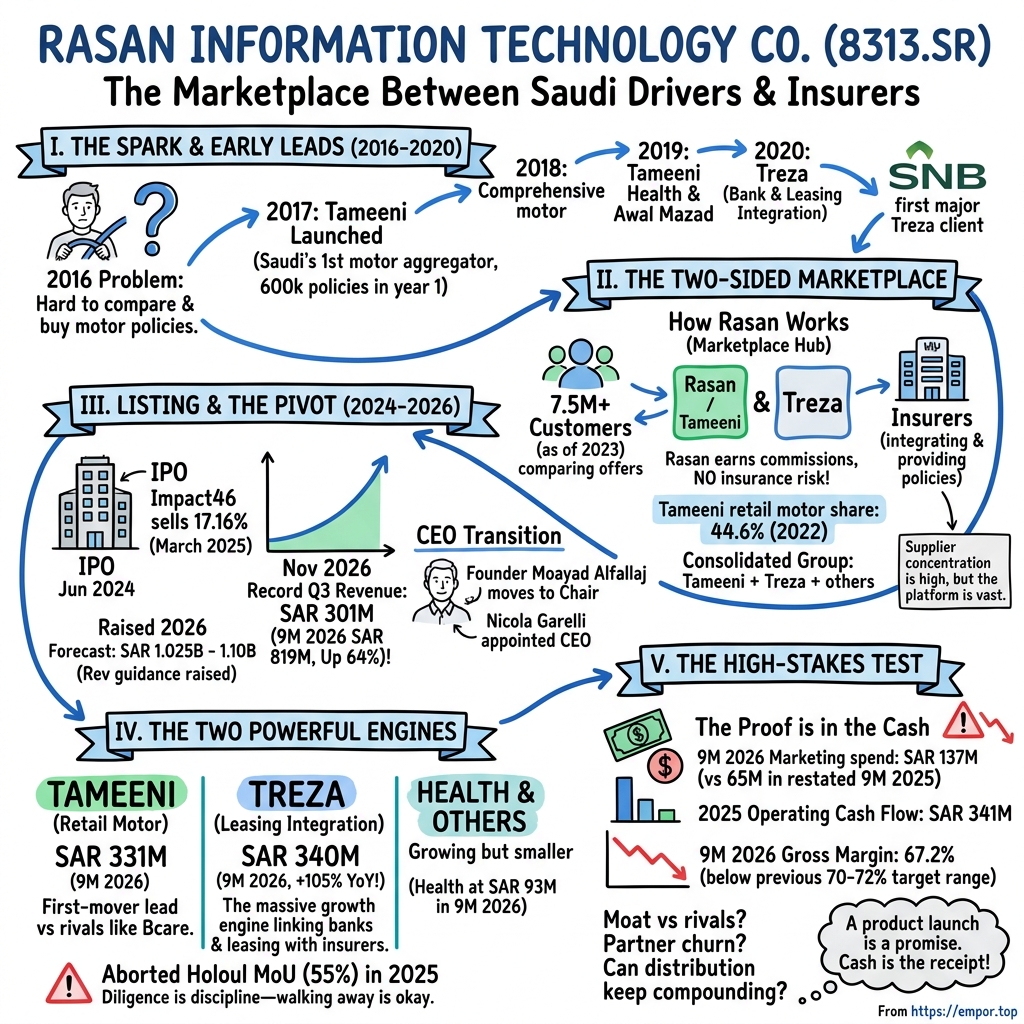
On 2 November 2026, Rasan Information Technology Co. put out the best quarter in its short public life. Revenue for the three months to September came to about SAR 301 million, the highest it had ever reported in a single quarter.1 For the first nine months of the year, revenue reached roughly SAR 819 million, up 64% on the same period of 2025.1
And instead of waiting for the full-year results to see how the year landed, management raised its 2026 revenue forecast to a range of SAR 1.025 billion to SAR 1.1 billion.12 A company that had booked well under half a billion riyals in revenue as recently as 2024 was now telling investors it expected to clear a billion.3
The release carried one more change that mattered as much as the numbers. The name at the top of the CEO's letter was no longer the founder's. Moayad Alfallaj, who had run the company through its growth years and its listing, had moved to the chair of the board in August, and Nicola Garelli, who had been deputy CEO and chief strategy and product officer, took over as chief executive in October.[^4]4
So the record quarter was also the first quarter reported under a new captain, delivered with a raised forecast that the new CEO will now have to meet.
It is worth rewinding to understand why a company with a name most investors outside Saudi Arabia have never heard of can produce numbers like these. Rasan did not start as an insurer, a bank, or a software vendor. It started as a company trying to make one tedious chore easier: buying car insurance online.
Its consumer brand, تأميني Tameeni, which roughly means "my insurance" in Arabic, put competing motor policies side by side on a screen, so a driver could compare prices and buy in minutes instead of visiting branches or calling agents.5
Everything else in this story, from the leasing platform that now earns more than retail motor to the questions about how sturdy the business really is, grows from that comparison screen.
The record quarter therefore raises a sharper question than "is Rasan growing?" It plainly is. The harder question is whether that growth is coming from a durable platform that customers and insurers keep choosing, or from a powerful but temporary wave of new business: a cohort of leasing partners reaching full contribution, a market moving online, and a step-up in marketing spending that bought volume. Four sub-questions follow from it, and they run through every section that comes after.
Can Tameeni hold its position as more insurance buying moves online? Can Rasan turn that position into a durable advantage, rather than just a head start? Will the adjacent products, from health insurance to auctions to financial-services brokerage, earn meaningful returns on the money being poured into them? And can a new CEO keep growth going without loosening the discipline that made the business so profitable?
Before going further, a word on what "Rasan" means in the numbers. Rasan is the listed parent company on the Saudi Exchange. Tameeni, Treza (the platform that sells insurance through banks and leasing companies) and its other subsidiaries, including some overseas software entities, sit inside the consolidated group.6 When this story talks about revenue, profit and cash, it means that consolidated group, because that is what a shareholder in the listed company owns.
There is also an accounting wrinkle that has to be put on the table now, because it touches every comparison in 2026. During the year, Rasan revised its 2025 comparatives. One change moved certain items from a net presentation to a gross one, which lifted reported revenue for the first nine months of 2025 by about SAR 60 million without changing gross profit by a single riyal.78
A separate change in how share-based compensation was accounted for cut the restated 2025 profit.7 The 64% revenue growth is measured against the restated base, so it is a like-for-like figure. But the restatement is a reminder that in this business the headline revenue line is a slippery thing, and gross profit is often the better measure of what Rasan actually earns.
Then there is the spending. Marketing expense in the first nine months of 2026 ran at about SAR 137 million, more than double the roughly SAR 65 million of the restated prior-year period.2 Growth that costs twice as much to acquire is still growth, but it is a different kind.
The quality and repeatability of the revenue, not its pace, is therefore the first test of this story. To judge it, one has to go back to the problem Tameeni was built to solve.
 Subscribe on LinkedIn
II. The First Comparison Screen
Picture Riyadh in 2016. Car ownership was near-universal among Saudi households that could afford it, motor insurance was compulsory, and the way to buy a policy was still mostly the old way: visit an insurer's branch, deal with an agent, or call around for quotes and hope the numbers were comparable.
Every driver had to buy the product, nobody enjoyed buying it, and almost nobody could easily tell whether the price they were paying was a good one. That was the kind of market where a middleman who removed the friction could become very valuable very quickly.
A small team set out to build that middleman. Tameeni Motor launched in 2017 and was Saudi Arabia's first motor insurance aggregation platform, according to the prospectus.5
In its first year, it sold around 600,000 motor policies.5 For a product with no physical branches and no prior brand, that was a startling first-year number, and it said something about how much latent demand there was for a faster way to buy a compulsory product.
The founder at the centre of this story is Moayad Alfallaj, who led Rasan as CEO from its early years through to the 2024 listing and into 2026.5[^4] The prospectus also names Samer Reslan among the founding shareholders, with a pre-IPO stake of about 9.4%.5
Rasan publishes little about the founders' personal backgrounds. What its record does show is their pattern of decisions, and that pattern is consistent: find a product people are already forced to buy, put it online, and then extend the same plumbing into the next product.
The first extension came quickly. In 2018, Tameeni moved beyond the compulsory third-party motor cover into comprehensive motor insurance, the more expensive policy that protects the driver's own car.5 That mattered because comprehensive cover is a bigger, more considered purchase, with more variation between insurers in price and terms. Comparison is more valuable when the choices differ more, so the move took the platform from convenience toward genuine advice.
In 2019 the product list grew again. Tameeni Health launched, aimed at medical insurance, and so did Awal Mazad, an online auction product.5 A year later came the product that would eventually reshape the company: Treza, an insurance-integration platform for banks and leasing companies.5
Where Tameeni sold policies to individuals who came to its site, Treza plugged into the systems of lenders and lessors, so that when a customer financed or leased a car, the insurance could be arranged inside that same process.
By September 2023, Rasan said it had served more than 7.5 million customers.5 That was a large number for a single national market, and it reflected the compulsory nature of the core product: almost everyone with a car was a potential customer, every year.
The opening bet was well matched to its moment. Saudi Arabia was digitizing quickly, a young population was comfortable buying online, and government systems for identity and vehicle data made it possible to quote a policy in seconds rather than days. But early adoption is not the same thing as loyalty.
A customer who used Tameeni once because it was the first site to make the purchase painless can use a different site next year if it is cheaper or simpler. The 600,000 first-year policies proved demand for online buying. They did not prove that the demand belonged to Tameeni.
That distinction ties the origin story to today. Every product Rasan has launched since still depends on the same four things: distribution, meaning getting in front of the customer at the moment of purchase; integrations with insurers and partners; customer acquisition, which costs money; and permission to operate, which comes from the regulator.
The comparison screen was the first answer to all four. Whether Tameeni earned a lead that would last, or simply arrived first in a market that rivals could catch up to, is the question the next stage of the story had to settle.
III. From First Mover to Listed Company
By 2020, Rasan was running two engines at once. Tameeni was scaling its motor platform, adding volume year after year, and Treza was signing its first big partner: the Saudi National Bank, the kingdom's largest bank, became Treza's first direct-channel customer.5
For a young company, winning the largest lender in the country as the launch customer of a new business line was a statement. It meant the plumbing worked well enough for a conservative institution to put its customers through it.
To understand what Rasan built in those years, it helps to understand who does what in Saudi insurance distribution. The insurers write the policies and keep the insurance risk. If a driver crashes, the insurer pays the claim. Rasan never carries that risk. It earns commissions for distributing the policies and fees for the technology services that make the distribution happen.56
Its customers, in an economic sense, are therefore two groups at once: the drivers and businesses who buy policies, and the insurers who pay for the sale.
The prospectus that Rasan published ahead of its listing gives the best picture of how fast Tameeni pulled ahead. Its share of Saudi motor-retail premiums, meaning motor policies sold to individuals rather than through fleets or lenders, rose from about 26% in 2019 to about 45% in 2022.5
Within the narrower aggregator channel, the online comparison sites, Tameeni's share was about 59% in 2022.5 On those numbers, close to half of all retail motor premiums in the country were flowing through one website, three years after the share had been about a quarter.
But the same table holds the counterweight. A second aggregator held about 39% of the aggregator channel that year.5 The prospectus does not name that rival. What matters is the shape of the market it describes: not one dominant platform with a scattering of small rivals, but two large players together accounting for nearly all of the aggregator channel. That is a duopoly-like structure, and duopolies can be either very comfortable or very bruising depending on whether the two sides compete on price.
Today, the alternatives are easier to name. Bcare, a Riyadh-based digital insurance platform, markets itself as a place to compare and buy policies across insurance lines.9 Insurers also run their own direct digital channels, so a driver can bypass any aggregator by buying from the insurer's app. The aggregator business is itself a regulated activity, with dedicated rules setting out who may run one and how.10
What the public record does not provide is a current, comparable market-share series showing how Tameeni has fared against these rivals since 2022. The prospectus documented a real early lead. Whether that lead has held, widened or narrowed since is a question Rasan does not answer in its annual documents.
There was another concentration hidden in the prospectus: the supplier side. Rasan's revenue comes from insurers, and in 2020 the five largest insurers on its platform supplied about 58% of revenue. By the first nine months of 2023, that share had fallen to about 41%.5 That is a healthy trend, because it means no single insurer could hold the company hostage as easily.
Yet 41% from five suppliers is still meaningful dependence. If a handful of insurers decided to cut commissions or push their own channels harder, Rasan would feel it.
Then came the listing. Rasan floated on the Main Market of the Saudi Exchange on 13 June 2024.11 The offering was priced at SAR 37 per share, at the top of its range.12 It sold 30% of the company, about 22.7 million shares, but the shares came from two places.513 About 5.3 million were new shares, whose proceeds went to the company. The remaining 17.4 million or so were existing shares sold by shareholders, whose proceeds went to them.5
So the IPO was mostly a liquidity event for early holders, with a smaller capital raise for Rasan itself. That is a common design for a profitable, cash-generating company that does not need much new money, and it is worth remembering when anyone describes the IPO as fuelling expansion.
Nine months later, one of the largest early holders left entirely. In March 2025, Impact46, a Saudi investment firm whose funds had backed Rasan, sold its full holding of about 13.3 million shares, around 17% of the company, through an accelerated bookbuild.14 A venture investor exiting after a listing is normal.
It tells shareholders the register has changed, and that a large block that might once have acted as an engaged owner is gone. It does not tell them anything about how Rasan used its IPO money, and it should not be read as a verdict on the business.
The listed company that emerged was a market leader in a two-horse aggregator race, with a growing second business in Treza and a supplier base that was concentrating less over time. What it sold, and how it made money each time a policy was bought, determines whether that lead is worth paying for.
IV. Who Pays for the Click?
Follow one customer. A driver in Jeddah needs to renew a motor policy. They open Tameeni, enter their national ID and vehicle details, and within moments see a list of quotes from competing insurers, each with a price and a set of features. They choose one, pay, and the policy is issued.
From the driver's point of view, the transaction is over. From Rasan's point of view, the important part has just happened: when the insurer issues the policy, it owes Rasan a commission, and that is the moment Rasan recognizes its revenue.6
That single click explains the whole income statement. Rasan's revenue is mainly commissions on insurance policies, recognized when policies are issued.6 Four things determine how much it earns: how many policies pass through its platforms, how large the premiums on those policies are, which products make up the mix, and what commission each insurer agrees to pay.
When more drivers buy through Tameeni, when premiums rise, when the mix tilts toward products with richer commissions, or when insurers pay more per policy, revenue climbs. When any of those move the other way, it falls.
In 2025, that machine produced about SAR 653 million of revenue.6 Motor, the original Tameeni business, contributed about SAR 319 million, roughly half. Treza's leasing business contributed about SAR 243 million, a little over a third. Health added about SAR 72 million, and smaller products made up the balance.6 Two businesses, both built around cars, did nearly all the work.
The prospectus offers a rare look at what one of these arrangements actually looks like. In a Treza agreement with IHC, a related party, the fee was SAR 160 per policy, capped at 4.05% of the premium, with monthly settlement and quarterly reconciliation.5 That example makes the economics tangible: Rasan is paid per transaction, the payment is linked to the premium, and the cap limits how much it can earn on any single policy.
It is one contract, not a company-wide rate, and Rasan does not disclose average commission rates across its platforms. But it shows the kind of deal that sits behind each line of revenue.
This is also why premium growth and revenue growth can diverge sharply. In the first nine months of 2026, Rasan reported about SAR 8.6 billion of gross written premiums flowing through its platforms, up 42%, against about SAR 819 million of revenue, up 64%.1 The premiums are the full price customers paid insurers.
Revenue is Rasan's share of that money. The two are linked, but they are not interchangeable. When revenue grows faster than premiums, as it did here, it means Rasan is earning more per riyal of premium, whether through product mix, better commission terms, the timing of partner onboarding or presentation changes.
When revenue grows slower, the opposite is true. For an investor, the gap between the two growth rates is one of the most revealing numbers Rasan publishes, because it is the closest public proxy for the platform's pricing power.
It is equally important to be clear about what Rasan is not. As established, Rasan does not carry underwriting risk; it has no loss ratio in the way an underwriter does. So the usual tools for analyzing Saudi insurers, such as reserves, combined ratios or investment yields on policyholder funds, do not apply.
Rasan's economics are closer to a marketplace's: the platform's costs are technology, people, data services and marketing, and its revenue is a cut of the transactions it enables.
That raises the obvious question of how recurring the revenue really is. Motor insurance in Saudi Arabia is compulsory and renews every year, so a customer who bought through Tameeni has a reason to come back. Leasing partners integrated into Treza generate a flow of policies every time they finance a car. Those features give the revenue a repeating quality.
But Rasan does not disclose a company-wide recurring-revenue share, a typical contract term or minimum commitments from partners.56 Every riyal still has to be earned again, one policy at a time. The honest description is a transaction-led business with repeat characteristics, not a subscription business.
That description cuts both ways. Transaction revenue can scale very fast when volumes surge, which is exactly what 2025 and 2026 show. It is also exposed to anything that reduces policy volumes, drives premiums down, or squeezes commissions, including insurance pricing cycles, regulatory changes to what aggregators may charge, and competition from rivals who are willing to take a smaller cut. Technology works on both sides too.
Better software and automation can lower Rasan's cost per policy, but the same tools make it cheaper for a competitor or an insurer's own app to offer a comparable comparison. The click pays Rasan well today. The real question is who controls the moment of the click, and that is a question about the two sides of the marketplace.
V. The Marketplace Has Two Sides
Every comparison site makes the same promise to the customer: choice. Here are all the offers, side by side, pick the best one. But behind the screen is a second customer who makes very different decisions. The insurer chooses which products to list, what prices to quote, and what commission it will pay the platform for the privilege. The driver sees a menu. The insurer writes it. Rasan's position depends on keeping both sides convinced that the menu is worth using.
The case for Rasan's strength starts with scale. Tameeni's early share gains were substantial,5 and by mid-2026 Rasan reported 22 insurance companies integrated with its platforms and 21 financial institutions live in its leasing ecosystem.8 An insurer that wants to reach Saudi drivers who shop online can hardly ignore a platform with that reach.
A bank or leasing company that wants to arrange insurance inside its financing process can plug into one system and reach almost every insurer, rather than building 22 separate connections. That is the classic two-sided marketplace logic: more insurers make the platform more useful for customers, more customers make it more valuable for insurers.
Porter's five forces help test that logic. The insurers are suppliers in this framework, and they have real bargaining power. They supply the entire inventory. Five of them accounted for about 41% of revenue as recently as 2023, and each could decide to pay lower commissions or push customers toward its own direct channel.5
Customers, on the other side, have low switching costs. A driver can check a second comparison site in a few minutes or go straight to an insurer's app.
Rival aggregators compete for the same driver, and the prospectus itself warned that competition could reduce Rasan's market share or its ability to charge higher commissions.5 The threat of new entrants is tempered by regulation, because running an aggregator requires approval under dedicated rules, but the regulator has already licensed more than one player.10
Substitutes, chiefly insurers' own digital channels, are a constant pressure. Of the five forces, only the integrations with banks and leasing firms clearly work in Rasan's favour.
So the moat claim has to be tested against the mechanism that would break it. A real moat would show up as customers who keep coming back even when a rival is cheaper, insurers who keep paying stable or rising commissions even though they have alternatives, and a market share that holds or grows over time. The historical evidence on the last point is good.5
But Rasan does not publish a comparable 2024 to 2026 market-share series in its annual documents, nor does it disclose customer retention rates, renewal rates, partner churn or average commission rates.36 The evidence that would turn a lead into a moat is exactly the evidence that is missing.
The second aggregator's share kept Tameeni's lead contested.5 A driver who did not find what they wanted on Tameeni had a well-known alternative, and an insurer unhappy with Tameeni's terms had a large competing channel to push volume through.
In a market with two strong platforms, the question becomes whether they compete on commission terms, on marketing spending, or on product quality. The doubling of Rasan's marketing expense in 2026 is at least consistent with a contest fought partly with advertising.2
The integration count needs the same scrutiny. Twenty-two insurers and 21 financial institutions are evidence of reach. They are not, by themselves, evidence of switching costs. A switching cost exists when leaving would be painful or expensive for the partner: when its systems, workflows and staff are built around Rasan's platform so deeply that moving elsewhere would cost more than any commission saving.
Treza's integrations may well have that quality, because a leasing company that has embedded insurance into its loan-origination process does not want to rebuild it. But Rasan does not disclose partner tenure, renewal terms or churn, so the strength of that lock-in remains an inference, not a measured fact.
There is also a supplier detail that cuts against the switching-cost story. IHC, a related party that generated about SAR 44 million of revenue in 2024, roughly 12% of that year's total, contributed nothing in 2025.6 A single large partner relationship can disappear from one year to the next. Rasan grew strongly enough in 2025 that the loss was absorbed, but the episode shows that integrations do not guarantee permanence.
The verdict on this side of the marketplace is therefore narrower than the bull case would like. Scale and integrations are credible advantages, and the historical share gains are real. The evidence supports a lead more strongly than it supports a moat. Customers can compare elsewhere, insurers supply the inventory and can redirect it, and the metrics that would prove durable advantage are not published in a comparable form.
The crucial missing proof is simple to state: does Rasan retain users and partners when customers can compare prices across platforms or buy directly from the insurer? Until it publishes that evidence, investors are pricing a position, not a proven moat. Yet in one corner of the business, the partner side is doing something more interesting than adding names to a list.
VI. Treza Moves the Story Beyond Retail Motor
Go back to 2020, when the Saudi National Bank became Treza's first direct-channel customer.5 At the time, it looked like a side project: a business-to-business integration for lenders, sitting next to the consumer brand that everyone knew. Fast forward to 2025, when a new group of leasing customers came onto the platform; the cohort has been ramping up through 2026.12 By the first nine months of 2026, that side project was the biggest single revenue line in the company.
Treza solves a different problem from Tameeni. When a customer leases or finances a car through a bank or a leasing company, the car has to be insured, usually with comprehensive cover, for the life of the financing. The lender cares that the asset is protected. Arranging that insurance has traditionally been a manual process: getting quotes, issuing policies, tracking renewals and making sure the coverage matches the contract.
Treza connects the lender's systems directly to the insurers, so that insurance is quoted, issued and managed inside the financing workflow.5 Think of it as plumbing that runs behind the lender's counter: the customer may never see Treza's name, but every policy that flows through it earns Rasan a fee.
The numbers show how far it has come. In 2025, Treza's leasing revenue was about SAR 243 million.6 In the first nine months of 2026 alone, it reached about SAR 340 million, up 105% on the same period a year earlier.1 Over the same nine months, motor retail revenue, the original Tameeni business, was about SAR 331 million, and Health was about SAR 93 million.1 For the first time, the business-to-business channel built around banks and leasing firms had overtaken the consumer brand on which the company was founded.
That mix shift is the most important strategic development in Rasan's recent history. It means the company is no longer simply a consumer comparison site. It is increasingly an infrastructure provider embedded in the operations of financial institutions. Revenue tied to leasing activity depends on how many cars are being financed and how many of those financings flow through Treza's partners, rather than on whether individual drivers choose Tameeni over a rival.
That is a different risk profile: less exposed to consumer marketing battles, more exposed to the health of car financing and the decisions of a smaller number of institutional partners.
But the growth figure needs unpacking, because volume and monetization moved at very different speeds. Leasing gross written premiums rose about 34% in the first nine months of 2026, while leasing revenue rose 105%.21 Revenue growing three times faster than premiums is a large gap.
Part of the explanation, according to management, is that leasing customers onboarded in 2025 reached a fuller run-rate in 2026.12 There may also be effects from product mix, the commission structure on new contracts and the gross-versus-net presentation change.
Rasan does not publish a breakdown of leasing revenue per riyal of premium by partner or cohort, so outsiders cannot fully decompose the gap. It is the single most useful question an analyst could ask management: how much of the leasing yield increase is durable, and how much reflects a one-time step as a cohort matures?
The answer matters because a cohort effect, by definition, fades. Once the 2025 partners are fully onboarded and contributing at their full rate, the 2026 jump in yield cannot repeat. From then on, leasing revenue growth will depend on three things: new partners joining, existing partners financing more cars, and the revenue earned on each policy.
The network's breadth tells investors how broad it is.8 It does not tell them whether the next cohort will be as valuable as the first.
Health is the other leg, and it is growing more slowly from a smaller base. At about SAR 93 million in the first nine months of 2026, it is less than a third the size of either motor business.1 Back in 2022, Tameeni Health's share of SME health premiums was about 4%.5
That is an old figure and should not be read as Rasan's current position, but it illustrates how much smaller Rasan's footprint in health was than in motor. Health insurance is a more complicated product, with networks, coverage tiers and employer decision-makers, and comparison sites have a harder time simplifying it.
Then there are the newer products, including Zooda and the auction business. They may broaden what Rasan offers customers, and management presents them as part of a wider platform. But "other products" were about 7% of group revenue in the first nine months of 2026.1 They are small enough that their success or failure will not move the investment case for some time, and large enough in ambition to absorb meaningful spending along the way.
The verdict on Treza is clear. Leasing has become a major economic engine, not a speculative side project. Its continued growth, however, depends on partner onboarding, leasing activity and the revenue earned per policy, not on the count of integrations alone, and the extraordinary 2026 revenue growth includes an effect that will not recur in the same form.
The same question of discipline, of spending where the returns are proven, follows Rasan into the decisions it made about what to build and what to buy.
VII. New Products, New Spend—and the Aborted Deal
In February 2025, Rasan signed a non-binding memorandum of understanding to acquire 55% of Holoul Financing, a Saudi finance company.1516 On paper, it was a logical step. Rasan was already plugged into banks and lessors through Treza; owning a majority of a financing business would have moved it further along the value chain, from arranging insurance for financed cars to participating in the financing itself. It was the kind of move that turns a platform story into a conglomerate story.
Then the deal fell apart. In June 2025, Rasan announced that the parties had terminated the memorandum after preliminary technical due diligence, without reaching a final agreement.1615 The cost of walking away was small: about SAR 270,000 in adviser fees.16 No purchase price was ever agreed, so there is nothing to compare with industry multiples and no way to judge whether Rasan would have overpaid.
What the episode shows is narrower and, in its way, more useful: when diligence turned up reasons not to proceed, the company stopped. It did not chase the deal, and the abandoned effort cost less than many companies spend on a single conference.
That is not a full capital-allocation record. Rasan has no completed acquisition in its public history that would let investors test whether it buys well. The Holoul episode is evidence of a due-diligence stop, not a completed deal to benchmark. Rasan's 2025 strategy said it would explore mergers and acquisitions, which means future deals are likely.17 Each one will be a fresh test: the price, the strategic fit, the milestones attached and the returns that follow.
Meanwhile, the bigger money was going into software. Rasan added about SAR 59 million of intangible assets in 2025, more than twice the roughly SAR 28 million it added in 2024.618 Intangible additions here mostly mean software development that the company capitalizes, putting it on the balance sheet as an asset instead of running it through the income statement as an expense.
Expensed research and development was only about SAR 5 million in 2025, under 1% of revenue.3 In other words, almost all of Rasan's product-development effort shows up as an asset that is written down gradually over time, not as a cost that hits profit in the year it is spent.
That accounting choice is legitimate when the software genuinely creates a lasting asset. It is also a judgment call, and the auditor flagged it. In the 2025 audit report, the capitalization of development costs was identified as a key audit matter, meaning the auditor considered it one of the areas requiring the most significant judgment.6
The opinion itself was unmodified, and no material weakness was reported.6 A key audit matter is not a criticism. It is a signpost that says this is where the numbers depend most on management's assumptions.
The offsetting evidence belongs right beside the investment claim. In 2025, Rasan recorded about SAR 6 million of intangible impairment, meaning some previously capitalized development was judged not to be worth what it had cost.6 Amortization, the gradual write-down of software already in use, was about SAR 12 million.6 And about SAR 17 million of share-based compensation was capitalized into intangibles, so part of the software asset represents shares and options granted to employees rather than cash paid.6
Each of those figures complicates the picture. Impairment shows that not every project pays off. Capitalized share-based compensation means that the income statement understates the full cost of the people building the product.
Put plainly, Rasan is investing heavily in technology, and the investment is growing faster than revenue. That may be exactly right for a platform business, if the software reduces the cost of serving each policy, improves the share of visitors who buy, or supports new products that generate revenue. The test is not how many products Rasan launches or how large the intangible balance becomes.
It is whether those assets show up later in lower operating costs, higher conversion or meaningful product revenue. Rasan does not disclose returns on its capitalized development or link specific software projects to revenue, so investors have to infer those returns from the overall margin trend and the impairment record.
The comparison worth watching is simple. If intangible additions keep doubling while the "other products" line stays near 7% of revenue and impairments recur, the spending is spreading across too many possible businesses. If cost per policy falls, gross margin holds, and newer products start contributing meaningfully, the spending is building an asset. The answer will appear in the numbers, which is why the numbers themselves, after the 2026 restatement, need a careful look.
VIII. The Numbers After the Restatement
The half-year review in 2026 changed how Rasan's accounts looked. In its interim financial statements for the six months to June, the company revised its 2025 comparatives in two main ways. It changed the presentation of insurance-related receivables and payables, and it revised the accounting for share-based compensation.198
A third, related change moved certain revenue items from net to gross presentation.7 None of these changes touched the underlying cash Rasan earned. All of them changed the numbers investors had been comparing against.
As the earlier comparison showed, revenue is more susceptible to presentation changes than gross profit.7
The share-based compensation restatement lowered the comparison base, helping lift reported profit growth. Net profit for the first nine months of 2026 was about SAR 284 million, up 93% on the restated comparison.71 The growth is genuine, but some of its height comes from the revised floor beneath it.
The balance sheet changed in the opposite direction, shrinking rather than growing. Rasan had been presenting the insurance premiums that pass through it as both receivables (money owed to Rasan by customers or partners) and payables (money Rasan owed onward to insurers). That gross presentation inflated both sides of the balance sheet. In 2026, Rasan concluded that, because it acts as an agent and has no legal recourse over those premium balances, they should be de-recognized.19
As a result, restated trade receivables at the end of 2025 were about SAR 89 million gross, with about SAR 84 million net of provisions, far smaller than the original presentation.19 The underlying business did not change. The picture of it did.
Now to the question that matters most for any investor: how much of Rasan's profit becomes cash? On the audited 2025 accounts, the answer looks excellent. Operating cash flow was about SAR 341 million, against net profit of about SAR 247 million.6 Cash generation exceeded profit by almost 40%. In 2024, the pattern was similar: operating cash flow of about SAR 168 million against profit of about SAR 95 million.6
But look at where the extra cash came from. Part of it is non-cash charges added back, chiefly about SAR 22 million of share-based compensation, plus amortization, impairment and credit-loss provisions.6 Most of the rest came from working capital. Receivables and prepayments used about SAR 123 million of cash in 2025, while payables provided about SAR 120 million.6
Those two movements almost cancelled out. In other words, Rasan collected more slowly from one side and paid more slowly on the other, and the net effect was small, but each side was large.
For a business that sits between customers and insurers, payables are partly money owed to insurers. A cash-flow figure supported by rising payables is real, but it is also, in part, the result of timing between collecting from one party and paying another.
The receivables themselves deserve a proportional look. The largest specific risk from 2024, IHC's net receivable of about SAR 22 million at year-end, was collected in 2025, along with additional amounts, allowing Rasan to reverse a credit-loss provision.6 That is a clean positive outcome.
Later filings showed a mixed picture on aging: at the end of June 2026, about SAR 9 million of receivables were more than 90 days old, mostly provided for, and by September that overdue balance had dropped to about SAR 1 million.197
The September report also recorded about SAR 3 million due from former senior personnel, with a SAR 1 million provision.7 Earlier, amounts due from founder Samer Reslan for tax-related matters had fallen to about SAR 1 million at the end of 2025 from about SAR 4 million.6 None of these balances is large relative to Rasan's size, but balances owed by insiders and former executives are the kind of detail that governance-minded investors track.
Treasury income adds one more layer. Rasan ended 2025 with about SAR 741 million of cash and cash equivalents, earning an average of about 5.8% on its short-term deposits, and other income, mostly interest and government incentives, was about SAR 19 million, around 7% of profit before tax.6
That is meaningful but not decisive. Rasan had no bank borrowings in 2024 or 2025, and its lease liabilities, which rose to about SAR 20 million by September 2026 after a new headquarters lease, are accounting obligations, not debt.67
The verdict is that cash conversion was strong in the reported year, but payables materially supported it, and non-cash compensation complicates any comparison of adjusted profit. The restatements change the comparison and the size of the balance sheet. They do not erase the underlying cash question. Three tests will keep that question honest: policy volumes, which show whether demand is growing; gross profit per unit or gross margin, which shows whether Rasan's cut is holding; and operating cash flow after normalizing for working-capital swings, which shows how much of the profit is truly free. Those tests now fall to a new chief executive.
IX. A Founder Steps Back; the New CEO Takes the Call
In August 2026, Rasan's board announced a set of changes that, taken together, ended the founder era of day-to-day management. Moayad Alfallaj's appointment as CEO was terminated, and Alfallaj became chair of the board, a non-executive role.[^4] Nicola Garelli, who had served as deputy CEO and chief strategy and product officer, was named chief executive, with the appointment taking effect in October.[^4]4 By the time of the November release, Garelli was leading the company's results presentation.1
Transitions like this one are common in founder-led companies as they mature after a listing, and this one had features that should reassure shareholders. Garelli was not an outsider parachuted in, having been inside Rasan in senior roles that covered both strategy and product, which means Garelli had a hand in the decisions that produced the recent growth. The founder remains on the board as chair, which provides continuity and institutional memory.
The structure is designed for evolution rather than revolution. It is also a meaningful test. A founder who built the company carries authority that a successor has to earn, and a new CEO who inherits a raised forecast has little margin for error in the first full year.
The incentives surrounding that leadership have changed sharply. Aggregate compensation for key management personnel rose to about SAR 25 million in 2025 from about SAR 5 million in 2024, a nearly fivefold increase, while net profit rose about two and a half times.6 Rasan does not disclose individual pay for the CEO, managing director or CFO in its annual statements, so investors cannot see how the total is divided.6
Part of the increase reflects share-based awards: Rasan's group share-based compensation was about SAR 22 million in 2025.6 In the first nine months of 2026, the company reported non-cash employee share-plan charges of about SAR 46 million, up from about SAR 25 million a year earlier.1
That brings in the distinction between reported and adjusted profit. For the first nine months of 2026, reported net profit was about SAR 284 million. Management also presented adjusted net profit of about SAR 330 million, which excludes the non-cash share-plan charges.1 The adjustment is common and the reasoning is understandable: the charges do not consume cash.
But share awards are a real cost to shareholders, paid in ownership rather than riyals. When the adjustment grows from about SAR 25 million to SAR 46 million in a year, the gap between the two profit figures becomes a material part of the story, and the reported number is the more conservative guide.
Ownership tells a related story. Rasan held about 883,000 treasury shares at the end of 2025 to serve its employee share plan, which means those shares are earmarked for staff, not returned to shareholders as a buyback.6 The 2025 annual report also shows reductions in several executive holdings; Alfallaj's reported stake fell from about 1.76 million shares to about 0.97 million.3
There may be many reasons for a share-count change, from personal finances to tax, and the filing gives none, so it says nothing about motive. What it does mean is that the founder's economic stake is smaller than it was, and that no single holder, on the basis of Rasan's disclosures, controls the company.320
The board's mandate is another data point. At the general assembly on 3 August 2026, shareholders elected a new board. The votes recorded about 67% in favour and about 33% abstention.21 Abstention is not opposition: a shareholder who abstains is declining to vote either way, which can reflect anything from a policy of not voting on certain items to uncertainty about candidates.
But a third of the voting shares abstaining is high enough to be worth noticing, and future votes and shareholder engagement will show whether it signals disengagement or a deeper question about accountability. The 2025 board had four independent directors among seven, a majority.3
The way to judge the new management is through behaviour over time. Across Rasan's earnings materials for 2025 and 2026, from the full-year 2025 deck through the first-quarter, half-year and nine-month presentations, the core narrative has been consistent: growth across business lines, expanding partner integrations, high margins and investment in product.1782 The raised revenue guidance in November is the first concrete promise under Garelli.
The gross-margin record is more complicated, because the company is running below its original target range, as the next section shows. And the explanations that matter most, for the marketing step-up, the leasing yield jump and the share-plan expense, are the ones investors should press for on every call.
Credibility will be built on three things. First, forecast versus delivery: does full-year 2026 land within the raised range? Second, the explanation of any misses: when gross margin came in below target, did management explain why in specific terms? Third, whether the capitalized software and new products produce measurable economics.
A CEO who previously ran strategy and product will be judged, fairly or not, on whether the products that CEO championed earn their keep. That brings the story to the question every investor ultimately has to answer: what is all of this worth?
X. Analysis & Bear vs. Bull Case
After the guidance increase in November, investors faced a choice about what kind of company they were valuing. One version of Rasan is a fast-growing digital distribution platform, embedded in the plumbing of Saudi insurance and finance, with high margins and a long runway. The other version is a transaction-led broker in a competitive two-sided market, riding a strong cycle and spending heavily to sustain it. The share price reflects which version the market believes.
As of 18 November 2026, Rasan's delayed share price was about SAR 139.80, giving a market capitalization of about SAR 10.8 billion and a trailing price-to-earnings ratio of about 28 times.20 That multiple is a dated snapshot, not a historical series, and Rasan has been listed for too short a time to establish a meaningful "normal" range of its own.
It is also hard to compare directly with Saudi insurers, because insurers take underwriting risk and hold capital against it, while Rasan carries no insurance risk at all.
A broker should, in principle, deserve a different multiple from an insurer, and any comparison has to make that difference explicit. What a 28-times multiple does imply is that the market expects earnings to keep growing well above the rate of the broader economy for several years. There is little room in that price for a stall.
The bull case begins with the evidence of the last nine months. Every reported business line grew in the first nine months of 2026.1 Motor retail remains strong. Treza has become the largest contributor. And the economics are attractive: Rasan generated about SAR 550 million of gross profit and about SAR 359 million of adjusted EBITDA in the period, an adjusted EBITDA margin of about 44%.12 A business that keeps nearly half of its revenue as operating cash profit, before share awards, is doing something right.
The bear case begins in the same place but reads it differently. Rasan still depends on policies issued, premium levels and insurer commissions. Customers can shop around. Current market-share and retention evidence is thin. A broker with these characteristics can grow very fast when the market is growing and the cohort of new partners is maturing, and it can slow just as quickly when either changes.
Hamilton Helmer's seven powers offer a stricter test than Porter's forces, because each power requires both a benefit and a barrier that stops rivals from copying it. Network economies are the most plausible power for Rasan: more insurers make Tameeni more useful to drivers, and more drivers make it more valuable to insurers. But a network effect is only a power if it creates a barrier, and the existence of a rival aggregator with a large share of the channel suggests that the network effect in Saudi motor comparison is real but not winner-take-all.5 Scale economies exist in technology and data costs, which are spread across more policies as volume grows, and they help explain Rasan's high margins.
Switching costs are the most promising power in Treza, where lenders have embedded insurance into their workflows, but the loss of the IHC relationship within a year shows they are not absolute.6 Brand is meaningful for Tameeni among consumers, but brand in a price-comparison business is fragile, because the customer is explicitly looking for the cheapest option.
Counter-positioning, cornered resources and process power are hard to identify from public evidence. The regulatory licence is a barrier to new entrants, but it is shared with competitors.10
Put together, the frameworks narrow the moat to a smaller and more specific version: Rasan has scale and network advantages in motor retail, and growing switching costs in leasing, but neither has been proven durable by the retention and pricing evidence that would confirm it. The claim is intact but unproven.
The bull case adds a second argument: breadth. Multiple products and integrations broaden Rasan's reach, and owning more of the value chain, from motor to health to leasing to financial-services brokerage, could raise revenue per customer. The bear rejoinder is that the track record of commercialization is shorter than the strategy list. "Other products" remain about 7% of revenue.1
The planned financial-services brokerage and newer products should not be valued as proven earnings until they produce material, recurring contribution. The impairment of some capitalized software in 2025 shows that not every product bet succeeds.6
Margin quality is where the debate becomes concrete. Gross margin for the first nine months of 2026 was about 67%, an improvement on the prior year, but below the original full-year guidance range of 70% to 72%.2 The third quarter alone was weaker still, at about 64%.2 When management raised its forecast in November, it lifted the revenue and gross-profit outlook while reaffirming its adjusted EBITDA margin range.2
The pattern suggests that Rasan is growing revenue faster than gross profit in recent quarters, which is consistent with a shift toward lower-margin business or higher costs of delivering it, and that management is holding operating margins by controlling other costs. That is not a crisis. It is a reminder that the headline revenue upgrade carries a margin cost.
ANB Capital's first take on the third quarter, published the day after the release, was one of the earliest outside readings of the numbers.22 Analysts will continue to debate whether the gross-margin trajectory is a temporary result of mix or a lasting change. What is clear from the company's own figures is that the gap between revenue growth and gross-profit growth is the number to watch.
Marketing is the second line of debate. The nine-month marketing spend more than doubled, faster than revenue.2 Rasan does not disclose customer acquisition cost, lifetime value or marketing return by product. The bull reading is that the company is spending to capture share while the market moves online, and that a customer acquired today will renew for years.
The bear reading is that a doubling of marketing spend is what one would expect in a competitive two-sided market where the lead must be bought rather than defended. Without retention data, both readings are possible, and the evidence that would settle the question is not published.
The share-plan charge belongs in this debate too. The non-cash charges in the first nine months are an economic cost, even though they do not consume cash, because they transfer ownership from existing shareholders to employees.1 Reported and adjusted net profit should be read side by side, not one instead of the other.1
An activist reading this record would press on five points. First, disclosure: a platform priced at 28 times earnings should publish retention, renewal, market-share and take-rate data so shareholders can test the moat claim. Second, software capitalization: with additions doubling and the auditor flagging the judgment, shareholders deserve a clearer link between capitalized development and the revenue or cost savings it produces. Third, compensation: shareholders should receive disclosed performance criteria for rising management pay and share-plan charges.
Fourth, governance: the board-election abstentions merit engagement. Fifth, capital allocation: Rasan held about SAR 741 million of cash at the end of 2025 and had no debt; the question of whether to return it, invest it or use it for acquisitions will become sharper as the business generates more cash.6
The risk radar is specific to this business. Regulation sits at the top. Rasan's model depends on permission to operate as an aggregator and broker, and changes to the rules, by the central bank or the Insurance Authority that now oversees the sector, could alter what aggregators may charge or how they operate.109
Data privacy and cyber risk come next, because Rasan handles national IDs, vehicle records and payment data for millions of customers, and a breach would damage the trust on which a comparison platform depends.
Technology is the third: tools that lower the cost of building a comparison engine help Rasan, but they also help any insurer or rival that wants to offer the same service.
If there are three numbers that will tell investors whether the case is holding, they are these. The first is the gap between gross written premium growth and revenue growth, which shows whether Rasan's share of each riyal of premium is rising or falling; in the first nine months of 2026, revenue pulled ahead of premiums.1
The second is gross margin, which shows whether the revenue mix is getting richer or poorer; it was about 67% for nine months, improving on the year but below target and weaker in the third quarter.2
The third is marketing spend relative to revenue, which shows whether growth is getting cheaper or dearer to buy; it rose sharply in the nine months.2
The investment spine comes down to one proof. Can Rasan hold partner access and customer demand while converting growth into cash after marketing, incentives and software investment? If it can, a premium valuation has a foundation. If it cannot, a 28-times multiple leaves a long way to fall. The lessons of the story so far point toward what that proof will look like.
XI. Playbook: Business & Investing Lessons
Think back to that first comparison screen, the one that sold about 600,000 motor policies in its first year.5 It became a wider distribution network, and then the company had to decide where that network could earn more. That arc, from one product to a platform and then to a portfolio of bets, is the arc of most successful marketplaces. Rasan's version has already taught five lessons, and each of them belongs to this company in particular.
The first lesson is that a first mover earns a lead, and every renewal has to earn it again. Tameeni's early share gains were earned by being first and being easy.5 But motor insurance renews every year, and every renewal is a fresh chance for the driver to try somewhere else.
The share gains are history. The retention rate is the present, and Rasan does not publish it. For founders, the lesson is that being first buys a head start, not a franchise. For investors, it is that a market-share table from three years ago is a starting point, not a moat.
The second lesson is that a second channel can become the core. Treza began in 2020 as a business-to-business experiment with one bank, a side project next to a famous consumer brand.5 By the first nine months of 2026, it had become Rasan's largest revenue line.1
The insight is that the most valuable place to sit is often not in front of the customer, but behind the institution that already has the customer's attention at the moment of purchase.
A leasing company financing a car can be a more direct point of sale for insurance than any advertising campaign. The question for Rasan is whether partner concentration and policy economics stay attractive once the 2025 cohort has fully matured, because a channel built on a few large partners is only as durable as those relationships.
The third lesson is that a product launch is a promise, and cash is the receipt. Rasan's software investment and impairment record show the scale of that promise.6 Every product announcement, from health to auctions to Zooda, adds to it.
The receipt is revenue that shows up in a line other than "other products", or costs that fall per policy. Until then, the balance sheet is holding an IOU from the product team, and the auditor has already circled it as a matter of judgment.6
The fourth lesson is that discipline includes walking away. The proposed purchase of 55% of Holoul Financing would have moved Rasan from arranging insurance for financed cars to participating in the financing itself. After due diligence, the company walked away, at a cost of SAR 270,000.16 That may be the cheapest strategic decision in this story.
It does not prove that Rasan will buy well when it eventually buys. But it shows a willingness to stop, which is the one capital-allocation trait investors cannot easily verify in advance and come to value most in hindsight.
The fifth lesson is that adjusted earnings still belong to shareholders. Rasan's reported and adjusted profits diverged because of share-plan charges.1 Those charges are paid in ownership, not cash, and every share granted to an employee is a share that existing holders no longer own.
The sharp rise in key-management pay in 2025 asks shareholders to trust that the incentive will be repaid in performance.6 Adjusted numbers can describe the operating business. Reported numbers describe what shareholders actually keep.
Taken together, the lessons point to one idea. Distribution can compound, but only while partners, customers and economics move with it.
XII. Epilogue
Tonight, Rasan stands at the end of the strongest nine months it has ever reported, with a raised forecast, a new CEO and a share price that assumes the growth will continue. The next full-year results, due in the first months of 2027, will be the first complete scorecard after the leadership transition and the 2026 growth surge.
They will also be the first full year reported entirely on the restated basis, which means investors will finally be able to compare like with like across a full twelve months.
The first moment of truth is whether revenue lands within the raised guidance and where gross profit lands.1 Landing inside that range, on a consistent accounting basis, would confirm that the third quarter was not a one-off and that the new management sets targets it can meet.
Landing at the top while gross margin recovers toward its original target would strengthen the case that growth is high-quality. Landing at the bottom with further gross-margin erosion would suggest that the growth is being bought.
The second is Treza. The company says the 2025 cohort of leasing partners has largely reached full contribution, which means 2027 will show what leasing growth looks like without that one-time step-up. If leasing revenue keeps growing strongly, it will mean new partners and rising volumes are doing the work. If it slows sharply toward the recent leasing-premium growth rate, it will mean the 2026 jump was largely a cohort effect.2
The third is disclosure. A company priced as a platform should eventually publish the metrics that prove it is one: comparable market share, renewal and retention rates, partner churn. If Rasan begins to publish those figures, investors will be able to test the moat directly. If it does not, the moat will remain an inference drawn from growth.
The fourth is the cost of growth. Gross margin and marketing cost per policy will show whether the product mix shift and the marketing step-up are producing durable volume. A falling marketing ratio would mean customers acquired in 2026 are coming back without being paid for again. A rising one would mean the lead requires constant reinvestment.
The fifth is the software. Future additions, impairments and any evidence that development spending drives revenue or lowers costs will show whether the capitalized balance is an asset or an accumulating promise.
And the sixth is governance. The next annual report will show how management explains its share-plan economics, how the founder's and executives' holdings have changed, and how the board, elected with a third of votes abstaining, holds the new CEO accountable.21
Each outcome maps back to the question this story began with. If the numbers show steady margins, falling acquisition costs and continued leasing growth, Rasan's expansion will look like a repeatable distribution engine. If they show eroding margins, rising marketing and slowing leasing, it will look like a company dependent on fast-growing policy volumes and the spending needed to capture them. The record quarter has set the bar. The next year will show whether it can be cleared again.
XIII. Outro
Go back to the comparison screen. The insurer carries the risk; Rasan does not. What Rasan owns, or tries to own, is the moment in between: the instant when a customer chooses.
That moment began with motor policies side by side on a website. Today the same question of distribution reaches into leasing companies' loan systems, employers' health plans and, if management's plans hold, financial services.
The tension that defines this company is built into the screen itself. A platform that makes comparison easier gives the customer power. It can only keep its own power if customers and partners keep choosing it, even when someone else can show them the same list.
Rasan's story is the story of who controls the route between a Saudi driver and an insurer, and whether owning that route creates lasting economic power, or only a very good toll booth on a road that others are free to build beside.
References
-
9M 2026 Earnings Release — Rasan, 2026-11-02 ↩↩↩↩↩↩↩↩↩↩↩↩↩↩↩↩↩↩↩↩↩↩↩↩
-
9M 2026 Earnings Call Presentation — Rasan, 2026-11-03 ↩↩↩↩↩↩↩↩↩↩↩↩↩↩↩
-
Rasan Information Technology Company Prospectus — Capital Market Authority, 2024-03-25 ↩↩↩↩↩↩↩↩↩↩↩↩↩↩↩↩↩↩↩↩↩↩↩↩↩↩↩↩↩↩↩
-
Audited Consolidated Financial Statements FY2025 — Rasan ↩↩↩↩↩↩↩↩↩↩↩↩↩↩↩↩↩↩↩↩↩↩↩↩↩↩↩↩↩↩↩↩↩↩
-
Interim Consolidated Financial Statements 9M 2026 — FinancialFilings, 2026 ↩↩↩↩↩↩↩↩
-
H1 2026 Earnings Call Presentation — Rasan, 2026-08-10 ↩↩↩↩↩
-
Bcare Introduces Its Latest Product Medical Capsule at LEAP 2025 — Sharikat Mubasher, 2025-02 ↩↩
-
Rules Governing Insurance Aggregation Activities — Saudi Central Bank Rulebook ↩↩↩↩
-
Saudi Exchange Welcomes Rasan to the Main Market — Saudi Exchange, 2024-06-13 ↩
-
Saudi Arabia's Rasan Information Technology Prices IPO at Top of Range — Reuters via Yahoo Finance, 2024-05-22 ↩
-
Rasan Information Technology Company Supplementary Prospectus — Capital Market Authority, 2024-05-26 ↩
-
Impact46 Share Sale Announcement — Saudi Exchange, 2025-03-13 ↩
-
Rasan Terminates Holoul Financing MoU — Argaam, 2025-06-26 ↩↩
-
Holoul Acquisition MoU Termination — Saudi Exchange, 2025-06-26 ↩↩↩↩
-
Interim Condensed Consolidated Financial Statements Q2 2026 — Rasan ↩↩↩↩
 LinkedIn
 WhatsApp
 Reddit
 Hacker News
 Email
 Kindle
 RSS Feed
 Spotify
 Apple Podcasts
 Amazon Music
 Audible
 YouTube