 Chat with
this content: Summary, Analysis, News...
Chat with
this content: Summary, Analysis, News...
 Subscribe on LinkedIn


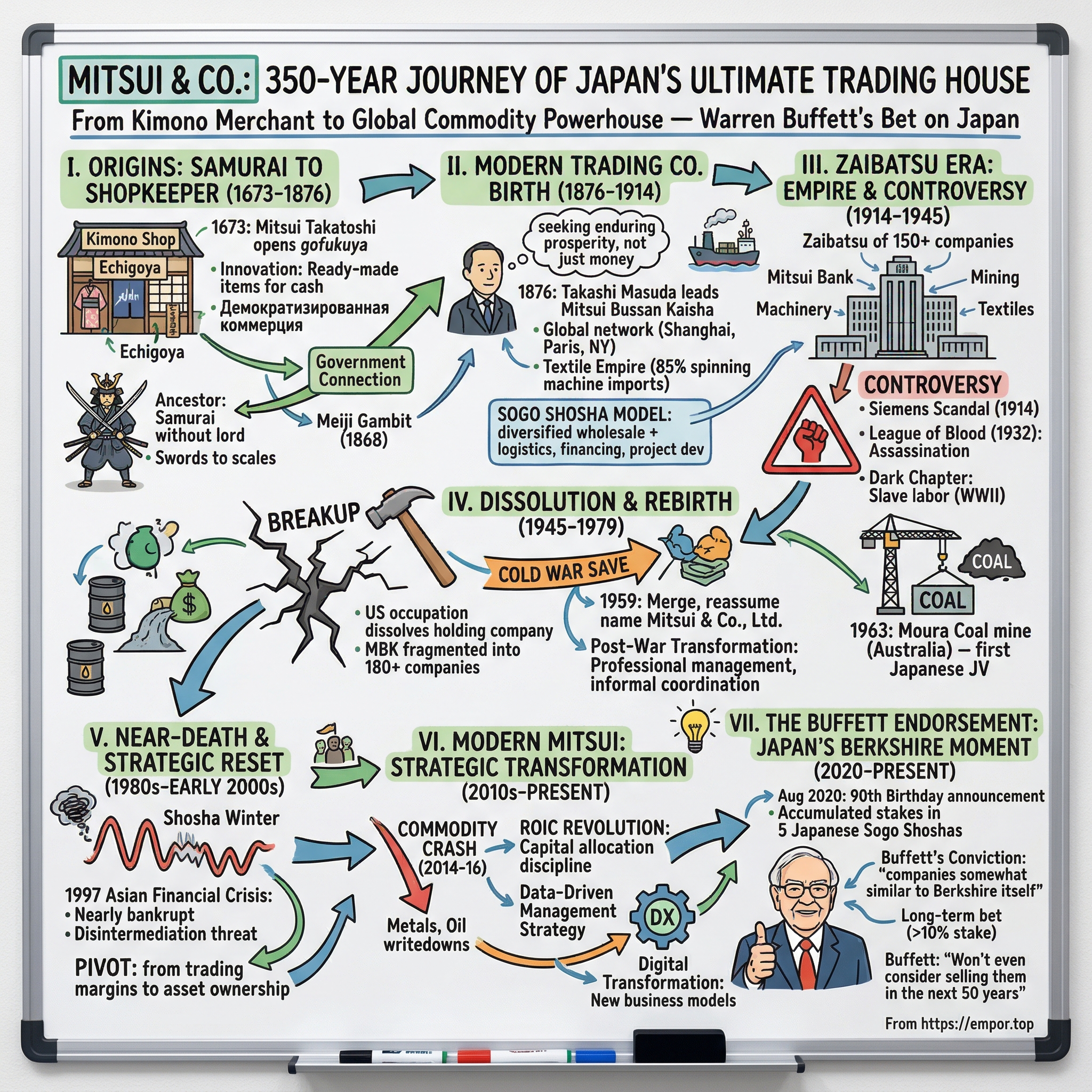
Mitsui & Co.: The 350-Year Journey of Japan's Ultimate Trading House
From kimono merchant to global commodity powerhouse—how a 17th-century retailer became Warren Buffett's bet on Japan
I. Introduction: The Mystery of the Sogo Shosha
Picture this: It's August 2020, and Warren Buffett is celebrating his 90th birthday with a gift to the world—the revelation that Berkshire Hathaway has quietly accumulated stakes in five Japanese companies that most American investors had never heard of. No Apple. No Coca-Cola. Instead, names like Itochu, Marubeni, Mitsubishi, Mitsui, and Sumitomo.
The financial press scrambled to explain what these "sogo shosha" companies actually did. The translations were clumsy: "general trading companies" or "comprehensive trading firms." Neither captured the Byzantine reality of enterprises that span commodities to convenience stores, LNG terminals to hospital chains.
Buffett himself offered a hint in his 2024 annual letter, noting that these five companies invest across diverse sectors domestically and abroad "in a manner somewhat similar to Berkshire itself." For Buffett, the comparison was the highest compliment he could bestow.
Among the five, Mitsui & Co. stands as perhaps the most compelling case study in corporate survival and reinvention. Founded by Mitsui Takatoshi (1622–1694), who was the fourth son of a shopkeeper in Matsusaka, this enterprise has navigated samurai politics, Meiji modernization, American occupation, commodity crashes, and digital disruption—emerging each time transformed but intact.
The headline numbers tell part of the story: ranked 121st in the Fortune Global 500 in 2024, with revenue of 14.66 trillion yen that year. Since 1992, market capitalization has grown from $8.16 billion to over $72 billion—a compound annual growth rate of roughly 6.7% over three decades of what most investors dismissed as Japan's "lost decades."
At the end of 2024, the market value of Berkshire's holdings in the five Japanese trading houses totaled $23.5 billion. In September 2025, Berkshire increased its holdings in Mitsui to more than 10% on a voting-rights basis, and may consider expanding its stake even further.
What explains Buffett's conviction? How does a 17th-century kimono shop become a $75 billion global trading and investment powerhouse? And what can investors learn from a business model that has no Western equivalent?
The answers lie in 350 years of evolution, adaptation, and a particular Japanese genius for institutional longevity. This is the story of Mitsui & Co.—Japan's original "360° business innovator."
II. The Mitsui Origins: From Samurai to Shopkeeper (1673–1876)
The year was 1673, and a 51-year-old merchant named Mitsui Takatoshi had finally received his moment. Sent back to Matsusaka by his older brother at age 28, Takatoshi had waited 24 years until his older brother died before he could take over the family shop, Echigoya.
The Mitsui family's origins were not in commerce but in warfare. Mitsui ancestor Mitsui Echigonokami Takayasu was a samurai commander in Namazue, Shiga Prefecture, but in 1568, his lord Rokkaku-Sasaki lost a battle against Nobunaga Oda, which left Takayasu a 'ronin,' or 'samurai without a lord.' So he moved to the area that is now known as Ise, in Mie Prefecture.
The family turned from swords to scales. From his shop, called Echigoya (越後屋), Mitsui Takatoshi's father originally sold miso and ran a pawn shop. The family would later open a second shop in Edo (modern Tokyo).
When Takatoshi finally took control, he made a decision that would echo across centuries. He opened a new branch in 1673; a large gofukuya (kimono shop) in Nihonbashi, a district in the heart of Edo. The genesis of Mitsui's business was in the Enpō era, which was a nengō meaning "Prolonged Wealth". In time, the gofukuya division separated from Mitsui, and became Mitsukoshi.
The Innovation That Changed Everything
What Takatoshi did next was revolutionary. In an era when merchants visited wealthy customers at home, took orders, extended credit, and delivered goods weeks later, Mitsui Takatoshi implemented a new system, manufacturing ready-made items which could be purchased directly at his shop for cash.
In 1683 he moved the store to the location of the current main Mitsukoshi department store, where he adopted innovative retail methods such as "cash basis at fixed prices" and selling products by the piece. This helped grow Echigoya into the largest textile store of the Edo period.
These may seem like basic business practices today—fixed prices! Cash transactions!—but in feudal Japan, they were nothing short of revolutionary. The traditional system favored the wealthy who could negotiate discounts and access credit. Takatoshi's innovation democratized commerce, attracting the emerging merchant class while generating faster cash turnover.
The Government Connection
In 1683, the shogunate granted permission for money exchanges (ryōgaeten) to be established in Edo. The Mitsui "exchange shops" facilitated transfers while mitigating risks.
Starting in 1691, members of the Mitsui family were designated chartered merchants (goyō shōnin) by the shogunate. These appointments were lucrative for Mitsui and gave it considerable influence in the government. The cultivation of close ties with the government became a great asset to Mitsui, especially during the Meiji period.
This pattern—innovation in commercial practices combined with cultivation of government relationships—would become a defining characteristic of Mitsui for centuries. The family understood that in Japan's hierarchical society, political capital was as important as financial capital.
The Mitsui Ryogaeten continued to expand, and around the year 1720 it was renamed Kawase Mitsuigumi (now known as Sumitomo Mitsui Banking Corporation), and its profits surpassed the textile business.
By the late Edo period, the Mitsuis were the richest and most eminent family in Japan, their business being thoroughly encouraged by the shogunal government of the time.
The Meiji Gambit
When the Meiji Restoration upended Japan's political order in 1868, the Mitsui family made a fateful choice. After the Meiji Restoration, the family switched allegiance to the Meiji government. This wasn't mere opportunism—it was strategic positioning for the industrial age to come.
On July 1, 1876, Mitsui Bank, Japan's first private bank, was founded. That same month, a separate entity would emerge that would carry the Mitsui name into the modern era—Mitsui Bussan Kaisha, the trading company.
The DNA embedded in those early decades—innovation in business practices, cultivation of government relationships, diversification across commerce and finance, intergenerational thinking—would prove remarkably durable. Three and a half centuries later, that same DNA still pulses through the global operations of Mitsui & Co.
III. Birth of the Modern Trading Company (1876–1914)
On July 1, 1876, a 27-year-old man named Takashi Masuda found himself at the helm of Japan's first modern trading company. Mitsui Bussan Kaisha—what we would eventually know as Mitsui & Co.—had just been formed with 16 employees, taking over the staff and assets of Senshu Gaisha, a trading house established by Kaoru Inoue.
Masuda's founding philosophy reflected a distinctly Japanese approach to capitalism. He later reflected: "I started Mitsui Bussan Kaisha with the goal of realizing trade on a large scale, not in pursuit of money, but from the desire to work." He spoke of "seeking only enduring prosperity by embracing grand aspirations."
This was not false modesty. Masuda was articulating what would become the sogo shosha ethos—building enterprises designed to last centuries, not quarters. The company wasn't structured as a trading house seeking quick arbitrage profits; it was conceived as what we would now call a venture capital company, making long-term bets on Japan's industrialization.
The Textile Empire
The timing was fortuitous. Mitsui became the largest textile trader in the 19th century, at a time when textiles were the backbone of Japan's economy.
Early contracts included a lucrative commission monopoly to market coal from the Miike mine. The company imported spinning machines made by UK firm Platt, known as the best in the business at the time, and held an 85% share of all spinning machine imports into Japan. It also began trading Indian cotton, leading to the establishment of an office in Bombay in 1893.
By 1880, the company had expanded beyond Japan, establishing branches in Shanghai, Paris, Hong Kong, New York, and London. This global network wasn't merely about selling Japanese textiles abroad—it was about creating an information advantage in an era before electronic communication.
The Emergence of the Sogo Shosha Model
Sogo shosha are Japanese wholesale companies that trade in a wide range of products and materials. In addition to acting as intermediaries, sōgō shōsha also engage in logistics, plant development and other services, as well as international resource exploration. Unlike trading companies in other countries, which are generally specialized in certain types of products, sōgō shōsha have extremely diversified business lines, in which respect the business model is unique to Japan.
What emerged at Mitsui was something unprecedented—a model that extended beyond simple trading to encompass logistics, financing, and project development. The structure of sōgō shōsha can give them advantages in international trade. First, they have extensive risk management capabilities in that they trade in many markets, keep balances in many foreign currencies and can generate captive supply and demand for their own operations. They also have large-scale in-house market information systems which give them economies of scale in pursuing new business opportunities.
Around that period, the company expanded into trading raw materials, machinery, and arms, gaining significant influence both economically and politically.
The diversification followed a logic that Western observers often struggled to understand. Rather than concentrating resources in a single profitable industry, Mitsui spread across interconnected sectors. This wasn't diversification for diversification's sake—it was about controlling entire value chains and creating captive demand within the Mitsui ecosystem.
Mitsui in particular quickly established itself as a major trading institution, because the Mitsui merchant family had sponsored the Meiji leadership. Consequently, Mitsui was given the privilege of entering into banking, mining, and trading and attained a semiofficial status. The government granted these favors not just to repay supporters but more importantly to advance Japan's industrialization.
By 1914, Mitsui had established a template that would prove remarkably resilient: global reach, diversified operations, government relationships, and long-term thinking. The company was positioned to benefit enormously from the coming world war—though dark chapters lay ahead.
IV. The Zaibatsu Era: Empire Building & Controversy (1914–1945)
The First World War transformed Mitsui from a major Japanese enterprise into a global industrial colossus. Sales rose from approximately ¥400 million pre-war to ¥2.1 billion in 1919, with more than 1,000 types of items handled. Japan's neutrality and then alliance with the Entente powers created unprecedented opportunities for supplying war materials and filling commercial vacuums left by European competitors.
In 1909, a Mitsui controlled holding company took over the business, with Mitsui thus becoming a zaibatsu of more than 150 companies operating financial, industrial and commercial industries.
The Mitsui combine underwent tremendous expansion and diversification in the 20th century, becoming the largest zaibatsu in Japan; by the end of World War II it comprised some 270 companies.
The zaibatsu structure—a family-controlled holding company atop a pyramid of industrial, financial, and trading subsidiaries—gave Mitsui enormous economic leverage. All zaibatsu owned banks, which they used to mobilize capital. The Mitsui zaibatsu, for example, owned companies or invested in banking, food processing, foreign trade, mining, insurance, textiles, sugar, machinery, and many other areas.
The Scandals
But with power came controversy. The 1914 Siemens scandal exposed bribery in naval procurement. It was revealed that Siemens bribed naval officers, and Vickers and its Japanese agent Mitsui & Co. had bribed Naval Officers to win the contract for the battlecruiser Kongō. The affair triggered the fall of the Yamamoto cabinet.
Worse followed. When the UK withdrew from the gold standard in 1931, Mitsui Bank and Mitsui & Co. were found to have speculated around the transaction. Matters came to a head in the League of Blood Incident of March 1932, with the assassination of the managing director of Mitsui. This political furor resulted in the assassination of Mitsui executive Dan Takuma, a stark reminder that business success could attract violent backlash in an era of rising militarism.
The zaibatsu were viewed with suspicion by both the right and left of the political spectrum in the 1920s and 1930s. Although the world was in the throes of a worldwide economic depression, the zaibatsu were prospering through currency speculation, maintenance of low labour costs and military procurement.
The Dark Chapter
During World War II several of the Mitsui group companies, including Mitsui-Miike mining, used Allied prisoners of war as slave labor, during which the prisoners were subjected to brutal treatment and torture, while some of them were permanently maimed by Mitsui employees.
This represents the darkest period in Mitsui's long history—a complicity in wartime atrocities that would haunt the company for decades. The zaibatsu became instruments of Japan's imperial expansion, supplying the war machine and profiting from occupied territories.
The four oldest and biggest zaibatsu (Mitsubishi, Mitsui, Yasuda, and Sumitomo) controlled some 25 percent of all industrial capital; the Mitsui and Mitsubishi trading companies alone handled 70 percent of all Japan's prewar trade.
By 1945, Mitsui had grown into a 270-company empire that dominated Japanese commerce. But defeat in war would bring dissolution, and the company would have to reinvent itself from the ashes.
V. Dissolution & Rebirth: The Post-War Transformation (1945–1979)
August 1945 brought not just Japan's surrender but the annihilation of the zaibatsu system that had made Mitsui the most powerful commercial enterprise in Asia. The American occupation authorities, steeped in New Deal skepticism of monopolies, viewed the zaibatsu as instruments of Japanese militarism that had to be destroyed.
On August 6, 1946, SCAP had the Japanese government set up the Holding Company Liquidation Committee, which promptly dissolved sixteen of the biggest holding companies and restructured thirty-seven others. On July 3, 1947, MacArthur disbanded the Mitsui and Mitsubishi Trading Companies, and banned some business leaders from holding office.
The Mitsui family preemptively resolved to abolish the Mitsui Honsha holding company on July 16, 1946, transferring its assets and dissolving familial control structures. SCAP issued a directive on July 3, 1947, mandating the dissolution of Mitsui Bussan Kaisha, the core trading entity that had handled approximately one-third of Japan's prewar foreign trade volume; the breakup was formalized by November 1947, fragmenting the firm into over 180 smaller independent companies prohibited from recombining under the original name.
Consequently, Mitsui Bussan was divided into over 200 separate companies and Mitsubishi into 139, and so sogo shosha activities all but ceased during the period of occupation.
The Slow Reconstitution
After Japan's defeat, the Mitsui zaibatsu was split up by U.S. occupation authorities. The holding company was dissolved, and the stock of the former subsidiary companies was sold to the public. The independent Mitsui companies began to reassociate in the 1950s. In contrast to the structuring of the former zaibatsu, in which the family-dominated holding company had complete control of the combine, the new grouping was characterized by informal policy coordination among the various company presidents and by a degree of financial interdependency among the corporations.
Complete dissolution of the zaibatsu was never achieved by Allied reformers or SCAP, mostly because, in an effort to reindustrialize Japan as a bulwark against Communism in Asia, the U.S. government rescinded the SCAP orders to deconcentrate Japan's large companies.
The Cold War saved what remained of the zaibatsu. As China fell to communism and the Korean War erupted, American priorities shifted from economic democratization to industrial reconstruction. Only eleven companies were eventually broken up, and eight more asked to make minor changes. Since then, the zaibatsu—including Mitsui, Mitsubishi, and the "new" zaibatsu Nissan—have re-formed under a different kind of organization known as keiretsu.
In 1959, after the end of the Allied Occupation, it merged with several other trading companies also descended from the pre-war Mitsui & Co. and reassumed the name Mitsui & Co., Ltd. Several trading companies with roots tracing back to the pre-war Mitsui, most notably Daiichi Bussan Kaisha, Ltd., merged to take on the name Mitsui & Co. in 1959.
This allowed Mitsui to regain its position as one of the largest trading houses in Japan, though the loss of its Iranian petroleum interests following the Iranian Revolution in 1979 gave Mitsubishi the opportunity to take the lead.
The Post-War Transformation
The sogo shosha helped Japan recover from the devastation of the war by procuring resources from overseas and aiding exporters. In the 1980s and 1990s, these companies grew from a commission-based trading business and started using their own balance sheets to make investments in diverse operating assets across many industries globally.
In 1963, Mitsui formed a joint venture with an international consortium to develop the Moura coal mine in Australia's Bowen Basin. Mitsui fully funded the exploration work, took an equity stake, and secured a contract to sell coal into the Japanese market. This joint venture was the first of its kind by a Japanese company in Australia and became a model for subsequent foreign investments.
In 1971, Mitsui took a stake in an offshore gas field near Das Island in Abu Dhabi, which supplies liquefied natural gas to Japan on an exclusive basis; it invested in a major Western Australian LNG project in 1985 and in the Sakhalin II project in 1994.
The post-war Mitsui was fundamentally different from its pre-war incarnation. Family control was gone, replaced by professional management. The holding company structure was forbidden, replaced by informal coordination through presidential councils. But the core competencies remained: global networks, diversified operations, government relationships, and long-term thinking.
VI. The Near-Death Experience: Asian Financial Crisis to Early 2000s
The 1997 Asian Financial Crisis nearly destroyed Japan's trading companies. Although the sogo shosha nearly went bankrupt during the crisis, they recovered and remained largely unscathed during the 2008 financial crisis. During the China/U.S. trade war and COVID-19 pandemic, earnings were negatively affected but balance sheets remained healthy given very limited downside risk.
The Mitsui Group, broken into many separate companies, reorganized itself as a horizontal coalition in the 1950s. However, Mitsui lagged somewhat behind its rivals Mitsubishi and Sumitomo Group in reorganization. Mitsui Bank, which should have been the mainstay and principal capital provider, declined in size due to the collapse of the Imperial Bank after the war, resulting in reduced cohesion.
The Existential Question
By the late 1990s, analysts were writing obituaries for the sogo shosha model. The core trading business faced relentless pressure from disintermediation—manufacturers increasingly dealt directly with buyers, cutting out the middleman. Digital platforms promised to make traditional trade facilitation obsolete.
In Part 1, we discussed the "Shosha winter" period of the 1980's, where disintermediation was one of the troubles to hit the trading companies. Since then, the threat of disintermediation has always been present. But what's also true is that disintermediation has played out over four decades, having largely run its course, leaving the trading companies today with entrenched businesses that have generally proved to be stickier.
The strategic pivot was clear: from trading margins to asset ownership and investment returns. The sogo shosha couldn't compete with digital platforms on transaction costs—but they could deploy capital into real assets that generated cash flows for decades.
More importantly Shoshas own joint venture interests in mines and oil/gasfields around the world, and thus cannot be disintermediated because they own the actual supply. And with China dominating the global demand picture across most commodities, Japanese demand is increasingly seen as a valuable hedge for many of its partners—especially commodity-producing Western nations like Australia. On this point, it's also worth noting that Shoshas have the backings of the Japanese government, and will continue to have a seat at the most important resources and energy projects of its allies and partners around the world.
This transformation would take two decades to complete, but it positioned Mitsui for the commodity supercycle of the 2000s and eventually caught Warren Buffett's attention.
VII. The Modern Mitsui: Strategic Transformation (2010–2020)
The Commodity Price Crash & Strategic Reset (2014-2016)
The 2014-2015 commodity supercycle collapse hit Mitsui hard. Iron ore prices plummeted from over $130 per ton to below $40. Oil crashed from over $100 to below $30. Energy and mineral resources—which had become the firm's largest line of business, accounting for over half of consolidated EBITDA and net earnings—saw massive writedowns.
Metals: Development and trading with a focus on iron ore and steel. This business accounts for about a quarter of consolidated EBITDA and net earnings.
Mitsui has two major energy projects in the United States, at the Marcellus Shale and Eagle Ford Shale. But the writedowns forced a fundamental rethinking of the business model.
The ROIC Revolution & Portfolio Transformation
The introduction of Return on Invested Capital (ROIC) as a key metric transformed how Mitsui allocated capital. Changes in the Mineral & Metal Resources segment from FY 2014 to FY 2024 tell the story: iron ore prices today are at a similar level as 10 years ago, but both profit and Core Operating Cash Flow have more than doubled.
The introduction of ROIC has had the effect of accelerating asset recycling, which along with portfolio reconfiguration has become a source of stable cash inflows. Through asset recycling, the company continuously allocates capital to areas with greater growth potential.
Mitsui has started to utilize third-party capital and adopt a buy, develop, and sell model that turns over assets, and they have started to see positive results.
Digital Transformation & New Business Models
Mitsui has two goals for DX: the first is to improve performance to enable people to do a bigger job, and the second is to create new businesses using digital technology and AI. They have been fully committed to DX since 2017.
Mitsui's DX Comprehensive Strategy consists of 2 strategies: "DX Business Strategy" and "Data-Driven (DD) Management Strategy." In DX Business Strategy, they aim to strengthen their business by creating new value through multiplying data held by each front line with digital power. In Data-Driven Management Strategy, they aim to make faster and more accurate decisions and strengthen business management by thoroughly using data. In order to carry out these two strategies, it is essential to make digital as a basic standard for all officers and employees.
Mitsui has established the Mitsui DX Academy with comprehensive training programs tailored to specific business needs. The company has certified over 200 DX Business Professionals who bridge business and technology domains, with their Boot Camp program providing on-the-job training in practical DX projects.
With this kind of momentum, Mitsui aims to have more than 1,000 in-house DX business personnel and practitioners by spring 2026.
One example of digital transformation driving operational improvement: QVC JAPAN's growth once plateaued in the early 2010s. Mitsui decided to deploy personnel to be directly involved in procurement of products. They increased well-known brands being offered, and in 2020 succeeded in improving results to become the industry leader.
VIII. The Buffett Endorsement: Japan's Berkshire Moment (2020–Present)
On his 90th birthday in August 2020, Warren Buffett announced that Berkshire Hathaway had acquired a slightly more than 5% stake in each of the five leading Japanese trading companies: Itochu, Marubeni, Mitsubishi, Mitsui, and Sumitomo. Berkshire had acquired the holdings over a roughly 12-month period through regular purchases on the Tokyo Stock Exchange.
The announcement sent shockwaves through investment circles. This was Buffett's first major Japanese investment in a six-decade career. Why now? Why these companies?
"I was confounded by the fact that we could buy into these companies," Buffett told CNBC. They had "an earnings yield maybe 14% or something like that, but dividends would grow."
"I just thought these were big companies. They were companies that I generally understood what they did. Somewhat similar to Berkshire in that they owned lots of different interests."
The Escalating Commitment
Berkshire's holding company raised its holdings in five Japanese trading houses—Itochu, Marubeni, Mitsubishi, Mitsui and Sumitomo—by more than 1 percentage point each, to stakes ranging from 8.5% to 9.8%, according to a regulatory filing.
The "Oracle of Omaha" said in his 2024 annual letter that Berkshire is committed to its Japanese investments for the long term and has reached an agreement with the companies to go beyond an initial 10% ceiling.
Berkshire grew its stake in Mitsui to 9.82% from 8.09%, in Mitsubishi to 9.67% from 8.31%, in Marubeni to 9.3% from 8.3%, in Sumitomu to 9.29% from 8.23%, and in Itochu to 8.53% from 7.47%.
Berkshire's Japanese holdings amounted to $23.5 billion at the end of 2024, at an aggregate cost of $13.8 billion.
Warren Buffett's Berkshire Hathaway Inc. has become a major shareholder of Mitsui & Co. after raising its stake. The US investor increased its holdings in Mitsui to more than 10% on a voting-rights basis, and may consider expanding its stake even further.
The Structural Appeal
While the news isn't surprising, "the fact that the 'god of investing' is buying more is a tailwind for Japan's trading house stocks," said Ryunosuke Shibata, an analyst at SBI Securities. The diversified nature of the trading houses means that they have been able to weather a period of volatile commodity prices better than overseas rivals, while also sharpening focus on shareholder returns.
At first, Buffett's investments in the five Japanese giants looked like an arbitrage play. He could borrow yen at a very low cost thanks to prevailing interest rates in Japan and Berkshire Hathaway's stellar credit rating. He could then use that to invest in these businesses with strong free cash flow, stable dividends, and shareholder-friendly operations. But after he and Vice Chairman Greg Abel visited Tokyo in 2023, Buffett expressed plans to hold these stocks for decades.
At the 2025 annual meeting, Buffett stated, "We won't even consider selling them in the next 50 years." Greg Abel, who will succeed Buffett as CEO, said that Berkshire would own trading houses "forever" or for at least 50 years. He said that "we're building relationships" and "we really hope to achieve big things with them."
The Buffett endorsement transformed how global investors perceived the sogo shosha. These weren't antiquated relics of Japan's past—they were sophisticated investment vehicles with decades of runway.
IX. The LNG & Energy Transition Bet
Mitsui has a significant global LNG portfolio and strong relationships with major LNG buyers spanning more than 40 years. LNG/natural gas is the core business of the Energy Business Unit. Since participating in the Abu Dhabi LNG project in the 1970s, Mitsui has become widely involved across the entire LNG value chain.
The characteristics of Mitsui's natural gas and LNG portfolio are that the regions and projects are well diversified. In their LNG business, they have 11 projects spread across 8 countries, with an equity share of production capacity of approximately 9 million tons per year.
Business development focuses on three key areas: natural gas and LNG, next-generation fuels, and decarbonization solutions. Natural gas and LNG are positioned as growth drivers for the foreseeable future.
The Global LNG Portfolio
Mitsui participates in LNG development projects in the United States, Australia, Qatar, Abu Dhabi, Oman, Russia, Indonesia, and Mozambique.
In July 2024, Mitsui made a final investment decision on the Ruwais LNG project in the UAE. Also, an FID was made on the Tangguh LNG additional development project in Indonesia.
The Ruwais LNG project is led by Abu Dhabi National Oil Company ("ADNOC") in Al Ruwais Industrial City. The Project is a midstream natural gas liquefaction project with an annual production capacity of 9.6 million metric tons that is scheduled to commence production in 2028.
In May 2013, Sempra teamed up with Mitsui & Co. and two other companies to add liquefaction facilities to the existing receiving terminal to provide an export capability. On May 14, 2019, production began at the first liquefaction train of the Cameron LNG project, and with the completion of train three, on August 10, 2020, full commercial operations were achieved.
Mitsui recently signed a deal to purchase 1 million tonnes per annum (mtpa) of LNG from Venture Global for a period of 20 years, commencing in 2029.
The Mozambique Opportunity
Mitsui and its partners made the final investment decision for the Mozambique LNG Project in June 2019. One of the largest natural gas reserves discovered anywhere in the world in recent years, it will be transformational for Mitsui, host country Mozambique, and the global energy system.
Japan's Mitsui & Co. is collaborating with TotalEnergies and the Mozambique government to finalize plans for restarting construction of the $20 billion Mozambique liquefied natural gas project, CEO Kenichi Hori said. The project, led by TotalEnergies, has faced delays due to concerns over violent unrest in the region. "We are working closely with the operator Total and the Mozambique government to ensure security and finalize preparations for resuming construction," Hori told investors.
The Mozambique LNG Project promises to be transformative for Mitsui, as the company increases its equity share of production capacity to over 10 million tons per year in the coming years.
The Russia Dilemma
Mitsui has faced criticism for continuing its operations in Russia despite the Russian invasion of Ukraine. The Japanese trading giant has maintained its stake in the Sakhalin-2 LNG project, citing the need to ensure energy supplies to Japan.
Mitsui & Co. and Mitsubishi Corp. kept 12.5 percent and 10 percent stakes, respectively, despite Russian President Vladimir Putin's signing of an order that sets up a new operating company to tighten its grip on the project.
Mitsui (12.5%) and Mitsubishi (10%) confirmed their participation in the new operator, while Shell opted out.
Around 9 percent of Japan's LNG imports come from Russia, almost all of them supplied by Sakhalin 2.
In fiscal year 2022, Mitsui reported a record full-year profit as soaring metals and energy prices offset a loss from its LNG business in Russia. "All business segments have performed well, with an overall profit reaching a significant new record high," said CEO Kenichi Hori. Net profit surged 173% to 914.7 billion yen.
The level of profit for Global Energy Transition is expected to be 150 billion yen for the current fiscal year. Mitsui plans to grow this to 270 billion yen by FY March 2030.
X. Mitsui Today: Business Segments & Current Strategy
Mitsui operates through Mineral & Metal Resources, Energy, Machinery & Infrastructure, Chemicals, Iron & Steel Products, Lifestyle, Innovation & Corporate Development, and All Other segments.
These companies handle everything from energy, metals, machinery, textiles, to food, acting as intermediaries between sellers and buyers in both domestic and international markets. These companies have a global reach, with offices and operations in countries around the world. They leverage their extensive networks and financial resources to facilitate trade, provide value-added services, and invest in promising businesses. Their broad scope of operations allows them to adapt to market changes and seize new business opportunities, making them a driving force in the Japanese economy.
The Iron Ore Foundation
Mitsui has been involved in Australia's iron ore industry since the 1960s. They were among the first companies to establish operations in the Pilbara region in Western Australia, and currently have investments in several iron ore mines.
Group company Mitsui Iron Ore Development has a 33 per cent stake in the Robe River joint venture, which is operated by Rio Tinto. They also have a 7 per cent stake in four iron ore projects with BHP.
Rhodes Ridge is located in the Pilbara region of Western Australia where Mitsui has been involved in iron ore businesses since the 1960s. Rhodes Ridge is one of the world's largest undeveloped iron ore deposits with 6.8 billion tons of Mineral Resources. Production is expected to start by 2030. With the acquisition of a total 40% interest, Mitsui's annual equity share of production from the project is expected to be approximately 16 million tons at the initial production stage and to exceed 40 million tons after further expansion. Mitsui's annual equity share of iron ore production for FY March 2024 was 61 million tons.
The company will buy 25% and 15% stakes from two existing investors for a total of $5.34 billion. Rhodes Ridge, located in the state of Western Australia, is one of the world's largest undeveloped iron ore deposits, with 6.8 billion tonnes of mineral resources.
The Penske Partnership
Penske Truck Leasing Co., L.P. is a joint venture of Penske Corporation, Penske Automotive Group, and Mitsui & Co. Headquartered in Reading, Pennsylvania, the company was founded by Team Penske owner Roger Penske on December 1, 1969. It is Penske's flagship and best known division.
Penske Corporation and PAG own 70%, and Mitsui owns 30%, of the partnership interests in PTL. PTL manages one of the leading full-service truck leasing, truck rental and contract maintenance businesses mainly in North America. PTL operates and maintains a fleet more than 250,000 vehicles in North America and Australia.
"Since 2001, Mitsui has been a valuable strategic partner, supporting the development and global expansion of Penske's businesses," said Roger Penske, Chairman of Penske Corporation.
Strategic Initiatives
Mitsui has set three key strategic initiatives for its current Medium-term Management Plan: supporting industries to grow and evolve with stable supplies of resources and materials, and providing infrastructure; promoting a global transition to low-carbon and renewable energy; and empowering people to lead healthy lives through the delivery of quality healthcare and access to good nutrition.
Their strategic investments, including approximately JPY 1 trillion over three years in global energy transition initiatives, aim for a 9% ROIC by 2030 in this sector.
In the Business Plan for the year ending March 2025, Mitsui anticipated Core Operating Cash Flow of ¥1 trillion and profit for the year attributable to owners of the parent of ¥900 billion.
The company maintains analyst support, with 10 "buy" ratings citing diversified operations and strategic agility. Mitsui's 2026 plan focuses on industrial solutions, JPY 1 trillion in energy transition investments, and JPY 350 billion in wellness ecosystem development.
XI. Playbook: Business & Investing Lessons
The Sogo Shosha Model: A Unique Competitive Advantage
Sogo shosha are extremely diversified (often said that they handle everything "from noodles to satellites") and because of this, investors easily get lost in the diversity of their business operations and fail to grasp the big picture. There is also no "Western comp," further making them challenging to understand. Interestingly, the rating agency Moody's recognizes Sogo Shoshas as its own unique category, separate from other conglomerates and distribution businesses.
Sogo shosha are extremely diversified, both in terms of products and services as well as geographically. Needless to say, they are extremely difficult to imitate. The closest thing the rest of the world has to a sogo shosha is the trading firms of such Korean chaebol as Samsung and Hyundai for example. However, they are much smaller and specialized in scope than the Japanese sogo shosha.
Myth vs. Reality
Myth: Sogo shosha are antiquated middlemen vulnerable to disintermediation.
Reality: By owning actual producing assets—mines, gas fields, processing facilities—they cannot be disintermediated because they control supply. The trading function has evolved into asset management and value chain orchestration.
Myth: Japanese companies are poor allocators of capital.
Reality: Mitsui's introduction of ROIC discipline and aggressive share buybacks demonstrate sophisticated capital allocation. Berkshire's cost basis of $13.8 billion for positions worth $23.5 billion suggests significant value creation.
Myth: Commodity exposure makes Mitsui a volatile, cyclical investment.
Reality: Diversification across LNG, iron ore, and non-resource businesses (healthcare, mobility, food) provides natural hedging. Record profits during commodity volatility in 2022 demonstrated this resilience.
Hamilton Helmer's 7 Powers Analysis
Scale Economies: Limited in traditional trading but significant in LNG and iron ore operations where Mitsui's production volumes reduce per-unit costs.
Network Effects: The 350-year-old network of customers, suppliers, and government relationships creates compounding advantages. New entrants cannot replicate these relationships.
Counter-Positioning: The sogo shosha model itself is a counter-position—no Western company has successfully replicated it. The long-term thinking embedded in Japanese business culture is incompatible with quarterly-focused Western markets.
Switching Costs: Multi-decade relationships with Japanese manufacturers and utilities create significant switching costs. When you've supplied a company's raw materials for 50 years, you're embedded in their operations.
Branding: The Mitsui name carries extraordinary weight in Japan and increasingly in global commodity markets. Government backing enhances this brand in resource-rich countries.
Cornered Resource: Equity stakes in world-class resource deposits (Robe River iron ore, various LNG projects) represent irreplaceable assets.
Process Power: Decades of experience operating globally across multiple industries have created organizational capabilities in risk management, logistics, and deal structuring that competitors cannot easily match.
Porter's Five Forces
Supplier Power: Moderate. Mitsui often IS the supplier through equity stakes in production.
Buyer Power: Low to moderate. Japanese utilities and manufacturers have long-term relationships with sogo shosha, and switching costs are high.
Competitive Rivalry: Limited among the five major sogo shosha, which tend to specialize in different niches. More competition from global commodity traders like Glencore and Trafigura, but geographic focus on Asia/Japan differentiates.
Threat of New Entry: Very low. 350 years of relationship-building cannot be replicated. Government relationships provide further moat.
Threat of Substitution: Moderate. Digital platforms threaten pure trading margins, but asset ownership and value-add services create defensibility.
Key KPIs to Monitor
For investors tracking Mitsui's ongoing performance, three metrics deserve particular attention:
-
Core Operating Cash Flow: Mitsui's internal metric that strips out working capital fluctuations. This better captures the cash-generating power of the portfolio than reported net income. Target for FY2025: ¥1 trillion.
-
Return on Invested Capital (ROIC): The metric that drove Mitsui's portfolio transformation. Watch for convergence toward the 9% target for energy transition investments by 2030.
-
Equity Share of LNG Production Capacity: Currently approximately 9 million tons per year across 11 projects. Growth in this metric signals successful execution of the energy transition strategy. The addition of Ruwais LNG and potential Mozambique resumption could significantly expand this figure.
Investment Considerations
Bull Case: - Berkshire's continued accumulation signals long-term value - LNG positioned as transition fuel for decades - Rhodes Ridge acquisition secures iron ore production through 2050+ - ROIC discipline drives capital efficiency - JPY weakness enhances dollar returns for international investors
Bear Case: - China slowdown impacts iron ore and LNG demand - Sakhalin Russia exposure creates geopolitical risk - Energy transition could accelerate faster than expected, stranding LNG assets - Commodity price volatility remains significant - Yen appreciation would hurt international investors
Regulatory and Accounting Considerations: - IFRS accounting makes comparison with Japanese peers straightforward - Russian sanctions create ongoing uncertainty around Sakhalin-2 carrying values - Japan's Ministry of Economy, Trade and Industry (METI) involvement in energy security decisions may constrain commercial flexibility
XII. Conclusion: 350 Years and Counting
In 1673, Mitsui Takatoshi opened a kimono shop in Edo and revolutionized Japanese retail with a simple innovation: fixed prices and cash sales. Three and a half centuries later, his descendants' company manages LNG terminals, iron ore mines, truck leasing operations, and healthcare investments spanning five continents.
"I may be setting a very high bar for our employees, but that is because I respect the passion held within each and every employee," says CEO Kenichi Hori. "I want Mitsui & Co. to be a company that is 100% committed to realizing the aspirations and visions of our employees."
The sogo shosha model has no Western equivalent—and that may be precisely its enduring advantage. In an era of quarter-by-quarter thinking and short-term activism, enterprises built to last centuries possess a rare form of competitive moat.
When Warren Buffett—himself a student of long-term compounding—chose to make his first major Japanese investment at age 90, he wasn't betting on commodity prices or currency arbitrage. He was betting on an institutional form that has survived samurai politics, imperial expansion, American occupation, and digital disruption.
Mitsui's mission is 'to build brighter futures, everywhere; to realize a better tomorrow for earth and for people around the world.'
From miso and kimonos to LNG and lithium, the journey continues. The question for investors is whether the next 350 years can match the first.


 RSS Feed
 Spotify
 Apple Podcasts
 Amazon Music
 Audible
 YouTube