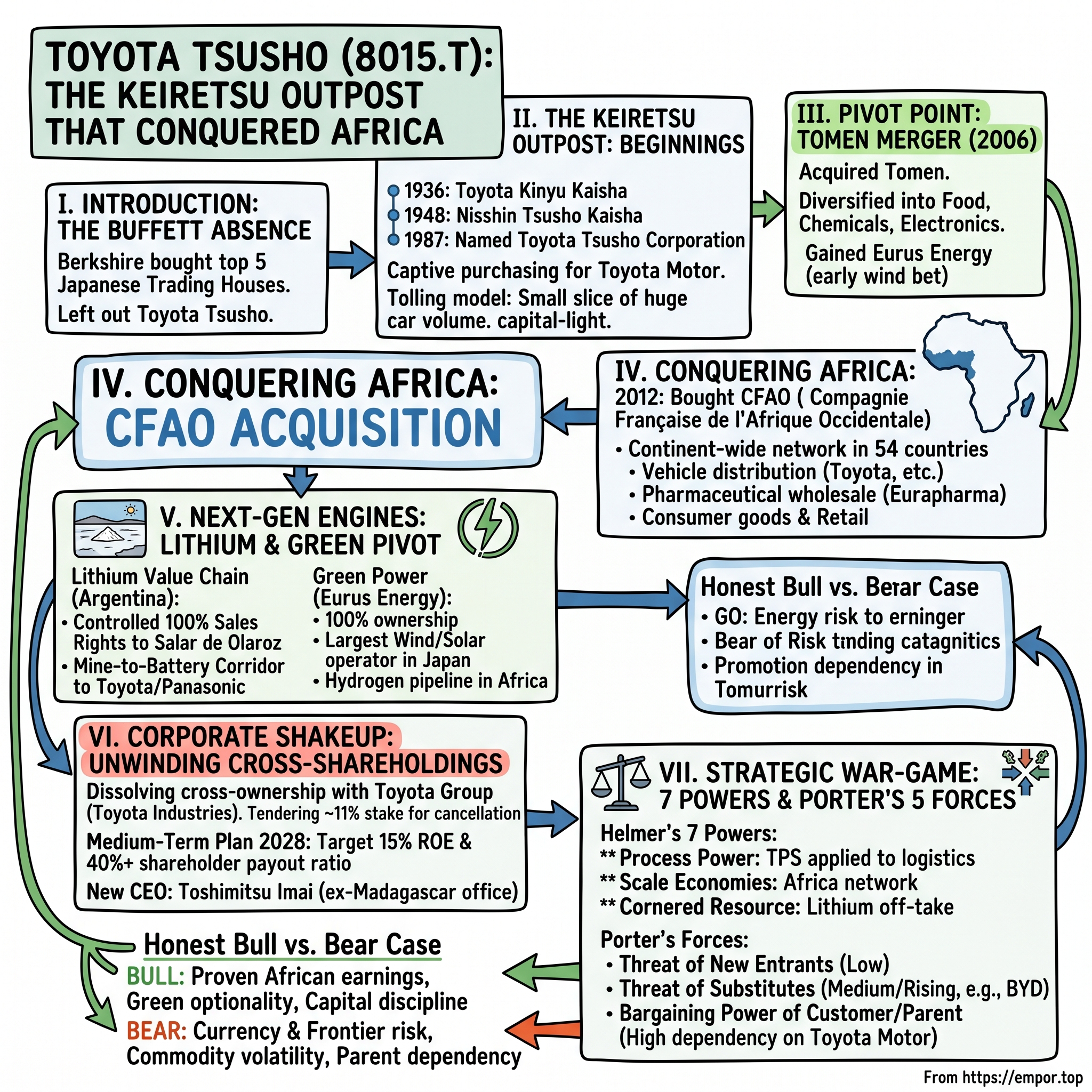
Toyota Tsusho: The Keiretsu Outpost That Conquered Africa
I. Introduction & Episode Roadmap
In late August 2020, on the morning of his ninetieth birthday, Warren Buffett let slip one of the most consequential foreign bets of his career. Berkshire Hathaway's insurance subsidiary, National Indemnity, had quietly accumulated slightly more than 5% of the shares of five Japanese trading houses — 三菱商事 Mitsubishi Corporation, 三井物産 Mitsui & Co., 伊藤忠商事 Itochu Corporation, 住友商事 Sumitomo Corporation, and 丸紅 Marubeni Corporation — after a year of patient buying on the Tokyo Stock Exchange.1 The positions were worth roughly $6.3 billion at the time, and Buffett said he was "confounded" by how cheap these sprawling conglomerates had become.1 By March 2025 he had lifted each stake toward 10%, and by that autumn the Japanese book had swelled past $30 billion.2
The 総合商社 sogo shosha — Japan's uniquely powerful "general trading companies" — are hard to describe to a Western investor. They are part commodity trader, part private-equity fund, part logistics operator, part venture capitalist. They finance, source, ship, and increasingly own slices of the physical economy, from liquefied natural gas fields to convenience-store chains. Buffett found in them exactly what he loves: durable cash flows, rising dividends, conservative balance sheets, and a price that ignored all of it.
But there was a conspicuous absence on his shopping list. Japan's sixth-largest trading house — 豊田通商株式会社 Toyota Tsusho Corporation, ticker 8015 on the JPX — never made the cut. This is the trading arm of the Toyota empire, a company that in the fiscal year ended March 2025 booked revenue above ¥10 trillion and profit attributable to owners of ¥362.5 billion.34 It is not small. It is not obscure. So why did the greatest capital allocator of the twentieth century walk right past it?
That question is the spine of this story. The easy answer is that Toyota Tsusho is a captive — a glorified purchasing department for the world's largest carmaker, too dependent on a single customer and a single cyclical end-market to qualify as the kind of independent, diversified compounder Buffett prizes. The more interesting answer is that hiding inside this "captive" is one of the most unusual corporate empires in the world: a company that completed one of the most successful Japanese acquisitions of the last two decades, cornered a strategic slice of the electric-vehicle battery supply chain, became Japan's largest renewable-power operator, and built a distribution network reaching all 54 countries of Africa that rivals cannot replicate at any price.
It is worth pausing on why Buffett's move mattered so much to Japan Inc. For years, the trading houses had been the market's unloved plumbing — sprawling, hard to model, trading below the accounting value of their own assets. When the Oracle of Omaha, of all people, declared them cheap and durable, he did something no domestic broker's "buy" rating could: he legitimized the entire sector for global capital. The Tokyo Stock Exchange's parallel campaign to shame companies trading below book value gave the re-rating a policy tailwind. Between 2020 and 2025, the shares of the five Berkshire holdings roughly tripled or better, and the whole peer group was dragged up in their wake. Toyota Tsusho rode that current too. So the puzzle sharpens: the market has been perfectly happy to own this company; it is Buffett specifically who abstained. Understanding his abstention is a way of x-raying exactly where Toyota Tsusho is strong and where it is structurally different from its more famous cousins.
This is the arc we will trace. First, the origins — how a post-war financing offshoot of a loom-maker turned into a trading house. Then the pivot: the 2006 merger with トーメン Tomen Corporation that broke Toyota Tsusho's near-total dependence on cars. Then the bold gamble on Africa through CFAO. Then the next-generation engines: the lithium value chain out of Argentina and the green-power platform of ユーラスエナジー Eurus Energy. Then the governance earthquake now reshaping the entire Toyota Group and the arrival of a new president who built his career in Madagascar. Finally, the strategic war-game — 7 Powers and Porter's Five Forces — and the honest bull-and-bear stress test that explains both why this company could win from here and what could break the case.
Throughout, the posture is neutral. Management says it will hit a 15% return on equity and monopolize African mobility. We will ask what evidence supports those claims and what would falsify them. The distinction matters because this is a company especially prone to two opposite errors. The first is dismissal — filing it away as "just Toyota's parts buyer" and missing that it has quietly built a business the market has never fully understood. The second is credulity — accepting the integrated-report narrative of unassailable monopolies and green-hydrogen destiny at face value, and mistaking a good, specialized, cyclical enterprise for a compounding machine. The goal of this story is to hold the middle ground: to give the company full credit for what it has genuinely built, while refusing to let strategic ambition substitute for evidence. Let's begin at the beginning.
 Subscribe on LinkedIn
II. The Keiretsu Outpost: Origins & Sogo Shosha Model
To understand Toyota Tsusho, you first have to understand the strange gravitational field it was born inside: the ケイレツ keiretsu. In the decades after the Second World War, Japanese industry reorganized itself into dense webs of interlocking companies — a carmaker, its parts suppliers, a trading house, a bank, a real-estate arm, a materials maker — each holding shares in the others, each preferring to buy from the others, all orbiting a central industrial nucleus. The Toyota group is the archetype. And Toyota Tsusho was engineered, quite literally, to be the group's hands and feet in the marketplace.
The lineage runs back to the loom. Sakichi Toyoda (豊田佐吉) built an automatic loom business that his son Kiichiro Toyoda (豊田喜一郎) would parlay into an automobile venture in the 1930s. The commercial plumbing that supported this expanding empire — the financing and trading functions — is what eventually crystallized into Toyota Tsusho. According to the company's own official history, the predecessor was established in 1936 as Toyota Kinyu Kaisha, a sales-financing company created to help customers buy Toyota vehicles.5 After the war, as the Allied occupation dissolved Japan's family-controlled 財閥 zaibatsu conglomerates and forced their trading operations to be broken up, the trading division was spun out in July 1948 as Nisshin Tsusho Kaisha, Ltd.5 It was renamed Toyoda Tsusho in 1956, and only in July 1987 did it adopt the name the market knows today, Toyota Tsusho Corporation.5 (The outline's shorthand — "renamed Toyota Tsusho in 1956" — compresses two separate renamings; the modern name is a 1987 event.)
For its first half-century, the job description was simple and unglamorous. Toyota Tsusho was the in-house trading arm of トヨタ自動車株式会社 Toyota Motor Corporation. It bought the steel, aluminum, and chemicals that flowed into Toyota's factories, and it sold the finished cars that flowed out — into dealer networks, onto ships, across borders. This is the classic sogo shosha function stripped to its essence: sit in the middle of a physical flow of goods, take a thin slice of every transaction, and make the money on volume rather than margin. A trading house is, in the crudest terms, a toll booth on the movement of stuff. The toll per car is tiny; the number of cars is enormous.
The elegance of the model is that it is capital-light relative to owning the factories, and it throws off information: a trader who touches every shipment of steel and every export of a sedan develops an almost unfair view of demand, pricing, and logistics bottlenecks across the whole value chain. It is worth dwelling on this because it is the single most misunderstood feature of a sogo shosha. The trading house does not, in the classic model, get rich on any one transaction. It gets rich on being indispensable to thousands of transactions, and on the proprietary knowledge that accrues to whoever sits at the crossroads. Think of it as owning the intersection rather than any of the cars passing through it. Over decades, that vantage point lets a trader spot arbitrage — a shortage here, a surplus there — and, increasingly, decide to stop merely brokering a commodity and start owning the mine, the plant, or the distributor that produces it. That evolution, from thin-margin broker to asset owner, is the arc every modern sogo shosha has traveled, and it is the arc that turns a low-return middleman into something with real returns on capital.
The weakness of the model is equally obvious, and it is the weakness that would define Toyota Tsusho's strategic anxiety for decades. When your single largest customer is your corporate parent, and that parent sells a cyclical durable good — automobiles — you inherit all of the cycle and almost none of the pricing power. Your margins are thin by construction. Your capital-deployment freedom is limited by the group's priorities. And your growth is capped, more or less, by how many cars Toyota can sell. Where Mitsubishi and Mitsui spent the post-war decades diversifying into energy, metals, and finance across the planet — building the multiple independent engines that would one day attract Buffett — Toyota Tsusho spent them deepening a single, loyal, and profoundly limiting relationship. By the turn of the millennium it was, by revenue, overwhelmingly an automotive company wearing a trading company's clothes. That concentration is precisely what management needed to break, and it is the reason the next chapter of this story is not about a triumph but about a rescue.
A middleman bolted to a single customer is not a business a value investor dreams about. It is a business that needs to escape its own origins. The story of the modern Toyota Tsusho is the story of that escape — and the first door out opened not through brilliance but through someone else's crisis.
III. The Pivot Point: The Tomen Merger and Diversification
By the mid-2000s, one of Japan's oldest trading houses was dying, and Toyota Tsusho was watching. トーメン Tomen Corporation had been founded in April 1920 as Toyo Menka Kaisha, spun out of the cotton-trading business of Mitsui & Co.6 For eight decades it had been a genuine sogo shosha in its own right — cotton and textiles first, then grain and foodstuffs, chemicals, agrochemicals, electronics, and, crucially, a pioneering global power-generation portfolio that included some of the earliest large-scale wind farms. But the collapse of Japan's asset-price bubble in the 1990s left the company staggering under debt, and it spent the decade in slow-motion restructuring, kept alive by lifelines rather than by strength.
Toyota Tsusho had already begun stepping in. It made a ¥7.5 billion private placement into Tomen in 2000, deepened the relationship in 2003 with additional capital alongside Toyota Motor, and finally completed a full merger on April 1, 2006.67 The combination vaulted Toyota Tsusho past Sojitz to become Japan's sixth-largest general trading company.7 But the ranking was the least interesting part. The strategic logic was that Toyota Tsusho, on the eve of the deal, was dangerously concentrated in automotive — the trading house was a car company's shadow, and when cars slowed, everything slowed. Tomen brought precisely the assets that a car-shadow lacked: food and agricultural supply chains, chemicals, electronics, and that early wind-power book that would, years later, become a crown jewel.
The wind portfolio deserves a special footnote here, because it is one of those acquired assets whose true value would only become visible fifteen years later. Tomen had entered the electricity business in 1986 and spun it into what became Eurus Energy — an early, almost eccentric bet on wind power made long before "renewables" was an investable theme.15 When Toyota Tsusho absorbed Tomen, it absorbed that seed. At the time, in 2006, it was a rounding error in the deal rationale. In hindsight, it was the option that would grow into Japan's largest renewable-power platform. This is a recurring pattern in the Toyota Tsusho story worth flagging early: the company's most valuable positions have often arrived as afterthoughts inside larger deals, and matured slowly while the market ignored them.
There is a temptation to narrate mergers as clean strategic chess. This one was not clean. Fusing the two cultures was genuinely hard. Tomen was an old-line trader with an entrepreneurial, deal-hungry, risk-embracing temperament — the culture of people who make money by taking positions and living with volatility. Toyota Tsusho carried the DNA of its parent: process discipline, 改善 kaizen, relentless standardization, a horror of waste, and a bias toward controlling risk rather than underwriting it. Bolting a swashbuckling trading floor onto a company steeped in the Toyota Production System is not a spreadsheet exercise; it is an organ transplant, with all the attendant risk of rejection. The skeptic's version of the story is that Toyota's caution would eventually smother Tomen's entrepreneurial spark, leaving a bigger but blander company. The optimist's version is that Toyota's discipline would channel Tomen's risk appetite into fewer, better, more carefully underwritten bets. The truth, as we will see, is somewhere in between — but the bets that followed were, if nothing else, ambitious.
What matters for the investment case is what the merger structurally enabled. Before Tomen, Toyota Tsusho generated cash almost entirely from the automotive cycle and had limited independent firepower for large, speculative, long-horizon bets. After Tomen, it had a genuinely diversified portfolio of cash flows — metals, chemicals, food, machinery, energy — that could keep generating profit even when global car production dipped. That diversification is the precondition for everything that follows in this story. A company cannot make a multi-billion-dollar contrarian bet on a continent, or build a lithium-conversion plant, or buy out a power utility, if all of its cash is hostage to one customer's production schedule. The Tomen deal is what turned Toyota Tsusho from a captive purchasing department into an entity with its own balance sheet ambitions.
There is a broader lesson here about how the best sogo shosha grow, and it reframes what "diversification" means for a trading house. For a manufacturer, diversification is often value-destroying — the dreaded "diworsification" of spreading management attention across unrelated businesses. For a trading house, diversification is closer to the core competence: the whole point of the model is to be a portfolio of positions across the physical economy, continuously rotating capital toward wherever returns are highest and away from wherever they have decayed. Seen that way, the Tomen merger was not Toyota Tsusho wandering off-strategy; it was Toyota Tsusho finally acquiring the raw material — a real portfolio — that the sogo shosha model needs to function. The interesting question, which the rest of this story tests, is whether Toyota Tsusho has actually rotated that capital well, or whether it has simply gotten bigger. On that score, the African bet is the first and clearest piece of evidence.
The proof of that thesis would come six years later, and it would come in one of the least fashionable places on the investing map: sub-Saharan Africa.
IV. Conquering the Last Frontier: The CFAO Acquisition and the African Empire
The company Toyota Tsusho set its sights on in 2012 was older than the automobile itself. In 1852, a French merchant named Charles-Auguste Verminck set up a trading operation on the West African coast, dealing in cocoa, peanuts, soap, and rubber; the business took the name Compagnie Française de l'Afrique Occidentale — CFAO — in 1887.8 It sold guns and cloth in the colonial era, pivoted to cars in 1913 (becoming the first dealer to distribute Ford's Model T in Africa), and after independence swung decisively toward Japanese automakers, becoming a major distributor for Toyota, Isuzu, and Subaru across Francophone West and Central Africa.8 By the twenty-first century, CFAO was a distribution conglomerate spanning vehicles, a large pharmaceutical wholesale arm (Eurapharma), consumer goods, and retail — with roots so deep in dozens of African economies that its depots, dealerships, and distribution licenses amounted to physical infrastructure that had taken a century and a half to lay down.
Toyota Tsusho moved in two acts. In August 2012 it acquired a 29.80% stake, then launched a voluntary public tender offer at €37.50 per share for the shares it did not already hold — a bid that valued CFAO at roughly €2 billion and lifted Toyota Tsusho's holding to about 97% by the end of that year.279 Then, in 2016, it squeezed out the residual minority, delisted CFAO from the Paris exchange, and took the business to full ownership, folding it into the group as the platform for its entire African strategy.8 By 2017, CFAO had effectively become Toyota Tsusho's Africa division.
It helps to understand just how much more than cars CFAO actually was, because the automotive label undersells the asset. Its pharmaceutical arm, Eurapharma — built up from a 1996 acquisition and later reinforced by the 2015 purchase of Missionpharma — made CFAO one of the largest importers and wholesale distributors of medicines across Francophone Africa, a business with its own web of import licenses, cold-chain logistics, and regulatory relationships that are extraordinarily hard for a newcomer to obtain.8 On the consumer side, CFAO had moved into manufacturing (a brewery, Brassivoire, launched in Côte d'Ivoire in 2017) and modern retail, developing PlaYce shopping centers and partnering with the French grocery giant Carrefour to roll out stores in African cities.8 In other words, Toyota Tsusho was not buying a car dealer. It was buying a diversified distribution utility for an entire region's rising consumer class — vehicles, medicine, beer, and groceries all moving through overlapping infrastructure. That breadth is the key to the scale economics we will return to in the strategic analysis: the more categories you push through the same trucks, depots, and relationships, the lower your cost per delivered item, and the harder you are to dislodge.
Did they overpay? At the time, the skeptics had a strong script. Africa in the mid-2010s meant currency volatility, commodity dependence, political risk, and thin, unpredictable consumer demand. Buying a low-margin distributor of cars and drugs in that environment looked, to many, like catching a falling knife with a French handle. But the bull's rebuttal was about replacement cost, not multiples. What Toyota Tsusho bought was not a quarter's earnings; it was a continent-wide physical and regulatory footprint — port operations, bonded warehouses, pharmaceutical import licenses, dealer relationships, and local staff — that a new entrant could not assemble from scratch for any amount of money in any reasonable timeframe. When the asset is the network itself, the relevant question is not "what is the EV/EBITDA multiple" but "what would it cost, and how many decades would it take, to build this again?" On that test, the price looks less like a premium and more like a discount to reality.
The strategic fit was almost suspiciously neat. In Toyota Tsusho's own telling, CFAO "primarily did business in northwest Africa" while Toyota Tsusho "primarily did business in southeast Africa," so the two "complemented each other geographically."11 Bolt them together and you get something no competitor possesses: contiguous, continent-wide coverage across all 54 African nations. This matters more than a map might suggest, because Africa is not one market but dozens of fragmented ones, split by language, currency, colonial-era legal systems, and customs regimes. A network that can move a product from a Mediterranean port to a landlocked capital, clearing borders and currencies along the way, is a genuinely rare piece of infrastructure — and it becomes more valuable, not less, as the continent's population and consumer base grow. The demographic backdrop is the whole reason the bet is interesting: Africa is the youngest and fastest-growing region on earth, and whoever controls the pipes through which cars, medicine, and consumer goods flow to that rising population owns a claim on decades of structural growth.
And then Toyota Tsusho did the very Toyota thing — it began applying the Toyota Production System, the lean logistics doctrine honed on factory floors in Aichi, to the messy realities of African supply chains, inventory management, and retail networks. The idea is to strip waste out of every step: less inventory sitting idle in a warehouse, fewer trucks running half-empty, faster turns of working capital. In a business where cash is trapped in goods-in-transit for weeks, shaving days off the cycle compounds into real returns. Whether TPS truly transfers to a Lagos pharmaceutical depot as cleanly as it does to a Toyota assembly line is a fair question, and one worth watching rather than assuming; a factory is a controlled environment, and a continent of potholed roads, unreliable power, and volatile customs officials is emphatically not. The claim that Toyota's operating genius travels to Africa is exactly the kind of management assertion an independent analyst should treat as a hypothesis to be tested against margins and inventory turns, not as an established fact.
Here is where the numbers force a re-rating of the whole thesis. In the fiscal year ended March 2024, the Africa segment was Toyota Tsusho's single most profitable division, contributing about ¥69.1 billion in profit — a figure that had leapt roughly 90% in a single year — and out-earning every other business, including the core domestic Metals segment at ¥60.7 billion and the Mobility (automotive) segment at ¥55.9 billion.10 Read that again. A company the market still files under "Toyota's captive parts trader" now makes more money in Africa than it does moving Toyota vehicles. That single fact is the strongest evidence in the entire story that Toyota Tsusho is something other than what its reputation says it is. The escape from the captive model did not just succeed; it produced the crown jewel.
But an independent analyst should be careful about what that number does and does not prove. A single year of segment leadership, especially one featuring a 90% jump, can flatter a business that is riding favorable conditions — a weak comparison base, strong commodity prices feeding into vehicle demand, or a temporary currency tailwind. The durable question is not "was Africa number one in one fiscal year" but "can Africa stay number one across a full cycle, including the years when African currencies devalue and consumer demand softens?" The pharmaceutical business offers some reassurance here, because medicine demand is far less cyclical than car demand — people buy their prescriptions in a recession — and the import licenses and cold-chain logistics behind Eurapharma are genuinely hard to replicate. But the vehicle side is exposed to exactly the boom-bust dynamics that make African markets treacherous. The bull reads the segment result as proof of a structural moat; the bear reads it as a good year in a volatile geography. Both are looking at the same number, and only time — several years of it — will settle which reading is right.
But a distribution empire, however defensible, is still exposed to the one force reshaping the global auto industry from underneath: electrification. And that is where Toyota Tsusho placed its second contrarian bet — not on a continent, but on a chemical.
V. Next-Gen Engines: The Lithium Moat and the Green Pivot
High in the Andes of Argentina's Jujuy Province, at an altitude where the air is thin and the sun is punishing, sits a salt flat called Salar de Olaroz. Beneath its crust lies brine rich in lithium — the "white oil" of the electric age. It is here, roughly 230 kilometers northwest of the provincial capital, that Toyota Tsusho placed a bet in 2012 that looks, in hindsight, like remarkable foresight for a company whose parent was famously cautious about pure battery-electric vehicles.11
The structure of the deal is where the strategy reveals itself. The Olaroz project is operated through a joint venture, Sales de Jujuy. The majority partner — originally the Australian miner Orocobre, which became Allkem, then Arcadium Lithium, and in March 2025 was swallowed whole by mining giant Rio Tinto in a $6.7 billion acquisition — holds the largest economic stake.12 Toyota Tsusho holds 25%, and JEMSE, the mining company owned by the Jujuy provincial government, holds 8.5%.11 Those percentages look modest. But Toyota Tsusho negotiated something far more valuable than equity: 100% of the sales rights to the lithium carbonate produced at Olaroz.11 In plain terms, it doesn't need to own most of the mine. It controls where the output goes.
To see why off-take rights can be worth more than equity, it helps to understand the physical journey of lithium. Brine is pumped from beneath the salt flat into a cascade of evaporation ponds, where the fierce Andean sun does the first stage of the work over many months, concentrating the lithium until it can be processed into lithium carbonate — a white powder that is the industry's basic tradeable form. Whoever holds the right to sell that carbonate controls where it flows, and therefore which battery makers get supplied and on what terms. In a world scrambling to secure battery materials, that is a position of real leverage, and Toyota Tsusho secured it for a fraction of the cost of owning the mine outright.
That off-take control is the setup for the real chess move, which happens back in Japan. In 2018, Toyota Tsusho established Toyotsu Lithium Corporation, and in November 2022 it completed a plant in Naraha, Fukushima Prefecture — the first facility in Japan to produce battery-grade lithium hydroxide, with capacity of around 10,000 tonnes per year.13 The plant is jointly held with the mine's majority owner, but Toyota Tsusho keeps the sales rights, so it captures value at both ends of the corridor.13 Here is the vertical-integration logic in layman's terms: the salt flat produces lithium carbonate, a raw chemical; the Fukushima plant refines it into lithium hydroxide, the higher-value form that the newest, energy-dense battery chemistries prefer. And the customer at the end of that chain is Prime Planet Energy & Solutions, the battery joint venture between Toyota Motor and パナソニック Panasonic, split 51/49.14 So Toyota Tsusho controls the flow from an Andean brine pond, through a Japanese refinery, into the batteries that will power its parent's electrified vehicles. It is a textbook mine-to-battery corridor, and it exists whether the future turns out to be hybrid, plug-in, or pure electric.
A note of discipline is warranted here, because this is exactly the kind of story that invites overstatement. To describe Toyota Tsusho as holding an "exclusive global monopoly" overstates what the primary documents actually claim. Toyota Tsusho holds the sales rights to Olaroz's output and runs a first-of-its-kind conversion plant — genuinely valuable, genuinely differentiated — but "cornered resource" is a description to test against reality, not a slogan. Consider the cycle it just lived through. Lithium prices exploded in 2021 and 2022 as the electric-vehicle boom outran supply, then collapsed through 2023 and 2024 as new mines came online and demand growth cooled, wiping out a large share of producers' margins. A company whose battery-materials profits swing with that pendulum does not own an annuity; it owns a call option on the electrification cycle, with all the volatility that implies. The durable edge, if there is one, sits in the logistics and the relationships — the off-take contracts, the only-one-in-Japan conversion capability, the tie to the Toyota-Panasonic battery venture — not in the metal, which the market prices with brutal indifference to who is selling it. It is a good position. It is not a moat around a river of gold.
There is a second-order risk worth flagging for the diligent investor: the mine's majority owner changed hands. When Rio Tinto absorbed Arcadium in early 2025, Toyota Tsusho's most important upstream partner became a mining supermajor with its own global lithium ambitions and its own view of how Olaroz should be run and expanded. That is not inherently bad — Rio Tinto brings deep pockets and technical muscle — but it does mean Toyota Tsusho now sits alongside a far larger partner whose priorities it does not set. Partnership dynamics with a supermajor are worth watching closely.
The second next-generation engine is greener and, arguably, more proven. ユーラスエナジー Eurus Energy Holdings began life in 1986 as the electricity-business arm of the old Tomen group — meaning it arrived, quietly, with the 2006 merger.15 For years it was co-owned with Tokyo Electric Power (TEPCO). Then, on August 1, 2022, Toyota Tsusho bought out TEPCO's remaining 40% for a reported $1.5 billion and took Eurus to 100% ownership.1617 The prize: a renewable-power platform that made the Toyota Tsusho group the largest wind-and-solar power operator in Japan, with more than 6 gigawatts of renewable capacity across 17 countries as of March 2026.18
Why does a trading house want to own power plants outright? Because Eurus is not a speculative green gesture; it is a profitable, cash-generating utility that also serves as a strategic hedge. As the world's energy logistics shift away from shipping barrels of oil and toward generating and moving electrons, a company whose historical toll booth sat on fossil-fuel flows needs a position on the other side of that transition. Owning renewable generation is also, in an important sense, the opposite kind of business from trading: it is capital-heavy and slow, but it produces long-dated, contracted, predictable cash flows — the closest thing a trading house has to a bond portfolio. That stability is valuable precisely because the rest of Toyota Tsusho is so cyclical; Eurus is ballast.
Eurus provides that ballast — and it forms the foundation for Toyota Tsusho's ambitions in green hydrogen, including in Africa, where abundant sun and wind could one day power the electrolysis of water into hydrogen for industry and transport. The logic is elegant: use the renewable platform to make clean power, use clean power to make green hydrogen, and use the African distribution network to move it. But elegance on a slide is not earnings in an income statement. Green hydrogen remains, worldwide, an expensive and largely pre-commercial technology, and whether Toyota Tsusho's version becomes a real profit engine or remains a glossy integrated-report rendering is a claim to watch across many years, not to bank today. The honest read is that Eurus is a proven, profitable asset with a speculative call option attached — and investors should value the proven part far more heavily than the option.
These forward bets — lithium and green power — are the growth story management wants investors to buy. But the most immediate re-rating catalyst has nothing to do with batteries or wind turbines. It is about who owns the shares, and it is happening right now.
VI. The Corporate Shakeup: Dissolving Cross-Shareholdings and the Imai Era
For most of Japanese corporate history, the cross-shareholding was sacred. Companies in a keiretsu held each other's stock not to earn returns but to cement loyalty, deter outsiders, and keep decision-making inside the family. Those stakes sat on balance sheets for decades, earning next to nothing, insulating management from the discipline of the market. In 2025 and 2026, that world began to come apart — and the Toyota Group's unwinding is one of the largest and most consequential examples anywhere.
The catalysts were two. First, the Tokyo Stock Exchange had spent years pressuring listed companies to stop trading below book value and to justify their capital structures, effectively naming and shaming firms whose shares traded for less than the accounting value of their net assets — a price-to-book ratio under one, which is the market's way of saying a company is worth less alive than broken up. For a nation of cash-hoarding, cross-holding conglomerates, this was a cultural earthquake, and it forced boards across corporate Japan to confront a question they had ducked for a generation: why are we holding tens of billions of yen in each other's shares, earning almost nothing, when we could return that capital to owners? Second, and reinforcing the first, the Toyota Group launched a sweeping campaign to dismantle its historical web of mutual ownership. The centerpiece was the roughly ¥4.7 trillion (about $33 billion) plan, led by Toyota Motor chairman 豊田章男 Akio Toyoda and Toyota Fudosan, to take 豊田自動織機 Toyota Industries Corporation private — a restructuring that included Toyota Industries resolving to tender its cross-held stakes in Toyota Motor, Denso, Aisin, and Toyota Tsusho into those companies' respective buyback offers.1920
For Toyota Tsusho, the concrete mechanics matter. Toyota Industries agreed to tender its entire holding — 118,095,502 shares, about 11.19% of Toyota Tsusho's outstanding stock — into a large repurchase tender offer, with the shares to be cancelled afterward.21 Toyota Tsusho tied the timing carefully: the buyback would commence only after the Toyota Industries privatization settled and after Toyota Tsusho disclosed its results for the year ending March 2026, scheduled for April 30, 2026, and the cap price was revised sharply upward over the process — from an initial ¥3,054 to ¥5,862 per share — as the broader Toyota Industries deal terms improved.21 The transaction effectively ends decades of defensive cross-ownership between the loom-maker that spawned the group and the trading house it helped create. Toyota Motor itself remains the anchor shareholder at roughly 21.69%, with the Master Trust Bank of Japan — a custodial nominee for index and institutional funds — the next largest holder at about 14%.22
The wider deal was not without controversy, and the controversy is instructive. The activist investor Elliott Management publicly opposed the terms of Toyota Fudosan's tender offer for Toyota Industries, arguing over price and governance — a reminder that even a "shareholder-friendly" unwind can be structured in ways that favor the controlling family over minority holders. For Toyota Tsusho investors, the episode is a useful lens: the same Toyota Group that is now returning capital and retiring shares is also the group that, for decades, used cross-shareholdings to insulate itself from exactly the kind of outside pressure Elliott represents. The unwind is genuinely good for Toyota Tsusho's per-share economics. But it is happening because the group decided it should, on the group's schedule and terms — not because independent shareholders forced it. That distinction is the crux of the governance debate we will return to in the bear case.
The financial logic is straightforward and, for once, genuinely shareholder-friendly. Retiring 11% of the share count mechanically lifts earnings per share and return on equity, and it signals a company willing to shrink its equity base rather than hoard idle capital. Management has attached numbers to the ambition. Its medium-term plan, "To the Next Dimension 2028," targets a return on equity of 15% or more and a total shareholder payout ratio — dividends plus buybacks — of 40% or more by the year ending March 2028, up from a prior floor of 30%.2324 For a company that earned an ROE of 12.8% in the year ended March 2025, closing the gap to 15% is a real stretch, not a rounding error, and it will require both the buyback math and continued operating momentum from Africa, metals, and green infrastructure.324
Presiding over this transition is a new president whose biography reads like a repudiation of the captive-subsidiary caricature. Toshimitsu Imai took office as president and CEO on April 1, 2025, succeeding Ichiro Kashitani.25 He had joined the company in April 1988 and, at the age of 25, was dispatched to run Toyota Tsusho's office in Madagascar — an island nation in the Indian Ocean that few Tokyo executives could find on a map, let alone volunteer to manage.26 His career then wound through the very markets that would become the company's crown jewel: in 2000 he was posted to a South African subsidiary, where he helped acquire vehicle-distribution businesses from the British conglomerate Lonrho, and he later served as CEO for the Europe region before taking the top job.26 By the company's own account he had a hand in seven M&A projects over his career.26 This is a leader whose instincts were forged in the 現場 gemba of difficult geographies — the very markets that now generate the company's fattest profits. There is a neat symbolism in it: the man who built his career selling Toyotas in Madagascar now runs the enterprise at the exact moment its African division has become its single largest profit center. But symbolism is not strategy. Whether that African pedigree translates into disciplined capital allocation for the whole enterprise — including the harder question of when to say no to the Toyota Group's pet projects — is the open question of his tenure, and it is the kind of question that can only be answered by watching what he does over several years, not by reading his biography.
Imai inherits, too, a modernized incentive structure. Both the annual bonus and the restricted-stock grants are weighted roughly 80% to consolidated profit attributable to owners, 10% to human-capital metrics such as employee engagement and the ratio of female managers, and 5% to greenhouse-gas emissions — an attempt, at least on paper, to align the executive suite with both financial returns and the group's decarbonization narrative.28 The credibility of that alignment will be judged, as always, by behavior over time rather than by the disclosure itself.
With the strategy, the assets, and the leadership on the table, it is time to war-game the whole enterprise — to ask, in the frameworks that serious investors use, where the durable advantages actually lie and where they are thinner than the brochure suggests.
VII. The Strategic Playbook: 7 Powers & Porter's 5 Forces
Strip away the narrative energy and put Toyota Tsusho on the analyst's operating table. It is worth first puncturing the reflexive consensus — the "myth" that this is simply Toyota's in-house parts buyer, a low-quality captive to be avoided. The reality is more nuanced: the company's most profitable division is a continent-wide African distribution business that has nothing to do with buying parts, and its fastest-growing optionality sits in battery materials and renewable power. But the opposite myth — the one management would prefer you believe, that Toyota Tsusho is a fortress of unassailable monopolies — is equally worth puncturing. The honest position is in between, and the way to find it is to be rigorous about what actually constitutes a durable advantage.
Hamilton Helmer's 7 Powers framework asks a single hard question of any business: what, specifically, prevents a competitor from replicating what you do and competing away your profits? Toyota Tsusho plausibly holds three of Helmer's seven powers — but each deserves scrutiny, not applause. Notably, it lacks several of the others. It has no meaningful network economies in the way a marketplace does; no branding power that lets it charge a premium (customers buy Toyotas, not "Toyota Tsusho"); no counter-positioning that incumbents cannot copy; and no switching costs of the software-like variety. Its powers are the old-economy, physical kind — the kind built from concrete, contracts, and accumulated operating know-how. That is not a weakness; some of the most durable moats in business are made of exactly those materials. But it does define the shape of the advantage.
The first is scale economies, and it lives in Africa. CFAO's distribution and logistics footprint across all 54 African countries — the depots, the pharmaceutical wholesale licenses through Eurapharma, the vehicle dealerships, the consumer-goods reach — creates cost efficiencies that a sub-scale competitor simply cannot match. When you can spread the fixed cost of a continent-wide network across vehicles, drugs, and consumer goods simultaneously, your cost per delivered unit falls below what any single-category entrant can achieve. The evidence that this power is real is the segment profit itself: Africa's position as the group's most profitable division is hard to explain without some genuine structural advantage.
The second is a cornered resource, though this is the power to treat most skeptically. The exclusive sales rights to Salar de Olaroz's lithium output, paired with Toyota Tsusho's role managing large parts of Toyota Motor's global parts supply chain, gives the company privileged access to flows that others cannot easily obtain. The caveat, already flagged, is that a cornered resource is only as valuable as the resource — and lithium's price volatility means this "corner" generates feast-or-famine economics rather than a smooth annuity.
The third, and perhaps most underrated, is process power — the accumulated, hard-to-copy organizational capability that comes from applying the Toyota Production System to trading and logistics. A traditional trading house is a working-capital hog: it finances inventory, carries it, and bleeds cash while goods sit in transit. To the extent Toyota Tsusho can run its physical networks with TPS-grade velocity and low inventory, it converts a capital-heavy business into a leaner, higher-turnover cash generator. This is a capability rivals cannot buy off a shelf; it is embedded in decades of institutional practice, in the muscle memory of thousands of employees trained in the same doctrine. Helmer's insight about process power is that it is slow to build and therefore slow to copy — a competitor cannot simply hire a consultant and replicate twenty years of continuous improvement. The honest caveat is that process power is the hardest of the three to measure from the outside, and management assertions about lean logistics deserve to be checked against actual working-capital and return metrics over time. If Toyota Tsusho's return on capital does not visibly exceed that of a comparable non-Toyota distributor, then the "process power" claim is more branding than substance — and that is a test the analyst can actually run.
What Toyota Tsusho conspicuously does not have, in Helmer's schema, is pricing power of the kind that lets a company raise prices without losing customers. Trading and distribution are, at their core, competitive, thin-margin activities; the company makes its returns on volume, velocity, and privileged access, not on the ability to charge a premium. This is the mathematical reality behind the whole enterprise, and it is why the African distribution business — where scale and network genuinely do confer some pricing latitude — stands out as unusual within the portfolio. It is also why the company's aspiration to a 15% return on equity is genuinely demanding: you do not reach mid-teens returns in a low-margin business without either significant leverage, exceptional capital velocity, or a few genuinely advantaged niches doing the heavy lifting.
Now the defensive view — Porter's Five Forces, the war-game of industry structure. The threat of new entrants is genuinely low: the ports, bonded warehouses, dealer networks, and regulatory licenses required to operate a global physical trading network are enormously capital-intensive and, in Africa especially, take generations to assemble. The bargaining power of suppliers presents an unusual case, because Toyota Tsusho's most important supplier and customer is the same entity — Toyota Motor, holder of that ~21.69% stake, which dictates product allocations and sits at the center of the group. That relationship is symbiotic, but it is also a dependency, and dependency cuts both ways. The threat of substitutes is medium and rising: direct-to-consumer digital sales channels and aggressive new entrants like 比亚迪 BYD, which has been pushing electric vehicles into emerging markets including Africa, could erode the traditional Japanese-brand dealer franchise that underpins much of the mobility business. And competitive rivalry among the sogo shosha is ferocious — Mitsubishi, Mitsui, Itochu, and the rest are formidable, well-capitalized, and diversified. Toyota Tsusho's answer has been not to fight them head-on across every commodity but to carve out uncontested ground: African mobility and distribution, and deep integration with the Toyota manufacturing ecosystem, where the other five have little presence.
There is one more force worth weighing that Porter's original framework underplays for a company like this: the power of the customer that is also the parent. Toyota Motor is not merely a large buyer; it is the strategic center of gravity for the whole group, and Toyota Tsusho's privileged role in managing parts of its global parts-and-logistics chain is both a source of stable, recurring business and a source of dependence. If Toyota Motor thrives, Toyota Tsusho gets a reliable, high-volume anchor customer that no rival trading house can pry away. If Toyota Motor stumbles — through a botched EV transition, a quality crisis, or a loss of share to Chinese entrants — Toyota Tsusho absorbs the shock with limited ability to diversify away from it. This single relationship is simultaneously the company's most reliable asset and its most concentrated risk, and any serious analysis has to hold both truths at once.
The synthesis is this. Toyota Tsusho's moat is narrower than a Mitsubishi's but, where it exists, it is arguably deeper and less contested. It has chosen specialization over breadth — Africa, mobility, and green metals and power — rather than trying to own a piece of everything. A generalist conglomerate spreads its risk but dilutes its edge; a specialist concentrates its risk but sharpens it. Toyota Tsusho has bet on the specialist path, and the bet only pays if its chosen niches — African distribution, the mobility supply chain, battery materials, renewable power — prove both defensible and growing. That choice is the crux of the investment debate, and it is exactly why the smartest investor in the world left it off his list.
VIII. The Skeptic's Stress Test: Why Buffett Missed Out & The Bull vs. Bear Case
Return to the opening puzzle. Why did Warren Buffett buy the other five and leave this one alone? The most persuasive explanation is diversification — or rather, its absence. Mitsubishi and Mitsui are spread across global mining, natural gas, financial services, and even convenience-store retail, giving them multiple independent engines and enormous, relatively steady cash flows. Toyota Tsusho, for all its African success, remains structurally leveraged to the global automotive cycle in a way its larger peers are not. When Buffett spoke of being attracted to the trading houses' dividend growth and durability, he was describing companies whose diversification smooths the ride; Toyota Tsusho's ride is bumpier by construction.
There is a second, subtler reason that fits Buffett's philosophy precisely. He prizes businesses with independent capital-allocation freedom — management teams that answer to shareholders and can redeploy cash wherever returns are highest. Toyota Tsusho is, ultimately, bound to the strategy of the broader Toyota Group. Its parent has historically been more cautious about pure battery-electric vehicles than global rivals, betting instead on a portfolio of hybrids, hydrogen, and plug-ins. A minority shareholder in Toyota Tsusho is, to some degree, a passenger in a vehicle steered by Toyota Motor's priorities — and Buffett has spent a lifetime avoiding the back seat.
So what is the honest bull case — the "why win" argument, tested rather than assumed? It rests on three pillars. First, Africa: a genuinely profitable, deeply entrenched distribution position in the world's fastest-growing demographic region, where the network is the moat and the segment profit is already the group's largest. The evidence for this pillar is the strongest in the whole case, because it is not a forecast — it is a realized result, showing up in audited segment profit that has already overtaken the domestic core. Second, the green and battery infrastructure: the lithium corridor and Eurus give the company positions that pay off across multiple possible energy futures, hedging the very BEV-versus-hybrid uncertainty that clouds its parent. This pillar is more speculative — it is optionality, not yet a proven earnings engine — but it is the kind of optionality that costs little to hold and could matter enormously if the electrification transition accelerates. Third, capital discipline: the cross-shareholding unwind, the 11% share retirement, and the shift to a 15% ROE ambition with a 40%-plus payout constitute exactly the kind of shareholder-friendly re-rating story that has driven the wider Japanese trading-house re-rating Buffett rode. The question here is whether management sustains the discipline once the easy, one-time buyback boost is behind it and the cycle turns.
The bull would add a fourth, subtler point: Toyota Tsusho does something none of the other five trading houses can. Its integration with the Toyota manufacturing ecosystem — the parts logistics, the battery-materials corridor, the vehicle distribution — gives it an anchor of recurring, embedded business that a Mitsubishi or Mitsui, for all their diversification, simply do not have. In a downturn, a diversified generalist has more places to hide; but in a steady state, an integrated specialist has a customer relationship that is almost impossible to compete away. The bull's wager is that this embeddedness, plus Africa, plus the green optionality, adds up to a re-rating the market has only partly priced.
The bear case is equally concrete, and an activist short-seller would press on three pressure points. First, currency and frontier risk: the African earnings that make this company special are denominated in currencies — the Nigerian naira, the Egyptian pound, and others — that have suffered sharp devaluations, and translated back into a strong yen, real operating gains can evaporate on the currency line. This is not a hypothetical. Both the naira and the pound have lost enormous ground against hard currencies in recent years, and a distributor that sells locally but reports in yen is structurally exposed to exactly that translation. A monopoly that earns in a melting currency is worth less than the profit statement suggests, and the bear would argue that a chunk of the celebrated Africa segment profit is a bet on currencies that have historically only gone one way. Second, commodity volatility: the lithium thesis is only as good as lithium prices, which collapsed after their 2022 peak and could stay depressed for years, turning a "cornered resource" into a low-return capital sink — and the same commodity exposure runs through the metals business, tying a meaningful share of profit to price cycles Toyota Tsusho does not control. Third — and this is the governance heart of the matter — minority shareholders remain vulnerable to a controlling group whose capital-allocation decisions may favor parent initiatives over the appreciation of Toyota Tsusho's own equity. The very cross-shareholding unwind now being celebrated is a reminder of how much power the Toyota Group holds over this company's structure; the buyback is happening on the group's timeline and terms, not at the behest of independent shareholders.
There is a fourth pressure point that ties the others together: the automotive cycle itself, and the specific danger of Chinese competition. Much of Toyota Tsusho's business — vehicle distribution in Africa, parts logistics, the battery corridor — ultimately rides on Toyota-branded vehicles winning in the market. But BYD and other Chinese manufacturers are pushing aggressively and cheaply into exactly the emerging markets where Toyota Tsusho is strongest, offering electric vehicles at price points that could undercut the Japanese dealer franchise model. If African and Asian consumers migrate to Chinese EVs sold through new channels, the "distribution moat" could find itself moving a shrinking product. The bear's sharpest question is therefore not about any single asset but about the whole thesis: what happens to a mobility-and-distribution specialist if the specific vehicles it distributes start losing? Management's answer — that its network is brand-agnostic and can distribute whatever sells — is plausible but unproven, and it is precisely the kind of claim that deserves to be tested against market-share data over the coming years rather than accepted on faith.
The activist would also note the portfolio complexity and the related-party density. Toyota Motor is simultaneously the largest shareholder, a major customer, a key supplier, and the strategic parent — a concentration of roles that would set off alarms in most governance frameworks. Management's answer is that the relationship is symbiotic and that the new incentive structures align executives with financial returns. That may be true. But "trust the alignment" is a claim, and the burden of proof sits with behavior over the next several years: Will the ROE target be hit or quietly abandoned? Will the payout ratio hold when the cycle turns down? Will African earnings survive the next currency crisis? Those are the questions that separate the bull's story from the bear's, and they are testable.
On the question of management credibility, the record so far is encouraging but young. Toyota Tsusho has, over two decades, done what it said it would do in the broad strokes: it integrated Tomen and diversified; it bought CFAO and made Africa a genuine profit center rather than a vanity project; it raised its shareholder-return commitment from a 30% floor to 40%-plus and backed it with an actual, structural buyback rather than vague promises. That is a narrative that has stayed reasonably consistent across filings and has been matched by action — the strongest evidence of credibility there is. The caution is that the hardest tests lie ahead and under a brand-new CEO. Raising a payout ratio in good times is easy; defending it through a downturn is where discipline is proven. Setting a 15% ROE target is easy; explaining honestly why you fell short, if you do, is where credibility is either built or destroyed. The company has earned the benefit of the doubt on execution. It has not yet been tested on candor in adversity, and that is the thing a careful investor will watch most closely.
Which brings us to the handful of metrics that will actually settle the argument.
IX. Key KPIs to Track
For all the moving parts — 54 African countries, an Andean salt flat, a Fukushima refinery, six gigawatts of wind and solar, a multi-trillion-yen cross-shareholding unwind — the case for or against Toyota Tsusho will ultimately be decided by a small number of trackable indicators. Three stand out.
The first is the Africa segment's profit growth and margin, read against local currency moves. Africa is the crown jewel and the single best test of whether Toyota Tsusho is a specialist compounder or a lucky cyclical. The question to watch is whether the high-value CFAO retail and pharmaceutical businesses can keep expanding profit faster than the region's chronic currency devaluations erode it. If segment profit keeps climbing in yen terms despite naira and pound weakness, the moat is real. If a currency crisis wipes out a year of gains, the bear's thesis is validated.
The second is consolidated ROE against the 15% ambition. This is the cleanest scorecard for management credibility and capital discipline in one number. With ROE at 12.8% in the year ended March 2025, the path to 15% depends on both the mechanical lift from the buyback and continued operating strength.3 The two levers are worth separating in your own tracking, because they say different things. The buyback lifts ROE by shrinking the denominator — equity — and that is a one-time, financial-engineering gain that tells you little about the underlying business. Genuine, durable ROE improvement has to come from the numerator: higher profit on the capital that remains. If Toyota Tsusho reaches 15% mostly by retiring shares, the quality of that achievement is lower than if it reaches it by growing African and materials profit. Watch not just the level but the honesty around it: does management hold the target, explain any shortfall specifically, and sustain the 40%-plus payout when earnings soften? Guidance discipline through a downturn tells you more than any integrated-report slogan.
The third is lithium off-take volume and downstream yield at Toyotsu Lithium. This is the leading indicator for whether the battery-materials bet becomes a real profit engine or stays a strategic curiosity. The specific things to monitor are whether the Olaroz expansion stages actually deliver rising carbonate volumes, and whether the Naraha plant converts them into profitable lithium-hydroxide shipments rather than running below capacity in a weak-price environment. Volume plus yield, not press releases, is what will tell you if the mine-to-battery corridor is earning its capital.
Three numbers, three theses. Together they will reveal, over the next several years, whether the market's long-standing discount to Toyota Tsusho was wisdom or oversight.
X. Outro & Episode Wrap-up
Step back from the detail and the shape of the thing becomes clear. Toyota Tsusho began as the most captive of captives — a financing offshoot built to help people buy Toyota cars, spun into a trading arm whose entire reason for existing was to serve one customer. It could have remained exactly that: a low-margin toll booth, forever hostage to someone else's production schedule, precisely the sort of business a great investor scrolls past without a second glance.
Instead, over two decades, it did something rare. It used a rival's crisis to diversify, then deployed that diversified cash into places and problems most competitors found too hard: a continent everyone else priced for failure, a battery-materials chain that required patience through brutal commodity cycles, a power business that demanded conviction about the energy transition. The result is not a generalist conglomerate that owns a little of everything, but a specialist that has turned "difficult" — difficult geographies, difficult supply chains, difficult chemistry — into some of the most defensible positions it holds.
The lesson for investors is not that Toyota Tsusho is a sure thing; it plainly is not, and the bear's currency, commodity, and governance objections are real and unresolved. The lesson is subtler. In a market that rewards easy diversification and punishes concentration, deep vertical specialization — mobility plus Africa plus green materials — can build a moat that even the most diversified giants cannot cross, precisely because they were never willing to do the hard, unglamorous work of laying the network down. Warren Buffett left this one off his list, and his reasoning was sound for what he wanted. But the company he passed over is not the captive its reputation suggests. It is a specialist that went where the giants would not, and the market is only now beginning to ask what that is worth.
References
-
Berkshire Hathaway Inc. Form 8-K — U.S. Securities and Exchange Commission, 2020-08-31 ↩↩
-
Buffett hikes stakes in five Japanese trading houses to almost 10% each — CNBC, 2025-03-17 ↩
-
Toyota Tsusho FY2025 Full-Year Financial Results — Toyota Tsusho / Quartr summary, 2025 ↩↩↩
-
Financial results for Fiscal year ended March 31, 2025 — Toyota Tsusho Corporation, 2025-04-28 ↩
-
Toyota Tsusho, Tomen to merge — The Japan Times, 2005-10-29 ↩↩
-
Toyota Tsusho Offers €1.62 Billion to Buy Rest of CFAO — Bloomberg, 2012-08-28 ↩
-
Financial Section 2024 — Segment Information, Fiscal year ended March 31, 2024 — Toyota Tsusho Corporation ↩
-
Supporting Electrified Vehicles with Stable Supplies of Lithium — Toyota Tsusho Corporation ↩↩↩↩
-
Rio Tinto completes acquisition of Arcadium Lithium — Rio Tinto, 2025-03-06 ↩
-
Lithium Hydroxide Production and Toyotsu Lithium Corporation — Toyota Tsusho Corporation ↩↩
-
Orocobre Limited — Major new MOU signed with Prime Planet Energy & Solutions, Inc. — GlobeNewswire, 2020-08-28 ↩
-
Toyota Tsusho Completes Stock Acquisition and 100% Ownership of Eurus Energy Holdings — Toyota Tsusho Corporation, 2022-08-01 ↩
-
Toyota Arm Buys Rest of Renewables Firm for $1.5 Billion — Bloomberg, 2022-05-26 ↩
-
Environmental Business — Sustainability — Toyota Tsusho Corporation ↩
-
Toyota Group to Accelerate Collaboration Through Privatization of Toyota Industries Corporation — Toyota Motor Corporation Global Newsroom, 2025 ↩
-
Toyota Industries to Unwind Major Cross-Shareholdings in Toyota Group — TipRanks, 2025 ↩
-
Toyota Tsusho Ties Share Buyback Tender to Toyota Industries Offer and FY2026 Results — TipRanks, 2025 ↩↩
-
Stock Overview / Major Shareholders — Toyota Tsusho Corporation ↩
-
Medium-Term Management Plan "To the Next Dimension 2028" — Toyota Tsusho Corporation ↩
-
Toyota Tsusho raises dividend payout ratio to at least 40% on solid earnings — Reuters / Yahoo Finance, 2025 ↩↩
-
Toyota Tsusho Announces Leadership Changes to Foster New Growth — Toyota Tsusho Corporation, 2025-01-31 ↩
-
Message from the President & CEO / CEO Message — Toyota Tsusho Integrated Report ↩↩↩
-
Case COMP/M.6718 — Toyota Tsusho Corporation / CFAO, Merger Decision — European Commission, 2012 ↩
-
Corporate Governance — Executive Compensation Disclosure — Toyota Tsusho Corporation ↩
 LinkedIn
 WhatsApp
 Reddit
 Hacker News
 Email
Email Kindle
 RSS Feed
 Spotify
 Apple Podcasts
 Amazon Music
 Audible
 YouTube