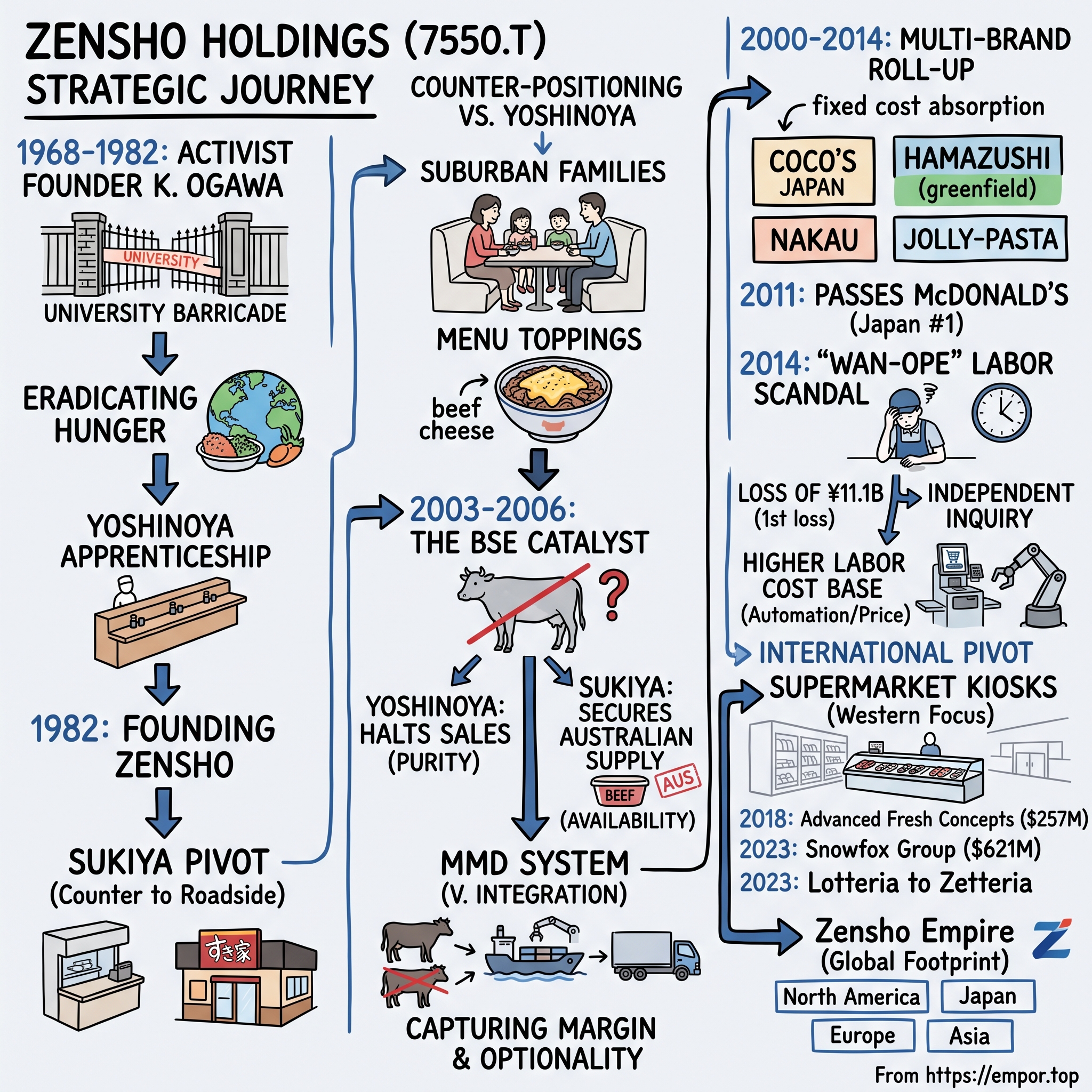
Zensho Holdings: The Empire That Conquered Global Food Service
I. Introduction & Episode Roadmap (0:00 – 0:10 | 10 mins)
On the morning of April 7, 2026, a two-page notice went out from the Tokyo headquarters of 株式会社ゼンショーホールディングス Zensho Holdings Co., Ltd. (7550.T, listed on the Prime Market of the 東京証券取引所 Tokyo Stock Exchange). It was written in the flat, procedural Japanese of a timely-disclosure filing: the company's Representative Director and Chairman, 小川賢太郎 Kentaro Ogawa, had died the previous day, April 6, 2026, at the age of 77. Ogawa was born in 石川県 Ishikawa Prefecture on July 29, 1948, and founded 株式会社ゼンショー Zensho in 1982. At the time of his death, he held 500,000 shares. The filing noted that his funeral would be private, with flowers, gifts, condolence money, and telegrams respectfully declined.1
It was a notably brief document for a man who had built the largest restaurant company in Japan and one of the ten largest in the world. The cause of death was reported as myocardial infarction.2 Fifty-five years earlier, Ogawa had been a University of Tokyo dropout loading equipment onto ships in Yokohama harbor, attempting to organize dockworkers into a political force.3
That trajectory—from student radical to shipyard laborer to founder of an enterprise operating roughly 15,000 restaurants across seven global regions—makes Zensho worthy of deep analysis. Yet the narrative arc alone is not the investment case. The core thesis centers on an operational system Ogawa spent four decades constructing: MMD, or the マス・マーチャンダイジング・システム Mass Merchandising System. MMD aims to control every link in the supply chain from cattle ranches and fishing vessels through processing plants, cold-chain logistics, and distribution centers, down to the moment a bowl of 牛丼 gyudon reaches a counter in suburban Yokohama or a tray of California rolls is purchased at a Kroger in Ohio.4
Zensho surpassed ¥1 trillion in consolidated net sales in the fiscal year ended March 2025, becoming the first Japanese restaurant company to do so.5 In the fiscal year ended March 2026, net sales rose 11.2% to ¥1.264 trillion, while operating profit reached ¥81.4 billion.67 On the surface, those top-line figures present a picture of steady compounding.
Beneath the headline numbers, however, the same fiscal year revealed deep operational stress: a 62% drop in operating profit at the flagship すき家 Sukiya chain, a food-safety scandal that forced the four-day closure of nearly 2,000 restaurants, a net reduction of 472 stores group-wide, a ¥50 billion issuance of non-voting preferred equity, and the death of the founder who had personally authored its operating philosophy.781 Return on invested capital stood at 8.4% against a weighted average cost of capital of 7.2%—a spread of 1.2 percentage points, narrower than in the prior year.6
The central question is not simply whether vertical integration works. It is more fundamental: what happens to a founder-designed operating system when the founder is gone, when the input costs it was engineered to absorb continue to rise, and when the company's geographic center of gravity has shifted from Japan to North America?
This analysis traces that trajectory in order: the radical founder's blueprint and the birth of Zensho; the suburban counter-positioning that set Sukiya apart from 吉野家 Yoshinoya; the 2003–2006 BSE mad-cow crisis, which drove the single largest transfer of market share in Japanese fast-food history and illustrated the core purpose of MMD; the subsequent M&A roll-up decade; the 2014 ワンオペ ("wan-ope") labor scandal that caused the company's first annual loss; and the international pivot marked by the $257 million acquisition of Advanced Fresh Concepts and the $621 million purchase of Snowfox Group. Finally, it examines the underlying metrics, executive succession, competitive positioning against Sushiro and Yoshinoya, the primary bear cases, and the key indicators that reveal whether the model is performing.
Start where Ogawa started: with a young man who had concluded that politics could not feed anyone.
 Subscribe on LinkedIn
II. The Activist's Blueprint: Kentaro Ogawa & The Birth of Zensho (1968–1982) (0:10 – 0:25 | 15 mins)
The University of Tokyo in the late 1960s was not a place where traditional academic life prevailed. The 全共闘 Zenkyoto movement—the All-Campus Joint Struggle Committees—had barricaded lecture halls, occupied Yasuda Auditorium, and turned Japan's premier university into a battleground between student activists and riot police. Kentaro Ogawa was deeply embedded in the unrest as an anti-establishment student demonstrator at the country's top institution.3
In 1971, Ogawa dropped out. Rather than joining a trading house or government ministry—the conventional path for a University of Tokyo student—he moved to the Yokohama docks to load equipment onto ships, aiming to organize port workers into a labor force.3 Where such a sharp detour often marks the end of an executive trajectory, for Ogawa it reshaped his operational worldview.
The Epiphany: Ideology Cannot Feed People
According to his later accounts, the aftermath of the Vietnam War fundamentally altered his thinking. Ogawa concluded that eliminating hunger and poverty would not be achieved through political ideology or state intervention, but through capital allocation and distribution systems. Abandoning revolutionary politics, he identified private enterprise as the most effective vehicle to achieve broad-scale food delivery.3
This rationale was directly integrated into Zensho's corporate mandate. Ogawa defined the company's core purpose as "eradicating hunger and poverty from the world," positioning the food-service industry as the primary mechanism to achieve it.4 While many corporate mission statements serve primarily decorative roles, Zensho's mandate functioned as an operational blueprint, explaining why a company selling ¥500 beef bowls built an infrastructure of processing plants, agricultural assets, fishing quotas, and cold-chain distribution centers. Providing affordable, safe calories at scale required building supply infrastructure rather than relying solely on brand marketing.
An independent analysis suggests a more pragmatic interpretation: an expansive corporate mission also provided a flexible mandate, framing broad operational expansion and subsequent acquisitions as philosophically aligned initiatives. This framework proved advantageous during Zensho's growth, though it later proved occasionally expensive.
The Yoshinoya Apprenticeship, 1978–1982
To master food-service operations, Ogawa joined 吉野家 Yoshinoya in 1978, then the dominant chain in Japan's gyudon sector with origins dating back to a stall in Tokyo's fish market in 1899.3 He spent four years analyzing store operations, corporate planning, and the fast-service mechanics of a model capable of delivering a hot bowl of beef and rice in under a minute.
In 1980, Yoshinoya filed for bankruptcy after rapid, debt-funded expansion coincided with cost-driven compromises on ingredient quality that eroded the core product. For an executive focused on operational design, Yoshinoya's collapse demonstrated that in low-margin food retail, growth financed by leverage and paid for by quality compromises unit economics and leads to failure.
This experience established two central operating principles for Ogawa. First, securing direct control over input costs was essential to protect operating margins. Second, store-level unit economics could not be subordinated to the ambitions of an expansion plan.
Founding Zensho, June 1982
Ogawa left Yoshinoya and incorporated Zensho on June 7, 1982, capitalized with ¥5 million and headquartered in the 鶴見区 Tsurumi ward of Yokohama.3 The name Zensho reflected a threefold linguistic play: 全勝 (zensho), meaning "complete victory"; 善商 (zensho), meaning "virtuous commerce"; and a reference to Zen philosophy, combining corporate ambition, ethical trade, and operational discipline.
Zensho's initial format was unsuccessful. In July 1982, one month after incorporation, the company opened a bento boxed-lunch shop, the 生麦 Namamugi store.9 Although bento offered low capital requirements and fast cash generation, the operational model proved inefficient.
Four months later, in November 1982, Ogawa opened the first Sukiya as an in-building counter location in the same corner of Yokohama.9 Shifting from bento boxes to gyudon reflected an operational pivot toward standardized production. Unlike a bento box requiring multiple distinct assembly steps, gyudon relied on a single continuous process: simmer beef and onions in a sweet soy broth, ladle it over rice, and hand it across a counter. Ogawa structured the store as a single-SKU factory line, drawing directly on his shipyard background and Yoshinoya training.
Zensho's primary expansion vehicle—the standalone suburban restaurant format—did not arrive until July 1987 in Mito, Ibaraki.9 The five-year gap between the initial urban counter and the first roadside store illustrates that Zensho's ultimate market positioning emerged through iterative operational testing rather than an immediate master plan.
III. Suburban Counter-Positioning & The "Gyudon Wars" (1982–2003) (0:25 – 0:40 | 15 mins)
In 1990, the archetypal Yoshinoya store operated near central Tokyo train stations. Featuring a horseshoe counter, orange-and-black signage, and no table seating, it served rows of time-pressed salarymen who dined individually in minutes. With a menu focused almost exclusively on a single item, store economics depended on rapid seat turnover in high-rent urban locations—a highly optimized system designed for a narrow demographic.
Kentaro Ogawa recognized that limitation and adopted a strategy of counter-positioning, building a business model that the dominant incumbent could not replicate without damaging its own core operations.
Building for the People Yoshinoya Ignored
Sukiya targeted suburban locations, securing roadside properties with dedicated parking, brighter interiors, extended operating hours, and booth or table seating rather than counters. Ogawa expanded the menu to appeal beyond solitary male diners to families, women, students, and groups.
Menu diversification proved to be a key strategic lever. Sukiya introduced toppings to the traditional beef bowl, including cheese, grated daikon, kimchi, and raw egg, culminating in its signature three-cheese gyudon.10 For traditionalists in the mid-1990s, adding toppings altered a classic dish; strategically, it accomplished three distinct objectives: it raised the average check without increasing the base price, gave consumers a reason to visit multiple times a week, and reduced the dish's dependence on the precise visual and flavor characteristics of raw beef cuts—a factor that gained immense importance a decade later.
Yoshinoya was constrained from responding directly. Its brand equity rested on speed, simplicity, and product purity: a single core dish served rapidly in compact urban storefronts. Introducing complex toppings threatened to dilute its core customer proposition, while expanding into suburban roadside locations would have stranded its existing urban cost structure. As a result, Yoshinoya's rational strategic response was to preserve its core model rather than match Sukiya's suburban footprint.
The Deflation Decade
During Japan's decade of economic stagnation in the 1990s, the gyudon sector devolved into a severe price war among Sukiya, Yoshinoya, and 松屋フーズ Matsuya Foods Co., Ltd. Base prices dropped from the ¥400 range down toward ¥280 at the trough of the cycle. In a commodity fast-food market with negligible consumer switching costs, price cuts offered only temporary volume surges before competitors matched them, leaving all operators with compressed operating margins.
Sustained profitability required achieving a structurally lower cost position—specifically, a lower landed cost per bowl.
A gyudon chain's profitability is highly sensitive to ingredient costs. For a beef bowl priced at ¥300, food costs typically absorbed ¥90 to ¥110, with imported short-plate beef representing the vast majority of that expense. Because store-level rent, labor, and utilities were largely fixed per operating day, a single-percentage-point change in the landed cost of beef moved operating profit by a margin far larger than typical gains from marketing or menu adjustments. Consequently, procurement operated as the primary driver of the profit and loss statement.
MMD Version 1.0
To address input-cost volatility, Ogawa converted his operational observations at Yoshinoya into a formal integration strategy. Japanese restaurant chains traditionally procured imported beef through 商社 sogo shosha (general trading houses) that managed international sourcing, financing, logistics, and currency hedging in exchange for a margin. Zensho bypassed these intermediaries, contracting directly with North American cattle ranches and beef processors while establishing its own processing, inspection, and distribution infrastructure.11
By 2011, Forbes reported that approximately 80% of Zensho's raw ingredients were traceable to its own facilities or audited partner plants, supported by a network of group-owned processing factories, distribution centers, inspection facilities, and farms.11 While prevailing management trends in the 1990s favored outsourcing non-core functions, Zensho systematically internalized its supply chain. Ogawa rejected direct competitor benchmarking, explaining to Forbes that copying rivals rendered a company indistinguishable: "only by being the one and only Zensho, the one and only Kentaro Ogawa, do you have value. Uniqueness matters."11
In the 1990s, this vertical strategy represented a capital-intensive commitment with limited immediate return. Owning processing facilities and logistics assets required substantial capital, whereas trading houses provided an efficient, low-overhead solution during periods of stable, low-cost beef imports. For nearly a decade, Zensho's Mass Merchandising System operated under higher capital intensity than its asset-light peers.
That dynamic shifted dramatically in December 2003, when a confirmed case of bovine spongiform encephalopathy (BSE) in Washington State triggered an immediate Japanese ban on U.S. beef imports, exposing the vulnerabilities of the industry's supply chain and testing Zensho's integrated model.
IV. The BSE Mad Cow Catalyst: Dethroning Yoshinoya (2003–2008) (0:40 – 1:00 | 20 mins)
The gyudon industry operated on an exceptionally narrow supply dependency. Japanese beef bowls relied on a specific cut: American short plate, a fatty belly cut from grain-fed cattle. It offered the necessary marbling to render into broth, the proper texture when sliced paper-thin, and—because U.S. consumers displayed limited demand for it—an attractive price point. Japan's fast-food chains were effectively the primary global buyers of a by-product of the U.S. beef industry.
In December 2003, a case of bovine spongiform encephalopathy was confirmed in Washington State, prompting Japan to halt all U.S. beef imports immediately. Supply did not simply diminish; it ceased entirely.
Yoshinoya Chooses Purity
Yoshinoya exhausted its remaining inventory and, on February 11, 2004, took an unprecedented step: it suspended beef bowl sales in Japan entirely for the first time in its history.12 The chain that had defined the category for a century removed its core product from the menu.
Management framed the decision around brand protection rather than operational failure. Australian cattle were predominantly grass-fed, yielding leaner meat with a distinct flavor and texture. Yoshinoya's leadership concluded that Australian short plate would alter the taste profile of its signature dish, deciding that serving an altered product posed a greater long-term risk to brand equity than halting sales. The chain substituted chicken and pork dishes while awaiting the return of U.S. beef. Standard beef bowl service did not resume until September 2006, leaving the core menu item absent for roughly two and a half years.
While that decision can be defended on brand-integrity grounds, it exposed a structural fragility: Yoshinoya lacked qualified alternative suppliers, a recipe adaptable to substituted ingredients, and the processing capabilities needed to bridge the shortfall. Its supply chain relied on a single source of origin, creating a vulnerable point of failure.
Sukiya Chooses Supply
Zensho pursued a contrasting approach. Company buyers quickly traveled to Australia to secure large volumes of grass-fed short plate.11 The operational challenge then shifted to product adaptation: Zensho re-engineered its broth and leveraged the topping options developed over the preceding decade to supplement the flavor profile of the leaner Australian beef. Sukiya resumed beef bowl sales by September 2004, while its primary competitor's signature dish remained unavailable for another two years.[^13]
Executing that pivot required specific operational groundwork: direct relationships with Australian producers unmediated by trading houses serving competing buyers, sufficient processing and quality-inspection capacity to verify a new supply origin rapidly, a recipe structure flexible enough to accommodate ingredient variations without alienating consumers, and an operational posture prioritizing product availability.
The crisis demonstrated the core utility of Zensho's Mass Merchandising System. While vertical integration is frequently evaluated as a margin-capture strategy, the BSE disruption highlighted its value as operational optionality. The capital invested in processing facilities and direct supply contracts provided business continuity when the industry's primary input became unavailable.
The Crown Changes Hands
The resulting market share realignment unfolded over several years. Customers unable to purchase beef bowls at Yoshinoya migrated to Sukiya, encountering roadside locations with dedicated parking, table seating, and expanded menu variations. A significant portion of those consumers did not return to the incumbent.
By late September 2008, Sukiya operated 1,087 domestic stores compared to Yoshinoya's 1,077, marking the first time the challenger surpassed the established leader in store count and signaling a shift in sector leadership.13 Sukiya maintained its lead in subsequent years; by 2024, it operated roughly 1,956 domestic outlets, establishing a footprint unmatched by any competitor in the Japanese gyudon market.[^13]
This transition illustrates a broader principle in retail supply-chain management. In commodity-focused sectors, competitive advantages rarely manifest during periods of market stability when input availability and margins remain uniform across peers. Instead, structural differentiation emerges during external shocks. Resilient operators withstand disruptions not merely through real-time execution, but through prior capital commitments in supply infrastructure that provide long-term operational flexibility.
Having established market leadership, Zensho faced a logical follow-on question in the mid-2000s: what additional restaurant concepts could be scaled through its integrated supply chain?
V. The MMD Engine & Domestic Multi-Brand Roll-Up (2000–2014) (1:00 – 1:20 | 20 mins)
In operational terms, the Mass Merchandising System functions much like an industrial factory built around centralized procurement, quality-testing laboratories, cold-chain logistics, and regional distribution infrastructure. Operating a single chain like Sukiya left that capital-intensive infrastructure underutilized. Expanding into additional restaurant concepts effectively added new product lines to an existing logistics grid.
Each added brand increased overall volume, enhancing purchasing power on shared commodities like beef, optimizing route density for delivery trucks servicing nearby locations, and spreading fixed inspection and distribution overhead across a broader revenue base. This fixed-cost absorption served as the primary financial engine driving Zensho’s expansion throughout the 2000s.
The Acquisition Sequence
Zensho's multi-brand roll-up proceeded rapidly, relying primarily on opportunistic acquisitions of distressed or non-core assets. In 2000, the company acquired ココスジャパン Coco's Japan, a family-restaurant operator that expanded Zensho's purchasing scale across beef, fresh produce, and general food supplies.14 In October 2002, Zensho established はま寿司 Hamazushi, entering the conveyor-belt sushi market as an internal venture. Two months later, in December 2002, it purchased all shares of Big Boy Japan Co., Ltd. from the troubled retailer ダイエー Daiei, Inc.14
Subsequent transactions followed a phased acquisition structure. In February 2005, Zensho acquired a 33.0% stake in なか卯 Nakau Co., Ltd.—a chain specializing in udon noodles and 親子丼 oyakodon (chicken-and-egg rice bowls)—from the trading house 双日 Sojitz Corporation, before launching a tender offer in August 2005 that raised its holding to 60.0%.14 The casual Italian dining chain ジョリーパスタ Jolly-Pasta Co., Ltd. was similarly brought into the group before Zensho consolidated full ownership in 2019.14
This expansion pattern revealed a distinct strategy: Zensho avoided competitive auctions, acquiring assets from motivated sellers seeking liquidity. Strategic value was derived less from the standalone growth potential of each brand than from the incremental volume each concept contributed to Zensho's central supply infrastructure.
Hamazushi: The Greenfield That Mattered Most
Despite the focus on acquisitions, Zensho's most impactful growth initiative during this era was developed internally. Launched in 2002, Hamazushi was designed to apply the company's global procurement capabilities to the 回転寿司 kaiten-zushi (conveyor-belt sushi) segment.
Kaiten-zushi operations require sourcing diverse seafood—including salmon, tuna, shrimp, scallops, yellowtail, and squid—across multiple international markets under precise temperature controls, portioning, and low retail price points of ¥100 to ¥150 per plate. Given thin unit-level margins, profitability depends heavily on procurement pricing and waste reduction. While operators relying on spot-market intermediaries remain exposed to seasonal supply swings, a vertically integrated chain contracting directly at scale holds a structural cost advantage.
That model eventually eclipsed the core business. In the fiscal year ended March 2026, Hamazushi generated ¥320.2 billion in net sales—a 28.9% increase year-over-year—with an operating margin of 8.4%, surpassing Sukiya to become the largest operating segment within the Zensho group.7
Passing McDonald's
A major commercial milestone occurred in the fiscal year ended March 2011, when Zensho's consolidated net sales surpassed those of McDonald's Holdings Co. (Japan), Ltd., establishing Zensho as Japan's largest food-service company by revenue.3 By that time, Zensho controlled approximately 49% of the domestic gyudon market, with Ogawa publicly setting a target of two-thirds market share.11
The Cost of the Machine
This aggressive expansion also exposed Zensho to corporate conglomerate risks. By combining gyudon, conveyor-belt sushi, family restaurants, casual Italian dining, steakhouses, and a retail supermarket business under one parent company, Zensho faced the operational complexities common to consumer conglomerates. While MMD provided a rationale for scale, the strategic question remained whether each acquired concept delivered an adequate return on capital independently or primarily served to subsidize group procurement.
Performance across segments has been mixed. In the fiscal year ended March 2026, the Restaurants segment—comprising Coco's, Jolly-Pasta, and Big Boy—generated ¥171.2 billion in net sales with a 7.6% operating margin.7 Conversely, the Retail segment recorded ¥76.9 billion in sales and posted an operating loss of ¥1.0 billion, following a ¥1.7 billion operating loss the previous year.7 Though small within a ¥1.26 trillion entity, the persistent drag in retail highlighted the limits of applying food-service integration across unrelated retail models.
The timing of these acquisitions reflects opportunistic capital allocation during periods of Japanese corporate restructuring, including the post-bubble deflationary era, the restructuring of Daiei, and the post-2008 downturn. Zensho acquired assets from distressed sellers when domestic competition for restaurant assets was minimal. Replicating that playbook became increasingly challenging as Japanese consumer businesses attracted global private equity bidding in later years.
Furthermore, the operating system that enabled Zensho's rapid multi-brand expansion harbored an unpriced labor liability—one that would manifest unexpectedly in 2014.
VI. The "Wan-Ope" Crisis & Labor Reckoning (2014–2018) (1:20 – 1:35 | 15 mins)
To understand what went wrong, you have to understand how tightly wound the Zensho operating system was. The company's employee charter ran to 49 pages and specified, among other things, that staff should move at two steps per second. Business negotiations were capped at 30 minutes. There was an annual internal competition, the S1 Grand Prix, in which employees competed to serve six customers in six minutes. Every outlet had 24-hour video surveillance, and the company ran its own internal television network, the Sukiya Channel, broadcasting weekly to stores. As of 2011, 88% of the roughly 41,100-person workforce were part-timers — mostly students and homemakers. Ogawa, the former dock organiser, refused to negotiate with unions and publicly dismissed them as excessively ideological.11
That last detail is not colour. It is the mechanism. A hyper-optimised labour system with no internal channel for workers to escalate problems has no early-warning system.
What Wan-Ope Actually Was
ワンオペ wan-ope — from "one operation" — meant a single employee running an entire 24-hour Sukiya alone through the overnight shift: cooking, serving, taking payment, cleaning the dining room and washing dishes, typically from around midnight to 5 a.m. On paper it was a beautiful piece of labour-cost engineering: overnight traffic was thin, so why staff two people?
In practice it produced something close to a humanitarian problem inside a listed company. Employees became targets for armed robbery, alone at night with a till. And the shift structure metastasised: when a store could not be covered, the same handful of managers absorbed the gap. The eventual investigation documented staff working more than 400 hours a month, some exceeding 500 hours, "回転 kaiten" rotations of 24 continuous hours, and employees who had not been home in two weeks.1516 Reporting at the time noted the company had received dozens of corrective-guidance notices from labour standards inspection offices over the preceding years.16
In early 2014 the system broke publicly. Workers stopped showing up. At the peak, of roughly 2,000 Sukiya outlets, as many as 123 could not open at all.16
The Committee Ogawa Could Not Control
What happened next is the part that reflects best on Ogawa, and it is worth being precise about it. In May 2014 Zensho established a third-party investigation committee and handed it to 久保利英明 Hideaki Kubori, a lawyer with a reputation for severity. Ogawa gave Kubori complete discretion to select the other committee members — which, in Japanese corporate practice, is the difference between an investigation and a public relations exercise. He appears to have expected and accepted a harsh verdict.15
The report landed on July 31, 2014, and it was harsh. It recommended eliminating overnight solo operation outright.15
The Bill
Zensho complied, and the cost was immediate and enormous. Sukiya was reorganised into seven regional operating companies in June 2014 to decentralise labour management. Minimum two-person overnight staffing became mandatory. Where the company could not staff two people, it simply closed the store overnight — and by October 2014 that meant 1,167 locations, around 60% of the chain, had suspended overnight service.15 Reporting from the period noted that among the roughly 90% of Sukiya stores that had operated 24 hours, something like 70% went dark overnight.16 The company invested in automation to structurally reduce the labour requirement: self-checkout, tablet ordering, and back-of-house equipment.
In the year ended March 2015, Zensho posted a net loss of ¥11.1 billion — the first annual loss in its history — on sales of ¥511.8 billion, with special losses of ¥16.8 billion.15 A company that had never lost money in 32 years lost money because it was forced to stop exploiting its own employees.
Recovery was gradual rather than instant. By March 2015 the number of stores with suspended overnight operations had fallen to 601, roughly 30%, as staffing improved.15 Even so, reporting in April 2015 found instances of solo overnight operation continuing at individual stores, including a case where an employee collapsed — evidence that in a chain of two thousand outlets, policy and practice are not the same thing.17
The Honest Reading
Two conclusions, and they point in opposite directions.
The favourable one: when confronted with an operational failure of his own design, Ogawa did not defend it, did not commission a friendly review, and did not slow-walk remediation. He commissioned a genuinely independent investigation, accepted a finding that cost his company its first-ever loss, and implemented it. That is a real governance data point, and it is rarer in founder-controlled Japanese companies than it should be.
The unfavourable one: this was an entirely foreseeable failure, produced by a labour model the company had run for years and a management posture that had explicitly rejected the mechanism — organised worker representation — that would have surfaced the problem earlier. Zensho did not detect wan-ope. Wan-ope detected Zensho, via mass absenteeism and press coverage. The remediation was excellent. The detection system was absent.
There is a third reading, and it is the one most relevant to the investment case today. The wan-ope episode revealed that a meaningful portion of Zensho's historic operating margin was not earned through supply-chain integration at all. It was borrowed from the labour line, and in 2014 the loan was called. Zensho's operating margin before the crisis and after it are not comparable series. The company that emerged had a permanently higher labour cost per store, and it spent the following decade rebuilding profitability through automation, price and mix rather than through the staffing model it had relied on before.
That is why the current-year personnel cost drag — ¥16.9 billion off operating profit in the year to March 2026, with a further ¥26.1 billion assumed in guidance — should not be read purely as a macro labour-shortage story.6 Part of it is the permanent post-2014 cost base of a company that is no longer permitted to run stores the way it once did.
That distinction matters, because the detection failure reappears eleven years later.
VII. Global Empire: Snowfox, Lotteria, and the $7B Conglomerate (2018–Present) (1:35 – 1:55 | 20 mins)
By the late 2010s, Zensho faced the structural growth ceiling confronting mature Japanese consumer companies: leading market share in a domestic market shaped by a declining and aging population. While menu adjustments and price increases offered modest same-store sales growth alongside incremental unit expansion, long-term capital deployment required looking beyond Japan.
The critical question was where and how to expand. While Zensho opened Sukiya outlets across Asia, international gyudon expansion remained a secondary growth vector. As of the end of March 2026, Zensho operated 1,062 stores in Asia, 395 in Oceania, 51 in Latin America, and 4 in the Middle East.6 Though significant, these operations did not alter the group's core financial trajectory.
The transformational shift came from a distinct strategic insight: Zensho recognized that its primary competitive asset overseas was not the Sukiya store format, but its global seafood supply chain. In Western markets, the highest-return mechanism for deploying that procurement infrastructure was not building standalone restaurants, but installing turnkey sushi kiosks inside established grocery stores.
The Kiosk Model
In November 2018, Zensho acquired Advanced Fresh Concepts Corporation (AFC), based in Torrance, California, for $257 million.18 Founded in 1986, AFC was the largest North American franchisor of supermarket-based sushi counters, operating more than 4,000 locations across the United States, Canada, and Australia.18
The economic structure of the supermarket kiosk model differs fundamentally from traditional dining formats. A standard restaurant demands capital-intensive leases, physical build-outs, full kitchen equipment, dedicated store personnel, and ongoing customer acquisition expense. By contrast, a supermarket sushi counter operates inside an established grocery location that has already funded the real estate and generated steady foot traffic. Kiosk operators typically partner with grocers through revenue-sharing or franchise arrangements rather than long-term commercial leases. Consequently, capital expenditure per unit remains minimal, and customer acquisition costs are near zero because sales target existing grocery shoppers.
This asset-light format involves clear operational trade-offs. The kiosk operator exercises no control over host-store foot traffic, faces strong counterparty negotiating leverage from grocery chains, and generates lower absolute profit per unit than a standalone restaurant. Nevertheless, as a capital-efficient vehicle for monetizing a Japanese seafood procurement network across Western retail channels, the model proved highly effective.
Lotteria and Zetteria
In February 2023, Zensho agreed to acquire the Japanese fast-food burger business of ロッテリア Lotteria from Lotte Group.[^20] The transaction price was not disclosed in the initial announcement.
The strategic rationale extended beyond entering the burger market. Lotteria provided several hundred established retail locations and a menu centered on beef—a commodity where Zensho already held the largest procurement volume in Japanese fast food. Zensho introduced its rebranded concept, ゼッテリア Zetteria, in Tokyo in September 2023, initiating a multi-year network conversion. By the end of December 2025, the estate comprised 106 Lotteria and 172 Zetteria locations, with management committing to convert all remaining units by the end of March 2026—retiring the 54-year-old Lotteria brand in Japan and leaving approximately 280 Zetteria stores.19 That footprint positioned Zetteria as Japan's fourth-largest burger chain, behind McDonald's at over 3,000 outlets and モスバーガー MOS Burger at roughly 1,300.19
Zensho's stated objective—consolidating the two brands to streamline raw material sourcing, optimize logistics, and enhance store-level efficiency—directly reflected its Mass Merchandising System strategy.19 However, the business remains small relative to the group. The Global Fast Food segment, which includes Zetteria, generated ¥112.8 billion in net sales in the fiscal year ended March 2026, delivering an operating margin of 2.9%—the thinnest among Zensho's operating divisions.7 Consequently, Zetteria represents an ongoing operational restructuring rather than an immediate profit driver.
Snowfox: The Big One
On June 13, 2023, Zensho agreed to acquire the Snowfox Group from Mayfair Equity Partners at an enterprise valuation of $621 million, completing the transaction on September 19, 2023.2021 The transaction represented the largest consumer exit by a UK private equity firm that year.20
The acquisition comprised four established brands—Snowfox, Bento, Taiko, and YO!—operating roughly 3,000 sushi kiosks and restaurants across the United Kingdom and North America, integrated directly into major Western grocery chains.2022 In the fiscal period ended November 27, 2022, Snowfox recorded revenues exceeding £300 million—a 52% year-over-year increase—and generated a 140% gain in adjusted EBITDA compared to 2019.20 Zensho subsequently rebranded the business as Wonderfield in July 2024.23
Combined with AFC, the Snowfox transaction established Zensho as the dominant operator in Western supermarket sushi and fundamentally altered its geographic focus. As of the end of March 2026, Zensho operated 7,459 locations in North America and 1,113 in Europe, compared to 4,863 in Japan.6 Measured by store count, the company transitioned from a domestic restaurant chain with international outlets into a North American food-retail operator with a substantial Japanese dining business attached.
This international expansion also introduced currency and capital structure considerations. Zensho funded its overseas acquisitions primarily through debt and hybrid equity instruments, backing assets that generate earnings in U.S. dollars and British pounds while reporting consolidated results in Japanese yen. Interest-bearing debt stood at ¥310.0 billion at the end of March 2026.6 A depreciated yen inflates the translated value of foreign earnings and overseas assets, enhancing top-line growth optics independently of underlying store performance. Assessing Zensho's international trajectory requires evaluating local-currency same-store sales and segment operating margins alongside reported yen revenue.
Whether this global expansion delivers durable returns or managerial complexity remains a central debate in the current investment case—a dynamic highlighted by the segment metrics analyzed in the following section.
VIII. Segment Economics & Financial Deep Dive (1:55 – 2:10 | 15 mins)
For the fiscal year ended March 31, 2026, Zensho Holdings reported strong top-line performance. Consolidated net sales reached ¥1,264.0 billion—an 11.2% increase—while operating profit rose 8.4% to ¥81.4 billion, ordinary profit expanded 8.9% to ¥78.2 billion, and net profit attributable to owners grew 16.6% to ¥45.8 billion, supported by operating cash flow of ¥101.1 billion, up 28.1%.67 Compared with the prior year's ¥1,136.6 billion in net sales and ¥75.1 billion in operating profit, the group demonstrated continued top-line compounding at a scale exceeding ¥1.2 trillion.6
However, the underlying results revealed margin compression: consolidated operating margin fell from 6.6% to 6.4%, driven by earnings erosion concentrated in a single core unit.6
Sukiya's Bad Year
Global Sukiya generated ¥314.4 billion in net sales, up 6.3%, but operating profit dropped 62.0% from ¥24.5 billion to ¥9.3 billion.7 Segment operating margin compressed from 8.3% to 3.0%.7 While the group added ¥6.3 billion in overall operating profit, Sukiya subtracted ¥15.1 billion from the total.6
Two primary drivers caused this decline. First, input costs escalated sharply: Japanese rice prices reached record highs following a poor 2024 harvest, while imported beef and seafood expenses rose alongside a weak yen.7 Second, operational disruptions stemmed from a food-safety incident examined in detail below.
Zensho's operating profit bridge illustrates the cost pressures absorbing top-line gains. Existing-store sales growth added ¥42.1 billion to operating profit across the restaurant businesses; however, cost of goods sold reduced profit by ¥8.6 billion, existing-store personnel expenses added a ¥16.9 billion drag, and existing-store selling, general, and administrative costs consumed another ¥20.5 billion.6 Although Zensho expanded customer traffic and average check size, approximately two-thirds of the incremental gross profit was offset by higher supplier, labor, and store operating expenses. This dynamic highlights the structural cost realities facing Japanese food-service operators in 2026, showing that vertical integration mitigates but does not fully neutralize broader inflationary pressures.
Where the Profit Actually Comes From
A breakdown of segment performance reveals a shift in Zensho's earnings engine.
Global Hamazushi generated ¥320.2 billion in net sales, up 28.9%, producing ¥26.7 billion in operating profit at an 8.4% margin to become the group's largest segment by revenue.7 Global Prepared Food—encompassing the Snowfox, AFC, YO!, and Bento kiosk operations—recorded ¥221.8 billion in net sales at a 12.3% operating margin, delivering ¥27.3 billion in operating profit.7 Meanwhile, the Restaurants segment contributed ¥12.9 billion at a 7.6% margin, Global Fast Food generated ¥3.3 billion at 2.9%, and the Retail division posted an operating loss of ¥1.0 billion.7
These figures demonstrate that Zensho's most profitable division is no longer its flagship domestic gyudon chain. The Western supermarket kiosk operation generated higher operating profit than Sukiya on significantly lower sales volume. By eliminating dedicated real estate, dining rooms, and standalone customer acquisition costs, the capital-light kiosk format achieves margins that exceed Zensho's traditional dining concepts.
The Store Count Puzzle
Group-wide store count decreased from 15,419 to 14,947 during the fiscal year, despite 1,042 new store openings comprising 101 domestic and 941 overseas units.6 This net reduction reflects more than 1,500 location closures, concentrated primarily within the prepared-food business; during the six months ended September 30, 2025, the Global Prepared Food segment closed 1,007 locations.[^26]
This contraction reflects network optimization rather than operational distress. Grocery sushi kiosks carry low entry and exit costs, allowing rapid rationalization of underperforming locations. The segment's ability to maintain a 12.3% operating margin alongside significant unit closures demonstrates disciplined portfolio management, while illustrating that aggregate store counts in retail kiosk networks cannot be evaluated on the same basis as standalone restaurant locations.
Capital and Returns
Capital expenditure rose to ¥78.0 billion from ¥61.5 billion in the prior year, exceeding depreciation of ¥53.3 billion and indicating investment well above maintenance levels.6 Free cash flow remained positive at ¥23.0 billion.6 Total assets reached ¥960.3 billion, backed by ¥310.0 billion in interest-bearing debt, a net debt-to-equity ratio of 0.4x on an adjusted basis, and an improved equity ratio of 38.2%.6
The key metric evaluating Zensho's capital allocation is return on invested capital, which stood at 8.4% against a weighted average cost of capital of 7.2%.6 This 1.2-percentage-point economic spread represents a narrowing from the prior year's spread of 9.0% against 6.4%, as return on capital declined while financing costs expanded. Although Zensho continues to generate positive economic value, the reduced buffer underscores the importance of return discipline as the group deploys ¥78 billion in annual capital.
That capital requirement highlights the critical question of how Zensho finances its growth strategy, and the terms attached to its funding.
IX. Management Credibility, Governance & Capital Allocation (2:10 – 2:20 | 10 mins)
The founder is dead, and the executive succession occurred before his death. Both facts matter, and in that sequence.
In May 2025, Zensho announced that 小川洋平 Yohei Ogawa—the founder's second son, born in 1979—would become Representative Director, President, and CEO, a transition formally confirmed at the June 27, 2025 shareholders' meeting as Kentaro Ogawa moved to Chairman.24 Ten months later, the founder passed away.1
Yohei Ogawa's background diverges from standard family-succession patterns. He joined 財務省 the Ministry of Finance in 2004, transitioned to Zensho in 2016, joined the board in 2017, chaired Advanced Fresh Concepts following its 2018 acquisition, and served as Vice President from February 2025 before assuming the top role.24 The executive now leading the group spent years directing the North American kiosk operation—the segment that emerged as Zensho's most profitable division. That background provides relevant operational preparation given the group's shifting earnings base.
What the Record Actually Shows
Evaluating management credibility requires assessing execution and governance over an extended period.
On strategic execution, the operational record demonstrates consistency. Management maintained for two decades that vertical integration would buffer input-cost volatility, a thesis validated during the BSE crisis and tested again during recent inflationary cycles. Capital allocation also aligned with stated targets, with overseas outlets now outnumbering domestic stores by more than two to one.
On accountability during operational crises, the 2014 labor investigation established a clear precedent: granting an independent committee full discretion, accepting a critical report, and implementing structural changes at the cost of the company's first annual loss. The 2025 food-safety response reflected a similar emphasis on rapid remediation.
On guidance discipline, management's forecast for the fiscal year ending March 2027 reflects a conservative stance. Management guided to ¥1.424 trillion in net sales, ¥92.0 billion in operating profit, ¥84.0 billion in ordinary profit, and ¥50.0 billion in net profit.6 Within that forecast, Sukiya's operating profit is projected at ¥10.6 billion—representing a 3.0% margin, identical to the depressed prior year.6 Despite double-digit monthly same-store sales growth at Sukiya, management refrained from forecasting an immediate margin recovery at its flagship chain, reflecting a cautious assessment of persistent cost pressures.
The Capital Structure Question
The group's capital structure also reflects deliberate control management. On August 18, 2025, Zensho announced a ¥50 billion issuance of 社債型種類株式 bond-type class shares—comprising 10 million shares at ¥5,000 each with a fixed 4.000% annual preferred dividend—which were issued on October 1, 2025, and listed on the TSE Prime Market the following day under code 75505.2526 Proceeds were designated for digital investments and store expansions at Sukiya and Hamazushi.27
The class shares carry no voting rights and no common stock conversion rights, preventing dilution of existing voting control.27 Rating agencies and the company treat the instrument as partial equity, contributing to an improved adjusted equity ratio of 38.2%.6
From a capital-allocation perspective, Zensho secured ¥50 billion in permanent capital at a 4.0% fixed cost without expanding voting rights. This fixed rate compares favorably against the company's 7.2% weighted average cost of capital. The structure preserves an ownership arrangement in which 日本クリエイト Nihon Create, the family holding vehicle, held 38.42% of common voting stock as of September 30, 2025.28 Kentaro Ogawa directly held 500,000 shares at his death, maintaining primary voting control within the family holding entity.1
This structure illustrates Zensho's core governance dynamic. Concentrated family control allowed management to make multi-decade investments in supply-chain infrastructure without quarterly market pressure. Conversely, it limits minority shareholder influence over capital allocation decisions, particularly regarding underperforming units such as the retail segment or the Global Fast Food division's burger operations. Dividend policy provides moderate cash-return continuity, with guidance for the year ending March 2027 projecting ¥80 per share—an increase of ¥5—representing a 27.0% payout ratio.29
Narrative Consistency
Strategic reporting has remained consistent across business cycles. Management has articulated the same core thesis—MMD vertical integration, food infrastructure, and international expansion—through a loss year in 2015, pandemic disruptions, and recent input-cost shocks, avoiding sudden narrative shifts.
However, operational disclosure lacks detailed breakdown in key areas. Zensho discloses segment-level sales, operating profit, store counts, and same-store sales metrics, but omits geographic profit breakdowns within segments, organic versus acquired growth rates in prepared foods, and unit-level kiosk economics. Given that the group's highest-margin segment relies on a recently acquired Western kiosk network undergoing store rationalization, this limited disclosure obscures whether Global Prepared Food's 12.3% operating margin stems from a durable structural advantage or temporary location closures.
The leadership transition represents the primary ongoing variable. Kentaro Ogawa personally established the operating philosophy, authorized the independent 2014 inquiry, and drove the vertical integration strategy. Whether that operational discipline persists under new leadership remains the central question for the enterprise.
X. Strategic Playbook: 7 Powers & Porter's 5 Forces (2:20 – 2:35 | 15 mins)
Stripped of its individual brand identities, Zensho functions as a self-reinforcing flywheel. Global procurement of beef, seafood, and rice feeds group processing facilities and central kitchens, which in turn supply an internal cold-chain logistics network servicing multi-brand outlets including Sukiya, Hamazushi, Snowfox kiosks, Coco's, and Zetteria. Margins captured at each stage are reinvested into counter-level value to drive customer volume and into international expansion to expand procurement scale. Greater purchasing scale then yields better supply terms, reinforcing the cycle.
The central investment question is how durable each link in that operating loop remains.
Seven Powers, Honestly Assessed
Scale economies — real but bounded. Zensho is the largest buyer of beef among Japanese food-service operators and one of the largest commercial buyers of sushi-grade seafood worldwide. The evidence is numerical: the Global Prepared Food segment's 12.3% operating margin in a business selling commodity sushi through third-party grocers points directly to a procurement advantage.7 However, scale economies in commodity food provide a modest margin buffer rather than an impenetrable moat. Sukiya's 3.0% operating margin in the fiscal year ended March 2026 demonstrates that when rice and beef prices surge simultaneously, scale mitigates input inflation rather than insulating the business from it.7
Process power — real and durable. Four decades of refinement in central-kitchen automation, cold-chain routing, and store-level throughput cannot be purchased off the shelf or replicated quickly. Paradoxically, the 2014 labor crisis highlighted this reality: the operating system was so tightly calibrated that removing a single employee from an overnight shift triggered systemic disruption. Process power of this depth is difficult for competitors to duplicate—and, as 2014 demonstrated, dangerous when optimized beyond human limits.
Counter-positioning — historical and largely exhausted. Sukiya's suburban family-dining format represented a classic counter-positioning strategy against Yoshinoya's urban counter layout in the 1980s and 1990s. That structural separation no longer exists; both Yoshinoya and Matsuya now operate suburban roadside locations featuring table seating and expanded menus. Having completed its strategic function, this competitive advantage has expired and offers no forward value.
Cornered resource — claimed but unproven. Zensho's retail relationships with major Western grocery chains are valuable, reflecting scale and incumbency rather than contractual exclusivity. Host grocers retain substantial bargaining power and can renegotiate terms. The closure of 1,007 prepared-food locations over a six-month period confirms that these kiosk placements represent terminable commercial agreements rather than proprietary assets.[^26]
Branding — modest. While Sukiya and Hamazushi command widespread consumer awareness in Japan, value-oriented fast food and conveyor-belt sushi remain fundamentally price-driven segments. The March 2025 food-safety incident illustrated how rapidly consumer trust and brand equity can erode in commodity dining.
Switching costs and network economies — absent. Consumers choosing among Sukiya, Yoshinoya, and Matsuya face zero switching costs, while restaurant formats offer no network effects to lock in diners.
Consequently, Zensho's durable competitive advantages boil down to scale economies and process power operating within low-margin commodity categories. While these provide a tangible operational edge, they do not constitute a wide economic moat and should not be valued as one.
The Five Forces
Threat of new entrants — low domestically, moderate internationally. Establishing a national Japanese restaurant network tied to an integrated supply chain requires immense capital and decades of execution. Conversely, supermarket sushi kiosks carry low capital barriers, allowing regional competitors with strong grocer relationships to enter local markets efficiently.
Supplier power — low to moderate. Direct contracting with cattle ranches and fisheries bypasses traditional trading-house intermediaries, limiting supplier leverage. However, vertical integration does not eliminate systemic commodity price exposure: Zensho can negotiate past middlemen, but it remains subject to global beef market fluctuations and domestic Japanese rice shortages.
Buyer power — structurally high. Japanese fast-food consumers exhibit strong price sensitivity and low brand loyalty. Zensho mitigates this risk through menu diversification and perceived value, but its pricing power remains constrained within tight boundaries—explaining why price adjustments are introduced cautiously alongside detailed explanations of rising input costs.
Threat of substitutes — high and unique to Japan. Japanese convenience stores (bento and meal counters at chains such as セブン-イレブン Seven-Eleven, ローソン Lawson, and ファミリーマート FamilyMart) represent formidable competitors for affordable prepared food. Offering higher store density, immediate service, 24-hour availability, and comparable pricing, convenience stores impose a permanent ceiling on domestic restaurant pricing power.
Competitive rivalry — intense. Yoshinoya and Matsuya remain well-capitalized competitors in gyudon, while the conveyor-belt sushi segment features aggressive rivalry from くら寿司 Kura Sushi and FOOD & LIFE COMPANIES, the parent of あきんどスシロー Sushiro. Peer performance comparisons highlight significant competitive pressure: Food & Life reported record revenue of ¥429.6 billion for its fiscal year ended September 2025, with its operating margin expanding from 6.5% to 8.4%—outperforming Zensho's consolidated margin of 6.4%.30 Furthermore, during the six months ended March 2026, Food & Life expanded revenue by 24.7% and operating profit by 43.7%, while announcing that overseas Sushiro operations had surpassed domestic operating profit for the first time on a quarterly basis.31
This performance divergence challenges the assumption that Zensho's conglomerate architecture and vertically integrated supply chain confer a decisive advantage in conveyor sushi. A smaller, more focused competitor is compounding revenue faster, generating higher operating margins, and executing an international expansion with superior capital efficiency. In sushi, absolute group scale has not guaranteed operational superiority.
XI. Bull vs. Bear Stress Test & Current Risk Radar (2:35 – 2:50 | 15 mins)
On January 22, 2025, a customer at a Sukiya in Tottori City was served miso soup containing a rat. The company did not disclose the incident publicly until March 22—two months later. On March 28, a store in suburban Tokyo served a meal containing an insect.32 Zensho's shares fell as much as 7%.33
The operational response was the most drastic in the company's history. Sukiya announced that essentially its entire domestic network—1,970 stores—would close for four days, from 9 a.m. on March 31 through April 4, to conduct chain-wide pest eradication.3233
That decision carried substantial immediate and deferred costs: four days of foregone revenue across a chain generating over ¥300 billion annually, direct remediation expenses, and lingering customer hesitation. The episode highlighted a recurring operational pattern: while the crisis response was rapid, thorough, and costly, the two-month disclosure lag revealed the same structural gap seen in 2014—effective remediation coupled with delayed internal detection and public disclosure.
This operational dichotomy frames the central bull and bear cases for Zensho.
The Bull Case
The profit pool has shifted toward higher-margin operations. Global Prepared Food earns a 12.3% operating margin by running capital-light sushi kiosks inside host grocery stores—a business model with structurally superior economics compared to Zensho's traditional restaurant formats.7 As this model expands across North America and Europe, group margin mix improves without requiring heavy real estate capital.
Pricing power has proven resilient despite operational headwinds. Sukiya raised its curry prices from ¥490 to ¥550 in March 2026 and increased beef bowl and other menu prices by ¥30 in July 2026.34 Same-store sales growth remained robust over the period, expanding 17.8% in April,35 15.9% in May,36 and 12.5% in June 2026 year-over-year.37 Although this growth partially reflects a weak comparison base—Sukiya's same-store sales were flat at 0.0% in June 2025 following the food-safety scandal38—the broader multi-year trend confirms sustained momentum. Indexed against 2019 pre-pandemic levels, cumulative same-store sales for the fiscal year ended March 2026 reached 151.4 at Sukiya and 170.6 at Hamazushi,6 demonstrating that price adjustments have not impaired overall customer volume.
Sector leadership in gyudon remains unchallenged. In June 2026, Sukiya's same-store sales rose 12.5% year-over-year, while Yoshinoya recorded a 0.4% gain and Matsuya contracted 4.8%,37 illustrating a wide performance gap between the market leader and its main rivals.
Hamazushi offers a proven internal growth engine. Delivering 28.9% sales growth at an 8.4% operating margin, the internally developed sushi chain demonstrates that Zensho's Mass Merchandising System can build profitable new concepts rather than merely supporting legacy brands.7
The Bear Case
The core gyudon business faces severe margin pressure. Operating Sukiya at a 3.0% margin, with management guiding to an identical 3.0% margin for the fiscal year ending March 2027, leaves the flagship chain absorbing input inflation that it cannot pass along through pricing.67 If vertical integration provided a decisive cost advantage during periods of sharp commodity inflation, that benefit should have manifested more clearly in store-level results.
Foreign exchange dynamics create asymmetrical domestic risks. A depreciated yen inflates local-currency costs for imported beef, Norwegian salmon, and energy across domestic operations—which generate roughly a quarter of group revenue at narrow margins—while providing an accounting translation benefit to foreign earnings. In cash-flow terms, input cost increases represent immediate cash outflows, whereas overseas translation gains represent non-cash reporting adjustments.
Cross-border integration introduces operational complexities. Managing supermarket kiosk partnerships with retail giants such as Kroger, Costco, Tesco, and Asda demands distinct commercial capabilities compared to operating domestic Japanese dining rooms. The closure of 1,007 prepared-food locations over six months may reflect disciplined portfolio optimization, but it also aligns with a network requiring more rationalization than initial acquisition models anticipated.[^26] Current disclosures remain insufficient to evaluate unit-level performance cleanly.
Concentrated governance limits minority shareholder influence. With 38.42% of common stock held by the family vehicle28 and a ¥50 billion equity issuance structured specifically to avoid voting dilution,27 minority shareholders possess minimal governance leverage. This dynamic persists alongside structural complexities, including a persistently loss-making Retail division, a burger business operating below a 3.0% margin, and a family-restaurant segment subject to periodic divestment speculation.39
Internal detection mechanisms remain a recurring vulnerability. Twice within twelve years, severe operational failures reached public view through external pressure rather than internal reporting channels. Across an estate of 14,947 outlets across seven regions, this delay indicates an ongoing systemic risk.
Risk Radar
Input cost and currency volatility (High): The transmission mechanism is immediate. Japanese rice prices reached record highs following a poor 2024 harvest, while imported beef and seafood represent yen-denominated liabilities against domestic revenue, directly compressing gross margins.7
Labor availability and wage pressure (High): Japan's demographic decline continues to drive wage inflation and constrain store operating hours. Existing-store personnel expenses reduced operating profit by ¥16.9 billion in the fiscal year ended March 2026, with management projecting an additional ¥26.1 billion cost headwind in the current year.6
Food safety and brand reputational risk (High): Recent events demonstrated how operational lapses can disrupt revenue. The March 2025 pest control incident resulted in four days of lost national sales alongside a two-month public disclosure delay.
M&A integration execution (Medium): The operational integration of Snowfox Group and the nationwide store conversion to Zetteria remain active, ongoing restructurings.
Executive succession (Medium to High): Following the death of founder Kentaro Ogawa, long-term operational continuity under new leadership remains unproven.
XII. Key KPIs & Conclusion (2:50 – 3:00 | 10 mins)
Evaluating a conglomerate with seven operating segments and nearly 15,000 outlets requires filtering out operational noise. Three core metrics clarify the underlying trajectory.
First: Sukiya's monthly same-store sales, split between customer traffic and average check size. Zensho discloses this breakdown monthly, offering the clearest indication of whether the flagship chain can pass along cost increases without alienating its customer base. The composition matters more than the top-line figure. Expansion driven solely by higher ticket size alongside flat or declining traffic suggests pricing power is temporary and customer harvesting is occurring. Conversely, growth driven by expanding traffic confirms that the underlying value proposition remains intact. With management forecasting Sukiya's operating margin flat at 3.0% for the fiscal year ending March 2027, this traffic-versus-ticket breakdown indicates whether that guidance is realistic or overly conservative.6
Second: the operating margin of the Global Prepared Food segment. Representing the grocery kiosk footprint—including Snowfox, AFC, YO!, and Bento—this unit delivered a 12.3% operating margin, making it Zensho's most profitable earnings vector.7 It also remains the least proven over a full credit cycle. If this margin holds or expands while the footprint stabilizes following recent location rationalization, it validates the thesis that Zensho can translate its Japanese supply infrastructure into high-margin Western retail profits. Conversely, if margins erode during host-grocer contract renewals, the rationale for its international M&A strategy weakens. Investors should prioritize margin durability over aggregate store count, which can be misleading in turnkey kiosk models.
Third: consolidated return on invested capital relative to weighted average cost of capital. The spread between return on invested capital and cost of capital narrowed to 1.2 percentage points in the fiscal year ended March 2026—down from 2.6 percentage points the prior year—even as annual capital expenditure expanded to ¥78.0 billion.6 An enterprise deploying capital at this magnitude requires an expanding return spread rather than a compressing one. While Zensho's explicit disclosure of both metrics provides greater transparency than many Japanese peers, the narrowing spread remains the ultimate measure of whether capital allocation is creating economic value.
Final Reflections
A central paradox defines Zensho's history. A founder who spent his early twenties attempting to organize dockworkers into an activist force concluded that eliminating poverty required capital allocation, spending the next 44 years constructing a global enterprise. The explicit mission—eradicating hunger and poverty—remains codified in Zensho's corporate philosophy today.4 While the mechanism shifted from political activism to private enterprise, the operational approach succeeded in scaling affordable food delivery globally, enabling Zensho to become the first Japanese restaurant company to surpass ¥1 trillion in annual net sales.5
Yet the same operating model that enabled low-cost volume also created systemic vulnerabilities: the 2014 labor crisis that subjected staff to extreme overtime and the 2025 food-safety breakdown that forced a four-day nationwide closure across nearly 2,000 outlets. These operational failures were not disconnected anomalies; they stemmed from the same relentless pressure to strip cost and friction out of a supply chain stretching from Australian ranches to urban storefronts.
For investors, vertical integration in commodity food offers specific, testable advantages rather than an unassailable economic moat. Direct supply-chain control provides two clear benefits: operational resilience during severe supply shocks, as demonstrated during the 2003 BSE import ban, and a structural cost advantage in capital-light formats, as reflected in Global Prepared Food's 12.3% operating margin. However, it does not confer immunity from broader commodity inflation, evidenced by Sukiya's margin compression to 3.0%. Nor does it prevent store-level execution failures or guarantee that a diversified conglomerate outpaces more focused competitors expanding abroad.
Kentaro Ogawa constructed an operating model engineered for late-twentieth-century economic conditions. Whether the current executive team can navigate twenty-first-century headwinds—including persistent labor shortages, climate-driven agricultural volatility, and a shrinking domestic population—remains the central question facing the market, four months after the founder's death.
References
-
Sukiya founder Kentaro Ogawa passes away at 77 due to heart attack — The Standard, 2026-04-07 ↩
-
Zensho Founder Kentaro Ogawa Dies at 77 — Jiji Press, 2026-04-07 ↩↩↩↩↩↩↩
-
Zensho Becomes First Japanese Restaurant Company to Surpass 1 Trillion Yen in Sales — News on Japan ↩↩
-
2026年3月期 決算説明資料 — Zensho Holdings, 2026-05-12 ↩↩↩↩↩↩↩↩↩↩↩↩↩↩↩↩↩↩↩↩↩↩↩↩
-
ゼンショーHD 決算/3月期営業利益8.4%増、コスト増ですき家減益・はま寿司は好調 — 流通ニュース, 2026-05-12 ↩↩↩↩↩↩↩↩↩↩↩↩↩↩↩↩↩↩↩↩
-
第1回社債型種類株式の発行決議並びに資本金及び資本準備金の額の減少に関するお知らせ — Zensho Holdings, 2025-08-18 ↩
-
ゼンショーホールディングス|すき家「ワンオペ」過重労働問題と第三者委員会の設置(2014年) — The社史 ↩↩↩↩↩↩
-
月500時間労働、多忙で2週間も家に帰れない… 「すき家」過重労働の報告書に誰もが驚愕 — J-CAST ニュース, 2014-08-01 ↩↩↩↩
-
批判浴びたすき家「ワンオペ」、まだ続いていた 高円寺南口店で起こった「昏倒」の舞台裏 — J-CAST ニュース, 2015-04-22 ↩
-
Masuda Funai Advises Advanced Fresh Concepts Corporation on its Sale to Zensho Holdings for $257M — Masuda Funai ↩↩
-
All Lotteria fast food restaurant outlets to become Zetteria by March — Japan Today, 2026-01-21 ↩↩↩
-
The Snowfox Group signs agreement to be acquired by Zensho at a valuation of $621 million — PR Newswire / Mayfair Equity Partners, 2023-06-13 ↩↩↩↩
-
Mayfair Equity Partners completes sale of The Snowfox Group to Zensho Holdings for $621 million — Mayfair Equity Partners, 2023-09-19 ↩
-
Japanese foodservice firm Zensho acquires US sushi specialist Snowfox Group — SeafoodSource ↩
-
Snowfox rebrands as Wonderfield following sale to Zensho — The Caterer, 2024-07 ↩
-
Earnings call transcript: Food & Life Companies Q4 2025 sees revenue boost — Investing.com ↩
-
3563.T FY2026 Q2 Earnings Call: Overseas Sushiro Operating Profit Surpasses Domestic — BigGo Finance, 2026-05-08 ↩
-
Japan's biggest beef bowl chain Sukiya to shut nearly 2,000 stores after rat and bug contamination — The Japan Times, 2025-03-30 ↩↩
-
Sukiya Japan: Beef bowl giant shuts after rat, bug found in food — CNN Business, 2025-03-31 ↩↩
-
牛丼3社/4月既存店売上高、すき家17.8%増・吉野家10.4%増・松屋8.0%増 — 流通ニュース, 2026-05 ↩
-
牛丼3社/5月既存店売上高、すき家15.9%増・吉野家9.7%増・松屋5.3%増 — 流通ニュース, 2026-06 ↩
-
牛丼3社/6月既存店売上高、すき家12.5%増・吉野家0.4%増・松屋4.8%減 — 流通ニュース, 2026-07 ↩↩
-
牛丼3社/6月既存店売上高、すき家0.0%・吉野家13.0%増・松屋18.8%増 — 流通ニュース, 2025-07-14 ↩
 LinkedIn
 WhatsApp
 Reddit
 Hacker News
 Email
Email Kindle
 RSS Feed
 Spotify
 Apple Podcasts
 Amazon Music
 Audible
 YouTube