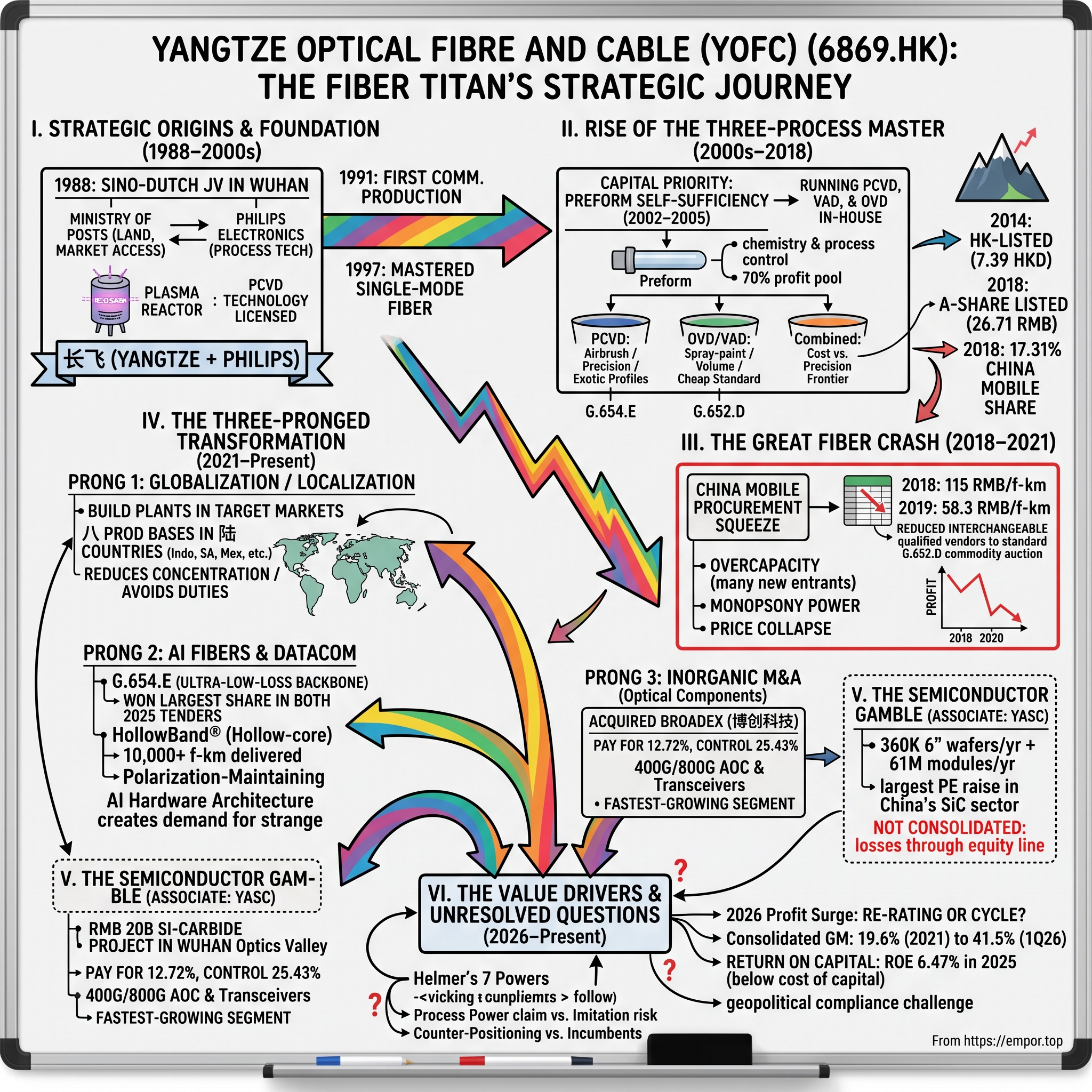
Yangtze Optical Fibre and Cable (YOFC): The Fiber Titan's Next Act
I. Introduction & Episode Roadmap
On the evening of July 14, 2026, a short filing landed on the Shanghai Stock Exchange that read less like a corporate disclosure and more like a typographical error. 长飞光纤光缆股份有限公司 Yangtze Optical Fibre and Cable Joint Stock Limited Company — YOFC to the English-speaking world — told investors that its net profit for the first half of 2026 would come in somewhere between RMB 2.4 billion and RMB 3.0 billion. The comparable figure a year earlier had been RMB 296 million. Stripping out one-off items made the arithmetic even stranger: adjusted profit was guided to between RMB 2.0 billion and RMB 2.6 billion, against RMB 138 million in the prior-year period, a range the company itself described as growth of 1,349% to 1,784%.1
For context on how violent that is: YOFC's entire audited net profit for the full year 2025 was RMB 813.7 million.2 In six months, the company expected to earn roughly three to four times its previous annual result — and by some readings, more than it had earned across the three preceding years combined.
What happened was not a product launch or an acquisition. It was a price shock in a piece of industrial glass. The CRU global optical fibre price index sat at a record low of 78.6 in March 2025, the trough of a brutal multi-year bear market in fibre. By January 2026 it had climbed to 107.9. In March 2026 it printed 263.0 — the sharpest rise since CRU began tracking the market in 2017, and violent enough that CRU abandoned bi-monthly assessments and moved to monthly reporting simply to keep up.3 Chinese standard single-mode bare fibre, the commodity product that had nearly destroyed this industry's economics seven years earlier, rose more than 80% between November 2025 and January 2026 and for the first time in over seven years traded above European prices.12
That is the setup for this story, and it contains the central tension. YOFC is simultaneously one of the most technically formidable manufacturers on earth in its niche and one of the most cyclically exposed. It is a company that spent 2019 through 2024 being ground down by the purchasing power of three state-owned telecom operators, and then in 2026 found itself holding the scarcest input in the AI infrastructure build-out. Investors who bought the story got both: the A-shares traded as low as RMB 40.12 within the past twelve months and as high as RMB 600, before settling at RMB 331.65; the Hong Kong H-shares ranged from HK$19.42 to HK$305 and last traded at HK$121.10.24 Those are not the price ranges of a stable industrial compounder. They are the price ranges of a business whose earnings power the market genuinely cannot pin down.
What this company actually is
Founded on May 31, 1988 as a Sino-foreign equity joint venture in Wuhan, YOFC makes optical fibre preforms, optical fibre, and optical fibre cable, and sells into more than 100 countries.2 The preform is the part most people have never heard of and the part that matters. It is a cylinder of ultra-pure synthetic quartz glass, roughly the size of a fence post, whose internal refractive-index structure is engineered atom-by-atom in a vapour deposition reactor. Heat one end and draw it out, and a single preform yields thousands of kilometres of hair-thin fibre. Every optical property of the finished fibre — how little light it loses, how little the signal smears, how consistently one spool matches the next — is baked into that glass rod before a single kilometre is drawn.
Which is why the profit pool in this value chain is so lopsided. Chinese industry analysis conventionally splits it roughly seven-to-two-to-one between preform, fibre drawing, and cable assembly.5 Preforms are chemistry and process control; cable is extrusion and jacketing. YOFC has spent thirty-eight years pushing itself as far upstream as it can get, and it reports being the only manufacturer to run all three mainstream preform processes in-house — PCVD, VAD and OVD — with essentially complete self-sufficiency in its own preform supply.20
The core paradox and the roadmap
Here is the paradox worth holding onto. YOFC and Chinese industry sources describe it as having led the global market in preforms, fibre and cable for ten consecutive years.5 Yet in Chinese operator procurement — its home market, the one that built it — it ranked third in share behind 中天科技 Zhongtian Technology (ZTT) and 亨通光电 Hengtong Optic-Electric.22 A technology leader that is not the volume leader in its own backyard is telling you something: at some point, management decided that winning tenders on price was a losing game.
This story runs in four movements. First, the origin — a tri-party joint venture that imported a Dutch process technology and, in a detail that tells you everything about the company's self-conception, took half its Chinese name from its foreign partner. Second, technological independence and the domestic super-cycle, ending in the peak-margin years of 2017–2018 and two stock exchange listings. Third, the crash — how a single procurement mechanism at 中国移动 China Mobile compressed this company's economics for half a decade, and what management did about it. Fourth, the pivot now being tested in public: overseas localisation, new-generation fibre for AI data centres, an optical components business bolted on through 博创科技 Broadex Technologies, and a silicon carbide semiconductor venture that is not even consolidated into the accounts. Somewhere in that last movement is the answer to whether the profit surge of 2026 is a re-rating or a cycle.
 Subscribe on LinkedIn
II. Strategic Origins & The Sino-Dutch Tri-Party Joint Venture (1988–2000s)
Picture China's telecommunications network in 1987. Waiting lists for a residential telephone line ran into years. Long-distance calls were booked in advance and shouted into. The Ministry of Posts and Telecommunications had a mandate to build a national backbone and almost none of the industrial base required to do it — no domestic capability in high-purity synthetic quartz, no preform chemistry, no fibre-drawing towers at scale. China could lay conduit. It could not make the glass.
The response was a piece of industrial policy that has since been imitated hundreds of times and understood far less often: buy the process, not the product. On May 31, 1988, a Sino-foreign equity joint venture was incorporated in Wuhan bringing together Chinese state and municipal interests with Royal Dutch Philips Electronics N.V.2 The Chinese side contributed land, labour, market access and the implicit promise of the largest telecom build-out in human history. Philips contributed something scarcer: a working, proprietary method for manufacturing optical fibre preforms.
The name tells you the deal
The company's Chinese name, 长飞, is a two-character compression of the entire arrangement. The first character, 长, comes from 长江, the Yangtze River that runs through Wuhan. The second, 飞, is lifted from 飞利浦, the Chinese transliteration of Philips. A Chinese river and a Dutch electronics conglomerate, welded into one word. Joint ventures of that era usually buried the foreign partner in a footnote. This one put it on the front door — an early signal that YOFC understood itself as a technology transplant rather than a national champion assembled by decree.
Why PCVD, and why it still matters
The technology Philips brought was Plasma Chemical Vapour Deposition. To understand why the choice mattered, it helps to know that there were three viable routes to a preform, and they are genuinely different manufacturing philosophies.
The Japanese-developed VAD (Vapour Axial Deposition) and American-developed OVD (Outside Vapour Deposition) methods both build the glass rod from the outside in, spraying soot onto a rotating target and then consolidating it. They are, broadly, the volume processes: fast deposition, large rods, excellent for churning out standard fibre cheaply.
PCVD works inside-out. A glass tube is fed with reactant gases while a travelling microwave-generated plasma sweeps along it, depositing thin glass layers on the inner wall — layer upon layer, hundreds or thousands of them, each with its dopant concentration set independently. Think of OVD and VAD as spray-painting a car and PCVD as airbrushing with a stencil. The spray gun covers ground faster. The airbrush lets you draw a precise picture.
That "picture" is the refractive index profile — the map of how light-bending the glass is at each radius from the centre. Control it finely and you control dispersion, bend loss, mode behaviour, and the batch-to-batch consistency that carrier customers obsess over. In 1988, when the requirement was simply "make fibre that works," this looked like an odd trade of throughput for precision. Three decades later, when the requirement became "make a fibre with an unusual index structure that nobody has mass-produced before" — bend-insensitive fibre, ultra-low-loss backbone fibre, polarisation-maintaining fibre, multi-core fibre — the airbrush turned out to be the strategically correct tool. The moat YOFC now claims in specialty fibre traces directly back to a licensing decision made when its customers only wanted the commodity.
Execution took time. First commercial fibre production came in 1991, cable in the same year, and by 1997 the company had become the third entity globally to master single-mode fibre technology, after Corning and Lucent Technologies.5 Nine years from incorporation to the front rank of a field defined by American research labs is fast for any manufacturer, and it was achieved with a licensed process and a workforce that had never made optical glass.
The partner kept changing hands
Then the foreign parent started moving. Philips exited the optical cable business in the early 2000s, and its stake passed to Draka Comteq B.V., the Dutch cable group. Draka in turn was absorbed into the Italian wire-and-cable giant Prysmian Group. YOFC's foreign shareholder of record therefore became Draka Comteq B.V., a Prysmian subsidiary — and Prysmian nominated directors to the board accordingly. As late as the 2023 board slate, three of the non-independent director candidates were Prysmian-side executives, including Philippe Claude Vanhille, Prysmian's executive vice-president for telecom, who served as vice-chairman.19
This produced one of the more unusual competitive relationships in global manufacturing: YOFC's second-largest shareholder was also a direct competitor in international fibre and cable markets. The arrangement was durable — it lasted more than two decades — but it constrained both sides. YOFC's international ambitions ran into the awkward reality that its own shareholder was already selling in those markets. And Prysmian was funding, and drawing dividends from, a company steadily eroding Western pricing power in fibre.
The important analytical point is what did not happen. YOFC did not remain a licensee. It did not stay boxed into PCVD-only production, dependent on a foreign partner for its most valuable know-how, which is the fate of most technology-transfer joint ventures. By the time the shareholding relationship finally dissolved — and it did, spectacularly, in 2025 — YOFC had long since stopped needing it. How the company engineered that independence is the next act.
III. The Master of Three Processes & The Domestic Super-Cycle (2000s–2018)
The decision that defined YOFC's next twenty years was made in a period the company's own president describes as its awkward adolescence. Speaking in a televised interview, 庄丹 Zhuang Dan characterised 2001 to 2011 as the growth phase in which manufacturing was progressively localised, and 2012 onward as the transition from follower to leader. His framing of the strategic priority was blunt: the key was to hold core technology in the company's own hands.6
Between roughly 2002 and 2005, management made preform self-sufficiency the top capital priority — not capacity, not market share, not vertical expansion into cable, but the ability to make its own glass rods without asking permission.5 In an industry where the upstream step holds the bulk of the profit, this was the whole game.
Collecting all three processes
What followed was unusual. Rather than optimising the PCVD process it had inherited, YOFC also developed OVD and VAD capability in-house, ending up as the operator of all three mainstream preform routes.5 Industry participants typically pick one and defend it; running three means triple the process engineering, triple the equipment base, triple the tribal knowledge.
The logic becomes clear once you think about it as a portfolio rather than a hedge. The outside-deposition methods handle the large-volume standard products where cost per kilometre decides everything. PCVD handles the exotic index profiles where precision decides everything. And because the processes can be combined — an OVD or VAD core with a PCVD cladding structure, or vice versa — the company can tune where on the cost-versus-precision frontier any given product sits. When the market pays for cheap, it can make cheap. When the market pays for strange, it can make strange. In 2026, with the market suddenly paying enormous premiums for strange, that optionality became the single most valuable asset on the balance sheet.
By mid-2026 YOFC operated preform capacity of roughly 4,000 tonnes a year, described in Chinese industry analysis as among the largest globally.5 The relevant fact for investors is not the tonnage but the physics of adding to it: building preform capacity takes 18 to 24 months, and with environmental approvals and imported equipment lead times, the practical cycle had stretched toward 30 months.23 Preform capacity cannot be conjured in response to a price spike. That asymmetry — slow to build, slow to unwind — is what makes this industry's cycles so violent in both directions.
Riding 宽带中国
The demand side arrived on schedule. China's 宽带中国 Broadband China programme, followed by nationwide fibre-to-the-home conversion, 4G LTE, and then early 5G, produced roughly fifteen years of state-coordinated capital expenditure by 中国移动 China Mobile, 中国电信 China Telecom, and 中国联通 China Unicom. Wuhan's 中国光谷 Optics Valley — the optoelectronics cluster that grew up around the same research institutes that spawned YOFC — became one of the densest concentrations of fibre manufacturing on earth.
For a decade this was as close to a guaranteed growth market as industrial manufacturing offers. Volumes were mandated by policy, financed by state-owned operators, and executed on multi-year timetables. The trap inside it was that a market defined by state-mandated volume is also a market defined by state-controlled price, and the operators had not yet chosen to use that power.
Two listings and the peak
YOFC used the boom to raise capital twice, on two exchanges, in two currencies.
The H-shares listed on the Main Board of the Hong Kong Stock Exchange on December 10, 2014, with 159,870,000 shares issued at HK$7.39 apiece.2 A follow-on issuance in December 2015 placed a further 42,652,000 shares — a mix of domestic shares and H-shares — at HK$7.15 to selected directors, employees and four independent institutional investors, a structure that tied insider wealth to the share price early.2
The A-share listing followed on July 20, 2018, when 75,790,510 new A-shares were sold at RMB 26.71 each, raising gross proceeds of RMB 2.024 billion and net proceeds of RMB 1.894 billion, and taking the company to a total of 757,905,108 shares split between H-shares and A-shares.2 YOFC became the first company in China's fibre-optic cable industry to hold both A- and H-share listings.
The timing of that A-share raise was, in hindsight, immaculate — and the company deserves neither credit nor blame for it. 2017 revenue reached RMB 10.366 billion, up 27.8%.7 In 2018, revenue grew a further 9.6% to RMB 11.36 billion, gross profit came in at RMB 3.228 billion for a gross margin of 28.4%, and net profit attributable to shareholders rose 17.4% to RMB 1.489 billion.7 The preform-and-fibre division contributed RMB 4.691 billion of revenue, cable RMB 5.727 billion, and everything else RMB 942 million — a business that was, at that moment, 83.4% domestic.7
That domestic concentration is the number to remember. Overseas revenue was RMB 1.886 billion, or 16.6% of the total, even after growing 62.5% in a single year.7 YOFC had built the world's best preform technology base and sold five-sixths of its output to three customers in one country.
In 2018 YOFC also held the largest share of China Mobile's ordinary cable tender at 17.31%.8 It was the peak of the old model: technology leadership converted into volume leadership converted into record profit. Within twelve months, all three would come apart, and the mechanism would be a procurement spreadsheet.
IV. The Great Fiber Crash: Monopsony, Overcapacity, & Price Collapse (2018–2021)
In March 2019, China Mobile published the results of its annual centralised procurement for ordinary optical cable, and an entire industry's business model stopped working.
The average winning price in that tender came in at RMB 58.3 per fibre-kilometre. The previous year's equivalent had been around RMB 115. Cable prices in the 2019 procurement fell roughly 40% year-on-year.8 Thirteen companies won allocations. YOFC's share was 4.39%, ranking sixth — down from first place and 17.31% the year before.8
Read those two facts together and a decision emerges. YOFC did not lose share because it lost a technology race. It lost share because it declined to sell glass at the clearing price the buyer had engineered. Whether that was strategic discipline or an inability to match subsidised competitors' cost structures is the interpretive question, and the honest answer is probably some of both.
How a buyer builds a squeeze
The mechanism deserves explanation because it recurs across Chinese industrial supply chains. Centralised procurement aggregates an operator's national demand into one enormous tender, then allocates volume across many suppliers by price rank. From the buyer's perspective it is elegant: maximum volume leverage, guaranteed multi-vendor supply, and no dependence on any single manufacturer.
From the seller's perspective it converts a differentiated product into a pure commodity auction. Standard G.652.D single-mode fibre — the workhorse product that carries most of the world's internet traffic — is genuinely interchangeable between qualified vendors. Once a buyer establishes that it will treat suppliers as interchangeable, the only variable is price, and the only equilibrium is marginal cost.
The supply side made it worse. Years of visible, policy-backed demand growth had attracted capital into fibre and cable across China: 亨通光电 Hengtong Optic-Electric, 中天科技 ZTT, 富通集团 Futong Group, 烽火通信 FiberHome and a long tail of smaller entrants, many with access to cheap local-government-linked financing. Capacity was built against a demand forecast that assumed the build-out would continue indefinitely. When 4G finished and 5G had not yet started at scale, the industry discovered it had built for a peak that had already passed.
The damage
The financial transmission was immediate and severe. In the first half of 2019, YOFC's revenue fell 41.07% to RMB 3.32 billion and net profit fell 45.99% to RMB 437 million.8 The segment detail showed exactly where the pain sat: preform-and-fibre revenue dropped 55.64% while cable fell 33.01%.8 The upstream business — the high-margin one, the one built on thirty years of process mastery — took the harder hit, because that is where the price premium had lived and therefore where the premium could be destroyed.
Full-year 2019 net profit landed at RMB 801 million, down 46.2%, and 2020 fell further to RMB 544 million. Gross margin, which had been in the high twenties at the peak and higher still in the preform business, bottomed at 19.63% in 2021.27 From peak profit in 2018 to trough profit in 2020, roughly two-thirds of earnings evaporated in twenty-four months. Recovery was slow and incomplete: RMB 709 million in 2021, RMB 1.167 billion in 2022, RMB 1.297 billion in 2023 — and then a relapse to RMB 675.9 million in 2024 as the international cycle turned down too.2
Note that even the 2023 recovery peak never regained the 2018 level. Six full years after the crash, YOFC had not earned back its old profit. For long-term investors this is the single most important historical fact about the company: its 2018 earnings power was not a base, it was a cyclical high built on a procurement regime that no longer exists.
The strategic response
The management team that had to absorb this had been in place since the start of 2017 — chairman 马杰 Ma Jie and president 庄丹 Zhuang Dan — and their response was to change what the company sold rather than fight for volume in what it had been selling.
Three redirections followed, and each will be examined in the sections ahead. Capital went into overseas localised production rather than domestic capacity. R&D went into fibre types that could not be reduced to an auction — ultra-low-loss backbone fibre, specialty fibres, and eventually hollow-core. And the balance sheet went to work acquiring businesses adjacent to fibre rather than more fibre.
The intellectually honest way to evaluate this is not to ask whether it sounds sensible — it does — but to ask whether it worked before the 2026 price spike bailed everyone out. On that test the record through 2024 was mixed at best: revenue in 2024 of RMB 12.197 billion was below 2018's, and net profit was less than half.2 The diversification bought optionality and geographic resilience. It did not, on its own, restore the earnings power that monopsony had taken away. What restored it was a global scarcity in the very commodity management had spent five years de-emphasising — which is either luck, or a reminder that in cyclical industries survival with the assets intact is itself the strategy.
V. The Three-Pronged Transformation: Globalization, AI Fibers, & Inorganic M&A (2021–Present)
In 2025 YOFC's Indonesian fibre plant turned ten years old. It is worth pausing on that anniversary, because when the facility opened in 2015 it was the first local optical fibre production capacity in Southeast Asia, and at the time it looked like a modest export-support investment by a company that derived the overwhelming majority of its revenue from three Chinese customers. A decade later, the company described Indonesia as the template for its entire international model — the transition, in management's phrasing, from "going global" to "becoming local," complete with a full local fibre-and-cable ecosystem and diversified product lines layered on top.2
Prong 1: Manufacturing where the customer is
The strategic insight behind localisation is unglamorous and powerful. Fibre and cable are heavy, bulky, and politically sensitive. Shipping them across oceans invites freight costs, lead-time risk, anti-dumping duties, and local-content rules. Building plants inside the target market defuses all four at once, and buys something harder to quantify: standing as a domestic supplier when a national carrier awards a multi-year framework.
By the end of 2025 the company operated eight production bases across six countries — Indonesia, South Africa, Brazil, Poland, Germany and Mexico.2 By mid-2026 that had expanded to ten sites in seven countries, alongside more than fifty overseas offices.216
The results are visible in the revenue mix, and this is where the strategy demonstrably worked. Overseas revenue reached approximately RMB 6.092 billion in 2025, up 47.8%, lifting the international share of the group to 42.7%.2 Domestic revenue over the same year grew 1.0%.2 Sit with that contrast: essentially all of 2025's growth came from outside China. Overseas contribution has exceeded 30% of revenue every year since 2021, and at the World Artificial Intelligence Conference on July 18, 2026, Zhuang Dan said he expected more than half of 2026 revenue to come from overseas customers.221
An investor should note what this does and does not fix. It genuinely reduces single-buyer concentration and gives YOFC access to markets where pricing is set by competitive negotiation rather than reverse auction. It does not make the company immune to trade politics — a manufacturer with plants in Poland, Germany, Mexico and Brazil has simply exchanged one set of political exposures for a more diversified set. Management's own outlook language acknowledged rising protectionism and supply-chain realignment as mounting challenges in customer acquisition, capacity planning and regulatory compliance.2
Prong 2: Making fibre that cannot be auctioned
The technical pivot has two layers, and the first has already produced hard commercial evidence.
G.654.E is ultra-low-loss, large-effective-area fibre for long-haul backbone routes. In plain terms: standard fibre loses a certain fraction of its light per kilometre, which forces you to install amplifiers at intervals; a fibre that loses less light lets you space amplifiers further apart and push more capacity down the same route. For 400G and 800G backbone transport, and for the long-distance links stitching data centres together, that changes the economics of the whole route.
2025 was the year Chinese carriers committed. In June 2025, China Mobile ran a centralised procurement for G.654.E cable totalling 3.14 million fibre-kilometres, up roughly 156% from its previous round. In October 2025, China Telecom conducted its first framework procurement dedicated to the category, including approximately 2.24 million fibre-kilometres. YOFC secured the largest share in both.2
That is the most important competitive datapoint in this entire story, and it is worth being precise about why. The same buyer that reduced YOFC to sixth place and 4.39% share in commodity cable in 2019 awarded it the top allocation in both premium fibre tenders in 2025. Monopsony power does not disappear when the product changes — but it becomes much harder to exercise when only a few suppliers can qualify. YOFC did not defeat the procurement machine. It moved to a product category where the machine has fewer levers.
Hollow-core fibre is the second layer, and it is genuinely radical. Conventional fibre guides light through solid glass; hollow-core fibre guides it through an air or gas channel held in place by an engineered microstructure of glass walls. Light travels about a third faster through air than through silica, so the same route delivers lower latency. The company's specifications describe attenuation as low as 0.04 dB/km, latency reduced by 31%, transmission speed increased by 47%, and near-zero non-linear effects relative to solid-core fibre.2
The commercial question with any exotic fibre is manufacturability, and here YOFC disclosed the metric that matters: a single hollow-core preform yielded a drawing length of 91.2 fibre-kilometres.2 Drawing tens of kilometres of continuous microstructured air channel without collapsing the geometry is the entire engineering problem. The company reported building the full industrial chain from preform through drawing, coating and cable testing, deploying more than ten commercial and pilot projects across Asia, Europe and the Americas, and supporting all three Chinese operators in world-first commercial hollow-core deployments — including a Guangdong–Hong Kong link of 100 kilometres described as the longest to date.2 In February 2026 it launched a hollow-core brand, HollowBand®, and stated an intention to work with global operators and cloud providers on more than fifty commercial and pilot projects.2 By June 2026 it claimed a world record of 206.5 km transmission with a 51.3 Tb/s capacity-distance product, more than thirteen commercial projects, and over 10,000 fibre-kilometres delivered.20
Now the skeptical read, which management itself has supplied. On the barriers to scaling hollow-core, the company identified two: cost and pricing, since current selling prices remain high against massive sunk R&D; and an immature supply chain.20 Ten thousand fibre-kilometres delivered is a real number and a tiny one — global cable demand ran to approximately 549 million fibre-kilometres in 2025.2 Hollow-core is a credible technology lead and an immaterial revenue line. Both things are true, and conflating them is the most common error in the bull case.
A third and newer front deserves mention because management flagged it with unusual enthusiasm. 保偏光纤 polarisation-maintaining fibre — fibre engineered to preserve the orientation of a light wave, which matters for coupling light into silicon photonics chips — is, per Zhuang Dan at the July 2026 AI conference, seeing demand he expects to grow ten- to twenty-fold over one to two years, positioned as the optimal connection medium for co-packaged optics. He noted YOFC is China's only company with certified mass-production capability in the product and has led domestic share for five consecutive years.21 Treat the growth multiple as a management forecast, not a fact. But the underlying claim — that AI hardware architecture is creating demand for fibre types that were laboratory curiosities five years ago — is exactly the structural shift that would justify a technology-led producer earning more than commodity economics. Zhuang also offered a framing worth keeping: datacom was previously under 10% of global fibre-cable demand, and he expects it to exceed 50% by 2030.21
Prong 3: Buying into the box
The third prong was M&A, and its centrepiece was 博创科技 Broadex Technologies, a Shenzhen-listed optical components maker.
On April 7, 2022, YOFC announced it would acquire 22.12 million Broadex shares by agreement transfer at RMB 40 per share, a total consideration of RMB 1.028 billion for 12.72% of the company. Simultaneously it signed a voting rights delegation agreement with Broadex's controlling shareholder covering a further 12.71%, giving YOFC command of 25.43% of the votes and control of the company. A performance-linked award of RMB 143 million to the outgoing controller formed part of the agreed consideration.13
The structure is worth noticing: YOFC bought control with roughly half the economics. It paid for 12.72% and controlled 25.43%. That is capital-efficient, and it also means minority shareholders sit alongside YOFC in a business YOFC directs — a governance configuration that rewards close attention.
Strategically, the logic was to move from passive glass into active components: optical transceivers at 400G and 800G, PLC splitters, active optical cables. Under the EverProX brand, and combined with YOFC's existing active-optical-cable assets, the components business became the group's fastest-growing segment. In 2025 it generated revenue of RMB 3.144 billion, up 48.6%, at a gross margin of 39.7%, with R&D spending of RMB 127 million representing more than 5% of its revenue. Its "1 plus 3" global production system — Indonesia plus Jiaxing, Chengdu and Hanchuan — was fully established, and 400G/800G AEC series products along with multimode 400G SR4 and 800G SR8 modules reached mass production.2
Here again, discipline about what the evidence shows. A 39.7% gross margin in optical components is strong, and 48.6% growth in a year when the core business grew 6.1% is the diversification thesis working.2 But management has been candid that market share in modules remains limited because the company entered in 2018, well behind incumbents, and that the products face intense competition.11 Owning a components business exposed to AI data centre spending is valuable. Being a marginal player in a segment dominated by scaled specialists is a different proposition from being the world's leading preform maker.
Two other diversifications were smaller but signal the pattern. In March 2025 YOFC agreed to buy 28,698,288 shares of Penta Laser (Zhejiang) Co., Ltd. from a subsidiary of Italy's El.En. S.p.A. for RMB 239.96 million in cash, consolidating the high-power laser equipment maker from July 2025 and framing it as a chain running from upstream specialty fibre through industrial lasers to downstream equipment.2 And in December 2025 the company signed a high-end submarine cable manufacturing and smart operations project in Yancheng, Jiangsu, building on offshore wind order backlog.2 Both are coherent on paper. Both also add operational surface area to a company whose core business had just entered the most favourable pricing environment in its history — a tension we will return to.
VI. The Third-Generation Semiconductor Gamble: YOFC Advanced Semiconductor (YASC)
On May 28, 2025, a production line in Wuhan's Optics Valley started up and the first six-inch silicon carbide wafers came off it, with the company reporting first-batch yields of 97%.14 For a fibre-optic manufacturer, this was either the most logical extension imaginable or the clearest case of a company wandering outside its circle of competence. Reasonable analysts disagree, and the disagreement is worth taking seriously.
What was actually built
长飞先进半导体 YOFC Advanced Semiconductor traces back to Wuhu Qidi Semiconductor, which YOFC acquired and restructured in May 2022, renaming it in October of that year. Anhui-based operations came first; Wuhan followed as the flagship. The Wuhan project carried a total planned investment of RMB 20 billion across 498 mu of land, with phase one on 344 mu. At full capacity the site was designed for 360,000 six-inch SiC wafers a year plus matching epitaxy and 61 million power modules annually — enough, on the company's arithmetic, to supply chips for 1.44 million new energy vehicles. Eight products were in validation at start-up with a target of twelve by end-2025, and a ramp to 3,500 wafers per month by the close of that year.14
Funding came substantially from outside. A Series A round announced in August 2023 raised over RMB 3.8 billion — described at the time as the largest private equity raise in China's third-generation semiconductor sector — from twenty-nine institutional investors including provincial state reform funds and telecom-linked capital.14 A Series A+ round of more than RMB 1 billion followed, announced on February 6, 2026, led by Jiangcheng Fund and Yangtze Industry Group with participation from Optics Valley financial holdings and a mobility fund associated with Chery. By then combined SiC wafer capacity across the Wuhu and Wuhan bases had reached an annual 420,000 wafers, with Wuhu at full production.15
The synergy argument, examined
The stated rationale is that preform manufacturing and SiC manufacturing are cousins. Both involve high-temperature vapour-phase deposition of ultra-pure crystalline material with obsessive control of impurities and defect density. Both live or die on yield. YOFC has spent three decades building institutional knowledge in exactly that discipline, plus an adjacent capability in high-purity quartz components which it also commercialised.2
The counter-argument is that the similarity is at the level of physics, not business. Optical preforms are sold to a few dozen cable makers on optical specifications. SiC power devices are sold to automotive tier-ones and inverter makers on automotive qualification cycles, reliability data, package-level thermal performance, and price points set by a global oligopoly. The deposition chamber may rhyme; the customer, the qualification pathway, and the competitive set do not.
Reading it through the accounts
Here is the fact that matters most for investors, and it corrects a common misconception. YASC is not consolidated into YOFC's financial statements. The 2025 annual results announcement explicitly describes it as an associate of the company.2 SiC therefore contributes no revenue line to YOFC's reported top line at all — the framing that it is a small percentage of consolidated sales is simply wrong.
What it does contribute is losses through the equity line. YOFC's losses from investments in associates and joint ventures were RMB 342.5 million in 2025, following RMB 302.6 million in 2024.2 The carrying value of long-term equity investments in associates and joint ventures sat at RMB 2.256 billion at end-2025, down from RMB 2.794 billion a year earlier.2 The company does not break out YASC's individual contribution, so attributing the whole figure to silicon carbide would overstate it — but the direction is unambiguous. Equity-accounted associates cost YOFC roughly RMB 645 million of pre-tax profit across two years while the carrying value declined by more than half a billion.
Set that against context: 2024 net profit attributable to shareholders was RMB 675.9 million.2 The associate losses in that year alone were equivalent to roughly 45% of reported earnings. This is not a rounding error. It is a material, ongoing drag that would be invisible to anyone reading only the revenue and gross margin lines.
The bull and bear, fairly stated
The bull case is straightforward optionality. China is the world's largest EV market; SiC power devices materially improve inverter efficiency and therefore range; and YOFC secured a large-scale, largely externally-funded position early. If YASC reaches commercial scale, YOFC holds a stake in a business that could be worth a multiple of its carrying value, and the structure — external co-investors, non-consolidated, ring-fenced from group leverage — limits the downside to the equity already committed.
The bear case is that Chinese SiC is one of the most crowded capacity build-outs in the semiconductor industry, that a RMB 20 billion project competes against global incumbents with a decade's head start in automotive qualification, and that "97% first-batch yield" on a pilot line and volume production yields at automotive reliability standards are separated by years of work. Two funding rounds in under three years for a business still ramping suggests the cash requirement is front-loaded and continuing.
The measured conclusion: this is real optionality bought with mostly other people's money, and it is also a business that has consumed board attention and equity-line profit for four years without producing disclosed earnings. An activist would ask a pointed question here — why is a company whose core preform business just entered the tightest supply environment in a decade allocating management bandwidth to laser equipment, submarine cable, quartz components, venture funds and silicon carbide? That question gets sharper when you look at where the money actually is.
VII. Segment Financial Breakdown & Value Drivers
The 2025 accounts are the last clean look at YOFC before the 2026 price shock distorted everything, and they repay careful reading — partly because the reporting structure itself has changed in a way that matters.
The segments as the company now defines them
YOFC no longer reports preforms, fibre and cable as three separate profit centres. It reports two: optical communication products, which bundles preforms, fibre and cable together, and optical transmission components, plus an unallocated "others" bucket.2
For 2025, optical communication products generated RMB 8.346 billion of external revenue, up 6.1%, representing 58.6% of the group against 64.5% a year earlier. Optical transmission components contributed RMB 3.144 billion, up 48.6%, at 22.1% of the group versus 17.3% in 2024. Other products and services added RMB 2.762 billion, up 24.7%, at 19.3%.2
Segment profit — defined as external revenue less segment operating costs, before selling, administrative, R&D and financial expenses — tells a more interesting story than revenue. The core communication products segment earned RMB 3.114 billion, an implied margin near 37%. Components earned RMB 1.258 billion, an implied margin near 40%. Others earned RMB 337 million on RMB 2.762 billion, a margin closer to 12%.2
That ordering deserves emphasis because it inverts the conventional framing of this company. In 2025 the bolted-on components business ran at a higher implied margin than the legendary preform-and-fibre franchise, while the diversified "others" bucket — lasers, submarine cable, quartz, engineering — ran at roughly a third of either. If you believe margin mix drives valuation, the acquired photonics business was carrying more than its weight and the broader diversification was diluting.
The consolidated picture: revenue of RMB 14.252 billion, up 16.8%; gross profit of RMB 4.380 billion, up 31.5%; gross margin of 30.7% against 27.3% — the first time margin exceeded 30% since the 2014 Hong Kong listing. Net profit attributable to shareholders reached RMB 813.7 million, up 20.4%, with adjusted net profit of RMB 516.2 million, up 40.6%. Earnings per share were RMB 1.07, and average return on equity was 6.47%.29
A 6.47% return on equity is the number that should anchor any discussion of this business. It is a below-cost-of-capital return, in a year the company described as high-quality growth. Whatever else is true about YOFC's technology, its 2025 capital productivity was poor.
Where the operating leverage lives
The cost structure explains the 2026 explosion. In 2025, raw materials cost RMB 7.420 billion while manufacturing overheads and direct labour together cost RMB 2.452 billion.2 Preform and fibre manufacturing is capital-intensive and fixed-cost heavy: reactors, drawing towers, clean rooms, depreciation of RMB 1.193 billion across segments.2 When selling prices rise and volumes hold, almost the entire increment falls to gross profit.
Watch it happen in sequence. Fourth-quarter 2025 net profit was RMB 344.1 million, up 234.2%, with a quarterly gross margin of 35.7% — both records since listing.2 First-quarter 2026 revenue was RMB 3.695 billion, up 27.7%, with net profit of RMB 495 million, up 226.4%, and adjusted net profit of RMB 461 million, up 966.4%. Operating costs rose only about 3.5% against 27.7% revenue growth, pushing quarterly gross margin to roughly 41.5%, a 13.7-point year-on-year gain.11 Then the second quarter, implied by the half-year guidance, at roughly RMB 1.9–2.5 billion of net profit.4
The mechanism is not mysterious and it is not a moat. Standard G.652.D fibre reached RMB 83.40 per fibre-kilometre by March 2026, reported as up 418% year-on-year, with emergency procurement above RMB 150; high-end G.654.E was quoted at RMB 200–260 per fibre-kilometre.23 Against 2019's roughly RMB 30 per fibre-kilometre for bare fibre, the swing is generational. Operating leverage in a fixed-cost business cuts both ways with equal force, and investors who extrapolate a 41.5% gross margin should remember that the same asset base produced 19.63% in 2021.
Cash, and the honest reading of it
Operating cash flow of RMB 3.653 billion in 2025, up 104.8%, comfortably exceeded net profit — attributed to better results and improved working capital efficiency.2 Capital expenditure was RMB 1.544 billion, directed at overseas capacity, diversified projects and domestic preform and fibre optimisation.2 Gearing fell to 20.8% from 41.4%, helped by the year's equity raise, and bank loans declined 9.5% to RMB 8.418 billion at effective rates spanning 1.03% to 5.90%.2 Headcount grew to about 10,596 from 9,616, with staff costs rising to RMB 2.046 billion from RMB 1.562 billion.2
Cash conversion of that quality in a low-ROE year is a genuine positive: it suggests the earnings are real and the working capital is not deteriorating. It also reflects a company that had been starved of pricing power for years finally seeing receivables and inventory work in its favour.
Customer concentration: what is and is not disclosed
The consensus framing holds that China Mobile, China Telecom and China Unicom together account for well over 45% of sales. That was a defensible characterisation of the old YOFC. It is not something the 2025 audited results announcement discloses, and investors should be careful repeating it as current fact. What the filing does disclose is that the five largest accounts receivable totalled RMB 1.518 billion, or 22.48% of total receivables, down from 27.20% a year earlier.2
With domestic revenue now at 57.3% of the group and overseas at 42.7%, and with the diversified businesses exceeding 40% of revenue for the first time at approximately RMB 5.9 billion, the arithmetic makes extreme operator concentration considerably less plausible than it was in 2018.2 The direction of travel is clear even where the precise disclosure is absent. The three operators still set the terms of the domestic standard-fibre market; they no longer set the terms of YOFC's income statement to the same degree.
VIII. Management Credibility, Incentives, & Capital Allocation Record
The most revealing corporate event in YOFC's recent history was not a product launch or a results beat. It was a shareholder walking away.
Between April and September 2025, Draka Comteq B.V. — the Prysmian subsidiary that had inherited the Philips stake and held roughly 23.7% of YOFC, tied with the Chinese state shareholder as joint-largest — sold every share it owned. The exit came in six tranches: 28.25 million shares on April 17, 32.97 million on June 5, 5.83 million between July 7 and 21, 37.60 million on July 29, 37.60 million on September 4, and a final 37.60 million on September 19, totalling roughly 180 million shares.17 Prysmian's own announcement of the last tranche, made on September 16, 2025, priced 37,595,257 H-shares at HK$47.10 for gross proceeds of about HK$1.8 billion, or €193 million, and confirmed the waiver of the previous tranche's lock-up to allow the full exit. Prysmian offered no explicit strategic rationale.16
Two observations. First, this was a 37-year industrial relationship terminated by a seller who is also a competitor — and by exiting, Prysmian removed both its capital and, in economic logic, the basis for its board representation. Second, the market's reaction was the opposite of the textbook. Across the divestment period YOFC's A-shares rose 259.2% and the H-shares 297.42%; on the day of the final clearance the A-shares hit their daily limit.17 A founding shareholder liquidating an entire position into a tripling share price is a striking piece of judgment by the party with the longest and closest view of the business. Whether it reflects Prysmian's own portfolio priorities or a view on YOFC's valuation is not disclosed, and both readings are available.
The two people running it
庄丹 Zhuang Dan is the operator, and his career is unusually vertical. He joined the company in March 1998 as an assistant manager in the finance department, became finance manager, served as chief financial officer from November 2001 to September 2011, and has been president since September 2011 and an executive director since January 24, 2017. His academic record is finance to the core: a bachelor's in auditing from Wuhan University in 1992, a master's in accounting from Wuhan University in 1995, a doctorate in accounting from Zhongnan University of Finance and Economics in 1998, and a post-doctoral business administration certificate from Shanghai University of Finance and Economics in 2001. He serves as a deputy to Hubei's provincial people's congress and holds a State Council special allowance.19
A CFO-turned-president running a capital-intensive cyclical manufacturer is a meaningful detail. It is consistent with the behaviour on display: prudent gearing, a preference for external co-investment in the semiconductor venture, and a willingness to surrender tender share rather than sell below acceptable margins. It also fits the frank language in his public commentary, where he has stressed holding core technology in-house and described R&D funding as having a floor of about 5% of revenue with no ceiling.6
The incentive alignment is thinner than the tenure suggests. As disclosed in 2023, Zhuang held no YOFC shares directly, and indirectly held the equivalent of 991,450 A-shares through a limited partnership interest.19 For a president of twelve years' standing at a company of this size, that is modest personal capital at risk. Non-independent and independent director fees were set at RMB 380,000 per year after tax.19
马杰 Ma Jie is the state-side chairman, and his background is telecom multinational rather than manufacturing. Born in 1971, he holds a bachelor's and a doctorate in economics from Nankai University, earned in 1993 and 1998, and an executive MBA from the joint Washington University in St. Louis and Fudan University programme in 2005. He spent 1998 to 2011 inside Shanghai Bell and its Alcatel and Nokia successors, rising to vice-president and executive vice-president, and has been chairman of 中国华信邮电科技有限公司 China Huaxin Post and Telecommunications since 2023 after serving as its director and general manager from 2017. He joined YOFC's board on December 19, 2013 and became chairman on January 24, 2017.18
The ownership structure, updated
The consensus description of YOFC's governance — a balanced tripod of Chinese central SOE capital at 23.73%, Draka at 23.73%, and Wuhan local state capital — was accurate as recently as March 31, 2025.17 It is now obsolete.
Following the foreign exit, the principal holders were China Huaxin Post and Telecommunications at 23.73% and Wuhan Yangtze Communications Industry Group at 15.82%, with the Dutch shareholder at zero.17 The company remains without a controlling shareholder, since the largest holder sits below 25%. But the character of the balance has changed fundamentally. What was a genuine Sino-foreign counterweight — where a Western competitor-shareholder with board seats had every incentive to police disclosure and related-party dealing — is now a structure of Chinese state and municipal holders plus a wide float.
The historical governance argument for YOFC was that this dual structure prevented insider tunnelling and forced financial transparency. That argument's evidentiary basis has weakened. It has not been replaced by evidence of poor governance — the accounts are audited by KPMG Huazhen LLP, prepared on a going-concern basis, with no contingent liabilities reported at end-2025 — but investors relying on the old structural safeguard should recognise that the safeguard left the building.2
The capital allocation ledger
The 2025 record is worth laying out because it is unusually active for a single year, and it cuts both ways.
Returning capital. The board proposed a final dividend of RMB 0.295 per share before tax, totalling RMB 244.2 million, up from RMB 0.268 and RMB 203.1 million a year earlier, payable on or before August 21, 2026.2 Against RMB 813.7 million of attributable profit, that is a payout near 30% — consistent with the company's long-standing practice and maintained through the downturn. Between April and May 2025 the company also repurchased A-shares for RMB 197.3 million excluding transaction costs and transferred them to a 2025 employee stock ownership plan.2 Notably, the buyback funded employee incentives rather than reducing share count — a legitimate choice, and one that should not be scored as shareholder return.
Raising capital. In August 2025 YOFC issued the first science and technology innovation bond in China's fibre-optic cable industry: RMB 500 million, three-year, AAA-rated, at a 1.9% coupon.2 That coupon on a three-year corporate bond is the clearest external signal on credit quality in the file. Then in December 2025 came the equity raise — a placing agreement signed December 9 with CICC as agent, completed December 17, of 70 million new H-shares at HK$32.26 to no fewer than six independent placees, representing about 9.24% of pre-placing issued capital. Gross proceeds were approximately HK$2,258.2 million and net proceeds HK$2,229.46 million, earmarked for overseas business development and general working capital, with full utilisation expected by December 2026. As of December 31, 2025 none had been deployed.2
The timing invites scrutiny. YOFC sold roughly 8.5% of its enlarged share capital at HK$32.26 in December 2025, weeks before the fibre price index tripled and months before the shares peaked at HK$305.24 Dilution at HK$32 to fund capacity that would earn 2026 margins is, with hindsight, an expensive way to raise money — and the placing price sat well below the HK$47.10 at which the departing foreign shareholder had cleared its final block three months earlier.16 No management team can be blamed for failing to predict a 418% price move in its own product. But a board that raised equity into the trough while describing the raise as demonstrating market confidence should expect that framing to be questioned.
The A/H puzzle. One structural oddity conditions all of this: YOFC's A-shares recently traded at RMB 331.65 while the H-shares traded at HK$121.10, giving market capitalisations of roughly RMB 258 billion and HK$172 billion for claims on the same cash flows.24 The Hong Kong line has persistently traded at a fraction of the Shanghai line. It makes H-shares the cheaper currency for buyers and the more expensive currency for the company to issue, which is precisely the tension in the December placing.
The diworsification question. The ledger also shows industrial venture funds — the Wuhan YOFC Sci-Tech Industrial Fund, a Hubei laser intelligent manufacturing venture fund, and a Hubei angel fund — created to incubate early-stage projects.2 Added to lasers, submarine cable, quartz, components and silicon carbide, a skeptic would argue the company is building a conglomerate around a franchise that has not yet earned its cost of capital across a full cycle. Management's counter is that each adjacency shares a technology or customer root with the core. Both positions are arguable; the resolution will be visible in whether group return on equity climbs durably above the 6.47% of 2025 once fibre prices normalise.
IX. Strategic Frameworks: Helmer's 7 Powers & Porter's 5 Forces
Strip away the narrative and ask the war-gamer's question: if you had unlimited capital and wanted to take YOFC's position, what would stop you?
Helmer's 7 Powers, tested against evidence
Process Power — the strongest claim, with real support. Helmer's process power describes an organisational capability built up over long periods that competitors cannot copy quickly even with full knowledge of what to do. YOFC's claim rests on running all three preform routes with near-total self-sufficiency, being the only Chinese producer with certified mass-production polarisation-maintaining fibre, drawing 91.2 fibre-kilometres from one hollow-core preform, and winning the largest allocation in both landmark Chinese G.654.E tenders of 2025.20212 The falsification test is direct and now live: several new entrants announced preform capacity in June 2026, including plans of 3,200 tonnes and 2,000 tonnes annually, with one acquiring hollow-core technology.20 If competitors reach comparable specifications on ordinary timelines, this is capacity, not process power. Watch qualification wins, not announcements.
Scale Economies — real but narrower than assumed. Roughly 4,000 tonnes of preform capacity buys purchasing leverage in the specialty chemicals and quartz that feed the process, and spreads enormous fixed costs.5 But the 2019 experience proved scale does not confer pricing power when the buyer aggregates demand and the product is fungible. Scale here reduces unit cost; it does not set price.
Counter-Positioning — genuine, and cutting the other way too. YOFC moved into active components and power semiconductors while cable-centric rivals stayed anchored to commodity tenders. But counter-positioning requires that incumbents cannot follow without damaging their existing business, and there is little evidence of that here — Hengtong and ZTT are actively strengthening in premium segments, and Corning remains formidable at the high end.20
Cornered Resource — partial. The PCVD lineage, thirty-eight years of accumulated process data, and a technical workforce concentrated in Optics Valley amount to something close to a cornered resource in specialty fibre. It does not extend to standard fibre, and it is not legally protected in any way that survives determined domestic imitation.
The power deficits are as important as the powers. There are no switching costs in standard G.652.D — a qualified vendor's spool is interchangeable with another's. There is no brand power with a state procurement committee. There is no network effect. And there is no direct end-customer relationship: YOFC sells to carriers and integrators, not to the enterprises and hyperscalers whose demand ultimately drives the cycle. In the commodity half of its business, YOFC has no durable power at all. Its entire strategic project of the last seven years has been to make that half matter less.
Porter's 5 Forces
Buyer power — very high domestically, moderating. The three Chinese operators demonstrated in 2019 exactly what centralised procurement can do to a supplier's margin. That power persists in standard products. It is weaker in G.654.E and hollow-core, where qualified suppliers are few, and it is diluted at group level by 42.7% overseas revenue.2
Supplier power — moderate and currently rising. High-purity quartz, germanium and helium are concentrated inputs. CRU specifically identified germanium and helium supply disruptions as a factor in the 2026 shortage, and preform availability itself as the critical bottleneck in the chain.312 For a vertically integrated producer this is partly an advantage — YOFC makes its own preforms while some competitors must buy them — but the raw material chain remains a real exposure.
Threat of substitutes — genuinely low. For high-bandwidth long-distance transmission there is no physical alternative to guided light. Wireless does not compete for backbone or data centre interconnect. If anything the substitution risk runs within fibre: hollow-core and multi-core designs could eventually displace conventional single-mode, which is precisely why YOFC is investing in the products that would cannibalise its own.
Rivalry — high, and about to be tested. Domestic rivalry among Hengtong, ZTT, Futong and FiberHome created the 2019 collapse. In operator procurement, ZTT led with 17.9% share, Hengtong followed at 15.9%, and YOFC ranked third at 14.5%.22 YOFC's differentiation shows up in margin instead: its 41.5% first-quarter 2026 gross margin was described as more than double the levels at ZTT and Hengtong.22 That is the clearest available evidence that the mix shift is real — the same market, half the share, more than double the margin. The 2026 price spike will now do what price spikes always do: invite capacity. Announcements are already arriving.
Myth vs reality
Myth: YOFC is the dominant player in Chinese fibre. Reality: it ranked third in operator procurement share.22 Its leadership is technological and upstream, not volumetric.
Myth: the 2026 profit explosion proves the AI pivot worked. Reality: the dominant driver was a global price shock in standard and premium fibre driven by preform scarcity, AI data centre demand, and even fibre-tethered drone consumption.312 The new-product portfolio amplified the move and improved mix; hollow-core revenue remains immaterial at over 10,000 fibre-kilometres delivered against global demand of 549 million.202
Myth: silicon carbide is a small drag. Reality: it is not consolidated at all, and equity-accounted associate losses of RMB 342.5 million in 2025 and RMB 302.6 million in 2024 are material against the reported earnings of those years.2
Myth: the Sino-foreign governance balance protects minority shareholders. Reality: the foreign shareholder sold its entire stake by September 2025.1716
Myth: the fibre business has escaped commodity economics. Reality: gross margin went from 19.63% in 2021 to 30.7% in 2025 to roughly 41.5% in the first quarter of 2026, driven substantially by price.211 Management itself has acknowledged that industry cycles oscillate perpetually between shortage and surplus.20
X. Playbook, Bull vs. Bear Case, & The 3 Critical KPIs
The playbook
Two transferable lessons sit inside this history.
Own the bottleneck, not the assembly. When an industry's value chain splits its profit pool roughly seven-two-one across upstream, midstream and downstream, competing in the downstream is competing for the crumbs.5 YOFC's decision in the early 2000s to prioritise preform independence over almost everything else is why it survived 2019 at all, and why in 2026 it was one of the few producers not exposed to a preform market where the constraint was other people's capacity.12 The generalisable rule: in commoditising industries, spend your capital moving upstream toward whatever step is hardest to replicate, and accept lower growth in exchange.
Diversify against your buyer, not just your product. The 2019 shock was not a demand shock. Demand was fine. It was a buyer-power shock. The only durable answers to buyer power are more buyers, or products where the buyer has fewer alternatives. YOFC pursued both — geographic localisation and premium fibre — and the evidence is that geography worked faster than product. Overseas revenue grew 47.8% in 2025 while domestic grew 1.0%.2
The bull case
Structural fibre intensity in AI infrastructure. CRU's analysis pointed to a structural increase in fibre intensity per AI data centre, with operators pursuing high fibre-count solutions and emerging hollow-core and multi-core designs.12 The company cited CICC research projecting AI-related fibre and cable demand rising from under 5% of global demand in 2024 to 35% by 2027, accounting for the majority of volume growth in between.2 If datacom really moves from under 10% to over half of global fibre demand by 2030, the customer base shifts from price-setting monopsonists to capacity-hungry hyperscalers.21
Overseas as a margin engine, not just a volume outlet. Ten sites in seven countries, guidance for majority-overseas revenue in 2026, and modest global fibre demand growth of 3.9% in 2025 to approximately 549 million fibre-kilometres against roughly a quarter of humanity still lacking internet access — the runway in emerging markets is long and largely outside China's tender system.212
Optionality that is not in the numbers. Hollow-core, polarisation-maintaining fibre for co-packaged optics, and the SiC associate all represent value that contributes little or nothing to current earnings. If any scales, it re-rates the whole.
The bear case
This is a price cycle, and price cycles end. The single most important sentence for a long-term investor came from management itself: industry cycles oscillate perpetually between shortage and surplus.20 Preform expansion takes 18 to 24 months and up to 30 months with equipment lead times — which means the capacity now being announced arrives in 2027 and 2028, into demand that may or may not still be growing.23 New entrant announcements of 3,200 tonnes and 2,000 tonnes are already public.20 Every fibre up-cycle in this industry's history has ended the same way.
Return on capital, not margin, is the unresolved question. Return on equity was 6.47% in 2025 — a year management characterised as high-quality growth.9 The company has not demonstrated an ability to earn attractive returns across a full cycle. Peak-cycle margins do not answer that; the next trough will.
Complexity and execution risk. Components with limited market share against scaled specialists, an unconsolidated semiconductor venture absorbing hundreds of millions of equity-line losses, industrial lasers, submarine cable, quartz components and three venture funds — all managed by a team whose core business just entered its most demanding operating environment in a decade.112
Geopolitics cuts both ways. Plants in Poland, Germany and Mexico are exactly the assets that trade restrictions and content rules target. Management itself identified protectionism as a mounting compliance and planning challenge.2
Valuation is doing enormous work. At mid-July 2026 the A-shares carried a trailing multiple reported around 167 times earnings, with market capitalisation near RMB 331 billion at the July 14 close.4 HSBC's published forecasts implied group net profit of RMB 7.487 billion in 2026, RMB 10.766 billion in 2027, and RMB 10.994 billion in 2028 — note the near-flat third year, which is the sell side quietly modelling a cycle peak.4 The share price had already fallen from RMB 600 to RMB 381.87 by July 13 before the guidance-driven bounce, and stood at RMB 331.65 at the most recent close, well below its 50-day average.2024 The market is not debating whether 2026 is a great year. It is debating what 2028 looks like.
The three KPIs that actually matter
1. Consolidated gross margin, read quarterly. This is the cleanest single readout of the two forces that decide this company's earnings — fibre pricing and product mix. It ran 19.63% in 2021, 27.3% in 2024, 30.7% in 2025, 35.7% in the fourth quarter of 2025, and roughly 41.5% in the first quarter of 2026.211 The question is not whether margin is high now. It is where it settles once new preform capacity lands in 2027–2028. A margin that holds above the low thirties through the next supply wave would be strong evidence that mix has genuinely changed the business. A retreat toward the low twenties would confirm the commodity read.
2. Overseas revenue share, and whether it carries a margin premium. Overseas reached 42.7% of revenue in 2025 with management guiding to above 50% in 2026.221 The share alone is not enough — the analytical value lies in whether international business earns better margins than domestic tenders, which is what would prove localisation created pricing power rather than just volume. The company does not currently disclose gross margin by geography, so watch for that disclosure and for segment commentary.
3. New-fibre and components commercialisation, in units delivered rather than announcements. Hollow-core fibre-kilometres shipped, G.654.E tender allocations, polarisation-maintaining fibre volumes, and optical transmission components revenue growth — the components segment grew 48.6% to RMB 3.144 billion in 2025 at a 39.7% gross margin.2 These are the metrics that distinguish a technology franchise from a cyclical glass maker. Over 10,000 hollow-core fibre-kilometres delivered by mid-2026 is a starting point, not a business.20 The right question each period is simple: did the non-commodity portfolio grow faster than the commodity price?
XI. Outro & Episode Wrap
The distance YOFC has travelled is easy to state and hard to internalise. In 1988 a Chinese state ministry and a Dutch electronics conglomerate incorporated a joint venture in Wuhan because China could not make optical glass. In 2025 the Dutch partner's successor sold its final share while the stock tripled, and the company it left behind operated production bases on four continents, generated 42.7% of revenue outside China, and reported that its diversified businesses had passed 40% of the top line for the first time.172 In 2026 it guided to more profit in six months than it had earned in three years, because the industrial glass it makes had become the scarcest link in the world's AI build-out.1
The unresolved question is what kind of company emerges on the other side of this cycle. The bull thesis requires that AI infrastructure permanently changes the fibre demand curve, that datacom customers buy on specification rather than price, and that hollow-core, polarisation-maintaining fibre and premium backbone products grow into a large enough share of revenue to break the link between YOFC's earnings and the commodity price of standard single-mode fibre. The bear thesis requires only that the industry does what it has always done: build capacity into a shortage, and hand the surplus back to the buyer.
What can be said with confidence is that the technical foundation is real, verified by tender outcomes rather than press releases; that the geographic diversification has already demonstrably worked; that the diversification into semiconductors and industrial equipment remains unproven and, in the case of silicon carbide, currently loss-making below the revenue line; and that a 6.47% return on equity in 2025 and a 41.5% gross margin in early 2026 describe the same assets one quarter apart. Both numbers are true. Which one describes the next decade is the whole investment question — and this time, unlike 1988, no foreign partner is arriving with the answer.
References
-
长飞光纤光缆股份有限公司2026年半年度业绩预增公告 — 上海证券报 Shanghai Securities News, 2026-07-15 ↩↩
-
Announcement of Audited Annual Results for the Year Ended 31 December 2025 — YOFC / HKEXnews, 2026-03-27 ↩↩↩↩↩↩↩↩↩↩↩↩↩↩↩↩↩↩↩↩↩↩↩↩↩↩↩↩↩↩↩↩↩↩↩↩↩↩↩↩↩↩↩↩↩↩↩↩↩↩↩↩↩↩↩↩↩↩↩↩↩↩↩
-
CRU introduces monthly optical fibre price reporting in response to market volatility — CRU Group, 2026 ↩↩↩
-
产品价格大幅下降 长飞光纤上半年盈利几近"腰斩" — 每日经济新闻 National Business Daily, 2019 ↩↩↩↩↩
-
长飞光纤光缆:2025年净利润8.14亿元 同比增长20.4% — 东方财富网 Eastmoney, 2026-03-29 ↩↩
-
长飞光纤发布2025年年报:抢占智算中心光纤需求 海外市场加速拓展 — 湖北日报 Hubei Daily, 2026 ↩
-
长飞光纤Q1净利环比增长43% 去年光模块等组件贡献约两成营收 — 新浪财经 Sina Finance, 2026-04-29 ↩↩↩↩↩
-
Optical fibre prices rise as preform availability tightens — CRU Group, 2026 ↩↩↩↩↩
-
长飞光纤:拟10.28亿元收购博创科技12.72%股份 并取得后者控制权 — 中国证券报 China Securities Journal, 2022-04-07 ↩
-
总投资200亿元!长飞先进碳化硅晶圆量产通线 满产可供应144万台新能源汽车 — 财联社 Cailianshe, 2025 ↩↩↩
-
长飞先进完成超10亿元A+轮融资 布局碳化硅功率半导体全产业链技术 — 证券时报 Securities Times, 2026-02-06 ↩
-
Prysmian announces the sale of all its remaining 37,595,257 shares of YOFC — Prysmian, 2025-09-16 ↩↩↩
-
第一大股东"清仓",680亿巨头却大涨3倍 — 新浪财经 Sina Finance, 2025-09-21 ↩↩↩↩↩↩
-
光纤的速度丨AI算力"卖水人"长飞光纤:狂欢、分歧与护城河 — 金融界 / 腾讯新闻, 2026-07-14 ↩↩↩↩↩↩↩↩↩↩↩↩
-
10倍、20倍!长飞光纤预判,保偏光纤需求狂飙 — 新浪财经 Sina Finance, 2026-07-19 ↩↩↩↩↩↩↩↩
-
Yangtze Optical Fibre & Cable Company Profile & Market Data — Reuters ↩↩↩↩
 LinkedIn
 WhatsApp
 Reddit
 Hacker News
 Email
Email Kindle
 RSS Feed
 Spotify
 Apple Podcasts
 Amazon Music
 Audible
 YouTube