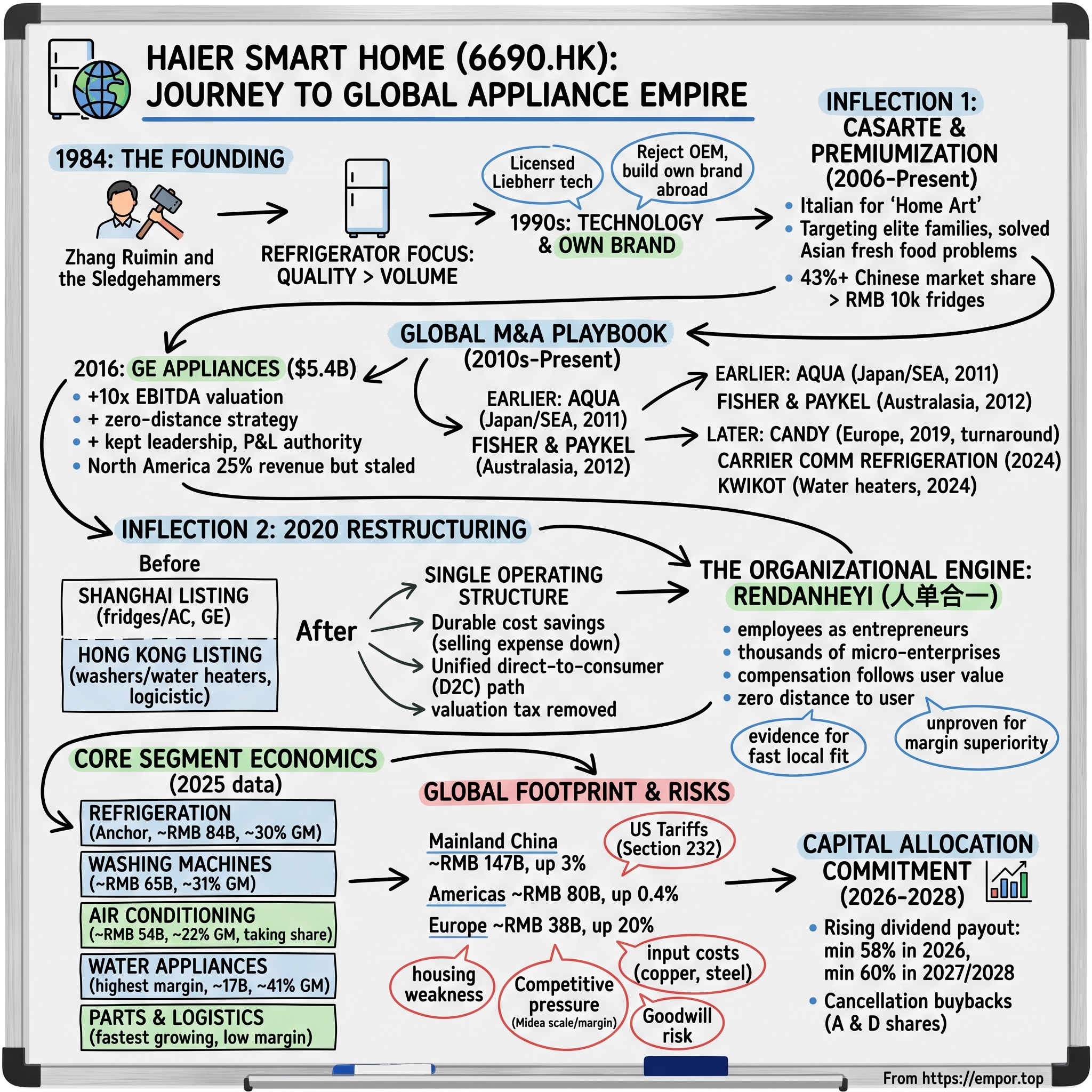
Haier Smart Home: From Smashed Fridges to Global Appliance Empire
I. Introduction & The $42B Global Appliance Titan (00:00 – 00:12)
A record year that nobody celebrated
On the evening of March 26, 2026, 海尔智家 Haier Smart Home published a set of numbers that its investor relations team had waited four decades to print. Global revenue had crossed RMB 300 billion for the first time in the company's history — RMB 302.35 billion, up 5.71% year on year — and net profit attributable to shareholders reached a record RMB 19.55 billion.1 For a business that began in 1984 as a near-insolvent collective refrigerator plant in Qingdao with annual sales of RMB 3.48 million, the arithmetic is almost absurd: revenue had compounded by a factor of roughly 87,000 across a single working lifetime.4
And yet the market's reaction was not celebration. Because buried inside that record year was a fourth quarter that fell apart. October through December revenue declined about 6.7% and net profit collapsed roughly 39% against the prior-year quarter, with gross margin sinking to 24.79% versus the 26.7% full-year average.3 China's appliance retail market shrank 4.3% for the year to RMB 893.1 billion, and the second half was brutal — down 16% as the government's trade-in subsidy program lapped its own success.2 Then came the first quarter of 2026: revenue of RMB 73.69 billion, down 6.86%, and net profit of RMB 4.65 billion, down 15.22%.1819
So the story of Haier in mid-2026 is not the story of a company at a triumphant peak. It is the story of a company that spent forty years buying its way into the hardest, most expensive form of globalization — and is now being asked, by tariffs and by a saturated home market, whether that bet actually pays.
The global anomaly
Here is what makes Haier genuinely unusual among Chinese industrial champions. In 2025, for the first time, the company earned more outside mainland China than inside it: RMB 155.79 billion overseas versus RMB 146.55 billion domestically.2 That would be unremarkable for a contract manufacturer.
But almost none of Haier's overseas revenue comes from stamping out white-label machines for Western brands. It comes from brands Haier owns or licenses and sells under its own signage — GE Appliances in the United States, Candy and Hoover in Europe, Fisher & Paykel in Australasia, AQUA across Southeast Asia and Japan, 卡萨帝 Casarte and 统帅 Leader at home. Seven consumer brands in total, each aimed at a different consumer and a different price band.2
That was a choice, and an expensive one. In the late 1990s the obvious way for a Chinese appliance maker to go global was to accept original-equipment orders from Whirlpool, Electrolux, or Sears: guaranteed volume, no marketing spend, no distribution build, no warranty risk. 张瑞敏 Zhang Ruimin refused, insisting instead on 自主创牌 — building the company's own brand abroad. Haier opened a US office in March 1999, broke ground on a $40 million refrigerator plant in Camden, South Carolina in April of that year, and started production in March 2000 — the first Chinese manufacturer to put real bricks and mortar into American production.5
Twenty-six years later, that decision explains both the bull case and the bear case in a single number. Haier's overseas gross margin in 2025 was 24.58%, versus 28.81% at home.2 Owning brands means owning the cost of owning brands: local sales forces, local warranty networks, local factories, local marketing, and — increasingly — local tariff exposure.
The peer comparison sharpens the point. 美的集团 Midea Group, which grew up with a much larger original-equipment book, generated H1 2025 revenue of RMB 252 billion at a net margin above 10%; 格力电器 Gree Electric, concentrated in domestic air conditioning, earned RMB 29 billion of net profit on RMB 170.4 billion of revenue in 2025 — a net margin near 17%.2120 Haier's 2025 net margin was about 6.5%.
Haier is therefore the biggest, the most global, and the least profitable per unit of revenue of the Chinese big three. Every serious argument about this stock is an argument about whether those three facts are causally linked, and in which direction.
The roadmap
This episode walks through five inflection points and then tests them. First, the founding crusade — compressed, because the sledgehammer story matters mainly for what it explains about today. Second, the 2006 invention of Casarte, an attempt to build a genuine luxury brand inside a mass-market manufacturer. Third, the acquisition machine, anchored by the 2016 purchase of GE Appliances and extended in 2024 into commercial refrigeration. Fourth, the December 2020 privatization of Haier Electronics, a piece of corporate plumbing that quietly changed the company's cost structure. Fifth, 人单合一 Rendanheyi, the management system Haier claims is its real moat — a claim that deserves interrogation rather than applause. Then the segment economics, the people running the place, the competitive war-game, and the two or three numbers that will actually settle the argument.
The through-line: Haier has spent forty years converting margin into optionality. The question for the next decade is whether the optionality converts back.
 Subscribe on LinkedIn
II. Succinct Origins: Sledgehammers, Quality, & The Brand Choice (1984–2005) (00:12 – 00:24)
Seventy-six refrigerators
Picture a factory floor in Qingdao in 1985. Concrete, poor lighting, a workforce with no particular reason to care. The Qingdao Refrigerator Factory had run through several managers in quick succession and was deep in debt. The man the local government had installed in 1984 was Zhang Ruimin, then in his mid-thirties, a party-appointed administrator with no glamour and no obvious mandate other than to stop the bleeding.
Then a customer came back with a broken refrigerator. Zhang went into the warehouse and started checking. He found 76 units with defects. In an economy where refrigerators were rationed luxuries and a flawed unit could still be sold at a discount to a grateful buyer, the commercially rational move was obvious: discount them, move them, book the cash. Zhang did the opposite. He had the 76 machines lined up, handed out sledgehammers, and made the workers who had built them destroy them in front of everyone.4
It is now one of the most-told parables in Chinese business, and it has been polished by four decades of retelling. But the underlying logic was sound and is worth stating plainly: in a market with no consumer protection, no brand infrastructure, and no reliable competitor quality, the fastest way to build pricing power was simply to be the one manufacturer whose product worked. Zhang was not making a moral argument. He was making a positioning argument with a blunt instrument.
Importing capability instead of copying it
Haier's second early decision was technological. Rather than reverse-engineer, the Qingdao plant licensed refrigeration technology from Germany's Liebherr — the name "Haier" itself is a phonetic residue of that partnership. This mattered because it established a pattern that recurs throughout the company's history: Haier prefers to buy or license capability from an incumbent and then re-engineer the commercial model around it, rather than build from zero. GE Appliances in 2016 and Carrier's commercial refrigeration arm in 2024 are the same move at 10,000 times the scale.
By the 1990s Haier was China's leading domestic refrigerator brand, and the company faced the question every successful national champion in a developing market eventually faces: what now?
The hard road
The consensus answer among Chinese manufacturers was straightforward — become the world's factory. Western brands wanted low-cost capacity. Accepting those orders meant instant scale, working capital that turned quickly, and no need to teach American or European consumers how to pronounce your name.
Zhang went the other way, and he articulated the reason with unusual clarity. As he put it in describing the American strategy, the objective was to "make Americans feel that Haier is a localized US brand instead of an imported Chinese brand."5 That sentence contains the whole doctrine. Not "sell into America" — be American, in the consumer's mental filing cabinet.
The execution was patient and, initially, small. Haier did not attack full-size refrigerators against Whirlpool and GE. It went for the segments the incumbents did not care about: compact dormitory refrigerators, small chest freezers, wine coolers, portable air conditioners. Products with low absolute price points, high student and second-home demand, and — critically — retail shelf space that the majors were happy to concede.
It worked as a wedge. By the early 2010s Haier held roughly 20% of the US compact refrigerator market, about 16% of room air conditioners, and around 22% of portable air conditioners.5 Those were not glamorous categories, but they bought something no original-equipment contract could: a relationship with Home Depot, Lowe's, and Best Buy buyers, a service network, and a brand that American consumers had at least heard of. In appliances, distribution access is the scarce asset — a great machine with no shelf is a hobby.
The Camden plant was the physical expression of the same idea, and at the time it was widely mocked as economically irrational — why manufacture refrigerators in South Carolina when you can ship them from Qingdao? In 1999 the answer was reputational. In 2026, with Section 232 steel-derivative tariffs applying to imported refrigerators, washers, and dryers, the answer looks rather different.17
What the early history means for today
Three things carry forward. The quality-first origin story is why Haier's brand in China supports a premium at all, which is the precondition for everything Casarte later became. The Liebherr precedent explains a management team that is culturally comfortable buying foreign capability, which is why Haier's cross-border deals have generally not blown up. And the own-brand export decision is the direct cause of Haier's structurally lower margin than Midea and Gree — the company carries decades of accumulated distribution and brand overhead that a pure exporter never built.
That is the trade the entire investment case rests on: Haier bought the harder asset. Whether the harder asset compounds faster is an empirical question, and the first real test came not overseas but at home, when China's own consumers started getting rich.
III. Inflection Point 1: The Creation of Casarte (卡萨帝) & China Premiumization (2006–Present) (00:24 – 00:42)
The trap of being number one
By the mid-2000s Haier had a problem that looked like success. It was the dominant mass-market appliance brand in China — and being the dominant mass-market brand in China in 2006 meant being trapped in a price war. Domestic competition had turned white goods into a commodity knife-fight. Meanwhile, in the marble-floored appliance halls of Shanghai and Beijing department stores, the machines that affluent Chinese families actually aspired to buy carried German and Italian nameplates: Miele, Bosch, Siemens. Haier could sell a refrigerator to a hundred million households. It could not sell one to the household that had just bought a BMW.
The instinct in most companies is line extension — a "Haier Premium" tier, a special badge, a stainless finish. It nearly always fails, for a reason any consumer marketer will recognize: a brand's ceiling is set by its cheapest product. Zhang's team chose the more expensive path and created a separate brand from scratch.
Casarte, 2006
The name is Italian by construction: la casa for home, arte for art. The positioning was aggressive to the point of comedy — the brand's own materials describe designing for "the needs of 0.03% elite families," backed by 14 design centres and more than 300 designers drawn from a dozen countries.6 Casarte was given its own design language, its own retail environments, its own engineering priorities, and — importantly — its own distribution. A Casarte refrigerator was not to be found on the same shelf as a Haier one.
The engineering was where the strategy earned its keep. Rather than importing European premium features wholesale, Casarte solved specifically Asian problems. Multi-zone humidity and temperature control matters enormously in a cuisine built on fresh fish, leafy greens, and delicate proteins that spoil at different rates — a single-temperature European refrigerator is simply the wrong tool. Quiet, low-agitation wash cycles matter when the garment is silk rather than cotton.
The 2025 vintage of that thinking arrived as the Zhijing series, with a proprietary nitrogen-based freshness system, and the Connoisseur and Maestro suites built around an in-house multimodal "AI Vision" platform that recognises ingredients and flags laundry colour-bleed risk.2 It is worth separating the two claims embedded there. Whether consumers will pay a premium for artificial intelligence in a refrigerator is genuinely unproven and should be treated as marketing until attach rates are disclosed. Whether they pay for a machine that keeps sashimi-grade fish edible for a week is long settled.
Where Casarte stands now
The results are, by any measure, the most successful premium brand-building exercise in Chinese consumer durables. In 2025 Casarte's retail volume exceeded RMB 38 billion, it counted a cumulative base of 20 million premium members, and its brand value was assessed at RMB 92.8 billion.2 In the segments that define Chinese luxury appliance buying, its share is extraordinary: roughly 43–44% of refrigerators priced above RMB 10,000, around three-quarters of washing machines above that threshold, and 60.8% of air conditioners priced above RMB 15,000 — the last of those being a category Haier historically lost to Gree.2
Stop and consider what that share means structurally. In the mass market, Haier competes for every unit against Midea on price. In the above-RMB-10,000 washing machine market, Haier is the market. That is the difference between being a manufacturer and owning a franchise, and it is the single most valuable asset the company built organically rather than by cheque.
Haier has since run the same playbook downmarket. 统帅 Leader, aimed at younger urban buyers, crossed RMB 10 billion in revenue for the first time in 2025, growing about 30% on the back of a viral triple-drum washing machine designed around the insight that young people would rather separate laundry by machine compartment than by wash cycle.2 The core Haier brand, meanwhile, grew retail sales about 8%, helped by an entry-level AI suite that sold more than 5.7 million units.2 Three brands, three price tiers, one manufacturing base.
Myth versus reality: does premium mix protect margin?
Here the analysis has to part company with the marketing. The standard narrative — repeated in sell-side notes for a decade — is that Casarte's premium mix drives continuous domestic gross margin expansion. In 2025 it did not. Domestic revenue grew a modest 3.05%, and domestic gross margin fell 1.03 percentage points to 28.81%, even as Casarte grew double digits and mix improved.2 Management's explanation was specific rather than evasive: efficiency savings were offset by rising commodity costs — copper in particular — and by intensified fourth-quarter price competition as subsidy-driven demand evaporated.3
That is the honest read on premiumization. A luxury sub-brand is a powerful defence against being commoditised. It is not a force field against the commodity cycle or against a demand air pocket. Casarte gives Haier a segment where it sets price; it does not exempt the other RMB 108 billion of domestic revenue from a market that shrank.
There is also a natural-limit question that investors should hold in mind. When a brand already holds three-quarters of a defined premium segment, incremental growth has to come from expanding the definition of premium — more categories, lower-tier cities, or overseas. Management is doing exactly that, with plans for 100 new Casarte experience centres and 300 flagship stores across tier 1–3 cities.2 But retail buildouts consume capital and operating expense in the near term and pay back later, if they pay back. It is a growth strategy with a real cost line attached.
Casarte proved Haier could manufacture desire at home. The far larger question was whether it could buy desire abroad — and that took the company to Louisville.
IV. Inflection Point 2: The Global M&A Playbook & The GE Appliances Acquisition (00:42 – 01:04)
How antitrust handed Haier an American icon
In the summer of 2015, the US Department of Justice did Haier an enormous favour. General Electric had agreed in 2014 to sell its appliances division to Electrolux for $3.3 billion. On July 1, 2015 the DOJ sued to block it, arguing that combining two of America's leading makers of ranges, cooktops, and wall ovens would eliminate competition that had kept prices down. GE terminated the Electrolux agreement on December 7, 2015 and reopened the process.7
Six weeks later, on January 15, 2016, GE announced a definitive agreement to sell the business to Qingdao Haier for $5.4 billion in cash. The deal closed on June 6, 2016, generating proceeds of about $5.6 billion for GE.78 GE's own announcement disclosed the multiple: approximately 10 times trailing EBITDA.7 Jeff Immelt's public rationale was notable for what it conceded — that Haier had "a good track record of acquisitions and of managing brands," and that innovation and brand management were fundamental to Haier's strategy.7
At the time the transaction was widely questioned. Ten times EBITDA was above the mid-to-high single-digit multiples that had characterised appliance transactions, and the asset itself was a slow-growth American legacy division that GE had been trying to exit for years. Chinese acquirers of Western industrial brands had an unhappy record. The bear case wrote itself: a state-adjacent Chinese buyer overpaying at the top of the cycle for a unionised, low-margin, culturally alien business in Kentucky.
Why it worked
Haier's integration approach inverted the standard cross-border template. It did not send Chinese managers to Louisville. It kept the GE Appliances headquarters, the management team, the workforce, and — through a long-term licence agreement — the GE brand itself.7 What it changed was the operating system: the layers of corporate approval that a division of a conglomerate accumulates. GE Appliances stopped being a business unit reporting into a matrix and started behaving like an independent company with its own P&L authority.
The proof point most often cited is not a margin number but a behaviour. GE Appliances now describes its own manufacturing strategy in Haier's language: CEO Kevin Nolan framed the 2025 decision to build washers in Kentucky as "fundamental to our 'zero-distance' business strategy to make appliances as close as possible to our customers and consumers."16 When an American executive team adopts the acquirer's internal vocabulary voluntarily, something real transferred.
The commercial results, as disclosed, are solid but should be read carefully. GE Appliances held the number one industry position in the United States for a fourth consecutive year in 2025, its premium revenue grew 7% against a declining market, and its Air & Water Solutions business — residential and commercial HVAC and water heating — grew double digits.12 Lowe's named it 2025 Vendor Partner of the Year.2 Haier does not break out GE Appliances' revenue or operating margin separately, so the frequently quoted claim that operating margins roughly doubled under Haier ownership cannot be verified from the company's filings; treat it as directional, not disclosed.
What is disclosed, and more important, is that in 2025 the Americas generated RMB 79.87 billion of revenue — up just 0.4% year on year, and the flattest of Haier's major regions.2 The North American business is now the group's single largest geographic exposure at roughly a quarter of revenue, and it stalled.
The rest of the shopping list
Before GE, Haier had bought Sanyo's white-goods operations in Japan and Southeast Asia in 2011, a deal that gave it the AQUA brand and an Asian manufacturing and distribution footprint, and in 2012 it took full control of New Zealand's Fisher & Paykel, whose direct-drive motor engineering fed into Casarte and Australasian premium positioning.
After GE came Europe. On January 8, 2019 Haier completed the acquisition of Italy's Candy Group for €475 million — roughly 5,000 employees, seven plants across Europe, Turkey, and China, 45 subsidiaries, and the Candy, Hoover, and Rosières brands, with Brugherio outside Milan becoming Haier Europe's headquarters.9 Candy was a turnaround, not a trophy: a sub-scale European maker in a market dominated by Bosch-Siemens and Electrolux.
Then the strategy widened beyond household appliances. On October 2, 2024 Haier completed the purchase of Carrier's commercial refrigeration business for an enterprise value of about $775 million, including roughly $200 million of net pension liabilities — supermarket refrigeration, cold-chain and food-retail systems, with brands including Profroid, Celsior, and Green & Cool.10 Two months earlier it had agreed to buy South Africa's Kwikot, the country's largest water-heater manufacturer, founded in 1903, from Electrolux for ZAR 2.45 billion; that deal completed on December 3, 2024.11
Both 2024 acquisitions had their first full year in 2025, and the disclosed outcomes are the best available evidence on whether Haier's integration machine still works. Carrier Commercial Refrigeration grew revenue double digits — 16% in Asia-Pacific — while simultaneously exiting Carrier's shared services under a transition agreement and building standalone finance, IT, and supply-chain functions.2 Kwikot delivered profit growth of about 10% versus pre-acquisition levels at a pre-tax margin of 12%, and started extending into solar water heating, purification, and air conditioning.2 Neither is large enough to move group earnings. Both suggest the playbook — buy the incumbent, keep the brand and the people, remove the corporate overhead, hand over the P&L — is repeatable.
The activist's counter-argument
A sceptical investor would push back on three fronts, and each has some force.
First, serial acquisition is a habit, and habits outlive their usefulness. Haier has bought a Japanese division, a New Zealand premium brand, an American icon, an Italian turnaround, a French-led commercial refrigeration business, and a South African water-heater maker. Commercial refrigeration and building HVAC are genuinely different businesses from household appliances — different customers, different sales cycles, different service economics. The word for this pattern when it fails is diworsification, and the fact that it has not failed yet is not proof that it cannot.
Second, the balance sheet has quietly changed character. Haier ended 2024 in a net cash position; at the end of 2025 it carried net debt of roughly two-thirds of one year's EBITDA. That is still conservative by any industrial standard, but the direction — funded by acquisitions and buybacks — is worth watching for a company also committing to a rising dividend.
Third, and most concretely, the acquisitions sit on the balance sheet as RMB 27.30 billion of goodwill, which Haier's auditors identified as a key audit matter requiring judgment on cash-flow conversion assumptions.2 No impairment was taken. But goodwill of that size against RMB 19.55 billion of annual net profit means a serious write-down in any acquired unit would be an earnings event, and the units most exposed to a demand shock — North America and Europe — are precisely where the goodwill originated.
The deeper point about the M&A record is that it created a structural asymmetry Haier now has to manage. Buying local brands gave it pricing power and tariff resilience that exporters lack. It also gave it a cost base spread across a dozen jurisdictions, four currencies, and multiple regulatory regimes. Which is why, by 2020, the most valuable thing management could do was not buy another company — it was to simplify the one it already had.
V. Inflection Point 3: The 2020 Restructuring — Privatizing Haier Electronics (01:04 – 01:19)
Which Haier?
For most of the 2010s, an investor who wanted to own Haier's Chinese appliance business faced a genuinely irritating question: which Haier?
The answer was two. 青岛海尔 Qingdao Haier, listed in Shanghai since 1993, owned the refrigerator and air-conditioning manufacturing base and the overseas businesses, including GE Appliances. Its majority-owned subsidiary, Haier Electronics Group, listed in Hong Kong under the code 1169, owned the washing-machine and water-heater businesses plus the domestic distribution and logistics arms. One company built a large share of the products. Another company sold them.
If that sounds like an accounting inconvenience, consider the operating consequences. Every transfer of goods between manufacturing and distribution required a transfer price, and every transfer price was a negotiation between two entities with two separate sets of minority shareholders, two boards, two audit processes, and two sets of management incentives. Profit that arose from the combined system had to be allocated between them. Cash that flowed to the Hong Kong subsidiary leaked to its minorities before reaching the Shanghai parent. Inventory sat in two ledgers. Any attempt to build a single digital view of what was in which warehouse in which province ran straight into the fact that the warehouses belonged to different listed companies.
For a business whose entire claimed advantage is speed of response to consumers, this was a self-inflicted handicap.
The transaction
Haier announced the resolution on July 31, 2020: Haier Smart Home would privatise Haier Electronics through a scheme of arrangement, with the scheme document dispatched on November 16, 2020.12[^13] The structure was elegant. Rather than paying out cash it did not want to spend, Haier Smart Home paid mostly in paper — 1.60 newly issued H shares plus HK$1.95 in cash for each Haier Electronics share, with the cash component capped at roughly $446 million against a transaction valuing the subsidiary at about $11.4 billion.12 To make those new H shares tradeable, Haier Smart Home simultaneously listed in Hong Kong. Haier Electronics delisted and the enlarged parent began trading under 6690.HK on December 23, 2020.
The result was a company listed in three places at once — Shanghai A-shares, Hong Kong H-shares, and the D-shares Haier had listed in Frankfurt in 2018 — but with a single operating structure underneath.12 Triple-listed and singly-run is a strange configuration, and it exists because each listing solved a different problem: A-shares for domestic capital, D-shares for European visibility, H-shares as acquisition currency for this specific deal.
Did it pay off?
This is where the standard narrative needs auditing. The commonly repeated claim is that unification cut the combined selling and administrative expense ratio by 200–300 basis points over the following three years. Haier's own disclosure for 2025 is more granular and less tidy. The selling expense ratio was 11.2%, an improvement of 0.6 percentage points year on year, attributed to digital allocation of marketing spend and better logistics and warehouse operations at home plus retail and resource integration abroad. But the administrative expense ratio rose 0.3 points to 4.6%, because one-off restructuring costs and marketing expansion overseas outweighed domestic efficiency gains.2
So the honest verdict is that structural simplification produced a durable, grinding improvement in the cost of selling — the line most directly affected by merging manufacturing and distribution — while the cost of administration has become a function of how much overseas reorganisation is in flight in any given year. Investors should track those two lines separately rather than as a blended figure, because they are telling different stories.
The operational payoff is easier to see. With one entity owning both the factory and the channel, Haier could finally rebuild the domestic route to market. By 2025 a centralised distribution model accounted for 57% of total shipments, dealers were being connected directly to retail outlets, service was being delivered directly to consumers, and domestic inventory turnover improved year on year.2 Management has committed to completing the direct-to-consumer rollout with a target of 100% direct delivery to end consumers during 2026.2 Each removed handling step is a small amount of working capital freed and a small amount of damage and return risk eliminated — unglamorous, cumulative, and difficult for a competitor operating through layered distributors to match.
The investor lens
There is a broader lesson here that generalises well beyond Haier. Complex corporate structures impose a valuation tax that is invisible until it is removed. Before 2020, an analyst modelling Haier had to forecast two sets of financials, guess at intercompany pricing, and haircut the result for governance risk. After 2020, the model is one company. That does not make the business better by itself — but it removes a reason for the market to demand a discount, and it removes management's excuse for opacity.
It also raises the bar. A unified Haier can no longer attribute margin underperformance versus Midea to structural complexity. The structure is fixed. What remains is execution — and execution, at Haier, has a name.
VI. The Organizational Engine: Rendanheyi (人单合一) & Operating Mechanics (01:19 – 01:34)
The management philosophy problem
There is a genre of management thinking that business schools love and investors should treat with suspicion: the proprietary organisational philosophy. It is unfalsifiable, endlessly quotable, and usually a poor guide to earnings. Haier's version, 人单合一 Rendanheyi, has been the subject of Harvard Business School cases, a Harvard Business Review cover essay by Gary Hamel and Michele Zanini arguing that Haier had effectively abolished bureaucracy, and detailed McKinsey write-ups.1314 It appears in Haier's annual report as a named competitive advantage.2
So it deserves both a plain-English explanation and a genuine stress test.
What the words mean
Ren (人) is people — specifically, employees treated as entrepreneurs rather than functionaries. Dan (单) is the order, or more precisely the user's demand and the value created in meeting it. He yi (合一) is the fusion of the two. Zhang Ruimin's proposition, developed from the mid-2000s onward, was that a company should not be a hierarchy with a market outside it, but a market with a light platform around it.
The practical mechanic is this: instead of departments that report upward, Haier organised itself into thousands of small units — micro-enterprises — each with its own profit and loss, its own authority over hiring and pay, and its own product decisions. A useful analogy is a shopping mall versus a department store. In a department store, head office decides what every counter sells and every clerk earns. In a mall, the landlord provides the building, the footfall, the power, and the plumbing; each tenant decides its own assortment, sets its own prices, hires its own staff, and lives or dies on its own numbers. Rendanheyi turned Haier into the mall, with corporate providing shared R&D platforms, procurement scale, capital, and brand.
Crucially, compensation follows user value rather than managerial approval. In a conventional structure, an engineer's raise depends on a manager's assessment. In Haier's, a micro-enterprise's compensation pool depends on whether the thing it built actually sold and whether the users it served came back. That is a genuinely different incentive gradient, and it is the mechanism behind the phrase Haier uses constantly: zero distance to the user.
The falsification test
Here is the problem with process-power claims: any company can assert one. The way to evaluate Rendanheyi is to ask what it should predict, and then check.
It should predict fast, cheap, locally-specific product iteration in markets where a headquarters-driven competitor would move slowly. There is real evidence for this. Haier's emerging-market portfolios are not adapted Chinese products; South Asia got a purpose-built series that drove significant share gains, Southeast Asia received large-drum machines and voice-controlled air conditioners tuned to local channels, and the results show up in the numbers: South Asia revenue grew 23% in 2025 to RMB 14.20 billion, Southeast Asia grew about 13% to RMB 7.52 billion, and Middle East and Africa grew more than half to RMB 4.17 billion.2 In Pakistan revenue grew over 30% with share above 40% in refrigerators, washers, and air conditioners.2 Those are not the growth rates of a company waiting for headquarters to approve a product brief.
It should also predict successful transplantation into acquired Western businesses. The evidence here is mixed and more interesting. Europe is the strongest case: in 2025 Haier stripped out regional management layers so that headquarters and local teams operated directly against shared objectives, migrated production capacity toward Turkey, Southeast Asia, and China, and pivoted from chasing volume to chasing price. European revenue grew about 20% to RMB 38.49 billion, average selling prices rose more than 10%, and profitability improved substantially.2 For an asset that was a distressed sub-scale turnaround at acquisition, that is a real result — and it took six years.
And it should predict resilience under stress. This is where 2025 and early 2026 provide the most useful evidence, because North America was under genuine stress and Rendanheyi did not save it. Tariffs on steel-content appliances, weak US consumer confidence, a frozen housing market, and — in the first quarter of 2026 — severe winter weather combined to push regional demand down roughly 10%.19 Organisational agility does not neutralise a border tax. On the Q1 2026 release, Chairman 李华刚 Li Huagang described the response as "reshaping our local supply chain, advancing sourcing actions, moving the product mix upmarket, and driving cost productivity."18 That is a specific plan rather than a deflection, which counts for something. It is also, in substance, exactly what any competent appliance executive would do, with or without micro-enterprises.
The honest conclusion
Rendanheyi is best understood not as magic but as a cost structure choice with a behavioural dividend. By pushing P&L accountability down, Haier gets faster local product-market fit, which is worth a great deal in fragmented emerging markets where a single global SKU fails. What it does not do is generate structural margin advantage — if it did, Haier would not be the least profitable of the Chinese big three per unit of revenue. And there is a plausible reverse reading: thousands of semi-autonomous units, each with its own overhead, may be part of why Haier's administrative costs run higher than a centralised competitor's.
Investors should weight the model as a demonstrated capability in market entry and product localisation, and as unproven in delivering peer-leading profitability. Which brings us to where the profitability actually comes from.
VII. Core Business Deep Dive: Segment Economics, Scale, & Competitors (01:34 – 01:54)
137 million machines
Strip away the management philosophy and the brand architecture, and Haier is a machine that made and sold about 137 million appliances in 2025 — 139 million produced, 137 million sold, with sales volume up 7.9%.2 Understanding the investment case means understanding which of those units make money.
The product mix, and the mix problem
Refrigeration remains the anchor: RMB 84.17 billion of revenue at a 30.15% gross margin, though it grew only 1.1%.2 Washing machines are similar in character — RMB 64.98 billion at 30.90% gross margin, up 3.1%.2 These two categories, where Haier holds Chinese offline share of 47.7% and 47.4% respectively and global leadership by retail volume, are the profit engine.12
Air conditioning is the growth story and the margin drag simultaneously: RMB 53.74 billion, up 9.6%, but at a 22.44% gross margin — roughly eight points below refrigeration.2 Haier has been taking share in a category historically owned by Gree and Midea, lifting online share 0.6 points and offline share 1.8 points in China with domestic revenue growing double digits.1 Winning share in a competitor's stronghold generally costs price, and the margin shows it.
Kitchen appliances contributed RMB 41.32 billion at 28.57%, essentially flat.2 The highest-margin business in the entire company is the smallest: water appliances — water heaters and purification — at RMB 17.47 billion with a 40.68% gross margin, growing nearly 11%.2 Water heaters are a quietly excellent business: replacement-driven, installer-mediated, technically differentiated, and much less exposed to the flat-panel price transparency that crushes refrigerator margins. It explains why Haier bought Kwikot and why GE Appliances is expanding into water heating.
Then there is the line most investors skip and shouldn't: equipment parts and channel integrated services, RMB 38.89 billion, growing 19.9% — the fastest-growing line in the company — at a gross margin of 9.34%.2 Do the arithmetic on mix. The fastest-growing segment carries roughly a third of the group's average margin. That alone explains a meaningful part of why group gross margin fell 1.1 points to 26.7% in a year when the premium brands grew double digits.2 It is a reminder that reported margin is an outcome of mix as much as of pricing power, and that a company growing its lowest-margin line fastest will look worse than it is operating — or better, depending on your view of whether logistics and parts revenue deserves to be there at all.
The geography, and where the risk sits
Haier reorganised its air conditioning, smart building, and water solutions businesses into a single HVAC division that now represents roughly a quarter of company revenue — a structural bet that climate control, not refrigeration, is the growth category.2
Geographically, the 2025 disclosure is the most important table in the annual report. Mainland China: RMB 146.55 billion, up 3.1%.2 The Americas: RMB 79.87 billion, up 0.4%.2 Europe: RMB 38.49 billion, up 20%.2 South Asia, Southeast Asia, and Middle East and Africa together added roughly RMB 25.9 billion and grew fastest.2 Australia was flat at RMB 6.70 billion; Japan grew 10% to RMB 3.78 billion.2
Read that as a portfolio and a clear picture emerges. Haier's two largest markets — China and North America, together about three-quarters of revenue — grew between zero and three percent. Everything growing quickly is small. That is the central tension in the equity story: the growth is real but it is not yet large enough to offset stagnation in the core, which is precisely what the 2025 second half and Q1 2026 demonstrated.
The war-game
In China the structure is a genuine oligopoly, and each of the big three occupies a different strategic position. Gree is the pure play: concentrated in air conditioning, revenue down 9.9% to RMB 170.4 billion in 2025 with net profit down the same, yet a domestic gross margin of 34.52% and operating cash flow up 58% to RMB 46.3 billion, funding a total 2025 payout of RMB 16.7 billion.20 Gree is smaller, shrinking, and vastly more profitable per yuan of revenue — the reward for category concentration and domestic focus.
Midea is the scale play, and the most direct threat. Its H1 2025 revenue reached RMB 252 billion, up 15.7%, with net profit up 25% to RMB 26 billion and international revenue growing 17.7% — faster than domestic.21 Midea is roughly half again Haier's size, growing faster, earning a materially higher net margin, and is now attacking Haier's own thesis by pushing its own brands overseas rather than relying on original-equipment work. It is also diversified into commercial HVAC, robotics, and industrial technology, which gives it profit pools Haier does not have.
Globally, Whirlpool and Electrolux are the legacy Western incumbents — both structurally challenged, both having sold assets to Haier — while Samsung Electronics and LG Electronics compete in premium connected appliances with far larger consumer electronics ecosystems behind them.
What actually drives demand now
The demand drivers are worth stating plainly because they are not the ones investors instinctively reach for. This is no longer an urbanisation story in China. Total appliance ownership exceeds 4 billion units, more than eight per household; replacement demand is the market.2 Which makes policy unusually important: the 2026 subsidy scheme covers six categories meeting top-tier energy or water efficiency standards, at 15% of the sale price capped at RMB 1,500 per item — a design that pushes consumers toward higher-efficiency, higher-priced models, which favours Haier's mix but against a high 2025 base.2 Alongside that sits a genuinely new structural driver: China's "silver economy" for senior-friendly appliances exceeded RMB 100 billion in 2025, with 323 million people aged 60 and above representing 23% of the population.2 Then the input side — copper, steel, resin — and, for the overseas half, freight and tariffs.
The company's own read on the industry is worth quoting because it is unusually candid for an annual report. Li Huagang wrote that shifting trade policy would "weigh on returns on capital and drive consolidation," that Haier is "still in the middle-to-late stages of that adjustment," and that the number of global appliance players is shrinking with some retreating to their home markets.2 Translated: management expects the industry to get harder and expects to be a survivor rather than an escapee. That is a more sober framing than the growth narrative the stock has historically been sold on.
Whether the survivors' club is the right place to invest depends heavily on who is doing the surviving.
VIII. Current Management, Incentives, & Capital Allocation (01:54 – 02:06)
The founder who actually left
On November 6, 2021, Zhang Ruimin — then 72, having run the company since 1984 — voluntarily stepped down as chairman of Haier Group and declined to participate in nominating new directors. He became honorary chairman. 周云杰 Zhou Yunjie, the group president, took over as chairman and chief executive.4
Founder transitions in Chinese private enterprise are frequently messy, delayed, or nominal. This one was none of those. Zhang left the board, took an honorary title, and did not linger operationally. For a founder whose personal mythology was inseparable from the company's — the man with the sledgehammer — that is an act of institutional discipline worth noting, because the alternative pattern (the founder who never quite leaves) is a recurring source of governance risk across Asian industrials.
The two men at the top
Zhou Yunjie joined Haier in 1988 out of Huazhong University of Science and Technology and has spent his entire career inside the company. As group chairman he owns the wider Haier ecosystem — the industrial internet platform, the biomedical and financial affiliates, and the overarching Rendanheyi doctrine — rather than the listed appliance business day-to-day.
The person accountable to shareholders of 6690.HK is Li Huagang. Born in 1969, he graduated from the same university as Zhou in 1991 with an economics degree, joined Haier that year, and later added an EMBA from China Europe International Business School in 2014.2 His career is a tour of the company's commercial engine: sales in the marketing and promotion division, then general manager of China operations, then chief executive of Haier Electronics from August 2017 to March 2019 — which means the man who ran the Hong Kong subsidiary later executed its absorption into the parent. He became president of Haier Smart Home in 2019 and is now chairman, chief executive, and the company's legal representative, aged 57.2 He was named to Forbes' 2024 China Best CEO list.2
That biography matters for one specific reason: Li is a distribution and brand operator, not an engineer or a financier. His formative wins were commercial — scaling Casarte, rebuilding the Chinese channel, and unwinding the dual-listed structure he had run one half of. It is consistent with where the company has actually improved: route to market, premium mix, and channel cost. It is also consistent with where it has not: manufacturing-driven margin structure, where Midea leads.
Below Li, the bench is notably long-tenured and internally grown. Wu Yong, who runs refrigeration and kitchen appliances, joined in 2001. Guan Jiangyong, who runs HVAC, also joined in 2001 and came up through water heaters. The exception, and a telling one, is Huang Xiaowu, appointed vice president in 2021 with responsibility for investor relations, capital markets, and strategic investment — a career banker from ICBC, Guosen Securities, and Anglo Chinese Investment who previously served as deputy general manager of Haier Electronics.2 Hiring a capital-markets professional into the executive suite is what a company does when it has decided that how it is understood by investors is a management problem, not a communications one.
Ownership and incentives
Haier's shareholder register has no controlling family and no single dominant state holder. The largest registered positions are HKSCC Nominees at 24.66% (the Hong Kong clearing house, representing H-share holders), Haier COSMO at 13.42%, Haier Group Corporation at 11.44%, and HCH (HK) Investment Management at 5.74% — with the Haier entities classified as domestic non-state-owned or foreign legal persons.2 The practical implication is a genuinely dispersed register in which the founding group retains influence through roughly a quarter of the shares rather than outright control. That is more shareholder-friendly than the typical Chinese industrial, and it also means less protection against outside pressure.
Compensation is aligned through an unusually elaborate set of instruments spanning all three listings: an A-Share Core Employee Stock Ownership Plan, an H-Share Core Employee Stock Ownership Plan, an H-Share Overseas Trust Incentive Plan for non-Chinese staff, and an A-Share Option Incentive Scheme — with the stated intent of covering domestic and overseas employees under one framework.2 Executive directors hold modest personal share and option positions rather than founder-scale stakes. The specific performance hurdles attached to each tranche are not laid out in a single consolidated disclosure, which is a legitimate transparency criticism: an investor cannot easily verify from the annual report alone how demanding the vesting conditions are.
Capital allocation: a promise being kept
For years the fair criticism of Haier was that it retained too much. Cash went into acquisitions and capacity while Gree and Midea returned more to shareholders. That has changed, and changed in a way that is verifiable rather than rhetorical.
For 2025 the company raised its cash dividend payout ratio to 55%, seven percentage points above 2024, with a final dividend of RMB 8.867 per 10 shares amounting to RMB 8.25 billion on top of the company's first-ever interim dividend of RMB 2.692 per 10 shares.2 Cumulative dividends since the 1993 A-share listing reached approximately RMB 48.7 billion.2 Then management went further and published a three-year commitment: a payout ratio of no less than 58% for 2026 and no less than 60% for both 2027 and 2028.12
Buybacks have become structural rather than opportunistic. Haier repurchased RMB 1.20 billion of A-shares during 2025.2 In the first quarter of 2026 it designated 74.54 million A-shares for cancellation, launched a new A-share repurchase programme of RMB 3–6 billion over twelve months with about RMB 600 million already deployed, and proposed a buy-back-for-cancellation of roughly 81 million D-shares.1819
The cancellation detail is what distinguishes this from cosmetic buying. Repurchased shares held in treasury can be reissued; cancelled shares permanently reduce the count and mechanically lift earnings per share. Committing to cancellation across both A-shares and the Frankfurt-listed D-shares is a harder promise to reverse, and it is being made at a moment when earnings are falling — which is when buybacks are most valuable and most tempting to abandon.
The credibility ledger
On the positive side: management set an explicit payout trajectory and has exceeded rather than trailed it; it disclosed the Q4 2025 and Q1 2026 deterioration promptly with specific rather than generic explanations; and it has been consistent across the annual report and quarterly releases in naming tariffs and North American demand as the problem rather than reaching for vaguer language. The chairman's letter concedes 2025 was "one of the most challenging business environments in our company's history" and explicitly states that North American trade conditions "pressured operating performance" — that is not the phrasing of a management team managing perceptions.2
On the negative side, two things warrant scrutiny. Research and development spending fell 6.26% in 2025 to RMB 10.10 billion while revenue rose — a decline of roughly 0.5 percentage points as a share of sales.2 For a company whose stated strategy is AI-enabled premium differentiation, cutting R&D in absolute terms during a margin squeeze is a choice that protects near-term earnings at some cost to the narrative. And the dividend commitment through 2028 was made simultaneously with continued acquisition appetite and a shift from net cash to modest net debt. Those are not incompatible, but they consume the same cash, and if 2026 earnings fall a rising payout ratio on a shrinking base is a smaller absolute dividend than the percentage implies.
The framework question, then, is whether Haier's advantages are strong enough to make the promise affordable.
IX. The Investment Spine: 7 Powers, 5 Forces, & Bull vs. Bear Case (02:06 – 02:21)
Separating advantage from rhetoric
Every long-term investment case eventually reduces to one question: why can this company earn returns above its cost of capital for a long time, and what would stop it? Hamilton Helmer's 7 Powers and Michael Porter's Five Forces are useful here not as a checklist but as a way to separate Haier's real advantages from its rhetoric.
Brand Power — strong, but geographically uneven. Haier has two genuinely powerful brands and one licensed one. Casarte commands share in Chinese premium categories that is closer to a franchise than a market position, and the ability to hold three-quarters of a price band is the definition of brand-derived pricing power. GE Appliances carries something subtler: a hundred-year-old American nameplate on machines made in American plants, licensed long-term, at a moment when country of origin has acquired real commercial value. Against that, the core Haier brand in most emerging markets is a value-for-money proposition rather than a premium one, and in Europe the Candy and Hoover names required a six-year repositioning before profitability improved. Brand power is real where it exists and thin where it doesn't.
Process Power — the most contested claim. Discussed at length above; the evidence supports Rendanheyi as a capability in localisation and post-acquisition integration, and does not support it as a source of margin superiority. A rigorous investor should score this as moderate, not strong, and should note that Midea's more centralised model currently converts revenue to profit better.
Scale Economies — strong but shared. At roughly 137 million units a year Haier has genuine buying power in steel, copper, compressors, and motors, and it amortises a single smart-appliance software platform across brands. But Midea is larger. Scale that a direct competitor also possesses is table stakes rather than advantage — it protects against smaller entrants, not against the peer that matters.
Cornered Resource — moderate. The Fisher & Paykel direct-drive motor heritage, the nitrogen-based freshness systems, the centrifugal atomisation technology in high-efficiency gas water heaters, and the carbon-dioxide refrigerant technology acquired with Carrier's commercial business are real proprietary assets.210 The more defensible cornered resource is arguably distribution: physical presence across Chinese tier 1–4 cities that took decades to build, now being extended with plans for more than 3,000 new county and township specialty stores and upgrades to over 6,000 existing locations.2 Rural Chinese distribution is expensive, slow, and nearly impossible to replicate quickly.
Switching Costs and Network Effects — emerging, and largely unproven. Haier's 三翼鸟 Sanyiniao smart-home platform is the vehicle for the ecosystem thesis: once a household's refrigerator, oven, air conditioner, and washer speak to one another through one app and one account, replacing a single unit with a competitor's breaks the system. If it works, it converts a durable-goods business with a ten-year replacement cycle into something with recurring engagement. The evidence that it is working is thin. Haier reports platform activity and 31.81 million social media followers, up 12%, but discloses no connected-household count, no attach rate for multi-appliance suites, and no revenue attributable to the platform.2 The suite-selling strategy — bundled sets marketed as complete solutions — is the more measurable version of the same idea, and bundled-set penetration is what an investor should watch as the leading indicator. Until then, treat the ecosystem as optionality, not moat.
Counter-Positioning — absent. Worth naming explicitly. Haier does not have a business model that incumbents cannot copy without damaging themselves. It competes in the same way as its rivals, better in some places and worse in others.
Porter's Five Forces
Rivalry is the dominant force and it is intense. Haier's own risk disclosure names it: persistent commoditisation across core categories, inventory imbalances in specific verticals leading to price wars, short product cycles, and the relative ease of copying.2 The fourth quarter of 2025 was a live demonstration.
Supplier power is moderate and cyclical — copper and steel are commodities Haier buys at scale, but management explicitly attributed part of the 2025 margin decline to rising commodity costs, so scale does not confer immunity.2 Buyer power is low at the individual consumer level and meaningfully higher at the retail level: Lowe's, Home Depot, and Best Buy in the US, and the major Chinese platforms domestically, control shelf and search placement. That GE Appliances was named Lowe's 2025 Vendor Partner of the Year is a real commercial asset precisely because that relationship is a chokepoint.2
Threat of new entrants is low in white goods — capital intensity, distribution, service networks, and safety certification are all barriers — with one caveat: Chinese consumer electronics and internet companies entering smart appliances via ecosystem plays rather than manufacturing excellence. Threat of substitutes is essentially nil at the category level; households will not stop refrigerating food. The more relevant substitution risk is technological within category, such as heat pumps displacing conventional water heating and air conditioning, which is a shift Haier is investing into rather than defending against.
The bull case, and what would prove it
The strongest version of the bull argument is not "Haier is the world's largest appliance maker." It is that the company's overseas margin gap is a fixable gap rather than a structural one, and that closing it is worth more than incremental revenue.
The evidence for fixability is Europe. A business that was a distressed sub-scale acquisition delivered roughly 20% revenue growth with average selling prices up more than 10% and substantially improved profitability, after management removed regional management layers and moved capacity to lower-cost hubs.2 If the same operating model can be applied in North America once tariffs are absorbed and localised production comes online, the arithmetic is powerful: the Americas generate about a quarter of group revenue at a gross margin nearly four points below domestic. Each point of overseas gross margin recovery is worth roughly RMB 1.5 billion of gross profit. Add the emerging-market portfolio compounding at high teens to low twenties percent from a small base, Casarte's continued premium capture, water appliances' 40% gross margin business scaling through Kwikot and GE Appliances' Air & Water Solutions, and a payout ratio contractually rising toward 60% with shares being cancelled, and the bull case is a self-funding margin-recovery story rather than a growth story.
What would confirm it: overseas gross margin inflecting upward, Americas revenue returning to growth, and administrative expense ratio falling once restructuring costs annualise.
The bear case, and what would prove it
The strongest bear argument is that Haier's structure permanently caps its returns. Owning brands and factories in every major market means duplicated overhead, duplicated inventory, and exposure to every jurisdiction's trade policy. On this reading, the roughly three-percentage-point net margin gap to Midea is not a fixable execution gap but the price of the 1999 strategy, paid annually forever.
The supporting evidence is uncomfortable. North America's stall is not primarily cyclical — it is policy. Section 232 steel-derivative duties on refrigerators, washers, dryers, dishwashers, freezers, and cooking appliances took effect on June 23, 2025 and are levied on the steel content of each product.17 A manufacturer with American plants pays them on imported components; a manufacturer with Chinese plants pays them on everything. Haier's response — $3 billion of US investment over five years announced in August 2025 across eleven plants, and a $490 million Louisville washer factory with 800 jobs and production starting in 2027 — is the correct strategic answer.1516 But it is capital-intensive, the payback arrives in 2027 and beyond, and the interim years carry both the tariff cost and the construction cost.
Meanwhile China offers no obvious relief. The 2026 subsidy programme laps a high base, and the second half of 2025 showed what happens when stimulus fades. And the balance sheet risk is real if demand stays weak: RMB 27.30 billion of goodwill sitting on units in the two slowest-growing regions, tested annually against cash-flow conversion assumptions.2
An activist would push a fourth line of attack: portfolio complexity. Three listings across three exchanges with three sets of disclosure obligations. Seven consumer brands. A business that now spans household appliances, commercial refrigeration, building HVAC, and water solutions. Related-party framework agreements with Haier Group Corporation covering procurement, sales, and financial services.2 Each element is individually defensible. Collectively they create a company that is genuinely hard for an outside investor to model, and hard-to-model companies trade at discounts.
The synthesis: Haier is the best-positioned Chinese appliance company for a world of trade blocs and local content requirements, and simultaneously the one paying the highest ongoing cost for that positioning. The bull and bear cases are not really in conflict. They are the same fact, viewed from different ends of the time horizon.
X. Key KPIs to Watch & Current Risk Radar (02:21 – 02:29)
Three numbers that settle the argument
Haier discloses hundreds of metrics. Three settle the argument.
First, overseas gross margin — with Americas revenue as its driver. This is the single most informative number in the company. Overseas gross margin was 24.58% in 2025, down 0.82 points, against a domestic 28.81%.2 The entire bull case rests on that gap narrowing rather than widening, and the entire bear case rests on it being permanent. Watch it alongside Americas revenue, which was RMB 79.87 billion and effectively flat.2 If overseas margin improves while the Americas remain weak, localisation and mix are working. If overseas margin keeps falling as Europe and emerging markets grow, the problem is structural rather than North American.
Second, the combined selling and administrative expense ratio. In 2025 selling expenses ran at 11.2% of revenue and administrative expenses at 4.6% — one improving, one deteriorating.2 Together they are the scoreboard for everything management claims about digitalisation, direct-to-consumer distribution, and post-privatization simplification. The reason to track them combined and not just the headline is that costs can migrate between the two lines. The reason to track them at all is that in a market where gross margin is hostage to copper prices and price wars, operating cost discipline is the part of the margin equation management actually controls.
Third, Casarte's retail volume and premium share. Casarte's retail volume exceeded RMB 38 billion in 2025.2 This is the health check on Chinese premium demand and on Haier's pricing power at home. If Casarte keeps growing double digits while the domestic market shrinks, the premium franchise is intact and the domestic margin decline is a commodity and competition story that will pass. If Casarte's growth decelerates toward the market, the premium moat is narrower than believed and domestic margin has a structural problem. Watch it against the premium share figures in above-RMB-10,000 categories, since volume growth achieved by discounting into the premium band would be a warning rather than a win.
The risk radar
Only the risks with a clear mechanism are worth listing.
Trade policy is the live one. Section 232 steel-derivative duties are the mechanism by which US demand weakness became a Haier-specific margin problem, and management has said explicitly that tariff pressure was expected to persist through the first half of 2026.217 The offsetting hope, also management's, is that Federal Reserve rate cuts feed into mortgage rates and revive US housing turnover in the second half of 2026 — a forecast dependent on variables Haier does not control.2
Housing and replacement demand. Appliance demand is discretionary and tied to household formation and moves. China's property weakness suppresses new installations and fully-furnished project shipments; the central air conditioning market showed this starkly, with domestic sales down 7.4% to RMB 112.55 billion in 2025 even as exports grew 12.7%.2 In the US, homeowners locked into low mortgage rates move less and therefore replace appliances less.
Input costs. Copper is the mechanism — it is in every motor and every compressor, and management named rising commodity prices as a direct cause of the domestic margin decline.2 Steel and resin matter similarly. Haier's scale gives it better purchasing than smaller rivals but no hedge against the cycle.
Currency. With more than half of revenue earned abroad, translation matters. In 2025 it helped: euro appreciation drove foreign exchange gains that pushed the financial expense ratio slightly negative, contributing 0.36 points of relief.2 What helps in one year reverses in another, and investors should treat FX-assisted profit as lower quality.
Accounting judgment. The goodwill balance and its annual impairment test, flagged as a key audit matter, is the clearest accounting-driven earnings risk.2 No impairment was recorded for 2025. A sustained downgrade to North American or European cash-flow assumptions is the path by which a demand problem becomes a reported loss.
Execution risk in the North American reset. Reshaping a supply chain, re-sourcing components, and building a new washer plant while simultaneously moving mix upmarket and cutting cost is four transformations at once in the company's largest overseas market. Management named all four on the Q1 2026 release.18 Any one slipping delays the margin recovery the bull case requires.
Competitive risk. Midea growing faster with higher margins and pushing its own brands internationally is the most important competitive development of the past three years, because it attacks the specific claim that Haier's own-brand overseas position is unassailable.
None of this is exotic. It is a cyclical, capital-intensive manufacturer with genuine brand assets, an unusual global footprint, and a policy environment that turned hostile at the worst possible moment.
XI. Epilogue & Business/Investing Playbook (02:29 – 02:35)
Two scenes, forty-one years apart
Forty-one years separate two scenes. In one, a young factory director hands sledgehammers to workers and makes them destroy 76 refrigerators they had built with their own hands, because he has decided that a company that ships defects has no future. In the other, a chairman writes to shareholders of a triple-listed multinational with 130,000 employees, records that revenue crossed RMB 300 billion for the first time, and then concedes in the same letter that this was among the most challenging environments in the company's history.2
Between those scenes sits a set of decisions with lessons that travel well beyond appliances.
The playbook
Deferred gratification is a strategy, not a virtue. The own-brand export decision cost Haier a generation of margin. Competitors who took original-equipment orders were more profitable for twenty years. The payoff arrived asymmetrically and late: when trade policy turned and country-of-origin became a commercial variable, Haier already owned American brands, American plants, and European factories, while pure exporters faced a border tax on their entire business model. The lesson is not that patience wins. It is that the value of optionality is invisible right up until the moment it is decisive — which is exactly why it is systematically underpriced.
A premium brand must be a separate company, not a separate badge. Casarte worked because Haier gave it independent design, engineering, retail, and distribution rather than a premium trim level. The cost was duplication. The return was ownership of a price band in the world's largest appliance market. Most attempts at moving upmarket fail for the opposite reason — they try to capture premium economics on mass-market infrastructure.
In cross-border acquisitions, the acquirer's job is to remove constraints, not add them. Haier's record with GE Appliances, Candy, Fisher & Paykel, and Carrier's commercial refrigeration business rests on a consistent choice: keep the brand, keep the people, keep the local decision rights, and strip out the corporate approval layers the previous owner imposed. That is nearly the opposite of the standard synergy playbook. It is also slower — Europe took six years to reach real profitability — which means it only works for an acquirer with a genuinely long clock.
Corporate structure is an operating variable. Two listed entities splitting manufacturing from distribution imposed transfer-pricing friction, duplicated inventory, and a valuation discount for a decade. Unwinding it did not create a new product or a new market. It simply removed drag — and the selling expense ratio has been grinding down ever since.
The unresolved question
Haier enters the second half of 2026 with its two largest markets barely growing, a tariff regime it cannot argue with, a US factory buildout that pays back no earlier than 2027, and a public commitment to distribute at least 58% of this year's earnings and 60% of the next two years' to shareholders while cancelling stock across two exchanges. The company that once solved its problems by buying capability is now trying to solve them by fixing what it already owns.
Whether that works is genuinely undetermined, and the evidence is checkable rather than rhetorical: the overseas margin line, the Americas revenue line, the two operating expense ratios, and Casarte's volume. From a warehouse floor in Qingdao to eleven American plants and a Louisville washer factory breaking ground, Haier has always been a company that chose the expensive path and then argued that the expense was the point. The next three years will show whether the argument holds.
References
-
Haier Smart Home Reports Full-Year 2025 Results: Global Revenue Surpasses RMB 300 Billion for the First Time; Net Profit Reaches a Record High — Haier Group, 2026-04-02 ↩↩↩↩↩
-
Haier Smart Home Co., Ltd. Annual Report 2025 — Haier Smart Home, 2026-03-26 ↩↩↩↩↩↩↩↩↩↩↩↩↩↩↩↩↩↩↩↩↩↩↩↩↩↩↩↩↩↩↩↩↩↩↩↩↩↩↩↩↩↩↩↩↩↩↩↩↩↩↩↩↩↩↩↩↩↩↩↩↩↩↩↩↩↩↩↩↩↩↩↩↩↩↩
-
Haier Smart Home's Annual Net Profit Hits Record High, But Q4 Earnings Unexpectedly Plunge Nearly 40% — BigGo Finance, 2026 ↩↩
-
Haier Founder Zhang Ruimin to Step Down as Chairman — Caixin Global, 2021-11-06 ↩↩↩
-
Home appliance maker Haier taking on America — China Daily USA, 2012-08-03 ↩↩↩
-
GE Agrees to Sell Appliances Business to Haier for $5.4B — GE Appliances Pressroom, 2016-01-15 ↩↩↩↩↩
-
Haier Smart Home Completes Acquisition of GE Appliances for $5.6 Billion — Reuters, 2016-06-06 ↩
-
Qingdao Haier Completes the Acquisition of Candy to Strengthen Global Leadership in Smart Home Appliances — CHEAA, 2019-01 ↩
-
Carrier Completes $775M Sale of its Commercial Refrigeration Business to Haier — Carrier Global, 2024-10-02 ↩↩
-
Haier Smart Home Announces to Complete Acquisition of Kwikot — PR Newswire, 2024-12-03 ↩
-
Clifford Chance advises on Haier Smart Home's proposed privatisation of Haier Electronics Group — Clifford Chance, 2020-08 ↩↩↩
-
Rendanheyi: Haier's Unique Organizational Model — McKinsey & Company, 2021-09-15 ↩
-
GE Appliances Announces Historic $3 Billion Investment to Expand U.S. Manufacturing — GE Appliances Pressroom, 2025-08-13 ↩
-
GE Appliances Doubles Down on U.S. Manufacturing with $490 Million Laundry Plant Investment at Its Global Headquarters in Louisville, Kentucky — GE Appliances Pressroom, 2025-06-26 ↩↩
-
Commerce Adds Appliances to Section 232 Derivative Products List — Cassidy Levy Kent, 2025 ↩↩↩
-
Haier Smart Home Reports Q1 2026 Results — NewMediaWire, 2026-04-27 ↩↩↩↩
-
North American Cold Snap Weighs on Haier Smart Home's Q1, But China Profit Rises and Rare Buyback-With-Cancellation Signals Long-Term Confidence — BigGo Finance, 2026 ↩↩↩
-
Chinese Aircon Giant Gree Surges on USD1.6 Billion Dividend Plan Despite 2025 Earnings Slump — Yicai Global, 2026 ↩↩
-
Midea Group Reports a Record-Breaking Financial Performance in 2025 H1 — PR Newswire, 2025 ↩↩
 LinkedIn
 WhatsApp
 Reddit
 Hacker News
 Email
Email Kindle
 RSS Feed
 Spotify
 Apple Podcasts
 Amazon Music
 Audible
 YouTube