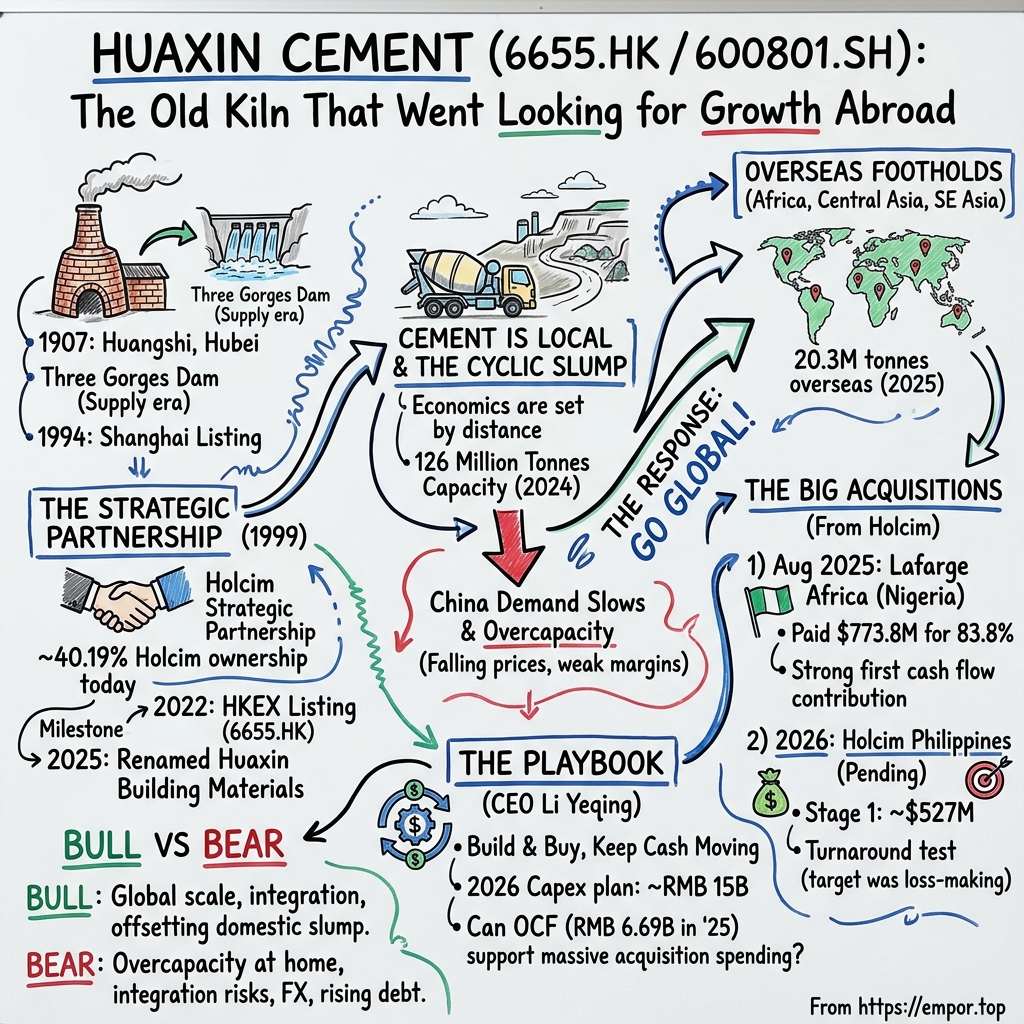
Huaxin Cement: The Old Kiln That Went Looking for Growth Abroad
I. The Nigerian Kiln and the Chinese Profit Rebound
Picture two kilns, roughly eleven thousand kilometres apart, both owned by the same company.
The first is in 黄石 Huangshi, an old industrial city on the south bank of the Yangtze in Hubei province, where a cement works first fired its kiln in 1907.1 The town grew up around iron ore, coal and limestone, and the cement plant became one of its anchors, a place where generations of workers learned how to turn quarried rock into the grey powder that holds modern China together. The second kiln sits in Nigeria, at one of the four integrated cement plants that make up Lafarge Africa: Sagamu and Ewekoro in Ogun State, Mfamosing in Cross River State and Ashaka in the north-eastern state of Gombe.2 Until August 2025, those Nigerian plants belonged to the Swiss building-materials giant Holcim. Since then, the controlling stake has belonged to the company that grew out of the plant in Huangshi.3
That is the strange, almost cinematic arc of 华新水泥 Huaxin Cement. A company that spent more than a century making cement for central China now earns a fast-growing share of its money in places like Lagos, Lusaka, Dushanbe and Phnom Penh. And in 2026, the arc looked like it was paying off. For the first nine months of the year, Huaxin reported revenue up about 19% and profit attributable to shareholders up about 41%, while operating cash flow rose even faster, by about half.4 For a cement maker in a country whose property market has spent four years shrinking, those are unusual numbers.
But step back and the picture becomes more complicated. In 2018, at the top of a great Chinese building cycle, Huaxin earned about RMB5.2 billion of attributable profit on revenue of about RMB27.5 billion.5 By 2025, revenue had grown to about RMB35.4 billion, yet profit had fallen to about RMB2.85 billion.3 Put plainly, Huaxin sold almost 30% more in 2025 than in 2018 and kept roughly 45% less of it as profit. The company got bigger and less profitable at the same time. The 2026 rebound is real, but it starts from a low base, and part of it comes from businesses Huaxin bought rather than grew.
So the opening question is simple to ask and hard to answer. Is Huaxin's recovery the payoff from a patient, decade-long global expansion, or is it a cyclical upswing made to look durable by acquisitions? The difference matters enormously to a long-term investor. A company that has learned to earn good returns building and running plants in difficult markets deserves a very different valuation from one that is buying revenue to cover a shrinking home market.
Three questions run through this story. The first is whether Huaxin can earn through the cement cycle, because cement is the purest kind of commodity: heavy, cheap, local and brutally exposed to construction demand. The second is whether Huaxin can make overseas acquisitions pay, because the company has moved from building plants abroad to buying them, and buying is a far easier way to grow than earning a return on what was bought. The third is the one that makes Huaxin unusual among Chinese industrials: whether its deals with Holcim, its longest-standing strategic shareholder, serve the minority shareholders who own the rest of the company. Holcim sold Huaxin the Nigerian business. In August 2026, Huaxin agreed to buy Holcim's Philippine business too.6 The partner that helped make Huaxin modern has become its most important seller.
Before going further, it helps to establish who the company is today. Huaxin trades in Hong Kong under the ticker 6655 and in Shanghai as 600801.3 In October 2025 it changed its Chinese name to 华新建材集团股份有限公司, which translates as Huaxin Building Materials Group Co., Ltd., a signal that management wants the market to see more than a cement maker.3 It sells cement and clinker, ready-mixed concrete, aggregates such as crushed stone and sand, and a smaller collection of newer materials and environmental services.3 Its two largest shareholders are Holcim, through the Dutch holding company Holchin B.V. and the Hong Kong vehicle Holpac Limited, and 华新集团 Huaxin Group, a company controlled by the Huangshi municipal state-assets authority.3 Neither is a parent in the conventional sense. That ambiguity, a company with a powerful foreign industrial shareholder and a local state-linked one, sits at the centre of the governance story.
The clearest way to understand Huaxin is as a sequence of strategic turns. It began as a local producer serving the construction of central China. It became a foreign-partnered operator in 1999, when it brought Holcim's predecessor inside the shareholder register.1 It grew into a national cement player during China's twenty-year building boom. And, as that boom faded, it became an overseas acquirer. Each turn solved the problem of its era. Each also created the problem of the next. The question tonight is whether the latest turn, from building abroad to buying abroad, is solving a problem or merely postponing one.
To answer that, the story has to begin where the company did, beside a river in Hubei more than a century ago.
 Subscribe on LinkedIn
II. The Plant That Outlasted Its First Century
Huaxin's official history traces the company to 1907, when the plant that would become Huaxin Cement was established in what is now Huangshi.1 China at the time was in the last years of the Qing dynasty. Cement was a modern, almost exotic material, and the handful of plants that made it were symbols of an industrialising ambition that the country had not yet fully realised. The Huangshi works sat where the raw ingredients met the transport route: limestone in the hills, coal within reach and the Yangtze at its doorstep to carry the product away.
That geography is worth pausing on, because it explains the company's entire economic logic and still does today. Cement is made by heating crushed limestone and clay in a kiln to about 1,450 degrees Celsius, which produces marble-sized nodules called clinker. Grind clinker with a little gypsum and other additives and the result is cement. The kiln needs enormous amounts of fuel, the quarry needs to be close to the kiln, and the finished product needs to be close to its buyers, because a tonne of cement is worth little and costs a lot to move. A cement plant, in other words, is a local business that happens to require national-scale capital. The Huangshi site had the right rock, the right river and the right customers.
For most of the twentieth century, the works lived through the same turbulence as the rest of Chinese industry: war, nationalisation, planning and reform. The company's own narrative emphasises the projects it supplied rather than the regimes it survived, and the most famous of those is the 三峡大坝 Three Gorges Dam, the giant hydroelectric project on the Yangtze for which Huaxin supplied cement.[^7] Huaxin's material also went into bridges, highways and other Yangtze infrastructure as central China built out.[^7]
It is tempting to treat those credentials as a moat, and plenty of corporate histories do exactly that. The record suggests a narrower reading. Supplying the Three Gorges Dam proves that Huaxin could make cement to a demanding specification and deliver it reliably at scale. That is genuine industrial competence, and it gave Huaxin a reputation with engineers and state buyers in its home region. But the dam was finished long ago, and a reputation for quality does not translate automatically into price. Cement buyers on a residential construction site in Wuhan in 2026 do not pay more because of what the company did in the 1990s. They pay the regional market price, which, as the next sections show, has been falling.
The more consequential part of the history is institutional. In 1993, the company was restructured as a joint-stock company through a public share offering, and in 1994 it listed both A shares, for domestic investors, and B shares, which foreigners could hold, on the Shanghai Stock Exchange.1 That made Huaxin one of the earliest Chinese industrial companies to open its shareholder register to outside money. The B shares mattered more than they might seem. They gave foreign investors a door into the company, and within five years, a foreign industrial investor would walk through it.
What the listing did not solve was the core problem of a regional cement producer in 1990s China: technology and scale. Much of the country's cement was still made in small, inefficient kilns, many of them the older wet-process or vertical-shaft designs that burned too much coal and produced inconsistent quality. The future belonged to large new-dry-process kilns, which preheat the raw material using the kiln's own exhaust gases and can make far more clinker per tonne of coal. Building them required capital, engineering know-how and management systems that a state-owned plant in Hubei did not have in abundance.
So by the late 1990s, Huaxin faced a question that every successful old industrial company eventually faces. It could stay a proud regional producer, living on its history and its local customers, and risk being overtaken by bigger, better-financed rivals. Or it could bring in outside expertise and capital, at the cost of sharing control of its future. The first path preserved its identity. The second might preserve its relevance.
Huaxin chose the second path. The partner it chose would shape everything that followed, from its kilns to its balance sheet to the deals it would sign more than a quarter-century later.
III. The Partnership That Brought Holcim Inside
In 1999, Huaxin formed a strategic partnership with Holderbank, the Swiss cement group that would rename itself Holcim two years later.1 At the time, Holderbank was one of the two or three largest cement companies in the world, with plants on every inhabited continent and a reputation for operational discipline. China was the market every global cement company wanted to enter and none had cracked. Holcim's China country head later said the group had entered the country in 1995 and formed its strategic partnership with Huaxin, which he described as one of China's oldest cement companies.7
For Huaxin, the bargain was about capability. A foreign partner could bring engineering standards, safety practices, kiln-optimisation techniques, procurement discipline and management systems that had been refined across dozens of countries. For Holderbank, the bargain was about access: a respected local operator, a listed vehicle, and a foothold in the fastest-growing cement market in history without the risk of building alone. Unlike many joint ventures of the era, this one was done at the level of the listed company, not a single plant. Holcim became a shareholder in Huaxin itself.
Over the following decade, that stake grew. By 2008, Holcim had become Huaxin's largest shareholder with 39% of its shares, and it later reinvested to lift its holding to 42%.7 In the years that followed, the partnership coincided with remarkable expansion. A 2012 profile credited it with helping Huaxin achieve steady revenue growth of about 30% a year over the previous eight years, and put Huaxin's annual cement capacity at about 60 million tonnes, ranking it in the top ten among Chinese cement companies.7 Correlation is not causation, and China's construction boom lifted every cement maker that could build kilns fast enough. But Huaxin's ability to raise capital, adopt modern process technology and run large plants safely was plainly strengthened by having one of the world's best operators in the boardroom.
The relationship also moved in the other direction. Holcim later folded its own Chinese cement interests, Lafarge China Cement, into Huaxin, effectively choosing Huaxin as its China platform rather than competing with it.2 That decision is revealing. A global company that thought it could do better on its own would have kept its Chinese plants separate. Holcim instead concentrated its Chinese exposure inside a company it influenced but did not control.
That word, influence, needs careful handling, because it is where many accounts of Huaxin go wrong. At the end of 2025, Holchin B.V. and Holpac Limited together held 40.19% of Huaxin's shares.3 Huaxin Group, the Huangshi state-linked company, held 16.26%.3 Holcim describes its interest as an effective participation of just under 42%.8 That is a commanding block, larger than any other holder by a wide margin, and Holcim nominates directors. But Huaxin's filings do not present Holcim as a controlling parent, and the second-largest shareholder is an arm of the local government that has backed the company since before the partnership existed. The governance balance is two strategic blocs, foreign and local, sitting above a public float of Hong Kong and Shanghai investors. Holcim's shares were unchanged during 2025 and were not pledged.3
Why does the distinction matter? Because when Huaxin buys something from Holcim, the transaction is a connected one: a deal between a listed company and an entity related to one of its largest shareholders. Hong Kong and Shanghai rules require independent directors, an independent financial adviser and a vote of independent shareholders for transactions of that kind. Those protections are real. They also exist because the incentives on the two sides of the table are not automatically the same. Holcim, as seller, wants the highest price. Holcim, as Huaxin's biggest shareholder, captures about 40% of whatever value Huaxin gains or loses from the purchase. The other 60% belongs to everyone else.
Day to day, related-party trading is small. In 2025, routine purchases and services from related parties came to about RMB54 million and sales to related parties about RMB47 million, trivial against group revenue of more than RMB35 billion.9 Huaxin says those transactions were done at market prices under contracts, and it reports no royalty or brand fee to Holcim in its related-party table.9 One balance is worth noting: at the end of 2025, Huaxin owed Holcim Technology Ltd about RMB103 million in other payables, a reminder that technical services still flow between the two companies.9 None of that is alarming. The exposure that matters is not the coffee-machine level of trade. It is the occasional, very large acquisition.
The partnership reached another milestone in March 2022, when Huaxin moved its foreign-investor shares from Shanghai to Hong Kong. Instead of selling new stock, it converted its existing Shanghai B shares into H shares and listed them on the Hong Kong exchange by introduction, with no new shares issued or sold.10 The H shares began trading on 28 March 2022.10 B shares had become a backwater of the Chinese market, thinly traded and persistently discounted. Hong Kong offered deeper liquidity, a broader base of international investors and, crucially for what came next, a currency in which global deal-making is easier. The listing raised no money. What it bought was access.
So the partnership leaves a trade-off that will return at the climax of this story. A long-standing industrial partner brings expertise, contacts and, when it decides to leave certain markets, a ready supply of assets that it knows intimately and can offer to a friendly buyer. That same partner becomes the seller, with superior knowledge of the assets it is selling. Whether that is a gift or a hazard depends on the price, the disclosure and what the assets go on to earn.
But that is getting ahead of the story. Before Huaxin could buy plants abroad, it had to survive the brutal economics of selling cement at home.
IV. Cement Is Local: The Scale That Helps and the Cycle That Hurts
Follow a cement truck out of the gate of a Huaxin plant in Hubei and the whole economics of the industry fits inside the cab. The truck carries perhaps thirty or forty tonnes of a product that sells for a few hundred renminbi per tonne. Every extra kilometre it drives eats into the margin. Beyond a radius of a couple of hundred kilometres by road, the trip stops making sense, unless the cement can travel by river barge or rail, which is exactly why plants cluster along waterways like the Yangtze. That single fact determines who competes with whom, who sets prices and why a national ranking can mislead.
Huaxin's operating chain begins in the quarry. Limestone is blasted, crushed and blended with clay and other minerals, then fed into a kiln. Beyond the kiln stage, clinker is ground into cement, sometimes at the kiln site and sometimes at separate grinding stations placed closer to customers, because clinker travels slightly better than cement and grinding plants are cheap to build. From there the chain extends forward. Ready-mixed concrete plants combine cement with sand, gravel and water and deliver the result in drum trucks that must pour within a couple of hours. Aggregate operations sell the crushed stone and sand that make up most of concrete's volume. A company that controls all three links can serve a construction site with nearly everything it needs, and can use its quarries twice: once for limestone to feed the kiln, and once for aggregates sold directly.
At the end of 2024, Huaxin reported about 126 million tonnes a year of cement capacity, a figure that includes grinding capacity and joint-venture plants.11 Cement generated about 55% of its 2024 revenue, with concrete and aggregates making up most of the rest.11 The newer businesses, from advanced materials to environmental services such as using cement kilns to dispose of waste, are real but small, and they do not yet change the company's economics. For all its rebranding, Huaxin remains, in financial terms, a cement company with two meaningful downstream extensions.
Those extensions behaved very differently in 2025. Cement revenue rose about 14%, helped by overseas growth and the newly consolidated Nigerian business.3 Concrete revenue fell about 15%, a direct reflection of weak Chinese construction.3 Aggregates told the most instructive story of all: Huaxin sold about 12% more aggregate by volume, yet aggregate revenue fell about 3%.3 Think about what that means. The company dug, crushed and delivered more stone than the year before and got less money for it. That is what an oversupplied market looks like from the inside. Volume is something a company controls. Price is something the market gives it.
Now set Huaxin beside its two giant rivals. 中国建材集团 China National Building Material Group, the state-owned behemoth, reported about 518 million tonnes of cement capacity, and 海螺水泥 Anhui Conch Cement, the most profitable large producer in the country, reported about 395 million tonnes.[^13] On those numbers Huaxin is a distant third tier, with roughly a quarter of CNBM's capacity and a third of Conch's. But because cement is local, the national ranking tells a listener less than it seems. What matters is how much of the capacity within trucking or barging distance of a given customer each company controls, and whether the producers in that region behave with discipline. Huaxin's strength has always been concentrated in Hubei, Hunan, Yunnan and neighbouring provinces in central and south-western China. In those markets it can be one of the two or three producers that matter. In coastal markets where Conch is dominant, it barely registers.
Here is the weak point of the whole model. A cement kiln is enormously expensive and runs best at high, steady utilisation. When demand falls, every producer in a region faces the same temptation: cut price to keep the kiln full, because the fixed costs do not go away. If enough of them do it at once, prices collapse for everyone. China's industry tried to manage this through 错峰生产 staggered production, coordinated seasonal kiln shutdowns encouraged by provincial authorities, and through policy limits on new capacity. Those measures help, but they cannot manufacture demand. Through 2024 and 2025, China's cement output kept shrinking with the property market, and industry coverage described a sector wrestling with deep overcapacity and weak prices.12 Scale could not save Huaxin from that. A large regional producer simply has more kilns exposed to the same falling price.
So does Huaxin have a moat? Test it once, properly. The case for an advantage rests on five things. Its plants are already built and permitted, and new kilns are hard to license in China today, so the existing capacity is a scarce asset. Its quarries are long-lived and sit next to its kilns, which lowers raw-material cost. Its logistics along the Yangtze let it reach customers by barge more cheaply than truck-bound rivals. Its integration into concrete and aggregates lets it capture more of each construction project's spending. And it has decades of process know-how, sharpened by the Holcim partnership, in running kilns efficiently.
Those are genuine cost and service advantages. But the record does not show that they convert into durable pricing power or customer lock-in. Huaxin's top five customers together accounted for only about 3.6% of 2025 sales, and no single customer exceeded 10% of revenue.3 That dispersion protects against the loss of any one buyer, but it also says buyers are many, small and free to shop elsewhere. A contractor pouring a foundation does not care whose cement is in the mixer as long as it meets the standard. And Huaxin's filings do not demonstrate superior per-tonne economics against its peers in a way that would let an investor say it earns structurally more than Conch in the same market. The fall in profit from 2018 to 2025 is the plainest evidence: whatever advantages Huaxin had, they did not prevent its earnings from almost halving when the cycle turned. The verdict is that Huaxin has a local cost advantage and a narrow, regional form of scale, not a moat that protects returns through a downturn.
What about technology? Huaxin talks a great deal about digital transformation, and the company says it has deployed automated kiln control, predictive maintenance and digital logistics across its plants.3 In cement, these are not gimmicks. A kiln burning coal at 1,450 degrees is a delicate chemical system, and small improvements in temperature control can save meaningful amounts of fuel, while predicting a bearing failure before it happens can avoid days of costly downtime. Artificial intelligence, in this business, is a tool for running the machine better rather than a threat to the product. No algorithm substitutes for cement. But the burden of proof is on the outcome. Huaxin's total research-and-development investment in 2025 was about RMB257 million, or under 1% of revenue.3 Until the company reports quantified improvements in fuel use per tonne of clinker, energy consumption, downtime or cost per tonne, digital operations should be treated as a plausible source of efficiency rather than a demonstrated edge.
That leaves the central tension of the domestic business. Huaxin is well run by the standards of a regional cement company, but its home market is shrinking, and its regional scale offers little protection when everyone else is cutting prices too. If the company wanted growth, it would have to find it where construction was still rising. That is exactly what it did, and it started long before the Chinese downturn made the choice obvious.
V. When China Slowed, Huaxin Went Abroad
The overseas story did not begin in Africa. It began in Central Asia, in mountain countries like Tajikistan, whose roads, dams and apartment blocks needed cement that local producers could not supply. Going there looked, at the time, like a curious detour for a company that could barely build plants fast enough at home. In hindsight it was the first step in the turn that would define the company's second century.
What followed was not one grand global platform but a series of footholds, each with its own logic. In Central Asia, Huaxin built and operated plants in Tajikistan, Kyrgyzstan and Uzbekistan, markets where Chinese engineering, Chinese financing and the Belt and Road push lined up neatly. In South and Southeast Asia it went into Cambodia and Nepal. In the Middle East it added Oman. By the end of 2023, Huaxin said it had just under 21 million tonnes a year of overseas cement capacity across those countries and its newer African operations.2
Africa is where the strategy changed character. Instead of only building, Huaxin started buying. In 2020 it acquired Maweni Limestone in Tanzania from the troubled ARM Cement.2 In 2021 it bought Lafarge Zambia and Pan African Cement in Malawi from Holcim.2 In 2023 it bought the Mozambique and South Africa subsidiaries of the Brazilian group InterCement.2 By late 2024, industry data suggested Huaxin operated about ten integrated cement plants in sub-Saharan Africa, with roughly 18 million tonnes a year of cement capacity, making it the region's second-largest producer after Dangote Cement.2 And that was before Nigeria.
Two patterns stand out in that sequence. The first is that Holcim was the seller in Zambia and Malawi, years before the far larger Nigerian deal. The pattern of connected acquisitions did not begin in 2025; it was established early, on a smaller scale. The second is that many of these assets were bought from owners who wanted out: a distressed Kenyan group, a heavily indebted Brazilian one and a Swiss multinational reshaping its portfolio. Buying from motivated sellers can mean a good price. It can also mean inheriting the reasons they wanted to leave.
By the time China's property market broke in 2021 and 2022, Huaxin's overseas business was already big enough to catch the falling demand. The numbers since then show how fast the centre of gravity moved. In 2024, overseas cement sales reached about 16 million tonnes, up 37%, and overseas revenue reached about RMB8 billion, up 47%.11 In 2025, overseas cement sales grew another quarter to about 20 million tonnes, while overseas revenue jumped about 48% to roughly RMB11.8 billion.3 Put those together and overseas revenue roughly doubled in two years, rising to about a third of the group total while the domestic business shrank. Revenue growing faster than volume in 2025 is partly a price story and partly the Nigerian consolidation, which arrived in the last four months of the year.
That is the momentum. Now consider the friction, because the expansion has not been a straight line. Building cement plants in frontier markets means contending with power shortages, foreign-exchange controls, import delays for equipment and political shifts. Several of Huaxin's overseas projects took longer than planned to bring capacity online, and some lines had to be restarted or upgraded after acquisition. The time from a decision to build to a kiln running at full output is typically measured in years, and every year of delay consumes capital without returning it. The overseas story is real, but it is a story of slow, effortful accumulation, not of easy wins.
Currency is the second friction, and it is becoming material. Huaxin earns revenue in Tajik somoni, Zambian kwacha, Mozambican metical and Nigerian naira, and it reports in renminbi. In 2025 its finance costs included an exchange-related line of about RMB227 million, against about RMB47 million a year earlier, and exchange-rate movements reduced its cash balance by about RMB92 million.3 The company says it monitors these exposures and uses forward contracts and currency swaps.3 But hedging a naira for years is expensive and often impossible; the realistic defence in many frontier markets is to raise local prices as the currency falls, which works only if the local market is disciplined enough to accept it.
The third friction is legal. Huaxin is a party to an arbitration brought by a company called Moncement, which claimed about US$77 million; at the end of 2025, Huaxin had booked a provision of about RMB40 million and had not yet received final legal documents.9 The provision is small relative to the group. The point is what the dispute represents: when a company buys and builds in foreign jurisdictions, it acquires contracts, counterparties and claims along with kilns and quarries. The group's guarantee balance tells a related story. At the end of 2025, Huaxin had about RMB9.8 billion of guarantees outstanding, mostly for its own subsidiaries, equal to about a quarter of its net assets.3 Guarantees for subsidiaries are normal in a group that finances overseas plants locally, but they mean the listed company stands behind debts that sit in places like Lusaka and Lagos.
Management has set a bold target for the overseas business. For 2026, it aimed for overseas cement sales above 27 million tonnes and overseas EBITDA above RMB7 billion.13 Those are targets to test, not results already earned. Reaching 27 million tonnes from about 20 million requires roughly a one-third jump in a single year, which is plausible only because a full year of Nigerian volume will be counted. An investor should therefore ask how much of the increase is organic, from existing plants running harder, and how much is simply the arithmetic of consolidation.
That question frames the turn the story takes next. Huaxin's overseas footprint is now large enough to shape the whole group's results. But the newest, largest pieces of it were not built by Huaxin's engineers. They were bought, and the most important of them was bought from Holcim.
VI. The Lafarge Africa Deal: A Strategic Buy at a Related-Party Price
On 29 August 2025, Holcim announced that it had completed the sale of its stake in Lafarge Africa, its Nigerian business, to Huaxin.14 Holcim had first announced the plan in late 2024, presenting it as part of its strategy of streamlining its portfolio and exiting markets where it saw less long-term fit.14 For Holcim, the deal closed a chapter in Nigeria that had begun when Lafarge, its French merger partner, built up a business in Africa's most populous country. For Huaxin, it opened its largest single bet outside China.
Start with what Huaxin bought. Lafarge Africa is a listed Nigerian company with four integrated cement plants and a combined capacity of about 10.5 million tonnes a year.2 Nigeria is a market of more than 200 million people with a severe housing deficit and huge infrastructure needs, but it is also dominated by Dangote Cement and BUA Cement, plagued by currency instability and exposed to gas-supply interruptions that can idle kilns. Huaxin bought an 83.81% controlling stake from Holcim affiliate Holderfin B.V.; the remaining shares continue to trade on the Nigerian Exchange in the hands of outside investors.3 That detail matters for the arithmetic later: Huaxin consolidates all of Lafarge Africa's revenue but is entitled to only about 84% of its profit and dividends.
Now the price, which is where the headlines and the filings part company. When the deal was announced, it was widely reported as worth about US$1 billion.2 Holcim described the sale at an equity value of about US$1 billion before dividend adjustments.14 Huaxin's own announcement in February 2025 set out the consideration and the mechanism for adjusting it.15 By the time the deal closed, Huaxin's final cash consideration, after contractual adjustments, was about US$774 million.3 The difference is largely accounted for by dividends that Lafarge Africa paid out before completion, which reduced the cash Huaxin had to hand over but also reduced the cash left in the business. So the lower price is not a discount Huaxin negotiated out of Holcim; it is mostly value that left the company before Huaxin arrived.
What did Huaxin get for that money in the first few months? From the acquisition date to the end of 2025, Lafarge Africa contributed about RMB1.8 billion of revenue, about RMB430 million of net profit and about RMB386 million of operating cash flow to Huaxin's accounts.3 Those are healthy numbers. A business that turns nearly a quarter of its revenue into net profit, and most of that profit into operating cash, is a good business over that period. Lafarge Africa's own 2025 accounts, published in Lagos for its remaining Nigerian shareholders, give the full-year picture of a business operating through the aftermath of the naira's steep devaluation, when cement producers raised prices to protect margins.16
The caveat is one of time. Four months of results are a first clue, not a verdict. Cement demand in Nigeria is seasonal, with the rainy season dampening construction for part of the year. Prices there have swung with the currency. And the first months after a deal often look flattering because the acquirer has not yet absorbed the costs of integration. Multiplying four months by three to get an annual figure would be a mistake. The right comparison is a full audited year, and that will come with Huaxin's 2026 results.
The accounting adds one more piece. Huaxin recorded provisional goodwill of about RMB2.4 billion on the deal.3 Goodwill is simply the portion of the price paid above the fair value of the identifiable assets. It represents what Huaxin paid for future earnings power, market position and the expectation of continued profits. If Nigerian earnings weaken, that goodwill could be written down, so it will be an important number to watch in future reports.
Was the price fair? Here honesty requires restraint. The evidence available does not establish an apples-to-apples case, using comparable cement transactions in sub-Saharan Africa, that Huaxin paid either too much or too little. Lafarge Africa's shares traded publicly in Lagos, so there was a market reference, but a controlling stake normally commands a premium over a minority market price, and Nigerian equity valuations were depressed by the currency crisis. What can be said is the following. Huaxin paid roughly three-quarters of a billion dollars for an asset with about ten million tonnes of capacity. The business was profitable and cash-generative in its first months under new ownership. And the seller was the buyer's largest shareholder.
This was a major connected transaction, subject to independent review and a vote of independent shareholders.15 Those safeguards worked as designed in the sense that the deal was scrutinised and voted on. They cannot by themselves answer whether Holcim, which knew the Nigerian business far better than Huaxin did, sold at a moment that suited the seller more than the buyer. Holcim chose to leave Nigeria. Huaxin chose to go in. Both cannot be right about the timing in every possible future.
So the real test is not the headline price but what the price must earn. Huaxin paid about US$774 million, financed in part with debt, for 84% of the profits of a business operating in a volatile currency. To earn a respectable return, Lafarge Africa needs to produce, after tax, after its own capital spending and after the 16% that belongs to minority holders, a stream of cash that comfortably exceeds Huaxin's cost of capital, translated back into renminbi at whatever the naira is worth in future years. The early numbers suggest that is possible. They do not yet prove it.
The Moncement arbitration and the guarantee exposure, which belong to the wider African build-out, are reminders that cross-border ownership comes with liabilities as well as plants. Lafarge Africa adds a new jurisdiction to that list. And even before its first full year had been reported, Huaxin went back to the same seller for another deal.
VII. One Acquisition Opens the Door to Another
On 1 August 2026, Huaxin's board signed an agreement that extended the Holcim relationship into a new country. The company would acquire Holcim Philippines, the listed Philippine cement producer, from Holcim affiliate Holderfin in two stages.6 When Holcim announced the deal on 2 August, it valued the business at about US$807 million.8
The structure is more intricate than the headline. In the first stage, Huaxin is to buy about 67.6% of Holcim Philippines for about US$527 million, a price based on an enterprise value of US$780 million and subject to closing adjustments.6 In the second stage, the remaining Holderfin stake of about 31.4% is to change hands after three years through a call or put mechanism, at a price determined by a formula but with a floor of US$280 million.6 Holcim said the overall valuation could rise depending on value created during that period, and it expected the first-stage sale to close in the first half of 2027.8 Holcim plans to use the proceeds to fund larger acquisitions and investment in its own business.8
Pause on what that floor means. A put option gives Holcim the right to sell the rest of its stake to Huaxin. A minimum price of US$280 million means that, if Holcim exercises it, Huaxin must pay at least that much regardless of how the Philippine business performs over the next three years. If Huaxin turns the company around, the formula may lift the price and Holcim shares in the upside. If the turnaround fails, the floor protects Holcim from much of the downside. That is a sensible structure for a seller. For a buyer, it is a commitment that should be counted as deferred consideration from day one.
And the Philippine business is not in good health. Holcim Philippines reported a net loss of about US$65 million in 2025.6 A loss of that size tells an investor that the business, as Holcim ran it, was not covering its costs, whatever the mix of import competition, energy prices and weak demand behind it. Holcim Philippines brings a network of plants across the archipelago and a long-established brand among contractors, but capacity and brand do not prove that losses will turn to profits. The question is not just the entry price. It is whether Huaxin can restore earnings, and how much it will spend doing so.
As of the third-quarter report, the deal had been approved by Huaxin's shareholders and cleared by the Philippine Competition Commission, but it still faced remaining procedures and closing conditions.4 It has not closed. Nothing about it yet appears in Huaxin's revenue or profit.
Placed beside Lafarge Africa, the Philippine deal reveals a pattern. Both targets are Holcim subsidiaries that Holcim decided to exit. Both are listed companies in which Huaxin is buying a controlling stake from Holcim's Holderfin, with minority holders remaining. Both were negotiated as connected transactions with Huaxin's largest strategic shareholder on the other side. The Zambia and Malawi purchases of 2021 fit the same mould at a smaller scale. Over five years, Holcim has become Huaxin's most important source of acquisitions.
There are legitimate reasons why that could be good for Huaxin. Holcim's subsidiaries run on systems Huaxin already understands. Their managers have been trained to the same safety and operating standards. Integration should be smoother than buying from a stranger. And Holcim, as a 40% owner of Huaxin, has some interest in not selling it a lemon. But the repeat relationship also makes independent valuation, governance and post-deal disclosure more important, not less. When one company repeatedly buys from its biggest shareholder, minority investors need to see, deal by deal, what each purchase earned against what it cost. Otherwise, the partnership's benefits and its conflicts become impossible to tell apart.
Here, then, is a concrete test for the Philippine deal. After closing, investors should look for Holcim Philippines' operating profit, its conversion of profit into cash, its kiln utilisation and any synergies Huaxin claims, and should compare all of them with the purchase price, the floor price on the second stage and the interest cost of the debt used to fund it. A turnaround that takes three years and consumes heavy capital spending could leave Huaxin owning a bigger Philippine business that still fails to earn its cost of capital.
The deal also lands on a balance sheet that is already working hard. Management's capital-spending plan for 2026 was about RMB15 billion, covering overseas capacity, maintenance and acquisitions.13 That is a large number for a company whose operating cash flow was about RMB6.7 billion in 2025.3 Acquisition discipline, in other words, is inseparable from liquidity and from what is left over for shareholders. Every dollar sent to Manila or Lagos is a dollar not returned to owners or used to reduce debt.
Which brings the story to the people deciding where those dollars go.
VIII. The CEO's Bet: Build, Buy and Keep the Cash Moving
Few chief executives in Chinese industry have been inside one company as long as 李叶青 Li Yeqing. He trained as an engineer in silicate materials, the science of cement and ceramics, at 武汉理工大学 Wuhan University of Technology, where he also earned a master's degree in industrial management, and later completed a doctorate in business administration.1 He joined Huaxin as a young man and rose through its plants and management ranks to become executive director and chief executive.1 By the time Huaxin turned decisively overseas, he had been in senior leadership for many years, long enough to have helped manage the Holcim partnership, the domestic expansion and the first foreign kilns.3
That continuity is both Li's credential and his test. He is not a turnaround manager parachuted in to clean up someone else's decisions. The domestic capacity Huaxin built during the boom, the overseas plants it built in Central Asia and the acquisitions it made in Africa all happened on his watch. So did the fall in profit from the 2018 peak. A long tenure means the record is his to defend, and that is exactly the record an investor should examine.
Around him sits a team responsible for capital allocation, including the financial controller 陈骞 Chen Qian.3 The board had eight directors at the time of the 2025 report, three of them independent non-executives, and the roles of chairman and chief executive were separate.3 One executive director, Liu Fengshan, left the board in March 2026.3 The structure is conventional for a Hong Kong and Shanghai dual listing, and it includes directors nominated by both Holcim and the local state-linked shareholder.
Do management's incentives line up with minority shareholders? There is some evidence that they do. Li reported holding about 1.41 million Huaxin shares at the end of 2024, up from about 1.0 million a year earlier.11 The company has run employee share ownership plans and restricted-share incentives, and it repurchased shares in 2025, though the cash spent on buybacks that year was a modest RMB62 million.3 Those are signs that managers own part of the outcome. But they are not a complete pay-for-performance picture. The annual report discloses aggregate remuneration under Chinese rules but does not present a simple multi-year comparison of the CEO's pay against profit or returns, so investors cannot easily tell whether management's rewards rose or fell with the halving of profit after 2018.3
The cash record is the more revealing test. Huaxin generated about RMB6.7 billion of operating cash flow in 2025, compared with about RMB2.85 billion of attributable profit; in 2024 the equivalent figures were about RMB6.0 billion and RMB2.4 billion.3 Operating cash flow more than doubling reported profit is not a sign of accounting trickery here. It reflects the heavy depreciation of a capital-intensive business, a non-cash charge that reduces profit without consuming cash, as well as working-capital movements. It does show that the underlying business throws off substantial cash even at the bottom of the domestic cycle. That is a genuine strength.
What happened to that cash is the more interesting question. In 2025, Huaxin's spending on plants and other long-lived assets fell to about RMB2.6 billion from about RMB4.5 billion a year earlier, while net cash paid for acquisitions was about RMB5.8 billion.3 Add those together and Huaxin spent more on growth and maintenance than its entire operating cash flow. It would be easy to read the fall in capital spending as a sign that the investment phase is over. The truth is the opposite. Investment did not shrink. It changed form, from building kilns to buying them. That is a shift in the source of growth, not a decline in its cost.
Management's own framing is built around volume and EBITDA, as its targets and spending plan show.13 EBITDA, earnings before interest, tax, depreciation and amortisation, is a useful measure of operating scale, but it is computed before the cost of the capital that bought the plants. A business can grow EBITDA every year by acquiring, while its return on the money spent stays mediocre. Huaxin does not publish a return-on-invested-capital target for its acquired businesses, nor a deal-by-deal hurdle against which Lafarge Africa or Holcim Philippines could later be judged. That gap is the most useful thing to track across the coming results briefings. Management that sets a measurable return hurdle and reports against it can be held to account. Management that speaks only of footprint and potential cannot.
So the verdict on management is a split one. On operations, the record shows a team that can run plants, generate cash and grow abroad, sustained over many years. On capital allocation, the record is still being written, and the hardest chapters are the newest. Claims about digital leadership and becoming a global building-materials leader should be treated as hypotheses until they arrive with reported operating outcomes: a cost per tonne, a return on capital, a cash yield on an acquisition. The credibility test is whether repeated overseas deals earn more than they cost, and whether management explains the misses as clearly as it celebrates the wins.
That test is the heart of the bull and bear debate.
IX. Analysis & Bear vs. Bull Case
Lay three documents side by side on a desk in November 2026. The first is management's overseas plan, with its targets of more than 27 million tonnes of foreign cement sales and more than RMB7 billion of overseas EBITDA.13 The second is any recent account of the Chinese cement market, describing an industry still producing less each year, with prices under pressure and capacity that far exceeds demand.12 The third is the agreement to buy a loss-making Philippine business from Huaxin's largest shareholder.6 An investor who reads all three will come away with two very different stories about the same company, and the job is to decide which one the evidence supports.
Start with the money, because it frames everything else. In 2025, Huaxin generated about RMB6.7 billion of operating cash. It spent about RMB5.8 billion, net, on acquisitions and another RMB2.6 billion on plants and other long-lived assets.3 Growth spending exceeded operating cash by well over a billion renminbi, before dividends. Then, in the first nine months of 2026, revenue rose about 19%, attributable profit about 41% and operating cash about 52%.4 Those growth rates include several months of Lafarge Africa that were not in the prior-year comparison, so they overstate what the pre-existing business achieved. Separating acquired from organic growth is the first discipline any analysis of Huaxin requires, and the company's quarterly reports do not make it easy.
The bull case begins with geography. Huaxin's operating network sits in places where cement demand is still structurally rising: African countries with young, fast-growing, urbanising populations; Central Asian economies building roads and power; Southeast Asian islands with infrastructure gaps. China's per-person cement consumption is far beyond what any of those countries will reach for decades. A Chinese cement maker with a domestic market in long-term decline and a large, operating overseas footprint has something most of its domestic rivals lack: a place to grow.
The second bull argument is that Huaxin did not arrive abroad as a tourist. It built and ran plants in Central Asia for years before buying in Africa, and it brings the integration model it perfected at home: quarry, kiln, grinding, concrete and aggregates operated as one system. In a frontier market, a producer that can supply reliably and control its own raw materials has an advantage over importers and small local plants.
The third bull argument is the Nigerian evidence. Lafarge Africa delivered positive earnings and operating cash in its first months under Huaxin, and the overseas business overall more than doubled its revenue over two years.3 Organic upgrades and restarts at existing overseas plants offer growth that does not require another acquisition. And the domestic business, for all its weakness, keeps generating cash, which funds the expansion without heavy reliance on new equity. Huaxin has issued bonds and borrowed from banks, but its share count has not been diluted by equity raisings in recent years; the 2022 Hong Kong listing sold no new shares.10
The case against buying the growth
The bear case starts from the same facts and reads them differently. Cement is a cyclical, capital-intensive commodity business. China's overcapacity, weak prices and rising environmental and energy costs can compress returns even for the best operators, and Huaxin's halving of profit from the 2018 peak is the proof. Overseas growth does not change the nature of the product; it moves the cycle to markets with weaker currencies, thinner institutions and higher political risk.
The second bear argument is that acquisitions obscure the underlying trend. When a company buys revenue faster than its home business shrinks, the consolidated numbers look like growth. But an investor is paying for returns on capital, not for revenue. The Philippine target lost about US$65 million in 2025.6 Lafarge Africa has not yet completed a full audited year under Huaxin. Buying a second large business from the same seller before the first has seasoned compounds valuation, funding, currency and integration risk all at once.
The third bear argument concerns leverage. China Chengxin, the domestic rating agency, recorded Huaxin's total debt rising from about RMB16 billion in 2022 to about RMB20 billion at the end of 2024 and about RMB21.6 billion in the first quarter of 2025, and its debt-to-EBITDA ratio worsening from about 2.3 times to about 2.5 times.17 Those readings predate most of the Nigerian payment and all of the Philippine one. The agency credited Huaxin's scale, integration and cash generation, but flagged rising leverage and overseas execution and currency risks as constraints.17 At the end of 2025, current liabilities exceeded current assets, and the company relied on operating cash and available bank credit lines to support its going-concern assessment.3 That is not unusual for a Chinese industrial group that rolls short-term bank loans, and there was no covenant breach or refinancing warning. But it is a balance sheet with less slack than the cash-flow statement suggests.
Where the advantage really lives
Michael Porter's five forces help sort these arguments. The threat of new entrants is low where it matters most, because kiln licences are hard to obtain in China and expensive to build anywhere; Huaxin's existing plants are protected by that barrier. The bargaining power of buyers is moderate to high: customers are fragmented, but they can switch suppliers freely whenever capacity is ample, as the aggregate price decline in 2025 demonstrated. Supplier power is meaningful because coal, gas and electricity are the largest variable costs of making clinker, and Huaxin is a price-taker for them, especially in markets like Nigeria where gas supply is unreliable. Rivalry is intense whenever demand weakens, because the economics of fixed-cost kilns encourage producers to chase volume. Substitution is a slow, long-term pressure, as low-carbon cements and alternative materials evolve, not an immediate threat, and AI is a tool for producers rather than a substitute for their product.
Hamilton Helmer's 7 Powers framework sharpens the verdict. Of the seven sources of durable advantage, Huaxin has a credible claim to scale economies at the regional level and to process power, the accumulated know-how of running kilns efficiently, partly inherited through the Holcim relationship. It has a form of cornered resource in its licensed plants and long-lived quarries. It does not show evidence of switching costs, network effects, a brand premium that commands higher prices, or counter-positioning against incumbents. And its scale is local, not national: its capacity is a fraction of CNBM's and Conch's, so where those companies operate, Huaxin's scale advantage disappears.[^13] The honest conclusion is that Huaxin's moat is real but narrow. It is a cost and access advantage in specific regions, sufficient to earn decent returns in a disciplined market and insufficient to protect returns when discipline breaks.
The strongest disconfirming evidence for the bull case lies in Huaxin's own history. Management built aggressively during China's boom, and when the boom ended, profits fell sharply even as revenue grew. That is not evidence of poor management; every Chinese cement maker suffered. But it is evidence that the domestic expansion did not create the pricing resilience its scale might have implied. The question is whether the overseas phase, where Huaxin is more often the buyer than the builder, will fare better. On the record available, overseas growth has been fast and the early Nigerian numbers encouraging, but impairments on overseas assets, delays in project start-ups and changes in the explanation for missed targets are exactly what an investor should look for in each new annual report. The absence of a widely reported overseas write-off so far is not the same as proof of discipline, because most of the large acquisitions are too recent to have been tested.
Receivables add a quieter warning. Trade receivables rose from about RMB3.0 billion at the end of 2024 to about RMB3.75 billion by March 2025, and the auditor named expected credit losses on receivables as the key audit matter in its 2025 report.173 Huaxin's provisioning is visible and conservative in places; cement receivables older than two years are fully provided.3 But in a weak construction market, contractors pay slowly, and overseas, collection risk adds a currency dimension.
Three measures matter more than all the rest. The first is the operating cash return on the capital invested overseas, especially in Lafarge Africa: Huaxin's overseas revenue was about RMB11.8 billion in 2025 and rising fast, but the return on the money spent to get there has not been published.3 The second is domestic cement realisation and unit margin, the price Huaxin achieves per tonne at home and what it keeps after costs; the direction in 2025 was still under pressure, as the fall in concrete and aggregate revenue showed.3 The third is the combination of receivables ageing and net debt, which together show whether growth is arriving as cash or as claims on customers and lenders; both were rising into 2025.17
Valuation, finally, needs to be read against Huaxin's own history rather than against the promise of its targets. The share price in Hong Kong rose strongly from its lows over the past year as the profit rebound took hold, which means the market is already crediting part of the overseas growth. The risk for an investor is to value acquisition-led earnings as if they were organic and durable. Compared with the 2018 peak, when profit was almost twice the 2025 level, current earnings are cyclically depressed at home and partly purchased abroad. A price that assumes both a domestic recovery and high returns on every acquisition leaves little room for either to disappoint.
Neither a capacity ranking nor one fast-growing year settles the case. The bull case is intact but unproven; the bear case is a set of real risks that have not yet crystallised. What would change the balance is evidence, and the story's long arc offers some lessons about how to read it.
X. Playbook: Business & Investing Lessons
From the 1999 partnership1 to the 2025 Nigerian acquisition and 2026 Philippine agreement,36 a quarter-century relationship turned from tutor to vendor. The lessons of Huaxin's story are written in that arc.
The first lesson is that a kiln is local, but a strategy can travel. Huaxin cannot ship cement from Huangshi to Lagos at a profit; the physics of a heavy, cheap product forbid it. What it can ship is the way of running a plant: how to manage a quarry, tune a kiln, integrate concrete and aggregates and keep a remote operation running when the power fails. That transferable know-how is the only thing that justifies a Chinese cement maker owning plants on three continents. For founders and investors, the wider point is that when a home market matures, the question is not whether the product can travel but whether the operating capability can. If the capability is real, it will show up as returns in new markets that look like the returns at home in good years. If it does not, the company has merely exported its cycle.
The second lesson is that scale only protects you if the market stays disciplined. Huaxin's scale did not stop its profit from halving when Chinese demand fell, and its aggregate business showed the pressure in 2025.113 Scale lowers unit costs, but in a commodity business, prices are set by the marginal producer that is desperate to keep its kiln running. The broader insight is that in industries with heavy fixed costs, a company's return depends as much on the behaviour of its competitors as on its own efficiency. Investors who buy the biggest player expecting safety can find that size simply means more capacity exposed to the same price war.
The third lesson is that a partner can become your seller. Holcim brought Huaxin into the modern cement era, and it still owns about two-fifths of the company.3 It has also been a recurring seller to Huaxin, including in Nigeria and, pending closing, the Philippines.26 Each of those deals may be sensible on its own. But the repeating pattern means minority shareholders are relying on independent directors and advisers to protect their interests against a counterparty who knows the assets better than anyone and sits inside the boardroom. The wider lesson is that a strategic shareholder's value and its conflicts arrive together. The right response is not suspicion of every deal but a demand for transparent, deal-by-deal accounting of what each connected acquisition returns against what it cost.
The fourth lesson is that cash is the receipt, not the press release. Huaxin generated substantial operating cash in 2025, but spent more on acquisitions and capital projects than it generated from operations.3 Capacity announcements, tonnage targets and EBITDA ambitions are the press release. The receipt is the free cash left after capital spending, debt service and the share of profits belonging to minority holders in Nigeria and, soon, the Philippines. For any company growing by acquisition, that is the number that tells owners whether the expansion is building their wealth or merely the company's size.
Taken together, those lessons describe Huaxin's distinctive advantage and its distinctive test. The advantage is a willingness, sustained over more than a century, to turn industrial experience into new markets. The test is whether each next step can pay for itself before the one after it begins.
XI. Epilogue
Tonight, as November 2026 draws on, Huaxin stands at an awkward midpoint. Lafarge Africa is approaching the end of its first full operating year under Chinese ownership. Holcim Philippines remains a pending transaction, approved by shareholders and cleared by the competition regulator, but not yet closed.4 The domestic business is benefiting from a profit rebound whose durability nobody can yet measure. And the next few reporting days will do more to settle the story than any strategy presentation.
The first moment comes with the 2026 annual results in the spring of 2027. That report will show whether Huaxin met its overseas targets.13 The more important disclosure will be how management separates the sources of growth: how much came from price, how much from volume, how much from currency and how much simply from consolidating Nigeria for twelve months instead of four. If Huaxin publishes that decomposition clearly, investors will be able to judge the organic health of the business. If it reports only the totals, the acquisition effect will continue to blur the picture.
The second moment is Lafarge Africa's first full year of results under Huaxin. A full-year result that roughly matches the strong post-acquisition months would begin to validate the price and the goodwill booked against it. A result dragged down by naira weakness, gas shortages or integration costs would raise the question every investor in a connected deal fears: did the seller know something the buyer did not? Either way, the number to compare is the cash that reaches Huaxin's shareholders, after the minority share, against the price paid.3
The third moment is the Philippine closing, expected in the first half of 2027.8 Investors will want to see whether it closes on the disclosed terms, how Huaxin funds it and what management commits to in turning around the business.6 A credible plan would come with dated milestones for utilisation, operating profit and cash. A vague one would come with talk of synergies and strategic fit.
The fourth thread runs through all of these: the group's debt, its receivables and the capital it actually deploys against the spending plan.13 Leverage was rising before the two largest deals.17 If net debt climbs faster than overseas cash returns, the expansion will begin to strain the balance sheet that funds it, and the room for dividends and buybacks will shrink.
And at home, the question remains whether China's cement industry is genuinely shedding capacity and stabilising prices, or merely enjoying a short cyclical respite. A recovery in domestic realisations would make every overseas risk easier to carry. A renewed slump would leave the overseas business carrying the group at exactly the moment it is absorbing new acquisitions.
Those moments will decide whether growth arrives with returns, cash and manageable leverage, or whether Huaxin has simply become larger. The footprint is no longer in doubt. The yield on it is.
XII. Outro
Return, one last time, to Huangshi. The old cement works on the Yangtze has been there since 1907, long enough to have watched a dynasty fall, a republic rise and a building boom transform the country around it.1 Its descendants now fire kilns in Nigeria, grind clinker in Central Asia and, if the Philippine deal closes, will soon pour concrete across an archipelago in the Pacific. A single balance sheet ties them all together, and through it, the fortunes of a Hubei factory town are linked to the price of cement in Lagos and the value of the naira.
That is Huaxin's particular wager: that the craft of making cement locally, learned over a century and refined alongside one of the world's great cement companies, can become a repeatable model for operating and acquiring plants anywhere. It is a bold idea for a business whose product cannot travel more than a few hundred kilometres. The measure of success will not be how far the kilns reach. It will be what they send back home.
References
-
Annual Report 2021 — Huaxin Cement, HKEX, 2022-04-27 ↩↩↩↩↩↩↩↩↩
-
Huaxin builds an empire in Sub-Saharan Africa — Global Cement, 2024-12-04 ↩↩↩↩↩↩↩↩↩↩
-
Annual Report 2025 — Huaxin Building Materials Group, HKEX, 2026-04-27 ↩↩↩↩↩↩↩↩↩↩↩↩↩↩↩↩↩↩↩↩↩↩↩↩↩↩↩↩↩↩↩↩↩↩↩↩↩↩↩↩↩↩↩↩
-
Third Quarterly Report 2026 — Huaxin Building Materials Group, HKEX, 2026-10-30 ↩↩↩↩
-
Acquisition of Holcim's Philippines Assets — Huaxin, CNINFO, 2026-08-03 ↩↩↩↩↩↩↩↩↩↩
-
Cementing a strong business in China — China Daily, 2012-08-24 ↩↩↩
-
Holcim to sell Philippine operations to Huaxin for US$807m — Global Cement, 2026-08-03 ↩↩↩↩↩
-
Annual Report 2025 — Huaxin Building Materials Group, CNINFO, 2026-03-27 ↩↩↩↩
-
B-to-H Listing by Introduction — Huaxin Cement, HKEX, 2022-03-22 ↩↩↩
-
2026 Half-Year Results Briefing — SSE Roadshow, 2026-09-28 ↩↩↩↩↩↩
-
Holcim completes Nigeria divestment — Holcim, 2025-08-29 ↩↩↩
-
Acquisition of Lafarge Africa — Huaxin announcement, HKEX, 2025-02-28 ↩↩
-
Lafarge Africa 2025 Annual Report and Accounts — Lafarge Africa ↩
-
2025 Tracking Rating Report — China Chengxin International Credit Rating ↩↩↩↩↩
 LinkedIn
 WhatsApp
 Reddit
 Hacker News
 Email
 Kindle
 RSS Feed
 Spotify
 Apple Podcasts
 Amazon Music
 Audible
 YouTube