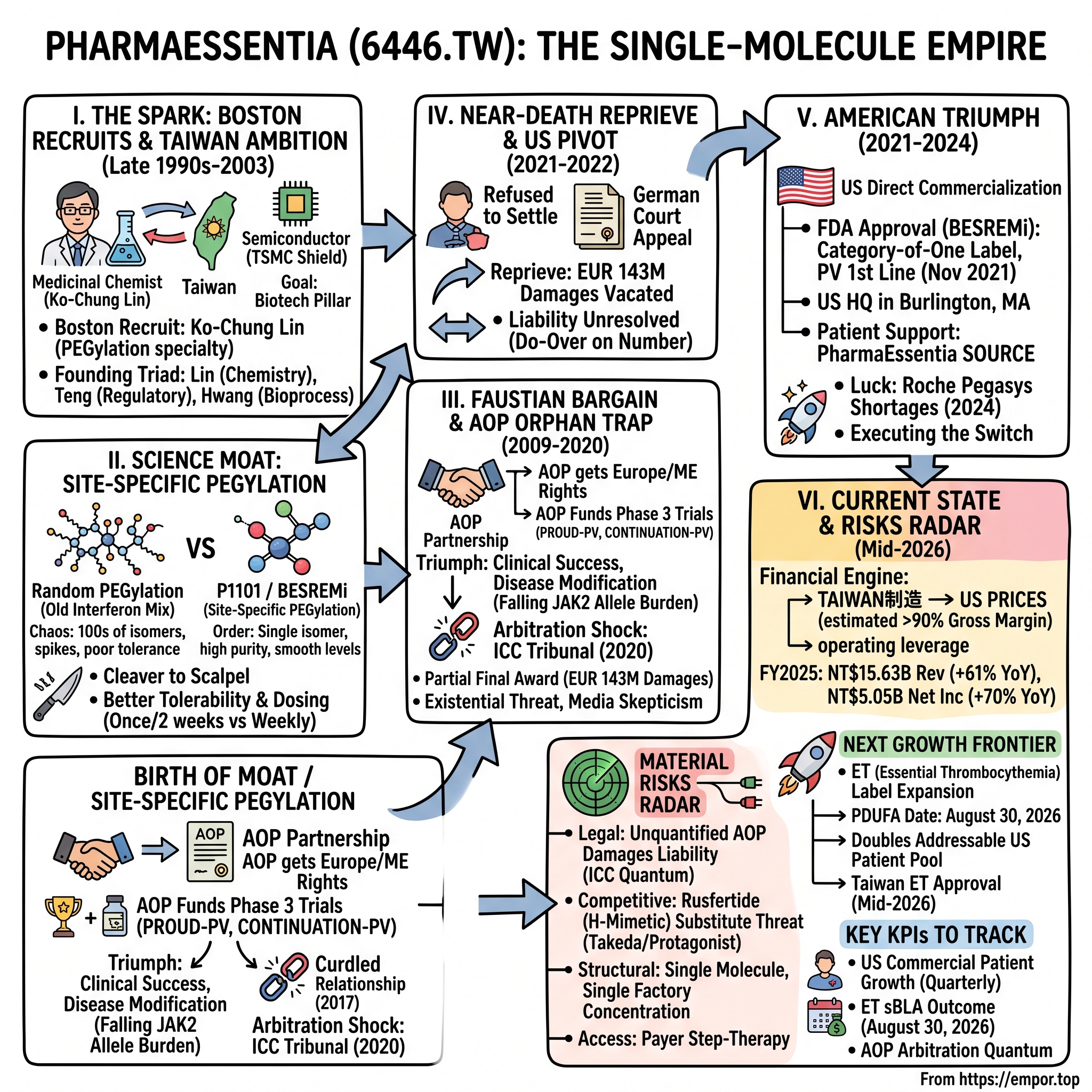
PharmaEssentia: The Single-Molecule Empire
I. Introduction & Episode Roadmap
Picture a mid-career medicinal chemist in the late 1990s, comfortably established in the Boston biotech corridor. He has spent two decades in American laboratories, attaching polyethylene glycol chains to protein drugs—an obscure specialty called PEGylation that most people outside pharmaceutical chemistry have never heard of. He has a good salary, a green card's worth of stability, and a reputation among the small guild of scientists who understand how to make fragile biological molecules last longer inside the human body. And then his home government comes calling, asking him to give it all up and come back to build something that did not yet exist: a Taiwanese biotechnology industry.
That chemist was 林國鐘 Ko-Chung Lin, and the "something" became 藥華醫藥 PharmaEssentia Corporation. Founded in Taipei in 2003, PharmaEssentia today carries a market capitalization north of NT$500 billion, making it one of the most valuable companies on the Taiwan Stock Exchange that does not etch silicon.1 It got there not by building a sprawling pipeline of a dozen drugs, but by doing the opposite—betting almost everything on a single, re-engineered molecule.
That is the paradox at the heart of this story. Interferon, the molecule in question, is one of the oldest biological drugs in existence. For decades it was known to hematologists and hepatologists as a kind of blunt instrument—a biological "cleaver" that could beat back viruses and blood cancers but left patients battered by flu-like misery, crushing fatigue, and, in the worst cases, depression severe enough to end treatment. PharmaEssentia's central insight was that interferon's problem was not the molecule itself but its impurity—and that by cleaning it up with a specific kind of chemistry, you could turn the cleaver into a scalpel.
This is a story about turning an overlooked, off-patent class of drug into a premium franchise that now sells, in the United States, for well over US$100,000 per patient per year. It is a story about a small company from a small market deciding, against every conventional playbook, to keep its most valuable rights instead of selling them—and paying for that decision with more than a decade of brutal international litigation. And it is a story about the extraordinary economics that emerge when you manufacture a biologic in Taiwan and sell it into the American specialty-pharmacy system.
But it is not a fairy tale, and Empor is not the company's investor-relations department. Nearly everything PharmaEssentia is worth rides on one molecule, ropeginterferon alfa-2b, sold as BESREMi. A single safety signal, a manufacturing failure, a hostile arbitration ruling, or a more convenient competitor could each, on its own, reshape the investment case. As we walk through the saga, we will keep asking the two questions that matter to a long-term owner: why does this company win from here, and what could break it?
Here is the roadmap. The Spark: Taiwan's post-semiconductor ambition to grow a world-class biotech sector, and the Boston recruits it lured home. The Science: the chemistry of site-specific PEGylation and the birth of P1101. The Trap: the Faustian early bargain with European partner AOP Health and the decade of legal warfare it spawned. The American Pivot: the audacious decision to bypass partners and build a direct US commercial engine. The Economics: the cash-flow power of a very expensive drug made cheaply. And finally the chessboard—competitors, the 7 Powers, the pipeline, and the bull and bear cases as they stand in mid-2026.
 Subscribe on LinkedIn
II. Taiwan's "TSMC of Biotech" Dream & The Boston Recruits
To understand why PharmaEssentia exists, you have to understand what was keeping Taiwanese policymakers awake at night around the turn of the millennium. Taiwan had pulled off one of the great economic feats of the twentieth century. It had willed into existence a semiconductor ecosystem so dominant—anchored by 台積電 TSMC—that the island's chip industry became known as the "silicon shield," a strategic asset so critical to the world economy that it functioned as a form of geopolitical insurance. But policymakers knew a hard truth about concentration: a single-industry miracle is also a single point of failure. The government wanted a second pillar, and it looked at the two industries that combine deep science with enormous, durable margins—semiconductors, which it had already conquered, and biopharmaceuticals, which it had not.
The problem was that you cannot subsidize your way into drug development the way you can into fabs. Biotech runs on a scarce, mobile resource: people who have actually shepherded a molecule from a laboratory bench through the regulatory gauntlet to a pharmacy shelf. In the late 1990s and early 2000s, almost none of those people were in Taiwan. They were in Boston, in San Francisco, in New Jersey—and a striking number of them were ethnically Taiwanese scientists who had gone to America for graduate school and simply never come back. So Taiwan did something clever and slightly audacious: it went to Boston to get them.
Ko-Chung Lin was exactly the kind of person these recruitment missions were designed to reach. He had spent roughly two decades as a scientist in the United States, and his specialty was almost custom-built for what would come next. He had worked on PEGylation and drug-delivery chemistry at Biogen, where his fingerprints were on the kind of long-acting protein engineering that would later define his life's work, and had done earlier research work in the American pharmaceutical industry.12 In 2002, after those two decades abroad, Lin returned to Taiwan—initially, in his own telling, to lobby for the funding and the ecosystem that a real biotech industry would require.1
He did not come alone, and this matters, because single-founder biotech origin myths tend to obscure how much of drug development is a team sport played across disciplines. The founding group that coalesced around PharmaEssentia brought together the three capabilities you actually need to build an integrated drug company. Lin himself owned the chemistry—the molecular design and PEGylation know-how. Dr. Ching-Leou Teng brought the regulatory and pharmaceutical-science muscle, having worked as a reviewer at the US FDA in the domain of biopharmaceutics and as a senior scientist in the American drug industry—precisely the person who knows what a regulator wants to see because she used to be the regulator. And Dr. Jack Hwang brought the unglamorous but decisive skill of bioprocess development and scale-up: the ability to take a molecule that works in a flask and manufacture it, reproducibly and at purity, in a tank. Chemistry, regulation, manufacturing—the founding triad mapped almost exactly onto the three places where biotech companies usually die.
They incorporated 藥華醫藥 PharmaEssentia Corporation in Taipei in 2003.2 And here is where the founders made their most consequential and most contrarian decision—one that would shape everything that followed, including the litigation that nearly killed them. The default model for an emerging-market biotech in 2003 was the "virtual" company: license in or discover a molecule, do just enough early work to make it attractive, and then sell or out-license it to a large multinational that owns the expensive parts—the global trials, the factories, the sales forces. It is capital-light, it de-risks fast, and it caps your upside at a royalty. PharmaEssentia's founders rejected it. They set out to build a fully integrated, globally commercializing biopharmaceutical company: their own molecule, their own manufacturing, and—eventually—their own sales force in the world's richest drug market.
For a cash-starved Taiwanese startup, this was close to hubris. Integrated drug companies are built by absorbing decades of losses; they are the most capital-intensive businesses in healthcare. Choosing that path in 2003, from Taipei, with no product and no revenue, was a bet that the founders' scientific edge was large enough to justify capturing the whole value chain rather than a slice of it. Whether that bet was wise is, in a sense, the question this entire episode is trying to answer. But it explains the psychology that runs through the rest of the story: a management team that would rather fight a ten-year legal war than surrender the economics of its own molecule. To see why they thought the molecule was worth fighting for, we have to get into the chemistry.
III. The PEGylation Breakthrough: P1101 & The Science of Monopegylated Interferon
Let us do the thing that most business stories skip and actually explain the science, because in this case the science is the moat. Start with interferon itself. Interferons are cytokines—signaling proteins your body naturally produces to marshal the immune system against viruses and abnormal cells. As a drug, recombinant interferon has been around since the 1980s, and for a long time it was a genuinely important therapy in hepatitis and in certain cancers. It was also, to put it plainly, miserable to take.
The misery had two root causes. First, natural interferon is cleared from the bloodstream quickly, so early versions had to be injected often—sometimes daily, often three times a week. Second, and worse, interferon is a systemic immune activator, and hitting the whole body with repeated spikes of it produces exactly what you would expect: relentless flu-like symptoms, fatigue, and—most feared—neuropsychiatric toxicity, including depression and, in a minority of patients, suicidal ideation. Discontinuation rates were brutal. For a chronic disease that a patient might live with for twenty years, a drug that half of patients cannot tolerate is a drug with a structural problem.
The pharmaceutical industry's first fix was PEGylation—attaching a chain of polyethylene glycol, an inert, water-loving polymer, to the interferon protein. Think of it as wrapping the small, fast-clearing drug in a bulky molecular overcoat. The overcoat makes the molecule too big for the kidneys to filter out quickly and shields it from enzymes, so it lingers in the bloodstream for days instead of hours. That is how the first-generation pegylated interferons—Roche's Pegasys and Merck's PegIntron—turned daily or thrice-weekly shots into weekly ones. It was a real advance, and both became major products.
But here is the subtlety that PharmaEssentia's founders understood better than almost anyone, because Lin had spent his career on it. The way those first-generation products attached their PEG chains was essentially random. The interferon protein has many sites where a PEG chain can bind, and the conventional chemistry sprayed PEG across those sites more or less indiscriminately. The result was not one clean molecule but a chaotic mixture—hundreds of different "positional isomers," each with the PEG stuck in a different place, each with slightly different biological activity, potency, clearance rate, and side-effect profile. When you inject that, you are really injecting a soup of related-but-different drugs. Some isomers are potent, some are duds, some clear fast, some clear slow. Batch-to-batch and dose-to-dose, the patient's experience is inconsistent, and the misbehaving isomers contribute to the sharp concentration spikes that drive toxicity.
Lin's breakthrough was to impose order on the chaos. Working with the site-specific PEGylation chemistry that had been his life's specialty, PharmaEssentia developed a proprietary process that attached the PEG chain to essentially one location on the interferon alfa-2b molecule, producing a single dominant positional isomer at very high purity rather than a mixture of hundreds. The molecule that emerged was designated P1101, later given the generic name ropeginterferon alfa-2b and the brand name BESREMi.1
Why does molecular purity translate into clinical value? Two reasons, and they compound. First, half-life. A clean, uniformly large, mono-PEGylated molecule clears slowly and predictably, which is why BESREMi could be dosed once every two weeks during treatment and, for stable patients, stretched toward once a month in maintenance—dramatically less often than the weekly Pegasys, let alone the daily interferons of old.4 For a patient facing decades of injections, the difference between weekly and biweekly-or-monthly is not a rounding error; it is the difference between a life organized around a disease and a disease that fits into a life.
Second, and more important for tolerability, a uniform molecule produces smoother, more predictable blood levels—fewer of the jagged concentration spikes that a chaotic isomer mixture throws off. Those spikes are strongly implicated in the systemic and neuropsychiatric toxicity that made older interferons so hard to take. By flattening them, PharmaEssentia made a decades-long interferon therapy plausible for the first time. This is the "cleaver to scalpel" transformation: same fundamental drug class, radically better delivery.
A word of analytical caution, since we are not writing a brochure. "Better tolerated interferon" is not the same as "well tolerated." BESREMi still carries a boxed warning for the risk of serious neuropsychiatric, autoimmune, ischemic, and infectious disorders, and interferon remains a drug that a meaningful share of patients would rather avoid entirely.3 The purity story is real and it is the foundation of the franchise—but its limits are exactly where a future competitor could attack, a point we will return to when we get to rusfertide. For now, the founders had their scalpel. The problem was that proving it worked in humans, at the scale global regulators demand, costs money a Taipei startup did not have.
IV. The Faustian Bargain: Out-Licensing & The AOP Orphan Trap (2009–2020)
Every integrated-biotech dream eventually collides with the same wall: the Phase III clinical trial. By 2009, PharmaEssentia had begun developing its own interferon in earnest and had a molecule it believed was genuinely superior to what was on the market.1 What it did not have was the tens of millions of dollars and the multi-year, multi-country trial infrastructure required to prove that molecule in polycythemia vera—a rare blood cancer where recruiting enough patients means running sites across many countries at once. For a company of PharmaEssentia's size, self-funding a global Phase III program in a rare disease was simply not on the menu.
So the company did what nearly every small biotech does at this juncture, and in doing so it partly betrayed its own integrated-company creed. It out-licensed. Its partner was AOP Orphan Pharmaceuticals, an Austrian specialist in rare and orphan diseases—the kind of nimble, regional company that knows how to run trials and sell niche drugs across Europe. Under the agreement, AOP received exclusive development and commercialization rights to BESREMi across Europe, the Commonwealth of Independent States, and the Middle East. In exchange, AOP would fund and run the pivotal European clinical trials, and PharmaEssentia would supply the drug. It was, on paper, a classic win-win: PharmaEssentia got its expensive trials paid for by someone else's balance sheet, and AOP got a promising asset for its territories.
And the trials worked—spectacularly. AOP executed the landmark PROUD-PV and its extension CONTINUATION-PV studies, and the data did something interferon advocates had long hoped for but rarely demonstrated so cleanly. BESREMi did not merely normalize patients' blood counts, the standard bar for polycythemia vera therapy. Over time it drove down the JAK2 mutant allele burden—the fraction of a patient's blood cells carrying the driver mutation that causes the disease. In plain terms, the drug appeared to be reducing the diseased clone itself, not just managing its symptoms. That is the difference between a thermostat and a cure-adjacent therapy, and it became the scientific spine of the entire BESREMi commercial pitch: disease modification, not just disease control. Those same studies later underpinned the drug's regulatory approvals.3
Here is the tragedy embedded in the triumph. The very success of the partnership set the two companies on a collision course, because success changed what each side had to gain. As BESREMi moved toward European approval and the data turned golden, the asset that PharmaEssentia had licensed out cheaply in 2009—when it was an unproven molecule from a startup with no leverage—was now demonstrably valuable. And the interests diverged. PharmaEssentia needed AOP's clinical trial data to support its own regulatory filings, most importantly with the US FDA, where the company intended to keep the rights and capture the economics itself. AOP, meanwhile, held exclusive rights to a proven drug across a large territory and had every incentive to protect and maximize that position.
By 2017, the relationship had curdled into open conflict. PharmaEssentia accused AOP of dragging its feet on the program and, critically, of failing to hand over the clinical data PharmaEssentia said it needed for its US and other filings. That year, PharmaEssentia moved to terminate the licensing agreement. AOP contested the termination fiercely, framing it—not unreasonably, from its side of the table—as an attempt by PharmaEssentia to claw back valuable European rights now that AOP's money and effort had de-risked the drug. Each side's narrative was internally coherent, which is precisely why the dispute proved so intractable. This was not a simple case of one villain; it was two partners whose contract had been written when the asset was worth little, now fighting over an asset worth a great deal.
The fight went to arbitration under the rules of the International Chamber of Commerce, with the seat in Frankfurt. And in October 2020, the tribunal delivered a ruling that landed on PharmaEssentia like a bomb. It found PharmaEssentia's termination invalid, dismissed the company's counterclaims, and ordered it to pay AOP damages of roughly EUR 143 million for its breaches and supply failures.7 To grasp the severity, you have to size the number against the company that received it: at the time, the award was in the neighborhood of PharmaEssentia's entire cash position. Taiwanese media openly questioned whether the company could survive; investors savaged the board over the capital-allocation and legal strategy that had led here. A company that had bet everything on holding its economics now faced a bill large enough to end it. The next two years would determine whether the integrated-company dream died in a Frankfurt arbitration room.
V. The Near-Death Arbitration & The German Appeal (2020-2022)
There is a moment in the life of some companies where the strategic questions—market share, pipeline, margins—recede entirely, and management is reduced to a single, existential problem: stay solvent. For PharmaEssentia, the winter of 2020 into 2021 was that moment. An arbitral tribunal had just handed a rival a claim roughly the size of the company's cash reserves. The rational, conventional move would have been to negotiate a settlement from a position of weakness and accept whatever survival terms it could get.
Management refused. Instead, it launched a multi-jurisdictional legal campaign to attack the award itself—to have it set aside where it was rendered, in Germany, and to block its enforcement elsewhere, including in the United States, where PharmaEssentia's future was increasingly concentrated. This was a high-variance strategy. If it failed, the delay would only add legal costs to an already crushing liability. But management calculated, correctly as it turned out, that arbitral awards can be vulnerable on procedure even when the underlying contract dispute goes against you—and that the tribunal's damages calculation was the soft spot.
The gamble paid off, at least for the moment, in early 2022. In the German courts, PharmaEssentia won a partial but decisive reprieve: the enormous damages award was vacated on procedural grounds relating to how the damages had been quantified, even as the validity of the underlying licensing arrangement—and therefore AOP's exclusive European rights—was left intact.7 This is the crucial nuance that a lot of the retail commentary at the time missed, and it matters enormously for how the saga later resumed. PharmaEssentia did not win the dispute. It won a do-over on the number. The court did not say AOP was wrong to be aggrieved; it said the specific EUR 143 million had not been arrived at properly. The liability question was, in effect, sent back to be re-argued.
But in the moment, the distinction hardly mattered. Vacating the damages award removed the immediate threat of insolvency. It let PharmaEssentia keep its cash, keep its manufacturing running, and—most importantly—keep executing on the prize that had motivated the whole ugly fight with AOP in the first place: the United States. The company had bought itself time and a balance sheet. What it did with that reprieve is the most important strategic chapter in the story, because it is where the contrarian, keep-your-own-rights philosophy finally got its chance to prove itself in the world's largest and most lucrative pharmaceutical market.
VI. The American Pivot: FDA Approval & US Commercialization (2021–2024)
Here is a counterfactual worth sitting with. A Taiwanese biotech, fresh from a near-death legal experience caused by out-licensing its European rights, approaches the United States—by far the largest and most complex pharmaceutical market on earth. The safe, well-worn path would be to do exactly what it did in Europe: find a big American or global pharma partner, hand them the US rights, take an upfront payment plus royalties, and let someone with an existing sales force and payer relationships do the hard, expensive work of commercialization. It is the path of least resistance, and for a company that had just been burned, it would have been the path of least apparent risk.
PharmaEssentia did the opposite. It decided to commercialize BESREMi in the United States entirely on its own—no big-pharma partner, no shared economics, the whole value chain in-house. Given what out-licensing had just cost the company in Europe, the decision reads less like reckless ambition and more like a lesson violently learned: never again let the partner sit between you and your most valuable market. The company would either capture the full economics of its molecule or fail trying.
The foundation for that bet was laid on November 12, 2021, when the FDA approved BESREMi for adults with polycythemia vera.3 Two features of the label made it far more valuable than a routine approval. First, it was the only interferon ever approved by the FDA specifically for polycythemia vera—a category of one.12 Second, and commercially decisive, the label did not restrict BESREMi to patients who had already failed the cheap generic standard-of-care, hydroxyurea. It was approved for adults with PV regardless of their treatment history.3 In payer terms, that meant BESREMi could compete for the large first-line market, not just the smaller pool of patients who had exhausted other options—an enormous difference in addressable revenue.
Approval, however, is only the starting gun. Selling a specialty drug in America is a distinct and formidable competency, and PharmaEssentia had to build it from scratch. The company established its US commercial headquarters in Burlington, Massachusetts—not coincidentally, right back in the Boston biotech corridor where its founder had been recruited two decades earlier—and hired experienced US commercial and market-access teams. The reason those teams matter is that in the American system, a $100,000-plus drug does not simply get prescribed and dispensed. It runs a gauntlet of payer prior authorizations, step-therapy protocols, specialty pharmacies, and copay economics that can strangle a launch if handled poorly.
To navigate that gauntlet, PharmaEssentia stood up a patient-support apparatus branded PharmaEssentia SOURCE, designed to smooth the two frictions that most often kill specialty-drug uptake: cost and paperwork. On the cost side, copay assistance can bring eligible commercially insured patients' out-of-pocket costs down toward zero, removing the sticker-shock objection at the pharmacy counter. On the paperwork side, the program helps physicians' offices fight through prior authorizations. None of this is glamorous, and none of it shows up in a molecule's clinical data—but hub services and market access are frequently the actual difference between a good drug that sells and a good drug that languishes.
Then came a stroke of fortune that no strategy deck could have scripted. For years, before BESREMi existed, hematologists who wanted to give their PV patients an interferon had been reaching for Roche's Pegasys off-label—it was never formally approved for PV, but it worked and doctors knew how to use it. That entrenched, off-label Pegasys base was, in one sense, BESREMi's competition. But around 2024, Roche's Pegasys ran into severe and chronic supply shortages, and Roche visibly deprioritized the aging product. Suddenly thousands of PV patients who had been maintained on off-label Pegasys needed somewhere to go—and there sat BESREMi, the only on-label interferon for their disease, with a company hungry to switch them over. PharmaEssentia moved into the vacuum and converted a meaningful cohort of Pegasys patients, supercharging its US growth just as its commercial machine was hitting its stride.
The analytical read here is important and cuts two ways. On one hand, the Pegasys collapse was genuine luck—a competitor's manufacturing stumble handed PharmaEssentia share it might otherwise have had to win patient by patient over years. On the other hand, luck only helps the prepared: without the on-label approval, the built-out commercial team, and the SOURCE support program already in place, PharmaEssentia could not have absorbed those patients. Execution turned a windfall into revenue. That combination—own-the-rights strategy, a category-of-one label, and a well-timed competitor failure—is what turned BESREMi from an approved drug into a fast-growing franchise. But the ghost of AOP had not been exorcised. It had only been waiting.
VII. The Legal Sword of Damocles: The 2025/2026 ICC Arbitration Shock
Remember the crucial nuance from the German courts in 2022: PharmaEssentia had not won the war with AOP, it had only won a do-over on the damages number. The underlying finding—that AOP had legitimate grievances and valid European rights—still stood. AOP, holding that finding, did exactly what a determined litigant with a live claim does. It went back to arbitration to re-establish and re-quantify its damages under refined legal theories. The sword had not fallen. It had merely been re-hung.
It began to descend again in early 2025. On February 10, 2025, the ICC tribunal issued a new partial final award in AOP's favor, and this time the language was pointed. The tribunal found PharmaEssentia liable for intentional breaches of contract.7 The substance of those breaches went to the heart of the American pivot we just described: delays that AOP said PharmaEssentia had caused to European regulatory approvals, and—most striking—the unauthorized use of AOP's clinical data for PharmaEssentia's own US regulatory filings. In other words, the arbitrators concluded that some of the very data that helped build the US franchise had been used in breach of the AOP agreement. The two threads of this story—the European trap and the American triumph—turned out to be tied together, and AOP was pulling the knot tight.
PharmaEssentia fought back on the same ground where it had won before: the German courts. In May 2025 it filed an application with the Higher Regional Court of Frankfurt to set aside the February 2025 partial award, arguing among other things that the award violated public order and its right to be heard.7 It was, in essence, running the 2022 playbook again—attack the award on procedural and public-policy grounds and hope the German judiciary again found a flaw.
This time, the playbook failed. On April 24, 2026—less than three months before the writing of this article—the Higher Regional Court of Frankfurt dismissed PharmaEssentia's set-aside application in its entirety and declared the partial award enforceable.7 The procedural escape hatch that had saved the company in 2022 was, at least at this level, closed. An appeal to Germany's Federal Court of Justice remains theoretically possible, but the company can no longer count on the courts to make the problem disappear.7
Now for the part that a neutral analyst has to state plainly, because it is the single largest overhang on the equity. What Frankfurt upheld in April 2026 was liability, not a final number. The precise monetary quantum of damages from this second round is, as of mid-2026, still being adjudicated. The original 2020 award was around EUR 143 million; a second-round award, layered with findings of intentional breach and years of additional accrual, could plausibly land in the multi-hundred-million-euro range.7 Against a company generating a few hundred million US dollars of annual revenue, a payout of that magnitude would be material to cash and could pressure the balance sheet or force dilution. This is not a resolved footnote. It is a live, unquantified liability sitting on top of an otherwise strong operating story.
Management's posture, notably, has shifted. After years of aggressive, multi-jurisdictional litigation, the company has signaled publicly that it would prefer to move from courtroom warfare toward a negotiated settlement. That is a rational evolution—the litigation strategy has now lost twice on the substance and once on the latest set-aside—but it is also a tacit acknowledgment that the fight is not going PharmaEssentia's way. For investors, the key point is that the AOP overhang cannot be modeled with precision; it can only be flagged as a real, potentially large, and still-uncertain claim against a company whose operating business has, in parallel, become genuinely impressive. It is to that operating business that we now turn.
VIII. Financial Engine, Unit Economics, & Capital Allocation
Set the courtroom aside for a moment and look only at the income statement, because the contrast is the whole point. While PharmaEssentia was losing arbitrations in Frankfurt, it was winning decisively in the market. In fiscal 2024, the company reported revenue of NT$9.73 billion. In fiscal 2025, revenue climbed to NT$15.63 billion—growth of roughly 61% year over year—while net income rose to NT$5.05 billion, up about 70% from NT$2.97 billion the year before.5 Diluted earnings per share reached NT$13.59, up from NT$8.00.5 That NT$5.05 billion of net income on NT$15.63 billion of revenue works out to a net margin above 32%—a level of profitability that most commercial-stage biotechs can only dream about, and that many large, diversified pharma companies never reach.5
The story those numbers tell is one of operating leverage finally unlocking. For most of its life, PharmaEssentia was a money-losing R&D and early-commercial company, absorbing the fixed costs of drug development and a US launch with limited revenue to offset them. Once BESREMi's US sales crossed the threshold where revenue outran that fixed-cost base, the incremental economics of each new patient dropped almost straight to the bottom line. That is why net income grew even faster than revenue in 2025: the expensive part—building the drug, running the trials, standing up the commercial infrastructure—was largely already paid for. Growth from here is disproportionately profit.
Why are the incremental economics so extraordinary? Because BESREMi combines two things that rarely coexist: a very high selling price and a very low cost to make. On price, BESREMi's US list price has been reported in the range of roughly US$180,000 or more per patient per year, translating to something on the order of US$9,000–$11,000 per biweekly syringe—figures consistent with a rare-disease specialty biologic, though actual net realized prices after rebates and payer discounts are lower and not fully disclosed.3 Even allowing for those discounts, this is a premium-priced product sold into the highest-priced healthcare system in the world.
On cost, PharmaEssentia manufactures both the active biological substance and the finished product at its own cGMP facility in Taichung, Taiwan—a plant built to standards that satisfy both the US FDA and European regulators. The strategic elegance here is a form of global arbitrage that is easy to describe and hard to replicate: build a world-class biologics factory in Taiwan's efficient, comparatively low-cost industrial environment, and sell the output into the American specialty-pharmacy system at American prices. The gap between Taiwanese manufacturing cost and American selling price is the engine, and it is why gross margins on the product are estimated to sit above 90%. The company controls its own supply chain end to end, which is both a margin advantage and—as we will note in the risk section—a concentration risk, because that single Taichung facility is a single point of failure for essentially all of the company's revenue.
Now the capital-allocation and governance lens, because a neutral platform has to look at management behavior, not just management results. On the credibility side, there is a genuinely impressive fact: the core strategy has been consistent for more than two decades. The founders said in 2003 that they would build an integrated global biopharma company that owned its molecule and its commercialization, and in 2025 that is precisely what exists. Very few emerging-market biotechs sustain a strategy that long without drifting into fashionable adjacencies. Founder and CEO Ko-Chung Lin remains at the helm with a personal shareholding—reported at roughly 1% of the company plus options—that is a minority stake but still represents meaningful skin in the game and unusual founder longevity.1
The debit side of the credibility ledger is the AOP saga itself, and an activist would press hard here. Management's litigious posture toward AOP has now cost the company enormously—directly in legal fees over the better part of a decade, and indirectly in a persistent valuation discount and repeated existential scares. A skeptic would argue that a company whose flagship legal strategy has lost the substantive arguments twice, and whose original 2009 licensing terms created the trap in the first place, has demonstrated a real weakness in contracting and dispute management. The counter-argument is that fighting preserved the US economics that now drive the entire equity. Both can be true. What a careful investor should conclude is that PharmaEssentia's management is exceptional at science, manufacturing, and strategic conviction—and has a documented, expensive blind spot in partner relationships and legal risk. That combination is the real management profile, and it sets up the competitive question: is the moat wide enough to justify betting on the science despite the legal scar tissue?
IX. The MPN Chessboard: Competitors, Market Dynamics, & Hamilton Helmer's 7 Powers
To war-game PharmaEssentia's position, you have to understand the battlefield: the treatment of polycythemia vera, one of a family of blood cancers called myeloproliferative neoplasms. Picture the market as a board with a first-line square and a second-line square, and four pieces contesting them.
The incumbent piece, and the one to beat, is hydroxyurea—a cheap, generic, oral chemotherapy that has been the default first-line treatment for decades. Its virtues are obvious: it is inexpensive, familiar, and it controls blood counts. Its weakness is equally real. Hydroxyurea manages the disease's output—the overproduced red cells—but does nothing to the underlying malignant clone, and it carries a long-tail concern about contributing to transformation of PV into acute myeloid leukemia, a far deadlier disease. In the framing BESREMi's marketing leans on, hydroxyurea is a symptom-suppressor, not a disease-modifier. That framing is also the crux of the counter-positioning battle, because hydroxyurea's unbeatable price is precisely what payers use to force patients to try it first.
The blockbuster piece is Jakafi (ruxolitinib) from Incyte, a JAK1/JAK2 inhibitor that generates well over US$2.5 billion in annual sales across its indications and is approved in PV as a second-line therapy for patients who fail or cannot tolerate hydroxyurea. Jakafi is excellent at what it does—controlling the miserable symptoms of MPNs, including severe itching and fatigue, and shrinking enlarged spleens. But like hydroxyurea, it does not meaningfully reduce the JAK2 mutant clone; the malignant population persists even as the patient feels better. It competes with BESREMi more in the second-line setting and on the symptom-control axis than on the disease-modification axis.
The retreating piece is Pegasys (peginterferon alfa-2a) from Roche—the off-label interferon whose supply collapse we have already covered. Clinically it is a capable interferon, but as a competitive force in PV it is exiting the board, handing its patients to BESREMi. We have accounted for that dynamic already and will not relitigate it here; the point for the chessboard is that one of BESREMi's few direct mechanistic rivals is actively vacating the field.
And then there is BESREMi itself, positioned as the disease-modifying first-line piece—the only interferon on-label for PV, carrying the PROUD-PV/CONTINUATION-PV story about reducing JAK2 allele burden. That is the case management makes. A neutral analyst should note the case is strong but not airtight: "disease modification" via falling allele burden is a compelling biological signal, but its translation into hard long-term outcomes like prevented leukemic transformation and extended survival is a claim that takes many years of data to fully substantiate, and the drug remains an interferon that some patients simply will not accept.
Now let us stress-test the moat using Hamilton Helmer's 7 Powers, taking only the powers that genuinely apply and being honest about the ones that do not.
Counter-Positioning is PharmaEssentia's most interesting power. BESREMi is positioned as a fundamentally different kind of therapy—one aimed at the diseased clone in the bone marrow rather than at symptoms or blood counts. The incumbents cannot easily reposition to match it: hydroxyurea is a generic with no owner to reinvest, and Jakafi's whole identity and approval are built around symptom and spleen control. This is a textbook counter-positioning setup—a challenger offering a different value proposition that incumbents are structurally reluctant or unable to copy. The vulnerability is that counter-positioning based on a mechanism can be neutralized by a newer mechanism, which is exactly the rusfertide threat we will discuss in the bear case.
Switching Costs are real and, in this disease, unusually powerful. Polycythemia vera is lifelong. Once a patient is stabilized on BESREMi and—over several years—begins accumulating deep molecular responses, both the patient and the treating hematologist face a high medical bar to switch: why disturb a durable remission on a disease-modifying therapy? That stickiness converts each captured patient into a potential multi-year, high-value annuity, which is the single most attractive feature of the business model. The caveat is that switching costs protect existing patients far better than they win new ones; they are a defensive moat, not an offensive weapon against a more convenient first-line entrant.
Cornered Resource is the third applicable power, residing in the proprietary site-specific mono-PEGylation process and the accumulated manufacturing know-how behind P1101. This is not a resource a biosimilar competitor can trivially reverse-engineer; reproducing a single-isomer PEGylated interferon at scale and purity is genuinely hard, which is part of why interferon competition in PV has been thin. But "cornered resource" should not be overstated into "permanent monopoly." Patents expire, know-how diffuses, and a competitor attacking with an entirely different drug class does not need to replicate the process at all—it can simply route around it. The moat is deep against imitators and shallow against substitutes.
Run Porter's lens over the same board and the picture is consistent. Rivalry today is muted—hydroxyurea is cheap but undifferentiated, Jakafi sits mostly second-line, Pegasys is exiting—which is why BESREMi has grown so fast. Barriers to entry via biosimilar are high (the cornered resource). But the threat of substitutes—a novel, non-interferon mechanism—is the force to watch, and buyer power in the form of payers demanding cheap hydroxyurea first is a persistent tax on first-line access. The moat is real and, for now, wide. Whether it stays wide depends on the pipeline and the competition still on the horizon.
X. The Next Growth Frontier: ET Label Expansion & Pipeline Optionality
If polycythemia vera is the franchise that PharmaEssentia has, essential thrombocythemia is the franchise it wants next—and the near-term catalyst that the entire equity narrative is organized around. Essential thrombocythemia, or ET, is PV's sibling in the myeloproliferative neoplasm family. Where PV is defined by overproduction of red cells, ET is defined by overproduction of platelets, and the danger it poses is similarly vascular: too many platelets raise the risk of dangerous clots and, paradoxically, of bleeding. Like PV, it is a chronic, lifelong condition. And critically, like PV a decade ago, it has been starved of innovation—there has historically been no therapy specifically approved and designed to modify the underlying ET disease.
The commercial logic of extending BESREMi into ET is almost too clean. It is the same molecule, made in the same Taichung facility, sold by the same US commercial team through the same SOURCE support program, to the same hematologists who already prescribe it for PV. The fixed costs are already built; an ET approval would spread them across a substantially larger patient base. PharmaEssentia has estimated that ET roughly doubles its addressable US patient pool, opening an additional population on the order of 100,000-plus patients. In business terms, that is close to a free option to double the size of the core market with minimal incremental infrastructure.
The catalyst is concrete and dated. PharmaEssentia submitted a supplemental Biologics License Application to the FDA for BESREMi in ET, and in January 2026 the FDA confirmed it had accepted the application for substantive review under a standard classification, with a PDUFA goal date of August 30, 2026.8 The clinical basis is the Phase 3 SURPASS-ET and Phase 2 EXCEED-ET studies, which the company argues support use across a broad ET population.8 Investors received an important derisking signal ahead of the US decision: in mid-2026, Taiwan's Ministry of Health and Welfare approved BESREMi for ET, making it the first market in the world to clear the drug for that indication—and, by the company's framing, the first genuinely new ET therapy in roughly three decades.9 A Taiwanese approval is not an FDA approval, but it demonstrates that at least one competent regulator found the ET data package convincing.
A neutral analyst should hold two thoughts at once. The bull thought: an August 30, 2026 US approval would be a genuine step-change, effectively doubling the commercial runway of a franchise that is already compounding at 60%-plus. The skeptic thought: it is not yet approved in the US, PDUFA dates can slip or end in a complete response letter, and even a clean approval must still convert into prescriptions against the same cheap-generic-first payer dynamics that constrain the PV business. The ET opportunity is large and probable, but it is not banked.
Beyond ET, the pipeline is best understood as optionality sized to its economic weight—which is to say, small today. The most strategically coherent extensions apply the company's core PEGylation platform to other cytokines: long-acting, PEGylated interleukins such as IL-2 and IL-15 engineered for immuno-oncology. This is the platform-leverage thesis—if the mono-PEGylation know-how is a genuine cornered resource, it should be applicable beyond interferon—and it is the piece of the pipeline most worth watching for what it says about whether PharmaEssentia is a one-molecule company or a platform. Further out sits P1801, an early-stage anti-PD-1 antibody being explored in solid tumors including in combination with BESREMi, which represents real but unproven optionality, and earlier still, exploratory TCR-T cell therapy work that carries essentially no current financial weight and should be treated as speculative. The honest framing: today, PharmaEssentia is BESREMi plus a hoped-for ET expansion, with a platform that might someday produce a second act. The valuation rests overwhelmingly on the first two.
XI. Playbook: Business & Investing Lessons
Step back from the particulars and PharmaEssentia offers a few durable lessons that generalize well beyond one Taiwanese biotech.
The first is the power—and price—of holding the line on your own rights. The conventional emerging-market biotech playbook is to out-license your crown-jewel markets, especially the United States, to a multinational in exchange for early upfront cash. It de-risks beautifully, and it typically leaves the originator capturing a minority slice of the ultimate commercial value while the licensee keeps the rest. PharmaEssentia's decision to build its own US commercial infrastructure and keep 100% of the American economics was the single most value-creating choice in its history; the surging, high-margin US revenue of 2024–2025 is the direct dividend of that choice. The lesson is not "always keep your rights"—it is that the rights to your best market are usually your most valuable asset, and selling them early, when you have the least leverage, is a decision to look at very hard before making. PharmaEssentia looked hard, kept the US, and was rewarded.
The second lesson is the mirror image of the first, and it is written in the AOP litigation: the danger of asymmetric regional agreements signed from weakness. When a small, cash-poor originator hands a territorial specialist broad rights and control over the clinical data, it can lose command of its own program and find that data—and the partner's cooperation—held hostage when interests later diverge. A decade of arbitration, hundreds of millions in potential liability, and a persistent valuation discount all trace back to the terms of a 2009 deal struck when PharmaEssentia had no leverage. The lesson for founders is uncomfortable but clear: the contracts you sign when you are weakest are the ones most likely to define your future, so the data rights, termination provisions, and dispute mechanics deserve as much attention as the upfront check.
The third lesson is the one with the broadest applicability: global-local cost arbitrage in biologics. Building a high-tech, dual-regulator-approved cGMP biologics plant in an efficient, lower-cost industrial hub like Taichung, and selling the output into premium Western healthcare systems, is a structurally advantaged model that surprisingly few companies have executed at scale. It is the same insight that made Taiwan's semiconductor industry—world-class engineering and manufacturing discipline applied to a high-value global product—transplanted into biology. PharmaEssentia is, in a real sense, TSMC's logic applied to a protein: own the hard manufacturing, do it better and cheaper than others can, and let the value accrue to the maker. Whether that model proves as durable in biologics as it did in chips is one of the more interesting open questions this company poses.
XII. Analysis: Neutral Bull vs. Bear Case & Current Risk Radar
Let us make the "why win / why not" spine explicit, because everything above has been building toward it.
The bull case rests on three legs, each of which we have evidence for rather than mere assertion. First, the ET growth vector: a probable US approval on or around August 30, 2026 that would roughly double the addressable market with almost no new fixed cost, layered on top of a franchise already growing north of 60%.89 Second, the annuity quality of the revenue: because PV and ET are lifelong and BESREMi's switching costs are high, each captured patient is a multi-year, high-margin revenue stream, giving the business a recurring, compounding character unusual for a single-product biotech. Third, the continued conquest of the legacy interferon market as Roche's Pegasys exits, converting a competitor's misfortune into durable share. Underpinning all three is the extraordinary unit economics—Taiwan manufacturing cost against American pricing—that turns revenue growth into disproportionate profit growth, as 2025's 70% net-income jump demonstrated.5
The bear case is equally concrete, and a serious investor should weight it heavily. The first and most immediate threat is the AOP damages hammer: a still-unquantified, potentially multi-hundred-million-euro liability that the German courts have now made enforceable at the partial-award stage, capable of draining cash or forcing dilution, with the precise number outside anyone's ability to model.7 The second is competitive substitution, embodied by rusfertide, the hepcidin-mimetic from Protagonist Therapeutics and Takeda. In 2025, rusfertide's Phase 3 VERIFY study met its primary endpoint and all key secondary endpoints, sharply reducing the need for therapeutic phlebotomy and improving hematocrit control, and the partners submitted a US new drug application on the strength of that data.1011 Rusfertide is not an interferon and does not carry interferon's tolerability baggage; if approved, its convenience and clean safety profile could peel away exactly the first-line patients who want disease control without interferon side effects—precisely BESREMi's soft flank. This is the substitute threat that Porter's framework flagged, now concrete and advancing. The third bear leg is structural: single-molecule, single-factory concentration. Essentially all of PharmaEssentia's revenue and valuation rides on one molecule made in one Taichung facility, so any safety signal, manufacturing interruption, or regulatory setback would be not a dent but a potential catastrophe.
An activist stress test sharpens the governance angle. A hostile investor would argue that PharmaEssentia's board has presided over a legal strategy that has now lost its central arguments repeatedly while accumulating enormous costs, that the 2009 contracting misstep reflects a durable weakness in partner management, and that the company has been slow to quantify or reserve against the AOP liability in a way the market can price. The rebuttal—that the same management preserved the US economics now driving the equity, and has executed the launch and manufacturing flawlessly—is genuine. But the unresolved, unquantified legal overhang combined with single-asset concentration is exactly the kind of tail risk that justifies a persistent valuation discount, and pretending otherwise would be to write like a shareholder rather than an analyst.
The material risk radar, then, reduces to three live wires. Regulatory: the ET sBLA could be delayed or rejected at the August 30, 2026 PDUFA date, removing the single largest near-term growth catalyst. Legal: the final ICC quantum, and any further German court action, could crystallize a large cash liability. Commercial access: payers can tighten step-therapy mandates, forcing patients through multiple lines of cheap hydroxyurea before reimbursing BESREMi, throttling first-line uptake regardless of the clinical case. Note what is not on this list: generic macro hand-waving. The risks that matter to this company are specific, identifiable, and mostly binary—which is itself a defining feature of a concentrated, single-molecule biotech.
XIII. Epilogue & KPIs to Track
PharmaEssentia's arc is, in the end, a story about conviction and its costs. A medicinal chemist was lured home from Boston to help build an industry that did not exist, and he did it not by hedging across a portfolio but by betting almost everything on cleaning up one old, unloved molecule—and then on keeping the rights to sell it himself in the one market that mattered most. That conviction produced a genuinely rare thing: a Taiwanese biopharma company with a category-defining product, world-class margins, and a fast-compounding US franchise. The very same conviction produced a decade of ruinous litigation and a single-asset concentration that leaves the whole enterprise exposed to a handful of binary events. The upside and the fragility spring from the same source.
The convergence at the heart of it—Taiwanese manufacturing and engineering discipline married to high-conviction global commercialization—is what makes the company interesting to a long-term investor, and it is also what makes it hard to value with confidence. This is not a diversified pharma whose risks average out. It is a bet on one molecule, one factory, one expanding label, and one unresolved legal fight.
For an investor who wants to follow the story rather than predict it, three key performance indicators carry almost all of the signal, and everything else is noise around them.
First, US commercial patient growth—the number of active patients on BESREMi in the United States, tracked quarter over quarter. This is the single cleanest read on whether the franchise is still compounding, whether the Pegasys conversion is sustaining, and how the launch is trending. It is the revenue engine expressed as a patient count, and it will move before the financials do.
Second, the ET sBLA outcome on August 30, 2026. A clean approval roughly doubles the addressable market and validates the platform-extension thesis; a delay or complete response letter removes the primary near-term catalyst and forces a rethink of the growth narrative. Few single dated events matter this much to a single company.
Third, the AOP arbitration quantum. The final damages number—whether it arrives via a further ICC ruling, a German court, or, as management now hopes, a negotiated settlement—will determine how large a bite the decade-long legal saga ultimately takes out of the balance sheet. Until it is fixed, it is the largest unpriced variable in the story.
Watch those three, and you are watching the company. Everything else—the science, the margins, the manufacturing arbitrage—has already told its story. What remains is execution against the label, defense against the substitute, and resolution of the fight that has shadowed this single-molecule empire from the beginning.
References
-
Interview: Ko-Chung Lin PhD – Founder & CEO, PharmaEssentia, Taiwan — PharmaBoardroom ↩↩↩↩↩↩
-
Ko-Chung Lin, Founder & Managing Director of PharmaEssentia — The CEO Magazine ↩↩
-
FDA Approves Besremi for Treatment of Polycythemia Vera — Pharmacy Times, 2021-11-12 ↩↩↩↩↩
-
Besremi (ropeginterferon alfa-2b-njft) FDA Approval History — Drugs.com ↩
-
PharmaEssentia Corporation Reports Earnings Results for the Full Year Ended December 31, 2025 — MarketScreener ↩↩↩↩
-
Frankfurt Higher Regional Court upholds BESREMi® arbitral award in favor of AOP Health — Business Wire, 2026-04-24 ↩↩↩↩↩↩↩↩
-
FDA Confirms a PDUFA Goal Date of August 30, 2026 for the sBLA Submission of Ropeginterferon Alfa-2b-njft in Essential Thrombocythemia (ET) — Business Wire, 2026-01-13 ↩↩↩
-
PharmaEssentia Announces Taiwan Approval of BESREMi® for Essential Thrombocythemia, Marking First Global Approval in ET — BioSpace, 2026-06-10 ↩↩
-
Protagonist and Takeda Announce Positive Topline Results from Phase 3 VERIFY Study of Rusfertide in Patients with Polycythemia Vera — Business Wire, 2025-03-03 ↩
-
Protagonist and Takeda Announce ASCO Plenary Presentation Highlighting Full 32-Week Results from Phase 3 VERIFY Study of Rusfertide — Takeda Oncology, 2025-06-01 ↩
-
FDA Approves the First Interferon for Adults With Polycythemia Vera — Blood Cancer United, 2021-11-12 ↩
 LinkedIn
 WhatsApp
 Reddit
 Hacker News
 Email
Email Kindle
 RSS Feed
 Spotify
 Apple Podcasts
 Amazon Music
 Audible
 YouTube