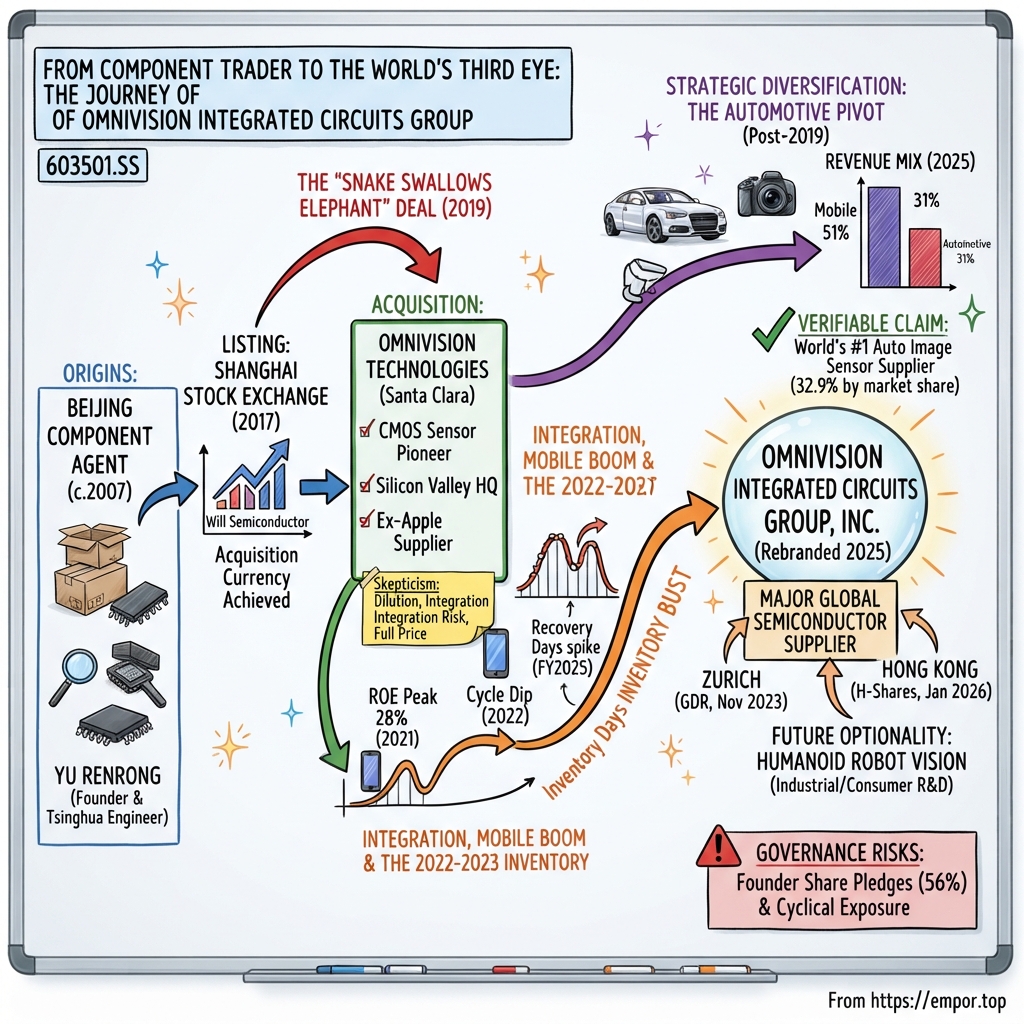
豪威集成电路(集团)股份有限公司 OmniVision Integrated Circuits Group: From Component Trader to the World's Third Eye
I. Introduction & Episode Roadmap
Some business transformations seem improbable when stated plainly.
In 2007, a Chinese engineer who had spent his career trading semiconductors founded a small distributor in Shanghai with four million yuan in registered capital—roughly half a million dollars. The company did not design chips or operate a fabrication plant; it bought discrete components from global suppliers and resold them to domestic manufacturers at a spread. By 2017, when the business listed on the Shanghai Stock Exchange, it remained fundamentally a component distributor.
Two years later, in 2019, the company acquired Santa Clara-based OmniVision Technologies—the CMOS image sensor maker whose sensors powered the original iPhone—for approximately RMB 15.3 billion in stock.1 In 2025, the parent company completed a rare corporate rebranding, retiring its original identity, Will Semiconductor (上海韦尔半导体), to adopt 豪威集成电路(集团)股份有限公司 OmniVision Integrated Circuits Group, Inc.2 The acquirer took the identity of the brand it had purchased.
Today, the combined entity operates as a major global semiconductor supplier, generating revenue of RMB 28.85 billion for fiscal 2025.3 It ranks as the world's largest supplier of automotive image sensors by market share.3 Listed in Shanghai, the company expanded its capital market footprint with Global Depositary Receipts trading in Zurich since November 20234 and H-shares listing on the Hong Kong Stock Exchange in January 2026.5 Its sensors equip flagship Chinese smartphones, electric vehicle surround-view cameras, surgical endoscopes, and—in early, non-material volumes—experimental humanoid robotics.6
This analysis addresses a core question: Is OmniVision a durable global technology franchise, built through a strategic acquisition and expanded through disciplined engineering and market diversification? Or is it a cyclical, working-capital-intensive semiconductor supplier whose peak valuation move occurred in 2019, leaving its stock to trade down from a 2026 high near RMB 157 to the mid-80s?
In practice, both narratives carry weight. This analysis tests the moat thesis against the company's weakest financial periods. It examines the sharp decline in return on equity in 2023, assessing whether automotive diversification represents a structural solution or a slower-moving version of the standard semiconductor cycle. Additionally, it evaluates corporate governance risks surrounding the founder's share pledges, given the implications of a controlling shareholder leveraging more than half of his equity stake.
The story begins where the business originated: with a distributor selling other people's chips.
 Subscribe on LinkedIn
II. Origins: The Component Trader Who Became China's Richest Chip Man
In the early 2000s, Beijing's Zhongguancun (中关村) electronics district was not the manicured technology campus of today. It was a dense network of multi-story markets, fluorescent-lit stalls, and handwritten price sheets, where traders moved cardboard boxes of relays, capacitors, and memory chips between floors. This was where China's hardware economy cleared. A Shenzhen contract manufacturer needing 40,000 power management ICs on short notice did not call a foreign manufacturer's sales desk—they called an agent.
Yu Renrong (虞仁荣) was one of those agents, eventually building the largest independent distribution business in Beijing.
Yu's background diverged from the typical component distributor. Born in 1966 in Ningbo (宁波), Zhejiang province, he trained as an engineer at Tsinghua University (清华大学), graduating in an influential 1985 electrical engineering class that produced several prominent leaders in China's semiconductor industry. He was an engineer by training, but spent the first two decades of his career as a merchant.
The distinction between merchant and designer is fundamental. Distribution is not a junior discipline to semiconductor design; it is a distinct business built on availability and trust. A distributor assumes inventory risk on behalf of customers, absorbs demand fluctuations, and gains visibility into real-time order flow across dozens of manufacturers—often recognizing demand shifts months before market analysts. Distribution also requires managing two distinct networks: upward to global semiconductor suppliers and downward to domestic original equipment manufacturers.
Yu spent nearly fifteen years cultivating this dual network. In 2007, he established Shanghai Will Semiconductor with RMB 4 million in registered capital—a modest foundation reliant on working capital and vendor relationships rather than capital-intensive infrastructure. The core model was straightforward: purchase inventory, hold it briefly, and resell at a spread.
Over the next decade, Will executed a two-track strategy. It expanded its distribution network to generate cash flow and market intelligence, while selectively acquiring small design capabilities in secondary components—such as analog devices, circuit protection components, and power management ICs. When the company listed on the Shanghai Stock Exchange in 2017 under ticker 603501, it operated as a hybrid entity: a high-volume distribution business with an emerging in-house design arm.
The 2017 initial public offering was priced on distribution economics rather than a high-valuation technology narrative. However, public listing provided Yu with strategic leverage: traded equity that functioned as acquisition currency. A listed stock gave the company a liquid instrument to issue, pledge, or deploy toward large-scale transactions without requiring equivalent cash reserves.
Two years later, Yu deployed that currency.
Will's trajectory illustrates a recurring pattern in industrial acquisitions: a lower-margin, working-capital-intensive business can serve as a strategic entry point to higher-value assets. Distribution provided Yu with global supplier ties, domestic customer relationships, a decade of demand data, and public stock. When a major asset became available, Yu possessed the rare combination of market reach, industry relationships, and equity currency necessary to execute a transaction.
That opportunity emerged in Silicon Valley: OmniVision Technologies, an image sensor pioneer that had stalled under public market pressure and was subsequently acquired by a consortium of Chinese state-backed funds seeking a permanent corporate home for the asset.
III. The Bet-the-Company Deal: Swallowing OmniVision (2015–2019)
Understanding why OmniVision Technologies was available for acquisition requires examining its origins, its early market leadership, and its subsequent strategic limitations.
The Santa Clara pioneer
Founded in Santa Clara in 1995, OmniVision spent its first decade pursuing a contrarian technical path. At the time, high-performance digital cameras relied on charge-coupled devices (CCDs). CCDs offered superior image quality but required specialized manufacturing, consumed significant power, and carried high production costs.
OmniVision instead bet on complementary metal-oxide-semiconductor (CMOS) technology.
The technical distinction explains the trajectory of the mobile market. An image sensor consists of a grid of millions of pixels that capture incoming photons and convert light charges into digital data. In a CCD, charges move physically across the chip, pixel by pixel, to a single converter at the edge—a process akin to a bucket brigade passing water to a single inspector. This yielded high image clarity, but was slow, energy-intensive, and reliant on proprietary fabrication processes.
By contrast, CMOS architecture performs signal conversion directly at each pixel using standard semiconductor manufacturing processes. This allows sensors to be produced in conventional foundries, integrate processing circuitry on the same die, and consume far less power. Although early CMOS sensors produced lower image quality in the 1990s, process engineering improvements by the mid-2000s made them competitive in quality while remaining compact and cost-effective enough for mobile devices.
OmniVision sensors subsequently supplied early camera phones and the original iPhone, establishing the company as an early leader in mobile image sensing.
However, its leadership proved vulnerable. Sony introduced backside-illuminated and stacked sensor architectures, Samsung leveraged its internal semiconductor foundries, and key customers shifted suppliers. OmniVision's FY2015 Form 10-K filed with the SEC detailed a company generating substantial revenue but constrained by intensifying competition and customer concentration in a market where Japanese and South Korean competitors possessed structural manufacturing advantages that OmniVision, as a fabless designer, could not match.7 A technology pioneer had been out-scaled.
The take-private
In April 2015, OmniVision agreed to a buyout by a consortium comprising Hua Capital Management, CITIC Capital, and GoldStone Investment for $29.75 per share in cash—a transaction that valued the company at approximately $1.9 billion.8 Following approvals from shareholders and the Committee on Foreign Investment in the United States (CFIUS), the deal closed in 2016, and OmniVision was placed into a Chinese holding entity known as Beijing Howay (北京豪威).
The acquiring consortium consisted of financial buyers backed by state-adjacent capital, operating in alignment with broader domestic initiatives to acquire semiconductor capabilities. Because the buyers lacked operational expertise in chip design and manufacturing, they required an industrial home for the asset—preferably an entity that could list on domestic Chinese equity markets, where semiconductor valuations were significantly higher than in private secondary markets.
That need created an opening for Will Semiconductor and its publicly traded shares.
The snake swallows the elephant
In 2018, Chinese financial media characterized Will Semiconductor's acquisition proposal as "a snake swallowing an elephant" (蛇吞象).
The transaction was structured as an equity exchange rather than a cash purchase. Will agreed to issue approximately RMB 4.4 billion in new equity to acquire roughly 96% of Beijing Howay, along with SuperPix Technology (北京思比科), a smaller domestic CMOS image sensor designer. Total consideration for the target assets reached approximately RMB 15.3 billion.1 For a distributor whose standalone revenue and market capitalization were a fraction of the target's size, the transaction represented a substantial corporate risk.
Executing the deal required regulatory approvals from both the China Securities Regulatory Commission and U.S. authorities overseeing OmniVision's American operations and intellectual property. Both regulatory bodies cleared the transaction in 2019.9
The market's verdict was not applause
Despite final regulatory clearance, public equity markets reacted with skepticism, and Will Semiconductor's stock declined upon confirmation of the deal.9
Three main factors drove the market's initial reaction. First, mechanical dilution: issuing substantial new shares diluted existing stockholders into a minority position in a dramatically altered business. Second, integration risk: a component distributor with no experience managing a global fabless design firm was assuming operational oversight of international R&D teams across Santa Clara, Shanghai, Norway, and Japan—a complex managerial challenge with historically mixed outcomes in cross-border tech acquisitions. Third, valuation concerns: the private equity consortium had acquired OmniVision for $1.9 billion in 2015, while Will paid approximately RMB 15.3 billion—over $2.1 billion at prevailing exchange rates—three years later for a controlling stake in the holding vehicle and a smaller secondary asset, despite no dramatic improvement in OmniVision's market share during that period.
Evaluating the acquisition price requires distinguishing between entry valuation and subsequent market tailwinds. As an independent U.S.-listed entity in 2015, OmniVision was a mid-tier fabless chipmaker losing market share to Sony and Samsung. Paying a higher valuation three years later was not an obvious bargain at closing. The acquisition proved successful in hindsight primarily due to two subsequent industry tailwinds: Chinese smartphone manufacturers adopted multi-camera arrays with higher pixel counts, and automotive manufacturers expanded camera deployments per vehicle to support advanced driver-assistance systems (ADAS).
This context clarifies management's execution. The 2019 transaction was strategically sound, avoiding debt by utilizing equity currency, and correctly positioned the firm for expanding image-sensor demand. However, attributing its success solely to valuation insight overlooks the favorable macro cycles that followed. The acquiring entity paid a full price for a recognized asset and benefited as market demand shifted toward its product portfolio.
The immediate structural result was clear: the transaction elevated a domestic semiconductor distributor into the world's third-largest supplier of CMOS image sensors, behind Sony and Samsung.
Then, cyclical industry pressures reemerged.
IV. Integration, the Mobile Boom, and the 2022–2023 Inventory Bust
The first three years after the 2019 transaction appeared to validate the acquisition.
Chinese smartphone manufacturers engaged in a multi-camera arms race tailored to OmniVision's product lineup. Camera counts per handset expanded from one to two, three, and four, while resolutions rose from 12 megapixels toward 48, 64, and 108 megapixels. Each additional camera module represented a new sensor sale, and higher resolutions increased average selling prices. Simultaneously, major Chinese handset makers—including Huawei, Xiaomi, OPPO, vivo, and Honor—sought alternatives to Sony for supply-chain security and commercial leverage as U.S.-China technology tensions escalated.
Image sensors rapidly transformed from an acquired asset into the primary driver of Will Semiconductor's identity and earnings. Return on equity climbed to roughly 28% by 2021—an exceptional metric for a fabless chip designer and a dramatic shift from the company's origins as a low-margin component distributor.
Then the cycle turned.
What actually happened in 2022–2023
The structural breakdown illustrates a classic semiconductor bullwhip effect.
As a fabless chip designer, OmniVision sells to an intermediary channel of distributors, camera module makers, and smartphone manufacturers. During an expansion, channel buyers over-order to secure supply and prevent missed product launches. This behavior generates artificial demand signals, blending actual end-user purchases with channel inventory accumulation, which prompts chipmakers to expand foundry commitments and inventory.
When smartphone demand slowed sharply across China in 2022, channel buyers halted new orders to clear existing stockpiles. Consequently, supplier revenues dropped far faster than consumer purchasing. OmniVision was left holding excess inventory that required substantial write-downs.
The financial impact was severe. OmniVision's return on equity collapsed from roughly 28% in 2021 to approximately 2.6% in 2023—representing an evaporation of returns on its equity base rather than a routine margin compression. Its cash conversion cycle stretched beyond 300 days at the trough, locking up ten months of working capital in a business with depressed earnings.
For a company framing itself as a durable global technology franchise, the 2023 contraction represents a critical baseline test. A enterprise possessing true pricing power rarely suffers a 90% decline in returns over two years. The 2023 downturn demonstrated that OmniVision's mobile-centric model retained high operating leverage and limited ability to cushion cyclical downturns—the signature of a cyclical component supplier rather than a wide-moat technology franchise.
The recovery, and what it does and does not prove
The subsequent financial recovery was significant. Fiscal 2025 revenue rose approximately 12% to RMB 28.85 billion, while net profit grew roughly 40% to about RMB 4.6 billion.3 Net profit expanding more than three times faster than revenue illustrates positive operating leverage as sales recovered, fixed research expenditures were spread over larger volumes, and prior inventory write-downs ceased.
However, a sharp cyclical rebound confirms the existence of a trough rather than structural improvement in through-cycle profitability. While most semiconductor suppliers achieve strong profit growth coming out of a down-cycle, the true test remains how the business performs in subsequent downturns. If another mobile contraction reproduces the severity of 2023, diversification efforts remain largely superficial. Conversely, if automotive revenues cushion future mobile declines, it would provide empirical evidence that strategic diversification has structurally altered the company's financial profile.
During the downturn, management maintained research and development expenditure at roughly 10% of revenue despite contracting earnings. Preserving R&D intensity when return on equity fell below 3% imposed an immediate earnings drag, but protected the underlying product pipeline.
By late 2025, management signaled that the recovery remained non-linear, with commentary regarding the first quarter of 2026 pointing to softer sequential revenue as semiconductor cyclicality reasserted itself.10 This outlook highlights that fiscal 2025 reflected a cyclical upturn rather than an uninterrupted growth trajectory.
That reality underscores why the expansion into automotive sensors became central to the company's strategy.
V. The Automotive Pivot: Diversifying Away from the Phone Cycle
Understanding why a chip designer would shift focus from its highest-volume market requires examining how the vehicle itself has changed.
A 2010 vehicle had, at most, a reversing camera—a low-resolution part sold primarily on price and replaced whenever a cheaper alternative appeared. A 2026 vehicle equipped with an advanced driver-assistance package might carry eight to twelve cameras: forward-facing stereo units for lane keeping and automatic braking, four surround-view cameras for parking and low-speed maneuvering, side and rear units for blind-spot detection, and in-cabin infrared sensors monitoring driver attentiveness. The camera has evolved from a convenience feature into a safety-critical sensing system.
This transition fundamentally altered the economics of automotive image sensors in two ways.
Why automotive is a different business, not just a different customer
First, silicon content per vehicle expanded significantly. What was once a market worth a few dollars per car expanded to tens of dollars per vehicle, growing with each safety mandate and step toward higher autonomy. Consequently, volume growth in automotive CMOS image sensors depends only partly on total vehicle production; it is primarily driven by the number of sensors designed into each model.
Second—the critical distinction for assessing competitive moats—the sales process differs entirely from consumer electronics. Supplying smartphone sensors involves annual negotiations: a handset maker designs a new flagship, component vendors compete on specifications and price, and the socket winner must re-compete the following year. By contrast, supplying automotive sensors requires a multi-year qualification process. The component must meet strict temperature, vibration, and functional-safety standards. A Tier 1 supplier builds a camera module around the chip, validates the unit, and the automaker validates the complete driver-assistance system. Moving from initial design-in to volume production typically takes three to five years, but once selected, the sensor usually remains on the platform for its five- to seven-year lifecycle.
This dynamic creates substantial switching costs grounded in re-qualification expense and product liability rather than brand preference. An automaker that has validated its automatic emergency braking system around a specific sensor will rarely substitute a competitor to save a dollar, as re-validation costs far outweigh potential savings and introduce asymmetric liability risks.
The proof point, and how to check it
Management makes a specific and verifiable market claim: OmniVision ranks as the world's largest automotive CMOS image sensor supplier, holding approximately 32.9% of global market share in 2024.3 Unlike broad assertions of leadership, this figure can be evaluated against peer disclosures.
Such verification is essential. Western incumbents in automotive vision—including onsemi, which established its position through prior imaging acquisitions, and STMicroelectronics—each claim leading positions in automotive imaging. Semiconductor market-share metrics vary widely depending on whether calculations rely on unit volumes, overall revenue, or specific sub-segments. A market share figure based on unit volume in basic surround-view cameras reflects different economics than one based on revenue from high-value, forward-facing driver-assistance sensors. Investors evaluating the 32.9% market-share figure must account for how it is measured and how competitors define the market.
What remains undisputed is the structural mix shift in revenue. Recent financial reporting shows mobile accounting for roughly 51% of sales, automotive representing about 31%, security and surveillance contributing 8%, medical applications taking 4%, and other segments filling the remaining 6%.3 The expansion of automotive sales from a negligible fraction at the time of the 2019 acquisition to nearly a third of total revenue represents a fundamental shift in the company's product mix, customer profile, and commercial terms.
The honest caveat
However, this transformation requires a nuanced assessment.
While the automotive segment offers structurally superior switching costs and longer design-in cycles compared to mobile, it is not acyclical. Global automotive manufacturing remains inherently cyclical, experiencing recent volatility driven by pandemic disruptions, semiconductor supply constraints, and intense price competition within the Chinese electric vehicle market. In 2026, a domestic automotive semiconductor supplier operates in an environment where major vehicle manufacturers face severe margin compression and actively pass pricing pressure down the supply chain.
The strategic reality is not that automotive sales eliminate cyclicality, but rather that they replace a short, highly volatile mobile cycle marked by annual re-negotiations with a longer, differently timed automotive cycle backed by higher switching costs. This shift represents a structural improvement, but not immunity from market downturns. Management's acknowledgment of softer near-term revenue underscores that cyclical pressures persist.10
The decisive key performance indicator for this thesis will be the multi-year trajectory of segment-level gross margins in automotive compared to mobile. If automotive gross margins remain resilient or expand alongside volume growth, it will confirm that high switching costs and design-in barriers generate durable pricing power. Conversely, if automotive margins compress toward mobile levels under pricing pressure from electric vehicle manufacturers, the company will have achieved volume diversification without economic insulation—a far weaker structural position.
Evaluating that trajectory requires recognizing that OmniVision operates not as a single uniform entity, but as two distinct businesses with fundamentally different operating models.
VI. What the Company Actually Is Today: Two Very Different Businesses
Examining segment disclosures reveals a clear structural duality. Beneath its corporate identity as a global image-sensor developer, the group continues to operate a substantial electronic components agency—the original trading business established in 2007.
Evaluating the company requires analyzing these two operations independently, as their financial profiles and underlying unit economics are fundamentally distinct.
Business one: semiconductor design
This segment underwrites the company's valuation. It encompasses CMOS image sensors—the core technology franchise—alongside analog integrated circuits and touch-and-display solutions. Operating on a fabless model, OmniVision focuses on circuit design while outsourcing wafer fabrication, assembly, and testing to foundry partners. Capital expenditure remains modest, with primary investment directed toward engineering talent and mask sets. Gross margins fluctuate with industry cycles and product mix, supported by research and development spending that runs at roughly 10% of consolidated revenue.3
Management's projections for this division set a clear benchmark for execution. Company guidance anticipates the image-sensor business becoming the single largest line item in 2026 at approximately 42% of revenue and roughly 52% of profit, driven by the ramp of 8-megapixel automotive sensors and share gains in overseas markets.3
The gap between revenue and earnings highlights the division's role as the group's primary profit engine. Profit contribution running roughly ten percentage points above revenue contribution demonstrates where the core earning power resides. Generating more than half the group's profit from two-fifths of total revenue implies that the remaining operations—including analog ICs, touch-and-display products, and the legacy distribution division—are collectively dilutive to overall margins.
Business two: electronic components agency
This division represents the legacy distribution business: purchasing inventory from global semiconductor suppliers, carrying stock, and reselling it to domestic manufacturers at a spread. Operating margins are structurally thin, compensating for logistics, credit, and inventory availability rather than proprietary intellectual property. The model absorbs substantial working capital, as its value proposition relies on holding stock that customers prefer not to carry on their balance sheets.
The company has not disclosed a formal strategic rationale for retaining the agency business rather than spinning it off. Several potential operational factors may explain its continuation. The segment generates revenue scale and incremental cash flow with minimal additional capital investment. It preserves supplier relationships across the global semiconductor industry cultivated over two decades, which can prove useful during allocation-constrained periods. Additionally, it maintains a commercial footprint across thousands of Chinese electronics manufacturers, offering a distribution channel through which the design business can sell its products.
However, whether these commercial benefits outweigh the associated costs remains an open question. The agency business reduces blended gross margins, inflates balance-sheet inventory and receivables, and complicates consolidated financial analysis. Investors evaluating the high-margin sensor franchise must isolate and discount an attached business with fundamentally different unit economics.
While management implies commercial synergies between the two units, the company has provided limited disclosed data detailing specific cross-selling metrics. In the absence of explicit evidence, the distribution segment appears to persist largely as a legacy of the founder's original business and an absence of pressing external pressure to restructure.
What you are underwriting
Ultimately, an investment in the stock is a thesis on the image-sensor design business. That division accounts for the concentration of profit, the primary growth opportunities, the defensible competitive position, and the bulk of the equity value. The distribution segment functions primarily as a low-return, capital-intensive appendage that inflates top-line revenue optics while generating modest cash.
Evaluating the company based on headline consolidated figures—such as its RMB 28.85 billion in fiscal 2025 revenue—obscures these underlying economics. The core technology business represents roughly 40% of total revenue and about half of operating profit, operating within an industry governed by specific competitive dynamics.
That competitive landscape defines the company's next strategic challenge.
VII. Industry Structure & Competitive Position: Porter's Five Forces and 7 Powers
The global CMOS image sensor (CIS) industry operates as a clear oligopoly within semiconductors, structured around distinct manufacturing models, high capital requirements, and concentrated market share.
The top of the market
Sony holds approximately 40% of the global market and maintains a clear technical leadership position. Its advantage is both architectural and manufacturing-based. Sony pioneered stacked backside-illuminated (BSI) sensors, an architecture that fabricates the light-sensing layer and processing logic separately before bonding them vertically. Rather than positioning light-capturing photodiodes and supporting circuitry side by side on a single silicon plane, stacked BSI places the pixel array on top with an unobstructed light path, moving signal-processing circuitry to the layer beneath. This structure maximizes light absorption while expanding processing capacity on the lower die.
Sony also operates internal semiconductor fabrication facilities, a structural factor that carries greater weight in image sensing than in standard digital logic. Image sensors rely on specialized manufacturing steps for photodiodes, color filter arrays, and microlenses. In-house fabrication allows integrated producers to co-optimize pixel design and wafer processing—an advantage that fabless designers relying on standard foundry offerings cannot fully replicate.
Samsung ranks second globally, leveraging a similar in-house manufacturing footprint alongside captive demand from its mobile device division.
OmniVision ranks third. Together, these three suppliers control roughly two-thirds of the global market, protected by substantial entry barriers: multi-decade research investments, proprietary pixel-process know-how, and long-standing OEM qualification cycles.
The threat from below
Beyond the market leader, the primary competitive dynamic involves emerging domestic rivals.
Chinese designers GalaxyCore (格科微) and SmartSens (思特威) collectively account for roughly 15% of the global CIS market. Both gained market share through low-end market entry, competing on price in secondary product tiers. GalaxyCore built substantial volume in entry-level mobile applications and auxiliary depth sensors, while SmartSens established a strong position in security and surveillance imaging, supported by domestic camera demand.
For OmniVision, the primary competitive risk is not sudden technological obsolescence, but steady price compression moving upward from commodity tiers. As low-end competitors build manufacturing scale in baseline applications, they re-invest cash flows into higher-specification sensor development—the same expansion playbook OmniVision deployed earlier in its growth.
Automotive: the contested ground
In automotive sensing, the competitive landscape differs significantly. Western incumbents, including onsemi and STMicroelectronics, maintain long-standing relationships with European and American Tier 1 suppliers and automakers, supported by established functional-safety track records.
Consequently, OmniVision's leading global market share by volume must be contextualized. A high volume position in surround-view cameras does not automatically guarantee equal representation in higher-value Western advanced driver-assistance system (ADAS) programs, particularly given geopolitical procurement sensitivity.
Applying 7 Powers honestly
Evaluating the business through Hamilton Helmer's 7 Powers framework reveals a mixed competitive profile:
Scale economies: present but bounded. Directing roughly 10% of its RMB 28.85 billion fiscal 2025 revenue base to research and development provides an absolute spend that smaller domestic rivals cannot match. However, Sony's larger total R&D budget leaves OmniVision at a scale disadvantage relative to the market leader, positioning the company between low-cost challengers and a capital-dominant industry leader.
Cornered resource: partial. Accumulated pixel-design intellectual property and the patent portfolio acquired in 2019 represent meaningful entry barriers. However, because process know-how is increasingly co-developed with commercial foundry partners, the exclusivity of that manufacturing expertise remains constrained.
Counter-positioning: absent or inverted. Operating as a fabless designer minimizes capital intensity and suited the original acquisition structure. However, in a sector where manufacturing processes directly dictate sensor performance, reliance on commercial foundries leaves OmniVision dependent on third-party production roadmaps. Vertically integrated competitors face no such constraint, creating a structural ceiling at the highest performance tier.
Switching costs: the strongest strategic pillar. In the automotive segment, multi-year qualification procedures and strict safety requirements generate high switching costs. This represents the company's most defensible competitive barrier, though its resilience across a full automotive cycle remains to be proven.
Branding: developing. Corporate rebranding and cross-border capital listings consolidate market identity, but brand recognition in business-to-business semiconductor sales serves primarily to secure procurement discussions rather than drive direct pricing power.
Network economies and process power: absent. Image sensor sales display no direct network effects, while manufacturing process advantages accrue primarily to integrated competitors.
Porter, briefly
A Porter's Five Forces assessment reinforces these structural dynamics:
Supplier power remains high, as fabless chipmakers depend on concentrated foundry capacity for specialized image-sensor production.
Buyer power is pronounced in mobile electronics, where major handset manufacturers leverage high volumes during annual price negotiations, but is moderated in automotive by high re-qualification barriers.
Threat of substitutes is limited in the short term, as complementary modalities such as radar and LiDAR enhance rather than replace optical cameras in driver-assistance suites.
Threat of new entrants is low at the advanced tier due to capital and technical barriers, though low-end market entry is already well established.
Industry rivalry remains intense and structurally price-competitive.
Overall, OmniVision maintains one strong, defensible competitive moat—automotive switching costs—within a market structure characterized by foundry supplier dependencies, price competition from lower-tier rivals, and an entrenched market leader with an unassailable manufacturing advantage.
This competitive landscape requires continuous operational execution and strategic adaptation—providing context for management's capital allocation and expansion initiatives beyond core semiconductor design.
VIII. Going Global: GDRs, the Rename, and the Hong Kong Listing
On November 10, 2023, the company began trading Global Depositary Receipts on the SIX Swiss Exchange in Zurich.4
On the surface, Zurich was an unconventional venue. Switzerland is not a hub for Asian semiconductor demand, nor is it a traditional destination for Chinese technology listings. However, the China-Switzerland Stock Connect program offered a regulatory pathway at a time when primary listings in the United States faced heightened geopolitical friction. Through the offering, Will Semiconductor raised approximately $445 million.4
The transaction was notable less for the capital raised than for what it revealed about corporate strategy. A $445 million injection was modest for an enterprise of this scale, providing neither the funds for a major acquisition nor the capital required to build a semiconductor fabrication plant. Instead, the Swiss listing secured international market access: a non-mainland shareholder base, institutional research coverage in Europe, and a foothold in capital markets insulated from U.S.-China regulatory tensions. It functioned as an insurance policy and a credibility exercise as much as a financing event.
Erasing your own name
In May and June of 2025, management executed a corporate change that reflected how it viewed the enterprise's long-term commercial value.
Six years after acquiring OmniVision, the parent company formally renamed itself 豪威集成电路(集团)股份有限公司 OmniVision Integrated Circuits Group, Inc., retiring the Will Semiconductor identity that Yu Renrong had built from a four-million-yuan trading company.2
Corporate renames are often cosmetic, sometimes deployed to distance a business from past challenges or attach it to emerging market trends. In this case, the rebranding reflected an explicit recognition of where the core asset sits.
The decision conceded an underlying commercial reality. "Will Semiconductor" represented the founder's origins: the component trading operation, the 2017 public listing, and the balance sheet that enabled the 2019 transaction. "OmniVision" was the acquired target. By adopting the target's identity, management acknowledged that brand equity, global customer recognition, engineering reputation, and commercial reach resided in the purchased business rather than the original parent entity. For a founder-led Chinese company, subordinating the founder's original corporate identity to an acquired American brand marked a significant strategic choice.
It was also a practical commercial decision. For a chip designer selling safety-critical sensors to German, Japanese, and American automakers—and recruiting technical talent in Santa Clara—the OmniVision brand opens conversations that Will Semiconductor did not. The rename formally aligned the group's legal identity with its operational reality.
Hong Kong, and the market's answer
On January 11, 2026, the company completed its H-share listing on the Hong Kong Stock Exchange, pricing at the top of its indicated range to raise HK$4.8 billion—roughly $616 million. Shares rose approximately 16% on debut.5
The strong initial reception signaled international institutional appetite for a Chinese semiconductor franchise with a defensible automotive position, arriving at a moment when investors actively sought exposure to autonomy and robotics supply chains.
Then the stock reversed course.
Over the course of 2026, the shares fell from a high near RMB 157 to the mid-80s—a decline of roughly 45% from peak. The immediate catalysts stemmed from company disclosures: guidance for softer first-quarter revenue as semiconductor cycles bit,10 followed by an unaudited first-quarter 2026 report that did not reverse the narrative.11
This sequence offers two primary insights for investors.
First, management executed its capital-markets program with discipline. Across three jurisdictions, the company raised roughly $1 billion in combined proceeds from its Swiss GDR and Hong Kong H-share offerings during periods of market strength rather than financial distress. Raising capital opportunistically reflects prudent balance-sheet management. How the Hong Kong proceeds are specifically deployed—whether earmarked for research and development, overseas expansion, or general balance-sheet flexibility—remains the key detail for investors to track in subsequent filings.
Second, the 2026 equity derating reflects the market actively repricing cyclical risk. Shares had appreciated on an automotive-and-robotics narrative, only to pull back when near-term revenue growth slowed. The market's reaction underscores ongoing debate over whether the business has established a secular growth trajectory or remains fundamentally tied to broader semiconductor cycles.
That market judgment directly impacts the founder's balance sheet—framing the corporate governance considerations that follow.
IX. Current Management: Founder Control, Incentives, and Capital Allocation Credibility
Domestic media narratives often portray Yu Renrong as a heroic figure: the Tsinghua-trained engineer who built China's top semiconductor distributor, orchestrated the acquisition of an iconic Silicon Valley chipmaker, and pledged a personal fortune to endow a hometown university. A skeptical short-seller, by contrast, would point to heavy share pledging, extreme cyclicality, and concentrated corporate governance. Both perspectives are grounded in the company's operating record, making an evaluation of management central to the investment case.
The alignment
Yu holds approximately 27.4% of the company directly, a stake that expands to roughly 33.6% alongside acting-in-concert parties—principally the Shaoxing Weihao (绍兴韦豪) investment vehicle and family holdings. This provides unambiguous founder control, giving Yu decisive authority over strategic direction and board composition.
This ownership structure creates substantial economic alignment. Yu's personal net worth remains tied to the performance of a single stock. When the share price declined from RMB 157 to the mid-80s in 2026, Yu absorbed a proportional loss far greater than any external shareholder. Controlling shareholders with a third of equity capital rarely pursue value-dilutive empire-building, as they bear the primary brunt of value destruction.
However, concentrated control imposes familiar governance costs. Minority investors in a founder-dominated enterprise possess limited leverage to influence corporate decision-making. In such an environment, board independence, related-party transaction oversight, and financial disclosure standards require rigorous scrutiny.
The pledge overhang
The more pressing governance concern centers on share pledging. Yu has pledged between 56% and 60% of his equity stake as loan collateral, with cumulative disclosures reaching approximately 194 million shares.12
While share pledging by controlling shareholders is common among Chinese listed companies, it introduces a specific structural risk. Pledged-share facilities carry strict maintenance thresholds. If stock prices decline past predetermined triggers, lenders issue margin calls requiring additional collateral or cash. If a borrower fails to meet those demands, lenders retain the contractual right to liquidate pledged shares on the open market. Forced sales during a market downturn create a downward feedback loop, pressuring the stock price further and potentially triggering additional liquidation thresholds—a dynamic that, in extreme cases across Chinese equity markets, has led to founder margin calls and forced shifts in corporate control.
A 45% drawdown in OmniVision's equity during 2026, against a stake that is more than half pledged, elevates share pledging from a theoretical governance footnote into an active risk factor. The arrangement creates a mechanical transmission belt through which market volatility can amplify stock weakness independent of operational performance. Investors must monitor the disclosed pledge ratio as a primary risk indicator: a rising ratio amid falling share prices signals collateral pressure, whereas a declining ratio indicates balance-sheet deleveraging.
The capital allocation record, tested
Evaluating management's capital allocation requires balancing the success of its signature transaction against subsequent operational challenges.
The defining strategic decision remains the 2019 acquisition of OmniVision. That transaction was directionally sound, structured entirely with equity currency rather than debt, and ultimately validated by expanding multi-camera mobile adoption and automotive vision demand. While it demonstrated strategic vision and execution capability, a single transformational transaction provides a limited dataset for evaluating long-term capital allocation discipline.
The primary counterpoint occurred during the 2022–2023 downturn. The management team that executed the 2019 acquisition subsequently presided over an inventory overhang that reduced return on equity from roughly 28% to 2.6%. While cyclical contractions impacted the broader semiconductor industry, exceptional demand forecasting should have mitigated channel inventory accumulation. The severity of the margin compression indicates that management remained fully exposed to broader supply-chain volatility.
Since the acquisition, capital deployment has turned notably conservative. Management executed opportunistic capital raises through Swiss GDRs and the Hong Kong listing, maintained research spending through cyclical troughs, and refrained from speculative mega-deals. This measured posture demonstrates restraint following a major transaction, though maintaining capital discipline across future semiconductor cycles remains an unproven long-term test.
The university
An additional element of Yu's public profile is his commitment to donate an estimated RMB 30 billion in pledged shares to endow a private research university in his hometown of Ningbo.
While this philanthropic commitment has no direct impact on corporate income statements, it provides insight into founder incentives. Establishing a long-term educational institution suggests a multi-decade planning horizon rather than a short-term capital exit. At the same time, because the endowment relies on share transfers and pledges, it remains linked to the controlling shareholder's broader equity structure and pledge dynamics.
Day-to-day operations benefit from management continuity provided by General Manager Gao Wenbao (高文宝) and Chief Financial Officer Xu Xing (徐兴). Nevertheless, OmniVision remains fundamentally a founder-driven enterprise where overarching strategy, capital allocation, and risk governance concentrate in one individual.
That centralized leadership structure is now directing the company toward its next major expansion frontier—an emerging market narrative that presents both compelling growth opportunities and distinct analytical risks.
X. The Hidden Optionality: Humanoid Robot Vision
Every few years, a semiconductor company discovers that its existing products happen to fit an emerging technology trend. Often this amounts to little more than a promotional narrative, but occasionally it reflects genuine commercial alignment.
The test for distinguishing hype from reality is straightforward: does the new application require the company to build an entirely new capability, or does it consume technology the company already produces? Companies that must develop new capabilities to chase a trend incur substantial execution risk. Companies whose existing product portfolio directly serves the new market possess genuine optionality.
OmniVision falls into the second category, which is why the segment warrants examination rather than immediate dismissal.
Why robots need this specific technology
A humanoid robot presents a sensing challenge far closer to an autonomous vehicle than a smartphone, with one critical addition.
First, it requires a dense camera array rather than a single sensor: head-mounted units for navigation and spatial mapping, wrist- or hand-mounted sensors for precise object manipulation at close range, and peripheral units for obstacle avoidance. Industry reports suggest that each humanoid unit requires multiple CMOS image sensors across its body, hands, and environment-sensing systems.6
Second, it requires global shutter sensors. Standard smartphone cameras rely on rolling shutters, which read out image pixels row by row over several milliseconds. When either the camera or the subject moves quickly, sequential row reading distorts the image—causing fast-moving objects to appear warped. While imperceptible in routine photography, this distortion is disqualifying for a robotic limb operating at high speed that must identify an object's precise location at a single microsecond. A global shutter captures every pixel simultaneously. Although technically complex to manufacture, global shutter technology is a capability OmniVision has developed over a decade for industrial machine vision and automotive applications.
Finally, robotic systems demand low power consumption. Because a humanoid robot operates on internal battery power, every watt consumed by visual processing reduces operating runtime and payload capacity.
Automotive-grade, global-shutter, low-power image sensing matches the core product line OmniVision developed for vehicle applications. Consequently, humanoid robotics represents a natural product adjacency rather than a costly strategic pivot.
Sizing it honestly
Design activity and supply-chain engagements have been reported across several prominent robotics developers, including Tesla's Optimus program, Figure AI, Agility Robotics, and Unitree (宇树科技).6
However, analytical discipline is required when evaluating these opportunities. Reported design engagements do not equal commercial revenue streams. Global production of humanoid robots currently remains in the hundreds to low thousands of units annually. Compared to OmniVision's core addressable markets—measured in billions of units for mobile devices and hundreds of millions for vehicles—robotics revenue in 2026 is financially immaterial and does not move the earnings line.
Furthermore, design wins do not guarantee sustained volume shipments. OmniVision's own automotive trajectory provides a clear lesson: design wins secured in the early 2020s required years to expand into the 31% revenue share automotive represents today, supported by an established, fully funded automotive market with regulatory mandates. Humanoid robotics lacks a comparable commercial foundation. Despite significant venture capital investment and compelling technology demonstrations, the sector has yet to demonstrate mass-market commercial viability.
The proper analytical framework treats robotics as low-cost optionality. Because serving the sector requires minimal incremental research or capital expenditure beyond existing automotive investments, OmniVision retains upside exposure if humanoid robotics achieves commercial scale. If the market fails to materialize, the company incurs virtually no capital loss, as the underlying sensors continue selling into automotive and industrial channels.
Consequently, robotics exposure should not distort the valuation of OmniVision's core earnings engine. Assigning substantial valuation weight to humanoid robotics in 2026 relies on speculative projections rather than financial realities. The key operational metric to monitor is whether robotics eventually emerges as a separately reported revenue line in corporate disclosures. Until management breaks out the segment, it remains financially immaterial.
Which returns the analysis to the metrics that actually drive financial performance.
XI. The Numbers That Matter: KPIs and Financial Character
Three primary metrics determine whether the company's operational transformation is succeeding.
KPI one: CIS segment revenue and gross margin
This metric serves as the primary gauge of commercial momentum and underlying earnings quality. Top-line revenue reflects unit volume and market footprint, while gross margin reveals whether that expansion stems from technological differentiation or aggressive price discounting.
Tracking revenue and margins in tandem provides a diagnostic indicator of competitive strength. Expanding segment sales accompanied by stable or widening gross margins indicates that switching costs remain effective and pricing power is holding. Conversely, top-line growth paired with compressing margins suggests the company is winning volume by competing on price against low-end rivals like GalaxyCore and SmartSens, or yielding to margin pressure from domestic vehicle manufacturers—a pattern that dilutes economic value. Given management's guidance that image-sensor design should reach roughly 42% of revenue and 52% of profit in 2026,3 the ten-percentage-point spread between those figures functions as a benchmark: if profit contribution fails to outpace revenue share, the higher-margin product-mix thesis has stalled.
KPI two: automotive design-win and share momentum
This metric evaluates the structural durability of the company's market diversification strategy. Because automotive design cycles require three to five years to transition into full-scale production, design-win momentum serves as a leading indicator of revenue trajectory through the end of the decade.
Key evaluation criteria include whether market share holds at or above the roughly 32.9% global level as incumbents onsemi and STMicroelectronics respond,3 whether design wins shift toward high-value forward-facing driver-assistance sensors rather than lower-margin surround-view modules, and whether customer adoption expands into European, North American, and Japanese vehicle platforms. Continued concentration among domestic electric vehicle manufacturers—a sector characterized by aggressive price discounting—would represent a structurally weaker market position than headline volume figures imply.
KPI three: inventory days and cash conversion cycle
Working-capital metrics function as an early warning system for cyclical supply-chain imbalances, a dynamic demonstrated during the 2023 downturn.
When the company's cash conversion cycle stretched beyond 300 days at the trough, it was not merely reflecting historical weakness; it signaled the real-time accumulation of excess channel inventory ahead of falling revenue. In a fabless semiconductor model paired with a component agency business, balance-sheet metrics invariably signal demand shifts before they register on the income statement.
However, interpreting these figures requires establishing a structural baseline. Inventory levels exceeding 150 days remain typical even during strong operating periods, reflecting extended foundry lead times and the capital requirements of holding distribution stock. Consequently, the key signal is not the absolute inventory metric, but its rate of change relative to sales growth. Inventory expansion outpacing revenue growth for two consecutive quarters provides a clear signal of emerging channel overhang.
Financial character
Three structural characteristics frame these key performance indicators.
First, maintaining research and development expenditures at roughly 10% of revenue throughout industry cycles, including the 2023 trough,3 demonstrates a commitment to long-term product development. However, this spending level represents an industry baseline necessary to maintain technical competitiveness rather than an aggressive capital deployment that would outspend market leader Sony.
Second, working-capital intensity remains an inherent feature of the operating model rather than a temporary inefficiency. Valuation models that assume reported net income easily converts into liquid cash risk overstating earnings quality, as incremental profit is routinely absorbed by inventory and accounts receivable. Consequently, free cash flow conversion provides a more accurate metric of underlying economic returns than headline net income growth.
Finally, corporate balance-sheet strength has improved following capital-raising activities. By raising approximately $1 billion across European and Hong Kong public offerings, financing the 2019 acquisition through equity rather than debt, and avoiding excessive corporate leverage, management has insulated the firm's balance sheet—even as the founder maintains substantial personal share pledges. Distinguishing between corporate financial health and controlling shareholder leverage remains essential for assessing overall risk.
XII. Bull vs. Bear: The Investment Case, Stress-Tested
The bull case, at its strongest
The bull case rests on a verifiable structural expansion. Automotive camera content per vehicle rises with every step toward higher autonomy, and OmniVision's 32.9% share of that market3 reflects established commercial positioning rather than long-term ambition. Unlike the mobile sector, automotive positions are protected by multi-year qualification cycles that make market-share gains deliberate and customer defections rare.
The company holds this market share with a cost structure tailored to its primary geographic market. Chinese automakers and smartphone manufacturers increasingly favor domestic suppliers for supply-chain security. OmniVision stands as the sole domestic supplier of image sensors possessing top-tier global technical credentials—while lower-tier domestic rivals compete primarily on price, foreign market leaders face geopolitical procurement headwinds in China.
Strategic capital deployment reinforces this positioning. Management executed a transformational acquisition in 2019 without taking on corporate debt, resisted speculative deals during subsequent market peaks, and sustained research and development expenditures through the industry's 2023 downturn. Furthermore, the firm broadened its investor base across three stock exchanges, raising approximately $1 billion in equity capital during periods of market strength.45
Finally, the company retains low-cost optionality in humanoid robotics. Serving this emerging market requires minimal incremental capital expenditure, as the required global-shutter visual sensors overlap directly with existing automotive product lines.6
The bear case, at its strongest
The bear case emphasizes that OmniVision remains a cyclical semiconductor component supplier that has been reframed as a secular platform franchise. Recent operational history demonstrates this exposure: consolidated return on equity dropped from roughly 28% in 2021 to 2.6% in 2023. An enterprise possessing true pricing power and strong economic moats rarely suffers a decline of that magnitude over a two-year period, and the 2023 downturn occurred under the current management team, customer base, and core product architecture.
Structurally, the company occupies a vulnerable middle tier. Industry leader Sony retains a durable competitive advantage through integrated, in-house semiconductor manufacturing—a structural benefit that a fabless chip designer cannot fully replicate regardless of research spending. Below, domestic challengers GalaxyCore and SmartSens hold roughly 15% combined market share, using aggressive price competition to expand into secondary product tiers while actively targeting higher-specification markets.
While real, the company's automotive expansion exposes the firm to an increasingly challenging customer base. Major Chinese electric vehicle manufacturers operate under intense margin pressure and actively pass cost reductions down their supply chains. Expanding volume within a price-sensitive customer segment yields far thinner economic returns than supplying high-margin legacy automakers.
Internal corporate structure adds further drag. The legacy component distribution business operates on thin margins, absorbs substantial working capital, and dilutes group profitability without a clear, disclosed operational synergy.
Corporate governance introduces a direct, quantifiable risk factor. The controlling shareholder has pledged more than half of his equity stake as loan collateral,12 creating a structural vulnerability during periods of share-price volatility. With the stock declining roughly 45% from its 2026 high, heavy share pledging creates a mechanical transmission channel for downward price pressure.
Equity markets have already begun reflecting these operational realities. After pricing at the top of its range during its January 2026 Hong Kong debut and gaining 16% on its first trading day,5 the stock subsequently surrendered those gains, pulling back to the mid-80s as investors re-evaluated near-term growth expectations.
Weighing it
Evaluating these competing claims yields a calibrated verdict across four core dimensions.
The economic moat thesis survives in a narrowed form. The severe profit compression of 2023 disproves the strong version of the thesis—that OmniVision operates as a durable growth franchise insulated from semiconductor cyclicality. However, it does not invalidate the narrower claim that the automotive segment possesses higher switching costs than the mobile business. Because automotive products represented a smaller fraction of total revenue during the 2023 downturn than their current 31% share, that structural buffer was not yet fully active. The automotive moat thesis remains plausible but unproven, with its ultimate test residing in the relative depth of segment margins during the next cyclical downturn.
The assessment of management capability requires similar nuance. Executing a well-timed, equity-funded cross-border acquisition demonstrates strategic judgment. However, presiding over the subsequent 2022–2023 inventory accumulation reveals vulnerabilities in demand forecasting and cycle management. Evaluating management going forward requires monitoring whether executive leadership maintains transparent guidance by signaling revenue shifts early and explicitly—as demonstrated in recent warnings regarding softer first-quarter revenue—or reverts to reactive explanations following earnings misses.10
Humanoid robotics optionality warrants minimal current valuation weight. While technically sound, the commercial timeline for robotics must be evaluated against historical precedent. Automotive image sensors required several years to progress from initial design wins to accounting for nearly a third of corporate sales in a market with established customer demand. Humanoid robotics currently lacks a comparable mass-market foundation.
Capital allocation discipline remains proven over the observed period. Management successfully funded a major acquisition with equity, avoided dilutive secondary transactions, preserved research intensity through cyclical troughs, and opportunistically raised capital across international exchanges. Nevertheless, high founder share pledging introduces personal financial leverage that could create strategic friction independent of corporate balance-sheet strength.
Ultimately, OmniVision presents a business with a defensible automotive position operating within a price-competitive industry structure. Its founder maintains strong equity alignment alongside quantified personal pledge exposure, arriving at a moment when public equity markets are actively distinguishing between cyclical recovery and structural growth. The bull and bear cases operate on different analytical horizons: the bear case rests on verified historical cyclicality, while the bull case depends on untested structural diversification.
XIII. Risk Radar
Five primary risks define OmniVision's operational outlook, each driven by a specific corporate or industry mechanism rather than a broad market label.
Demand cyclicality represents the baseline risk. The underlying driver remains channel inventory behavior: distributors and module manufacturers over-order during market expansions and halt purchases during contractions, causing supplier revenue to fall faster than end-user consumption while forcing inventory write-downs. The 2022–2023 downturn serves as the primary benchmark for the magnitude of this volatility. The company's expansion into automotive sensors—now accounting for roughly a third of revenue with longer contract durations—is designed to dampen cyclical swings. However, that stabilizing effect remains a strategic hypothesis rather than an empirically proven outcome across a full automotive cycle.
Competitive price erosion poses a grinding, long-term threat. Emerging domestic competitors GalaxyCore and SmartSens undercut prices in low-end mobile applications as well as security and surveillance. The primary danger is not that lower-tier rivals will immediately displace OmniVision's flagship sockets, but that price compression across high-volume commodity tiers will reduce profits needed to fund advanced research and development. The key operational warning sign for this trend is expanding unit volume accompanied by falling segment gross margins.
Geopolitical exposure is structural and inherently unhedgeable. OmniVision operates as a China-domiciled parent of a historically U.S.-headquartered technology enterprise, maintaining engineering facilities in the United States while selling safety-critical components globally amidst ongoing U.S.-China technology friction. Potential mechanisms of disruption include Western automakers designing out Chinese-owned suppliers under tightened procurement policies, export controls restricting technology access or addressable markets, foundry capacity constraints resulting from fabless manufacturing reliance, and capital-markets friction. Evaluating this risk requires tracking disclosed regulatory developments and formal management filings rather than modeling outcomes from news headlines. As of late 2026, the company continues to maintain its international operational structure and execute cross-border capital offerings, indicating that geopolitical friction has not halted operations to date.
Governance and shareholder leverage carry distinct structural risks. The controlling shareholder's pledge ratio creates forced-selling exposure during sharp equity drawdowns, with the potential to trigger liquidity cascades.12 This mechanism represents the factor most capable of driving share-price volatility independent of core operational performance.
Execution risk threatens forward growth initiatives. The company's key growth narratives—automotive market-share expansion and humanoid robotics optionality—depend on successfully converting design engagements into commercial shipping volumes. Both initiatives also rely on sustained research spending that the enterprise can maintain only if its core business remains profitable. A deep downturn that forces cuts to research and development would impair both growth legs simultaneously, underscoring why preserving R&D intensity through the 2023 trough was critical to the company's long-term pipeline.
Inventory provisioning requires rigorous analytical scrutiny. In a working-capital-intensive business, the accounting policy for inventory write-down provisions involves substantial management estimation. This line item is often where a cyclical downturn first registers on the balance sheet—or where deferred provisioning can temporarily conceal emerging financial stress. Comparing inventory provision charges against inventory growth across reporting periods provides a vital diagnostic check on earnings quality.
XIV. Business & Investing Lessons
Four broader lessons generalize beyond this specific corporate history:
The boring business is often the option on the exciting one. Yu Renrong spent two decades as a component distributor, and conventional analysis assumed he simply exited trading to enter chip design. The operational reality was the reverse: distribution was the critical foundation. It provided supplier relationships, real-time demand insights, a broad domestic customer footprint, and—following the 2017 listing—the equity currency that made the RMB 15.3 billion acquisition executable for a company unable to fund it in cash.1 Markets often undervalue unglamorous intermediary businesses that aggregate industry relationships and market intelligence, as those intangible assets do not register on a balance sheet until deployed in a transformative transaction.
Timing a cyclical acquisition matters as much as pricing it. The 2019 transaction proved highly successful, driven largely by subsequent tailwinds in smartphone camera counts and automotive vision deployments—trends that were directionally foreseeable but uncertain in magnitude. Assessing an acquisitive management team requires separating the quality of an initial strategic decision from the macro cycle that follows. Management made a sound strategic move, and a favorable demand cycle amplified the outcome. Conflating execution with cyclical timing risks creating overconfidence in future dealmaking.
Renaming a company after an acquired brand serves as an explicit strategic statement. Dismissing the 2025 corporate rebranding as cosmetic marketing oversimplifies its operational significance.2 A founder subordinating an original corporate identity to an acquired asset represents a deliberate signal regarding where long-term enterprise value resides. If the OmniVision brand enhances commercial access among Western automakers and international engineering talent, the impact will manifest in the geographic distribution of future design wins. If not, the rebranding remains a costly cosmetic exercise. Regardless of the outcome, management clearly communicated its operational conviction.
End-market diversification is the classic response to cyclicality, but its effectiveness requires a downturn to verify. Transitioning from consumer electronics into automotive and emerging robotics applications aligns with standard strategic management principles. However, the true stabilizing benefit becomes visible only during an industry contraction. Accepting a diversification narrative during an upturn amounts to endorsing an unproven hypothesis. A disciplined analytical framework evaluates the thesis strictly against empirical evidence—acknowledging the strategy as structurally sound yet awaiting validation in the next cyclical trough.
XV. Epilogue: What to Watch From Here
Four key indicators will clarify, over the next several years, which narrative ultimately holds true.
Where the Hong Kong money goes. The HK$4.8 billion raised in January 20265 represents management's most recent capital allocation choice, and its disposition will be informative. Deployed into research and development headcount and overseas market expansion, it would signal management investing in automotive and international growth from a position of strength. Retained on the balance sheet, it would point to a team building a cash buffer against an anticipated downturn. Directed toward a major acquisition, it would reopen concerns regarding capital discipline that recent years had begun to settle. Subsequent regulatory filings and earnings reports will make the allocation clear.
Whether the automotive position holds under pressure. The roughly 32.9% share figure3 is a snapshot of a contested market rather than a permanent position. Competitors onsemi and STMicroelectronics have strong incentives to defend market share, domestic rivals aim to push upmarket, and vehicle manufacturers continue to demand supply-chain cost reductions. Consequently, the crucial metric to monitor is not market share alone, but share alongside automotive segment gross margin. Maintaining market share at the expense of compressing margins would indicate that volume is being defended through price reductions—an outcome that contradicts the high-barrier moat thesis.
Whether robotics ever becomes a line item. The design relationships across humanoid programs are real,6 but commercial revenue remains negligible. The definitive test of whether robotics moves from narrative optionality into a material business driver is whether the company eventually breaks it out as a reportable segment. Until financial disclosures include explicit segment figures, the opportunity remains speculative.
Yu Renrong's pledge trajectory. If equity prices remain subdued, the disclosed pledge ratio is the highest-frequency governance signal available.12 Rising pledges during a share decline indicate collateral stress and potential margin-call risk, while falling pledges indicate deleveraging. This metric remains uniquely capable of forcing structural consequences for corporate control, independent of operational performance.
The enterprise Yu Renrong built executed a rare corporate transition: originating as a component distributor, acquiring its primary supplier's technology, and securing a leading position in machine-perception hardware. Whether that position compounds into a durable technology franchise or reverts to the cyclical economics of component supply remains an open question—one that cannot be answered during an industry expansion.
It will be answered in the next downturn. That is when investors will determine whether the company operates as a defensible global technology leader or as a major supplier of cyclical semiconductor components.
References
-
豪威集成电路(集团)股份有限公司 2025年年度报告 (2025 Annual Report) ↩↩↩↩↩↩↩↩↩↩↩↩
-
Chinese Company Will Semiconductor Lists Its GDRs at SIX Swiss Exchange — SIX Group, 2023-11-10 ↩↩↩↩
-
OmniVision Rises in Hong Kong Debut After $616 Million Offering — Bloomberg, 2026-01-11 ↩↩↩↩↩
-
OmniVision Technologies Inc. Form 10-K, FY2015 — SEC EDGAR ↩
-
OMNIVISION to be Acquired by Hua Capital Management, Citic Capital and GoldStone Investment for $29.75 per Share in Cash — OmniVision press release, 2015 ↩
-
OmniVision Flags Softer Q1 Revenue as Semiconductor Cycles Bite — TipRanks ↩↩↩↩
-
OmniVision Integrated Circuits Group Issues Unaudited First-Quarter 2026 Report — TipRanks ↩
 LinkedIn
 WhatsApp
 Reddit
 Hacker News
 Email
Email Kindle
 RSS Feed
 Spotify
 Apple Podcasts
 Amazon Music
 Audible
 YouTube