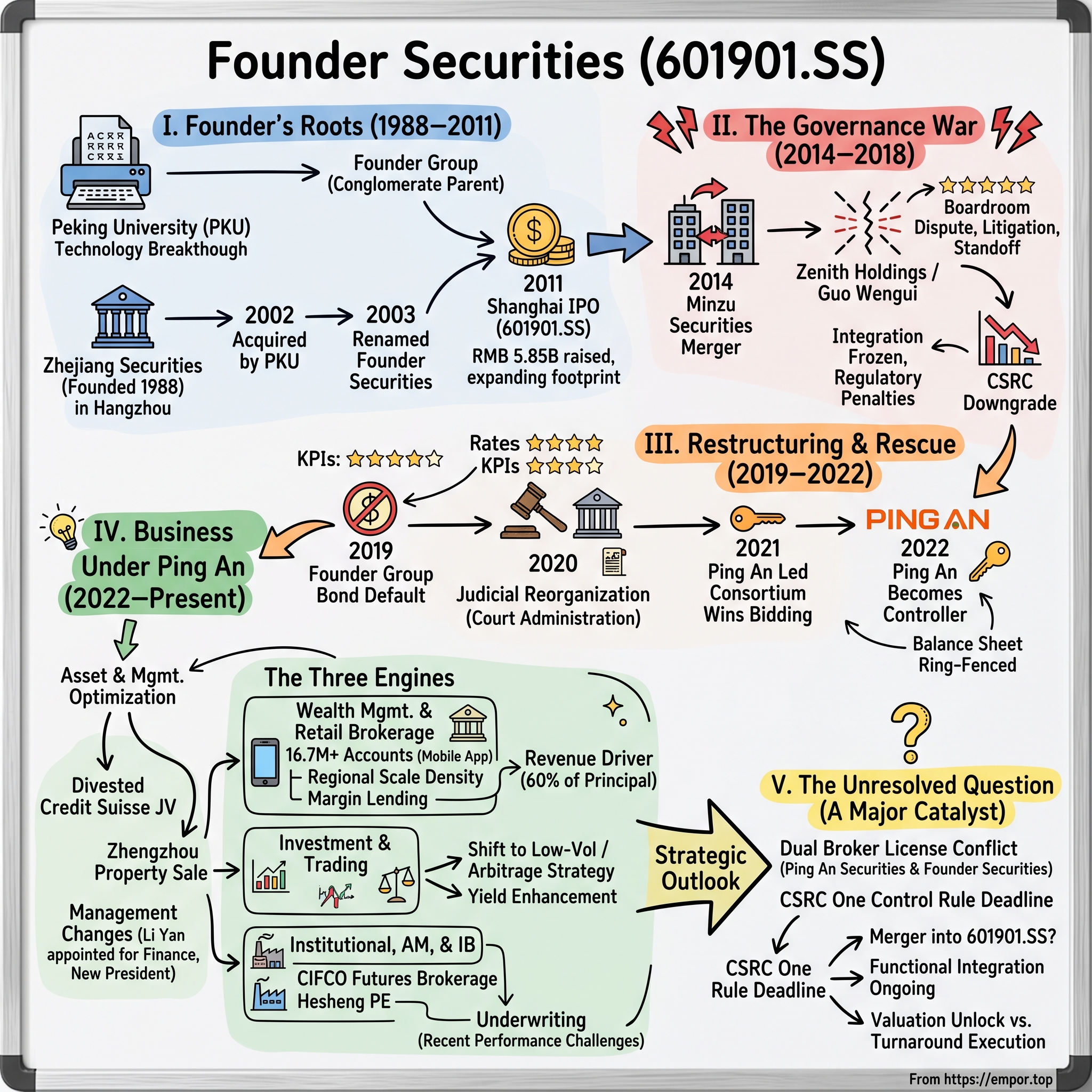
Founder Securities: The Restructuring of a Chinese Financial Empire
I. Episode Roadmap & The Setup
In November 2014, employees arriving at the Beijing headquarters of 中国民族证券 China Minzu Securities found the building contested. Two sets of executives claimed authority over the same offices. One faction had been installed by the firm's new parent. The other answered to the shareholder who had just sold it. Within weeks, the dispute had escalated from press releases into court filings, criminal allegations, and a regulator's intervention — all of it playing out around a mid-sized Chinese brokerage that most global investors had never heard of.
That brokerage was 方正证券 Founder Securities Co., Ltd., and the fight over Minzu would define the next decade of its existence.
The pitch for this story is a question: how does a regional securities firm, absorbed into the commercial arm of China's most prestigious university, become one of the most governance-scarred listed companies in the A-share market — and then get rescued, cleaned up, and folded into the empire of 中国平安 Ping An Insurance (Group) Company of China, Ltd., the country's largest private financial conglomerate? It is a story about what happens when an industrial conglomerate treats a licensed financial institution as a funding instrument rather than a business, and about what it takes to unwind that mistake once the courts get involved.
Founder Securities trades as 601901.SS on the 上海证券交易所 Shanghai Stock Exchange and is headquartered in Changsha, Hunan — an unusual choice, since almost every large Chinese brokerage clusters in Beijing, Shanghai, or Shenzhen. For the 2025 financial year the company reported operating revenue of roughly RMB 10.50 billion, up about 36% year on year, and net profit attributable to shareholders of about RMB 3.97 billion, up nearly 80%.12 Total assets stood at roughly RMB 272.6 billion and net assets attributable to shareholders at roughly RMB 50.8 billion.1 Weighted average return on equity came in at 8.01%, against 4.72% the year before.1
Those are good numbers. They are also, importantly, cyclical numbers, arriving after a strong stretch in Chinese equity markets — and the headline profit growth flatters the underlying business. Strip out non-recurring items and net profit rose about 29%, not 80%.2 Holding both facts in mind at once is the correct posture for this company.
The core paradox is straightforward. Founder Securities has always had a genuinely valuable asset: an enormous retail distribution network across central and eastern China, feeding a mobile app, 小方 Xiaofang, that reached 6.54 million monthly active users in June 2025 — a top-ten ranking among Chinese brokerage apps.3 More than 16.7 million client accounts sit on that platform.3 That is a real franchise. And for roughly a decade, it was operated by a company that could barely hold a board meeting.
Three themes run through what follows.
The first is the conglomerate trap. 北京大学方正集团 Peking University Founder Group — the commercial vehicle of China's most famous university — spent two decades buying its way into semiconductors, pharmaceuticals, property, and finance. A securities license inside that structure is not merely a business; it is a balance sheet, a fundraising channel, and a source of collateral. The temptation to use it that way is enormous, and the incentives point one direction.
The second is the M&A nightmare. The 2014 absorption of Minzu Securities was, on paper, a sensible piece of industry consolidation — the first time one listed Chinese brokerage swallowed another whole.4 In practice it handed a large voting bloc to a counterparty whose interests diverged from the buyer's almost immediately, and the resulting war with 政泉控股 Zenith Holdings and its controller 郭文贵 Guo Wengui consumed years of management attention and regulatory goodwill.
The third is the Ping An rehabilitation — and the unfinished business at its center. Ping An now controls Founder Securities. It also controls 平安证券 Ping An Securities. Chinese regulation does not comfortably permit one owner to control two competing full-license brokerages indefinitely, and the clock on resolving that overlap has been running since 2022.15 Everything about how this stock behaves today is downstream of that unresolved question.
To understand why the question is so hard, start with a laser printer.
 Subscribe on LinkedIn
II. Academic Pedigree & Early Growth: PKU & The Birth of Founder Securities (1988–2011)
The origin story of Founder Securities has almost nothing to do with securities.
In the late 1970s, a physically frail applied mathematics researcher at Peking University named 王选 Wang Xuan was working on a problem that had defeated Chinese publishing for decades: how to typeset Chinese characters efficiently. Alphabetic languages need a few dozen glyphs. Chinese needs tens of thousands, each with intricate strokes that resist crude digitization. Wang's insight was to store characters not as bitmaps but as compressed mathematical outlines — vectors describing the contours of each stroke — which could then be scaled and rendered on demand. It was the breakthrough that let Chinese newspapers abandon hot-metal type and jump directly to laser phototypesetting.
That technology became the foundation of Peking University Founder Group, and by the 1990s it had made the university one of the improbable commercial powers of reform-era China. Chinese universities in that period were encouraged to commercialize research through 校办企业 university-run enterprises, and Founder was the flagship. But once a conglomerate exists, it wants to grow, and technology margins alone do not fund expansion into capital-hungry industries.
Meanwhile, in Hangzhou, an entirely separate institution had been quietly operating since June 1988: 浙江证券 Zhejiang Securities, a provincial brokerage set up to serve the private-enterprise economy of Zhejiang, then the most entrepreneurial province in China.33 It was a creature of the first generation of Chinese capital markets — regional, state-linked, and small.
The two stories converged in 2002. In March of that year, Peking University Founder Group signed a cooperation memorandum with 浙江省国信控股集团 Zhejiang Guoxin Holdings; by June, Zhejiang Securities' shareholders had approved the transfer of 51% of the company to Founder Group for RMB 229.5 million in cash, with the board reconstituted in August.33 On September 1, 2003, the firm was formally renamed Founder Securities.33
Consider what RMB 229.5 million bought. Not a franchise — Zhejiang Securities was unremarkable. What it bought was a license. In China's financial system, licenses are the scarce good. The regulator decides who may underwrite, who may broker, who may lend against securities, and it does not hand those rights out casually. A conglomerate that owns a brokerage owns a permanent seat at the table where capital is allocated.
The strategic logic was never hidden. A technology conglomerate pushing into semiconductor fabrication, hospital ownership, commodity trading, and real estate development needs continuous access to capital. Bank credit is rationed and relationship-dependent. A securities subsidiary provides something better: proprietary balance sheet capacity, bond underwriting relationships, an equity currency, and a legitimate reason to sit inside the capital markets plumbing. This is the conglomerate trap in its purest form — the financial subsidiary is worth more to the parent as a funding channel than as a standalone business, and capital allocation inside the group starts bending toward the parent's needs.
For most of the 2000s, though, the operating story was more prosaic and more interesting. Founder built out branches. Not in the marquee financial districts of Beijing's Financial Street or Shanghai's Lujiazui, where 中信证券 CITIC Securities and 国泰君安 Guotai Junan Securities already dominated institutional relationships, but across Hunan, Zhejiang, and the second- and third-tier cities of central China. The headquarters eventually settled in Changsha — a decision that looks eccentric next to peers, and that gave the company an identity it still trades on: the brokerage that owns the retail investor in the Chinese interior.
The economics of that choice deserve a moment. A retail brokerage branch in China is essentially a customer acquisition and service node: it opens accounts, handles the paperwork and identity verification the regulator requires, hosts investor education sessions, and — critically — sells products. In a market where individual investors have historically driven the majority of turnover, physical presence in cities where the alternative was a bank branch offering deposit products was a genuine advantage. It also created dense local scale: in a province where Founder has hundreds of thousands of accounts, the marketing, compliance, and back-office costs get spread across a large base.
It helped enormously that the 2000s were the decade in which China's retail investor class came into being. The Shanghai market's spectacular run into 2007 and its equally spectacular unwinding pulled tens of millions of first-time investors into the system, and the firms that captured them were the ones with a physical door in the right city at the right moment. Founder was not the largest of those firms, and it never had the underwriting relationships that generate the highest-margin fee income. What it had was a queue outside its branches. In an industry where the regulator controls how many licenses exist but not how many customers each licensee attracts, being early and dense in an under-served geography was the whole strategy — and for a while it worked.
The limitation of that model was equally structural, and it would matter later. A retail brokerage built on branches earns most of its money from transactions. It has little contractual claim on client assets, no advisory mandate, and no recurring fee stream that survives a quiet market. When turnover collapses, so does the P&L, and the branch network — the source of the advantage — becomes a fixed cost that cannot be switched off. Every Chinese broker has faced this problem. Founder faced it with an owner that needed cash.
The company converted into a joint-stock company in 2010 and listed the following year.33 The IPO priced at RMB 3.90 per share for 1.5 billion new shares, raising RMB 5.85 billion, and the stock began trading on the Shanghai exchange on August 10, 2011 — the seventeenth mainland brokerage to list.34 It closed its first day up 43.59%.34
Where did the money go? Into exactly the things a Chinese brokerage needed in 2011: margin financing and securities lending (两融业务, the business of lending clients money to buy shares and lending them shares to sell short), branch infrastructure, and proprietary trading capacity. Margin lending in particular was newly liberalized and structurally attractive — it converts a brokerage's balance sheet into an interest-earning book collateralized by listed equities, with margin calls as the safety valve. For a firm with a big retail base, it is close to the ideal adjacency.
So by 2011, Founder Securities had a coherent story: a licensed brokerage with a differentiated regional footprint, freshly capitalized, expanding into balance-sheet businesses, owned by a prestigious conglomerate. It should have been a decade of compounding.
Instead, the company decided to buy something.
III. The Minzu Securities Acquisition & The Great Governance War (2014–2018)
On the evening of January 10, 2014, Founder Securities disclosed a restructuring plan that would make Chinese capital markets history: it proposed to acquire 100% of China Minzu Securities through a private share issuance valued at RMB 13.202 billion.4 It was the first absorption merger of one securities firm by another listed brokerage in the country.36
The industrial logic was defensible. China had — and still has — an oversupply of small brokerages, and the regulator had signaled for years that consolidation was welcome. Minzu brought a Beijing base, an investment banking team, and additional license scope to a firm whose strength was retail distribution in the provinces. Founder's management framed it as the step that would turn a regional broker into a large integrated securities firm.36
Now the price. Here the popular retelling deserves correction. The consensus shorthand is that Founder paid roughly 2.5 times book for Minzu, wildly above peers. The disclosed terms tell a more specific story: Minzu's net assets were RMB 6.837 billion as of August 31, 2013, and the appraised valuation represented a premium of about 93% to that figure, with the new Founder shares issued at RMB 6.09 each.4 That works out closer to 1.9 times book than 2.5 times — a full price for a mid-tier brokerage in a market where listed peers were not trading at dramatic premiums, but not a historically absurd one.
The real problem was never the multiple. It was the currency and the counterparty.
Because Founder paid in its own shares, Minzu's shareholders became Founder's shareholders. And Minzu's dominant shareholder was 政泉控股 Zenith Holdings, controlled by 郭文贵 Guo Wengui — a businessman whose commercial career in China had been built less on operating skill than on relationships. Caixin's later reporting laid out the arrangement: in spring 2014, Guo struck a deal under which Founder would capitalize Minzu using Zenith shares as collateral and then merge Minzu into Founder Securities, an arrangement underpinned by Guo's rapport with Founder Group's chief executive 李友 Li You, whom he had known since his days in Zhengzhou.[^7]
The transaction closed in the second half of 2014, and Zenith emerged as Founder Securities' second-largest shareholder.[^7] What happened next was not a slow drift. It was an immediate rupture.
Zenith demanded five board seats and the right to name executives.[^7] Founder's side resisted. By the autumn, the two shareholders were fighting in public — an extraordinarily rare spectacle in Chinese corporate life, where disputes of this kind are normally settled behind closed doors precisely because airing them invites regulators in. Zenith publicly accused Li You of embezzlement and stock manipulation.[^7] Founder's camp accused Zenith of stalling and of failing to make good on obligations tied to the deal; Zenith in turn blamed Founder for delays in a dispute involving roughly RMB 3 billion.5 The fight escalated into litigation, and by January 2015 the board dispute had moved into the courts.[^6]
Underneath the mudslinging was a substantive question about Minzu's balance sheet. The allegation that hardened into the deal's defining scandal was that a large pool of Minzu's funds — reported at around RMB 2 billion — had been moved into third-party investment products rather than sitting where an acquirer would expect to find them. Whatever the ultimate legal characterization, the practical effect was immediate and severe: integration froze. You cannot merge two brokerages' risk systems, client accounts, and capital when the two owners are accusing each other of misappropriation and a court is deciding who controls the board.
The physical dimension of the conflict is what made it notorious. Control of a Chinese securities firm is not an abstraction settled by a shareholder register; it runs through company seals, business licenses, personnel files, and the authority to instruct staff. Both camps understood that whoever physically held the apparatus of the Beijing operation held effective control while the courts worked through the legal question. The result was the kind of standoff that Chinese corporate governance disputes occasionally produce and that markets everywhere find unnerving — rival executive teams, competing announcements, and employees who did not know whose instructions were valid.
For investors, this is the moment worth dwelling on. The diligence failure here was not financial. Founder's advisers could read Minzu's balance sheet. The failure was in assessing who they were buying from and what that person would want afterward. When an acquirer pays in stock, it does not end a relationship with the seller — it begins a new, permanent one, as shareholders. If the seller's business model depends on influence rather than operations, the acquirer has imported a governance problem it cannot fire, cannot dilute quickly, and cannot easily litigate away.
The regulatory consequences followed with grim predictability. The 中国证监会 China Securities Regulatory Commission does not tolerate open warfare inside a licensed financial institution, because the entity holds client assets. Investigations, penalties, and constraints on new business followed, and the company's standing in the CSRC's annual classification evaluation deteriorated badly.
That evaluation deserves explanation, because non-Chinese investors routinely underestimate it. Every year the regulator scores each brokerage on compliance, risk management, business development, and functional contribution, then sorts the industry into grades from AA down to D.20 The grade is not a credit rating and not a marketing badge. It is an operating permission system. A firm's classification determines how much it must contribute to the investor protection fund, how readily new business applications and branch approvals move through the queue, and in practice which innovative or capital-intensive activities it may enter at all. A downgrade therefore does not merely embarrass a firm — it mechanically shrinks the set of things it is allowed to do, and the effect compounds because competitors are simultaneously permitted to do more. For a mid-sized broker trying to close the gap on the leaders, several years in the regulatory penalty box is close to a lost decade.
Consider what the merged company looked like from the inside during those years. Two brokerages nominally combined but operationally distinct. A Beijing investment banking team whose parent shareholders were suing each other. A retail network in the provinces that had nothing to do with the fight and no way to benefit from the promised synergies. Recruiting was near-impossible: no senior banker joins a firm whose board composition is being decided in court. Meanwhile the rest of the Chinese industry spent 2015 through 2018 building out margin books, expanding asset management, and preparing for the registration-based IPO reform that would reshape underwriting economics.
Guo Wengui's own trajectory ran off the map. He left China and became a prominent overseas critic of the Chinese government; former staffers later gave accounts to Chinese authorities of coercive practices in his takeovers.21 He was arrested in the United States in March 2023 on charges connected to an alleged billion-dollar fraud scheme unrelated to Founder.[^40] Li You's career inside the Founder Group also ended.
By 2018, Founder Securities had a merged entity on paper, a damaged regulatory standing, and years of lost compounding. Its retail franchise had survived — clients kept trading, branches kept opening accounts — which tells you something durable about the underlying business. But the company had spent the most important years of China's brokerage build-out fighting itself.
And the parent that had presided over all of it was about to encounter a much larger problem of its own.
IV. The RMB 300B Default & Peking University Founder Restructuring (2019–2021)
On December 2, 2019, Peking University Founder Group failed to repay a RMB 2 billion ultra-short-term commercial paper. The company warned that its liquidity was "extremely tight."6
The market reaction was less about the sum than about the identity of the borrower. Chinese bond investors had long treated debt issued by university-affiliated conglomerates as carrying an implicit halo — not a formal government guarantee, but a widely held belief that a company bearing the name of Peking University, with the university itself as ultimate owner, would not be allowed to fail. That belief had made Founder Group's paper cheap to issue and easy to place. Its collapse in a single missed payment shocked investors and forced an immediate repricing of an entire category of quasi-state credit.7
The underlying condition had been building for a decade. Founder Group had expanded relentlessly and expensively — into pharmaceuticals and hospitals, semiconductors, commodities trading, real estate, and finance — funded overwhelmingly by debt. Its later disclosed obligations were enormous: it had defaulted on roughly $3 billion of dollar bonds and RMB 34.5 billion of onshore bonds, and by April 2021 a total of 743 creditors had filed claims of about RMB 256.2 billion against the group and four of its units.8 Analysts had long put total group liabilities above RMB 300 billion; the formally verified claim pool alone was extraordinary for a nominally state-linked technology company.
In February 2020, 北京银行 Bank of Beijing, one of its creditors, successfully petitioned the court to force Founder Group into restructuring under China's bankruptcy law.8 The Beijing No. 1 Intermediate People's Court took the case. What followed was one of the largest and most complex judicial reorganizations China had attempted — a conglomerate with hundreds of subsidiaries, six listed companies, foreign bondholders, banks, retail creditors, and a university at the top of the chart.
Here Founder Securities occupied a peculiar and instructive position: it was simultaneously the healthiest asset in the group and one of the most constrained.
Chinese securities regulation ring-fences a brokerage's operations. Client cash sits in third-party depository accounts at commercial banks, not on the broker's balance sheet in a way the parent could raid. Net capital rules impose continuous minimums. The CSRC supervises related-party transactions between a broker and its shareholders with particular suspicion — precisely because of scenarios like this one. So the operating company kept operating. Branches opened accounts, the margin book kept earning, clients kept trading.
What was frozen was ownership. The controlling shareholding in Founder Securities — a bloc that ultimately amounted to about 2.363 billion shares, or 28.71% of the company — sat inside the bankruptcy estate, subject to court process.10 For roughly two years, the listed company had a controlling shareholder that could not act like one.
The practical costs were real and worth naming precisely, because they explain the valuation discount that followed the company for years. A brokerage with a paralyzed parent cannot easily raise equity — no rights issue or private placement can be structured when the anchor shareholder's stake is under court administration. It cannot credibly pursue acquisitions. It struggles to recruit senior talent, since nobody knows who will own the firm. Its own credit standing is questioned by counterparties who see the parent's name on the shareholder register. And it cannot make multi-year strategic commitments, because the strategy will be set by whoever eventually buys the stake.
There is a second-layer point here that recurs across Chinese financial holdings. The market's instinct during 2020 was to treat Founder Securities as impaired by association. The regulatory architecture says otherwise: the operating subsidiary was largely insulated. The gap between those two views — perceived contamination versus actual ring-fencing — was where the eventual return lived. But capturing it required something specific to happen: a solvent, credible owner had to emerge from the court process.
It is worth pausing on what Chinese judicial restructuring actually involves, because the term "bankruptcy" imports misleading Western associations. Under China's Enterprise Bankruptcy Law, a court-supervised reorganization is not primarily a liquidation mechanism. An administrator is appointed, claims are registered and verified, operations generally continue, and the process searches for a strategic investor willing to inject capital in exchange for equity in a restructured entity. Creditors vote on the resulting plan by class, and the court can confirm it. The design goal is to preserve going-concern value and employment rather than to maximize immediate recovery.
For a conglomerate as sprawling as Founder Group, that meant an unusually complicated auction: the administrator had to package assets ranging from hospitals to semiconductor operations to a listed brokerage into something a buyer would want, while satisfying hundreds of creditor classes with sharply divergent interests. Offshore dollar bondholders, onshore banks, trade creditors, and the university itself all had claims on the same estate. The process took the better part of two years for a reason.
For minority shareholders of the listed subsidiary, the experience was one of complete powerlessness. They could not vote on the plan. They could not influence who bought the stake. They could not force the company to raise capital or return it. They could only watch a court decide who their controlling shareholder would be. That asymmetry is the defining feature of holding a listed subsidiary through a parent insolvency, and it is why the eventual identity of the buyer mattered more than any operating metric the company reported in those years.
In January 2021, reports emerged that Ping An was moving to take control of the group.[^15] The rescue was formalized that spring.
V. Enter Ping An: Corporate Rehabilitation & Asset Optimization (2021–2024)
The bidder that won Peking University Founder Group was not another technology company, nor a state industrial holding. It was an insurer — and that detail explains most of what has happened to Founder Securities since.
In late April 2021, a consortium led by Ping An Insurance and 珠海华发集团 Zhuhai Huafa Group, the investment arm of the Zhuhai municipal government, agreed to a rescue of Peking University Founder Group valued at approximately RMB 73.3 billion.[^13][^14] The court approved the restructuring plan that July.9
Why would an insurer want this? Because of a structural problem specific to life insurers in a falling-rate world. Ping An collects premiums today against liabilities payable over decades, and it must invest the float somewhere that earns more than the guaranteed crediting rates on its policies. Chinese government bond yields had been grinding lower. Healthcare assets, property, and — critically — controlling stakes in fee-generating financial businesses offered better long-run economics than duration-matched bonds. Founder Group carried hospital assets that fit Ping An's declared "integrated finance plus healthcare" strategy, and a brokerage that fit its financial supermarket.
The mechanics settled in December 2022. Ping An Life agreed to pay approximately RMB 48.2 billion for about 66.51% of 新方正集团 New Founder Group, the entity created to hold the restructured assets, with the transfer receiving regulatory approval and Zhuhai Huafa's vehicle holding roughly 28.5%.10 Ping An announced formally that its investment in the Founder Group restructuring had been approved and that seven entities had been incorporated under New Founder Group.11 中金公司 China International Capital Corporation acted as financial adviser on what became the largest acquisition in Ping An's history, and the first detailed equity-change report disclosed the structure to the market.23
Through that chain, Ping An became the ultimate controller of Founder Securities. The listed brokerage now had, for the first time in its history, an owner with more capital than it needed and a genuine institutional interest in running it as a business rather than as a funding channel.
Understanding what Ping An wanted requires understanding how Ping An thinks. The group has spent two decades building what it calls integrated finance: a model in which a customer acquired through one product — motor insurance, say — is progressively sold banking, health coverage, wealth management, and investment products by a single group with shared data and a common brand. The internal metric that matters is contracts per customer. In that framework, a brokerage is not primarily a trading business. It is another shelf in the store, one that captures a customer's equity allocation and generates fee income without consuming much insurance capital. Founder's 16-million-account retail base and provincial branch network is, viewed through that lens, a distribution acquisition.
Whether that logic converts into results is a separate question, and the honest answer as of 2026 is that the company has not published the numbers that would settle it. Integrated finance has been a stated ambition at many global financial conglomerates and has disappointed at most of them, because insurance agents and securities advisers sell differently, are compensated differently, and are supervised under different rulebooks. Ping An has executed it better than most. It has not yet demonstrated it here.
What Ping An did next was less glamorous than a growth strategy. It was housekeeping.
Selling the Credit Suisse stake. The joint venture originally established in October 2008 as Credit Suisse Founder Securities — later renamed 瑞信证券 Credit Suisse Securities (China) — had never become material to either parent.13 After Credit Suisse took majority control, Founder retained 49%. In June 2024, Beijing State-Owned Assets Management reached a tripartite agreement with UBS and Founder Securities to acquire 85.01% of the venture: 36.01% from UBS for about $91.35 million, and Founder's 49% for about $124 million, or roughly RMB 885 million.1213 The CSRC approved Beijing State-Owned Assets Management as the substantial shareholder and actual controller in March 2025.14
The clean-up logic was sound — a passive minority in a subscale joint venture consumed regulatory capital and management attention while generating little. But the price deserves scrutiny rather than applause. Reporting on the disposal noted the RMB 885 million sale compared against a RMB 1.14 billion acquisition cost booked in 2022, meaning the stake was sold below what Founder had paid for it.15 Separately, in February 2025, Founder's underwriting subsidiary sold the Zhengzhou Yuda International Trade building for RMB 730 million against a 2021 book value of RMB 1.249 billion.15 Management framed both as sharpening focus on core operations.15 An investor should read them as what they are: value-realizing disposals of legacy assets at losses against carrying value, which is still the right decision but is not evidence of investing skill.
There is an accounting wrinkle worth flagging, because it recurs in the FY2025 numbers. Because the Credit Suisse stake had been carried under the equity method and had been absorbing losses, the disposal was expected to add at least RMB 273 million to net profit in the year of completion, with roughly RMB 857 million of cash recovered.25 This is precisely the kind of item that inflates a headline growth rate without reflecting operating performance — and it helps explain why FY2025 reported profit growth of about 80% while the ex-exceptional figure grew about 29%.2
The management question — and a correction to the standard narrative. The convenient story is that Ping An swept out the old guard and installed its own financial veterans. The record is more nuanced and more interesting.
施华 Shi Hua, the chairman, is not a Ping An import. He joined Peking University Founder Group in October 2015 as an executive committee member and vice president, and formally became chairman of Founder Securities in September 2018 — meaning he was appointed under the old ownership, before the default and before Ping An arrived.17 The genuine Ping An insertion came later and lower: 李岩 Li Yan, a long-serving Ping An executive, was appointed a director and vice president of Founder Securities in 2023, taking control of the finance function.17 Chinese financial media read that appointment exactly as it looked — Ping An tightening its grip through the balance sheet and reporting line rather than through a dramatic decapitation.17
The president's chair turned over through ordinary succession. 何亚刚 He Yajian retired at the mandatory age, and on May 9, 2025 the board appointed vice president 姜志军 Jiang Zhijun as president.16 Jiang is a lifer: born in February 1969, he joined Founder Securities in 1993, held general manager roles across multiple departments, served as vice president from 2016, and had also worked at the underwriting subsidiary.16 In July 2025 he additionally took over supervision of the asset management business following the retirement of vice president 徐子兵 Xu Zibing.28
Other seats moved too, and not all of them smoothly. Vice president 袁玉平 Yuan Yuping, who had overseen investment banking, resigned from the executive committee on June 11, 2025 for personal reasons, before his term was due to expire in June 2026; he had already stepped down as chairman and general manager of the investment banking subsidiary in January 2025, with 孙斌 Sun Bin taking over.15 Sun had himself moved from chief risk officer to vice president in December 2024.15
That is a lot of churn in eighteen months, concentrated in the business line that was performing worst. Which brings us to what the cleaned-up company actually looks like.
VI. The Business Engine Today: Segments, Economics, & Operational KPIs
Walk into a Founder Securities branch in a prefecture-level city in Hunan and the business model becomes obvious within thirty seconds. There is a counter for account opening. There are staff whose job is to move a client from "I have a stock account" to "I own three funds and a structured product." And there is a screen showing the market. Almost everything the company earns traces back to that interaction, repeated across hundreds of locations and, increasingly, through a phone.
Management organizes the firm around what it calls three engines — 第一动力 wealth management, 第二动力 investment and trading, and 第三动力 institutional, asset management, and investment banking. It is a useful frame as long as one remembers that the first engine does most of the work.
The first engine: wealth management and retail brokerage. For the 2025 financial year, wealth management contributed roughly 59% of principal operating revenue, with the segment generating about RMB 7.74 billion of segment revenue for the year.2 Brokerage revenue alone rose about 44% to roughly RMB 5.05 billion.1 In the first half of 2025, net income from agency securities trading rose 69.27% to RMB 1.889 billion.3
That growth number requires immediate context, and the context is not flattering to the business model. Chinese brokerage commissions are almost purely a function of market turnover. When A-share average daily turnover surges, commission revenue surges; when it collapses, so does revenue. A 69% increase in agency trading income tells you far more about the market in the first half of 2025 than about Founder Securities' competitive position. The honest read is that this is a high-operating-leverage, low-control revenue line.
What is within management's control is the client base and the conversion of trading clients into fee-paying asset holders. Here the disclosed numbers are more informative. Total client accounts exceeded 16.73 million by mid-2025, having grown about 330,000 in six months, and client assets rose 8.07% in the first half after growing by more than RMB 1 trillion across full-year 2024.3 The Xiaofang app's monthly active users of 6.54 million against 16.73 million accounts implies that roughly four in ten clients touch the app in a given month — respectable engagement for a brokerage app, and the mechanism by which a physical branch network stays relevant.3
The distribution footprint itself is being pruned. At the end of 2024 the company operated 340 securities branches and 24 regional sub-branches; during 2025 it cancelled 18 branches, part of an industry-wide contraction in which nearly 300 brokerage outlets were closed across China in a year.26 This is the correct direction — branch economics deteriorate as account opening migrates online — but it also quietly undermines the "320+ branches as a moat" framing. A shrinking branch network is a cost story, not a growth story.
The conversion question is where the wealth management label earns or loses its meaning. Selling a client a mutual fund produces a one-time distribution commission plus a small trailing fee; managing that client's assets under a fee-based advisory mandate produces recurring revenue that persists through a dull market. The entire Chinese industry has been trying to move from the first model to the second for a decade, with limited success, because Chinese retail investors have historically been reluctant to pay explicitly for advice. Founder discloses client asset growth and account counts. It does not disclose the split between transactional distribution revenue and recurring advisory fees, which is precisely the disclosure that would let an outsider judge whether "wealth management" here means anything more than "brokerage plus fund sales."
Margin lending is the other pillar of the first engine, and it is the one investors should watch most closely. Founder's margin financing and securities lending balance stood at RMB 40.10 billion in the first half of 2025, giving it a market share of 2.17%.3
The mechanics are worth spelling out for readers unfamiliar with the product, because it behaves unlike ordinary lending. A client wants to buy RMB 200,000 of shares but has RMB 100,000. The broker lends the difference and holds the purchased shares as collateral, marking them to market continuously. If the shares fall far enough that the collateral cushion thins, the client must post more cash or the broker sells the position. In effect the broker has made a secured loan whose collateral is the very asset the loan was used to buy — leverage on a self-referential security. In good markets this is close to an ideal business: high spread, short duration, automated risk management, and a customer who becomes structurally sticky because moving brokers means unwinding the loan.
In bad markets the reflexivity bites. Falling prices trigger margin calls, margin calls force selling, forced selling pushes prices lower. Chinese regulators learned this at scale during the 2015 crash and have supervised the product carefully ever since. So the margin book is simultaneously the highest-quality earnings stream a Chinese broker has and the one that requires the most disciplined underwriting.
Founder's 2.17% share of the national margin balance, against a client base representing a larger share of retail accounts, suggests the firm under-indexes on credit relative to its distribution.3 That gap can be read two ways: as headroom for a well-funded owner to grow a high-margin book, or as evidence that the client base skews toward smaller, less active accounts that do not use leverage. Both readings are consistent with the disclosed data, which is exactly why the trajectory of this balance — not its level — is the thing to watch.
The second engine: investment and trading. Proprietary investment contributed roughly 35% of principal revenue in 2025, with investment and trading revenue of about RMB 3.17 billion.12 Management's stated strategy has been to shift from directional equity positions toward non-directional fixed income, currencies and commodities strategies and yield-enhancement books.
The intent is sensible. In plain terms, a directional book bets that prices go up; a non-directional book tries to harvest small, repeatable spreads — the gap between a bond and its hedge, between related futures contracts, between a convertible and its underlying — while remaining roughly indifferent to market direction. Done well, it converts a lottery ticket into an annuity. Done badly, it is leveraged carry that works until correlations break.
The evidence that Founder has done it well is, so far, thin — and one data point cuts the other way. In the first quarter of 2026, investment income turned negative by more than RMB 36.97 million, even as overall revenue rose 14.70% to RMB 3.40 billion and net profit attributable rose 24.35% to RMB 1.486 billion.1819 A single quarter proves nothing, but it is a reminder that "low volatility" is a claim about a portfolio, not a property of one. Investors should want several years of quarterly investment results before crediting the ballast thesis.
There is also a governance dimension to proprietary trading that Chinese brokerages rarely address in disclosure. A trading book is the easiest place in a securities firm to take risk that does not appear as risk until it does, and the historical record at this company gives reason for attention rather than trust. Ping An's risk framework is the implicit answer — the group's reputation rests on not having accidents in subsidiaries — but the mechanism by which group risk standards bind a listed subsidiary's trading desks is not spelled out publicly. Investors should read the value-at-risk and sensitivity disclosures in the annual report rather than the strategy language in the chairman's statement.
The third engine: institutional, futures, asset management, and investment banking. This is the smallest and, historically, the most troubled cluster.
方正中期期货 Founder CIFCO Futures, roughly 90.6% owned, is a genuinely well-established futures broker offering commodity and financial futures brokerage, risk management, advisory, and asset management.29 Futures brokerage is a volume business tied to commodity and financial derivatives activity, and it gives Founder a real institutional clearing franchise that most similarly sized peers lack.
方正富邦基金 Founder Fubang Fund was approved on June 30, 2011 as the first cross-strait joint venture fund manager licensed by the CSRC, with Founder Securities holding 66.7% and Fubang Securities Investment Trust of Taiwan 33.3% after a 2018 capital increase took registered capital to RMB 660 million.29 Its scale remains modest by Chinese mutual fund standards. Asset management revenue for the group came in around RMB 558 million in 2025.1
方正和生 Founder Hesheng houses private equity and alternative investment activity, including government guidance and industrial funds — a small business, and one that ties the firm to local government capital in ways that carry both relationship value and concentration risk.
方正证券承销保荐 Founder Securities Underwriting & Sponsoring is where the story gets uncomfortable. Investment banking contributed roughly 2% of principal revenue in 2025.2 The 2024 record was worse than weak: asset management revenue fell 82.18%, the investment banking division posted losses, and it completed zero equity underwriting projects, with a 100% project rejection rate.15 In March 2025, regulators issued corrective orders citing deficiencies in due diligence and failures in internal control.15
That is not cyclical underperformance. That is a franchise that was not functioning. It also frames the strategic question that dominates the rest of this story: if Founder cannot build investment banking organically, and Ping An Securities already has one, the cheapest way to fix it is not to hire — it is to merge.
Before getting there, it is worth war-gaming the competitive terrain Founder actually occupies.
VII. Competitive Landscape & Strategic Frameworks
The Chinese brokerage industry is one of the most crowded regulated markets on earth. In the CSRC's 2025 classification evaluation, 107 firms were assessed on a consolidated parent-plus-subsidiary basis: 53 landed in the A category, 43 in B, and 11 in C, with 14 of the A-rated firms achieving AA.20 That distribution has been stable for years — roughly half A, forty percent B, ten percent C — and it means being "A-rated" places a firm in the top half of a very large field, not in an elite tier.20 The company's specific 2025 grade was not disclosed in that public summary.
Rivalry: very high. More than a hundred licensed firms compete for the same pools of retail turnover, institutional flow, and underwriting mandates. The top tier — CITIC Securities, 华泰证券 Huatai Securities, and the newly enlarged entity formed when 国泰君安 Guotai Junan absorbed 海通证券 Haitong Securities in a merger approved in November 2024 — controls the institutional relationships, the largest balance sheets, and the sponsorship league tables.31 That merger matters directly to Founder: it signaled that Beijing actively wants fewer, larger brokerages, and it reset the scale bar for everyone below.
The more corrosive competition comes from below. 东方财富 East Money built a brokerage on top of a financial information portal and stock forum, acquiring clients at a fraction of branch-based cost and pricing execution accordingly. Commission rates across the industry have compressed toward a few basis points. A firm whose largest revenue line is agency trading is, structurally, a price-taker in a market where the price is falling.
It is worth being concrete about the scale gap, because "mid-tier" understates it. Founder ended 2025 with total assets of roughly RMB 272.6 billion and equity of roughly RMB 50.8 billion.1 The largest Chinese brokerages operate balance sheets several times that size, and balance sheet capacity is not a vanity metric in this industry — it directly determines how large a margin book a firm can fund, how much market-making and derivatives risk it can warehouse, how large an underwriting commitment it can make, and how cheaply it can borrow. A firm competing for the same institutional mandate as a rival with four times the capital is not competing on equal terms regardless of talent.
Nor is the gap purely financial. Research coverage, algorithmic execution, prime brokerage infrastructure, and cross-border capability all require sustained spending that only amortizes across a large revenue base. This is the mechanism by which Chinese brokerage market share has been slowly concentrating for a decade, and it is why regulators have been comfortable encouraging mergers: the industry's economics were already pushing that direction.
Buyer power: high. For plain stock execution, a Chinese retail investor's switching cost is close to zero — open an account at another broker in minutes on a phone. Stickiness must be manufactured: an outstanding margin loan, custody of fund holdings, a structured product with a maturity, an advisory relationship. Every one of those is a product-level tether, not a platform-level lock-in. This is the central reason to be careful with any claim that Founder's retail base is a moat. It is an asset. Whether it is a moat depends entirely on conversion.
Substitutes: high and rising. The competition for a Chinese household's savings is not only other brokers. It is bank wealth management subsidiaries (理财子公司), which distribute through the vastly larger branch networks of the commercial banks; it is insurance savings products; it is, still, property in many households' mental accounting. When equity markets are dull, these substitutes take share of wallet quickly.
Supplier power: medium. A brokerage's principal input is money. Funding comes from interbank markets, repo, and bond issuance, so the cost of the margin book and the trading book is set by rates the firm does not control. This is where Ping An ownership genuinely helps — a controlling shareholder of that credit standing improves how counterparties and rating agencies view the issuer, which shows up as basis points on funding costs across a large balance sheet. Founder has been a regular issuer in the professional-investor corporate bond market, with multiple tranches rated through 2026.30
New entrants: low. The license regime is the barrier, and it is formidable. The live entry threat is not domestic startups but foreign firms building wholly owned onshore operations after the removal of ownership caps — a competitive threat concentrated in institutional and investment banking, precisely where Founder is weakest, and largely irrelevant to its retail heartland.
Running the same terrain through Hamilton Helmer's 7 Powers is clarifying, mostly because of how few of the powers actually apply.
Scale economies — operational, and regional. Founder does have genuine density in Hunan and Zhejiang, and density is the one place where a branch network still creates cost advantage: regional marketing, compliance supervision, and back-office functions amortize over a large local account base. But this is a regional scale economy in an industry where the binding scale economies — balance sheet size, technology spend, research coverage — are national. Against CITIC or Huatai, Founder is subscale on the dimensions that matter most, and the branch closures indicate management knows it.
Cornered resource — potential, unproven. The most cited bull argument is access to Ping An Group's enormous retail financial services client base and distribution ecosystem. On paper it is compelling: an insurer with a vast agent force selling savings products to households that could be converted into brokerage and wealth clients. In practice, cross-selling between insurance and securities has a long history of disappointing everywhere in the world, because the customer relationship, the regulatory permissions, the compensation systems, and the sales cultures are different. Until Founder discloses concrete metrics — accounts sourced from Ping An channels, assets migrated, revenue attributable to group referrals — this remains a hypothesis. It is the single most important thing for an investor to demand evidence on.
Counter-positioning — weak. The pivot toward low-volatility trading is a sensible risk decision, not a counter-position. Counter-positioning requires that incumbents cannot copy you without damaging their existing business. Every Chinese brokerage can and does run non-directional books. There is no structural reason a rival cannot follow.
Switching costs — moderate, product-level. As discussed, real but shallow.
Network economies, branding, process power, cornered resources in the classic sense — absent. Founder's brand carries, if anything, negative equity from the governance decade. There is no evidence of proprietary process advantage.
The honest synthesis: Founder Securities is a well-distributed, cyclically leveraged retail broker with one potential structural advantage that has not yet been demonstrated in numbers, operating in an industry where the state is actively engineering consolidation. Which means the most consequential variable is not competitive at all. It is ownership.
VIII. Management, Governance, & The Ping An Consolidation Question
Every quarter, on Chinese retail investor forums and on the exchange's 上证e互动 SSE e-Interaction platform, some version of the same question arrives at Founder Securities' investor relations desk: when does the merger happen? And every quarter, some version of the same answer goes back: the company is advancing integration in accordance with regulatory requirements, and there is no definite timetable.15
To evaluate this management team fairly, separate two questions: what have they done, and what have they said?
On behavior, the record is mixed but improving. The disposals of the Credit Suisse joint venture stake and the Zhengzhou property were the right calls — a subscale minority interest and an office building are not core to a brokerage, and freeing the capital and attention was correct. But both were sold below carrying value, which means the actual value creation was in stopping the bleeding, not in the transaction.15 The subsequent balance sheet is genuinely stronger, with net assets attributable crossing RMB 50 billion in 2025.13 Dividends have been raised: the company paid an interim distribution of RMB 502 million for the first half of 2025, or RMB 0.61 per ten shares, up about 27% from the prior year's interim payout, with total cash dividends for the full year approaching RMB 1.2 billion.324
Against that, investment banking was allowed to deteriorate to the point of a zero-completion year and a regulatory corrective order for due diligence and internal control failures — an outcome that reflects on supervision, not just markets.15 The senior team churn that followed reads as accountability applied late rather than early.
On narrative, the pattern is consistency without specificity. At Ping An's own results briefing on March 22, 2024, group general manager and co-CEO 谢永林 Xie Yonglin addressed the overlap directly, saying the priority was to operate both companies well and that Ping An would advance a resolution appropriately under the guidance of the relevant regulators while fulfilling its disclosure obligations.22 That formulation — reassuring in tone, empty of dates — has been repeated in substance for years. Founder's own chairman said in early 2024 that the firm had been advancing the merger with Ping An Securities, while the market read the situation as one in which Founder would keep operating independently for some time.35
An investor should treat this as an analytical fact rather than a grievance. Neither company has overpromised a timeline it then missed, which is a form of discipline. But neither has given the market anything falsifiable either, and that is a real cost: it makes it impossible to hold management accountable to a schedule, and it means the single largest driver of the equity story sits outside disclosed guidance.
The dual-license problem, precisely stated. China's 一参一控 framework — literally "one participation, one control" — restricts a single controlling party from holding controlling interests in two firms operating the same licensed business, because the arrangement creates conflicts in client allocation, pricing, and information handling. When Ping An became the actual controller of Founder Securities in December 2022 through its 66.51% stake in New Founder Group, it already controlled Ping An Securities.15 Regulators required the competitive overlap to be resolved within five years, a window that runs to the end of 2027, and as of mid-2026 no concrete integration plan had been announced.15
What has happened instead is functional integration without a corporate transaction. The investment banking lines were unified in 2025, and wealth management channels, branch operations, and systems have been progressively connected. Ping An has assembled operational control through management appointments and the finance function. Founder has been methodically shedding assets that would complicate a combination.
The logic of the endgame is not hard to reconstruct. Founder Securities is the listed vehicle, which makes it the natural surviving entity — using it preserves a listing and simplifies the transaction. Ping An Securities brings investment banking, fixed income capability, and technology; Founder brings the retail branch network, wealth distribution, and the futures franchise. The combined entity would be substantially larger than either alone.
But the bull framing — that a combination would automatically create a top-five Chinese brokerage rivaling CITIC and Huatai — should be treated skeptically. The enlarged Guotai Junan and Haitong entity reset what "top five" means, and CITIC's lead in institutional business is measured in multiples, not percentages.31 A merged Ping An-Founder would be a substantially larger mid-to-upper-tier firm with an unusually strong retail and futures position and an unproven institutional one. That is a meaningfully better business. It is not automatically a peer of the leaders.
There is also a scenario the consensus underweights: that the overlap is resolved without a merger. The 一参一控 requirement can in principle be satisfied by disposal as well as by combination — Ping An could sell one of the two platforms, or restructure Ping An Securities' licensed scope so that the businesses no longer directly compete. Neither looks likely given how far operational integration has already gone, and selling a securities license in the current market would be value-destructive. But an investor holding Founder shares primarily for merger optionality should be clear that the regulatory obligation is to eliminate the conflict, not specifically to merge into the listed vehicle.
An activist looking at this situation would press on three things. First, the absence of a disclosed plan eighteen months from a regulatory deadline, which transfers all timing risk to minority shareholders. Second, the conflict inherent in the structure: Ping An controls both entities and will set the exchange ratio in any merger, and Founder's minority holders have limited leverage over terms negotiated between two subsidiaries of the same parent. Third, the related-party surface area created by functional integration — shared channels, shared systems, and referred clients between commonly controlled entities are exactly the arrangements where transfer pricing questions live. None of these are allegations. They are the structural pressure points a skeptical holder should monitor in the disclosure.
That tension — a genuinely improved operating company inside a governance structure whose most important decision has not been made — is the investment case.
IX. Investment Thesis: The Bull vs. Bear Case & Material Risk Radar
The bull case rests on three legs.
The first is consolidation optionality. If the overlap with Ping An Securities is resolved through a combination in which Founder is the surviving listed entity, the company acquires an investment banking franchise it demonstrably cannot build itself, gains balance sheet scale, and moves up a regulatory tier that governs what businesses it may enter. Chinese brokerage valuations are heavily influenced by scale and franchise quality, so a step change in both could support a different multiple. The evidence supporting this leg is not management rhetoric but regulatory compulsion — the deadline exists whether or not anyone likes it — plus the observable operational integration already completed.15
The second is household asset reallocation. The long-running Chinese story is that savings historically parked in property migrate toward financial assets as property ceases to be a one-way bet. A broker with 16.7 million accounts and deep penetration in central China provinces is positioned to intermediate part of that flow.3 The evidence here is partially supportive: client assets grew by more than RMB 1 trillion in 2024 and a further 8.07% in the first half of 2025.3 What is not yet proven is monetization — whether those assets generate advisory and product fees or merely sit in cash and low-margin holdings.
The third is balance sheet repair. Non-core disposals, a rebuilt equity base above RMB 50 billion, a rising dividend, and an improved cost of funds under a strong parent together mean the company enters this cycle with more capacity than it has had at any point since 2014.1324
The bear case is equally concrete.
First, turnover dependence. Roughly six-tenths of principal revenue traces to wealth management, and the largest component of that is commissions tied to A-share average daily turnover.2 The 2025 result was produced by an active market. A multi-quarter slump in turnover would compress the largest revenue line, shrink margin balances, and slow product sales simultaneously — three correlated hits, not one.
Second, the timing risk on the license question. A resolution could be announced next quarter or slip toward the deadline with extensions. Every month without disclosure is a month in which the stock carries speculative premium and minority holders bear terms risk they cannot influence.
Third, structural fee compression. Execution commissions have been falling for a decade and there is no mechanism visible that reverses it. A branch network is a high-fixed-cost way to serve a business whose unit revenue keeps declining — which is why the branch count is shrinking.26
Fourth, earnings quality. The gap between roughly 80% headline profit growth and roughly 29% ex-exceptional growth in 2025 is not an accounting scandal, but it is a signal to underwrite the underlying number rather than the headline.2 The negative investment income in the first quarter of 2026 similarly warrants attention to how the trading book actually behaves across different rate and equity environments.19
Fifth, institutional weakness. Two percent of revenue from investment banking, a zero-completion year, and a regulatory corrective order describe a franchise that does not currently compete.15 If the merger does not happen, this weakness is permanent.
A myth worth retiring. The most repeated bullish shorthand on this company is that it is a "320-plus branch network" story — a distribution moat waiting to be monetized. The disclosed facts complicate that framing in three ways. The network is shrinking, not growing, as the company cancelled branches during 2025 alongside an industry-wide cull.26 Branch presence confers no pricing power in a market where execution commissions have compressed to a few basis points and account opening happens on a phone. And the historical evidence that branch density converts into wealth management fees rather than merely into transaction volume has not been published by the company. The branch network is best understood not as a moat but as a legacy customer-acquisition machine that has already done its work: it delivered 16.7 million accounts.3 The question now is what those accounts are worth, and that is answered by conversion metrics, not by outlet counts.
A second consensus claim worth testing is that Founder's balance sheet is now "clean." It is certainly cleaner. But the disposals that produced that description were sales at losses against carrying value, and a portfolio that required such sales is one where remaining legacy positions deserve scrutiny rather than assumption.15 Investors should read the asset composition in the annual report rather than accept the adjective.
The material risk radar, limited to what is genuinely mechanical for this business:
Market risk is the dominant exposure and operates through three channels at once — commissions, margin balances, and proprietary marks. There is no diversification within a domestic broker against a domestic equity downturn.
Regulatory and political risk runs in both directions. The same authority that could bless a merger could impose conditions, extend timelines, or require disposals instead. Chinese securities regulation also shifts with policy priorities around market stability and investor protection, and enforcement actions of the kind Founder received in March 2025 constrain business scope directly.15
Interest rate risk affects the fixed income book on both sides: bond prices move inversely to yields, while the funding cost of the margin and trading books moves with short rates. A firm running non-directional strategies is hedged against direction but exposed to volatility and to breakdowns in the relationships it is arbitraging.
Refinancing and cost-of-capital risk is modest but real. Founder funds itself substantially through the corporate bond market, and its access and pricing depend on maintaining credit standing.30
Execution risk in the transformation is the one most often underweighted. Merging two brokerages means merging trading systems, client records, risk engines, compliance frameworks, and — hardest of all — two sales cultures and two compensation structures. The 2014 Minzu experience is the cautionary case study, and while the circumstances differ enormously, the operational lesson stands.
Concentration and personnel risk: a firm whose earnings depend on retail flows in specific provinces is exposed to regional economic conditions, and the senior management turnover of 2024 and 2025 means several key seats are held by recent appointees whose track records in those roles are short.
The single question that decides this case: does Founder Securities convert a large, cheaply acquired retail base into recurring fee income and a durable institutional franchise — most plausibly via the Ping An combination — or does it remain a well-distributed, cyclically leveraged commission business whose earnings rise and fall with turnover it does not control?
X. Core Playbook & Investing Lessons
Beware the financial subsidiary inside an industrial conglomerate. The structural problem is not that conglomerates are bad owners of banks and brokers. It is that a licensed financial institution inside a leveraged industrial group has a use — as a funding channel, a collateral source, a relationship node — that is worth more to the parent than the subsidiary's standalone earnings. Regulators build ring-fences precisely because they know this. Those ring-fences worked here: Founder Securities kept operating through its parent's bankruptcy.8 But ring-fences protect clients, not shareholders. Minority holders of the listed subsidiary absorbed years of frozen strategy, blocked capital raising, and a valuation discount they had no way to cure. The lesson is to look upward: the credit condition of a controlling shareholder is a live risk factor for a listed subsidiary even when the operating business is fully insulated.
Diligence the counterparty, not just the asset. Founder's advisers could read Minzu's balance sheet. What they underwrote badly was who they would be in business with afterward. When an acquirer pays in equity, it converts a seller into a permanent partner with voting rights, board access, and standing to litigate. In markets where ownership chains are opaque and influence substitutes for operating capability, the question "what does this counterparty want after closing?" is more predictive than any valuation model. The RMB 13.2 billion price was defensible.4 The relationship was not.
Court-supervised restructuring can be a genuine value-transfer mechanism — for whoever is patient and solvent. The Peking University Founder reorganization did what such processes are supposed to do: it separated a fixable operating asset from an unfixable capital structure and delivered it to an owner capable of running it.9[^13] For public market investors, the practical takeaway is that the perception of contamination and the fact of insulation can diverge sharply during a parent's insolvency, and that gap is where returns are available — but only to investors who can hold through an indeterminate court timeline with no ability to influence the outcome. That is a specific and demanding temperament, not a general strategy.
A fourth lesson, which this story teaches almost better than any other: regulatory deadlines are the most reliable catalysts in Chinese equities, and the least reliable in their timing. The 一参一控 requirement makes some resolution nearly certain. It says almost nothing about when, or on what terms for minority shareholders.
XI. Primary Evidence & Conference Call Guide for Researchers
For anyone wanting to work this name from primary sources rather than commentary, the material is more accessible than the language barrier suggests.
Start with the annual and interim reports filed to the Shanghai exchange. The 2025 annual report and its summary, filed March 31, 2026, contain the segment revenue disaggregation, the reconciliation between reported and ex-exceptional net profit, the shareholding table showing New Founder Group's position, and the dividend proposal.1 The 2025 interim report is the better source for operating KPIs — client counts, client assets, margin balance and market share, and app engagement all appear there in a form the annual summary compresses.27 The first quarter 2026 report gives the most recent trend on revenue, profit, and the investment line.19
Read the annual results briefings (年报业绩说明会). Founder has held these since Ping An took control, and the first ones after the ownership change were notable simply for who appeared: Ping An-affiliated executives fielding questions alongside the incumbent team. The recurring themes to trace across years are how management describes the conversion of trading clients into wealth clients, how it characterizes the stability of trading yields, and — the question that never goes away — the state of the competitive overlap.
Mine the SSE e-Interaction platform. This is the exchange's structured channel for retail shareholder questions, and it is where the merger question gets asked most persistently. The value is not in any single answer, which will be formulaic, but in tracking whether the formula changes. A shift from "advancing in accordance with regulatory requirements" to any language containing a stage, a condition, or a date would be genuinely new information.
Pull the disposal documents. The June 2024 announcement of the 49% Credit Suisse Securities (China) sale sets out the RMB 885 million consideration and the expected accounting treatment, and the March 2025 progress announcement confirms CSRC approval of Beijing State-Owned Assets Management as controller.121425 Reading these against the original acquisition cost is the cleanest available test of how this management team prices non-core assets.15
Read the bond credit rating reports. Founder issues corporate bonds to professional investors regularly, and the accompanying rating reports filed to the exchange are among the most useful documents on the company: they discuss shareholder structure, subsidiary performance, liquidity, and business-line detail in a form annual reports often omit.30 Credit analysts also tend to state risks more bluntly than equity-facing disclosure does.
Read Ping An's own materials. Because Founder's most consequential decision will be made at the parent level, Ping An Group's results announcements and investor communications are primary evidence for this stock, not context.32 Xie Yonglin's March 2024 remarks are the template against which future statements should be compared.22
Where to press. Three questions have not been answered with specifics and should be the focus of any analyst engagement: how many clients and how much in assets have actually been sourced through Ping An group channels; what the net interest margin on the margin lending book is and how it moves with funding costs; and what conditions, if any, the CSRC has communicated regarding the competitive overlap. The next scheduled results release falls in late August 2026.[^41]
XII. Outro & Key Takeaways
The arc of this company is unusual even by the standards of Chinese capital markets. A provincial brokerage founded in 1988 became the financial arm of a conglomerate built on a laser typesetting breakthrough, listed itself, made one catastrophic acquisition, spent years in governance warfare, watched its parent become one of the largest bankruptcies in Chinese history, and emerged under the control of the country's largest private insurer with its client franchise substantially intact.
That last clause is the most important one. Through the boardroom fights, the regulatory penalties, the frozen shareholding, and the court proceedings, clients kept opening accounts and kept trading. The operating business proved considerably more durable than the ownership structure around it. That durability — not any strategic brilliance — is what made the company worth rescuing.
What Founder Securities is today is a cleaned-up, better-capitalized, still cyclically exposed retail brokerage with one unresolved structural question that dominates everything else. The improvements are real: a repaired balance sheet, non-core assets sold, a rising dividend, functioning risk governance. The limitations are equally real: an investment banking business that does not compete, a revenue base tied to market turnover it cannot control, and a controlling shareholder that has not disclosed how it intends to resolve a regulatory requirement with a finite deadline.
For investors following this story, three metrics carry most of the signal.
First, A-share average daily turnover (A股日均成交额) together with Founder's own brokerage commission market share. Turnover sets the size of the pie and explains most of the year-to-year swing in the largest revenue line. Market share reveals whether Founder is holding its position against fintech-native competitors or quietly losing ground in a rising market — the two look identical in reported revenue and are completely different in what they imply.
Second, the margin financing balance (两融余额) and its market share. This is the cleanest read on whether the retail relationship is deepening into a credit relationship, which is where stickiness and durable spread income live. Rising balances in a flat market would be genuine evidence of share gain; balances rising only with the index would not.
Third, disclosure regarding the competitive overlap with Ping An Securities. Not commentary, not speculation — actual filings, exchange announcements, and regulatory notices. This is a binary that has been pending since 2022 and carries a regulatory horizon at the end of 2027. Whatever form it takes, it will do more to determine the outcome for shareholders than any operating decision management makes in the interim.
Founder Securities spent a decade proving that a good distribution business can survive a bad owner. The next two years will test whether a good owner can turn it into a good business.
References
-
方正证券股份有限公司 2025 年年度报告摘要 — Founder Securities / Sina Finance, 2026-03-31 ↩↩↩↩↩↩↩↩↩↩
-
方正证券2025年营收105.04亿元同比增36.08%,归母净利润39.70亿元同比增79.85% — Sina Finance, 2026-03-30 ↩↩↩↩↩↩↩↩
-
新三年战略收官之年行进过半,方正证券净资产突破500亿元,客户总数超1673万户 — 财联社 Cailianshe, 2025 ↩↩↩↩↩↩↩↩↩↩↩↩↩
-
Zenith says 'stalling' by Founder behind dispute over 3b yuan — South China Morning Post, 2014 ↩
-
Exclusive: Founder Warns of 'Extremely Tight' Liquidity After Bond Default — Caixin Global, 2019-12-04 ↩
-
Missed bond payment by China's state-owned Peking University Founder Group shocks investors — South China Morning Post, 2019 ↩
-
In Depth: Saving Peking University's Fallen Tech Conglomerate — Caixin Global, 2021-05-25 ↩↩↩
-
Court Gives Nod to Restructuring of State-Linked Peking University Founder Group — Caixin Global, 2021-07-06 ↩↩
-
方正证券"易主"加速度!平安人寿482亿元受让新方正集团66.51%股权获批 — 界面新闻 Jiemian, 2022 ↩↩
-
Ping An Receives Approval for Founder Group Restructuring Investment — Ping An Insurance Group, 2022 ↩
-
UBS and Founder Securities to Sell Shares in Credit Suisse Securities (China) to Beijing State-Owned Assets Management — UBS Media Release, 2024-06-24 ↩↩
-
方正证券出售瑞信证券85.01%股权获批 北京国资公司受让并成为实际控制人 — Sina Finance, 2025-03-17 ↩↩
-
方正证券人事调整背后:投行承压、加速资产处置,平安系整合仍无时间表 — 证券时报 Securities Times, 2025 ↩↩↩↩↩↩↩↩↩↩↩↩↩↩↩↩↩↩
-
方正证券强化"平安"烙印:平安系高管出任副总裁,主掌财务大权,融合进程悄然加快? — Sina Finance, 2023-02-17 ↩↩↩
-
方正证券(601901.SH):2026年一季报净利润为14.86亿元 — 界面新闻 Jiemian, 2026-04-30 ↩
-
方正证券2026年一季报解读:筹资现金流增71.25% 投资收益转亏超3697万元 — Sina Finance, 2026-04-30 ↩↩↩
-
Former Staffers of Guo Wengui Confess in Coercive Takeover — Caixin Global, 2018-08-21 ↩
-
中金首以财务顾问亮相,"重整"方正成中国平安史上最大并购案,首次披露权益报告透露四大关键点 — 财联社 Cailianshe, 2022 ↩
-
方正证券2025年净利润预增超75%,财富管理业务成增长引擎 — Sina Finance, 2026-02-08 ↩↩
-
方正证券第四季度扣非7.1亿增近百倍 出售瑞信证券获批将收回现金8.57亿 — Sina Finance, 2025-03-17 ↩↩
-
瘦身中寻找破局之路,一年来近300家券商网点被裁撤,负责人密集调整 — Sina Finance, 2026-01-13 ↩↩↩
-
方正证券股份有限公司2026年面向专业投资者公开发行公司债券(第五期)信用评级报告 — 联合资信 / Shanghai Stock Exchange, 2026-05-13 ↩↩↩
-
Guotai Junan Securities, Haitong Securities merger approved — China Daily, 2024-11-08 ↩↩
-
China Ping An "took" Founder Securities, how to coexist with Ping An Securities? — Moomoo News ↩
-
券商同业整合大幕拉开 方正证券拟132亿并购民族证券 — 经济参考报 Economic Information Daily, 2014-01-11 ↩↩
 LinkedIn
 WhatsApp
 Reddit
 Hacker News
 Email
Email Kindle
 RSS Feed
 Spotify
 Apple Podcasts
 Amazon Music
 Audible
 YouTube