Shanghai Electric: The Story of China's Heavy Machinery and Energy Transition Titan
I. Introduction and Episode Roadmap
There is a particular sound that a 1,000-megawatt steam turbine rotor makes when it is lowered onto its bearings for the first time. It is not loud. A hundred tonnes of forged alloy steel, machined to tolerances measured in microns, settles into place with something closer to a sigh than a clang. In the turbine halls of Shanghai's Minhang district, that sound has repeated, in one form or another, for the better part of a century. The workers who build these machines have equipped a meaningful share of the turbines that convert coal, nuclear fuel, gas, and wind into the electricity powering the world's second-largest economy.
That is the romance. Here is the other half of the story.
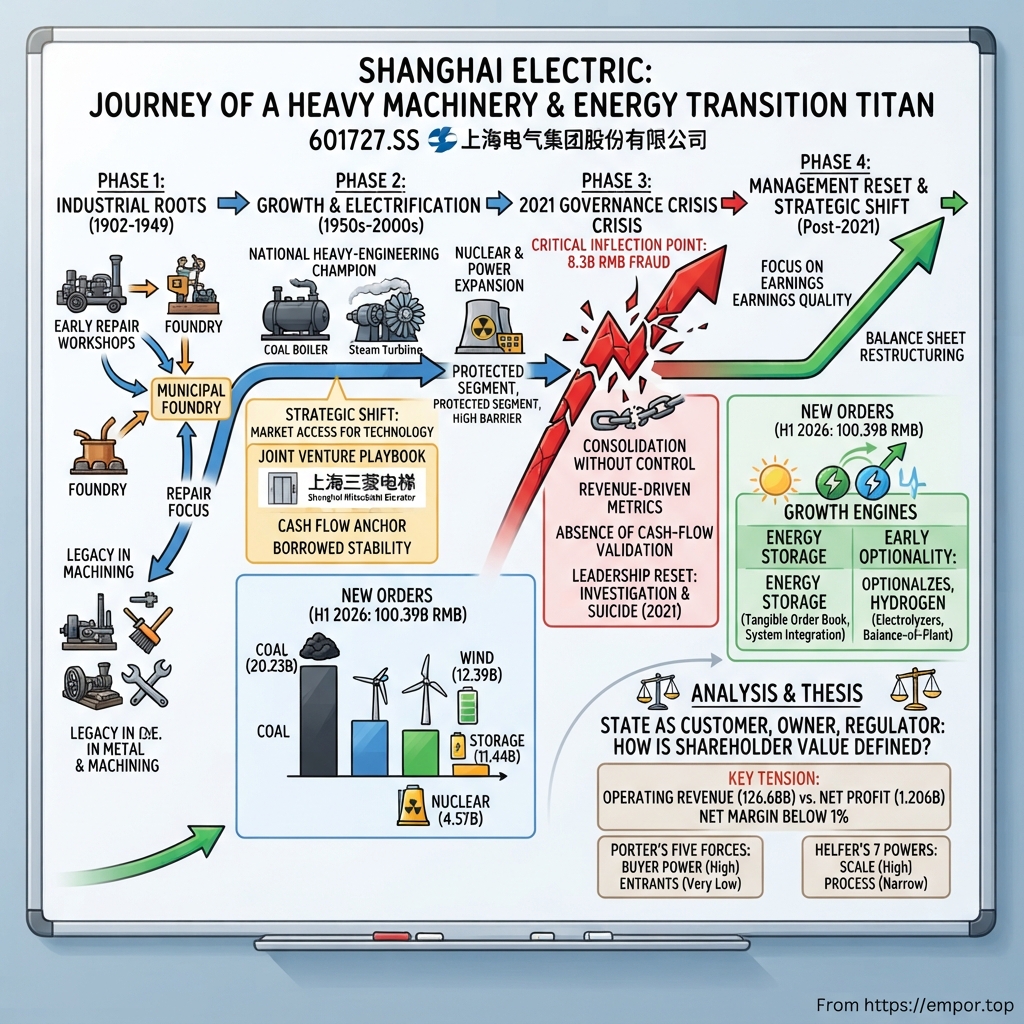
In May 2021, a company with a century-long legacy in heavy industrial manufacturing announced potential losses of up to 8.3 billion RMB. A subsidiary it barely controlled had shipped communications gear in circular transactions—paying suppliers in full up front while collecting from customers who never paid.1 Within three months, the former chairman was under investigation by discipline inspection authorities, and the sitting president was dead. It remains one of the most significant governance failures among state-owned enterprises listed on Chinese A-share markets in the past decade, occurring inside a municipal industrial group whose core capability is forging steel rather than speculative finance.
上海电气集团股份有限公司 Shanghai Electric Group Company Limited trades as 601727.SS on the 上海证券交易所 Shanghai Stock Exchange and as 02727.HK in Hong Kong. For the 2025 financial year, it reported operating revenue of roughly 126.68 billion RMB, up 9.03% year over year, with net profit attributable to shareholders of about 1.206 billion RMB—a 60.4% increase off a small base.2 The business operates across three main segments: Energy Equipment at roughly 75.02 billion RMB, Industrial Equipment at roughly 38.07 billion RMB, and Integrated Services at roughly 20.65 billion RMB.3 Control rests with the Shanghai Municipal Government through Shanghai Electric Holding Group Co., Ltd., within the state asset supervision architecture overseen by the 国务院国有资产监督管理委员会 State-owned Assets Supervision and Administration Commission (SASAC).
Holding those two figures side by side defines the core financial tension of the enterprise. Operating revenue reached 126.68 billion RMB against net profit of 1.206 billion RMB, generating a net margin below one percent. Despite possessing genuine manufacturing scarcity—as one of only three organizations in mainland China capable of forging nuclear reactor pressure vessels—the company converts very little of that structural advantage into bottom-line profit.
The arc of this episode runs as follows. First, the industrial inheritance: how Shanghai machine shops became a national heavy-engineering champion, and why that legacy continues to shape the cost base. Second, the growth phase: China's electrification, nuclear expansion, and a series of European acquisitions that promised technology transfer but largely produced impairments. Third, the 2021 governance crisis in full forensic detail. Fourth, the management reset under chairman 武磊 Wu Lei and president 刘平 Liu Ping. Fifth, a segment-level financial breakdown benchmarked against 东方电气 Dongfang Electric and 哈尔滨电气 Harbin Electric. Sixth, an evaluation of potential growth options in energy storage and hydrogen. Finally, a strategic assessment using Helmer's 7 Powers and Porter's Five Forces, balancing the bull and bear investment cases.
The central thesis rests on a question relevant to state-linked industrial enterprises globally: when the state serves simultaneously as customer, owner, and regulator, how is shareholder value defined—and who ultimately captures it?
 Subscribe on LinkedIn
II. Industrial Roots: From Municipal Foundry to Heavy Engineering Titan
Walk the Huangpu riverfront in 1902 and a visitor would find a strip of workshops built to serve maritime trade. Foreign trading houses needed boilers repaired, propeller shafts re-machined, and electric motors rewound. Out of that ecosystem of repair shops and metal foundries emerged the ancestors of the modern group—Shanghai Electric traces one of its lineage strands to machinery works founded in that era, and the group's corporate history places its origins in this period of treaty-port industrial improvisation.[^4]
This origin matters for a reason unrelated to heritage. Shanghai's industrial base was built around repair before manufacture, instilling a specific operational discipline: inputs cannot be selected, incoming machinery must be restored, and performance is judged on operational turnaround. That bias toward pragmatic problem-solving over original product design threaded through the company's subsequent development. Shanghai Electric proved adept at building to customer specifications, but less capable of originating proprietary designs. It became an efficient contract manufacturer of heavy industrial hardware, while its status as a technology innovator remained far less defined.
After 1949, these workshops were integrated into China's planned economy. Under central and municipal allocation, Shanghai was designated as one of a small group of manufacturing hubs for boilers, steam turbines, and heavy industrial motors. Production was assigned, prices were administered, and performance was measured against tonnage targets. Yet this period established lasting industrial infrastructure: heavy forging presses, deep machining bays, and a metallurgical workforce with generational continuity. Those physical assets created the baseline industrial capability that underpins the company's manufacturing footprint today.
The decisive operational shift began after 1978. As economic reform opened China to foreign capital, Shanghai's municipal government held an asset foreign multinationals required: domestic manufacturing capacity tied to an expanding home market. The signature transaction of that era was 上海三菱电梯 Shanghai Mitsubishi Elevator, established with Mitsubishi Electric Corporation—a joint venture that grew into one of China's dominant elevator suppliers and a major contributor to group cash flow over the next three decades.
The pattern established by that transaction—trading market access for technology and branding while retaining local manufacturing and sharing equity profits—became Shanghai Electric's core playbook. While highly effective in elevators, the strategy delivered mixed results in other segments, creating structural challenges that later impacted profitability.
Through the 1990s and early 2000s, Shanghai municipal authorities consolidated these factory assets into a single industrial group under China's 国企改革 State-Owned Enterprise reform program. The strategic goal was to separate operational assets from social liabilities, unify the balance sheet, and access public equity markets. Shanghai Electric listed H-shares in Hong Kong in 2005 and A-shares on the Shanghai Stock Exchange in 2008, following the standard dual-listing path for large state-owned enterprises, using Hong Kong for international governance standards and Shanghai for domestic market liquidity.
The newly listed entity supplied the core equipment for China's infrastructure expansion: coal-fired boilers, steam turbines, and electrical generators. The business was highly cyclical, tied directly to annual national power generation additions. For fifteen years following its listing, China's demand for power capacity expanded steadily.
The inheritance problem
Alongside physical plant assets, the group inherited substantial structural liabilities that continue to affect operating margins.
A municipal industrial enterprise of this era inherited an embedded social safety net alongside its manufacturing facilities. Housing, medical clinics, schools, canteens, pension commitments, and implicit employment guarantees remained tied to local plant operations. Although the reforms of the 1990s formally transferred many direct social services to municipal government control, social employment expectations persisted. A state-owned industrial employer in Shanghai rarely executes large-scale workforce reductions during downturns, as municipal authorities oversee both corporate governance and regional employment stability.
For investors, this structure creates a distinct cost profile: Shanghai Electric's operating leverage is asymmetric. When production volumes rise, incremental margins expand cleanly. When demand contracts, operating costs do not decline proportionally because labor costs remain largely fixed. This asymmetry has emerged in every major cyclical trough in the group's history, representing a structural feature of its ownership model rather than a temporary execution flaw.
This dynamic also drove the group's corporate diversification strategy. Unable to downsize operations during periods of slack demand, the enterprise sought revenue opportunities to utilize excess plant capacity and maintain its workforce. Expansion into elevators, industrial motors, factory automation, environmental equipment, and financial services was driven in part by a mandate to maintain operational scale. That continuous demand for top-line revenue created structural vulnerabilities that later re-emerged during the governance challenges of 2021.
This operational legacy established the foundation for Shanghai Electric as China entered its period of rapid power grid expansion.
III. The Golden Age of Grid Expansion and Cross-Border M&A
The scale of China's power sector expansion during the 2000s was unprecedented: in a typical year, the country added generating capacity equivalent to a major national power grid. Every gigawatt required a boiler, a turbine, and a generator. Crucially, only three domestic manufacturers were licensed and equipped to supply equipment at this scale: Shanghai Electric, 东方电气 Dongfang Electric, and 哈尔滨电气 Harbin Electric—collectively known as the Big Three.
For a decade, conditions for these heavy equipment makers were exceptionally favorable. Demand was driven by national industrial policy rather than market fluctuations, insulating manufacturers from economic downturns. Barriers to entry were formidable; the capital intensity and safety-critical nature of heavy power generation equipment effectively barred new entrants. Shanghai Electric built ultra-supercritical coal units operating at 600-megawatt and 1,000-megawatt capacities—turbines designed to run steam at extreme pressures and temperatures to extract maximum electrical output per tonne of coal burned.
The technical distinction of ultra-supercritical power generation is significant. Water normally converts to steam across a discrete phase boundary. Under sufficient pressure and temperature, that boundary disappears and the fluid becomes supercritical, carrying far greater thermal energy per unit. Operating in this regime requires advanced metallurgical alloys capable of retaining strength at extreme temperatures, alongside precise forging, welding, and inspection capabilities built through decades of accumulated manufacturing process knowledge.
However, the nature of this expansion created long-term structural challenges. Because state policy guaranteed abundant demand, the Big Three never underwent market-driven consolidation. In conventional capital goods industries, a prolonged boom is typically followed by industry shakeouts that leave dominant players with pricing power. In China, because the state acted as both owner of the power generators and owner of the equipment suppliers, authorities maintained all three vendors to preserve domestic capacity. Consequently, the industry exited its expansion era with the same competitive structure it entered, leaving no single manufacturer with a durable pricing advantage.
Nuclear power offered a higher-margin growth segment. Shanghai Electric established itself as a primary supplier of heavy nuclear island equipment—including reactor pressure vessels, steam generators, and pressurisers—alongside conventional turbine sets, supplying core components for China's third-generation reactor deployment, such as the 华龙一号 Hualong One. Entry into this segment was protected by strict regulatory barriers, including specialized manufacturing licences from China's nuclear safety regulator, multi-year qualification cycles, and a concentrated customer base of state-owned nuclear operators.
As domestic demand conditions evolved, Shanghai Electric turned toward international expansion. The protected domestic environment had fostered operational habits optimized for volume delivery and institutional relationships rather than commercial sophistication, pricing agility, or aggressive customer acquisition. When the company expanded beyond its protected home market, these structural limitations became evident.
Ansaldo Energia, 2014. Shanghai Electric acquired a 40% stake in Italian heavy gas turbine manufacturer Ansaldo Energia from Fondo Strategico Italiano. The strategic rationale was clear: while Chinese manufacturers excelled in steam turbines, the technology for heavy-duty gas turbine hot sections—including single-crystal blades, thermal barrier coatings, and complex internal cooling channels—remained concentrated among Siemens Energy, General Electric, and Mitsubishi Heavy Industries. The acquisition aimed to accelerate domestic technical capabilities.
However, the transaction yielded limited operational results. A 40% equity stake provided strategic influence but lacked operational control. Restructuring efforts faced structural friction under European labor regulations and works councils. Simultaneously, global gas turbine demand contracted as renewable power generation captured market share in Europe and North America, limiting cash flows and ultimately leading to asset impairments on Shanghai Electric's balance sheet.
Manz AG, 2016. Shanghai Electric acquired a 19.9% stake in German automation and solar equipment maker Manz AG to gain capabilities in lithium battery and display manufacturing equipment. Like the Ansaldo investment, this minority position lacked operational control, and the target market developed more slowly than anticipated, resulting in subsequent financial write-downs.
A critical evaluation of management's technology transfer thesis reveals clear structural constraints. Across the past decade, executive communications framed overseas investments as mechanisms for domesticating frontier engineering capabilities. Yet both the 2014 and 2016 transactions involved minority stakes that yielded financial impairments rather than competitive domestic product lines in gas turbines or battery automation equipment. More than a decade after the Ansaldo transaction, Chinese heavy gas turbine manufacturing continues to rely on foreign hot-section technology, and Shanghai Electric's gas turbine order book remains minor relative to its coal, wind, and nuclear divisions.
While acquiring a minority stake in Ansaldo provided industry access, international visibility, and commercial relationships in a restricted sector, the underlying structural thesis—that non-controlling stakes in overseas engineering firms would transfer proprietary process technology to a state-owned enterprise—proved unworkable in practice. Demonstrating genuine technology domestication would require a substantial, proprietary heavy-duty gas turbine order book relative to established coal and wind product lines.
The third pillar of Shanghai Electric's growth strategy involved international engineering, procurement, and construction (EPC) projects across South Asia, the Middle East, and Southeast Asia under the Belt and Road Initiative. Key projects included the Thar Block-1 coal power plant in Pakistan and the Dubai concentrated solar power installation. While EPC contracts allowed Shanghai Electric to bundle its own boilers and turbines into broader project scope, they also exposed the company's balance sheet to construction delays, currency fluctuations, and counterparty credit risks in developing markets. This exposure to complex, multi-party credit structures established operational vulnerabilities that directly preceded the group's subsequent governance crisis.
IV. The 2021 Governance Crisis: The 8.3 Billion RMB Fraud
On May 30, 2021, Shanghai Electric filed a corporate disclosure revealing that a 40%-owned subsidiary, 上海电气通讯技术有限公司 Shanghai Electric Communication Technology (SECT), had accumulated massive uncollectible receivables. The company estimated potential losses of up to 8.3 billion RMB.1 For an industrial group whose annual net profit typically hovered in the low single-digit billions, the disclosure represented several years of earnings wiped out by a trading unit whose core activities lay far outside the group's traditional heavy manufacturing footprint.
The 2021
专网通信 private network communicationaffair stands as one of the largest disclosed financial and governance failures among Chinese A-share listed SOEs of the past decade.
Corporate filings during financial distress often begin with understated estimates, yet Shanghai Electric quantified the potential loss near its ultimate magnitude immediately. Subsequent regulatory findings on disclosure adequacy indicated that the critical governance breakdown occurred not in May 2021, but during the preceding years while the arrangement developed without adequate board oversight or public disclosure.
How the machine worked
The mechanism relied on structural flaws within SECT's commercial operations.
SECT operated in the 专网通信 private network communication equipment sector, ostensibly trading specialized communication hardware for private networks. It purchased components from suppliers and resold them to end customers. In an industrial group evaluated primarily on top-line scale, SECT's rapid revenue expansion initially masked operational risks.
The payment structure created acute financial exposure. Upstream suppliers required 100% prepayment before delivering goods, while downstream customers paid roughly 10% up front and received extended credit for the remaining 90%. Under these terms, SECT functioned as an un-underwritten financing vehicle rather than a distributor. Each additional order consumed liquidity, worsening the cash deficit as sales volumes grew.
The supply chain lacked commercial independence. The upstream suppliers and downstream buyers were part of a circular network allegedly orchestrated by 隋田力 Sui Tianli, a figure tied to identical financing arrangements across multiple listed Chinese companies. Physical goods moved largely in closed loops, while Shanghai Electric's cash flowed outward.
In May 2021, downstream buyers defaulted simultaneously—a synchronicity pointing to coordinated failure rather than independent commercial distress. SECT was left holding uncollectible receivables alongside inventory of dubious value.
The structure was not isolated to Shanghai Electric. Identical private network communication schemes surfaced across a cluster of listed Chinese firms in 2021, featuring the same payment terms and central coordinator. Rather than demonstrating an isolated internal control failure, the episode highlighted a systemic blind spot across corporate audit and governance functions, allowing revenue-generating trading operations to bypass standard cash-flow verification.
For investors, the failure underscored that the defective controls were standard practice rather than unusual anomalies. Basic working-capital checks—such as comparing cash conversion to reported revenue—were readily available but rarely applied.
What it cost
The financial fallout forced impairments and provisions totaling roughly 8.3 billion RMB, erasing years of accumulated profit and severely damaging investor confidence.1 The institutional impact followed rapidly.
In July 2021, discipline inspection authorities placed former chairman and party secretary 郑建华 Zheng Jianhua under investigation.4 In August, president Huang Ou died by suicide following intensified regulatory scrutiny.5 The China Securities Regulatory Commission subsequently penalized the company for disclosure violations and internal control failures.
Judicial proceedings against Zheng concluded in early 2026. On January 13, 2026, the Shanghai No. 1 Intermediate People's Court sentenced him to death with a two-year reprieve, ordered the deprivation of political rights for life, and confiscated his personal property. The court established that between 2003 and 2021, Zheng solicited or accepted bribes exceeding 156 million RMB; embezzled 2.15 million RMB in public funds in 2007–2008; misappropriated over 700 million RMB in public funds for unreturned loans in 2018; and between 2015 and 2021 abused his authority to pursue personal political achievement, causing severe losses to state assets.6
The charge of abusing authority for political advancement illustrates the structural incentives at play. Rather than simple embezzlement alone, executive performance was evaluated on top-line growth set by state owners. In that environment, senior management lacked motivation to scrutinize a subsidiary reporting rapid revenue expansion.
The crisis also caused severe operational disruption. Losing both the chairman and president within weeks deprived the group of senior leadership at the precise moment required to manage the financial restructuring.
The analytical takeaway
Viewing the crisis as an isolated incident involving a single subsidiary and corrupt management overlooks broader systemic vulnerabilities. Three structural factors enabled the failure:
First, consolidation without control. Despite holding only a 40% equity stake in SECT, Shanghai Electric consolidated the entity onto its balance sheet, bearing full financial losses without operational control. This mirrored the group's overseas investments in Ansaldo and Manz, where minority ownership positions created disproportionate liability.
Second, revenue-driven evaluation. When state-owned enterprise performance metrics emphasize revenue scale over capital efficiency, working capital quality receives insufficient oversight.
Third, the absence of cash-flow validation. Comparing SECT's reported net profit against operating cash flows would have revealed severe divergence years prior to the collapse. The failure to conduct basic cash conversion analysis remains the central internal control breakdown.
The subsequent management restructuring required a comprehensive overhaul of corporate governance, approval thresholds, and risk management protocols across the enterprise.
V. Governance Reset and Management Under Chairman Wu Lei
Rebuilding a listed SOE after a fraud of this magnitude is a complex exercise, because the shareholder requiring satisfaction and the regulator enforcing oversight are functionally the same entity. The Shanghai Municipal Government and SASAC stepped directly into the reconstruction: management was replaced, risk-management protocols for state assets were tightened, and the corporate portfolio was audited for any operations resembling the SECT pattern.
The immediate priority was triage. A group emerging from a crisis of this scale faces three conflicting objectives: uncover any additional liabilities, contain disclosed losses, and reassure external counterparties—including lenders, bondholders, international customers, and joint venture partners—that the enterprise remains commercially viable. Internal forensic investigations routinely surface additional adverse findings, creating short-term counterparty friction even as they establish long-term institutional stability.
武磊 Wu Lei assumed the roles of chairman and party secretary, while 刘平 Liu Ping was appointed president to oversee daily operations. This division of responsibility reflects standard governance across large state-owned enterprises, where the chairman manages strategic and policy alignment while the president drives execution, cash management, and cost control.
The subsequent internal audit represented the critical phase of the operational reset, though it generated few public disclosures. Auditing an enterprise of this scale for arrangements similar to SECT required evaluating partially owned subsidiaries, off-balance-sheet trading structures, extended receivables, and accounting consolidation decisions. The practical output of this work was primarily defensive—reducing financial risk, winding down non-core entities, and exiting speculative trading activities.
Evaluating management's operating scope requires understanding state-owned enterprise incentive structures. Shanghai Electric Holding Group maintains a controlling equity stake of roughly 49.8%. Executive compensation within this framework is tied primarily to state-mandated metrics—such as economic value added, return on equity, research spending, operational safety, and green energy transition targets—rather than equity options. Consequently, executive incentives prioritize avoiding catastrophic losses and achieving policy objectives over maximizing per-share equity value. Where state policy goals and minority shareholder returns diverge—such as share buybacks, aggressive asset divestitures, or workforce reductions—policy requirements take precedence.
Conversely, state ownership provides key competitive advantages. The structure ensures capital access during credit contractions, maintains demand from state-aligned customers committed to preserving domestic industrial capacity, and accommodates extended payback periods for capital-intensive sectors such as nuclear manufacturing. That capital intensity and qualification timeline would be difficult for a private enterprise to sustain. The governance framework that limits equity upside simultaneously underwrites downside financial risk.
In recent reporting periods, management's strategic focus shifted from top-line expansion to balance-sheet restructuring. Non-core financial services and trade financing operations were curtailed, while capital expenditure was directed toward upgrading thermal power technology, expanding nuclear manufacturing capacity, and scaling renewable equipment lines. Impairment disclosures also became more detailed and transparent.
The 2025 financial results provided the first comprehensive benchmark of this operational transition. Operating revenue rose 9.03% to 126.68 billion RMB, while net profit attributable to shareholders increased 60.37% to 1.206 billion RMB, alongside record new order volume.2 The interim results for the first half of 2026, disclosed on September 15, 2026, showed operating revenue of 63.33 billion RMB—up 16.6% year over year—attributable net profit of 970 million RMB, representing an 18.2% increase, and new orders totaling 100.39 billion RMB.7
Analyzing these figures reveals key operational dynamics. New order intake of 100.39 billion RMB in six months relative to full-year 2025 revenue of 126.68 billion RMB indicates strong demand and solid backlog conversion, reflected in revenue growth accelerating to 16.6%. However, net profit of 970 million RMB on 63.33 billion RMB in revenue represents a net margin of roughly 1.5%, as earnings growth lagged top-line expansion during the half. The margin profile demonstrates that recent volume expansion has been secured at tight pricing, indicating that order growth reflects robust market demand and capacity utilization rather than pricing power.
Management's execution strategy remains consistent but unproven regarding margin expansion. Corporate disclosures have maintained a coherent focus on risk controls, earnings quality, and transparent asset impairments. However, sustainable recovery requires expanding profit margins alongside revenue growth. A key metric for evaluating future performance is whether gross margins in the core Energy Equipment segment expand as order volume increases.
Evaluating that shift requires examining performance across individual operating segments.
VI. Segment Breakdown: Energy Equipment vs Industrial Equipment
             Shanghai Electric Group Co., Ltd. (FY2025 Revenue: ~126.68B RMB)
                                      |
         +----------------------------+----------------------------+
         |                                                         |
 能源装备 Energy Equipment                                  工业装备 Industrial Equipment
 Revenue: ~75.02B RMB (59%)                                Revenue: ~38.07B RMB (30%)
 Growth: +21.5% YoY                                        Growth: -1.5% YoY
 Drivers: Ultra-supercritical coal, nuclear,               Drivers: Shanghai Mitsubishi Elevator JV,
 gas turbines, offshore wind, storage                      motors, automation, precision tools
         |                                                         |
         +----------------------------+----------------------------+
                                      |
                           集成服务 Integrated Services
                           Revenue: ~20.65B RMB (16%)
                           Drivers: Power plant EPC, environmental
                           services, industrial software, leasing
1. Energy Equipment — the engine, and the margin problem
Energy Equipment contributed roughly 75.02 billion RMB in 2025, representing about 59% of group revenue and growing over 21% year on year.3 In the first half of 2026, segment revenue reached 36.56 billion RMB, up 21.4%, driven specifically by wind power and energy storage.7 That revenue composition is structurally significant: top-line expansion is originating from the newest, most price-competitive, and least differentiated portions of the product portfolio.
Evaluating segment performance in heavy equipment manufacturing requires accounting for revenue recognition dynamics. Revenue on major power equipment is recognized across multi-year manufacturing and construction milestones rather than at the point of sale. Current revenue reflects orders secured two to four years prior, whereas current order intake will not convert into reported revenue for several reporting cycles. When order intake and revenue recognition accelerate simultaneously—as Shanghai Electric reported in mid-2026—the demand signal is corroborated across both leading and lagging indicators.
Nuclear equipment remains the highest-quality franchise within the group. Shanghai Electric is a primary domestic supplier of nuclear island heavy equipment and conventional island turbine sets, holding a domestic market share in nuclear equipment historically estimated between 40% and 45%. The manufacturing barriers are substantial; forging a reactor pressure vessel requires steel ingots of a size that only a small number of global facilities can process, alongside multi-year regulatory qualifications. However, nuclear new orders totaled 4.57 billion RMB in the first half of 2026, compared with 20.23 billion RMB for coal-fired equipment.7 The highest-margin segment remains constrained by approval cadences: China authorizes reactor construction in annual batches, generating periodic equipment orders years ahead of revenue recognition. Consequently, the nuclear business offers structural stability rather than rapid top-line expansion.
Coal equipment continues to serve as the group's volume anchor. Chinese energy policy has repositioned coal-fired capacity from continuous baseload generation to flexible grid balancing, supporting intermittent wind and solar output. Operational flexibility retrofits allow baseload thermal units to ramp output up and down dynamically. This shift has sustained policy-driven demand for both high-efficiency ultra-supercritical units and plant retrofits, allowing Shanghai Electric to capture over 20 billion RMB in coal equipment orders in the first half of 2026.7
Gas turbines represent an ongoing technology capability gap, as detailed in previous strategic reviews.
Wind equipment offers volume growth alongside compressed operating margins. The group's wind operations reside within 上海电气风电集团 Shanghai Electric Wind Power Group (688660.SH on the STAR Market), which focuses on offshore turbine platforms. Chinese offshore wind manufacturing has experienced prolonged price competition, with turbine prices per kilowatt declining significantly as 金风科技 Goldwind, 远景能源 Envision Energy, and state-owned equipment vendors competed for market share. Wind equipment orders reached 12.39 billion RMB in the first half of 2026, reflecting strong unit volume but constrained profitability under prevailing industry pricing.7
This competitive dynamic illustrates a structural feature of Chinese renewable manufacturing. Manufacturers have competed primarily by advancing turbine power ratings—scaling platform capacities from 8 megawatts to 12 megawatts, 16 megawatts, and higher. While larger turbines reduce levelized energy costs for power developers, they impose ongoing capital demands on equipment makers. Each successive platform requires new engineering design, re-tooling, and supply chain re-qualification, eroding early-mover advantages as competitors match unit capacities within a single product cycle.
Offshore wind volume expansion reflects participation in an intensive capital cycle rather than durable moat building. Equipment manufacturers can escape this margin treadmill only through structural cost leadership or proprietary technology, neither of which Shanghai Electric has conclusively demonstrated against peers such as Goldwind or Envision.
Competitive benchmarking. 东方电气 Dongfang Electric (600875.SS / 01072.HK) represents the closest peer, maintaining comparable market positions in nuclear and thermal equipment alongside a larger hydroelectric turbine division. 哈尔滨电气 Harbin Electric (01133.HK) remains heavily weighted toward thermal and hydro equipment, lacking Shanghai Electric's industrial automation footprint and elevator joint venture. Relative to these peers, Shanghai Electric's distinguishing assets are its offshore wind division and elevator operations—neither of which confers an advantage in core thermal power manufacturing.
Where Shanghai Electric possesses genuine business differentiation (elevators and offshore wind), those operations sit outside core heavy power machinery. Within core power equipment, three state-owned manufacturers compete for orders from a concentrated base of state-owned utility buyers. Gross margins in Energy Equipment have historically fluctuated between 16% and 20%, remaining sensitive to raw material input costs—including steel, copper, and nickel—and utility procurement pricing.
Evaluating the group's nuclear market share requires contextual analysis. A 40% to 45% share within a market served by three qualified state-backed vendors reflects state allocation policies designed to maintain domestic manufacturing capacity alongside competitive bidding. Furthermore, nuclear equipment contracts encompass components with varying margin profiles; reactor pressure vessels command high technical premiums, whereas conventional turbine generators face greater competition. Shanghai Electric retains a protected position in heavy nuclear components, but segment expansion remains bounded by national regulatory approval timelines.
2. Industrial Equipment — the cash generator under pressure
Industrial Equipment generated roughly 38.07 billion RMB in 2025, down 1.5% year on year, and 18.95 billion RMB in the first half of 2026, up 1.9%.37 Segment revenue has remained largely flat over recent reporting periods.
The primary financial driver within this division is 上海三菱电梯 Shanghai Mitsubishi Elevator. The elevator business model pairs commodity-like initial equipment sales with long-term servicing revenue. Installed units require periodic inspection, maintenance, repair, and eventual modernization over multi-decade operating lifespans. Original equipment manufacturers retain structural advantages in securing service contracts. This installed base generates recurring, high-margin service revenue that operates independently of heavy industrial capital cycles, historically mitigating earnings volatility during power equipment downturns.
Regulatory standards reinforce this service revenue stream. Safety mandates require regular inspection and certified maintenance for building elevators. These compliance requirements convert routine maintenance into non-discretionary operational spending, favoring established vendors with certified technician networks and proprietary spare parts access.
The primary operational headwind stems from conditions in the domestic real estate sector. The prolonged contraction in new property construction has reduced demand for initial elevator installations, reflected in the flat revenue trajectory. However, ongoing service demand from the existing installed base prevents sharp revenue declines. As the installed base grows, revenue shifts toward higher-margin maintenance and modernization services.
This maintenance annuity buffers downturns but offers limited top-line growth without new unit installations. Growth in service revenue depends on pricing adjustments and modernization cycles. Consequently, Industrial Equipment functions primarily as a margin stabilizer rather than a primary growth driver.
3. Integrated Services — the enabler
Integrated Services generated roughly 20.65 billion RMB in 2025 and grew 31.5% to 10.86 billion RMB in the first half of 2026.37 The segment encompasses international engineering, procurement, and construction (EPC) projects, environmental services, industrial software, and financial leasing.
Following the 2021 governance reset, management narrowed the scope of Integrated Services to focus on supporting core equipment sales while scaling back speculative financial services and third-party trade financing. Restricting high-risk financing activities directly addresses the control failures that led to the SECT receivables crisis.
However, Integrated Services contains higher accounting complexity relative to manufacturing divisions. International EPC contracts use percentage-of-completion accounting, requiring management to estimate total project costs and completion stages. These estimates directly influence period-to-period profit recognition. Additionally, overseas EPC projects involve currency conversion risks and counterparty credit exposures in emerging markets. Consequently, top-line expansion in EPC contracts represents an expansion of balance-sheet execution risk alongside revenue growth.
This structural balance between core equipment manufacturing, mature cash-generating JVs, and emerging services frames the operational baseline as management pursues new growth initiatives in energy storage and hydrogen.
VII. Hidden Growth Engines: Energy Storage and Hydrogen
Every major industrial group in China maintains presentation slides on hydrogen, but very few derive meaningful revenue from it. Evaluating these emerging initiatives begins with sizing.
New energy storage—spanning lithium-ion systems, vanadium redox flow batteries, and thermal storage—alongside green hydrogen equipment together account for only a low single-digit percentage of consolidated revenue today. These segments warrant examination not because they are financially material at present, but because they may become material later, and because they test a core management claim: that Shanghai Electric can convert its heavy engineering capabilities into viable new commercial franchises.
Energy storage is the more advanced of the two verticals, with order volumes expanding significantly. New orders for storage equipment reached 11.44 billion RMB in the first half of 2026—approaching the 12.39 billion RMB recorded in wind power—with management explicitly attributing segment growth to the combined momentum of wind and storage.7 This expansion transitions storage from a theoretical presentation slide into a tangible order book.
The strategic rationale is straightforward. China's power grid faces severe renewable intermittency challenges, which have become a primary bottleneck to further wind and solar deployment. In response, provincial policies increasingly require developers to pair generation assets with energy storage capacity. An equipment maker capable of offering wind turbines, structural foundations, grid connection hardware, and storage systems as an integrated turnkey package holds a distinct commercial advantage over standalone battery integrators—not because its battery cells are superior, but because state-owned utility customers prefer a single project contract over managing multiple vendors.
However, a critical counterweight exists: battery energy storage is rapidly commoditizing, cell manufacturing remains dominated by specialized battery makers, and integration margins are structurally thin. Shanghai Electric operates primarily as a systems integrator in this market rather than a battery cell technologist. Accelerating low-margin storage revenue improves top-line growth metrics while contributing little to overall group profitability—a dynamic already visible in the compressed profit margins reported for the first half of 2026.
Determining whether storage constitutes a durable commercial franchise or merely temporary top-line revenue requires evaluating how Shanghai Electric fares in standalone tenders. If a customer solicits competitive bids for an independent battery storage facility with no wind turbines attached, Shanghai Electric lacks a decisive competitive edge. Battery cells are sourced from third-party specialists, power electronics remain highly contestable, and system integration capabilities are widely available across the industry. The company's competitive advantage exists primarily in bundled bids, where utility customers prioritize single-contract accountability across generation and storage assets.
While valuable, this bundled advantage remains narrow and highly dependent on prevailing procurement practices. Should state buyers transition toward unbundled tendering—a standard evolution in maturing capital goods markets aimed at driving down costs—that competitive edge would erode. Consequently, assessing the long-term viability of this growth engine requires monitoring changes in utility procurement structures rather than tracking top-line order volumes alone.
Hydrogen represents an earlier and far more speculative initiative. Shanghai Electric has developed multi-megawatt electrolyzer stacks—utilizing both alkaline and proton exchange membrane (PEM) technologies—targeted at green hydrogen production projects in renewable-rich regions such as Inner Mongolia and Xinjiang. While the basic principle of electrolysis involves using electricity to split water into hydrogen and oxygen, industrial execution requires operating at scale with high thermal efficiency, cost-effective catalysts, and variable power inputs from intermittent wind generation. Shanghai Electric's core capability in this field lies not in proprietary electrochemistry, but in the balance-of-plant architecture—the pressure vessels, gas-handling systems, and process equipment surrounding the stack, where its traditional chemical equipment manufacturing experience directly applies.
However, technical capability and prototype certifications do not automatically translate into commercial revenue. Shanghai Electric's historical track record in commercializing new technologies remains mixed: highly successful in coal and nuclear power equipment where state policy guaranteed long-term demand, but less effective in gas turbines where guaranteed demand was absent. At present, green hydrogen economics depend on access to low-cost surplus renewable power and regulatory mandates for green steel and green chemicals—neither of which has reached widespread commercial viability.
A realistic evaluation suggests that energy storage has transitioned from theoretical optionality into a tangible, albeit low-margin, business line that should be judged on margin expansion rather than order volume. Hydrogen, by contrast, remains early-stage optionality with no demonstrated commercial conversion. Until Shanghai Electric secures recurring, commercially priced electrolyzer orders at scale from non-state demonstration projects, hydrogen initiatives contribute little to the group's fundamental valuation.
VIII. Investor Playbook: Business and Strategy Lessons
Three strategic lessons extend beyond Shanghai Electric to capital goods enterprises and state-linked industrial groups globally.
Lesson 1 — Trading revenue inside a manufacturing company is a critical warning sign.
The SECT affair illustrates a classic governance breakdown: a trading subsidiary reporting rapid revenue growth while generating negative operating cash flow, with receivables and prepayments expanding faster than sales. When a heavy equipment manufacturer generates top-line volume by standing between commercial counterparties rather than forging physical hardware, the economic reality of those transactions requires immediate scrutiny.
Effective internal control in this setting relies on an operational habit rather than compliance paperwork: reconciling every fast-growing subsidiary's reported earnings against cash conversion each period, treating sustained divergence as a potential control failure rather than a working-capital anomaly.
Lesson 2 — Joint-venture annuities provide borrowed stability, not a durable moat.
For three decades, Shanghai Mitsubishi Elevator provided vital earnings support, allowing a highly cyclical heavy-equipment enterprise to buffer downturns in power sector capital expenditure. That recurring cash flow provided real balance-sheet protection, distinguishing Shanghai Electric from standalone turbine manufacturers during demand contractions.
However, this stability remains structurally circumscribed. The elevator division earns high-margin servicing income on an installed base, but operates within a joint venture where the foreign partner supplies the underlying brand and core technology. Shanghai Electric lacks unilateral operational control, cannot independently expand the platform globally, and cannot easily replicate the asset. While borrowed stability protects earnings during cyclical troughs, a cash engine dependent on a non-controlled joint venture does not constitute a proprietary corporate moat.
Lesson 3 — Minority equity stakes rarely transfer core technology.
The cross-border investments in Ansaldo Energia and Manz AG illustrate a recurring limitation in international industrial transactions: capital purchases equity returns, not engineering capability. Absorbing proprietary manufacturing processes requires direct control over operational priorities, workforce allocation, and technology licensing—authority that 19.9% or 40% equity stakes do not confer. When host governments or corporate partners act to retain core intellectual property domestically, minority buyers face structural barriers to technology domestication.
For investors, corporate claims framing foreign minority acquisitions as technology-transfer shortcuts warrant strict skepticism. Sound valuation requires underwriting such positions strictly on standalone financial returns, assigning zero strategic value to technology-transfer narratives until domestic, commercially viable product lines actually materialize.
IX. Strategic Frameworks, Risk Radar, and Bull vs Bear
1. Helmer's 7 Powers
Scale Economies — high, and genuinely so. Ultra-heavy forging presses, turbine assembly bays sized for hundred-tonne rotors, and nuclear-qualified manufacturing halls represent billions of RMB in sunk capital with no alternative industrial use. The fixed-cost base is enormous, and the minimum efficient scale is large enough to exclude potential new entrants.
Process Power — high, but narrowly bounded. Decades of metallurgical practice, precision machining, and nuclear assembly discipline constitute institutional knowledge that resides in workforce expertise and operating procedures rather than patents, making it slow to replicate. However, this power applies primarily to nuclear and ultra-supercritical steam hardware, not to wind nacelles or battery containers, where manufacturing is far more contestable. The company's recent order expansion has concentrated in segments where its process power is weakest.
Cornered Resource — medium, and weaker than it appears. Nuclear manufacturing licences and long-standing relationships with municipal utilities are genuine strategic assets. Yet these resources are not cornered by Shanghai Electric alone; Dongfang Electric and Harbin Electric hold comparable qualifications. The resource is cornered by three state-backed manufacturers collectively against external entrants, protecting industry structure without protecting any individual member's margin against its domestic peers.
Counter-Positioning — low, and arguably negative. The legacy thermal asset base creates operational inertia rather than advantage during the transition to renewable generation. Shanghai Electric is the incumbent being counter-positioned against by specialized renewable manufacturers, rather than the disrupter.
Switching costs exist in nuclear equipment supply and elevator maintenance contracts, whereas branding and network economies remain essentially absent.
2. Porter's Five Forces
Threat of new entrants — very low. Capital intensity, nuclear regulatory certifications, and multi-year customer qualification cycles make market entry effectively impossible. This represents the strongest structural barrier protecting the enterprise.
Bargaining power of buyers — high, and the decisive force. The customer base is dominated by state-owned power generators—including 中国华能 China Huaneng, 中国大唐 China Datang, and 国家能源集团 China Energy Investment—alongside state nuclear operators and State Grid Corporation of China. These concentrated, state-directed buyers procure through competitive tenders, explicitly maintain multiple qualified domestic vendors as policy, and face their own cost constraints under regulated electricity tariffs. Concentrated buyers facing three interchangeable suppliers create a structural environment for margin compression, yielding net margins below 2%.
Bargaining power of suppliers — moderate to high. Key raw materials such as specialty steel, copper, and nickel are globally priced commodity inputs. Because long-dated equipment contracts are typically fixed-price, input price inflation is absorbed directly by the equipment manufacturer.
Threat of substitutes — moderate. Renewable generation paired with energy storage substitutes for traditional thermal power, though Shanghai Electric supplies equipment across both product categories. The primary risk concerns product mix rather than unit volume: substituting equipment lines currently carry lower profit margins than the thermal hardware they replace.
Rivalry — high. Competition remains oligopolistic and relatively disciplined in nuclear and thermal equipment, but intensely price-competitive in wind power, where aggressive tendering against Goldwind and Envision Energy has compressed industry margins.
Synthesizing these forces: the sector is well protected from external entrants but exposed to concentrated state buyers. This structural combination delivers long-term operating durability without high profitability, creating an enterprise that is resilient against market exit yet constrained in its ability to generate high returns on equity.
3. Risk Radar
Buyer-power and policy risk remains the dominant structural constraint, as concentrated state utility procurement caps pricing power across all major product lines.
Property market overhang continues to weigh on new elevator installation volumes, capping growth in the industrial segment that historically stabilized consolidated earnings. While recurring service revenues buffer the decline, they do not fully offset weaker initial equipment sales.
Input cost inflation on steel, copper, and industrial resins threatens Energy Equipment gross margins on long-lead contracts priced prior to commodity price increases.
Technology access risk regarding high-efficiency gas turbine licensing and specialized industrial software persists in the current geopolitical environment, directly impacting the primary technical capability gap the company has sought to bridge.
Legacy litigation and accounting recovery risk lingers from the SECT private network communications affair. Capital recovery on defaulted receivables of this nature is historically low, and international counterparty diligence remains rigorous. More broadly, reported profitability depends heavily on accounting judgments—including impairment adequacy, percentage-of-completion revenue recognition on long-term EPC contracts, and accounting consolidation choices for partially owned subsidiaries.
Governance and capital allocation structure. The controlling 49.8% stake held by Shanghai Electric Holding Group leaves minority shareholders with limited influence over corporate actions. The dual A-share and H-share structure maintains distinct investor bases, with H-shares historically trading at a persistent discount relative to A-shares. Furthermore, the separate listing of the wind power subsidiary on the STAR Market introduces a minority interest layer between consolidated wind revenues and Shanghai Electric Group shareholders.
These structural factors mean that the transmission mechanism between operational volume growth and minority shareholder returns is subject to state policy priorities, dividend policies, and subsidiary ownership structures.
4. The Skeptic's Stress Test
An institutional investor evaluating Shanghai Electric faces a central question: is the group executing a disciplined corporate turnaround in the early stages of a re-rating, or does it remain a low-return state supplier that has stabilized after a major governance crisis?
The bear argument rests on historical financial metrics: return on equity has remained in the low single digits, net margins sit below 2% despite expanding revenues, and top-line growth is concentrated in lower-margin wind and energy storage lines. Interim data for the first half of 2026 shows net profit growth lagging top-line revenue expansion.7 Additionally, traditional activist levers—such as divesting underperforming divisions, executing rapid workforce reductions, increasing leverage, or launching large share buybacks—are constrained by state ownership mandates regarding employment and industrial capacity.
The counter-argument highlights sector context. Across domestic peers Dongfang Electric and Harbin Electric, low profit margins reflect industry-wide procurement dynamics rather than single-company execution failures. Furthermore, post-2021 corporate actions demonstrate an explicit management focus on risk control, balance-sheet cleanup, and operational stability following senior leadership turnover.
The calibrated assessment indicates that internal governance controls have tightened and order intake remains strong. However, revenue growth has not yet translated into structural margin expansion, leaving the near-term investment thesis dependent on sector demand cycles and state energy transition policy rather than expanding corporate pricing power.
5. The KPIs That Matter
Three core operational metrics track the group's financial trajectory:
First, Energy Equipment gross margin. This metric indicates whether top-line expansion reflects genuine pricing power or volume growth secured at tight margins. Expanding order intake paired with stable or declining gross margins indicates growth driven by competitive pricing, whereas sustained gross margin expansion would signal improving commercial terms.
Second, net operating cash flow relative to reported profit. Monitoring cash conversion serves as a direct test of revenue quality and working-capital controls, ensuring that reported earnings are backed by realized cash inflows and that receivables remain collectible.
Third, the new-energy share of total order intake. The proportion of new orders represented by nuclear, wind, energy storage, and hydrogen equipment tracks the pace of portfolio diversification away from legacy coal equipment. In the first half of 2026, order intake comprised 20.23 billion RMB in coal equipment alongside 12.39 billion in wind, 11.44 billion in energy storage, and 4.57 billion in nuclear, illustrating an ongoing but gradual portfolio transition.7
6. Bull vs Bear
The bull case. China's nuclear power expansion provides multi-year demand visibility, with Shanghai Electric occupying a certified supplier position in high-barrier heavy nuclear components. Simultaneously, national grid policies supporting thermal flexibility retrofits sustain coal equipment order volumes. Record new orders of 100.39 billion RMB in the first half of 2026 demonstrate robust end-market demand,7 while energy storage has developed into a tangible order book. Meanwhile, elevator servicing generates recurring cash flow, and internal governance oversight has tightened following the 2021 restructuring.
The bear case. Return on equity and net margins remain structurally low due to concentrated state buyer power. Order growth is concentrated in offshore wind and energy storage, where price competition is intense and historical manufacturing moats offer limited pricing leverage. Real estate weakness caps initial elevator sales, while technical capability gaps in heavy gas turbines remain unclosed. Furthermore, state ownership prioritizes industrial capacity preservation and employment stability over minority shareholder returns.
Comparing the two perspectives, the bull case rests primarily on near-term order intake visible in recent financial reporting. The bear case rests on structural features—buyer concentration, industry rivalry, and ownership mandates—that evolve slowly over time. Strong order volume reflects current market demand, while thin operating margins remain a persistent industry condition.
7. Myth vs Reality
Three common market assumptions warrant direct examination:
Myth: China's energy transition implies an immediate collapse in Shanghai Electric's thermal power business. Reality: coal-fired equipment generated the largest single order category in the first half of 2026 at 20.23 billion RMB, as China repurposes thermal assets for grid balancing and peak-load support rather than executing immediate capacity retirements.7 Demand for high-efficiency thermal units and flexibility retrofits provides ongoing order volume.
Myth: the 2021 SECT crisis resulted entirely from external fraud by third-party trading entities. Reality: judicial findings established long-standing internal control failures and executive abuse of authority extending from 2003 to 2021.6 External counterparties exploited existing governance blind spots and revenue-focused evaluation metrics within the organization.
Myth: heavy exposure to nuclear and offshore wind automatically qualifies the group as a high-margin energy transition growth stock. Reality: while transition-related product lines are expanding rapidly, intense price competition in segments such as offshore wind and battery integration has yielded compressed operating margins that weigh on consolidated profitability. Volume participation in growing end markets does not guarantee expanded corporate profit margins.
X. Epilogue and Key Takeaways
There is a version of Shanghai Electric's story that is purely triumphant: the century-old foundry that electrified a nation and now equips its energy transition. There is another that is purely damning: the state conglomerate that lost multiple years of profit to a fraud its own leadership was later convicted of enabling, and that earns less than two cents of profit on every yuan of revenue.
Both perspectives contain truth, yet neither provides a complete picture. Shanghai Electric remains an institution of unmistakable industrial consequence and unremarkable financial return—a company capable of forging components that few global peers can match, selling to state customers with overwhelming bargaining power, under an ownership model that prioritizes operational reliability over shareholder return. The 2021 collapse was not an external anomaly; it was a systemic failure mode that the group's governance structure permitted, and post-crisis reforms have been aimed directly at eliminating those vulnerabilities.
The strong order book recorded across 2025 and 2026 demonstrates that underlying demand remains robust and that the group's manufacturing position survived the crisis intact.27 Margin metrics, however, indicate that structural operational improvements have barely begun. For long-term investors, the central question is whether the operational discipline management has applied to loss avoidance will eventually translate into expanded profit margins—a shift that will become visible first in Energy Equipment gross margins rather than top-line press releases.
Heavy industrial state enterprises of this scale are frequently misjudged in one of two directions. The first mistake is to value them as high-growth technology leaders simply because they produce hardware required for the energy transition. Building the physical infrastructure of an industrial transition rarely guarantees capturing its economic rents; historically, manufacturers of railway locomotives and telecommunications switches captured far lower returns than the networks they enabled. The second mistake is to dismiss them as obsolete state relics due to thin operating margins, ignoring that thin margins on essential, regulator-gated industrial output can persist indefinitely as a stable, viable enterprise.
Shanghai Electric sits squarely between these two extremes. It shows no current evidence of evolving into a high-return compounder, yet its position in heavy nuclear manufacturing remains exceptionally durable. The investment evaluation is not a binary choice between disruption and collapse. Instead, it centers on a narrower, testable question: whether an institution structurally mandated to serve state priorities can deliver an acceptable return to equity holders. Two consecutive reporting periods of expanding orders and recovering net profit represent the initial steps toward an answer—not the final verdict.
References
-
State-Owned Power Giant Shanghai Electric Discloses Billions in Potential Losses — Caixin Global, 2021-05-31 ↩↩↩
-
Shanghai Electric Reports Strong 2025 Performance, New Orders Hit Record High — PR Newswire ↩↩↩
-
2025 Annual Results Announcement of Shanghai Electric Group Co., Ltd. ↩↩↩↩
-
Chairman of Shanghai Electric Placed Under Corruption Investigation — Caixin Global, 2021-07-28 ↩
-
Shanghai Electric President Dies in Apparent Suicide Following Investigation — Caixin Global, 2021-08-06 ↩
-
Shanghai Electric Reports 16.6% Revenue Growth in H1 2026 as New Orders Reach CNY 100.39 Billion — PR Newswire, 2026-09-15 ↩↩↩↩↩↩↩↩↩↩↩↩↩
 LinkedIn
 WhatsApp
 Reddit
 Hacker News
 Email
Email Kindle
 RSS Feed
 Spotify
 Apple Podcasts
 Amazon Music
 Audible
 YouTube