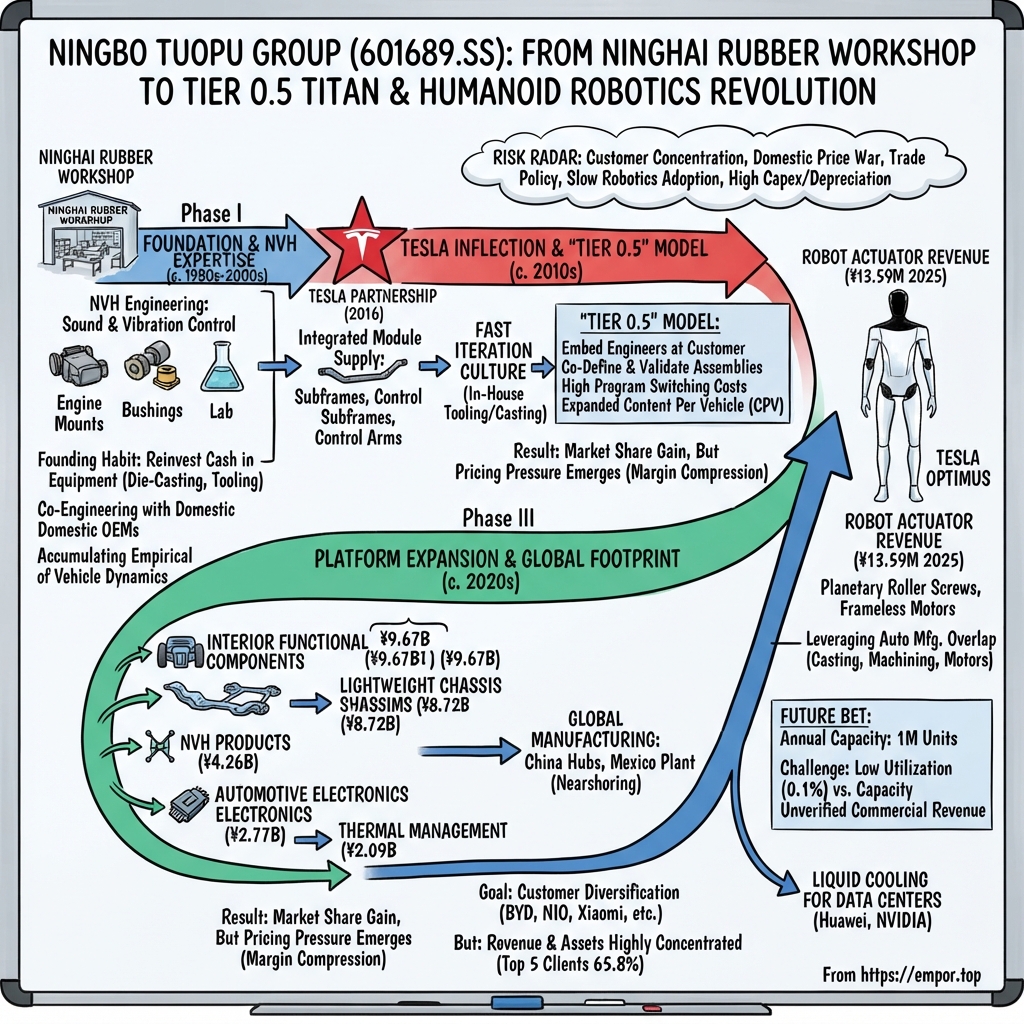
Ningbo Tuopu Group: The Tier 0.5 Titan Behind Tesla & the Humanoid Robotics Revolution
I. Introduction & Episode Roadmap
Drive forty minutes south of Ningbo, past the container cranes of Beilun and into the low green hills of Ninghai County, to arrive somewhere that looks nothing like the center of global manufacturing. This is rubber country — or it was. Ninghai's industrial heritage was moulds and mouldings, the unglamorous business of pressing hot polymer into shock-absorbing shapes. It is the kind of place that, in most versions of industrial development stories, gets left behind when a national economy climbs the value chain.
Instead, Ninghai produced a company that in 2025 booked ¥29.58 billion of revenue — roughly $4.1 billion — employed about 26,000 people across more than 100 facilities in 28 Chinese cities and 14 overseas locations, and sits inside the bill of materials of nearly every electric vehicle brand that matters in China.12 宁波拓普集团股份有限公司 Ningbo Tuopu Group Co., Ltd. is not a household name outside the automotive supply chain. Inside it, Tuopu is the supplier that competitors study.
The hook drawing generalist investors to Tuopu, however, is not vibration dampers. It is a single line item buried in its 2025 annual report: robot actuator revenue of ¥13.59 million.1 Thirteen million yuan represents just 0.05% of the company's top line. Yet that rounding error explains why an auto-parts maker has traded at valuations far exceeding traditional automotive multiples. Those actuators are destined for Tesla's Optimus humanoid robot, and Tuopu has positioned itself as the anchor supplier for the rotary and linear joints that move a bipedal machine.
This story operates on two clocks running at different speeds. One is the cash-generating, brutally competitive business of supplying integrated systems to automakers — a core operation Tuopu compounded at high rates for a decade, but which showed visible strain in 2025 and 2026. The second clock represents an option on physical artificial intelligence that, as of late 2026, remains almost entirely unbacked by revenue and driven by narrative valuation.
Key areas of coverage:
- The founder and the forty-year arc. How
邬建树 Wu Jianshubuilt a Ninghai rubber operation into noise, vibration, and harshness (NVH) engineering, then chassis systems, and ultimately electronics — and why the founding family still controls roughly 58% of the voting rights. - The Tesla inflection and the "Tier 0.5" model. What Tuopu actually invented, whether the model provides a structural moat or serves primarily as marketing, and what the 2025–2026 margin trajectory reveals.
- Platform expansion. Five product lines, their relative scale, and the pressure reflected in 2025 as gross margins compressed across every single division.
- The Optimus bet. Planetary roller screws, frameless torque motors, a ¥5 billion factory, and a stated target of one million actuators annually against ¥13.59 million in realized revenue. This analysis treats the underlying engineering seriously while evaluating commercial revenue forecasts with skepticism.
- Capital deployment. Roughly ¥6 billion raised over three years, a Hong Kong listing application filed in March 2026, five expansion projects delayed to December 2027, and share sales by the controlling family during periods of stock strength.
- The investment spine. The structural factors driving Tuopu's market position, potential points of failure, and the essential operational metrics worth tracking.
A note on analytical posture. Tuopu's management presents a clean narrative: platform breadth, co-engineering intimacy, and a robotics expansion that flows naturally from automotive manufacturing competence. Key elements of that narrative are verified in financial disclosures, while other aspects remain speculative assertions. This analysis maintains a clear distinction between confirmed operating results and strategic ambition, as the gap between them determines the investment risk.
 Subscribe on LinkedIn
II. Ninghai Workshops to Auto Giant: The 邬建树 Wu Jianshu Era
In the mid-1980s, China's automotive industry was tiny. Total national passenger-car output was measured in the tens of thousands. The sector consisted of a handful of state-owned plants building licensed designs, while the component supply chain barely existed as an independent commercial layer. Parts came bundled with foreign joint-venture partners, priced in hard currency, shipped from Germany or Japan, and delivered with technical packages that Chinese firms were expected only to install, not comprehend.
Into that environment stepped a small rubber workshop in Ninghai. The founding story reflects the classic Zhejiang township-enterprise trajectory: modest scale, private ownership in an era when private enterprise remained ideologically sensitive, and a product—moulded rubber—that required craft rather than heavy capital. 邬建树 Wu Jianshu was never a founder who cultivated a public persona or delivered keynote speeches on corporate vision. What the historical record shows instead is a single, repeated operational habit across four decades: re-invest the cash generated by the current product to purchase equipment for the next one.
Why NVH was the right first mountain
To understand Tuopu's rise, one must understand noise, vibration, and harshness (NVH)—the least glamorous discipline in automotive engineering and one of its most commercially defensible.
The mechanical reality is straightforward: an internal combustion engine is a controlled series of explosions mounted inside a frame carrying human passengers, while the road surface transmits continuous kinetic energy through the tires. NVH engineering prevents that kinetic energy from reaching the cabin. Suppliers achieve this through rubber-to-metal components—engine mounts, bushings, and isolators—tuned to maintain directional stiffness while absorbing specific vibrational frequencies.
The core barrier to entry is that tuning cannot be derived from a simple lookup table or standard formula. The optimal mount for a given vehicle depends on its specific engine dynamics, mass distribution, body structure, and target customer profile. A supplier cannot simply manufacture to a static blueprint; it must test, measure, and iterate alongside the automaker's chassis engineers, accumulating an empirical library of vehicle dynamics. That proprietary knowledge is an invisible balance-sheet asset—one that Tuopu spent fifteen years building while European incumbents extracted margin from legacy contracts.
Tuopu's ascent relied not on cheap rubber alone, but on a progressive escalation: from raw rubber moulding to acoustic and vibration laboratories, and eventually to complete engine-mounting modules. Domestic joint-venture programs and rising Chinese independent automakers provided the manufacturing volume needed to fund these test facilities. Global OEM qualification followed in the 2000s, serving less as an immediate revenue catalyst than as a portable credential proving compliance with stringent Western quality audits.
The capital-allocation habit that defined everything after
The defining characteristic of Tuopu's pre-IPO era was a clear capital-allocation model: converting operating cash flow directly into heavy manufacturing equipment rather than issuing cash distributions or pursuing unaligned diversification. The company continuously acquired aluminum die-casting machinery, tooling shops, and testing rigs. While this suppressed near-term returns on capital in any single year, it compounded over two decades, granting Tuopu the technical credentials required to enter higher-value component categories.
This strategy carried clear caveats. Reinvestment in heavy machinery is common among Chinese industrial firms, most of which failed to achieve Tuopu's scale, making it a necessary condition rather than a sufficient explanation. Furthermore, expanding that same strategy with debt and equity capital generated structural pressure on margins in 2025 and 2026. Depreciation and amortisation reached about 6.1% of revenue in 2025, a direct consequence of capacity built ahead of the demand meant to fill it.3 The same capital allocation discipline that built the business created visible operating drag when revenue growth slowed.
The decade nobody writes about
Standard corporate histories often jump from a company's founding to its defining customer contract, skipping the operational foundation that made the breakthrough possible.
Between 1995 and 2014, Tuopu systematically internalized toolmaking and tooling design. In the Chinese automotive supply chain, mould manufacturing was typically outsourced to avoid heavy capital requirements and long payback periods. Tuopu brought mould fabrication in-house, followed by aluminum die-casting and internal validation equipment.
While these investments depressed short-term returns on invested capital, they gave Tuopu the ability to complete engineering design iterations in weeks rather than quarters, eliminating external supply-chain bottlenecks. In the mid-2000s, automakers rarely selected suppliers based on iteration speed; a decade later, fast-moving electric vehicle producers would prioritize rapid prototyping above nearly all other vendor attributes.
The structural advantage that proved decisive after 2016 was accumulated during the two decades when fast iteration was underappreciated by legacy OEMs.
This era also reshaped Tuopu's customer engagement model. Early contracts with domestic Chinese automakers and joint ventures—clients with limited internal chassis engineering capacity—forced Tuopu to deliver co-engineered system solutions rather than simple build-to-print parts. When Tesla sought supply partners willing to collaborate on rapid engineering iterations, Tuopu had already spent fifteen years refining that exact co-development model. The "Tier 0.5" framework was not invented in Tesla's Lingang factory; it was formalized there.
By 2014, Tuopu had established a solid but bounded operation, generating roughly ¥2.74 billion of revenue with gross margins near 29%, and a respectable position in Chinese NVH.4 It was an established mid-cap supplier, yet its next phase required public capital and an emerging customer that was virtually unknown in Ningbo just a few years earlier.
III. The Shanghai IPO & The Tesla Inflection Point: Inventing the "Tier 0.5" Model
In March 2015, Tuopu listed on the 上海证券交易所 Shanghai Stock Exchange under the ticker 601689.5 The timing proved advantageous: Chinese equity markets were in the final stretch of the 2015 bull run, enabling a profitable industrial manufacturer with a verified order book to raise capital efficiently. Revenue that year reached approximately ¥3.01 billion, with net profit near ¥409 million.4
Management directed the IPO proceeds back into core industrial capacity—specifically lightweight aluminum technologies, including high-pressure die casting and forged aluminum control arms. In 2015, this investment appeared to be a focused bet on weight-reduction programs for European premium brands. In practice, it positioned Tuopu for a far larger structural shift in automotive manufacturing.
The customer that changed the shape of the company
When Tesla sought local suppliers in China, its operational requirements diverged sharply from the traditional Tier 1 model. Tesla's engineering culture prioritized rapid design iteration: modifying specifications, machining new tooling, testing components, and repeating the cycle immediately. Legacy Tier 1 suppliers were structured to resist that pace. Their business model depended on freezing designs, amortizing tooling across multi-year vehicle programs, and collecting engineering-change fees for modifications. In that framework, development speed represented a cost rather than an advantage.
Tuopu offered two capabilities that incumbent suppliers struggled to replicate: in-house mold and die-casting operations that allowed tooling modifications without third-party delay, and a centralized, owner-controlled management structure that could authorize capital commitments during a single meeting. Having served as a Tesla chassis vendor since 2016, Tuopu secured subframe and control-arm contracts for the Model 3 and subsequently the Model Y.6
What "Tier 0.5" actually means
The "Tier 0.5" framework is management's internal positioning, requiring critical examination rather than uncritical adoption.
The traditional automotive supply chain follows a rigid hierarchy: automakers design vehicles and specify component requirements, Tier 1 suppliers bid on major modules, and Tier 2 vendors supply Tier 1s. Information flows down the chain alongside constant downward price pressure. In a build-to-print arrangement, suppliers execute designs provided by the customer—a structural position that offers minimal differentiation, as competing vendors can manufacture to the same specifications.
Tuopu's Tier 0.5 thesis asserts that the company reverses part of this dynamic. Under this model, Tuopu embeds its engineers directly within the automaker's product development team to co-define sub-assemblies, taking responsibility for module integration, validation, and delivery. If valid, this arrangement yields three operational consequences: program switching costs rise because replacing an integrated module requires revalidating the vehicle architecture; content per vehicle expands as the supplier delivers complete assemblies; and price negotiations shift away from simple component benchmarking, as automakers cannot easily evaluate a bespoke assembly against standard catalog parts.
Empirical evidence supports the first two claims. Tuopu's content per vehicle expanded from basic vibration-damping components to multi-thousand-yuan assemblies spanning chassis, interior, thermal, and electronic systems. This expansion is reflected in top-line growth, with revenue rising from ¥3.94 billion in 2016 to ¥29.58 billion in 2025 without the company entering a genuinely unrelated industry.41
However, financial disclosures undermine the third claim regarding pricing power. If the Tier 0.5 model protected Tuopu from customer price pressure, that advantage should manifest in stable gross margins. Instead, consolidated gross margin compressed continuously from 23.0% in 2023 to 20.8% in 2024 and 19.4% in 2025, falling below the broader industry average of roughly 20.6%.3 The company's Hong Kong listing application, prepared under a different accounting framework, shows a matching decline from 21.8% in 2023 to 18.6% in 2025.2 Regardless of the reporting standard, the trajectory remains consistently downward.
This margin compression represents a central empirical finding. While integration and close co-location have secured higher component volume and market share for Tuopu, they have not provided pricing leverage. Consequently, Tier 0.5 functions as an effective market-share acquisition mechanism with program-level switching costs, rather than a margin-defense shield. Notably, management's explanation for the 2025–2026 margin decline—citing initial ramp-up costs for new capacity, higher labor and depreciation expenses, and raw material inflation—focuses entirely on cost pressures and does not claim that pricing held.7
This operational model also introduces asset-concentration risks. Co-locating manufacturing operations concentrates fixed assets in specialized facilities with limited alternative utility. Reconfiguring a stamping or casting line built for a specific automaker's subframe requires substantial capital and time. As a result, the balance sheet reflects the same customer concentration evident in revenue disclosures. While market analysis frequently focuses on revenue diversification, asset redeployability presents a more rigid operational constraint.
The two-hour circle
Tuopu's geographic deployment presents a clearer strategic rationale. The company constructed manufacturing hubs adjacent to key customer assembly plants, including facilities near Tesla's Shanghai Gigafactory in Lingang, as well as sites across Hangzhou Bay, Ningbo, and Chongqing. Shipping large assemblies like subframes or cockpits over long distances is economically inefficient due to transport volume. Physical proximity provides a durable cost and lead-time advantage that distant competitors cannot easily match.
However, this geographic footprint creates mutual operational dependencies. A facility engineered for a specific customer's production line acts as an asset with essentially one tenant. That alignment delivers high utilization during customer growth, but becomes a source of fixed-cost drag when production volumes contract—a risk highlighted when Tesla's global deliveries fell roughly 13.3% in 2025.3
IV. Platform Expansion: From NVH to Lightweight Chassis & Thermal Management
To evaluate Tuopu's current structure, it is useful to view the business less as a single parts supplier and more as a portfolio of specialized manufacturing capabilities deployed across client platforms. That framework clarifies both its automotive expansion logic and its subsequent move into humanoid robotics.
The five businesses, honestly sized
In 2025, Tuopu's revenue broke down across five key operating areas. Interior functional components generated the largest share at ¥9.67 billion, or roughly 33% of total revenue. Lightweight chassis systems followed closely at ¥8.72 billion, accounting for about 29%. Shock-absorption products—the founding noise, vibration, and harshness (NVH) business—contributed ¥4.26 billion, or nearly 14%. Automotive electronics produced ¥2.77 billion, while thermal management systems generated ¥2.09 billion.8
This revenue mix reveals an unexpected structural shift. While market commentary often treats chassis systems as the primary growth engine and NVH as the core cash generator, interior components have quietly become the company's largest single division. Furthermore, overall top-line expansion is concentrated in the smaller, newer product segments. Automotive electronics grew 52.1% year over year in 2025, whereas legacy shock absorbers contracted 3.3% and thermal management declined 2.3%.8
These figures demonstrate that Tuopu's legacy operations are no longer compounding on their own; instead, top-line gains rely heavily on newer categories and expanded volume per vehicle. Crucially, gross margins compressed across all six reported business segments in 2025, with interiors dropping approximately 1.24 percentage points and chassis declining about 1.28 percentage points.3 The margin erosion is therefore a broad-based operational challenge across the entire platform, rather than the result of a single low-margin division dragging down overall performance.
The competitive map
NVH and vibration control. Legacy global incumbents include Vibracoustic, Boge, and Continental, while 中鼎股份 Anhui Zhongding serves as the primary domestic peer. Tuopu's prospectus places the company second among Chinese shock-absorber suppliers and third globally, holding a 3.1% market share.2 While this reflects a solid domestic footprint, a 3.1% share in a fragmented global market provides minimal pricing power.
Lightweight chassis. The company's competitive standing is stronger in lightweight chassis systems, where its prospectus claims global leadership with a 4.1% market share.2 Key competitors include domestic suppliers 华域汽车 Huayu Automotive and Minth Group, as well as global Tier 1 incumbents ZF Friedrichshafen and Magna. Tuopu offers large-scale aluminum die-casting capabilities, manufacturing integrated single-piece structures that simultaneously reduce part counts, weld points, and overall vehicle weight. However, setting up a large casting cell requires a capital commitment of hundreds of millions of yuan before commercial production begins, creating a steep entry barrier that also amplifies fixed-cost risk when factory capacity is underutilized.
Thermal management. In thermal management—its smallest division at roughly 7% of revenue—Tuopu competes directly against specialized players like 三花智控 Sanhua Intelligent Controls and Hanon Systems. Thermal systems for electric vehicles require precise climate loops to keep batteries within narrow operating temperatures and route waste heat efficiently via electronic valves and pumps. Tuopu's thermal management revenue contracted in 2025; in a rapidly expanding new-energy vehicle market, shrinking revenue indicates lost market share rather than category-wide headwinds.
Air suspension. Although not broken out as an independent segment in financial reports, air suspension represents a key strategic priority. Management has set an annual capacity target of one million units, building on a fourth-place global position with an estimated 2.2% market share.92 Air suspension serves as a significant content-per-vehicle multiplier, transitioning from an option reserved for premium European import models to a standard feature on mass-market Chinese electric vehicles as domestic suppliers lowered system costs.
The electronics line deserves more attention than it gets
Segment disclosures highlight one business expanding at the rapid pace expected across the broader platform. Automotive electronics grew 52.1% in 2025 off a revenue base of ¥2.77 billion.8 This division encompasses intelligent chassis hardware—including electronic braking, steering, and suspension controls—representing Tuopu's closest offering to a differentiated, software-adjacent product suite.
However, entering electromechanical actuation presents significant competitive hurdles. As Tuopu moves from purely mechanical components into smart hardware with embedded controllers, it faces direct competition from specialized braking suppliers like 伯特利 Bethel, established global Tier 1s like Bosch and Continental, and automakers' internal engineering teams. Chinese electric vehicle manufacturers increasingly insist on retaining control over chassis software algorithms, limiting the economic value a hardware-focused supplier can capture.
For investors, strong growth in electronics demonstrates that Tuopu's platform strategy retains operational momentum, but it also marks an entry into a market where historical hardware margins may not apply. Tuopu is entering this arena primarily as a hardware fabricator rather than an established systems integrator.
The customer-concentration problem, quantified
Tuopu's core growth strategy hinges on customer diversification—reducing reliance on Tesla by replicating its Tier 0.5 model across domestic automakers, including 比亚迪 BYD, 蔚来 NIO, 小鹏 Xpeng, 理想 Li Auto, 小米汽车 Xiaomi EV, and 赛力斯 Seres within 华为 Huawei's HIMA ecosystem. While these commercial relationships are established and generating revenue, disclosures reveal that customer concentration remains high.
The company's top five customers accounted for 63.4% of revenue in 2023, 67.1% in 2024, and 65.8% in 2025, with the largest single customer generating over 25% of top-line revenue throughout that period.2 Despite multi-year diversification efforts, revenue concentration ended higher in 2025 than in 2023. Securing contracts with new domestic automakers has not meaningfully diluted client dependence, because the new accounts are themselves concentrated among a small group of high-volume electric vehicle producers.
Geographic disclosures show a similar divergence from management's international expansion goals. Domestic Chinese revenue increased from 70.3% of total sales in 2023 to 78.8% in 2025, while international revenue contracted from 29.7% to 21.2%.2 Considering the substantial capital deployed to build production capacity in markets such as Mexico during this period, the shrinking share of overseas revenue indicates that international investments have yet to yield proportional top-line returns.
Evaluating Tuopu's platform expansion leads to a clear conclusion: the company has demonstrated an ability to increase content per vehicle within its primary customer accounts, but it has not yet translated that platform breadth into pricing leverage or customer diversification. That operational dynamic sets the stage for its next major strategic initiative—an expansion into humanoid robotics actuators intended to address both volume and margin constraints.
V. The Hidden Mega-Bet: Tesla Optimus & Humanoid Robot Actuators
In January 2024, two new production lines began operating at a site in Ningbo dedicated entirely to non-automotive products. The site represented a ¥5 billion investment across roughly 300 acres, including about ¥3 billion in fixed assets and an annual design capacity of 300,000 electric-drive actuators.10 Tuopu established an electric-drive division in 2023, marking its formal entry into what Chinese industry shorthand terms "embodied intelligence" (jùshēn zhìnéng).6
The sheer scale of this move highlights the company's aggressive capital deployment strategy. Tuopu committed ¥5 billion to robotics in 2024, even though its total robot-related revenue for 2025 reached just ¥13.59 million.110 This was not a modest pilot program, but a major strategic gamble whose ultimate success depends on customer adoption.
Why an auto-parts company can credibly build robot joints
The engineering rationale behind this expansion underpins the bullish case for the stock.
Mechanically, a humanoid robot functions as a series of articulated joints. Each joint requires an electric motor, a mechanism to convert high-speed, low-torque rotation into powerful, controlled movement, a position sensor, control electronics, and a housing. These components must fit into an enclosure roughly the size of a human knee while remaining lightweight enough to allow autonomous locomotion.
The conversion mechanism presents the primary engineering challenge. For linear joints—such as knees or elbows—Tesla’s Optimus employs planetary roller screws instead of traditional ball screws. Unlike ball screws, which transmit force through point contact along small spheres, planetary roller screws use threaded rollers with line-contact surfaces. This larger contact area significantly increases load capacity and shock resistance, which is essential for leg joints that absorb repetitive ground impacts. Industry teardowns estimate that an Optimus unit contains 14 planetary roller screws, accounting for roughly 19% of the robot's bill of materials, with actuators overall representing the majority of core component costs.11
These technical requirements align with Tuopu’s core manufacturing capabilities. Precision thread grinding and heat treatment for roller screws mirror high-tolerance automotive machining. Frameless torque motors—supplied as rotor-and-stator pairs that integrate directly into the joint structure—leverage electric motor expertise derived from electric power steering and pump production. Managing the thermal profile of a tightly packaged actuator involves the same physical principles as cooling a battery plate, while the structural housing utilizes aluminum die-casting.
Consequently, the transferability of Tuopu's automotive manufacturing capabilities rests on four distinct technical overlaps. However, manufacturing precision screws at scale presents a separate operational hurdle. Grinding roller screws to exact tolerances remains a slow process, making production throughput—rather than component design—the industry's primary bottleneck.
The scale-up plan, and the gap between plan and reality
Management has outlined ambitious operational targets. Tuopu aims to build annual capacity for one million actuators. The initial phase calls for 100,000 units across four commissioned production lines, with its Ningbo base operating two lines that produced approximately 3,000 units per week in the first quarter of 2025 and targeting 15,000 units per week in 2026.912 Overseas expansion plans include a facility in Thailand designed for 20,000 units per week, aligning with the million-unit annual capacity goal.13
These targets contrast sharply with realized financial results. Tuopu generated ¥13.59 million in robot actuator revenue in 2025 against installed capacity of 300,000 units, representing an implied capacity utilization rate of roughly 0.1%.3 Although the segment reported a gross margin of 28.3%, that figure declined by 22.65 percentage points year-over-year as heavy fixed overhead costs weighed on minimal sales volumes.3
Near-term market demand may not quickly absorb this capacity. Industry forecasts for global humanoid robot shipments in 2026 range between 30,000 and 50,000 units, with TrendForce projecting roughly 50,000 units and UBS estimating 30,000 units.3 Even under optimistic market share assumptions, near-term addressable revenue remains a small fraction of Tuopu's top line of nearly ¥30 billion. The company's prospectus projects the global humanoid component market will expand from approximately ¥7 billion in 2024 to ¥101.2 billion by 2030—a long-term outlook that does not resolve near-term operational imbalances.2
What the dexterous hand tells you about the ceiling
Beyond actuator figures, Tuopu's prospectus defines its humanoid product scope to include actuators, dexterous hand motors, and structural assemblies.2 The hand components highlight specific technical challenges.
Humanoid hands represent both high-value components and complex engineering targets. While leg joints prioritize load capacity and durability, hand mechanisms require strength, durability, and extreme miniaturization to pack multiple degrees of freedom and sensors into a compact volume. The required motors are small, high-torque devices built to tighter tolerances than standard automotive parts. Furthermore, design standards have not stabilized; through 2026, reports indicated Tesla was continuing to iterate on the Optimus hand architecture, evaluating gearbox, lead-screw, and tendon-drive configurations.27
For suppliers, evolving component architectures present both opportunity and risk. Participating in early co-development can secure long-term integration, but investing in tooling before designs freeze risks asset write-offs if specifications change. While Tuopu's history with Tesla demonstrates an ability to navigate iterative engineering changes, hardware redesigns in robotics carry higher risks, as architecture shifts can render specialized production lines obsolete before commercial delivery begins.
Consequently, projecting Tuopu's market share or content per robot remains speculative until component architectures and supply contracts stabilize.
The falsification test
Evaluating Tuopu’s trajectory requires assessing its historical performance in converting technical milestones into commercial revenue on stated timelines.
The company's core automotive business demonstrates a track record of execution: Tuopu consistently expanded capacity and converted investments into revenue across chassis systems, interior components, and automotive electronics.
However, recent disclosures indicate execution delays in established product lines. In 2025 and 2026, Tuopu postponed five capital-raise projects covering lightweight chassis, interior components, and thermal systems, extending their target completion dates from July and August 2026 to December 2027.7 A sixteen-month delay in core business segments underscores operational pressures and provides context for evaluating robotics timeline projections.
Additionally, management has declined to disclose specific order backlogs or customer contracts for robotics, citing commercial confidentiality.14 As a result, commercial progress cannot be independently audited from public filings. While industry reports have noted a major rotary-joint order for 2026 delivery, the contract has not been confirmed in official company disclosures.11
In summary, while Tuopu's manufacturing overlap with robotics is technically sound, commercial timelines remain unverified. The robotics segment currently functions as a capital-intensive option with an uncertain realization date. Sustained revenue expansion into billions of yuan—backed by disclosed customer commitments—would validate the strategy, whereas continued low revenue against installed capacity would indicate persistent underutilization.
The third leg: liquid cooling
A parallel expansion in thermal management has progressed more rapidly. Tuopu has adapted its automotive thermal technologies—including pumps, sensors, and cold plates—for liquid cooling applications in data centers and energy storage systems. The company reported cumulative orders growing from an initial ¥1.5 billion to ¥1.75 billion,1514 citing a customer base that includes Huawei, NVIDIA, and Meta.15
This segment presents more immediate commercial opportunities. Demand driven by AI data center infrastructure is active, the product architectures are less complex than robotic actuators, and manufacturing requirements align closely with existing electric vehicle thermal systems. However, as of the first quarter of 2026, liquid cooling revenue was not separately itemized in financial statements, leaving these order figures unvalidated in official reporting.14
VI. M&A, Capital Deployment, & Global Manufacturing Footprint
Tuopu's capital allocation provides the clearest view of the company's strategic character—and the most critical evidence for evaluating its operational trajectory.
The shape of the spending
The business converts a substantial portion of its revenue directly into fixed assets. Depreciation and amortization reached roughly 6.1% of revenue in 2025, driven by new Mexican facilities and expanded domestic plants coming online ahead of customer demand.3 The speed of this asset expansion is evident in the numbers: annual depreciation and amortization climbed from approximately ¥550 million in 2021 to roughly ¥2.10 billion in 2025—nearly a fourfold increase over four years, outpacing a 2.6-fold rise in top-line revenue over the same period.4
This divergence represents the defining operational reality of Tuopu's current phase: fixed assets expanded faster than revenue. In heavy manufacturing, such asymmetry makes margin compression a mathematical consequence of underutilized capacity rather than an unforeseen setback. Consequently, any margin recovery depends on filling existing factory lines rather than committing fresh capital to construct new ones.
Where the money came from
Tuopu's funding history illustrates a heavy reliance on capital markets to finance its physical expansion. Over the past decade, the company repeatedly accessed equity and convertible bond markets: securing a ¥2.395 billion non-public placement in April 2017, a ¥2.0 billion A-share issuance in February 2021, ¥2.5 billion in convertible bonds in July 2022, and a ¥3.515 billion private placement in January 2024. In total, equity and convertible fundraising reached approximately ¥6.015 billion over the three years leading into mid-2025.16
In March 2026, Tuopu filed an application to list H-shares on the Hong Kong Stock Exchange, appointing CITIC Securities and UBS as joint sponsors to establish a dual listing.1718 Company filings list the intended uses of proceeds as humanoid robot component manufacturing, intelligent vehicle systems, liquid cooling infrastructure, general capacity expansion and digitalization, and strategic acquisitions.219
These capital raises underscore a business model dependent on external capital rather than internally generated cash flow to fund growth. While aggressive fundraising can be a valid strategy for capturing market share during industry transitions, it also dilutes existing equity and challenges assertions of conservative financial management. Notably, net financing cash flow turned sharply negative in 2025, falling about 142% year over year as the company shifted from net capital raising to debt repayment within the fiscal year.8
Heavy reinvestment alone does not guarantee future profitability. While high capital expenditures are frequently interpreted as management conviction, they can also reflect an industry requirement to spend continuously just to remain competitive. In automotive supply chains where original equipment manufacturers dictate pricing and suppliers carry fixed assets, maintaining pre-built capacity is often the baseline requirement for winning contract bids. Tuopu's sustained margin compression during its peak spending years aligns with this structural dynamic, indicating that capital intensity may reflect competitive pressure as much as market opportunity until factory utilization rates improve.
M&A: small, adjacent, and customer-driven
In contrast to its extensive organic spending, Tuopu's acquisition track record remains modest and focused on strategic customer relationships. In early 2025, Tuopu agreed to acquire 100% of 芜湖长鹏汽车零部件有限公司 Wuhu Changpeng Auto Parts Co., Ltd. for up to ¥330 million in cash from sellers including Wuhu Chery Technology.20 Changpeng manufactures headliners, carpets, insulation, wheel arches, and underbody protection—products that complement Tuopu's existing interior functional components line—and reported over ¥400 million in revenue during the first nine months of 2024.20
The transaction's primary value lay in customer access rather than product line expansion. The acquisition integrated 奇瑞汽车 Chery into Tuopu's top-ten customer list, with industry estimates projecting Chery could generate up to ¥3 billion in annual revenue for Tuopu in 2026.15 Acquiring Changpeng for ¥330 million effectively secured a major OEM relationship, though the involvement of Chery's technology arm as a seller indicates the automaker selected Tuopu to absorb its internal component operations.
Significantly, Tuopu has avoided large, debt-financed international acquisitions of legacy suppliers—a path that eroded capital for several Chinese auto-parts peers during the 2010s. While this restraint has protected the balance sheet from major integration failures, a single targeted domestic transaction leaves Tuopu's inorganic execution largely untested at scale.
The timing of Tuopu's capital deployment initiatives also bears examination. The company submitted its Hong Kong listing application in March 2026, following a year of compressed operating margins in 2025 and amidst a year-to-date decline of over 17% in its Shanghai-listed shares.1814 Seeking a secondary listing during a period of earnings pressure provides additional financial flexibility, but it exposes the business to offshore investors who historically evaluate Chinese industrial firms on current cash flow and earnings metrics rather than growth narratives.
Mexico, and the trade-policy wager
The construction of manufacturing facilities in Monterrey, Mexico, represents Tuopu's largest overseas investment. Since announcing the project in September 2022, Tuopu has brought plants producing thermal management, chassis, vibration-damping, and interior components into operation, with a second expansion phase underway.13 The strategic objective aligns with standard nearshoring practices: comply with United States-Mexico-Canada Agreement (USMCA) rules of origin, operate within North American trade boundaries, and supply Tesla and other regional assembly plants with locally produced modules.
However, this strategic posture carries distinct geopolitical risks. The commercial viability of Mexican operations depends on whether U.S. trade policy maintains current treatment for Mexican-manufactured components produced by Chinese-owned subsidiaries. As trade regulations undergo continuous regulatory scrutiny, Tuopu faces political exposure beyond its operational control. Furthermore, while capital commitments and depreciation expenses for these facilities are already reflected in financial statements, international sales contracted as a proportion of total revenue between 2023 and 2025.2 As a result, Tuopu has absorbed the initial capital costs of international expansion without yet realizing proportional top-line returns.
VII. Current Financials, Segment Breakdown, & Management Credibility
The 2025 annual report, published in late March 2026, was the first in years that management could not frame as an unambiguous win.
What the numbers said
Revenue reached a record ¥29.58 billion, up 11.2% year over year. However, net profit attributable to shareholders fell 7.4% to ¥2.779 billion (¥27.79 hundred million)—marking the company's first annual profit decline since 2020. Net margin compressed from roughly 10.9% in 2023 to 9.41% in 2025, while gross margin fell 1.37 percentage points year over year.18
The deceleration continued into 2026. First-quarter revenue grew 14.9% while net profit fell 2.4% to ¥552 million.2114 The first half brought revenue of ¥14.199 billion, up 9.8%, against net profit of ¥1.023 billion, down 21.0%, with non-recurring-adjusted profit dropping 21.9%.722 The second quarter proved weaker than the first, with revenue rising 5.6% while net profit fell 35.5%.7
Strip away the percentages, and the underlying pattern is clear: revenue continues to grow, profit is shrinking, and the gap between top-line expansion and bottom-line earnings is widening quarter by quarter. Management attributed the margin squeeze to initial labor and depreciation costs from ramping up new production capacity, along with higher raw material prices and foreign-exchange fluctuations.7 While those cost headwinds are real, in combination they describe an enterprise that expanded its fixed-cost base faster than its top-line revenue and is now absorbing the operating drag.
Is this cyclical or structural?
The distinction between cyclical drag and structural margin compression matters enormously, and while the definitive outcome remains uncertain, available evidence tilts toward a structural explanation.
The cyclical thesis suggests that depreciation on new plants is naturally front-loaded, capacity utilization will rise over time, aluminum and rubber prices will mean-revert, and gross margins will recover as the 2024–2026 capital expenditure cohort fills up. This view is supported by ongoing top-line revenue growth, demonstrating that new manufacturing facilities are underloaded rather than idle.
The structural thesis paints a more challenging picture. Chinese automakers are engaged in an aggressive price war, passing cost pressures down to component suppliers. Every one of Tuopu's six product lines experienced concurrent margin compression in 2025—a pattern consistent with broad industry-wide pricing pressure rather than isolated factory ramp-up costs. Furthermore, Tuopu's consolidated gross margin fell below the automotive supply chain industry average, while delivery volumes at its largest customer contracted in 2025.3
Both factors are likely at work. The decisive metric to monitor is whether margins stabilize in mature product categories that are not incurring new capacity ramp costs. If mature lines such as shock-absorption components continue to experience margin erosion where ramp-up costs offer no explanation, the structural thesis will prove dominant.
Working capital and cash flow dynamics present an additional operational constraint. A supplier expanding revenue while earnings decline—carrying substantial new fixed assets financed through a combination of public capital markets and operating cash flow—operates under a tight funding equation. This balance holds only so long as three conditions remain intact: customers settle accounts on schedule, factory capacity fills, and equity capital markets remain open. While all three currently hold, none is guaranteed, and automotive supply chains have a history of extending payment terms when vehicle sales volumes disappoint.
Control, succession, and the thing an activist would raise first
邬建树 Wu Jianshu maintains firm control over Tuopu through 迈科国际控股(香港)有限公司 Mecca International Holding (HK) Ltd., which holds roughly 1.006 billion shares, or 57.88% of the company. Coupled with Wu's direct 0.69% stake, the founding family holds an aggregate voting interest of approximately 58.4% and complete ownership of the Hong Kong holding entity.23 This structure confers absolute control, leaving minority shareholders with no formal mechanism to alter corporate direction.
Executive succession has also moved at an unusually rapid pace. 邬好年 Wu Haonian, Wu Jianshu's son, earned a bachelor's degree from the University of Toronto in June 2023, joined Tuopu in July 2023, and was appointed to the board of directors as vice chairman by October 2023—just four months after graduating.24 He held a 0.11% equity stake and received approximately ¥512,900 in 2025 compensation, while Wu Jianshu took no executive salary in 2025.2324
A skeptical investor analyzing corporate governance would highlight two concurrent developments and request clarification from leadership.
First, elevating a 23-year-old to vice chairman of a ¥30 billion industrial group four months after university graduation is an undeniable governance reality. While family succession is common among Asian industrial conglomerates and Tuopu retains an experienced executive team—with most senior managers possessing fifteen or more years of service—the appointment underscores that board composition reflects controlling shareholder preferences rather than independent oversight.24
Second, in June 2025, Wu Jianshu and Wu Haonian announced a joint plan to reduce their equity holdings—offering up to 2,999,182 shares for the father and 495,646 shares for the son, representing roughly 0.2% of the company combined, over a window spanning July to October 2025.1625 The transactions were executed in August and September 2025, generating approximately ¥215 million and ¥31.12 million respectively (totaling about ¥246 million), before the disposal plan was terminated early in late September 2025.2426 The timing warrants scrutiny: these share sales occurred ahead of the Hong Kong listing application, at a moment when market valuation for the humanoid robotics thesis peaked, and before 2025 annual results revealed the company's first profit decline in five years.
While neither transaction violated regulatory rules, together they form a pattern that activist investors typically target: a controlling family liquidating equity for cash while the company simultaneously prepares to issue new shares to offshore investors. For a business that raised roughly ¥6 billion across public markets in three years and is seeking additional capital, insider stock sales represent an operational signal that investors must carefully weigh.16
Narrative consistency
Regarding management credibility, the empirical record reveals distinct patterns across operational domains. Tuopu's executive team has demonstrated consistent accuracy on physical capacity: when management commits to constructing a plant, facilities are built rapidly. However, performance on commercial conversion has been overly optimistic: timelines translating capital expenditure into revenue have experienced delays, visible in the five deferred fundraising projects and in the slow ramp of robotics sales.7 Finally, disclosure around high-valuation initiatives remains opaque, with management declining to break out revenue figures for data center liquid cooling or specific order backlogs for robotics.14
Market analysts have repeatedly raised questions on these key issues—specifically gross margin durability during domestic price wars, returns on Mexican nearshoring capital, and the timeline for commercial robot actuator revenue. In response, management has reiterated its integrated system strategy and multi-line packaging model. That defense has yet to be reflected in gross margin data, and management has avoided offering binding numerical targets against which its operational execution can be independently audited.
VIII. The Playbook: Business & Investing Lessons
Four transferable lessons emerge from Tuopu's trajectory, each carrying a structural constraint worth emphasizing alongside it.
1. Proximity is a real moat, but it is a moat with a single tenant. Co-locating engineering teams inside a customer's development workflow and placing manufacturing facilities within its logistics radius genuinely raises switching costs — an automaker cannot easily replace an integrated, co-validated module mid-program without revalidating the entire vehicle. The limitation is that a purpose-built plant adjacent to one customer's production line has only one realistic user. Tuopu's customer concentration—where its largest client generates more than 25% of top-line revenue—is not an accident of sales execution; it is the structural consequence of its operating model.2
2. System bundling increases revenue per vehicle far more reliably than it protects margins. Expanding from single components to eight integrated modules multiplied Tuopu's content per vehicle, serving as the primary driver of its decade-long top-line expansion. However, the margin trajectory from 2023 through 2025 demonstrates that wallet-share breadth failed to shield the company from annual price-down demands by automakers. The broader lesson for industrial investors is clear: cross-selling is a volume strategy, not an automatic driver of pricing power, and should not be treated as a margin defense without empirical financial evidence.
3. Rapid capital deployment acts as an asset only when market demand arrives on schedule. Tuopu's ability to construct and commission factories faster than foreign incumbents proved decisive in capturing content during China's electric vehicle transition. Yet that same speed accelerates margin compression when growth slows, as depreciation costs begin immediately regardless of plant utilization rates. High-speed capital expenditure is an aggressive, high-beta capability: it magnifies the upside of an accurate demand forecast, but compounds fixed-cost drag when capacity runs ahead of orders.
4. Capability expansion is cheapest when the shared asset is a process rather than a product. Tuopu's entry into humanoid robot actuators and data center liquid cooling is strategically coherent because both draw on core internal manufacturing processes — high-precision machining, motor winding, thermal design, and aluminum die-casting — eliminating the need to build entirely new operational competencies. The constraint is that a shared process does not guarantee a shared market. Tuopu's ability to monetize its manufacturing overlap in robotics and artificial intelligence infrastructure remains constrained by a narrow group of prospective buyers operating on their own timelines.
IX. Analysis: 7 Powers, Porter's 5 Forces, & Risk Radar
Hamilton Helmer's 7 Powers, applied with a sharp pencil
Process Power — present but eroding at the margin. Tuopu's tooling speed, high-pressure casting scale, and module integration capabilities are genuine and difficult for rivals to replicate quickly. However, that process edge is eroding at the margin. In 2025, consolidated gross margin fell to 19.4%, slipping below the broader industry average of roughly 20.6%.3 A process advantage that fails to yield superior relative profitability is either being competed away or conceded directly to auto clients.
Switching Costs — the strongest of the powers, and program-bounded. Replacing a co-engineered module mid-program imposes substantial costs and revalidation risks on an automaker. The key qualification, however, is mid-program. When an OEM launches a new vehicle platform, the sourcing decision reopens and switching costs reset to near zero. High mid-cycle switching costs can thus coexist with aggressive annual price-reduction demands: an automaker cannot easily replace an incumbent supplier today, but it can credibly threaten to award the next platform contract to a competitor.
Scale Economies — moderate. Scale advantages are real in aluminum procurement, stamping press utilization, and automated welding lines. Yet these benefits remain bounded, given that Tuopu holds a 3% to 4% global market share in its strongest product categories—representing leadership within a fragmented industry rather than true pricing dominance.2
Cornered Resource — claimed, not yet demonstrated. The primary candidate for a cornered resource is Tuopu's supplier position on Tesla's Optimus actuator program. Serving as an early development partner for a product not yet in mass production represents a head start rather than an exclusive moat. Tesla has an established history of dual-sourcing components and insourcing critical modules once volume scales, while competing Chinese screw and actuator manufacturers are actively bidding for the same sockets.11 This positioning is best rated as an unproven option, deserving re-evaluation only if backed by multi-year, binding volume commitments.
Counter-Positioning, Branding, Network Economies — absent. These powers are not applicable to a high-volume hardware supplier, regardless of strategic positioning.
Porter's Five Forces
Buyer power: high, and the dominant force in this industry. Automakers routinely contract for low-to-mid single-digit annual price cuts, and Chinese electric vehicle manufacturers engaged in intense market-share competition demand even steeper concessions. Tuopu's strategy of module bundling has expanded vehicle content, but as financial disclosures demonstrate, it has not shielded gross margins. When a single client generates over 25% of total revenue, commercial negotiations remain inherently asymmetrical.
Supplier power: low. Raw materials such as aluminum ingots, steel, and synthetic rubber are commodities sourced from competitive global markets. However, low structural supplier power does not eliminate margin vulnerability: management cited raw material price inflation as a key contributor to profit declines in 2026, demonstrating that input cost increases hit Tuopu faster than the company can pass them along to vehicle manufacturers.7
Threat of new entrants: low in the core, higher in robotics. Establishing high-pressure die-casting capacity and securing automotive OEM quality certifications requires years of effort and billions of yuan in capital, creating a high barrier to entry in core vehicle systems. In contrast, the humanoid robotics actuator market lacks established incumbency, meaning the capital and certification barriers protecting Tuopu's automotive lines offer little protection in robotics.
Threat of substitutes: low. Passenger vehicles require structural components, vibration damping, and thermal management regardless of powertrain architecture. Furthermore, the transition to electric vehicles has expanded content opportunities, introducing complex heat pumps and battery cooling systems that were absent from traditional internal combustion engine designs.
Rivalry: high and intensifying. Established domestic peers—including 华域汽车 Huayu Automotive, 伯特利 Bethel, 三花智控 Sanhua Intelligent Controls, and 中鼎股份 Anhui Zhongding—alongside a broad cohort of well-funded specialists, compete aggressively for new vehicle programs. Many of these rivals match the rapid prototyping and low-cost manufacturing capabilities that initially set Tuopu apart, reflecting an industry where rapid capacity deployment has become a widespread standard.
Risk radar
Customer and end-market concentration. Tuopu's top five customers generated 65.8% of total revenue in 2025, with its single largest customer contributing over 25%.2 This concentration creates significant vulnerability, particularly as global deliveries at that key customer contracted by approximately 13.3% in 2025.3 Customer reliance remains the single most direct driver of recent earnings volatility.
Domestic price war. Ongoing price competition among Chinese automakers represents a structural drag on margins. Tuopu has limited ability to insulate itself unilaterally from sector-wide price reductions, which are likely to persist until domestic automotive manufacturing undergoes broader consolidation.
Trade and geopolitical exposure. Manufacturing investments in Monterrey, Mexico, depend on continued favorable treatment of Chinese-owned local content under the United States-Mexico-Canada Agreement (USMCA). Potential European tariff adjustments on Chinese electric vehicle supply chains add further complexity. Heavy capital has already been deployed, while trade policy environments remain uncertain.
Execution risk on deferred projects. Management's decision to postpone five capital-raise expansion projects to December 2027 provides clear, disclosed evidence of execution delays within the core automotive business.7
Robotics disappointment risk. The primary risk in robotics is commercial timeline extension rather than technological failure. Maintaining production capacity built for one million annual units while generating tens of millions of yuan in revenue creates ongoing depreciation drag that increases as new production lines come online.
Funding and dilution risk. Having raised approximately ¥6.0 billion across public markets in three years while filing for a Hong Kong H-share listing, Tuopu continues to rely on external capital to finance its expansion, introducing ongoing equity dilution risks for current shareholders.1618
Disclosure quality. Management's decision not to disclose itemized liquid cooling revenues or specific robotics order backlogs—even as these growth initiatives feature prominently in equity valuation narratives—represents an important disclosure constraint.14 While fully compliant with reporting rules, this opacity places the analytical burden on investors without providing the underlying operational metrics required for independent verification.
X. Bull vs. Bear Thesis & 3 KPIs That Matter Most
Myth versus reality
Three consensus beliefs deserve rigorous examination before establishing the core investment thesis.
Myth: Tier 0.5 integration protects Tuopu's margins. Reality: It has protected production volumes rather than pricing power. Gross margin fell for three consecutive years to below the industry average, with management attributing the decline to cost pressures rather than pricing resilience.37
Myth: Tuopu has diversified away from Tesla. Reality: The company has added large OEM customers without reducing aggregate client reliance, as revenue concentration among its top five customers rose from 63.4% to 65.8% between 2023 and 2025.2
Myth: Tuopu is expanding globally. Reality: Manufacturing capacity has expanded internationally while sales remain concentrated domestically. Overseas revenue share contracted from 29.7% to 21.2% over the same period, even as depreciation expenses from foreign facilities arrived on schedule.2
These dynamics do not make Tuopu an unviable business. Instead, they define it as a volume-driven compounder carrying heavy capital intensity, rather than a margin-expanding platform.
The bull case
Tuopu's bull case rests on an operational sequencing argument. Between 2023 and 2026, the company established a cost structure intended for production volumes it has not yet reached. If domestic price competition moderates and new facilities reach higher utilization, operating leverage functions in reverse: spreading fixed depreciation costs across substantially higher revenue restores margins without requiring price increases. That mechanical recovery relies on core manufacturing rather than prospective robotics orders.
Parallel content expansion offers a second growth pillar. Advanced component categories—such as air suspension, fly-by-wire braking and steering, and integrated chassis control systems—command higher value per vehicle as domestic automakers incorporate premium features into mass-market models. Tuopu maintains established positions across these categories, while targeted transactions like the Changpeng acquisition demonstrate an ability to efficiently expand customer access.20
Finally, humanoid robotics represents a long-term growth option. If bipedal robots achieve mass production between 2028 and 2030, Tuopu possesses established actuator capacity, precision screw manufacturing, and customer access. Company disclosures project the global humanoid component market could reach roughly ¥101.2 billion by 2030—a figure reflecting strategic ambition rather than guaranteed revenue, but illustrating the scale of the addressable opportunity.2 Meanwhile, the liquid cooling division, having secured ¥1.75 billion in cumulative orders from hyperscale customers, may generate near-term commercial revenue faster.15
The bear case
The bear case asserts that performance from 2023 through 2026 reflects the structural reality of the business rather than temporary disruption.
Under this perspective, Tuopu's prior growth phase was a single share-capture cycle driven by electric vehicle adoption and initial anchor-customer demand—a transition that is now largely complete. The remaining business is a capital-heavy supplier delivering large structural components to automakers that possess significant buying power and routinely demand annual price cuts. Consequently, gross margins may stabilize near 18% to 19% rather than rebounding toward historical levels of 23%. Underutilized assets built ahead of demand would then become a structural drag on return on capital rather than a catalyst for operating leverage.
Geopolitical risks present additional challenges. Investments in Mexican production facilities remain vulnerable to U.S. trade policy adjustments beyond management's control, creating the risk of stranded capital. Concurrently, commercial robotics adoption may require years to materialize, while commissioned lines generate ongoing depreciation expenses against minimal current revenue.
Governance considerations add further complexity: a founding family holding 58% of voting rights, a vice chairman appointed months after university graduation, insider stock sales totaling approximately ¥246 million executed ahead of a Hong Kong listing application, roughly ¥6 billion raised across public markets in three years, and selective disclosure regarding high-valuation growth segments.232416 While each item can be explained individually, collectively they present a pattern that invites investor scrutiny.
The peer comparison that frames everything
Comparing Tuopu to 三花智控 Sanhua Intelligent Controls provides useful context, as Sanhua represents its closest peer across thermal management and actuator supply programs. Both companies are pursuing similar strategic objectives from different technical origins—Sanhua from refrigeration-grade precision components and Tuopu from heavy structural die-casting.
This comparison highlights two key analytical points. First, it challenges assertions of exclusive supplier status for Tuopu's robotics components, as major customers maintain multiple qualified suppliers and retain internal engineering capabilities. Second, peer performance provides an empirical benchmark: if robot actuator revenue remains negligible across both firms through 2027, commercial adoption constraints reflect market-wide timing rather than company-specific failure. Conversely, divergence in revenue realization will provide clear evidence of competitive standing in segment disclosures.
A similar analytical framework applies to core automotive operations. Tuopu's gross margin falling below the industry average must be evaluated relative to peer performance. Sector-wide margin compression indicates broad pricing pressure across the supply chain, whereas relative underperformance would point to company-specific cost inefficiencies.
Weighing it
A balanced assessment indicates that the core automotive thesis remains valid in narrowed form, while the robotics business functions as an unvalidated option rather than a near-term commercial driver.
Tuopu has demonstrated an ability to expand vehicle content and deploy physical capacity rapidly. However, financial disclosures over a three-year period show no evidence of pricing power, customer diversification, or international revenue expansion. Consequently, the investment thesis depends on fixed-cost absorption and factory utilization rather than structural pricing power. This represents a cyclical recovery thesis operating alongside secular growth opportunities, and should be evaluated on those operational terms.
The three KPIs that matter
1. Segment-level gross margins, particularly within mature lines. Segment margin disclosures provide critical evidence for separating cyclical factors from structural pressure. Because established product lines like shock absorbers and interior components do not carry initial ramp-up costs from new plant construction, their margin trajectory indicates whether overall margin pressure stems from temporary capacity expansion or permanent pricing concessions.
2. Absolute revenue from robot actuators in yuan. Evaluating robotics execution requires monitoring realized top-line revenue rather than capacity targets, order estimates, or market forecasts. Segment disclosures listed robot actuator revenue at ¥13.59 million in 2025.1 Tracking this figure toward ¥100 million and ¥1 billion will indicate whether dedicated manufacturing capacity is converting into commercial sales or remaining a fixed-cost burden.
3. Customer concentration metrics alongside overseas revenue share. These two disclosures evaluate management's customer diversification and geographic expansion strategies, both of which have diverged from stated targets for three consecutive years.2 Sustained progress—marked by top-five customer concentration falling below 60% and international sales expanding past 25% of total revenue—would provide verified evidence of portfolio diversification.
XI. Outro & Epilogue
There is a version of this story that ends in 2024. In that version, a township rubber workshop in Ninghai becomes a ¥26 billion-revenue systems supplier over four decades, rides the electric vehicle wave alongside the industry's most demanding customer, and stands as a clear example of Chinese industrial capability moving up the value chain. It is a genuinely remarkable arc, and nothing in the subsequent two years erases it.
But the story did not end in 2024. Instead, the company ran into 2025's first profit decline in five years, a first half of 2026 where net profit fell by a fifth despite expanding revenue, deferred capacity expansion projects, and a gross margin that slipped below the industry average.173 邬建树 Wu Jianshu built an enterprise optimized for a decade when manufacturing capacity was the primary constraint and rewards went to whoever could build fastest. That constraint has shifted; the reward now goes to whoever can fill the capacity already built.
Tuopu is now navigating that fundamental operational transition. The humanoid robotics narrative sits on top of it as both a genuine long-dated growth option and a convenient distraction from near-term financial reality. Both perspectives contain truth.
What to watch from here. Whether the Hong Kong listing completes and on what terms will reveal what international capital is willing to pay for this business in a market less enamored of robotics concepts than mainland A-share investors have been.18 Whether the second phase in Mexico proceeds on schedule or quietly slows as U.S. trade policy evolves.13 Whether Tesla's Optimus reaches production volumes that convert installed capacity into material revenue, or whether 2027 arrives with the robotics division still showing a ¥13.59 million rounding error in segment disclosures. And whether the deferred expansion projects land by their revised December 2027 target, because a second delay would signal operational execution challenges that no strategic narrative could offset.7
The DNA of the original Ninghai rubber workshop remains intact: the instinct to acquire machinery before the order arrives. That habit built the company. Whether it has expanded the enterprise beyond its immediate market opportunity is the central question the next two years will answer.
References
-
拓普集团2025年营收295.81亿元同比增11.21%,归母净利润27.79亿元同比降7.38% — 新浪财经, 2026-03-23 ↩↩↩↩↩↩↩
-
拓普集团的"进与退":295亿营收新高却遭利润首降,机器人百万台产能面临"证伪"考验 — 天风财经, 2026 ↩↩↩↩↩↩↩↩↩↩↩↩↩
-
Ningbo Tuopu Group Co Ltd (601689.SS) annual income statements — Financial Modeling Prep ↩↩↩↩
-
Shanghai Stock Exchange company information (601689) — Shanghai Stock Exchange ↩
-
Who Will Build the "Joints" for Tesla's Million Robots? — 36Kr ↩↩
-
新建产能爬坡叠加原材料涨价!拓普集团上半年净利下滑两成,部分募投项目延期 — 腾讯新闻, 2026-08-27 ↩↩↩↩↩↩↩↩↩↩↩
-
拓普集团2025年报解读:营收增11.21%至295.81亿元 筹资现金流大降142.04% — 新浪财经, 2026-03-23 ↩↩↩↩↩
-
Elon Musk's Plan to Build One Million Robots: How Many Motors, Reducers, and Lead Screws Are Made in China? — 36Kr ↩↩↩
-
拓普集团(601689)递交IPO招股书,拟赴香港上市,中信证券、瑞银联席保荐 — 新浪财经, 2026-04-01 ↩
-
宁波拓普集团股份有限公司关于向香港联交所递交境外上市股份(H股)发行并上市申请的公告 — 上海证券交易所公告, 2026-04-01 ↩↩↩↩
-
拓普集团拟以不超过3.3亿元现金收购芜湖长鹏汽车零部件有限公司100%股权 — 新浪财经, 2025-01-07 ↩↩↩
-
宁波拓普集团股份有限公司实际控制人、副董事长提前终止减持计划暨减持股份结果公告 — 上海证券交易所公告, 2025-09-18 ↩
-
Tesla's Optimus Hand Undergoes Redesign: Gen-3 Robot May Adopt Gearbox, Lead Screw, and Tendon Drive — RobotToday ↩
 LinkedIn
 WhatsApp
 Reddit
 Hacker News
 Email
Email Kindle
 RSS Feed
 Spotify
 Apple Podcasts
 Amazon Music
 Audible
 YouTube