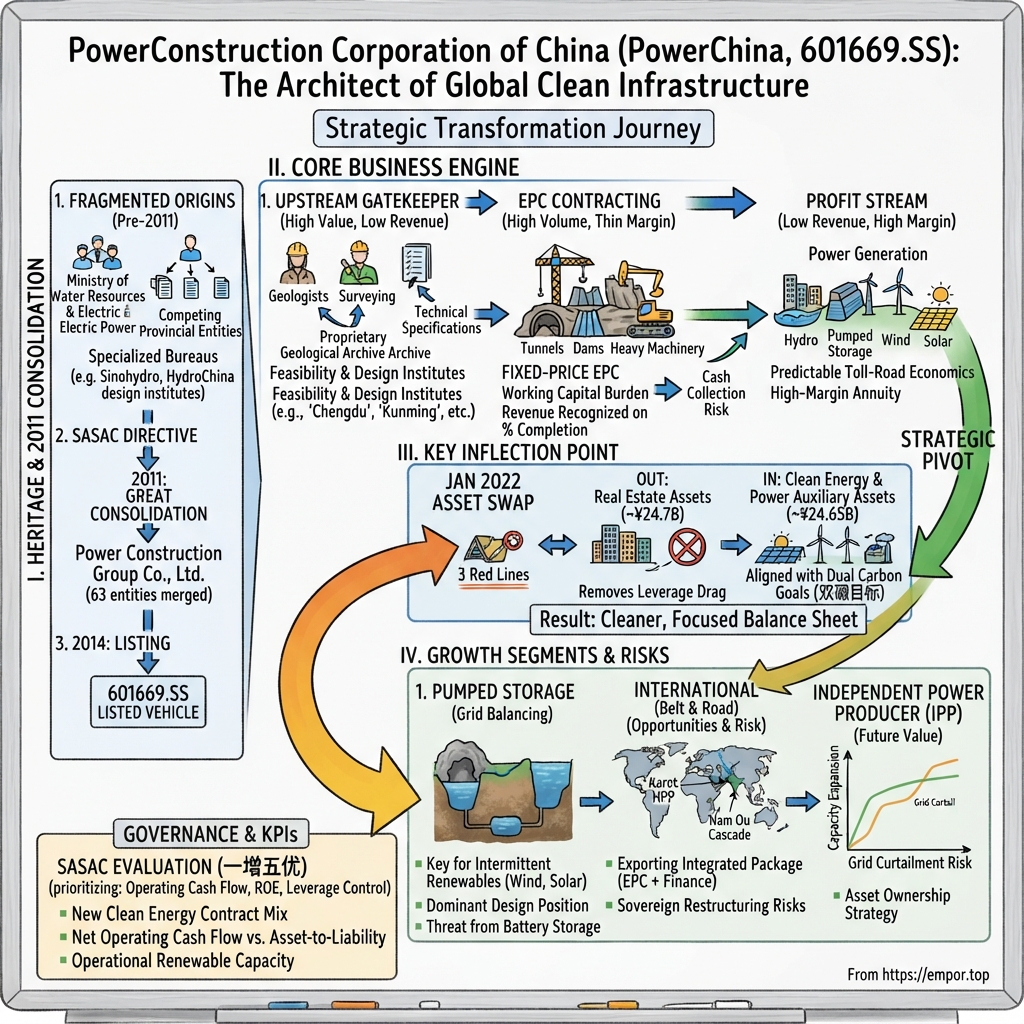
Power Construction Corporation of China: The Architect of Global Clean Infrastructure
I. Introduction & Episode Roadmap
Somewhere in the upper reaches of the Jinsha River, a geologist in a mud-caked field jacket hammers a core sample out of a gorge wall that lacks road access. The nearest paved surface is a day's drive away. The data collected — rock competence, seismicity, silt load, and the hundred-year flood line — will sit in a survey report that few outside a small group of specialized engineers will ever read. Yet that report determines whether a dam is built at the site, its required height, the cost of diversion tunnels, and which construction consortium is best positioned to win the contract. That quiet, technical work sits at the heart of Power Construction Corporation of China.
Power Construction Corporation of China, Ltd — 中国电力建设股份有限公司 PowerChina, listed in Shanghai under ticker 601669 — is the largest power engineering contractor globally by revenue, created by administrative fiat rather than organic entrepreneurial growth.1 Rather than developing through gradual commercial expansion, the company was established by state directive. In 2011, China's 国务院国有资产监督管理委员会 State-owned Assets Supervision and Administration Commission (SASAC) consolidated dozens of state engineering bureaus, design institutes, and construction brigades into a single holding company, and three years later injected the operating assets into a listed vehicle on the Shanghai Stock Exchange.23
The central thesis examining PowerChina is that it is not merely a civil works contractor. It serves as the upstream gatekeeper of China's hydropower and pumped-storage infrastructure pipeline — the entity whose survey and design institutes write the technical specifications that competing firms bid against. Management is attempting to convert that gatekeeping position into higher-margin, cash-generating power assets. That transition represents a significant corporate transformation, though one subject to operational and financial risks alongside its strategic potential.
The roadmap of this analysis follows a clear sequence. First, it traces the company's heritage: how the engineering apparatus of the former Ministry of Water Resources and Electric Power fragmented into competing provincial entities, and why state planners eventually re-consolidated the sector. Second, it examines the core engine — the engineering, procurement, and construction business that generates the vast majority of revenue at thin single-digit margins typical of heavy construction, alongside the higher-margin survey and design franchise. Third, it evaluates the listed company's primary capital allocation move: the January 2022 transaction that swapped roughly ¥24.7 billion of real estate development assets out to the parent company in exchange for a comparable portfolio of clean energy and power auxiliary assets.4
Fourth, the analysis reviews a segment historically underappreciated by public markets: pumped-storage hydropower, a vital grid-balancing technology for intermittent wind and solar, alongside the independent power producer portfolio management has built. Fifth, it assesses the overseas order book, including 一带一路 Belt and Road Initiative projects that offer substantial construction volume alongside sovereign restructuring risks. Sixth, it examines governance: how SASAC evaluates central enterprise leadership and whether those incentives align with equity shareholder returns. Finally, it stress-tests the balance sheet against leverage, trade receivables, and local government financing vehicle exposure, concluding with valuation frameworks, bull and bear cases, and critical operating metrics.
A caution is necessary before analyzing the company. As a Chinese central state-owned enterprise, PowerChina's disclosure profile differs from Western large-cap equities. The company does not conduct Western-style quarterly earnings calls; management communication occurs primarily through annual and interim reports, Shanghai Stock Exchange filings, and periodic investor reception records.3 Where specific operational or financial data is omitted from public filings, this analysis highlights the gap directly rather than filling it with speculation.
 Subscribe on LinkedIn
II. Heritage & The Great 2011 Consolidation
Understanding PowerChina's structure requires examining China's water and power engineering establishment prior to its creation — a system historically fragmented across competing regional authorities and specialized bureaus.
The ministry that engineered a continent's rivers
From the 1950s onward, the Ministry of Water Resources and Electric Power was among the most consequential technical organizations in China. It functioned less as a policy ministry than as an operational field enterprise. Its engineering bureaus lived on-site for years in remote river gorges, constructing diversion works, earth-and-rockfill dams, and the massive concrete gravity structures that came to define modern Chinese hydropower. The institutional culture was intensely technical, accustomed to severe physical hardship, organized around the project rather than the head office, and structurally unconcerned with capital returns. Cost of capital held little meaning in a system where capital was allocated by state plan.
Two distinct lineages emerged from that apparatus, developing fundamentally different operational capabilities.
The first was the construction lineage, which eventually consolidated as 中国水利水电建设集团公司 Sinohydro Group — the heavy civil arm. Sinohydro provided the physical execution power: tunnel boring, rock excavation, mass concrete placement, resettlement logistics, and moving thousands of workers and heavy machinery into terrain devoid of basic infrastructure. Its competitive advantage lay not in patents, but in the capability to execute complex civil engineering works on schedule in conditions where few competitors could operate.
The second was the design lineage, which consolidated as 中国水电顾问集团公司 HydroChina Corporation. This represented the analytical core: a federation of survey and design institutes — including Chengdu, Kunming, East China, Central South, Northwest, Guiyang, Beijing, and Tianjin — each having spent decades mapping specific river basins. What those institutes accumulated was a proprietary geological archive: hydrological time series, seismic profiles, sediment transport models, and institutional memory regarding how specific rock formations in specific gorges behaved when loaded by major dams. Such institutional knowledge cannot be quickly replicated by hiring talent; it requires decades of field survey work, creating a formidable barrier to entry.
Together, these two lineages built the backbone of China's water and power infrastructure — including river basin cascades, major components of the South-to-North Water Diversion program, and the generation facilities that established China as the world's largest hydropower producer.
Why the state decided to rebuild the machine
By the late 2000s, the former ministry had been dismantled and its constituent entities distributed across the state sector. This structure produced destructive friction: provincial design institutes and national construction groups competed against one another for domestic projects and, more damagingly, for overseas tenders. Price competition among Chinese contractors in international markets eroded margins and transferred economic value to foreign project owners.
SASAC responded in 2011 with a structural overhaul. State planners consolidated 63 entities — including Sinohydro, HydroChina, and a broad array of power grid survey, design, and equipment companies across 14 provinces — into China Power Construction Group Co., Ltd.25 The strategic objective was to create an integrated national champion spanning the entire infrastructure value chain: survey, design, engineering, procurement, construction, equipment manufacturing, and project operation.
This administrative origin is a defining aspect of PowerChina's competitive position. The company's market dominance stemmed not from organic corporate strategy, but from a directive by a state shareholder seeking to eliminate internal price competition among its subsidiaries. Because this competitive moat was granted by state administrative action, it remains subject to future policy adjustments — a relevant consideration given that central SOE restructuring in China remains an active process.
2014: the listed vehicle
In 2014, core operational assets were injected into the Shanghai-listed entity, ticker 601669, establishing public market access, regulatory reporting obligations, and a minority equity shareholder base while maintaining parent control.36 This structure, standard among Chinese central SOEs, creates an inherent governance tension: the objectives of public minority shareholders do not always align with those of the state parent, and when priorities diverge, decision-making authority rests with state administrators rather than the public board.
The operational integration of the merged entities presented substantial friction. Combining design institutes with construction bureaus required bridging distinct institutional cultures: design engineers often viewed field contractors as crude operators, while field managers viewed design staff as academic theorists unversed in winter concrete pours. Establishing unified bidding discipline across dozens of previously independent entities to prevent price undercutting required a decade of ongoing administrative alignment.
This consolidated structural legacy defines how the core engineering and construction engine operates today, as well as the narrow operating margins that characterize its primary revenue stream.
III. The Core Engine: EPC, Survey & Design, and Industry Structure
Consider the financial anatomy of a mega-project. When a provincial government or state power generation group sets out to build a 1,200-megawatt pumped-storage station, the project begins long before heavy machinery arrives on site. Geologists and engineers must first confirm the viability of the location: verifying two reservoirs at suitable elevations, adequate hydraulic head, stable geology for a waterway shaft, acceptable seismic risk, and a viable grid connection point. That initial feasibility and design contract represents a tiny fraction of the total project budget. Yet it is the most strategically valuable link in the development chain, because the technical specifications established during this phase shape the construction tender that follows.
Where the money actually comes from
PowerChina's revenue structure presents a contrast that can easily mislead casual observers. Engineering contracting, combined with survey and design, generates roughly four-fifths of consolidated revenue, covering conventional hydropower, solar photovoltaics, onshore and offshore wind, water environment treatment, and municipal infrastructure.36 Power generation and asset operation contributes only a low-to-mid single-digit percentage of top-line revenue, while equipment manufacturing and auxiliary services account for an even smaller portion.
However, evaluating PowerChina solely through top-line revenue misrepresents its underlying economics. Engineering contracting operates on thin gross margins in the high single digits to low double digits. By contrast, power generation yields gross margins that are multiples of the contracting business, reflecting the predictable, toll-road-like economics of operating hydro and wind power assets once built and project-financed. Consequently, a segment that generates a small fraction of total revenue accounts for a disproportionate share of gross profit and an even larger share of total economic value when weighted for cash flow durability and predictability.6
This distinction forms the central analytical core of PowerChina's business model: while reported revenue reflects a high-volume engineering, procurement, and construction (EPC) contractor, underlying asset value relies increasingly on power-generation ownership. Evaluating the company on a simple revenue multiple or comparing top-line expansion directly to pure-play construction peers obscures this structural dual identity.
The industry map
PowerChina's closest direct peer is 中国能源建设集团有限公司 Energy China (CEEC), listed in Shanghai under ticker 601868.7 Both organizations trace their roots to the former power ministry, though state planners assigned them distinct core domains: CEEC concentrates on thermal power and grid engineering design, while PowerChina focuses on hydropower, pumped storage, and renewable civil works. Their commercial footprints overlap significantly in solar power, wind energy, overseas EPC projects, and municipal infrastructure, where competition frequently turns into a margin-compressing price battle.
Beyond CEEC, PowerChina faces competition from China's major state-owned construction conglomerates: 中国建筑股份有限公司 CSCEC (601668), the building and real estate contractor, alongside railway construction groups 中国铁建股份有限公司 CRCC (601186) and 中国中铁 CREC (601390).8 While these peers lack the technical capability to challenge PowerChina in specialized hydroelectric design, they compete aggressively in municipal infrastructure, water treatment, and general civil engineering — segments that generate a substantial share of PowerChina's domestic non-power revenue. This dynamic creates a strategic tension: the specialized hydro segments where PowerChina holds a strong competitive moat generate a minority of total revenue, whereas standard civil works, where it competes against four peer giants on price, represent a much larger share.
In specialized hydropower survey and design, PowerChina maintains a commanding position. Company disclosures and industry reports estimate its share of China's hydroelectric and pumped-storage design capacity above 80 percent, alongside claims of involvement in the site selection, design, or construction of the overwhelming majority of China's operating and under-construction pumped-storage stations.19 While these figures originate from corporate statements rather than independent third-party audits and should be viewed as directional estimates, the underlying reality remains clear: China possesses only a limited number of specialized hydraulic engineering institutes, and PowerChina controls most of them.
The physics of contracting economics
Understanding the company's financial performance requires distinguishing between its primary contract structures. Cost-plus design contracts generate high gross margins with minimal balance sheet risk, but represent a small fraction of total revenue. Fixed-price EPC contracts generate the bulk of top-line revenue at thin margins, while leaving the contractor exposed to input cost volatility. If prices for key materials such as steel and cement inflate after a contract price is locked without adequate price-escalation clauses, the contractor absorbs the cost overrun. Given high-single-digit gross margins, even modest material price increases across a large fixed-price project portfolio can severely erode profitability.
Compounding this risk is heavy civil construction's inherent working capital burden. Contractors must mobilize equipment, fund labor, and purchase materials upfront, billing clients at project milestones. Payment collection involves multi-stage verification, certification delays, and retention money held until the end of defect liability periods that often extend years past construction completion. Because accounting standards recognize revenue well before cash collection, rapid top-line expansion can consume substantial cash flow even as reported net income increases. Balance sheet capacity, rather than reported revenue, ultimately constrains growth, making cash flow statements a far more reliable indicator of underlying financial health than income statements.
PowerChina's survey and design franchise serves as a strategic counterweight to these contracting dynamics. Securing a preliminary design mandate allows the company's engineering institutes to establish technical specifications, effectively shaping the downstream construction tender. Although design work generates modest standalone revenue, it exerts outsized influence over eventual project execution volume. However, writing design specifications does not guarantee winning the subsequent construction contract; Chinese public procurement regulations explicitly aim to enforce competitive bidding. While this early-stage positioning creates a pipeline advantage, PowerChina does not publicly disclose its design-to-EPC conversion rate, making the precise financial yield of this franchise difficult for external investors to measure.
These structural realities explain why management sought to expand beyond heavy civil contracting, laying the groundwork for a strategic shift toward power asset ownership.
IV. The Masterstroke Pivot: The ¥24.7B Real Estate Exit & Green Asset Swap
Residential real estate was initially conceived as an engine of higher returns for the conglomerate.
How a profit centre became an anchor
For years, 电建地产 PowerChina Real Estate appeared to be a logical addition to the corporate portfolio. Combining civil engineering expertise, land access, project management capabilities, and state-backed credit made residential property development a natural adjacency. Throughout the 2010s, the division boosted overall profitability, generating gross margins that PowerChina's core engineering business could not match.
That dynamic shifted dramatically in 2020 when Beijing introduced the 三道红线 Three Red Lines policy. The regulation imposed strict leverage caps on property developers, causing the industry's debt-fueled business model — where pre-sales revenues funded land purchases to drive subsequent pre-sales — to stall. Parcels acquired at peak-cycle valuations turned into illiquid inventory, creating substantial impairment risk. Furthermore, the property unit absorbed capital generated by the core engineering business, which already had substantial working capital demands of its own.
This dynamic illustrates a classic conglomerate strain: a stable, cash-generative engineering business was funding a cyclical, highly leveraged real estate unit. As a result, the combined entity bore the elevated balance sheet risks of the property business while realizing the full returns of neither. Return on equity dropped, leverage metrics deteriorated, and public markets applied a holding-company discount due to the mixed asset profile.
The swap
In January 2022, PowerChina executed a major portfolio restructuring. The listed company transferred approximately ¥24.72 billion in real estate development assets to its parent entity, 中国电力建设集团有限公司, while simultaneously acquiring roughly ¥24.65 billion in clean energy and power auxiliary assets from the parent, settling the small net valuation difference in cash.43
The mechanics of this transaction were critical. This was not an open-market sale into a distressed property sector, where third-party buyers for large residential development portfolios were virtually non-existent at book value. Instead, it was a related-party asset exchange with a controlling shareholder, structured so the valuations of the incoming and outgoing portfolios nearly offset. The listed company exited a troubled sector and expanded its clean energy footprint without incurring substantial cash outlays or undergoing open-market price discovery.
The transaction carried clear strategic logic: it eliminated horizontal competition with the parent company, removed property development risk from the listed vehicle, and aligned PowerChina's balance sheet with China's 双碳目标 dual carbon goals of peaking carbon emissions by 2030 and achieving carbon neutrality by 2060.10 For public investors, the swap created a cleaner, more focused asset base.
However, a related-party transfer at negotiated valuations also highlights unique governance dynamics. Market conditions in mid-2022 suggested that the real estate assets were likely worth less than book value, while the long-term economic yield of the acquired power assets was not fully verifiable from public disclosures alone. The parent company's absorption of the real estate portfolio represents a form of state-backed balance sheet support unavailable to private competitors. While minority shareholders benefited from this alignment with state policy goals, the outcome reflects strategic state backing rather than formal minority shareholder protections.
What it says about management
Chairman 丁焰章 Ding Yanzhang and President 王斌 Wang Bin had previously signaled a strategic pivot toward clean energy, technology-intensive engineering, and balance sheet discipline. The asset swap represented concrete execution consistent with those public commitments.13
Evaluating the move requires separating strategic intent from market execution. Management successfully identified an operational drag and leveraged its state parent relationship to resolve it. However, because the transaction occurred outside an open competitive market, it did not test asset values against market pricing. The ultimate validation of the swap depends on the multi-year performance of the acquired clean energy assets: if they achieve generation volumes and operating margins consistent with their transfer valuations, the move will prove value-accretive; if they underperform or require future write-downs, the transaction will have effectively exchanged real estate risk for overpriced generation assets. Investors evaluating this strategic shift must monitor segment power generation output and gross margins rather than relying solely on narrative framing.
These acquired generation facilities lead directly into the operational segment that forms the core of PowerChina's long-term valuation thesis.
V. The Hidden Giant: Pumped Storage Hydropower & Power Investment IPP
In the mountains north of Beijing, in Hebei's Fengning county, sits a facility that looks from the air like two ordinary reservoirs connected by nothing. The connection is underground: shafts and tunnels carrying water between an upper and a lower reservoir through reversible pump-turbines buried in a cavern in the rock. When the grid has surplus power, the machines run as pumps and push water uphill. When the grid needs power, the water falls back through the same machines and they run as generators. 丰宁 Fengning is among the largest such stations in the world.9
The world's oldest battery, and why it suddenly matters again
The technology is a century old and conceptually straightforward: storing energy as elevation. Its round-trip efficiency is roughly three-quarters — retaining about three units of energy for every four injected — a figure that gains value when evaluated against its structural advantages. A pumped-storage asset operates for 50 to 80 years rather than 10 to 15. It does not degrade with cycling in the manner of electrochemical cells, and it scales to gigawatt-hours of storage at a marginal cost that lithium cannot match over extended durations. Crucially, it also provides physical rotating inertia, helping stabilize grid frequency in ways chemical batteries cannot replicate as naturally.
In energy storage terms, a lithium battery functions like a sprinter — delivering high power output and rapid response times over limited durations before wearing out. Pumped storage operates like a heavy draft horse — slower to construct and asset-heavy, but capable of sustained performance for six decades. A power grid integrating massive volumes of intermittent wind and solar generation, where output is dictated by weather rather than demand patterns, requires both capabilities. China's rapid renewable build-out has created the world's largest requirement for grid-balancing storage, prompting state planners to establish an explicit national development framework for the sector.10
PowerChina's position, honestly assessed
PowerChina occupies a central position in executing that strategy. Its design institutes have conducted site selection, feasibility studies, or engineering design for the majority of China's operating and under-construction pumped-storage capacity, including flagship stations such as Fengning and 长龙山 Changlongshan.91 Although pumped-storage construction is booked within the engineering segment, its structural complexity — requiring underground powerhouse caverns, high-pressure waterway shafts, and reversible turbine integration — commands higher margins than standard solar racking installation, while frequently securing equity participation rights in the completed facilities.
However, this competitive position confronts clear structural constraints. Suitable pumped-storage sites in China are finite: locations featuring optimal topography, favorable geology, and proximity to major load centers are developed first, leaving remaining candidate sites with higher technical or economic hurdles. Furthermore, a development pipeline driven by government planning remains subject to administrative policy revisions. At the same time, competing technologies continue to advance; as costs for lithium and sodium-ion battery storage decline, four-to-eight-hour storage systems become increasingly economic, narrowing pumped storage's unique role toward multi-day or long-duration flexibility. While PowerChina maintains dominance in pumped-storage design, that advantage does not automatically translate into dominance over grid-scale storage as a whole.
From contractor to owner
A more fundamental strategic shift lies in PowerChina's accumulation of owned power generation assets. Transitioning from a pure civil contractor to an independent power producer (IPP) converts transaction-based project revenue into recurring long-term annuities. While contracting revenue terminates upon project completion, power generation revenue commences at commissioning and persists for decades. Retaining generation assets also helps buffer the consolidated entity against construction volume cyclicality, as power output depends on hydrology and wind conditions rather than annual contract wins.6
This transition requires substantial capital. Financing retained gigawatts expands a balance sheet that already carries significant leverage, with capital recovery extending over twenty years rather than twenty months. The IPP strategy represents an explicit trade-off: accepting lower near-term free cash flow and higher debt loads in exchange for improved long-term earnings stability. The ultimate success of this trade depends on the economic returns of the retained assets, which are governed by power tariffs, plant utilization rates, and grid curtailment.
Curtailment represents a critical, often understated operational risk across Chinese renewable power generation. When transmission infrastructure or local grid capacity lags new generation build-outs, plant output is restricted, reducing asset yields below nameplate capacity. China's earlier wind expansion experienced widespread curtailment that required years of targeted grid infrastructure investments to resolve. Consequently, the pace of power grid integration remains a primary determinant of PowerChina's capital returns in the IPP segment — a variable entirely outside corporate control.
Offshore wind represents an adjacent growth area, leveraging marine engineering, heavy-lift vessels, and subsea foundation installation where PowerChina's civil engineering capabilities provide a competitive foundation. However, while offering technical synergies, offshore wind currently functions as an early-stage revenue contributor rather than an established profit center.
This same build-and-own operational framework, when deployed in international markets, forms the foundation of PowerChina's overseas expansion — accompanied by substantially higher political and financial risk.
VI. Belt & Road Expansion: Global Mega-Projects and Sovereign Risk
The Jhelum River cuts through the Punjab uplands south of Islamabad, where water passes through a Chinese-built, Chinese-financed power station — 卡洛特水电站 Karot Hydropower Project — that stands as one of the flagship energy assets of the China-Pakistan Economic Corridor.11 Several thousand kilometers east, the 南欧江梯级水电站 Nam Ou River cascade in Laos strings hydropower stations along a single river system, executing an integrated basin development of a scale rarely attempted by international contractors. On Java, the traction power supply for the Jakarta–Bandung high-speed railway carries Chinese engineering into Southeast Asia's first high-speed line.1112
The overseas book
Overseas markets contribute roughly 15 to 20 percent of new contract signings and revenue, distributed across Asia-Pacific, the Middle East, Africa, and Latin America.36 That proportion has remained relatively stable: despite a decade of Belt and Road Initiative policy emphasis, PowerChina remains predominantly a domestic civil works group with a selective international footprint rather than a fully globalized enterprise.
What PowerChina exports is an integrated package that few Western competitors can match: engineering design, equipment supply, heavy construction execution in challenging terrain, and access to Chinese policy bank financing alongside 中国出口信用保险公司 Sinosure credit insurance cover.11 A foreign finance ministry facing tight fiscal constraints does not evaluate tenders solely on price; it chooses between a funded project proposal and an unfunded one. This bundling of engineering capability with sovereign capital represents the primary driver of Chinese contractors' international market gains — a competitive advantage rooted in state financial backing as much as corporate execution.
Where it goes wrong
The failure modes in international infrastructure contracting are well established across emerging-market sovereign debt cycles. A host government assumes a dollar- or renminbi-denominated debt obligation. If its local currency depreciates and its central bank restricts foreign exchange conversion, contractor receivables become difficult to repatriate and decline in real value. In severe cases, the sovereign restructures its external obligations, forcing Chinese lenders and contractors into prolonged renegotiations alongside commercial bondholders and the International Monetary Fund. Emerging economies across South Asia and East Africa experienced several such restructuring episodes during the 2020s.
The structural transition from pure engineering, procurement, and construction (EPC) contracts toward concessionary build-operate-transfer (BOT) and public-private partnership models amplifies these risks. While an EPC contractor absorbs execution risk and receives milestone payments, a BOT sponsor assumes construction risk and then holds the completed asset over a multi-decade concession. That extended ownership exposes the contractor to long-term offtake volumes, currency fluctuations, tariff regulation, and political shifts. The model offers higher lifecycle returns, but introduces the potential for multi-year balance sheet impairments.
Mitigating mechanisms — including Sinosure insurance, multilateral co-financing, and state-level diplomatic intervention — provide real but incomplete protection. Credit insurance policies feature deductibles, coverage exclusions, and claims verification delays. Diplomatic engagement cannot generate foreign exchange reserves that a sovereign host lacks. Furthermore, Chinese state-backed infrastructure lending has faced increasing political scrutiny in several host countries, where national debt sustainability concerns have slowed new project origination and delayed collections on existing contracts.
The international business serves as a key operational differentiator and a source of incremental margin, but it also represents the balance sheet segment with the widest distribution of financial outcomes. Accounting for these contracts depends heavily on management judgment regarding the recoverability of receivables from sovereign and state-owned counterparties whose credit risk is not marked to market daily. Periodic impairment charges on international exposures represent an ongoing operational risk inherent to heavy overseas civil contracting rather than isolated anomalies.
That reliance on accounting discretion leads directly to a fundamental governance question: who makes those recoverability judgments, and against what performance incentives are those executives evaluated?
VII. Management & Governance: Corporate Strategy, SASAC Mandates, & Capital Allocation
The career path that produces the chairman of a Chinese central state-owned enterprise differs fundamentally from that of a Western corporate executive. It typically begins with an engineering degree, moves through decades of project- and bureau-level management within the state system, passes through Party organizational assessment, and concludes with an appointment made by the state shareholder rather than an independent board of directors.
The people at the top
Chairman 丁焰章 Ding Yanzhang built his career through that system, accumulating an extensive technical and administrative record across state energy infrastructure. The strategic emphasis associated with his tenure has been consistent across public materials: increasing technology and intellectual property intensity, aligning with the carbon transition, and prioritizing debt governance over pure volume expansion.13 President 王斌 Wang Bin's focus in the same disclosures centers on operational execution, risk control, and improving contract margins rather than chasing gross revenue.1
Assessing management credibility in this environment requires a different methodology than evaluating a Western publicly listed company. Without quarterly earnings calls or direct analyst Q&A sessions, performance must be evaluated against multi-year commitments in annual reports and stock exchange filings. On that metric, execution has largely tracked stated strategy: the intent to shed real estate development and focus on clean energy preceded the 2022 asset swap, while the goal of expanding power ownership has matched the steady growth in operating generation capacity. These actions demonstrate strategic alignment, though they represent a baseline expectation for corporate reporting.
However, public disclosures provide limited visibility into the underlying quality of capital allocation. Key operational criteria — such as whether acquired assets were purchased at attractive valuations, whether rejected bids were properly vetted, or how strictly internal hurdle rates are enforced — remain unobservable. Consequently, investors must recognize that evaluating management requires extending a degree of trust that public filings alone cannot verify.
What SASAC actually measures
A central, frequently understated factor in PowerChina's corporate governance is its administrative evaluation framework. SASAC sets performance targets for central enterprise leadership, and that framework has shifted in recent years away from top-line revenue and asset growth toward a multi-metric system summarized as 一增五优. This framework prioritizes return on equity, operating cash flow quality, research intensity, labor productivity, and balance sheet leverage ratios.5
For public equity investors, this regulatory shift creates partial alignment between state mandates and minority shareholder interests. An assessment regime that rewards top-line expansion incentivizes contractors to bid aggressively on low-margin projects funded by debt — a strategy that swells revenue while eroding capital efficiency. Conversely, a framework prioritizing return on equity and cash conversion encourages disciplined bidding and balance sheet management. PowerChina's 2022 real estate swap, its focus on contract margin quality, and its emphasis on leverage management reflect direct responses to these SASAC performance metrics.
Yet this alignment remains conditional. Central SOEs retain non-commercial mandates, including supporting employment stability, executing strategic national projects that may not meet commercial return thresholds, and advancing broader industrial policies. Because management equity ownership is minimal — standard for central SOE executives — executive incentives are tied to administrative evaluations and career advancement within the state hierarchy rather than stock price appreciation. Minority shareholders effectively hold equity in an entity whose leadership is evaluated against state policy metrics that currently overlap with commercial returns, though those state priorities can evolve over time.
The investor dialogue
Company communications in annual reports, interim filings, and investor reception records maintain a consistent narrative focused on new contract expansion, the renewable energy transition, and backlog growth.36 In turn, institutional analyst inquiries center on three primary vulnerabilities: the size and aging of working capital accounts, including trade receivables and contract assets; payment delays from fiscally constrained local governments on municipal and environmental projects; and the balance sheet tension between funding capital-intensive power generation assets while attempting to control overall leverage.
That third tension represents a structural challenge with no simple resolution: a contractor cannot rapidly expand an owned generation portfolio while simultaneously deleveraging unless its core engineering business generates far higher free cash flow than historical levels suggest. Management's stated approach — combining asset recycling, disciplined receivable collections, and selective bidding — offers logical risk mitigation steps, though their efficacy depends on operational execution. Monitoring whether management provides specific quantitative execution targets over time will serve as a key metric for assessing how effectively the company resolves this balance sheet conflict.
Before drawing final conclusions, it is worth extracting the broader lessons from PowerChina's corporate trajectory.
VIII. The Playbook: Business & Investing Lessons
Upstream position converts to downstream volume — imperfectly. The most durable asset PowerChina controls is not its equipment fleet or construction workforce, but the survey and design institutes that sit at the front of the project lifecycle. Whoever writes the technical specification shapes the subsequent tender. This pattern recurs across industries: the architect who specifies materials, the consultant who scopes a system, or the standards body that defines an interface. The primary investment takeaway is to look upstream of where top-line revenue is reported, as high-volume engineering revenue is often the lagging consequence of a much smaller, far more defensible design franchise. The analytical discipline then requires evaluating what the design-to-EPC conversion rate actually is. Because PowerChina does not disclose that metric, the strength of its competitive moat remains an argument rather than a measured fact.
The related-party swap is a powerful lever and a governance question at the same time. Offloading a structurally impaired business to a state parent while receiving policy-aligned assets in return provides an efficient mechanism to recapitalize a listed company without cash outlays or open-market distressed sales. However, this structure is available only to enterprises with a controlling shareholder capable of absorbing the underperforming assets. Investors must weigh both sides of the transaction: while the swap created a cleaner listed entity, it occurred without independent market price discovery. As a result, multi-year operating returns across the acquired clean energy assets will serve as the ultimate test of value creation.
Top-line growth in contracting can be a cash flow warning. In heavy civil engineering, where revenue is recognized on a percentage-of-completion basis while cash is collected at project milestones with retention money held back for years, accelerating top-line growth consumes substantial working capital. A contractor reporting rapid revenue expansion alongside weakening operating cash flow may simply be financing its clients rather than building sustainable economic value. Analyzing this sector requires prioritizing cash flow statements over income statements to evaluate underlying financial health.
Aligning with national policy guarantees flow and constrains freedom. Tailoring corporate strategy to state imperatives — grid decarbonization, pumped-storage expansion, and international infrastructure diplomacy — reliably generates project volume, credit access, and regulatory support. However, relying on state directives means project pipelines are determined by government planners rather than market demand. Furthermore, capital allocation may include projects accepted for strategic rather than commercial reasons, leaving the corporate thesis vulnerable to sudden policy shifts. Policy tailwinds represent valuable operational support, but they carry no guaranteed contractual duration.
These strategic lessons establish the framework for evaluating PowerChina's balance sheet, leverage metrics, and risk exposures in the formal stress test that follows.
IX. Strategic Analysis: 7 Powers, Skeptical Investor Stress Test, & Risk Radar
Hamilton Helmer's 7 Powers
Cornered Resource — the strongest claim, and it survives scrutiny in narrowed form. The accumulated hydrological archives, topographical and geological datasets, and deep-tier design expertise housed in the eight elite survey and design institutes constitute an asset that cannot be bought or rapidly rebuilt.1 Decades of basin-specific field data, combined with engineers who know how to interpret it, represents the closest equivalent in heavy civil engineering to genuine proprietary intellectual property. The qualification is that this resource is specific to complex hydropower and pumped storage. It confers comparatively little advantage in solar EPC, onshore wind balance-of-plant, or municipal water treatment — all of which are commoditized, highly competitive, and represent a substantial share of revenue. The cornered resource is genuine, but it covers only a minority of the business.
Scale Economies — strong, but largely a procurement effect. Group-level purchasing of cement, steel, turbines, and heavy machinery, alongside global logistics and equipment fleet utilization, yields clear unit cost advantages. The qualification is that CSCEC, CRCC, CREC, and CEEC all operate at comparable or greater scale in overlapping markets, making scale a baseline requirement among Chinese state contractors rather than a unique differentiator. Scale distinguishes PowerChina from foreign and private competitors, but not from the four central SOEs against which it regularly bids.
Counter-Positioning — moderate and time-limited. PowerChina's specialized pumped-storage and renewable civil engineering capabilities allow it to capture grid flexibility spending that a thermal-focused contractor cannot easily target. Incumbents optimized for coal plant construction face significant friction when reorienting their operations. However, CEEC and other peers have actively built renewable capabilities for years, and the window in which pumped-storage design expertise remains scarce is narrowing as the industry matures and utility-scale battery storage claims a growing share of the grid flexibility market. This positioning represents an operational head start rather than an enduring structural moat.
Switching Costs, Network Economies, Branding, Process Power — largely absent or immaterial in a tender-based infrastructure business. Clients re-tender every major contract, leaving no installed customer base to lock in. Process power in project execution exists in a modest form — accumulated operational know-how in managing massive sites — but remains replicable by state peers with similar operational histories.
Porter's Five Forces
Buyer power: moderate to high, and higher than standard narratives suggest. Key customers include state grid operators, central power generation groups, provincial and municipal governments, and foreign sovereigns. These buyers are concentrated, price-sensitive, and sophisticated, relying on competitive tenders. In domestic markets, buyers are often sister entities under the same state owner. While their reliance on PowerChina for specialized hydroelectric design is real, that work accounts for a small portion of total procurement. Across the broader book of municipal infrastructure and renewable construction, buyers hold strong pricing power, as reflected in thin EPC margins.
Threat of new entrants: very low. Capital intensity, regulatory licensing, strict safety track records, qualification prerequisites, and technical depth make greenfield entry virtually impossible in the core segments. This force strongly favors incumbents.
Rivalry: high. Bidding against CEEC and provincial SOE contractors for conventional infrastructure is a price-focused contest among well-capitalized rivals with similar cost structures and state-driven directives to maintain workforce utilization. This intense rivalry sets industry margins and explains why EPC profitability remains constrained.
Substitutes: rising. For the energy storage franchise, grid-scale batteries serve as a direct substitute over shorter durations. Declining battery cost curves have steadily increased competitive pressure on long-duration pumped-storage economics.
Supplier power: moderate. Steel, cement, and turbine suppliers possess limited pricing power against a buyer of PowerChina's scale, yet commodity price volatility passes directly through to fixed-price contracts regardless of purchasing leverage.
The skeptical investor's case
A skeptical investor evaluating PowerChina would focus first on the balance sheet. The company's asset-to-liability ratio has hovered in the mid-to-high 70 percent range — a leverage level that would be alarming in most sectors, though standard for Chinese state construction enterprises.36 Interest coverage remains stable because borrowing is anchored by state banks at policy-influenced interest rates, providing a structural funding advantage. However, leverage of this magnitude constrains return on equity: funding each additional gigawatt of owned power generation requires debt, creating a direct conflict between deleveraging targets and expansion goals. This tension is not a potential future risk, but an ongoing operational reality.
Second, working capital accounts — specifically trade receivables and contract assets — present significant credit risk. Exposure to municipal finance platforms and local government financing vehicles, against a backdrop of local government fiscal strain following reduced land sale revenues, represents the primary impairment threat in the domestic portfolio. Adding overseas sovereign counterparties expands this credit exposure. Because receivable impairment provisioning relies on management discretion, investors should scrutinize the aging profile of receivables and provisioning trends far more closely than headline net income.
Third, thin margins in the core contracting engine leave minimal operational buffer. High-single-digit gross margins across the majority of revenue mean that unhedged material inflation on fixed-price contracts, schedule delays on major projects, or write-offs on overseas commitments can absorb a disproportionate share of operating profit. Thin margins reflect the structural economics of competitive infrastructure contracting rather than a temporary inefficiency.
Fourth, corporate governance and structural complexity remain key considerations. As a parent-controlled listed entity with substantial related-party transactions, minimal management equity ownership, dozens of subsidiary design institutes and construction bureaus, and a controlling state shareholder with objectives extending beyond market capitalization, the company carries structural friction that investors often reflect through a persistent valuation discount.
Current risk radar
Local fiscal strain. Slower cash collections on municipal water treatment and environmental projects stemming from provincial and municipal budget constraints. Reduced land sale revenues diminish local government liquidity, extending receivable aging and driving higher provisioning requirements.
Overseas sovereign and currency risk. Debt distress in emerging markets, local currency depreciation, and foreign exchange conversion restrictions impair collection on international projects. Concession-based BOT and PPP structures extend these financial risks over multi-decade horizons.
Input cost volatility. Fluctuations in steel, cement, and energy prices erode thin operating margins on fixed-price contracts that lack inflation pass-through provisions.
Grid integration and curtailment. Rapid renewable capacity additions outpacing transmission and absorption infrastructure, threatening to reduce plant utilization rates and lower financial returns across the owned IPP portfolio.
Policy revision. Pipeline expansion in pumped storage and renewable power depends heavily on state directives. Adjustments to national planning targets, capacity pricing frameworks, or renewable tariff structures could reprice forward growth opportunities independently of corporate execution.
X. Bull vs. Bear Case
The bull case
The bull case begins with a structural argument. China's power grid is absorbing intermittent renewable generation at an unprecedented pace, requiring grid-balancing resources measured in gigawatt-hours and multi-decade asset life. Pumped storage remains the incumbent technology for long-duration flexibility, supported by explicit national expansion mandates, and PowerChina occupies the front of the design and engineering queue for the overwhelming majority of these facilities.910 This positioning provides multi-year revenue visibility anchored to state policy rather than unpredictable market demand — an advantage difficult for competitors to replicate given that the primary barrier to entry is accumulated technical expertise rather than capital.
Complementing the structural argument is the earnings quality thesis. Transitioning gigawatts of hydro, wind, and solar assets from construction contracts to owned generation converts one-time, low-margin, capital-intensive projects into multi-decade, high-margin, cash-generating annuities. If the independent power producer (IPP) portfolio expands as planned, this segment shift could lift consolidated gross margins, strengthen cash conversion, and prompt public markets to revalue the company beyond a pure construction contractor multiple.6 The January 2022 asset swap accelerated this structural transition by removing real estate development liabilities and acquiring clean energy assets in a single transaction.4
Finally, the valuation argument relies on potential multiple expansion rather than immediate price forecasts. Chinese state-owned contractors have historically traded at persistent discounts to earnings and book value relative to both global engineering peers and their underlying asset bases.1314 Proponents argue that this valuation discount stems from market aversion to state ownership, high leverage, and real estate exposure. Under this view, as the higher-margin IPP portfolio expands, property risks fade, and cash flow predictability improves, the valuation discount could narrow over time — though such a re-rating remains contingent on sustained operational execution.
The bear case
The bear case rests on capital structure constraints rather than market sentiment. A company operating with leverage in the mid-to-high 70 percent range, a working-capital-intensive contracting core, and ambitious plans to build an owned generation portfolio faces clear financial trade-offs. Simultaneously deleveraging, funding heavy capital expenditures, and expanding shareholder distributions is mathematically unfeasible. Consequently, free cash flow to equity shareholders is likely to remain constrained as cash is reinvested into asset build-outs, justifying a persistent valuation discount as an accurate reflection of capital intensity rather than a market mispricing.
Second, working capital accounts present ongoing earnings risks. Persistent fiscal pressures on local governments — driven by diminished land sale revenues — threaten recurring impairment write-downs on municipal infrastructure and local government financing vehicle (LGFV) receivables. If historical credit loss provisioning proves understated, past reported net income may have been artificially inflated. Similar credit risks apply to overseas sovereign counterparties in developing economies, representing a direct vulnerability to reported earnings.
Third, the competitive moat is narrower than top-line numbers suggest. PowerChina's estimated 80 percent design share is concentrated in specialized hydroelectric and pumped-storage engineering. The vast majority of revenue, however, derives from general civil engineering, solar installation, and municipal infrastructure, where the company competes directly on price against equally large, state-backed construction conglomerates with limited pricing power across all participants. A proprietary design franchise covering a minority of total revenue provides only a partial defense against broader industry margin pressures.
Fourth, the clean energy transition involves execution and grid integration risks. Delays in transmission build-outs can defer revenue realization on newly constructed renewable facilities, while power curtailment risks reducing actual plant returns below nameplate targets. Furthermore, generation assets acquired from the parent company have yet to demonstrate long-term economic yields in an open market. Securing a project mandate differs fundamentally from operating an asset that achieves its cost of capital, and the transition between construction and steady-state generation is where project returns are ultimately determined.
Weighing it
Evaluating these competing arguments yields a nuanced synthesis. The strongest bull claim — a cornered resource in hydroelectric and pumped-storage design — remains valid, but applies to a minority of total revenue while facing long-term competitive pressure from advancing battery storage technologies. Management execution has demonstrated consistency between strategic announcements and corporate actions, yet falls short of a proven market-tested capital allocation track record given that its key asset swap occurred with a related state parent at negotiated valuations. Finally, the earnings quality thesis — that transitioning into an asset-owning IPP will drive structural margin expansion — remains plausible in concept but unproven in multi-year financial performance.
Ultimately, whether PowerChina succeeds in transforming its business profile depends on measurable operating trends rather than strategic narrative framing.
XI. Epilogue & Core KPIs to Watch
Returning to the geologist in the gorge, the company's competitive position ultimately rests on knowing site conditions before project scoping begins — a structural advantage established when state planners consolidated China's water and power engineering institutes decades ago. Yet while PowerChina occupies a central engineering role in China's energy transition, its prospective equity returns depend on a narrower commercial question: whether technical design dominance can be converted into sustainable cash flow and improved return on equity while managing heavy leverage and dealing with price-sensitive state counterparties.
Evaluating that strategic transition requires tracking three primary operating metrics rather than relying on corporate narrative.
New contract signings and backlog composition — specifically the mix. Headline order totals largely reflect broader state infrastructure spending rather than corporate execution. The critical indicator is the proportion of new contracts originating from clean energy, pumped storage, and environmental protection relative to conventional civil works. That mix dictates gross margin profiles two to three years into the future and serves as direct evidence of whether strategic diversification is taking hold in the order book.36 Expanding total backlog accompanied by a deteriorating mix would signal margin risk, whereas a stable backlog with an improving higher-margin mix would indicate structural progress.
Asset-to-liability ratio alongside net operating cash flow. Evaluating balance sheet health requires analyzing leverage and cash generation together. A declining debt ratio achieved merely through asset contraction does not reflect operational progress, while a temporary spike in operating cash flow during a cyclical slowdown is standard for civil contractors and typically reverses when activity accelerates. Meaningful balance sheet improvement requires the debt ratio to remain stable or decline while net operating cash flow expands during periods of steady revenue growth — demonstrating that management is successfully controlling working capital demands, which remain a primary swing factor for equity returns.6
Operational renewable installed capacity and the power generation segment's gross margin. Installed capacity tracks the speed of the company's asset pivot, while segment gross margin reflects its underlying profitability. Rising capacity paired with compressing segment margins would indicate that the company is expanding into grid curtailment or unremunerative tariffs, reinforcing the bear case. Conversely, expanding capacity alongside stable or improving segment margins would provide empirical verification that the clean energy asset swap and independent power producer expansion are generating the high-quality earnings management has outlined.6
Monitoring these three performance indicators will clarify PowerChina's fundamental investment thesis well before any corporate narrative does.
References
-
POWERCHINA Official Investor Relations Portal — Power Construction Corporation of China ↩↩↩↩↩↩↩
-
State-owned Assets Supervision and Administration Commission of the State Council (SASAC) Official Portal — SASAC ↩↩
-
Shanghai Stock Exchange Listed Company Disclosure Portal (Search Ticker 601669) — SSE ↩↩↩↩↩↩↩↩↩↩↩
-
Power Construction Corporation of China Corporate Website (Chinese) — PowerChina ↩↩↩
-
SASAC Central Enterprise Reform and Performance Assessment Framework — SASAC ↩↩
-
Power Construction Corporation of China 2024 Semi-Annual Report — Shanghai Stock Exchange, 2024-08-29 ↩↩↩↩↩↩↩↩↩↩↩
-
China Energy Engineering Corporation (CEEC / 601868.SH) Overview — Shanghai Stock Exchange ↩
-
China State Construction Engineering Corporation (CSCEC / 601668.SH) Overview — Shanghai Stock Exchange ↩
-
Power Construction Corporation of China Corporate Website — Hydropower and Pumped Storage Projects ↩↩↩↩
-
National Development and Reform Commission (NDRC) Clean Energy Policies — NDRC ↩↩↩
-
Belt and Road Infrastructure Construction & Financing Insights — Caixin Global ↩↩↩
-
Power Construction Corporation of China, Ltd (601669.SS) Market Data — Reuters ↩
-
Power Construction Corporation of China Co Ltd (601669:CH) Overview — Bloomberg ↩
 LinkedIn
 WhatsApp
 Reddit
 Hacker News
 Email
Email Kindle
 RSS Feed
 Spotify
 Apple Podcasts
 Amazon Music
 Audible
 YouTube