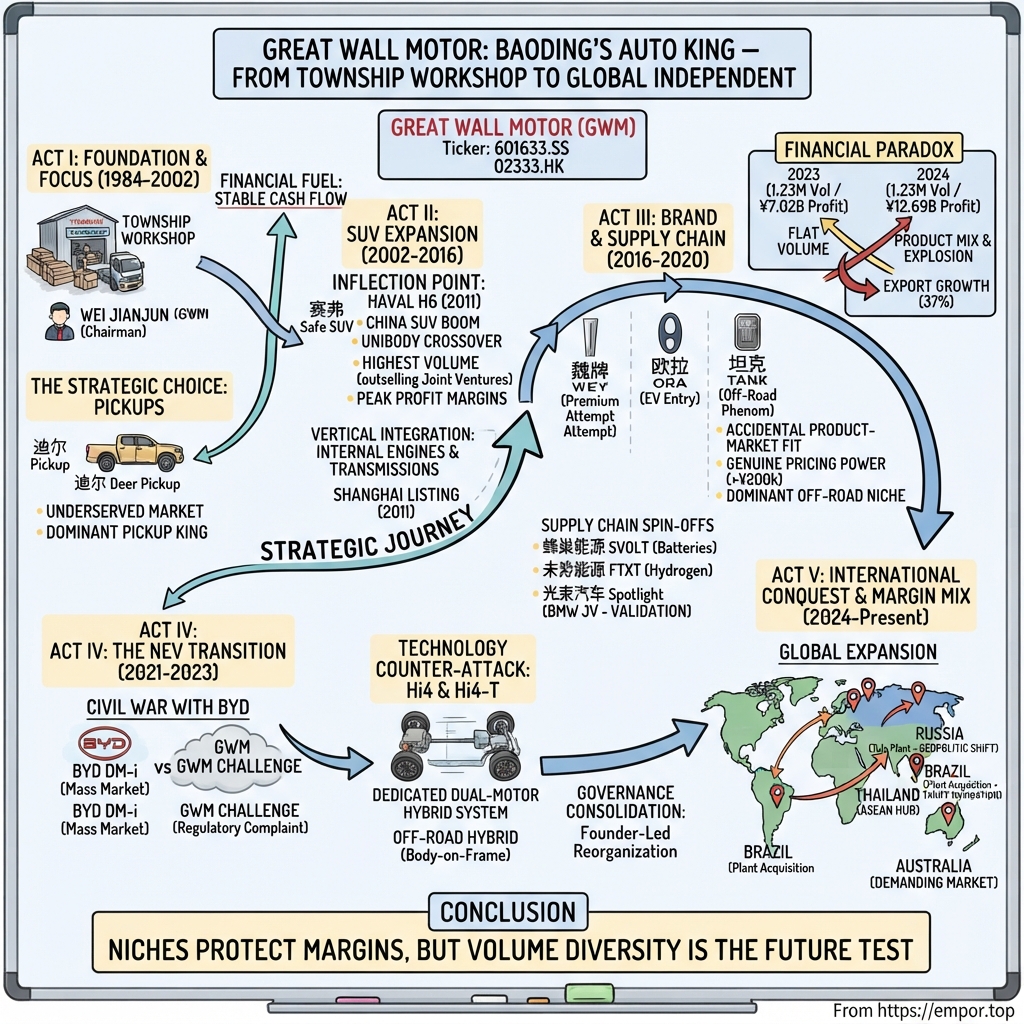
Great Wall Motor: The Pickups, SUVs, and Sovereign Strategy of Baoding's Auto King
I. Introduction & Episode Roadmap
Baoding is not where one would expect to find one of the world's most profitable independent carmakers. It sits about 90 miles southwest of Beijing on the North China Plain — a city of coal dust, steel fabricators, textile mills, and a long municipal history of being the place Beijing's ambitions passed through on the way to somewhere else. It has no foreign consulate district, no glittering financial quarter, and no Shanghai-style expatriate class. When German and Japanese automakers arrived in China in the 1980s and 1990s looking for joint-venture partners, they went to Changchun, Shanghai, Wuhan, and Guangzhou. Nobody went to Baoding.
And yet 长城汽车 Great Wall Motor — listed in Shanghai as 601633.SS on the 上海证券交易所 Shanghai Stock Exchange, and in Hong Kong as 02333.HK — built a business there that generated more than ¥200 billion in annual revenue and ¥12.69 billion in net profit attributable to shareholders in 2024, an 80.8% increase over the prior year.1 It achieved this without ever relying on a foreign joint-venture partner to underwrite its core brands. That distinction makes the company unusual in Chinese automotive history. Almost every other major Chinese automaker of its generation — 上汽集团 SAIC Motor, 中国一汽 FAW Group, 东风汽车 Dongfeng Motor, and 广汽集团 GAC Group — was built on a foundation of profits from joint ventures with Volkswagen, Toyota, Honda, Nissan, or General Motors. Great Wall was built on pickup trucks that state-backed rivals in Shanghai had little interest in producing.
The financial paradox
Here is the puzzle that frames the company's trajectory. In 2023, Great Wall sold roughly 1.23 million vehicles. In 2024, it sold roughly 1.23 million vehicles again — essentially flat volume in a expanding domestic market where maintaining sales means losing market share.1 Over the same period, net profit attributable to shareholders rose from ¥7.02 billion to ¥12.69 billion.1 Net earnings nearly doubled without an increase in total vehicle volume.
This was not a volume-driven expansion; it was a product-mix and geographic transformation driven by two simultaneous forces. First, export growth: Great Wall shipped 454,100 vehicles overseas in 2024, up 44.6% year over year, representing roughly 37% of everything it built.1 Second, premium pricing: the share of sales coming from vehicles priced above ¥200,000 expanded sharply, led by the 坦克 Tank off-road brand and the 长城炮 GWM Cannon premium pickup line.
For investors, the core question is whether this earnings expansion is durable. Margin gains derived from selling a constant volume of vehicles at higher price points in foreign markets remain high quality only until those export markets face policy hurdles or high-margin domestic segments attract heavier competition. Great Wall's largest single export destination, Russia, represents a market vulnerable to rapid regulatory and policy shifts. Meanwhile, the premium off-road niche it dominates in China represents an attractive target for competitors seeking higher profit margins.
The realistic framing of Great Wall Motor in 2026 is that of an automaker with a distinctive operating history, targeted engineering depth in defensible niches, centralized control under its owner-operator, and an earnings base that is more concentrated — by market, by vehicle segment, and by executive decision-making — than headline financial figures indicate.
Episode structure
This story proceeds across seven sections. Act I covers the township workshop and the pickup franchise that funded early growth (1984–2002). Act II examines the 哈弗 Haval SUV expansion, when the Baoding automaker generated higher domestic volume than joint ventures involving Volkswagen and Toyota in China's rapidly growing vehicle segment (2002–2016). Act III analyzes brand expansion, supply-chain spin-offs, and the emergence of the 坦克 Tank off-road line (2016–2020). Act IV detail the plug-in hybrid market competition, public disputes with 比亚迪 BYD, and executive reassignments that altered corporate governance (2021–2023). Act V reviews international expansion and current corporate strategy (2024–present). Act VI applies strategic frameworks, including Helmer's 7 Powers and Porter's Five Forces, testing operational claims against disclosed financial results. Act VII presents the bull and bear investment cases, key risk factors, and core operational metrics.
The overarching question is whether Great Wall's strategic model — entering markets overlooked by established competitors — remains effective as domestic rivals expand rapidly across all automotive market segments.
 Subscribe on LinkedIn
II. Act I: The Township Workshop & The Pickup King (1984–2002)
In 1990, 26-year-old 魏建军 Wei Jianjun took over a failing vehicle workshop in Baoding. The enterprise had fewer than a hundred employees, a collection of hand tools, and debts it could not service. It was a 乡镇企业 township and village enterprise — the distinct institutional form of China's reform era that was technically collective, practically entrepreneurial, and legally ambiguous in ways that would matter two decades later when ownership had to be untangled for a public listing.
Wei was not a credentialed engineer; his background was hands-on and mechanical. Colleagues and Chinese business journalists have described him for decades in consistent terms: blunt, frugal, skeptical of consultants, and active on the factory floor. He remains one of the few Chinese automotive chairmen who personally test-drives company vehicles, using that practice as both a management standard and a product quality check.
The workshop he inherited modified truck chassis and built specialty vehicles, including hearses. Moving from specialty conversions to global vehicle manufacturing required navigating the gaps in Chinese industrial policy.
What a township enterprise actually was
Understanding Great Wall's origins requires examining the structure of township and village enterprises in the 1980s. Nominally owned by local government collectives, these entities lacked clear private property rights, had little access to state bank loans on terms granted to state-owned enterprises, received no state allocations of raw materials, and held no protection against bankruptcy. Their main asset was commercial operating permission in a tightly controlled economy. Millions were formed, but the vast majority failed amidst intense competitive pressure.
The Baoding workshop was insolvent when Wei took charge. His father had been involved in the enterprise's earlier iteration, making the transfer less a promotion than an effort to rescue a distressed local asset. Wei spent his initial years establishing a rigid cost-control discipline: cutting overhead, personally inspecting assembly lines, and restricting capital expenditures to direct vehicle production. Chinese business media have long highlighted his practice of switching off lights in empty offices and personally driving prototypes. While such accounts can lean toward corporate hagiography, their thirty-year consistency and Great Wall's lean operating cost structure relative to peers lend credibility to the characterization.
For investors, this founder frugality presents a double-edged trait. Extreme cost discipline supports efficient manufacturing operations, but it aligns less easily with the patient, capital-intensive investments required for software architecture and advanced battery chemistry. Great Wall's subsequent challenges in those domains reflect the same operational mindset that ensured its survival in 1990.
The strategic choice that made everything else possible
Throughout the 1990s, Beijing strictly rationed passenger-car manufacturing licenses, reserving sedan production for major state-owned enterprises and their foreign joint ventures. Lacking political backing and tier-one state resources, a township enterprise in Hebei had no realistic path to obtaining a sedan license. Rather than challenging state policy directly, Wei targeted unallocated market segments.
Commercial vehicles, including pickup trucks, operated under looser regulatory oversight. Pickups were increasingly demanded by small business owners, rural contractors, and traders created by market reforms — buyers who required a durable vehicle capable of hauling freight during the working week and carrying family members on weekends. With imported and joint-venture pickups priced above ¥100,000, an underserved entry-level market emerged.
In 1996, Great Wall introduced the 迪尔 Deer pickup priced at approximately ¥60,000 — half the cost of established options. The vehicle avoided technical complexity, prioritizing durability, low maintenance costs, and utility for commercial buyers focused on cost per ton-kilometer. By 1998, Great Wall became China's top-selling pickup manufacturer, and it has held that position continuously for more than twenty-five years, running at roughly half the domestic pickup market today under the 长城炮 GWM Cannon and Poer nameplates.2
This quarter-century category leadership highlights a structural operational strength. Pickups in China depend heavily on regional distribution and aftermarket servicing. Commercial buyers in smaller cities and rural counties prioritize immediate spare-parts availability and affordable repairs. Great Wall constructed an extensive county-level service network during the 1990s that larger, urban-focused competitors overlooked, building a geographic footprint that compounded over time.
However, this competitive position comes with structural limitations. China's domestic pickup market remains small compared to the passenger vehicle segment and has faced long-standing municipal restrictions limiting pickup access to urban road networks. While dominating the segment provides stable cash flow, it could not serve as the primary engine for long-term corporate growth.
The unglamorous mechanics of winning a category
While regulatory arbitrage created the initial opportunity, operational execution determined Great Wall's market tenure.
In 1990s China, a pickup purchaser was typically a county-level contractor or merchant treating the vehicle as an income-generating asset. Total operating cost depended on fuel efficiency and uptime. Uptime relied on obtaining replacement parts locally and completing repairs without multi-day delays. Foreign and joint-venture brands struggled outside major cities, where replacement parts required distribution from provincial capitals and dealer coverage remained sparse.
Great Wall addressed this gap by engineering vehicles around standardized, readily available mechanical components and expanding service points into lower-tier markets. The straightforward design allowed regional mechanics to diagnose and repair issues easily, establishing brand trust through word-of-mouth recommendations among commercial operators.
This distribution advantage proved resilient, allowing Great Wall to maintain pickup market share against entry from major Chinese original equipment manufacturers over twenty-five years. It also supported the later launch of the premium 长城炮 GWM Cannon line as a higher-priced lifestyle pickup, leveraging established customer familiarity with the core brand.
Nevertheless, this distribution advantage had clear limits. A rural service network built for commercial work trucks provided little competitive leverage in urban premium SUV markets, a structural reality that later impacted the performance of the WEY brand.
Capital formation and the ownership question
Transitioning Great Wall from a township enterprise into an investable corporation required extensive asset restructuring. Wei Jianjun and his family consolidated equity control through 保定创新长城资产管理 Baoding Innovation Great Wall Asset Management, which remains the controlling shareholder of the listed enterprise. Consequently, Great Wall operates under founder-controlled governance within a public corporate structure.
In 2003, Great Wall listed H-shares on the 香港交易所 Hong Kong Stock Exchange under 02333.HK, becoming the first private Chinese automaker to raise capital on an international exchange.[^3] The listing signaled that a Hebei-based enterprise could access global capital markets without relinquishing equity control or entering a joint venture with a foreign automaker — avoiding the conventional Chinese automotive trade-off of market access for technology transfers.
This independent path brought distinct trade-offs. Without a foreign joint-venture partner, Great Wall received no direct engineering transfers or established vehicle platforms. Early models were derivative and required roughly fifteen years of incremental engineering iterations to achieve competitive vehicle quality. State-backed joint ventures secured advanced technology faster, but Great Wall retained full equity ownership and operational independence.
This foundation set the stage for Great Wall to transition from a low-cost utility vehicle producer into the SUV market that would reshape Chinese automotive demand over the subsequent decade.
III. Act II: The 哈弗 Haval Phenomenon & The SUV Golden Age (2002–2016)
Mechanically speaking, Great Wall's first SUV was a pickup truck with an enclosed cargo area.
In 2002, the company launched the 赛弗 Safe, built on the economics and underlying hardware of its existing pickup platform, priced under ¥80,000.2 At the time, an SUV in China was largely an imported commodity: models such as the Toyota Land Cruiser or Mitsubishi Pajero routinely cost over ¥200,000 and were primarily purchased by state agencies, mining firms, and wealthy individuals. The Safe was utilitarian, relying on a leaf-sprung ladder-frame chassis that delivered an unrefined ride. Yet it gave small-business owners an affordable utility vehicle, establishing an immediate market foothold.
This launch demonstrated an operational playbook Great Wall would repeat across subsequent product cycles: identify a vehicle category where prevailing prices are established by foreign competitors, re-engineer the product around lower domestic manufacturing cost structures, tolerate initial criticisms of vehicle refinement, and iteratively improve manufacturing quality. Rather than attempting to compete directly where established incumbents held deep technical advantages, Great Wall systematically targeted under-served price points.
The Safe also generated a broader manufacturing learning curve. Building an SUV forced the company to develop internal capability in body structural engineering, interior assembly, and fit-and-finish tolerances required by retail consumers. Each subsequent iteration built upon that accumulated manufacturing knowledge. While early Chinese independent automakers were often described as copying foreign designs, Great Wall's progress stemmed from high-volume production experience that exposed engineering and operational weaknesses in real time.
Inflection point: the Haval H6, 2011
By the late 2000s, Chinese consumer demand shifted significantly. Urban middle-class households began purchasing first vehicles for family use, seeking the elevated seating posture, cabin space, and road presence of an SUV without the high fuel consumption or harsh ride of a body-on-frame truck. Capitalizing on this transition required abandoning truck chassis architecture in favor of unibody crossover construction.
Great Wall introduced the 哈弗 H6 Haval H6 in 2011, priced between ¥100,000 and ¥150,000. The crossover offered a spacious cabin, competitive standard features, straightforward mechanical systems, and low operating costs, alongside improved build quality compared to earlier domestic offerings.
What followed was a remarkably sustained market performance. The H6 became China's top-selling SUV for over one hundred consecutive months, with monthly sales frequently reaching between 40,000 and 80,000 units, outselling established foreign joint-venture competitors including the Volkswagen Tiguan, Honda CR-V, and Toyota RAV4.2
From a strategic perspective, Great Wall was uniquely positioned in China's rapidly expanding SUV market between 2011 and 2017. A significant portion of the company's cumulative net profit over that decade was generated by a single nameplate. While this product concentration drove rapid financial growth during the segment's expansion, it created strategic vulnerabilities when market conditions shifted and crossover competition intensified.
The H6 also altered Great Wall's customer demographics. While pickup and Safe buyers acquired vehicles for commercial utility, H6 customers purchased vehicles for personal and family use. Serving retail consumers required sustained capital investment in vehicle quality, including superior paint finish, cabin sound insulation, and interior materials. By the mid-2010s, the quality gap between Haval models and comparably priced joint-venture offerings narrowed sufficiently to make Haval a viable alternative, particularly given the 20% to 30% price premium commanded by foreign joint-venture brands.
As a result, Great Wall recorded net profit margins in the mid-2010s that ranked among the highest of any volume global automaker. These margins were driven by strong segment demand, high nameplate volume, competitive domestic labor costs, and minimal advertising expenses relative to foreign peers. However, these peak margins reflected favorable cyclical conditions rather than a permanent structural advantage, establishing a historical baseline relevant to evaluating current profitability metrics.
The 2011 Shanghai listing
Great Wall completed an A-share listing on the Shanghai Stock Exchange in 2011 under ticker 601633.SS, securing a domestic equity channel alongside its existing Hong Kong listing.[^3] Capital raised from the offering was allocated primarily toward vertical integration, funding internal engine development, transmission manufacturing plants, and expanded assembly facilities in Baoding and Tianjin.
This strategy differed from many contemporary Chinese independent automakers, which relied on engine and transmission supply from Mitsubishi affiliates or third-party vendors. While purchasing third-party powertrains reduced initial capital expenditure, it capped profit margins and limited technical differentiation. Great Wall invested heavily in internal powertrain engineering, securing cost advantages during the SUV expansion and laying the technical foundation for its subsequent development of proprietary hybrid transmission systems.
Conversely, deep vertical integration in internal combustion powertrains carries structural risks during technology transitions. Great Wall's substantial capital investment in engine and transmission manufacturing assets exposed the firm to asset impairment risks as market demand shifted toward electric powertrains. This manufacturing footprint directly influenced the company's subsequent electrification strategy, which prioritized plug-in hybrids over battery-electric vehicles.
The Shanghai listing also established an A+H dual-class equity structure subject to disclosure rules in both Hong Kong and mainland China. Historically, Great Wall's H-shares have traded at a noticeable discount to its A-shares, reflecting broader differences in international and domestic investor bases, capital controls, and valuation methodologies applied to Chinese industrial enterprises.
The culture question
Great Wall's corporate culture is frequently characterized in Chinese business literature by its strict operational discipline: mandatory orientation programs for new hires, rigid attendance rules, an empowered internal audit department, and founder-enforced cost controls. Former executives from external automotive firms have noted the stark contrast between Baoding's operational environment and coastal corporate cultures.
This disciplined corporate culture yielded two distinct operational outcomes. It supported tight manufacturing cost discipline and consistent assembly quality at Great Wall's target price points, factors that later facilitated a joint-venture partnership with BMW. Conversely, it fostered a highly centralized management structure dependent on chairman Wei Jianjun, accompanied by periodic executive turnover that presented ongoing corporate governance considerations.
By the mid-2010s, Great Wall possessed a highly profitable SUV operation, a dominant domestic pickup franchise, and an executive leadership team accustomed to category focus. The company's next strategic phase marked a deliberate shift toward brand expansion.
IV. Act III: Multi-Brand Proliferation, Supply Chain Spin-Offs & The 坦克 Tank Craze (2016–2020)
Naming a car brand after oneself is a statement of confidence, and in 2016 Chairman Wei Jianjun made it. 魏牌 WEY — bearing his own surname — launched as Great Wall's attempt to climb the price ladder into the ¥150,000 to ¥250,000 range, territory where Volkswagen, Buick, and entry-luxury Japanese marques harvested most of their profits in China.
The strategic logic was clear. Great Wall possessed proven manufacturing competence and an extensive dealer footprint; what it lacked was brand permission to command premium prices. Launching a separate marque with distinct styling and dedicated showrooms followed standard industry practice — echoing Toyota's strategy with Lexus and Hyundai's with Genesis.
Execution proved far more challenging than strategy. WEY sold respectably at first before sales faltered. The marque arrived just as Chinese premium consumer preferences began shifting toward electrified powertrains and software-rich cabins. WEY's initial lineup — conventionally powered, handsomely styled, and conservatively engineered — targeted buyers whose preferences were rapidly evolving. Although Great Wall repeatedly repositioned WEY toward plug-in hybrid multi-purpose vehicles and premium family crossovers, the brand did not develop into the major profit engine envisioned in 2016.
This trajectory offers important context for evaluating Great Wall's broader capital allocation. WEY represents the clearest test of whether the company could deliberately build brand equity in the premium tier, rather than acquiring it by accident. The operational record indicates that doing so systematically remained elusive.
欧拉 Ora followed in 2018 as a dedicated battery-electric sub-brand marketed explicitly to young urban drivers, featuring cat-themed model names — including the Black Cat, White Cat, Good Cat, and the Funky Cat for export markets. Ora achieved early differentiation with its distinct market positioning. However, its product portfolio relied heavily on compact, low-cost electric vehicles — a vulnerable segment when domestic battery-electric price competition intensified. As unit economics deteriorated under severe price pressure and rising input costs, Great Wall withdrew its entry-level Ora models from the domestic market. Today, Ora serves as a modest contributor to total sales.
Two brand expansions produced limited results. The third initiative succeeded, though in an unexpected manner.
The Tank 300 and the accident of product-market fit
The 坦克 300 Tank 300 was originally conceived under the WEY brand: a true body-on-frame off-roader featuring a boxy retro silhouette, dedicated off-road hardware such as mechanical differential locks, and a passenger-car refined interior, priced around ¥200,000.
Internal expectations framed the vehicle as a niche halo model. Instead, it became a broader commercial phenomenon. The Tank 300 launched amid a surge in Chinese outdoor recreation — camping, overlanding, and long-distance road trips to Tibet and Xinjiang — among urban buyers in their thirties seeking an adventurous aesthetic. Waiting lists extended for months, and secondary market premiums emerged over list prices — a rare occurrence for a domestic Chinese marque.
Great Wall responded quickly: in 2021, it spun Tank into a standalone brand, established dedicated dealership channels, and expanded the portfolio upward with the Tank 400, 500, and 700 models. The expansion secured a dominant position in China's premium off-road SUV segment, with market share estimates exceeding 50% in a space where imported alternatives from Toyota and Land Rover routinely cost two to three times as much.
The analytical significance of this transition is distinct. Tank marked the first instance in which Great Wall achieved genuine pricing power — with customers willingly paying above ¥200,000, and often significantly more, for a Baoding-built vehicle without discounting. The core strength of Great Wall's 2024 earnings performance stems directly from this margin expansion. However, this success resulted not from building a premium marque through heavy marketing expenditures — the approach WEY attempted — but from deploying a capable vehicle into a market segment with real engineering barriers and high-cost incumbents. Great Wall succeeded by discovering an unfortified market niche rather than constructing a defensible brand barrier from scratch.
This dynamic explains the margin structure that emerged three years later. Premium off-road vehicles represent a rare automotive category where buyers pay a substantial premium for hardware capabilities they rarely utilize in practice. Mechanical differential locks, low-range transfer cases, and ladder-frame chassis with steep approach and departure angles remain unused by most urban buyers. Customers purchase the underlying capability as an expression of lifestyle identity. Willingness to pay is anchored to symbolic capability rather than daily utility, allowing the segment to sustain profit margins that comparably sized urban crossovers cannot match. While global brands such as Jeep and Land Rover relied on this model for decades, Great Wall became the first domestic Chinese automaker to capitalize on it at scale.
Yet this positioning carries inherent vulnerability: identity-driven demand remains subject to shifting consumer trends. China's outdoor recreation boom of 2021 represents a cyclical surge. Consequently, a meaningful portion of Tank's sales volume exhibits cyclical characteristics unlike the company's core commercial work-truck franchise, meaning current growth rates cannot be projected indefinitely without accounting for consumer trend dynamics.
The ecosystem spin-offs: strategic chess or portfolio sprawl?
Alongside its brand diversification, Great Wall restructured several internal technical divisions during the late 2010s into standalone corporate entities designed to raise external capital.
蜂巢能源 SVOLT Energy Technology was carved out from Great Wall's internal battery research unit in 2018, growing into an independent lithium-ion cell manufacturer known for short-blade prismatic cells and cobalt-free chemistry research.3 The strategic rationale addressed vertical integration: as traction batteries became the largest cost component in electrified vehicles, Great Wall sought to avoid transferring battery supply-chain margins to dominant suppliers such as 宁德时代 CATL, much as it had previously strived to avoid dependence on foreign engine vendors.
未势能源 FTXT Energy pursued hydrogen fuel-cell development, targeting heavy commercial transport — a sector that has absorbed substantial R&D capital globally while delivering limited commercial revenue to date. The business functions primarily as a long-term technology option rather than a core earnings engine.
光束汽车 Spotlight Automotive, established in 2018 as a 50:50 joint venture with BMW Group in Zhangjiagang, Jiangsu, was formed to engineer and manufacture battery-electric MINI models for global export.[^5] Beyond its direct financial contribution, the partnership served as third-party validation of Great Wall's manufacturing quality and assembly standards, representing an external endorsement that traditional marketing campaigns could not replicate.
A critical assessment of this period highlights notable capital allocation trade-offs. Between 2016 and 2020, an automaker built on two core profitable franchises introduced three new automotive marques, two technology spin-offs, and an international manufacturing joint venture, just prior to an intense domestic price war. While certain investments proved forward-looking, others resulted in corporate portfolio sprawl. Equity markets subsequently lowered SVOLT's implied valuation and questioned the capital intensity of fuel-cell investments within a volume automaker, while SVOLT's path toward an initial public offering faced repeated delays.
In summary, Great Wall's capital allocation during this period produced one highly profitable product franchise in Tank, a valuable manufacturing credential in Spotlight Automotive, an unmonetized industrial asset in SVOLT, and two initial brand disappointments in WEY and Ora. This mixed track record provides an essential baseline for evaluating the company's broader operational optionality.
Meanwhile, competitive dynamics were shifting rapidly across Great Wall's primary domestic profit pools.
V. Act IV: The NEV Transition & The "Civil War" with 比亚迪 BYD (2021–2023)
In May 2023, Great Wall Motor took the rare step of publicly attacking a direct domestic competitor. The company announced it had filed a formal complaint with Chinese environmental and market regulators, alleging that two of 比亚迪 BYD's best-selling plug-in hybrids — the Qin PLUS DM-i and Song PLUS DM-i — used non-pressurized fuel tanks that risked failing evaporative emissions standards.[^6]
BYD responded the same day, disputing the technical allegations and arguing that it opposed unfair competitive practices. The dispute generated widespread public scrutiny across Chinese social media, prompting the China Association of Automobile Manufacturers to urge domestic carmakers to halt public conflicts.
Beyond the public friction, the episode highlighted a major strategic challenge for Great Wall, driven by a rapid shift in hybrid technology.
The timing of the filing added to the tension: the public disclosure arrived days before BYD was scheduled to launch an updated version of the Song PLUS. While Great Wall stated that it had submitted the report weeks earlier, industry observers widely viewed the move as an attempt to disrupt a competitor's key product launch.
What actually threatened the business
The underlying dispute stemmed from the engineering requirements of plug-in hybrid electric vehicles (PHEVs). Because a PHEV can operate for extended periods strictly on battery power, its gasoline tank may sit unused for weeks. Evaporating fuel builds vapor pressure that must be managed. In a conventional internal combustion vehicle, fuel vapors are routed into a carbon canister and burned when the engine runs. In a PHEV with infrequent engine use, the canister cannot purge regularly, making a sealed, pressurized metal fuel tank the industry standard for containing vapor. Pressurized tanks, however, add manufacturing cost.
Great Wall's allegation effectively argued that BYD used lower-cost, non-pressurized tanks to reach a price point that compliant hardware could not match. While BYD maintained that its vehicles fully met regulatory standards — and no public enforcement action against BYD followed — the commercial pressure on Great Wall was undeniable. Introduced in 2021, BYD's dual-mode hybrid architecture, known as DM-i, represented a pivotal shift in the Chinese mass market. By offering an electrified driving experience at prices comparable to conventional gasoline cars, BYD targeted the exact ¥100,000 to ¥150,000 price range that Great Wall's 哈弗 H6 Haval H6 had dominated for a decade.
The market impact was immediate. The H6's long-standing leadership in China's crossover segment ended as consumers migrated to plug-in hybrids. Great Wall's primary volume nameplate, which had anchored its profits and factory utilization for years, faced a competitor with a fundamentally more efficient powertrain architecture.
For investors, the shift underscored the limits of domestic distribution networks and brand familiarity. In China's mass-market passenger vehicle segment, established dealer footprints and historical popularity offered little defense once a competitor delivered superior fuel economy and driving dynamics at price parity. Great Wall's mainstream crossover market share proved highly vulnerable to powertrain substitution — a reality that contextualizes the company's subsequent premium positioning strategy.
The core technical distinction of BYD's DM-i system lay in its mechanical priorities. Traditional parallel hybrids use an internal combustion engine to drive the wheels directly, using an electric motor primarily for secondary assistance. DM-i inverted this structure: an electric motor drives the wheels under most operating conditions, while the gasoline engine functions primarily as a high-efficiency generator to charge the battery. By operating predominantly at a fixed, optimal RPM rather than across a broad speed range, the engine achieved exceptionally high thermal efficiency while eliminating the need for a complex multi-speed transmission, reducing total component costs.
For retail buyers, the result was a vehicle priced comparably to a gasoline crossover that offered lower operating costs and smoother acceleration. Against this powertrain shift, Great Wall's conventionally powered H6 had no direct competitive counterweight in its core price band.
The Hi4 counter-attack
Great Wall's technical response arrived in 2023 with the introduction of Hi4 (Hybrid Intelligent 4WD), a dedicated dual-motor hybrid powertrain platform.
Unlike traditional four-wheel-drive systems that rely on mechanical driveshafts and transfer cases to distribute power — adding weight, mechanical friction, and cost — Hi4 uses dual electric motors mounted on separate axles without a physical connecting shaft. All-wheel drive torque distribution is governed via software, allowing the system to disengage an axle when not required. This configuration enables all-wheel-drive traction at fuel consumption levels and manufacturing costs close to those of two-wheel-drive systems.
To serve its heavy-duty vehicles, Great Wall developed an off-road variant, Hi4-T. Built around a longitudinal engine layout, a traditional multi-speed transmission, and an integrated electric motor, Hi4-T preserves mechanical low-range gearing and physical four-wheel-drive locks. The architecture was deployed across the premium Tank 400, Tank 500, and Tank 700 models.
Strategically, Hi4-T allowed Great Wall to leverage its deep experience in body-on-frame chassis and four-wheel-drive engineering — areas where pure-electric startups and urban crossover specialists lacked historical depth. Integrating plug-in hybrid powertrains into rugged off-road vehicles presents complex mechanical packaging and heat management challenges. By focusing its hybrid development on body-on-frame off-roaders, Great Wall anchored its electrification efforts in a segment where its historical mechanical expertise provided a competitive barrier.
However, this segment strategy carries volume limits. Off-road SUV sales represent a small fraction of the mass crossover market. While dominating the hybrid off-road niche protected gross margins, it could not replace the sheer unit volume previously generated by the Haval H6, as reflected in Great Wall's flat total annual sales volume of roughly 1.23 million units across 2023 and 2024.
Concurrently, Chairman Wei Jianjun publicly criticized the aggressive price discounting across China's auto sector, raising concerns over supplier payment cycles, margin erosion, and channel-stuffing practices. He framed Great Wall's strategy around 长期主义 long-termism — prioritizing operating profitability, regulatory compliance, and capital discipline over total unit volume expansion.
While industry overcapacity and margin compression lent credibility to Wei's critiques, the stance also aligned with Great Wall's inability to match competitors' aggressive pricing in mass-market crossovers. Nonetheless, corporate financial results validated this strategic focus: Great Wall refrained from aggressive price-slashing in entry-level segments, maintaining overall profitability even as overall unit sales remained flat.
The Wang Fengying departure and what it says about governance
In 2022, 王凤英 Wang Fengying, who had joined Great Wall in 1991 and spent three decades leading sales, marketing, and brand strategy, departed the company. Long regarded as one of the most prominent commercial executives in the Chinese automotive industry, she joined 小鹏汽车 Xpeng as President in 2023.[^7]
Her departure coincided with broader leadership turnover across Great Wall's brand management and commercial divisions during the NEV transition. In response, Great Wall flattened its organizational structure, bringing brand general managers under direct oversight of the chairman. Wei Jianjun also assumed a far more visible public role, hosting vehicle test-drive livestreams and commenting directly on industry safety and pricing standards.
This consolidation of authority highlights central governance questions for investors. On one hand, direct founder leadership during a period of rapid technological change can streamline decision-making and realign operational priorities. On the other hand, high executive turnover and the further concentration of operational authority in a founder-chairman underscore key-person reliance, particularly given the absence of a publicly disclosed succession plan.
The stability of this management model will depend on whether the current brand executives overseeing Haval, Tank, WEY, Ora, and the pickup division can maintain operational continuity and execute multi-year product strategies.
Ultimately, while domestic segment defenses protected margins in China, the key driver of Great Wall's overall earnings expansion during this period emerged outside the domestic market.
VI. Act V: Foreign Conquest, Margin Explosion & Current Strategy (2024–Present)
In 2019, Great Wall Motor opened a full-process manufacturing plant in Tula, approximately 120 miles south of Moscow, equipped for stamping, welding, painting, and final assembly. At the time, the investment appeared to be a high-risk capital expenditure in a mid-sized market with a complex operating history for foreign automakers.
When major European, Japanese, and South Korean carmakers exited Russia in 2022, consumer demand persisted. Equipped with a fully operational local plant, an established dealer network, and no Western shareholder restrictions, Great Wall capitalized on the vacancy, making 哈弗 Haval one of Russia's top-selling foreign vehicle brands.
This dynamic represents a central driver of Great Wall's 2024 financial expansion. A substantial portion of the export profits that fueled its net income growth stemmed from this geopolitical shift. However, these earnings remain vulnerable to policy adjustments, including Russian import and recycling levy increases, domestic-content mandates, currency volatility, or the eventual return of global competitors. Export volume growth decelerated from its 2023–2024 surge as Russian tariffs rose. Consequently, treating 2024 profit levels as a permanent structural baseline carries risk — a constraint acknowledged by management in its emphasis on broader geographic diversification.
The Tula facility also illustrates Great Wall's long-term capital allocation methodology. The plant was approved and built when Russia was an unexceptional mid-sized market and rival Chinese carmakers relied primarily on shipping finished vehicles overseas. Localizing complete vehicle production requires significantly higher upfront capital than knock-down kit assembly, offering returns only over an extended operational horizon. While a short-term public market orientation might discourage such capital commitment, a founder-controlled enterprise can execute extended industrial plans.
This operational patience provides a tangible counterweight to key-person governance concerns. The centralized control that permits rapid, unilateral decisions also enables patient capital deployment.
The wider export map
Beyond Russia, Great Wall constructed a broader overseas footprint by acquiring distressed manufacturing facilities rather than funding greenfield projects.
In Thailand, Great Wall purchased General Motors' Rayong assembly complex, converting it into a regional hub for right-hand-drive markets and Southeast Asian sales. In Brazil, it acquired Mercedes-Benz's Iracemápolis plant in São Paulo state, expanding local production to navigate rising tariffs on imported vehicles.4 In Australia and New Zealand, Great Wall established a market presence anchored by the 长城炮 GWM Cannon pickup and the 坦克 300 Tank 300 — a demanding export arena where brand reputation depends on towing capacity, mechanical durability, and dealer service.
This expansion pattern reflects the disciplined capital deployment established in Great Wall's early operations. Rather than paying a premium for legacy global brand equity, the company acquired production capacity from exiting owners at distressed valuations and deployed its own vehicle platforms. However, execution risks remain substantial, as operating facilities in Brazil and Thailand requires managing local labor regulations, supplier quality standards, and regional compliance frameworks.
Conversely, Great Wall's European strategy suffered a strategic setback. In 2024, the company closed its European headquarters in Munich, eliminating approximately 100 positions and restructuring its European operations around a distributor-led model.[^9] While management cited European Union tariff uncertainty and the high cost of establishing a direct-sales network, the retreat highlighted the operational hurdles of establishing a direct brand presence in Western Europe's established market.
Great Wall's overseas strategy has evolved from opportunistic export shipments toward market-specific product development, right-hand-drive engineering, local homologation, and regional assembly. While this localized approach demands higher upfront capital, it creates competitive barriers that are difficult for rivals to replicate quickly, as building regional distribution and service networks requires multi-year investments.
Nevertheless, competitive pressure across international markets is intensifying. Chinese state-owned and independent automakers are pursuing similar global expansion strategies. 奇瑞汽车 Chery Automobile, China's leading vehicle exporter for two decades, is expanding local manufacturing capacity across overlapping markets. 比亚迪 BYD has opened production facilities in Thailand and Brazil, while 吉利汽车 Geely Auto exports across its global brand portfolio. As a result, the window in which a Chinese brand could enter emerging markets facing minimal domestic competition has largely closed, positioning Great Wall's export margins as a first-mover advantage rather than a permanent structural moat.
Why the profits moved without the volumes
The financial mechanics behind Great Wall's performance reflect a deliberate shift in product mix. In 2024, total vehicle sales volume remained essentially flat at roughly 1.23 million units compared to 2023. However, net profitability expanded significantly as lower-priced domestic Haval crossover volume was replaced by higher-margin sales: domestic deliveries of premium 坦克 Tank and 长城炮 GWM Cannon models priced above ¥200,000, alongside overseas exports that commanded higher average selling prices and superior gross margins.1
This transition demonstrates Great Wall's ability to prioritize sales value over total unit volume. However, sustaining flat vehicle volume carries long-term operational risks. In an industry where manufacturing scale drives component cost efficiencies, holding unit sales constant while competitors expand domestic volume compresses overall market share. Long-term volume growth will therefore depend on expanding international sales.
Additionally, evaluating Great Wall's reported net profit requires analyzing non-operating income streams. Reported earnings have included contributions from investment gains, state manufacturing subsidies, and fair-value adjustments on financial assets, creating a divergence between core operational performance and headline net income figures.
The motorcycle
In 2024, Great Wall introduced 长城Souo Souo, a luxury touring motorcycle powered by an in-house developed 2.0-liter flat-eight engine — a rare engine configuration in two-wheeled manufacturing. Chairman Wei Jianjun championed the project personally and participated directly in its promotional campaigns.
From a financial perspective, the motorcycle line represents a minor portion of total corporate revenue. Its primary function serves as an engineering showcase for Great Wall's internal powertrain capabilities while building brand affinity among the premium outdoor lifestyle consumers who purchase Tank off-roaders. Given the company's past challenges in converting technical demonstrations into broad commercial revenue — as seen in its hydrogen fuel-cell initiative — evaluating Souo as a material business driver requires detailed disclosures regarding unit production costs and operating margins.
Great Wall enters its current strategic phase with strong profitability, a higher-margin product mix, and an international expansion strategy serving as its primary growth driver. The central operational test is whether its focused product positioning and localized manufacturing capabilities can defend these profit pools as competition intensifies across global markets.
VII. Playbook: Business & Investing Lessons
Myth vs reality
Three consensus narratives about Great Wall Motor require clarification when evaluated against its operating record.
Myth: Great Wall is a technology laggard that missed electrification. Great Wall entered the battery-electric market early with 欧拉 Ora, offering competitive products at launch. What it missed was the early wave of mass-market plug-in hybrid adoption in China, where a key competitor achieved cost parity first. Great Wall responded by developing its own plug-in hybrid platform, Hi4, within two years. A more precise criticism centers on digital software, autonomous driving features, and in-cabin user experience, areas where premium domestic buyers increasingly make purchasing decisions.
Myth: The 2024 profit doubling reflects a permanent structural margin transformation. Two distinct and partly temporary factors drove the earnings expansion: a product-mix shift toward premium vehicles priced above ¥200,000 and an export surge into Russia following the exit of Western automakers. While the premium product-mix shift offers greater durability than single-market export gains, neither factor provides an unassailable long-term barrier. Management's strategic focus on expanding into additional international markets implicitly reflects this concentration risk.
Myth: Concentrated family control guarantees long-term strategic execution. Concentrated ownership under Chairman 魏建军 Wei Jianjun through 保定创新长城资产管理 Baoding Innovation Great Wall Asset Management insulates management from short-term public market pressures, enabling long-horizon capital investments such as the Tula plant in Russia. However, it also removes governance checks on strategic missteps, contributing to costly initiatives like the European operational retreat and delayed brand realignments. For investors, founder control generates operational variance rather than guaranteed outperformance.
1. Niche monopolisation over mass-market volume
The primary strategic lesson from Great Wall is its consistent avoidance of direct competition in established, highly contested vehicle segments. The company bypassed the sedan market, where joint ventures possessed decades of engineering and brand advantages, focusing instead on pickup trucks neglected by state-backed competitors. Similarly, rather than challenging European luxury brands directly on vehicle refinement in mainstream SUVs, it targeted rugged off-road vehicles, competing against imported models priced two to three times higher.
The generalizable principle is that in a commoditizing auto industry, durable operating returns reside in specialized market segments protected by distinct engineering, mechanical, or distribution barriers. However, the corollary demonstrated by Great Wall's performance is that segment dominance holds only as long as the market remains under-contested. The market-share erosion of the 哈弗 H6 Haval H6 when mass-market crossover competition intensified illustrates the limits of this approach.
2. Supply-chain integration, and the honest score
Great Wall systematically developed internal capabilities across internal combustion engines, multi-speed transmissions, hybrid architectures, traction batteries through 蜂巢能源 SVOLT Energy Technology, and hydrogen fuel cells via 未势能源 FTXT Energy, seeking to control component costs and independently monetize technical spin-offs.
Evaluating this vertical integration strategy against historical performance reveals mixed results. Powertrain integration succeeded commercially: the Hi4 and Hi4-T platforms rely directly on proprietary hybrid transmission designs. Conversely, battery integration remains unproven as an independent financial model. While SVOLT supplies both Great Wall and external OEMs, it has faced repeated initial public offering delays and has not achieved independent public-market monetization. Meanwhile, FTXT Energy's hydrogen fuel-cell investments have generated negligible commercial revenue.
Consequently, Great Wall's vertical integration demonstrates strong capability in developing manufacturing technologies adjacent to its core vehicle operations, but a limited track record in incubating standalone technology enterprises. Capital markets should account for this distinction when assessing sum-of-the-parts valuations for the company's non-automotive subsidiaries.
Being specific about what "the export margin" means
The financial mechanism behind Great Wall's higher export profitability is straightforward. Vehicles shipped from China to markets in Australia, Brazil, or the Middle East command significantly higher retail prices than identical models sold domestically, where dozens of automakers engage in continuous price discounting. Provided the retail price premium overseas exceeds the combined costs of freight, tariffs, and localized distribution, each exported vehicle generates higher gross and operating margins than a domestic unit.
However, three factors threaten to narrow this margin gap: rising import tariffs across key regions such as Russia, Brazil, and Europe; expanding overseas distribution by competing Chinese exporters like 奇瑞汽车 Chery Automobile and 比亚迪 BYD; and local manufacturing mandates that transform high-margin export sales into capital-intensive overseas factory operations subject to local inflation and currency fluctuations. Because of these risks, detailed destination-by-destination financial disclosures are essential for evaluating export earnings quality, making their absence in official corporate reporting a persistent analytical limitation.
3. Brownfield acquisition discipline
Acquiring General Motors' assembly facility in Thailand and Mercedes-Benz's plant in Brazil at distressed valuations reflects disciplined industrial capital allocation, avoiding the expensive brand acquisitions pursued by certain domestic peers. However, asset acquisition discipline differs from overall capital management. The operational closure of Great Wall's European headquarters in Munich, combined with scaling back volume ambitions for the 魏牌 WEY and 欧拉 Ora brands, highlights a key strategic contrast: Great Wall demonstrates strong execution when acquiring physical manufacturing assets at distressed prices, but faces greater difficulty when attempting to build premium brand equity through direct marketing expenditure.
4. Helmer's 7 Powers, tested
Counter-positioning. Great Wall's strongest strategic power lies in its Hi4-T plug-in hybrid architecture for rugged off-road vehicles. Pure battery-electric vehicle (BEV) manufacturers face structural limitations in off-road applications due to battery weight, range degradation under heavy towing or heavy load, and sparse charging infrastructure in remote terrain. Pure BEV specialists such as 蔚来 NIO, 小鹏汽车 Xpeng, and 理想汽车 Li Auto cannot easily contest this segment without developing body-on-frame chassis, low-range transfer cases, and internal combustion capabilities—investments that would compromise their core platform architecture and cost structures. However, this counter-positioning offers little defense against multi-powertrain competitors such as 比亚迪 BYD's Fang Cheng Bao or 奇瑞汽车 Chery Automobile's off-road lines, which operate without those constraints and compete directly in the segment.
Scale economies. Scale economies are significant within specific niches but limited at the corporate level. Standardized off-road vehicle architectures across the 坦克 Tank lineup and proprietary engine manufacturing provide cost efficiency in the ¥200,000 to ¥300,000 four-wheel-drive segment. Overall, however, Great Wall's annual production volume of roughly 1.23 million units remains sub-scale compared to BYD's multi-million-unit operations, particularly as automotive scale advantages increasingly center on battery procurement, custom semiconductor design, and software development. Great Wall maintains segment-level scale efficiency alongside a group-level scale deficit.
Cornered resource. Concentrated founder control via 保定创新长城资产管理 Baoding Innovation Great Wall Asset Management functions more as a corporate governance framework than a cornered resource. Family control under Chairman 魏建军 Wei Jianjun insulates management from short-term public market pressures, enabling long-term investments such as the Tula plant in Russia and the standalone Tank brand rollout. Conversely, this structure leaves minority shareholders with limited recourse to challenge capital allocation decisions, as evidenced by costly investments in European direct retail distribution and early battery-electric product repositioning. Concentrated founder control represents an operational trade-off rather than an unmitigated strategic power.
Brand. Brand power is emerging within the 坦克 Tank brand and in select export markets where the GWM nameplate carries no legacy preconceptions. Conversely, brand equity remains weak in China's mainstream premium crossover segment, where 魏牌 WEY struggled to establish a lasting market position.
Switching costs, network economies, process power. These powers are largely absent, consistent with the broader automotive industry. The closest operational equivalent is Great Wall's lower-tier pickup service and distribution network, which operates as a geographic distribution barrier rather than a customer switching cost.
5. Porter's Five Forces
Threat of new entrants: Low to moderate in specialized niches; high in mainstream segments. Engineering a body-on-frame off-road vehicle with durable four-wheel-drive hardware requires specialized chassis expertise accumulated over extended development cycles. By contrast, entering China's mainstream crossover segment in 2026 requires minimal proprietary hardware background, relying primarily on tier-one supplier components and contract design houses. Consequently, entry barriers vary widely across Great Wall's product lineup.
Bargaining power of buyers: High in the domestic market; moderate in export destinations. Domestic retail buyers face severe industry overcapacity and pervasive price discounting, maximizing buyer bargaining power. In export markets across Latin America, the Middle East, and Southeast Asia, consumers encounter fewer competitive plug-in hybrid alternatives at Great Wall's price points, sustaining higher international margins. However, this pricing power will lessen as competing Chinese automakers expand global distribution.
Bargaining power of suppliers: Moderate. Internal powertrain production and partial battery cell integration mitigate supplier leverage, though Great Wall remains dependent on dominant global suppliers for advanced semiconductors and specialized battery chemistry.
Threat of substitutes: Rising over the long term. The primary substitute for plug-in hybrid off-roaders lies in advancing battery technology. Should battery energy density and rapid-charging infrastructure advance sufficiently to make heavy, pure-electric body-on-frame vehicles practical for remote use, Great Wall's Hi4-T platform—which relies on internal combustion integration—could transition from a competitive advantage into a legacy cost structure.
Industry rivalry: High, representing the dominant competitive force. Great Wall faces intense competition across all operational fronts: 比亚迪 BYD in mass-market hybrid volume and manufacturing scale; 吉利汽车 Geely Auto in mainstream domestic segments and overseas expansion; 理想汽车 Li Auto in premium family crossovers; and 奇瑞汽车 Chery Automobile in export markets. Chery presents a direct competitive challenge, having maintained its position as China's top vehicle exporter for two decades while establishing localized manufacturing plants in key shared international markets.
The analytical synthesis indicates that Great Wall's competitive defensibility is narrower than its total revenue base. While a significant portion of current net profit is protected by genuine engineering and distribution barriers in pickups and off-road SUVs, its mainstream volume segments remain fully exposed to broader domestic price competition.
VIII. Analysis: Bear vs. Bull Case, Risk Radar & Key KPIs
The bull case, and what would have to be true
Exports carry the volume growth China cannot. If the Brazilian and Thai plants ramp as intended and destination markets diversify away from Russian concentration, export volume moving decisively past 500,000 units would give Great Wall the scale growth its domestic business cannot supply, at better margins than domestic sales. The evidence supporting this potential is tangible: Great Wall exported 454,100 units in 2024, expanding 44.6% year over year, with local assembly capacity already bought and paid for.14 The falsification test is equally clear: if export growth stalls in low single digits while Russian market share declines, the earnings expansion was simply a temporary Russia trade that has already run its course.
The off-road hybrid position holds its margins. Tank's share of the premium off-road segment and the technical difficulty of replicating the Hi4-T powertrain support this thesis, representing the most defensible operational claim in the business model. However, this advantage applies to a specific product niche rather than the entire enterprise, and must be weighed against the Haval H6 precedent: Great Wall previously held a dominant segment position that appeared secure, only to lose leadership within three years to a competitor offering a more efficient powertrain at a lower price point. BYD's Fang Cheng Bao brand represents a direct attempt to repeat that market disruption in the off-road space. The surviving core of the bull argument is that Tank possesses genuine pricing power today, defended by specialized engineering rather than brand legacy, even as a formidable competitor enters the category.
Balance sheet strength and owner alignment. Great Wall operates with low net debt and substantial cash reserves, while the controlling family's economic interest aligns with long-term enterprise value rather than short-term public market expectations. However, characterizing this financial structure as exceptional discipline requires nuance: the company has accessed both the Shanghai and Hong Kong equity markets throughout its history, and dividend payouts have fluctuated alongside net earnings rather than adhering to a formal progressive dividend policy. While founder alignment is genuine, a track record of sustained shareholder returns through severe industry downturns remains unproven, as the business has not yet navigated a multi-year profit contraction under its current product lineup.
The Spotlight validation and the BMW relationship. The MINI joint venture in Zhangjiagang carries strategic significance for the bull case beyond its direct financial metrics: it functions as an independent operational audit of Baoding's assembly quality by an established global automaker. Should the partnership expand beyond MINI production, it would provide concrete evidence that Great Wall's manufacturing capabilities represent a differentiated asset that can be commercialized with third parties. Conversely, if the relationship quietly unwinds, it would signal limits to those manufacturing capabilities.
The bear case
Domestic market erosion continues. Haval's position in mainstream domestic crossover markets has suffered structural disruption rather than temporary softness. Should that trend persist, Great Wall's domestic volume baseline will continue to contract, spreading fixed manufacturing overhead across fewer units and diluting the margin gains achieved through premium product mix improvements. Mix expansion represents a margin percentage, but total unit volume functions as the underlying multiplier.
Geopolitical concentration. Exposure to the Russian market represents the single largest vulnerability in Great Wall's earnings structure. Additional headwinds stem from European Union tariff policies—where the company has already scaled back direct operations—alongside currency volatility across Latin America and Turkey, and a broader global trend toward local content rules that convert high-margin export sales into capital-intensive local manufacturing commitments.
Technology lag in pure battery-electric vehicles. Great Wall's strategic focus on plug-in hybrids aligns with its existing powertrain assets, but it remains a deliberate technology wager. Should battery cell costs decline significantly and charging infrastructure expand rapidly, the internal combustion engineering that currently anchors Great Wall's margin advantage could become stranded capital. Furthermore, Ora's commercial history indicates that the company has yet to demonstrate sustained success in pure battery-electric vehicle segments.
Governance and key-person concentration. The corporate structure lacks a publicly disclosed succession plan, relies on a flattened management organization reporting directly to a single founder-chairman, has experienced notable senior executive departures, and provides minority shareholders with minimal governance recourse. This key-person concentration represents an operational risk that public equity valuations rarely price accurately until a sudden transition occurs.
Activist stress test
A skeptical institutional investor would scrutinize four core areas. First, capital allocation and portfolio complexity: managing five vehicle brands, an internal battery manufacturer, a hydrogen technology unit, a BMW joint venture, and a luxury motorcycle line from an operating base of roughly 1.2 million annual units raises questions regarding return on capital across non-core assets and whether corporate value would increase through a sharper operational focus. Second, disclosure transparency regarding segment profitability: Great Wall does not provide detailed breakdowns of operating profit by individual brand or geographic region, leaving external analysts unable to verify the underlying durability of export profit margins. Third, the quality of reported net earnings, given the gap between core operating profit and net income resulting from recurring non-operating income, government subsidies, and asset revaluations. Fourth, management accountability: the brand realignments at WEY, early positioning missteps at Ora, the operational closure of the Munich headquarters, and ongoing capital deployment into hydrogen fuel cells reflect management decisions that yielded poor financial returns without public post-mortem explanations. Management credibility relies on explaining strategic setbacks, an area where Great Wall's corporate disclosure remains limited.
Risk radar
Executing localized production in Brazil and Thailand represents the immediate operational risk, as managing assembly plants within unfamiliar labor and supplier environments historically challenges expanding Chinese exporters. Trade-barrier risks are structural and expanding across multiple export destinations. Domestic price discounting shows little sign of abating, despite periodic regulatory calls for pricing restraint. Finally, cybersecurity and automotive data-governance standards present escalating compliance expenditures for any Chinese OEM marketing connected vehicles across Europe and Australia.
The metrics that actually matter
Evaluating Great Wall's operational trajectory requires tracking three primary indicators.
First, overseas sales volume, its percentage of total deliveries, and destination breakdowns. This metric drives top-line expansion and gross margin improvement simultaneously. Analytical focus must center on volume composition—specifically whether growth across non-Russian export markets expands rapidly enough to offset potential volume declines in Russia. A rising export share distributed across a broader set of international markets validates the global expansion thesis; a stagnant export total sustained primarily by Russian volume disproves it.
Second, delivery volume and average selling prices for vehicles priced above ¥200,000, led by Tank off-roaders and premium Cannon pickups. This provides a direct measure of whether the pricing power that expanded 2024 profitability is being maintained or eroded by competing entrants. This trend should be evaluated alongside discounting intensity within the premium off-road segment.
Third, blended gross margin. This metric serves as the comprehensive indicator capturing product mix, geographic distribution, and pricing discipline in a single figure. If the share of premium models increases while blended gross margin remains flat or declines, higher-priced sales gains are being offset by discounting in domestic crossover lines.
Other headline metrics—including total vehicle volume, gross revenue growth, and net income—are either downstream indicators of these three variables or subject to distortion from non-operating financial line items.
What a change of mind would look like
Great Wall's strategic valuation depends on a central technological premise: that plug-in hybrid powertrains will remain the optimal solution for its target customer base, across its core geographic markets, for longer than public market consensus assumes. That premise remains defensible in 2026. Public charging networks across South America, Southeast Asia, the Middle East, and regional China remain sparse; heavy towing and long-range utility degrade pure battery-electric range; and hybrid powertrains frequently bypass tariff structures targeted specifically at battery-electric imports.
If that technological premise proves incorrect, the shift will not manifest in a single quarterly earnings miss. It will unfold gradually: through the entry of competitive battery-electric models into the off-road segment, through accelerated charging infrastructure build-outs in key export markets, and through Great Wall itself shifting development priorities toward pure-electric body-on-frame platforms. The moment Great Wall begins promoting battery-electric off-roaders as its primary long-term technology path, investors should recognize that management is pivoting away from its core installed asset base—and re-examine the underlying investment thesis.
IX. Outro & Summary
Great Wall Motor represents an answer to a question the Chinese automotive industry rarely contemplated: what happens when an automaker rejects the traditional joint-venture model and builds from the ground up—operating from an unheralded industrial city and targeting market segments established incumbents overlooked?
The result is an enterprise defined as much by its targeted operational strengths as by its strategic boundaries. Thirty-six years after Wei Jianjun assumed control of an insolvent township workshop in Baoding, Great Wall maintains a quarter-century lead in Chinese pickups, a strong position in premium off-road SUVs, a manufacturing partnership with BMW, and an export operation that generated the majority of its recent earnings growth. Yet it also contends with a mainstream crossover franchise that surrendered market leadership, brand expansions that struggled to build lasting equity, unmonetized technical subsidiaries, an export earnings base shaped by geopolitical shifts, and a centralized governance structure centered on a single founder without a publicly disclosed succession plan.
For investors, the central analytical question is not whether the 2024 earnings expansion occurred, but which of its primary drivers remains durable. The product-mix shift toward higher-priced premium vehicles relies on specialized mechanical engineering that competitors are aggressively targeting. Meanwhile, high export profit margins stemmed from early entry into overseas markets that rival Chinese automakers are now expanding into at scale. Neither advantage is permanent, making ongoing operational evaluation dependent on tracking overseas delivery volume, premium pricing discipline, and blended gross margins.
Great Wall's historical trajectory reflects a proven capability to identify and capture unfortified market niches. Its ultimate strategic test is demonstrating whether that operational model can scale in a global automotive market where few unguarded positions remain.
 LinkedIn
 WhatsApp
 Reddit
 Hacker News
 Email
Email Kindle
 RSS Feed
 Spotify
 Apple Podcasts
 Amazon Music
 Audible
 YouTube