New China Life Insurance: The Sovereign Bailout, Agency Realignment, and the Low-Yield Crucible
I. Introduction & Episode Roadmap
In December 2006, in a conference room in Beijing, auditors from China's insurance regulator laid out a spreadsheet tracking funds that had quietly flowed out of the reserves of a national life insurance company — capital that legally belonged to policyholders. The money had been funneled into real estate projects, private equity vehicles, and related-party loans structured to help allies of the chairman consolidate control of the insurer. The chairman, 关国亮 Guan Guoliang, was removed that month.[^1] He later stood trial for embezzlement and misappropriation of funds.[^2]
Two decades later, that same company — 新华人寿保险股份有限公司 New China Life Insurance Company Ltd., known as NCI — manages more than RMB 1.9 trillion in investment assets, operates under the control of China's sovereign investment arm, and trades on the 上海证券交易所 Shanghai Stock Exchange under ticker 601336 and the Hong Kong Stock Exchange under 1336.1 In 2025, NCI reported net profit attributable to shareholders of RMB 36.28 billion, an increase of 38.3%, on gross written premiums of RMB 195.87 billion.12
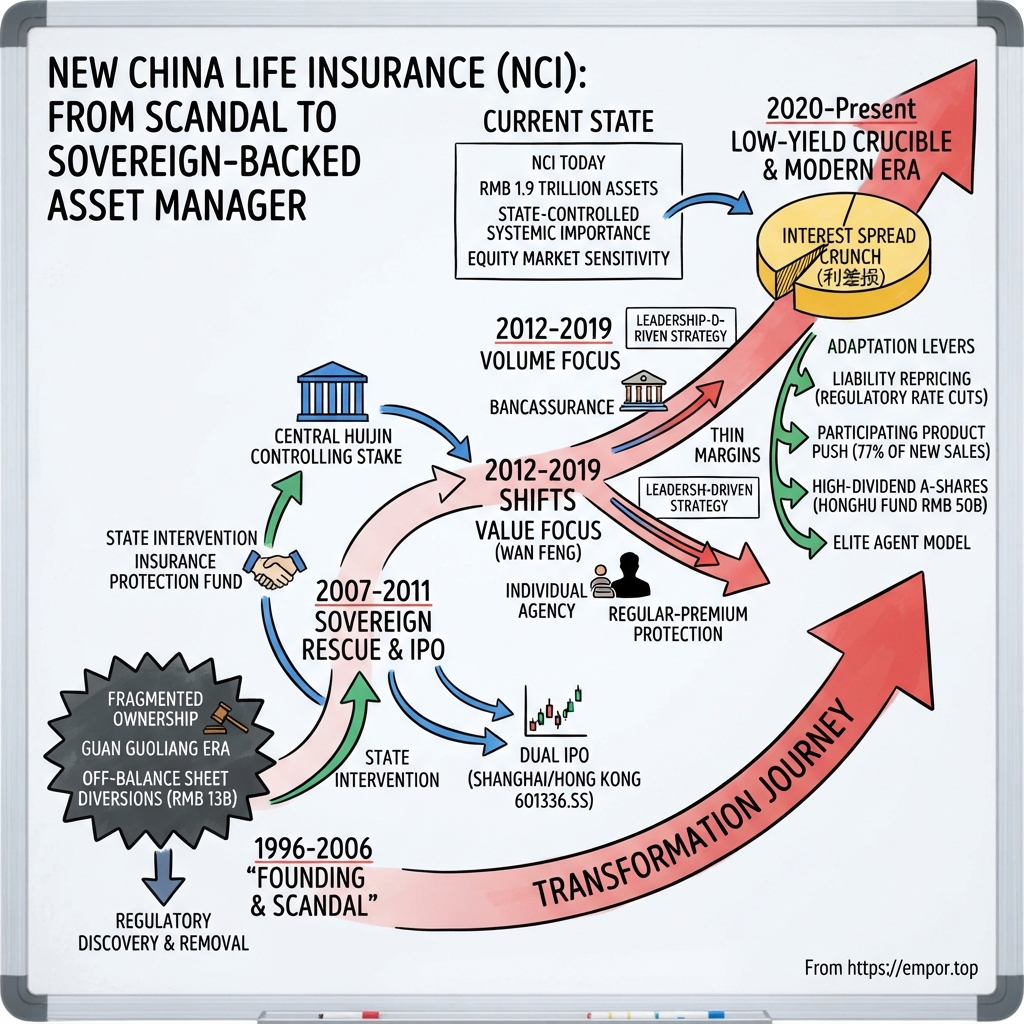
That transformation — from one of the largest corporate looting scandals in Chinese financial history to a state-controlled institution of systemic importance — forms the central spine of NCI's history. Beyond its past rescue, the essential question for investors is how the company adapts to its current operating environment.
Today, NCI sits at the convergence of four structural forces that will shape the profitability of Chinese life insurers over the next decade. Demographic aging is expanding demand for savings and protection products just as investment returns needed to support those commitments have compressed. Falling Chinese government bond yields have turned legacy guaranteed-rate policies — issued when returns of 3.5% or higher appeared conservative — into long-term balance sheet liabilities. Regulators have responded by lowering cap rates and enforcing product repricing across the industry. Meanwhile, NCI maintains higher equity market sensitivity than many of its large peers: its 2025 profit expansion was driven heavily by investment performance, posting a total investment yield of 6.6% and total investment income of RMB 104.33 billion, up nearly 31%.2
That concentration warrants careful examination. A life insurer reporting a return on equity of 34.69% in 2025 — a level rarely generated from underwriting alone — demonstrates how heavily earnings depend on market returns.2 NCI operates largely as a leveraged vehicle for Chinese financial assets wrapped in an insurance license, making asset price movements the critical variable in its valuation.
This analysis examines NCI's trajectory across eight key sections. First, the founding and scandal: how a fragmented private shareholder base in the 1990s created governance weaknesses that enabled off-balance-sheet diversions over eight years. Second, the state intervention and dual IPO — the transition from a troubled private insurer to a sovereign asset. Third, the strategic shifts between 2012 and 2019, when management moved aggressively into low-margin bancassurance before dramatically curtailing the channel under 万峰 Wan Feng. Fourth, financial mechanics: how Chinese life insurers generate income under IFRS 17 and why the 三差 ("three spreads") framework remains necessary to evaluate earnings quality. Fifth, the low-yield landscape — analyzing regulatory rate cuts, the 报行合一 commission-alignment policy, and the RMB 50 billion 鸿鹄志远 (Honghu) joint investment vehicle established with 中国人寿 China Life to buy high-dividend A-shares. Sixth, an evaluation of the current management team and its operational track record. Seventh, NCI's competitive positioning evaluated through a 7 Powers framework. Eighth, the bull and bear cases, alongside key operational metrics for ongoing monitoring.
Throughout this story, management assertions are evaluated against disclosed operational data and historical performance. While NCI's investor communications in 2025 and 2026 reflect management confidence, the company's structural history requires rigorous verification of its underlying earnings drivers.
 Subscribe on LinkedIn
II. The Founding & The Wild West Scandal (1996–2006)
In 1996, China's financial sector was undergoing rapid structural evolution. Eighteen years into economic reform, private wealth in coastal cities was accumulating faster than institutional capacity could manage, while life insurance penetration remained negligible. To introduce competition against state monoliths, regulators licensed a wave of new national joint-stock life insurers. NCI was established that year as part of this cohort.
Crucially, NCI differed fundamentally from state incumbents. While 中国人寿 China Life emerged directly from the state insurance apparatus with implicit government backing, NCI was built from a fragmented coalition of industrial enterprises, steel conglomerates, private entrepreneurs, and quasi-state entities, none of which held a controlling stake. On paper, this structure resembled healthy corporate diversification. In practice—within a developing market economy lacking established corporate governance precedents—it created an accountability void. No single shareholder took responsibility for oversight, assuming other equity holders were monitoring executive management.
关国亮 Guan Guoliang stepped directly into that governance void.
At the time, NCI's ownership structure represented a stark departure from market norms. The Chinese insurance sector in the late 1990s was split between two primary models. The first was the state-owned monolith, where capital, leadership appointments, and strategic priorities were dictated by government ministries. Though governed by bureaucratic rather than commercial discipline, this model maintained strict paper trails over fund movements. The second model, drawn from economic reform initiatives, was the joint-stock company—featuring multiple equity holders, a board of directors, and executive leadership, theoretically disciplined by private capital at risk.
That theory, however, presupposed institutional monitoring capabilities that China's emerging market lacked. A steel conglomerate holding a 12% stake in a life insurer was unequipped to staff internal teams capable of auditing actuarial reserves or off-balance-sheet guarantees. Equity holders attended board meetings, reviewed management presentations, and returned to their core operations. Multiplied across a fragmented investor base, the board functioned as a passive audience rather than an operational check.
The Man and the Method
Guan established dominant control over NCI during the late 1990s and served as chairman through 2006. His strategy focused aggressively on top-line growth, measuring success primarily through gross written premiums. NCI expanded rapidly through bancassurance, selling short-duration, savings-type products across commercial bank counters while simultaneously building an individual agency sales force across tier-one and tier-two cities. Premium volumes surged, elevating NCI's industry ranking.
Behind this operational expansion, Guan was running an unauthorized parallel treasury operation. Between 1998 and 2006, he bypassed board authority to divert roughly RMB 13 billion—equivalent to nearly $1.6 billion at contemporary exchange rates—out of company and policyholder reserves.[^1][^2] Rather than transferring funds into personal accounts, the capital was funneled into complex structures: unapproved real estate developments, private investment vehicles, unauthorized corporate guarantees issued under NCI's name, and financing vehicles designed to acquire NCI equity stakes for allied parties.
This circular mechanism elevated the diversion beyond standard financial fraud: policyholder capital was systematically deployed to consolidate equity control over the insurer holding those very reserves. Had the scheme succeeded, Guan's network would have converted policyholder premiums into permanent voting control of the institution. Such a closed loop was possible only because NCI's fragmented shareholder register allowed a modest equity block to tip corporate control.
The Mechanics of Not Getting Caught
The diversion of RMB 13 billion over an eight-year period persisted due to three structural features of China's early financial system.
First, the structural dynamics of insurance float created a persistent disguise. A life insurer collects premiums upfront against claims that mature over decades, creating a substantial duration gap between cash inflows and contractual liabilities. Unlike commercial banks, where capital shortfalls prompt immediate liquidity crises during depositor runs, life insurers can remain mark-to-market insolvent for extended periods while continuing to meet current obligations. In standard operating models, short-term cash flow acts as a natural audit mechanism: a retailer or manufacturer diverting working capital quickly faces operational distress. Insurance suspends that immediate feedback loop because fraudulent and healthy institutions display near-identical operating cash flows over long horizons. Consequently, detection depends entirely on rigorous balance sheet examination rather than monitoring cash flow statements.
Second, financial accounting standards at the time lacked detailed disclosure requirements for off-balance-sheet exposures, related-party lending, and third-party guarantees. Transactions omitted from consolidated balance sheets evaded standard audit verification procedures.
Third, regulatory supervisory capacity was still maturing. Established in 1998, the 中国保险监督管理委员会 China Insurance Regulatory Commission (CIRC) focused its initial years on establishing basic supervisory frameworks across a rapidly expanding sector. Comprehensive forensic audits of off-balance-sheet exposures at major national insurers were not yet part of routine regulatory oversight.
The Collapse
In late 2006, targeted CIRC examinations uncovered major irregularities: severe asset-liability mismatches unaccounted for by standard investment mandates, corporate guarantees lacking board authorization, and uncollateralized loans to non-viable counterparties. Guan was removed in December 2006.[^1] He was subsequently arrested and stood trial for embezzlement and misappropriation of funds.[^2]
The scandal escalated into a systemic crisis because of the nature of NCI's liability base. Unlike institutional bondholders capable of pricing credit risk, NCI's primary counterparties were millions of retail policyholders who viewed life insurance policies as secure savings vehicles. A default by NCI threatened to trigger a broader crisis of confidence across China's financial system.
NCI's founding era established the core governance framework under which the insurer operates today. The company's defining features—state equity ownership, Central Huijin Investment's controlling stake, heightened regulatory oversight, and an implicit sovereign backstop—were direct responses to the failures of the 1998–2006 period. State intervention was driven not by an ambition to run a commercial insurer, but by the systemic necessity of preventing institutional failure.
The scandal also reshaped China's insurance regulatory framework. Observing policyholder reserves diverted into unauthorized real estate developments instilled long-term regulatory skepticism toward insurer investments in illiquid, hard-to-value, or related-party assets. Modern Chinese insurance investment mandates—including stringent asset-class ceilings, concentration limits, and approval requirements—trace their origins directly to this period of intervention.
III. The State Rescue, Sovereign Pivot, & Dual IPO (2007–2011)
In May 2007, Chinese regulators took an unprecedented step by deploying the 中国保险保障基金 Insurance Protection Fund—the industry-funded backstop designed as a last line of defense for policyholders—to acquire a 38.8% controlling stake in NCI.[^5]
The intervention was a takeover rather than a conventional liquidity injection. Rather than extending loans, the Protection Fund assumed voting control, displacing the fragmented shareholder coalition whose passive oversight had permitted years of fund diversion. The regulatory signal to the sector was explicit: severe governance failures would result in equity expropriation rather than state recapitalization.
The urgency reflected broader systemic risks. In 2007, expansion across China's life insurance sector depended heavily on consumer confidence in long-duration financial commitments. A visible failure by a major national insurer risked undermining household trust in insurance products nationwide, creating systemic costs far exceeding the price of intervention. The Protection Fund's action effectively served to backstop institutional credibility across the broader industry.
Enter Central Huijin
Because the Protection Fund was not designed to operate commercial enterprises permanently, 中央汇金投资有限责任公司 Central Huijin Investment Ltd.—the domestic financial-holdings subsidiary of 中国投资有限责任公司 China Investment Corporation—agreed in November 2009 to acquire the 38.8% stake.[^6]
While structured as a technical equity transfer, the acquisition fundamentally transformed NCI's institutional standing. As the primary vehicle for state equity holdings in China's major state-owned commercial banks, Central Huijin's entry reclassified NCI from a troubled private company under temporary restructuring into a core state financial asset.
This sovereign ownership structure imposes dual mandates. State-controlled financial institutions are expected to operate profitably on commercial terms, while also serving as instruments of macroeconomic stability and policy execution. When state authorities seek long-term institutional capital to stabilize equity markets, finance infrastructure at controlled spreads, or absorb distressed assets, state-backed entities are positioned to respond.
For NCI, this reclassification created immediate commercial advantages. For Chinese households committing to 30-year savings policies, sovereign backstopping provides a powerful trust signal that private competitors cannot easily match. It also lowers effective funding costs and grants privileged access to sovereign bond placements and policy-aligned investment programs.
However, sovereign alignment also introduces structural constraints. As a state-controlled asset, NCI cannot evaluate risk and return entirely in isolation when policy directives require capital deployment into broader financial markets. Subsequent sections return to this dynamic in detail when evaluating the Honghu joint investment fund, a prominent example of sovereign mandates shaping NCI's investment portfolio.
Kang Dian and the Cleanup
To lead NCI's operational cleanup, 康典 Kang Dian assumed the chairmanship in 2009. Drawing on an investment banking background rather than traditional insurance management, Kang focused initially not on premium growth, but on audit verification: assessing balance sheet holdings, resolving Guan-era litigation, and constructing corporate governance frameworks required for an institutional listing.
The restructuring required significant loss recognition, including provisions against legacy non-performing real estate assets, the cancellation of unauthorized guarantees, and the implementation of internal control procedures capable of withstanding international audit standards. It also necessitated a cultural shift to establish process discipline across an organization accustomed to centralized off-balance-sheet decision-making.
Two aspects of this restructuring continue to influence NCI's operations. First, asset provisioning had to meet the due diligence requirements of international IPO underwriters, forcing rigorous transparency into the balance sheet cleanup. Second, the risk-management architecture implemented under regulatory supervision established structured investment controls that persist today—maintaining disciplined formal processes even when portfolio allocations lean toward aggressive equity strategies.
December 2011: The Dual Listing
In December 2011, NCI executed simultaneous initial public offerings on the Shanghai and Hong Kong stock exchanges, raising approximately $1.9 billion.3
The listing took place amid difficult market conditions driven by the European sovereign debt crisis and weak demand for Chinese financial equities. Management proceeded with the offerings because the dual listing served a strategic governance purpose: subjecting NCI to dual regulatory regimes, international institutional disclosure requirements, and continuous public market scrutiny in Hong Kong. For an institution previously defined by opaque governance, the public listing anchored its commitment to transparency.
The IPO established NCI as the fourth listed A-share life insurer, alongside China Life, 中国平安 Ping An, and 中国太保 CPIC. This scale positioned NCI as a major national carrier, though smaller than the industry's market-defining leaders.
The sovereign restructuring successfully stabilized NCI and established a durable trust advantage. However, state control did not automatically translate into operational excellence. While Central Huijin provided stability and institutional legitimacy, NCI's subsequent strategic execution proved less consistent, as examined in the following section.
IV. Strategic Evolution: From Volume Chasing to High-Quality Protection (2012–2019)
Following its 2011 dual listing, NCI expanded aggressively through commercial bank counters. In bank branches across China in 2013, tellers routinely offered single-premium savings products: a customer deposited a lump sum, received a guaranteed return over a few years, and gained minimal mortality coverage. To the policyholder, it functioned as a higher-yielding deposit substitute. To the bank, it generated immediate fee income. To NCI, it expanded gross written premiums.
Yet for NCI's long-term economic value, single-premium bancassurance generated negligible return.
Why Bancassurance Volume Is Not Value
Evaluating Chinese life insurers requires distinguishing top-line premium growth from value creation.
An insurer's profit on a policy represents the present value of future cash inflows minus expected claims and expenses. On a single-premium savings product sold through a bank, the insurer collects one upfront payment, pays a substantial bank commission, guarantees the customer a return rate, and must invest the capital at a yield exceeding that guarantee plus operational expenses. The resulting profit margin is the narrow spread between investment yield and guaranteed payout. If asset yields fall, that spread contracts or turns negative.
Single-premium bancassurance presents a structural vulnerability beyond low initial margins. Because these products compete directly with bank deposits and wealth management products, their pricing is set by prevailing market rates rather than what the insurer can afford to pay. The insurer becomes a price taker on liability costs in its highest-volume channel. In a falling-rate environment where asset yields decline faster than competing deposit rates — typical for insurers reinvesting long-duration bond portfolios at lower yields — margins face a double squeeze.
By contrast, a ten-year regular-premium critical illness policy sold by an individual agent delivers fundamentally different economics. The policyholder pays premiums annually for a decade. The insurer earns across three distinct sources: investment spreads, favorable underwriting margins (the gap between actual and priced claims), and expense efficiencies. Once underwritten, the policy is difficult for the policyholder to replace as health risks age.
Regular-premium policies also mitigate duration and reinvestment risk. Rather than locking the insurer into deploying a single large lump sum at current market rates against a fixed lifetime guarantee, regular-premium products generate annual cash inflows that can be invested at future yields.
The industry measures long-term value creation through 新业务价值 Value of New Business (VNB) — the present value of expected future profits from policies written during a given period. While two insurers can report identical gross written premium growth, their underlying VNB creation can diverge sharply depending on product mix. Post-IPO NCI's heavy reliance on single-premium bancassurance delivered strong premium headlines, but thin VNB margins.
The Wan Feng Pivot
In 2016, 万峰 Wan Feng assumed the chairmanship of NCI after serving as president of China Life, where he had managed the industry's largest agency sales force.
Wan Feng launched a strategy termed 回归本源 ("return to the origin"), focusing on margin expansion rather than premium volume. NCI deliberately curtailed its single-premium bancassurance business, foregoing high-volume, low-margin revenues to reallocate capital into higher-value protection products.
The shift produced an immediate drop in reported top-line premiums, requiring management to defend a contracting revenue headline to public equity investors while the strategic benefits accumulated in less visible VNB metrics. Wan Feng's industry credibility and the long-term horizon of NCI's controlling shareholder, Central Huijin, provided the institutional runway needed to sustain the shift.
Capital freed from bancassurance was redirected into recruiting, training, and supporting individual agents selling multi-year, regular-premium health and critical illness policies (重疾险). Long-term health products carried substantially higher VNB margins than single-premium savings products, significantly expanding NCI's blended profit margin.
Then It Didn't Hold
Despite initial margin gains, the strategic pivot faced operational and structural limitations.
First, the agent model NCI expanded relied on high turnover and rapid recruitment. During the 2010s, Chinese life insurers expanded agency headcount rapidly, relying on new hires to sell policies to immediate family and personal networks. Once those networks were exhausted, agent productivity plummeted and drop-out rates surged.
As recruitment slowed across the sector, agent numbers contracted sharply. Across China's five listed life insurers, agency headcount declined for consecutive years. At NCI, the individual agency force shrank to roughly 133,000 agents by mid-2025 — a small fraction of its peak size.45 At the same time, critical illness penetration reached saturation among urban middle-class households, reducing the addressable customer base for high-margin protection policies.
Second, the strategic focus on high-margin protection products did not persist after Wan Feng's departure in 2019. Following his exit, NCI resumed aggressive growth in bancassurance channels. By 2025, first-year long-term bancassurance premiums were highlighted in financial reporting as major growth achievements.6
NCI's shift highlights a key takeaway for investors: channel strategy has historically reflected the priorities of individual leadership rather than an entrenched institutional framework. NCI maintained its value-over-volume strategy for roughly three years before reverting to volume-driven growth under subsequent management.
Whether NCI can maintain margin discipline across leadership cycles remains an open question for investors monitoring its current distribution mix and participating-policy push.
V. Financial Mechanics & Segment Anatomy: How New China Life Makes Money
Strip away the accounting, and a life insurer operates two core businesses simultaneously.
The first is underwriting: pricing risk, collecting premiums, paying claims, and retaining the underwriting margin. The second is asset management: investing the policyholder float that accumulates between premium receipt and future claims. NCI held over RMB 1.9 trillion of investment assets as of mid-2026.6
While investment returns drive profitability across China's insurance sector, NCI's reliance on asset management results has become particularly pronounced.
The Four Channels
NCI operates across four primary distribution and operating channels:
Individual agency (个险渠道) remains the primary value engine. It distributes complex, long-duration, higher-margin products—such as whole life, annuities, critical illness, and increasingly participating policies—that require direct agent interaction. In the first half of 2026, individual channel premiums reached RMB 82.22 billion, up 13.4%, and management reported per-agent productivity up 31.7% with roughly 20,000 net new agents added.6 The combination of headcount stabilization and rising productivity offers initial operational evidence that NCI's "elite agent" (精兵战略) model is producing tangible results after years of contractive agent turnover.
Bancassurance (银保渠道) serves as the volume and asset-gathering channel. While bank distribution scales rapidly with lower operational overhead, it yields thinner profit margins. First-year long-term premiums through banks hit RMB 14.65 billion in H1 2026, up 32% and described by the company as a record.6
Group insurance (团险渠道) provides corporate life, medical, and accident cover. While offering sticky enterprise relationships and strategic client access, group insurance operates on modest margins and represents a minor portion of overall value creation.
Asset management operates through 新华资产管理股份有限公司 New China Asset Management Co., Ltd., which manages internal insurance reserves alongside third-party mandates.
The asset management subsidiary plays a critical role in NCI's financial structure. For a carrier whose reported earnings are dominated by investment results, the internal asset manager functions not as an ancillary fee-generating business, but as the core engine of corporate earnings. Unlike independent fund managers focused strictly on risk-adjusted returns, New China Asset Management operates under strict liability-matching constraints. It must manage asset duration, liquidity requirements, and accounting classifications against a massive, long-duration liability portfolio with legacy guaranteed return commitments.
The Three Spreads
To evaluate profitability, Chinese life insurers use the 三差 ("three spreads") framework:
Interest spread (利差) measures net investment yield earned on assets relative to guaranteed rates owed to policyholders—functioning as the insurance equivalent of a bank's net interest margin over a multi-decade horizon. It represents both the primary profit driver and the central balance sheet risk for Chinese life carriers.
Mortality and morbidity spread (死差) reflects the difference between projected and actual claim payouts. When underwriting claims for critical illness or mortality fall below priced assumptions, the resulting difference generates underwriting profit. This represents the purest insurance earnings stream, offering steady but modest contributions relative to investment spreads.
Expense spread (费差) captures the difference between budgeted policy acquisition costs and actual operating expenses. Historically, aggressive commission competition across China's insurance market frequently drove expense spreads into negative territory.
NCI's net profit expansion in 2025 was driven primarily by investment performance rather than underwriting or expense gains. It came from investment income of RMB 104.33 billion at a 6.6% total yield — a year in which Chinese equity markets performed well.2 Return on equity of 34.69% is not an insurance number.2 It reflects capital market performance.
This dynamic highlights NCI's dual identity as both an insurer and a leveraged asset manager operating with a captive policyholder funding base. During buoyant equity markets, investment returns dominate the income statement. Conversely, during market downturns, underlying insurance economics—liability funding costs, claim trends, and expense discipline—re-emerge as the primary determinants of performance. Evaluating NCI strictly during strong investment years risks overestimating its baseline earning power across a full market cycle.
What IFRS 17 Changed, In Plain Terms
Under IFRS 17 accounting standards, reporting frameworks isolate insurance liabilities and investment fluctuations to reflect underlying economic performance. Three core metrics define this evaluation:
Contractual Service Margin (契约服务边际 / CSM) represents unearned profit held on the balance sheet and recognized in income over the coverage duration. Functioning similarly to deferred revenue in subscription models, newly written profitable contracts accumulate in the CSM and amortize gradually over decades. CSM serves as a key measure of pre-contracted future earnings independent of annual market volatility. Investors should review full annual report disclosures for detailed CSM balances, as brief earnings summaries often omit this item.
Embedded Value (内涵价值 / EV) measures adjusted net asset value plus the present value of expected profits from in-force policies. NCI's EV reached RMB 287.84 billion at end-2025, up 11.4%.2 Because EV calculations rely on long-term investment yield assumptions, the metric must be analyzed alongside realized market yields.
Value of New Business (新业务价值 / VNB) reflects the present value of future profits generated from policies underwritten during the reporting period. In 2025 NCI's VNB was RMB 9.84 billion, up 57.4%, with margin on first-year premium of 16.2%, up 1.5 percentage points.27 In H1 2026, VNB grew 11.9% to approximately RMB 6.92 billion.6
Two key operational insights emerge from these figures. First, VNB growth decelerated markedly from 57.4% in 2025 to 11.9% in the first half of 2026. While high prior-year base effects played a role, the magnitude of the step-down indicates that 2025 growth rates should not be extrapolated. Second, a 16.2% VNB margin remains modest in absolute terms, reflecting a product mix still heavily weighted toward savings-type products rather than high-margin protection policies. NCI is currently expanding VNB primarily through channel volume rather than structural product margin expansion.
Additionally, embedded value metrics require scrutiny regarding baseline economic assumptions. EV is an actuarial projection dependent on long-term expectations for investment yields, discount rates, lapse behavior, and mortality. If actual long-term asset yields fall below model assumptions, in-force policy valuations become overstated—an effect that compounds over multi-decade policy horizons. Sensitivity disclosures in annual filings provide the necessary framework to assess how lower rate environments impact reported EV figures.
NCI's financial engine remains a broad savings and protection distribution franchise attached to an investment portfolio that heavily dictates reported net income. While effective during market upturns, this model leaves reported profitability vulnerable to earnings contractions whenever capital markets soften—setting up the low-yield landscape examined next.
VI. The Low-Yield Crucible & Asset-Liability Management (2020–Present)
The structural challenge facing Chinese life insurers can be summarized simply: decades ago, carriers promised policyholders guaranteed returns of 3.5% or more per year for life, but the risk-free assets available to back those commitments no longer yield anywhere near that level.
That dynamic is 利差损 — negative interest spread — and it is not a theoretical risk, but the defining structural condition of the industry today.
The Japan Precedent
In the 1990s, Japanese life insurers held vast portfolios of policies written with guaranteed rates of 5% or higher, issued when Japanese government bond yields supported those promises. When interest rates collapsed toward zero, insurers were unable to escape those contractual commitments, while reinvestment yields fell relentlessly below guaranteed liability costs. Several Japanese life insurers failed as a result.
The parallel to China is imperfect. Chinese insurers maintain different asset mixes, regulators intervened earlier in the cycle, and domestic demographic and savings dynamics differ. Yet the underlying mechanism is identical: long-duration fixed liabilities funded by shorter-duration assets in a falling-rate environment. Executives across the Chinese insurance sector know the Japanese precedent well, which explains the speed and scale of the regulatory intervention in China.
A defining structural distinction sets the Chinese and Japanese experiences apart. In China's favor, regulators acted while the problem was still accumulating rather than after it had crystallized, lowering permitted guarantee caps in stages rather than waiting for institutional insolvencies. Japanese guarantees had already been locked in at unsustainable levels before authorities intervened. Against China, domestic insurers have responded to yield compression by pushing further out the risk curve into equities — exchanging a pure duration-and-guarantee risk for a duration-and-guarantee exposure partially hedged with equity beta. Japanese insurers largely lacked that option at comparable scale.
The Regulator Repricing an Industry
The 国家金融监督管理总局 National Financial Regulatory Administration (NFRA), which absorbed CIRC's regulatory mandate, targeted liability costs directly. The cap on guaranteed rates for traditional life products was lowered from 3.5% to 3.0%, and subsequently to 2.5%, with lower caps imposed on participating and universal products.8
From a Western market perspective, this regulatory intervention was extraordinary. Rather than relying on non-binding supervisory guidance on prudent pricing, the NFRA administratively reduced the return an entire industry could offer its customers, effectively repricing a national savings product by decree. That authority represents a distinct structural feature of the Chinese insurance market, enabling regulators to lower industry liability costs in a manner impossible in competitive market economies.
The corollary, however, is that regulatory authority can also be exercised in ways less favorable to carriers. An authority capable of reducing guaranteed rates can equally mandate product features, cap surrender charges, require enhanced disclosures, or raise capital requirements. NCI's shareholders benefit when regulatory mandates curb funding costs, but remain exposed when policy directives impose operational burdens. As a policy taker in both directions, NCI's recent profitability has benefited from regulatory actions that happened to align with insurer economics.
The regulatory rate cuts forced a major product mix shift toward 分红险 participating insurance. Under participating policies, policyholders receive a lower guaranteed base rate alongside a variable dividend tied to actual investment performance, improving insurer economics by shifting a portion of investment risk to the policyholder.
This transition marks the most significant product shift in Chinese life insurance in a generation, and NCI has pursued it aggressively. President 龚兴峰 Gong Xingfeng described the company's 2025 participating push — which generated RMB 12 billion in first-year participating premiums following its second-quarter launch — as "difficult to come by" after years of minimal focus on the category. By the fourth quarter of 2025, participating policies represented 77.0% of regular-premium new business.79
That 77% concentration represents a dramatic shift, though it carries operational nuances management rarely highlights. Transferring investment risk to policyholders relies on customer acceptance over time. Although participating dividends are contractually variable, policyholder expectations, sales practices, and reputational pressures create a practical floor. If investment returns falter, cutting participating dividends sharply risks triggering policy surrenders and damaging distribution channels. The risk transfer is genuine, but softer than product terms suggest, and it remains untested through a prolonged market downturn at this scale.
报行合一: Killing the Commission Arms Race
The NFRA's second major intervention targeted the expense spread. 报行合一 — the mandatory alignment of filed and actual expenses — requires that commissions paid to distributors match the expense assumptions filed with regulators when pricing products.
This policy eliminated a ruinous distribution arms race. Bank branches represent scarce distribution real estate, and insurers historically competed for shelf space by offering banks escalating commissions, rebates, and off-book fees that exceeded filed assumptions. While carriers recognized the negative economics, no single insurer could unilaterally curtail payments without sacrificing market share. By eliminating the ability to offer unfiled incentives, the regulator resolved the prisoner's dilemma, driving down bancassurance acquisition costs across the industry.
For NCI, this regulatory enforcement was structurally favorable. The company expanded bancassurance first-year premiums strongly in 2025 and 2026, benefiting from lower distribution costs on higher volumes to deliver genuine margin expansion.67
The policy also altered competitive dynamics. When commission payouts dictated bank shelf space, institutions with aggressive risk appetites and deep capital reserves held an advantage. With commissions capped at filed rates, commercial banks must allocate shelf space based on product competitiveness, brand reputation, service quality, and institutional relationships — criteria that favor established, state-backed national carriers like NCI. While NCI's bancassurance expansion in the post-报行合一 environment aligns with this shift, isolating the policy's impact from broader household savings flows remains difficult based on public disclosures.
However, framing 报行合一 as a proprietary competitive moat overstates its effect. Lower commission expenses benefit the entire industry rather than any single carrier. If anything, the policy provides a larger relative benefit to insurers with weaker banking relationships by neutralizing competitors' ability to buy distribution access. The accurate interpretation is that 报行合一 improved baseline industry economics, allowing NCI — given its heavy reliance on bancassurance relative to agency-focused peers — to capture a proportionate share of the benefit.
The Honghu Fund and Patient Capital
In late 2023, NCI and China Life established the 鸿鹄志远 Honghu private equity investment fund with RMB 50 billion in capital to invest in listed A-share equities — targeting high-dividend, large-cap companies across banking, telecommunications, and utility sectors.[^14]
The investment rationale is straightforward. When state bank dividend yields exceed thirty-year government bond yields, stable equity holdings offer a logical asset match for long-duration liabilities. The structure also delivers accounting benefits: classifying holdings as long-term equity investments or at fair value through other comprehensive income shields the income statement from mark-to-market volatility under IFRS 17.
At NCI's 2025 annual results briefing, management announced that three phases of these long-term investment pilot funds with China Life had deployed RMB 46.25 billion in cumulative capital since March 2024.9 Chairman 杨玉成 Yang Yucheng characterized the initiative as transforming "long-term capital, patient capital into high-level strategic capital."9
That framing warrants analytical scrutiny. "Patient capital" can serve as a favorable description for illiquid positions that cannot be rapidly unwound. The Honghu structure serves three distinct roles simultaneously: a duration-matching asset strategy, an accounting volatility buffer, and a state-aligned vehicle to deploy insurance capital into domestic equity markets. The critical question for investors is how NCI will navigate potential conflicts between these objectives if policy directives encourage equity purchases when risk-adjusted commercial returns are unappealing. Given its state ownership structure, NCI possesses limited latitude to decline sovereign mandates.
Concentration and correlation risks also demand attention. High-dividend A-share blue chips are heavily concentrated in state-owned banks, telecommunications firms, utilities, and energy producers — sectors closely tied to state policy and macro conditions. A large portfolio allocated across these sectors does not provide true economic diversification; it represents a concentrated bet on Chinese state-linked corporate earnings and dividend policies. Should these enterprises ever reduce dividend payouts to absorb credit losses, support policy initiatives, or preserve capital, the dividend yield underpinning NCI's strategy would compress when the insurer needs it most.
NCI's 2025 financial performance illustrated the upside of this positioning, with total investment yield reaching 6.6% during a favorable A-share market.2 The downside, however, is a matter of clear arithmetic during equity downturns.
Separately, NCI has reduced its exposure to Chinese property developer debt and equity while taking impairments on legacy holdings — a prudent adjustment given sector conditions. However, granular disclosure regarding residual exposures to real estate, trust products, and local government financing vehicles remains limited.
In total, NCI has addressed low-yield pressures through appropriate operational levers: repricing liabilities, expanding participating products, and allocating capital toward high-dividend equities. These measures mitigate balance sheet risk on new business. However, they do little to alleviate the drag from the legacy policy book written at guaranteed rates of 3.5% or higher, which must be run off over time. That legacy liability burden cannot be eliminated through strategic pivots, making the duration and cost of the in-force book a far more decisive factor in long-term performance than new product design alone.
VII. Modern Management, Governance, & Capital Allocation
A review of NCI's leadership timeline highlights a defining governance issue: frequent executive turnover. Guan Guoliang led until 2006, Kang Dian took over in 2009, and Wan Feng served from 2016 to 2019, followed by additional management transitions leading to 杨玉成 Yang Yucheng, who was appointed in 2023 amid a broader leadership shakeup across China's insurance sector.[^15]
For an enterprise whose insurance liabilities span decades and whose strategic initiatives require years to materialize in financial performance, this turnover rate represents a fundamental governance vulnerability. It also reinforces the reality that NCI's strategic direction has historically depended heavily on individual chairmen rather than institutional continuity.
Frequent leadership rotation is common across large Chinese state-controlled financial institutions, where executive appointments reflect broader state and regulatory staffing priorities alongside commercial performance. While this is an industry-wide characteristic rather than an isolated defect at NCI, the operational consequences remain: an insurer whose strategic priorities shift with each new chairman presents greater long-term underwriting risk than one guided by institutionalized strategy.
Yang Yucheng and Gong Xingfeng
Yang joined NCI from the securities industry after serving as a senior executive at Shenwan Hongyuan. Bringing a capital-markets background rather than traditional insurance operational experience—mirroring Kang Dian's earlier appointment—his selection signaled Central Huijin's preference for leadership skilled in investment strategy at an institution where earnings are heavily driven by capital market performance.
龚兴峰 Gong Xingfeng assumed the presidency in 2024 following a long internal career as chief actuary and chief financial officer. This division of responsibilities couples a market-oriented chairman managing assets with a career actuary overseeing liabilities—a practical alignment for an insurer focused on asset-liability duration matching. Gong's internal continuity also provides operational stability that helps offset executive turnover at the board level.
On operational execution, recent performance shows improvement over the prior decade. NCI completed the IFRS 17 accounting transition smoothly, responded promptly to 报行合一 expense-alignment mandates, and launched its participating-product pivot in the second quarter of 2025. By the fourth quarter of that year, participating policies represented 77.0% of new regular-premium business—an unusually rapid distribution shift for a carrier redirecting its sales force toward a previously minor product line.79
Management has explicitly committed to maintaining the individual agency force alongside bancassurance expansion. At the 2025 results briefing, executives asserted that the role of individual agents as NCI's core channel "has never changed, is not changing now, and will not change in the future."9 Results from the first half of 2026 offer empirical support for that commitment, showing 20,000 net agent additions, a 31.7% increase in per-agent productivity, and a 13.4% gain in individual channel premiums.6
However, two analytical qualifications temper this progress. First, productivity gains require careful context. A 31.7% surge in average per-agent output following years of agency contraction can reflect basic mathematical survivor bias—the departure of lower-performing agents raises average metrics even if individual efficiency remains unchanged. The net addition of approximately 20,000 agents alongside rising output in early 2026 is a positive signal, as simultaneous headcount expansion and productivity growth are harder to generate through simple attrition.6 Still, a single six-month reporting period does not establish a permanent trend.
Second, the rapid push into participating insurance occurred during a favorable market environment. Marketing policies featuring lower guaranteed base returns alongside variable dividends is relatively easy when investment returns perform strongly, as they did during NCI's 6.6% total investment yield year in 2025.2 The true stress test for this product strategy will occur when lower investment yields reduce credited dividends, forcing agents to manage policyholder expectations against legacy fixed-rate alternatives.
Ownership and What It Means
Central Huijin holds approximately 31.34% of NCI as its controlling shareholder, while 中国宝武钢铁集团 China Baowu Steel Group serves as the second-largest equity holder at roughly 12%.10 Together, state-aligned entities control over 43% of voting shares, eliminating any prospect of a contested change in control.
For institutional public investors, this capital structure highlights a clear governance constraint: minority shareholders possess virtually no mechanism to influence strategic decisions, board composition, or capital allocation. Takeover bids, proxy contests, and activist campaigns cannot be deployed to discipline management. Minority shareholders rely instead on the state's institutional incentive to maintain a stable, solvent, and investable financial carrier—an alignment that supports system stability, but does not always prioritize short-term equity valuations.
Capital Returns
NCI's dividend trajectory provides tangible evidence of capital distribution priorities. The company declared a full-year 2025 dividend of RMB 2.73 per share, up 7.9%, marking twelve consecutive years of shareholder distributions.2 In the first half of 2026, NCI declared an interim dividend of RMB 0.73 per share, totaling approximately RMB 2.28 billion—a 9% year-over-year increase and the third consecutive year of interim dividend distributions alongside annual payouts.6
Establishing and increasing an interim dividend over three consecutive years signals an intentional effort to construct a predictable payout profile for equity investors, creating a dividend structure that is harder to scale back than one-off distributions.
However, a key analytical caveat remains: payouts supported by a 34.69% return on equity driven primarily by buoyant capital markets reflect earnings that cannot be consistently replicated across market cycles.2 The central question for investors is not whether current earnings cover immediate dividends, but how capital returns will hold up when investment yields revert toward 3% rather than remaining at 6.6%.
Solvency
NCI's core solvency margin ratio stood at 135.11% at the end of 2025, an increase of 11.04 percentage points year over year.2 This leaves the insurer comfortably above regulatory minimums under C-ROSS Phase II (偿二代二期). Investors evaluating total balance sheet strength should confirm the comprehensive solvency ratio directly from company disclosures. Because solvency ratios at NCI declined in earlier periods, the 2025 improvement represents a balance sheet recovery rather than an established trend.5
Ultimately, current management has executed effectively on key operational targets, supported by disclosed operational metrics. What remains unproven is whether this performance can endure across future leadership changes or through a prolonged period of weak market returns—tests that will determine NCI's long-term investment profile.
VIII. Industry Structure, Competitive Benchmarking, & 7 Powers Analysis
China's life insurance sector functions as an oligopoly dominated by a top tier of five major carriers. 中国人寿 China Life leads the market with an 18% to 20% share, anchored by a vast agency force and deep penetration into rural counties where private competitors lack distribution. 中国平安 Ping An Insurance holds 14% to 16%, combining a highly productive agency force with a broader health and technology ecosystem. 中国太保 CPIC commands 9% to 10% through a balanced agency and bancassurance distribution model, while NCI holds roughly 6% to 7% of the market, positioned just ahead of 中国人保 PICC Life at 5% to 6%.
Within this competitive cohort, NCI is distinguished by two primary characteristics. First, it operates as a relative pure-play life insurer without a large property-and-casualty subsidiary or banking unit to diversify revenue streams. Second, it exposes its earnings more directly to capital market movements than its peers, making its reported net profit the most volatile among China's top five carriers.
Porter's Five Forces
Rivalry: intense but structurally bounded. Chinese life insurers compete for retail policyholders through the same primary agency and bancassurance channels. Product differentiation remains limited because regulators set cap rates and dictate contract terms. However, competitive intensity is constrained by regulatory intervention. In particular, the 报行合一 commission-alignment mandate curtailed destructive commission bidding among carriers, effectively placing a regulatory cap on price competition across distribution networks.
Buyer power: minimal individually, powerful in aggregate. Individual retail policyholders exercise no pricing leverage over carriers. Collectively, however, Chinese households determine industry premium volume through asset allocation decisions across bank deposits, wealth management products, and insurance savings vehicles. As bank deposit yields decline, guaranteed insurance products gain relative appeal—generating an industry-wide tailwind driven by macroeconomic trends rather than firm-level operational differentiation.
Supplier power: concentrated among commercial banks. Bank branch networks represent scarce distribution infrastructure. Commercial banks historically extracted economic surplus by demanding escalating distribution commissions from insurers. Strict enforcement of 报行合一 has reduced bank bargaining power, shifting economic value back toward insurance carriers in a significant structural realignment of distribution costs.
Threat of new entrants: negligible. Strict licensing oversight, stringent capital solvency requirements under C-ROSS Phase II (偿二代二期), and the capital required to build a national agency or bancassurance network make new entrant scale impractical.
Substitutes: the primary competitive pressure. Bank deposits, wealth management products, mutual funds, and residential real estate historically competed for Chinese household savings. The downturn in property markets and falling bank deposit rates have directed household capital toward insurance products. While this shift currently benefits NCI, it reflects a cyclical macroeconomic trend rather than a permanent competitive moat.
This substitution dynamic represents the single largest driver of Chinese life insurance premium growth. For two decades, residential real estate served as the primary wealth store for Chinese households, supplemented by bank deposits and wealth management products. As residential property yields weakened, bank deposit rates fell, and regulatory reforms eliminated implicit principal guarantees on wealth management products, retail capital migrated toward insurance savings vehicles offering explicit contractual guarantees backed by state-controlled institutions. This trend has provided a strong demand tailwind across the sector, driving NCI's premium growth. However, because this capital inflow stems from external macroeconomic conditions rather than product innovation, a reversal in interest rate trends or a resurgence in alternative asset yields could redirect household savings away from life insurance regardless of carrier execution.
7 Powers, Tested
Cornered resource: sovereign ownership. Controlling equity ownership by Central Huijin provides an institutional trust advantage that private competitors cannot replicate. However, this advantage is shared with state-owned peers China Life and PICC Life, both of which operate with larger balance sheets. Sovereign backing provides a meaningful edge against private insurers, but represents baseline table stakes among top-tier state-backed carriers. Furthermore, sovereign control entails policy alignment costs, as demonstrated by capital deployment into joint state-backed equity funds like Honghu. Verdict: genuine but non-exclusive advantage, accompanied by policy obligations.
Switching costs: high for policyholders. Long-duration life insurance policies impose substantial financial and health barriers to exit. Policyholders face early surrender penalties, while aging or changes in health status prevent replacing legacy coverage on comparable terms. Operational disclosures substantiate this lock-in effect: at the end of 2025, NCI reported a 13-month persistency rate of 97.1% and a 25-month persistency rate of 93.3%, while its surrender rate fell 0.4 percentage points to 1.5%.2 These metrics confirm high policyholder retention. However, strong persistency on legacy policies carrying guaranteed return rates of 3.5% or higher presents a double-edged sword: policyholders retaining the highest guaranteed rates are the least likely to lapse, prolonging balance sheet liabilities during low-yield cycles. Verdict: high and empirically validated, though economically burdensome on legacy guarantees.
Scale economies: moderate. Managing RMB 1.9 trillion in investment assets provides NCI with operating leverage, fixed-cost absorption, and preferential access to sovereign bond allocations and institutional private placements. However, as the fourth- or fifth-largest carrier by market share, NCI enjoys scale advantages relative to smaller regional insurers while operating at a material scale deficit compared to China Life and Ping An. Verdict: moderate scale advantage relative to smaller peers, but a relative scale disadvantage against market leaders.
Process power: limited durability. Actuarial capabilities and asset-liability management controls developed under President Gong Xingfeng are reflected in NCI's rapid transition toward participating products. However, true process power requires proprietary operational mechanisms that competitors cannot easily copy. Given the frequent mobility of actuarial, investment, and executive talent across China's major state insurance carriers, process advantages remain difficult to institutionalize permanently. Verdict: weak as a durable competitive power.
Branding: neutral. NCI maintains high brand awareness across national markets. However, because regulatory caps standardize insurance product pricing and guarantee structures, brand recognition does not translate into premium pricing power or superior underwriting margins. Verdict: lacks pricing power in a strictly regulated product environment.
Network economies and counter-positioning: absent. Life insurance policies carry no network externalities, as product value to individual policyholders is independent of total customer volume. Furthermore, NCI operates a conventional industry distribution model, lacking counter-positioned business structures that incumbents cannot replicate.
The comparison with Ping An provides the most instructive competitive benchmark. Over the past decade, Ping An deployed substantial capital to establish structural powers unavailable to traditional life insurers, constructing a health and senior-care ecosystem to generate switching costs and network effects beyond standard policy contracts. By integrating medical services, health management, and elder care into core insurance offerings, Ping An sought to increase customer exit costs. While market analysts debate whether return on invested capital has justified this ecosystem strategy, the initiative underscores a fundamental industry reality: in a market defined by regulated product terms and capped guarantee rates, standard life insurance contracts alone do not generate sustainable competitive moats. NCI has avoided capital-intensive ecosystem investments, reducing execution complexity while leaving the company dependent on traditional distribution channels without structural product differentiation.
In summary, NCI's defensible competitive advantages consist of policyholder switching costs on its in-force book and the trust premium associated with Central Huijin's sovereign ownership. While these factors protect NCI's existing market position, they do not deliver superior premium growth or outsized returns relative to state-owned peers that command identical sovereign backing and comparable policy persistency. NCI remains structurally secure but competitively unexceptional within China's top tier—meaning the long-term investment case relies far more on valuation discipline, capital returns, and investment portfolio management than on durable competitive differentiation.
IX. Investment Story Spine, Risk Radar, & Bear vs. Bull Case
Myth vs. Reality
Myth: NCI's 2025 earnings surge demonstrates a business transformation. Reality: It demonstrates a strong A-share market meeting a large equity allocation. Net profit rose 38.3% and return on equity reached 34.69%, driven by total investment income up 30.9% at a 6.6% yield.2 Underwriting performance also improved, with the value-of-new-business margin expanding 1.5 percentage points to 16.2%, but reported net profit remains fundamentally driven by capital markets.2 Extrapolating 2025 profitability assumes a continuous bull run in equity returns.
Myth: Participating products resolve the negative interest spread. Reality: Participating policies address interest rate risk on new business, subject to the practical constraint that policyholder dividend expectations are difficult to reduce during market downturns. They do not alter the legacy portfolio written at guaranteed rates of 3.5% or higher, which must run off over decades. Reaching a 77.0% participating share of fourth-quarter 2025 new business represents a tactical fix applied at the margin of a massive pre-existing liability base.7
Myth: State controlling ownership guarantees positive shareholder returns. Reality: Sovereign ownership guarantees institutional survival, not equity outperformance. State alignment and commercial shareholder returns can diverge, as demonstrated by capital commitments to policy-aligned investment vehicles such as the Honghu fund.
Risk Radar
Prolonged low interest rates (利差损). Negative interest spread remains the primary structural risk. If Chinese government bond yields remain depressed, reinvestment yields on the fixed-income portfolio will steadily decline toward legacy liability costs. The mechanism is gradual but relentless: maturing higher-yielding bonds are replaced with lower-yielding assets while fixed policy guarantees endure. No operational strategy can eliminate this drag on the in-force book.
Equity market dependence. To offset lower bond yields, NCI increased its equity market exposure, trading duration risk for capital market volatility. Under IFRS 17, weak equity market performance directly compresses reported earnings, while long-term allocations like the Honghu fund positions cannot be rapidly liquidated.
Agency transformation execution. Although first-half 2026 productivity figures show improvement, NCI's "elite agent" model remains unproven across a full market cycle, and the broader industry's agent headcount contraction has not definitively ended.46
Asset quality transparency. Residual credit exposure to property developers, trust products, and local government financing vehicles poses ongoing valuation risks. Although NCI has recognized impairments, limited disclosure granularity prevents independent sizing of remaining risk exposures.
Regulatory mandates. The regulator that reduced guaranteed rate caps retains broad administrative authority to adjust capital requirements, alter product rules, or direct institutional capital deployment. NCI operates as a policy taker under state controlling ownership.
Governance and minority representation. With state-aligned entities controlling over 43% of voting shares, minority equity holders lack formal mechanisms to influence strategic direction, board appointments, or capital allocation.
The Activist Stress Test
An institutional investor examining NCI's balance sheet and operational disclosures would focus on five key disclosure gaps.
First, earnings quality requires clear decomposition. A carrier reporting a 34.69% return on equity driven by capital market gains alongside a 16.2% VNB margin on new business leaves normalized underlying earnings unclear.2 Second, the Honghu structure—combining long-term holding classifications, concentrated state-sector equity exposure, and a joint investment framework with market leader China Life—warrants clearer disclosure regarding valuation methodologies and exit flexibility. Third, evaluating the duration of low-yield headwinds requires detailed disclosures on the average guaranteed cost and runoff schedule of the legacy liability book. Fourth, assessing asset quality requires granular data on remaining carrying values and impairment methodologies for real estate, trust, and local government financing vehicle exposures. Fifth, board composition and executive succession reflect a broader governance reality: minority shareholders lack mechanisms to enforce management accountability.
Identifying these areas highlights where corporate disclosure remains thinnest relative to underlying balance sheet risks.
The Bear Case
NCI functions as a leveraged vehicle for Chinese financial assets wrapped in an insurance license. Reported profitability in 2025 was driven by capital market gains that cannot be reliably replicated, while an underlying VNB margin of 16.2% reflects a lower-margin savings mix rather than high-margin protection products.2 Legacy guaranteed-rate liabilities represent a multi-decade balance sheet drag. The company's strategic history demonstrates executive turnover and directional shifts—exemplified by the value-over-volume pivot under Wan Feng that was later reversed—indicating that current participating-product discipline may not persist across future leadership cycles.9 Competitively, NCI operates with less scale than China Life, lower agent productivity than Ping An, and shares its sovereign backing with both. Minority shareholders face inherent governance constraints. Furthermore, momentum is moderating: VNB growth decelerated from 57.4% in 2025 to 11.9% in the first half of 2026.26
The Bull Case
Chinese household wealth is migrating from real estate and low-yielding bank deposits into guaranteed and participating insurance products, positioning NCI as a direct beneficiary. In 2025, NCI expanded gross written premiums by 14.9% and first-year long-term premiums by 48.9%.7 Regulatory mandates have improved industry economics: lower guaranteed caps reduce long-term liability costs, while 报行合一 enforcement has curtailed bancassurance commission competition. The strategic shift into participating products transfers investment risk to policyholders, while the high-dividend equity strategy provides a logical asset-liability match for long-duration liabilities. Operationally, the individual agency channel shows initial productivity gains alongside high customer retention, evidenced by a 97.1% 13-month persistency rate and a falling surrender rate.26 Finally, capital return discipline is improving, marked by twelve consecutive years of dividend payouts and three consecutive years of interim dividend distributions.26
Weighing It
The bull and bear cases are not symmetrical. The bull case relies significantly on external macroeconomic and regulatory conditions—household asset reallocation, lowered liability caps, and favorable capital markets—that benefit the broader sector rather than reflecting firm-specific competitive moats. Conversely, the bear case centers on durable structural factors: legacy liability funding costs, earnings volatility tied to equity markets, executive turnover, and a scale deficit against larger state peers.
This structural reality does not make NCI an unviable institution, but it establishes that earnings and shareholder returns will be determined primarily by capital market cycles and entry valuations rather than proprietary operational differentiation. Investors evaluating NCI should distinguish between short-term market tailwinds and long-term structural transformation.
X. Essential Investor KPIs & Guidance for Downstream Writers
Three key operational metrics provide the clearest indication of whether NCI's strategic shift is generating durable economic value.
First, Value of New Business growth and VNB margin. VNB remains the definitive measure of whether NCI is underwriting profitable contracts or merely accumulating top-line volume. Premium expansion without corresponding VNB growth would signal a repeat of the insurer's post-IPO bancassurance missteps. The critical dynamic to monitor is whether VNB margins widen as the participating product portfolio matures, or whether participating policies — which offer lower guaranteed yields but thinner underlying margins — cap overall profitability in the mid-teens. The sharp deceleration from 57.4% VNB growth in 2025 to 11.9% in the first half of 2026 makes this margin trajectory the central operational question over coming reporting periods.26
Second, total and net investment yield (总/净投资收益率). Because capital market returns dominate NCI's reported net profit, investment performance acts as the primary earnings engine. Net investment yield — measuring recurring interest and dividend income — provides a more reliable indicator of structural earning power than total yield, as it excludes mark-to-market swings and realized capital gains. The spread between net investment yield and the average guaranteed cost of the in-force policy book measures true interest spread (利差损) risk, making it an essential balance sheet metric to track across market cycles.
Third, CSM balance and release. Under IFRS 17, the Contractual Service Margin represents the balance sheet stock of unearned future profits. An expanding CSM confirms that the underwriting business is accumulating long-term earnings power, whereas a contracting balance indicates that new policy origination is failing to replace amortized profits. Given the inherent volatility of NCI's investment portfolio, CSM tracking offers the clearest view into the core insurance franchise stripped of capital market noise.
For analysts evaluating NCI's ongoing trajectory, comprehensive annual and interim reports serve as indispensable reference materials, as summary earnings releases omit detailed CSM breakdowns. The 2025 annual results briefing in March 2026 and the August 2026 interim results represent the key recent management communications.69 Five specific operational areas warrant ongoing scrutiny:
- The average guaranteed cost and multi-decade runoff schedule of the in-force liability book.
- The operational mechanisms for adjusting participating policyholder dividends if investment yields decline.
- The accounting classifications, mark-to-market treatments, and exit flexibility associated with the Honghu equity investments.
- The exact sizing, carrying values, and impairment methodologies applied to residual real estate, trust product, and local government financing vehicle exposures.
- Whether individual agency productivity gains reflect sustainable operational improvement or a compositional artifact of shedding low-producing agents.
References
-
New China Life Insurance Company Ltd. 2025 Annual Results Announcement — New China Life Insurance, 2026-03-27 ↩↩
-
New China Life 2025 slides: record profits clash with Q4 miss — Investing.com, 2026-03-27 ↩↩↩↩↩↩↩↩↩↩↩↩↩↩↩↩↩↩↩↩↩
-
New China Life Raises $1.9 Billion in Dual Hong Kong and Shanghai IPO — Reuters, 2011-12-09 ↩
-
30周年之际交出历史最佳成绩单!新华保险发布2026年中期业绩 — 新浪财经, 2026-08-27 ↩↩↩↩↩↩↩↩↩↩↩↩↩↩↩
-
National Financial Regulatory Administration Official Circulars — NFRA ↩
-
直击业绩会|新华保险杨玉成:把耐心资本转化成高能级战略资本 — 21世纪经济报道, 2026-03-31 ↩↩↩↩↩↩↩
-
Individual Investors Account for 38% of New China Life Insurance Company Ltd.'s (SHSE:601336) Ownership, While Sovereign Wealth Funds Account for 31% — Moomoo / Simply Wall St ↩
 LinkedIn
 WhatsApp
 Reddit
 Hacker News
 Email
Email Kindle
 RSS Feed
 Spotify
 Apple Podcasts
 Amazon Music
 Audible
 YouTube